Israel Campaigns Against Global Free Speech
The Bilzerian Report | February 20, 2014
Alarmed at the rise of anti-Semitism and anti-Israeli sentiments on the internet, Israeli politicians recently called for nations around the world to enact legislation prohibiting criticism of Jews and Israel. Lobbying to outlaw global free speech is nothing new for Israel, however; it has been in the business of criminalizing speech for decades.
 Israel is in the precarious position of receiving tens of billions of dollars in aid every year from nations that purport to support democracy, while simultaneously oppressing the Palestinian people and perpetrating what Nobel Peace Prize winners Bishop Desmond Tutu and President Jimmy Carter deem an apartheid. If the American or European people ever knew that their tax dollars where being used in such a way they would surely cut Israel off. In order to conceal this truth and stifle any criticism, Israel and its lobbyists rely on sympathy from the Holocaust and labels of anti-Semitism to discredit critics. Even US Secretary of State John Kerry was recently called an anti-Semite for supporting a peaceful resolution to the Jewish/Palestinian conflict. Kerry is not alone however, President Obama, and just about anyone who has ever opposed an Israeli policy has been labeled anti-Semitic by his enemies. In order to add teeth to these labels, Israel lobbyists around the world lobby endlessly to criminalize anti-Semitism and Holocaust denial.
Israel’s threat of forcing world governments to enact new laws against free speech should not be taken lightly. Israel and its lobbyists have already succeeded in enacting stiff anti-racist laws in most Western countries. These laws have been used on numerous occasions to jail academics, pro-Palestinian activists, and also individuals who have spoken provable facts that are deemed anti-Semitic “canards.”
In Australia, Jewish groups lobbied successfully to outlaw holocaust study and “hate speech.” As with most laws regulating speech and academic study, it has been routinely abused, and is now on the list for repeal. In fact, the law is so tied to Jewish lobbying, that the Jewish newspaper Haaretz published an article: Australian Jews brace for a fight against the repeal of hate laws.
In Canada, Jewish groups lobbied for the enactment of hate speech regulation, and defend its use today. In 1983, Israel lobbyists filed a complaint against Ernst Zundal over a book he had written. He was tried several times, his citizenship application in Canada denied (even though he had resided there for decades), he was detained for two years without trial, and eventually deported to Germany where he was sentenced to 5 years imprisonment.
In France, Israel lobbyists publicly complained about comedian Dieudonne’s parodies of Israel and the holocaust. His home was raided, his shows banned, and hefty fines were imposed. England also followed suit and barred Dieudonne’s entrance into the country. In 2003, the French legislator and Israel lobbyist Pierre Lellouche managed to push through a law which extends the definition of discrimination to include nationalities so anti-Israel activists could be jailed. In 2009, the Lellouche law was used to convict 20 anti-Israel activists.
In England, Jewish lobbying efforts successfully enacted strict hate speech laws, and in Austria, acclaimed historian David Irving was incarcerated after Israel lobbyists complained about his academic work. The European Jewish Parliament and the chief Israel lobbyist in Belgium recently called for similar laws to stifle criticism of Israel. According to the Canadian Jewish News article French Vigilance on anti-Israel speech provoking backlash, Israel lobbyists are also attempting to enact similar legislation in the Netherlands.
In America, the Israel lobby has been fighting mightily for years to prohibit hate speech. Those efforts have been unsuccessful thus far, but they have managed to enact hate crime legislation. As Abe Foxman of the ADL noted, the social consequences in America for bigotry against Jews are so severe, (given disproportionate Jewish influence in government, media, finance, higher education, professional sports, etc…) that anti-Israel speakers often see graver consequences than the criminal sanctions they would face in Europe. For example, if one were to be labeled an “anti-Semite,” even if the allegations were wholly unsubstantiated, he would most likely be fired and ostracized from society.
One has to realize that Israel’s efforts having nothing to do with hate speech, anti-Semitism or holocaust denial, but are rather about stifling critical speech that affects Israel and its lobbyists. For example, we know that Israel and its lobbyists are not offended by holocaust denial because Israel and its lobbyists are the leading proponents of Armenian holocaust denial in the world today. Israel should also not be particularly offended by anti-Semitism, because Israel is actually one of the most racist and anti-Semitic nations on the planet.
Today, Israel is furiously enacting anti-free speech laws, hiring internet trolls to spread propaganda and disinformation, and even asking the Jewish owners of social media websites Facebook, Wikipedia, Google, and Youtube to remove material Israel does not like, regardless of its truth or merit. Israel has also campaigned against political parties it does not like in Greece, Hungary, and Ukraine. In Greece, the anti-Israel Golden Dawn Party was disbanded and its leaders arrested for no legal reason. This is a dangerous precedent that threatens world wide freedom and must be combated immediately, before speaking out against such Israeli efforts is also illegal.
Laws protecting free speech are put in place specifically to protect speech that powerful groups find objectionable. Otherwise, there is no free speech and it is just a matter of time before the list of prohibited phrases grows to include everything the powerful oppose. If it’s illegal to speak about certain races, the disabled or elderly, then why not government employees, and then the rich, or poor, and so on? Either speech is totally protected or it is not protected at all. The point of speech protection is to protect the most unpopular forms of speech. Popular forms of speech obviously need no protection.
Premature reporting tarnishes IAEA image: Iran
Press TV – November 14, 2014
A senior Iranian nuclear official has criticized the International Atomic Energy Agency (IAEA) for releasing its reports prematurely, warning that the move will tarnish the image of the UN nuclear agency.
“The IAEA reports should be submitted confidentially before they are finalized; therefore, the premature release [of reports] in the media will undermine its (IAEA’s) credibility,” said Behrouz Kamalvandi, the spokesman for the Atomic Energy Organization of Iran (AEOI), in a Friday interview.
He pointed to the correction of the IAEA’s latest report on Iran’s nuclear activities, saying, “It has not been the IAEA’s first mistake and if the present trend continues, it seems it would not be the last one either.”
On Thursday, the IAEA corrected its previous estimate of the size of Tehran’s low-enriched uranium stockpile, saying it is 8,290 kg.
This is while the agency had announced last week that Iran’s stockpile of low-enriched uranium had increased by 625 kg to around 8.4 tons since the IAEA’s September report, estimating the stock to be nearly 8,390 kg.
Kamalvandi noted that the IAEA’s final report on a country can be officially released only after it is discussed at the Board of Governors by the member states and the respective country.
“The release of these reports at certain websites linked to Western countries has been politically-motivated and aimed at influencing the process of [nuclear] talks [between Iran and P5+1 group of countries]…,” the AEOI spokesman pointed out.
The size of Tehran’s uranium stockpile is one of the moot points in the nuclear negotiations between Iran and the P5+1 group of world powers.
The IAEA correction came two days after top officials from Iran and the P5+1 group — the US, Britain, France, Russia, China and Germany – wrapped up talks over Iran’s nuclear program in the Omani capital city of Muscat on Tuesday.
The next round of nuclear talks between Iran and the world powers is set to be held in the Austrian capital, Vienna, on November 18-24.
Lockheed Used Taxpayer Money to Lobby for more Taxpayer Money
By Noel Brinkerhoff | AllGov | November 15, 2014
In the world of federal contracting, it takes taxpayer dollars to win more taxpayer dollars, or at least that’s how Lockheed Martin sees things.
Lockheed Martin for years has been running one of the government’s most important nuclear research facilities, Sandia National Laboratories. Five years ago, its lucrative contract with the Department of Energy (DOE) was coming to an end, so Lockheed Martin started to lobby officials to win an extension.
That lobbying included using some of the money paid by DOE for Lockheed Martin to run Sandia. Under federal law, this is a big no-no. Contractors are explicitly forbidden from using taxpayer money to lobby for more contracting work. But Lockheed Martin did it anyway, claiming they were just trying to better inform DOE managers when it came time to decide whether to give them another contract. The company hired a firm run by former Republican Congresswoman Heather Wilson to make its case.
“This is, after all, how Washington usually functions,” R. Jeffrey Smith wrote at the Center for Public Integrity.
The Energy Department’s inspector general, Gregory Friedman, said in a report (pdf) that Lockheed Martin broke the rules. He called the company’s actions “highly problematic” and “impermissible.”
Lockheed Martin did get a new deal, but it was for two years and $7.7 billion. It had sought a longer extension to keep running Sandia.
To Learn More:
Alleged Attempts by Sandia National Laboratories to Influence Congress and Federal Officials on a Contract Extension (Department of Energy Inspector General) (pdf)
Nuclear Weapons Lab Used Taxpayer Funds To Obtain More Taxpayer Funds (by R. Jeffrey Smith, Center for Public Integrity)
IG: Energy Contractor and Ex-Lawmaker Lobbied Officials for No-Bid Contract Worth $2.4 Billion Per Year (by Josh Hicks, Washington Post )
Violence in Iraq Means Profits for Beechcraft, Lockheed, Raytheon and other Weapons Makers (by Steve Straehley, AllGov )
Penguins, Polar Bears and Sea Ice
Jim Steele
View:
Part 1 Climate Sensitivity and Drought: Landscape Changes vs CO2
Part 2 Droughts and Heatwaves: Ocean Oscillations vs CO2
Part 3 Recovering Whales, Ocean Acidification, and Climate Horror Stories
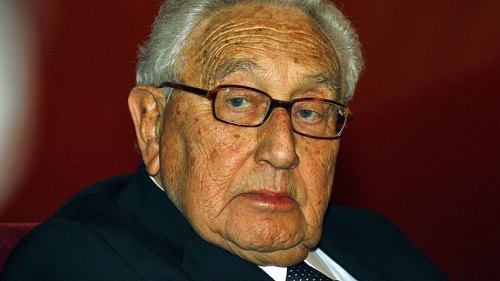
When Henry Kissinger Makes Sense
By Robert Parry | Consortium News | November 12, 2014
The American public is faced with an information crisis as the New York Times and other mainstream U.S. media outlets have become little more than propaganda organs on behalf of the neoconservative agenda and particularly the rush into a new Cold War with Russia – so much so that even ex-Secretary of State Henry Kissinger has broken ranks.
MSM articles consistently reek of bias – and in some cases make little sense. For instance, Times correspondent David M. Herszenhorn, one of the leading propagandists, wrote an alarmist story on Wednesday about a new Russian “invasion” of Ukraine but curiously he had the alleged Russian tank column heading east toward the Ukrainian city of Donetsk which would be back toward Russia, not westward into Ukraine.
According to Herszenhorn’s article, “The full scope of the Russian incursion is not clear, [NATO Supreme Commander Gen. Philip M. Breedlove] said, though the convoys seemed to be heading east toward Donetsk, an O.S.C.E. spokesman, Michael Bociurkiw, said Wednesday.”
Typical of his anti-Russian bias, Herszenhorn also cited Ukrainian government complaints that the Russians had been using a shaky cease-fire to bolster the ethnic Russian rebels in the east, but the reality is that both sides have been accusing the other of such maneuvering. Herszenhorn surely knows this but he wrote only:
“Ukrainian officials have complained all along that Russia was taking advantage of the so-called truce to reinforce the rebels in eastern Ukraine with more fighters and equipment.”
The reality is that there has been widespread alarm among eastern Ukrainians that the Kiev regime was using the relative lull in the fighting to resupply and reposition its forces for a new offensive like the one that killed thousands over the summer. Though human rights organizations have criticized Kiev for indiscriminate shelling of cities and unleashing brutal militia forces on the population, the Times and other mainstream U.S. newspapers have either ignored or downplayed such facts.
On Wednesday, Herszenhorn also compared the alleged new Russian incursion with the “invasion” of Crimea, although there really was no “invasion” of Crimea since the Russian troops that were involved in supporting Crimea’s popular referendum to secede from Ukraine and rejoin Russia were already in Crimea under an agreement with the Ukrainian government regarding the Russian naval base at Sebastopol.
Herszenhorn’s use of the word “invasion” is just an exaggeration like the rest of the imbalanced reporting that has made a rational U.S. public response to the crisis in Ukraine nearly impossible.
Since the start of the crisis in February, the New York Times’ coverage has been remarkable in its refusal to present the Ukraine story in anything like an objective fashion. For example, the Times has largely ignored the substantial public evidence that U.S. government officials and agents helped orchestrate the Feb. 22 coup which overthrew the elected President Viktor Yanukovych. [See Consortiumnews.com’s “The Whys Behind the Ukraine Crisis.”]
The Times also has buried evidence that extreme right-wing and neo-Nazi elements played key roles in firebombing police, forcing Yanukovych and other government officials to flee for their lives, and spearheading later attacks on ethnic Russians. When this reality is referenced, it is usually presented with little meaningful context or tacked on in the last few paragraphs of long articles on other topics.
Mocking Medvedev
Herszenhorn himself has been a leading violator of journalistic standards. For instance, in mid-April, early on in the crisis, he penned a mocking story from Moscow ridiculing Russian Prime Minister Dmitri Medvedev for predicting a possible civil war.
In the article entitled “Russia Is Quick To Bend Truth About Ukraine,” Herszenhorn accused Medvedev of posting an item on Facebook that “was bleak and full of dread,” including noting that “blood has been spilled in Ukraine again” and adding that “the threat of civil war looms.”
Herszenhorn continued, “He [Medvedev] pleaded with Ukrainians to decide their own future ‘without usurpers, nationalists and bandits, without tanks or armored vehicles – and without secret visits by the C.I.A. director.’ And so began another day of bluster and hyperbole, of the misinformation, exaggerations, conspiracy theories, overheated rhetoric and, occasionally, outright lies about the political crisis in Ukraine that have emanated from the highest echelons of the Kremlin and reverberated on state-controlled Russian television, hour after hour, day after day, week after week.”
This argumentative “news” story spilled from the front page to the top half of an inside page, but Herszenhorn never managed to mention that there was nothing false in what Medvedev wrote. Indeed, as the bloodshed soon grew worse and escalated into a civil war, you might say Medvedev was tragically prescient.
It was also the much-maligned Russian press that first reported the secret visit of CIA Director John Brennan to Kiev. Though the White House later confirmed that report, Herszenhorn still cited Medvedev’s reference to it in the context of “misinformation” and “conspiracy theories.” Nowhere in the long article did the Times inform its readers that, yes, the CIA director did make a secret visit to Ukraine.
In this upside-down world of MSM disinformation, there has been very little criticism of the glaring biases of the mainstream Western media but instead continued attacks on the professionalism of the Russian media, including an adverse finding this week by an official British agency that monitors alleged bias in news outlets operating in the UK. The agency, known as Ofcom, accused Russia’s RT network of failing to meet standards for “due impartiality” in early Ukraine coverage.
Interestingly, Ofcom did not judge any of the RT reports false in their description of neo-Nazi thugs participating in the Feb. 22 coup, a possible role of coup-related snipers in the slaughter of scores of people at the Maidan, and the unconstitutionality of the new government.
But Ofcom faulted RT for not meeting the fuzzy concept of “due impartiality” and threatened regulatory sanctions against RT if it didn’t shape up. Ofcom defined “due impartiality” as “impartiality adequate or appropriate to the subject and nature of the programme.”
The image of a British regulatory body threatening RT with sanctions for not toeing the pro-Western propaganda line that nearly all UK and U.S. news outlets do has an Orwellian feel to it, singling out one of the few sources of news that doesn’t accept the prevailing “group think.”
It would be one thing if the same standards were applied to Western media outlets for their one-sided reporting on Ukraine, but that apparently would ruffle too many important feathers.
Kissinger’s Dissent
Curiously, one of the few prominent Westerners who has dared question the prevailing wisdom on Ukraine is former Secretary of State Henry Kissinger who said, in an interview with the German newsmagazine Der Spiegel, that the West was exaggerating the significance of the Crimean annexation given the peninsula’s long historic ties to Russia.
“The annexation of the Crimea was no bid for world domination,” the 91-year-old Kissinger said. “It is not to be compared with Hitler’s invasion in Czechoslovakia” – as former Secretary of State Hillary Clinton and others have done.
Kissinger noted that Russian President Vladimir Putin had no intention of instigating a crisis in Ukraine: “Putin had [spent] tens of billions of dollars for the Olympic Winter Games … in Sochi. Russia wanted to present [itself] as a progressive nation. … It does not make sense that Putin, a week later, [launches] the Crimea attacks and a war for Ukraine begins.”
Instead Kissinger argued that the West – with its strategy of pulling Ukraine into the orbit of the European Union – was responsible for the crisis by failing to understand Russian sensitivity over Ukraine and making the “fatal” mistake of quickly pushing the confrontation beyond dialogue.
But Kissinger also faulted Putin for his reaction to the crisis. “I do not want to say that Russia’s response was appropriate,” Kissinger said.
Still, Kissinger told Der Spiegel that “a new edition of the Cold War would be a tragedy. … We must keep in view, that we need Russia to solve other crises, such as the nuclear conflict with Iran or Syria’s civil war.”
When Henry Kissinger starts to sound like the voice of reason, it says a lot about how crazy the New York Times and the rest of the MSM have become.
~
Investigative reporter Robert Parry broke many of the Iran-Contra stories for The Associated Press and Newsweek in the 1980s. You can buy his new book, America’s Stolen Narrative, either in print here or as an e-book (from Amazon and barnesandnoble.com).
US words on Gitmo torture ‘laughable’ without release of force feeding tapes
Reprieve | November 13, 2014
The US has announced that it will this week tell the United Nations that it now considers a ban against torture to apply to US prisoners held overseas – including those 148 men held without charge or trial at Guantanamo Bay. The US had previously only considered the U.N. Convention Against Torture to apply within US borders.
A US Federal Judge recently ordered the US government to release to the public video tapes of a hunger striking detainee being force-fed and manhandled, a decision the Obama administration is expected to appeal.
Commenting, Reprieve staff attorney Alka Pradhan, said:
“For the US to say it has ‘banned’ torture at Guantanamo is laughable, given the ongoing abuse at the prison. The rules at GTMO are actually written precisely to allow such abuse, and the video footage of force feedings is incredibly disturbing. Our clients, on hunger strike in peaceful protest at their indefinite detention without charge, are regularly hauled to what they call the ‘torture chair’, and force-fed in such a painful, punitive manner that even some camp personnel refuse to be involved. But don’t take my word for it – US medical experts and the World Medical Association have also condemned these abuses. The US needs to uphold its supposed ‘torture ban’ and stop punishing the detainees for their rightful protest – while the tapes I have seen should be released to the public without delay.”
Obama and the Convention Against Torture
By Steve Breyman | CounterPunch | November 13, 2014

US and ARVN soldiers waterboard a North Vietnamese prisoner during Operation Wheeler in 1967
On November 12—thirteen years after the onset of George W. Bush’s dirty underground war against “unlawful combatants”—the Obama administration finally told the United Nations Committee Against Torture that the United States believed, in the words of Assistant Secretary of State Tom Malinowski, “that torture, cruel, inhuman and degrading treatment and punishment are forbidden in all places, at all times, with no exceptions.” Finally! Not so fast.
Torture is as old as human civilization. Assyrians skinned victims alive. Torture was a routine feature of Greek and Roman interrogations. Execution by torture took the form of crucifixion for the Romans, stoning for the Jews, and desert sun death for the Egyptians. Chinese emperors preferred lingchi—the slow slicing—of their prisoners (the infamous “death by a thousand cuts”). The Aztecs favored blood sacrifices that included consumption of the hearts of their victims.
Torture was not the sole preserve of heathens and idolators. The Dominicans, endlessly inventive in the torture of “heretics” and “witches” in Spain, made sexual humiliation of victims their trademark. John Calvin had a fellow early Protestant tortured and beheaded. Guy Fawkes spent time on the rack following his capture during the Gunpowder Plot.
As with slavery and the mass execution of hostages, torture slowly, fitfully came to be seen as barbaric and ineffective, although it took over two millennia for official if hypocritical and imperfect bans to appear. The British outlawed “cruel and unusual” punishment in the Bill of Rights of 1689; the prohibition protected Britons only as American, Boer, Irish, Indian, and Iraqi patriots knew well. The Americans included a similar ban in the Eighth Amendment to their Constitution—which applied only to citizens, not slaves or Natives. And lynching did not of course end following the Reconstruction Amendments. Napoleon forbade the use of torture by his armies in 1798, history forgotten by French troops in Algeria a century and a half later. Pius VII waited until 1816 to overturn the papal bull of 1252 permitting torture during the Inquisition. The Chinese outlawed lingchi in 1905 (which did not stop Nationalists and Communists from torturing one another before and during the Civil War).
The horrors of the twentieth century’s two world wars led to the Universal Declaration of Human Rights (1948) and to the Geneva Conventions of 1949, which effectively (in the legal sense of the word) banned torture of civilians or military personnel. That these icons of international law weren’t effective in reality became abundantly clear during the counter-insurgencies waged by the United States and European imperial powers resistant to decolonization of the Third World from the late forties through the mid-seventies. They were joined by the secret police of the Soviet bloc controlling Eastern European dependencies. They were joined too by the secret police and armed forces of dozens of Arab monarchies, and Latin American, African and Asian (military) dictatorships. Torture during the Cold War knew no ideological or territorial boundaries.
The United States and the Soviet Union masterfully outsourced and offshored torture during their decades long rivalry. Vast empires run by remote brutes require burden sharing with local brutes. The Soviets trained East Germans, Hungarians, Czechs, Bulgarians, Romanians, and Poles in the dark arts. As Chomsky and Herman detailed in The Washington Connection and Third World Fascism (1979), Americans trained military and police in twenty-six countries that according to Amnesty International practiced torture. These included Iran, Saudi Arabia, Indonesia, Turkey and Brazil.
The Pentagon cast further light on the postwar American way of torture with the release of seven “intelligence training” manuals in 1996. Written and perfected by the CIA during spasms of concentrated violence like Operation Phoenix in South Vietnam, the manuals were widely distributed by the US Agency for International Development (USAID), and put into practice by Special Forces Mobile Training Teams. US Special Forces are today present (mostly on training missions) in more than one hundred countries, including Iraq and Afghanistan. The US Army’s School of the Americas crafted a custom manual for Central and Latin American trainees.
By the eighties, amidst the bloody interventions of the Reagan administration and the brutal Soviet occupation of Afghanistan, the world was ready to make another effort at outlawing torture. The United Nations Convention Against Torture and Other Cruel, Inhuman and Degrading Treatment or Punishment was adopted in 1984, entered into force in 1987, signed by Ronald Reagan in 1988, and ratified by Congress during Bill Clinton’s first term in 1994. The US—with the largest prison population in the world—failed to ratify the Optional Protocol to the Convention (adopted in 2002; entered into force in 2006) that provides for regular, unannounced visits to prisons and detention centers, and for private interviews with detainees.
Barak Obama first criticized the Bush record on torture following revelations that emerged from the Senate confirmation hearings of Alberto Gonzalez as Attorney General in 2005. Gonzalez claimed that the provisions of the Convention Against Torture did not govern official US behavior against “aliens” overseas. Obama was a strong rhetorical supporter of the legislation reaffirming official US condemnation of torture that passed the following year (to which George Bush added a signing statement permitting the CIA to continue should the Commander in Chief deem it necessary).
On his second day in office, Obama issued Executive Order 13491—“Ensuring Lawful Interrogations”—to revoke Bush’s Executive Order 13440 of 2007 (designed to further ‘legalize’ CIA detention and “interrogation” of al Qaeda and Taliban “unlawful enemy combatants” after the fact; Bush’s lawyers first invented the category of “unlawful enemy combatant” in 2002). The long international nightmare of official US endorsement of torture—brought to life in the shameful corridors of Guantanamo, Abu Ghraib, Bagram, and the CIA’s “black sites”—appeared over. Not even close.
The Convention on Torture, other international treaties, and domestic law require the president to investigate allegations of torture, and to prosecute those responsible. Obama has, contrary to the law, shown zero interest in pursuing Bush, Cheney, Rumsfeld, Rice or the other enablers and defenders of criminal behavior in the country’s name; “we need to look forward as opposed to looking backwards.” There’s been no full-scale public inquiry into or publication of the various torture memos written by John Woo, or other records of official lawlessness. Neither have we witnessed a reckoning by the Obama Justice Department with the illegal and outrageous practice of extraordinary rendition.
The White House (with the CIA looking over its shoulder) holds up publication of a five hundred page executive summary of the Senate’s 6300 page report on the CIA’s “enhanced interrogation” program. Chances are that what finally squirts out will be so blacked out as to further shield the evildoers.
Indefinite detentions in Guantanamo likely violate the Convention; the failure to offer redress to detainees certainly does. US military commissions violate at least two articles of the Convention. US refusal to grant independent monitors access to Guantanamo violates at least two articles of the Convention. Transfer of prisoners to countries known to practice torture (common during the Bush years) clearly violates the Convention. Hyper-aggressive domestic counter-terror investigations (especially the widespread use of sting operations by the FBI) appear to violate “human rights safeguards in law and practice.”
“Special housing units,” supermax cells, and other forms of solitary confinement of domestic prisoners, including children, clearly constitute torture, cruel, inhuman or degrading treatment or punishment. On any given day, more than 80,000 people are held in isolation in US federal and state prisons. Capital punishment appears to most civilized peoples as torture, cruel, inhuman or degrading treatment or punishment. Continued US failure to put in place adequate safeguards against sexual assault in state and federal prisons violates the Convention.
Local police departments’ failure to pursue allegations of sexual assault (the most underreported crime in the country) violates victims’ right to be free from mistreatment. The epidemic of police killings, brutality, racial profiling, and asset seizures is among the most egregious violations of the Convention during the Obama years. The policy of deporting immigrants (including especially unaccompanied children) without proper screening to assess their prospects for torture or mistreatment violates the Convention, and deserves a special place in the annals of perfidy.
When George Bush declared “we don’t torture,” the world knew it was a lie. What about when Nobel Peace Prize winner Barak Obama says it?
Steve Breyman is a former William C. Foster Visiting Scholar Fellow in the US State Department. Reach him at breyms@rpi.edu
Moscow slams NATO’s accusations of invasion in Ukraine as groundless
RT | November 12, 2014
Russia has denied NATO claims that its army has crossed into eastern Ukraine in the past few days, calling them groundless, the Defense Ministry said.
“We have stopped paying attention to the groundless accusations made by NATO’s Supreme Allied Commander in Europe, US General Philip Breedlove, of the ‘observed’ Russian military columns allegedly invading Ukraine,” said Defense Ministry official representative, General-Major Igor Konashenkov on Wednesday.
He gave a reminder of earlier and similar NATO claims, which have not been backed by any evidence.
“[We have] repeatedly stressed that there was and is no evidence supporting Brussels’ regular trumpeting over the alleged presence of Russian forces in Ukraine,” Konashenkov said.
NATO: ‘Russian troops in Ukraine – but we have no good picture’
Earlier on Wednesday, General Breedlove declared that NATO had “seen” the Russian army crossing the Ukraine border.
“Across the last two days we have seen the same thing that OSCE is reporting. We have seen columns of Russian equipment, primarily Russian tanks, Russian artillery, Russian air defense systems and Russian combat troops entering into Ukraine,” Breedlove told journalists in Sofia.
Although he added that NATO does not “have a good picture at this time of how many. We agree that there are multiple columns that we have seen.”
NATO has previously made numerous statements of the kind, but failed to provide any concrete evidence.
In one such case in August, after Kiev accused Moscow of an alleged invasion, NATO made satellite images public, saying that they were “proof” that Russian artillery was on Ukrainian territory. The images also allegedly showed about 1,000 Russian troops taking part in special operations in eastern Ukraine. The images were provided by a commercial company, DigitalGlobe, operating civilian satellites.
At that time, Konashenkov ridiculed the so-called NATO proof, adding that this time NATO officials were even hesitant to put their names on it.
“You know, it has become ridiculous… If earlier, someone would at least put their names on those images, be it Breedlove, [NATO former Secretary General Anders Fogh] Rasmussen, or even [NATO spokeswoman Oana] Lungescu, now, they are hesitant,” Konashenkov said then, as cited by RIA Novosti. “It makes no sense to comment seriously on this.”
READ MORE:
Russia’s Defense Ministry ridicules NATO’s photo-proof of invasion in Ukraine
Moscow to Kiev: Stick to Minsk ceasefire, stop making false ‘invasion’ claims
The Endgame of the US ‘Islamic State’ Strategy
By Nicola Nasser | alarabi | November 11, 2014
Dismantling what the former US President George W. Bush once described as the Syria – Iran component of the “axis of evil,” or interrupting in Iraq the geographical contiguity of what King Abdullah II of Jordan once described as the “Shiite crescent,” was and remains the strategic goal of the US – Israeli allies in the Middle East unless they succeed first in “changing the regime” in either Damascus or Tehran.
The US, Israel and their regional allies have been on the record that the final target of their “regime change” campaign in the Middle East was to dismantle the Syria – Iran alliance.
With the obvious failure of Plan A to dismantle the self-proclaimed anti-Israel and anti-US Syrian – Iranian “Resistance Axis” by a forcible “regime change” in Damascus, a US – led regional alliance has turned recently to its Plan B to interrupt in Iraq the geographical contiguity of that axis.
This is the endgame of President Barack Obama’s strategy, which he declared on last September 10 as ostensibly against the Islamic State (IS).
This would at least halt for the foreseeable future all the signed and projected trilateral or bilateral Iranian, Iraqi and Syrian pipeline networks to carry oil and gas from Iran and Iraq to the Syrian coast at the Mediterranean.
Israeli Col. (res.) Shaul Shay, a research associate at the Begin-Sadat Center for Strategic Studies and a former Deputy Head of the Israel National Security Council anticipated in writing on last January 21 what he called the “Salafi Crescent” that is dangerously emerging to challenge the “Shia Crescent.”
“The growing involvement of Sunni Salafi jihadis in Iraq (since 2003), among the rebels in Syria (since 2011), and in Lebanon has created a ‘Salafi Crescent’ … from Diyala [in eastern Iraq] to Beirut,” he wrote.
“A positive outcome” of this Salafi Crescent “will be the decline in Iranian influence in the region,” Shay concluded.
Conspiracy theories aside, the eventual outcome is a sectarian Sunni military and political wedge driven into the Iraqi geographical connection of the Iran-Syria alliance in a triangle bordering Turkey in the north, Iran in the east, Jordan in the west and Saudi Arabia in the south and extending from north eastern Syria to the Iraqi province of Diyala which borders Iran.
Iraqi Kurdistan is already effectively an independent state and cut off from the central government in Baghdad, but separating Iran and Syria as well and supported by the same US – led anti – IS coalition.
Amid the misinformation and disinformation, the fact is that the IS threat is being used as a smokescreen to confuse and blur this reality.
The IS was conceived and delivered in an American womb. The US – drafted and enforced current constitution produced the sectarian government that is still trying to rule in Iraq. Sectarian cleansing and exclusion of Sunnis could not but inevitably create its antithesis.
The IS was the illegitimate fetus born and nurtured inside the uterus of the US – engineered political process based on a constitution legalizing a federal system based in turn on sectarian and ethnic sharing of power and wealth.
This horrible illegitimate creature is the “legacy” of the US war on Iraq, which was “conceived” in the “sin” of the US invasion of the country in 2003, in the words of the president of the Arab American Institute, James J. Zogbi, writing in the Jordan Times on last June 16.
US Senator John McCain, quoted by The Atlantic on last June 23, thanked “God,” the “Saudis and Prince Bandar” and “our Qatari friends” for creating the “monster.”
The pro-Iran government of former Prime Minister Noori al-Maliki was squeezed by the IS military advances to “request” the US help, which Washington preconditioned on the removal of al-Maliki to which Iran succumbed. The IS gave Obama’s IS strategy its first success.
However, al-Maliki’s replacement by Haider al-Abadi in August has changed nothing so far in the sectarian component of the Iraqi government and army. The US support of Iraq under his premiership boils down only to supporting continued sectarianism in the country, which is the incubator of the survival of its IS antithesis.
Moreover, the destruction of the Iraqi state infrastructure, especially the dismantling of Iraq’s national army and security agencies and the Iraqi Baath party that held them intact, following the US invasion, has created a power vacuum which neither the US occupation forces nor the sectarian Shiite militias could fill. The IS was not powerful per se. They just stepped in on a no-man land.
Similarly, some four years of a US – led “regime change” effort, which was initially spearheaded by the Muslim Brotherhood and which is still financed, armed and logistically facilitated by the US regional allies in Turkey, Qatar, Saudi Arabia as well as by allied western intelligence services, has created another power vacuum in Syria, especially on border areas and in particular in the northern and eastern areas bordering Turkey and Iraq.
US Senator Rand Paul in an interview with CNN on last June 22 was more direct, accusing the Obama administration of “arming” and creating an IS “safe haven” in Syria, which “created a vacuum” filled by the IS.
“We have been fighting alongside al Qaeda, fighting alongside ISIS. ISIS is now emboldened and in two countries. But here’s the anomaly. We’re with ISIS in Syria. We’re on the same side of the war. So, those who want to get involved to stop ISIS in Iraq are allied with ISIS in Syria. That is the real contradiction to this whole policy,” he said.
The former 16 – year member of the US Congress and two – time US presidential candidate Dennis Kucinich, writing in the Huffington Post on last September 24, summed it up: The IS “was born of Western intervention in Iraq and covert action in Syria.”
The IS could have considered playing the role of a US “Frankenstein,” but in fact it is serving as the US “Trojan horse” into Syria and Iraq. Fighting the IS was the US tactic, not the US strategy.
On record, Iranian deputy foreign minister Hossein Amir-Abdollahian said that “the best way of fighting ISIS and terrorism in the region is to help and strengthen the Iraqi and Syrian governments, which have been engaged in a serious struggle” against the IS. But this would not serve the endgame of Obama’s strategy, which targets both governments instead.
Beneficiaries of the IS “Trojan horse” leave no doubts about the credibility of the Syrian, Iranian and Russian doubts about the real endgame of the US – led declared war on the IS.
The United States was able finally to bring about its long awaited and promoted “front of moderates” against Iran and Syria into an active and “air-striking” alliance, ostensibly against the IS.
In Iraq, the IS served the US strategy in wrestling back the so called “political process” from the Iranian influence by proxy of the former premier al-Maliki. Depriving al-Maliki of a third term had proved that there is no unified Iran – backed “Shia house” in Iraq. The US has its own influence inside that “house.”
Installing a US Iraqi satellite was the strategic goal of the US – led invasion and occupation of Iraq in 2003. Instead, according to Doug Bandow, writing in Forbes on October 14, “Bush’s legacy was a corrupt, authoritarian, and sectarian state, friendly with Iran and Syria, Washington’s prime adversaries in the Middle East. Even worse was the emergence of the Islamic State.”
This counterproductive outcome of the US invasion, which saw Iran wielding the reigns of power in Baghdad and edging Iraq closer to Syria and Iran during the eight years of al-Maliki’s premiership, turned the red lights on in the White House and the capitals of its regional allies.
Al-Maliki, whom Bush had designated as “our guy” in Baghdad when his administration facilitated his premiership in 2006, turned against his mentors.
He edged Iraq closer to the Syrian and Iranian poles of the “axis of evil.” Consequently he opposed western or Israeli military attack on Iran, at least from or via Iraqi territory. In Syria, he opposed regime change in Damascus, rejected direct military “foreign intervention” and indirect proxy intervention and insisted that a “political solution” is the only way forward in Iraq’s western Arab neighbor.
Worse still was his opening Iraq up to rival Chinese and Russian hydrocarbon investments, turning Iraq a part of an Iran-Iraq-Syria oil and gas pipeline network and buying weapons from the Russian Federation.
Al-Maliki had to go. He was backed by Iran to assume his second term as prime minister in spite of the US, which backed the winner of the 2010 elections for the post, Ayad Allawi. The US had its revenge in the 2014 elections. Al-Maliki won the elections, but was denied a third term thanks to US pressure.
The IS was the US instrument to exert that pressure. US Secretary of State John Kerry during his visit to Baghdad on last June 23 warned that Iraq was facing “an existential threat.”
It was a US brinkmanship diplomacy to force al-Maliki to choose between two bad options: Either to accept a de facto secession of western and northern Iraq on the lines of Iraqi Kurdistan or accept the US conditional military support. Al-Maliki rejected both options, but he had paid the price already.
The turning point came with the fall of Iraq’s second largest city of Mosul to the IS on last June 10. Iraqi Kurdistan inclusive, the northern and western Iraq, including most of the crossing points into Syria and Jordan in the west, were clinched out of the control of Baghdad, i.e. some two thirds of the area of Iraq. Al-Maliki was left to fight this sectarian Sunni insurgency by his sectarian Iran-backed Shiite government. This was a non-starter and was only to exacerbate the already deteriorating situation.
Al-Maliki and Iran were made to understand that no US support was forthcoming to reign in the IS until he quits and a less pro-Iran and a more “inclusive” government is formed in Iraq.
The creation of the IS as the sectarian Sunni alternative against Iran’s ruling allies in Baghdad and Damascus was and is still the US tactic towards its strategic endgame. Until the time the US strategy succeeds in wrestling Baghdad from Iran influence back into its fold as a separating wedge between Iran and Syria, the IS will continue to serve US strategy and so far Obama’s strategy is working.
“America is using ISIS in three ways: to attack its enemies in the Middle East, to serve as a pretext for U.S. military intervention abroad, and at home to foment a manufactured domestic threat, used to justify the unprecedented expansion of invasive domestic surveillance,” Garikai Chengu, a research scholar at Harvard University, wrote in CounterPunch on September 19.
As a doctrine, since the collapse of the Ottoman caliphate early in the twentieth century, western powers did their best to keep Arabs separated from their strategic depth in their immediate Islamic proximity. The Syria – Iran alliance continues to challenge this doctrine.
Nicola Nasser is a veteran Arab journalist based in Birzeit, West Bank of the Israeli-occupied Palestinian territories (nassernicola@ymail.com).
Featured Video

Matt Bracken: US Plans Massive MOAB Strike on Iran?
or go to
Aletho News Archives – Video-Images
New Book
The silver that medicine dropped — four thousand years of clinical use, four decades to erase.
Colloidal Silver — First Edition, 2026, Paperback
Lies are Unbekoming | October 16, 2026
Silver was medicine. Not alternative medicine. Not folk medicine. Medicine. In surgery. In obstetrics. In the burn ward. In water treatment. In the household medicine chest. Every physician before 1938 knew this.
By the 1870s, silver nitrate was standard in surgical wound care across the leading hospitals of Britain, Germany, and the United States. Colloidal silver preparations — Collargol, Argyrol, Protargol — entered European and American practice through the 1890s and early 1900s and became standard antiseptics in military field medicine. By the time Fleming grew his first penicillin mould in 1928, silver was the first-line antimicrobial of the Western pharmacopoeia. The Lancet and the British Medical Journal carried the clinical reports in volume. The practice ran continuously through the Victorian era, the Edwardian era, the First World War, the interwar period. By 1980, almost all of it was gone.
What has not been treated at book length, until now, is how a four-thousand-year clinical record disappeared from mainstream medicine within four decades of the Flexner Report — and what the honest account of silver looks like once that record is reassembled.
Colloidal Silver reconstructs the pre-1938 record from The Lancet, the British Medical Journal, and the primary literature of the era; recovers Robert Becker’s bioelectric framework from the regeneration research the pharmaceutical model buried; and places silver inside a practical terrain-paradigm guide to its current place — in water, on the body, inside the body, and in the chronic conditions where antibiotics have failed. … continue
Blog Roll
 Aletho News
- US arms supplied to Ukraine found in war-torn Sudan – Moscow
- The silver that medicine dropped — four thousand years of clinical use, four decades to erase.
- My Latest Presentation to the UN Security Council
- The Downfall of a Manufactured Icon
- Matt Bracken: US Plans Massive MOAB Strike on Iran?
- Russia accuses France of ‘piracy’ over tanker seizure
- Why Yemen Is Bombing Saudi Arabia’s Airports: The War Behind the Headlines
- Sally Rooney’s books pulled from UK over support for Palestine Action
- Bombs for Tel Aviv, Promises for Riyadh
- Israeli ad agency conducted vast global espionage campaign using online ads: Report
- If Americans Knew
- Gaza’s child amputees are growing faster than their prosthetics allow
- Israel keeps Palestinians struggling just to survive–Daily Update
- Israeli firm used online ads to run vast spy operation, researchers say
- No, the world zionist movement is not an antisemitic conspiracy theory
- Hundreds of IDF investigations into killings still have no public outcome, BBC Verify finds
- After Ashley Moody Epstein Probe, Donors Linked to Him Poured Money Into her Senate Campaign
- Worried about Russian meddling in UK politics? Wait till you see what Israel is up to
- Israeli settlers attack West Bank center for disabled children, church leader calls for int’l action
- Pulling Out Teeth Just to Live: How Israel Has Devastated Dental Care in Gaza
- Gaza’s “ceasefire” death toll passes 1,500 – Daily Update
- No Tricks Zone
- New Study Suggests Large Regions Of The Pacific Ocean Have Been Cooling For The Last 80 Years
- Germany’s Green Energy Debacle: High Energy Costs Force Kahla Porzellan to Close After 182 Years!
- New Study: 50 Years Of The Most Aggressive ‘Net Zero’ Policies Can Only Affect The Global Climate By 0.03°C
- US September “Heat” Was No Record…Many Records Set Decades Ago
- Latest European Green Energy Debacle; Portugal’s Largest Flagship Solar Park Insolvent!
- Green Energy Debacle: German Expert Professor Fritz Vahrenholt Warns Of Severe Economic And Social Consequences
- Two More Paleo Reconstructions Affirm Meters-Higher Sea Levels Across Ireland, Brazil 7000-6000 Years Ago
- New Study: Earth And Venus Surface Warmth Largely Explained By Convection And Lapse Rate, Not CO2 Or Radiation
- 2025 Nature Paper Claiming Worsening Global Drought Gets RETRACTED …Heavily Flawed
- New Study: ‘Global Drought Shows No Detectable Recent Acceleration Under Climate Warming’

