Hamas Rocket Launches Don’t Explain Israel’s Gaza Destruction
By Gareth Porter | IPS | September 9, 2014
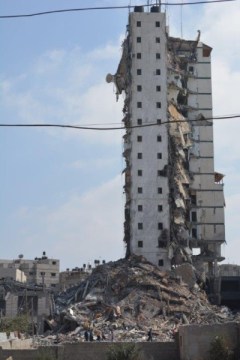 Israel and its supporters abroad have parried accusations of indiscriminate destruction and mass killing of civilians in Gaza by arguing that they were consequences of strikes aimed at protecting Israeli civilians from rockets that were being launched from very near civilian structures.
That defence has already found its way into domestic U.S. politics. A possible contender for the Democratic nomination for president, Sen. Elizabeth Warren, defended her vote for more military aid for Israel during the Israeli assault on Gaza by citing the rocket launch defence.
“[W]hen Hamas puts its rocket launchers next to hospitals, next to schools, they’re using their civilian population to protect their military assets,” said Warren. “And I believe Israel has a right, at that point, to defend itself.”
But although some Hamas rockets were launched near homes or other civilian structures, military developments on both sides have rendered that defence of Israeli attacks on civilian targets invalid.
The rocket launchers for Hamas’s homemade Qassam missiles consist of simple tripods that can be removed in seconds, and the extensive Hamas tunnel network has given it underground launching sites as well as storage facilities for its larger, longer-range Grad and M-75 missiles.
On the other side, the Israeli Air Force possesses air-to-ground missiles that are so accurate that they can destroy a very small target without any damage to civilian structure even if it is very close.
A video released by the Israel Defense Forces (IDF) in a report on Hamas’s “illegal use of civilian infrastructure” last month shows an attack – obviously by an Israeli drone — on an underground rocket launcher only a few metres away from a mosque causing no damage whatever to the mosque.
These technological changes take away any justification for flattening civilian buildings even if a rocket launch site is nearby. In fact, however, the evidence now available indicates that Hamas launch sites are not that close to hospitals, schools and mosques.
The IDF sought in mid-July to use the rocket launcher defence to explain the damage to Al Wafa Rehabilitation and Geriatic Hospital in eastern Gaza City from 15 rockets, which forced the staff to evacuate its patients. An IDF spokesman said the military had “no choice” because rockets had been launched from very near the hospital.
Clearly revealing that the rocket launch justification for the attack was a ruse, however, the spokesman revealed to Allison Degler of Mondoweiss that the alleged launch site was 100 metres from the hospital. That would have been far more space than was needed to strike the launch site without any damage to the hospital whatever.
A report released by the IDF August 19 included an aerial view of Al Wafa Hospital with two alleged rocket launching sites marked at locations that appeared to be much farther from the hospital than the 100 metres claimed by the IDF spokesman.
The IDF nevertheless went so far as to declare on July 21, “Hamas fires rockets from Wafa hospital in the Gaza neighborhood of Shujaiya.”
When the IDF destroyed Al Wafa hospital completely by airstrikes on July 23, it abandoned the pretense that the reason was a Hamas rocket launch site. Instead it released a video purporting to show firing at IDF troops from the hospital.
It turned out, however, the video clips of the firing had been shot during Operation Cast Lead in 2009, not in 2014.
The IDF has continued to suggest that its destruction of public civilian facilities was forced on it by rocket launches from within those facilities. At the end of the Operation Protective Edge the IDF spokesman’s office claimed that 597 rockets had been launched from civilian facilities, of which 160 were allegedly fired from schools, 50 from hospitals, and 160 from mosques.
But those figures were by produced only by pretending that launching sites some distance from the facilities in question were on the premises of the facilities.
An IDF “declassified report” released August 19, aimed at showing that civilian facilities were serving as military infrastructure for Hamas, includes no evidence of any rocket launches on the grounds of any civilian facility.
A very blurry 20-second video appears to show a rocket launch from what is identified as “Abu Nur” school. But it, too, is deceptive. A black streak rises from the area of the school for a little more than a second of the video, but for the entire length of the video two voices declare repeatedly that they saw three rockets launched “from within the school”.
Careful viewing of the footage reveals, however, that the apparent launch comes from outside the wall of the three-story school building rather than from within it.
In three other cases of alleged rocket launches from schools, the IDF provides no visual evidence – only large red dots drawn on an aerial view of the schools.
During the Operation Protective Edge, the IDF openly targeted mosques, claiming they are military targets, demolishing 73 mosques and partially destroying 205 more.
The August 19 IDF report refers to a “rocket cache and gathering point for militants hidden in a mosque” in Nuseirat. But despite frequent repetitions of the notion that Hamas routinely stores rockets in mosques, the IDF has not produced photographic evidence of rocket storage in a single mosque.
Nor has the IDF made public any video evidence of secondary explosions from the destruction of mosques. In a tacit admission that such evidence is lacking, the report instead cites an instance of a “concealed entrance” to a Hamas tunnel located between a mosque and a school.
The most extensive destruction of civilian structures in Operation Protective Edge was the complete leveling of large parts of entire neighbourhoods in the Shujaiya district of Gaza City on July 19. After the United Nations published a map showing the complete destruction of those areas of Shujaiya, the IDF published its own map on August 4 aimed at justifying the destruction.
The map shows that the IDF can’t claim the proximity of Hamas rocket launching sites as the justification for the leveling of many residential blocks in Shujaiya. The Israeli military had identified every home in the devastated neighbourhoods on its map as a “hideout” for Hamas or Islamic Jihad fighters.
The IDF obviously did not have actual intelligence on each of those homes that had been reduced to rubble. The massive designation of houses as “hideouts” indicates the Israelis believed Palestinian fighters were hiding in some of them.
Although the red dots on the IDF map identifying rocket launch sites are too big to estimate accurately the distance between them and the closest houses, only a few such dots appear to be as close as one city block to a house in one of the areas of massive destruction. And all but a few of the homes destroyed are much farther than a block from the alleged launching sites.
An account of the Shujaiya destruction by journalist Mark Perry based on a July 21 U.S. Defence Department report recalls that the IDF fired 7,000 artillery shells at residential areas in the district the night of July 19, including 4,500 shells in the space of just seven minutes.
Such massive and indiscriminate destruction of civilian structures is strictly prohibited by the international laws of war. Israeli officials have frequently said the purpose of IDF military operations in both Lebanon and Gaza was to “deter” their adversaries in the future by imposing heavy costs on the civilian population.
Malaysia Airlines Whodunnit Still a Mystery
By Robert Parry | Consortium News | September 9, 2014
Beyond confirming that Malaysia Airlines Flight 17 apparently was shot down on July 17, the Dutch Safety Board’s interim investigative report answered few questions, including some that would seem easy to address, such as the Russian military radar purporting to show a Ukrainian SU-25 jetfighter in the area, a claim that the Kiev government denied.
Either the Russian radar showed the presence of a jetfighter “gaining height” as it closed to within three to five kilometers of the passenger plane – as the Russians claimed in a July 21 press conference – or it didn’t. The Kiev authorities insisted that they had no military aircraft in the area at the time.
But the 34-page Dutch report is silent on the jetfighter question, although noting that the investigators had received Air Traffic Control “surveillance data from the Russian Federation.”
The report is also silent on the “dog-not-barking” issue of whether the U.S. government had satellite surveillance that revealed exactly where the supposed ground-to-air missile was launched and who may have fired it.
The Obama administration has asserted knowledge about those facts – initially pointing the finger at ethnic Russian rebels using a powerful Buk anti-aircraft missile system supposedly supplied by Russia – but the U.S. government has withheld satellite photos and other intelligence information that could presumably corroborate the charge.
Curiously, too, the Dutch report, released on Tuesday, states that the investigation received “satellite imagery taken in the days after the occurrence.” Obviously, the more relevant images in assessing blame would be aerial photography in the days and hours before the crash that killed 298 people on the flight from Amsterdam to Kuala Lumpur.
In mid-July, eastern Ukraine was a high priority for U.S. intelligence and a Buk missile battery is a large system that should have been easily picked up by U.S. aerial reconnaissance. The four missiles in a battery are each about 16-feet-long and would have to be hauled around by a truck and then put in position to fire.
Just days after the July 17 shoot-down, a source who was briefed by U.S. intelligence analysts told me that the analysts were examining satellite imagery that showed the crew manning the suspected missile battery wearing what looked like Ukrainian army uniforms.
Then, on July 22, at a briefing given to journalists from major U.S. publications, a U.S. intelligence official suggested that a Ukrainian military “defector” might have launched the Buk missile against the airliner, possibly explaining the issue of the uniforms.
The Los Angeles Times reported that “U.S. intelligence agencies have so far been unable to determine the nationalities or identities of the crew that launched the missile. U.S. officials said it was possible the SA-11 [Buk anti-aircraft missile] was launched by a defector from the Ukrainian military who was trained to use similar missile systems.”
The briefers also theorized that the rebels hit Malaysia Airlines Flight 17 by mistake, thinking it was a Ukrainian military aircraft.
Yet, while the U.S. government has released a variety of satellite photos to bolster various allegations lodged against ethnic Russian rebels in eastern Ukraine and the Russian government, the Obama administration has balked at providing satellite imagery relating to the Flight 17 case, instead basing much of its public case on “social media.”
Russian Satellite Images
The Dutch report’s reference to only post-crash satellite photos is also curious because the Russian military released a number of satellite images purporting to show Ukrainian government Buk missile systems north of the eastern Ukrainian city of Donetsk before the attack, including two batteries that purportedly were shifted 50 kilometers south of Donetsk on July 17, the day of the crash, and then removed by July 18.
Russian Lt. Gen. Andrey Kartopolov called on the Ukrainian government to explain the movements of its Buk systems and why Kiev’s Kupol-M19S18 radars, which coordinate the flight of Buk missiles, showed increased activity leading up to the July 17 shoot-down.
The Ukrainian government countered these questions by asserting that it had “evidence that the missile which struck the plane was fired by terrorists, who received arms and specialists from the Russian Federation,” according to Andrey Lysenko, spokesman for Ukraine’s Security Council, using Kiev’s preferred term for the rebels.
Lysenko added: “To disown this tragedy, [Russia] are drawing a lot of pictures and maps. We will explore any photos and other plans produced by the Russian side.” But Ukrainian authorities have failed to address the Russian evidence except through broad denials.
On July 29, amid escalating rhetoric against Russia from U.S. government officials and the Western news media, the Veteran Intelligence Professionals for Sanity called on President Barack Obama to release what evidence the U.S. government had on the shoot-down, including satellite imagery.
“As intelligence professionals we are embarrassed by the unprofessional use of partial intelligence information,” the group wrote. “As Americans, we find ourselves hoping that, if you indeed have more conclusive evidence, you will find a way to make it public without further delay. In charging Russia with being directly or indirectly responsible, Secretary of State John Kerry has been particularly definitive. Not so the evidence. His statements seem premature and bear earmarks of an attempt to ‘poison the jury pool.’”
However, the Obama administration failed to make public any intelligence information that would back up its earlier suppositions.
Then, in early August, I was told that some U.S. intelligence analysts had shifted away from the original scenario blaming the rebels and Russia to one focused more on the possibility that extremist elements of the Ukrainian government were responsible. But then chatter about U.S. intelligence information on the shoot-down faded away.
Given the intense global interest in the tragedy, there were high hopes that the Dutch Safety Board, which is heading up the international investigation, would at least begin clarifying the evidence and shifting through the conflicting claims. However, more than seven weeks after the crash, the preliminary report fails to address any of the evidence regarding who actually fired the missile and from precisely what location.
The Dutch Safety Board promised a final report before the first anniversary of the crash on July 17, 2015. By then, however, the slaughter of those 298 people could well become a cold case with little hope of finding the perpetrators – whoever they might be – and bringing them to justice.
~
Investigative reporter Robert Parry broke many of the Iran-Contra stories for The Associated Press and Newsweek in the 1980s. You can buy his new book, America’s Stolen Narrative, either in print here or as an e-book (from Amazon and barnesandnoble.com).
US bans Europol from releasing its own documents to European officials
RT | September 9, 2014
The United States has instructed Europol, the European Union’s police agency, to withhold its own annual internal data-protection review from EU lawmakers because the report was written without the US Treasury Department’s permission.
Europol drafted the data-protection report “without prior written authorisation from the information owner (in this case the Treasury Department),” according to the US, violating “security protocols” that could “undermine the relationship of trust needed to share sensitive information between enforcement agencies.”
The report, drafted by Europol’s Joint Supervisory Body, outlines how data concerning EU citizens and residents is transferred to the US, according to the EUobserver. The document is mainly known to monitor implementation of the EU-US Terrorist Finance Tracking Program, or TFTP. Basically, the US Treasury Department is quite territorial about how the TFTP is adhering to European data protection compliance.
EU ombudsman Emily O’Reilly said Europol refused to allow her to see the report based on US demands. O’Reilly then confronted US ambassador to the EU Anthony Gardner in July. Gardner confirmed the order.
On Thursday, O’Reilly said she sent a letter to the European Parliament asking the body “to consider whether it is acceptable that an agreement with a foreign government should prevent the Ombudsman from doing her job.”
“If the US says ‘No disclosure’ then it won’t be disclosed, which is ridiculous because we are EU citizens, we vote, we pay taxes, we have EU laws, and we decide what happens on this continent. Nobody else,” Dutch MEP liberal Sophie In’t Veld told EUobserver. In’t Veld first requested the report in 2012.
In’t Veld said there is no top-secret information in the report that should be viewed as overly sensitive.
“There is no operational information, there is no intelligence, there is nothing in the document. So you really wonder why it is kept a secret,” she said.
The TFTP has received scrutiny in the last year after documents supplied by former US government contractor Edward Snowden showed mass spying by the US National Security Agency on citizens and officials across the world, including in the EU.
The Snowden leaks showed the NSA had gained a “back door” entrance into the SWIFT servers – SWIFT being a financial-record sharing program, which revealed the banking details of millions of European citizens, despite the fact that access to this financial data was limited by the TFTP.
French President Hollande in Political Storm
teleSUR | September 6, 2014
 A survey released on Thursday by TNS Sofres revealed that Francois Hollande had just 13 percent support among the French population, as turmoil in his government continues.
Since popularity polls were begun in 1978, no French president has had such low popularity. […]
Hollande has been implementing austerity reforms, even though he was elected with the motto, “I have only one enemy: the world of finance.”
Last week, the whole cabinet resigned because the economy minister, Arnaud Montebourg, from the left faction of the governing socialist party, criticized this approach. The controversial Emmanuel Macron, a former director of the Rotschild Bank, was then chosen to replace him. … Full article
Desperate Drug War Beneficiaries Spread Marijuana Legalization Disinformation
Ron Paul Institute | September 6, 2014
While local and state governments continue moving forward with reducing and eliminating restrictions and penalties regarding marijuana, drug war beneficiaries are desperately responding by spreading disinformation. One such effort is the Rocky Mountain High-Intensity Drug Traffic Area August report “The Legalization of Marijuana in Colorado: The Impact.”
The report purports to be a balanced analysis of the effects of marijuana legalization in Colorado. In fact, the report is over 150 pages of deceptive pro-drug war propaganda.
One may wonder how much time and money the HIDTA spent on researching, writing, and producing the professional appearing report. Whatever the cost, the HIDTA people must figure it is a good investment of other people’s money.
While the Rocky Mountain HIDTA and its private and government allies spent hundreds or thousands of hours creating the agitprop, drug war writer Jacob Sullum had no trouble promptly rebutting a good portion of the report’s conclusions and exposing some of the rhetorical trickery that made the report particularly deceptive. Nonetheless, singers of prohibition praise from Cully Stimson of the Heritage Foundation to DARE enthusiastically promoted bite-size packets of the report’s disinformation.
As explained by the Office of National Drug Control Policy, 28 HIDTAs, including the Rocky Mountain HIDTA, assist United States, state, local, and tribal law enforcement agencies in fighting the drug war in areas that include 60 percent of the US population pursuant to the Anti-Drug Abuse Act of 1988. While a lot has changed in America since 1988, the US government’s drug war keeps going strong.
With more and more state and local governments moving away from prohibition of marijuana and this trend showing no signs of reversing, the HIDTA people, along with their connected police departments and other allied drug war beneficiaries, must be having some job security concerns. Drug war arrests, and marijuana arrests in particular, after all, help keep the police busy. US News and World Report writer Steven Nelson reports some of the Federal Bureau of Investigation war on drugs arrest statistics:
Data released Monday by the Federal Bureau of Investigation show there were an estimated 1,552,432 arrests for drug-related crimes in 2012 – a slight uptick from the 1,531,251 drug arrests in 2011. Marijuana offenses accounted for 48.3 percent of all drug arrests, a slight reduction from 49.5 percent in 2011, which itself was the highest rate since before 1995.
Most marijuana-related arrests were for possession of the drug. By mere possession, there was one marijuana arrest every 48 seconds in 2012. Including arrests for distribution, there was a pot-related arrest every 42 seconds, the same interval as in 2011.
HIDTAs (with their $238 million in ONDCP grants) and US, state, and local police (with their “policing for profit” through drug war asset seizures) are not the only groups that benefit from marijuana prohibition. There are many additional beneficiaries including prosecutors who push defendants who typically lack comparable legal resources along the guilty plea conveyor belt, private and public prisons that cage drug war convicts, treatment centers where people with no addiction problem whatsoever will opt to take part in court-mandated treatment as an alternative to being in prison, and arms manufacturers who have found new income in police militarization.
While it is important to counter deceptive propaganda with truth and logic, there is little reason to expect that the Rocky Mountain HIDTA report and other propaganda efforts will stop the general American trend toward greater respect for the right to grow, use, transport, buy, and sell marijuana. On marijuana, America it seems has turned a corner, with the country moving toward a patchwork quilt of marijuana laws that overall are much less prohibitionary and punitive than the laws have been over the last few decades of the war on drugs. People are seeing firsthand that very significant loosening of marijuana restrictions in parts of the country did not cause the sky to fall. Indeed, people are seeing that marijuana freedom, despite the prohibitionists’ dire warnings and continuing disinformation campaigns, is not dangerous.
With marijuana use coming out of the shadows of illegality, people are more and more recognizing that individuals who use marijuana, on occasion or regularly, are not so different from people who do not. Reality is overtaking hype.
Marijuana freedom is nothing to fear. Instead, as Ron Paul Institute Chairman and Founder Ron Paul says, freedom “brings people together, whether you are liberal or conservative or what, because people like to be in charge of their own life; they like to be in charge of their own money.” Despite the efforts of the Rocky Mountain HIDTA and its prohibitionist allies, Americans are rejecting the government and private drug war beneficiaries’ propaganda and experiencing the benefits of “live and let live” over “arrest, fine, and incarcerate.” Hopefully, this lesson will help create paths to greater respect for other freedoms as well.
Federal Court Blocks Release of Possible Torture Video
By Noel Brinkerhoff | AllGov | September 7, 2014
Efforts to expose videos and photos that documented torture at Guantánamo have been blocked by a federal appeals court in New York that sided with the Obama administration in its refusal to turn over the information.
The case centered on the treatment of Mohammed al-Qahtani, dubbed the 20th hijacker in the 9/11 attacks. Captured in 2001 and held at Guantánamo since then, al-Qahtani has been subjected to torture and other harsh treatment during his detention, according to his lawyers at the Center for Constitutional Rights (CCR).
CCR filed a Freedom of Information Act lawsuit to force the administration to release photos and videos depicting its client’s abuse at the U.S. prison in Cuba.
There are reportedly 58 videos in the possession of the Federal Bureau of Investigation, Kevin Gosztola wrote at Fire Dog Lake, which show Qahtani’s “activities in his cell and his interactions” with U.S. military personnel. Two videos allegedly depict “forced cell extractions” involving Qahtani that resulted in abusive or aggressive behavior on the part of his jailers.
But those recordings will not see the light of day anytime soon. The government successfully argued “with adequate specificity” that the footage and images “could logically and plausibly harm national security because these images are uniquely susceptible to use by anti-American extremists as propaganda to incite violence against United States interests domestically and abroad,” Judge José Cabranes wrote in the court’s opinion.
To Learn More:
Court: Releasing Images of Guantanamo Prisoner Would Incite Violence, Especially Since He Was Tortured (by Kevin Gosztola, Fire Dog Lake)
No Daylight for US Govt Photos, Video That May Show Gitmo Torture (by Nadia Prupis, Common Dreams)
Circuit Keeps Lid Closed on al-Qahtani Footage (by Adam Klasfeld, Courthouse News Service)
Center for Constitutional Rights v. Central Intelligence Agency (Second Circuit Court of Appeals)
Group Sues U.S. Government to Force Release of Only Known Remaining Torture Video (by Noel Brinkerhoff, AllGov)
Compare and Contrast: Cluster Bomb Usage in Syria, July 2014 Vs September 2014
Interventions Watch | September 6, 2014
Rick Gladstone, writing in The New York Times, July 30th 2014:
‘Cluster bombs, internationally banned weapons that can maim and destroy indiscriminately, not only have been frequently used for the past two years by government forces in the Syrian civil war . .
. . . According to an assessment by Human Rights Watch, a member of the Cluster Munition Coalition, Syrian government forces used the weapons in at least 224 locations, in 10 of Syria’s 14 governorates, from July 2012 to this March, with new indications that their “use is ongoing.” The assessment is incomplete and based partly on remnants recorded by video, Human Rights Watch said, suggesting the actual use may be even more widespread.
Syria’s government has denied the use of cluster munitions in the conflict, which is now in its fourth year. But Ms. Blakemore said that the insurgents fighting to topple President Bashar al-Assad did not have the capacity to deploy such weapons.’
So then, rebels in Syria simply aren’t able to use cluster bombs. No siree! It’s all the work of the Assad regime.
Rick Gladstone, writing in The New York Times, September 1st 2014:
‘The Islamic State in Iraq and Syria, the extremist militant group now almost universally vilified for atrocities that include boastful beheadings, summary mass executions and enslavement in the areas it aspires to control, also has attacked enemies with cluster bombs, the banned weapons that kill and maim indiscriminately, Human Rights Watch said on Monday.
Stephen Goose, the arms division director of Human Rights Watch, said in a statement that “credible evidence” had emerged that ISIS forces used ground-fired cluster munitions on July 12 and Aug. 14 during fighting with Kurdish militia members in Aleppo Province near the northern Syrian border with Turkey.
“The use of cluster munitions by nonstate actors such as the Islamic State shows the urgent need for Syria and all nations that have not yet done so to join the ban on cluster munitions and destroy their stockpiles,” Human Rights Watch said in the statement’.
No wait! The rebels do have the capacity to deploy cluster bombs after all, and they are deploying them! And they were even when we said they weren’t! Or at least ISIS are!
And how convenient that this new ‘credible evidence’ has come to light just as the U.S. et al are embarking on a long term, overt war in Iraq – and very probably Syria before too long – to be justified by the ISIS ‘threat’.
Dilanian’s Dizzying Defense & Dissemination of Disinformation: My Own Discussion with the ‘CIA’s Mop-Up Man’

By Nima Shirazi | Wide Asleep in America | September 5, 2014
On Wednesday afternoon, The Intercept‘s Ken Silverstein dropped a bombshell:
A prominent national security reporter for the Los Angeles Times routinely submitted drafts and detailed summaries of his stories to CIA press handlers prior to publication, according to documents obtained by The Intercept.
That reporter is Ken Dilanian, who has since joined Associated Press as an intelligence reporter.
A swath of emails from the first half of 2012, released to The Intercept in response to a FOIA request, show that Dilanian maintained a particularly obsequious relationship with the media relations team over at the Central Intelligence Agency, the clandestine U.S. government service he was hired to cover for the paper.
Dilanian, dubbed “the CIA’s Mop-Up Man” by The Intercept, went beyond the usual role of mainstream media stenographer of government talking points. According to Silverstein – and overwhelmingly corroborated by the content of the published documents – Dilanian “enjoyed a closely collaborative relationship with the agency, explicitly promising positive news coverage and sometimes sending the press office entire story drafts for review prior to publication. In at least one instance, the CIA’s reaction appears to have led to significant changes in the story that was eventually published in the Times.”
Silverstein continues:
“I’m working on a story about congressional oversight of drone strikes that can present a good opportunity for you guys,” Dilanian wrote in one email to a CIA press officer, explaining that what he intended to report would be “reassuring to the public” about CIA drone strikes. In another, after a series of back-and-forth emails about a pending story on CIA operations in Yemen, he sent a full draft of an unpublished report along with the subject line, “does this look better?” In another, he directly asks the flack: “You wouldn’t put out disinformation on this, would you?”
Another example of Dilanian’s shameful sycophancy is found in an email he sent to his contact at the CIA Office of Public Affairs on April 11, 2012. In the message, Dilanian passes along a 10-day-old dispatch from the Yemen Times, reporting on a U.S. drone strike in Azzan, a town in the country’s eastern Shabwa province. Five people were killed in the strike, one of whom was immediately identified as 60-year-old civilian, Mohamed Saleh al Suna. Six children were also injured by shrapnel from the bombing while playing soccer.
Even though Reuters had already reported on the attack on March 30, 2012 – the day it occurred – Dilanian attempted to get confirmation on the strike and reported casualties from his buddies at the CIA. “This one sounds like you guys,” he wrote, adding, “Do you agree that a civilian was killed?”
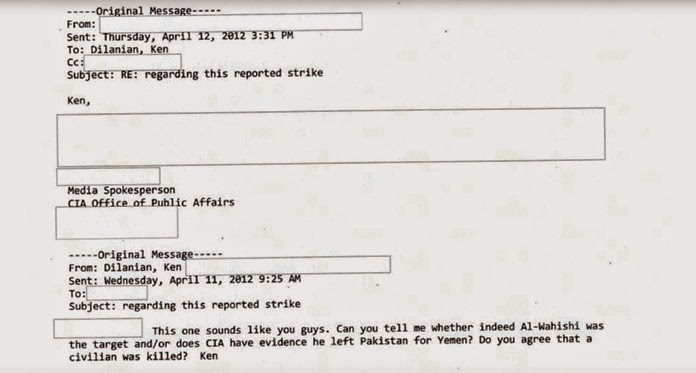
Far from acting as a venerable “Fourth Estate” check on the excesses state power, Dilanian clearly revels in his access to the upper echelons of the security and surveillance establishment, eager to laundering their lies and whitewash their war crimes.
While Dilanian’s “closely collaborative” and “deferential relationship” with the CIA, as Silverstein puts it, is shameful, unprofessional, and does a great disservice to what should be the adversarial, critical, and challenging role the press should the government, it certainly comes as no surprise.
At least to me.
A month before the first of Dilanian’s emails released to The Intercept was written, I engaged in a brief online correspondence with him.
On February 23, 2012, Ken Dilanian wrote a refreshingly solid piece on the U.S. government’s view of the Iranian nuclear program, noting that there was still no evidence Iran is actually building a nuclear bomb nor actively pursuing the means to do so.
Nevertheless, the article contained a slight error regarding Dilanian’s description of Iran’s declared and safeguarded enrichment site at Fordow, which he wrote was a “clandestine underground facility” that had been “discovered” by “Western intelligence agencies.”
Since the piece was otherwise generally good, I thought Dilanian would be receptive to a minor bit of fact-checking and decided to get in touch, using my nice voice.
What happened next was bizarre. The defensive posture immediately on display by Dilanian – someone with an important role at a large American newspaper – was revealing, and illuminating. No amount of reasoned explanation or fact-based rationale would do – he deflected, doubled-down, fumed, fulminated, and then, as the short-lived conversation continued, became increasingly insulting and juvenile.
He effectively admitted to being a sounding board for anonymous government spooks and berated anyone who doesn’t have Pentagon and CIA officials on speed-dial as being ignorant and agenda-driven, citing a “conspiracy” I never suggested existed.
The best part, perhaps, was when he wrote, “[T]here are checks and balances, including Congressional oversight, journalistic scrutiny and whistleblowers from within – all of which insures, I would argue, that US officials do not often get away with elaborate lies…”
My guess is that there are hundreds of thousands of Iraqis who might beg to differ with his particularly sunny assessment if they weren’t already dead.
At another point, Dilanian insisted to me that “U.S. government officials are not in the habit of elaborate disinformation campaigns,” and then later, after I challenged the official narrative on something, writes, “but it’s so easy for you to sit in Brooklyn, having no contact whatsoever with anyone senior from the government’s national security apparatus, and having no real idea of how that apparatus works, and us[ing] phrases like ‘a narrative emerges.'”
With the new revelations published by The Intercept, we now know, even more than before and beyond a shadow of doubt, who’s actually responsible for foisting particular narratives upon the unwitting public.
But, hey, if only I sent fawning emails from Washington D.C. to my pals across the Potomac in Langley, maybe I’d have some clue as to what really going on. Thanks Ken, for setting me straight.
Below is our email exchange in full (the only editing made have been the standardization of the spelling of “Fordow” and the removal of Dilanian’s mobile phone number):
From: Nima Shirazi | Wide Asleep in America
Sent: Friday, February 24, 2012 1:55 AM
To: Dilanian, Ken
Subject: Your Iran Piece: A Thank You and a Comment
Mr. Dilanian,
I’m writing to thank you for the important piece, “U.S. does not believe Iran is trying to build nuclear bomb,” in the L.A. Times today. It contains a lot of vital information that is not reported on nearly often enough in the mainstream press. Those who follow this issue closely, like myself, have been writing about this information for a long time, so reading it in the L.A. Times is a huge boost to getting the truth out.
I do question, however, your decision to include the following sentence: “In 2009, Western intelligence agencies discovered a clandestine underground facility called Fordow, near the city of Qom…”
In fact, the Fordow plant was not really “discovered” by “Western intelligence agencies”; rather, it was announced by Iran to the IAEA on September 21, 2009. Barack Obama’s sensationalist press conference, alongside Nicholas Sarkozy and Gordon Brown in Pittsburgh, during which supposedly “revealed” the existence of the Fordow facility to the world, occurred on September 25, 2009, four days after Iran itself told the IAEA about the plant, which was subsequently described as “a hole in a mountain” and “nothing to be worried about” by then-IAEA Secretary General Mohammed ElBaradei.
In advance of Obama’s supposed revelation, IAEA spokesman Marc Vidricaire told reporters, “I can confirm that on 21 September, Iran informed the IAEA in a letter that a new pilot fuel enrichment plant is under construction in the country.”
Obama even acknowledged this fact in his speech, noting, “Earlier this week, the Iranian government presented a letter to the IAEA that made reference to a new enrichment facility…”, though he deliberately omitted the inconvenient fact that Iran is only legally obligated to inform the IAEA of new facilities within 180 days of the introduction of nuclear material thereby making his own accusation of Iran’s alleged intransigence deliberately deceiving.
Unfortunately, your report also fails to acknowledge the essential fact that IAEA spokesman Gill Tudor has confirmed: “All nuclear material in the [Fordow] facility remains under the agency’s containment and surveillance.”
In such an otherwise excellent report, it is frustrating to see the “secret Fordow facility” meme still repeated.
Considering your attention to the Iranian nuclear issue and constant dis- and misinformation, speculation and propaganda regarding Iran’s capabilities and intentions, I think you might be interested in this piece of mine from December 2010, which has subsequently been updated over 51 times with new predictions since its original publication: The Phantom Menace: Fantasies, Falsehoods, and Fear-Mongering about Iran’s Nuclear Program
Best,
Nima Shirazi
Brooklyn, NY
From: Dilanian, Ken
Sent: Friday, February 24, 2012 9:35 AM
To: Nima Shirazi | Wide Asleep in America
Subject: Re: Your Iran Piece: A Thank You and a Comment
Mr. Shirazi, thanks for your comment. I believe you are flat wrong about Fordow. Iran declared it only after Iran discovered that Western intelligence agencies knew about it. I did get the date wrong – the U.S. actually discovered it years before, and announced it only after Iran’s preemptive letter. See:
http://www.nytimes.com/2009/09/26/world/middleeast/26intel.html?_r=2&hp=&pagewanted=all
http://www.isisnucleariran.org/assets/pdf/Qom_Q-As.pdf
Best,
Ken Dilanian
National Security Correspondent
Los Angeles Times
O:(202) 824 8328
Twitter: @KenDilanianLAT
From: Nima Shirazi | Wide Asleep in America
Sent: Friday, February 24, 2012 10:12 AM
To: Dilanian, Ken
Subject: Re: Your Iran Piece: A Thank You and a Comment
Thanks for replying so quickly, Ken.
That Iran was merely reacting to a Western discovery and hoping to pre-empt its publicity is precisely the narrative that has been wholeheartedly accepted by the press without any hint of scrutiny or shred of evidence. First off, how would Iran find out that Obama was going to hold a press conference announcing the “discovery” of the site with enough time to decide to “preemptively” draft a letter to the IAEA? – a declaration, it should be pointed out, that took place well before the 180 days before nuclear material was introduced to the site as mandated by Iran’s ratified Safeguards Agreement with the IAEA. Actually, Iran announced the site about a year and a half before it technically and legally had to. I suppose, though, it is possible that Iranian agents had access to Rahm Emanuel’s google calendar.
It’s silly to rehash what has been addressed already, but I think IPS journalist Gareth Porter’s recent article on this very subject in instructive (forgive me for quoting at length):
The Clinton and Hague statements [that Fordo was “covert” and “clandestine” before revealed to the world by the West] recalled a briefing for reporters during the Pittsburgh G20 summit meeting Sep. 25, 2009, at which a “senior administration official” asserted that Iran had informed the IAEA about the Fordow site in a Sep. 21 letter only after it had “learned that the secrecy of the facility was compromised”.
That administration claim was quickly accepted by major media outlets without any investigation of the facts. That story line is so deeply entrenched in media consciousness that even before Clinton’s remarks, Reuters and Associated Press had published reports from their Vienna correspondents that repeated the official Obama administration line that Iran had revealed the Fordow site only after Western intelligence had discovered it.
But the administration never offered the slightest evidence to support that assertion, and there is one major reason for doubting it: the United States did not inform the IAEA about any nuclear facility at Fordow until three days after Iran’s Sep. 21, 2009 formal letter notifying the IAEA of the Fordow enrichment facility, because it couldn’t be certain that it was a nuclear site.
Mohammed ElBaradei, then director general of the IAEA, reveals in his 2011 memoir that Robert Einhorn, the State Department’s special advisor for nonproliferation and arms control, informed him Sep. 24 about U.S. intelligence on the Fordow site – three days after the Iranian letter had been received.
An irritated ElBaradei demanded to know why he had not been told before the Iranian letter.
Einhorn responded that the United States “had not been sure of the nature of the facility”, ElBaradei wrote.
The administration’s claim that Iran announced the site because it believed U.S. intelligence had “identified it” was also belied by a set of questions and answers issued by the Obama administration on the same day as the press briefing. The answer it provided to the question, “Why did the Iranians decide to reveal this facility at this time,” was “We do not know.”
Greg Thielmann, who was a top official in the State Department’s Bureau of Intelligence and Research until 2003 and was on the staff of the Senate Select Committee on Intelligence during the 2009 episode, told IPS the evidence for the claim that Iran believed the site had been discovered was “all circumstantial”.
Analysts were suspicious of the Iranian letter to the IAEA, Thielmann said, because, “it had the appearance of something put together hurriedly.”
But there is an alternative explanation: the decision to reveal the existence of a second prospective enrichment site – this one built into the side of a mountain – appears to have reflected the need to strengthen Iran’s hand in a meeting with the “P5 + 1” group of state led by the United States that was only 10 days away.
The Iranian announcement that it would participate in the meeting on Sep. 14, 2009 came on the same day that the head of Atomic Energy Organisation of Iran, Ali Akbar Salehi, warned against an attack on Iran’s nuclear facilities.
The idea that Iran was planning to enrich uranium secretly at Fordow assumes that the Iranians were not aware that U.S. intelligence had been carrying out aerial surveillance of the site for years. That is hardly credible in light of the fact that the Mujahideen-E-Khalq (MEK), the armed opposition group with links to both U.S. and Israeli intelligence, had drawn attention to the Fordow site in a December 2005 press conference – well before it had been selected for a second enrichment plant.
Anyway, whether you roll your eyes or not about this minor point of contention, my opinion, or Porter’s conclusions, I do thank you again for your LAT piece and look forward to reading more from you in the future.
Best,
Nima
From: Dilanian, Ken
Sent: Friday, February 24, 2012 10:32 AM
To: Nima Shirazi | Wide Asleep in America
Subject: Re: Your Iran Piece: A Thank You and a Comment
Nima, the problem with intelligence reporting is there is often no way to independently confirm what your sources are telling you. You just have to rely on triangulating the information, on your years of experience dealing with certain people, and on the fact that—while you may find this hard to believe—U.S. government officials are not in the habit of elaborate disinformation campaigns. Not to say it never happens, of course, but it’s just not typically the way it works. I am confident in the New York Times reporting on this, which was based on multiple sources from within the U.S. intelligence community. What seems to be the case is that the US, France and Britain thought they knew what was there, but were not 100% certain until Iran admitted it, which may be why they didn’t send a letter to the IAEA. Just like the CIA wasn’t certain bin Laden was in Abbottabad until they ID’d his body. It is, of course, easy to say there isn’t a “shred of evidence” to support what anonymous US intelligence sources are claiming. That is true for just about any story about secret intelligence. But there are checks and balances, including Congressional oversight, journalistic scrutiny and whistleblowers from within – all of which insures, I would argue, that US officials do not often get away with elaborate lies of the kind you are suggesting they perpetrating here. Ken
From: Nima Shirazi | Wide Asleep in America
Sent: Friday, February 24, 2012 2:49 PM
To: Dilanian, Ken
Subject: Re: Your Iran Piece: A Thank You and a Comment
I don’t think it’s particularly elaborate or dastardly for U.S. officials to establish a particular narrative regarding alleged Iranian intransigence and malfeasance. This one is actually quite simple – Iran legally places a new facility under full IAEA Safeguards in line with its obligations and, as a result, undercuts a big, fancy announcement by the president. So, in response, a narrative emerges that Iran did this deliberately because they had been “found out.” And the press repeats that story until it becomes established, unquestioned fact.
Pretty simple, really.
Anyway, no need to bicker about this. I’m glad to hear you have such confidence in the honesty of our government officials and think that they “do not often get away with elaborate lies.”
Best,
Nima
From: Dilanian, Ken
Sent: Friday, February 24, 2012 2:58 PM
To: Nima Shirazi | Wide Asleep in America
Subject: Re: Your Iran Piece: A Thank You and a Comment
but it’s so easy for you to sit in Brooklyn, having no contact whatsoever with anyone senior from the government’s national security apparatus, and having no real idea of how that apparatus works, and uses phrases like “a narrative emerges.”; what you are saying there is that multiple people from multiple government agencies conspired in a big lie. you can’t make the accusation and then hide behind euphemisms. and what I’m saying is, we live in a democracy, it doesn’t (usually) work like that. not that people are so righteous, but that it’s impossible to orchestrate a conspiracy like that. there are 16 intel agencies, and a lot of other people with access to this sort of information, including liberal democrats and conservative republicans. even if obama and his advisers wanted to lie about something like this, some malcontent somewhere would talk.
I chose not to carry the conversation further. After all, I had plenty of more sitting to do in Brooklyn, far far away from all those truth-tellers in the CIA press office.
EU admits Putin’s comment on ‘storming Kiev’ taken out of context
RT | September 5, 2014
The EU has admitted that Vladimir Putin’s words about “taking Kiev in two weeks” had been “made public out of context,” said a spokeswoman for the European Commission President in a written response to The Wall Street Journal.
José Manuel Barroso’s spokesperson Pia Ahrenkilde-Hansen said on Thursday the EU is going to address the issue “through diplomatic channels, not in the press.”
“I can only add that the president of the Commission informed his colleagues in the European Council in a restricted session of the conversations he had with President Putin. Unfortunately part of his intervention was made public out of context,” Ahrenkilde-Hansen wrote to the WSJ.
Last week Barroso gave a briefing on his phone conversation with President Vladimir Putin, describing the conversation as “very frank.” During the talk, the EU functionary alleged the Russian president had said that if necessary military occupation of the Ukrainian capital would take just a matter of weeks.
Italia’s La Repubblica was among the very first to overblow the scandal, saying that José Manuel Barroso had told European leaders who attended Saturday’s EU summit in Brussels that replying to Barroso’s accusations about regular Russian troop operating in Ukraine, President Putin had said that “If I wanted to, I could take Kiev in two weeks.”
An EU official has confirmed to the WSJ that Putin’s note about Russian forces being able to take Kiev within two weeks did take place during last week’s telephone call, but the context of the comment was not clear.
The unexpected divulgement by the top EU official immediately sparked a political scandal involving Russia’s high ranking officials and diplomats, who accused Barroso of both intentionally wrenching Russian leader’s remarks out of context as well as breaching diplomatic protocol.
According to Russia’s permanent representative to the EU, Vladimir Chizhov, Putin’s words were “clearly taken out of context.”
On Tuesday, September 2, Moscow threatened to reveal the full recording of the controversial phone call “to remove all misunderstandings” if European Commission President Jose Manual Barroso doesn’t object in the next two days, Chizhov said.
Russia’s presidential aide Yury Ushakov lashed at the EU Commission president’s behavior, stressing it is “incorrect and goes beyond the bounds of diplomatic practices.”
“If that was really done, it is not worthy of a serious political figure,” Ushakov added.
As the EU official acknowledged on Thursday, September 4, President Putin possibly made the comment to strengthen Russia’s position of not and never being involved militarily in Ukrainian crisis.
READ MORE:
Moscow ready to expose ‘Kiev in two weeks’ spin with Barroso call transcript
‘Did he mean Alaska?’ Obama wrongly blames Russia for ‘trying to reclaim lands lost in 19th century’
Fake cell phone ‘towers’ may be spying on Americans’ calls, texts
RT | September 3, 2014
More than a dozen “fake cell phone towers” could be secretly hijacking Americans’ mobile devices in order to listen in on phone calls or snoop on text messages, a security-focused cell phone company claims. It is not clear who controls the devices.
ESD America, which markets heavily-encrypted cell phones built within the body of a Samsung Galaxy S3, said it was able to locate numerous towers intercepting mobile communications – but does not know who is running them.
Speaking to Popular Science, ESD America CEO Les Goldsmith recently said that the company has used its phone – the CryptoPhone 500 – to map 17 different fake cell phone towers, dubbed “interceptors,” across the United States. Locations include New York, Chicago, Los Angeles, Seattle, and more.
“Interceptor use in the US is much higher than people had anticipated,” he told the website. “One of our customers took a road trip from Florida to North Carolina and he found 8 different interceptors on that trip. We even found one at South Point Casino in Las Vegas.”
Although these interceptors act as fake cell phone towers, they are not necessarily large, physical structures. They could simply be small mobile devices that act exactly like a real tower, deceiving phones into giving up information. Such devices are known as “stingrays,” after the brand name of one popular type of interceptor.

Once connected to a person’s phone, they can bypass the mobile device’s encryption to either listen in on calls or capture texts. In some cases, they are also powerful enough to take over a device or make it seem as if it has shut down – only to leave the microphone on in order to eavesdrop.
The American Civil Liberties Union has been attempting to pry information about government and police use of stingray equipment, but its efforts have been met with resistance from federal officials.
According to Ars Technica, the Federal Communications Commission pledged in August to investigate the “illicit and unauthorized use” of interceptors – with a primary focus on foreign governments, criminals, and terrorists – but denied a Freedom of Information Act request to reveal more data about current stingray use.
For Goldsmith, determining who is using the interceptors is important. He speculated that the operators could be American agencies or foreign governments.
“What we find suspicious is that a lot of these interceptors are right on top of US military bases. So we begin to wonder – are some of them US government interceptors? Or are some of them Chinese interceptors?” he told PopSci. “Whose interceptor is it? Who are they, that’s listening to calls around military bases? Is it just the US military, or are they foreign governments doing it? The point is: we don’t really know whose they are.”
Outside of national governments, local law enforcement agencies are also beefing up their stingray/interceptor capabilities. In Oakland, California, police are looking to spend hundreds of thousands of dollars to upgrade their cell phone surveillance system.
Meanwhile, police in Tacoma, Washington have caught the eye of civil liberties advocates after the News Tribune revealed they have been using interceptor equipment to catch cell phone calls for the last six years. Some, including Mayor Marilyn Strickland, said it was legitimate for police to do so as long as people’s rights were not violated. However, the ACLU disagreed, arguing it was like “kicking down the doors of 50 homes and searching 50 homes because they don’t know where the bad guy is.”
More NATO Aggression Against Syria?
Media Myths and Distortions
By Rick Sterling | CounterPunch | September 3, 2014
Syria will be an important subject of discussion at this week’s NATO Summit meeting in Wales. The US and NATO powers will evaluate whether to expand air strikes against ISIS (Islamic State in Iraq & Syria) into Syria, whether to do it in cooperation with the Syrian government and whether to increase support to the “moderate” armed opposition. The US mainstream media and politicians have been beating the war drums with Republican Senator McCain calling for military escalation and Democratic Senator Feinstein criticising President Obama for being “too cautious”.
There has been little mention of the fact that it is one year since the highly publicized chemical weapons attack in the Ghouta outskirts of Damascus. The same elements who are pushing for “regime change” military action now were doing so one year ago. Since then, the case that the Syrian government was responsible for the attack has been effectively discredited. The diplomatically negotiated agreement to remove all Assad’s chemical weapons has been successfully implemented. One would think this would merit attention, but it has been widely ignored.
One good thing in the media this week is recognition that Libya is now in chaos. This is the country which was “liberated” by NATO bombing which led to the murder of President Ghadaffi and collapse of that government. Nine months ago a plurality of Libyans said they are worse off than before the regime change. It’s very likely that even more Libyans are unhappy with their externally imposed regime change today. Three years ago NATO members were congratulating themselves on the air war against Libya. Now they are hopefully more sober as it goes public that Libya is in chaos, the airport shut down, competing extremists fighting for dominance, with one faction enjoying themselves in the US Embassy swimming pool.
The Obama Administration is at another turning point where it may choose to escalate its aggression against Syria. Clearly Obama and team do not want to go solo. The dreams of a“New American Century” with unchallenged US dominance have been broken by reality in Iraq, Afghanistan and beyond. But the hounds of war and aggression are noisy and persistent.
As NATO begins to deliberate whether and how to escalate aggression against Syria, let’s review some recent and long standing myths and lies about the Syrian conflict.
Myth #1.
Some articles and even the (current) Wikipedia entry for James Foley (journalist) claim that he was a prisoner of the Syrian military and that they turned him over to ISIS. This is in perfect keeping with the pervasive demonization of the Assad government. However it’s false. A serious investigation into the disappearance of Foley is in the May 2014 Vanity Fair. Foley was captured by Nusra Front (or allied rebels) in November 2012 and later transferred or sold to ISIS.
Myth #2.
Both NY Times’ Anne Barnard and John McCain suggest or assert that the Syrian government has collaborated with ISIS. The “evidence” of this is that the Syrian Army did not actively attack ISIS in eastern Syria during the past year.
The reality is that Syrian Army needs to pick and choose its battles and priorities. They are weakened by over three years of intense conflict resulting in at least 65 THOUSAND Syrian army and militia deaths. For reference, the total US death count in Vietnam was 58 thousand and Syria today is one tenth the size of the US in the 1970’s. In the past year the Syrian military has focused on confronting armed opposition in Aleppo (the largest city), Homs, outer Damascus and the Lebanese border area. The Syrian military has gained ground in each of these areas along with implementing the national “reconciliation” policy.
In the past two months, ISIS has gone on the offensive in eastern Syria and is pressing towards Aleppo and central Syria with US equipment and weaponry captured in Iraq. The battles have taken a heavy toll on both ISIS and the Syrian military. According to rebel aligned Syrian Observatory for Human Rights (SOHR), 346 ISIS fighters were killed in a four day assault on Tabqa Air Base near Raqqa. The fighting has been brutal with heavy losses on both sides.
Longtime Mideast journalist Patrick Cockburn writes, “A conspiracy theory, much favoured by the rest of the Syrian opposition and by Western diplomats, that Isis and Assad are in league, has been shown to be false.”
In contrast with the myth, ISIS has in fact been aided and abetted by US allies. This includes funds from Saudi Arabia and other Gulf countries, ideology and recruitment by Saudi media, transportation and safe haven through Turkey.
Myth #3.
It is usually claimed that the Syrian conflict is a civil war that started with peaceful protests in 2011. In reality the seeds of the conflict were planted much earlier. General Wesley Clark’s 2007 memoir described plans for “regime change” in Syria and other countries. Also in 2007 Seymour Hersh documented the US strategy of fomenting conflict in Syria (and Iran) by working with Sunni extremists:
“The U.S. has also taken part in clandestine operations aimed at Iran and its ally Syria. A by-product of these activities has been the bolstering of Sunni extremist groups that espouse a militant vision of Islam and are hostile to America and sympathetic to Al Qaeda.”
When mass protests began in Syria they included violent attacks and murders of police from the beginning. The situation was the same in other regions. Jesuit priest Father Frans Van Der Lugt was widely respected by Sunni Muslims and Christians in the Old City of Homs. He described the start of the protests thus:
“From the start, the protest movements were not purely peaceful. From the start I saw armed demonstrators marching along in the protests, who began to shoot at the police first. Very often the violence of the security forces has been a reaction to the brutal violence of the armed rebels.”
The conflict in Syria has been primarily instigated and continued by some of the world’s wealthiest and powerful governments. They make no secret and call themselves, with Orwellian chutzpah, the “Friends of Syria”. Their division of labor including who pays the salaries of the rebel mercenaries, who supplies communication equipment, who does training and who supplies weapons. Thus the conflict in Syria is primarily a war of aggression using domestic and foreign mercenaries.
Myth #4.
It is often suggested the “moderate opposition” is popular, democratic and secular.
President Obama has recently proposed giving $500 million to the “moderate opposition”.
Patrick Cockburn sums up the reality in the newly released book “The Jihadis Return: ISIS and the New Sunni Uprising”:
“It is here that self-deception reigns, because the Syrian military opposition is dominated by ISIS and by Jabhat Al Nusra, the official Al Queda representative, in addition to other extreme jihadi groups. In reality there is no dividing wall between them and America’s supposedly moderate opposition allies.”
This siuation is not new. A NY Times article in summer 2012 discussed the hidden presence of Al Queda within the “Free Syrian Army”. When he read this, James Foley sent out a tweet linking to the article and pondering whether the photographed black flag was necessarily Al Queda. He did not recognize the flag and wondered whether it was “some misc jihadi group”. Ironically that was the unique flag of ISIS before it was widely recognized. The “misc jihadi” group is the one that would later murder him.

Foley’s last article documented the overall unpopularity of the rebels in Aleppo:
“Aleppo, a city of about 3 million people, was once the financial heart of Syria. As it continues to deteriorate, many civilians here are losing patience with the increasingly violent and unrecognizable opposition — one that is hampered by infighting and a lack of structure, and deeply infiltrated by both foreign fighters and terrorist groups.”
Myth #5.
Finally there is the myth that the Free Syrian Army and other “moderate opposition” groups were not supported. In reality, huge quantities of weapons and ammunition have flowed which is exactly what has allowed the terrorist organizations to continue the mayhem and bloodshed. Starting in November 2012 three thousand TONS of weapons and ammunition were flown from Zagreb to Turkey and then transferred to the Syrian rebels. In addition there were huge shipments from Benghazi Libya and more shipments paid by Saudi Arabia and Qatar.
DO USA AND NATO REALLY WANT TO STOP ISIS?
One week after the Syrian Presidential election where 73% of the electorate turned out, ISIS made its advance through western Iraq to Mosul and other cities. There were virtually no battles. Iraqi military leadership simply departed and in the confusion troops fled or disbanded. Was this a military collapse or was it planned, with key Iraqi figures either bribed or otherwise in alliance with ISIS? Whichever is the truth,we can see the consequences and who has benefited: the campaign for greater autonomy in the oil rich Kurdish region has advanced; the split between Shia and Sunni has been exacerbated; and one of the world’s greatest overnight military arms transfers took place with ISIS effortlessly taking control of vehicles, humvees, tanks, lethal mortar launchers, high grade military equipment and tons of ammunition.
Did US military officers, who spent years and billions of dollars “training” the Iraqi military, have advance notice or knowledge of this seeming collusion between ISIS and Iraqi military officers? Did wealthy enemies of Syria simply bribe the Iraqi officers? Was it a “collapse” or is there much more behind this? How can a few hundred jihadi militants traveling in new Toyota pickup truck convoys surprise and overtake military checkpoints and bases without a fight unless there was collusion at the highest levels?
Actions reveal more than words. If the US and NATO really are worried about ISIS they can and will implement measures such as the following:
* shut down the Jihadi Highway through Turkey.
* shut down safe haven and supply routes of ISIS and other terrorist groups in Turkey
* provide useful information from surveillance flights to the Syrian army which is doing the main on-the-ground fighting
* demand and check that Saudi Arabia and Qatar stop broadcasting TV programs featuring hate speech which serve to recruit jihadis to join ISIS.
* demand and check that Saudi Arabia and Qatar implement measures to stop funding for ISIS through their banks and other financial operations.
Will the US and NATO take practical steps to counter ISIS or will they escalate their aggression against Syria, violating Syrian air space and looking for a pretext to impose a “no fly zone” as done in the disastrous aggressions against Iraq and Libya?
Will the US and NATO start a bombing campaign against ISIS in Syria which will ignite MORE support for the group in the Arab world?
Will they violate Syrian air space as a stepping stone to US bombing of Syrian army positions?
Or will the US and NATO resist the hounds of war and finally put aside the campaign of regime change against a secular, socialist inclined government that is supported by a big majority of its people?
Rick Sterling is a founding member of Syria Solidarity Movement. He can be contacted at rsterling1@gmail.com
Featured Video

Matt Bracken: US Plans Massive MOAB Strike on Iran?
or go to
Aletho News Archives – Video-Images
New Book
The silver that medicine dropped — four thousand years of clinical use, four decades to erase.
Colloidal Silver — First Edition, 2026, Paperback
Lies are Unbekoming | October 16, 2026
Silver was medicine. Not alternative medicine. Not folk medicine. Medicine. In surgery. In obstetrics. In the burn ward. In water treatment. In the household medicine chest. Every physician before 1938 knew this.
By the 1870s, silver nitrate was standard in surgical wound care across the leading hospitals of Britain, Germany, and the United States. Colloidal silver preparations — Collargol, Argyrol, Protargol — entered European and American practice through the 1890s and early 1900s and became standard antiseptics in military field medicine. By the time Fleming grew his first penicillin mould in 1928, silver was the first-line antimicrobial of the Western pharmacopoeia. The Lancet and the British Medical Journal carried the clinical reports in volume. The practice ran continuously through the Victorian era, the Edwardian era, the First World War, the interwar period. By 1980, almost all of it was gone.
What has not been treated at book length, until now, is how a four-thousand-year clinical record disappeared from mainstream medicine within four decades of the Flexner Report — and what the honest account of silver looks like once that record is reassembled.
Colloidal Silver reconstructs the pre-1938 record from The Lancet, the British Medical Journal, and the primary literature of the era; recovers Robert Becker’s bioelectric framework from the regeneration research the pharmaceutical model buried; and places silver inside a practical terrain-paradigm guide to its current place — in water, on the body, inside the body, and in the chronic conditions where antibiotics have failed. … continue
Blog Roll
 Aletho News
- China’s FM: Palestinian cause is ‘greatest injustice of the century’
- US sympathy for Palestinians surpasses support for Israelis
- Israeli rabbi permits occupiers to steal Palestinian olive harvest in West Bank
- Spanish firm sells Latvia vehicles equipped with Israeli tech despite arms embargo
- Saudi Arabia under fire… Yemen is burning down the House of Saud
- Israeli Spy Pollard stole the files, today’s it’s delivered through official channels
- Why Iran Didn’t Walk Away
- US arms supplied to Ukraine found in war-torn Sudan – Moscow
- The silver that medicine dropped — four thousand years of clinical use, four decades to erase.
- My Latest Presentation to the UN Security Council
- If Americans Knew
- NPR investigation finds evidence of widespread fraud at mall kiosks tied to Israeli skincare brand
- Tucker Carlson exposes Israeli Lies about the Oct 7th attack, Charlie Kirk, and the U.S.
- Israel has detained thousands of Palestinian children since Oct 7th – over half spent time in solitary, many uncharged
- Israeli Analysis: Is Netanyahu Planning an ‘October Surprise’ Attack Before Israel’s Election?
- Israeli settlers brutally attack Palestinians and Washington Post female photographer, 65
- Words Have Changed, Occupation Continues: The Reality of the Gaza Ceasefire
- Gaza’s child amputees are growing faster than their prosthetics allow
- Israel keeps Palestinians struggling just to survive–Daily Update
- Israeli firm used online ads to run vast spy operation, researchers say
- No, the world zionist movement is not an antisemitic conspiracy theory
- No Tricks Zone
- New Study Suggests Large Regions Of The Pacific Ocean Have Been Cooling For The Last 80 Years
- Germany’s Green Energy Debacle: High Energy Costs Force Kahla Porzellan to Close After 182 Years!
- New Study: 50 Years Of The Most Aggressive ‘Net Zero’ Policies Can Only Affect The Global Climate By 0.03°C
- US September “Heat” Was No Record…Many Records Set Decades Ago
- Latest European Green Energy Debacle; Portugal’s Largest Flagship Solar Park Insolvent!
- Green Energy Debacle: German Expert Professor Fritz Vahrenholt Warns Of Severe Economic And Social Consequences
- Two More Paleo Reconstructions Affirm Meters-Higher Sea Levels Across Ireland, Brazil 7000-6000 Years Ago
- New Study: Earth And Venus Surface Warmth Largely Explained By Convection And Lapse Rate, Not CO2 Or Radiation
- 2025 Nature Paper Claiming Worsening Global Drought Gets RETRACTED …Heavily Flawed
- New Study: ‘Global Drought Shows No Detectable Recent Acceleration Under Climate Warming’

