Tesco: the boycott that wasn’t
By Therezia Cooper | Corporate Watch | July 31, 2014

The illegal settlement Beqa’ot in the occupied Jordan Valley. Photo by Corporate Watch, February 2013
Earlier this week, the Irish Sun published an article which claimed that Tesco’s Irish stores are to stop stocking fruit grown in Israeli settlements and that the chain’s UK stores will follow suit. In the article a Tesco spokesperson said that the chain currently has one kind of own brand dates which is “grown in Israel, but packed in the West Bank”, and that Tesco “plan to stop using that facility in September”. The news spread quickly amongst Palestine activists on the internet, with many congratulating Tesco’s decision boycott settlement produce. It seems, however, that the victory call was premature. In fact, there is no evidence that Tesco’s policy regarding trade with Israel has changed and campaigners should not become complacent.
Firstly, the changes do not refer to all produce but only to Tesco’s own brand, in this case one line of dates, and when Corporate Watch contacted Tesco for a clarification on practice its press office was less than forthcoming. After several attempts, we finally received a short reply from Alasdair Gee which stated “I’d like to point out that the Irish article is highly misleading. There has been no sourcing policy change. Any sourcing arrangements are purely for commercial reasons”. The statement failed to answer any of the questions we had posed, including whether Tesco will continue to source from the Israeli company Mehadrin, which operates in several settlements in the occupied Jordan Valley, as well as in the Golan. A follow up question regarding this has gone unanswered. As Corporate Watch has previously exposed, Mehadrin frequently mislabels produce from illegal settlements as Israeli. By continuing to trade with Mehadrin Tesco is complicit in aiding the settler economy.

Mislabelled Mehadrin produce in the illegal settlement Beqa’ot in the occupied Jordan Valley. Photo by Corporate Watch, February 2013
There is of course a possibility that the “commercial reasons” Tesco gives for its decision to no longer have any of its own lines packaged in a settlement packinghouse have come about because of the consumer boycott of produce with a settlement label, hence making this kind of trade less profitable. According to the Jewish Chronicle two health and beauty product suppliers have been asked by Tesco to list all their products and ingredients from Israel and the West Bank, indicating that pressure from the growing number of consumers who are campaigning for Boycott, Divestment and Sanctions (BDS) is working on some level.
There is no doubt that the boycott movement is now firmly on the supermarket’s radar, but so far the steps Tesco has taken are no cause for celebration, but rather increased action. As a minimum, BDS activists should continue to push all supermarkets to adopt a similar position to the Co-op, who became the first UK chain to act on settlement produce when it dropped four suppliers known to operate in settlements in 2012, including Mehadrin. This is the campaign strategy of the Sainsbury’s Campaign, which has monthly pickets outside Sainsbury’s shops nationwide.
HRW: Human Rights Watch or Hypocrites Representing Washington
By Eric Draitser | New Eastern Outlook | August 1, 2014
Ulike previous centuries and epochs, modern warfare is not restricted solely to the battlefield. Rather, it extends into the information sphere where the dissemination of propaganda and the construction of narratives are of equal importance to weapons and soldiers. For today, the legitimacy of a war in the eyes of public opinion in many ways determines victory or defeat. It is here, in the realm of public opinion, that an organization such as Human Rights Watch (HRW) becomes indispensible to the Empire, not so much for the facts that it presents, but the narrative that it shapes.
Put another way, HRW serves as intermediary between the facts on the ground and the western public who rely on the organization (and similar NGOs such as Amnesty International) to accurately tell the story of a given conflict. It is precisely this position as an “information middleman” that makes HRW both relevant and dangerous for the simple fact that the manner in which it presents information, along with the critical facts it chooses to omit or otherwise distort, can have a tremendous impact on how the world views a conflict and, consequently, how the world responds.
By examining the way in which HRW documented, investigated, and presented findings from the conflicts in Israel/Palestine, Ukraine, Libya, Syria, and Venezuela, it becomes clear that the organization, though theoretically objective and “disinterested,” is in fact an integral part of the western imperial system. Though HRW has done some good work, and likely will in the future, this cannot be taken as evidence that the organization is somehow not a part of the Empire. On the contrary, without HRW and similar organizations, Washington and its allies would not be able to champion themselves as “defenders of human rights,” “beacons of democracy,” and “humanitarian powers.”
HRW on Israel/Palestine
In analyzing HRW’s findings and, perhaps most importantly, the way in which they are presented, one conclusion becomes inescapable: when the facts are damaging to the western powers, HRW dilutes the impact of its own conclusions, and when its findings advance the western agenda, HRW exaggerates them. What can one call such obvious service to power under the guise of truth-telling? Words like cynical, insidious, and treacherous certainly come to mind.
On the subject of Israel/Palestine, HRW has consistently placed itself in the “condemn both sides” camp. That is to say, it makes an equivalence between the violence and barbarism of Israel’s colonial-style occupation of Gaza and the West Bank on the one hand, and Palestinian armed resistance on the other. The cynicism is painfully obvious. By making such equivalence, HRW effectively reduces the scope and scale of Israeli crimes which are, objectively speaking, far more widespread, systematic, and devastating.
As renowned Palestinian journalist and Middle East analyst Mouin Rabbani wrote in 2009:
In the years since 2000, HRW pursued a consistent — and consistently effective — formula: criticize Israel, but condemn the Palestinians. Challenge the legality of an Israeli aerial bombardment, preferably in polite, technical terms, and vociferously denounce the Palestinian suicide bomber in unambiguous language — especially when raising questions about the latest Israeli atrocity. In HRW publications, explicit condemnations and accusations of war crimes were almost wholly monopolized by Palestinians. With Israeli citizenship a seeming precondition for the right to self-defense, the right to resist was for all intents and purposes non-existent.
Rabbani here correctly points out not only the false equivalence between the violence perpetrated by Israel and the armed resistance of the Palestinians, but also the question of legitimacy and legality in regard to the latter. HRW portrays Palestinian resistance, in whatever form it takes, as illegitimate and a violation of international law, often referring to the rockets and, when it was still applicable the “suicide bombers,” as war crimes. In contrast, HRW very rarely, if ever, expressly uses the term “war crimes” to refer to any of the atrocities committed by Israel that undoubtedly are such.
Perhaps here it would be relevant to point out that, according to international law and UN precedent, all Israeli so-called “self-defense” (bombing civilian targets, laying siege to Gaza, etc.) constitutes war crimes. By contrast, the Palestinians have a legal right to resist their occupation by a foreign power by any means necessary. Indeed, this point has been reiterated countless times by the United Nations. One particularly relevant example comes from the 43rd resolution of the 37th UN General Assembly held in 1982 against the backdrop of Israel’s vicious war on Lebanon which, “Reaffirms the legitimacy of the struggle of peoples for independence, territorial integrity, national unity and liberation from colonial and foreign domination and foreign occupation by all available means, including armed struggle.”
Though certainly not the only example of international law and UN precedent legitimizing the armed resistance of the Palestinian people, the above resolution makes it quite plain that the argument that “Hamas rockets constitute a war crime” is little more than a rhetorical flourish from those who attempt to make an equivalence between Israeli and Palestinian violence in order to justify the former by discrediting the latter. It goes almost without saying that such faulty reasoning must be rejected entirely.
But this issue of rhetoric and language is also crucial to understanding how HRW is able to criticize Israel without actually condemning its atrocities or exposing it to charges of war crimes and crimes against humanity. In response to the most recent round of Israeli crimes, renowned scholar and activist Norman Finkelstein wrote:
In its first press release on 9 July 2014, Indiscriminate Palestinian Rocket Attacks; Israeli Airstrikes on Homes Appear to be Collective Punishment, HRW stated that “Israeli attacks targeting homes may amount to prohibited collective punishment.” In its second press release on 16 July, Unlawful Israeli Airstrikes Kill Civilians; Bombings of Civilian Structures Suggest Illegal Policy, HRW states that “Israeli air attacks in Gaza… have been targeting apparent civilian structures and killing civilians in violation of the laws of war. Israel should end the unlawful attacks that do not target military objectives and may be intended as collective punishment or broadly to destroy civilian property.” It then proceeded to legally define the meaning of war crimes, but artfully avoided accusing Israel of committing them… In these statements HRW doubly distanced itself from alleging Israeli war crimes: first, it qualified the weight of the incriminating evidence – “appear,” “may,” “apparent,” “may be,”; second, it recoiled from explicitly charging Israel with war crimes and instead settled for lesser or vaguer charges – “collective punishment,” “violation of the laws of war,” “unlawful attacks.”
As Finkelstein correctly notes, the language that HRW employs is, at least superficially, supposed to provide a veneer of objectivity by using qualifier words such as “may” and “apparent.” However the reality is that such language is deliberately designed to allow HRW to avoid correctly ascribing terms like “war crimes” and “crimes against humanity” to Israeli actions. In this way, HRW dilutes its own findings, pleasing the powerful corporate and political interests in the US that fund it.
Indeed, here it is important to reiterate how HRW creates a false equivalence between Israeli war crimes and Palestinian “war crimes.” HRW has gone on record saying that “Hamas rocket attacks targeting Israeli civilians are unlawful and unjustifiable, and amount to war crimes… As the governing authority in Gaza, Hamas should publicly renounce rocket attacks on Israeli civilian centers and punish those responsible, including members of its own armed wing.”
So, let’s just be clear here. Israeli bombings of Palestinian civilian targets through systematic campaigns “may” constitute “collective punishment” (not war crimes according to HRW’s language), while Hamas rocket attacks “amount to war crimes.” The transparently hypocritical use of double-standards in terms of language exposes a deeply rooted bias in HRW against the justness of Palestinian resistance. Whether one agrees or disagrees with Hamas’s military (and political) tactics, the legal and moral righteousness of their resistance cannot be disputed by anyone objectively evaluating the conflict.
More to the point, HRW accusing Palestinians of war crimes implies yet another distortion perpetrated by the Empire and its media and NGO toadies: that the conflict in Gaza is a “war.” This is no war, it is a one-sided slaughter. One could point to the casualty figures, the absence of an army, navy, or air force on the Palestinian side, the complete lack of indigenous economic activity to support a “war economy” in Gaza, or any of the other myriad material reasons why this is not a war.
If one is being honest, then it is clear that it is the western media (which includes of course Israeli media) which distorts the reality of the situation, calling it a “war” so as to justify the horrific crimes being committed. Because, as is self-evident, only under conditions of war can Israeli actions be justified in the minds of westerners. This is willful self-deception of the highest order. Indeed, self-deception is one of the most potent weapons that Israel’s supporters, along with HRW, have at their disposal.
HRW on Ukraine
 The armed conflict between the US-sponsored regime in Kiev and the anti-Kiev rebels in the East of the country has devolved into a bona fide civil war. However, it should be noted that, though the term “civil war” is used to describe the fighting, it should not be taken to mean that there is equivalent force on both sides. Rather, the Kiev regime has the full force of an organized military with air power, heavy weapons, tanks, artillery, and a host of other military materiel. In contrast, the anti-Kiev forces possess very few of these same weapons, with no air power whatsoever, despite the continued allegations of Russian support. And so, as with the so called “war” between Israel and Hamas, the conflict is far more one-sided than most media is willing to admit.
This point about unequal force is critical to understanding just how HRW, though seemingly condemning the use of rockets by the US-backed Ukrainian military, in fact provides an important service to the western narrative on Ukraine. Specifically, HRW presents a “condemn everyone equally” perspective which unjustifiably condemns the rebel forces with as much fervor as it does Kiev’s military. In so doing, HRW once again makes false equivalence, thereby distorting the true nature of the conflict in the eyes of western observers.
In its report Ukraine: Unguided Rockets Killing Civilians, HRW documents the use of “Grad” (Russian for “hail”) rockets by both sides in Ukraine. The report noted that “Unguided Grad rockets launched apparently by Ukrainian government forces and pro-government militias have killed at least 16 civilians and wounded many more in insurgent-controlled areas of Donetsk and its suburbs in at least four attacks between July 12 and 21, 2014.” In this initial assessment at the opening of the report, HRW is correct in pointing out that both sides of the conflict have been using such weapons, at least according to a number of independent reports from the region. However, again one must return to the question of equivalence between the two sides. In other words, are both sides equally accountable for the death and destruction wrought on the civilian population?
According to HRW and the language of the report, the answer is yes. Ole Solvang, senior emergencies researcher at HRW noted that, “Grad rockets are notoriously imprecise weapons that shouldn’t be used in populated areas. If insurgent and Ukrainian government forces are serious about limiting harm to civilians, they should both immediately stop using these weapons in populated areas.” Though of course one would agree that the use of such weapons by either side harms civilians, it presupposes that each side is equally responsible. Naturally, one should note that it is the Kiev regime’s military which is launching these rockets against a civilian population, while the rebels are using such rockets against military positions held by the Ukrainian army. This simple fact, conveniently left out of HRW’s report, should significantly alter how the issue is perceived. Rather than a war between two equally criminally responsible parties, there is undoubtedly an asymmetry in the violations of the rules of war.
To be fair, there are portions of the HRW report which do intimate, though perhaps stop short of explicitly stating, the fact that Kiev bears the majority of the blame. The report states, “Human Rights Watch called on all parties to the conflict in eastern Ukraine, particularly Ukrainian government forces, to stop using Grad rockets in or near populated areas because of the likelihood of killing and wounding civilians.” Indeed, the use of the phrase “particularly Ukrainian government forces” does suggest that Kiev is more culpable than the rebels. However, HRW quickly negates whatever value can be drawn from the above statement by following it with “Insurgent forces should minimize the risk to civilians under their control by avoiding deploying forces and weapons in densely populated areas.” Such a statement is patently absurd considering that the war is undeniably being fought in densely populated areas (Donetsk alone has about a million residents).
How can HRW genuinely tell rebels who are protecting their homes, their families, and their communities, not to fight in densely populated areas? The Ukrainian air force and military have been shelling civilian areas with far more than just the Grad rockets (artillery, aerial bombardment, and possibly white phosphorous bombs), and HRW expects the rebels to simply allow this? Again, the report presents an equivalence between the force employed by both sides, an utterly disingenuous argument. The report notes, “Human Rights Watch said that insurgent forces have failed to take all feasible precautions to avoid deploying in densely populated areas, thereby endangering civilians in violation of the laws of war.” In other words, though HRW condemned the use of the rockets by Kiev’s military forces, ultimate responsibility lies with the rebels who are “endangering civilians.”
This is backwards thinking. It is the equivalent of Israeli military spokesmen who argue that Hamas is responsible for Palestinian deaths because of where they place their rockets. The sort of mental gymnastics required to evaluate the situation in this way perhaps best illustrates what HRW is doing. Rather than assigning blame to Kiev where it is deserved, HRW condemns fervently the rebels for the actions of Kiev. In this way, HRW bolsters the western narrative that the “pro-Russian separatists” (as the western media is fond of calling them) are the ultimate cause of the conflict and the civilian deaths. This is not the first time that HRW has blamed the victims of aggression for the crimes of the aggressors.
‘Wrong time, altered images’ Moscow slams Kiev’s MH17 case
RT | August 1, 2014

Satellite images Kiev published as ‘proof’ it didn’t deploy anti-aircraft batteries around the MH17 crash site carry altered time-stamps and are from days after the MH17 tragedy, the Russian Defense Ministry has revealed.
The images, which Kiev claims were taken by its satellites at the same time as those taken by Russian satellites, are neither Ukrainian nor authentic, according to a Moscow statement.
The Defense Ministry said the images were apparently made by an American KeyHole reconnaissance satellite, because the two Ukrainian satellites currently in orbit, Sich-1 and Sich-2, were not positioned over the part of Ukraine’s Donetsk Region shown in the pictures.
Moscow claims weather and lighting conditions in the images were not possible at the dates and times Ukraine claims they were made, the Russian military said.
At least one of the images published by Ukraine shows signs of being altered by an image editor, the statement added.
The Russian ministry also criticized images published by Kiev to back its allegations Russia smuggled heavy weapons over the border and shelled Ukrainian army positions.
The images lack proper timestamps and coordinates, while Kiev didn’t bother to explain why it believes that whatever vehicles are shown in them are Russian, the statement pointed out.
“It’s the latest ‘masterpiece’ in the Ukrainian exercise in conspiracy theories, an attempt to divert responsibility,” the defense ministry said.
“It can take a deserved place next to other allegations against Russia voiced by Kiev that claimed that Russia was responsible for masterminding the Maidan protest and the tragedy in Odessa.”
“Apparently that’s why the real owners of those photos are hesitating to publish them under their own name, since it would derail the myth of the omniscience of their space reconnaissance,” the Russian military said.


Malaysian Airlines flight MH17 crashed in Ukraine’s Donetsk Region, which is engulfed by armed hostilities between Ukrainian troops and armed local militias. The plane was apparently shot down by a missile, although neither the type of missile nor who shot it has yet been properly established.
As a troubled investigation into the tragedy, which claimed almost 300 lives, is underway, Kiev and some Western countries were quick to say that the militias and Russia were culpable for the deed. Kiev said it had no capabilities to take down the plane.
The Russian Defense Ministry published satellite images and radar data, saying that evidence proved that Ukraine had both ground-based anti-aircraft batteries and military aircraft capable of firing an air-to-air missile deployed in the region on the day of the MH17 downing.
Days later Kiev published its own set of images, claiming that those released by Russia were false.
The CIA Does Las Vegas
By Bill Blunden | CounterPunch | August 1, 2014
One evening over drinks in Ethiopia, during his tour as a CIA officer back in the 1960s, John Stockwell expressed reservations about covert operations to a senior fellow officer named Larry Devlin. Stockwell worried that the CIA was infiltrating governments and corrupting leaders to no useful end. Devlin, well-known in spy circles for his work in the Congo, berated Stockwell[i]:
“You’re trying to think like the people in the NSC back in Washington who have the big picture, who know what’s going on in the world, who have all the secret information, and the experience to digest it. If they decide we should have someone in Bujumbura, Burundi, and that person should be you, then you should do your job, and wait until you have more experience, and you work your way up to that point, then you will understand national security, and you can make the big decisions. Now, get to work, and stop, you know, this philosophizing.”
It’s a compelling argument: trust me, I know secrets. In fact it’s the same sort of argument that a federal informant named Hector Xavier Monsegur used to convince an activist named Jeremy Hammond to break into a whole slew of servers belonging to foreign governments[ii]. Monsegur assured Hammond: “Trust me, everything I do serves a purpose.” Hammond didn’t realize that he was actually part of an elaborate intelligence campaign being run by the FBI. Pimped out to other American three-letter agencies as it were.
Trust Me: I’m an Insider
John Stockwell was patient. He stayed on with the CIA and rose through the ranks, ultimately garnering enough clout to sit in on subcommittee meetings of the National Security Council. What he witnessed shocked him. Stockwell saw fat old men like senior ambassador Ed Mulcahy who fell asleep[iii] and petty officials like Henry Kissinger who got into embarrassing spats when someone else sat in their chair.[iv] All the while decisions were made that would kill people.
Quelle surprise! There were no wise men making difficult decisions based on dire threats to national security. Merely bureaucrats in search of enemies whose covert programs created more problems than they solved.
There’s a lesson in this story that resonates very strongly. A security clearance is by no means a guarantee of honesty or integrity. The secrets that spies guard don’t necessarily justify covert programs. Rather the veil of the government’s classification system is often leveraged to marginalize the public, to exclude people from policy making, and conceal questionable activity that would lead to widespread condemnation and social unrest if it came to light.
Past decades offer an endless trail of evidence: Operation Gladio, Operation Mockingbird, Project MKUltra, Operation Wheeler/Wallowa, Watergate, Operation CHAOS, COINTELPRO, Operation Northwoods, P2OG (the Proactive, Preemptive Operations Group), Iran-Contra, etc.
Cryptome’s John Young describes how this dynamic literally unwinds democracy[v]:
“Those with access to secret information cannot honestly partake in public discourse due to the requirement to lie and dissimulate about what is secret information. They can only speak to one another never in public. Similarly those without access to secret information cannot fully debate the issues which affect the nation, including alleged threats promulgated by secret keepers who are forbidden by law to disclose what they know.”
The Parade of Lies
In light of Ed Snowden’s revelations, and the remarkably flat-footed response of our political leaders, society is witnessing a crisis of trust. Time after time we’ve been lied to by ostensibly credible government officials. Not little white lies, but big scandalous ones. Lies that bring into question the pluralistic assumptions about American democracy and suggest the existence of what political analysts from Turkey would call a “Deep State[vi].”
For instance, both former NSA director Keith Alexander and House Intelligence Chair Mike Rogers claimed that NSA mass interception was instrumental in disrupting over 50 terror plots, a claim that dissolved quickly upon closer scrutiny[vii].
Or contemplate an unnamed NSA spokesman who vehemently told the Washington Post that the NSA was not engaged in economic espionage[viii], only to be contradicted by leaked top-secret documents which described how the NSA broke into networks run by the Chinese telecom giant Huawei and made off with the company’s crown jewels (i.e. product source code).
When President Obama scored some air time with Charlie Rose, in soothing tones he calmly explained to viewers that the NSA doesn’t monitor American citizens without a warrant. It’s surprising that POTUS, a man with a background in constitutional law no less, would be unaware of Section 702 of the Foreign Intelligence Surveillance Act (FISA). This legal provision contains a loophole that allows just this sort of warrantless monitoring to transpire[ix]. Never mind Executive Order 12333, which is arguable an even greater threat[x].
More recently, consider Dianne Feinstein’s claim back in March that the CIA had been monitoring a network used by the Senate Intelligence Committee. John Brennan, the CIA director, told her that she was full of it and sanctimoniously replied “when the facts come out on this, I think a lot of people who are claiming that there has been this tremendous sort of spying and monitoring and hacking will be proved wrong[xi].”
Well guess what? It turns out Brennan was on the losing side of that bet. An internal investigation showed that CIA officers had indeed been watching the Senate Committee[xii]. Stop and pause for a moment. This disclosure is a serious warning sign. What, pray tell, do you think happens to the whole notion of checks and balances when the executive branch spies on the other two branches? Do you suppose there are implications for the balance of power?
Damage Control
Faced with this ever expanding dearth of credibility, spies have worked diligently to maintain the appearance of integrity. Specifically, industry conferences like Black Hat and DEF CON have regularly catered to the needs of U.S. Intelligence by serving as platform for the Deep State and its talking points: that Cyberwar is imminent[xiii], that cybercrime represents an existential threat[xiv], and that mass interception is perfectly normal and perfectly healthy[xv].
“If the tariff of security is paid, it will be paid in the coin of privacy. [xvi]”
In these hacker venues high-profile members of the intelligence community like Cofer Black[xvii], Shawn Henry[xviii], Keith Alexander[xix], and Dan Greer[xx] are positioned front and center in keynote slots, as if they were glamorous Hollywood celebrities. While those who value their civil liberties might opine that they should more aptly be treated like pariahs[xxi].
“Time Out” Posturing
One would hope that the gravity of Ed Snowden’s documents would have some impact. Indeed, Jeff Moss, the organizer who currently runs DEF CON and who originally founded Black Hat (and, by the way, currently sits on the Department of Homeland Security’s Advisory Council[xxii]), did attempt to make a symbolic gesture of protest in the summer of 2013. He gently requested that feds call a “time-out” and not attend DEF CON[xxiii].
To grasp the nature of this public relations maneuver is to realize that roughly 70 percent of the intelligence budget is channeled to private sector companies[xxiv]. As Glenn Greenwald observed during the 2014 Polk Award ceremony, as far as the national security state is concerned there is little distinction between the private and public sector[xxv]. Anyone who has peered into the rack space of the data broker industry knows that the NSA is an appendage on a much larger corporate apparatus[xxvi].
So asking federal employees to stay away really doesn’t change much because the driving force behind the surveillance state, the defense industry and its hi-tech offshoots, will swarm Vegas in great numbers as they normally do. Twelve months after Moss calls his halfhearted “time-out,” Black Hat rolls out the red carpet for the Deep State[xxvii], (while the government threatens to clamp down on attendance to conferences by foreign nationals[xxviii]). This is all very telling.
Bill Blunden is an independent investigator whose current areas of inquiry include information security, anti-forensics, and institutional analysis. He is the author of several books, including The Rootkit Arsenal , and Behold a Pale Farce: Cyberwar, Threat Inflation, and the Malware-Industrial Complex. Bill is the lead investigator at Below Gotham Labs.
Notes
[i] John Stockwell, THE SECRET WARS OF THE CIA: part I, lecture given in October, 1987,
http://www.thirdworldtraveler.com/Stockwell/StockwellCIA87_1.html
[ii] Mark Mazzetti, “F.B.I. Informant Is Tied to Cyberattacks Abroad,” New York Times, April 23, 2014, http://www.nytimes.com/2014/04/24/world/fbi-informant-is-tied-to-cyberattacks-abroad.html
[iii] John Stockwell, THE SECRET WARS OF THE CIA: part I, lecture given in October, 1987,
http://www.thirdworldtraveler.com/Stockwell/StockwellCIA87_1.html
[iv] John Stockwell, The Praetorian Guard: The U.S. Role in the New World Order, South End Press, July 1, 1999.
[v] John Young, “Wall Street Journal Secrecy,” Cryptome, August 22, 2014, http://cryptome.org/0002/wsj-secrecy.htm
[vi] Peter Dale Scott, “The Deep State and the Wall Street Overworld”, Asia-Pacific Journal: Japan Focus, March 10, 2014, http://japanfocus.org/-Peter_Dale-Scott/4090
[vii] Cindy Cohn and Nadia Kayyali, “The Top 5 Claims That Defenders of the NSA Have to Stop Making to Remain Credible,” Electronic Frontier Foundation, June 2, 2013, https://www.eff.org/deeplinks/2014/06/top-5-claims-defenders-nsa-have-stop-making-remain-credible
[viii] Barton Gellman and Ellen Nakashima, “, U.S. spy agencies mounted 231 offensive cyber-operations in 2011, documents show” Washington Post, August 30, 2013
[ix] Nadia Kayyali, “The Way the NSA Uses Section 702 is Deeply Troubling. Here’s Why,” Electronic Frontier Foundation, May 7, 2014, https://www.eff.org/deeplinks/2014/05/way-nsa-uses-section-702-deeply-troubling-heres-why
[x] John Napier Tye, “Meet Executive Order 12333: The Reagan rule that lets the NSA spy on Americans,” Washington Post, July 18, 2014, http://www.washingtonpost.com/opinions/meet-executive-order-12333-the-reagan-rule-that-lets-the-nsa-spy-on-americans/2014/07/18/93d2ac22-0b93-11e4-b8e5-d0de80767fc2_story.html
[xi] Mark Mazzetti And Jonathan Weisman, “Conflict Erupts in Public Rebuke on C.I.A. Inquiry,” New York Times, March 11, 2014, http://www.nytimes.com/2014/03/12/us/cia-accused-of-illegally-searching-computers-used-by-senate-committee.html
[xii]Mark Mazzetti, “C.I.A. Admits Penetrating Senate Intelligence Computers,” New York Times, July 31, 2014, http://www.nytimes.com/2014/08/01/world/senate-intelligence-commitee-cia-interrogation-report.html
[xiii] Molly Mulrain, “Former CIA Official: ‘Cyber Will Be Key Component of Any Future Conflict’”, ExecutiveBiz, August 4, 2011, http://blog.executivebiz.com/2011/08/former-cia-official-cyber-will-be-a-key-component-of-any-future-conflict/
[xiv] Gerry Smith, “Cyber-Crimes Pose ‘Existential’ Threat, FBI Warns,” Huffington Post, January 12, 2012, http://www.huffingtonpost.com/2012/01/12/cyber-threats_n_1202026.html
[xv] “U.S. Cyber Command Head General Alexander To Keynote Black Hat USA 2013,” Dark Reading, May 14, 2013, http://www.darkreading.com/risk/us-cyber-command-head-general-alexander-to-keynote-black-hat-usa-2013/d/d-id/1139741
[xvi] Daniel E. Geer, “Cybersecurity and National Policy,” Harvard Law School National Security Journal, Volume 1 – April 7, 2010, http://harvardnsj.org/2011/01/cybersecurity-and-national-policy/
[xvii] https://www.blackhat.com/html/bh-us-11/bh-us-11-archives.html#Black
[xviii] https://www.blackhat.com/html/bh-us-12/speakers/Shawn-Henry.html
[xix] Jim Finkle, “Defcon 2012 Conference: Hackers To Meet With U.S. Spy Agency Chief,” Reuters, July 20, 2012, http://www.huffingtonpost.com/2012/07/20/defcon-2012_n_1691246.html
[xx] Spencer Ackerman, “NSA keeps low profile at hacker conventions despite past appearances,” Guardian, July 31, 2014, http://www.theguardian.com/world/2014/jul/31/nsa-hacker-conventions-recruit-def-con-black-hat/print
[xxi] George Smith, “Computer Security for the 1 Percent Day,” Escape From WhiteManistan, May 19, 2014, http://dickdestiny.com/blog1/?p=18011
[xxii] http://www.dhs.gov/homeland-security-advisory-council-members
[xxiii] Dan Goodin, “For first time ever, feds asked to sit out DefCon hacker conference,” Ars Technica, July 11, 2013, http://arstechnica.com/security/2013/07/for-first-time-ever-feds-asked-to-sit-out-defcon-hacker-conference/
[xxiv] Tim Shorrock, “Put the Spies Back Under One Roof,” New York Times, June 17, 2013, http://www.nytimes.com/2013/06/18/opinion/put-the-spies-back-under-one-roof.html
[xxv] “”We Won’t Succumb to Threats”: Journalists Return to U.S. for First Time Since Revealing NSA Spying,” Democracy Now! April 14, 2014, http://www.democracynow.org/2014/4/14/we_wont_succumb_to_threats_journalists#
[xxvi] “Inside the Web’s $156 Billion Invisible Industry,” Motherboard, December 18, 2013, http://motherboard.vice.com/blog/inside-the-webs-156-billion-invisible-industry
[xxvii] Spencer Ackerman, “NSA keeps low profile at hacker conventions despite past appearances,” Guardian, July 31, 2014, http://www.theguardian.com/world/2014/jul/31/nsa-hacker-conventions-recruit-def-con-black-hat/print
[xxviii] Andrea Shalal and Jim Finkle, “U.S. may act to keep Chinese hackers out of Def Con hacker event,” Reuters, May 24, 2014, http://www.reuters.com/article/2014/05/24/us-cybercrime-usa-china-idUSBREA4N07D20140524
Senators call on CIA director to resign
Press TV – August 1, 2014
Some US senators are calling on John Brennan, the director of the Central Intelligence Agency, to resign following the CIA’s admission that it spied on members of Congress.
“After being briefed on the CIA Inspector General report today, I have no choice but to call for the resignation of CIA Director John Brennan,” said Sen. Mark Udall (D-Colorado) in a statement on Thursday.
The CIA watchdog’s report sent shockwaves through US Congress when it revealed on Thursday that the agency’s staffers had unauthorized access to the computer network the CIA and the Senate Intelligence Committee had created to share classified documents as the committee was preparing a report on torture techniques used by the CIA during the presidency of George W. Bush.
“The CIA unconstitutionally spied on Congress by hacking into Senate Intelligence Committee computers. This grave misconduct not only is illegal, but it violates the U.S. Constitution’s requirement of separation of powers. These offenses, along with other errors in judgment by some at the CIA, demonstrate a tremendous failure of leadership, and there must be consequences,” Udall, who is a member of the Senate panel, added.
Sen. Martin Heinrich (D-New Mexico), another member of the committee, also called for Brennan’s resignation on Thursday.
“I think that at this point, it would probably be better for the agency, frankly, if he step aside,” Heinrich said. “I think that the level of trust between the committee and the director has hit a new low and I think today’s revelations largely sorted out who was being accurate in the run-up to this.”
Heinrich was referring to a months-long standoff between the spy agency and the Senate panel over spying allegations.
Following the release of the CIA Inspector General report on Thursday, Brennan apologized to the Senate Intelligence Committee.
The torture report prepared by the Senate panel is a 6,300-page report detailing torture techniques, including water-boarding, wall-slamming and shackling, used by the spy agency.
The report is not going to be made public and even a small portion of the report approved by the Senate to be made public is under review by the White House for further redaction before disclosure.
U.S. Anti-Iran Lobby Group Accused of Mossad Ties
By Richard Silverstein | Tikun Olam | July 31, 2014
The NY Times reports a blockbuster story about the anti-Iran lobby group, United Against a Nuclear Iran. It’s an especially perfidious group supporting regime change, though it couches its approach in terms of opposing Iran’ nuclear program. Curiously, this is precisely the same way Israel’s far-right government disguises its own support for the violent overthrow of the Iranian government. Knowing that such a plan is not supported by the west including the Obama administration, they believe that they can paint Iran as enough of a threat to the world through it’s alleged plans to create nuclear weapons, that this will get them half-way to regime change.

Rami Ungar, Israeli “fixer” working either for Mossad or UANI to make problems of sanctions-busting companies “go away”
UANI specializes in “outing” companies which allegedly violate UN sanctions against Iran. The Times article revealed that the companies are usually approached by an Israeli “fixer” with close ties to the Mossad. He’s Rami Ungar, owner of an Israeli company, Ray Shipping, who’s worth $500-million.
Ungar gives them an opportunity to renounce their supposed trade with Iran. Sometimes they’re extorted for a donation to UANI as well. Though the article doesn’t mention it, I’m certain that the Mossad intermediary probes for companies that will serve Israel’s interests in its fight against Iran. Companies doing business with Iran who are willing to become Mossad assets are worth their weight in gold, since the Iranians trust them and Israel can use such trust to sabotage whatever aspect of the Iranian military or commercial interests the sanctions-buster participates in.
What brought much of this to light is a lawsuit brought by one of the ship owners who was targeted by UANI. Instead of rolling over and playing dead, Victor Restis decided to sue UANI to find out what was going on inside the bowels of this organization. Restis, who denies all charges against him made by UANI, decided to take the battle to UANI. He’s demanding to see internal documents that would show who conveyed information to the group about him, what the information said, and how it was collected. His suit also implies that the Mossad directly funds UANI, another explosive charge.
What’s especially odd about the case is that the U.S. Justice Department has threatened to intervene in the case on behalf of UANI. Clearly, the real reason they’re willing to take such an unusual step is that they’re trying to protect the Mossad. It would not only embarrass our Israeli ally[sic], it might expose the covert methods and work product of Israeli intelligence. It might allow Iran to find out what Mossad knows about it and how.
This is so unseemly because the Obama administration is protecting a foreign spy agency which aggressively steals U.S. secrets when possible. We are also protecting the Mossad as it attempts to manipulate U.S. public opinion in a witch hunt against Iran, which is a country with whom we’re trying to negotiate a rapprochement. Here is how the U.S. explained its “interest” in the case:
Government lawyers said they had a “good faith basis to believe that certain information” would jeopardize law enforcement investigations, reveal investigative techniques or identify confidential sources if released.
If we take this literally, it means the U.S. government has been in cahoots with the Mossad in this campaign against Iranian commerce. Even if it means something less than that, it certainly means that we’re protecting the Mossad as one of our “confidential sources.” The other possible interpretation is that the U.S. is investigating UANI or the Mossad for their collusion together, though the article doesn’t point in that direction at all.
UANI, though it claims to be a bi-partisan group above the political fray, is heavily laden with neocon, Bush-era personnel and board members. It’s full of U.S. intelligence officials and diplomats known as especially friendly to Israel, including Dennis Ross. Meir Dagan is also listed as an advisor. UANI appears little more than an extension of Israeli intelligence based in the U.S.
FBI forensic lab misconduct could affect 2,600 convictions, 45 death row cases
RT | July 30, 2014
Nearly every criminal case the FBI and US Justice Department has reviewed during a major investigation that began in 2012 regarding an FBI lab unit has involved flawed forensic testimony, The Washington Post reported.
The review – originally spurred by a Post report in 2012 over flawed forensic testimony by Federal Bureau of Investigation lab technicians that may have led to convictions of hundreds of innocent people – was cut short last August when its findings “troubled the bureau,” according to the Post. The review was ordered by the Justice Department (DOJ) to resume this month, government officials said.
Most of the defendants in cases that involved possibly-botched testimony over microscopic hair matches were never told that their case was part of the review, which includes 2,600 convictions and 45 death-row cases from the 1980s and 1990s. In these cases, the FBI’s hair and fiber unit claimed it found a match to crime-scene samples prior to the age of DNA testing of hair.
The FBI reviewed around 160 cases before halting the investigation 11 months ago, officials said. The probe resumed once the DOJ inspector general lambasted the FBI for the delay in this investigation and another involving the same forensic unit.
A DOJ spokesman said that by last August, reviews were completed and notifications offered for defendants in 23 cases, including 14 death-row cases, that FBI examiners “exceeded the limits of science” when linking hair to crime-scene evidence.
Yet the FBI restarted the review given concerns that forensic errors applied to the “vast majority” of cases. This restart caused major delays in the investigation, leading to objections by the DOJ in January. The FBI and DOJ standoff was finally resolved this month.
“I don’t know whether history is repeating itself, but clearly the [latest] report doesn’t give anyone a sense of confidence that the work of the examiners whose conduct was first publicly questioned in 1997 was reviewed as diligently and promptly as it needed to be,” said Michael R. Bromwich, DOJ inspector general from 1994 to 1999.
“Now we are left 18 years [later] with a very unhappy, unsatisfying and disquieting situation, which is far harder to remedy than if the problems had been addressed promptly,” he added.
The reviews resumed this month under original terms based on an order by Deputy Attorney General James M. Cole, officials said.
The delay came, in part, “from a vigorous debate that occurred within the FBI and DOJ about the appropriate scientific standards we should apply when reviewing FBI lab examiner testimony — many years after the fact,” the FBI said. “Working closely with DOJ, we have resolved those issues and are moving forward with the transcript review for the remaining cases.”
Emily Pierce, a Justice Department spokeswoman, said: “The Department of Justice never signed off on the FBI’s decision to change the way they reviewed the hair analysis. We are pleased that the review has resumed and that notification letters will be going out in the next few weeks.”
Since 2012, the review has addressed only about 10 percent of the 2,600 convictions under suspicion, and maybe two-thirds of questioned death-row sentences.
The DOJ will notify defendants about misconduct in two more death-row cases and in 134 non-capital cases over the next month. The department will also complete evaluations of 98 other cases by early October, including 14 more death-row cases.
In question is a 10-member FBI unit that testified in cases across the nation that involved murder, rape, and various other violent felonies.
Though the FBI has said since the 1970s that hair evidence cannot be used as positive identification, agents still often testified to the near-certainty of matches, according to the Post. Ultimately, there is no accepted research regarding how often hair from different people can appear as the same. Today, the FBI uses visual hair comparison protocols to rule out a potential suspect as a source of hair found at a crime scene before using more accurate DNA testing.
The review highlights a hesitance among courts and law enforcement to address systemic faults of forensic testimony and methods from bygone eras.
“I see this as a tip-of-the-iceberg problem,” said Erin Murphy, an expert on modern scientific evidence who teaches at New York University.
“It’s not as though this is one bad apple or even that this is one bad-apple discipline,” she said. “There is a long list of disciplines that have exhibited problems, where if you opened up cases you’d see the same kinds of overstated claims and unfounded statements.”
US-Russia Intermediate-Range Nuclear Forces Treaty lapsing: Cui bono?
RT | July 30, 2014
The US has accused Moscow of violating a 1987 INF Treaty banning short and medium range ballistic and cruise missiles. Experts speculate whether Washington is nudging Moscow to pull out of a treaty to create a new ‘nuke bogey’ and offer aegis to the EU.
Washington says Russia has tested a prohibited ground-launched cruise missile thus breaching the Intermediate Range Nuclear Forces Treaty signed by the US and the Soviet Union nearly 30 years ago, banning all ground-based nuclear-capable missiles with range from 500 to 5,500 kilometers, the New York Times cited.
READ MORE: US claims on nuclear missiles treaty unfounded, Russia has questions too
Though no Western media outlet has mentioned the name of the missile, there are probably only two candidates for the role of the “peace breaker.”
The first is Russia’s RS-26 Rubezh (Frontier) ICBN “ABM-killer” complex. According to a top military official, it was tested several times at distances ranging from 2,000 km to 5,700 km, RBC Daily reports.
However, Rubezh is technically out of suspicion, according to member of the Academy of Sciences, Aleksey Arbatov, as under the treaty the ballistic missile’s range is estimated as the maximum range it was tested at.
The second candidate for the role is the R-500, a cruise missile which can be used with ground-based 9K720 Iskander launcher. Its range is a delicate issue, said Arbatov as cited by RBC Daily. Though it has an officially announced range below 500 kilometers, its exact characteristics remain top-secret and could be argued.
According to military experts, the R-500 is a modification of the old Soviet 3M10 Granat with an estimated range of 2,600 km that was initially designed for submarine launch. All land-based Granat missiles were destroyed under the INP Treaty. However, the treaty did not apply to naval missiles.
Earlier the US already complained about suspected Russian treaty violations, presumably about the R-500 and its land-based tests that reportedly had to be conducted due to lack of funding. Moscow’s explanations did not satisfy Washington, noted Arbatov adding that such decisions and arguments are usually discussed during the meeting of working groups – while now the issue has reached the presidential level.
At the same time Russian Air Force possesses a unique X-101 cruise missile – that could be adopted for surface launch – with some reports indicating its maximum range to be over 5,500 kilometers, in which case this missile would not fall under conditions of the INF Treaty either.
Timing is everything?
The situation in the world has greatly changed over the years and today Moscow and Washington remain the world’s only capitals that imposed restrictions on themselves in this regard. In the meantime Russia has several nuclear states in proximity to its borders that already have such medium-range missiles (China, India, Pakistan and probably Iran and North Korea) that can potentially strike Russian territory, whereas the US has no such neighbors.
The New York Times broke to the world on Monday that President Barack Obama sent a letter to Vladimir Putin, in which Russia is accused of testing a surface-to-surface cruise missile with an excessive range.
The first tests of those missiles were conducted back in 2008, the report suggests, and it took the Obama administration 3 years to conclude that they were a compliance concern. But the question of possible treaty violation was raised by the State Department’s arms control officials only in 2013.
When reports of Russia’s ground-based tests re-emerged in January 2014, the US administration wasn’t ready to comment on the issue or draw any conclusions and media attention to the issue at that particular time.
The US is obviously trying to force Russia out of the INF Treaty to have a pretext for further augmentation of its military presence in Europe, expert of the Institute of International Security Problems, Valery Fenenko shared with RIA news agency.
“A lukewarm conflict between Russia and the US has been drawing on since 2007. In my opinion, Americans are pushing Russia to step out of the treaty,” Fenenko opined.
He believes that the accusations of the INF Treaty violation is a part of American strategy of spreading anti-ballistic missile defense shield in Europe.
“Some American and Russian analysts expected Russia to respond to the imposed sanctions with threatening rhetoric towards the EU, and an obvious and harsh step of quitting the INF Treaty but that never happened,” explained Fenenko, adding that now Washington wants to fulfill the aim in a different manner.
“If Russia re-deploys medium and short range missiles that would be a direct threat to EU member states, both Eastern and Western European countries,” the expert concluded.
Fenenko specifically stressed that both Russia and the US never stopped development of such missiles because the INF Treaty does not prohibit this.
“Americans are in a much easier situation in this regard. They have allies France and the UK that haven’t signed the INF Treaty. These countries have cruise missile projects of their own that could be easily be transformed into surface-to-surface missiles,” Fenenko said.
Russia could try to impose a moratorium on the Treaty until France and UK sign the document, “but there is no chance they would sign, so that would be the end of the treaty,” Fenenko concluded.
Washington uses the alleged INF Treaty violation to boost global tensions in the background of the Ukrainian crisis and sanctions imposed on Russia, Andrey Koshkin told RT, military political analyst at Plekhanov Academy in Moscow.
“This is interconnected with the crisis situation being created by the Americans themselves,” estimated Koshkin, adding that Washington is launching a political assault on Moscow from every direction “to hype up the tensions.”
“They try to blame Russia every morning, every evening, every night – this is a salvo of accusations. They try to get western public accustomed to blaming Russia,” Willy Wimmer, the former State Secretary of the German Ministry of Defense, told RT.
“Justice” for a billionaire, none for the state he ripped off
Systemic Disorder | July 30, 2014
There has been much cheering across the corporate media about the Permanent Court of Arbitration in The Hague ordering the Russian government to pay more than US$51 billion as compensation for confiscating the assets of Yukos, yet silence concerning the original theft of the company by Mikhail Khodorkovsky.
The basis of the decision by the arbitration court was that the assets of Yukos, seized for alleged non-payment of taxes, were sold for US$9 billion, well below the estimated value of the company. Conveniently left out of this picture is that Mr. Khodorkovsky purchased the assets for $159 million seven years earlier in a rigged process that he controlled. He did so as one of seven oligarchs who bought deeply unpopular former President Boris Yeltsin a second term and were handed control of the country’s vast natural resources as a reward.
This is a story that can not be separated from the fall of the Soviet Union and the looting of its assets, with a handful of newly minted oligarchs, mostly former black marketeers who became bankers, coming to control post-Soviet Russia’s economy. Estimates of the size of the assets that came to be owned by the seven biggest oligarchs (Mr. Khodorkovsky was one of them) in the late 1990s range up to one-half of the Russian economy. This at the same time that the Russian economy shrank by 45 percent and an estimated 74 million Russians lived in poverty according to the World Bank; two million had been in poverty in 1989.
An important factor in the failure of Mikhail Gorbachev’s perestroika was that working people saw the reforms as coming at their expense. A 1987 reform loosened job protections in exchange for enterprise councils that were to have given workers a voice in management, but the councils were largely ineffective or co-opted by managements. The law had also been intended to eliminate labor shortages. It didn’t, and a 1990 reform was stealthily passed to reduce employment and eliminate the ability of working people to defend themselves. Enterprises would now have private owners with the right to impose management and ownership shares could be sold.
Exhaustion from years of struggle also were a factor in the lack of organized resistance to the elements of capitalism that were introduced in the last years of perestroika and to the shock therapy that was imposed on Russia at the start of 1992, days after the formal dissolution of the Soviet Union and the assumption of uncontested power by President Yeltsin. Shock therapy wiped out Russians’ savings through hyperinflation and state enterprises were sold at fire-sale prices, or sometimes simply taken.
Connections allowed him to set up businesses
Mr. Khodorkovsky used his connections as an official within the Communist Youth League to found a company that imported and resold computers and other goods at huge profits and engaged in currency speculation. The proceeds were used to buy companies on the cheap and found a bank. His bank, Menatep, earned large fees by providing credit when it was in scarce supply during the post-Soviet collapse.
When President Yeltsin was up for re-election in 1996, he faced a daunting challenge as his popularity rating was well below 10 percent — tens of millions of Russians had been plunged into poverty and the economy had contracted for several years in succession. The president admitted in his memoirs that he was about to cancel the election. But he was presented with a plan by the seven oligarchs, the scheme that became known as “loans for shares.”
These seven oligarchs offered Yeltsin a bargain: In lieu of paying taxes, they would make loans to the government so it could meet its expenses, such as actually paying its employees. In return, the government would give the oligarchs collateral in the form of shares of the big natural-resources enterprises that were soon to be privatized. (Other state enterprises had been quickly privatized upon the implementation of shock therapy.)
If the loans were repaid, the bankers would give the shares back. If not, the oligarchs would hold auctions to sell the collateral. The government had no ability to pay back these loans, but Yeltsin issued a decree sealing the deal in August 1995.
The oligarchs used their own banks to conduct the subsequent auctions, and, through a mix of rigged terms and conveniently closed airports, won them all at prices that were small fractions of the enterprises’ reasonable market value. These enterprises represented Russia’s enormous reserves of oil, nickel, aluminum and gold, and a minority share in the dominant gas company, Gazprom.
These seven oligarchs all became billionaires through the “loans for shares” scam. The oligarchs, who owned almost the entire Russia mass media, spent 33 times the legal limit on the election and provided 800 times more television coverage of Yeltsin than was provided to his opponents.
Mr. Khodorkovsky’s bank, Menatep, was put in charge of the auction of Yukos. It avoided competitive bidding, enabling his holding company to buy it for $159 million, only $9 million above the starting price. As long as Boris Yeltsin was president, the oligarchs could steal all they wanted. Nor did Western authorities complain about this; President Yeltsin’s bombardment and illegal disbanding of the Russian Parliament in 1993, resulting in more than 500 deaths, was celebrated as a democratic triumph. Indeed, the World Bank’s chief economist for Russia declared, “I’ve never had so much fun in my life.”
Corporate lawyers as arbitrators
The Permanent Court of Arbitration that handed down the $51 billion judgment is one of the international tribunals that hear investor-state disputes behind closed doors. As is customary with these bodies, the arbitrators are corporate lawyers appointed by governments.
In the Yukos case, each side could choose one of the three panelists who hear the case. The deciding panelist was Yves Fortier, a former chair of one of Canada’s biggest corporate law firms and of Alcan Inc., a mining company since bought by Rio Tinto, and a director of several other companies.
I see no sense in denying that politics were behind Mr. Khodorkovsky’s prison sentence and his loss of Yukos. But there can be no dispute that politics and shady dealing earned him his fortune in the first place. The gangster capitalism in which he excelled in the 1990s, cheered on by the West, was without mercy. Are there going to be outpourings of sympathy for the tens of millions of Russians immiserated so that the country’s Khodorkovskys could become billionaires? I think we already know the answer.
Zionism’s Prior Condition: Propaganda
By Nima Shirazi | Wide Asleep in America | July 29, 2014
“Propaganda by its very nature is an enterprise for perverting the significance of events and of insinuating false intentions…The propagandist will not accuse the enemy of just any misdeed; he will accuse him of the very intention that he himself has and of trying to commit the very crime that he himself is about to commit. He who wants to provoke a war not only proclaims his own peaceful intentions but also accuses the other party of provocation.” – Jacques Ellul, Propaganda: The Formation of Men’s Attitudes, 1965
As Israeli war crimes continue unabated – at the time of this writing, nearly 1100 human beings in the besieged Gaza Strip, the vast majority of whom are civilians, have already been slaughtered by their occupiers; over 6,200 have been wounded – Israeli lies too keep piling up.
Despite what Israeli spokespeople and their dutiful, compliant, and prostrate puppets in the media continue to claim, Hamas was not responsible for the abduction and murder of three Israeli teenagers last month. Hamas did not break the 2012 ceasefire, Israel did. Hamas is not forcing Palestinians to act as “human shields.” Israel is not acting in self-defense when it bombs hospitals, schools, ambulances, mosques, homes, refugee camps, parks, or a zoo. The “terror tunnels” which Israel apparently needs to murder hundreds and hundreds of men, women, and children in order to destroy pose essentially no threat whatsoever to Israeli civilians. The list goes on and on.
Israel’s ongoing massacre cannot continue without a steady barrage of hasbara – what Zionists, in their Orwellian glory, refer to as “public diplomacy,” but which is merely propaganda to justify the indefensible, inexcusable, and unspeakable. That is, the promotion of a 19th century, colonial European ideology of ethnic, religious, and racial superiority, imposed upon an indigenous population through military conquest and a campaign of ethnic cleansing, displacement, dispossession, disenfranchisement, and discrimination.
And yet, though mainstream media outlets are suffused with pro-Israel bias and Israel has legions of willing propagandists trolling the internet to spread Netanyahu’s latest talking points, we have heard – especially as the Palestinian death toll keeps rising – that Israel and its advocates are “losing the media war.” Politico, Mashable, New York Magazine, analyst Juan Cole, and Britain’s Channel 4 have all noted this.
Even the Telegraph‘s detestable, neoconservative “Defence Editor” Con Coughlin is worried for Israel’s image, writing that, “with so much focus on the Palestinian victims of this dreadful conflict, it is hard to see how Israel can turn the propaganda war around in its favour.” Coughlin laments, “I fear the answer is that it cannot.”
Similarly, in a conversation via Twitter with a spokesman at the Israeli Embassy, Washington Post White House correspondent Scott Wilson was fretful that the Israeli slaughter in Gaza might not be “good for Israel – strategically.” For Wilson, as for so many others, Israeli war crimes and crimes against humanity are simply image problems, a matter of PR.
Without its propaganda, Israel cannot sustain the support of its benefactors, whether in the war chests of Congress or the war cries of brainwashed and bloodthirsty communities. Without its lies, Israel can’t survive. This fact is known not only to professional hasbarists like Michael Oren, Dore Gold, and Mark Regev, but – more importantly – is a vital feature of Zionism, inseparable from the ideology itself.

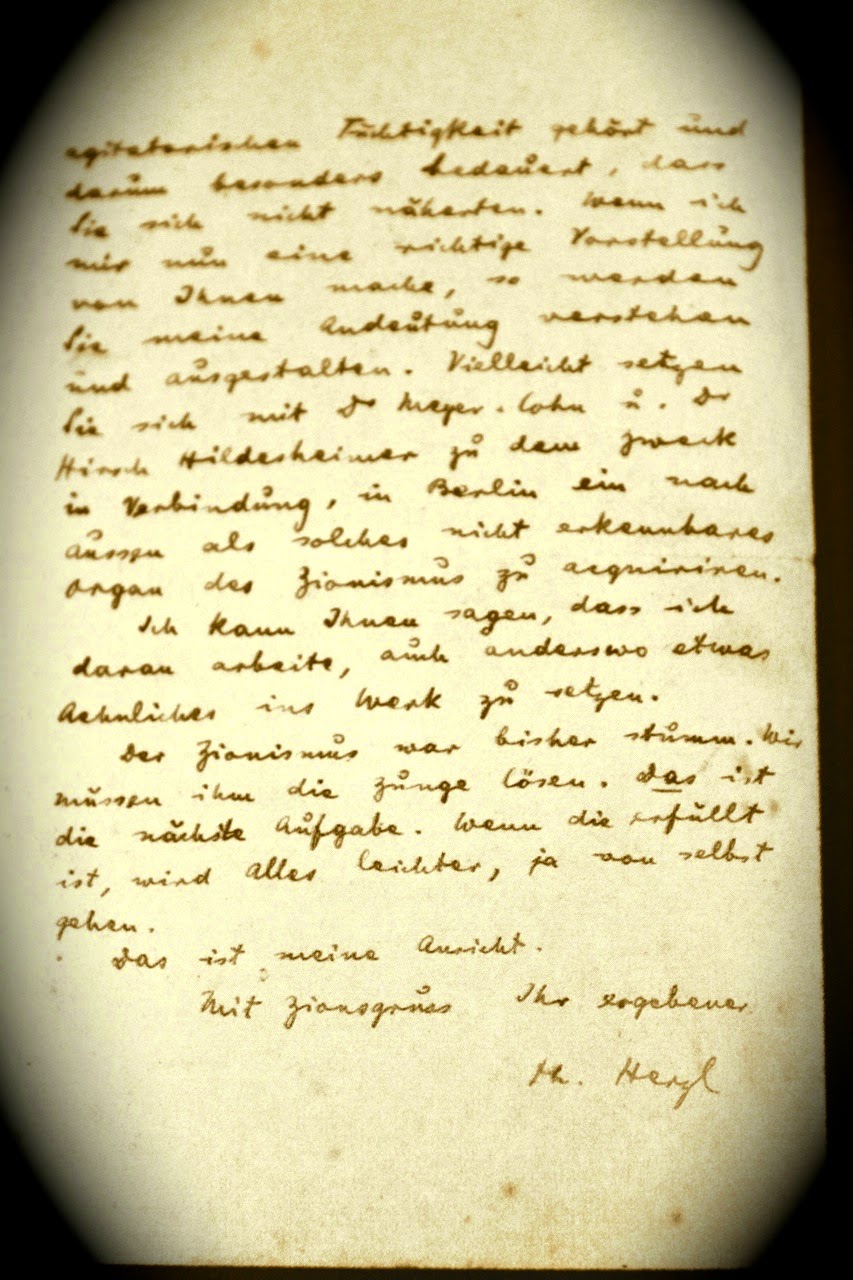
In a little known and rarely-referenced letter written in early 1897, Theodor Herzl, the ostensible founder of political Zionism, made this perfectly clear. During the planning stages of the First Zionist Congress – initially to take place in Munich but eventually held in Basel, Switzerland in late August 1897 – Herzl contacted Willy Bambus, leader of the Berlin Hovevei Zion society (an early Zionist organization committed to Jewish immigration and agricultural settlement in Palestine), for support.
“I want to reach an understanding with the Berlin Zionists,” Herzl wrote from Vienna on January 26, 1897. “[I]n the general Zionist conference that I am planning for next summer, we will grow closer to each other.” The letter is written in German, Herzl’s first language.
Herzl’s dream was big and he knew what he needed to achieve it:
But a project of this sort… has one prior condition: propaganda. First we must have propaganda and afterward establish economic projects… [T]ry to win influence at a Berlin daily newspaper… There is no necessity to immediately give the newspaper a Zionist imprint. On the contrary, because of the cowardly suspicions (to my sorrow, of most of the Jews) of Zionism, it would be wiser to keep things innocent… Perhaps you can… purchase a Zionist paper in Berlin, that will not be outwardly noticed as such.
Friendly media coverage? Feigned innocence and impartiality? Sounds familiar.
“Until now Zionism has been silent,” Herzl wrote Bambus. “We must free its tongue. This is the first order of business.”
Those tongues of Zionism have since wrought over a century of pain and suffering, in name the entitlement and privilege, to the people of Palestine. It is time to drown out the propaganda with truth.
President of the Canadian Green Party channels Mark Regev
Interventions Watch | July 28, 2014
Paul Estrin is the President of the Green Party of Canada. He recently shared his thoughts on the current fighting in Israel and Gaza.
I thought his comments were worth going over in some detail, if only because they’re so incongruous with what I believe to be some fundamental ‘Green’ principles: namely equality, social justice, human rights and self-determination.
So without further ado . . .
On the Israeli ‘withdrawal’ from Gaza in 2005, Estrin writes:
‘Israel decided to leave, fighting its own citizens, showing once more that it sticks to its word about the settlements not being permanent, but instead something to be removed painfully if peace is achievable to be had’.
But Alvaro De Soto, who was the U.N.’s Peace Envoy to the Middle East at the time, gives quite a different version of events.
In a leaked U.N. report from 2007, he writes that:
‘I don’t think the disengagement marked in any way a conversion by Sharon to the idea of an independent and viable Palestinian state – on the contrary, it was basically a spectacular move that killed and put into ‘formaldehyde’ the Road Map, to quote his key advisor. Sharon used the disengagement to gain vital concessions from the U.S. – including the Bush letter of assurances on retention of settlement blocs and non-return of Palestinian refugees to Israel – while proceeding with the construction of the barrier and the implementation of more settlers in the West Bank’.
http://image.guardian.co.uk/sys-files/Guardian/documents/2007/06/12/DeSotoReport.pdf – p.8
The number of settlers living in the Occupied West Bank and East Jerusalem has increased by over 100’000 since 2005, giving credence to De Soto’s analysis.
The De Soto report also disputes that the Israeli occupation of Gaza ever ended, saying that:
‘Since, as I recall, the test of occupation in international law is effective control of the population, few international lawyers contest the assessment that Gaza remains occupied, with it’s connections to the outside world by land, sea and air in the hands of Israel’.
http://image.guardian.co.uk/sys-files/Guardian/documents/2007/06/12/DeSotoReport.pdf – p.10
That remains as true in 2014 as it was in 2007, and mainstream Human Rights NGOs like Amnesty International and Human Rights Watch concur.
On how Hamas came to be the dominant political force in Gaza, Estrin writes:
‘And then Hamas took power. It has nearly been ten years. Since August 2005, Gazans have been in control of their own destiny’.
It might be worth mentioning here that Hamas actually won parliamentary elections in 2006.
The usual narrative is then to say that Hamas went on to wrest complete control of Gaza in a coup in 2007, driving Fatah out in the process. But that isn’t the full story.
Another facet to the story is that elements in Fatah, working alongside Israel and a George Bush/Condoleezza Rice/Elliot Abrams axis in the U.S., had themselves planned a coup to overthrow Hamas – the democratically elected government of the Occupied Palestinian Territories, remember – and Hamas had simply got wind and pre-empted it.
This is according a lengthy Vanity Fair article based on leaked documents and the testimony of some of those involved.
Either way, to say that Hamas simply ‘took power’ is to remove some important context (and the claim that ‘Gazans have been in control of their own destiny’ since 2005 is just downright false, for reasons already mentioned).
On the state of the economy in Gaza, Estrin writes:
‘instead of showing openness to the world, or managing, or caring . . . Gaza has instead shown that it is not interested in peace, in building a stable economy, in a secure future’.
Notice here that he’s stopped referring to ‘Hamas’, and is openly referring to Gaza as a whole. And Gaza as a whole is not ‘interested in peace, in building a stable economy, in a secure future’, apparently. Is he implying a kind of collective guilt?
But it is no secret that, since 2007, Israel has been deliberately trying to strangle the Gazan economy, as a means of inflicting collective punishment on the population of Gaza. That’s what the so-called blockade is expressly designed to do.
As the International Committee of the Red Cross put it in 2010:
‘The closure imposed on the Gaza Strip is about to enter its fourth year, choking off any real possibility of economic development . . . The whole of Gaza’s civilian population is being punished for acts for which they bear no responsibility. The closure therefore constitutes a collective punishment imposed in clear violation of Israel’s obligations under international humanitarian law’.
http://www.icrc.org/eng/resources/documents/update/palestine-update-140610.htm
Estrin is quite simply engaged in victim blaming here. Lambasting Gazans for not building their economy, while Israel has been deliberately implementing policies to prevent them doing so.
And I just wonder how the U.S., U.K. and Canada would manage their economies if a near total ban on imports and exports was placed on them, and their means of production were destroyed via aerial bombardment every couple of years.
On the Hamas charter, Estrin writes:
‘In Canada and elsewhere, national charters protect the people. In Gaza, the first article calls for the death of Israel and the Jew. (Let me quote just a bit: “Israel will exist and will continue to exist until Islam will obliterate it, just as it obliterated others before it”‘.
Personally, I’m more perturbed by the fact that whole areas of Gaza are being obliterated right now, than I am about what a Charter written in 1988 says.
And there are in fact real questions over just how relevant to Hamas’ political program the 1988 charter is anymore.
In January 2009, Jeremy Greenstock – who is a former U.K. ambassador to the U.N., and who has negotiated with Hamas leaders as part of his work with the Ditchley Foundation – told BBC Radio 4’s Today program that Hamas:
‘ . . . are not intent on the destruction of Israel. That is a rhetorical statement of resistance . . . The charter was drawn up by a Hamas linked Imam some years ago, and has never been adopted, since Hamas was elected as the Palestinian government in January 2006, as part of their political program. This is a grievance based organisation desperate to end the occupation’.
http://news.bbc.co.uk/today/hi/today/newsid_7823000/7823746.stm
Greenstock is Establishment to the bone, and yet even he recognises that the focus on Hamas’ charter is a red herring while Israel continues to build settlements in the Occupied West Bank and East Jerusalem, thus making a just two-state solution a virtual impossibility.
On Gaza Vs Syria, Estrin writes:
‘It looks very bad for Israel. 800+ Gazans dead. 1000s injured. Lots of destruction. Meanwhile, in Syria, how many hundreds of thousands of people, including so many Palestinians, are dead or injured … where are the inflammatory protests …’.
This is basically a claim that Israel is being unfairly singled out as compared to Syria.
First and foremost, it’s worth pointing out that the regime in Israel is heavily supported by the governments of the U.K., U.S.A. and Canada. That support takes the form of military sales, economic aid, general praise and diplomatic protection (e.g. the U.S. using its veto to thwart attempts by the U.N.S.C. to hold Israel accountable for its serial war crimes).
I suspect that protests against Israel in the U.K., U.S.A. and Canada are as much designed to get the respective governments in those countries to stop facilitating Israeli crimes as they are designed to express outrage at Israel itself.
Such support for the Assad regime, however, hasn’t been forthcoming from said same governments, and so there have been no protests designed to stop it.
You could argue that there should still have been more protests against the Assad regime regardless, but that doesn’t change this basic context.
And indeed, in other important ways, Israel is actually being given highly preferential treatment as compared to Syria. There is no talk of formally sanctioning Israel, for example. No talk of ‘no-fly zones’ or ‘humanitarian intervention’, and no talk of equipping Palestinian rebels with high-tech weaponry so they can better defend themselves and their people.
Compare that to Syria now or Libya in February 2011, when some or all of those things were put on the agenda pretty much straight away, and were then carried out to a greater or lesser degree (for reasons that had nothing to do with humanitarianism or human rights, obviously).
Israel is literally getting away with mass murder scot free, for the third time in five years, and so the idea of Israel being singled out is simply untenable.
On the people who have attended protests against Israeli state violence over the last couple of weeks, Estrin writes:
‘if it is anti-Israel it is an easy band-wagon to get on, to get their anti-Israel war-paint on and join their friends between potlucks, veggie smoothies and coffee breaks’.
Seriously, why didn’t he just call them Long Haired Hippy Freaks and have done with it?
On Israel’s military tactics, Estrin writes:
‘Military experts look at Israel’s military strategy: No carpet bombing, no quick actions, but instead pinpoint strikes whilst warning the enemy in advance of what their plans are, and slow movements . . . What other military calls up the enemy on their phone to tell them that their building will be bombed, to kindly leave, yes, you have enough time to leave, just thought it would be the neighbourly thing to do … anyone else in war, and that is what Hamas is calling this time in Gaza, would simply bomb, kill and destroy’.
Once again, research carried out by mainstream human rights organisations belies this claim that the IDF is a profoundly moral army that tries its hardest to avoid inflicting civilian casualties.
On July 16th, Human Rights Watch published a short report documenting how:
‘Israeli air attacks . . . have been targeting apparent civilian structures and killing civilians in violation of the laws of war . . . Recent documented cases in Gaza sadly fit Israel’s long record of unlawful airstrikes with high civilian casualties’.
On July 21st, Amnesty International published a short report documenting how:
‘Israel’s continuing bombardment of civilian homes in several areas of the Gaza Strip, as well as the shelling of a hospital, add to the list of possible war crimes that demand an urgent independent international investigation’.
http://www.amnesty.org.uk/press-releases/israelgaza-attacks-hospitals-are-possible-war-crimes
Also on July 21st, Medicins Sans Frontieres published a short report documenting how:
‘Since the beginning of Operation Protective Edge in the Gaza Strip, the majority of the dead and wounded in Gaza are civilians and medical workers are also coming under fire’.
http://www.msf.org/article/gaza-strip-israel-must-stop-bombing-trapped-civilians
Circa 1,000 Palestinian civilians now lie dead, hundreds of homes have been destroyed, and over 100’00 civilians have been displaced. ‘Hell of a pin-point operation’, as John Kerry said.
I am absolutely certain that when international investigators get into Gaza and research these attacks in more detail, they will conclude that Israel has indeed been wilfully targeting civilian infrastructure, and systemically as well, to the extent that both war crimes and Crimes against Humanity have been committed by them.
On ‘Gaza’s’ respect for human life, Estrin writes:
‘And that is it in a nutshell: Whilst Israel does all that is in its power to protect the lives of all its citizens and the lives of those it is attacking, Gaza does all in its power to have all the more die’.
Once again, Estrin is engaged in shameless victim blaming here, and once again he is referring to ‘Gaza’ as a whole. They are trying to get themselves killed in large numbers, see, to make Israel look bad.
But I wouldn’t be at all surprised if, as on previous occasions, the claim that Hamas uses Palestinians as ‘human shields’ turns out to be without foundation – Israeli propaganda, in other words.
For example, the BBC’s senior middle east correspondent, Jeremy Bowen, recently wrote in an article for the New Statesman :
‘I saw no evidence during my week in Gaza of Israel’s accusation that Hamas uses Palestinians as human shields’.
And as they are doing now, Israeli spokespeople also continually accused Hamas of using ‘human shields’ during Operation Cast Lead in 2008/2009, but the Goldstone Report found:
‘ . . . no evidence . . . to suggest that Palestinian armed groups either directed civilians to areas where attacks were being launched or that they forced civilians to remain within the vicinity of the attacks’.
http://www2.ohchr.org/english/bodies/hrcouncil/docs/12session/A-HRC-12-48.pdf – p.18
They did, however, uncover:
‘ . . . four incidents in which the Israeli armed forces coerced Palestinian civilian men at gunpoint to take part in house searches during the military operations . . . The Mission concludes that this practice amounts to the use of Palestinian civilians as human shields and is therefore prohibited by international humanitarian law’.
http://www2.ohchr.org/english/bodies/hrcouncil/docs/12session/A-HRC-12-48.pdf – p.22/23
So if anything, it is the IDF, and not Hamas, who have form for using Palestinians as ‘human shields’ in this kind of operation.
To conclude:
Only in the bizarro world inhabited by apologists for Israeli state violence is Gaza free from occupation, and Israel keen on ending the settlement enterprise in the Occupied West Bank and East Jerusalem.
Only in the bizarro world inhabited by apologists for Israeli state violence are Gazans responsible for the ruination of their own economy, and desperate to get themselves killed.
And only in the bizarro world inhabited by apologists for Israeli state violence does the IDF make strenuous efforts to avoid civilian casualties.
In the real world inhabited by the rest of us, the complete opposite is true, and demonstrably so.
Estrin has apparently chosen to firmly ensconce himself in that bizarro world, and its to the detriment of the Green Party of Canada.
Featured Video

Matt Bracken: US Plans Massive MOAB Strike on Iran?
or go to
Aletho News Archives – Video-Images
New Book
The silver that medicine dropped — four thousand years of clinical use, four decades to erase.
Colloidal Silver — First Edition, 2026, Paperback
Lies are Unbekoming | October 16, 2026
Silver was medicine. Not alternative medicine. Not folk medicine. Medicine. In surgery. In obstetrics. In the burn ward. In water treatment. In the household medicine chest. Every physician before 1938 knew this.
By the 1870s, silver nitrate was standard in surgical wound care across the leading hospitals of Britain, Germany, and the United States. Colloidal silver preparations — Collargol, Argyrol, Protargol — entered European and American practice through the 1890s and early 1900s and became standard antiseptics in military field medicine. By the time Fleming grew his first penicillin mould in 1928, silver was the first-line antimicrobial of the Western pharmacopoeia. The Lancet and the British Medical Journal carried the clinical reports in volume. The practice ran continuously through the Victorian era, the Edwardian era, the First World War, the interwar period. By 1980, almost all of it was gone.
What has not been treated at book length, until now, is how a four-thousand-year clinical record disappeared from mainstream medicine within four decades of the Flexner Report — and what the honest account of silver looks like once that record is reassembled.
Colloidal Silver reconstructs the pre-1938 record from The Lancet, the British Medical Journal, and the primary literature of the era; recovers Robert Becker’s bioelectric framework from the regeneration research the pharmaceutical model buried; and places silver inside a practical terrain-paradigm guide to its current place — in water, on the body, inside the body, and in the chronic conditions where antibiotics have failed. … continue
Blog Roll
 Aletho News
- Inside Bill C-22, Canada’s Patriot Act.
- China’s FM: Palestinian cause is ‘greatest injustice of the century’
- US sympathy for Palestinians surpasses support for Israelis
- Israeli rabbi permits occupiers to steal Palestinian olive harvest in West Bank
- Spanish firm sells Latvia vehicles equipped with Israeli tech despite arms embargo
- Saudi Arabia under fire… Yemen is burning down the House of Saud
- Israeli Spy Pollard stole the files, today’s it’s delivered through official channels
- Why Iran Didn’t Walk Away
- US arms supplied to Ukraine found in war-torn Sudan – Moscow
- The silver that medicine dropped — four thousand years of clinical use, four decades to erase.
- If Americans Knew
- NPR investigation finds evidence of widespread fraud at mall kiosks tied to Israeli skincare brand
- Tucker Carlson exposes Israeli Lies about the Oct 7th attack, Charlie Kirk, and the U.S.
- Israel has detained thousands of Palestinian children since Oct 7th – over half spent time in solitary, many uncharged
- Israeli Analysis: Is Netanyahu Planning an ‘October Surprise’ Attack Before Israel’s Election?
- Israeli settlers brutally attack Palestinians and Washington Post female photographer, 65
- Words Have Changed, Occupation Continues: The Reality of the Gaza Ceasefire
- Gaza’s child amputees are growing faster than their prosthetics allow
- Israel keeps Palestinians struggling just to survive–Daily Update
- Israeli firm used online ads to run vast spy operation, researchers say
- No, the world zionist movement is not an antisemitic conspiracy theory
- No Tricks Zone
- New Study Suggests Large Regions Of The Pacific Ocean Have Been Cooling For The Last 80 Years
- Germany’s Green Energy Debacle: High Energy Costs Force Kahla Porzellan to Close After 182 Years!
- New Study: 50 Years Of The Most Aggressive ‘Net Zero’ Policies Can Only Affect The Global Climate By 0.03°C
- US September “Heat” Was No Record…Many Records Set Decades Ago
- Latest European Green Energy Debacle; Portugal’s Largest Flagship Solar Park Insolvent!
- Green Energy Debacle: German Expert Professor Fritz Vahrenholt Warns Of Severe Economic And Social Consequences
- Two More Paleo Reconstructions Affirm Meters-Higher Sea Levels Across Ireland, Brazil 7000-6000 Years Ago
- New Study: Earth And Venus Surface Warmth Largely Explained By Convection And Lapse Rate, Not CO2 Or Radiation
- 2025 Nature Paper Claiming Worsening Global Drought Gets RETRACTED …Heavily Flawed
- New Study: ‘Global Drought Shows No Detectable Recent Acceleration Under Climate Warming’

