Why the Draft Never Stopped a War
 It was the Vietnamese Who Stopped the US War Machine

By JONATHAN CARP | CounterPunch | October 17, 2013
In 2011 I sat on a panel discussion at King’s Books in Tacoma, Washington, on the subject of the effect of the wars in Iraq and Afghanistan on soldiers and their families. My prepared remarks were a discussion of the impact of repeated deployments on the families I saw on the labor and delivery floor where I worked, but during the discussion after I was startled to hear a forceful call for the re-reinstatement of the draft from one of my fellow panelists- a call that met with widespread cheers from the audience.
Since then I’ve seen many, many more calls for a draft from ostensibly anti-interventionist voices, most recently in Andrew Bacevich’s latest book. The underlying premise of these calls, sometimes made explicit and sometimes not, is that a draft would stop America’s lust for war and foreign interventions because it would force the burdens of war to be spread more equally. The draft has been damned, and rightly so, for being a form of slavery and at times a particularly murderous one at that, but even those who might get the vapors at the idea of seeing American solders as slaves cannot deny the simple historical fact that the draft has never, ever- not once- stopped or slowed or in any way inhibited the conduct of a war.
The first American war fought with conscription was the first American war, the Revolution, and it was fought all the way to its conclusion. The next war fought with conscripts, the Civil War, claimed more American lives than any other and while the draft helped provoke some riots, most notably a draft protest turned anti-black pogrom in New York City, that war too was fought all the way to the bloody finish. The First and Second World Wars as well were fought largely with draftees and fought to the bitter end, in the latter case with the immolation of two major cities by a hideous new weapon delivered by aircraft in part manned by draftees.
Korea and especially Vietnam form what the pro-draft lobby thinks of as the lynchpin of their case. The conventional narrative of resistance to the war in Vietnam is of Middle America tiring of seeing its sons’ lives destroyed by Westmoreland’s war of attrition and rising up, of LBJ allegedly saying “If I’ve lost Cronkite, I’ve lost Middle America.” Supposedly the marches in the streets somehow persuaded the American government to leave Vietnam. What this narrative leaves out is what actually stopped the American war in Vietnam–the Vietnamese.
The American Revolution, the Civil War, the World Wars- for the American government, these were all victorious wars. Victory is very popular; victorious wars, however obviously aggressive or absurdly unjust, rarely generate any significant resistance. But in Vietnam, America was not winning. America was losing, and badly. Middle America was in the streets against Vietnam, it is true, but they weren’t there because Johnny was coming home in a box. They were there because Johnny was losing.
The pro-draft narrative of domestic resistance to the Vietnam War is at heart a racist, imperialist narrative, denying the Vietnamese their place as actors in their own history, giving pride of place to white Americans holding signs in the street over Vietnamese peasants giving their lives to drive out yet another imperialist power coming to lord over their country. What stopped the Vietnam War was not a college kid with a sign; it was a rice farmer with an AK-47. Americans only get upset about draftees dying when they are dying in a losing war, and credit for resistance to such wars goes not to Americans at home but to the victims of the American government abroad.
The idea that if only everyone had to share the burden, war would be less popular seems intuitive and appealing, but history reveals it to be deluded. Victory makes wars popular, and defeat makes them unpopular. To try to stop the war machine from inside the imperial center, we must do whatever we can to gum up its works, be it counter-recruiting, supporting GI resistance, spreading awareness about the costs of militarism, tax resistance, or anything else that might help. And while we might debate their ultimate aims as Communists in Vietnam or Islamic radicals in Iraq, we must always remember that the people who do the most to stop the war machine are the people who take up arms against it.
Jonathan Carp is a member of Iraq Veterans Against the War and a nurse. He lives in Tacoma, WA.
The Crying of Flight 655: The Washington Post and the White-Washing of a War Crime
By Nima Shirazi | Wide Asleep in America | October 16, 2013
Here’s how Washington Post foreign affairs blogger Max Fisher tells the story – virtually unknown here in the United States – of the downing of Iran Air Flight 655, which occurred 25 years ago during the Iran-Iraq War:
Toward the end of the war, on July 3, 1988, a U.S. Navy ship called the Vincennes was exchanging fire with small Iranian ships in the Persian Gulf. The U.S. Navy kept ships there, and still does, to protect oil trade routes. As the American and Iranian ships skirmished, Iran Air Flight 655 took off from nearby Bandar Abbas International Airport, bound for Dubai. The airport was used by both civilian and military aircraft. The Vincennes mistook the lumbering Airbus A300 civilian airliner for a much smaller and faster F-14 fighter jet, perhaps in the heat of battle or perhaps because the flight allegedly did not identify itself. It fired two surface-to-air missiles, killing all 290 passengers and crew members on board.
Fisher – who based his post on a new TIME magazine piece noting a number of valid Iranian grievances with the West – writes that the “horrible incident” helped cement Iranian enmity toward the United States government, but intimates that the whole episode was just a random mistake, an innocent fluke, albeit with tragic and long-lingering consequences. To this end, he quotes notorious war propagandist Kenneth Pollack of the Brookings Institute’s Saban Center, presumably because Pollack was the most egregious serial fabricator Fisher could find with a quick Google search of “Iran Air Flight 655” and “accident.”
Quoting from Pollack’s 2004 compendium of conventional wisdom and glaring inaccuracies, “The Persian Puzzle,” Fisher adds, “The shoot-down of Iran Air flight 655 was an accident, but that is not how it was seen in Tehran. The Iranian government assumed that the attack had been purposeful… Tehran convinced itself that Washington was trying to signal that the United States had decided to openly enter the war on Iraq’s side.”
Fisher recounts this story in order to explain why Iranian officials and diplomats might not view their American counterparts as trustworthy interlocutors when it comes to diplomacy over its nuclear program. He writes, “If Iran believes that the United States is so committed to its destruction that it would willingly shoot down a plane full of Iranian civilians, then Tehran has every incentive to assume we’re lying in negotiations.”
Yet, both Pollack’s explanation and Fisher’s insinuation grossly decontextualize and sanitize the American role in the later stage of the Iran-Iraq War in general, and the destruction of Flight 655 in particular. To claim that – in mid-1988, no less – Tehran had to somehow “convince itself” that the Reagan administration was merely attempting to enter the war as a combatant, in aggressive and lethal support of Saddam Hussein’s Iraq, is bizarre. Iran didn’t have to invent such a scenario; it was already an established fact.
Beyond training Iraqi troops, providing intelligence and shipping arms to Iraq, and facilitating the use of chemical weapons against Iranian civilians, by 1987 the U.S. military was also helping Iraq “carry out long-range strikes against key Iranian targets, using U.S. ships as navigational aids,” according to Barry Lando in his book, “Web of Deceit: The History of Western Complicity in Iraq, from Churchill to Kennedy to George W. Bush.”
As one senior U.S. officer told ABC’s Nightline, “We became forward air controllers for the Iraqi Air Force.”
In July 1987, the CIA began a reconnaissance program, code-named Eager Glacier, that, as reported by John Barry in Newsweek some years later, “sent spy planes and helicopters flying over Iranian bases… Navy SEALs, manning Mark III patrol boats, were stationed on two giant floating barges, and special operations helicopter units first the Little Birds of the army’s Delta Task Force 160, later joined by the specially built gunship Warriors of Task Force 118–roamed the gulf by night.”
The purpose of this kind of American firepower in the Persian Gulf was clear. Lando writes, “Their mission was to destroy any Iranian gunboats they could find. Other small, swift American vessels, posing as commercial ships, lured Iranian naval vessels into international waters to attack them. The Americans often claimed they attacked the Iranian ships only after the Iranians first menaced neutral ships plying the Gulf. In some cases however, the neutral ships which the Americans claimed to be defending didn’t even exist.”
By August 1987, the U.S. Navy was conducting direct military attacks on Iranian aircraft and sea vessels. In early August, the Financial Times reported that “a carrier-borne F-14 Tomcat fighter unleashed two missiles at an Iranian jet spotted on its radar which had flown too close for comfort to an unarmed US surveillance aircraft.” On September 23 of that year, the Washington Post reported, “U.S. Navy commandos yesterday boarded and captured the Iranian navy ship that was attacked by American helicopters Monday in the Persian Gulf,” killing three Iranian sailors. An additional 26 Iranian crew members were detained. The same day, “the U.S. frigate involved in the attack fired warning shots at an Iranian hovercraft as it sped toward U.S. warships gathered near the disabled Iranian vessel, officials said.”
A few weeks later, in early October, three Iranian ships were sunk by the U.S. Navy; later that month the Americans attacked two Iranian oil platforms. In April 1988, not only did a U.S. warship fire missiles at Iranian jets over the Persian Gulf, but two more oil platforms were destroyed and at least six Iranian ships were either crippled or sunk by American naval forces.
Fifteen years after these events, the International Criminal Court determined that “the actions of the United States of America against Iranian oil platforms on 19 October 1987 (Operation Nimble Archer) and 18 April 1988 (Operation Praying Mantis) cannot be justified as measures necessary to protect the essential security interests of the United States of America.”
Then, on July 3, 1998, shortly after taking off from Bandar Abbas, the Dubai-bound Iran Air Flight 655 was blown out of the sky on the orders of U.S. Navy Commander William C. Rogers III of the USS Vincennes, a Ticonderoga class AEGIS guided missile cruiser. The two surface-to-missiles fired at the Iranian Airbus A300B2, a commercial flight that traveled along the same route every morning, obliterated the aircraft in broad daylight, killing all 290 civilians on aboard, including 66 children under the age of 12.
U.S. government white-washing was swift.
In a statement issued soon after the attack, U.S. President Ronald Reagan called the incident “a terrible human tragedy,” but justified it as “a proper defensive action by the U.S.S. Vincennes” after “the aircraft failed to heed repeated warnings.”
Reporting on the downing of Iran Air Flight 655 an Associated Press report claimed on July 3, 1988 that the “Pentagon said U.S. Navy forces in the gulf sank two Iranian patrol boats and downed an F-14 fighter jet in the Strait of Hormuz on Sunday during an exchange of fire.” Iran disputed this version of events, insisting that plane attacked had been a civilian airliner and that nearly 300 civilians on board had been killed in the assault. AP noted, “U.S. Navy officials in the gulf denied the Iranian claim.”
In reaction to Iranian statements, President Reagan reportedly quipped, “Well, I don’t go by what the Iranians say, ever.”
Following the attack on Flight 655, Admiral William J. Crowe Jr., Chairman of the Joint Chiefs of Staff, outlined what he called the “threatening flight profile” of the airplane the U.S. Navy ship had blown up. He told reporters that the Iranian plane had been “outside the prescribed commercial air corridor,” that it “headed directly for Vincennes,” that “there were electronic indications on Vincennes that led it to believe that the aircraft was an F-14” and that the plane was “decreasing in altitude as it neared the ship.”
Crowe also maintained that the Vincennes, which, according to the Washington Post at the time, “was equipped with the most sophisticated radar and electronic battle gear in the Navy’s surface arsenal,” was “outside of Iranian territorial waters” when it fired at the Iranian aircraft.
“We do have some eyewitness reports that saw the vague shape of the aircraft when the missile hit,” Crowe told reporters, “and it looked like it disintegrated.” He also defended Commander Rogers’ actions as “logical”, saying, “The commanding officer conducted himself with circumspection and, considering the information that was available to him, followed his authorities and acted with good judgment at a very trying period and under very trying circumstances.”
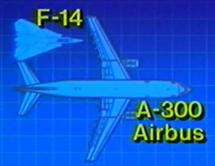
The official story was that the crew of the Vincennes mistook the massive, lumbering Airbus for a small, supersonic F-14 Tomcat making attack maneuvers.
The following day, July 4, Reagan issued a report to Congress in which he stated the USS Vincennes had been “operating in international waters of the Persian Gulf” and that following “indications that approximately a dozen Iranian small boats were congregating to attack merchant shipping, the Vincennes sent a Mark III Lamps Helicopter on investigative patrol in international airspace to assess the situation.” The helicopter, Reagan claimed, was fired upon and returned to the ship.
Reagan further declared, “The actions of U.S. forces in response to being attacked by Iranian small boats were taken in accordance with our inherent right of self-defense.” These actions included the downing of Flight 655, which, he said, was “believed to be a hostile Iranian military aircraft.”
In a press briefing on the White House lawn the same day, Reagan claimed that the Iranian airliner had been “lowering its altitude,” indicating an aggressive posture, at the time it was shot down.
The next day, the New York Times editorialized that “while horrifying, it was nonetheless an accident,” concluding, “The onus for avoiding such accidents in the future rests on civilian aircraft: avoid combat zones, fly high, acknowledge warnings.”
At the time, a report by Norman Solomon in Extra! revealed how the U.S. “government’s public relations spin quickly became the mass media’s: A tragic mishap had occurred in the Persian Gulf, amid puzzling behavior of the passenger jet. Blaming the victim was standard fare, as reporters focused on the plight of U.S.S. Vincennes commander Capt. Will Rodgers III, whose picture appeared on tabloid covers (7/5/88) with bold headlines: “Captain’s Anguish” (Newsday) and “Captain’s Agony” (New York Post).”
Naturally, if the Iranian military had blown up a Pan Am flight taking off from Dubai, protestations of self-defense probably wouldn’t find many sympathetic ears in the United States; fewer still would empathize with the personal trauma of murderer who gave the order.
Ten days later, on July 13, 1988, Assistant Secretary of State Richard S. Williamson continued to insist that the Vincennes was “at the time of the incident, in international waters.” The next day, speaking in defense of American actions before the United Nations Security Council, Vice President George H.W. Bush declared, “One thing is clear, and that is that the USS Vincennes acted in self-defense.”
Iran’s allegations that the warship was far too technologically advanced to make such a catastrophic mistake were dismissed by the American government. When questioned about the incident, Bush announced, “I will never apologize for the United States of America, ever. I don’t care what the facts are!”
Nearly all of these claims made by U.S. military and government officials about why Flight 655 was fired upon were lies, and the subsequent investigation was effectively one big cover-up, reports in Newsweek and by Nightline later revealed.
There had been no merchant vessel in distress and no helicopter was ever dispatched from the Vincennes, let alone fired upon. The warnings by Vincennes radio operators had not been broadcast to air traffic control frequencies. There had been no visual confirmation of an approaching or attacking aircraft. Iran Air Flight 655 – with its nearly 300 passengers aboard – was well within its flight corridor, flying comfortably at 12,000 feet and steadily climbing. It had been in the air less than seven minutes. At the time it was hit, it was gradually turning away from where the Vincennes was located. It would have landed in Dubai about twenty minutes later. As John Barry reported in 1992:
Captain [Mohsen] Rezaian of Iran Air was calmly reporting to Bandar Abbas that he had reached his first checkpoint crossing the gulf. He heard none of the Vincennes’s warnings. His four radio bands were taken up with air-control chatter. “Have a nice day,” the tower radioed. “Thank you, good day,” replied the pilot. Thirty seconds later, the first missile blew the left wing off his aircraft.
There were other American naval vessels in the area at the time, none of which mistook the Iranian commercial airliner for a jet fighter, but were unable to act quickly enough to save Flight 655. “A few miles away, on the bridge of the Montgomery, crewmen gaped as a large wing of a commercial airliner, with an engine pod still attached, plummeted into the sea,” Barry reported. “Aboard the USS Sides, 19 miles away, Captain [David] Carlson was told that his top radar man reckoned the plane had been a commercial airliner. Carlson almost vomited, he said later.”
Vincennes commander Rogers was himself known to other naval officers as especially trigger-happy. Captain Carlson, who commanded the Sides, a frigate in the same Surface Action Group as the Vincennes, later said that the Flight 655 disaster “marked the horrifying climax to Rogers’ aggressiveness.”
According to the subsequent government review of the downing of Flight 665, and particularly its Aegis targeting system and the “complex network of radar and computers” onboard the Vincennes, TIME magazine reported that “blame fell not on the machines but on the men who were operating them.”
Nevertheless, not a single member of the crew of the Vincennes received official reprimand or opprobrium from the U.S. Navy or government. Moreover, in what can only be described as an act of staggering hubris, following the end of their deployment in 1989, all crew members aboard the Vincennes were awarded combat-action ribbons, while both Commander Rogers and Lieutenant Commander Scott Lustig, the ship’s tactical coordinator for air warfare, were specifically granted the Navy’s Legion of Merit medal for “meritorious service” and “heroic achievement.”
Rogers was honored “for exceptionally meritorious conduct in the performance of outstanding service as commanding officer… from April 1987 to May 1989,” while Lustig received his citation for his “ability to maintain his poise and confidence under fire,” enabling him to “quickly and precisely complete the firing procedure.”
Iran’s only act of retaliation or retribution for the downing of Flight 655 was bringing forth a legal case for responsibility and restitution. The International Court of Justice awarded the victims of the attack $61 million in compensation for unwarranted loss of life. The U.S government has still never officially apologized to the Iranian people for this heinous crime.
Last year, the Iranian Foreign Ministry Iranian Foreign Ministry issued a statement in commemoration of the tragedy. “This inhumane crime is clear proof of the innocence of the Iranian nation,” it read, “and (provides) clear evidence that the United States is not committed to any international legal and ethical principles and norms, and (it) will remain in the historical memory of the Iranian nation.”
The Washington Post‘s Max Fisher concludes his column, writing, “Americans might not know about Flight 655. But Iranians surely do — they can hardly forget about it.”
While he – and TIME’s Michael Crowley – should be commended for reminding (or informing) their readership about the events of July 3, 1988 and its implications today, they should also remember that telling only part of the story – and allowing American aggression, dishonesty and denial to be dismissed uncritically as an “accident” – does a great disservice to the truth.
The 290 innocent victims deserve better.
NSA practices cannot be excused as ‘fighting terrorism’
RT | October 16, 2013
The NSA has attacked key European institutions such as the EU parliament and banking system, using malware to find out all there is to know about other countries in a power game, Andy Mueller-Moguhn, founder of Buggedplannet.info, tells RT.
He says that in a world where so many communications go over the web we all have something to protect rather than something to hide, as proponents of mass surveillance often argue.
RT: No matter what precautions companies take or measures to protect the privacy of subscribers isn’t the agency [NSA] capable of bypassing all these routes?
Andy Mueller-Moguhn: I would say it like this; unfortunately in Germany we have a situation that the trustworthiness or our foreign and interior intelligence service watching their high level of cooperation with the NSA and GCHQ does not make them trustworthy at all. If they can intercept the stuff, they might hand it over in a bargain to the Americans, which is not helpful.
So this means that what is to be done, is to ensure on whatever level in whatever country that encryption for the end user is becoming available like easy to use and as a standard tool, because you send your postal letters in an envelope so should you do with your emails.
RT: Let’s look at the situation from both sides. On the one hand we have the privacy of citizens that has of course to be respected, but on the other hand there are some companies who are fighting hard to protect their privacy. Doesn’t that give us a cause for concern, that they have something to hide, some skeletons in the closet as they say?
AMM: The point is that we have seen that installations of the United States National Security Agency, attacking also carriers in Europe, as we’ve seen with things that have nothing to do with terrorism or with fighting terrorism. They have a lot to do with power games or with knowing everything about other countries, about business, about embassies, about other country’s governments as we also see with the Brazilian presidential interception.
So obviously the thing that you have nothing to hide is totally wrong in the case that everybody has something to protect and in the days where everything, cultural, economic, political, things go over the internet and advance knowledge of a political decision, which can have for example an impact on stock rates, on currencies, on country’s reputations and so on. This is worth a lot of money and we have not really come to the bottom, we have seen a big part of this NSA approach, we have seen a lot of money, a lot of effort internationally to intercept all communications, but we have not yet come to the question, who is the customer, in the sense who are the guys ordering this, getting the product and using that.
That it is still a very interesting question where we come to monetary, political and other influences being taken with blackmailing, with greymailing, with advanced knowledge about what other people think, act and do.
RT: You mentioned an interesting point here saying that it’s not the point whether we have something to hide, but it’s what we have to protect. In that case what’s your take on the role of America as a global policeman? Does it have any moral authority to conduct global surveillance?
AMM: The point is that we have seen attacks, not passive interception but buggedplannet.info was subject to an attack in the sense that there was malware installed in the system, there were exploits used, the NSA literally took control over the network. This cannot be excused with fighting terrorism at all. This obviously was targeting the European parliament, it was targeting the European airspace control, it was targeting the SWIFT network or the banking network, so obviously there is no moral excuse here in terms of this being to do with fighting terrorism or ensuring security. This is about the global interest of the United States against other European and other peaceful acting countries and democratic organized entities.
Related articles
Egyptian coup leaders hire US lobbyist with ties to Israel
MEMO | October 14, 2013
The group’s managing director, Arik Ben-Zvi, is an Israeli citizen who served in the Israeli army and consulted on Israel’s elections
In response to the Obama Administration’s announcement last week that it will be restructuring US military aid to Egypt in light of the ongoing military crackdown, officials in Cairo have hired a well-known lobby group to improve the image of Egypt’s coup, according to a US newspaper.
The Hill, a political newspaper based in Washington DC, has revealed that documents filed with the US Justice Department on Friday confirm that Egypt’s interim authorities are employing the Glover Park Group to “provide public diplomacy, strategic communications counsel and government relations services” for Egypt’s post-coup government.
The records filed indicate that the firm’s work for Egypt “will include communications associated with the Government’s implementation of its Road Map to build the institutions of an inclusive democratic state through parliamentary and presidential elections.”
The Glover Park Group is no stranger to Israel. The group’s managing director, Arik Ben-Zvi, is an Israeli citizen who served in the Israeli army and consulted on Israel’s elections. In addition, one senior executive previously served as the National Deputy Political Director of the American Israel Public Affairs Committee, also known as AIPAC, the most powerful arm of the Israel Lobby in the US, while another senior executive served in its legislative department.
The newspaper describes the Glover Park Group as one of Washington’s most experienced lobbyists when it comes to representing foreign governments and politicians.
The interim Egyptian government’s “recent violent crackdown on its opponents” has led the United States to suspend some of its foreign aid to Egypt, “including proposed sales of F-16 fighter jets, M1 Abrams tanks and Apache attack helicopters as well as about $260 million in cash assistance,” according to the newspaper.
Related article
Rendition of Libyan Terror Suspect: What If Abu Anas al-Liby Had Nothing to Do With the Embassy Bombings?
By Kevin Gosztola | FDL | October 14, 2013
A Libyan terror suspect kidnapped from Libya in a raid by US special forces on October 5 was transferred from the naval ship, where he was being detained and interrogated, into “law enforcement custody” over the weekend.
The Justice Department indicated in a press release that he was “brought directly to the Southern District of New York, where he has been under indictment for more than a decade.” He was expected to be brought before a judge on October 15.
Al-Liby is suspected of being involved in the bombings of US Embassies in Kenya and Tanzania in 1998.
Last week, a chief federal public defender, David E. Patton, according to the Los Angeles Times, had pressed a federal judge to order that he be “brought to court immediately,” as he was aboard a ship being interrogated by the High Value Detainee Interrogation Group, which is a special task force of personnel from the Pentagon, FBI, CIA and other agencies. He had not been read Miranda rights, which he and other terror suspects have a right to be read if they are being prosecuted under US law. But a federal judge would not issue such an order and would not appoint a defense lawyer to represent him either.
A more critical issue is that al-Liby, whose real name is Nazih Abdul-Hamed al-Ruqai, may not be the dangerous al Qaeda terrorist the United States government believes he happens to be.
American-British foreign correspondent Jamie Dettmer interviewed family members of al-Liby, who suggested just last month he had “talked with the Libyan attorney general and the head of intelligence to say he was keen to clear his name of the bombing accusations and was ready to face any Libyan judicial inquiry they deemed necessary. He was prepared for an American interrogation—in Libya. [Dettmer saw a copy of a letter from the attorney general’s office dated September 15, 2013, that confirmed his father’s discussions.]
Umm Abdul Rahman, al-Liby’s wife, explained to Dettmer that in the 1990s, at the same time as the bombings, they were living in Britain and “under tight surveillance, with their home being raided frequently and her husband’s computers seized.” Rahman was “sure that if British intelligence had any evidence, they would have acted and the British authorities would have agreed to an extradition request made by the Americans during their stint in the UK.” Al-Liby’s family essentially decided to flee Britain because the surveillance and harassment was no longer tolerable and were allowed to legally leave the country.
Although she admitted he had been affiliated with al Qaeda and was a member for a period, he left at some point in the mid-1990s to join the Libyan Islamic Fighting Group (LIFG), which was formed by Islamic dissidents to overthrow Muammar Gaddafi. She contended that allegations by the US government that he was now overseeing al Qaeda groups in North Africa were “untrue.” She showed Dettmer a copy of a document that showed he was trying to get back his job as a computer engineer for the Ministry of Oil. [Gaddafi convinced President George W. Bush’s administration that LIFG members were jihadists and a number were victims of rendition, detention and torture. They were transferred to Libya where they were abused.]
Dettmer’s story suggests that the rendition of al-Liby deprived him of a key due process he should have had in Libya. Al-Liby was obviously ready to offer up any information on his past and evidence of crimes could have been passed on to the US government. Rather than allow this to take place, he was abducted.
If the US had requested that he be extradited to face charges for his alleged role in the embassy bombings, he could have challenged the allegations in a court in Libya. He could have argued that if he was tried in the US he would not receive a fair trial and, if convicted, he would likely be held in a supermax prison and subjected to conditions of solitary confinement that were cruel and inhuman. He could have also argued that he might be deprived other due process rights, like a right to a lawyer.
This is what makes rendition a violation of international human rights law. The abduction of a person is clearly intended to bypass a process that he should have been afforded because President Barack Obama’s administration was unwilling to wait for the Libyan government to extradite him.
Libyan Prime Minister Ali Zidan, who was kidnapped and released by militants angry the US raid had occurred, has called the snatch and grab of al-Liby a “kidnapping.” But no clear proof exists yet that Zidan did not privately grant consent to US forces to conduct a raid and remove him from Libya.
Even if Zidan granted consent to the US government, that does not necessarily make it any more lawful. It would mean Zidan had agreed to deprive due process rights to al-Liby and allow him to be transported to a navy ship vessel, where he could not guarantee that al-Liby’s human rights would be protected.
Al-Liby may be suspected of bombing US embassies, and, if there is any evidence to support this serious allegation, he should have been able to defend himself in a court of law before being handed over to US custody.
As Jeremy Scahill has eloquently stated, “Our values are not defined by how we treat the rich and the powerful and the popular. It’s defined by how we treat the least of our people, how we treat the poorest. And it’s also how we treat the most reprehensible.”
Unfortunately for al-Liby, a process may have been set in motion that virtually guarantees he will be imprisoned for a lengthy period of time. He may not be responsible for the bombings but his past history with al Qaeda—even though Britain found no evidence of crimes—may discourage a judge from letting him return to Libya.
That the due process he will be given in the United States is likely to take place under a cloud of fear is why renditions of terrorist suspects should be opposed.
Related article
NSA Claims It Doesn’t Do Online Attacks; That’s A Different Organization… Run By The NSA
By Mike Masnick | Techdirt | October 14, 2013
There are times you just shake your head and wonder who the NSA top officials think they’re kidding with their statements. Take, for example, some recent comments from the NSA’s number two guy in charge, Chris Inglis, the Deputy Director, who gave an interview to the BBC where he tried to paint the NSA as not being quite as bad as everyone says, but admitted that there could be more transparency. That’s all the usual stuff, but the following tidbit caught my eye:
The job of the NSA, Mr Inglis said, was to exploit networks to collect intelligence in cyberspace and to defend certain networks – but not carry out destructive acts.
“NSA had a responsibility from way back, from our earliest days, to both break codes and make codes,” he said. “We have a responsibility to do intelligence in a space we once called the telecommunications arena – now cyberspace – and the responsibility to make codes or to defend signals communications of interest.
“That’s different than what most people conceive as offence or attack in this space.”
That task of destructive cyber attack, if ordered, lies with the US military’s rapidly expanding Cyber Command.
Except, as we’ve noted more than a few times, US Cyber Command is the NSA. It’s run by Keith Alexander, the director of the NSA, and it’s housed in the same place as the NSA. For all intents and purposes, US Cyber Command is the NSA, and Alexander has no problem at all swapping hats depending on what’s most convenient. He regularly tries to talk about “protecting the network” when it suits him, ignoring that the same efforts he’s looking at (greater access to corporate networks) would also make it much easier for the NSA and US Cyber Command to launch offensive attacks — which Snowden’s leaks proved the NSA did hundreds of times.
Pretending the two are different, and that the NSA only focuses on “breaking codes and making codes” is yet another bogus claim from an NSA official, adding to a very long list.
Related articles
- US Cyber Command: Documents Reveal Pentagon Launching Covert Cyber Attacks (dissidentvoice.org)
Thom Hartmann’s ‘Last Hours’ video negated by IPCC AR5
By Anthony Watts | Watts Up With That? | October 13, 2013
From The End is Near department comes this video documentary from lefty talk radio guy Thom Hartmann that claims we are on the verge of a “mass extinction” due to climate change. Only one problem; the IPCC says “no” to his scenario. Ooops.
From the YouTube description, bold mine:
“Last Hours” is the first in a series of short films that explore the perils of climate change and the solutions to avert climate disaster. Each subsequent film will highlight fact-based challenges facing the human race, and offer solutions to ameliorate these crises. The initial short film series will culminate in a feature film to be presented prior to COP21, the 2015 UN Conference on Climate Change in Paris.
An asset for the climate change movement, “Last Hours” will be disseminated globally to awaken modern culture worldwide about the various dangers associated with climate change.
“Last Hours” describes a science-based climate scenario where a tipping point to runaway climate change is triggered by massive releases of frozen methane. Methane, a powerful greenhouse gas, has already started to percolate into the open seas and atmosphere from methane hydrate deposits beneath melting arctic ice, from the warming northern-hemisphere tundra, and from worldwide continental-shelf undersea methane clathrate pools.
Burning fossil fuels release carbon that, principally through greenhouse effect, heat the atmosphere and the seas. This is happening most rapidly at the polar extremes, and this heating has already begun the process of releasing methane. If we do not begin to significantly curtail the use of carbon-based fossil fuels, this freed methane threatens to radically accelerate the speed of global warming, potentially producing a disaster beyond the ability of the human species to adapt.
This first video is designed to awaken people to the fact that the earth has experienced five major extinctions in the deep geologic past — times when more than half of all life on earth vanished — and that we are now entering a sixth extinction. Industrial civilization with its production of greenhouse gases has the ability to trigger a mass extinction; in the extreme, it could threaten not just human civilization, but the very existence of human life on this planet.
The world community and global citizens urgently need to chart a path forward that greatly reduces green house gas emissions. To take action and follow the pathway to solutions to the climate crisis, you can explore this website and you can also sign-up for future updates. Thank you.
It’s the old “methane emergency” meme again.
But here’s the problem.
Apparently Thom never got the memo from the IPCC AR5. Note the third and fourth items in Table 12.4 from the IPCC:

Definitions for this table can be found in the section “TFE.5: Irreversibility and Abrupt Change” in the draft report. They say:
“Abrupt climate change is defined in AR5 as a large-scale change in the climate system that takes place over a few decades or less, persists (or is anticipated to persist) for at least a few decades, and causes substantial disruptions in human and natural systems.”
But alas, IPCC says Clathrate methane release is very unlikely, and they have high confidence in that assessment. Permafrost doesn’t seem to be much of a problem either, as it doesn’t seem to have the potential for abrupt climate change.
Looks like Thom Hartmann will have to rework his video.
Related articles
US denies lawyer for abducted al-Libi
Press TV – October 12, 2013
 A federal judge refused on Friday to allow a court-appointed attorney to represent Abu Anas al-Libi, a Libyan man who was abducted by US military forces in Tripoli on October 5.
The refusal came after some US defense lawyers from the Federal Defenders of New York demanded to be allowed to represent al-Libi, arguing there is no legal basis for holding him “offshore” on a navy vessel.
However, US District Judge Lewis Kaplan claimed it was premature because the Libyan man has not apparently been formally arrested.
“The government denies that any federal criminal arrest has taken place, and there is no evidence to the contrary,” wrote Kaplan.
Kaplan also said even if an arrest is made, the appropriate time to assign counsel would depend on the first court appearance.
Al-Libi was abducted over his alleged involvement in the 1998 twin bombings of US embassies in Kenya and Tanzania and is believed to be held in military custody and interrogated on board a navy ship, the USS Antonio, in the Mediterranean.
According to a law enforcement source, authorities in New York have not indicated when or if he might be brought to the US.
Kaplan said that the Federal Defenders have expressed concerns about the legality of the man’s detention but added that the matter is outside his jurisdiction.
Officials say al-Libi has not been Mirandized, and is facing open-ended interrogation on the ship without access to a lawyer.
Even US Secretary of State John Kerry last week defended al-Libi’s abduction as “legal” and “appropriate.”
Dr. Randy Short, an American human rights activist, who talked Thursday to Press TV on the arrest of al-Libi, said “I am just intrigued that the same government that funded al-Qaeda to destroy Libya” and “the same government [that] funds and supports al-Qaeda which is fighting and killing people in Lebanon and in Syria now goes back retroactively and attack someone who may have even been in their service”.
Featured Video

Trump asks Iran not to retaliate after he strikes Pickaxe Mountain
or go to
Aletho News Archives – Video-Images
Book Review & Summary
Calling of an Angel: The True Story of Rene Caisse and an Indian Herbal Medicine Called Essiac (1988)
Dr. Gary L. Glum – 30 Q&As – Book Review & Summary
Lies are Unbekoming | October 17, 2026
On June 10, 1975, Dr. Chester Stock, a vice president at Memorial Sloan-Kettering Institute for Cancer Research, wrote to a Canadian nurse named Rene Caisse: “Enclosed are test data in two experiments indicating some regressions in sarcoma 180 of mice treated with Essiac.” The sentence sat in a letter from one of the world’s largest private cancer research centers, concerning an herbal tea an elderly English woman had learned from an Ojibwa medicine man at a northern Ontario mining camp in the 1890s. The tests were terminated the following year after Sloan-Kettering admitted, in sworn affidavit three years later, that they had prepared the injectable solution improperly from the dried material supplied — freezing and thawing the herb rather than boiling it as Rene had instructed. By the time Calling of an Angel was published in 1988, Rene Caisse had been dead for a decade, having treated thousands of cancer patients across fifty-six years in her Bracebridge, Ontario kitchen, never charging a fee, and refusing every offer — from Memorial Sloan-Kettering, the National Cancer Institute, Merck, Parke Davis, and private corporations dangling contracts up to $1 million — to release her formula before the medical establishment admitted her remedy had merit. … continue
Blog Roll
 Aletho News
- Trump asks Iran not to retaliate after he strikes Pickaxe Mountain – w/ Prof. Marandi
- Vice President J.D. Vance’s Deceptive ‘Antiwar’ Campaign Speech
- Iran: Palestinians’ rights must not be compromised in Gaza’s future; US, Israel to blame for Hormuz situation
- Ongoing tales of Syrian chemical weapons
- Moscow blasts UN for ignoring torture of Russian POWs
- Millions of Books Could Have Been Destroyed in Lebanon During Israeli Bombings
- Moscow warns of ‘hunt for Russians’
- Calling of an Angel: The True Story of Rene Caisse and an Indian Herbal Medicine Called Essiac (1988)
- South Korean Assistance to the U.S. in the War with Iran: Between Allied Duty and National Interests
- Pharma- and Gates-Funded GAVI Seeks to Assure Parents
- If Americans Knew
- Israeli soldiers debunk Israel’s talking points
- In West Bank, Israeli settlers are totally out of control – Daily Update
- NPR investigation finds evidence of widespread fraud at mall kiosks tied to Israeli skincare brand
- Tucker Carlson exposes Israeli Lies about the Oct 7th attack, Charlie Kirk, and the U.S.
- Israel has detained thousands of Palestinian children since Oct 7th – over half spent time in solitary, many uncharged
- Israeli Analysis: Is Netanyahu Planning an ‘October Surprise’ Attack Before Israel’s Election?
- Israeli settlers brutally attack Palestinians and Washington Post female photographer, 65
- Words Have Changed, Occupation Continues: The Reality of the Gaza Ceasefire
- Gaza’s child amputees are growing faster than their prosthetics allow
- Israel keeps Palestinians struggling just to survive–Daily Update
- No Tricks Zone
- New Study Suggests Large Regions Of The Pacific Ocean Have Been Cooling For The Last 80 Years
- Germany’s Green Energy Debacle: High Energy Costs Force Kahla Porzellan to Close After 182 Years!
- New Study: 50 Years Of The Most Aggressive ‘Net Zero’ Policies Can Only Affect The Global Climate By 0.03°C
- US September “Heat” Was No Record…Many Records Set Decades Ago
- Latest European Green Energy Debacle; Portugal’s Largest Flagship Solar Park Insolvent!
- Green Energy Debacle: German Expert Professor Fritz Vahrenholt Warns Of Severe Economic And Social Consequences
- Two More Paleo Reconstructions Affirm Meters-Higher Sea Levels Across Ireland, Brazil 7000-6000 Years Ago
- New Study: Earth And Venus Surface Warmth Largely Explained By Convection And Lapse Rate, Not CO2 Or Radiation
- 2025 Nature Paper Claiming Worsening Global Drought Gets RETRACTED …Heavily Flawed
- New Study: ‘Global Drought Shows No Detectable Recent Acceleration Under Climate Warming’

