Venezuela Rejects U.S. Version of Maduro Airspace Prohibition Dispute
By Ewan Robertson | Venezuelanalysis | September 20, 2013
Mérida – Venezuela has rejected the United States’ version of events in the dispute over President Nicolas Maduro’s passage through U.S. airspace last night.
The diplomatic fallout reached media attention when Venezuelan foreign minister Elias Jaua told reporters yesterday that President Maduro had been denied permission to fly through U.S. airspace.
According to Venezuelan officials, the presidential flight was prohibited from passing over Puerto Rico, with President Maduro considering changing the flight path to reach Paris, France. However after hurried diplomatic talks permission was eventually granted for the flight to pass through U.S. airspace.
The flight’s final destination is Beijing, China, where Maduro will conduct a state visit.
U.S. statement
In a diplomatic statement emitted today by the United States Embassy in Caracas, the U.S. denied prohibiting the Venezuelan president’s passage through its airspace, and blamed any delays in granting passage on the Venezuelan government for not “properly submitting” the flight request.
The statement said that Venezuela had only submitted the international flight request with one day’s notice, when three are required. Further, the U.S. diplomats argued that approval was delayed because “the [presidential] plane in question was not a state aircraft, which is required for diplomatic clearance”.
“We advised Venezuela on the correct way to get the clearance and notified their authorities last night that permission was granted,” the statement read.
Response
Venezuela’s top diplomat in Washington, Calixto Ortega, rejected the U.S. version of events, affirming in a call to state channel VTV that the U.S. had indeed denied Maduro’s passage through its airspace.
“The permission was denied. I have the denial in writing. We had to have a series of conversations [to gain clearance for the flight],” he said.
Ortega also disagreed with the arguments put forward for the delay in granting permission to enter U.S. airspace, explaining that the plane, route and flight request were exactly the same as in June when Maduro passed over Puerto Rico en route to Italy for a diplomatic tour of Europe.
“It’s the same plane, with the same crew, and exactly the same route made, [and in June] a permission request [was] immediately approved,” he explained.
The Venezuelan diplomat argued that Venezuela would need to keep “very aware” of the possibility such moves by the U.S. in the future, saying that “they took us by surprise”. He also criticised press in Europe for favouring the U.S. version of events in the dispute.
In addition, Ortega voiced concerns that the U.S. would repeat last night’s action next Wednesday 25 September, when Maduro will travel to New York to attend the United Nations General Assembly meeting.
Venezuela has further accused the U.S. of denying visas to members of its delegation to the U.N. gathering.
Samuel Moncada, Venezuela’s ambassador to the U.N., today wrote a letter to U.N. General Secretary Ban Ki Moon requesting that the U.N. ensure that the U.S. “strictly fulfills its international obligations”.
In the letter, Moncada accused the U.S. government of “deliberately delaying the approval of entry permits” to members of Maduro’s diplomatic team, and of trying to “create logistical barriers…to his [Maduro’s] visit”.
U.S. State Department spokesperson Marie Harf denied the accusation, stating to journalists, “No visa has been denied to the Venezuelan delegation to the United Nations General Assembly this year”.
International concern
The apparent denial of President Maduro’s request to fly through U.S. airspace has generated criticism from Venezuela’s regional allies.
Bolivian president Evo Morales requested an “emergency meeting” of the Community of Latin American and Caribbean States (CELAC), saying that he would propose that all member states of the bloc withdraw their ambassadors from the U.S. in protest. CELAC brings together every state in the Western Hemisphere with the exception of the U.S. and Canada.
“If it’s with Maduro, it’s with everyone. The United States must know that if it messes with Maduro, it messes with the whole Latin American people…because this is about the unity and sovereignty of our peoples,” he said.
Meanwhile, Cuban foreign minister Bruno Rodriguez called U.S. conduct “unjustifiable, arbitrary and unfriendly, which offends the whole of Latin America and the Caribbean”.
Rodriguez said that CELAC member states were discussing the issue, and would bring it up at the U.N. General Assembly meeting. Cuba is currently the pro tempore president of the CELAC.
The fallout comes after Evo Morales’ presidential plane was denied airspace access by four European countries in July, under supposed suspicions that the flight harboured ex-NSA intelligence leaker Edward Snowden.
Further, this week Brazilian president Dilma Rousseff cancelled her scheduled state visit to the U.S. in October, apparently due to concerns over the U.S. spying activities toward Brazil revealed by Snowden’s leaks.
Venezuelan relations with the U.S. have remained distant, and the two countries have not had an exchange of ambassadors since 2010. The brief attempt to improve relations following Maduro’s election in April was brought to a close by Venezuela in July, after the U.S.’s new ambassador to the U.N. made “unacceptable and unfounded” comments about the Venezuelan government.
The Conservative Canadian Contradiction: Claiming to be for Democracy and Monarchy
By Yves Engler | Dissident Voice | September 20th, 2013
Harper’s Conservatives have a thing for monarchy, the more absolute the better, it seems.
At home they’ve put up portraits of Queen Elizabeth II and added the moniker “royal” to the Canadian Navy and Air Force while in the Middle East they’ve strengthened Canada’s ties to kingdoms from Morocco to Saudi Arabia.
Jordan’s pro-US/pro-Israel King Abdullah II has been the focus of significant attention with the Conservatives signing a free trade and military cooperation agreement with that country last year. Now the Conservatives are strengthening Canada’s ties to a monarchy confronted by an influx of Syrian refugees, volatile regional geopolitics and popular protests. Even the aid the Conservatives are sending to Jordan for Syrian refugees is largely designed to bolster the country’s monarchy.
Over the past year Jordan has become a central staging ground for Syrian rebel groups. Weapons from the Gulf monarchies and the US are flowing through Jordan and the CIA is training Syrian rebels there. According to France’s Le Figaro, Jordan has opened its airspace to armed Israeli drones monitoring Syria while the Financial Times reports that the US has 1,000 troops and a number of F-16 fighter jets in the country.
While Jordanian officials say they will not let their country be used as a launchpad for any Western military intervention against Syria, they recently allowed the US (and others) to conduct war games near that country’s border. And three weeks ago Jordan hosted the military chiefs from the main opponents of Bashar al-Assad — the US, Saudi Arabia, Qatar, Turkey, France, Canada etc. — to discuss the conflict.
Not surprisingly, the Syrian regime is unhappy with its southern neighbour. Syrian officials have said Jordan was “playing with fire” in allowing the US and others to train and arm its opponents, which includes many jihadists who could end up turning on Jordan’s regime. While King Abdullah II likely doesn’t trust the Syrian rebels and is fearful of retaliation from his larger neighbour, Jordan is under significant pressure from Ryadh and Washington to back Syria’s opposition.
As it contributes to instability in Syria, Jordan is also a victim of the conflict. At least 600,000 Syrian refugees have crossed into the country of 6.3 million people. This has added to the pressure on a Jordanian monarchy that’s faced a series of pro-democracy protests over the past two years. Additionally, the US military’s growing presence in the country is not popular.
Worried about the Jordanian monarchy’s ability to survive this volatile political climate, Canada has worked to bolster the regime. Under the guise of helping Syrian refugees, Ottawa (alongside Saudi Arabia, Qatar and the US) has made a series of major aid announcements over the past year. $6.5 million for Syrian refugees in Jordan in August 2012, then another $13 million in March and in June Ottawa announced a three-year $100-million aid package to Jordan.
Buried in Ottawa’s announcements about the Syrian refugee crisis is the fact that much of the money on offer is for “security programming”. Foreign Affairs explains: “Canada is providing equipment and vehicles to the Jordanian Armed Forces (JAF) to assist in their efforts to transport Syrian refugees from the border to registration centres. Canada will also provide equipment and infrastructure support to the Public Security Directorate (PSD), the Gendarmerie Forces (GF) and the Civil Defence Directorate, which provide security and other essential services within new and expanding refugee camps.
“This [$25 million in] support builds upon a previous Canadian contribution … $9.5 million in material support was provided to the JAF to respond to initial transportation needs of Syrian refugees coming across the border, and $2 million in material support was provided to the PSD and the GF in their efforts to manage security within Zaatari refugee camp.”
On top of this $36.5 million in support for Jordan’s security forces, Ottawa is working “to mitigate the threat posed by Syria’s stockpile of weapons of mass destruction”, which will include more “equipment, infrastructure, technology and training to the JAF, the Civil Defence Directorate, the Ministry of Health and other relevant ministries.”
Ottawa isn’t openly admitting that its aid to Jordan for Syrian refugees is designed to prop up the monarchy, but it’s obvious. In June the Globe and Mail’s John Ibbitson noted, “Ottawa is concerned that Syrian violence could infect and endanger neighbouring countries, especially the Hashemite Kingdom [Jordan], with which Canada has good relations.”
But there isn’t equal concern for “neighbouring countries”. For instance, there is a striking incongruence in the amount of aid Ottawa has allotted to Jordan versus Lebanon. Though it hosts 20% more Syrian refugees and is only 65% of Jordan’s population, Lebanon has received much less Canadian aid for Syrian refugees. (It should be noted that Lebanon is wealthier than Jordan, but nonetheless the World Bank is estimating that “Syria’s conflict will cost Lebanon $7.5 billion in cumulative economic losses by the end” of 2014)
Ottawa’s aid to Jordan is part of a series of efforts to back the monarchy. In 2012 the Conservatives voted into law a free-trade accord, which Foreign Affairs noted “shows Canada’s support for Jordan as a moderate Arab state that promotes peace and security in the Middle East.”
In addition to the trade accord, the Jordanian military has benefited from Canadian military support. Canada and Jordan signed a defence co-operation memorandum of understanding in the spring of 2012. At the end of last month the Chief of the Defence Staff, Gen. Tom Lawson, met his Jordanian counterpart and, according to the Jordan Times, “discussed ways to boost cooperation and coordination between the two countries’ armed forces.” This meeting followed on the heels of another meeting between the heads of the two countries militaries in April and Canada’s participation in a military exercise with 17 other “friendly” countries, Eager Lion 2013, hosted by Jordan’s armed forces.
Foreign minister John Baird has visited Jordan three times since last August to discuss “the ongoing turmoil in Syria” among other issues. What Baird and Jordanian officials almost certainly don’t talk about is the country’s pro-democracy struggles, which have flared up over the past two and a half years. The Conservatives were silent when thousands of Jordanians marched against the monarchy and for better social conditions in March and April 2011. A handful of protesters were killed and hundreds arrested in a country that prosecutes individuals for “extending one’s tongue” (having a big mouth) against the King.
A few months after the “Arab Spring” protests Foreign minister Baird claimed: “King Abdullah II in Jordan has really expedited reforms they were already working on.” But Baird’s positive portrayal of Jordan’s reforms doesn’t withstand scrutiny. Labour unions and independent media are heavily restricted while elections mean little. In short, Jordan remains an absolute monarchy with power concentrated in the hands of a ruling clique.
Just the way Harper’s Conservatives like it.
~
Yves Engler is the author of Lester Pearson’s Peacekeeping: The Truth May Hurt. His latest book is The Ugly Canadian: Stephen Harper’s foreign policy.
Israel’s latest Syria ‘game-changer’ — ‘The al-Qaeda-Assad alliance’
By Maidhc Ó Cathail | The Passionate Attachment | September 21, 2013
In a highly speculative September 12 report entitled “Game-Changer: Signs of the al-Qaeda-Assad Alliance,” PJ Media’s Washington editor Bridget Johnson attempts to turn conventional wisdom about the current Syria debate on its head by asserting that “al-Qaeda is working not against Bashar al-Assad but in concert with the dictator.”
In support of this rather tendentious claim, Johnson cites a “student dissident” named Ahed Al Hendi whom she says fled Syria five years ago after imprisonment and torture by the Assad regime. According to Al Hendi, Damascus was secretly collaborating with Al-Qaeda during the Iraq War even as it sought to convince the U.S. that it was serious about fighting terrorism. That covert alliance persists to this day, asserts Johnson:
Assad appears OK with losing a building now and then by a car bomb — bombings that never hit too close to his home and that come with ample warning anyway. Al-Qaeda units, meanwhile, get left alone by Assad’s forces. “They never touch them,” Al Hendi said.
PJ Media’s spurious effort to persuade readers that Al-Qaeda is an ally rather than a foe of Assad makes a lot more sense, however, when you know that both the “conservative” American website and its seemingly objective Syrian source both have intimate ties to the country that has done most to induce Washington to use military force against Syria.
The effort to raise the $3.5 million in venture capital to start Pajamas Media [the original name for PJ Media] was led by Aubrey Chernick. A former trustee of the Washington Institute for Near East Policy, a think tank created by the American-Israel Public Affairs Committee, Chernick provides funding for a broad spectrum of pro-Israel organizations from the supposedly liberal Anti-Defamation League to the extremist Islamophobia-promoting Jihad Watch.
Ahed Al Hendi is Arabic Program Manager for a organization called Cyberdissidents.org. As I wrote in a May 2011 piece entitled “Arab Dissidents’ Strange Bedfellows”:
CyberDissidents.org is a project launched in 2008 by the Jerusalem-based Adelson Institute for Strategic Studies “to research and focus attention on the online activities of democracy advocates and dissidents in the Middle East, in the hope of empowering them at home and raising awareness of their plight abroad.” Until its demise in 2009, the Adelson Institute was located at the Shalem Center, a controversial research institute associated with right wing Zionist causes.
While Israel and its media assets might like Americans to believe that Assad and al-Qaeda are allies, there is far more reason to suspect an al-Qaeda-Israeli alliance in Syria. As Israel’s outgoing ambassador to the U.S. Michael Oren recently admitted to the Jerusalem Post:
“The initial message about the Syrian issue was that we always wanted [President] Bashar Assad to go, we always preferred the bad guys who weren’t backed by Iran to the bad guys who were backed by Iran,” he said.
This was the case, he said, even if the other “bad guys” were affiliated to al-Qaida.
Maidhc Ó Cathail is an investigative journalist and Middle East analyst. He is also the creator and editor of The Passionate Attachment blog, which focuses primarily on the U.S.-Israeli relationship. You can follow him on Facebook and Twitter @O_Cathail.
Related articles
- Syria and the ‘devious’ Israeli connection – Dr. Olmert doth protest too much, methinks (alethonews.wordpress.com)
- Was Kerry’s ‘Munich moment’ on Syria created by a protégé of the Israel lobby? (alethonews.wordpress.com)
- Israelis Flying Aid to Syrian Rebels Under the Cover of Humanitarianism (thepassionateattachment.com)
The coming crisis of climate science?
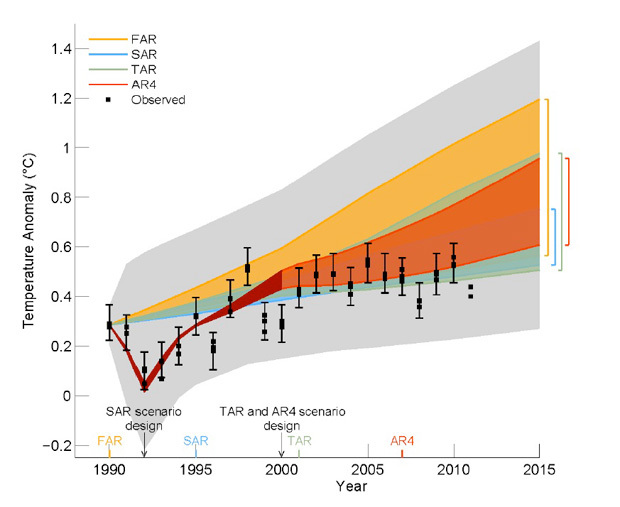
Figure 1.4 from Chapter 1 of a draft of the Fifth Assessment Report from the Intergovernmental Panel on Climate Change. Initials represent the First Assessment Report (FAR) in 1990, the Second (SAR) in 1995. Shaded banks show range of predictions from each of the four climate models used for all four reports since 1990. The last report, AR4, was issued in 2007. The black squares, shown with uncertainty bars, measure the observed average surface temperatures over the same interval. The range of model runs is indicated by the vertical bars. The light grey area above and below is not part of the model prediction ranges.
By Reiner Grundmann | September 19, 2013
With the fifth assessment report soon to be released by the IPCC the pre-publication buzz is well underway. A while ago unauthorised drafts circulated in the blogosphere and now the official leaks have found their way into news editing rooms. A central question picked up by most commentators is the ‘pause in global warming’, the ‘stagnation’, or the ‘hiatus’.
An anomaly presents itself for climate science in that model projections about future temperature increases do not concur with actual temperature observations. As expected, comments align with the agendas of the commentators, depending if one wants to defend the official modelling output or criticise it. These agendas are closely linked to policy options and the question if a lower observed temperature trend provides justification for political action on greenhouse gas emissions.
On this blog Hans von Storch expressed optimism as regards the ability of climate science to deal with this anomaly: ‘Eventually, we need to evaluate the different suggestions, but that will need time. No doubt that the scientific community will achieve this.’ Others are quick to pronounce climate science bunk. David Rose wrote in the Daily Mail ‘A leaked copy of the world’s most authoritative climate study reveals scientific forecasts of imminent doom were drastically wrong.’ Hayley Dixon in The Telegraph put it less blatant but still succinct in her opening sentence: ‘A leaked draft of a report by the UN Intergovernmental Panel on Climate Change is understood to concede that the computer predictions for global warming and the effects of carbon emissions have been proved to be inaccurate.’
Of course, both papers are on the political right and often skeptical about efforts to curb greenhouse gas emissions. It seems as if this topic is inconvenient for the left leaning papers who support action on climate mitigation. The Guardian so far is silent on the issue and prefers to write about new record lows of Arctic Ice coverage. When it looked last at this issue, Fiona Harvey bolstered the heat uptake by the oceans as explanation for the pause in global warming, thus doing away with a potential anomaly. At the same time she claims that climate scientists point out ‘that the trend is still upwards, and that the current temperature rises are well within the expected range.’ A quick glance at the graph above shows this is an illusion (the grey upper and lower bands are not part of the model prediction range).
Both the Mail and Telegraph quote Myles Allen (Oxford University) who tries to put the IPCC and its work into perspective. Says Allen: ‘we need to look very carefully about what the IPCC does in future… It is a complete fantasy to think that you can compile an infallible or approximately infallible report, that is just not how science works. It is not a bible, it is a scientific review, an assessment of the literature. Frankly both sides are seriously confused on how science works – the critics of the IPCC and the environmentalists who credit the IPCC as if it is the gospel.’
The Mail quotes Judy Curry (Georgia Institute of Technology) saying it makes ‘no sense that the IPCC was claiming that its confidence in its forecasts and conclusions has increased. For example, in the new report, the IPCC says it is ‘extremely likely’ – 95 per cent certain – that human influence caused more than half the temperature rises from 1951 to 2010, up from ‘very confident’ – 90 per cent certain – in 2007. Prof Curry said: ‘This is incomprehensible to me’ – adding that the IPCC projections are ‘overconfident’, especially given the report’s admitted areas of doubt.’
Both Allen and Curry call for a radical reform of the IPCC with Curry being more specific: ‘The consensus-seeking process used by the IPCC creates and amplifies biases in the science. It should be abandoned in favour of a more traditional review that presents arguments for and against – which would better support scientific progress, and be more useful for policy makers.’
Meanwhile in the Financial Post, Ross McKitrick wrote: ‘As the gap between models and reality has grown wider, so has the number of mainstream scientists gingerly raising the possibility that climate models may soon need a bit of a re-think. A recent study by some well-known German climate modellers put the probability that models can currently be reconciled with observations at less than 2%, and they said that if we see another five years without a large warming, the probability will drop to zero.’ (this seems to be a reference to the paper by Hans von Storch and Eduardo Zorita recently presented here on Klimazwiebel).
McKitrick goes on: ‘Judging by the drafts circulated this year, [the IPCC] is in full denial mode. Its own figure reveals a discrepancy between models and observations, yet its discussion says something entirely different. On page 9 of Chapter 1 it explains where the numbers come from, it talks about the various challenges faced by models, and then it sums up the graph as follows: “In summary, the globally-averaged surface temperatures are well within the uncertainty range of all previous IPCC projections, and generally are in the middle of the scenario ranges.” Later, in Chapter 9, it states with “very high confidence” that models can correctly simulate global surface temperature trends.’
McKitrick then makes a link between a ‘failed science’ and a ‘costly policy’: ‘since we are on the verge of seeing the emergence of data that could rock the foundations of mainstream climatology, this is obviously no time for entering into costly and permanent climate policy commitments based on failed model forecasts. The real message of the science is: Hold on a bit longer, information is coming soon that could radically change our understanding of this issue.’
This is where the crux of the matter lies. While it is indeed highly problematic to tie costly policies to flawed model forecasts the prospects of climatology are perhaps worth considering.
I chose as title for this blog post ‘The coming Crisis of Climate Science?’ The question mark is intentional and important. It could well be that in the coming year global surface temperatures pick up as expected. Existing models would be vindicated, end of story. The question is: how many more years should climatologists wait for this ‘renormalization’? It appears that mood is shifting towards alternative models and explanations. The timing of the fifth assessment report falls into this critical juncture where a lot of momentum has built up in favour of the current modelling practices which now prove so elusive. While the IPCC tries to make last minute rhetorical adjustments in order to accommodate anomalies, some of its participants, looking beyond, already indicate that this institution may have run its course. But even if the IPCC was reformed or dissolved, we still would have these questions in front of us:
How convincing is the climate science? How important should it be for climate policies? Do we need to implement climate policies, and if so, what should they be?
I can envisage an irony of history where climatology enters a period of crisis and looses its central place in public discourse about climate change, thus opening up discursive spaces for pragmatic options to deal with the problem.
Update: Global mean surface temperatures continued their sideways trajectory for the entire year of 2013 and October 2013 Arctic ice volume increased 50% from October 2012. – (Aletho News)
Related article
Western lies, criminality unraveling in Syria
By Finian Cunningham | Press TV | September 19, 2013
The US has accused Russia of “swimming against the tide” in persisting with its claims that foreign-backed militants in Syria committed the chemical weapons attacks, not the Syrian armed forces, as the Western governments have asserted.
In a sense, the US is correct. Russia is indeed swimming against a tide – a powerful tide of fabrication and propaganda promulgated by Washington, its Western allies and their dutiful news media.
But that tide is now subsiding, by the day, as more facts emerge about what really happened in Syria with regard to the use of chemical weapons. If Russia was swimming against a tide, the position of the US and its allies is now sinking from lies and criminality.
As each day passes, it becomes clear that Western states tried to railroad a guilty verdict on the Syrian government and thereby trigger a desired military aggression.
The Western propaganda operation went into full speed on Monday following the release of the report by the United Nations chemical weapons team, led by Swedish scientist Ake Sellstrom. No sooner had that report been published than the US, British and French governments were crowing that it provided “conclusive proof” of their allegations that Syrian President Bashar al-Assad’s forces had committed the mass killings on 21 August near the capital, Damascus.
The UN team did not actually state who perpetrated the chemical gas attack, but its inferences allowed others to point the finger of accusation at the Syrian army. So too did the tone of UN Secretary General Ban Ki-Moon who called for sanctions against those who commit such crimes “against your own people”.
So, they all lined up in familiar choreography to denounce the Syrian government. The US, British and French said they were justified in calling for military strikes and that they intended incorporating such action in the recent chemical decommissioning deal worked out by Washington and Moscow. For a day or two, it seemed that the Western governments had gained the psychological upper hand.
But it is increasingly clear that the Western “certainty” over Syrian chemical weapons is an edifice built on sand. The initial Western claims were never supported by verifiable evidence, only “secret intelligence”. Now it turns out that the UN inspectors’ report upon which the Western governments have rested their case is fatally flawed.
By its own admission, the UN study was carried out hurriedly under duress and in circumstances tampered with by the Western-backed anti-government militants. In a word, its putative evidence is unreliable.
More damning is the new disclosure by the Syrian government purporting to show that the culpable party for the gas attack near Damascus is the insurgents. Syria shared this “factual evidence” with Russian Deputy Foreign Minister Sergei Ryabkov, who was in Damascus this week. Syria and Russia are to submit this information to the UN.
What is disturbing is that this latest evidence, which includes ballistic charts and chemical analysis data, was already presented to the UN team led by Sellstrom. Russia has also said that other evidence and information presented to the UN team during the investigation was ignored in its final report. That suggests that the UN team was compromised to accommodate Western political interests.
Another disclosure this week is that Moscow confirmed that it never supplied Syria with sarin gas, not even during the years of the former Soviet Union. The significance of this is that Western governments flagged up the finding in the Sellstrom report that the inspectors had recovered remains of unusual rockets with Cyrillic (Russian) lettering. The inference was that Russia supplied Syria with chemical weapons, which the Syrian army had used.
But the Kremlin denied that it has ever delivered such munitions to Syria. It said that Soviet-era rockets with Cyrillic markings of the type cited in the Sellstrom report were supplied in the past to Libya. Given that Libya is a major arms supply conduit to the Western-backed so-called rebels in Syria, this again lends credibility to the Russian and Syrian claims that the chemical gas attacks near Damascus were carried out by these groups in a provocation to elicit Western military intervention.
There are many other unanswered perturbing questions about the chemical weapons attack near Damascus last month. Who were those dead children in the videos that the West has based so much of its emotive claims on? Why were they dressed in day clothes if they were supposedly killed in the middle of the night when they should have been in their beds? Why were their corpses arranged in such an orderly way, suggesting the scene was organized for an anticipated video recording? Why are there so few adult female victims in the apparent gas attack? Where are the grieving mothers and fathers of the little ones whose bodies are stacked up in death shrouds?
More chilling is a study led by Syrian Christian figure, Mother Agnes Mariam, which cites relatives of the dead who claim that the children were abducted by militants during earlier attacks in the northwest Latakia area. In that case, the children may have been poisoned, not by rockets filled with sarin, but by premeditated murder, with the purpose of fabricating a chemical gas attack.
What this demonstrates is that the exact circumstances of the atrocity near Damascus are far from known. But what is clear is that Western governments are shamelessly contriving partial and unsubstantiated data to fit political objectives.
The rush to railroad a guilty verdict on the Syrian government shows once again that the Western objective is regime change. That objective is criminal and the means to achieve it – fabricating lies and fomenting acts of war – gravely compound the criminality.
Related article
Syria and the ‘devious’ Israeli connection — Dr. Olmert doth protest too much, methinks
By Maidhc Ó Cathail | The Passionate Attachment | September 18, 2013
In a September 9 blog for The Huffington Post, Dr. Josef Olmert seizes on Professor Stephen Walt’s open letter to Congressman Joseph Kennnedy, urging him to oppose the use of military force against Syria, as an opportunity to attack Walt and Mearsheimer’s thesis that the influential — not “demonic” as Olmert chooses to misrepresent it — Israel Lobby has managed to skew U.S. foreign policy from its national interest. Writes Olmert:
So, under these circumstances, I eagerly expected to read about the Israeli connection of the Syrian problem, as well as it being behind the President’s decision to attack in Syria. Nothing of the kind in the open letter, and for good reason. The Syrian conflict has nothing to do with Israel. So was the case in Tunisia, where the Arab Spring started, so it was in Libya, where the US intervened ” from behind,” so it was in Egypt, where the secular-liberal Tamarud movement agitates against the Egyptian-Israeli Peace Treaty and the deposed Muhammad Morsi related to Jews as descendants of pigs and monkeys.
Well, Israel has not been involved in all these situations, as well as in Yemen, Bahrain etc. because the Arab Spring had nothing to do with the Arab-Palestinian-Israeli conflict. It has to do with poverty, corruption, authoritarianism and sectarianism — all are huge issues which are concerned with the very fabric of the Arab state system, with basic ills of Arab societies; in sum, with issues that are mostly the makings of the Arabs, ones which ought to be solved by them.
The Arab Spring has been a cataclysmic, formative event, the most important to have happened in the Middle East since the heydays of Nasserism, back in the 1950′s. Such a huge event and no Israel connection, so where is the big thesis of Walt and Mearsheimer? How is it connected to the Middle East circa 2013? Well, it is not.
Dr. Olmert’s denial of an Israeli connection to the so-called “Arab Spring” is undermined, however, by his own biography. Although omitted from his “full bio” page at the HuffPost, the adjunct professor at the University of South Carolina is a contributor to an “online community” known as Fikra Forum, “that aims to generate ideas to support Arab democrats in their struggle with authoritarians and extremists.” Notwithstanding the high-sounding self-description, the pro-democracy “Arab” forum is in fact a creation of the Washington Institute for Near East Policy, a think tank that was itself created by the American-Israel Public Affairs Committee (AIPAC), the most powerful and best known organization in the Israel Lobby.
Among Olmert’s fellow Fikra Forum contributors is Mouaz Moustafa, the executive director of the Syrian Emergency Task Force (SETF), a group that lobbies Washington for military intervention on behalf of the Syrian opposition. As Moustafa’s Israeli Fikra co-contributor no doubt remembers, an op-ed piece in the Wall Street Journal by SETF’s recently resigned political director, “Doctor” Elizabeth O’Bagy, was touted by John McCain and John Kerry during a Senate Foreign Relations hearing to bolster the dubious case for intervention in support of the supposedly “moderate” rebels.
So who does the one-time advisor to former Israeli Prime Minister Yitzhak Shamir and the brother of former Prime Minister Ehud Olmert think he’s fooling when he claims there’s no “ever devious” Israeli connection to the Syrian problem?
Maidhc Ó Cathail is an investigative journalist and Middle East analyst. He is also the creator and editor of The Passionate Attachment blog, which focuses primarily on the U.S.-Israeli relationship. You can follow him on Facebook and Twitter @O_Cathail.
Related articles
- A brief insight into the Israel Lobby’s non-transparent reinforcement of a ‘red line’ on Syria (thepassionateattachment.com)
- Israelis Flying Aid to Syrian Rebels Under the Cover of Humanitarianism (thepassionateattachment.com)
Surveillance at the United Nations
By Danny O’Brien and Katitza Rodriguez | EFF | September 17, 2013
The surveillance scandal has now reached the United Nation’s Human Rights Council, which opened its 24th session last week to a volley of questions about privacy and spying, many of them targeted at the United States and United Kingdom. (That’s perhaps not surprising, since U.N. representatives were among those listed as being monitored by the NSA and GCHQ).
The opening statement by the eminent South African human rights lawyer Navi Pillay (now the U.N.’s High Commissioner for Human Rights) warned of the “broad scope of national security surveillance in countries, including the United States and United Kingdom,” and urged all countries to “ensure that adequate safeguards are in place to prevent security agency overreach and to protect the right to privacy and other human rights.” On September 13, the German Ambassador Schumacher delivered a joint statement on behalf of Austria, Germany, Liechtenstein, Norway, Switzerland and Hungary expressing their concern about the consequences of “surveillance, decryption and mass data collection.”
One part of the potential solution to those concerns will be officially launched this Friday in a Human Rights Council side-meeting on digital privacy hosted by these same concerned countries: the International Principles on the Application of Human Rights to Communications Surveillance.
For over a year, EFF has been working with other civil liberties groups to develop these principles that spell out how existing human rights law applies to modern digital surveillance. The 13 Principles — which have been signed by 258 organizations across the world— also provide a benchmark that people around the world can use to evaluate and push for changes in their own surveillance laws. For this 24th session, EFF has joined RSF and APC in a joint written submission to the HRC, advocating for these checks and balances.
The Human Rights Council isn’t the only diplomatic venue at the United Nations where complaints about the United States’ surveillance practices are being heard. The Human Rights Committee is also set to scrutinize the United States on its compliance with Article 17 (right to privacy) of the International Coventant on Civil and Political Rights. The United States’ written response to Human Rights Committee has already laid out its diplomatic response in favor of the Patriot and FISA provisions. It notably dodges the key question that is emerging from other countries regarding these programs: if the U.S. government cannot rein in its domestic surveillance program, riven as it is with constitutional and statutory problems, just how much worse are the controls on the surveillance of non-US persons?
More directly relevant to the diplomatic community is a connected question: how can the United States accuse, with a straight face, other countries of undermining “Internet Freedom” through the use of malware and mass spying, when it seems that there are precious few internal limits to what its own security services are permitted to do in the same arena?
This is not just a matter of the United States’ international reputation. The greatest risk to the Internet in the international arena right now lies in the formation of an unholy alliance between countries who are already seeking excuses to spy and censor the net and those, like the United States, who have previously argued against such practices, but are now having to defend their own surveillance excesses with similar language.
Without promising substantive reform at home, the U.S. and the U.K. risk alienating their own allies at the United Nations, while granting a carte blanche for other countries to pursue a repressive Internet agenda abroad. The Western countries implicated in the NSA scandal should grab onto the full set of principles as a liferaft: a way that they can show a commitment to transparency and proportionality in a way that obliges other countries to follow the same standards. Otherwise, the U.S. and the U.K. will be seen as having started a race to the bottom of privacy standards: a race too many other countries will be happy to join.
Court Reveals ‘Secret Interpretation’ Of The Patriot Act, Allowing NSA To Collect All Phone Call Data
By Mike Masnick | Techdirt | September 17, 2013
The FISA Court (FISC) today released a heavily redacted version of its July ruling approving the renewal of the bulk metadata collection on all phone calls from US phone providers under Section 215 of the Patriot Act. This is part of the “secret interpretation” as to how the FISC interprets the Patriot Act’s “business records” or “tangible things” section to mean that the government can order a telco to turn over pretty much all records — even as the very author of the law says it was written specifically to not allow this interpretation.
Much of the ruling is pretty much what you’d expect, given the way defenders of this program have been insisting that this is all very legal. It argues that Smith v. Maryland show that there are no privacy protections in data given to your telco. It goes on at length defending the third party doctrine, arguing that because some third party holds your data, you have no expectation of privacy. As many have argued, this is a ridiculous and antiquated view of the third party doctrine, not at all consistent with modern technology, but the FISC repeats it without question. While some have pointed out that even if single points of metadata might not be privacy violating, collecting all of them creates a new problem, the court rejects that entirely.
From there, there’s a big discussion of whether or not “there are reasonable grounds to believe that the tangible things sought are relevant to an authorized investigation.” This is a big part of where the concern lies. How can the government defend the claim that all records are “relevant to an authorized investigation.” Here, the court compares the order to the Stored Communications Act (SCA), which lets the government get access to records as well. And then the word games begin. Basically, it argues that because one law requires “specific and articulable facts” and that the information must be “material,” while the other (the PATRIOT Act) does not, then the government doesn’t need specific and articulable facts. Rather it just needs “a statement of facts showing there are reasonable grounds to believe that the records are relevant to the investigation.”
For non-content records production requests, such as the type sought here, Section 2703(c) provides a variety of mechanisms, including acquisition through a court order under Section 2703(d). Under this section, which is comparable to Section 215, the government must offer to the court “specific and articulable facts showing that there are reasonable grounds to believe that the records or other information sought, are relevant and material to an ongoing criminal investigation.” 2703(d) (emphasis added). Section 215, the comparable provision for foreign intelligence purposes, requires neither “specific and articulable facts” nor does it require that the information be “material.” Rather, it merely requires a statement of facts showing that there are reasonable grounds to believe that the records sought are relevant to the investigation. 50 U.S.C. That these two provisions apply to the production of the same type of records from the same type of providers is an indication that Congress intended this Court to apply a different, and in specific respects lower, standard to the government’s Application under Section 215 than a court reviewing a request under Section 2703(d). Indeed, the Act version of FISA’s business records provision required “specific and articulable facts giving reason to believe that the person to whom the records pertain is a foreign power or an agent of a foreign power.” 50 U.S.C. §1862(b)(2)(B) as it read on October 25, 2001. In enacting Section 215, Congress removed the requirements for “specific and articulable facts” and that the records pertain to “a foreign power or an agent of a foreign power.” Accordingly, now the government need not provide specific and articulable facts, demonstrate any connection to a particular suspect, nor show materiality when requesting business records under Section 215. To find otherwise would be to impose a higher burden — one that Congress knew how to include in Section 215, but chose to dispense with.
Also, it argues that since Section 215 allows recipients of the order to challenge them and no telco ever has that this lends it to believe there are no problems with the law.
Second, Section 2703(d) permits the service provider to file a motion with a court to “quash or modify such order, if the information or records requested are unusually voluminous in nature or compliance with such order otherwise would cause undue burden on such provider.” Congress recognized that, even with the higher statutory standard for a production order under Section 2703(d), some requests authorized by a court would be “voluminous” and provided a means by which the provider could seek relief using a motion. Under Section 215, however, Congress provided a specific and complex statutory scheme for judicial review of an Order from this Court to ensure that providers could challenge both the legality of the required production and the nondisclosure provisions of that Order. 50 U.S.C. §1861(f). This adversarial process includes the selection of a judge from a pool of FISC judges to review the challenge to determine if it is frivolous and to rule on the merits, provides standards that the judge is to apply during such review, and provides for appeal to the Foreign Intelligence Surveillance Court of Review and, ultimately, the U.S. Supreme Court. This procedure, as opposed to the motion process available under Section 2703(d) to challenge a production as unduly voluminous or burdensome, contemplates a substantial and engaging adversarial process to test the legality of this Court’ Orders under Section 215. This enhanced process appears designed to ensure that there are additional safeguards in light of the lower threshold that the government is required to meet for production under Section 215 as opposed to Section 2703(d). To date, no holder of records who has received an Order to produce bulk telephony metadata has challenged the legality of such an Order. Indeed, no recipient of any Section 215 Order has challenged the legality of such an Order, despite the explicit statutory mechanism for doing so.
Basically, the court says “why of course there’s an adversarial process” to protect users’ privacy. It just depends on Verizon or AT&T taking up the fight on behalf of their users, and they haven’t done so, so let’s just assume everyone’s okay with this. That’s kind of crazy when you think about it. Admittedly, the public should be up in arms that Verizon and AT&T appear to have no interest in challenging these broad collections of data, but that hardly makes them constitutional.
From there we move onto the interpretation of how this massive data collection could possibly be seen as “relevant.” First, it notes (as mentioned above) that the government doesn’t need to prove that the data is actually relevant. Just that it has reasonable grounds to believe that they are relevant.
As an initial matter and as a point of clarification, the government’s burden under Section 215 is not to prove that the records sought are, in fact, relevant to an authorized investigation. The explicit terms of the statute require “a statement of facts showing that there are reasonable grounds to believe that the tangible things sought are relevant.
Then it basically says that because the NSA can sniff out terrorists within a giant database, that makes the entire database relevant. Really.
This Court has previously examined the issue of relevance for bulk collections. See; [REDACTED] While those matters involved different collections from the one at issue here, the relevance standard was similar…. (“[R]elevant to an ongoing investigation to protect against international terrorism….”). In both cases, there were facts demonstrating that information concerning known and unknown affiliates of international terrorist organizations was contained within the non-content metadata the government sought to obtain. As this Court noted in 2010, the “finding of relevance most crucially depended on the conclusion that bulk collection is necessary for NSA to employ tools that are likely to generate useful investigative leads to help identify and track terrorist operatives.” [REDACTED] Indeed, in [REDACTED] this Court noted that bulk collections such as these are “necessary to identify the much smaller number of [international terrorist] communications.’ [REDACTED] As a result, it is this showing of necessity that led the Court to find that “the entire mass of collected metadata is relevant to investigating [international terrorist groups] and affiliated persons.” [REDACTED]
It then applies those previous, redacted-named rulings, to this case, repeating the DOJ’s own filing saying “all of the metadata collected is thus relevant, because the success of this investigative tool depends on bulk collections.”
That’s ridiculous and tautological. You could argue that the “success” of a program designed to stop crimes “depends on” putting cameras inside everyone’s home, but that doesn’t make it any less a violation of privacy. It also hardly makes the collection of all such data “relevant.”
The FISC continues to tap dance on the grave of the 4th Amendment:
The government depends on this bulk collection because if production of the information were to wait until the specific identifier connected to an international terrorist group were determined, most of the historical connections (the entire purpose of this authorization) would be lost. The analysis of past connections is only possible “if the Government has collected and archived a broad set of metadata that contains within it the subset of communications that can later be identified as terrorist-related.” Because the subset of terrorist communications is ultimately contained within the whole of the metadata produced, but can only be found after the production is aggregated and then queried using identifiers determined to be associated with identified international terrorist organizations, the whole production is relevant to the ongoing investigation out of necessity.
Once again, that makes no sense. First off, just because you can put together all this aggregate data and use it to find criminals and terrorists doesn’t automatically make it legal. Once again, I’m sure that having cameras in everyone’s homes would allow similar capturing of illegal behavior. But that doesn’t make it legal. Second, the argument that without this metadata collection the information would be “lost” is clearly untrue. As was just revealed a few weeks ago, AT&T has employees embedded with the DEA who are willing, ready and able to do deep dive searches on decades worth of phone records (even beyond AT&T). The data isn’t lost. They’re available via AT&T employees who are working right alongside government employees.
Incredibly, the FISC then claims that the mere claim that terrorists use the phone system is enough to show that all phone records are relevant.
The government must demonstrate “facts showing that there are reasonable grounds to believe that the tangible things sought are relevant to an authorized investigation.” The fact that international terrorist operatives are using telephone communications, and that it is necessary to obtain the bulk collection of a telephone company’s metadata to determine those connections between known and unknown international terrorist operatives as part of authorized investigations, is sufficient to meet the low statutory hurdle set out in Section 215 to obtain a production of records.
Except, almost nothing there makes sense. It’s not true that it is necessary to obtain bulk collection of the metadata to find those connections. And just because terrorists live in houses, we don’t say that it’s okay for law enforcement to search every house. Take this same argument and apply it to anything else and the 4th Amendment goes away entirely.
In short, this shows the serious problems with these efforts being non-adversarial. The FISC more or less buys the government’s argument at every single turn, even though there are multiple arguments for why the government’s position is either not true or, at the very least, misleading.
Related article
Brazil to bypass US-centric internet amid spy revelations
Press TV – September 17, 2013
Brazil has announced plans to bypass the US-centric internet amid revelations that Washington conducts spy operations on web communications.
 Brazilian President Dilma Rousseff announced the country’s measures to boost the Brazil’s independence and security on the World Wide Web, including storing data locally and bypassing internet traffic that goes through the United States.
Rousseff said plans are in the works to lay underwater fiber optic cable directly to Europe and all the South American nations in order to create a network free of US eavesdropping. This is while most of Brazil’s global internet traffic passes through the US.
The president also announced that she will push for new international rules of privacy and security in hardware and software during the UN General Assembly meeting later this month.
The country’s postal service also plans to create an encrypted e-mail service that would serve as an alternative to Gmail and Yahoo, two companies being monitored by the NSA.
Experts said the move may herald the first step toward a global network free from US monopoly and its illegal surveillance of global communications.
The development comes following the publication of documents leaked by whistleblower and former NSA contractor Edward Snowden in July, exposing US spying on Brazilian companies and individuals for a decade.
Snowden, a former CIA employee, leaked two top secret US government spying programs under which the NSA and the Federal Bureau of Investigation (FBI) are eavesdropping on millions of American and European phone records and the Internet data from major Internet companies such as Face book, Yahoo, Google, Apple, and Microsoft.
The NSA scandal took even broader dimensions when Snowden revealed information about its espionage activities targeting friendly countries.
Related articles
- Brazilian president postpones visit to Washington over US spying
- South America: UNASUR To Build Fibre-Optic ‘Mega Ring’
- Latin America Condemns US Espionage at United Nations Security Council
- Mercosur complains to Ban Ki-moon on US global espionage and EU affront towards Bolivia’s Evo Morales
- UK spying on Germany’s major data cable to US triggers media storm
Featured Video

Trump asks Iran not to retaliate after he strikes Pickaxe Mountain
or go to
Aletho News Archives – Video-Images
Book Review & Summary
Calling of an Angel: The True Story of Rene Caisse and an Indian Herbal Medicine Called Essiac (1988)
Dr. Gary L. Glum – 30 Q&As – Book Review & Summary
Lies are Unbekoming | October 17, 2026
On June 10, 1975, Dr. Chester Stock, a vice president at Memorial Sloan-Kettering Institute for Cancer Research, wrote to a Canadian nurse named Rene Caisse: “Enclosed are test data in two experiments indicating some regressions in sarcoma 180 of mice treated with Essiac.” The sentence sat in a letter from one of the world’s largest private cancer research centers, concerning an herbal tea an elderly English woman had learned from an Ojibwa medicine man at a northern Ontario mining camp in the 1890s. The tests were terminated the following year after Sloan-Kettering admitted, in sworn affidavit three years later, that they had prepared the injectable solution improperly from the dried material supplied — freezing and thawing the herb rather than boiling it as Rene had instructed. By the time Calling of an Angel was published in 1988, Rene Caisse had been dead for a decade, having treated thousands of cancer patients across fifty-six years in her Bracebridge, Ontario kitchen, never charging a fee, and refusing every offer — from Memorial Sloan-Kettering, the National Cancer Institute, Merck, Parke Davis, and private corporations dangling contracts up to $1 million — to release her formula before the medical establishment admitted her remedy had merit. … continue
Blog Roll
 Aletho News
- Trump asks Iran not to retaliate after he strikes Pickaxe Mountain – w/ Prof. Marandi
- Vice President J.D. Vance’s Deceptive ‘Antiwar’ Campaign Speech
- Iran: Palestinians’ rights must not be compromised in Gaza’s future; US, Israel to blame for Hormuz situation
- Ongoing tales of Syrian chemical weapons
- Moscow blasts UN for ignoring torture of Russian POWs
- Millions of Books Could Have Been Destroyed in Lebanon During Israeli Bombings
- Moscow warns of ‘hunt for Russians’
- Calling of an Angel: The True Story of Rene Caisse and an Indian Herbal Medicine Called Essiac (1988)
- South Korean Assistance to the U.S. in the War with Iran: Between Allied Duty and National Interests
- Pharma- and Gates-Funded GAVI Seeks to Assure Parents
- If Americans Knew
- Israeli soldiers debunk Israel’s talking points
- In West Bank, Israeli settlers are totally out of control – Daily Update
- NPR investigation finds evidence of widespread fraud at mall kiosks tied to Israeli skincare brand
- Tucker Carlson exposes Israeli Lies about the Oct 7th attack, Charlie Kirk, and the U.S.
- Israel has detained thousands of Palestinian children since Oct 7th – over half spent time in solitary, many uncharged
- Israeli Analysis: Is Netanyahu Planning an ‘October Surprise’ Attack Before Israel’s Election?
- Israeli settlers brutally attack Palestinians and Washington Post female photographer, 65
- Words Have Changed, Occupation Continues: The Reality of the Gaza Ceasefire
- Gaza’s child amputees are growing faster than their prosthetics allow
- Israel keeps Palestinians struggling just to survive–Daily Update
- No Tricks Zone
- New Study Suggests Large Regions Of The Pacific Ocean Have Been Cooling For The Last 80 Years
- Germany’s Green Energy Debacle: High Energy Costs Force Kahla Porzellan to Close After 182 Years!
- New Study: 50 Years Of The Most Aggressive ‘Net Zero’ Policies Can Only Affect The Global Climate By 0.03°C
- US September “Heat” Was No Record…Many Records Set Decades Ago
- Latest European Green Energy Debacle; Portugal’s Largest Flagship Solar Park Insolvent!
- Green Energy Debacle: German Expert Professor Fritz Vahrenholt Warns Of Severe Economic And Social Consequences
- Two More Paleo Reconstructions Affirm Meters-Higher Sea Levels Across Ireland, Brazil 7000-6000 Years Ago
- New Study: Earth And Venus Surface Warmth Largely Explained By Convection And Lapse Rate, Not CO2 Or Radiation
- 2025 Nature Paper Claiming Worsening Global Drought Gets RETRACTED …Heavily Flawed
- New Study: ‘Global Drought Shows No Detectable Recent Acceleration Under Climate Warming’

