Painful experiences of recent years should have taught the American people the danger that comes when the government and the mainstream press adopt a pleasing but false narrative, altering the facts to support a “good guy v. bad guy” scenario, such as is now being done regarding the history of Syrian peace talks.
The preferred narrative now is that American military force against Syria is needed not only to punish President Bashar al-Assad for allegedly using chemical weapons but to compel his participation in peace talks aimed at ending the civil war. That is a storyline that has slipped into U.S. “news” articles in recent days.
For instance, on Friday, the New York Times’ Michael Gordon stripped out the actual history of why the opposing sides of the Syrian civil war have not come together for planned meetings in Geneva. Instead, Gordon placed the blame on Assad and on obstacles partly the fault of the Russians, leaving out the fact that it was the U.S.-supported Syrian opposition that has repeatedly torpedoed the talks.
Gordon wrote: “State Department officials initially said the peace conference might occur before the end of May, but plans became bogged down in differences between the United States and Russia, and the conference has yet to be held.
“And the Obama administration [regarding its expected missile strike against Syrian government positions] did not articulate a comprehensive military strategy that would — in concert with allies — be certain to weaken the Assad government to the point that it would be willing to cede power and negotiate.”
So, you are supposed to believe that “our” side – the brave “opposition” in league with the U.S. State Department – is ever so reasonable, wanting peace and eager to negotiate, but that “their” side – both the evil Assad and his troublemaking Russian allies – is unwilling to take difficult steps for peace.
Except that this storyline from Gordon and other mainstream journalists isn’t accurate. Indeed, from May to July. the U.S. news media, including the New York Times, reported a different scenario: that Assad had agreed to participate in the Geneva peace talks but that the opposition was refusing to attend.
On July 31, for example, Ben Hubbard of the New York Times reported that “the new conditions, made by the president of the opposition Syrian National Coalition, Ahmad al-Jarba, … reflected a significant hardening of his position. He said that the opposition would not negotiate with President Bashar al-Assad or ‘his clique’ and that talks could begin only when the military situation in Syria was positive for rebel forces.”
The opposition has spelled out other preconditions, including the need for the United States to supply the rebels with more sophisticated weapons and a demand that Assad’s Lebanese Hezbollah allies withdraw from Syria. The most recent excuse for the rebels not going to Geneva is the dispute over Assad’s alleged use of chemical weapons.
Yet, even if Gordon and other mainstream journalists sympathize with the opposition’s reasons for staying away from the peace talks, reporters shouldn’t alter the narrative to shape U.S. public opinion. That is a case of journalistic malfeasance reminiscent of the way the Times and other news outlets manufactured a case for war with Iraq in 2002-2003.
Indeed, Gordon played a key role in that propaganda effort as well, coauthoring with Judith Miller the infamous Times article on Sept. 8, 2002, touting the false claim that Iraq was purchasing aluminum tubes for use in building nuclear weapons, the story that gave rise to the memorable refrain from President George W. Bush and his aides that they couldn’t let “the smoking gun” be “a mushroom cloud.”
Though Miller eventually was forced to resign from the Times – after her level of collaboration with the Bush administration’s neocons was exposed – Gordon escaped any serious accountability, remaining the newspaper’s chief military correspondent.
But Gordon is far from alone these days in spinning a more pleasing black-and-white narrative about Syria. It apparently seems to many mainstream U.S. journalists that it’s nicer to portray “our” side as favoring peace and going the extra mile to negotiate a cease-fire and “their” side as intransigent and eager for more bloodshed.
And, if the facts don’t support that scenario, you just leave out some and make up others.
~
Investigative reporter Robert Parry broke many of the Iran-Contra stories for The Associated Press and Newsweek in the 1980s. You can buy his new book, America’s Stolen Narrative, either in print here or as an e-book (from Amazon and barnesandnoble.com).
August 30, 2013
Posted by aletho |
Deception, Mainstream Media, Warmongering | Bashar al-Assad, Iraq War, New York Times, Robert Parry, Syria, United States |
Leave a comment
Brazil has criticized the United States for spying on Brazilian companies and individuals, saying the electronic surveillance is a violation of the South American country’s sovereignty.
“We expressed Brazil’s unhappiness on learning that data was intercepted without the authorization of Brazilian authorities, for the use of US intelligence,” Brazilian Justice Minister Jose Eduardo Cardozo said on Thursday, the last day of his two-day visit to the US.
“The acts imply a violation of human rights, violation of Brazilian sovereignty and rights enshrined in our constitution,” he added.
Last month, Brazilian Foreign Minister Antonio Patriota expressed serious concerns over a report, which said the US National Security Agency (NSA) has been spying on Brazilian companies and individuals for a decade.
Brazil’s O Globo newspaper reported on July 7 that the NSA had collected data on billions of telephone and email conversations in the country.
The report said that information released by US surveillance whistleblower Edward Snowden reveals that the number of telephone and email messages logged by the NSA in the 10-year period was near to the 2.3 billion captured in the US during the same period.
During his visit to Washington, the Brazilin justice minister met US Vice President Joe Biden, US Attorney General Eric Holder and White House counter-terrorism adviser Lisa Monaco.
Cardozo said US officials could not allay his country’s concerns.
“We made a proposal to move toward an agreement to establish the rules on procedures in the interception of data. They told us the United States would not sign an agreement under those terms with any country in the world,” he said.
Cardozo said US officials claimed that the spying was used for counter-terrorism purpose.
“But for us it was clear that there was collection of data to deal with organized crime and drug-trafficking, but what is worse, also Brazilian diplomatic actions,” he said.
The chairman of the US Joint Chiefs of Staff, Gen. Martin Dempsey, admitted in July that Snowden’s exposés have seriously damaged US ties with other countries. “There has been damage. I don’t think we actually have been able to determine the depth of that damage.”
Snowden, a former CIA employee, leaked two top secret US government spying programs under which the NSA and the Federal Bureau of Investigation (FBI) are eavesdropping on millions of American and European phone records and the Internet data from major Internet companies such as Facebook, Yahoo, Google, Apple, and Microsoft.
The NSA scandal took even broader dimensions when Snowden revealed information about its espionage activities targeting friendly countries.
August 30, 2013
Posted by aletho |
Corruption, Deception, Economics | Antonio Patriota, Brazil, Federal Bureau of Investigation, Jose Eduardo Cardozo, National Security Agency, NSA, United States |
Leave a comment
By PAUL GOTTINGER | August 30, 2013
The Nobel Peace Prize Laureate himself, Obama, weighed in on the human rights abuses being carried out by the U.S. trained and funded General Abdel Fattah el-Sisi in Egypt on August 23 saying “We care deeply about the Egyptian people,” and “We deplore violence against civilians.” These statements came after a vicious attack on protestors on August 14 that Human Rights Watch called, “most serious incident of mass unlawful killings in modern Egyptian history.”
The day of the Egyptian security forces attack on the non-violent protestors John Kerry did his best to conjure up indignation in response to the events. In the stiff and passionless manner of a marionette, which is convincing only in that he is “deeply concerned” with not forgetting his lines, he stated, “The violence is deplorable.”
So one would imagine this peacenik president who is deeply troubled by the violence in Egypt would unleash the hoards of humanitarians to protect the Egyptian civilians he cares so much about. But instead Obama stated, “America cannot determine the future of Egypt. That’s a task for [Egyptians].”
Then on August 19 Chuck Hagel changed the tone slightly (he’s the Secretary of Defense, so he has to sound tough) by focusing on America’s impotence in regards to Egypt. He stated, “[The U.S.’] ability to influence the outcome in Egypt is limited” and that “All nations are limited in their influence in another nation’s internal issues”.
On August 22 the LA Times echoed much the same stating, “Obama’s inability to ease the crisis reflects America’s diminished ability to influence political outcomes in [Egypt].”
The media continued the theme of failing U.S. influence in Egypt by focusing on the fact that the three richest monarchies in the gulf pledged $12 billion in cash and loans to Egypt. The Wall Street Journal wrote, ‘The U.S.’s closest Middle East allies undercut American policy in Egypt by encouraging the military to confront the Muslim Brotherhood rather than reconcile, U.S. and Arab officials said.’
The idea we’re supposed to have about Obama’s policy towards Egypt couldn’t be clearer: Obama would really love to stop all that awful violence in Egypt, but unfortunately America just isn’t powerful enough to save everyone. Come on, Obama isn’t superman.
The consistency with which the mainstream media adhered to this message demonstrates the strict discipline the major newspapers maintain in their role as ideological managers.
But just as the population of most of the planet was about to collectively erupt in simultaneous celebration at the end of American military hegemony, Obama stated he was considering a military strike on Syria.
We’re supposed to swallow that the situation in Egypt is beyond the realm of American power, but Syria, where the U.S. has significantly less influence, is within the capabilities of the U.S.
Apparently the forecast of the decline of American power from the mainstream media was a bit premature. Perhaps there is a lesson here: whatever the mainstream media is saying about U.S. foreign policy, you can be almost certain it’s not true.
However, it is true that U.S. power has been in decline since the end of World War II when it was at its most powerful, but the U.S. still is far and away the most powerful country in the world. This will likely be the case for a long time to come.
In order to understand the cynicism of Obama’s rhetoric, one must be familiar with the U.S.’ long record of support for brutal dictators with awful human rights records. This is especially the case in Egypt where the U.S. supported Anwar El Sadat beginning in the early 1970s, and also supported his successor Hosni Mubarak until nearly the end of the 2011 protests.
If the Peace Laureate president had any sincerity with regards to stopping the human rights abuses in Egypt he could pressure the military government there. With Egypt’s small economy (a GDP of around 260 billion dollars) the military government could be easily bought, or enticed with a long stalled IMF deal and debt forgiveness. This is especially true because the Egyptian economy has suffered serious unemployment and inflation for years.
Even if the U.S. didn’t want to spend a dime on Egypt it could take Turkey’s suggestion and bring the issue of violence against civilians to the UN Security Council and Arab League with the hopes of influencing the military government.
The U.S. could also assert its influence on its close allies the Gulf States and Israel. But the U.S. is fine with the military government in Egypt and allows the aid from the Gulf States to reach Egypt.
Another instructive element to the political crisis in Egypt was the Obama administration’s fake attempts to resolve the situation diplomatically.
The New York Times reported that Chuck Hagel made, “17 personal phone calls” to the Egyptian military government, but they “failed to forestall” the crisis. Perhaps Hagel would have had more luck if he tried contacting the General el-Sisi on Facebook.
The next act in the made for New York Times special was the diplomatic trip of John McCain and Lindsey Graham to Egypt on behalf of Obama. The New York Times reports Graham spoke to John McCain about General el-Sisi saying, “If this guy’s voice is indicative of the attitude, there’s no pulling out of this thing.”
This conjures up the image of the Egyptian military commander as a runaway train and all the bros from Washington are pulling as hard as they can on the break, but somehow the general is just too strong for them.
You see it’s imperative that the media portray the U.S. as powerless to stop the violence of dictators the U.S. likes. However, when the U.S. doesn’t care for the leader, be they democratically elected like Hamas in 2006, or Chavez in 2002, or a dictator like Saddam, Qaddafi, or Assad, then the U.S. is capable of anything, usually devastating violence.
Just when you think there is not a sensible member of the U.S. government John McCain stated that he recommended the U.S. cut aid to Egypt. But the reason he gave for why he recommended this was telling. He said, “[the U.S.] has no credibility. ”We know that the administration called the Egyptians and said, ‘look, if you [have] a coup, we’re going to cut off aid because that’s the law.’ We have to comply with the law. And … this administration did not do that after threatening to do so.”
McCain’s reasoning for supporting a cut to aid has nothing to do with protecting human rights in Egypt, but is solely about American credibility. The logic is this: if the U.S. makes threats, we have to follow threw with them. This is the same logic used when raising a child, which tells us much about how the U.S. views its relationship to Egypt and much of the rest of the world.
When we put aside the dark theatrics of the Obama administration’s rhetoric it is obscenely obvious that el-Sisi and the Egyptian military have very close connections to the U.S. and serve U.S interests.
For decades the Egyptian leaders have played an important role for the U.S. by allowing U.S./Israel to act with impunity against the Palestinians.
The closeness of the ties between the Egyptian military and the U.S. is demonstrated by the fact that General el-Sisi spent a year at the Army War College in Pennsylvania in 2006. The same Army War College trains 500-1000 Egyptian military officers every year.
Since 1979 Egypt has received the 2nd most bilateral aid, behind only Israel, totaling 68 billion dollars. The U.S. buys relationships with the militaries of countries like Egypt to insure influence.
This is why Obama has allowed and will continue to allow the human right abuses to continue in Egypt. Despite his pretty talk and composed outrage, he actually is just fine with protestors being gunned down in the street, the brutal repression of a political party (Muslim Brotherhood), the prevention of freedom of speech, and the destruction of Egypt’s brief experiment with democracy (which resulted from the sacrifice of 800 hundred lives with 6,000 injured and 12,000 hauled before military courts).
Obama is A okay with military curfews and a state of emergency. Obama has no problem with attacks on Christian churches, attacks on journalists, and “Nightmare scenes that Egyptians could never have imagined could take place in [their] country.” Obama sees nothing wrong with tear gas being fired into hospitals, and Islamists being portrayed as terrorists or even animals.
Obama has no problem with any of this because he knows he can count on el-Sisi to follow U.S. orders. Egyptian civil society’s destruction simply makes controlling the country easier for the U.S. […]
Whether or not the U.S. knew about the military coup ahead of time the U.S. seems to be following a predictable PR plan.
1. The Obama administration strongly condemns the violence and calls for a return to democracy. 2. There is a semantic battle waged over whether or not to classify the events as a coup. 3. When it looks bad to support a thug overtly, you engage in superficial detachment from the leader of the coup. (This is the canceling of the joint military operations) 4.Then if necessary, as in the 2009 coup to the somewhat progressive Manuel Zelaya in Honduras, cut some amount of aid as a slap on the wrist, but then quietly restore it later.
Obama’s policies are all predictable. It’s the same story once again: the U.S. destroys yet another country. The revolution in Egypt is back at square one. Morsi is detained and Mubarak has been released from prison. The U.S. has done its best to destroy the progress of the Arab Spring.
But more protests are being called for in Egypt on Friday, August 30. The question is can Egypt regain the spirit of the January 25 revolution and continue to fight for basic rights? Perhaps for us as Americans the more important question is how much longer will Americans tolerate the dark theatrics of our government’s foreign policy? When we witness the immense bravery of the Egyptians challenging their government and getting massacred don’t we have a responsibility to challenge our government when the risks for us are far less? As Americans we must work to protect victims of U.S. violence, and the best way for us to do that is to get off the Internet and get in the street.
Paul Gottinger can be reached at paul.gottinger@gmail.com
Source
August 30, 2013
Posted by aletho |
Deception, Mainstream Media, Warmongering, Progressive Hypocrite, Solidarity and Activism, Timeless or most popular | Chuck Hagel, Egypt, Egyptian Armed Forces, Human rights, John McCain, New York Times, Obama, United States |
Leave a comment
In response to Bashir Assad’s crossing of a “red line” by allegedly using chemical weapons against his own people, Secretary of State John Kerry cites his own fatherly feelings as justification for the all-but-inevitable looming US military intervention in Syria. “As a father, I can’t get the image out of my head, of a father who held up his dead child, wailing …”
Hopefully CNN will try extra hard to sanitize the war footage from Syria once the bombing starts, now that we know how badly dead Syrian kids upset Kerry. Because you can be sure there are a lot more dead Syrian kids on the way.
Of course, Kerry’s sensitivity to dead children is a bit like Carter having a problem with liver pills. This is the same John Kerry who served in Vietnam, and who backed two attacks on Iraq and one on Afghanistan, is it not? One of the most iconic images in the history of journalism is a little girl, naked and burning, running down a Vietnamese road after a chemical weapons attack by the United States. And the US all but condemned Al-Jazeera as a terrorist organization for airing images of Iraqi children incinerated in the American attack in 2003.
For that matter, US “redlining” of a country for using chemical weapons is also a bit odd. In the same press conference, Kerry spoke of holding Iraq accountable for violating international, historically established norms. But the US itself has quite a history of violating such norms. In WWII, for instance, the U.S. holds pride of place not only for the firebombing of Dresden and Tokyo, but for being the first and only military power in history to burn hundreds of thousands of civilians alive with atomic weapons in the Japanese cities of Hiroshima and Nagasaki.
As for chemical weapons, aren’t Agent Orange and napalm — the liquid fire used on that screaming little girl mentioned above — supposed to count? The cumulative effect of US chemical weapons use in Indochina is millions dead during the war in South Vietnam, Laos and Cambodia — and millions more dead of cancer and genetic defects in the decades since.
While we’re on the subject of chemical weapons, the story just came out — at about the worst possible time for the US, as it’s rolling out its propaganda for another war — that the US actively aided Iraq’s Saddam Hussein in targeting Iranian troops with nerve gas. It was known for some time that the Reagan administration had shared intelligence with Iraq at the same time it was using chemical weapons in the Gulf War. But it turns out Washington was supplying intelligence in full knowledge that that intelligence would be used to identify Iranian troop concentrations for targeting with nerve agents. Iran was preparing for the strategic exploitation of a huge hole in Saddam’s defenses, which might well have turned the tide of the war and led to enormous Iranian gains at the mouth of the Tigris and Euphrates, increasing military pressure on Kuwait and other Arab Gulf states.
The overall American policy arc in Iraq from the ’80s on seems to be: 1) Help Saddam to make war on his neighbors; 2) help Saddam use weapons of mass destruction against his neighbors; 3) encourage Saddam to invade Kuwait; 4) bomb the hell out of Saddam in 1991 for invading Kuwait and making war against his neighbors; 5) bomb the hell out of Saddam in 2003 for possibly still having weapons of mass destruction.
In short, the United States simply does not give a rip about Saddam, Assad, or anyone else using chemical weapons or committing war crimes of any kind. The US routinely supports regimes that engage in war crimes — and then publicly condemns them for war crimes only when they stop taking orders from Washington or otherwise become a liability. War crimes by official enemies are just a propaganda point for selling wars to the public.
Consumer advisory: Don’t buy a used war from this man.
August 30, 2013
Posted by aletho |
Deception, Mainstream Media, Warmongering, Militarism, Timeless or most popular | Agent Orange, Iraq, Iraq War, John Kerry, Syria, United States |
Leave a comment
 CNN is bringing back Crossfire next month, but viewers on August 27 got a taste of what they might expect: The left thinks we should bomb Syria, while the right thinks we should have started that a long time ago.
On the show The Lead, guest host John Berman moderated a “debate” between conservative S.E. Cupp and left-leaning Van Jones.
“Look, I want to commend the president for finally following through on our red line threats,” Cupp declared–before explaining that Obama’s plan was too timid:
We should absolutely intervene to stop the genocide of more than 100,000 people. We should absolutely intervene to stop Al-Qaeda and Islamic extremism from jihadizing yet another conflict. It is absolutely our obligation, and instead we do the bare minimum to save face and pat ourselves on the back for our civility and our diplomacy. I think it’s pathetic.
OK, and from the left? Jones said:
This president has now said there is a red line. It was not clear before whether the line was crossed. It’s crossed, he’s moving forward. I think we need to stand behind this president and send a clear message to Assad that this type behavior is not acceptable.
And:
If you kill Assad right now, wonderful. You have a huge power vacuum. Who is going to fill it? Listen, people have a nostalgia for 1953 when the U.S. could just sort of thump out dictators like in Iran. This is not the world we live in. It is a tough neighborhood over there, and the idea that we should have a more bloodthirsty and reckless president, I reject.
I’m not sure what “thumping out dictators like in Iran” is supposed to mean; in 1953, the United States supported a coup against Iran’s elected president.
But back to Syria: The American public is generally and overwhelmingly skeptical of military strikes on Syria. But in CNN‘s left/right debate, that point of view seems to be missing entirely.
August 29, 2013
Posted by aletho |
Deception, Mainstream Media, Warmongering, Timeless or most popular, War Crimes | Assad, CNN, Iran, Peter Hart, Syria, United States, Van Jones |
Leave a comment
[Jerry] Dobson, a professor of geography at Kansas University [KU], is the lead researcher on one of 14 projects to win grants this year from the Minerva Research Initiative, a U.S. Department of Defense effort to learn more about other parts of the world through social-science research. He and other researchers will receive about $1.8 million over three years to study indigenous communities throughout Central America, with a possibility to apply for renewal and receive a total of $3 million over five years. […] “There are too many instances where misunderstanding of other areas has cost us,” Dobson said. From Vietnam to Iraq and Afghanistan, he says, the United States may have fared better in many of its conflicts over the past half-century with more knowledge about the culture and politics of other parts of the world.
Yes, the Bowman expeditions are back, rebooted by a Department of Defense Minerva grant, and soon to arrive in all seven Central American countries. To study which indigenous peoples, exactly? Usually in academia such things are not secret, but this project involves the US military. After reading Erickson’s story I wrote Professor Dobson to ask for a copy of his research proposal. In reply to my request, he sent me a link to one of his peevish essays. I thanked him for the piece and asked for the proposal again; he replied by asking if I had read his essay—which, I gather, he sees as a scathing rebuke of critical scholars like me, hence an answer in itself. That’s the thing about collaborating with the military: it makes you more cloistered and secretive. The fraternal romance of power creeps in. Pretty soon you don’t share basic information about your research with other scholars, even when the work is funded from the public and motivated, ostensibly, by a need to create an “informed public.”
In fairness to Professor Dobson, he has reason to be defensive. His work has come under sharp criticism (see Joe Bryan’s essay, e.g., and its links). I recently published a book, Geopiracy: Oaxaca, militant empiricism, and geographic thought, that examines how Dr. Dobson and other geographers from the University of Kansas went to Mexico to map indigenous lands with funds from the US military and, according to the communities they studied, failed to mention the source of their funds and their ties to the US military. I won’t recapitulate the whole story (you can read Jeremy Crampton’s review here), but it’s worth remembering that the controversy started when indigenous communities in Oaxaca discovered the ties between the Bowman expeditions and the US military. They rebelled, publishing a trio of public denunciations of the project, such as this 2009 letter from the community of San Miguel Tiltepec, Oaxaca:
[The geographers] never informed us that the data they collected in our community would be given to the Foreign Military Study Office (FMSO) of the Army of the United States, nor did they inform us that this institution was one of the sources of financing for the project. Because of this, we consider that our General Assembly was tricked by the researchers, in order to draw out the information the[y] wanted. The community did not request the research[;] it was the researchers who convinced the community to carry it out. Thus, the research was not carried out due to the community’s need, it was the researchers […] who designed the research method in order to collect the type of information that truly interested them. […] [W]e wish to express to the public […] our complete disagreement with the research carried out in our community, since we were not properly informed of the true goals of the research, the use of the information obtained, and the sources of financing [for the entire statement, see Zoltan Grossman’s website].
The ‘Oaxaca controversy’ shocked many by revealing US military collaboration with academic geographers. With his NSF/Minerva grant, Professor Dobson is again spearheading the military front within the discipline. Although to read the coverage of his work in LJWorld, it seems the sole motivation is cultural understanding.
Thanks to the Public Records Office at the University of Kansas, I was able to obtain a copy of the proposal that won Dr. Dobson the $3 million. As a scholarly proposal it is not worth serious discussion. The text is comprised mainly of recycled bits of Bowman Expedition doggerel; superficially it resembles an NSF proposal, but the analytical architecture is just shoddy. For instance, their research hypothesis is: “certain land tenure and land use practices will mean significant level of cultural resilience, with associated benefits, such as environmental conservation and tourism development…” (p 4). Yet these “certain” practices are never defined and the brief theoretical discussion on land tenure relies mainly on a handful of US military sources. Their methodology is to vacuum up as much material about indigenous communities as they can obtain and repackage everything into one giant “ArcGIS database of digital maps, data, and statistics” (p 5).
Nevertheless, the proposal contains these useful hints about the project. Their fieldwork is based out of the Department of Anthropology at the National Autonomous University of Honduras (or UNAH) where they are collaborating with anthropologist Dr. Silva Gonzalez (p 5). They aim to study all the municipalities in Central America where at least 30% of the population is indigenous as classified by language (p 7). Presumably this means that they will conduct considerable fieldwork in Guatemala – home to the largest percentage of indigenous people in Central American – although, curiously, Honduras is the only country singled out for fieldwork in the proposal.
Less ambiguous are their promises about the project’s usefulness to the US military. The proposal’s one-page ‘abstract’ includes this statement:
Impact on DoD Capabilities and Broader Implications for National Defense: The proposed research addresses recognized deficiencies in U. S. foreign policy, military strategy, and foreign intelligence. DoD will gain new capabilities to conduct human geographic research, similar to but more advanced than those employed extensively in World Wars I and II. DoD will benefit directly and abundantly from the openly-reported research and the geographic information disseminated and from a greatly improved pool of regional experts, an improved labor pool, and a better informed public in times of future political debates and conflict [my italics].
Never mind a weak analytical argument; this is the stuff that wins Minerva grants.
The Minerva program emerged out of the DoD circa 2007, i.e. the same era as the Bowman expeditions. Through Minerva the DoD seeks to derive ideas and data about potential targets from US-based social scientists. To do so, the Pentagon has teamed up with NSF (which engages the scholars and handles the money). The funding isn’t enormous – a few million dollars per grant – but these are times when money is scarce and even research proposals rated as ‘excellent’ are not necessarily funded by NSF. Ironically, the competitiveness of normal NSF (scientific) funding increases the prestige value of the Minerva (military) grants. And the NSF helps some Minerva applicants assuage their fears that they are not actually conducting military research. But make no mistake; it is the DoD’s money and they shape the agenda. They will also certainly get the ArcGIS database being built by the Kansas geographers.
Geographers have not been at the forefront of the Minerva program; Dr. Dobson’s was, I believe, the only geography proposal funded in this year’s batch. Among geographers there is practically nothing written on Minerva, but perhaps Dobson’s grant will change that (the Social Science Research Council has posted a useful overview on Minerva with some good essays, such as this one by Priya Satia at Stanford). To grasp something of the psychology of those geographers working with the US military today, we are best served by studying the recent pair of extraordinary papers published by Trevor Barnes on Walter Christaller’s work for the Nazi regime (including this one, coauthored with Claudio Minca, in Annals of the AAG 103(3)). And in times of Bowman redux, we should reread the late Neil Smith’s outstanding biography of Isaiah Bowman, American Empire:
[C]iting the ‘growing influence of geography among military men,’ [Bowman] even urged the War Department [today’s Department of Defense] to send some officers to the AGS [sponsor of today’s Bowman expeditions] to advance their studies in ‘the field of geography as applied to military operations’. He hedged about whether Latin American governments should be informed. What became of these plans tendering geography for the purpose of government spying is not clear. There have always been social scientists who have collaborated with government intelligence organizations, and from the time of the Roman geographer Strabo to the current CIA [headed by Petraeus], geography as a scholarly pursuit has traditionally operated as a handmaiden to the state. But the great majority of scholars have traditionally frowned on collusion with military intelligence operations, and scholarly associations often carry explicit prohibitions against spying. […] What is remarkable about Bowman’s injudicious peddling of geography and the services of the AGS is the lack of any sense that his eager cooperation with Military Intelligence, the government’s premier spy agency of this period, in any way compromises his scientific integrity or endangers scientists (pp. 89-90).
The Bowman Expeditions represent only one side-project for the US state/military and a small one at that. Thanks to Edward Snowden, the NSA’s spying has been exposed and we’ve learned how hundreds of thousands of people in the US have been subject to government surveillance. The situation is much worse when we consider US state surveillance of the rest of the world. The task of systematically collecting geospatial data and conducting routine surveillance around the world for the US state/military falls to the National Geospatial-Intelligence Agency (NGA), an organization that has not received the scrutiny given to the NSA. (On the NSA revelations and the NGA, see Jeremy Crampton’s excellent essay at the Society and Space website.) No less worrying are the myriad military programs to improve how the US armed forces – particularly the Army – ‘uses’ human geography as a weapon. As I have discussed elsewhere, these are geographical projects of much greater significance than the Bowman expeditions and led by people who are more dangerous than Professor Dobson.
We are witnessing an unprecedented attempt by one state to collect data – much of it geocoded – from multiple sources (data mining, satellites, outright spying, and much more), reaching into the most intimate spaces of our lives and saturating our very means of communication. The US government has constructed an unparalleled platform for geospatial data collection and analyses, capable of mapping people’s movements and communications across the entire planet. All of this has potential military ‘applications’, meaning the potential to harm people, including US citizens (since we can have little faith that these tools cannot be used on civilians through police, FBI, or other agencies). The capacity of the US state/military to locate, follow, track, and kill people is without precedent and without equal, and that is the point. Given the extraordinary record of violence carried out by the US government over the past century – from Vietnam to Iraq and Afghanistan – one would have to have an almost religious faith in the infallibility of US leadership and the rightness of their ideology not to look at the government’s military/intelligence capacities and feel enraged at the injustices already committed—and the many more to come.
What are we to do? One way to answer this question, as Professor Dobson reminds us, is to ask how we can “reduce international misunderstandings.” His approach is to militarize those misunderstandings by providing maps and data to the Pentagon. There is another way, one elaborated beautifully by Edward Said in a 1991 interview. Allow me to quote at length:
There’s only one way to anchor oneself [as an intellectual], and that is by affiliation with a cause, a political movement. There has to be identification not with the secretary of state or the leading philosopher of the time but with matters involving justice, principle, truth, conviction. Those don’t occur in a laboratory or a library. For the American intellectual, that means, at bottom, that the relationship between the United States and the rest of the world, now based upon profit and power, has to be altered to one of coexistence among human communities that can make and remake their own histories and environments together. … [Unfortunately, even] inside the university, the prevalence of norms based upon domination and coercion is so strong because the idea of authority is so strong, whether it’s derived from the nation-state, from religion, from the ethnos, from tradition. … Part of intellectual work is understanding how authority is formed. Authority is not God-given. It’s secular. And if you can understand that, then your work is conducted in such a way as to be able to provide alternatives to the authoritative and coercive norms that dominate so much of our intellectual life, our national and political life, and our international life above all.
If we are going to criticize the formation of authority and provide alternatives to the norms that dominate intellectual life, we have no choice: we must confront the US military.
~
Joel Wainwright is an Associate Professor in Geography at The Ohio State University. His most recent book Geopiracy: Oaxaca, Militant Empiricism, and Geographical Thought delivers an expanded critique of the first round of Bowman expeditions.
August 29, 2013
Posted by aletho |
Deception, Full Spectrum Dominance, Militarism, Timeless or most popular | Central America, Jerry Dobson, Kansas University, Minerva Research Initiative, Oaxaca, United States, United States Department of Defense |
Leave a comment
In a recent article in Politico, Anna Palmer pondered the question of why the Israel lobby is silent on Syria. After having spoken with a number of pro-Israel activists representing pro-Israeli organisations like the American Israel Public Affairs Committee (AIPAC) and the American Jewish Committee (AJC) she reports that most have kept quiet about the events in Syria for two main reasons: one is the uncertainty of what is going on in Syria and, two, not wanting to seem in any way influential about US foreign policy relating to affairs in the Middle East – especially after the disastrous invasion of Iraq which was strongly supported by most Israeli lobby groups on the basis that Saddam supported the Palestinian cause during the Second Intifada and had WMDs likely to be used against Israel.
Meanwhile, at Commentary online magazine, lead neocon propagandist Jonathan Tobin attempts to spin that the pro-Israeli groups in the US, better known as the Israel Lobby (‘so-called’ as Tobin would have it), don’t have a vested interest in the outcome of the Syrian war because, regardless of who wins, it will not, he says, be in Israel’s interests. He denies that the pro-Israeli organisations are not trying to keep a low profile for any nefarious reasons that they could take advantage of or that they are worried about public opinion if they supported intervention against al-Assad.
The reality, which Palmer has ignored and which Tobin would vehemently deny, is that the Israeli Zionists, including the neocons and those in AIPAC, the AJC and the other pro-Israeli organisations are hoping that the war in Syria where al-Assad is supported by Hezbollah and Iran, will spill out into Lebanon which will then provide Israel with an opportunity to attack Hezbollah. Further escalation may then even involve an attack against Iran by either Israel and/or the US.
Israel will play its usual game of provocation such as IDF incursions into Lebanon, drone flights over Lebanon, low level strike jet overflights into Lebanese airspace, shootings of Palestinians in the West Bank and Gaza Strip, etc., in the hope of provoking retaliation from the Palestinians and Hezbollah that would justify a full on attack against both. A US and allied attack against Syria might also provoke retaliatory attacks against Israel that would also justify Israeli action.
But, of course, none of this is likely to be talked about openly by Zionist Israelis or their representative Israel Lobby organisations are they? Hence the silence.
August 29, 2013
Posted by aletho |
Deception, Wars for Israel | American Israel Public Affairs Committee, American Jewish Committee, Israel, Israel lobby in the United States, Jonathan Tobin, Middle East, Syria, United States |
Leave a comment
A federal court in Texas struck a blow last week to contractor KBR’s attempt to thwart efforts to hold it accountable for labor trafficking in Iraq. After a review of the evidence, the court ordered that a case charging the former Halliburton subsidiary with human trafficking and forced labor proceed to trial.
The case, Ramchandra Adhikari v. Daoud & Partners, is brought by 12 Nepali men under the Trafficking Victims Protection Act (TVPA) against KBR and its Jordanian subcontractor, Daoud & Partners, for their participation in the trafficking and forced labor scheme. The ACLU and Yale Law School’s Allard K. Lowenstein International Human Rights Law clinic filed an amicus brief in support of the men.
As part of the scheme, the men were duped into working on U.S. military bases in Iraq after being falsely promised lucrative employment in hotels and restaurants in relatively safe countries in the Middle East. En route to the military base – on a dangerous highway with no security – the convoy in which the men were traveling, along with dozens of others in identical predicaments, was attacked by Iraqi insurgents. Eleven of the men in the convoy were later executed, their deaths broadcast on television. The survivor made it to the base but was refused permission to return home for another 15 months.
As the ACLU has documented in Victims of Complacency, while the fate of the men may be unique, the scheme of which they were a part was sadly all too common at the time. Since 2003, similar labor trafficking schemes resulted in thousands of foreign workers (known as Third Country Nationals or “TCNs”) being hired to work on U.S. government contracts in Iraq, Afghanistan, and elsewhere.
In an attempt to avoid accountability, KBR sought the dismissal of the case, arguing that the 12 Nepali men had not been subjected to labor trafficking and that regardless, it is shielded from liability under the TVPA. The judge rejected this argument, correctly ruling that the evidence presented:
[S]hows that each man was deceived about his promised job; each man was promised a hotel-related job in Jordan; each man’s family took on significant debt in order to pay recruitment fees; when the men arrived in Jordan, they were subject to threats and harm; their passports were confiscated; and the men were locked into a compound and threatened.
The case can now proceed to trial, bringing the families of the 11 victims, along with the one survivor, an important step closer to holding their traffickers accountable. It is our hope that this trial, along with new regulations against the trafficking and forced labor of persons serving under government contracts, will help end modern-day slavery on government overseas contracts once and for all.
August 28, 2013
Posted by aletho |
Deception | Daoud & Partners, Human rights, Human trafficking, Iraq War, KBR |
Leave a comment

Several Palestinian schools in Jerusalem will incorporate Israeli educational material in their curriculum after receiving financial incentives from Israeli officials, Ma’an news agency reported on Wednesday.
An education official told Ma’an that the Israeli municipality in Jerusalem had offered increased salaries for teachers and principals who implement Israeli course material in the classes, bringing an estimated $550 for each student enrolled in schools agreeing to the switch.
Some Palestinian and Israeli school principals and teachers met in Tel Aviv last week to discuss the change, the official added.
Jerusalem’s director of education Samir Jibril said at least five Palestinian schools in Jerusalem will switch from Palestinian Authority to Israeli education plans at certain grade levels.
“This step is very dangerous and touches the awareness of Palestinians in Jerusalem in an effort to brainwash them and control them, especially young generations,” a teacher identifying only as Jibril told Ma’an.
The Israeli curriculum purportedly includes maps marking the West Bank as part of Israel and identifying territories by their Jewish Biblical names.
The history material also identifies Jerusalem as the capital of Israel despite the fact that the United Nations and most states do not recognize Israel’s claim on the city.
The apartheid wall in the West Bank is also referred to as Israel’s security fence, and Israel is described as a bastion of human rights and democracy.
Another section depicts a conversation between Arab students who praise Israel’s development of Palestinian cities and decide to sing the Israeli national anthem.
(Al-Akhbar, Ma’an)
August 28, 2013
Posted by aletho |
Deception, Ethnic Cleansing, Racism, Zionism, Full Spectrum Dominance | al-Akhbar, Human rights, Israel, Jerusalem, Palestine, Zionism |
Leave a comment
If there is any comfort in how the Guardian has been reporting the Middle East, especially Libya and Syria, it is that many of its readers, judging from their remarks in ‘Comment is Free’, do not appear to believe or trust it.
The Guardian sells itself as the global beacon of liberal opinion. It is liberal on social issues and alongside the chatterers, it has some excellent political correspondents and commentators, notably Gary Younge and Seamas Milne. As liberals themselves, its readers around the world must think they are on safe ground when quoting from the Guardian but if so, where the Middle East is concerned, they are deluding themselves.
Throughout the crisis in Syria the Guardian has been not so much reporting the conflict as running a propaganda campaign against the government in Damascus, to the benefit of the armed Islamist groups and the outside governments sponsoring them. The wellsprings of its ‘reporting’ have been the unsubstantiated claims of ‘activists’ no matter how wild and improbable. Without any evidence it is now accusing the Syrian government of being responsible for the alleged nerve gas/chemical weapons attack in the Ghouta district around Damascus. The far greater likelihood that the armed groups were responsible for this atrocity scarcely rates a mention. Building on the unsubstantiated claim that it was the Syrian military, Martin Chulov argues in favor of another one, that it was Bashir’s brother Maher who was personally responsible (the same accusation is being made by the Israeli intelligence propaganda outlet Debkafile, from which Chulov may well have taken his lead). This is how propaganda works. Once set in motion it just needs a push to keep it rolling.
Buttressing its editorial and reports, Fawaz Gerges is given space to claim that it is up to the Syrian government to prove that it was not responsible for this atrocity. This is nonsense: if the Syrian government was not responsible for this atrocity, how can it prove what it did not do, especially when anything it says will be dismissed out of hand by the mainstream media and the governments arming, financing and training the ‘rebels’? The onus of proof lies on those making the accusations, and so far neither the Guardian nor the anti-Assad campaigning Kim Sengupta of the Independent (where Robert Fisk has provided balance with some reports giving the perspective of the Syrian government) nor William Hague nor anyone else making this accusation has produced a scrap of evidence that this attack was carried out by the Syrian military.
Probability points in the direction of the armed groups. The ‘rebels’ are known to have acquired stocks of sarin. They used a chemical weapons compound in their home-made missile attack on a military outpost at Khan al Assal in March that killed dozens of soldiers and civilians. (1) In May this year Carla del Ponte, a member of the UN Independent Commission of Inquiry on Syria said investigators had evidence that the ‘rebels’ had used sarin gas. (2) In May also Turkish police seized sarin gas along with hand guns, grenades, ammunition and unspecified ‘documents’ from apartments where Jabhat al Nusra members were living in Adana and Mersin. (3) Early in June the Syrian military seized two barrels of sarin gas from a ‘rebel’ hideout in Hama. (4)
On top of all this the armed groups have filmed themselves experimenting with chemical weapons on rabbits. As they have slaughtered thousands of civilians in the most barbaric fashion there is no argument that moral considerations would prevent them from taking this further atrocious step – and it is they who have every reason to take it. They are being ground down across the country and at this stage only direct military intervention is going to save them and save the project to destroy the Syrian government. It is a measure of the desperation of their outside sponsors that Bandar bin Sultan, Saudi Arabia’s intelligence chief, was recently in Moscow with an offer from his government to buy $15 billion worth of Russian arms if Russia would just allow the passage of a UN Security Council resolution authorizing a military attack on Syria. Putin said no, and what a coincidence it is that a short time later there is a mass atrocity that gives the western-led collective the pretext it wants to attack Syria without a UNSC resolution behind them.
Clearing positions held by the armed groups a few days after the apparent nerve gas/chemical weapons attack, Syrian soldiers found stocks of chemicals, gas masks, syringes and anti-neurotoxin drugs in tunnels at Jobar, one of the three districts on the outskirts of Damascus, along with Ain Tarma and Zamalka, targeted in the attack. Several soldiers were taken to hospital in critical condition. The official Syrian news agency English-language news site, SANA ran photos of cylinders of chemicals and other material, including syringes, produced by the ‘Qatar-German Company for Pharmaceutical Industries’. There is no company of this name but there is a company called Qatar-German Medical Devices whose QG logo can be seen on a box found in the tunnel marked ‘Flow I.V. Cannula’. The army also found a basement stocked with quantities of chemical agents manufactured in Saudi Arabia and a number of European countries. The material included equipment for making chemical weapons and anti-neurotoxins in case the armed men poisoned themselves.
The discovery of this material was followed by the Medecins Sans Frontieres statement that three of the hospitals it supports in the Damascus governorate had received 3,600 patients displaying neuro-toxic symptoms in three hours on the morning of August 21, of which number 355 had died. While MSF cannot say who was responsible for this atrocity, its statement highlights the complete improbability of the Syrian government carrying out a mass chemical weapons/nerve gas attack on civilians in suburbs only a few kilometers from the center of Damascus, shortly after the arrival of UN chemical weapons inspectors and indeed only several kilometers from where they were staying, killing or wounding thousands and filling its own hospitals with the victims. At face value the accusation is ludicrous, yet such is the propaganda whipped up against the Syrian government over the past three years that some people will believe it to be capable of anything.
Not only do the armed groups, their backers and the media salesmen of their pitch, including the Guardian, want the world to believe that the Syrian government was responsible for this atrocity, they want the world to believe that Bashar is stupid, indeed so stupid that he would have ordered this attack within three days of the arrival of the UN chemical weapons inspectors. This canard is reminiscent of the accusation that the Syrian government arranged the assassination of Rafiq Hariri in 2005. The killing was a master stroke used as a lever to get the remaining Syrian troops out of Lebanon, and to blacken Syria’s name internationally. By the time all the four suspects had been freed and Syria cleared by the UN tribunal of any responsibility the media had moved on. It is a long time since it has shown any interest in who killed Hariri. Like the Hariri killing the first question to be asked in the wake of this latest atrocity is ‘who benefits?’ In both cases the answers are clear: in the first, Israel, the US and their proxies in Lebanon; in the second, the armed groups and the outside governments supporting them, including, of course, Israel, which is now leading the charge for a direct military attack on Syria.
By disseminating the deceit and lies put out by Libyan and then Syrian ‘rebels’ and ‘activists’, Al Jazeera ruined its reputation. The Guardian has run the same line as this mouthpiece of the government of Qatar yet remains protected by its mystique as a beacon of liberal opinion. Many of its readers are clearly confused when all they have to do is see that the emperor has no clothes: far from being the guardian of liberal opinion, this newspaper is the guardian of western, gulf and Israeli interests in the Middle East against Iran, Syria and Hezbollah. Its correspondents are still writing seriously and positively about a Palestinian ‘peace process’ that is a grotesque sham. Israel is playing with the Palestinians, as a cat plays with a mouse. It has Abbas in its pocket and by abandoning Syria and embracing Muhammad Morsi and the deposed ruler of Qatar, Ismail Haniyeh and Khalid Misha’al have found themselves without any backers. Not since its foundation has Israel enjoyed such a good run. If only the governments in Tehran and Damascus could be destroyed and Hezbollah extinguished life would be perfect.
The Guardian has never even attempted to provide balanced coverage of what is going on in Syria. There has been no counterweight – no antidote – to the anti-Assad and pro-rebel reporting and comment of Ian Black and Martin Chulov. The techniques will be familiar to all but the most inert readers. The paper runs headlines which are not justified in the text. The claims of ‘activists’ are given prominence and the claims of the Syrian government minimized, without there ever being any doubt about what the Guardian wants its readers to believe. It has downplayed or ignored the evidence of terrible atrocities by the armed groups (such as the massacres this August of hundreds of villagers in the Lattakia governorate (5) , of more than 100 people in Khan al Assal (6) and the massacre by Jabhat al Nusra of an estimated 450 Kurdish women and children around the Syrian-Turkish border town of Tal Abyad). (7) It has printed the wildest claims without any attempt to substantiate them, such as the allegation by a London-based ‘activist’ that the Syrian government was packing detainees into shipping containers and dumping them at sea. It has allowed ‘activists’ to shift the blame for car and suicide bombings on to the government even when it is government institutions that have been bombed and government employees who have been the victims. It has expected its readers to believe that the Syrian government is exploding bombs in densely populated residential areas in the middle of its own cities. It relies on the so-called Syrian Observatory for Human Rights when it must know that it is a completely tainted source. The only explanation for this can be that this one-man band is saying what the Guardian wants to hear and what it wants its readers to believe.
The strategy of the armed groups has been to destroy infrastructure and terrorize the civilian population. This they have largely succeeded in doing. Syrians are pouring out of the country to get away from them. In the name of a twisted pseudo-revolution these armed men are supported by a collective of foreign governments. The line of the moment following the alleged chemical weapon/nerve gas attack is that ‘all red lines have been crossed’ when these governments crossed all red lines in international law long ago by financing and arming groups such as the brigades of the Free Syrian Army and Jabhat al Nusra. International law prohibits armed intervention in other countries and the use of mercenaries. International law forbids the application of economic sanctions against member states of the UN yet in all these categories the collective bent on the destruction of the Syrian government has shown complete contempt for international law. Of course this is merely standard procedure. International law is for other people, not the ‘international community’ as represented by the UK, France and the US [or Israel] and nowhere have they treated international law with more contempt than in the Middle East.
These governments are making the most strenuous effort in the history of the modern Middle East to destroy an Arab government. The reason has been clear from the beginning: Syria is Iran’s strongest regional ally and is being targeted as a second best option to targeting Iran itself. The takfiris inside Syria, demeaning Islam with their shouts of ‘Allahu Akbar’ every time they cut a throat, are doing the work of governments that have done nothing but damage to the Middle East for the past century. The prime losers are the Syrian people. About 100,000 have been killed in this conflict and much of their country’s infrastructure has been deliberately torn to shreds. The chief regional beneficiaries are Israel and Saudi Arabia, holding hands under the table. The destruction of the Syrian government would be an unparalleled strategic triumph for Israel and the ‘west’, which is why Russia and China have not budged in their position that it is the Syrian people who must decide their own future and not outside governments and armed gangs and why Russia in particular will be planning its riposte should Barack Obama be talked into launching a Cruise missile strike.
The Guardian’s propaganda cover for the Syrian ‘rebels’ follows its support for the Libyan ‘rebels’ against another dictator. The protest movement in Benghazi was seized upon by Britain, France and the US as the opportunity to intervene and destroy the government in Tripoli. There was no countrywide movement against Muammar al Qadhafi and the ‘rebels’ could not have advanced a yard beyond the city limits of Benghazi without the cover of NATO missiles. Qadhafi was brought down after a seven month blitz by the air forces of three of the most powerful militaries in the world and eventually murdered after several previous attempts to murder him by missile strike had failed, while killing members of his family. Thousands of innocent Libyans were killed during this prolonged aerial assault. This neo-imperialist adventure was fully underwritten by the mainstream media. None of the war crimes committed by NATO forces or ‘rebels’ on the ground had the same impact on editorials and ‘reporting’ as the claims that the Libyan leader was bombing his own people from the air, using black mercenaries and distributing Viagra to his troops. These sensational allegations were later shown to be lies, but by this time they had served their purpose in setting up Qadhafi as someone who deserved to be killed (rather than put on trial, embarrassing in the process Blair, Sarkozy and others who benefitted from Libyan money and oil concessions). With Libya out of the way the same western governments and the same mainstream media flapped on like vultures to Syria and another supposed dictator, leaving the Libyans to clean up the mess they had created as best as they could.
Having shed the shackles of balanced journalism in Libya and Syria, the Guardian is now defending media ethics and responsibility in the Edward Snowden- Glenn Greenwald affair. Greenwald has been revealing secrets from Snowden’s store of official documents. David Miranda, his partner, was detained for nine hours by British intelligence while in transit through London. If the purpose was to shut Greenwald up by putting pressure on his relationship, his scarcely repressed fury is an indication that it will not work. Alan Rusbridger, the Guardian’s editor-in-chief, had been having private conversations with British intelligence and only decided to take action, by destroying material the Guardian had on hard drives, when threatened with legal action. This was a significant exercise of the power of the surveillance state which had to be challenged, but how much more significant is media support for mass death and destruction delivered to Syria by groups of men financed, armed and trained by outside governments?
The Guardian does not actually call for war. It leaves that to other people. It merely sets the stage. It runs an editorial based on the assumption that this chemical weapons attack was the work of the Syrian government. The possibility that the armed groups might have done it is not even taken into account. It observes that ‘choosing between bad options is even more complex [supporting armed groups responsible for one atrocity after another is obviously not considered a bad option] … this paper has resisted the calls for military intervention in Syria [as if there is not already military intervention in Syria] … but we do appear to be coming ever closer to a tipping point with difficult judgments ahead.’ Without calling for war itself, this beacon of liberal opinion then quotes with approval the arch conservative William Hague, who talks of civilized values while pushing for a war that would bury them in further great mounds of bodies.
Behind the mask of asinine geniality Hague is a warmonger. He has wanted ‘intervention’ in Syria – a war kicked off with the declaration of a no-fly zone and now possibly a Cruise missile strike – for years and now sees it in his grasp. The Guardian should have been on to his smiling duplicity and double-speak like a terrier on to a rat. Instead it is joining the chorus line for war. That is the reality behind its own double-speak. The Syrian government agreed to allow UN inspectors into the districts targeted in this apparent nerve gas/chemical weapons attack but as soon they approached these districts, they were shot at by snipers. If it can be proven that it is the armed groups that carried out this attack it is a safe bet that we will hear no more talk of red lines being crossed. Obama said he would not take a decision until he had proof but now we are being told by an unnamed US official that the on the spot inquiry is too little and, not even a week after the event, too late. The British media is talking of a military attack being launched within days.
The US media is much more reserved: after all, their country is being pushed into the front line by governments that would never have the guts to attack by themselves but will only run in from behind once the US takes the lead. Obama is still holding back and has the intelligence and sense not to fall for this if, unfortunately, not necessarily the strength of character to resist the pressure being applied to him. Britain, France and Israel want to strike now, while the propaganda is running hot and strong and before the UN inspectors ruin their rush to war by concluding that this attack around Damascus either was or might have been the work of the armed groups.
This will not be Libya. This never was Libya. This will not begin and end with a few Cruise missiles fired at Syria from warships in the eastern Mediterranean. This may well spark a major war involving Turkey, Iran, Israel, Hezbollah and Russia for which those pushing for war must be held responsible right now and not just afterwards. If the decision is taken the Guardian will wring its hands about the horrors of war but it will still justify it on humanitarian grounds and the ‘responsibility to protect’. Amidst the smoke and carnage, the question of who fired the chemical weapons around Damascus will soon be forgotten.
– Jeremy Salt is an associate professor of Middle Eastern history and politics at Bilkent University in Ankara, Turkey.
Notes:
1. See ‘Russia’s UN envoy says Syria rebels used chemical weapons’, Los Angeles Times,July 9,2013, reporting the statement by Russian UN ambassador Vitaly Churkin that armed groups had used sarin gas in the attack at Khan Assal on March 15, killing 26 people, including 16 military personnel, and wounding 86.
2. See ‘UN’s Del Ponte says evidence Syrian rebels ‘used sarin’. BBC News Middle East, May 6, 2013.
3. See ‘Adana’da El Kaide operasonyu:12 gozalti ( Al Qaida operation at Adana: 12 arrested), Zaman, May 28, 2013.
4. ‘Syrian army seized sarin cylinders from militants in Hama’, Press TV, June 2, 2013.
5. See ‘Massacre in Latakia, August 2013. A documentary report on Al Nusra massacre in Lattakia’, Sham Times, August 8, 2013. Translated by Australians for Reconciliation in Syria.
6. See ‘UN rights chief calls for investigation into Syrian massacre’, Reuters.com., reporting on the ‘apparent’ massacre ‘carried out by Syrian opposition forces in the town’.
7. See ‘Defend the Kurds in Syria from massacre and ethnic cleansing’, Kurdistan Times, August 8,2013, reporting the massacre of 120 children and 330 women by Jabhat al Nusra at Tal Abyad on August 5. While the numbers have not been independently verified, the massacre triggered off an exodus of tens of thousands of Syrian Kurds into northern Iraq. Syrian Kurds have given details of massacres of Kurds carried out by Jabhat al Nusra across northern Syria.
August 28, 2013
Posted by aletho |
Deception, False Flag Terrorism, Mainstream Media, Warmongering, War Crimes | Guardian, Middle East, Saudi Arabia, Syria |
Leave a comment
By Michael McGehee · NYTX · August 27, 2013
In George Orwell’s classic dystopian novel 1984, Winston Smith, the protagonist, is a clerk for the Records Department at the Ministry of Truth. Winston’s job is to rewrite Oceania’s history, news article by news article, as official party policy changes. The idiom “down the memory hole” comes from this portion of Orwell’s book and refers to the destruction of Winston’s efforts, after making revisions.
When one knew that any document was due for destruction, or even when one saw a scrap of waste paper lying about, it was an automatic action to lift the flap of the nearest memory hole and drop it in, whereupon it would be whirled away on a current of warm air to the enormous furnaces which were hidden somewhere in the recesses of the building. — George Orwell, 1984, Chapter 4
The website NewsDiffs.org shows us how this function exists today, in the real world, where articles by major news organizations are rapidly revised dozens of times following publication and without editors providing any explanatory note. By comparing and contrasting these revisions, what goes down the proverbial memory hole, along with what simply does not make it to publication, readers are provided with a keen insight into how major news outlets operate as the Records Department for dominant power systems in the West.
Take, for example, the New York Times’ article on the alleged use of chemical weapons in Syria, “Kerry Cites Clear Evidence Of Chemical Weapon Use.”
According to NewsDiffs the article has gone through 22 revisions since yesterday. While some of them were for simple grammar corrections, like changing “to” to “too,” many of the changes were considerable, and offered a hawkish, pro-war, bias to the U.S. and its Western allies, particularly Washington’s usual partners: the United Kingdom and Israel.
The first major change was the addition of this remark made by U.K.’s Foreign Secretary William Hague: “Is it possible to respond to chemical weapons without complete unity on the U.N. Security Council? I would argue yes it is, otherwise it might be impossible to respond to such outrages, such crimes, and I don’t think that’s an acceptable situation.”
Already readers can see how the “paper of record” is shaping the article as a public relations piece on behalf of those who have been working tirelessly for years on bringing down the government in Syria. Worse, no space is provided to point out that, unless in response to a specific armed attack, use of force without a U.N. mandate is unlawful. Nor is space given to question the difference between “possible” and “legal.” Is it possible the West would violate international law? The historical record is affirmative.
The next significant revision included comments added by Israeli officials that it was “crystal clear” that Assad’s forces used chemical weapons. The evidence? None is provided.
The next two major revisions were updates about how the U.N. inspector team came under sniper fire (here and here). While the two edits show confusion as to who was likely behind the attacks it is noted that the U.N. convoy was being “escorted by Syrian security forces.” No commentary is provided as to what interests the rebels may have in preventing the investigation. This could have been an important moment to do so, especially considering that The Wall Street Journal reported earlier that the U.S. was trying to stop the investigation.
Then there are the past incidences we have reported on: Washington signing off on a plan to use chemical weapons and then blame it on the Syrian government, as well as rebel fighters getting caught with sarin nerve gas in Turkey (see here and here).
In another significant revision space is provided to the U.S. Secretary of Defense Chuck Hagel and his argument for intervention: “if there is any action taken, it will be in concert with the international community and within the framework of legal justification.”
The pattern continues: the NYT article is a morphing argument for war.
The following change provides space to Russia to warn against the use of military force and to indicate that the rebels might have been behind alleged chemical attack. But, this, like Syria’s account, doesn’t make it to the final edit that we have to-date.
When the NYT gets around to offering limited space to the Syrian government they still manage to warp the paragraph in derision:
[President Assad] said government troops would have risked killing their own forces if they had used chemical weapons. “This contradicts elementary logic,” news reports quoted him as saying. It is “not us but our enemies who are using chemical weapons,” he said, referring, as he usually does, to antigovernment rebels as “the terrorists.” [emphasis added]
And in the next edit the entire reference above is stricken out, leaving no space for the Syrian government to comment on the matter. While nearly all of the article has been given to anti-Assad officials to make threats, or shed crocodile tears over the war’s tragic costs, there is but one one-sentence paragraph that alludes to the possibility that the rebels were behind the attack, and even it is carefully constructed to cast doubt on the possibility:
“Obama administration officials said that Mr. Kerry’s statement was calculated to rebut the claims made by Syria and its longtime patron, Russia, that the rebels were somehow responsible for the chemical weapons attack, or that Mr. Assad had made an important concession by giving the United Nations investigators access.” [emphasis added]
Finally, the article is headlined as “Kerry cites evidence . . .,” but the final revision states: “In the coming days, officials said, the nation’s intelligence agencies will disclose information to bolster their case that chemical weapons were used by Mr. Assad’s forces.” In other words, no evidence is ever cited, just promised to be given later, much like was said with the last accusation that proved fruitless.
What we witness is the evolution of an article, not into a journalistic piece of integrity, truth, or impartial coverage, but into a mouthpiece for those who want war, and have invested years into the making. The Syrian conflict has been going for nearly three years, all during which the U.S. and its allies have been seeking to bring down the Assad government, turning a blind-eye to the crimes of the rebels, and thwarting efforts to reach a peaceful solution. The NYT article was so far revised and rewritten nearly two dozen times, with only minimal space provided to what could best be described as the “enemy” side of the conflict, and done so with contempt, showing that just as Washington has taken sides on the conflict, so too has the New York Times.
August 28, 2013
Posted by aletho |
Deception, Mainstream Media, Warmongering, Timeless or most popular, War Crimes | Chuck Hagel, New York Times, Syria |
Leave a comment
The recent acts of political violence in the Middle East’s Levant are not unrelated.
Car bombings in the predominantly Shia southern Beirut suburb of Dahiyeh; twin bombings targeting Sunni mosques in the northern Lebanese city of Tripoli; an alleged chemical weapons attack in the suburbs of Damascus blamed on the Syrian government; a secret IDF operation across the Lebanese border foiled by Hezbollah; rockets lobbed by an Al Qaeda-related group into Israel; an IDF airstrike on a pro-Damascus Palestinian resistance group base in Lebanon…
From one perspective, the common thread is the crisis in Syria, where a 29-month conflict has cemented divisions in the rest of the region and set the stage for an existential fight on multiple battlefields between two highly competitive Mideast blocs.
From another perspective, the common thread drawing these disparate crime scenes together is the “culprit” – one who has strong political interest, material capabilities and the sense of urgency to commit rash and violent actions on many different fronts.
In isolation, none of these acts are capable of producing a “result.” But combined, they are able to instill fear in populations, stir governments into action, and in the short term, to create the perception of a shift in regional “balances.”
And no parties in the Mideast are more vested right now in urgently “correcting” the regional balance of power than the Kingdom of Saudi Arabia and the state of Israel – both nations increasingly frustrated by the inaction of their western allies and the incremental gains of their regional rivals Iran, Syria, Hezbollah and now Iraq.
Worse yet, with every passing month the “noose of multilateralism” tightens, as rising powers Russia, China and others offer protective international cover for those foes. Israel and Saudi Arabia are keenly aware that the age of American hegemony is fast declining, and with it, their own regional primacy.
Common foes, common goals
At the helm of efforts to “correct” the imbalance is Prince Bandar bin Sultan bin Abdul Aziz al-Saud, the US’s longtime go-to man in Riyadh – whose 22-year reign as Saudi Arabia’s ambassador to Washington provided him with excellent contacts throughout the Israeli political and military establishment
Like Israel, Bandar has long been a vocal advocate of curtailing the regional influences of Iran and Syria and forging a neocon-style “New Middle East” – sometimes to his detriment.
When he all but disappeared from public view in 2008, one of the reasons cited for Bandar’s “banishment” from the royal circle of influence was that he had “meddled in Syrian affairs, trying to stir up the tribes against the Assad regime, without the king’s approval.”
The frustrated Bandar, who at the time officially headed Saudi’s National Security Council, was also notably absent when Saudi King Abdullah paid a highly visible visit to the Syrian president in late 2009 to renew relations after four years of bitter tensions.
All that changed with the Arab uprisings in early 2011. Regime-change in Syria – according to an acquaintance who visited various prominent Saudi ministers (all key royals) in 2012 – suddenly become a national priority for the al-Saud family. According to this shocked source, the Saudis had come to believe that if the battle for control over Syria “is lost,” the kingdom would lose its Shia-dominated Eastern Province where its vast oil reserves are concentrated.
That year marked Bandar’s return to influence in the kingdom, and within short order he was promoted to head the powerful Saudi Intelligence Agency, known for its myriad links into the underworld of global jihadis.
But the kingdom’s once-reliable western powerhouse ally, the United States, appeared to be withdrawing from the region. Highly sensitive to the fall-out over its aggressive interventions in Afghanistan and Iraq, Washington was shying away from the kind of overt leadership that the Saudis desperately needed to re-establish their equilibrium in the region.
Which is where Bandar comes into the picture. The former ambassador to Washington has the kind of relationships that go deep – no Saudi knows how to twist American arms better than he. But to push western allies in the desired direction, the Saudis were in need of an influential and opportunistic ally that was also passionately fixated on the same set of adversaries. That partner would be Israel.
Says a 2007 Wikileaks cable from the US embassy in Riyadh:
“We have also picked up first hand accounts of intra-family tension over policy towards Israel. Some princes, most notably National Security Advisor Bandar Bin Sultan bin Abdulaziz, are reportedly pushing for more contact with Israel. Bandar now sees Iran as a greater threat than Israel.”
Bandar’s ascendancy to his current position suggests more than ever that the Saudis, at least for now, have put aside their reservations over dealing with Israel. And Iran’s election of a moderate new President Hassan Rouhani has brought urgency to the Saudi-Israeli relationship – both fearing the possibility of a US-Iranian grand bargain that could sink their fortunes further.
Putting wheels into motion
For Riyadh and Tel Aviv, Syria is the front-line battle from which they seek to cripple the Iranians in the region. None have been as ferocious in lobbying Washington on the issue of Syrian “chemical weapons use” and “red lines” as this duo – perhaps even setting up false flag operations to force its hand. Since last Winter, says the Wall Street Journal:
“The Saudis also started trying to convince Western governments that Mr. Assad had crossed what President Barack Obama a year ago called a “red line”: the use of chemical weapons. Arab diplomats say Saudi agents flew an injured Syrian to Britain, where tests showed sarin gas exposure. Prince Bandar’s spy service, which concluded in February that Mr. Assad was using chemical weapons, relayed evidence to the US, which reached a similar conclusion four months later.”
The following Spring, it was Israel’s turn. In an article entitled “Did Israel Ambush the United States on Syria,” Alon Ben David says:
“By stating that Syrian President Bashar al-Assad had used chemical weapons, Brig. Gen. Itai Brun, the director of Israel’s Military Intelligence Research Department, cornered the Americans. Washington finally — and very tentatively — admitted that such weapons had been used. If Israeli Prime Minister Benjamin Netanyahu planned to ambush the Americans, it was a phenomenal success. From an Israeli standpoint, this was a chance to test America’s supposed “red line.”
The Russians, however, have stood in the way of every effort to draw the US into intervening directly in Syria. In the past year, the Saudis and Israelis have tag-teamed Moscow, by turns cajoling, threatening and dangling incentives to shift the Russians from their immovable position.
Just last month, Bandar beat a path to Moscow to test Russian President Vladimir Putin’s appetite for compromise. According to leading Lebanese daily As-Safir, a private diplomatic report on the Saudi prince’s visit claims that Bandar employed a “carrot-and-stick” approach to wrest concessions from Putin on Syria and Iran.
In what has to be the most delusional statement I’ve heard in a while, Bandar allegedly told the Russian president: “There are many common values and goals that bring us together, most notably the fight against terrorism and extremism all over the world.” He continued with a threat:
“I can give you a guarantee to protect the Winter Olympics in the city of Sochi on the Black Sea next year. The Chechen groups that threaten the security of the games are controlled by us, and they will not move in the Syrian territory’s direction without coordinating with us. These groups do not scare us. We use them in the face of the Syrian regime but they will have no role or influence in Syria’s political future.”
According to the report, Putin responded to Bandar thus: “We know that you have supported the Chechen terrorist groups for a decade. And that support, which you have frankly talked about just now, is completely incompatible with the common objectives of fighting global terrorism that you mentioned. We are interested in developing friendly relations according to clear and strong principles.”
Bandar ibn Israel: a terror Frankentein
Chechen jihadis have, of course, turned up in Syria to fight alongside their brethren from dozens of other countries against the government of Syrian President Bashar al-Assad in the past two years.
The Saudi links go beyond jihadis though. Seventeen months ago in Homs – and barely a month after the battle over Baba Amr – 24 Syrian rebels groups sent an email to the externally-based Syrian National Council, complaining about the rogue behavior of the Saudi-funded Al Farouq Battalion. This is the group to which the infamous lung-eating Syrian rebel once belonged.
Alleging that Al Farouq was responsible for killing at least five rebels and fomenting violence against civilians and other fighters, the group wrote:
“The basis of the crisis in the city today is groups receiving uneven amounts of money from direct sources in Saudi Arabia some of whom are urging the targeting of loyalist neighborhoods and sectarian escalation while others are inciting against the SNC. They are not national, unifying sources of support. On the contrary, mature field leaders have noted that receiving aid from them [Saudi Arabia] entails implicit conditions like working in ways other than the desired direction.”
In a reprisal of his role in Afghanistan where he helped the CIA arm the Mujahedeen – who later came to form the backbone of the Taliban and Al Qaeda – Bandar is now throwing funding, weapons and training at the very same kinds of Islamist militants who are establishing an extreme version of Sharia law in territories they hold inside Syria.
Says an analyst at a Beirut-based think tank:
“These fighters, many of whom are ideologically aligned with Al Qaeda, are much more pragmatic today. They are ready to take funding, facilities and arms from the Saudis (who previously they targeted). There is no concept of a main enemy – it could be the US, Russians, Iranians, Saudis, Muslim Brotherhood. Their only priority is to use the new situation of instability in the region to form a core territorial base. They now think in Syria they have a real opportunity to regenerate Al Qaeda that they didn’t have since their defeat in Iraq. In the Sinai too. Through a central Syrian base they are ready to converge with other regional actors from which they will move into Lebanon, Iraq and other places.”
“Some of them know Bandar for a long time,” says the analyst. “There have always been Saudi intelligence officers dedicated to oversee jihadist groups in Afghanistan, Bosnia, Kashmir, Chechnya.”
Though the Saudis tell Washington that their goal is to keep extremists out of power in Syria, elements in the US administration remain uncomfortable about where this could end. Says the Wall Street Journal, quoting a former official concerned about weapons flowing into jihadi hands: “This has the potential to go badly” – an understatement, if ever there was one.
Using Lebanon as a lever
Whereas western powers have sought to maintain stability on the Lebanese front, the Saudis – who lost influence in the Levantine state when Hezbollah and its allies forced the dissolution of a Riyadh-backed government in early 2011 – are not as inclined to keep the peace.
Paramount for Bandar’s Syria plans is halting the battlefield assistance Hezbollah has provided for the Syrian army in key border towns which had become supply routes for rebels.
To punish Hezbollah and weaken its regional allies, the Saudis have used their own alliances in Lebanon to hammer daily at the Shia resistance group’s role in Syria. One easy route is to sow sectarian tensions in multi-sect Lebanon – a tactic at which the conservative Wahhabi Saudis excel. Pitting Sunni against Shia through a series of well-planned acts of political violence is child’s play for Saudis who have decades of expertise overseeing such acts – just look at the escalation of sectarian bombings in Iraq today for example.
This does not necessarily mean that Riyadh is involved in planning these operations though.
Says the Beirut analyst: “The escalation may be Saudi-run, but not necessarily the deed itself. (When they back these Islamist extremists in Lebanon), they know the software of these people. They know they will attack Shia and moderate Sunni, use rockets, car bombs, etc. They empower these groups being conscious of the consequences. These guys are predictable. And the Saudis also have some trusted men among these groups who will act in a way that will conform to Saudi interests and projects.”
The diplomatic report on the Bandar’s Moscow visit concludes: “It is not unlikely that things [will] take a dramatic turn in Lebanon, in both the political and security senses, in light of the major Saudi decision to respond to Hezbollah’s involvement in the Syrian crisis.”
Two bombings: one, targeting a Shia neighborhood, the second aimed at Sunni residents. On another front, the IDF launches a secret mission across the Lebanese border, swiftly thwarted by a Hezbollah counterattack. Soon after, an Al Qaeda linked group called the Abdullah Azzam Brigades (AAB), which last year acknowledged its fight against the Syrian state, launches four rockets into Israeli territory. Israel does not retaliate against this Salafist militia though. The IDF choses instead to strike at the Popular Front for the Liberation of Palestine (PFLP), a group that supports the Resistance in Lebanon and Syria.
It appears that Israel, like the Saudis, has a message to relay to Lebanon: Hezbollah should stay out of Syria or Lebanon will bear the consequences.
The escalation of violence in the region – from Lebanon to Iraq – is today very much a Bandar-Israel project. And the sudden escalation of military threats by Washington against the Assad government is undoubtedly a result of pressures and rewards dangled by this duo.
While Putin may have told Bandar to take a hike when the he offered to purchase $15 billion in weapons in exchange for a compromise on Syria and Iran, the British and French are beggars for this kind of business. Washington too. With $65 billion in arms sales to the kingdom in process, the Obama administration is prostituting Americans for cold, hard cash.
Let there be no mistake. Bandar ibn Israel is going for gold and will burn the Middle East to get there.
Sharmine Narwani is a commentary writer and political analyst covering the Middle East. You can follow Sharmine on twitter @snarwani.
August 28, 2013
Posted by aletho |
Deception, Ethnic Cleansing, Racism, Zionism, False Flag Terrorism, Timeless or most popular, Wars for Israel | Bandar Bin Sultan, Israel, Middle East, Saudi Arabia, Syria, United States |
Leave a comment
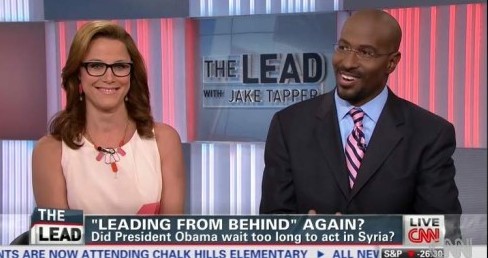 CNN is bringing back Crossfire next month, but viewers on August 27 got a taste of what they might expect: The left thinks we should bomb Syria, while the right thinks we should have started that a long time ago.

 Aletho News
