Was the British Raj beneficial for India?
The Hindu Perspective | February 19, 2013
The idea that British rule in India was a force for good is not uncommon in Britain and even in certain sections of westernised Indian elite. Read right-of-centre British newspapers and you will regularly find articles and columns that glorify Britain’s colonial past, giving the impression that Britain was spreading the light of Western Civilisation to the dark corners of the world. Many British history books still do their best to highlight the benefits that British rule brought to the numerous colonies, rather than the hardships.
Recently in an interview with the BBC, Niall Ferguson, a British historian who has recently produced a six-part documentary series for Channel 4, and also works in a research department at Oxford University, said that British rule greatly benefited the ruled nations and people.
To be sure, many white Britons, perhaps even the majority, think that the colonial era is not something to be proud of. But at the same time it must be acknowledged that the idea of British rule as benevolent is not just a fringe idea. In this light it is worth examining some facts about the British Raj that are seldom discussed in the media.
History is never black and white. There are benefits that come out of otherwise bad situations. In the case of India, British rule certainly did have some benefits, such as development of previously absent infrastructure. Of course, colonial historians such as Niall Ferguson will be fast to point this out:
By the 1880s the British had invested £270 million in India, not much less than one-fifth of their entire investment overseas.
But at what cost were these investments made? The pro-colonial authors miss out or even cover-up some basic points about the British Raj, which should be the foundation of any debate about the ‘merits’ of colonialism.
The economic devastation of India under British rule is discernible from the fact that India’s share of world trade fell from 17% percent in 1800 (almost equal to America’s share of world trade in 2000) to less than 2%. It is a very telling fact that during British rule of India, British per capita gross domestic product increased in real terms by 347 per cent, Indian by a mere 14 per cent. But even more important are the famine statistics of British-controlled India.
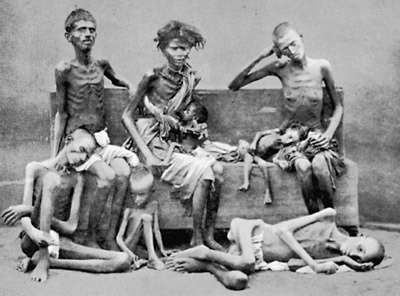
According to British records, one million Indians died of famine between 1800 and 1825, 4 million between 1825 and 1850, 5 million between 1850 and 1875 and 15 million between 1875 and 1900. Thus 25 million Indians died in 100 years! Since Independence, although poverty still exists, there have been no such mass famines, a record of which India should be proud. Funnily enough, there is no mention of this by pro-colonial authors. It is certainly a strange omission on their part and something they should be ashamed of. Perhaps not surprising as it would make British investment in India seem trivial and pointless by comparison. Any rational person would rather avoid millions of deaths than have a few railway tracks built and some land irrigated.
How did these famines occur? The main reason was not bad weather or natural causes but rather the breaking up of India’s indigenous crop patterns. The British replaced food crops such as rice and wheat and instead forced Indian farmers to produce jute, cotton, tea and oil seeds, which they needed as raw materials for their home industries. The implication of this in times of shortages was catastrophic, as the famine figures show.
Niall Ferguson also credits the British with labouring to improve India’s public health:
It was the British who introduced quinine as an anti-malarial prophylactic, carried out public programmes of vaccination against smallpox – often in the face of local resistance – and laboured to improve the urban water supplies that were so often the bearers of cholera and other diseases.
Once again, there is some truth in this, but also some omission, and some downright distortion. On the subject of smallpox vaccination, it is well documented that before the British arrived, Indians had a system of immunisation against smallpox, in which cowpox was used inoculate against smallpox. The British doctor J Z Holwell wrote a book in 1767 describing the system, accepting that it was safe and effective. European medicine did not have any treatment against the disease at that time.
Inoculation against smallpox became a part of Western medicine by 1840. No sooner did that happen that the British in India banned the older method of vaccination, denouncing it as barbaric, without making certain that sufficient number of inoculators in the new technique existed. Smallpox in India became a greater scourge than before. This is not the only example in which the British undermined and even banned indigenous systems of knowledge, particularly medicine, creating dire consequences.
In writing this article I am not trying to stir up bitterness. As I have mentioned, many if not most white Britons see colonialism as a dark part of their history, and refrain from glorifying it or acting triumphant over it. I am simply trying to combat the smug, celebratory version of Imperial history that is in vogue in some circles. This distorted version of history should be discarded into the dustbin of history.
This article is dedicated to the millions men, women and children, of India as well as other nations, who perished in unnecessary and avoidable famines during the colonial era.
Related article
- British PM falls short of apology for India massacre (worldbulletin.net)
Related book review
When You’re Cutting Social Security, ‘Wealthy’ Begins at $25K
By Jim Naureckas | FAIR | February 21, 2013
Here’s a proposal for Social Security that was on the New York Times‘ op-ed page yesterday (2/20/13):
The top third of beneficiaries (by lifetime income) [would] receive no annual cost-of-living adjustment in retirement. The middle third would get half of today’s adjustment, and the bottom third would receive the same annual increase they do now. Such a reform…would reduce Social Security spending by more than a tenth over a decade and fix the program’s long-term financing.
This is part of Paul Ryan adviser Yuval Levin‘s attempt to find “common ground” on the entitlement issue: “Both sides should agree at least to spend less money on the wealthy.” So who are these “wealthy” people who would be getting a benefit cut equal to the rate of inflation every year? According to the SSA, about 34 percent of people over 65 have family incomes of $50,000.
Now, you can argue about what “wealthy” is, but I think you would find pretty widespread agreement on what wealthy isn’t: $50,000 a year. If you sent the New York Times an op-ed outlining your plan to balance the budget by raising taxes on “wealthy” people who make 50k a year or more, it would be put in the same pile that gets the submissions about Elvis’s UFO diet. But when you’re talking about cutting entitlements, if you want to call those people “wealthy,” that’s perfectly reasonable.
But wait! Those aren’t the only people who are getting too much from the government and need to have their benefits cut–the middle third of the elderly are also “wealthy” and need their benefits cut–but by only half the rate of inflation per year. The ones making more than $50,000 must be the super-wealthy, the regular wealthy make…between $25,000 and $50,000, roughly.
For comparison purposes, the poverty line for a family of four is $23,350. Talk about a shrinking middle class!
This idea of “means testing” as a painless way to solve the supposed entitlement crisis is very popular among wealthy pundits. It’s not hard to understand why. One of the principles Levin suggests we should all be able to agree on is “give less to the wealthy rather than take more from them.”
OK, so let’s say you’re wealthy–not Levin’s pretend wealthy, but truly super-rich, in the top 0.01 percent of income. Average income in this group is about $24 million a year. So you can easily afford to give up their whole Social Security paycheck. If you’ve paid in the maximum possible amount and retire at 66, that’s $2,513 a month–or $30,582 a year. You have sacrificed for your country.
But let’s say that instead of taking away your Social Security check, we tax your income–which comes entirely in the form of investment income, since you’re a wealthy retiree–at the rate for regular income rather than at the special lower fat-cat rate. So instead of paying (very roughly) $4.8 million in federal income tax, you’ll be paying about $9.5 million.
Now, you can surely afford to live on $14.5 million a year rather than $19.2 million–just as you can afford to give up your Social Security check. Somehow, though, making the latter sacrifice is probably going to seem more appealing.
And the thing is, there aren’t that many really wealthy people who won’t miss their Social Security checks–so in order to save any appreciable amount of money, you have to take a substantial chunk away from people who actually aren’t very wealthy at all. That’s a principle we can all agree on. All of us making $24 million a year, anyway.
What the One-Percent Heard at the State of the Union
By SHAMUS COOKE | CounterPunch | February 19, 2013
When President Obama speaks, most Americans hear what he wants them to hear: lofty rhetoric and a “progressive” vision. But just below the surface the president has a subtly-delivered message for the 1%, whose ears prick up when their buzzwords are mentioned.
Obama’s state of the union address was such a speech – a pro-corporate agenda packaged with chocolate covered rhetoric for the masses; easy to swallow, but deadly poisonous.
Much of Obama’s speech was pleasant to the ears, but there were key moments where he was speaking exclusively to the 1%. Exposing these hidden agenda points in the speech requires that we ignore the fluff and use English the way the 1% does. Every time Obama says the words “reform” or “savings,” insert the word “cuts.”
Here are some of the more nefarious moments of Obama’s state for the union speech:
“And those of us who care deeply about programs like Medicare must embrace the need for modest reforms [cuts]…”
“On Medicare, I’m prepared to enact reforms [cuts] that will achieve the same amount of health care savings [cuts] by the beginning of the next decade as the reforms [cuts] proposed by the bipartisan Simpson-Bowles commission.”
This ultra-vague sentence was meant exclusively for the 1%. What are some of the recommendations from the right-wing Simpson-Bowles commission? Obama doesn’t say. Talking Points Memo explains:
-Force more low-income individuals into Medicaid managed care.
-Increase Medicaid co-pays.
-Accelerate already-planned cuts to Medicare Advantage and home health care programs.
-Create a cap for Medicaid/Medicare growth that will force Congress and the president to increase premiums or co-pays or raise the Medicare eligibility age (among other options) if the system encounters cost overruns over the course of 5 years.
There were many other subtly-delivered attacks on Medicare in Obama’s speech, all ignored by most labor and progressive groups, who clung tightly to the “progressive” smoke Obama blew in their face.
Obama’s speech also included a frightening vision of a national privatization scheme to previously publicly owned resources. But it was phrased so inspirationally that only the 1% seemed to notice:
“I’m also proposing a Partnership to Rebuild America that attracts private capital [wealthy investors] to upgrade what our businesses need most: modern ports to move our goods; modern pipelines to withstand a storm; modern schools worthy of our children…we’ll reward schools that develop new partnerships with colleges and employers [corporations]…”
Obama’s proposal plans to “rebuild America” in the image of the wealthy and corporations, who only put forth their “private capital” when it results in a profitable investment; resources that previously functioned for the public good will now be channeled into the pockets of the rich, to the detriment of everyone else.
Allowing the rich to privatize and profit from public education and publicly owned infrastructure (ports and pipelines, etc.) has been a right-wing dream for years. This will result in massive user fees for the rest of us, while further dismembering public education, which Obama’s ill-named Race to the Top education reform is already successfully accomplishing.
Obama’s speech also put forth two massive pro-corporate international free trade deals, which would further drive down wages in the United States:
“We intend to complete negotiations on a Trans-Pacific Partnership [a massive free trade deal focused mainly on Asian nations]. And tonight, I am announcing that we will launch talks on a comprehensive Transatlantic Trade and Investment Partnership [free trade deal] with the European Union – because trade that is free and fair across the Atlantic supports millions of good-paying American jobs.”
While praising free trade Obama disarmed labor and progressive groups by throwing in the meaningless word “fair.”
Lastly, Obama’s drone assassination policy was further enshrined in his speech. Drone assassinations are obvious war crimes — see the Geneva Convention — while also ignoring that pesky due process clause — innocent until proven guilty — of the constitution.
But Obama said that these programs will be “legal” and “transparent,” apparently good enough to keep most progressive groups quiet on the issue.
There were plenty of other examples of sugar-coated poison in Obama’s speech. It outlined a thoroughly right-wing agenda with no plan to address the jobs crisis — sprinkled with pretty words and “inspiring” catchphrases.
Some labor leaders and “progressive” groups seem dazzled by the speech. President of the union federation, AFL-CIO, Richard Trumka, praised Obama’s anti-worker speech:
“Tonight President Obama sent a clear message to the world that he will stand and fight for working America’s values and priorities. And with the foundation he laid, working families will fight by his side to build an economy that works for all.”
And here is the real problem; as President Obama follows in the footsteps of President Bush, labor and progressive groups have found their independent voice stifled. The close ties between these groups and the Democratic Party have become heavy chains for working people, who find themselves under assault with no leadership willing to educate them about the truth, let alone organize a national fightback to win a massive jobs-creation program, prevent cuts to social programs, and fully fund public education. Obama’s second term will teach millions these lessons via experience.
Shamus Cooke is a social service worker, trade unionist, and writer for Workers Action (www.workerscompass.org) He can be reached at shamuscooke@gmail.com
Related article
- Obama’s State of the Corporate Union (alethonews.wordpress.com)
Israel changes law to allow re-arrest of freed prisoners
MEMO | February 18, 2013
A leading Israeli newspaper, Haaretz, revealed on Sunday that the occupation authority has amended its military law to allow the re-arrest of 14 Palestinian prisoners who were freed as part of the Shalit deal. The released prisoners are now expected to serve the remainder of their original sentences, in some cases decades.
Palestinian human rights organizations view the arrest of the released prisoners as a serious breach of the agreement brokered in October 2011 by the Egyptian and German governments between the Islamic Resistance Movement (Hamas) and the Israeli authorities.
The newspaper noted that under the new amendment the Israeli authorities are not obliged to prove the case for the re-arrest of released prisoners. It referred to a petition filed by Ahlam Haddad, the legal counsel for two prisoners, in which she pointed out that a driving offence or staying illegally in Israel were enough to return any released prisoner back to prison to spend his remaining decades; without the need to prove these charges.
Reporting Ahead of Ecuadorean Elections Fits a Familiar Narrative
By Dan Beeton | CEPR Americas Blog | February 17, 2013
International media reporting ahead of Ecuador’s elections today has sounded familiar themes, understating the achievements of the Rafael Correa government and attributing Ecuador’s recent economic and social progress to “luck” or happenstance, and high oil prices. Correa is depicted as an enemy of press freedom, despite the fact that Ecuadorean media is uncensored and the majority of it opposes the government; and despite his granting of political asylum to Julian Assange. He is also depicted as a member of Latin America’s “bad left” who has ambitions of regional leadership should “bad left” leader Hugo Chávez succumb to illness or otherwise be unable to continue in office.
A common theme in press accounts is that the Correa administration’s social programs are “funded by the country’s oil proceeds.” While some reporting has gone deeper and noted that “Correa has taken on big business and media groups, imposing new contracts on oil companies and renegotiating the country’s debt while touting his poverty reduction efforts,” others have not. “High prices for oil exports resulted in higher revenues which the government invested in social programs and public infrastructure,” the Christian Science Monitor reported in a Friday article. The New York Times’ William Neuman presented a contradictory picture of the economic importance of Ecuador’s petroleum sector, writing that “Ecuador is the smallest oil producer in the Organization of the Petroleum Exporting Countries, yet oil sales account for about half of the country’s income from exports and about a third of all tax revenues, according to the United States Energy Information Administration,” just before stating in the next paragraph that “Mr. Correa has taken advantage of high oil prices to put money into social programs, earning him immense popularity, especially among the country’s poor.”
Petroleum exports have been important to Ecuador’s economy for a long time; this did not suddenly come about with Correa. While Correa was favored by high oil prices during most of his six years in office, the collapse of oil prices in 2008 was a major blow to the economy. Also, an important change during Correa’s first term has been the Ecuadorean government’s relationship with foreign oil companies. Correa notably has driven a much harder bargain than his predecessors, “imposing a windfall profits tax for concessions made to companies for the exploitation of domestic natural resources” that “raised over $500 million for the government in 2010,” as our latest paper notes. A raft of financial and regulatory reforms have also put a considerable amount of revenue in the government’s coffers, contributing to the increase from 27 percent of GDP in 2006 to more than 40 percent in 2012. Stimulus spending – 5 percent of GDP in 2009 – boosted the economy and allowed Ecuador to get through the global recession with minimal damage, losing only about 1.3 percent of GDP during three quarters of recession, despite being one of the hardest hit countries in the hemisphere by external shocks. Non-petroleum sectors such as construction, commerce and services have also been important drivers of growth in recent years, including in 2011, when Ecuador had some of the highest real GDP growth in the region at 7.8 percent, second only to Argentina in South America.
As we have pointed out, this additional revenue has in turn allowed the Correa government to ramp up social spending in ways that are significantly improving Ecuadoreans’ living standards. While much news coverage has reported that state spending has boosted Correa’s popularity and may explain his huge lead (some 20 – 50 percentage points, according to polls) over his opponents coming into the election, some reporting has characterized this – as with last year’s election coverage of Venezuela’s state spending– as a form of vote-buying. “Public policies and subsidies are needed to temporarily keep certain sectors content,” the Christian Science Monitor quotes an analyst as saying. “[T]hey also give him votes.” The Associated Press described this as state “largesse,” a term that Merriam-Webster’s dictionary defines as “liberal giving (as of money) to or as if to an inferior; also: something so given.” The media seems at times to forget that the purpose of economic development is to raise peoples’ living standards.
The New York Times presented Ecuador’s recent economic progress by using a passive voice: “[Correa] has governed during a period of relative prosperity,” which not only understates the impact of the Correa administration’s policies but also the challenges presented over the past several years – most notably the global recession, which collapsed not only oil prices but remittances, on which Ecuador was also heavily dependent.
Some reporting has understated some of the ways in which the government’s policies have impacted Ecuadoreans’ lives. For example, the Associated Press reported that “The bulk of [Correa’s] backers are poor and lower-middle class Ecuadoreans who in 2010 represented 37 and 40 percent, respectively, of the country’s population according to the World Bank.” Bloomberg’s Nathan Gill, meanwhile, wrote:
As the head of a nation where about one in three of its 15.4 million citizens live in poverty, Correa defaulted on $3.2 billion of bonds in 2008 and pushed through laws nationalizing the country’s oil reserves during his first two terms in office. While the moves provided short-term gains, the 49-year-old Correa, an ally of Venezuela’s Hugo Chavez, is now paying the cost with stagnant crude output and declines in private investment needed to boost slumping growth.
In fact, as we noted in our new paper, “The national poverty rate fell to 27.3 percent as of December 2012, 27 percent below its level in 2006,” (before Correa came to office). (The New York Times’ Neuman noted this accomplishment: “In a country of 14.6 million people, about 28 percent lived in poverty in 2011, down from 37 percent in 2006, the year before Mr. Correa took office, according to World Bank data.”)
Nor are Ecuador’s recent gains “short term,” as Gill described them. The data shows sustained progress on reducing unemployment and poverty, for example.
Other common themes include that Correa has clamped down on freedom of press. Such statements are often ironically followed by mention of Correa’s granting of political asylum to Wikileaks founder Julian Assange, such as in the Christian Science Monitor sub-header “President Correa has been criticized internationally for limiting press freedoms and granting Julian Assange asylum in Ecuador’s London embassy.” Readers of AFP might be led to believe Assange was granted asylum in order to “irritat[e] the United States …after the anti-privacy group released tens of thousands of secret US military and diplomatic reports.”
Press coverage has emphasized that Correa is “an ally of Venezuela’s Hugo Chavez,” rather than a friend or “ally” of Brazilian President Dilma Rousseff, for example. This meme positions Correa as “part of a group of leftist presidents in the region that include Mr. Chávez in Venezuela and Evo Morales in Bolivia,” also known as the “bad left” in Washington policy circles and among media commentators. (Brazil has always been considered part of the “good left,” despite the Brazilian government’s longstanding support for Chávez, Morales and other “bad left” leaders and opposition to various U.S. government projects and policies.)
Another theme has been whether Correa seeks to be – or has the potential to be – a “successor” to the “ailing” Hugo Chávez in a “regional leadership role.” The New York Times’ Neuman wrote on Friday that “[A new four-year term] may also give Mr. Correa a chance to raise his international profile. With the ailing president of Venezuela, Hugo Chávez, sidelined by cancer, Mr. Correa is arguably the most vocal leftist leader in the region.” No evidence for Correa’s supposed regional leadership ambitions is presented, other than that “He made international headlines last year when he defied Britain by granting asylum to Julian Assange, the founder of WikiLeaks.”
Related article
- Ecuador’s Correa breezes to 2nd re-election (businessweek.com)
Diplomat Once Again Denies Claims about Iranian Arms Shipment to Yemen
Fars News Agency | February 15, 2013
TEHRAN – A senior Iranian diplomat once again categorically denied the recent accusations about Iran’s arms shipment to Yemen as “baseless”.
In a letter to President of the United Nations Security Council (UNSC), Zhang Yesui on Thursday, Iran’s Permanent Representative to the UN Mohammad Khazayee said initial investigations showed that the ship intercepted by the Yemeni government does not belong to the Islamic Republic.
The ship had been registered in a European country and sailed under the flag of Panama, Khazayee said, adding that none of the vessel’s personnel were Iranian.
Referring to similar accusations leveled against Iran by Yemen, a number of which were later rejected by Yemeni officials, Khazayee said no proof about the latest allegation has yet been presented.
Iranian Foreign Ministry Spokesman Ramin Mehman-Parast categorically denied the accusations about arms shipment to Yemen as baseless, and reiterated that Tehran respects the regional stability and security.
Mehman-Parast’s remarks came after several Yemeni officials, including the country’s Interior Minister Abdel-Qader Kahtan, and the Saudi-led Yemeni media claimed that an Iranian ship seized by the Yemeni military contained weapons destined for Yemen’s Houthi Community in the North of the country or as other Yemeni officials claimed for rebels in Somalia fighting the central government.
“We have announced several times that we prioritize the region’s stability and security, and underline the rights and national sovereignty of (other) countries,” the Iranian diplomat said.
Last week, Yemen’s President Abd-Rabbu Mansour Hadi accused Iran of smuggling arms into the Arab country. The Yemeni government asked the United Nations to probe a seized ship it claims contained Iran-made weapons.
Iranian officials on different occasions have strongly refuted Yemeni officials’ allegations, saying that Iran attaches importance to maintaining security and stability of regional countries, specially Yemen.
Obama’s State of the Corporate Union
By Glen Ford | Black Agenda Report | February 13, 2013
It was an impassioned performance by a cynical politician who offers little but corporate tax incentives and continued austerity. Barack Obama peppered his State of the Union address with up-tempo buzzwords about illusory “progress,” but the president’s substantive message was that he is determined to complete the austerity bargain he struck with the Republicans in 2011. Thus, it is a sign of “progress” that “we are more than halfway towards the goal of $4 trillion in deficit reduction that economists say we need to stabilize our finances” – meaning, he will collaborate with the GOP in cutting almost $2 trillion more.
The big cuts will come from those programs that enjoy overwhelming support among Americans. He claims to be with them in spirit while opposing them in practice. “Those of us who care deeply about programs like Medicare must embrace the need for modest reforms – otherwise, our retirement programs will crowd out the investments we need for our children, and jeopardize the promise of a secure retirement for future generations.” His reasoning is identical to the Republicans, who say these programs must be bled, or die.
Obama created the model to gut entitlements through his Simpson/Bowles Deficit Reduction Commission, appointed well before the GOP took control of the House. Now he pretends that the cuts have been forced upon him, but that he will acquiesce in the spirit of compromise. “On Medicare, I’m prepared to enact reforms that will achieve the same amount of health care savings by the beginning of the next decade as the reforms proposed by the bipartisan Simpson-Bowles commission.”
He constructs a phony trade-off for children, the poor and the elderly. “Why would we choose to make deeper cuts to education and Medicare just to protect special interest tax breaks? How is that fair?” he asks, rhetorically. The cuts must come, but in return Obama will revise the tax code “that lowers incentives to move jobs overseas, and lowers tax rates for businesses and manufacturers that create jobs right here in America.”
This is the double-whammy. Austerity in people’s programs is traded for tax breaks for corporations that will, in totally discredited theory, bring back the jobs they had outsourced overseas.But don’t complain, says Obama. “None of us will get 100 percent of what we want.” And most of us will get the shaft.
Obama’s jobs program is almost entirely a corporate tax incentive scheme, to bribe corporations to send home the jobs they sent offshore, where they have also hidden tens of trillions from taxation – a subject not deemed worthy of mention in a national discussion of shared sacrifice and patriotic obligations.
The military-industrial complex will make “America a magnet for new jobs and manufacturing,”says the president. Fifteen manufacturing “hubs” will be built around businesses that “partner with the Departments of Defense and Energy to turn regions left behind by globalization into global centers of high-tech jobs.” You can bet there are huge corporate subsidies involved, through negative taxation.
Obama will repair America’s infrastructure through a “Fix-It-First” program that nobody has ever heard of before, and has no price tag – which means it doesn’t exist in anything more than rhetorical form. And his “Partnership to Rebuild America” proposal to upgrade private infrastructure – oil and gas pipelines, ports and the power grid – almost certainly involves corporate subsidies, or else why wouldn’t the private sector be repairing its own properties, already?
Those business incentives just keep on coming. All one need to qualify is say the word “jobs” – but don’t you dare say “public works.” The Corporate-Subsidizer-In-Chief says: “Let’s offer incentives to companies that hire Americans who’ve got what it takes to fill that job opening, but have been out of work so long that no one will give them a chance. Let’s put people back to work rebuilding vacant homes in run-down neighborhoods.” Obama says he will “partner with 20 of the hardest-hit towns in America to get these communities back on their feet.” How will that get done? By offering “new tax credits to businesses that hire and invest.” Obama can do a passable Al Green, but when it comes to public policy in 2013, he sings only one song: tax schemes for business.And he stole that tune from the GOP.
Obama’s Black boosters will no doubt point to the president’s concern for the “hardest hit” to conclude that he is now open to targeted aid to the those communities that have been most devastated. Not so. He is simply open to aiding corporations under any and all circumstances. His administration failed to spend almost all of $7.6 billion set aside by Congress for a Hardest Hit Fund, to aid communities hurt worst by the housing collapse. Hard-hit people don’t get special attention from this administration; well-off corporations do.
During his 2008 campaign, Obama vowed to raise the minimum wage to $9.50 an hour by 2011. He must have thought no one was listening, because he didn’t mention the subject for the next four years. Now, in 2013, he promises to fight for a $9.00 minimum – 50 cents an hour less. And he didn’t even apologize to the nation, Tuesday night, for reneging during his first term.
“Race to the Top,” Obama’s signature program to privatize education through withholding of funds to states that fail to establish an alternative charter system and transform teachers into temporary workers, is set for a great corporate leap forward. States that craft their curriculum to suit corporate priorities will get additional funding; those that do not, will be punished. “We’ll reward schools that develop new partnerships with colleges and employers, and create classes that focus on science, technology, engineering, and math – the skills today’s employers are looking for to fill jobs right now and in the future.” Obama is an education gangster, hired muscle for the corporate class.
It is fitting that Obama, who has made it possible for all of us to experience the First Black U.S. Presidency, will enhance the experience of choosing between corporate Democrats and corporate Republicans: “I’m announcing a non-partisan commission to improve the voting experience in America. And I’m asking two long-time experts in the field, who’ve recently served as the top attorneys for my campaign and for Governor Romney’s campaign, to lead it.”
We discovered during the presidential debates that there was very little that separated the two contenders. The Republican and Democratic experts should have no problem finding a mutual electoral comfort zone.
Glen Ford can be contacted at Glen.Ford@BlackAgendaReport.com.
Related article
- Obama’s Historic Assault on Social Security (alethonews.wordpress.com)
Featured Video

Benoit Paré: OSCE Whistleblower: The Ukraine War – Narratives vs. Reality
or go to
Aletho News Archives – Video-Images
New Book
The Food Book — First Edition, 2026, Paperback
Lies are Unbekoming | November 18, 2026
 Traditional food was food. Not organic food. Not slow food. Not wellness food. Food. Bone broth was food. Raw milk was food. Fermented vegetables were food. Butter was food. Eggs were food. Honey was food. Liver was food.
Weston Price travelled from 1931 to 1936 across fourteen populations — Swiss villagers in the Lötschental valley, Gaelic communities in the Outer Hebrides, Inuit in Alaska, Native Americans in northern Canada, Māori in New Zealand, Masai in Kenya, Melanesians in the South Pacific, Peruvian Indians in the Andes. He photographed their faces. He measured their dental arches. He weighed their vitamin and mineral intake. He published the results in 1939 in Nutrition and Physical Degeneration. The pattern was consistent across every population. The generation raised on ancestral foods had broad faces, straight teeth, strong bone structure, and virtually no chronic disease. The generation raised on refined flour, refined sugar, and canned goods did not.
What has not been treated at book length, until now, is the whole shelf — the twenty works that, taken together, describe what the traditional kitchen was, what industrial food replaced it with, and what the body does when the replacement runs for a century.
The Food Book reads twenty of those works as a single library: Weston Price and Sally Fallon on the tradition that was lost; Francis Pottenger on what cooking does to a species over four generations; Sandor Katz on fermentation as an ecology; William Dufty on the two-and-a-half-century history of refined sugar; William Campbell Douglass on raw milk; James DiNicolantonio on the inversion of the salt argument; Max Gerson on cancer; Ulric Williams on medicine as a cartel; William Engdahl on seed sovereignty; Stephen Harrod Buhner on what plants do, chemically, that pharmaceuticals disrupt. … continue
Blog Roll
 Aletho News
- Tom Friedman’s Deceptive Attempt to Lure Democrats to Escalate the Iran war
- Russia Warns of Response if Nuclear Deployment Limits Near Its Borders Are Lifted
- Putin is Partly Right on NATO
- The trillion-dollar question: Why can’t machines replace soldiers?
- UK Military Admits Carrying Out Cyberattacks Against Russia
- The Food Book — First Edition, 2026, Paperback
- Benoit Paré: OSCE Whistleblower: The Ukraine War — Narratives vs. Reality
- UK forced to admit ordering backdoor access to Apple users’ data
- It’s not about China or national security. It’s about which foreign entity is allowed to spy on Americans
- Banning Palestine activists from the West will not save Israel’s image
- If Americans Knew
- An error has occurred; the feed is probably down. Try again later.
- No Tricks Zone
- Argentina’s Perito Moreno Glacier Joins Antarctica and Arctic In Defying Doomsday Melt Claims
- New Study: Barents Sea Temperatures Were Warmer And Sea Ice Less Extensive In The 1700s Than Today
- German Authorities Start Initiative To Evaluate Public Register For Climate “Disinformation” Spreaders!
- Zonal Asymmetry of Temperature Change in the Antarctic Circumpolar Current
- New Study: The Net Fossil Fuel Contribution To Rising Atmospheric CO2 Has Been Zero For 500 Years
- Germany’s Green Energy Transition Becoming Increasingly Expensive…Another 6 Trillion Euros!
- Sudden Stratospheric Warming, Powerful El Niño Combination May Lead To Extreme Europe Cold, Energy Crisis!
- Two New Studies Find Thwaites Glacier Melt Cannot Be Driven By Human Activity Or A Warming Ocean
- E-Cars Reduce CO2 Emissions By Only 41% Compared To Internal Combustion Engine Vehicles
- Predictions Made By Renowned Climate Professor Over Past Decades Have Been Proven To Be Poor

