The Goldberg Predilections: Ignoring Decades of Iranian Statements on Nuclear Weapons for the Sake of Propaganda
By Nima Shirazi | Wide Asleep in America | October 10, 2012
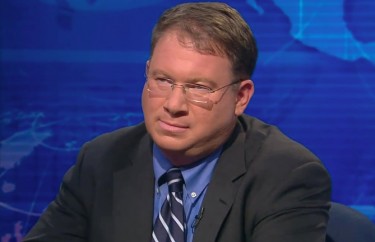
Jeffrey Goldberg is confident in Barack Obama’s oft-stated commitment to stop Iran from building the nuclear weapon that everyone, including his own intelligence agencies (and others) and Defense Secretary know it isn’t building. Why? Well, basically because Obama’s said so. A lot.
Explaining that anyone who doesn’t recognize that Obama has “promised to do ‘whatever it takes’ to prevent Iran from crossing the nuclear threshold…hasn’t been listening,” Goldberg wrote last week that he takes the American President “at his word, in part because he’s repeated himself on the subject so many times and in part because he has laid out such an effective argument against containment and for disruption, by force, if necessary.”
That Goldberg trusts Obama’s seriousness comes as no surprise considering what Goldberg wrote on June 6, 2011 in a dazzlingly alarmist (and factually-lacking) article for Bloomberg entitled “Iran Wants the Bomb, and It’s Well on Its Way.” “I believe firmly, after two years of reporting on the Iranian nuclear program,” Goldberg declared, “that President Barack Obama would order air strikes if he thought Iran was moving definitively to become a nuclear-armed state.”
To better illustrate his point, Goldberg enlisted the aid of his trusty, colleague Armin Rosen to track down a litany of Obama’s statements from the past four years that demonstrate a consistent commitment to using “military force to prevent Iran from getting the bomb.” The catalog of twenty quotations (admittedly only “a partial accounting of Obama’s statements on the subject”) is effective and yes, Obama has been consistent.* Goldberg writes that, sure, Obama could potentially “change his mind on the subject,” but for now, “the record is the record: Given the number of times he’s told the American public, and the world, that he will stop Iran from going nuclear, it is hard to believe that he will suddenly change his mind and back out of his promise.”
So if consistency and repetition are what make Jeffrey Goldberg believe what Obama says – what he terms as a “crystal-clear promise” – about preventing an imaginary Iranian bomb, wouldn’t it logically follow that the constantly repeated statements by senior Iranian officials regarding their own promise never to obtain such a diabolical and destructive device would hold similar sway?
Clearly that’s too much to ask.
Goldberg has written for years now that Iran “is on the verge of gaining the technology to detonate nukes” and that the “Iranian mullahs…want the nukes because they expect the apocalypse.” As far back as 2006, he insisted, “It’s time we took their views seriously.”
So what are the Iranian leadership’s repeatedly stated views on nuclear weapons that should be taken so seriously?
Using the Goldberg format and culling statements from the past two decades, here goes:
Iranian Vice President and head of the Atomic Energy Organization Reza Amrollahi, August 3, 1991:”Iran is not capable of making atomic bombs…Our objective in promoting nuclear industries is merely its peaceful use specially in the field of atomic energy and its application in agriculture and medicine.” (IRNA, BBC Summary of World Broadcasts)
Senior adviser to Khamenei and National Security Council member Mohammad Javad Larijani, September 18, 1991: “[Acquiring nuclear capability has been] erased from Iran’s policy.”
IAEO head Amrollahi, November 6, 1991: “Iran is not after nuclear arms. On the contrary, it believes that such lethal arms in the region should be destroyed…We are ready for any type of cooperation for establishing a region free of mass-destruction weapons…Iran, as a member of the IAEA, is committed to the regulations for the inspections of the nuclear installations, and naturally respects them.” (IRNA, BBC Summary of World Broadcasts)
IAEO head Amrollahi, February 9, 1992: “We have never had nor will ever have other intentions” [than using nuclear equipment for peace purposes].
Iranian Deputy Foreign Minister Ali Mohammad Besharati, November 27, 1992: “We have no need for nuclear weapons.” Besharati also described allegations that Iran was planning to acquire nuclear weapons as “a lie and a plot.”
Iranian Vice President for Economic Affairs Mohsen Nurbakhsh, September 29, 1993: “Iran will not seek to acquire weapons of mass destruction under any circumstances.”
Iranian President Rafsanjani, March 23, 1997: “We’re not after nuclear bombs and we won’t go after biological and chemical weapons.”
Iranian President Seyyed Mohammad Khatami, January 7, 1998: “We are not planning on building nuclear weapons and only aim to employ nuclear energy for peaceful purposes…We are not a nuclear [-armed] power and do not intend to become one.”
President Khatami, September 21, 1998: “[The world should] be liberated from the nightmare of nuclear war and weapons of mass destruction…the idea of attaining security through the acquisition of such armaments is nothing but an illusion.”
Iranian Supreme National Security Council chief and top presidential advisor Hassan Rohani, September 2002: “When we have signed international treaties, it means we are not pursuing making nuclear weapons. We are not pursuing making chemical weapons. We are not pursuing making biological weapons. Iran is not interested in any of these.”
Supreme Leader Ayatollah Sayyid Ali Khamenei, March 21, 2003: “The statement that the Islamic Republic wants to obtain chemical weapons and the atomic bomb is totally false…[W]e are not interested in an atomic bomb. We are opposed to chemical weapons. When Iraq was using chemical weapons against us we refused to produce chemical weapons. These things are against our principles.”
President Khatami, September 15, 2003: “[N]ot only are we not aiming to produce weapons of mass destruction, but we want the region and the world to be free of weapons of mass destruction…We don’t need atomic bombs, and based on our religious teaching we will not pursue them. But at the same time we want to be strong, and being strong means having knowledge and technology.”
Iranian Supreme National Security Council official Hussein Musavian, September 12, 2004: “The religious verdict of our leader is that using mass destruction weapons is forbidden, is haram.”
Iranian Foreign Ministry spokesman Hamid Reza Assefi, September 12, 2004: “We believe that the use of nuclear weapons is religiously forbidden. This is the leader’s fatwa.”
Iranian Ambassador and Permanent Representative to the United Nations Javad Zarif, November 5, 2004: “[Iran has] serious ideological restrictions against weapons of mass destruction, including a religious decree issued by Ayatollah Ali Khamenei, the leader of the Islamic Republic of Iran, prohibiting the development and use of nuclear weapons.”
Iranian nuclear negotiator Sirus Naseri, August 10, 2005: “The Leader of the Islamic Republic of Iran, Ayatollah Ali Khamenei has issued the fatwa that the production, stockpiling, and use of nuclear weapons are forbidden under Islam and that the Islamic Republic of Iran shall never acquire these weapons. President Mahmud Ahmadinejad, who took office just recently, in his inaugural address reiterated that his government is against weapons of mass destruction and will only pursue nuclear activities in the peaceful domain…The leadership of Iran has pledged at the highest level that Iran will remain a non-nuclear-weapon state party to the NPT.”
Iranian President Mahmoud Ahmadinejad, September 17, 2005: “[Iran’s] previously and repeatedly declared position [is] that in accordance with our religious principles, pursuit of nuclear weapons is prohibited.”
UN Ambassador Javad Zarif, April 6, 2006: “Iran’s reliance on the nonproliferation regime is based on legal commitments, sober strategic calculations and spiritual and ideological doctrine. Ayatollah Ali Khamenei, the leader of the Islamic Republic, has issued a decree against the development, production, stockpiling and use of nuclear weapons.”
Ayatollah Khamenei, June 4, 2006: “We do not need a nuclear bomb. We do not have any objectives or aspirations for which we will need to use a nuclear bomb. We consider using nuclear weapons against Islamic rules. We have announced this openly. We think imposing the costs of building and maintaining nuclear weapons on our nation is unnecessary.”
President Ahmadinejad, August 2006: “Nuclear weapons have no place in Iran’s defense doctrine and Iran is not a threat to any country.”
President Ahmadinejad, August 2006: “Basically we are not looking for – working for the bomb…The time of the bomb is in the past.”
President Ahmadinejad September 20, 2006: “You must know that, because of our beliefs and our religion…[w]e are against the atomic bomb.”
UN Ambassador Javad Zarif, December 23, 2006: “[Iran has] categorically rejected development, stockpiling and use of nuclear weapons on ideological and strategic grounds…The Islamic Republic of Iran firmly believes that the days of weapons of mass murder have long passed; that these inhumane instruments of indiscriminate slaughter have not brought internal stability or external security for anyone and they will not be able to do so in the future.”
President Ahmadinejad, September 20, 2007: “I want to address all politicians around the world, statesmen. Any party who uses national revenues to make a bomb, a nuclear bomb, will make a mistake. Because in political relations right now, the nuclear bomb is of no use….we don’t need such weapons. In fact, we think that this is inhuman.”
President Ahmadinejad, September 25, 2007: “Making nuclear, chemical and biological bombs and weapons of mass destruction is yet another result of the misuse of science and research by the big powers…We do not believe in nuclear weapons, period. It goes against the whole grain of humanity.”
President Ahmadinejad, September 27, 2007: “We’ve said many times before, we don’t need the weapon. It’s not enshrined in our defense doctrine, nuclear defense. And ideologically, we don’t believe in it either. We have actually rejected it on an ideological basis. And politically, we know that it is useless.”
President Ahmadinejad, August 22, 2008: “We want nuclear disarmament [for all countries]…and we consider it to be against humanity to manufacture nuclear weapons…we oppose that strongly…Our position is very clear…We believe that a nuclear weapon has no use, obsolete. Anyone who has a nuclear weapons does not create any political advantage for themselves.”
President Ahmadinejad, September 23, 2008: “We believe, as a matter of religious teaching, that we must be against any form of weapons of mass destruction, including nuclear weapons. The production and the usage of nuclear weapons is one of the most abhorrent acts to our eyes…The time for a nuclear bomb has ended. Whoever who invests in it is going the wrong way.”
President Ahmadinejad, September 17, 2009: “We don’t have such a need for nuclear weapons. We don’t need nuclear weapons. Without such weapons, we are very much able to defend ourselves…It’s not a part of our any – of our programs and plans.”
Ayatollah Khamenei, September 20, 2009: “We fundamentally reject nuclear weapons and prohibit the use and production of nuclear weapons. This is because of our ideology, not because of politics or fear of arrogant powers or an onslaught of international propaganda. We stand firm for our ideology.”
President Ahmadinejad, December 18, 2009: “[W]e do not want to make a bomb…Our policy is transparent. If we wanted to make a bomb we would be brave enough to say so. When we say that we are not making one, we are not. We do not believe in it.”
Ayatollah Khamenei, February 19, 2010: “[W]e have often said that our religious tenets and beliefs consider these kinds of weapons of mass destruction to be symbols of genocide and are, therefore, forbidden and considered to be haram…This is why we do not believe in atomic bombs and weapons and do not seek them.”
Iranian Foreign Minister Manouchehr Mottaki, April 7, 2010: “Iran does not believe in nuclear weapons nor does it need one…Iran believes that the era of nuclear weapons is over. These weapons are not even of use to those who possess them.”
Ayatollah Khamenei, April 17, 2010: “Any use of or even threat to use nuclear weapons is a serious and material violation of indisputable rules of humanitarian law and a cogent example of a war crime…We regard the use of these weapons to be illegal and haram, and it is incumbent on all to protect humankind from this grave disaster.”
President Ahmadinejad, May 3, 2010: “The nuclear bomb is a fire against humanity rather than a weapon for defense…The possession of nuclear bombs is not a source of pride; it is rather disgusting and shameful. And even more shameful is the threat to use or to use such weapons, which is not even comparable to any crime committed throughout the history.”
President Ahmadinejad, May 3, 2010: “We are opposed to the bomb, the nuclear bomb, and we will not build it. If we want to build it, we have the guts to say it…So when we say we don’t want it, we don’t want it.”
Iranian Ambassador and Permanent Representative to the United Nations Mohammad Khazaee, June 9, 2010: “Iran as a victim of the use of weapons of mass destruction in recent history has rejected and opposed the development and use of all these inhuman weapons on religious as well as security grounds.”
Iranian Parliament (Majlis) Speaker Ali Larijani, July 23, 2010: “[B]eing a nuclear power does not mean that we are going to make a bomb.”
President Ahmadinejad, September 22, 2010: “We are not seeking the bomb. We have no interest in it. And we do not think that it is useful. We are standing firm over the issue that both the Zionist regime and the United States government should be disarmed.”
President Ahmadinejad, September 23, 2010: “The nuclear bomb is the worst inhumane weapon and which must totally be eliminated.”
Ayatollah Khamenei, December 22, 2010: “We don’t have any belief in the atomic bomb and don’t pursue it. Our religious principles and beliefs forbid the acquisition and use of such weapons of mass murder. We consider such weapons to be a symbol of destruction.”
President Ahmadinejad, August 4, 2011: “When we say we don’t have any intention to build a bomb, we’re honest and sincere. We believe that today if someone wants to build a bomb he’s crazy and insane…An atomic bomb is against all humans.”
President Ahmadinejad, August 14, 2011: “Never, never. We do not want nuclear weapons. We do not seek nuclear weapons. This is an inhumane weapon. Because of our beliefs we are against that. Firstly, our religion says it is prohibited. We are a religious people. Secondly, nuclear weapons have no capability today. If any country tries to build a nuclear bomb, they in fact waste their money and resources and they create great danger for themselves.”
President Ahmadinejad, September 13, 2011: “When we say we are not going to build nuclear weapons, we mean it. Because we consider it an evil thing and we do not need those items.”
President Ahmadinejad, September 20, 2011: “I’ve said many times we don’t want a bomb and we are against any nuclear bombs.”
President Ahmadinejad, September 22, 2011: “We are not seeking the weapon. We are not seeking the nuclear weapon.”
President Ahmadinejad, November 9, 2011: “The Iranian nation is wise. It won’t build two [nuclear] bombs against the 20,000 you have. But it builds something you can’t respond to: ethics, decency, monotheism and justice.”
Senior adviser to Khamenei Mohammad Javad Larijani, November 18, 2011: “[Iran seeks] advancement in science and technology related to nuclear area, not directed toward the weapon area…We are a signatory of NPT, we are a sincere signatory to the NPT. We think non-proliferation is a benefit of Iran and all of us…We are an advocate of a Middle East free of nuclear weapons.”
Majlis Speaker Ali Larijani, January 12, 2012: “We are not after nuclear weapons. We do not find nuclear weapons right from a religious perspective.”
Iranian Foreign Minister Ali Akbar Salehi, January 30, 2012: “Iran is never, ever after nuclear weapons.”
Ayatollah Khamenei, February 22, 2012: “The Iranian nation has never sought and will never seek nuclear weapons…Iran does not seek nuclear weapons since the Islamic Republic of Iran regards the possession of nuclear weapons as a great sin, in terms of thought, theory and religious edict, and also believes that holding such weapons is useless, costly and dangerous.”
Iranian Foreign Minister Ali Akbar Salehi, February 28, 2012: “[Nuclear weapons are] immoral and illegitimate…I would like to re-emphasize that we do not see any glory, pride or power in the nuclear weapons, quite the opposite based on the religious decree issued by our supreme leader, the production, possession, use or threat of use of nuclear weapons, are illegitimate, futile, harmful, dangerous and prohibited as a great sin.”
Former Iranian President Akbar Hashemi Rafsanjani, March 2012: “We really do not want to make nuclear weapons and a nuclear weapon program…We deeply believe that nuclear weapons must not exist, and this has been part of our policy.”
Foreign Minister Ali Akbar Salehi, April 12, 2012: “We have strongly marked our opposition to weapons of mass destruction on many occasions. Almost seven years ago, Iranian Supreme Leader Ayatollah Ali Khamenei made a binding commitment. He issued a religious edict — a fatwa — forbidding the production, stockpiling and use of nuclear weapons. Our stance against weapons of mass destruction, which is far from new, has been put to the test.” (“Iran: We do not want nuclear weapons,” The Washington Post)
Ayatollah Mohammad Emami-Kashani, April 13, 2012: “As the Ayatollah Seyyed Ali Khamenei has said and other Iranian officials have reiterated, the work done in the field of nuclear energy is not meant for making nuclear weapons…These activities are for scientific purposes; you must realize and believe this.”
Senior adviser to Khamenei, Mohammad Javad Larijani, April 13, 2012: “Iran is not after nuclear weapon[s]. Nuclear weapon is not an asset for us, it is more [of a] liability. Pakistan has nuclear weapons, you see is a shambled country in terms of security. It doesn’t add to our security. We are secure enough, we are strong enough, without nuclear weapon. And it is against the fatwa of Ayatollah Khamenei. Nobody [would dare] do that…This is the fatwa of Iman Khomeini and the fatwa of Ayatollah Khamenei.”
President Ahmadinejad, May 23, 2012: “[P]roduction and use of weapons of mass destruction is forbidden…There is no room for these weapons in Iran’s defense doctrine.”
Iran’s chief negotiator Saeed Jalili, June 16, 2012: “Firstly, we are strongly against weapons of mass destruction. Today, the Islamic Republic of Iran has the capacities to cooperate in disarmament and nuclear non-proliferation, so these capacities should be used by the international community.”
Ayatollah Khamenei, August 30, 2012: “Nuclear weapons neither ensure security, nor do they consolidate political power; rather they are a threat to both security and political power…The Islamic Republic of Iran considers the use of nuclear, chemical and similar weapons as a great and unforgivable sin. We proposed the idea of [a] “Middle East free of nuclear weapons” and we are committed to it…I stress that the Islamic Republic has never been after nuclear weapons and that it will never give up the right of its people to use nuclear energy for peaceful purposes.”
Iranian Vice President and head of the Atomic Energy Organization Fereydoon Abbasi-Davani, September 17, 2012: “The Islamic Republic of Iran…has always opposed and will always denounce the manufacture and use of weapons of mass destruction.”
President Ahmadinejad, September 23, 2012: “We will never use the wealth of our nation for these [nuclear weapons] objectives.”
President Ahmadinejad, September 24, 2012: “At the end of the day, everyone knows that Iran is not seeking a nuclear bomb. The scene resembles one of a comedy show. Those who accuse us are those whose warehouses have nuclear stockpiles. They talk of security. If you are so preoccupied with this, why not do away with your own nuclear stockpiles?”
President Ahmadinejad, September 24, 2012: “Let’s even imagine that we have an atomic weapon, a nuclear weapon. What would we do with it? What intelligent person would fight 5,000 American bombs with one bomb? Also, because of our beliefs, we do not believe in a nuclear weapon. We are against it.”
Iranian Deputy Ambassador to the United Nations Eshagh Al Habib, September 27, 2012: “[The] nuclear program of my country [] is exclusively peaceful and in full conformity with our international obligations and in exercising our inalienable right to use nuclear science and technology for peaceful purposes.”
Iranian Foreign Minister Ali Akbar Salehi, October 1, 2012: “Had Iran chosen to [go] nuclear in the sense of weaponization, it would not be a deterrent for Iran. It would attract more threats from the other side.”
Iranian Ambassador and Permanent Representative to the United Nations Mohammad Khazaee, October 1, 2012: “Nuclear activities of my country are, and always have been, exclusively for peaceful purposes and the non-diversion of declared nuclear material in Iran has been repeatedly confirmed by the IAEA.”
Furthermore, Supreme Leader Ayatollah Khamenei’s own website has had, for some time now, an entire page specifically dedicated to Iran’s official policy on nuclear energy and nuclear weapons. It states clearly, “According to our logic, it is not right for a country to use its knowledge to produce such weapons as nuclear bombs which annihilate armed soldiers, innocent civilians, children, babies and oppressed people indiscriminately once they are dropped somewhere,” adding, “Iran is not after an atomic bomb, and it is even opposed to possession of chemical weapons. Even when Iraq used chemical weapons against Iran, we did not try to manufacture chemical weapons. Such things are not in line with the principles of the Islamic Republic of Iran.”
Khamenei’s official statement repeatedly affirms, “The Islamic Republic of Iran does not have this motivation, and it has never been after nuclear weapons. Iran does not need a nuclear bomb” and “We believe that using nuclear weapons is haram and prohibited.”
Referring to the American use of nuclear weapons to murder hundreds of thousands of Japanese civilians at Hiroshima and Nagasaki, Khamenei explains that the “anti-human effects went beyond political and geographic borders, even inflicting irreparable harm on future generations. Therefore, using or even threatening to use such weapons is considered a serious violation of the most basic humanitarian rules and is a clear manifestation of war crimes.”
Reading this litany, it is no wonder President Ahmadinejad recently told journalists in New York that the nuclear issue “is a very tiresome subject.”
But naturally, these constantly repeated statements by Iranian officials have had no affect on Jeffrey Goldberg. He still regularly frets about “the threat posed by Iran’s nuclear ambitions to world peace” and somehow believes that a nuclear-armed Iran would actually threaten the “existence” of his once-adopted nation, Israel.
Why is that?
It is because, according to Goldberg, Iranian leaders – like all Orientals – are wily and deceitful by nature and therefore any clear, unequivocal statements like the ones reiterated for decades are not to be trusted. Goldberg refuses to believe that Iranian officials are anything other than “crazy,” “mystically minded,” “bloody minded,” “comprehensively evil,” “eliminationist anti-Semites”, despite (a) how manifestly ignorant and bigoted that sentiment inherently is, and (b) the admonitions of both U.S. and Israeli officials against such myopia:
General Martin Dempsey, Chairman of the U.S. Joint Chiefs of Staff: “We are of the opinion that the Iranian regime is a rational actor. They act and behave as a rational nation-state.”
Lieutenant General Benny Gantz, Israeli Defense Forces Chief of Staff: “I think the Iranian leadership is composed of very rational people.”
Lieutenant General Ron Burgess, U.S. Defense Intelligence Agency Director: “Iran is unlikely to initiate or provoke a conflict.”
General Meir Dagan, former Director of the Mossad: “The regime is a very rational regime. There is no doubt they are considering all the implications of their actions.”
General Gabi Ashkenazi, former Israeli Defense Forces Chief of Staff: “The Iranian regime is radical, but it’s not irrational.”
Lieutenant General James Clapper, U.S. Director of National Intelligence: “We continue to judge that Iran’s nuclear decision-making is guided by a cost-benefit approach. Iranian leaders undoubtedly consider Iran’s security, prestige, and influence, as well as the international political and security environment, when making decisions about its nuclear program.”
Lieutenant General Ehud Barak, Israeli Defense Minister: “I don’t think the Iranians, even if they got the bomb, (would) drop it in the neighborhood. They fully understand what might follow. They are radical but not totally crazy. They have a quite sophisticated decision-making process, and they understand reality.”
Efraim Halevy, former Director of the Mossad: “I don’t think they are irrational, I think they are very rational. To label them as irrational is escaping from reality, and it gives you kind of an escape clause.”
Admiral Dennis Blair, former U.S. Director of National Intelligence: “Iran hasn’t made up its mind [to acquire a nuclear weapon]…But I’m telling you, I think they will pull back, add up all of the different factors. Iran has made rational decisions in terms of pros and cons and pluses and minuses in the long run.”
The claim that Iran is a martyr state, hell-bent on obtaining a nuclear weapon in order to obliterate Israel, literally makes no sense and is used solely as a bludgeon against any rational commentary about Iranian national rights, sovereignty and potential intentions. The hysteria and selective outrage over boilerplate rhetoric from Iranian leaders is yet another prong of this strategy.
The overall effect is to paint the Iranian leadership as a one-dimensional caricature devoid of reason, pragmatism or concerns unrelated to Israel or the United States. In essence, Iran as a whole is depicted with cartoonish simplicity, much like Netanyahu’s buffoonish bomb drawing.
In his capacity as the Israeli Prime Minister’s dutiful mouthpiece here in the United States, Goldberg consistently allows himself to be willfully used by the Israeli leadership to promote whatever public image it seeks to show at any given time.
To put it simply, Goldberg is nothing but a propagandist.
His adherence to Israeli government talking points, fealty to the concept that American aggression should be never be hampered by law or morality, and his blinkered understanding and incessant demonization of Iran are testaments to this fact.
Consequently, when a Nobel Peace Prize-winning President repeatedly affirms his commitment to authorize the supreme international crime of initiating a war of aggression, Goldberg lauds this determination as a consistent, crystal-clear promise. When Iranian leaders consistently declare they have no intention of acquiring nuclear weapons or attacking any country, they are either dismissed as liars or, more often, totally ignored.
It is clear that, for Jeffrey Goldberg, along with a large majority of the mainstream press, the record is only the record if it conforms to and reinforces predetermined assumptions and a political agenda.
* The very first quote listed in Rosen’s catalog has the incorrect date applied to it. It’s actually from a meeting in Cairo on June 4, 2009, not – as Rosen labeled it – June 5, 2008. Also, Rosen could have included Obama’s 2004 statement that while “launching some missile strikes into Iran is not the optimal position,” he said his “instinct would be to err on not having those weapons in the possession of the ruling clerics of Iran.” Goldberg himself is aware of this statement, but it didn’t make the list, which probably means he outsourced his post almost entirely to Rosen’s mildly-capable hands.
Turkey Releases Syrian Plane after Detention
Al-Manar | October 10, 2012
Ankara has allowed a Syrian passenger plane to leave, hours after forcing it to land, saying it had suspected the plane might be carrying “non-civilian cargo.”
Earlier on Wednesday, Turkish F16 fighter jets intercepted the Airbus A-320 airliner as it passed through Turkish airspace while flying from Moscow to Damascus with 35 passengers and two crew-members on board.
Turkish fighter jets forced the plane to land at the Esenboga airport in Ankara for security checks.
Foreign Minister Ahmet Davutoglu said Turkey seized “objectionable cargo” from the plane. Anatolia news agency quoted officials as saying they suspected the aircraft was carrying arms.
“There is illegal cargo on the plane that should have been reported” in line with civil aviation regulations, Davutoglu was quoted as saying by Anatolia.
“There are elements on board that can be considered objectionable,” he said, adding that Turkey would hold on to the cargo for further investigation but declining to elaborate on the contents.
MOSCOW SAYS PLANE DID NOT CONTAIN ARMS
Meanwhile, the Interfax news agency reported on Thursday, citing an arms exporting source, that the passenger plane did not contain any arms or military equipment on board.
“Neither weapons nor any systems or assembly parts for military equipment were or could have been on board the passenger plane,” the unidentified high-ranking source from one of Russia’s arms exporting agencies told Interfax.
“If there were a need to deliver military equipment or armaments to Syria, it would be done in a routine way rather than illegally, let alone by using a passenger plane,” the source was quoted as saying.
Related articles
- NATO mortar ‘gift’ from Turkey to Syrian rebels – Turkish newspaper (alethonews.wordpress.com)
A Hall of Shame for Venezuelan Elections Coverage
By Keane Bhatt | Manufacturing Contempt | October 8, 2012
Hugo Chávez, as a number of us expected, won the Venezuelan presidential election in yet another landslide yesterday: 55.1% to his opponent Henrique Capriles’s 44.2%.
To understand why Chávez’s electoral victory would be apparent beforehand, consider that from 1980 to 1998, Venezuela’s per capita GDP declined by 14%, whereas since 2004, after the Chávez administration gained control over the nation’s oil revenues, the country’s GDP growth per person has averaged 2.5% each year.
At the same time, income inequality was reduced to the lowest in Latin America, and a combination of widely shared growth and government programs cut poverty in half and reduced absolute poverty by 70%—and that’s before accounting for vastly expanded access to health, education, and housing.
However, the establishment media broadly anticipated that yesterday’s election would be a repudiation of the Chávez administration’s policies. Consider The Guardian headline, “Hugo Chávez: A Strongman’s Last Stand,” for example. To be sure, if Chávez were to win, the press explained, it could be chalked up to a climate of fear and repression or voter suppression. Even with a tight victory, his now-anemic support would still augur the beginning of the end to a failed, 14-year experiment.
Inconveniently for this narrative, over 19 million people in a country of 29 million were registered to vote, and any supposed intimidation did not prevent a historic turnout of 81%. With 96% of the votes counted, the country’s National Electoral Council has shown that Chávez has thus far received 1.5 million more votes than Capriles. And the electoral system’s credentials are sterling—Jimmy Carter, who received a Nobel Peace Prize for his democracy-promotion work with the Carter Center after his presidency, commended the record of Venezuela’s voting process a month before the elections:
Although some people have criticized the result—which is Hugo Chavez having won—there’s no doubt in our mind, having monitored very closely the election process, that he won fairly and squarely. As a matter of fact, of the 92 elections that we’ve monitored, I would say that the election process in Venezuela is the best in the world. They have a very wonderful voting system…
This, apparently, wasn’t as newsworthy as the inane question of whether Venezuela is a dictatorship. A LexisNexis search for all English-language news containing the terms “Jimmy Carter” and “Venezuela” between September 11, when Carter made those comments, and October 7, returned 45 results. In that same time period, 78 news items mentioning both the terms “Hugo Chavez” and “dictator” appeared. (To be fair, some of the 78 pieces refuted the notion that Chávez is a dictator, but even these articles are a reflection of the pervasiveness of the nonsensical topic.)
This contrast in the media’s priorities is symptomatic of the overwhelmingly disgraceful portrayal of Venezuela’s elections. The Hall of Shame that follows is a sampling of some of the most typical distortions, gratuitous slurs, and incorrect predictions that readers have been exposed to over the past few weeks:
• In a Saturday editorial, The Washington Post falsely attributed the question, “If Hugo Chavez is an autocrat, how could he be in danger of losing the Venezuelan presidency in an election on Sunday?” to economist Mark Weisbrot, “one of Mr. Chavez’s dwindling band of American supporters.” In fact, Weisbrot energetically argued, using statistical analysis of polling data, that there was virtually no chance that Chávez was in danger of losing. The editorial went on to compare Chávez to Putin and Ahmadinejad, incorrectly claiming that Chávez controls “most television channels.” In actuality, the BBC reported that “some 70% of Venezuela’s radio and TV stations are in private hands,” while “just under 5% are state-owned.” The Post misleadingly asserted that “many voters, too, are intimidated by high-tech polling machines that read their fingerprints; polls show that they suspect their votes will not be secret.” But whether these fears are well-founded was left unanswered. The editorial board ignored the Carter Center’s report on the technical features of Venezuela’s voting system, which concluded that “this concern has no basis…The software of the voting machines guarantees the secrecy of the vote.” Finally, the Post ended its editorial by conjuring up a menacing hypothetical scenario: “Venezuela’s neighbors, and the Obama administration, should be ready to react if [Chávez] attempts to remain in power by force.” Never mind that during the elections Chávez repeatedly said, “We will recognize the results, whatever they are,” and previously demonstrated this when, after losing a referendum vote in 2007, he publicly stated, “I congratulate my adversaries for this victory.”
• Jon Lee Anderson, writing for The New Yorker’s News Desk, erroneously declared that “Venezuela leads Latin America in homicides.” That distinction actually goes to Honduras, which leads the world in per capita homicides. But a mention of this would have been off message, as Honduras’s illegitimate post-coup regime receives $50 million a year in arms and training from the United States for its repressive security forces. And unlike in Venezuela, being an opposition activist in Honduras carries a significant chance of being disappeared or killed. Anderson continues by predicting that, irrespective of the election’s outcome, “this will probably represent the final eclipse of the long, heady reality show that his leadership has become.” Capriles “or someone else like him,” says Anderson, can “carry on with the task of making Venezuela a fairer and safer society.” His piece (originally titled, “The End of Chavez?,” but quietly revised to “Chavez The Survivor”) concludes with a quote from a journalist who ponders the prospect of a defeat for Chávez, while also using the term “autocrat” in reference to him—somehow, a ruler who by definition has absolute power can also be defeated in a competitive election. This is not the first time that Anderson has obscured the differences between democratically elected leaders and actual autocrats: he once lumped Haiti’s ousted president, Jean-Bertrand Aristide, with the country’s Duvalier dictators—in Anderson’s rendering, they were all “despots and cheats.”
Google result of Anderson’s title, now renamed “Chavez The Survivor”

• The New York Times, a day before the election, ran an op-ed with the instantly dated headline, “How Hugo Chávez Became Irrelevant.” Its author, Francisco Toro, offers a confused attempt to separate Latin America’s left into “radical revolutionary regimes”—Venezuela, Ecuador, Bolivia, Nicaragua and Cuba—and a “more moderate set of leaders”: Brazil, Uruguay, and Guatemala. In Toro’s account, apparently, Guatemalan President Otto Pérez Molina, a School of the Americas–trained special forces officer once in charge of counterinsurgency operations under military dictator Efraín Ríos Montt, is now one of the left-leaning Latin American leaders who do not turn “their backs on democratic institutions.” Toro also contends, without providing evidence, that “behind closed doors,” Brazilians “sneer” at Chávez. While it is impossible to refute such a claim, it is worth noting the effusiveness with which, at least publicly, former Brazilian president Lula Da Silva endorsed Chávez’s reelection bid in July. In a video statement, Da Silva said: “Chavez, count on me…Your victory will be ours… and thanks, comrade, for everything you have done for Latin America.”
• The Times also ran an October 5 news article by William Neuman, reporting that a young law student intended to vote for Chávez for fear that voting on a secret ballot for her preferred candidate, Capriles, would expose her to professional retribution. As the Center for Economic and Policy Research found, however, a quick search on Twitter showed that the law student had no qualms about publicly uploading a photo of herself kissing a poster of Capriles. (William Neuman might be remembered as the author of a Times piece on WikiLeaks founder Julian Assange, which bizarrely claimed that Assange “had refused to flush the toilet during his entire stay” at the Ecuadorian embassy in London. The sentence was later erased on the Times‘ website with no explanation.)
• And as a final example (even though there are countless more articles to criticize), one of the most glaring acts of journalistic misconduct within the mainstream press appeared in U.S. News & World Report. Other prominent media outlets have taken some small steps to veil their denunciations against Chávez. U.S. News & World Report was much more brazen: it published a news, not opinion, article by Seth Cline on October 1 that put Venezuela’s “fair and free elections” in quotation marks but offered no scare-quotes in its very first sentence, which introduces the reader to “President Hugo Chavez, the Venezuelan dictator.”
* Update (10-8):
Bloomberg Businessweek published a 994-word report by Charlie Devereux last evening on Bloomberg.com, following the election. Surprisingly, the piece included this paragraph:
Under Chavez, poverty fell to 31.6 percent at the end of 2011 from about 50 percent when he first took office, according to the national statistics institute. Extreme poverty declined to 8.5 percent from about 20 percent over the same period. Venezuela has the lowest level of inequality in Latin America and the Caribbean, according to the United Nations.
Today, however, a reworked 960-word article, now co-authored by Charlie Devereux and Alexander Cuadros, occupies the original hyperlink at Bloomberg.com. The segment above on poverty and inequality has been eliminated (although it can be still be found in a version republished on the website of the San Fransico Chronicle).
Keane Bhatt is an activist in Washington, D.C. He has worked in the United States and Latin America on a variety of campaigns related to community development and social justice. His analyses and opinions have appeared in a range of outlets, including NPR, The Nation, The St. Petersburg Times and CNN En Español. He is the author of the NACLA blog “Manufacturing Contempt,” which critically analyzes the U.S. press and its portrayal of the hemisphere. Follow his blog on Twitter @KeaneBhatt
Related articles
- Chavez Wins Venezuelan Presidential Election with 54% of the Vote (alethonews.wordpress.com)
German state TV reports: Syrian rebels claim responsibility for attack on Turkey
By R. Teichmann | Global Research News | October 05, 2012
On Oct. 4th, the German state TV channel ZDF reported on the attack on Turkey several times.
In its “Mittagsmagazin” at 1300 hours it reports as follows:
02:06 – 02:32
German:
“Raketen- und Granatfeuer. Die Türkei übt Vergeltung für einen Angriff von syrischer Seite. Gestern Nachmittag hatten syrische Rebellen einen türkischen Ort in Grenznähe beschossen. Seit Wochen schon warnt Ankara davor, die Türkei zu provozieren. Inzwischen haben sich die syrischen Rebellen ganz offiziell zu der Provokation bekannt.”
Translation: (emphasis added)
“Rocket and mortar fire. Turkey takes revenge after an attack from the Syrian side. Yesterday afternoon Syrian rebels fired on a Turkish village close to the border. For weeks Ankara had warned against provoking Turkey. Meanwhile Syrian rebels officially claimed responsibility for the provocation.”
Only 3 hours later in its “Heute in Europa” at 1600 hours it reports:
01:40 – 01:52
German:
“Raketen und Granatfeuer. Vergangene Nacht übte die Türkei Vergeltung für einen Angriff von syrischer Seite. Gestern Nachmittag hatten Rebellen einen türkischen Ort in Grenznähe beschossen.”
Translation:
“Rocket and mortar fire. Last night Turkey took revenge for an attack from the Syrian side. Yesterday afternoon rebels fired on a Turkish village close to the border.”
0220 – 0227
German:
“Aussage eines Einheimischen (Türke): „Die syrischen Rebellen versuchen, uns in ihren Konflikt zu verwickeln. Wir müssen da sehr vorsichtig sein.”
Translation:
Testimony of a local Turk: “The Syrian rebels try to draw us into their conflict. We have to be very careful here.”
In their main evening news “Heute” at 1900 hours they report:
01:40 – 01:53
German:
„Raketen- und Granatfeuer. Vergangene Nacht übte die Türkei Vergeltung. Gestern Nachmittag hatten die Syrer einen Ort in Grenznähe beschossen. Die Spannungen zwischen den Nachbarn waren eskaliert – Ankara schlug zurück.“
Translation:
“Rocket and mortar fire. Last night Turkey took revenge. Yesterday afternoon the Syrians fired on a Turkish village close to the border. The tensions between the neighbours had escalated – Ankara retaliated.”
In the late evening news “Heute Journal” at 2300 hours they reported:
0154 – 0205
German:
“Raketen und Granatfeuer. Vergangene Nacht übte die Türkei Vergeltung. Gestern Nachmittag war von syrischer Seite ein Ort in Grenznähe beschossen worden. Die Spannung eskalierte. Ankara schlug zurück.”
Translation:
“Rocket and mortar fire. Last night Turkey took revenge. Yesterday afternoon a village close to the border had been fired upon from the Syrian side. The tension escalated – Ankara retaliated.”
0235 – 0242
German:
“Zerschossene Häuser und menschenleere Straßen. Noch ist nicht einmal klar, wer eigentlich geschossen hat, die syrische Armee oder die Rebellen.”
Translation:
“Houses shot to pieces and streets devoid of people. It is not even clear yet who really fired, the Syrian army or the rebels.”
The first victim of war is the truth
The first report clearly states that the rebels officially claimed responsibility for the attack on Turkey.
It is telling to see how the pressure on this TV station worked. They had to back-paddle:
At 1300 it was the Syrian Rebels officially claiming responsibility.
In the main evening news at 1900 it was the Syrians (suggesting the Syrian army). This is a prime example of how the first and probably most authentic and truthful report is turned and twisted by the spin doctors to come to the desired result. In these times of Orwellian double speak we have to give credit to the ZDF that they did not stick with “The Syrians did it” but at least ended with a question mark – in the late evening they leave it open who was responsible.
Supporting the original ZDF report that the rebels are responsible for the attack is another video (Source: Syria News) which shows that the rebels have the equipment to carry out such an attack.
These mortar shells are Russian-made, at least, the armed Western-backed fighters state this in this video on YouTube. It seems that they use ammunition that they got by attacks of arms depots of the Syrian Arab Army.
The author is a member of Awaken Ireland and a frequent contributor to this blog. He can be contacted via brtirl@eircom.net
Norman Finkelstein and Neocon Denial
By Stephen J. Sniegoski | The Passionate Attachment | October 7, 2012
While a number of mainstream media pundits have acknowledged that the neocons played a major role in bringing about the war on Iraq (though usually without mentioning their connection to Israel or their predominantly Jewish ethnicity), there are stringent critics of Israel and US policy in the Middle East who totally reject this interpretation. One of the most notable of these is Norman Finkelstein, who expounds on his view in his latest book, “Knowing Too Much.” Because I must limit the length of this article, my argumentation must be kept to a minimum. My book, “The Transparent Cabal: The Neoconservative Agenda, War in the Middle East, and the National Interest of Israel,” provides a detailed and extensively-documented account of all the issues covered here. It should be added that Finkelstein has labeled my book as conspiratorial—which is just the opposite of what the word “transparent” in the title conveys and what is explicitly stated in the book—and he denies that there is any evidence for my contentions. It does not appear that Finkelstein has actually read my book; he probably considers it not worth reading.
Despite denying that the neocons had an effect on US Middle East policy, Finkelstein does grant that the “Jewish neocons pushed long and hard for an attack on Iraq.” (p. 75, “Knowing Too Much”) Contrary to Finkelstein, the very fact that for many years the neocons had been the major exponents of an attack on Iraq, which did become US policy, is at least prima facie evidence for their vital role in bringing about the war. Finkelstein, however, firmly holds that the neocon agenda was irrelevant to US policy, and that what was achieved was done by others and would have occurred even if the neocons had not existed.
Finkelstein does accurately point out that “Every reconstruction of the 2003 war places Cheney and Rumsfeld at the helm of the decision-making process.” (p. 76, “Knowing Too Much”) Then he devotes some space to refuting John J. Mearsheimer and Stephen M. Walt’s alleged insinuation that the two officials were “duped” by the neoconservatives. (The two academic scholars wrote the bombshell essay, “The Israel Lobby and U.S. Foreign Policy,” later expanded into a book. And I should add that it is not apparent from my reading of their book that Mearsheimer and Walt necessarily imply that Cheney and Rumsfeld were “duped.”) Finkelstein maintains that “Cheney and Rumsfeld did not only partake of the ‘belief’ of Jewish neoconservatives that Saddam posed a mortal danger. Their own ‘American nationalist’ strategic vision also largely coincided with the neoconservative agenda.” In essence, they “shared basic assumptions.” (p. 78, “Knowing Too Much”) From these claims, which I would qualify but not fundamentally differ with, Finkelstein manages to derive the idea that Cheney and Rumsfeld were not influenced by the neocons, but somehow came up with the same war agenda independently. Evidence would indicate that this is highly unlikely to have been the case.
Undoubtedly, Cheney and Rumsfeld, rather than being tricked by the neocons, were in league with them, but it also seems almost certain that they were actually influenced by the neocon agenda. For Rumsfeld and, even more so, Cheney were personally close to the neocons. Prior to the start of the George W. Bush administration, Cheney, for example, was involved in a number of key neoconservative organizations: the board of advisors of the Jewish Institute for National Security Affairs (JINSA); the board of trustees of the American Enterprise Institute (AEI); and the Project for a New American Century (PNAC). It would seem reasonable to believe that, instead of independently fashioning their own “strategic vision” that harmonized completely with that of the neocons, Cheney and Rumsfeld were influenced by the neocons’ well-developed positions, including specific strategies for action, which meshed with their own more general foreign policy attitudes—e.g., a proclivity for unilateral, aggressive action.
Although Cheney had for years identified with a tough-minded, militaristic foreign policy, he had, as Secretary of Defense, loyally adhered to the George H.W. Bush administration policy in 1991 of eschewing an occupation of Iraq, and continued to identify with that position after the end of the administration. As late as a 1996 interview for a documentary on the 1991 Gulf War for PBS’s “Frontline” program, Cheney declared: “Now you can say well you should have gone to Baghdad and gotten Saddam, I don’t think so [rather] I think if we had done that we would have been bogged down there for a very long period of time with the real possibility we might not have succeeded.”
In short, it seems reasonable to conclude that during the latter 1990s, Cheney was persuaded by neocon claims backed by numerous facts and factoids that Saddam was dangerous—though whether he really believed that Saddam was a “mortal danger” is questionable—and that his removal would be good thing for the United States that would outweigh the costs of a war. Although Cheney undoubtedly must have realized that the neocons had cherry-picked and exaggerated the intelligence claims, his involvement in the highest levels of government and partisan politics for many years had habituated him to having the truth twisted to advance policy goals.
Furthermore, Cheney was known to pick up newer views expressed in conservative circles that entailed marked changes in his actual policy prescriptions, though leaving his overall conservative attitude unaffected. For example, in regard to economic policy, he moved from being a budget-balancer to a supply-sider willing to tolerate large budget deficits. (Barton Gellman, “Angler: The Cheney Vice Presidency,” 2008, pp. 257-259) And, as Vice President, Cheney specifically relied on advice from the eminent historian of the Middle East, Bernard Lewis, a right-wing Zionist and one of the neocons’ foremost gurus, who strongly advocated war against Iraq and other Middle Eastern states. (Gellman, “Angler,” p. 231) So while the neocon Middle East war agenda did resonate with Cheney’s general militant stance on foreign policy, there is little reason to think that he would have come up with the specifics of the policy, including even the identification of Iraq as the target, if it had not been for neocon influence.
The influence of ideas per se was not the only factor that likely motivated Cheney. The fact that Cheney and his wife, Lynne, who was with the American Enterprise Institute (known as “neocon central”), had close personal and professional relations with the neocons also would have predisposed him to give his support to the neoconservatives and their agenda.
There is certainly no inherent reason why “American nationalists” (as Finkelstein styles Cheney and Rumsfeld) qua “American nationalists” would identify with Israeli interests and pursue wars in the Middle East against the Islamic states. If global power were the American nationalist goal, one could easily argue that supporting the Islamic world would best serve its advancement. For by pursuing such an alternative policy, the United States would have the support of the major oil-producing region of the world. And if the more than one billion Muslims were friendly to the United States, they could be used, if such a weapon were necessary, to undermine America’s most powerful military adversaries—Russia and China—since both have restive Muslim populations.
It should be noted that representatives of the “realist” camp of foreign policy, which focuses on concrete national interests rather than ideals—and includes such luminaries as Brent Scowcroft, National Security Advisor for George H. W. Bush; James Baker, Secretary of State for George H. W. Bush; and Zbigniew Brzezinski, National Security Advisor to Jimmy Carter—did not push for the war on Iraq, and Brzezinski and Scowcroft openly opposed it.
Furthermore, large numbers of nationalist conservatives, such as Pat Buchanan and other traditional conservatives, have opposed globalist American intervention and believed from the outset that wars in the Middle East were not in America’s interest. These conservative nationalists had supported a hard-line Cold War policy long before the neoconservatives came onto the scene—though while opposing Communism they were wary of American global involvement, especially nation-building, perceiving the global policy against Communism as a something of a necessary evil. During most of the Cold War, they had been the dominant face of American conservatism, but the neocons, by the end of the 1980s, would achieve a leading position in the conservative movement. They quickly purged or marginalized those who dissented from their positions, especially in regard to Israel, and mainstream conservatism itself was transformed in a neoconservative direction, a change which has been lauded by the neocons and lamented by those purged and marginalized conservatives and their followers, now called paleoconservatives. The upshot of all of this is that being an “American nationalist” did not ipso facto make one a supporter of the neoconservative Middle East agenda, as Finkelstein would imply.
Being in charge of the incoming Bush administration transition team, Cheney used that position to staff national security positions in the government with his neocon associates. While the neocons could not actually make the ultimate decisions in the Bush administration, they were in sufficiently authoritative positions inside the administration to influence the decisions that would be made. And the anger and fear resulting from the 9/11 terror attacks enabled the neocons, with their already existing war agenda, to markedly increase their influence in the administration. Significantly, the administration’s neocons were not only providing what was regarded by President Bush as expert advice but, as mentioned above, they also cherry-picked the spurious intelligence that depicted Saddam Hussein as a threat to the United States.
The formidable power of the neoconservatives in the Bush administration derived from the fact that they worked in unison to advance their war agenda and override and marginalize all opposition. Not only was there no consensus for war in the foreign policy and national security components of the executive branch, but crucial aspects of the neocon war agenda were opposed by significant elements of the military brass, the State Department, and the CIA.
Bob Woodward in his “Plan of Attack” (p. 292) notes that Secretary of State Colin Powell saw a “separate little government,” consisting of “Wolfowitz, Libby, Feith,” and what Powell privately called Feith’s “Gestapo office.” According to Colonel Lawrence Wilkerson, who served as Powell’s chief of staff, “There were several remarkable things about the vice president’s staff. One was how empowered they were, and one was how in sync they were. In fact, we used to say about both [Rumsfeld’s office] and the vice president’s office that they were going to win nine out of ten battles, because they are ruthless, because they have a strategy, and because they never, ever deviate from that strategy . . . . They make a decision, and they make it in secret, and they make [it] in a different way than the rest of the bureaucracy makes it, and then suddenly foist it on the government – and the rest of the government is all confused.”
Regarding the concomitant loss of power by the State Department, Wilkerson remarked: “I’m not sure the State Department even exists anymore.”
Also of vital importance was a cohesive neocon network outside the Bush administration, which helped to mobilize crucial public support for the war. Social anthropologist Janine R. Wedel in her book, “The Shadow Elite: How the World’s New Power Brokers Undermine Democracy, Government, and the Free Market,” provides a detailed description of the neoconservatives as an example of an interlocking network of organizations, agencies, and think tanks united behind a shared agenda that was capable of driving government policy.
It seems apparent that without all-out support from the neocon network, Cheney and Rumsfeld could not have brought about the attack on Iraq, even if that had been their goal. For the neocon network had to overcome significant opposition to achieve the implementation of their war agenda, as well as generate public and congressional support for war. For example, the neocons had championed Ahmed Chalabi and enabled much of his spurious intelligence to receive the imprimatur of the US government—though the established intelligence community regarded him as a con man.
Although Cheney and Rumsfeld could not have brought off the war without the neocon network, those two were not indispensable to the neocons, who could have likely achieved war with other individuals at the helm. For example, the hawkish pro-Israel John McCain was the favorite Republican candidate for numerous neocons in 2000 (and, of course, was the Republican presidential nominee in 2008). Given McCain’s penchant for neoconservative foreign policy advisors, his advocacy of forcible regime change in Iraq prior to 2001, and his staunch support for the attack on Iraq during the war build-up (and his later hawkishness on Iran), there is no reason to think that a President McCain, surrounded by neocon advisers, would have avoided a war on Iraq.
Nothing of what I have written is intended to imply that the neoconservatives were the sole cause for the war on Iraq or that they single-handedly drove the country to war. While neoconservatives spearheaded the war on Iraq, and without the neoconservatives the war would have been highly improbable, they obviously needed auxiliary support, in which category I would include Cheney and Rumsfeld. Most significantly, the 9/11 terror attacks created the ideal milieu to generate government and popular support for such a military endeavor, as those attacks certainly enabled the neocons’ Iraq war agenda to move to the forefront in the Bush administration. Without the popular fear and anger generated by the 9/11 attacks, it is unlikely that the neocons would have been able to successfully promote a war on Iraq. Nonetheless, the neoconservatives were the primary actors. It was they who created the war agenda, and it was they who played a key role in its implementation.
Syria opposes escalation of violence with Turkey
TREND | October 5, 2012
Syria’s UN envoy said Thursday his government is not seeking any escalation of violence with Turkey and wants to maintain good neighborly relations, Today’s Zaman reported.
Ambassador Bashar Ja’afari said the government hasn’t apologized for the shelling from Syria that killed five Turkish civilians because it is waiting for the outcome of an investigation on the source of the firing.
He read reporters a letter he delivered to the deeply divided UN Security Council that sent Syria’s “deepest condolences” to the families of the victims “and to the friendly and brotherly people of Turkey.”
It urged Turkey and its other neighbors to “act wisely, rationally and responsibly” and to prevent cross-border infiltration of “terrorists and insurgents” and the smuggling of arms.
The Security Council has so far failed to respond to Wednesday’s deadly attack from Syria.
The US and its Western allies are seeking a strong statement condemning the attack on Turkey but Russia, Syria’s most important ally, is opposed and is seeking much weaker language that the West says is unacceptable, UN diplomats said, speaking on condition of anonymity because talks have been private.
US Ambassador Susan Rice said the original draft, proposed by Azerbaijan and backed by the Turkish government, “adequately reflected the key points that need to be made.” But diplomats said many council members objected to Russia’s proposed amendments watering down the text. So council experts were meeting to see if they could bridge the differences.
“This sort of cross-border military activity is very destabilizing and must be stopped,” Rice said. “While I think it’s too early to say what will be the result of those negotiations, we think it’s very important that the council speak clearly and swiftly to condemn this shelling.”
The border violence has added a dangerous new dimension to Syria’s civil war, dragging Syria’s neighbors deeper into a conflict that activists say has already killed 30,000 people since an uprising against President Bashar Assad’s regime began in March 2011.
UN Secretary-General Ban Ki-moon expressed alarm Thursday at the escalating border tensions and warned that the risks of regional conflict and the threat to international peace is increasing, UN spokesman Martin Nesirky said.
The UN chief called on all parties “to abandon the use of violence, exercise maximum restraint and exert all efforts to move toward a political solution,” he said.
Nesirky said Lakhdar Brahimi, the UN-Arab League envoy, has been in contact with Turkish and Syrian officials “in order to encourage an easing of tensions.”
Syria’s Ja’afari said the “Syrian government is keenly interested in maintaining good neighborly relations with Turkey.”
“The Syrian government is not seeking any escalation with any of its neighbors, including Turkey,” he stressed.
But he said Syria wants to explain to the Turkish people that their government’s policies supporting the opposition “are wrong and have been wrong since the beginning of the crisis.”
Ja’afari said Turkey responded to the incident by launching artillery shells into Syria starting at 7 p.m. local time Wednesday and stopping at midnight. Turkish troops then resumed artillery shelling Thursday morning until 7 a.m., injuring two Syrian army officers, he said.
“Our forces practiced self-restraint and did not respond to this Turkish artillery shelling,” Ja’afari said.
The Syrian ambassador said he delivered another letter to the Security Council seeking its condemnation for four suicide bombings in the country’s largest city and commercial capital, Aleppo, which killed scores of innocent civilians and took place about the same time Wednesday as the cross-border shelling.
But he said the council once again has been unable to condemn “these suicide terrorist attacks.”
Ja’afari urged the Turkish government to show “the same kind of sympathy” to the hundreds of innocent Syrian civilians killed in the suicide bombings as the Syrian government showed to the Turkish victims.
Venezuela Election Polls by “Respected” Consultores 21 Unreliable
By Erik Sperling | Venezuelanalysis | October 3rd 2012
With the Venezuelan presidential elections looming this Sunday, the U.S. press is dedicating increasing attention to the campaign between Hugo Chavez and opposition challenger Henrique Capriles. While nearly all polling companies, including the opposition-aligned Datanalisis, give double-digit leads for Chavez, many news organizations continue to give the impression that the race is a toss-up. Countless news agencies have focused heavily on polls conducted by Consultores 21, whose latest poll shows Capriles ahead 49.9 percent to 45.7 percent, to demonstrate that the contest is neck-and-neck.
Consultores 21 is “respected,” “reputable,” and “well-regarded,” according to the Wall Street Journal, ABC News, and Washington Post, respectively. Capriles himself has said “personally, I believe in Consultores. I’ve been looking at Consultores’ polls for many years.”
In a meeting with U.S. election monitors on Monday, influential opposition media figure Teodoro Petkoff said that Consultores is one of the only “serious” pollsters in Venezuela today (discounting Datanalisis as corrupt). It is entirely unclear how they come to this conclusion, however, as Consultores has an extremely poor record in previous Venezuelan electoral contests. For example: In the 2004 vote to recall Chavez mid-term, Consultores predicted a tie between those wanting Chavez to finish his term and those voting to recall. But the recall vote failed with Chavez garnering 60 percent of the vote.
In the 2006 presidential election between Chavez and opposition candidate Manuel Rosales, Consultores maintained that Chavez had just a 13% lead over his opponent. Chavez won that contest with a nearly 26 percent margin over Rosales (62.8% to 36.9%).
In the 2009 constitutional referendum to remove term limits for president, Consultores polls a month beforehand showed just 41.8 backing the referendum, with 56.20 opposed. The referendum passed with a 54 percent majority–almost a polar opposite result from the one predicted by Consultores.
Grave errors such as these by a polling company should have been more than enough to put them out of business. The continued existence of Consultores 21, despite their consistent lack of any semblance of accuracy, demonstrates its purpose as a mere campaign tool for opponents of Chavez. News organizations should be able to uncover and identify this type of blatant bias, and now must take steps to correct their misrepresentation of the status of the Venezuelan presidential election.
Related articles
- One Month before Venezuela’s Presidential Election Polls Show Huge Leads for Chávez (alethonews.wordpress.com)
- BofA Sees Chavez Re-Election Even as Lead in Polls Narrows – Bloomberg (bloomberg.com)
- Chavez Trails Rival Capriles for First Time in Poll (bloomberg.com)
- Chavez Rival Maintains Lead in August Consultores 21 Poll – Bloomberg (bloomberg.com)
Featured Video

Benoit Paré: OSCE Whistleblower: The Ukraine War – Narratives vs. Reality
or go to
Aletho News Archives – Video-Images
New Book
The Food Book — First Edition, 2026, Paperback
Lies are Unbekoming | November 18, 2026
 Traditional food was food. Not organic food. Not slow food. Not wellness food. Food. Bone broth was food. Raw milk was food. Fermented vegetables were food. Butter was food. Eggs were food. Honey was food. Liver was food.
Weston Price travelled from 1931 to 1936 across fourteen populations — Swiss villagers in the Lötschental valley, Gaelic communities in the Outer Hebrides, Inuit in Alaska, Native Americans in northern Canada, Māori in New Zealand, Masai in Kenya, Melanesians in the South Pacific, Peruvian Indians in the Andes. He photographed their faces. He measured their dental arches. He weighed their vitamin and mineral intake. He published the results in 1939 in Nutrition and Physical Degeneration. The pattern was consistent across every population. The generation raised on ancestral foods had broad faces, straight teeth, strong bone structure, and virtually no chronic disease. The generation raised on refined flour, refined sugar, and canned goods did not.
What has not been treated at book length, until now, is the whole shelf — the twenty works that, taken together, describe what the traditional kitchen was, what industrial food replaced it with, and what the body does when the replacement runs for a century.
The Food Book reads twenty of those works as a single library: Weston Price and Sally Fallon on the tradition that was lost; Francis Pottenger on what cooking does to a species over four generations; Sandor Katz on fermentation as an ecology; William Dufty on the two-and-a-half-century history of refined sugar; William Campbell Douglass on raw milk; James DiNicolantonio on the inversion of the salt argument; Max Gerson on cancer; Ulric Williams on medicine as a cartel; William Engdahl on seed sovereignty; Stephen Harrod Buhner on what plants do, chemically, that pharmaceuticals disrupt. … continue
Blog Roll
 Aletho News
- ‘Same fraudulent script’: Iran slams US biological and chemical weapons claims as recycled Iraq-style deception
- Tom Friedman’s Deceptive Attempt to Lure Democrats to Escalate the Iran war
- Russia Warns of Response if Nuclear Deployment Limits Near Its Borders Are Lifted
- Putin is Partly Right on NATO
- The trillion-dollar question: Why can’t machines replace soldiers?
- UK Military Admits Carrying Out Cyberattacks Against Russia
- The Food Book — First Edition, 2026, Paperback
- Benoit Paré: OSCE Whistleblower: The Ukraine War — Narratives vs. Reality
- UK forced to admit ordering backdoor access to Apple users’ data
- It’s not about China or national security. It’s about which foreign entity is allowed to spy on Americans
- If Americans Knew
- An error has occurred; the feed is probably down. Try again later.
- No Tricks Zone
- Argentina’s Perito Moreno Glacier Joins Antarctica and Arctic In Defying Doomsday Melt Claims
- New Study: Barents Sea Temperatures Were Warmer And Sea Ice Less Extensive In The 1700s Than Today
- German Authorities Start Initiative To Evaluate Public Register For Climate “Disinformation” Spreaders!
- Zonal Asymmetry of Temperature Change in the Antarctic Circumpolar Current
- New Study: The Net Fossil Fuel Contribution To Rising Atmospheric CO2 Has Been Zero For 500 Years
- Germany’s Green Energy Transition Becoming Increasingly Expensive…Another 6 Trillion Euros!
- Sudden Stratospheric Warming, Powerful El Niño Combination May Lead To Extreme Europe Cold, Energy Crisis!
- Two New Studies Find Thwaites Glacier Melt Cannot Be Driven By Human Activity Or A Warming Ocean
- E-Cars Reduce CO2 Emissions By Only 41% Compared To Internal Combustion Engine Vehicles
- Predictions Made By Renowned Climate Professor Over Past Decades Have Been Proven To Be Poor

