China invests millions in oil production in Afghanistan
Free West Media | January 9, 2023
While Western governments are trying to ignore or isolate the Taliban regime, which was able to take power in Afghanistan in August 2021, an Afghan-Chinese deal worth millions was concluded. China wants to develop an extensive oil field in Afghanistan. The Afghan mining minister and Chinese representatives signed a corresponding agreement in Kabul.
Accordingly, oil deposits are to be developed in three northern provinces in the Amu Darya Basin. The Chinese company CAPEIC plans to invest 150 million US dollars as a first move. The joint project aims to create around 3,000 jobs. The Taliban government will initially receive a 20 percent share of the profits. It is the largest planned economic project since they came to power.
Afghanistan has large deposits of raw materials that have hardly been tapped in the past four decades due to the ongoing military conflict. According to estimates, the total value could amount to one trillion dollars (around 940 billion euros) and more.
So far, however, the infrastructure such as roads, rails and sufficient power capacity has been missing to exploit the deposits on a large scale.
Afghanistan’s landlocked location and rugged landscape make mining and export difficult. However, the cooperation project with the Chinese should give Afghanistan access to the Chinese Silk Road transport network, which is intended to promote economic integration between China and the rest of the Eurasian-African landmass.
Chinese Media Says Washington ‘in No Position’ to Lecture Beijing How to Deal With Moscow
By Oleg Burunov – Samizdat – 01.01.2023
On Saturday, Chinese President Xi Jinping underscored that relations between Moscow and Beijing may “find new opportunities for growth” in 2023.
A Chinese media outlet has reported that the US is “in no position” to point the finger at China and lecture Beijing on “how to deal with its relations” with Moscow.
“Compared with the US’ alliance system, the China-Russia relationship, which is based on non-alliance, non-confrontation and non-targeting of any third party, not only conforms to the interests of both sides, but also can be more conductive in addressing global challenges,” the report said.
The solid ties between Beijing and Moscow “can help the world advance toward multipolarity, and prevent the international community from slipping into unilateralism.”
Even before the beginning of the ongoing Russian special operation in Ukraine on February 24, Washington “had been wary of close ties” between Russia and China.
“As the US has classified the two countries as its main competitors, or even potential foes, Washington is worried that the deepening cooperation between China and Russia will impact its global leadership and hegemony, and affect its containment effect against the two countries.”
The news outlet also quoted Yang Jin, an associate research fellow at the Institute of Russian, Eastern European and Central Asian Studies at the Chinese Academy of Social Sciences, as saying that the US “worries that mounting China-Russia cooperation in areas covering the economy and trade will significantly reduce the effect of sanctions imposed by the US and the West on Russia.”
The comments come after a US State Department spokesperson said on Friday that “those that side with Moscow in this unjust war will inevitably find themselves on the wrong side of history,” an apparent reference to the ongoing Russian special operation in Ukraine.
“Beijing claims to be neutral, but its behavior makes clear that it is still investing in close ties to Russia,” the spokesperson said, adding that Washington was “monitoring Beijing’s activity closely.”
The statement followed a virtual meeting between Russian President Vladimir Putin and Chinese counterpart Xi Jinping, during which the two, in particular, praised bilateral economic ties.
Putin stressed that “despite the unfavorable external conditions, illegitimate restrictions and direct intimidation by some countries of the West, Russia and China managed to secure record growth rates of mutual trade.” According to him, “by the end of the year, it will increase by 25%. Under such a dynamic, we will be able to reach the $200 billion target mark set by us for 2024 ahead of schedule.”
Xi, for his part, emphasized that China is ready to build up strategic cooperation with Russia in the interests of world stability against the backdrop of a difficult international situation. The Chinese president added that Beijing highly appreciates the fact that Russia is not refusing to resolve the Ukrainian crisis through negotiations.
In a separate development this week, Xi sent a New Year telegram to Putin, expressing a willingness to maintain close contacts with him in 2023.
“I am ready […] to lead our countries to the deepening of comprehensive strategic cooperation and practical collaboration in various fields for the benefit of the peoples of the two countries,” the telegram reads.
Demographic expert warns Ukraine will experience “catastrophic drop” in birth rate
By Ahmed Adel | December 29, 2022
The birth rate of Ukraine is expected to drop to catastrophic levels in 2023 and lead to the country’s population dropping to 35 million in the coming years. This is a demographic crisis that Ukraine will find extremely difficult to escape from, even if the war was to end tomorrow.
“Next year will see a catastrophic drop in the birth rate, and there is a risk that by 2030 the population of Ukraine will drop to 35 million,” said Professor Ella Libanova, Academician-Secretary at The National Academy of Sciences of Ukraine and Director of M.V. Ptukha (Institute for Demography and Social Studies).
She added that the main factor is the war as it contributes to a high mortality rate, stress, overload, poor nutrition, and a lack of medical care, all of which has an effect on reproduction and birth rates.
The expert noted that a Ukrainian woman would need to give birth to 2.13 – 2.15 children in her lifetime to maintain Ukraine’s current population of approximately 43.1 million. According to her, in 2021, the average birth rate in Ukraine was 1.1, and in 2022 it will be “even less”.
Libanova said that many of the people that have left Ukraine are “young women of active reproductive and working age, which means that they are not working in Ukraine today and not giving birth to children here.”
“It is clear that the purely quantitative effect is negative. But given the catastrophic decline of the economy due to the war, most likely these women would not have found work in Ukraine, and their presence would have increased pressure on the labor market,” the professor explained.
According to M.V. Ptukha, the population of Ukraine has decreased every year since 1994. The current population is estimated at 43.1 million, but it is recalled that in the 2001 All-Ukrainian Census, nearly 48 million people lived in Ukraine.
The United Nations High Commissioner for Refugees (UNHCR), as of August 9, found that more than 10.5 million people fled Ukraine to go into neighbouring countries. Since then, more than 4.4 million people have returned to their homes.
Although many people have returned to their homes, Libanova stressed that Ukrainian women still abroad will be less incentivised to return “because each new month of their stay […] deepens their adaptation – their knowledge of the language improves, their children go to schools and universities, and mothers take on work.”
At the same time, according Oleg Soskin, a former adviser to the President of Ukraine, Kiev is becoming a ghost city due to the massive exodus of people leaving.
“Rent in Kiev is falling and there is no longer demand. This means that migrants in Kiev are starting to leave, and there are 400,000 of them. Kiev is slowly becoming a ghost city thanks to Klitschko and all the people like Zelensky, Yermak and Shmyhal,” he said on his YouTube channel.
Soskin urged Ukrainians to leave towns and villages where production has stopped working and where there is no water, electricity, and heating systems.
“Manufacturing is going down, the economy is going down, banks are almost unable to hold out. Therefore, devaluation, inflation. Don’t linger in ghost towns,” he advised.
Following the Kiev regime’s terrorist attack on the Crimean bridge, Russia began launching missile attacks against Ukrainian infrastructure. The targets of the retaliatory strikes were energy facilities, defence industry, military command, and communications. The knock-on effects of such strikes mean electricity cuts and other inconveniences to citizens.
Soskin also highlighted that Ukrainians are being taken off city streets and forced to the front lines, which points out that Zelensky is becoming an “undisguised dictator in the eyes of the people.”
“Zelensky says what is democracy, what is freedom, and that we do not have a dictatorship, but in fact we are a dictatorship,” he said, before revealing that he receives videos of Ukrainians being forced off the streets of Dnieper, Chernivtsi, Krivoy Rog and other cities so that they can fight on the front lines.
Along with Kiev becoming a “ghost city”, people being forced off the streets to fight on the front lines, and Ukrainian women in Europe unlikely to return to their country, Ukraine faces a significant demographic crisis that will only worsen with its deepening economic crisis.
According to the Washington Post, at a closed-door meeting at the National Bank of Ukraine in December, central bank officials warned that if Russia’s attacks intensified, “people could flee Ukraine in droves, taking their money with them and crash the national currency as they seek to exchange their Ukrainian hryvnia for euros or dollars.”
“The Ukrainian government could be left without international reserves to pay for critical imports and unable to meet its foreign debt obligations — a doomsday scenario known as a balance-of-payments crisis,” the report added.
With such a dire economic situation, it is only inevitable that Ukrainian couples will have fewer children, and much later in life, even if wartime factors are suddenly excluded. This is a crisis that Ukraine cannot avoid now, even if the war is to end tomorrow.
Ahmed Adel is a Cairo-based geopolitics and political economy researcher.
The American Colony Called Germany
Tales of the American Empire | December 22, 2022
The end of World War II resulted in a stand off with the Soviet Union. The practical solution was to rebuild and rearm West Germany to deter a Soviet invasion, but keep that nation under American rule.
After World War II, Germany remained occupied by a million foreign troops during the Cold war. After that ended in 1990, the Russians returned home and the Warsaw Pact alliance disbanded. There was no threat to the west and NATO troops returned home, except the Americans, who insisted on keeping several large bases in Germany.
Billions of dollars were spent on new military facilities to include a massive spy center at a newly expanded Wiesbaden base.
You do not have to look very hard to find historical information revealing that the CIA has been spying inside Germany for more than seventy years to bribe and blackmail political leaders and journalists.
In 2022, the United States destroyed the Nordstream pipelines and thus the German economy. This was the third time in a century the United States destroyed Germany. The innovative and productive German industry was shut down in 1919, 1945, and 2022. Germany is not a true democratic state, but a colony of the United States.
____________________
Related Tale: “The Genocide Called World War I”;  • The Genocide Call…
Related Tale: “American Aerial Massacres in Germany”; • American Aerial M…
Related Tale: “American Military Cities in Germany”; • American Military…
“CIA Hacking Base in Frankfurt”; DW; March 7, 2017; https://www.dw.com/en/frankfurt-used-…
“Who Blew Up Nordstream Pipelines”; Matt Orfalea; YouTube; October 23, 2022; • Who Blew Up Nord …
“America Defeats Germany for the Third Time in a Century”; Michael Hudson, The Unz Review; February 28, 2022; https://www.unz.com/mhudson/america-d…
Russian Foreign Minister Lavrov Predicts Downfall of Western Economic Leadership
Samizdat – 26.12.2022
MOSCOW – Russian Foreign Minister Sergey Lavrov said on Monday that the West was bound to lose its leading role in the global economic hierarchy.
“The revision of risks and threats stemming from such dependence [on the Western leadership] is progressing rapidly. I assure you that we will soon see the West’s capacity to steer the global economy shrink drastically,” he told Russian media.
Lavrov said that many countries were increasingly disillusioned with the West after initially seeing the “instruments and mechanisms” at its disposal as promoting a global balance of interests. Russia, in particular, came to distrust the West after the recent breakdown in bilateral ties.
“We will not be running after the West after it severed almost all ties… We will seek out those who have never let us down and with whom we had to make difficult compromises in the past — but once we agreed on something they never failed us,” he said.
Lavrov argued that the Biden administration was bent on universalizing its vision of Western liberal democracy, as described by American political scientist Francis Fukuyama in his 1992 book, “The End of History and the Last Man.”
“American envoys demand that every country take a tough stance on Russia, join the sanctions and stop dealing with Russian representatives. It is all part of this plan to bring about the end of history by ensuring the final and irreversible dominance of the so-called golden billion,” he said.
China-Russia relations ‘strong as monolith’: Chinese FM
Press TV – December 25, 2022
Chinese Foreign Minister Wang Yi has praised Sino-Russia relations, saying ties between the two countries are “strong as a monolith” and do not change under the influence of the unstable international circumstances.
Wang made the remarks via video at a conference on Chinese diplomacy in the capital Beijing on Sunday.
“Relations maintained between China and Russia are firm as a monolith. They are not susceptible to interference and provocations; major changes in the state of affairs do not hurt them,” he said.
The top Chinese diplomat said both countries are proactively promoting bilateral cooperation, addressing mutual strategic interests and resting on mutual confidence. He said cooperation between the two sides is not antagonistic and is not aimed against any third party, adding that Beijing and Moscow “firmly speak out against hegemony and against a new Cold War.”
Elsewhere in his remarks, Wang defended China’s “impartial” position on the ongoing war in Ukraine, signaling that Beijing would deepen ties with Moscow in the coming year. “With regard to the Ukraine crisis, we have consistently upheld the fundamental principles of objectivity and impartiality, without favoring one side or the other, or adding fuel to the fire, still less seeking selfish gains from the situation,” Wang said, according to an official text of his remarks.
China would “deepen strategic mutual trust and mutually beneficial cooperation” with Russia, he said, pointing that warships from the two countries held joint naval drills in the East China Sea last week. He also said trade turnover between China and Russia is moving to the level of $200 billion per year, adding that major investment projects are under way.
Wang further blamed the United States for the deterioration in relations between the world’s two largest economies, saying that Beijing has “firmly rejected” Washington’s “erroneous China policy.”
Last week, Wang urged the US to abandon the “old routine of unilateral bullying” and stop suppressing China’s development, during a phone call with his American counterpart Antony Blinken.
The latest remarks by the top Chinese diplomat underscored deep tensions that have marked relations between the world’s two largest economies despite direct and indirect channels of communication.
China’s refusal to condemn the offensive against Ukraine and join others in imposing sanctions on Russia has also further frayed ties.
Russia launched the “special military operation” in Ukraine on February 24. Since the onset of the war, the United States and its European allies have unleashed a wide array of unprecedented sanctions against Russia and poured numerous batches of advanced weapons in Ukraine to assist its military fend off the Russian troops, despite repeated warnings by the Kremlin that such measures will only prolong the war.
A German-China-Russia triangle on Ukraine
BY M. K. BHADRAKUMAR | INDIAN PUNCHLINE | DECEMBER 24, 2022
The US Secretary of State Antony Blinken probably thought that in his self-appointed role as the world’s policeman, it was his prerogative to check out what is going on between Germany, China and Russia that he wasn’t privy to. Certainly, Blinken’s call to Chinese State Councilor and Foreign Minister Wang Yi on Friday turned out to be a fiasco.
Most certainly, his intention was to gather details on two high-level exchanges that Chinese President Xi Jinping had on successive days last week — with German President Frank-Walter Steinmeier and the Chairman of the United Russia Party and former Russian President Dmitry Medvedev respectively.
Blinken made an intelligent guess that Steinmeier’s phone call to Xi on Tuesday and Medvedev’s surprise visit to Beijing and his meeting with Xi on Wednesday might not have been coincidental. Medvedev’s mission would have been to transmit some highly sensitive message from Putin to Xi Jinping. Only last week, reports said Moscow and Beijing were working on a meeting between Putin and Xi Jinping later this month.
Steinmeier is an experienced diplomat who held the post of foreign minister from 2005 to 2009 and again from 2013 to 2017, as well as of Vice Chancellor of Germany from 2007 to 2009 — and all of it during the period Angela Merkel was the German chancellor (2005- 2021). Merkel left a legacy of surge in Germany’s relations with both Russia and China.
Steinmeier is a senior politician belonging to the Social Democratic Party — same as present chancellor Olaf Scholz. It is certain that Steinmeier’s call with Xi was in consultation with Scholz. This is one thing.
Most importantly, Steinmeier had played a seminal role in negotiating the two Minsk Agreements (2014 and 2015), which provided for a package of measures to stop the fighting in Donbass in the downstream of the US-sponsored coup in Kiev.
When the Minsk agreements began unravelling by 2016, Steinmeier stepped in with an ingenious idea that later came to be known as the Steinmeier Formula spelling out the sequencing of events spelt out in the agreements.
Specifically, the Steinmeier formula called for elections to be held in the separatist-held territories of Donbass under Ukrainian legislation and the supervision of the OSCE. It proposed that if the OSCE judged the balloting to be free and fair, then a special self-governing status for the territories would be initiated.
Of course, all that is history today. Merkel “confessed” recently in an interview with Zeit newspaper that in reality, the Minsk agreement was a western attempt to buy “invaluable time” for Kiev to rearm itself.
Given this complex backdrop, Blinken would have sensed something was amiss when Steinmeier had a call with Xi Jinping out of the blue, and Medvedev made a sudden appearance in Beijing the next day and was received by the Chinese president. Notably, Beijing’s readouts were rather upbeat on China’s relationship with Germany and Russia.
Xi Jinping put forward a three-point proposal to Steinmeier on the development of China-Germany relations and stated that “China and Germany have always been partners of dialogue, development, and cooperation as well as partners for addressing global challenges.”
Similarly, in the meeting with Medvedev, he underscored that “China is ready to work with Russia to constantly push forward China-Russia relations in the new era and make global governance more just and equitable.”
Both readouts mentioned Ukraine as a topic of discussion, with Xi stressing that “China stays committed to promoting peace talks” (to Steinmeier) and “actively promoted peace talks” (to Medvedev).
But Blinken went about his mission clumsily by bringing to the fore the contentious US-China issues, especially “the current COVID-19 situation” in China and “the importance of transparency for the international community.” It comes as no surprise that Wang Yi gave a stern lecturing to Blinken not to “engage in dialogue and containment at the same time”, or to “talk cooperation, but stab China simultaneously”.
Wang Yi said, “This is not reasonable competition, but irrational suppression. It is not meant to properly manage disputes, but to intensify conflicts. In fact, it is still the old practice of unilateral bullying. This did not work for China in the past, nor will it work in the future.”
Specifically, on Ukraine, Wang Yi said, “China has always stood on the side of peace, of the purposes of the UN Charter, and of the international society to promote peace and talks. China will continue to play a constructive role in resolving the crisis in China’s own way.” From the US state department readout, Blinken failed to engage Wang Yi in a meaningful conversation on Ukraine.
Indeed, Germany’s recent overtures to Beijing in quick succession — Chancellor Olaf Scholz’s high-profile visit to China last month with a delegation of top German CEOs and Steinmeier’s phone call last week — have not gone down well in the Beltway.
The Biden Administration expects Germany to coordinate with Washington first instead of taking own initiatives toward China. (Interestingly, Xi Jinping underscored the importance of Germany preserving its strategic autonomy.)
The current pro-American foreign minister of Germany Annalena Baerbock distanced herself from Chancellor Scholz’s China visit. Evidently, Steinmeier’s phone call to Xi confirms that Scholz is moving according to a plan to pursue a path of constructive engagement with China, as Merkel did, no matter the state of play in the US’ tense relationship with China.
That said, discussing peacemaking in Ukraine with China is a daring move on the part of the German leadership at the present juncture when the Biden Administration is deeply engaged in a proxy war with Russia and has every intention to support Ukraine “for as long as it takes.”
But there is another side to it. Germany has been internalising its anger and humiliation during the past several months. Germany cannot but feel that it has been played in the countdown to the Ukraine conflict — something particularly galling for a country that is genuinely Atlanticist in its foreign-policy orientation.
German ministers have expressed displeasure publicly that American oil companies are brazenly exploiting the ensuing energy crisis to make windfall profits by selling gas at three to four times the domestic price in the US. Germany also fears that Biden Administration’s Inflation Reduction Act building on foundational climate and clean energy investments may lead to the migration of German industry to America.
The unkindest cut of all has been the destruction of the Nord Stream gas pipeline. Germany must be having a fairly good idea as to the forces that were behind that terrorist act, but it cannot even call them out and must suppress its sense of humiliation and indignation. The destruction of the Nord Stream pipelines makes a revival of German-Russian relationship an extremely tortuous affair. For any nation with a proud history, it is a bit too much to accept being pushed around like a pawn.
Scholz and Steinmeier are seasoned politicians and would know when to dig in and hunker down. In any case, China is a crucially important partner for Germany’s economic recovery. Germany can ill afford to let the US destroy its partnership with China also, and reduce it to a vassal state.
When it comes to the Ukraine war, Germany becomes a frontline state but it is Washington that determines the western tactic and strategy. Germany estimates that China is uniquely placed to be a peacemaker in Ukraine. The signs are that Beijing is warming up to that idea too.
All Rights Reserved © 2022 Indian Punchline
HAS NATO’S STRATEGY TO BLEED RUSSIA BACKFIRED?
By Larry Johnson | Son Of The New American Revolution | December 23,2022
My short answer to the question — Yes! I received an interesting response to my request for opinions on what constitutes the “Endgame” in Ukraine from a man named Matt. Here is his analysis:
The end game is to diminish/weaken Russia. The US has determined they cannot fight and win a war against both China and Russia. The US and it’s allies have sought to pick off the weaker of the two. The longer the US bleeds out Russia, via Ukraine, the better. Not all NATO (think Germany) were onboard with the plan. Hence, NATO starts talks with Ukraine about joining. Such talk provoked a response from Russia. Blowing up Nordstream forced Germany fully on board. The US/NATO will fight Russia to the last Ukrainian. NATO weakens Russia; US clears the decks to more capably deal with China; arms manufacturers make money, and politicians skim money here and there. The way the conflict is currently postured, this can go on for some time, all of which benefits US/NATO. Last thought, the EU will need to take laboring oar on rebuild. Current projections are $1 trillion and rising. EU will need to issue bonds. Interest rates currently too high. Plus, you get into problems between the rich northern countries, and poorer southern countries ((PIGS)). The US won’t publicly announce they win by weakening Russia, by taking away a Chinese ally, and saddling Europe with a generation of debt, but that seems to be happening. What do you think?
My response — “Matt, Thank you for taking the time to write something thoughtful. I think the facts on the ground contradict you. For example, the US economy is in recession with the added whammy of inflation. Russia’s economy is growing not shrinking. It is the United States that cannot supply Ukraine with an adequate supply of artillery rounds and HIMMARs. Russia by contrast is not running out of weapons/missiles. It continues to fire and hit targets in Ukraine. It is the US that is bleeding out.
Why do you believe that the US is so strong militarily? We no longer meet recruiting goals and the military leadership is more worried about proper pronouns rather than a competent military.”
I think Matt is correctly observed that the original plan of the United States and NATO was to “bleed out” Russia. The phrase, “bleed out,” refers to an arterial wound that cannot be staunched. A person with such a wound will die within four minutes if the bleeding is not stopped. Only one little problem — Russia ain’t bleeding; it is NATO and the United States that are hemorrhaging.
The Wall Street Journal published a news item this week making this very point, Europe Is Rushing Arms to Ukraine but Running Out of Ammo:
Europe, home to some of the world’s largest weapons manufacturers, is struggling to produce enough ammunition for Ukraine and for itself, jeopardizing NATO’s defense capacity and its support for Kyiv, officials and industry leaders say.
A lack of production capacity, a dearth of specialized workers, supply-chain bottlenecks, high costs of financing and even environmental regulations are putting a brake on efforts to increase output, presenting the West and Ukraine with a fresh challenge for next year.
The United States and its European allies have been deceived by their use of military force over the last 30 years. They have never had to fight a peer nation with the capability to produce all of its own military equipment that is on par with what the West relies on. They have deployed their military forces against ill-equipped, poorly trained armies that lacked air power and effective artillery and tank forces. The United States and NATO were lulled into a state of complacency.
Compounding the problem was the decision of the West to shift much of its manufacturing capability to foreign countries. American can no longer do what it did in the wake of Japan’s attack on Pearl Harbor in December 1941, when the United States switched its massive industrial base into manufacturing tanks, planes, ammunition, battleships and air craft carriers. Modern day America specializes in producing grotesquely expensive, unreliable weapons that take months and years to appear on a battlefield.
This also is an intelligence failure. It appears the CIA bought into the nonsense that Russia had a small, weak economy and would crumbled in the face of Western sanctions. A real analyst would have raised the fact that sanctions, historically, have been ineffective in forcing regime change. Cuba and Iran are primary examples. It looks like the CIA donned its cheerleading uniform, complete with Blue and Yellow pom poms, and parroted the lie that Russia could not produce the rockets, artillery shells and precision missiles to support a long war. We are ten months into Russia’s “Special Military Operation” and they continue to shred Ukraine’s troops and infrastructure like a lethal Energizer Bunny — those pesky Rooskies keep going and going.
We enter the New Year under a dark and dangerous cloud. The failure of the United States and NATO to stop Russia may lead the Western alliance to act with more desperation and recklessness. Russia, for its part, admitted as much this week and is taking steps to bulk up its forces in the event this escalates into a World War. I continue to pray for peace, but there are no Western leaders embracing that approach. They are pinning their hopes on getting rid of Vladimir Putin without taking a moment to consider that Putin’s replacement would likely be more nationalistic and less inclined to negotiate. We are living in an historic, epochal moment that likely signifies the beginning of the end of American dominance in world affairs.
Will Korea send its shells to Ukraine, and more importantly, which Korea?
By Konstantin Asmolov – New Eastern Outlook – 23.12.2022
Over the past few days, the author has come across several fake news reports on Korean arms supplies to Ukraine. Both from the North and the South.
On the one hand, there is ongoing speculation in the West that the DPRK is allegedly supplying or intends to supply Russia with munitions for use in Ukraine, although such speculation is only true if the DPRK has secretly already built a teleportation machine. Well, or this is a case of “bold assumptions.”
However, Pentagon Press Secretary Pat Ryder reiterated on November 15 that the United States is working with its allies and partners to monitor North Korea’s supply of artillery shells to Russia. The general declined to comment on whether the US had tried to prevent this.
On November 24, during an exclusive interview with the Yonhap News Agency, First Deputy Chairman of the Verkhovna Rada of Ukraine Oleksandr Kornienko said that military cooperation between North Korea and Russia cannot be ruled out.
In a webinar hosted by the Washington-based think tank Foundation for Defense of Democracies on December 2, 2022, Assistant Secretary of State for International Security and Nonproliferation Eliot Kahn not only claimed that Moscow was doing little to enforce Security Council resolutions on North Korea, but specifically noted that Russia allegedly continues to allow numerous North Korean workers to earn income in its jurisdiction in defiance of the UN Security Council resolution and is in the process of acquiring prohibited munitions from the North to support the invasion of Ukraine. As always, no evidence was presented.
In addition to fake news about shells, Western propaganda floods the media with overwhelming amounts of all kinds of disinformation. First, it is “information” about the alleged recruitment of North Korean workers: in the summer and fall, the South Korean Daily NK reported several times that the DPRK was actively recruiting more and more workers to send to eastern Ukraine.
Another fake story was launched by Radio Free Asia, which, citing unnamed sources in North Korea, claimed that three Pyongyang factories were sewing uniforms for the Russian military engaged in the special military operation in Ukraine using Russian fabric. “Journalists” even had the audacity to send a comment to the Russian Embassy, after which, on November 12, the diplomatic mission’s social media page advised the journalist to choose a career as a science fiction writer.
On December 7, Spokesperson for the US Department of State Ned Price again told that Russia continues to seek weapons from North Korea and Iran for use in its war against Ukraine. And again – with no evidence. Against this backdrop, the National Security Council Coordinator for Strategic Communications John Kirby seems a paragon of honesty: “We know that the Russians continue to express interest in obtaining North Korean artillery…. (but) I don’t believe we can say today that we’ve seen definite indications that that transaction has been consummated.”
However, there is much more interest in the information from the other side. It tells the story that South rather than North Korean weapons may appear in the conflict zone.
In September 2022, the Czech publication iDNES claimed that the US was preparing a new scheme to supply Ukraine with weapons: allegedly, a certain Czech arms company would soon receive for transfer to Ukraine South Korean Shingung missile systems (KP-SAM) manufactured by LIG Nex1, designed to counter Russian drones and attack aircraft. The $2.9 billion deal is paid for from the US budget, but has yet to be implemented due to the South Korean government’s official policy of non-interference. On October 2, 2022, the ROK media also wrote about this, although claiming that it is not true: the Czech Republic allegedly has South Korean weapons, but acquired a long time ago, the US started to re-buy them to send them from the Czech Republic to Ukraine already in its own name.
In this context, speaking at a plenary session of the Valdai international discussion club on October 27, Russian President Vladimir Putin said that the decision to supply arms and ammunition to Ukraine “will destroy our relations”. And this can refer to both direct and indirect supplies, when South Korean weapons are sent via third countries or go as replacements for those supplied to Ukraine. Vladimir Putin said that Russia was aware of the Republic of Korea’s plans to supply arms and ammunition to Ukraine, referring to indirect supplies via Poland.
The next day, on October 28, ROK President Yoon Suk-yeol reiterated that the country had never provided lethal weapons to Ukraine; although aid is a matter of “South Korean sovereignty,” Seoul tries to maintain peaceful and good relations with all countries, including Russia.
However, on November 11, the Wall Street Journal, citing unnamed US officials, reported that the US was planning to purchase 100,000 155mm artillery shells from the ROK for subsequent transfer to Ukraine, while previously the US military contingent in South Korea (USFK) had already handed over some of its ammunition in the ROK to Kiev (https://newsis.com/view/?id=NISX20221111_0002082163).
On the same day, the ROK Ministry of Defense confirmed that Seoul and Washington were discussing supplies of shells to make up for shortages in US arsenals, and the issue was discussed during talks between the defense ministers of the two countries in early November. But the talks are based on the assumption that the ammunition will be used by the US Army.
The latest fake story, that the US is planning to buy 100,000 shells for 155mm artillery pieces from the ROK for supply to Ukraine, was reported by CNN in late November, citing an unnamed Pentagon official. The CNN news comes amid reports that the US is running out of weapons to send to Kiev, and one of the problems is the 155mm artillery ammunition currently being used on the battlefields in Ukraine. As the ROK media wrote, compared to the US, South Korea’s weapons stockpile is quite large, given that South and North Korea are technically still at war, which helps South Korean manufacturers to continue producing ammunition. In addition, Yoon Suk-yeol sees arms exports as one way out of the emerging economic crisis. He said the ROK will aim to become the world’s fourth largest arms exporter by 2027, taking at least 5% of the industry market.
Commenting on the announcement, Col. Moon Hong-sik of the ROK Ministry of Defense reiterated on November 28 that the US is the end user of South Korean-made artillery shells. Similar reports are citing unnamed officials, but in this case more precise information is needed.
Thus, South Korea does not deny supplying weapons to the US or other countries, while a number of the author’s local respondents, following the South Korean President, emphasize that there will be no direct supplies to Ukraine, the US is the end user, and the deal with Poland even provides for a ban on transferring these weapons to Ukraine.
Of course, the author does not know whether the contract between Poland and the ROK restricts the supply or transfer of arms to third parties. But the whole situation does not bode well.
Although the ROK has been placed on Russia’s list of unfriendly countries, it remains the friendliest of the unfriendly. Without wishing to zero out economic cooperation, Seoul says it is “together with the international community” on the Ukrainian issue, but is not particularly keen to jump ahead. Moreover, some South Korean companies are not only reluctant to leave the Russian market, but are buying up the property of those firms that have actually left.
Such defiance is certainly not to the liking of Washington, which would like relations between Moscow and Seoul to be as messy as those with other US allies. There is a sense that the US is deliberately pushing the ROK and Russia towards a bigger rift, and the fake about “arms deal” in the US media, citing secret sources and without confirmation, was intended to drive an additional wedge into relations between Seoul and Moscow.
Moreover, knowing Moscow’s concerns about the possibility of South Korean arms supplies to Ukraine, Washington is in a position to stage a provocation, realizing that Moscow might be furious and not particularly concerned about whether Seoul knew where the US weapons were going or whether it was “set up.” After all, such a move would be perceived by Moscow as crossing red lines and would be a reason for retaliation.
The possibility of this, incidentally, is also recognized by South Korean experts. On November 11, Jeh Sung-hoon, head of the Russian Studies Department at the University of Foreign Studies, told RIA Novosti that Washington is seeking artillery supplies from the ROK not for military assistance to Ukraine but to chill relations between Seoul and Moscow and make South Korea even more deeply involved in the anti-Russian front.
Park Byung-hwan, a former Consul Ambassador at the South Korean Embassy in Moscow and now director of the South Korean Institute for Eurasian Strategic Studies, also told RIA Novosti that in the current circumstances there is a possibility of “hidden” supplies of South Korean arms to Ukraine, unless there are direct instructions in the contract from Seoul not to send weapons there.
Shin Jong-woo, a senior researcher at the Korea Defense and Security Forum, believes that “if the US purchases the artillery shells from us based on an agreement that the US will be the end user, but it changes its mind later in order to transfer them to Ukraine, we cannot take issue with the decision after selling them.” It is absurd to be interested in who the end user will be as “… exporting countries have few options even if end users do something illegal with their exports.”
On the contrary, Victor Cha, a well-known hawk, who is in charge of Korean affairs at the Center for Strategic and International Studies in Washington, writes directly that “the Yoon government should consider arming Ukraine in earnest. Russia has already sanctioned South Korea for joining multilateral sanctions against it, and now, it is already accusing Seoul of doing so. Thus, the Yoon government should go ahead and provide such support to the besieged country as requested by President Volodymyr Zelensky of Ukraine in his speech to the South Korean National Assembly in April 2022.”
Thus so far, despite the media fuss, none of the fakes about Korean weapons in Ukraine has been confirmed with regard to either the North or the South. Here’s hoping that such propaganda will never become a reality.
Konstantin Asmolov, PhD in History, leading research fellow at the Center for Korean Studies of the Institute of China and Modern Asia, the Russian Academy of Sciences.
What Is Crimson Contagion?
By Jeffrey A. Tucker | Brownstone Institute | December 22, 2022
The lockdowns of March 2020 shocked the American people and most public health agencies, not to mention infectious disease doctors. The idea of school shutdowns, business closures, plus mandatory remote work and other restrictions have previously seemed inconceivable. It was especially remarkable to have such an “all-of-government” response to a virus that we already knew posed a threat mainly to the elderly and infirm.
Issues like public-health precedent, American legal tradition, and medical knowledge about dealing with respiratory viruses, not to mention natural immunity and collateral damage of lockdowns, were all thrown out the window.
Robert Kennedy, Jr.’s book The Real Anthony Fauci mentions a tabletop exercise called Crimson Contagion that ran from January through August, 2019. I had not previously heard of it and I found the mention remarkable, simply because it proves that not everyone was shocked by lockdowns. They were not part of official planning documents of either the CDC or WHO but they were clearly in the plans of someone.
I’ve only followed up on this report in light of growing focus on the person who coordinated Crimson Contagion: Robert Kadlec, who served in the Trump administration as Assistant Secretary of Health and Human Services, Preparedness and Response. It was he who also ran the Covid response between HHS and the Department of Homeland Security.
Kadec’s lifetime government service (and, yes, he is said to be CIA) extends all the way back to the G.W. Bush administration when in 2007 he took the position of Special Assistant to the President and Senior Director for Biodefense Policy on the Homeland Security Council from 2007 to 2009. The very notion of lockdowns originated in that administration.
The 2019 tabletop exercise involved a huge number of public-sector agencies across all states plus many private-sector associations. It postulated a disease scenario in which a respiratory virus begins in China and spreads around the world by air travelers. It is first detected in Chicago. The World Health Organization declares a pandemic 47 days later. But then it was too late: 110 million Americans became sick, with 7.7 million hospitalized and 586,000 dead.
The conclusion of the exercise was that government was not well prepared for a pandemic and urged more planning and fast acting to implement what we now call lockdowns as we await a vaccine. Presumably, the vaccine then fixes everything.
The public knew nothing of this exercise until March 19, 2020, when the New York Times reported on it for the first time. This was one day following the detailed release of stay-at-home orders by the Cybersecurity and Infrastructure Security Agency. The next day, National Public Radio also ran a report on Crimson Contagion.
The Times reported:
The Crimson Contagion planning exercise run last year by the Department of Health and Human Services involved officials from 12 states and at least a dozen federal agencies. They included the Pentagon, the Department of Veterans Affairs and the National Security Council. Groups like the American Red Cross and American Nurses Association were invited to join, as were health insurance companies and major hospitals like the Mayo Clinic.
The war game-like exercise was overseen by Robert P. Kadlec, a former Air Force physician who has spent decades focused on biodefense issues. After stints on the Bush administration’s Homeland Security Council and the staff of the Senate Intelligence Committee, he was appointed assistant secretary of Health and Human Services for Preparedness and Response.
Also participating were former Trump administration officials Rex Tillerson (Secretary of State, 2017-2018) and John F. Kelly, who was White House chief of staff from 2017 to 2019. The NYT even ran a picture of the two of them at the event.
Here are some direct quotes from the October 2019 report of Crimson Contagion:
The exercise revealed several workforce protection challenges under conditions where medical countermeasures, such as the pandemic vaccine, antiviral medications, and personal protective equipment, are limited. To protect the public prior to vaccine distribution, public health officials issued guidance on the implementation of nonpharmaceutical interventions intended to slow the spread of the virus.
In keeping with non-pharmaceutical intervention recommendations, employers – including government entities – sought to practice social distancing by having a significant portion of their employees work remotely. Employers encountered cascading impacts associated with making, communicating, and implementing such work-distancing decisions.
At multiple levels of government, officials wrestled with identifying employees who are essential and those who are nonessential in the context of an incident forecasted to span many months. In addition, officials faced challenges in determining which employees could perform their duties remotely and hierarchical organizations, such as state and federal departments and agencies, were uncertain as to the process for determining and implementing remote-workforce decisions.
Also:
During the exercise, CDC recommended that states delay school openings for six weeks, a follow-up to the initial (pre-exercise) recommendation that states delay the opening of schools for two weeks if the disease is present in the area. Many local jurisdictions and school districts have the authority to decide to close schools (or keep schools open). This distributed approach to school closure decisions caused confusion centered on discrepancies between schools that remained open and those that closed. In addition, while school delays and dismissals may be necessary over the course of the pandemic response, state participants identified any continued school delays and dismissals as having serious cascading impacts that require a concerted public messaging campaign and government coordination. Multiple states realized that dismissing schools is much more complex than they previously appreciated.
The participating private sector organizations and businesses:
- Aetna
- Allegheny Health Network
- Amador Health Center
- American Hospital Association
- American Red Cross
- Association of Public Health Laboratories
- Association of State and Territorial Health Officials Carestream Health
- Council of State and Territorial Epidemiologists
- Ephraim McDowell/James B. Haggin Hospital
- Giant Eagle Pharmacy
- Grand Strand Health/HCA
- Health Information Sharing and Analysis Center Healthcare and Public Health Sector Coordinating Council Healthcare Ready
- International Safety Equipment Association
- Juvare
- Kidney Community Emergency Response Program
- Mayo Clinic
- Moldex-Metric Inc.
- National Alliance of State Pharmacy Associations National Association of County and City Health Officials
- National Community Pharmacists Association
- National Indian Health Board
- North Shore University Health System Patients’ Hospital
- RBC Limited
- San Mateo County Health – EMS Agency Seqirus Inc., USA
- Spectrum Health
- TriStar Skyline Medical Center
- University of Minnesota
This exercise took place entirely out of the public eye but had strangely prescient foretelling of events only 5 months later. Kadlec, who had organized the entire tabletop exercise, was also later the author of the U.S. Senate Committee on Health Education, Labor and Pensions report: An Analysis of the Origins of the COVID-19 Pandemic, which came out earlier this year.
Robert F. Kennedy, Jr., reports: “second only to his longtime crony and comrade in arms Anthony Fauci, Robert Kadlec played a historic leadership role in fomenting the contagious logic that infectious disease posed a national security threat requiring a militarized response.”
He is the signer of the report to HHS, in a letter dated December 9, 2019:
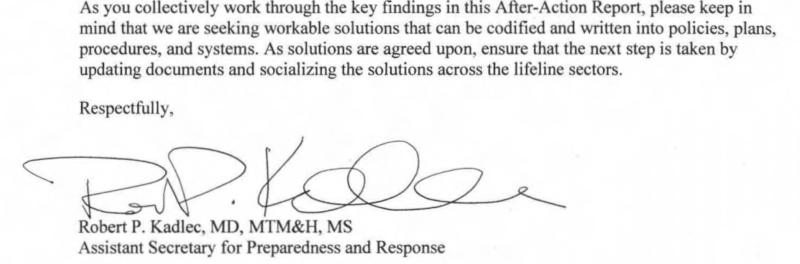
By the time of this letter, US intelligence already knew of the Wuhan virus. Four months later, US lockdowns began, starting with the March 8th cancellation of South-by-Southwest by the Austin, Texas mayor, and extending to the March 12th imposition of travel restrictions, the March 13 takeover by FEMA, and the March 16th press conference by Trump, Fauci, and Deborah Birx, which announced nationwide lockdowns.
The same day, Politico ran an article about another pandemic exercise from 2017 in which some incoming Trump officials participated, including Kelly and Tillerson. The article claims that such exercises are required by law. By the time of Covid lockdowns, they had both been pushed out, only to reemerge as key participants in Crimson Contagion along with most national-security and health-related agencies of the federal government.
The lockdowns – to which Trump agreed only reluctantly and were extended far past the point in which he believed they would control the virus – were the most ruinous of the administration. Trump’s pollsters for 2020 all agreed that these lockdowns created the conditions that drove him from office.
What does it all mean? Perhaps it is all just a series of coincidental data points, that what is called the worst pandemic in 100 years came only a few months after an elaborate multi-agency trial run of the same in which former high officials of the Trump administration participated. And perhaps the best person to run the Covid response also happened to be the very person who organized and managed the trial run in the previous season.
Many people will surely say there is nothing to see here. There is so much not to see these days.
Hungary wants European Parliament dissolved
RT | December 22, 2022
The recent corruption scandal in the European Parliament (EP) is a sign that the EU institution should be abolished in its current form, Hungarian Prime Minister Viktor Orban said on Wednesday. He added that the EP already had an abysmal reputation.
Orban’s remarks came after Eva Kaili, a Greek politician who served as one of the European Parliament’s vice presidents, was arrested and charged this month with corruption for receiving bribes from Qatar.
“The Hungarians would like for the European Parliament to be dissolved in its current form,” he said at a press conference in Budapest.
Orban argued that the scandal “draws attention to the fact that national parliaments have a stronger control system in place,” adding that legislators from the parliaments of member states should be delegated to the European Parliament, as opposed to being elected separately.
“And they obviously know our political position: the swamp must be drained,” the prime minister said.
Budapest has repeatedly clashed with the European Parliament and other EU institutions over a number of issues, including migration and LGBTQ rights. Brussels, in turn, accused Orban’s conservative government of eroding the rule of law at home.
Hungary, whose economy heavily depends on Russian energy imports, has also criticized the EU sanctions imposed on Moscow in response to the military operation in Ukraine, which was launched in late February. Unlike many of the bloc’s member states, Orban has refused to send weapons to Kiev.
“If it were up to us, there would not be a sanctions policy,” Orban said on Wednesday. “It is not in our interest to permanently divide the European and Russian economies into two, so we are trying to save what can be saved from our economic cooperation with the Russians.”
Featured Video

ARE PATIENTS BEING PROPERLY INFORMED ABOUT OZEMPIC?
or go to
Aletho News Archives – Video-Images
From the Archives
Trans ‘milk’ as good as the real thing – NHS
RT | February 18, 2024
The drug-induced nipple secretions of trans women are as good as mothers’ breast milk for babies, the University of Sussex Hospitals NHS Trust claimed in a letter to campaigners made public in a report by British think tank the Policy Exchange on Sunday.
The healthcare trust’s medical director, Rachel James, argued that the off-label prescription drug cocktail men transitioning to female take in order to produce milk was “similar to the natural hormones which encourage lactation to develop when the baby is newly born.”
“The evidence which is available demonstrates that the milk is comparable to that produced following the birth of a baby,” James wrote in the letter, sent to Children of Transitioners last August.
Biological men who wish to lactate must first take hormones to grow milk glands and then take high doses of either domperidone or metoclopramide to stimulate milk production. Neither drug is approved for this use, though they are occasionally prescribed off-label to biological women who have trouble lactating.
However, domperidone’s own manufacturer, Janssen, warns patients the drug “may cause unwanted side effects affecting the heart in a breastfed baby” and “should be used during breastfeeding only if your physician considers this clearly necessary.” … continue
Blog Roll
 Aletho News
- 2025 Nature Paper Claiming Worsening Global Drought Gets RETRACTED …Heavily Flawed
- Your Milk Is Not the Problem
- The Truth About the Trump Shootings with Ken Silva
- ARE PATIENTS BEING PROPERLY INFORMED ABOUT OZEMPIC?
- US lawmaker blocks $2.8 billion weapons sale to Israel: Report
- Yemeni army claims responsibility for strikes on sensitive sites in Saudi capital, Aramco facilities in Yanbu
- Iran Judiciary issues indictments against 159 US, Israeli officials for assassination of Leader, commanders
- Turkiye revokes Iranian bank license under US sanctions campaign
- US-Denmark Agreement on Greenland Is ‘PR Stunt’ Ahead of Midterms
- Araghchi: Military intervention cannot create security; coercion cannot bring peace
- If Americans Knew
- Inside Gaza’s death trap of collapsing, bombed-out buildings
- The everyday items Israel bans from Gaza every day
- Inside the siege, the ruined buildings of Gaza – Daily Update
- Debunking The Claim That Macklemore Has A “History Of Antisemitism”
- CPJ demands release of arrested Palestinian-US journalist near Bethlehem
- Robert Kraft: The Billionaire Friend of Netanyahu Pulling The Strings Behind the Macklemore/Ed Sheeran Blow Up
- Columbia Administered Fund Gives Big Money to Pro-Israel Groups
- Deportation Case of Palestinian Activist Salah Sarsour Tests First Amendment
- ‘We Will Not Forget’: Palestinians Mark 44 Years since Sabra and Shatila
- Why do we let Zionists decide what we can and can’t say?
- No Tricks Zone
- 2025 Nature Paper Claiming Worsening Global Drought Gets RETRACTED …Heavily Flawed
- New Study: ‘Global Drought Shows No Detectable Recent Acceleration Under Climate Warming’
- Economic Masterminds: German Socialists Suggest Taxing Productivity Gains Stemming From Using AI
- The South China Sea Has Not Been Cooperating With The Climate Change Narrative
- Energy Crisis: Germany Enters Heating Season With Historically Low Gas Reserve Fill Levels
- New Study: The Antarctic Ice Sheet Gained Mass From 2020-2024 Due To Staggering Snow And Ice Accumulation
- Study: Ocean Heating Rates From Thousands Of Years Ago ‘Dwarf’ Modern Ocean Heating Rates
- Climate Extremists Target, Attack Large-Scale Power Grid Infrastructure In Germany!
- New Study: Antarctic Ice Melt Has Contributed Less Than 1 Centimeter To Sea Level Rise In The Last 30 Years
- Fear Of Debate: Alarmist German Climate Scientist Calls On Mainstream Media To Discredit Skeptic Voices
 Aletho News
