Sanctions on Russia damaging EU economy
By Jerome Hughes | Press TV | March 16, 2022
Brussels – As the cost of living in the EU goes through the roof, union members held a demonstration outside a meeting of EU finance ministers in Brussels on Tuesday. They want the bloc’s leaders to provide more support for EU citizens who are being hit hard by the financial ramifications resulting from the conflict in Ukraine.
Finance ministers have signed off on the 4th package of sanctions against Russia. 600 individuals have been targeted and Russian exports too. However, there is a very negative boomerang effect for the EU itself.
Russia, which is now the most sanctioned country in the world, has been removed from the so-called Most-Favoured-Nation clause relating to the World Trade Organization.
Finance ministers say €200bn worth of loans are available to EU nations most impacted by the Ukrainian refugee crisis.
Critics say, if Western leaders had shown more skill and compromise, when listening to Russia’s security concerns, the misery now being piled on Ukrainian citizens and the financial hardship being placed on EU citizens could have been avoided.
China, US keep dialogue, but ‘no respect, no cooperation’
By Yang Sheng, Wan Lin and Wang Wenwen – Global Times – March 14, 2022
China’s top diplomat Yang Jiechi met US National Security Advisor Jake Sullivan in the Italian capital of Rome Monday to exchange views on China-US relations and other international and regional issues of common concern.
Chinese analysts said the US wants to use the Rome meeting to further pressure China to serve its sanctions against Russia, but China won’t be misguided, and they slammed Washington for its arrogance in bossing other countries to unconditionally follow its strategy while showing no respect to the core interests of others.
However, the differences won’t allow the world’s No.1 and No.2 economies to cut off channels of communication, since there are many issues on which the two sides share common concerns. Experts said the scheduled Yang-Sullivan meeting, nearly four months after the virtual summit was held between the top leaders of the two countries, demonstrated that the China-US high-ranking communication mechanism is stably running and is a positive sign to the world at such a turbulent time.
The key issue of this meeting is to implement the important consensus reached by the Chinese and US heads of state in their virtual summit in November last year, Zhao Lijian, spokesperson of the Chinese Foreign Ministry, announced on Sunday.
China and the US arranged the meeting between Yang, a member of the Political Bureau of the Communist Party of China (CPC) Central Committee and director of the Office of the Foreign Affairs Commission of the CPC Central Committee, and Sullivan at the end of last year. Both sides have been in communication on the meeting and set the date and time, said Zhao.
The White House said in a statement on Sunday that the two sides will discuss ongoing efforts to manage the competition between the two countries and discuss the impact of the Russia-Ukraine conflict on regional and global security.
Monday’s meeting was not one that was urgently set up in response to an emergency, it had been planned long ago by the two sides according to their own schedules, Diao Daming, associate professor at the Renmin University of China in Beijing, told the Global Times on Sunday.
According to the statement from the White House, Sullivan will also meet with Luigi Mattiolo, diplomatic advisor to the Italian Prime Minister.
Diao said one important part of the discussion will address whether the consensus reached by the leaders of China and the US in their November 2021 meeting has been fulfilled and how the next step will be implemented.
“The stably sustained high-ranking communication between China and the US, the two major powers whose relations have long affected the overall development of the world, will send positive signals to the world at this time,” said Diao.
Chinese experts said the most important consensus reached by the two leaders in November 2021 is to reconfirm the US stance on supporting the one-China principle and opposing Taiwan secessionism, as this is the foundation of bilateral ties. But what the US has done indicates it will continue to be duplicitous, so based on this fact, it’s unlikely that there will be a major breakthrough to bring ties back on normal track despite the two sides maintaining dialogue.
Yang and Sullivan met in Zurich in October 2021, during which both parties had a “comprehensive and in-depth” exchange of views on China-US relations as well as international and regional issues of common concern.
Lü Xiang, a research fellow at the Chinese Academy of Social Sciences, said that the issue of common concern for both China and the US now is the conflict between Russia and Ukraine. He highlighted that the key to this issue is the strategic confrontation between Russia and the US, or NATO.
With a potentially tense conflict between Russia and the US, it is critical for the US to understand China’s position, and China also wants to know how the US will play the game under the current situation, Lü noted.
The US might expect China to be a mediator with Russia, but the US should not try to create discord between China and Russia even if it is not capable of doing so, the expert said.
The US should calm down and take a more reasonable view of bilateral relations and the global order, and it should reconsider its approaches toward both China and Russia and learn that pressure, sanctions and provocations won’t solve any problems, but only make the US suffer more, Chinese experts said.
Apart from the Russia-Ukraine conflict, other hot topics concerning regional or international relations, such as climate change, the Korean Peninsula issue and the Iran nuclear deal, could also be discussed in Monday’s meeting, according to Diao.
No respect, no cooperation
According to CNN, Sullivan said on Sunday that Russia is concerned about China’s support after the West launched sanctions against Moscow.
“We also are watching closely to see the extent to which China actually does provide any form of support, material support or economic support, to Russia. It is a concern of ours. And we have communicated to Beijing that we will not stand by and allow any country to compensate Russia for its losses from the economic sanctions,” Sullivan said.
Li Haidong, a professor at the Institute of International Relations of China Foreign Affairs University, told the Global Times, “Obviously, the US is expecting China to do unconditionally what it says or it will punish China as well. This is totally opposite to the principles of mutual respect, peaceful coexistence and win-win cooperation.”
The three principles were laid out by the Chinese side at the virtual summit between the two heads of state last year.
If the US keeps dealing with China in this way, the dialogue will be pointless and meaningless, and there is no chance that Washington will get what it wants from China, said Li, noting that this would be a tragedy of US diplomacy, and “we hope the US won’t mess up its ties with China like it did with Russia. It has made a huge mistake in dealing with Russia, and it’s making mistakes in dealing with China.”
Both China and Russia are aware of the US attempt to split them, but both sides have confidence and calmness to make the strategic partnership withstand the instigation from Washington, said analysts.
Timofei Bordachev, program director of the Moscow-based Valdai Club, told the Global Times on Monday, “A high level of trust exists between Chinese and Russian leadership. What is most important is not the efforts of the US, but how the present relationship between China and Russia fits the development goals of both nations, which do not require competition between them.”
The US is trying to force the international community to stand with it, and will not give any room for any other countries to remain neutral or stay away from joining Western sanctions and condemn Russia, just as China, India, Turkey, Israel and South Africa are doing, observers said.
These countries have their own reasons for refusing to follow Western sanctions, as they make diplomatic decisions independently based on their own interests, their understanding of the issue and fairness in international relations, rather than just simply following the US or Russia, said experts.
Observers also noted that these countries are the ones that can really contribute to mediating the conflict, as only those that are truly neutral will be accepted by the warring parties to be mediators, while the US can only worsen the situation through sanctions and supplying weapons.
Moscow reveals whether US sanctions would harm Iran deal
RT | March 15, 2022
Russian Foreign Minister Sergey Lavrov said on Tuesday that Moscow has received written assurances from the US that Ukraine-related sanctions won’t hinder its ability to trade with Iran under the terms of a new nuclear agreement. “We received written guarantees. They are included in the text of the agreement itself on the resumption of the Joint Comprehensive Plan of Action on the Iranian nuclear program,” Lavrov told reporters in Moscow.
The ‘Joint Comprehensive Plan of Action’, or JCPOA, is the official title of the 2015 Iran nuclear deal. Signed by Iran and the US, UK, Russia, France, Germany, China and the EU the deal promised Iran sanctions relief in exchange for a halt to its nuclear program. Former US President Donald Trump unilaterally withdrew from the deal in 2018, claiming that Iran was breaching its obligations, and negotiators have been meeting in Vienna, Austria and attempting to hammer out a new deal for nearly a year now.
An unnamed US official told the Wall Street Journal on Sunday that the US was not prepared to ease any Ukraine-related sanctions to save the deal, and would be open to negotiating a “replica of the JCPOA” without Russian involvement if Moscow insisted on exemptions being made.
Commenting on the reports, Lavrov suggested that Washington itself is still not ready to support the deal, and pointed out that, according to his Iranian counterpart, the problem with the agreement is in the US’ “exorbitant demands.”
Appearing beside Lavrov on Tuesday, Iranian Foreign Minister Hossein Amir-Abdollahian said that there is no link between the conflict in Ukraine and the talks in Vienna.
The Iranians have repeatedly insisted that Russia remain a part of any deal.
The Vienna negotiations have been paused since last week, but an Iranian Foreign Ministry spokesman said on Monday that they should resume shortly, when they will enter their “final, crucial steps.” Lavrov told reporters on Tuesday that he believes these talks are on the home stretch, and called on the US to “return to the legal framework of this nuclear deal” and lift “the illegal sanctions the US has imposed to hurt not only Iran and its people, but a number of other countries.”
Whither US Oil Production?
By Paul Homewood | Not A Lot Of People Know That | March 13, 2022
This single chart from the US EIA explains just why oil prices are shooting up there:

https://www.eia.gov/petroleum/production/
The oil boom initiated by Trump saw crude oil output increase by a half between 2016 and 2019.
Output naturally collapsed in early 2020 as a result of the pandemic, which affected both supply and demand. But since then output has only slowly recovered, and is still 9% below 2019 levels.
It is worth pointing out that demand in 2021 was still not back to 2019 levels. Assuming it recovers this year, it is likely to put further upward pressure on prices, unless production increases as well.
To put the numbers into perspective, the US produces a sixth of the world’s crude oil. The increase in US output between 2016 and 2019 was 205 million tonnes, and represents 5% of global output.
Small changes in supply have a disproportionate effect on international oil prices, because demand is so inelastic. An extra 5% on world production would have a significant impact on prices.
Oil price hikes hit poor countries the hardest
By Vijay Jayaraj | American Thinker | March 13, 2022
The fighting in Ukraine has intensified with Russian forces showing no signs of retreating and residents are fleeing cities.
What does this have to do with the lives of billions of people living far away from the war? Oil price increases.
The conflict has caused an increase in international oil prices, which have now crossed $130 per barrel, a 13-year high. As a result, gas prices at pumps across the globe are set to rise even further.
Being the largest consumers of automobile fuels, motorists in the U.S. and Europe are feeling significant economic pain. However, the situation is far more serious for populations of developing countries who have a much smaller buffer against life-threatening deprivation.
Take Nigeria, for example, the largest economy in Africa with $514 billion GDP. Neither the size of the economy nor the presence of crude reservoirs was sufficient to protect the country from the price shock. Nigerians already were grappling with a month-long fuel shortage due to quality-related import restrictions. While government subsidies soften the effect on users of gasoline, there is no such support for diesel.
Diesel is selling for 625 naira per liter in Lagos and Abuja, 30 percent higher than two weeks ago. Diesel prices are expected to touch 650 soon and are disrupting everyday lives. Nigeria is infamous for its energy poverty, with only 40 percent of the country’s 193 million population having access to electricity. The rising fuel costs will force many more millions into energy poverty.
In the neighboring West African country of Ghana, which is a net exporter of oil, fuel prices have risen dramatically in the first quarter and are affecting all kinds of businesses. For a country that is already in an ongoing economic crisis caused by debt distress, rising gasoline and diesel prices have become a nightmare.
Though Ghana exports high-quality crude, it has inadequate refinery capacity to convert domestic oil into finished petroleum products. Like Nigeria, it depends on imports of refined products. Currently, 80 percent of all finished petroleum products are imported. Inflation rates will be driven up by fuel prices that may increase by 6 percent, sending households into further chaos in what was originally supposed to be the fastest growing major economy in Africa.
In Asia, less-developed economies that were caught up with the decade-long green movement failed to invest in fossil-fuel technology and now face extraordinary import bills due to the rise in international crude prices.
Last month, Thailand’s inflation rose to its highest level in 13 years at 5.28 percent. Speaking to Al Jazeera, the chairman of the Thai National Shippers Council said: “The geopolitical situation, global inflation, the pandemic – Thailand still has a high number of cases – and freight costs are still very high. All of that is certain to damage our growth.”
Neighboring Philippines is in murky waters as well, with gasoline prices set to rise by 11 Phillipine pesos and eventually increase by a further 20 pesos by the end of March. A record high of 100 pesos per liter for gasoline will send small businesses and households into great distress.
In the abstract, the victims of higher energy prices are economic growth and the long-running fight against poverty, which translates into harder lives for billions of people struggling to fend off malnutrition and disease.
A simple solution would be to reverse anti-fossil fuel policies that cause shortages and to make the well-being of citizens the first priority.
Vijay Jayaraj is a Research Associate at the CO2 Coalition, Arlington, Va., and holds a Master’s degree in environmental sciences from the University of East Anglia, England. He resides in Bengaluru, India.
Biden Faces Backlash for Venezuela Talks as Caracas Demands Recognition
Venezuelan Foreign Minister Félix Plasencia argued the US needs to recognize Maduro and lift sanctions before oil shipments can restart

Venezuelan Foreign Minister Félix Plasencia participates in the Antalya Diplomacy Forum in Turkey. (@plasenciafelixr / Twitter)
By José Luis Granados Ceja – Venezuelanalysis – March 14, 2022
The Biden administration faced strong bipartisan criticism over recent direct talks with the Venezuelan government.
News outlets reported that in light of criticism from hardline sympathizers of the Venezuelan opposition, the Biden administration had suspended its direct talks with the Venezuelan government but that a deal to lift some US sanctions in exchange for restarting oil sales to the US was still on the table.
Washington recently ordered the suspension of Russian oil imports, leaving the US desperate to find other sources of crude as rising energy prices threaten to create a domestic crisis for the Democrats ahead of midterm elections in November.
Despite the lack of diplomatic relations stemming from the US’ refusal to recognize the results of the 2018 presidential election, Caracas and Washington have maintained back-channel communications. These talks led to the first direct exchange between the US and Venezuelan governments in years, which came at Washington’s request.
News of the encounter was met with a vehement condemnation from both Republican politicians such as Senator Marco Rubio and fellow Democrats such as Florida’s Debbie Wasserman Schultz, a longtime supporter of the Venezuelan opposition.
Rubio, one the most vocal champions of Venezuela’s self-declared “interim president’ Juan Guaidó, has gone on the offensive to try to preemptively stop any deal and introduced legislation to ban the import of oil from Venezuela and Iran.
Various politicians from Florida sent a letter to Biden criticizing the administration’s decision to hold direct talks with Maduro. Florida’s large Cuban and Venezuelan population and status as a “swing state” in US elections has led politicians to cater their foreign policy toward Latin America in the interest of pleasing this comparatively small constituency.
However, skyrocketing energy costs inside the US as a result of global geopolitical situation in light of the Russian military operation in Ukraine and the subsequent ban of Russian oil imports have put the Maduro government in Venezuela, which counts on the world’s largest oil reserves, in a more favorable bargaining position.
Until recent developments, the Biden White House had largely maintained its predecessor’s “maximum pressure” policy aimed at ousting Maduro, though the Financial Times reported that the administration had already been considering a change in strategy.
White House spokeswoman Jen Psaki tried to downplay the March 5 meeting that counted on the presence of Venezuelan President Nicolás Maduro and Vice President Delcy Rodríguez as well as Biden Latin America adviser Juan González.
The direct talks led to the release of US citizens Gustavo Cardenas and Jorge Fernández on Tuesday, however US State Department spokesman Ned Price denied their release was tied to a deal regarding Venezuelan oil.
For his part, Maduro called the engagement “respectful, cordial and very diplomatic” and said that the US had committed to a follow-up meeting.
The direct talks with the Venezuelan leader have undermined the US’ strategy in Venezuela and its support for Juan Guaidó, who the Biden administration insists they still recognize as “interim president.”
With Guaidó’s position under increased scrutiny, the opposition has come to rely on the US almost exclusively for its legitimacy. Senator Rubio recently admitted that a deal would mean the opposition would be “finished”.
Guaidó was not part of the talks and reportedly only learned of the high-level meeting between the US and Venezuelan governments the day of the meeting.
Sources in Venezuela’s opposition told the Miami Herald that the potential deal would involve granting a special license to Chevron to ramp up activities in Venezuela. Chevron has previously lobbied the US State Department for a rollback of sanctions against Venezuela.
Caracas demands recognition, sanctions relief
Venezuelan officials have likewise commented on the possibility of restarting the oil trade with the US, with Foreign Minister Félix Plasencia stating that any deal to supply oil would be contingent on Washington and Brussels recognizing Nicolás Maduro as president.
“We have a 100-year oil business relationship with the United States. We have not taken them out of the business, they left in order to impose coercive measures. Now they want to return. Fine, if they accept that the only and legitimate government of Venezuela is the one led by President Nicolás Maduro, then US and European oil companies would be welcome,” said Plasencia at the Antalya Diplomacy Forum held this past weekend in Turkey.
Plasencia added that a “respectful relationship” would also require the lifting of coercive measures that deepened the country’s economic crisis.
EU High Commissioner for Foreign Affairs Josep Borrell held a bilateral meeting with Plasencia on the margins of the forum that both described as “good,” with Borrell’s team indicating a willingness on the part of the European bloc to normalize relations and lift sanctions.
Venezuela, home to the world’s largest oil reserves, had a steady crude production of around 1.9 million barrels per day (bpd) and exported approximately 500,000 bpd to US markets until sanctions targeted the sector and crippled production.
The Venezuelan oil industry has lately shown signs of improvement with Plasencia stating that the country could produce up to 2 million barrels per day by the end of the year thanks to the assistance of “reliable partners, such as Russia, China and Iran.”
The recent diplomatic summit also saw Plasencia and Vice President Delcy Rodríguez both meet with a Russian delegation led by Foreign Minister Sergei Lavrov.
“We held a meeting with our good friend Sergei Lavrov. We reviewed our bilateral strategic relations and the complex international scenario,” Rodriguez said via Twitter.
The March 5 high-level meeting between the US and Venezuela was likewise driven by Washington’s efforts to isolate Russian President Vladimir Putin from his allies in Latin America. US officials were reportedly seeking a public condemnation of Russia’s incursion into Ukraine by Maduro. Caracas has called for a “peaceful resolution” to the ongoing crisis but has stopped short of criticizing the Russian military operation.
The Venezuelan leader spoke directly by phone with Putin, with the Russian Ministry of Foreign Affairs reporting that the Venezuelan president expressed his “firm support” for Russia and condemned destabilization efforts by the US and NATO.
Edited by Ricardo Vaz in Caracas.
Japanese firms have no plans to abandon Russian energy project
RT | March 14, 2022
Japanese trading houses, Mitsui and Mitsubishi, are reportedly not considering quitting Russia’s Sakhalin-2 project, that is focused on producing and shipping liquified natural gas (LNG), 60% of which is destined for the Japanese market.
The Japanese trading giants, which hold a total stake of 22,5% in Sakhalin-2, will remain partners to the project, as “prompt exit is risky” and “will be in favor of China,” Nikkei newspaper reports, citing documents submitted by the companies to the Ministry of Economy, Trade and Industry of Japan earlier this month.
The project has been one of the main sources of natural gas supply to Japan with nearly 100% of Japanese LNG imports coming from Sakhalin-2, according to media reports.
Located on the Russian island of Sakhalin in the Pacific Ocean, north of Japan, the project reportedly produces nearly 11.5 million tons of LNG annually which is mainly exported to major markets in Asia.
The project, launched in 2009, includes the offshore Piltun-Astokhskoye oil field and Lunskoye natural gas field in the Okhotsk Sea, and associated infrastructure on Sakhalin Island itself.
Sakhalin-2 is managed and operated by the Sakhalin Energy Investment Company. The majority stake in the enterprise belongs to Russia’s energy giant Gazprom. Shell, the world’s largest LNG trader, holds 27,5% minus one share, Mitsui’s share totals 12,5%, while Mitsubishi Corporation owns 10%.
On February 28, UK-based Shell announced plans to pull out its stake in the Sakhalin-2 liquefied natural gas facility, its 50% stake in the Salym Petroleum Development and the Gydan energy venture following sanctions placed on Moscow over the ongoing military operation in Ukraine.
‘US will scrap Iran deal before agreeing with Russia on sanctions’
RT | March 13, 2022
The US will not negotiate the easing of any Ukraine-related sanctions on Russia to ensure that Moscow can trade with Tehran under a new iteration of the Iran nuclear deal, a US official told the Wall Street Journal on Sunday. Despite a deal being reportedly close at hand, the official said that Washington would pursue an alternate agreement before granting Russia any exemptions.
“I don’t see the scope for going beyond what is within the confines of the JCPOA,” the official said, referring to the 2015 Joint Comprehensive Plan of Action, which guaranteed Iran limited sanctions relief in exchange for a halt to its nuclear program. “I think it’s pretty safe to say that there is no room for making exemptions beyond those.”
Russian Foreign Minister Sergey Lavrov has demanded written assurances that sanctions imposed on Russia since the start of its military offensive in Ukraine won’t impact any trade between Russia and Iran under a successor deal to the JCPOA, which is currently being negotiated.
Despite US Secretary of State Tony Blinken describing the Ukraine-related sanctions as “irrelevant” to the deal last week, the Iranians are apparently siding with Russia. Iranian Foreign Ministry spokesman Saeed Khatibzadeh stated last week that “Iran’s peaceful nuclear cooperation should not be affected or restricted by any sanctions, including Iran’s peaceful nuclear cooperation with Russia.”
According to the Wall Street Journal, Russian negotiators are likely to specify their precise demands in writing in the coming days, and the Americans will “know within a week whether or not Russia is prepared to back down,” the US official added.
Should Russia remain firm on its demands, the US would be open to negotiating a “replica of the JCPOA” without Russian involvement, the official said, noting that “we…at this point wouldn’t rule anything out.”
However, it is far from clear whether the other parties to the 2015 deal would agree to a new accord without Russia. The original agreement was signed by Iran and the US, UK, Russia, France, Germany, China and the EU. While the Wall Street Journal claimed that European diplomats are exploring “options for pursuing a deal without Russia,” China is a major nuclear power and generally a diplomatic ally of Russia, and may balk at any deal that excludes Moscow.
Negotiators have been attempting to hammer out a replacement for the JCPOA for nearly a year, meeting regularly in Austria’s capital Vienna for negotiations. The French Foreign Ministry said last week that the parties are “very close to a deal,” but admitted that disagreements between the US and Russia could scupper any potential accord. The anonymous US official echoed these concerns on Sunday, describing Russia’s demands as “the most serious stumbling block and obstacle to reaching a deal.”
Iran and SCO sign protocol to start accession process for Tehran
Press TV – March 12, 2022
Iran and the Shanghai Cooperation Organization (SCO) have started a formal process for Tehran’s accession to the major economic bloc.
A Saturday report by Iran’s IRIB News said that a document had been signed a day earlier in the Uzbek capital of Tashkent between representatives of the eight-member SCO and Iran to allow the organization to consider Iran’s accession bid.
Uzbekistan’s Foreign Ministry said in a statement that the signing of the protocol would practically allow the implementation of decision by SCO heads of state in Tajikistan last year to provide membership to Iran.
The next step in the process will be for Iran to sign a memorandum of commitment at an SCO summit in Uzbekistan’s Samarkand in September 2022, said the statement, adding that SCO heads of states will then decide to include Iran in the bloc.
Iran was an observer member of the SCO before applying to join the bloc that includes Russia, China, India, Kazakhstan, Kyrgyzstan, Pakistan, Tajikistan and Uzbekistan.
Experts says Iran’s accession to the SCO will be a major boost to the bloc’s influence in the region mainly because Iran’s massive transportation network can facilitate regional and international trade.
Iran is also expected to benefit economically from membership in the bloc. The Iranian customs office (IRICA) said on Saturday that Iranian exports to SCO members had increased by 41% year on year in the 11 months to late February to reach nearly $18.3 billion.
IRICA figures showed that Iran had imported $14.4 billion worth of goods from the SCO countries between March 2021 and February 2022, an increase of 31% against the previous similar period.
Much wants more and loses all
GEFIRA | March 11, 2022
 The collective post-West has been running amok for the last two weeks. The powers that be make believe that they did not expect that events would unfold the way they are unfolding now (though they did their best to make things happen as they are happening) and they make a show imposing sanctions on the aggressor and assuring the populace that the aggressor sooner or later will cave in. There is yet a third aspect to the phenomenon: the same powers that be want the people to forget that merely twenty years back they themselves assaulted Yugoslavia/Serbia, used missiles with depleted uranium, bombed cities and shot at civilians. Of course, that earlier event was a humanitarian action while the current one is a brutal act of aggression, but we digress.
Now there is a big misconception on the part of the post-West about Russia. If the Western media claim the Russian people are against the war or that the Russian people are about to rebel and overthrow President Putin, then they are either delusional or lying through their teeth. Reality is something that refuses to obey our wishes. The Russian people have rallied around their president and their authorities; the Russian people – unlike citizens of the post-Western countries – are patriotic and ready to sacrifice themselves in defence of their fatherland. Western sanctions? The post-West may withdraw businesses and impose sanctions on Russian oligarchs, which is music to the ears of the Russian people. They resented Western dominance anyway and they will be more than happy to see the oligarchs mopped up from their society. Russians view the hostilities as a repeat of the Great Patriotic War of 1941-1945. Contrary to what has been done to the Western collective mentality, the Russian authorities under Vladimir Putin took great efforts to raise Russia’s citizens in patriotic values. Russians are going to win because they do not care about money so much as the West does. That’s one big misconception that Western people have about their opponents from the East.
It is the West that cannot imagine a life without money and the resultant luxuries. Sanctions or no sanctions, Western companies will sooner or later (I bet: sooner) resume business with Russia because – as everybody in the West knows – “money makes the world go round”. No less a person than Comrade Lenin famously said: capitalists will sell us the rope with which we will make a noose to hang them. And so they will, make no bones about it.
Yes, the West is ready to go to war with Russia so long as it has… Ukrainian, Polish, Romanian, Lithuanian, Latvian or Estonian soldiers at its disposal. The moment the West runs out of those soldiers, its leaders will go back to the negotiating table with the Kremlin. Do you want any evidence? Here you are.
A few days ago Americans tried to set Poland against Russia in that they suggested to Warsaw that it send Soviet-made MiG aircraft to Ukraine. Though the Polish authorities usually oblige the West’s wishes, this time they had second thoughts about the proposal and replied that they were ready to send the said aircraft to the American air base in Rammstein so that Americans could pass them over to Kiev. And you know what? Washington was beside itself with annoyance! You see? The dog was expected to bite the bear, with the dog’s owner watching from the sidelines and biding his time.
Just picture it to yourself. Warsaw sends the MiG aircraft to Ukraine, Moscow regards it (and rightly so!) as a hostile act and fires a couple of missiles against selected targets in Polish territory. What do you think the West would do? Yes, you guessed it right. The West would express its great indignation and impose a set of new sanctions… for a time.
Talking about President Putin, who – according to the Western analysts is about to be toppled either by the people closest to him or by the nation – his Christian name is Vladimir, and Vladimir was the name of the grand prince of Rus’ who united the many Slavic tribes and christened them. He went down in history as Vladimir the Great. The chances are – whether you like it or not – that Putin is going to be another Vladimir the Great.
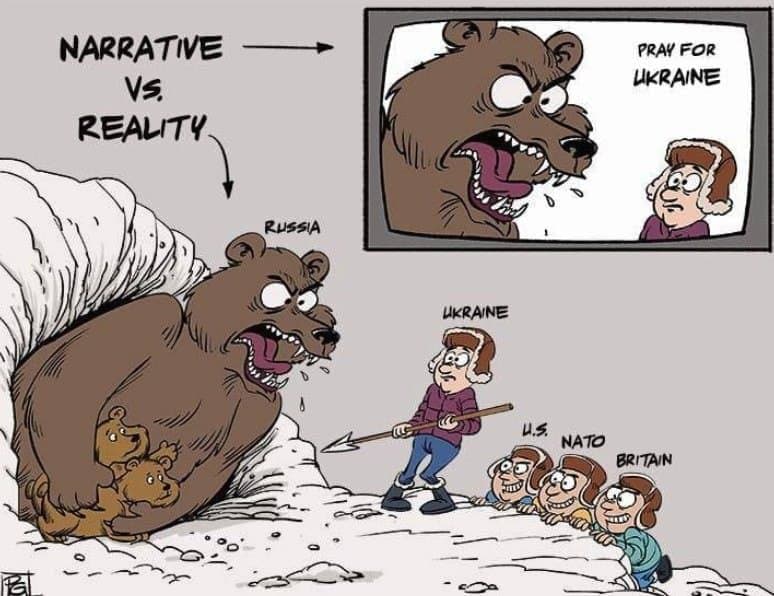
The current war means the end of the world that we have been accustomed to. We are entering a new cold war period and a new division of the globe with the United States, Great Britain, and the European Union on the one side, and Russia and China on the other. This new world throws a monkey wrench into the plans forged by globalists of the Klaus Schwab ilk. Or, globalism will be reduced to the Western world. The international rules that all the countries have up to now tried to abide by are no more valid for Russia, and consequently sooner or later for others because of the domino effect. Being beleaguered by the West, Moscow will have no intention to play by the rules created in this West. Why should it?
Sanctions work both ways. Russia has a lot to offer, be it crude oil, natural gas, rare metals or what not. Look back into the past! The Bolsheviks that took reins of power after 1917 were hated by the West. Lo and behold, it did not take many years for the capitalists to resume business with the hated communists; similarly, after the Second World War the Soviet Union was regarded as a hostile empire and yet, and despite that, business between the West and the Soviets went as usual. How about China? It was Taiwan that was first supported by the West, yet slowly but surely Washington reversed course, left Taiwan to its own devices and resumed contacts with Beijing. Since – as said above – money makes the world go round, the greedy capitalists helped China develop in that they outsourced almost all production to the Middle Kingdom. Do you think it is going to be different now with regard to Russia?
When Ukraine is eventually conquered by Russia, what will the elites in such small countries like Lithuania, Latvia and Estonia – all bordering on Russia – think about their security and the ability of the collective West to help them? I want to see that man or that woman who really thinks that NATO will go to war with Russia over Estonia or Latvia.
Ukraine has been exploited by Western companies for thirty long years. All those contacts with democracies and capitalism did not benefit the country at all. It only benefited a handful of people, who fled Ukraine before the hostilities, leaving the rank and file behind. Rumour has it that President Zelensky is kept in the American embassy in Warsaw though we are all made to believe that he remains in Kiev. How much would you bet on President Zelensky residing in Kiev, a city that is about to be soon encircled?
The West could have further exploited Ukraine and teased Russia but it simply overplayed its hand. Precisely as it is described in this fable by Aesop where a goose laying golden eggs is killed by the greedy owners. The moral? Much wants more and loses all. Now that Moscow is taking retaliatory steps like shutting down media outlets that propagated Western ideas and Western lifestyle the West has lost its ideological bridgehead inside Russia that it has held for thirty years. The West really thought it was ready to make a killing. A big killing. Western elites really thought Russia would be withdrawing from its positions further and further; they really believed the Navalny kind of Russian dissenters that the Russian people were all against the authorities. Worse, the West still thinks that Russians will force their president to surrender because otherwise common people will be stripped of the opportunity to eat hamburgers and cheeseburgers in McDonald’s restaurants in Moscow and Petersburg! Sure, there are some such people who are ready to trade their country for ham- and cheeseburgers, but then it is a splinter from the large whole. The majority accustomed to Russia’s greatness are not willing to sell this greatness off. Plus, they are not attracted by the Western values of married homosexuals or the many sexes that are invented by the month. That’s also something that the post-West is not aware of. Remember also that millions of Russians have bitter recollections of the Yeltsin era during which western-style capitalism promised them well-being and brought poverty, unrest and humiliation instead. That’s one big reason why President Putin is appreciated by the vast majority of the population: he put an end to chaos and brought in stability. If you think Russians dream about homosexual parades in their cities or pregnant soldiers in their army or the many gender pronouns, you cannot be more delusional.
There is one more explanation to all what is occurring. The West went to great lengths to have Russia and Ukraine clash for the sheer purpose of weakening both countries. This is one sure way of preserving world preponderance, is it not? Lead nations to war the moment you see they have developed too much and too fast. The United States achieved its global dominance because the Second World War wreaked havoc with the economies of Germany, Great Britain, France, Russia, Italy and Japan – the world’s powerhouses. After the cessation of the hostilities all those countries needed American aid and American dollars and were compelled to accept almost all the dictates from Washington.
Look at the present political map of the world. Iraq, Syria, Libya, Afghanistan, Ukraine, the countries of former Yugoslavia, the states that went through an array of all those colour revolutions: they are reeling under the blows of all manner of war, civil war, social upheaval and the attendant economic collapse. Which country emerges victorious? Yes, sure, the one that has not been directly engaged in the conflict. A classic case of two dogs fighting for a bone with a third running away with it.
Russia and Ukraine will lose a number of people (killed, wounded, displaced); Ukraine will have its economy ruined; Poland is already accommodating a million (and rising!) Ukrainians who somehow do not want to defend their country and prove their rights to it (If you say that women and children do not or should not take part in hostilities, then think again); Warsaw will have a lot of trouble with them. Who emerges victorious? You know who. Vice-President Kamala Harris visited Poland to reassuringly pat the Polish nation on the shoulder in recognition of Poland’s hospitality towards Ukrainians. She knows that such gestures work with Poles. The supranational elites hating ethnically monolithic countries are rubbing their hands in glee. At last Poland, this ethnically and religiously monolithic nation, is changing to a mix of Poles and Ukrainians, of Catholic and Orthodox Christians, to be later skilfully set off against each other like Croats and Serbs if Warsaw should fail to toe the Western party line.
GEFIRA – Global Analysis from the European Perspective. Preparing for the world of tomorrow.
ESG Scoring Drives Companies Into Sustainable Development, Aka Technocracy
By Patrick Wood | Technocracy News | March 3, 2022
ESG stands for “Environmental, Social, Corporate Governance” and has been likened to a globalized Social Credit Scoring system for business. If you have a high ESG score, it will be easy to qualify for credit, to get the best deals with vendors and to participate in the global supply chain.
Alas, if you don’t have a high ESG score, you won’t be in business long unless you change your behavior and knuckle under to its demands.
So, how is ESG determined and who sets the rules and guidelines?
First, ESG has nothing to do with the physical aspects of a company, like capital, cash flow or profit. Rather, it concerns intangible factors such as how closely you, your vendors and customers adhere to Sustainable Development and climate change policies.
According to Forbes,
“The story of ESG investing began in January 2004 when former UN Secretary General Kofi Annan wrote to over 50 CEOs of major financial institutions, inviting them to participate in a joint initiative under the auspices of the UN Global Compact and with the support of the International Finance Corporation (IFC) and the Swiss Government. The goal of the initiative was to find ways to integrate ESG into capital markets.”
One year later (2005), an environmental policy wonk, Ivo Knoepfel, wrote a a major paper, Who Cares Wins: Connecting Financial Markets to a Changing World. This 58 page report contained “recommendations by the financial industry to better integrate environmental, social and governance issues in analysis, asset management and securities brokerage.”
The corporate collaborators, far from real people like ordinary citizens, included all the big names one might suspect: World Bank Group, Morgan Stanley, HSBC, Goldman Sachs, Deutsche Bank, UBS, Mitsui Sumitomo Insurance, Citigroup and others.
And just like that, ESG was born.
The report summarizes ten innocuous and subjective principles that read much like the UNs’ Sustainable Development Goals (SDGs):
U.N. Global Compact Principles
Human Rights
Principle 1: Businesses should support and respect the protection of internationally proclaimed human rights within their sphere of influence; and
Principle 2: make sure that they are not complicit in human rights abuses.
Labour
Principle 3: Businesses should uphold the freedom of association and the effective recognition of the right to collective bargaining;
Principle 4: the elimination of all forms of forced and compulsory labour;
Principle 5: the effective abolition of child labour; and
Principle 6: eliminate discrimination in respect of employment and occupation.
Environment
Principle 7: Businesses should support a precautionary approach to environmental challenges;
Principle 8: undertake initiatives to promote greater environmental responsibility; and
Principle 9: encourage the development and diffusion of environmentally friendly technologies.
Anti-Corruption
Principle 10: Businesses should work against corruption in all its forms, including extortion and bribery.*
Who decides ESG standards and scores? It is repeatedly stated that financial analysts are the key operatives:
-
- “We invite financial institutions to expand the scope of ESG integration in research to other asset classes impacted by ESG factors, beyond equity.” Beyond equity implies a rating system for bonds, corporate debt and other financial instruments.”
- “We encourage analysts to further advance the development of valuation methodologies to better deal with qualitative information and uncertain impacts related to ESG issues.”
- “Financial analysts should expand their understanding and analysis of these factors to other industries.”
- “Financial analysts should improve their understanding and integration of ESG issues in emerging markets research.”
- “Financial analysts and investment professionals should take a leading role because they are the specialists best placed to show how ESG issues impact company and investment value.”
To put this in perspective, the financial analyst position at a large financial institution is typically an entry-level job for people just out of college. In reality, they are coached by ESG policies to act like “fact checkers” as they examine these non-tangible aspects of a company. With the stroke of a pen then can upgrade or downgrade a company according to its ESG compliance, but no two analysts would likely come to the same exact conclusion.
Nevertheless, with subjective ESG research reports in hand, senior executives then call on pension funds, mutual funds, hedge funds, investment funds, etc., to divest themselves of low scoring companies and reinvest in high scoring companies. If they refuse to cooperate, they are branded with a lower ESG score of their own. Lending institutions are approached to examine the ESG value of their loan portfolios. Not high enough to satisfy the “fact checkers”? Then stop loaning money to low ESG companies, or risk being downgraded yourself!
It gets worse from here. The report calls for government force to mandate disclosure:
“We also believe that regulatory frameworks requiring a minimum degree of disclosure and accountability on ESG issues would improve the availability and comparability of data, and therefore support integration in financial analysis.”
And for stock exchanges to inform rank-and-file investors and institutions alike:
“Stock exchanges, for instance, could include ESG criteria in listing particulars for companies. Both voluntary and market-friendly regulatory approaches are needed to improve disclosure. Both should be flexible enough to allow for diversity of approaches and providers, rather than relying on rigid prescriptions.”
Conclusion
ESG is a globalist scam, and having just said that, my score probably went to zero. It is designed to drive investments and company operating policies into Sustainable Development, aka Technocracy. It is also a circular design that once started, reinforces itself with every spin around the financial universe.
Next up will be ESG for individuals, which goes one step further into how you actually think about these things.
What? You own an investment in a dirty old low-ESG company? Own a gas-guzzling car? Big house? Too much grass in your front yard? Work for a low-ESG company? Post social media pictures that lampoon global warming or mask mandates? Well, that shows that you just don’t care, so boom, down goes your score. Now, try to get financing for that new car you want to buy, or get underwritten for a new life insurance or homeowner’s policy.
You get the idea.
Patrick Wood is a leading and critical expert on Sustainable Development, Green Economy, Agenda 21, 2030 Agenda and historic Technocracy. He is the author of Technocracy Rising: The Trojan Horse of Global Transformation (2015) and co-author of Trilaterals Over Washington, Volumes I and II (1978-1980) with the late Antony C. Sutton.
COPYRIGHT COHERENT PUBLISHING, LLC 2016-22
Featured Video

Trita Parsi: Middle East Unraveling — Are We on the Path to World War?
or go to
Aletho News Archives – Video-Images
New Book
Trans agenda is ‘normalization of sadism’ – US author

RT | September 23, 2026
The US Democratic Party has embraced a transgender agenda that amounts to “the normalization of sadism,” author A.J. Rice has said, warning that radical trans policies would return if the party is allowed to regain power.
Speaking to RT’s America First host Scotty Nell Hughes about his new book, ‘The Curse of the Bearded Lady: How the Trans Mafia Whacked American Sanity’, Rice argued that activists have gained significant influence in schools, medicine, and corporate America while people who questioned the agenda have faced pressure to stay silent.
The author described the “trans mafia” as the sprawling network of people and institutions that have helped the movement gain influence. He singled out parts of academia, wealthy backers, and corporations, and stated that providers of transition-related treatment also have a financial incentive to keep young people in their care indefinitely.
Rice argued that the consequences of these policies ultimately fall on children who are being drawn toward gender-affirming medical treatments and on girls who are expected to share locker rooms or compete in sports with biological males.
He noted that while voters rejected the Democrats’ approach to gender in 2024, the party, which has been “captured by madness,” has since only doubled down and is seeking what is effectively “the normalization of sadism.” … Full report
Blog Roll
 Aletho News
- German chemicals giant reveals details of downsizing
- Refaat Al-Areer Was The Canary In The Coal Mine In Israel’s War On The Truth
- Israeli election committee bars candidate from Knesset race over Gaza war opposition
- French-Lebanese man files war crimes complaint over Israeli attacks
- Mahan Air Flight Lands in China Despite US Threat against Iranian Airlines
- US eyes $10bn fund to rebuild war-battered Gulf infrastructure
- Trump meets Rodríguez near Maduro’s prison as Venezuela’s oil flows to US
- Trita Parsi: Middle East Unraveling — Are We on the Path to World War?
- Iran FM meets with US envoy on UN meeting’s sidelines at American side’s insistence: Report
- Qatar PM calls for Gulf security framework with Iran, says war must be ‘wake-up call’
- If Americans Knew
- Caught on Tape: AIPAC CEO Boasted of Controlling Trump’s National Security Officials
- Why Hamas Attacked Israel in October 2023 – Israeli professor Ilan Papé
- They see them, then kill them: Israeli quadcopters track, deliberately target civilians in Gaza
- Winter could turn Gaza’s treacherous, war-damaged buildings into deathtraps
- Majority of Democratic Voters Want to Prosecute Both Biden and Trump Administration Officials Over Gaza
- As Gaza languishes, world leaders gather at the UN – Daily Update
- Sanctions are collective punishment: immoral and self-defeating
- Phosphorus Munitions Fired by Israel Burn Groves, Orchards in Southern Lebanon
- Israel Carries Out New Ceasefire Violations Across Gaza
- AI – Emphasis on the ‘I’: Israel Is Funding AI Chatbot Propaganda
- No Tricks Zone
- New Study: Earth And Venus Surface Warmth Largely Explained By Convection And Lapse Rate, Not CO2 Or Radiation
- 2025 Nature Paper Claiming Worsening Global Drought Gets RETRACTED …Heavily Flawed
- New Study: ‘Global Drought Shows No Detectable Recent Acceleration Under Climate Warming’
- Economic Masterminds: German Socialists Suggest Taxing Productivity Gains Stemming From Using AI
- The South China Sea Has Not Been Cooperating With The Climate Change Narrative
- Energy Crisis: Germany Enters Heating Season With Historically Low Gas Reserve Fill Levels
- New Study: The Antarctic Ice Sheet Gained Mass From 2020-2024 Due To Staggering Snow And Ice Accumulation
- Study: Ocean Heating Rates From Thousands Of Years Ago ‘Dwarf’ Modern Ocean Heating Rates
- Climate Extremists Target, Attack Large-Scale Power Grid Infrastructure In Germany!
- New Study: Antarctic Ice Melt Has Contributed Less Than 1 Centimeter To Sea Level Rise In The Last 30 Years

