US Officials Meet Maduro, Fail to Drive Wedge Between Venezuela and Russia
By José Luis Granados Ceja | Venezuelanalysis | March 7, 2022
Mexico City, Mexico – A high-level United States (US) government delegation that visited Venezuela on Saturday failed to produce an agreement with the government of Nicolás Maduro.
News of the delegation was first broken by the New York Times, which described the trip as the highest-level visit by US officials in years. Outlets subsequently reported that no agreement was reached. Caracas had not publicly commented on the meeting at the time of writing.
According to Reuters, the US team was led by White House Latin America adviser Juan González and made “maximalist” demands concerning electoral guarantees. Citing three people familiar with the matter, Reuters reported that the US was seeking new presidential elections, a larger participation of foreign private capital in Venezuela’s oil industry and a public condemnation of Russia’s incursion into Ukraine. The Biden administration representatives reportedly offered Venezuela a temporary return to the SWIFT financial transaction system.
Venezuelan President Nicolás Maduro and Vice President Delcy Rodríguez, who directly participated in the meeting, instead demanded broader sanctions relief and the return of foreign assets such as oil subsidiary CITGO. US officials reportedly brought up the cases of US citizens jailed in Venezuela, including six oil executives imprisoned for corruption and two former Green Berets who took part in a failed coup effort.
The meeting in Caracas was the latest US effort to isolate Russian President Vladimir Putin from his allies in the region. US officials told the Times that Washington views Russia’s Latin American allies as a potential “security threat” should the tensions continue to escalate in light of the ongoing conflict in Ukraine, which has ratcheted up conflict between the US and Russia.
Venezuela broke off diplomatic relations with the US in 2019 after the latter recognized opposition figure Juan Guaidó as “interim president.” The US and its allies refused to recognize the results of the 2018 election that saw Maduro reelected to a six-year term. Washington then proceeded to engage in and support a series of unsuccessful coup plots, ultimately failing to oust Maduro from power.
US strategy toward Venezuela has more recently been focused on isolating Maduro, imposing crippling sanctions on the country’s energy sector and seizing, together with its allies, the country’s assets abroad. In public statements, the Biden administration has expressed its unwillingness to seriously negotiate with Caracas absent new elections.
Nonetheless, due to the failure of the US to successfully install Guaidó as an authority with any real power inside Venezuela, Caracas and Washington have maintained back-channel communications despite the lack of formal diplomatic relations. Guaidó, despite being recognized by the US as the country’s president, was only informed of the high-level delegation the morning of the meeting.
Venezuelan geopolitical analyst Sergio Rodríguez Gelfenstein told Venezuelanalysis that the leak of the news of the visit of senior US officials was motivated by an effort to drive a wedge between Caracas and Moscow and leave the impression that there was a “chill” in relations between the two countries.
Rodríguez maintained that Washington and Caracas would nonetheless leave the door open to dialogue.
“I believe that there will be continued attempts at rapprochement, especially because the Mexican [dialogue between the Venezuelan government and the opposition] was exhausted,” he said. “The Mexico talks were totally absurd since the opposition was being directed from within the United States, any step they took had to be consulted with Washington. In that sense it is much more feasible for the United States to negotiate directly with Venezuela.”
President Maduro has repeatedly expressed a willingness to negotiate an end to US-led sanctions on the country. The lack of a deal stemming from the visit by the senior-level delegation suggests Venezuela did not find it to be a workable proposal. Reuters reported that US officials agreed to a follow-up meeting.
It would take a considerable reversal of US policy toward the Caribbean nation to get the country to walk away from its Russian ally. Relations between the two countries have only grown in light of US efforts to isolate Caracas. Russian assistance has played an important role in Venezuela’s efforts to attend to the economic crisis in the country, providing support and expertise to the country’s key industries as well as steady investment in Venezuela’s energy sector.
Venezuela likewise recently strengthened its ties with Russia following a visit by Russian Deputy Prime Minister Yuri Borisov in February.
Caracas has called for a “peaceful resolution” to the ongoing crisis in Ukraine but has stopped short of condemning the Russian military operation. Venezuela did not vote in the United Nations (UN) General Assembly’s resolution concerning the Russian offensive in Ukraine. The country’s voting rights have been suspended as a result of unpaid UN membership dues due the impact of sanctions.
In light of coercive measures applied on Russia by the US and the European Union, Maduro has insisted that Venezuela will maintain its commercial relations with the Eurasian nation.
The Venezuelan leader also spoke directly by phone with Putin last week, with the Russian Ministry of Foreign Affairs reporting that the Venezuelan president expressed his “firm support” for Russia and condemned destabilization efforts by the US and NATO. Maduro has publicly called NATO’s handling of the Minsk Agreements a “mockery” and argued that their “derailment” constituted a violation of international law.
The Russian ambassador in Caracas Sergey Melik was invited to greet the opening 5th Congress of the ruling United Socialist Party of Venezuela, held this Saturday, and was met with strong applause from the delegates.
Edited by Ricardo Vaz in Caracas.
Russia adjusts to “sanctions from hell”
BY M. K. BHADRAKUMAR | INDIAN PUNCHLINE | MARCH 11, 2022
The Russian President Vladimir Putin’s remarks at his meeting with government ministers on Thursday constituted his first comments on the West’s “sanctions from hell.” They were focused almost entirely on “a set of measures to minimise the consequences of sanctions on the Russian economy and the people of our country.”
Putin’s number one priority is to hold himself accountable to his people. Unlike his American counterpart, Joe Biden, Putin feels no need of grandstanding, given his high approval rating above 70%.
The paradox is, while the western countries who imposed the sanctions are going through paroxysms of angst, gnawing worries and anxiety syndromes, the “victim”, Russia, seems nonchalant and is calmly adjusting to the “new normal.” The contrast couldn’t be sharper.
Without doubt, the Kremlin prepared thoroughly for the western sanctions. Prime Minister Mikhail Mishustin told Putin that a “special headquarters” has swung into action to coordinate the activities of all departments, including at the regional level. He said, “Steps to protect the most vulnerable areas are being worked through sector by sector.” The “core goals” are:
- “protecting the domestic market”;
- ensuring uninterrupted functioning of enterprises by eliminating disruptions in logistics and production chains;
- helping the people and businesses to quickly adapt to the changing circumstances; and,
- maintaining employment.
Over 20 major legislations are in the pipeline, which include specific proposals for stabilising financial markets, support industries, especially for the private sector, as well as for the “return of capital.”
One draft law aims to prevent shutdown of factories by foreign owners through “external management.” There is a vague hint of nationalisation, if push comes to shove. Interestingly, most western owners are announcing “temporary suspension of operations” while paying salaries to employees.
The IT sector, construction industry, transport companies and travel and tourism sector will receive special attention — as also agriculture, which is not only about jobs but also food security. There is an overall relaxation of regulatory measures, debt repayment schedules, bureaucratic procedure, etc.
Mishustin noted: “Maximum freedom of economic activity in the country, minimal regulation and control and, of course, support for the labour market will remain the basis for our economic response. The Government will expand import substitution and help domestic producers replace foreign products in supply chains.”
The highlight of yesterday’s event was the presentation by Finance Minister Anton Siluanov on measures to stabilise the domestic financial market, underscoring how accurately the Kremlin anticipated the West’s agenda to isolate Russia.
Siluanov said, “the Western countries have basically launched a financial and economic war” combining a default on their financial liabilities to Russia with a freeze on Russia’s gold and currency reserves. “They are doing all they can to stop foreign trade and the export,” he added, “trying to create a shortage of imported everyday essentials… (and) compel successful businesses with foreign capital to shut down.”
In these circumstances, the government’s “priority is to stabilise the situation in the financial system and ensure uninterrupted operations.” Siluanov explained that the measures taken in this direction include “precautions to control the outflow of capital abroad” and a special procedure for servicing external debt, including national debt, whereby Russia will pay off its external liabilities in rubles and “carry out the conversion by de-freezing our gold and currency reserves.”
Other measures include mandatory surrender of foreign exchange proceeds by companies, higher ruble interest rates, suspension of taxes on individual interest income for two years, suspended VAT on the purchase of gold and “a large project on capital amnesty.”
The central bank will fully guarantee the liquidity and uninterrupted operations of financial institutions. Siluanov claimed, “These measures have already produced results. The situation on the outflow of deposits is being stabilised and the amount of cash withdrawals has been reduced to almost zero… balance of payments is also improving. Current account receipts are balancing out capital flow.”
To be sure, the big increase in oil and gas revenue will offset any decline in revenue in other sectors, thereby reduce borrowing and public debt, and will provide funds for priority spending.
Most important, Siluanov stressed that the government regards the social commitments as the “top budget priority.” He said, “We will ensure the payment of pensions, benefits, salaries and other payments in a timely manner and in full. Medicines are provided as planned as well, including for children with complex diseases..
“In May, low-income families with children will start receiving new payments. We will earmark additional spending for these purposes in the budget system. The Government has begun to implement anti-crisis measures. Our top priority is to maintain employment and jobs, and to support people who need help under the current circumstances.”
All in all, the prognosis here rubbishes the western predictions of “apocalypse now”. The EU’s rejection of Washington’s proposal for sanctions on Russia’s oil exports virtually ensures that there isn’t going to be any income deficit in Moscow. In 2021, the Kremlin balanced its budget with an oil price expectation of $45 per barrel. The prices currently exceed $130 per barrel!
This conservative fiscal approach by the government largely insulates the economy from the effects of Western economic sanctions. Ironically, the pressure is going to be on European leaders who are concerned about major energy supply disruptions from Russia and have to keep their economies supplied with fuel, while also punishing Russia!
On the contrary, if Putin responds with gas cutoffs, that could spike energy prices further, drive inflation, and undermine Europe’s economic recovery. Simply put, Russia is much larger than the contiguous United States, and has an educated population and far more natural wealth than the West’s Russophobes might expect!
Take Russia’s exclusion from SWIFT. The fact of the matter is that while seven Russian banks were removed from SWIFT, those targeted did not include Sberbank or Gazprombank, two of Russia’s largest banks by assets. Why? Primarily due to Europe’s continued reliance on Russia for energy!
The point is, Russia is intricately connected to the global economy, holds large quantities of critical resources, and has been strategically preparing since 2014 to weather the long-term impacts of sanctions and a removal from SWIFT.
Furthermore, it needs to be understood that while several Russian banks are now cut off from SWIFT, they can still execute international transactions with other banks — except that they must use slower and less-secure methods of interbank communication, such as the outdated telex telegram network or phone calls and email.
By the way, Russia has also developed its own internal financial transaction messaging system, the System for Transfer of Financial Messages that could at a pinch serve as a functional alternative to SWIFT.
Equally, the western sanctions against Russia are bound to cause ripple effects across global markets, including supply chain disruptions and higher prices on energy and agricultural goods. Apart from being a key exporter of oil and gas, Russia is the world’s largest producer of palladium and the second-largest producer of platinum—key commodities used in semiconductor manufacturing—and a major exporter of other critical minerals, mining commodities, and agricultural goods.
Clearly, Russia has no dearth of willing trade partners across Asia, Africa, and the Middle East, as it comes under compulsion to rely primarily on non-Western-aligned nations for trade markets for the foreseeable future.
This has larger implications. Western sanctions could potentially accelerate a global economic divide between the West and Russian-aligned economies that are open to break away from the current US-dominated financial system, thereby accelerating a broad global economic reorientation.
Surely, sanctions will isolate Russia from the US and EU markets, but its large reserve of natural resources and strong ties to China decrease the likelihood that it will become economically isolated.
On the contrary, if Western sanctions persist, economic relations with Russia could help accelerate the growth of a non-Western bloc in the global economy, which would have deleterious impact on the status of the American dollar as the world currency.
Quite obviously, there are already incipient signs that thoughtful minds in Europe, especially France and Germany, feel troubled and are conscious of the need to rebuild bridges with Russia. How they pan out remains to be seen.
The likelihood is that once the dust settles down in Ukraine and Russia has had its way as regards its security guarantees, a process of rapprochement will commence between the major European countries and Russia sooner rather than later.
In fact, at yesterday’s meeting, Putin expressed confidence that he expects a volte face by the US too, just as the Biden administration has done vis-a-vis Venezuela and Iran recently. Putin also signalled that Russia may not resort to tit-for-tat sanctions against Europe, especially in regard of energy exports.
Venezuela backs Russia despite tempting US offers
MEMO | March 10, 2022
The US has been trying to tempt Venezuela into increasing its oil production, but President Nicolas Maduro insists on standing by his traditional ally and Russian counterpart Vladimir Putin. US officials have visited the country with the promise of continued access to US markets.
Venezuela and other South American countries were surprised by the visits by the officials from the White House and the State Department as soon as the Russian military operation against Ukraine started. Venezuelan newspapers reported that the American justification was the difference in the vision of the administration of Democratic President Joe Biden compared with its predecessor run by Republican President Donald Trump, who once threatened to wage war against Venezuela’s socialist President Maduro to remove him from power.
Venezuela wants to regain its share of oil sales to the US market, which was its main market before sanctions were imposed by Washington. However, it said that this must be done without engaging in any policy hostile to Russia. US companies increased their imports of Russian oil when the embargo on oil from Venezuela was imposed.
Despite the US offers, Venezuela has stressed that any increase in its oil quota will be made in coordination with OPEC. It will not submit to US demands.
Although it is in contact with the Biden administration, Venezuela has made its support for Russia’s invasion of Ukraine very clear. President Maduro, for example, has told Putin that Russia has the right to defend its security in the face of NATO expansion. Moreover, the Venezuelan representative in the Human Rights Council in Geneva has condemned the punitive measures taken against Russia, while his country abstained during the UN General Assembly vote on a resolution condemning the invasion.
Russia Sanctions Blowback Only Beginning: Globalization in the Crosshairs, Russian Retaliation Coming?
By Yves Smith – naked capitalism – March 10, 2022
It’s surprising that the business press has not gotten to be apocalyptic about the worst case downside of the economic war on Russia. And by that we are not including nuclear winter. Due to the fact that financial and real economy effects occur in very different time scales, we are in a phase similar to the runup to the global financial crisis, where it was clear Something Bad to Horrible was underway, yet the press and pols were largely sanguine. I gasped out loud in May 2007 when Bernanke declared that subprime was contained.
The reason the blowback from the sanctions could be cataclysmic is that trying to isolate one of the biggest commodity producers in the world, with significant market share in many critical ones, will soon hit Covid-stressed supply chains. And if the economic brinksmanship isn’t dialed down soon, we’ll see tightly-coupled systems start to go critical. Because the hollowed out business press is much more fixated on finance than nitty gritty real economy operations, some bad outcomes will be noticed quickly because they affect visible companies, while others could be just as detrimental but not be picked up until the effects were advanced.
And recall that the defining characteristic of a tightly coupled process is that a shock moves through the system so quickly that it can’t be interrupted (or may not be reversible at all. Mind you, that does not necessarily mean it moves quickly in clock time.
Another characteristic of tightly coupled systems is that moves to reduce risk once the system is spiraling out of control are virtually assured to make matters worse, since participants don’t understand the system well enough to know how to intervene. The only measures that do help are ones that reduce the tight coupling, like trading halts.
Admittedly, the Something Bad to Horrible that is now occupying center stage is the prosecution of the war itself. That plus the West’s desire to punish Russia, combined with its unwillingness to do so militarily, has led to unprecedented economic measures, like preventing Russia’s central bank from using $300 billion of its foreign exchange reserves. Even the Financial Times politely pointed out that that move would focus the minds of other central bankers. As Michael Hudson and other commentators have pointed out, this move alone is a strong impetus of the heretofore slow-moving trend for China and other major non-Western economies to move away from the dollar, which has been a powerful tool of American economic and increasingly foreign policy.
So far, Russia has not imposed much in the way of counter-sanctions, although Russia-friendly websites report that Putin signed a series of measures early this week, to be announced Thursday. Since that shoe has yet to drop, we’ll go over only a few examples of how sanctions aimed at Russia are set to do a great deal of harm outside Russia. (Yes, it is theoretically possible that the US could de-escalate and swallow a peace negotiated by Ukraine, but given the press-induced blood lust and Biden Administration’s ego investment, that seems vanishingly unlikely).
One way Russia has been naughty is in seizing commercial jets under lease. According to Bloomberg, it’s managed to hang on to all but two dozen of over 500 planes. I had assumed Russia would keep them for domestic-only use; they can’t run much of a commercial airline service otherwise. If things ever get back to sort of normal, Russia probably won’t be able to lease planes for a very long time again and might have to make large deposits on service contracts, but count on the profit-minded to find a way.
It doesn’t appear that Russia is even trying to pretend it has no option: “Oh, gee, we understand you want your planes, but we can’t find a safe way to do that given the givens” or “Gee, we’d love to return those jets, but we are entitled to lease termination payments. How about gold for equipment?” From Bloomberg :
Technically, lessors have until March 28 to retrieve the planes under European Union sanctions. But state-owned Aeroflot PJSC and other Russian airlines have already gathered the vast bulk of them back inside the country, out of reach of their owners. The government aided the effort by instructing carriers to stop flying internationally and return the jets to Russia by Tuesday…
In telexes over the weekend, Russian authorities urged the nation’s airlines to restrict flying to domestic routes and friendly Belarus to prevent their jets being grabbed by repossession crews lying in wait, Emily Wicker, a partner with law firm Clifford Chance, told the lessor conference. The Russian government also advised operators to re-register foreign-owned aircraft in Russia from their traditional base of Bermuda, another move that could thwart efforts to revoke an aircraft’s certification — or track its maintenance and upkeep.
Lessors are now weighing their next steps…they’ve hired lawyers to parse insurance and re-insurance policies as they gird for long, costly fights and try to recover their losses…
Russia’s recent actions raise questions about another aviation staple: records documenting every detail of a jet’s upkeep, from maintenance visits to the remaining life for key parts. Without such paperwork, a jet’s value rapidly diminishes, said Chris Sponenberg, a vice president at Wilmington Trust.
However, at this juncture, the vast majority of harm to the non-Russian world is not due to retaliation. For instance, Biden appeared to up the ante by banning Russian oil imports earlier this week. However, Biden may simply have been taking credit for the state of play. It’s not clear how much oil was able to come into the US due to barring Russian ships from ports,1 shipments from Black Sea ports being halted due to war risk, and oil buyers being unable to get letters of credit.
Admittedly, the Reuters Feb 24 story does not parse out how much of the freeze on letters of credit was due to war risk, as in fear of destruction of tankers, versus fear of sanctions, which the US had said it would impose:
At least three major buyers of Russian oil have been unable to open letters of credit from Western banks to cover purchases on Thursday, four trading sources said, citing market uncertainty after the Russian invasion…
Letters of credit from the bank of the buyer are standard practice in commodities trading and guarantee the seller’s bank that payment will be made in full and on time.
Keep in mind that the latest report we have seen says Russia was still sending gas to Europe consistent as stipulated.
Another source of pain we’ve mentioned more than once is fertilizer. Russia and Ukraine provide roughly 40% of global supply. Fertilizer was already expected to be in short supply before the war. It’s hard to ship it given the inability to use the Black Sea and difficulties in getting paid. A lack of fertilizer means greatly reduced output of grains and famine. That will be compounded by reduced wheat exports from Russia and Ukraine.
Similarly, Russia is a critically important supplier of aluminum, necessary for airplanes and other equipment, and metals used in non-electric cars. It was possible to work around chip shortages to a degree. Metals are a much more binding constraint. And car prices were already a big driver of headline inflation.
We are already seeing market upheaval in terms of the massive nickel short squeeze. Matt Levine provided great one-stop shopping, describing how a huge Chinese producer, Tsingshan Holding Group Co., the world’s largest nickel and stainless steel producer, got caught in a short placed by its owner, Xiang Guangda. Levine pointed out how a producer could be net long yet still not having enough ready cash to meet on a margin call on his hedge. Levine described how some people, apparently officials at the LME, decided to intervene on Guangda’s behalf, no doubt arguably to protect market integrity. From Levine:
There is a sense in which this is all a bit unnatural. Yes, nickel prices should go up for geopolitical reasons, but arguably they should not go up that much; arguably the extent of these moves is driven by technical factors (margin calls on short sellers who are “really” long) that, in some sense, shouldn’t count. I mean. You could think that. You don’t have to; you could instead think “no, market structure is part of the real world, and if prices go up because of a short squeeze then prices go up, that’s life.” But some people certainly think that these price moves shouldn’t count, either because they are generically unnatural and unfair, or more specifically because they might blow up some traders and destabilize the market.
One way to reduce this sort of pressure is to suspend some of the margin calls, which happened:..
Another, more drastic way to reduce this sort of pressure is to suspend nickel trading, which also happened:…
A third, even more drastic way to reduce this sort of pressure is to retroactively suspend nickel trading, by canceling trades that already happened. That happened too; from the LME today:
The LME have been monitoring the impact on the LME market of the situation in Russia and the Ukraine, as well as the recent low-stock environment observed in various LME base metals. With immediate effect, and following the suspension of the LME Nickel market announced in Notice 22/052, the LME (acting where required through the Special Committee) has determined that it is appropriate in the circumstances to take the following actions in respect of physically settled Nickel Contracts: (i) cancel all trades executed on or after 00:00 UK time on 8 March 2022 in the inter-office market and on LMEselect until further notice (Affected Contracts); and (ii) defer delivery of all physically settled Nickel Contracts due for delivery on 9 March 2022 and any subsequent Prompt Date in relation to which delivery is not practicable (as determined by the LME and notified to the market) owing to a trading suspension in line with the process in this Notice.
Obviously that’s bad! You don’t want to break trades! The whole point of an exchange is that it is a transparent and predictable place to agree to trades. On the other hand if price moves are too wild, and if they are driven too much by margin calls, you’re going to blow up enough exchange participants to undermine predictability anyway. (If a lot of traders go bankrupt, it is hard to avoid breaking trades. If some of those traders are nickel producers, bankrupting them due to soaring nickel prices is an especially bad idea: You need them to make some more nickel!)
So you shut everything down for a while, including retroactively, and hope that everyone can get their financing in order to make for an orderly reopening. In theory, if the people caught in the short squeeze are in fact largely big nickel producers, this should work. If you’re a nickel producer your nickel should be worth more now, and probably someone will give you some money for it.
On the other hand if you’re a retail investor who was three times short nickel, this was not your week.
Oh, and in a later story, Bloomberg reported that Tsingshan also got emergency bank loans.
What Levine does not say explicitly but strongly implies is if you blow up enough big traders, you could blow up the exchange. If traders fail to meet margin calls and their liquidated position leave a loss, the exchange has to plug the hole from its reserves, or failing that, capital calls to members or other backstops. We’ve repeatedly pointed out that derivatives central counterparties are systemically under-reserved because charging enough to properly reserve would render derivatives economically unattractive. Volatility is certain to continue. How long before we see a CCP or exchange bailout?
Mind you, these are just first order effects. There are going to be plenty of second-order ones due to “for the want of a nail” supply chain problems propagating, as well as businesses failing due to Russia effects, even just exposure to suddenly high energy prices.
The Russia-friendly press has highlighted additional Russian gambits. One sounds potentially very powerful, the other isn’t, as described. The first, from RT, contends that Russia could withhold chip substrates as a quid pro quo for being denied advanced chips. From RT:
The ban on technology exports to Russia, in response to the war in Ukraine, could backfire on global manufacturers of computer processors and semiconductors, as many crucial components for their production are made exclusively in Russia, an industry expert has warned…
While global tech majors are announcing their split from Russia, Izumrudov says potential Russian retaliation moves “would leave almost the entire world without microelectronics.” [Oleg Izumrudov, head of the Consortium of Russian Developers of Data Storage Systems (RosSHD), says.]
According to the expert, Russia accounts for 80% of the market for sapphire substrates – thin plates made of artificial stone, which are used in “every processor in the world,” including those manufactured by AMD and Intel.
“Our position is even stronger in special chip etching chemistry using ultra-pure components. Russia accounts for 100% of the world’s supply of various rare earth elements used for these purposes,” the expert states…
He says the timeframe to ensure the quality of sapphire substrates, required for microchips, for instance, is 30 years of continuous production. Plants at which they can be made have to be located in conditions of almost zero seismic activity, which means the products of enterprises similar to those in Russia in seismically active California or Taiwan “are noticeably inferior in quality and volume to the level required in the industry.”
The key question is whether the second-best sources are workable, and what the cost is in terms of reduced reliability and performance.
Izumrudov also asserts that Russia has work-arounds for the loss of tech imports. He does not mention a large laundry operation through non-banned countries.
Pepe Escobar claims Russia is about to announce a work-around for the banking restrictions. I’m dubious about this one:
Moscow has not even announced a package of what could be defined as “counter-sanctions from hell”. Yet a decree on “foreign exchange obligations to foreign creditors” which allows Russian companies to settle their debts in rubles is already an eye-opener.
Economist Yevgeny Yushchuk defined it as a “nuclear retaliatory landmine”.
It all revolves around a new presidential decree, signed last Saturday: “On Temporary Order of Obligations to Certain Foreign Creditors”.
It works like this: to pay for loans obtained from a sanctioning country exceeding 10 million rubles a month, a Russian company does not have to make a transfer. They ask for a Russian bank to open a correspondent account in rubles under the creditor’s name. Then the company transfers rubles to this account at the current exchange rate, and it’s all perfectly legal.
Payments in foreign currency only go through the Central Bank on a case-by-case basis. They must receive special permission from the Government Commission for the Control of Foreign Investment.
As I discussed with Michael Hudson, what this means in practice is that the bulk of the $478 billion or so in Russian foreign debt may “disappear” from the balance sheets of Western banks. The equivalent in rubles will be deposited somewhere, in Russian banks, but Western banks, as it stands, can’t access it.
Sorry, this is silly, except possibly as a talking point for debt cramdown negotiations: “You know we are prohibited from paying you the usual way. This is much better than nothing, which is what you’d get otherwise.” It cannot be forced on lenders. The question is how many, if any, would bite.
This idea would work only if the debts in question were subject to Russian law. This is almost certainly not the case. The reason Cyprus was a huge center for investment into Russia was that Western companies and investors structured those deals as subject to English law, which could be adjudicated in courts in Cyprus, which used English law.
If not, Russia cannot unilaterally change payment terms. If a Russia borrower agreed to pay as of certain dates in dollars or euros, tendered to a certain account or address, those payments are still due. Depositing a foreign currency in a new account does not cut it.
Due to time constraints, as well as this situation still evolving, I have not begun to adequately articulate how much havoc widespread commodities shortages will inflict in an overly-interdependent manufacturing and trading system. The fact that the harm hasn’t show up much does not mean it won’t become baked in very soon.
______
1 I have no idea how much Russian oil is carried by Russian tankers…
US Enriches itself at the Expense of the EU Paralized by the Price Shock
By Vladimir Danilov – New Eastern Outlook – 09.03.2022
Europe has been shaken by galloping gas prices in recent months, leading to financial and socio-political instability in the Old World.
There are several reasons for this, one of them being the politics of domestic European speculators, who wanted to get rich quick when, as a result of their blatant Russophobic policies, European officials managed to keep Gazprom and its cheap gas out of the EU internal market. As a result, these speculators sell at a markup of 300, 400 or 500 per cent the cheap gas that Gazprom pumped into their storages back in the summer. In doing so, they squeeze their super-profits out of the European consumer. And until they sell these reserves, they will not let Russian gas into Europe.
In addition to European speculators on Russian gas, the United States has become enormously rich in recent months, profiting from the extraordinarily high prices. Meanwhile, in order to distract public opinion from the true situation on the issue, Joe Biden’s administration officials are trying to falsely accuse Moscow of increasing gas prices, while doing nothing to lower those prices themselves, as their fall is absolutely unprofitable for Washington.
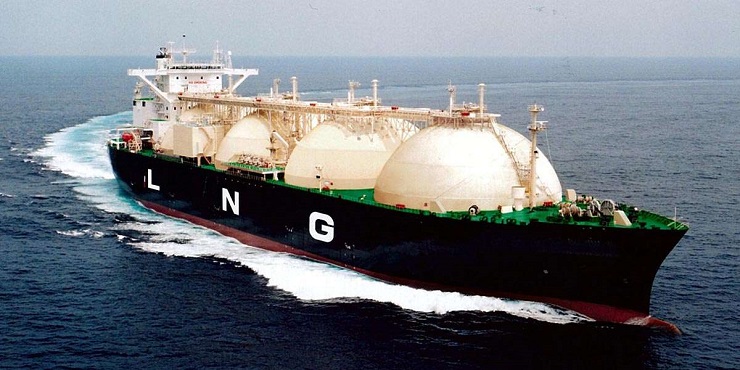
And this is confirmed by data from the Russian Federal Customs Service and the US Bureau of Economic Analysis, which clearly show reports on gas exports to Europe by the US and prove that it is the US that has been making more money than Russia on the super-high gas prices in recent months. Thus, the value of natural gas and LNG exported by Russia in January-August 2021 was $33.197 billion, compared with $42.9 billion worth of LNG exported by the US during the same period!
Most US gas supplies to Europe come under spot contracts (at exchange prices, quick purchase and payment and delivery by a certain date) concluded in December and January, when quotations in Europe were hitting record highs. As a result, traders now supplying American gas to Europe are making super profits. In January, they not only benefited from supplying Europe with gas produced in the US, but they also diverted volumes from the Middle Eastern and even Asian routes as a result of lower gas prices in the Asia-Pacific region (APAC).
As for Gazprom, it delivers, fulfilling its contractual obligations mainly under long-term contracts, i.e. at prices significantly lower than those on the stock exchange.
If LNG supplies result in lower gas prices in Europe, that market will automatically become uninteresting to US exporters, and Europeans themselves will have to go back to buying gas from the traditional suppliers. The panic mood in Europe is therefore now being artificially maintained by allegtions that Russia could cut off gas supplies because of the escalating situation around Ukraine. It is remarkable, however, that all the LNG supplies from the US have never managed to seriously depress gas exchange quotations in Europe, while any news of successful negotiations between Russia and the US or European leaders knocks prices down by $100-150.
As we know, the European gas market is the backyard of the global LNG market, dependent on the conditions in the APAC countries, where the market is physically larger. As soon as prices begin to fall in Asia, they also fall in Europe, and vice versa. In 2021, half of US gas exports went to Asia-Pacific and only a quarter to Europe. However, the diversion of LNG flows from the US to Europe could soon result in higher gas prices in the APAC, with US gas carriers heading back to Asia and European prices again breaking records for the benefit of the same European speculators and US traders, and to the misfortune of Europeans who will pay the price for Washington’s gangster gas policy.
Europe, with its substantial gas consumption and dozens of underutilized LNG import terminals, has long been of great interest to US companies, which have spent a total of $60bn on export infrastructure. There has been a real boom in the construction of LNG terminals in Europe too, under the influence of Washington, and they have even been built in Lithuania and Poland. However, no one can deny that LNG is expensive compared to pipeline gas from Russia. This is why, until recently, Europe was very enthusiastic about buying pipeline gas cheaply from Russia and why 75-80% of Europe’s LNG terminal capacity stood empty. In any case, the main criterion for assessing the prospects of US LNG as a competitor to Gazprom in Europe is price.
However, there have been some significant deteriorations in the gas market in recent weeks. Above all, they followed Russia’s receipt in late February of written confirmation of NATO’s and the United States’ refusal to engage in a dialogue with Moscow on security guarantees. This came against a backdrop where the West had previously blatantly refused to reassure Kiev’s rampant neo-Nazi authorities, who came to power in 2014 through a Washington-inspired coup. But for 8 years, at the instigation of Washington and with the tacit support of the West, the Kiev authorities have consistently pursued a policy of genocide in Donbas, where, according to incomplete information, they have killed more than 13,000 Russian-speaking civilians and pursued a policy of Russophobia. In addition, the Kiev authorities have recently intensified their neo-Nazi activities in the country and have made increasing threats of a potential nuclear weapon capability in Ukraine, in the hope of using which Kiev has already begun to develop far-reaching plans to attack Russia.
Under these conditions and in the absence of a proper Western response to the activities of the Kiev authorities, in late February Moscow was forced to launch a special operation in Ukraine to demilitarize and denazify it for reasons of self-preservation. In response, Washington and its Western allies unleashed an information war against Russia and slapped severe sanctions. Brussels, in a bid to please the Russophobic US political establishment, has refused to certify the already built Nord Stream 2, which could have significantly eased the situation on the European gas market. However, other Russian pipelines continue to operate and pump gas to Europe. Moreover, despite the misleading anti-Russian information warfare unleashed by Washington, Russian gas continues to flow through the Ukrainian gas transmission system without interruption, as reported by the Ukrainian transmission system operator itself. Gas supplies to Europe are not just flowing through the Ukrainian pipeline, they have also increased. The Europeans have increased their requests for supply and Gazprom has begun to pump through the Ukrainian pipe all of 109 million cubic meters of gas per day instead of 50 million cubic meters per day, as it was before the Russian special operation in Ukraine began, which is a doubling of supplies.
However, due to the depletion of European underground storage facilities due to winter weather, there is almost no gas left, forcing the EU to switch to current imports, which are “obligingly” offered by the US, which itself unleashed the crisis in Ukraine to, among other things, raise the price of gas in Europe. As for the Europeans, they are so far trying to move Russia’s hydrocarbon supplies out of the sanctions bracket, although individual European politicians, such as Borel, who openly “eat from Washington’s table”, have started talking about imposing additional sanctions against Russia in the gas sector as well, to please White House policy. At the same time, such European officials know full well that Russia is not going to use its gas as a tool against Europe. The EU has no substitute for that, by the way, and many of the world’s gas exporters have already spoken out about it. And the situation in Europe will only get worse for the population if the anti-Russian policy of the current European officials continues, threatening not only the impoverishment of the population, but also the bankruptcy of many European companies and even entire sectors of the economy.
At the same time, as Europe’s anti-Russian sanctions policy continues to escalate, it cannot be ruled out that Russia may eventually, in order to ensure its own security, use hydrocarbon supplies as a retaliatory measure if it considers Western sanctions to be disastrous for the Russian economy. But such actions will only lead to a clear victory for the United States over Europe, a further increase in its dependence on Washington, including on gas, and an even greater enrichment of the United States through its previously planned increase of gas prices in Europe by exacerbating relations with Russia.
Moscow explains how it’ll do business with firms from ‘unfriendly states’
The Ministry of Finance has set up a special subcommittee to control foreign investment
RT | March 7, 2022
Russian companies wishing to work with firms from countries which oppose Moscow’s military operation in Ukraine will have to receive government permission for the deals, the press service of Russia’s Ministry of Finance said on Monday. Permission will be granted by the Government Commission for the Control of Foreign Investments. It includes representatives from Russia’s Central Bank (Bank of Russia) and the presidential administration.
According to the resolution establishing the procedure, which was signed by Prime Minister Mikhail Mishustin, a Russian resident company or foreign company from an “unfriendly state” must apply for permission for any business deal.
“[The application] should contain comprehensive information about the applicant, including information on the beneficial owners of the company. Based on the analysis of the documents received and the nature of the future agreement, a decision will be made to approve or refuse to implement it,” the press service said, stressing that “the main goal of this work is to ensure the country’s financial stability in the face of external sanctions pressure.”
The government on Monday also unveiled an updated list of countries which have been deemed “unfriendly states” for their positions on the Ukraine conflict. It includes the United States and Canada, the countries of the EU bloc, the UK (including Jersey, Anguilla, the British Virgin Islands, and Gibraltar), Ukraine, Montenegro, Switzerland, Albania, Andorra, Iceland, Liechtenstein, Monaco, Norway, San Marino, North Macedonia, and also Japan, South Korea, Australia, Micronesia, New Zealand, Singapore, and China’s self-ruled territory of Taiwan.
The countries and territories were added to the list after they imposed or joined the sanctions against Russia in connection with the ongoing military operation of the Russian Armed Forces in Ukraine.
According to the government decree, Russian citizens and companies, the state itself and its regions and municipalities will now also have to pay for obligations to foreign creditors from countries on the list in rubles. The new temporary procedure applies to payments exceeding 10 million rubles per month, or a corresponding amount in foreign currency.
The measures have been introduced by Moscow to support the Russian economy after Western states placed Russia under heavy sanctions over the past 10 days. A number of Russia’s largest banks have been cut off from SWIFT and had their foreign assets frozen, restrictions were placed on certain Russian exports and imports, and a growing number of companies from all sectors have been shutting down operations in the country.
Biggest financial players back net zero

United Nations | April 21, 2021
Over 160 firms with $70 trillion in assets have joined forces behind a common goal: steer the global economy towards net-zero emissions and deliver the Paris Agreement goals.
The new Glasgow Financial Alliance for Net Zero (GFANZ), chaired by Mark Carney, UN Special Envoy on Climate Action and Finance, brings together leading net-zero initiatives from across the financial system to accelerate the transition to net-zero emissions by 2050 at the latest.
Members include major asset owners and managers as well as banks with the power to mobilize trillions of dollars behind the transition to net zero. By working together, alliance members can catalyse strategic and technical coordination on steps firms need to take to align with a net-zero future.
All members will set science-aligned interim and long-term goals to reach net zero no later than 2050 in line with the criteria of the UN Race to Zero campaign. Member-determined short-term targets and action plans will supplement these goals.
Existing and new net zero finance initiatives will be part of the Alliance. They comprise the Net Zero Asset Managers Initiative, the UN-convened Net-Zero Asset Owner Alliance and the newly launched Net-Zero Banking Alliance. The last links 43 of the world’s leading banks, and is hosted by the United Nations Environment Programme Finance Initiative and co-launched by the Financial Services Taskforce of the Prince of Wales’ Sustainable Markets Initiative.
UK Prime Minister, Boris Johnson, said: “Uniting the world’s banks and financial institutions behind the global transition to net zero is crucial to unlocking the finance we need to get there – from backing pioneering firms and new technologies to building resilient economies around the world. The Glasgow Financial Alliance for Net Zero will lead this charge ahead of COP26 to scale-up our ambition, accelerate our shift and help us to build back greener together.”
U.S. Special Presidential Envoy for Climate John Kerry said: “The largest financial players in the world recognize energy transition represents a vast commercial opportunity as well as a planetary imperative. As countries around the world move to decarbonize, the large sums these institutions are dedicating to climate finance also reflect a growing understanding of how critical a low-carbon global economy is to their business models. Ultimately, their commitment of capital and assets, as well as adherence to high standards and reporting, will accelerate the transition to this new economy, create a massive number of new jobs, and increase our collective ability to tackle the climate crisis.
Mark Carney, UN Special Envoy for Climate Action and Finance and Prime Minister Johnson’s Climate Finance Advisor for COP26, said: “This is the breakthrough in mainstreaming climate finance the world needs. I welcome the leadership of the Financial Services Task Force and other global banks for their new commitments to net zero and for joining forces with GFANZ, the gold standard for net zero commitments in the financial sector. Most fundamentally, GFANZ will act as the strategic forum to ensure the financial system works together to broaden, deepen, and accelerate the transition to a net zero economy.”
Burning Globalist Structures to Save the Globalist ‘Liberal Order’
By Alastair Crooke | Strategic Culture Foundation | March 6, 2022
In its triple strike of sanctions on Russia, the EU initially was not looking to collapse the Russian financial system. Far from it: Its first instinct was to find the means to continue purchasing its energy needs (made all there more vital by the state of the European gas reserves hovering close to zero). Purchases of energy, special metals, rare earths (all needed for high tech manufacture) and agricultural products were to be exempted. In short, at first brush, the sinews of the global financial system were intended to remain intact.
The main target rather, was to block the core to the Russian financial system’s ability to raise capital – supplemented by specific sanctions on Alrosa, a major player in the diamond market, and Sovcomflot, a tanker fleet operator.
Then, last Saturday morning (26 February) everything changed. It became a blitzkrieg: “We’re waging an all-out economic and financial war on Russia. We will cause the collapse of the Russian economy”, said the French Finance Minister, Le Maire (words, he later said, he regretted).
That Saturday, the EU, the U.S. and some allies acted to freeze the Russian Central Bank’s foreign exchange reserves held overseas. And certain Russian banks (in the end seven) were to be expelled from SWIFT financial messaging service. The intent was openly admitted in an unattributable U.S. briefing: It was to trigger a ‘bear raid’ (ie. an orchestrated mass selling) of the Rouble on the following Monday that would collapse the value of the currency.
The purpose to freezing the Central Bank’s reserves was two-fold: First, to prevent the Bank from supporting the Rouble. And secondly, to create a commercial bank liquidity scarcity inside Russia to feed into a concerted campaign over that weekend to scare Russians into believing that some domestic banks might fail – thus prompting a rush at the ATMs, and start a bank-run, in other words.
More than two decades ago, in August 1998, Russia defaulted on its debt and devalued the Rouble, sparking a political crisis that culminated with Vladimir Putin replacing Boris Yeltsin. In 2014, there was a similar U.S. attempt to crash the Rouble through sanctions and by engineering (with Saudi Arabian help) a 41% drop in oil prices by January 2015.
Plainly, last Saturday morning when Ursula von der Leyen announced that ‘selected’ Russian banks would be expelled from SWIFT and the international financial messaging system; and spelled out the near unprecedented Russian Central Bank reserve freeze, we were witnessing the repeat of 1998. The collapse of the economy (as Le Maire said), a run on the domestic banks and the prospect of soaring inflation. This combination was expected to conflate into a political crisis – albeit one intended, this time, to see Putin replaced, vice Yeltsin – aka regime change in Russia, as a senior U.S. think-tanker proposed this week.
In the end, the Rouble fell, but it did not collapse. The Russian currency rather, after an initial drop, recovered about half its early fall. Russians did queue at their ATMs on Monday, but a full run on the retail banks did not materialise. It was ‘managed’ by Moscow.
What occurred on that Saturday which prompted the EU switch from moderate sanctions to become a full participant in a financial war à outrance on Russia is not clear: It may have resulted from intense U.S. pressure, or it came from within, as Germany seized an opportune alibi to put itself back on the path of militarisation for the third time in the past several decades: To re-configure Germany as a major military power, a forceful participant in global politics.
And that – very simply – could not have been possible without tacit U.S. encouragement.
Ambassador Bhadrakumar notes that the underlying shifts made manifest by von der Leyen on Saturday “herald a profound shift in European politics. It is tempting, but ultimately futile, to contextually place this shift as a reaction to the Russian decision to launch military operations in Ukraine. The pretext only provides the alibi, whilst the shift is anchored on power play and has a dynamic of its own”. He continues,
“Without doubt, the three developments — Germany’s decision to step up its militarisation [spending an additional euro100 billion]; the EU decision to finance arms supplies to Ukraine, and Germany’s historic decision to reverse its policy not to supply weapons to conflict zones — mark a radical departure in European politics since World War II. The thinking toward a military build-up, the need for Germany to be a “forceful” participant in global politics and the jettisoning of its guilt complex and get “combat ready” — all these by far predate the current situation around Ukraine”.
The von der Leyen intervention may have been opportunism, driven by a resurgence of SPD German ambition (and perhaps by her own animus towards Russia, stemming from her family connection to the SS German capture of Kiev), yet its consequences are likely profound.
Just to be clear, on one Saturday, von der Leyen pulled the switch to turn off principal parts to Global financial functioning: blocking interbank messaging, confiscating foreign exchange reserves and the cutting the sinews of trade. Ostensibly this ‘burning’ of global structures is being done (like the burning of villages in Vietnam) to ‘save’ the liberal Order.
However, this must be taken in tandem with Germany’s and the EU decision to supply weapons (to not just any old ‘conflict zone’) but specifically to forces fighting Russian troops in Ukraine. The ‘Kick Ass’ parts to those Ukrainian forces ‘resisting’ Russia are neo-Nazi forces with a long history of committing atrocities against the Russian-speaking Ukrainian peoples. Germany will be joining with the U.S. in training these Nazi elements in Poland. The CIA has been doing such since 2015. (So, as Russia tries to de-Nazify Ukraine, Germany and the EU are encouraging European volunteers to join in a U.S.-led effort to use Nazi elements to resist Russia, just as in the way Jihadists were trained to resist Russia in Syria).
What a paradox! Effectively von der Leyen is overseeing the building of an EU ‘Berlin Wall’ – albeit with its purpose inverted now – to separate the EU from Russia. And to complete the parallel, she even announced that Russia Today and Sputnik broadcasts would be banned across the EU. Europeans can be allowed only to hear authorised EU messaging – (however, a week into the Russian invasion, cracks are appearing in this tightly-controlled western narrative – “Putin is NOT crazy and the Russian invasion is NOT failing”, warns a leading U.S. military analyst in the Daily Mail. Simply “[b]elieving Russia’s assault is going poorly may make us feel better but is at odds with the facts”, Roggio writes. “We cannot help Ukraine if we cannot be honest about its predicament”).
So Biden, finally, has his foreign policy ‘success’: Europe is walling itself off from Russia, China, and the emerging integrated Asian market. It has sanctioned itself from ‘dependency’ on Russian natural gas (without prospect of any immediate alternatives) and it has thrown itself in with the Biden project. Next up, the EU pivot to sanctioning China?
Will this last? It seems improbable. German industry has a long history for staging its own mercantile interests before wider geo-pollical ambitions – before, even, EU interests. And in Germany, the business class effectively is the political class and needs competitively-priced energy.
Whilst the rest of the world shows little or no enthusiasm to join with sanctions on Russia (China has ruled out sanctions on Russia), Europe is in hysteria. This will not fade quickly. The new ‘Iron Curtain’ erected in Brussels may last years.
But what of the unintended consequences to last Saturday’s ‘sanctions Blitzkrieg’: the ‘unknowable unknowns’ in Rumsfeld’s famous mantra? The unprecedented switch-off affecting a key part of the Globalist system did not download into a neutral, inert context – It developed into an emotionally hyper-charged atmosphere of Russophobia.
Whereas EU states had hoped to spare Russian energy shipments, they did not take account of the frenzy raised against Russia. The oil market has gone on strike, acting as if energy were already in the frame for Western sanctions: Oil tankers had already started to avoid Russian ports because of sanctions fears, and rates for oil tankers on Russian crude routes have exploded as much as nine-fold in the past few days. But now, amid growing fears of falling foul of complex restrictions in different jurisdictions, refiners and banks are balking at purchasing any Russian oil at all, traders and others involved in the market say. Market players fear too that measures that target oil exports directly could be imposed, should fighting in Ukraine intensify.
Commodity markets have been in turmoil since the Special Military Operation began. European natural gas jumped as much as 60% on Wednesday, as buyers, traders and shippers avoid Russian gas. A combination of sanctions and commercial decisions by shippers and insurers to steer clear has cut that contribution to global supplies sharply over the last week. A default cascade by western companies is perfectly possible. And Supply line disruption is inevitable.
Many will be affected by the commodity turmoil, but with Russia providing 25% of global wheat supplies, the 21% hike in wheat and 16% rise in corn prices since 1 January will represent a disaster for many states in the Middle East among others.
All this disruption to markets comes even before Moscow responds with its own countermeasures. They have been silent so far – but what if Moscow demands that future payments for energy are to be made in Yuan?
In sum, the changes set out by von der Leyen and the EU, with surging crude oil costs, could potentially tip global markets into crisis, and set off spiralling inflation. Cost inflation created by energy costs spiralling higher and food disruptions are not so easily susceptible to monetary remedies. If the daily drama of the war in Ukraine starts to fade from public view, and inflation persists, the political cost of von der Leyen’s Saturday drama is likely to be European-wide recession.
“Since well before the Russian invasion of Ukraine, Europeans have been struggling under the weight of runaway energy bills”, OilPrice.com notes. In Germany, for some, one month’s energy costs the same as they used to pay for a whole year; in the UK the government has raised the price cap for energy bills by a whopping 54%, and in Italy a recent 40% domestic energy cost hike could now nearly double.
The New York Times describes this impact on local businesses and industries as nothing short of “frightening”, as all kinds of small businesses across Europe (prior to last week’s events) have been forced to cease their operations as energy costs outweigh profits. Large industries have not been immune to sticker shock either. “Almost two-thirds of the 28,000 companies surveyed by the Association of German Chambers of Commerce and Industry this month rated energy prices as one of their biggest business risks … For those in the industrial sector, the figure was as high as 85 percent.”
One recalls that old prediction from the Middle East, that western values would turn against the West itself, and ultimately devour it.
Russia hits back on “sanctions from hell”
BY M. K. BHADRAKUMAR | INDIAN PUNCHLINE | MARCH 5, 2022
An innocuous tweet from Russia’s Permanent Representative to International Organisations in Vienna Mikhail Ulyanov earlier today in the afternoon said that he met with the EU Coordinator at the Vienna talks on Iran nuclear issue Enrique Mora and “raised a number of questions which need to be duly addressed now in order to ensure smooth civil nuclear cooperation with Iran.”
A couple of hours later, he again tweeted, “The #ViennaTalks continue. I had today a useful meeting with Deputy Foreign Minister of Iran for Economic Diplomacy Mr. Mehdi Safari.”
Other reports suggest that Russia has put forth a new demand at Vienna that its trade, investment and military cooperation with Iran would not be hindered by US sanctions. Russia seeks written guarantees in this regard at the highest level from the Biden administration. Apparently, Russia put forth this demand a couple of days back.
A few hours ago in the evening, Foreign Minister Sergey Lavrov confirmed this development. Disclosing this at a press conference in Moscow, Lavrov explained that against the backdrop of the latest western sanctions, Russia wants to have a “very clear answer” from the US in the context of bilateral Moscow-Tehran relations and the Iranian nuclear deal.
In Lavrov’s words, “We need guarantees these sanctions will in no way affect the trading, economic and investment relations contained in the Joint Comprehensive Plan of Action for the Iranian nuclear program. We have asked the American counterparts, who rule the roost here, to provide us with guarantees at least at the level of the secretary of state [that] the current process launched by the United States will by no means affect our right to free and full-fledged trading, economic, investment, military and technical cooperation with Iran.” [Emphasis added.]
Furthermore, Lavrov also openly backed Iran’s remaining demands, saying that Tehran’s expectations are “quite fair.” Whether Lavrov spoke in consultation with Tehran, we don’t know.
The development comes as the 8th round of negotiations on the restoration of the Joint Comprehensive Plan of Action (JCPOA) and the United States’ return to the fold of that multilateral agreement is nearing completion. The negotiators are working on a draft final document. Iran and the IAEA also agreed today on a roadmap with the UN nuclear watchdog to resolve all outstanding questions about the country’s nuclear program by late June, which removes one big stumbling block.
Lavrov calmly pointed out that the sanctions on Russia create a “problem” from Moscow’s perspective. He noted sarcastically, “It would have all been fine, but that avalanche of aggressive sanctions that have erupted from the West — and which I understand has not yet stopped — demand additional understanding by lawyers, above all.”
So, Lavrov insisted: “We want an answer — a very clear answer — we need a guarantee that these [US] sanctions will not in any way touch the regime of trade-economic and investment relations which is laid down in the Joint Comprehensive Plan of Action.”
On Iran’s part, Foreign Minister Hossein Amir-Abdollahian had told EU foreign policy chief Josep Borrell only yesterday, “I am ready to fly to Vienna when the Western sides accept our remaining red lines… We are ready to finalise a good and immediate agreement. Most of Iran’s requests have been considered.”
But today, the most anxious person to clinch the deal at Vienna is none other than President Joe Biden himself. After derailing the Russia-Europe energy relationship, Biden is witnessing that the prices for gas are skyrocketing in Europe, and Washington has no solutions to the grave situation that is developing. The spot market price for gas has zoomed to 8 times the price at which Russia had been supplying Germany. (Russia has announced that w.e.f Thursday, it has shut down the Yamal-Europe gas pipeline which is the trunk route transporting gas to German market.)
On the whole, the situation in the energy market is becoming very complicated, as western oil companies which had invested in Russia are forced to quit due to the sanctions. These include big players such as BP which has a 20-percent stake in Russian giant Rosneft, Shell with 27.5 percent stake in the Sakhalin-II LNG facility and a 50 percent stake in the Salym Petroleum Development, ExxonMobil (Sakhalin-1) and so on.
Apart from the impairment these companies will suffer running into tens of billions of dollars, their exit will also strain Russia’s ability to maintain such high production levels and continue to meet its commitments under the OPEC+ agreement. Now, the already-tight global market for crude – which saw Brent crude top $115 per barrel in early Thursday trading – can ill-afford these downstream hits from the sanctions against Russia. Evidently, crude prices still have nowhere to go but up from here. Expert opinion is that if oil price touches $125 per barrel, US economy slides into recession.
Russia has not so far made any direct indications that it will restrict energy exports, though the rhetoric is heating up. Deputy Prime Minister Andrey Belousov warned on Friday that western companies, including energy firms, that are ditching Russia will be considered pushing their Russian subsidiaries to “deliberate bankruptcy,” which under Russian law draws criminal prosecution.
To solve Europe’s problem of high prices, Biden recently swallowed pride and mentioned buying cheap Iranian oil as a response. Western analysts opine that Biden is in a mood to appease the “Iranian hawks” at Vienna. That is to say, US desperately needs both a lucrative energy deal and Iranian cooperation in Vienna. Israeli observers are apprehensive that the Biden administration might go ahead with easing or lifting restrictions on Iranian oil exports even without signing the Vienna agreements!
One big reason behind this panic is that the Biden administration is profoundly concerned about the strong growth of motor fuel prices in the US lately. But on the other hand, any visible US appeasement of Iran at this critical stage will be a sign of weakness, and, surely, Biden will come up for trenchant criticism in the domestic opinion.
Indeed, Lavrov has factored in all these developments while demanding that “at least” Antony Blinken should give a written guarantee. Moscow is paying back for Blinken’s boorishness. Of course, it will be a devastating loss of face for Biden to cave in publicly. Of course, the most awful thing will be that it is not only precedent setting but makes a complete mockery of America’s weaponisation of the dollar!
Europeans too must be wondering what is going on. They have passively sacrificed self-interests vis-a-vis Russia on the basis of Biden’s demands! Nord Stream 2 stands abandoned!
This is going to be a catch-22 situation. For, Russia’s green signal is an imperative for the JCPOA deal to be approved within the framework the joint commission of Iran and the international quintet (Russia, Britain, Germany, China and France.) Besides, Iran will surely expect a formal approval for any deal from the UN Security Council.
On the other hand, if the negotiations at Vienna get prolonged, Iran’s enrichment activities at the accelerated pace will continue and a point of no return may be reached very soon, in a matter of weeks at the most, which will put the Biden administration in an even bigger bind, as the spectre of a nuclear Iran haunts West Asia and Europe.
To be sure, the blowback to the US sanctions has begun. This is of course only the beginning. Trust Russia to go further and further up on the escalation ladder. Russia would have no conceivable reason to cooperate with the US from now onward. (See my blog Ukraine sparks EU, US rush to Iran deal, March 1, 2022)
However, if the chronicle of Russian-American relations is anything to go by, trust Biden to start making entreaties using back channels to Moscow.
Actually, in response to a question at a press briefing in Moscow today evening about the current state of Russia-US relations in view of the developments in Ukraine and the pressure of sanctions, Kremlin spokesman Dmitry Peskov remarked cryptically that “We are maintaining certain channels of a dialogue with the United States.” He didn’t elaborate.
On Ukraine, Biden’s State of the Union address was just ‘good vs. evil’
By Scott Ritter | RT | March 3, 2022
Biden’s simplistic “good versus evil” pronouncements on the Russian-Ukraine conflict did little to prepare America for the consequences of declaring economic warfare against the Russian state.
It wasn’t surprising that Russia’s ongoing military incursion into Ukraine topped the list of issues addressed by US President Joe Biden in his first State of the Union (SOTU) address, delivered on March 1, 2022, to a joint session of Congress.
Biden pitched the Ukraine crisis as a defining moment in modern history, a problem that could only be resolved with American leadership, both at home and abroad. His job during his address was to convince both domestic and foreign viewers alike that he was the man for the job.
He repeated the time-tested mantra that held that Russia and its president, Vladimir Putin, constituted a threat to democratic principles at home and abroad. This was especially true, he said, when it came to Ukraine.
There was nothing new in what Biden told his audience – the same words and themes had been deployed many times over in the past week. He pushed the same buttons – Putin as the personification of “autocratic oppression,” leading a Russia addicted to power, hell-bent on forcefully absorbing the nation of Ukraine into the Russian orbit.
He likewise pulled at the heartstrings of America, talking about Ukraine’s embattled leader, Volodymyr Zelensky, and the heroic resistance of his people in the face of overwhelming Russian power. The United States stood fully behind them, Biden said. This sentiment was shared by many in the audience as the president spoke. They held small Ukrainian flags or wore the nation’s blue-and-yellow colors. But this support, he said, had its limits – the US, he declared, would not send a single soldier to Ukraine to fight for its cause.
The fact was, Biden was abandoning it to its fate. While praising the courage and leadership of the Ukrainian president, he said, “Let me be clear, our forces are not engaged and will not engage in conflict with Russian forces in Ukraine. Our forces are not going to Europe to fight in Ukraine, but to defend our NATO allies in the event that Putin decides to keep moving west.”
There is no evidence that Russia intends to “keep moving west.” And while Biden spoke of the important leadership role played by the US in Europe, the fact remains that Europe is a veritable prisoner to the whims of any US president, whose pronouncements take on the weight of law whenever they are uttered.
Neither Europe nor the United States, it seemed, would be intervening on behalf of Ukraine against Russia. Zelensky and Ukraine were on their own, their only choice for national relevance being to commit suicide on the international stage while the West, from the safety of their homes and offices, cheered them on like bloodthirsty Romans watching gladiators do battle in the Colosseum.
The major takeaway from Biden’s SOTU address? Ukraine will lose this war, and the West will do nothing to stop that fact.
While Biden lionized Ukraine and its beleaguered president, he failed to explain to the American people why there was a war, beyond the sophomoric argument that “Putin did it.” No talk of America’s role in the Maidan back in 2014, no discussion of the role played by Ukrainian right-wing ultra-nationalists in oppressing the Russian-speaking population of Ukraine, no mention of the shelling of the breakaway Donbass region, no discussion of the role that NATO expansion played in creating an untenable security situation for the Russian state.
Simplistic jingoism plays well in atmospheres such as televised political addresses, where a captive audience is compelled to rise and applaud made-for-TV pronouncements lest they be singled out for public criticism by a fawning, vindictive corporate media. The cheer-fest the SOTU has become would give any Brezhnev-era meeting of the Presidium a run for its money when it comes to mindless standing ovations.
But it was here, in the orgy of self-congratulation that is the interplay between president and Congress where America’s weakness in its conflict with Russia was exposed. As united as everyone seemed to be about sacrificing Ukraine on the altar of Russia-bashing, it was clear Congress was deeply divided from Joe Biden on issues of domestic policy, especially when it came to the economy of the US. While the US president may not want to engage Russia in a shooting war in Europe, he has embarked on a great global crusade to destroy it economically. And the tepid response the political opposition gave to his pronouncements underscores the reality that the US is not prepared for the consequences of his declaration of open economic war with Russia.
Let there be no doubt: Russia will win the shooting war in Ukraine. This outcome is inevitable, given the reality that Ukraine has been abandoned by its erstwhile partners in the West. Yet the conflict between Russia and the West won’t end when the last bomb explodes on Ukrainian soil, but when, in the mindset of the US and its European partners, the Russian economy is destroyed and Putin is humiliated and diminished as a political force, domestically, regionally, and globally.
Here, the US president did the American people a great disservice, selling them a feel-good struggle in which Ukraine is promoted as the glorified martyr and Russia demoted as the evil oppressor. A bloodless conflict – from the US perspective, at least – that will be won simply by shutting down the Russian economy by remote control. It won’t be that simple.
Russia has yet to respond to the US-led economic war being waged against it. When it does, rest assured that these sanctions Congress so enthusiastically applauded will prove to be a double-edged sword – one that will cut into a US economy still reeling from the consequences of the Covid pandemic. When that time comes, President Biden could find that many of those politicians who rose to their feet to cheer on the sacrifice of Ukraine will turn on him.
War, it is said, is but an extension of politics by other means. Given the deep partisan political divide that exists in the US when it comes to the economy, it is clear neither Biden nor the American public is ready for what is about to happen when the consequences of their anti-Russian hysteria finally comes home to roost.
Scott Ritter is a former US Marine Corps intelligence officer and author of ‘SCORPION KING: America’s Suicidal Embrace of Nuclear Weapons from FDR to Trump.’ He served in the Soviet Union as an inspector implementing the INF Treaty, in General Schwarzkopf’s staff during the Gulf War, and from 1991-1998 as a UN weapons inspector.
Public Health Erred on the Side of Catastrophe
In a coercive mass experiment, governments opened a Pandora’s box of harms
By Brian McGlinchey | February 21, 2022
Throughout the Covid-19 pandemic, proponents of lockdowns, shelter-in-place orders, mask mandates and other coercive government interventions have characterized these measures as benevolently “erring on the side of caution.”
Now, as the grim toll of those public health measures comes into ever-sharper focus, it’s increasingly clear those characterizations were terribly wrong.
What’s less readily apparent, however, is how the very use of the “erring on the side of caution” framing was injurious in itself—by thwarting reasoned debate of public health policies, diverting attention from unintended consequences, and buffering the Covid regime’s architects from accountability.
To understand how the misuse of “erring on the side of caution” performed a sort of mass hypnosis that coaxed populations into two years of submission to disastrous, overreaching policies, consider how the expression is typically used.
In everyday life, one might err on the side of caution by:
- Leaving for the airport an extra 30 minutes early
- Carrying an umbrella when there’s a 25% chance of rain
- Opting for a less-challenging ski slope
- Going back into the house to make sure the iron is unplugged
- Getting a second medical opinion
Generally speaking, “erring on the side of caution” in everyday life means lowering risk with a precaution that has a negligible cost.
When mandate proponents portrayed their edicts as “erring on the side of caution,” it had the effect of tacitly assuring the public—and themselves—that there’d be little or no harm associated with extreme measures like:
- Shutting down businesses for months at a time
- Knowingly forcing millions of people into unemployment
- Halting in-person attendance at schools and colleges
- Ordering people of all ages and risk profiles to wear masks
- Denying people opportunities to socialize, recreate and enjoy living
That implicit low-downside assurance not only fostered unthinking support for draconian measures among citizens and experts alike, it also cultivated an atmosphere of intolerance toward those who questioned the wisdom of these interventions and predicted the great many harms that have resulted.
“Overconfident, unnuanced messaging conditioned us to assume that all dissenting opinions are misinformation rather than reflections of good faith disagreement or differing priorities,” write Rutgers professors Jacob Hale Russell and Dennis Patterson in their essay, The Mask Debacle. “In doing so, elites drove out scientific research that might have separated valuable interventions from the less valuable.”
Of course, in addition to its implicit assurance that a risk-reduction measure comes at little cost, “erring on the side of caution” conveys an assumption that the precaution will actually be effective.
That hasn’t been the case with Covid mandates. Though many continue embracing the illusion of government control over Covid, the contrary studies and real-world observations are stacking far too high to be denied any longer by the intellectually honest among us.
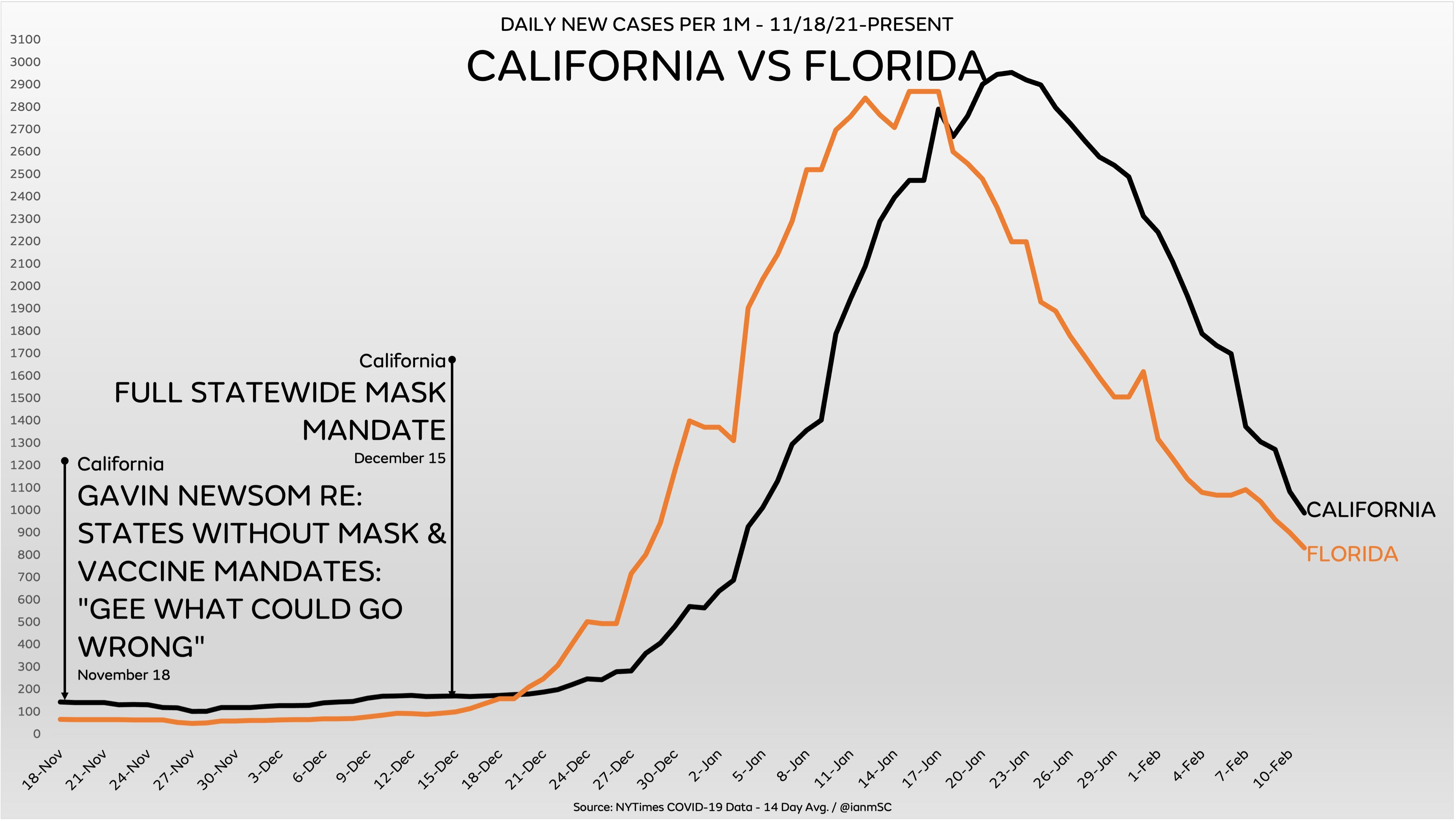
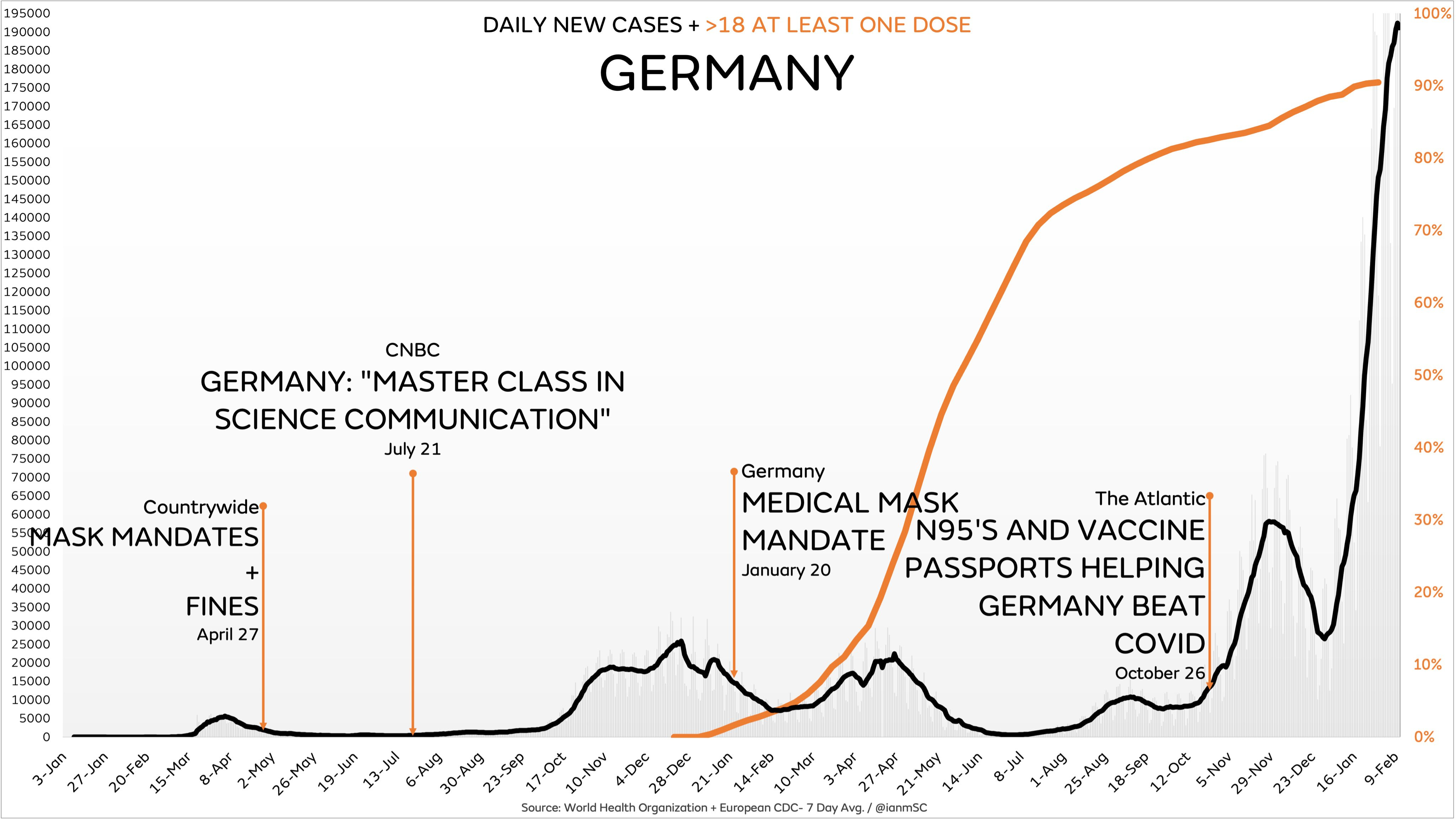
Charts via Ian Miller at Unmasked
Public Health Threw Out the Playbook and Threw Pandora’s Box Wide Open
The masses who’ve chanted “I trust science,” as they praise each government intervention and idolize those who impose them, are likely unaware that, before Covid-19, the well-considered scientific consensus was against lockdowns, broad quarantines and masking outside of hospital settings—particularly for a virus like Covid-19 that has a 99% survival rate for most age groups.
For example, a 2006 paper published by the Center for Biosecurity of the University of Pittsburgh Medical Center—focusing on mitigation measures against another contagious respiratory illness, pandemic influenza—reads like a warning label against many of the policies inflicted on humanity in the face of Covid-19:
- “There is no basis for recommending quarantine either of groups or individuals. The problems in implementing such measures are formidable, and secondary effects of absenteeism and community disruption as well as possible adverse consequences… are likely to be considerable.”
- “Widespread closures [of schools, restaurants, churches, recreations centers, etc] would almost certainly have serious adverse social and economic effects.”
- “The ordinary surgical mask does little to prevent inhalation of small droplets bearing influenza virus… There are few data available to support the efficacy of N95 or surgical masks outside a healthcare setting. N95 masks need to be fit-tested to be efficacious.”
The point of that and other pre-2020 research into pandemic mitigation was to be prepared, in times of crisis, with policies that reflected a well-reasoned and dispassionate weighing of costs and benefits.
However, when the pandemic arrived, panicking public health officials and academics threw out the playbook and took their policy inspiration from the government that was first to confront the virus. Sadly for the world, that was communist China.
The breadth of the resulting harms from the ensuing plunge into public health authoritarianism is staggering. Far from erring on the side of caution…
Public health erred on the side of a mental health crisis. Anxiety and depression have surged, particularly among adolescents and young adults, where symptoms have doubled during the pandemic.
“I have never been as busy in my life and I’ve never seen my colleagues as busy,” New York psychiatrist Valentine Raiteri told CNBC. “I can’t refer people to other people because everybody is full.”
Public health erred on the side of juvenile suicide attempts. In the summer of 2020, emergency room visits for potential suicides by children leapt over 22% compared to the summer of 2019.
Public health erred on the side of drug overdoses. According to the National Institute on Drug Abuse, overdose deaths surged 30% in 2020 to a record-high of more than 93,000. Among the factors cited: social isolation, people using drugs alone, and decreased access to treatment.
Public health erred on the side of auto fatalities. Traffic deaths had been on a general downtrend since the 60s, reaching a near-record low in 2019. However, even with shutdown-lightened traffic, deaths jumped 17.5% in the summer of 2020 compared to 2019, and kept rising into 2021.
Blame increased drug and alcohol use, along with psychological fallout from people being denied life’s fundamental pleasures. University of Texas cognitive scientist Art Markman told The New York Times that anger and aggression behind the wheel in part reflects “two years of having to stop ourselves from doing things that we’d like to do.”
Public health erred on the side of domestic violence. A review of 32 studies found an increase in domestic violence around the world, with the increases most intense during the first week of lockdowns. “The home confinement led to constant contact between perpetrators and victims, resulting in increased violence and decreased reports,” the researchers found.
Public health erred on the side of riots, arson and looting. It’s my own conviction that 2020’s eruption of summer violence following a Minneapolis police officer’s callous homicide of George Floyd was greatly magnified by the period of forced mass confinement that preceded it.
Floyd’s death was a match dropped into a tinderbox of humanity confined to veritable house arrest. People blocked from restaurants and bars were suddenly granted a societal waiver to venture out into enormous crowds, where they found excitement, socialization and, far too often, a senselessly destructive means of venting months of pent-up energy, anxiety and frustration. It stands as the costliest civil unrest episode in American history.
Public health erred on the side of confining people where the virus is transmitted most. Lockdowns ordered people away from workplaces, schools, restaurants and bars and into their homes, where New York contract tracers found 74% of Covid spread was happening, compared to just 1.4% in bars and restaurants and even less in schools and workplaces.
Public health erred on the side of obesity. According to the CDC, “the risk of severe COVID-19 illness increases sharply with higher BMI [Body Mass Index].” So what happens when public health “experts” shut down schools, workplaces and recreation options and told people to stay home to stay “safe”?
The CDC found that, in 2020, the rate by which BMI increased among 2- to 19-year olds doubled. Another study found that 48% of adults gained weight during the pandemic, with those who were already overweight most likely to add even more. Among other factors, the study pointed to psychological distress and having schoolchildren at home.
Public health erred against fresh air, exercise and Vitamin D. Governments raced to shut down playgrounds, basketball courts and other outdoor recreation facilities. In a move that’s profoundly emblematic of heavy-handed, counterproductive authoritarianism in the age of Covid, the city of San Clemente, California filled a skate park with 37 tons of sand.
Public health erred on the side of impaired child development. “We find that children born during the pandemic have significantly reduced verbal, motor, and overall cognitive performance compared to children born pre-pandemic,” say the authors of a study from Paediatric Emergency Research in the UK and Ireland (PERUKI).
“Results highlight that even in the absence of direct SARS-CoV-2 infection and COVID-19 illness, the environmental changes associated [with the] COVID-19 pandemic [are] significantly and negatively affecting infant and child development.”
Public health erred on the side of learning loss. Children are less vulnerable to Covid-19 than they are to the flu, and rarely transmit it to teachers. Unfortunately, American public health officials and teacher unions prevailed in halting in-person instruction (and socialization) in favor of “remote learning.”
It was a poor substitute that fell hardest on the youngest learners. For example, according to curriculum and assessment provider Amplify, the percentage of first-graders scoring at or above the goals for their grade in mid-school-year dropped from 58% before the pandemic to just 44% this year.
Public health erred on the side of pointlessly masking schoolchildren. When schools did open, mask mandates abounded—despite children’s relative invulnerability to the virus and the documented rarity of in-school transmission. A Spanish study showed no discernible difference in transmission among 5-year-olds—who aren’t required to mask—and 6 year olds, who are.
“Masking is a psychological stressor for children and disrupts learning. Covering the lower half of the face of both teacher and pupil reduces the ability to communicate,” wrote Neeraj Sood, director of the Covid Initiative at USC, and Jay Bhattacharya, professor of medicine at Stanford. “Positive emotions such as laughing and smiling become less recognizable, and negative emotions get amplified. Bonding between teachers and students takes a hit.”
“Most of the masks worn by most kids for most of the pandemic have likely done nothing to change the velocity or trajectory of the virus,” writes University of California associate professor of epidemiology and biostatistics Vinay Prasad. “The loss to children remains difficult to capture in hard data, but will likely become clear in the years to come.”
Public health erred on the side of giving masked people a false sense of security. As I wrote in August, “Covid-19 particles are astoundingly small. Hard as it is to imagine, the imperceptible gaps in surgical masks can be 1,000 times the size of a viral particle. Gaps in cloth masks are well larger.” That’s to say nothing of the respirated air that simply goes around the mask’s edges.
Earlier in the pandemic, questioning cloth masks triggered outrage and swift social media censorship. Now, even mandate-happy CNN medical analyst Leanna Wen has declared they’re “little more than facial decorations.” Mask skepticism is sprouting elsewhere in mainstream media; the Washington Post and Bloomberg even published an essay titled “Mask Mandates Didn’t Make Much of a Difference Anyway.”
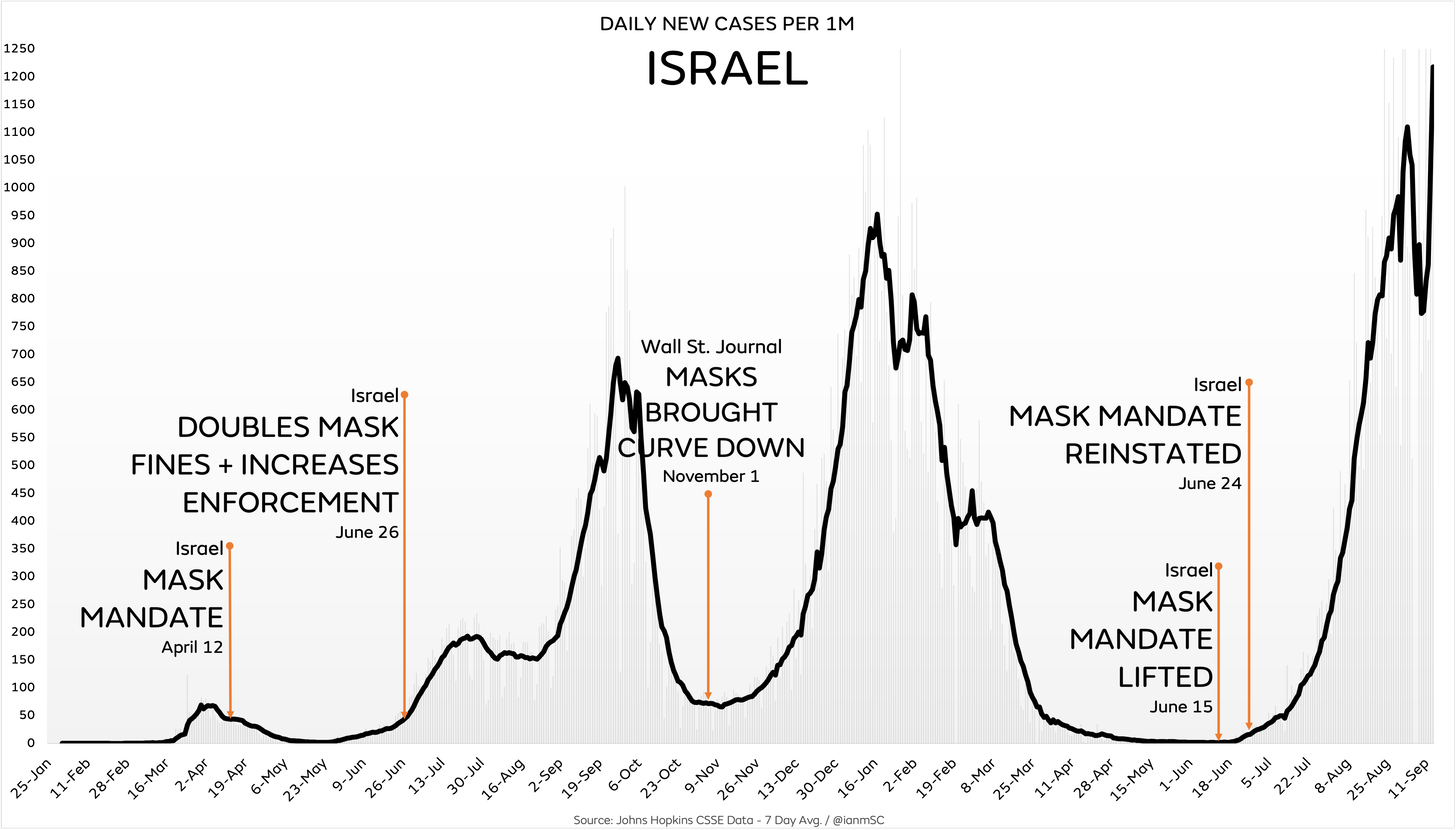
Chart via Ian Miller at Unmasked
When public health officials exaggerated the power of masks, they did more than promote pointless discomfort and a dystopian way of life. “Naively fooled to think that masks would protect them, some older high-risk people did not socially distance properly, and some died from Covid-19 because of it,” said epidemiologist, biostatistician and former Harvard Medical School professor Martin Kulldorff.
Public health erred on the side of killing small businesses. Thanks in large part to government’s targeting of so-called “non-essential businesses,” the first year of the pandemic brought an additional 200,000 business closures over prior levels.
Public health erred on the side of harming women’s careers. Women comprise a greater proportion of the sectors hid hardest by lockdowns, and the closing of schools and child care centers prompted many more women than men to put their careers on hold.
Public health erred on the side of inflation. To offset the massive economic destruction inflicted by public health shutdowns, the federal government plunged into an astounding spending spree, handing out cash to individuals, businesses and city and state governments.
It was money the government didn’t have, so the Federal Reserve essentially created it out of thin air. Pushing all that new fiat money into circulation debases the currency, fueling today’s surging price inflation—which is a stealth tax with no maximum rate, which hits poor people hardest.
Note: Lockdowns and other mandates weren’t the exclusive driver of many of the various harms I’ve described; general fear of the virus also contributed to some of them. However, it should also be noted that public health officials—and media that overwhelmingly emphasized negative stories—whipped up a level of fear that led people to overstate the level of danger actually posed by the virus.
There’s one more way in which characterizing lockdowns and other mandates as “erring on the side of caution” plays a psychological trick: Since the phrase is embedded with the notion of good intentions, it conditions citizens to be forgiving of the bureaucrats and politicians who imposed them.
Note, however, that in most everyday usage of “erring on the side of caution,” the choice to “err” is made voluntarily by individuals who bear the consequences of their own decisions—or by others, like an airplane pilot or a surgeon, to whom we’ve voluntarily and unmistakably granted control of our well-being.
The grim impacts of lockdowns and other mandates, however, were coercively imposed on society, to say nothing of the fact that so many of the edicts represented gross usurpations of power and violations of human rights.
On top of all that, the edicts were reinforced by Orwellian censorship and ostracism leveled at those who dared raise questions that have now proven valid.
So make no mistake: Overreaching public health officials and politicians—and the journalists-in-name-only who served as their mindless, unquestioning megaphones—have fully earned our withering condemnation. Indeed, holding them accountable is essential to sparing ourselves and future generations from repeating this dystopian chapter of human history.
France openly declares that “Russian people will suffer”
By Paul Antonopoulos | March 2, 2022
French Finance Minister Bruno Le Maire declared an “all-out economic and financial war” against Russia for launching its military operation against Kiev last week. It is hoped that such an economic war will ‘punish’ Russia – but shortly after making his comment, Le Maire was quick to change his rhetoric after probably being given a stern warning from within the Champs-Élysées to not make bombastic comments that intensify tensions and could actually lead to war between Russia and NATO.
Responding to Moscow’s decision to go to war with Ukraine, Washington and its closest allies have imposed a string of sanctions aimed against Russia’s central bank, government officials (including President Vladimir Putin and Foreign Minister Sergey Lavrov), and barred some Russian banks from the SWIFT international payments system.
When describing the sanctions, Le Maire said they are proving to be “extremely effective.” However, it was his next comments that raised eyebrows as he told France Info radio that: “We’re waging an all-out economic and financial war on Russia. We will cause the collapse of the Russian economy. The Russian people will also pay the price.”
This of course is extremely alarming as he effectively revealed the intention to impoverish more than 140 million Russian citizens without considering that Moscow has its own retaliatory measures that will also hurt the average European citizen. Le Maire later clarified to AFP that he had misspoken and that the term “war” was not compatible with France’s efforts to de-escalate tensions surrounding the Ukraine conflict, adding: “We are not in a battle against the Russian people.”
This ‘clarification’ was of course made after former Russian Prime Minister and President, Dmitry Medvedev, who is now the deputy Chair of the Security Council of the Russian Federation, chillingly tweeted: “Watch your tongue, gentlemen! And don’t forget that in human history, economic wars quite often turned into real ones.”
For this reason, the Kremlin said on Tuesday that it was placing temporary curbs on foreigners seeking to remove their investments from the country, thus stopping an investor exodus driven by the sanctions which are aimed at shutting out major banks from the international payments system and capital controls choking off money flows.
What the Europeans do not realize is that Moscow sees this current crisis as an existential battle for survival. When Putin announced on TV his “special military operation,” he warned: “To anyone who would consider interfering from the outside – if you do, you will face consequences greater than any you have faced in history.”
Recirculating in western media after this statement was Putin’s comment in a 2018 documentary: “… if someone decides to annihilate Russia, we have the legal right to respond. Yes, it will be a catastrophe for humanity and for the world. But I’m a citizen of Russia and its head of state. Why do we need a world without Russia in it?”
Returning to the situation in Ukraine, Putin said at a meeting with businessmen that there was no reason to destroy a system which they live in, unless Russia were to be excluded from it. If the Europeans wanted to destroy the Russian economy and impoverish millions of Russian citizens, it cannot be excluded that Moscow with a touch of a button can turn off the gas supplies and bring the entire continent’s industry and economy to a halt – while civilians freeze.
This of course would completely destroy the Russian economy at the same time, but from Moscow’s perspective, why would they continue providing energy to a bloc that has already declared an “all-out economic and financial war.” It is extremely curious that the EU believes that Moscow would not make any retaliatory measures, measures that would spell bad news for European citizens. This is especially critical as it seemingly appears that European leaders and decisionmakers are completely naïve to the responses and retaliations that Russia can make.
For now, gas to Europe from Russia via Ukraine is flowing at full capacity. This accounts for at least $1 billion a day to the Russian economy, and threatening to end this will likely be considered a casus belli. With Russia’s nuclear forces already on alert, it remains to be seen whether the EU will pursue an “all-out economic and financial war” against Russia.
Paul Antonopoulos is an independent geopolitical analyst.
Featured Video

Trita Parsi: Middle East Unraveling — Are We on the Path to World War?
or go to
Aletho News Archives – Video-Images
New Book
Trans agenda is ‘normalization of sadism’ – US author

RT | September 23, 2026
The US Democratic Party has embraced a transgender agenda that amounts to “the normalization of sadism,” author A.J. Rice has said, warning that radical trans policies would return if the party is allowed to regain power.
Speaking to RT’s America First host Scotty Nell Hughes about his new book, ‘The Curse of the Bearded Lady: How the Trans Mafia Whacked American Sanity’, Rice argued that activists have gained significant influence in schools, medicine, and corporate America while people who questioned the agenda have faced pressure to stay silent.
The author described the “trans mafia” as the sprawling network of people and institutions that have helped the movement gain influence. He singled out parts of academia, wealthy backers, and corporations, and stated that providers of transition-related treatment also have a financial incentive to keep young people in their care indefinitely.
Rice argued that the consequences of these policies ultimately fall on children who are being drawn toward gender-affirming medical treatments and on girls who are expected to share locker rooms or compete in sports with biological males.
He noted that while voters rejected the Democrats’ approach to gender in 2024, the party, which has been “captured by madness,” has since only doubled down and is seeking what is effectively “the normalization of sadism.” … Full report
Blog Roll
 Aletho News
- German chemicals giant reveals details of downsizing
- Refaat Al-Areer Was The Canary In The Coal Mine In Israel’s War On The Truth
- Israeli election committee bars candidate from Knesset race over Gaza war opposition
- French-Lebanese man files war crimes complaint over Israeli attacks
- Mahan Air Flight Lands in China Despite US Threat against Iranian Airlines
- US eyes $10bn fund to rebuild war-battered Gulf infrastructure
- Trump meets Rodríguez near Maduro’s prison as Venezuela’s oil flows to US
- Trita Parsi: Middle East Unraveling — Are We on the Path to World War?
- Iran FM meets with US envoy on UN meeting’s sidelines at American side’s insistence: Report
- Qatar PM calls for Gulf security framework with Iran, says war must be ‘wake-up call’
- If Americans Knew
- Caught on Tape: AIPAC CEO Boasted of Controlling Trump’s National Security Officials
- Why Hamas Attacked Israel in October 2023 – Israeli professor Ilan Papé
- They see them, then kill them: Israeli quadcopters track, deliberately target civilians in Gaza
- Winter could turn Gaza’s treacherous, war-damaged buildings into deathtraps
- Majority of Democratic Voters Want to Prosecute Both Biden and Trump Administration Officials Over Gaza
- As Gaza languishes, world leaders gather at the UN – Daily Update
- Sanctions are collective punishment: immoral and self-defeating
- Phosphorus Munitions Fired by Israel Burn Groves, Orchards in Southern Lebanon
- Israel Carries Out New Ceasefire Violations Across Gaza
- AI – Emphasis on the ‘I’: Israel Is Funding AI Chatbot Propaganda
- No Tricks Zone
- New Study: Earth And Venus Surface Warmth Largely Explained By Convection And Lapse Rate, Not CO2 Or Radiation
- 2025 Nature Paper Claiming Worsening Global Drought Gets RETRACTED …Heavily Flawed
- New Study: ‘Global Drought Shows No Detectable Recent Acceleration Under Climate Warming’
- Economic Masterminds: German Socialists Suggest Taxing Productivity Gains Stemming From Using AI
- The South China Sea Has Not Been Cooperating With The Climate Change Narrative
- Energy Crisis: Germany Enters Heating Season With Historically Low Gas Reserve Fill Levels
- New Study: The Antarctic Ice Sheet Gained Mass From 2020-2024 Due To Staggering Snow And Ice Accumulation
- Study: Ocean Heating Rates From Thousands Of Years Ago ‘Dwarf’ Modern Ocean Heating Rates
- Climate Extremists Target, Attack Large-Scale Power Grid Infrastructure In Germany!
- New Study: Antarctic Ice Melt Has Contributed Less Than 1 Centimeter To Sea Level Rise In The Last 30 Years

