Can Germany disconnect from Russian gas?
By Paul Antonopoulos | March 1, 2022
It is not an exaggeration to say that the course of the war in Ukraine will determine the geopolitics and economy of Eastern Europe for the decades to come. Although it appears that the West is making great effort to oust Russia from Ukraine, they also hope to liberalise their energy supplies, especially Germany – but can the European Union’s biggest economic powerhouse separate itself from Russian gas?
German Finance Minister Christian Lindner dispels the hopes that Moscow will succeed in “blackmailing” the launch of Nord Stream-2 in an interview. He also points out, without any ambiguous allusions, that the economy of Germany and the EU as a whole will inevitably collapse if Russian gas stops flowing. In fact, the German Minister is saying the obvious outcomes according to data, but this is ignored by other senior German politicians and EU states.
Poland, the Baltic states and Ukraine have been asking Washington for years to impose sanctions on Russian energy, and now it is beginning to be supported by many European leaders. German Chancellor Olaf Scholz, who recently returned from talks in Moscow, ordered the Ministry of Economy to withdraw its conclusion that launching Nord Stream-2 does not pose a risk to the German gas market.
News circulated that the Chancellor had suspended the certification process for the Russian pipeline. However, the certification of the pipeline is not carried out by the Ministry of Economy, but by the Federal Network Agency, which operates under its legislative package. No one has yet announced a certification deadline, and the Ministry of Economy, having withdrawn its report, is obliged to prepare another report and submit it again for consideration to the Federal Network Agency.
Germany ranks eighth in the global list of natural gas and buys more blue fuel abroad every year. By comparison: In 2013, the Germans imported only 97 billion cubic meters of gas but by 2020 it reached 155.5 billion. By the end of this year, when Germany’s last three nuclear power plants will stop, these figures will be even more inflated.
The European country is not only the leader in natural gas imports, but also the main buyer of electricity – the supply from abroad accounts for more than 10% of the energy balance. Therefore, it must be questioned whether Berlin believes that the supply of LNG from the US can fulfil their energy needs.
In January, it was reported that 106 ships arrived at gas terminals in the EU, bringing a record 7.1 million tons of liquefied gas. This rate is not only a record high, but is 37% higher than the average for previous periods. However, American traders delivered no more than 76 billion cubic meters to Europe in the record year of 2021.
Another issue for the German government is that Europe has now exhausted its physical capacity to import LNG. In total, there are 29 gas terminals in the EU, most of them in Spain and France. Britain, which is no longer part of the eurozone, has three and Germany does not have any LNG terminals. This is why American gas can only enter German storage facilities through resellers with an additional mark-up.
Recently, Qatar’s energy minister said that there was simply nothing to replace Russian gas. Qatar is incapable of increasing LNG production, and current volumes have been condensed under long-term agreements. Earlier, Italian Foreign Minister Luigi Di Maio mentioned the same thing.
Robert Habeck, Vice Chancellor of Germany and Federal Minister for Economic Affairs, said that allowing coal-fired power plants to run longer than planned was an option, challenging Berlin’s scheduled exit from coal energy by 2030.
“There are no taboos on deliberations,” Habeck said, adding that it was Germany’s goal to ultimately choose which country will supply its energy. “Being able to choose also means, in case of doubt, saying goodbye to Russian gas, coal or oil. And should Russia wilfully cut off this supply, then the decision has of course to be made. In that case they will never be rebuilt. I think the Kremlin knows that, too.”
For all the hope in American LNG or using coal in the interim, they are not realistic prospects, and for this reason, even if Berlin wanted to, it cannot divorce itself from Russian gas in the foreseeable future despite some defiant voices.
Paul Antonopoulos is an independent geopolitical analyst.
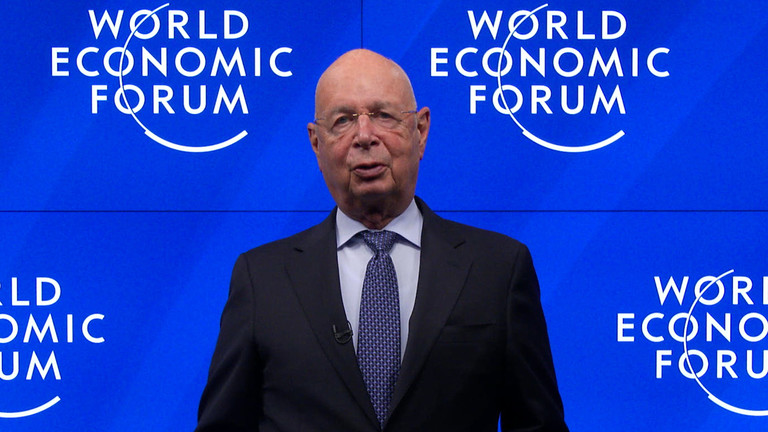
‘Great Reset’ architect backs Ukraine
RT | February 28, 2022
The World Economic Forum (WEF) and its chairman, Klaus Schwab, have thrown their support behind Ukraine, vowing to do “whatever is possible to help” the country against Russian “aggression.”
In the statement on Sunday, Schwab – the author of ‘Covid-19: The Great Reset’ – and WEF President Borge Brende said they “deeply condemn the aggression by Russia against Ukraine” and “the attacks and atrocities.”
“Our full solidarity is with Ukraine’s people and all those who are suffering innocently from this totally unacceptable war,” they stated.
“We only hope that – in the longer-term – reason will prevail and that the space for bridge-building and reconciliation once more emerges,” they said, joining NATO, the European Commission, the UN chief, and other Western powers in publicly condemning Russia’s military action in Ukraine.
During a February 2020 speech to the World Economic Forum, which took place just a few months before the WEF’s controversial ‘Great Reset’ meeting, Ukrainian President Volodymyr Zelensky called for “western investors” to become “the stakeholders, shareholders of the success of a new Ukraine,” and said Ukraine was “a place where miracles come true.”
“Ukraine should become an investment mecca of eastern and central Europe,” he said.
The Great Reset calls for the creation of “entirely new foundations for our economic and social systems” and a reset of capitalism in response to the Covid-19 pandemic. Critics, however, have accused it of being a globalist plot to increase the power of governments and implement a new global economic order.
90% Have No Intention Of Buying Electric Cars
By Paul Homewood | Not A Lot Of People Know That | February 28, 2022
 Maybe somebody might explain one day why the AA President, who traditionally was supposed to look after members’ interests is so determined to get rid of the cars that the vast majority of his members want to drive?
Meanwhile, the fact that only 10% plan to buy an electric car by 2027 is a disaster for both the government’s plans, as well as motor manufacturers who who will need to invest billions before then to set up assembly lines and retool. As they will also have to drastically cut back on production of conventional cars at the same time, many drivers will be forced to buy imported cars.
I simply cannot see how the car industry can go from selling 300,000 cars a year, to 3 million in the space of a couple of years.
Also interesting to see that one in five are planning to buy a hybrid, double the number of plug in electrics. Given that all hybrids will be banned by 2035 anyway, this surely is a dead end sector. Why on earth would manufacturers spend billions developing hybrid technology and production lines, when hybrids have no long term future?
USPS Shuns Biden’s EV Dreams With Massive Gasoline-Powered Mail Truck Purchase
By Tyler Durden | Zero Hedge | February 23, 2022
The Biden administration has been pressing the U.S. Postal Service (USPS) to make a massive purchase commitment of electric delivery vehicles, though such plans were derailed Wednesday when the agency announced a majority of its next-generation fleet would be powered by gasoline rather than a battery, according to Bloomberg.
USPS’ record decision memo states that the agency will move ahead with its purchase of 165,000 mail trucks over the next decade. At least 90% of these trucks will be gasoline-powered built by Oshkosh Corp., and 10% will be electric.
This action steamrolls the Biden administration’s pledge to replace its federal fleet of 600,000 cars and trucks with electric power. USPS operates 230,000 vehicles, which is approximately 33% of the government fleet. Postmaster General Louis DeJoy, a Trump ally, has firmly said the full electrification of the USPS fleet wouldn’t happen under his watch. Last year, he committed to converting only 10% of its new trucks to electric power.
The decision allows USPS to purchase gasoline-powered trucks from Oshkosh under a $6 billion contract awarded last February. USPS rejected a bid from electric-vehicle manufacturer Workhorse Group Inc. to electrify its fleet. Workhorse shares slumped as much as 3.5% today on the USPS news to purchase Oshkosh mail trucks.
USPS wrote that given its financial condition, “the battery-electric option has a significantly higher total cost of ownership than its combustion-engine counterpart.”
USPS under DeJoy appears to be locking in decades of fossil fuel consumption as the president’s “Build Back Better” green plan appears to be faltering. Gasoline mail trucks are more reliable than electric ones, and ownership is cheaper.
The ‘Constructive Destruction’ of Russia’s Model of Relations with the West
By Alastair Crooke | Strategic Culture Foundation | February 27, 2022
The collective West was already angry. And it is apoplectic after President Putin shocked western leaders by ordering a special military operation in Ukraine, which is being widely described (and perceived in the West) as a declaration of war: ‘a shock and awe assault affecting cities widely across Ukraine’. So angry in fact is the West that the information space has literally bifurcated into two: It is all black and white, with no greys. For the West, Putin has comprehensively defied Biden; he has unilaterally and illegally ‘changed the borders’ of Europe and acted as a ‘revisionist power’, attempting to change not just the borders of Ukraine, but the current world order. “Thirty years after the end of the Cold War, we are facing a determined effort to redefine the multilateral order,” the EU High Representative, Josep Borell, warned. “It’s an act of defiance. It’s a revisionist manifesto, the manifesto to review the world order”.
Putin is characterised as a new Hitler, and his acts asserted to be ‘illegal’. It is claimed that it was he who tore up the Minsk II Accord (yet the Republics declared their independence in 2014, signed Minsk in 2015, and it was Russia who never signed the accord – and therefore cannot be in breach of it). Indeed, it is the US effectively that has vetoed the Minsk process since 2014, and Russia’s publication of diplomatic correspondence in November 2021 exposed that France and Germany too, had little intention of pressurising Kiev on any meaningful implementation. And so, having concluded that a negotiated settlement – as stipulated in the Minsk Accords – would simply not happen, Putin determined that there was no point in waiting any longer before implementing Russia’s red line.
The late Stephen Cohen wrote of the dangers of such unqualified Manichanaeism — how the spectre of an evil-doing Putin had so overwhelmed and toxified the US image of him that Washington has been unable to think straight – not just about Putin – but about Russia per se. Cohen’s point was that such utter demonisation undercuts diplomacy. How does one split the difference with evil? Cohen asks, how did this happen? He suggests that in 2004, the NY Times columnist, Nicholas Kristof, inadvertently explained, at least partially, Putin’s demonisation. Kristof complained bitterly of having been “suckered by Mr. Putin. He is not a sober version of Boris Yeltsin”.
Most Russians however, are behind Putin with the recognition of the Donbas Republics, which he then followed up by obtaining the authorisation of Russia’s upper parliament house for the use of armed forces outside Russia (as required under the constitution). The resolution by the Federation Council was unanimously supported by all the 153 senators at an extraordinary session on Tuesday.
In his national address, Putin spoke with a bitterness that is reflected by many Russians. He views the post-2014 political developments in Ukraine as having been engineered to create an anti-Russian regime in Kiev nurtured by the West, and with hostile intentions towards Russia. Putin illustrated this point by explaining that “The Ukrainian troop control system has already been integrated into NATO. This means that NATO headquarters can issue direct commands to the Ukrainian armed forces, even to their separate units and squads”. Putin also noted that the Russian constitution stipulates the borders of Donetsk and Lugansk regions to be as they were “at the time when they were part of Ukraine”. This is a carefully worded formulation — the borders of the two republics underwent significant changes in the aftermath of the Maidan coup. (At issue here is Donetsk’s historic claim to coastal Mariupol).
Putin’s recognition statement was accompanied by an ultimatum to the Kiev forces to cease their artillery bombardment across the Line of Control or face military consequences. Throughout Wednesday evening however, the situation on the Contact Line was heating up, with heavy artillery fire; but early Thursday morning, for the first time, multiple rocket-fire was used by the Kiev forces across the Control Line. (Someone from the Kiev side clearly wanted escalation – perhaps to put pressure on Washington). Putin immediately ordered what was evidently a pre-prepared Special Operation ‘to de-militarise and de-nazify Ukraine’. Russia’s military announced within a couple hours of the offensive that all of Ukraine’s air defense systems had been taken out. A massive Russian aerial presence, including fighter jets and helicopters, has been confirmed over much of the country.
Possibly this operation (which Putin said is not about occupying Ukraine), will follow the pattern of Georgia in 2018, when Russian forces withdrew after a few days. This was the pattern too, in Kazakhstan. We simply do not know whether this will be the case in Ukraine — very possibly not. When Putin spoke of ‘de-nazification’ he was referring to the US co-option of a neo-Nazi formation in Ukraine’s armed forces to help mount the 2014 Maidan coup. The so-called Azov Brigade of neo-Nazis had proved to be the most effective fighting force in pushing back the DLR militia in the Donbass region. (Ukraine is the world’s only nation to have a neo-Nazi formation in its armed forces and there will be scores to be settled).
Nonetheless, Putin’s Special Order has, as no doubt he foresaw, shocked the West deeply with its decisive military reaction. It has set the world – and its financial and energy markets – on edge.
Indeed, the latter aspect may become the more salient. In 1979, upheavals in the Middle East sent energy prices soaring (just as is occurring today), and western economies tumbling. Whatever the next days bring, it must be plain that Putin’s short press conference on 22 February is acting as intended, as a powerful accelerant. The “constructive destruction” of the old Global Order will proceed faster than many of us had imagined. It marks an End to Illusions — an end to the notion that the US imposed, rules-based order remains an option.
How then to interpret the extreme anger in the West? Simply this: In the end, there is reality. And that reality – i.e. what the West can do about it – is all that matters — which is … little.
The brutal first realisation underlying the anger is that the West has no intention – and critically, no ability – to counter Russia’s moves militarily. Biden has repeated the ‘no boots on the ground mantra’ again in the wake of Russian military operations. And for Europe, the imposition of a sanctions regime on Russia could not have come at a worse moment. Europe is facing recession and a pre-existing energy crisis (which will be hugely aggravated by Germany’s offering up Nordstream 2 to the hungry gods of vengeance). And spiking inflation (worsened with oil at $100) is causing interest rate and sovereign bond nerves to rattle. Now the pressure will be on Europe to find additional sanctions.
Sanctions there will be – and they will hurt Europeans directly in their pockets. Some European states are putting up a rear-guard action to limit sanctions that might worsen the coming European recession. However, in a very real sense, the fact is that Europe is effectively sanctioning itself (it will sustain the bigger hurt from its own sanctions), and Moscow has promised to reciprocate any sanctions in a way that will hurt the US and Europe. We are in a new era. This prospect and impotence in the face of it, must account for a large portion of European frustration and anger.
Washington professes to have a ‘killer weapon’ targeted at Moscow: sanctioning semi-conductor chips. “This would be the modern equivalent of a 20th century oil embargo, since chips are the critical fuel of the electronic economy”, Ambrose Evans Pritchard argues in the Telegraph: “But this too, is a dangerous game. Putin has the means to cut off critical minerals and gases needed to sustain the West’s supply chain for semiconductor chips”. In short, Moscow’s control over key strategic minerals could give Russia leverage, akin to Opec’s energy stranglehold in 1973.
Here lies the second strand to Europe’s outpouring of frustration: the unspoken recognition that Biden’s Ukraine policy; the west’s failure of diplomacy (all process and no substantive addressing of the underlying issues); plus Germany’s cack-handed handling of the Nordstream 2 question, have doomed the EU to years of economic decline and suffering.
The third strand is more complex and is reflected in Josep Borell’s indignant cry that Russia and China are two “revisionist” powers attempting to change the current world order. The European ‘fear’ is grounded not only in the content of the Beijing joint declaration, but likely also that not in his entire life has President Putin before made a speech like Monday’s address to the Russian people. Nor has he ever named the Americans to be Russia’s national enemy in such unequivocal Russian terms – American promises: worthless; American intentions: deadly; American speeches: lies; American actions: intimidation, extortion and blackmail.
Putin’s speech portends a great fracture. It seems to be just dawning on Europeans (such as Borrell) just how much of an inflection point Putin’s address represents. It was framed around Ukraine, yet the latter issue – though compelling – is incidental to the decision by Russia and China to change forever the geo-political balance and the security architecture of the globe.
What the recognition of the Donbas republics represented was the manifestation of this earlier geo-strategic decision. It is the first practical unfolding of that break with the West (never absolute, of course), and the unveiling of Russia’s compilation of ‘technical-military’ measures designed to force a separation of the globe into two distinct spheres. The first was the republics’ recognition; the second military-technical measure was Putin’s address; and the third, his subsequent ‘Special Operations’ order.
They – the Russia-China Axis – want separation. This is to come about either through dialogue, (which is unlikely, since the core principle of today’s geo-politics is defined by the deliberate non-comprehending of ‘otherness’), or it must be achieved by a contest of escalating pain (defined in terms of red lines) until one side, or the other, buckles. Of course, Washington does not believe Presidents’ Xi and Putin possibly can mean what they say – and they believe that, anyway, the West has escalatory dominance in the field of imposing pain.
Less diplomatically put, Russia and China have concluded that sharing a global society with an America set on enforcing a hegemonic global order crafted to ‘resemble Arizona’ is no longer possible. Putin means what he says: Russia’s back is to the wall, and there is nowhere to which Russia can now retreat — for them it is existential.
The West’s denial that Putin ‘means it’ (thus ensuring the consequent failure of diplomacy) suggests that this crisis will be with us for at least the next two years. It is the start a drawn-out, high-stakes phase of a Russian-led effort to change the European security architecture into a new form, which the West presently rejects. The Russian aim will be to keep the pressures – and even the latency of war ever-present – in order to harass war-averse Western leaders to make the necessary shift.
Ultimately – after a painful struggle – Europe will seek reconciliation. America will be slower: the Beltway hawks will try to double-down. And it will be the western economic and market situation that may ultimately determine the ‘when’.
Russian cargo ship seized by French authorities
RT | February 26, 2022
A Russian cargo ship has been intercepted in the English Channel by French authorities on suspicion of violating EU sanctions imposed following Moscow’s military offensive in Ukraine.
The vessel, which departed from Rouen, was transporting cars to St. Petersburg when it was redirected to the port of Boulogne-sur-Mer in northern France in the early hours of Saturday morning.
The press office for the Maritime Prefecture of the Channel confirmed to the media that the ship was “strongly suspected of being linked to Russian interests targeted by the sanctions.”
According to the statement, during a routine patrol of the channel, police “came across the Russian boat, an inspection aboard was made and the boat was ordered to return to the French port” for further investigations.
The Russian embassy in France confirmed the detention of a vessel.
”On February 26 at 07:00 in the territorial waters of France near the city of Boulogne-sur-Mer, the Russian cargo ship ‘Baltic leader’ was detained. Its crew lists 19 people,” the diplomatic mission’s representative told RIA Novosti.
The embassy said it plans to send a note of protest to the French Foreign Ministry and to take measures to protect the crew.
According to media reports, the 127-meter-long vessel had permission to sail in French waters. Following Russia’s military attack on Ukraine, launched on Thursday, the US, EU, UK and others have imposed harsh economic sanctions with the aim of creating “massive and severe consequences” for Moscow.
Moscow considers the sanctions unlawful and unjustified and claims that the military action has been the only option available to protect the Donetsk and Lugansk People’s Republics and to ensure that Russia would not be threatened by the expansion of NATO in Ukraine.
Counter-sanctions against West to hit its ‘weak spots’– Moscow
RT | February 25, 2022
Moscow will respond to sanctions imposed by the US and its allies over Russia’s military operation in Ukraine, the head of the Russian Senate, Valentina Matviyenko, told journalists during her visit to Tajikistan on Friday.
“As for the reciprocal sanctions … they are ready,” Matviyenko said, adding that Russia’s response would not mirror the restrictions imposed by Washington and its allies but would instead hit the western nations where it hurts.
“We are well aware of the West’s weak spots and we have drafted an entire package … a series of potential sanctions to be used against those nations that announced sanctions against Russia,” the Senate head has said, adding that “the West has many soft spots.”
The official has not elaborated on any details of the drafted sanction proposals. She only said that the measures would be designed so as not to hurt Russia itself. The Russian government has taken “all the threats stemming from sanctions” into account and developed “safety mechanisms.”
Matviyenko has also said that Russia will remain a reliable gas supplier for Europe despite measures taken by the US and Germany against the Russian-backed Nord Stream 2 pipeline project. Berlin decided to put an immediate halt to the certification of the project even before Russia launched its operation in Ukraine. The decision was taken following the official recognition by Moscow of the two breakaway Donetsk and Lugansk Republics earlier this week.
The Russian Senate head’s words also come after US President Joe Biden imposed “long-term impact” sanctions against Russia over its military operation in Ukraine on Thursday. The measures targeted Russia’s banking sector, as well as the nation’s ability to do business in dollars, pounds, or yen. The restrictions did not involve cutting Russia off from the SWIFT system, though.
Later on Thursday, the EU followed suit by also targeting “70% of the Russian banking market, but also key state-owned companies, including the field of defense,” as the EU Commission head, Ursula von der Leyen, put in her statement.
‘US sanctions on Russia over Ukraine will cost Americans dearly’
Press TV – February 23, 2022
A popular pro-Republican cable TV host in the US has questioned Joe Biden administration’s raison d’être in confronting Russia over developments in Ukraine, saying it will prove counter-productive.
Tucker Carlson, host of “Tucker Carlson Tonight” on Fox News, in a lengthy diatribe on his most-watched cable TV show Tuesday, blasted Joe Biden and said his attempts to take on Russian President Vladimir Putin will come at a heavy cost for American taxpayers.
The controversial TV show host asserted that there are no actual reasons for Americans to hate Putin, even if the leftist media outlets tell them that “anything less than hating Putin is treason”.
“Why do Democrats want you to hate Putin? Has Putin shipped every middle-class job in your town to Russia? Did he manufacture a worldwide pandemic that wrecked your business,” Carlson said in his prime-time monologue.
US President Joe Biden on Tuesday announced a slew of fresh sanctions against Russia, calling its recognition of two breakaway regions in eastern Ukraine as independent the “beginning of a Russian invasion” of that country.
Putin on Monday recognized the Donetsk and Luhansk regions as independent and ordered troops into the restive Donbas region. On Tuesday, Russian lawmakers approved a request by Putin to use military force outside of Russia.
“If Russia goes further with this invasion, we stand prepared to go further as with sanctions,” Biden said.
“Who in the Lord’s name does Putin think gives him the right to declare new so-called countries on territory that belongs to his neighbors? This is a flagrant violation of international law and demands a firm response from the international community.”
Carlson, a staunch critic of Biden’s foreign policy, said his latest move over developments on the Ukrainian border “will have costs” at home.
He emphasized that Biden’s resolve to confront Russia over Ukraine was motivated by personal and family corruption, rather than geostrategic concerns.
The cost of sanctions on Russia, the TV host noted, will be paid by Americans, who will see a rise in gas prices, a concern shared by many across the political spectrum in the US.
He also slammed Biden for moving to freeze the Nord Stream 2 pipeline connecting Russia and Germany, which is likely to fuel the global energy crisis.
The Fox News host went on to ask why Ukraine’s borders were more important for Biden than his own country’s southern border – adding that the US president’s priorities were determined by his son who made huge money while working on the board of a Ukrainian gas company.
“It seems like a pretty terrible deal for you and for the United States. Hunter Biden gets a million dollars a year from Ukraine, but you can no longer afford to go out to dinner”, Carlson remarked.
While Washington has outlined its fresh offensive against Russia over Ukraine, a group of Republican and Democratic lawmakers told Biden in a letter on Tuesday that he must seek authorization from the Congress before sending in troops or ordering military attacks.
“If the ongoing situation compels you to introduce the brave men and women of our military into Ukraine, their lives would inherently be put at risk if Russia chooses to invade,” the letter reads.
“Therefore, we ask that your decisions comport with the Constitution and our nation’s laws by consulting with Congress to receive authorization before any such development.”
Reps. Nancy Mace (R-S.C.), Pramila Jayapal (D-Wash.), Ilhan Omar (D-Minn.), Matt Gaetz (R-Fla.), and Warren Davidson (R-Ohio), among others, signed the letter.
The “World’s Dumbest Energy Policy” Just Got Dumber… The Frightening Race To Reset By World War
By P Gosselin – No Tricks Zone – 22. February 2022
Just when we thought leaders couldn’t possibly screw things up more… now Europe faces a massively crippling energy shock and the German Chancellor closes a pipeline… NATO’s frightening race to war with Russia.
The inflation rate in Germany stood at +4.9% in January, 2022. In December 2021, it had been +5.3% when it reached its highest level in almost 30 years.
Soaring energy costs
The main inflation driver for Germany is energy, which in January saw an increase of 20.5% year on year.
According the the the Federal Statistical Office, motor fuel prices jumped 24.8% and household energy prices 18.3%, year on year. The price of home heating oil rose a whopping 51.9%, natural gas up 32.2% and electricity +11.1%.
The steep price rise for energy products was affected by several factors: 1) the CO2 charge that increased from 25 euros to 30 euros per metric ton of CO2 at the beginning of the year and 2) higher electricity prices.
Escalating to war
Now worries are growing that the situation Europe is about to get a lot worse.
Earlier today Chancellor Olaf Scholz announced that Germany was suspending the approval process for the Russian-German Nord Stream 2 natural gas pipeline – which means it cannot go online. The pipeline was built to be a major supply line to meet Germany’s energy needs as the country takes nuclear and coal power plants offline.
“55% of Germany’s natural gas demand is met by Russia’s Gazprom. Gas storage facilities in the country are currently only 31% full,” reports Disclose.tv.
2000 euros for 1000 cubic meters of gas
Dmitry Medvedev, Deputy Chair of the Security Council of the Russian Federation, reacted with a forceful tweet to the German move:
Nuclear superpowers’ mad race to world war
All signs point to an escalating Ukraine conflict that threatens to fly out of control, possibly unleashing a World War between nuclear super-powers Russia and NATO.
It’s reported: “NATO has put more than 100 fighter jets on high alert, and 120 allied ships are underway in what Stoltenberg called ‘the most dangerous moment for European security in a generation.’”
Stock up everyone. it’s not looking good. We’re being run by dangerous, reckless madmen.
Before you save the planet, save the people who live on it

By Vijay Jayaraj – bizpacreview – February 12, 2022
Climate change frequently dominates media coverage and political discourse. Why wouldn’t it when those advancing the apocalyptic agenda speak in terms of saving the planet? The state of the climate is nothing if not an “existential threat,” or so it is said.
For the sake of argument, let us assume that the motives of climate alarmists are as pure as the environment they envision. That they really do see their roles as saviors. Even so, there is a very large elephant in the room, which is that they seek to save the planet by killing its inhabitants — unwittingly or not.
Not only do climate enthusiasts refuse to acknowledge the issue of ongoing energy poverty for billions of people across the world, but they promote policies that exacerbate lack of access to affordable, reliable electricity. The socio-economic conditions of energy poverty, which can only be worsened by the forced replacement of fossil fuels with wind and solar, contribute to higher rates of both morbidity and mortality.
Lack of gas for cooking and heating is the major cause of death from indoor air pollution in the world. The World Health Organization (WHO) states, “Around 2.6 billion people cook using polluting open fires or simple stoves fueled by kerosene, biomass (wood, animal dung and crop waste).” Around 4 million people among them die annually and many more millions suffer long-lasting illnesses.
Community-level energy poverty affects larger populations. Some regions that are home to hundreds of millions of people in Africa and Asia have no access to electricity. Among those who do have electricity, the supply is highly unreliable. From inadequate supplies of drinking water to intermittent power in health care centers, energy poverty poses an imminent threat to the lives of these people.
Death due to blackouts in hospitals has become a common event. A 2020 scientific study suggests that there is a possibility of between 3 to 105 additional deaths per 1,000 patients in grids with frequent blackouts. Problems “can range from postponing surgery, postponing accurate diagnoses for a needed surgery, permanent disabilities, and even to fatalities during surgery, due to failure of various medical equipment,” according to the study.
Climate alarmists are seemingly unaware of the billions of people who wouldn’t live to see the future if their basic energy necessities of today were not met by affordable and available fossil fuels. For people in extreme energy poverty, dreams of climbing the socio-economic ladder are impossible to achieve without coal, oil and natural gas. Rhetoric about “green” energy meeting these needs ignores the hard, physical reality that wind and solar can produce but a tiny fraction of the output of traditional generating sources..
Even if third-world governments — backed with foreign aid — install expensive micro-scale, off-grid renewable technologies, such systems are of a temporary nature incapable of meeting high baseload energy demand for either domestic or commercial use. They are of little or no use when there is no sun or wind.
The choice of energy source in the poorest areas is a matter of life and death in many cases. Regardless of where one stands on the issue of climate change and the supposed ability of government policy to avoid global warming, it is necessary that all agree on the immediate need for affordable and reliable energy for those who don’t have it.
Saving the planet must not mean rejecting fossil fuels to meet such needs. Otherwise, the clarion call of environmental activists is the death knell for the billions they would condemn to energy poverty.
Vijay Jayaraj is a Contributing Writer to the CO2 Coalition, Arlington, Va., and holds a master’s degree in environmental sciences from the University of East Anglia, England. He resides in Bengaluru, India.
Featured Video

Trita Parsi: Middle East Unraveling — Are We on the Path to World War?
or go to
Aletho News Archives – Video-Images
New Book
Trans agenda is ‘normalization of sadism’ – US author

RT | September 23, 2026
The US Democratic Party has embraced a transgender agenda that amounts to “the normalization of sadism,” author A.J. Rice has said, warning that radical trans policies would return if the party is allowed to regain power.
Speaking to RT’s America First host Scotty Nell Hughes about his new book, ‘The Curse of the Bearded Lady: How the Trans Mafia Whacked American Sanity’, Rice argued that activists have gained significant influence in schools, medicine, and corporate America while people who questioned the agenda have faced pressure to stay silent.
The author described the “trans mafia” as the sprawling network of people and institutions that have helped the movement gain influence. He singled out parts of academia, wealthy backers, and corporations, and stated that providers of transition-related treatment also have a financial incentive to keep young people in their care indefinitely.
Rice argued that the consequences of these policies ultimately fall on children who are being drawn toward gender-affirming medical treatments and on girls who are expected to share locker rooms or compete in sports with biological males.
He noted that while voters rejected the Democrats’ approach to gender in 2024, the party, which has been “captured by madness,” has since only doubled down and is seeking what is effectively “the normalization of sadism.” … Full report
Blog Roll
 Aletho News
- German chemicals giant reveals details of downsizing
- Refaat Al-Areer Was The Canary In The Coal Mine In Israel’s War On The Truth
- Israeli election committee bars candidate from Knesset race over Gaza war opposition
- French-Lebanese man files war crimes complaint over Israeli attacks
- Mahan Air Flight Lands in China Despite US Threat against Iranian Airlines
- US eyes $10bn fund to rebuild war-battered Gulf infrastructure
- Trump meets Rodríguez near Maduro’s prison as Venezuela’s oil flows to US
- Trita Parsi: Middle East Unraveling — Are We on the Path to World War?
- Iran FM meets with US envoy on UN meeting’s sidelines at American side’s insistence: Report
- Qatar PM calls for Gulf security framework with Iran, says war must be ‘wake-up call’
- If Americans Knew
- Caught on Tape: AIPAC CEO Boasted of Controlling Trump’s National Security Officials
- Why Hamas Attacked Israel in October 2023 – Israeli professor Ilan Papé
- They see them, then kill them: Israeli quadcopters track, deliberately target civilians in Gaza
- Winter could turn Gaza’s treacherous, war-damaged buildings into deathtraps
- Majority of Democratic Voters Want to Prosecute Both Biden and Trump Administration Officials Over Gaza
- As Gaza languishes, world leaders gather at the UN – Daily Update
- Sanctions are collective punishment: immoral and self-defeating
- Phosphorus Munitions Fired by Israel Burn Groves, Orchards in Southern Lebanon
- Israel Carries Out New Ceasefire Violations Across Gaza
- AI – Emphasis on the ‘I’: Israel Is Funding AI Chatbot Propaganda
- No Tricks Zone
- New Study: Earth And Venus Surface Warmth Largely Explained By Convection And Lapse Rate, Not CO2 Or Radiation
- 2025 Nature Paper Claiming Worsening Global Drought Gets RETRACTED …Heavily Flawed
- New Study: ‘Global Drought Shows No Detectable Recent Acceleration Under Climate Warming’
- Economic Masterminds: German Socialists Suggest Taxing Productivity Gains Stemming From Using AI
- The South China Sea Has Not Been Cooperating With The Climate Change Narrative
- Energy Crisis: Germany Enters Heating Season With Historically Low Gas Reserve Fill Levels
- New Study: The Antarctic Ice Sheet Gained Mass From 2020-2024 Due To Staggering Snow And Ice Accumulation
- Study: Ocean Heating Rates From Thousands Of Years Ago ‘Dwarf’ Modern Ocean Heating Rates
- Climate Extremists Target, Attack Large-Scale Power Grid Infrastructure In Germany!
- New Study: Antarctic Ice Melt Has Contributed Less Than 1 Centimeter To Sea Level Rise In The Last 30 Years

