US warns of ‘global fallout’
The world economy will pay a heavy price if the West imposes new sanctions on Moscow, the US Treasury warns

By Alexey Viryasov | RT | February 17, 2022
If Russia launches an invasion of Ukraine, the global economy will suffer an inevitable fallout as a result of newly unleashed Western sanctions on Moscow, the US Treasury secretary warned on Wednesday.
Speaking to French news agency AFP, Janet Yellen explained that the US and its European allies are preparing a “very substantial package of sanctions that will have severe consequences for the Russian economy.”
However, despite Washington wanting the highest cost to fall on Moscow, she admitted that there would be “some global fallout” from the measures.
The primary concern of Washington and Brussels is the potential impact of economic sanctions on the global energy market. As a major exporter of energy, Moscow supplies around 40% of the gas used by EU countries. The bloc’s energy security could be in danger if Moscow were to cut off its gas pipelines in retaliation for economic sanctions, some have claimed. And even if Russia doesn’t limit its supply, energy prices could still rise even further in the event of a large-scale conflict in Europe.
Earlier on Tuesday, US President Joe Biden warned that Americans would also have to pay a heavy price for the escalation around Ukraine.
“If Russia decides to invade, that would also have consequences here at home. But the American people understand that defending democracy and liberty is never without cost,” he said. “I will not pretend this will be painless.”
The recent spat over Ukraine between Moscow and NATO allies started when Russia allegedly began amassing troops on its Western border. Fears of war then led to some nations, including the US, opting to evacuate diplomatic personnel from Kiev. The Kremlin has repeatedly denied that it is planning a military incursion, claiming that troop movements near the frontier are due to planned training exercises.
Pandemic-related school closings likely to have far-reaching effects on child well-being
By Sandra M. Chafouleas – The Conversation – February 9, 2022
A global analysis has found that kids whose schools closed to stop the spread of various waves of the coronavirus lost educational progress and are at increased risk of dropping out of school.
As a result, the study says, they will earn less money from work over their lifetimes than they would have if schools had remained open.
Educational researchers like me know these students will feel the effects of pandemic-related school closures for many years to come. Here are four other ways the closings have affected students’ well-being for the long term:
1. Academic progress
At the end of the 2020-2021 school year, most students were about four to five months behind where they should have been in math and reading, according to a July 2021 report by McKinsey and Co., a global management consulting firm.
When the researchers looked at the data from fall 2021, though, they found students attending majority-white schools are catching up. But students from historically disadvantaged backgrounds — including those attending majority-Black or low-income schools — are falling further behind.
As a result, students attending majority-Black schools are now estimated to be a full year behind those attending majority-white schools.
Differences also can vary by grade level. High schools have been closed more total days than elementary schools. According to a recent news report, 2021 graduation rates dipped across the country, and some education leaders fear future graduating classes may be hit even harder.
Schools have scrambled to provide options such as credit recovery to boost graduation rates, leaving concerns about the quality of learning.
College and university leaders have been preparing for first-year students with less knowledge, weaker study habits and more difficulty concentrating than new college arrivals in past years.
2. Social-emotional development
Even early in the pandemic, school closings were harming students’ social and emotional well-being, according to a review of 36 studies across 11 countries including the U.S. By summer 2021, teachers and administrators in the U.S. said students felt more emotional distress, disengagement, depression, anxiety and loneliness than in previous years.
When schools resumed in fall 2021, large numbers of children in the U.S. had lost a primary caregiver over the previous year to COVID-19. A colleague and I raised concerns about the anxiety and grief those students would likely feel.
In addition, 28% of all parents of children in grades K-12 are “very concerned” or “extremely concerned” about their child’s mental health and social and emotional well-being. That’s down from a high of 35% in spring 2021, but is still 7% higher than before the pandemic.
Parents of Black and Hispanic students are 5% more likely to be worried than parents of white students.
Schools and organizations have focused resources on supporting students’ social, emotional and mental health. The U.S. Department of Education, for example, recommends, based on research, that teachers integrate lessons around compassion and courage into classroom activities, and that schools establish wellness teams to help students.
States have said they plan to address these needs with federal funds meant to help schools respond to the pandemic. In Connecticut, for example, school districts will hire additional mental health support staff, offer social-emotional programs and partner with local agencies to increase access to supports.
3. Behavioral habits
The return to in-person learning has been accompanied by school leaders’ reports of increasing student misbehavior and threats of violence. These increases were more likely to be reported in larger districts and where most students had engaged in remote or hybrid learning — rather than in-person instruction — during the prior school year.
Viral social media “challenges” — like memes on TikTok suggesting students “smack a staff member” or skip school on a particular day — certainly aren’t helping educators provide safe and supportive environments.
Parents’ distress is also affecting their children. Students whose parents are depressed, anxious, lonely and exhausted are more likely to misbehave in school — and that connection grew stronger during lockdown periods when schools were closed.
Meanwhile, news reports show students are missing more school than they were before the pandemic, with more kids out for more than 15 days of a school year.
Given links between chronic absenteeism and increased high school dropout rates, researchers warn this increase in missed school could lead between 1.7 million and 3.3 million students in eighth through 12th grade to not graduate on time.
4. Physical health
Adults have suffered hair loss, sore eyes, irritable bowels and skin flare-ups as a result of the pandemic. One study found that Chinese preschool children whose schools closed during the pandemic were shorter than preschoolers in previous years, though the researchers did not observe noteworthy differences in weight change.
Schools can be a primary place for children to access physical activity and healthy food. Amid school closures, researchers are exploring the effects of losing out on these benefits. During lockdowns in Italy, children with obesity engaged in less physical activity, slept and used screens more and increased their consumption of potato chips and sugary drinks.
In the U.S., 1 in 4 families with school-age children don’t have reliable access to food. Abrupt school closures cut off more than 30 million children from free and reduced-price lunches and breakfasts delivered at school.
The U.S. Department of Agriculture, which oversees school food programs, provided waivers to let schools provide meals in ways that fit their students’ needs. In Connecticut, for example, researchers found that letting families know about wider availability and pickup sites for to-go school meals boosted the number of students who received food during the pandemic.
Time will tell if the costs of school closings will be worth the benefits. These early indicators show that decisions are not as simple as reducing the physical health risks of COVID-19. A full assessment would consider the effects across all aspects of child well-being, including how diverse populations are affected.
Connection, collaboration and positive interaction are fundamental to healthy childhood growth and development. Working together, schools, families and communities can assess and address every child’s needs to reduce the lasting effects of school closings.
Disclosure statement
Sandra M. Chafouleas receives funding from the National Institutes of Health, U.S. Department of Education, Connecticut State Department of Education, the Neag Foundation, and the Principal Foundation.
Hungary not willing to host NATO troops amid Ukrainian crisis
By Lucas Leiroz | February 10, 2022
Another European country appears to be taking different paths from NATO’s central plans. In a recent official statement, the Hungarian foreign minister stated that his country will not allow the arrival of more NATO troops on its territory. The case demonstrates further evidence of the crisis in the legitimacy of the anti-Russian discourse of the Western alliance, which is increasingly convincing fewer people.
Peter Szijjarto, Hungarian foreign minister, during an interview to Euronews on February 9, stated that Hungary is unwilling to receive NATO troops on its territory in the midst of the current Ukrainian crisis. For him, the Hungarian armed forces are sufficiently well prepared and equipped to deal with any threat of war in the region, so there is no need to import more foreign troops.
These were some of his words: “No, we have not agreed to that and we will not agree because we have already NATO’s troops on the territory of the country, which is the Hungarian army and the Hungarian armed forces, [they] are in the proper shape to guarantee the security of the country. So we don’t need additional troops on the territory of Hungary”. Szijjarto also commented that the current Ukrainian situation recalls the Cold War times, which were “many decades where we [the Hungarian people] suffered (…) That’s why we don’t want these times to come back. We ask, we urge the international community to do its best in order to avoid the Cold War to return, avoid even the psyche of the Cold War to return because we learned it from history, unfortunately have very clearly, that whenever there is an East-West conflict , the countries of Central Europe lose and we don’t want to be losers anymore”.
In addition to ruling out the possibility of receiving troops and taking a stance against a “new cold war”, the minister also expressed skepticism about the efficiency of the implementation of coercive measures against Moscow: “If you look at the sanctions themselves, it’s a failure. They don’t work out. They are unsuccessful. Trade between Germany and the Russian Federation has increased since the sanctions have been in place. (…) We have to invest in diplomacy, we have to invest in dialogue. That’s why we urge the Russian Federation and our Western allies, the big countries, the strong countries, not to give up hope of peaceful settlement, to the contrary, to talk to each other because once again, I want to underline that for us, rather small Central European countries, it can be extremely dangerous if violent action take place”.
Szijjarto’s speech comes as a Hungarian response to recent American pressure for all European countries to accept that new NATO troops are deployed on their territories. Earlier, US Defense Department spokesman John Kirby said Washington would send a new group of troops to Europe, including a squad of about 1,000 men to Romania, a country that borders Hungary and already has more than 900 American soldiers installed. On February 8, the first soldiers of the new American squadron for Romania arrived in Bucharest, which increased pressure during this week for Budapest to give a definitive answer on the reception of the troops, but the Hungarian government seems really willing not to follow the trends in neighboring nations.
In fact, this kind of attitude is being taken simply because Budapest no longer believes in the existence of a Russian invasion plan. And it is very likely that other European governments will soon abandon this narrative as well. This is a natural consequence of the recent events. NATO has been talking about such an invasion for a long time, but it never happened and is unlikely to happen, so there is no reason to accept that European countries are passively filled with thousands of American soldiers. There is no threat to justify this.
Furthermore, regarding the opinion against sanctions and in favor of bilateral dialogue, we can see that the Hungarian government is forming a solid pro-diplomacy stance. This position is a consequence of the friendly ties that Viktor Orban has been trying to develop in recent times – which is why he suffers so much criticism within the European Union. In early February, the prime minister visited Moscow and spoke with Putin on various strategic topics in bilateral relations, including security issues in Europe, gas trade, among others. In the West, Orban’s attitude has been seen with criticism due to the moment of tensions, but it was an opportunity to make it clear that the Hungarian position is anti-war, anti-sanctions and pro-diplomacy one. Now, Szijjarto’s words corroborate this thesis.
It is possible that it will take time, but at some point other European countries will start to take the same attitude as Hungary. There is no possibility that the narrative about “Russian invasion” will endure, considering that it is unsubstantiated and fallacious. If there is no threat of war, there will be no reason for these governments to want their territories occupied by foreign troops and this will inevitably generate a NATO retreat in Europe.
Lucas Leiroz is a researcher in Social Sciences at the Rural Federal University of Rio de Janeiro; geopolitical consultant.
China’s support is a game changer for Russia
BY M. K. BHADRAKUMAR | INDIAN PUNCHLINE | FEBRUARY 6, 2022
During the visit by President Vladimir Putin to Beijing on Friday, the world attention was focused on how far China would go in support of Russia in the latter’s standoff with the US and NATO. From the joint statement issued after the visit, China has given fulsome support to Russia, endorsing Moscow’s demand for security guarantee and its opposition to NATO expansion, the two core issues.
Russia never expected or sought any Chinese intervention in any military confrontation with the western alliance. Russia has the capability to safeguard its sovereignty.
The Chinese support to Russia at the present juncture can still manifest in a variety of ways. Aside China’s backing at the UN Security Council, what really matters most for Moscow would be the myriad ways in which Beijing can mitigate the effect of any harsh western sanctions against by way of transfer of technology, trade, investments, etc. Conceivably, Putin and Xi Jinping have reached an understanding.
Already, a significant step has been taken in this direction during Putin’s visit with the agreement on new Russian oil and gas deals with China worth an estimated $117.5 billion, and China promising to ramp up Russia’s Far East exports. A new 30-year contract to supply 10 billion cubic meters (bcm) per year to China from Russia’s Far East was signed.
Separately, Russian oil giant Rosneft signed a deal with China’s CNPC to supply 100 million tonnes of oil through Kazakhstan over 10 years, effectively extending an existing deal, which is worth an estimated $80bn. The construction of the Power of Siberia 2 gas pipeline to China with a massive capacity of 50 bcm annually is also under discussion.
No doubt, Russia is seriously diversifying its markets for oil and gas exports. This will create space for Moscow to negotiate with its European partners. The new deal with Beijing will not necessitate diversion of Russia’s gas exports to Europe, as they are linked to the gas reserves from the Pacific island of Sakhalin, whereas Russia’s European pipeline network sources gas from the Siberian fields.
The ball is in now entirely in the European court — whether to continue to source assured energy supplies from Russia at such incredibly low prices or punish itself by forgoing that option.
While sanctions may inflict some dislocation initially necessitating readjustments, Moscow will cope with it, as past experience shows. With around $640 billion in foreign exchange reserves, Moscow could persevere longer than the Europeans in the energy market.
The big question is about Putin’s decisions regarding the dangerous situation on Russia’s western borders. The short answer is that Putin will not be browbeaten by the Biden Administration’s threat of sanctions.
China does not consider that a full scale invasion of Ukraine is in the Russian calculus but it neatly sidesteps the issue, nonetheless. Putin acts very cautiously, and almost always is reactive. Be it in Chechnya, Georgia, Syria or Ukraine itself, that has been the pattern. Of course, it is a different matter that in all these instances, Putin acted decisively to make sure his objectives were realised.
In the situation surrounding Ukraine, the Biden Administration is forcing Putin’s hands. The latest US and NATO troop reinforcements to Russia’s neighbours—particularly to the Baltic states, in close proximity to St. Petersburg — were completely unwarranted and can only be seen as a calculated act of provocation when there has so far been no evidence of an adequate justification for a major Russian military operation.
Yet, there could be a method in this madness, given the real possibility of risky military operations in Donbass by an emboldened Ukrainian military or even worse, by the nationalist battalions in that region (to whom NATO has secretly provided a large influx of arms in recent weeks.)
In the event of any attack on Donbass, make no mistake, Russian intervention is guaranteed. The legislation under consideration with the Duma in Moscow currently factors in precisely such a contingency. It calls upon the Russian government to recognise the independence of Donetsk and Luhansk and, secondly, authorises the government to provide with new weapons to these two “people’s republics.”
A plausible scenario could be that Russia will patiently wait for the Ukrainian provocation. That is, it all boils down to a question of resolve. For Russia, the stakes are exceedingly high and its staying power is far greater than that of its Western adversaries.
There is a big element of brinkmanship here. What is happening in Europe at the moment has turned out to be a huge distraction for the US and as time passes, the Biden Administration would rue that its Indo-Pacific strategy is faltering and it is bogged down. The likelihood of Russia backing off is zero.
Evidently, the North Korean missile testing is already putting enormous strain on the US’ alliance system in the Far East. Unlike Ukraine, the US’ security interests are directly affected. Yet, on Friday, a US-drafted statement condemning Pyongyang crash-landed.
Ironically, China called on the US to be more flexible in its dealings with North Korea and joined six other member countries (including Russia and India) in refusing to sign the joint statement.
China’s ambassador to the UN, Zhang Jun later told reporters, “If they do want to see some new breakthrough, they should show more sincerity and flexibility. They should come up with more attractive and more practical, more flexible approaches, policies and actions and accommodating the concerns of the DPRK.”
This is where the US is facing the new reality that its Cold War mentality to isolate China in the Asia-Pacific region and Russia in Europe will not work.
The solidarity between China and Russia reflected in Friday’s joint statement goes far beyond the immediate crisis in Ukraine or the tensions over Taiwan and has an epochal significance heralding a new era in international relations based on a pluralistic world order where the role of the US will no longer be exclusive or defining.
Russia and China have a broad consensus today on almost all core issues related to global strategic stability, which is unprecedented in modern history.
The joint statement mentions the US not less than five times while highlighting the common stance of China and Russia on several key regional and global issues, including the expansion of NATO, the US-led ideological clique in the name of democracy, the US’ Indo-Pacific strategy, AUKUS, etc.
Xi told Putin he is willing to work with him to plan a blueprint and guide the direction of China-Russia ties under the new historical conditions. China has lent support to the fundamental principle of the indivisibility of security that Russia is upholding. In these circumstances, if the US with its zero-sum mindset thinks it can defeat Russia through sanctions, it is being delusional.
Stonewalling the Russian demands is not going to be feasible, either. The challenge facing the Biden Administration will be how to preserve its credibility, especially in the European eyes. For, if Russia is compelled to act militarily to defend its non-negotiable core interests, as it will be at some point, a dangerous escalation may happen.
Is the US ready for an open-ended conflict with Russia? Are its allies game for it? Can they afford it? Will their domestic opinion allow it — war with a thermonuclear nuclear power in Europe to defend ill-defined notions?
A far more judicious course would be to seek a diplomatic formula that takes into account all of these self-evident realities and negotiate some kind of a document that guarantees Russia’s legitimate security needs.
Omicron did not “slam labor markets.” Covid policy did. And it was entirely avoidable.
el gato malo – bad cattitude – february 2, 2022
CNBC would appear to wish to have us believe that the drop in jobs was caused by “the variant” as though this was some act of nature instead of an act of government.
it is not. this is a deeply misleading framing intended to obscure causality rather than reveal it.
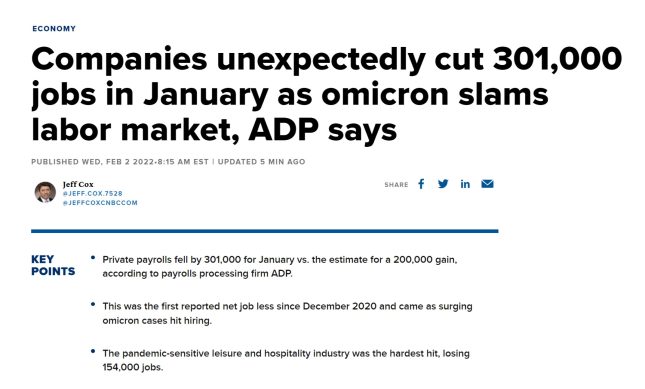
it’s way past the point where even these people could possibly be this ignorant of baseline reality.
this is, instead, a clear bet that you are.
this drop in jobs was not “unexpected” at least not by anyone paying attention. this is the direct, proximate effect of imposing vaccine mandates as a precondition to work. the OSHA mandate fell, but the federal mandate for contractors did not. thousands of mandates for health care workers imposed by states and hospital systems did not. requirements for many truckers and teachers and hospitality workers did not. many employers went ahead and imposed these anyway. they waited until after the holidays, but here we are.
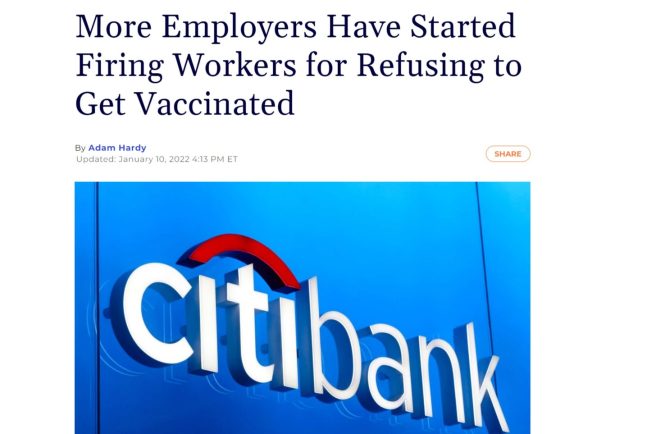
we also cut off the flow of travel and of patronage. we closed businesses (again). we limited capacity. we mandated vaccination as a pre-requisite for going out to eat or staying in hotels. and like clockwork, it choked off the flow of tourists and local patrons alike because people HATE this and hate playing officious games and pretending that the made up “covid physics” of “wear your mask to the table then take it off when you sit” make any sense at all. they hate having some hostess demand “their papers.” maybe not everyone does, but enough people do that it has savaged businesses.
we’re living though needless damage to no useful effect at all.
this is NOT the virus.
it’s the predictable and unavoidable output of deeply stupid public health policy.
the damage since this began has been acute and severe. “2 weeks to flatten the curve” was, as many of us were screaming right from the beginning, the commencement of the nastiest economic hit to jobs and small business per unit time in US history and probably in global history.
in the US, we dropped 20 million jobs in 2 months. that is so far outside any precedent it’s staggering.
the entire 2008 recession and financial crisis led to a job reduction of 8 million over 24 months…
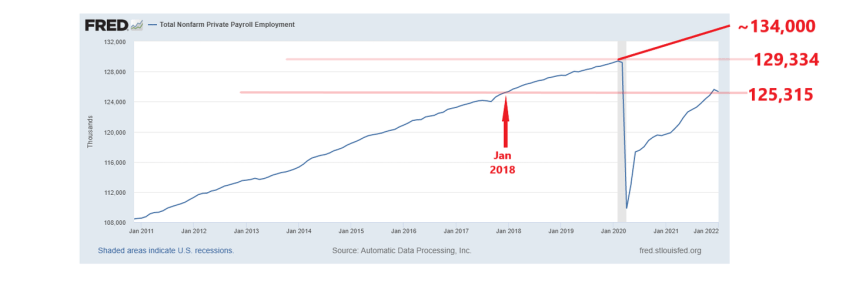
and we have NOT recovered to previous levels. current job levels are about the same as jan 2018.
they are 4 million jobs below the level from early 2020.
they are 9 million below where we would be had job growth continued as before. (added in red)
might job growth have slowed anyway? yes, perhaps, but this gives us a set of fairly reasonable bookends to assess the scope of what this has cost in terms of private nonfarm employment.
we’re 4-9 million jobs short of where we would likely have been without this public health response and claims that the US jobs market looks strong are pretty iffy.
(keep in mind that the unemployment rate drops when people drop out of the labor force/stop looking for work. it does not mean they found jobs.)
“but it was the virus! most of this would have happened anyway!”
this is a predictable claim, but seems out of step with reality. fortunately, we have a control group.
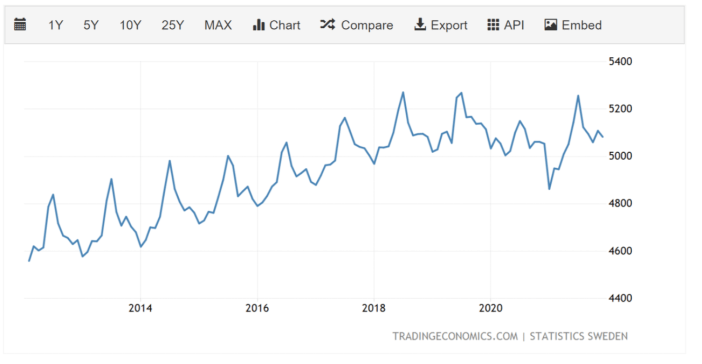
compare this damage to a place like sweden who did not lock down and freak out.
sweden’s payrolls figure is much more seasonally variable than the US, but looking through this seeming cardiac rhythm the overall difference in outcome is unavoidably obvious.
the dip was extremely minor in comparison. it was extremely short in comparison. and, despite the effects of many neighbors locking down, tourism and travel dropping, and global supply chain issues, their jobs figures currently look indistinguishable from 2019 and pre pandemic 2020.
employment today is higher than dec 2019 or jan 2020.
the US is nowhere close.
it’s really very simple: places that locked down harder got no better outcomes on covid. but they got much, much worse outcomes on economic and societal damage.
this was all known and knowable.
the base prior for pandemics was to never, never do this.
it’s what the guidelines said.
i did a ton of work on this back in the twitter days. it was obvious right from the start that drops in google mobility data (measuring actual human behavior from cell phone tracking) had zero effect on bending any epidemiological curve. it was clearly doing nothing at all. this was already glaring. and so was the harm.
i pulled this data from BLS way back in 2020:
it was more than a little apparent that it was predominantly politics and policy, not covid putting people out of work.
the no lockdown states were back at baseline by the fall.

the relationship was not subtle:
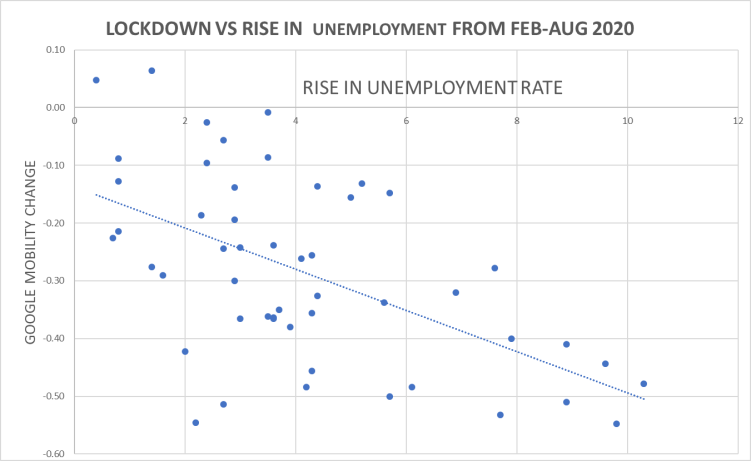
at this stage of the game and with this much clear data at one’s disposal, it’s pretty absurd to still be trying to blame upon a virus that which’s fault lies with public health response.
to do so is neither economically or epidemiologically accurate.
these are choices, not happenstance.
and it’s long past time to be making different ones.
Rocketing Energy Prices Were Part Of The Plan All The Time
By Paul Homewood | Not A Lot Of People Know That | January 29, 2022

https://www.theccc.org.uk/publication/sixth-carbon-budget/
The above excerpt comes from the CCC’s Sixth Carbon Budget. It shows conclusively that high energy prices have always been the official policy, in order that expensive renewables are made viable.
EU carbon prices have already risen from 32 to 80 euro/tonne in the last year, and the new UK ETS system tracks EU prices, with prices now at £75/tonne.
As it turns out global price rises for natural gas have brought the CCC’s dream to fruition a decade early.
Biden Regime Escalates War on Supply Chains
By Stephen Lendman | January 30, 2022
Effective on January 22, the Biden regime’s Department of Homeland Security ordered the following:
“(N)on-US individuals seeking to enter the US via land ports of entry and ferry terminals at the US-Mexico and Canada borders (must) be fully (jabbed) for (flu/covid) and provide related proof” of kill shots gotten.
The draconian mandate does not apply to US citizens and lawful residents.
It has nothing to do with protecting public health.
If that was official policy, kill shots and all else flu/covid never would have been mandated and heavily promoted.
Banning unjabbed foreign truckers from entering the US is polar opposite a Biden regime “commitment to…facilitat(e) cross-border trade and travel that is critical to our economy (sic).”
It’s all about more greatly disrupting supply chains than already.
It’s about further increasing shortages of food and other essentials.
It’s about heightening double-digit inflation above its current level.
It’s about continuing the largest-scale ever transfer of wealth from ordinary people to super-rich ones.
It’s about imposing greater misery on ordinary Americans and others abroad.
It includes mass-extermination of unwanted segments of society at home and abroad, along with eliminating what remains of greatly eroded freedoms.
According to draconian Biden regime policy, foreign nationals traveling to the US — including truckers from Canada and Mexico — must:
“Verbally attest to their (jabbing) status.”
“Provide proof of (Phama-controlled) CDC-approved (jabs).”
“Present a valid Western Hemisphere Travel Initiative (WHTI)-compliant document, such as a valid passport, Trusted Traveler Program card, or Enhanced Tribal Card.”
“Be prepared to present any other relevant documents requested by a US Customs and Border Protection officer during a border inspection.”
While proof of being jabbed doesn’t apply to US citizens and lawful residents, when reentering the US from abroad, they must present a WHTI-compliant document on request.
All of the above is about destroying public health and what remains of a free and open society — on both sides of the US/Canadian border.
It’s about growing social control tyranny that’s heading toward becoming full-blown without all-out resistance against what no one should tolerate.
It’s about transforming the US, Canada — other Western countries and all others — into being more unsafe and unfit to live in than their current deplorable state.
Prohibiting foreign truckers from entering the US unless jabbed was ordered despite knowing that many thousands are unjabbed.
That the vast majority of refusenik truckers are likely to hold firm on this issue.
That banning them from entering the US will cause greater supply shortages and higher prices from demand greatly exceeding supply.
It’s at a time when real inflation is 15.15% — based on how calculated pre-1990 before things were rigged to way understate it.
It’s when real unemployment is 24.8%.
In the world’s richest country, one-fourth of its working-age population is not only jobless.
Based on officially reported data, the vast majority of the unemployed don’t exist.
Thousands of outraged Canadian truckers comprised a 93-mile-long Freedom Convoy en route to the country’s capital.
On Saturday, they arrived. See below.
A statement by its organizers said the following:
Truckers involved oppose draconian mandates by the Biden and complicit Trudeau regimes.
“No more lockdowns. No forced (mass-jabbing) (and yes, it IS force when you choose between a shot you don’t want and your ability to feed yourself),” they stressed.
The Freedom Convoy traveled from British Columbia in Canada’s west to the country’s capital in Ottawa.
According to media reports along the way, large crowds expressed support for their freedom-supporting initiative.
Like the Biden regime, Trudeau requires truckers entering Canada from the US to be jabbed with health-destroying kill shots.
According to Freedom Convoy organizer Chris Barber:
“We’re going to end mandates.”
To be jabbed or not jabbed is “everybody’s personal choice.”
“The straw that broke the camel’s back was the USA border for commercial drivers, and you have to show (a flu/covid) passport.”
“A lot of guys are going to lose their jobs over that.”
What’s going on “has gone too far.”
“If we can’t get across the border freely, and we’re being forced to (be jabbed), we can take a stand or we can’t.”
According to US and Canadian trucking associations, around 26,000 of 160,000 drivers who travel regularly cross border will be out of work if the draconian US and Canadian mandates aren’t challenged and rescinded.
Enough US and Canadian truckers holding firm on this issue is the most effective way of beating it.
As long as it remains official policy of the Biden and Trudeau regimes, countless millions of Americans and Canadians will endure greater economic and financial misery than already.
Late Friday and early Saturday, Freedom Convoy truckers arrived in Ottawa.
Ahead of their arrival, Canadian PM Trudeau moved to an undisclosed location — a cowardly act by the vassal to US interests, notably its highest of high crimes against humanity.
On Saturday, the Ottawa Citizen reported that thousands are protesting peacefully in the nation’s capital.
There have been “no incidents of violence or injuries.”
Despite sub-zero weather conditions, Parliament Hill remains filled with protesting truckers and supporters.
Much the same is expected throughout Sunday and days to follow.
Freedom Convoy truckers didn’t travel thousands of miles to back off from their legitimate demands for the Trudeau regime to rescind its draconian mandates from hell.
How About A Pilot Project To Demonstrate The Feasibility Of Fully Wind/Solar/Battery Electricity Generation?
By Francis Menton | Manhattan Contrarian | January 25, 2022
At this current crazy moment, most of the “Western” world (Europe, the U.S., Canada, Australia) is hell bent on achieving a “net zero” energy system. As I understand this concept, it means that, within two or three decades, all electricity production will be converted from the current mostly-fossil-fuel generation mix to almost entirely wind, solar and storage. On top of that, all or nearly all energy consumption that is not currently electricity (e.g., transportation, industry, heat, agriculture) must be converted to electricity, so that the energy for these things can also be supplied solely by the wind, sun, and batteries. Since electricity is currently only about a quarter of final energy consumption, that means that we are soon to have an all-electric energy generation and consumption system producing around four times the output of our current electricity system, all from wind and solar, backed up as necessary only by batteries or other storage.
A reasonable question is, has anybody thought to construct a small-to-moderate scale pilot project to demonstrate that this is feasible? Before embarking on “net zero” for a billion people, how about trying it out in a place with, say, 10,000, or 50,000, or 100,000 people. See if it can actually work, and how much it will cost. Then, if it works at reasonable cost, start expanding it.
As far as I can determine, that has never been done anywhere. However, there is something somewhat close. An island called El Hierro, which is one of the Canary Islands and is part of Spain, embarked more than a decade ago on constructing an electricity system consisting only of wind turbines and a pumped-storage water reservoir. El Hierro has a population of about 11,000. It is a very mountainous volcanic island, so it provided a fortuitous location for construction of a large pumped-storage hydro project, with an upper reservoir in an old volcanic crater right up a near-cliff from a lower reservoir just above sea level. The difference in elevation of the two reservoirs is about 660 meters, or more than 2000 feet. Here is a picture of the upper reservoir, looking down to the ocean, to give you an idea of just how favorable a location for pumped-storage hydro this is:

The El Hierro wind/storage system began operations in 2015. How has it done? I would say that it is at best a huge disappointment, really bordering on disaster. It has never come close to realizing the dream of 100% wind/storage electricity for El Hierro, instead averaging 50% or less when averaged over a full year (although it has had some substantial periods over 50%). Moreover, since only about one-quarter of El HIerro’s final energy consumption is electricity, the project has replaced barely 10% of El Hierro’s fossil fuel consumption.
Here is the website of the company that runs the wind/hydro system, Gorona del Viento. Get ready for some excited happy talk:
A wind farm produces energy which is directed into the Island’s electricity grid to satisfy the population’s demand for electricity. The surplus energy that is not consumed directly by the Island’s inhabitants is used to pump water between two reservoirs set at different altitudes. During times of wind shortage, the water stored in the Upper Reservoir is discharged into the Lower Reservoir, where the Wind-Pumped Hydro Power Station is, to generate electricity from its turbines. . . . The diesel-engine-powered Power Station only comes into operation in exceptional circumstances when there is neither sufficient wind or water to produce the energy to meet demand.
Over at the page for production statistics, it’s still more excitement about tons of carbon emissions avoided (15,484 in 2020!) and hours of 100% renewable generation (1293 in 2020!). I think that they’re hoping you don’t know that there are 8784 hours in a 366 day year like 2020.
But how about some real information on how much of the island’s electricity, and of its final energy consumption, this system is able to generate? Follow links on that page for production statistics, and you will find that the system produced some 56% of the electricity for El Hierro in 2018, 54% in 2019, and 42% for 2020. No figures are yet provided for 2021. At least for the last three years of reported data, things seem to be going quite rapidly in the wrong direction. I suspect that that’s not what you had in mind when you read that the diesel generators only come into operation in “exceptional circumstances” when wind generation is low. And with electricity constituting only about 25% of El Hierro’s final energy consumption, the reported generation statistics would mean that the percent of final energy consumption from the wind/storage facility ran about 14% in 2018, 13.5% in 2019, and barely 10% in 2020.
So why don’t they just build the system a little bigger? After all, if this system can provide around 50% +/- of El Hierro’s electricity, can’t you just double it in size to get to 100%? The answer is, absolutely not. The 50% can be achieved only with those diesel generators always present to provide full backup when needed. Without that, you need massively more storage to get you through what could be weeks of wind drought, let alone through wind seasonality that means that you likely need 30 days’ or more full storage. Get out your spreadsheet to figure out how much.
Roger Andrews did the calculation for El Hierro in a January 2018 post on the Energy Matters website. His conclusion: El Hierro would need a pumped-storage reservoir some 40 times the size of the one it had built in order to get rid of the diesel backup. Andrews provides plenty of information as to the basis of his calculations and his assumptions, so feel free to take another crack at his calculations with better assumptions. But unfortunately, his main assumption is that the pattern of wind intermittency for any given year will be just as sporadic as it was for 2017.
Then take a look at the picture and see if you can figure out where or how El Hierro is going to build that 40 times bigger reservoir. Time to look into a few billions of dollars worth of lithium ion batteries — for 11,000 people.
And of course, for those of us here in the rest of the world, we don’t have massive volcanic craters sitting 2000 feet right up a cliff from the sea. For us, it’s batteries or nothing. Or maybe just stick with the fossil fuels for now.
So the closest thing we have to a “demonstration project” of the fully wind/storage electricity has come up woefully short, and really has only proved that the whole concept will necessarily fail on the necessity of far more storage than is remotely practical or affordable. The idea that our political betters plow forward toward “net zero” without any demonstration of feasibility I find completely incomprehensible.
Have Lockdown Sceptics Won the Argument?
By Edward Chancellor | The Daily Sceptic | January 25, 2022
Now that Covid restrictions are being rolled back, various commentators are declaring victory over the miserable virus. Lockdowns, we are told, worked. Only a fool could argue otherwise.
Devi Sridhar, the Chair of Global Public Health at Edinburgh University, who was formerly an exponent of the Zero Covid strategy of completely eradicating the virus, has recently announced in the Guardian that “delaying and preventing infection as much as possible through this pandemic was a worthwhile strategy. In early 2020, there were few treatments, limited testing and no vaccines. The costs of those lockdowns were big, but the effort to buy time paid off”.
At the other end of the political spectrum, Tom Harwood of GB News says much the same. Lockdown sceptics, he writes in CapX, are “bizarrely claiming victory now that restrictions are coming to an end”. The sceptics, Harwood asserts, ignore the success of vaccines. “There is a blindingly obvious distinction between the need for non-pharmaceutical interventions amongst a non-immune population, verses [sic] one with incredibly high levels of immunity.” He points to a lower death toll from the Omicron variant which appeared after the “stupendously successful vaccine rollout”. In conclusion, Harwood writes that to “deny lockdowns worked to reduce spread is to deny logic”.
Let’s examine the logic. If lockdowns bought time for the rollout of vaccines, then we would expect fewer Covid deaths in places that locked down early and fast. That is the case in Australia and New Zealand, which early in the pandemic sealed their borders against the virus. But the trouble with this policy, as our Antipodean friends are discovering, is the difficulty of exiting. Their policy of national self-isolation has lasted nearly two years, and continues in large measure even after most of their population has been vaccinated.
By contrast, in Europe there is no evidence that lockdowns significantly reduced Covid deaths. Sweden, which never locked down, has the same number of deaths per million as Austria, which did (see chart below). It’s true that Swedish deaths ran higher somewhat earlier than Austria, but this ‘bought-time’ doesn’t appear to have changed the final tally.

The evidence from the United States points to a similar conclusion: the Covid death rate (as a share of the population) in Florida, which largely avoided lockdowns, is slightly below the U.S. national average and far below that of New York, which had (and continues to impose) relatively tough restrictions.
It’s true that mass vaccination has reduced the risk of hospitalisation and death from Covid. But lockdown exponents imply that vaccines alone are responsible for the decline in the infection fatality rate. The evidence from South Africa, whose vaccination rate is around a quarter of the European average (49 doses per 100 people versus 180, or 27%), suggests otherwise.
It appears that either Covid has evolved to become less virulent, as the South African doctors suggested back in December, or South Africa’s population has built up strong natural immunity from prior infection – a possibility overlooked by most commentators. It seems likely that both factors have played a role in reducing the virulence of the disease. Even if lockdowns had succeeded in reducing Covid deaths until the vaccine rollout that wouldn’t necessarily justify their imposition. From the start, lockdown sceptics were concerned about the collateral damage caused by closing down the economy, shuttering schools, neglecting conventional health care and forcing people to isolate in their homes for months on end. They railed in vain against the cruelty of lockdowns: mothers giving birth alone, old people dying alone or left for months without visitors in nursing homes, the damage to children’s education, funerals unattended, small businesses crushed and so forth. Finally, the public appears to be waking up to these cruelties. Hence, the fury at the hypocrisy of Downing Street officials who imposed harsh rules for the nation which they didn’t scrupulously follow themselves.
Then there are lockdown’s immense financial costs. At the time, these could be ignored since governments financed them with interest-free loans from central banks. But all that money-printing is now fuelling inflation that will lead to further immiseration in the coming years. The sceptics argued that lockdowns were never subject to a proper cost-benefit analysis which took social and economic costs into account. That remains the case. Thus, not only has there been no ‘victory’ in the war on Covid – on the contrary, the highly contagious Omicron variant appears to be overcoming all attempts to constrain it – but the argument over lockdowns has yet to be decisively won by either side, so that lockdowns are either accepted as a tool of sound public health policy or roundly condemned as a colossal mistake. The sceptics’ work continues.
Edward Chancellor is a financial journalist and the author of Devil Take the Hindmost: A History of Financial Speculation (1998).
The Political Economy of Autism
By Toby Rogers | September 14, 2021
Autism is an epidemic and a pandemic by any reasonable definition of those words. J.B. Handley in, How to End the Autism Epidemic, produced the best chart showing the growth in autism prevalence in the U.S. over the last 50 years:
Increase in Autism Prevalence in the U.S. 1970 to 2017
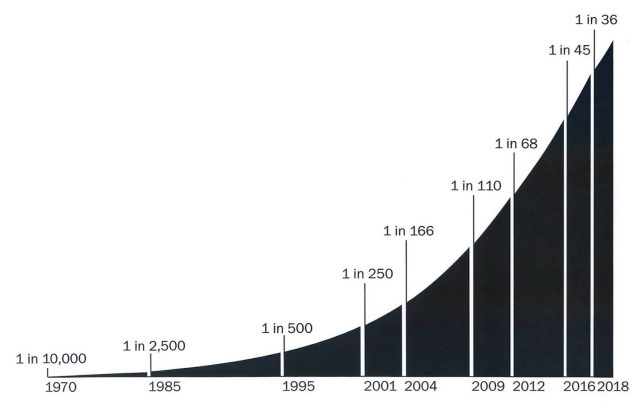
Source: Handley (2018).
Darold Treffert at Winnebago State Hospital in Wisconsin was one of the first people to attempt to measure autism in the general population. His study, published in Archives of General Psychiatry in 1970, showed an autism rate of less than 1 in 10,000 children.
Then, sometime around 1987, the autism rate in the United States began to skyrocket. By 2017, the autism rate in the U.S. was 1 in 36 kids (Zablotsky et al., 2017). So the U.S. has experienced a 277-fold increase in autism prevalence in the last 50 years.
In some places and populations the rates are even higher: in Tom’s River, NJ, the state’s largest suburban school district, 1 in 14 eight-year-olds is on the autism spectrum; in Newark, NJ, 1 in 10 Black boys is on the spectrum (forthcoming).
The United States is in the midst of a genocide.
Genetic theories of autism never made much sense because “there is no such thing as a genetic epidemic” — the human genome just does not change that fast. An early twin study by Susan Folstein and Michael Rutter at the Institute of Psychiatry in London in 1977 suggested a strong genetic component to autism. More recent scholarship shows that this was likely overstated; the study only had 21 twin pairs and did not effectively control for environmental factors (twins usually grow up in the same family and are thus likely exposed to the same toxicants).
As the autism rate exploded throughout the U.S., the state of California hired eleven of the best geneticists in the country to examine the role of genes in autism. They concluded that genetics explains at most 38% of autism cases and in two places they explained that this was likely an overestimate (Hallmayer et al., 2011). Whatever is driving the surge in autism prevalence, it is not primarily genetics.
Well perhaps the increase in autism prevalence is just the result of better awareness (and what’s called “diagnostic expansion and substitution”)? That theory of the case does not check out either. The state of California funded two multimillion dollar studies to examine sharply rising prevalence in the state and whether it was the result of social factors. The first study was led by pediatric epidemiologist Robert S. Byrd at UC Davis who directed a team of investigators at UC Davis and UCLA. The investigators concluded that, “The observed increase in autism cases cannot be explained by a loosening in the criteria used to make the diagnosis” and “children served by the State’s Regional Centers are largely native born and there has been no major migration of children into California that would explain the increase in autism” (Byrd et al., 2002).
The state of California revisited this question in 2009 with a study led by the top environmental epidemiologist in the state — Irva Hertz-Picciotto at the UC Davis Mind Institute. This study concluded that changes in diagnostic criteria, the inclusion of milder cases, and earlier age at diagnosis explain about a quarter to a third of the total increase in autism (Hertz-Picciotto & Delwiche, 2009). In a subsequent interview with Scientific American, Hertz-Picciotto explained that these three factors “don’t get us close” to explaining the sharp rise in autism over that time period and she urged the scientific community to take a closer look at environmental factors (Cone, 2009).
There are now seven good ‘societal cost of autism’ studies (Jarbrink and Knapp, 2001; Ganz, 2007; Knapp et al., 2009; Buescher et al., 2014; Leigh & Du, 2015; Cakir et al., 2020; Blaxill, Rogers, & Nevison, 2021). They all show that the U.S. and much of the developed world is heading for economic and social collapse as a result of surging autism costs.
Autism increases poverty and inequality. Lifetime care costs for autism range from $1.4 to $2.4 million. Mothers of kids with autism earn 35% less than mothers of kids with other health limitations and 56% less than mothers of kids with no health limitations (Buescher et al., 2014).
In 2015, autism cost the U.S. an estimated $268 billion a year in direct costs & lost productivity; given current rates of increase, autism costs will reach $1 trillion a year (3.6% of GDP) by 2025 (Leigh & Du, 2015). As a point of comparison, the U.S. Defense Department budget is “just” 3.1% of GDP.
All of the more recent studies show autism costs surpassing $1 trillion a year in the near future. There is no plan by any level of government to raise revenue to meet these costs or prevent autism to mitigate these costs. Elected officials are frozen like a deer in the headlights.
In the last decade, three groups of top epidemiologists have published consensus statements declaring that neurodevelopmental disabilities including autism are caused by toxicants in the environment (The Collaborative on Health and the Environment, 2008; Mount Sinai Hospital, 2010; Project TENDR, 2016).
This is good news because it means that autism is likely preventable. The bad news is that the leading mainstream toxicologists do not want to lose their jobs so they generally avoid mentioning pharmaceutical products (even though these products appear to have an outsized impact). Parents groups have made up for the cowardice of mainstream toxicology by funding their own research.
We have fairly good data that five classes of toxicants increase autism risk:
- Mercury from coal fired power plants and diesel trucks;
- Plastics;
- Pesticides & herbicides;
- EMF/RFR; and
- Pharmaceuticals (Tylenol, SSRIs, & vaccines).
Taking each toxicant in turn…
For every 1,000 pounds of environmentally released mercury, there was a 61% increase in the rate of autism (Palmer, 2006). For every 10 miles closer a family lives to a coal fired power plant the autism risk increases by 1.4% (Palmer, 2009).
Plastics: Children with autism had significantly increased levels of 3 endocrine disruptors (two phthalates — MEHP & DEHP, & BPA) in blood samples as compared with healthy controls (Kardas, 2016).
Pesticides & herbicides: Increased use of RoundUp is strongly correlated (r = 0.989) with the rising prevalence of autism (Swanson, 2014). Organophosphates increase autism risk 60 – 100%; chlorpyrifos increase risk 78% – 163%; pyrethroids increase risk 78% (Shelton et al., 2014).
9 studies show an association between acetaminophen (Tylenol) use & adverse neurodevelopmental outcomes (Bauer et al., 2018). Avella-Garcia (2016) & Liew et al. (2016) found that males exposed to Tylenol in utero have significantly elevated risk of autism.
8 studies show a statistically significant association between selective serotonin reuptake inhibitor (SSRI) use in pregnant women and subsequent autism in their children (see meta-analysis in Kaplan et al., 2016). Doctors who prescribe SSRIs to pregnant women are committing malpractice.
Unfortunately, in the debate over toxicants that increase autism risk, all roads lead back to vaccines. At least 5 studies show a statistically significant association between vaccines & autism (Gallagher & Goodman, 2008 & 2010; Thomas & Margulis, 2016; Mawson et al., 2017a & 2017b).
Dr. Paul Thomas is the most successful doctor in the world at preventing autism. Data from his practice show:
If zero vaccines, autism rate = 1 in 715;
If alternative vaccine schedule, autism rate = 1 in 440;
If CDC vaccine schedule, autism rate = 1 in 36.
That study had large sample size (3,344 children), access to medical files, and good researchers working on it. But look closely. His alternative vaccine schedule reduces autism risk by more than 1200%. However even an alternative vaccine schedule increases autism risk by 160% versus no vaccines at all.
And all of those other toxicants that I described above that have been shown to increase autism risk? Those are the 1 in the 715 cases when the parent does not vaccinate at all. Autism appears mostly be a story of iatrogenic injury from vaccines.
This is not a surprise. Thousands of parents have been telling us for years that their children regressed into autism following vaccinations. Ethylmercury is a known neurotoxin and is still in 7 different vaccines (Thomas & Margulis, 2016, p. 14).
Aluminum is a known neurotoxin (Grandjean & Landrigan, 2014) and is used in a majority of vaccines. “The dose makes the poison” paradigm has collapsed in recent years and now we know that many toxicants have no safe dose.
In a sane world, all of this would be seen as good news. In a sane world the CDC, EPA, NIH and every major newspaper would rush out to Portland, Oregon to examine whether the data from Dr. Paul’s practice (and other studies) are correct. But we live in an insane world…
To date, the CDC, EPA, NIH, the federal government, and all state governments have ignored Dr. Paul’s work. None of the top 10 major newspapers in the U.S. have reviewed his book, The Vaccine Friendly, plan even though it is a bestseller on Amazon. In fact the Oregon Medical Board was so incensed by Dr. Paul’s success in preventing autism that they pulled his medical license briefly in 2021 (he has since been reinstated).
All of this information is public and available to anyone with an internet connection and a library card. By 1999 it was clear that vaccines that contained mercury were a problem (see Kirby, 2005). By the early 2000s it was clear that the problems with vaccines went well beyond mercury. Government had a choice to make: come clean or double down. And starting with senior scientist Thomas Verstraeten and then William Thompson the CDC decided to just flat out lie, manipulate findings, and destroy data.
The pharmaceutical industry also had a choice to make: improve their products or utilize their extensive capture of media and government to protect their existing toxic products. As everyone now knows, they chose to protect their existing toxic products. But the pharmaceutical industry has an enormous problem on their hands. We know some vaccines (hepatitis B, HPV, flu, DTaP…) cause catastrophic harms. And pockets of unvaccinated people across the country — who are healthier than vaccinated children — are the control group that provides evidence of Pharma’s crimes.
So starting in 2015, with the introduction of SB277 in California, the pharmaceutical industry began a systematic effort to eliminate the unvaccinated control group in all 50 states. They start by removing religious or personal belief exemptions to vaccination. In subsequent years they introduce bills to eliminate all medical exemptions to vaccination (SB 277 in CA in 2019) to get to 100% vaccination rates (even though all scientists will tell you that there are some children who should not be vaccinated because of underlying health conditions). In the Pharma legislative blitzkrieg no one is spared so that there will be no evidence left of the harms from these products. If 100% of children are treated, then there is no background rate of illness and all vaccine injuries just appear “normal”.
These mandatory vaccine bills are racketeering and crimes against humanity. With the introduction of coronavirus vaccines in late 2020, the situation has gotten much worse. Pharma now aims to vaccinate 100% of adults as well as 100% of kids and the results thus far have been catastrophic.
So here’s where things stand. The vaccine paradigm has collapsed (and no, mRNA, DNA, and adenovirus vector vaccines are not going to save it). Pharma has piles of cash and extensive capture of the media, academia, and government. So they have the ability to do just about whatever they want. Fearing prosecution and seeking immense profits, Pharma has abandoned any pretense of science, consent, or health and pushed all in to set up a totalitarian state that will serve their interests.
But Pharma has harmed so many people — first with the childhood schedule and now with coronavirus vaccines — that there are now millions of people who have seen vaccine injury first-hand and are now fighting back with everything they’ve got. Variously referred to as the medical freedom movement, the health choice movement, and/or the personal sovereignty movement, these brave citizens are taking on the most powerful industry in the world and fighting to save our country from Pharma fascism. The fighting is so fierce because the stakes are enormous. We are fighting to preserve human life as we know it from the most predatory and corrupt industry in the world.
To learn more about the toxicants associated with autism, read The Political Economy of Autism. To learn more about the battle to save our country and the world from Pharma totalitarianism, please subscribe to my Substack.
Featured Video

Trita Parsi: Middle East Unraveling — Are We on the Path to World War?
or go to
Aletho News Archives – Video-Images
New Book
Trans agenda is ‘normalization of sadism’ – US author

RT | September 23, 2026
The US Democratic Party has embraced a transgender agenda that amounts to “the normalization of sadism,” author A.J. Rice has said, warning that radical trans policies would return if the party is allowed to regain power.
Speaking to RT’s America First host Scotty Nell Hughes about his new book, ‘The Curse of the Bearded Lady: How the Trans Mafia Whacked American Sanity’, Rice argued that activists have gained significant influence in schools, medicine, and corporate America while people who questioned the agenda have faced pressure to stay silent.
The author described the “trans mafia” as the sprawling network of people and institutions that have helped the movement gain influence. He singled out parts of academia, wealthy backers, and corporations, and stated that providers of transition-related treatment also have a financial incentive to keep young people in their care indefinitely.
Rice argued that the consequences of these policies ultimately fall on children who are being drawn toward gender-affirming medical treatments and on girls who are expected to share locker rooms or compete in sports with biological males.
He noted that while voters rejected the Democrats’ approach to gender in 2024, the party, which has been “captured by madness,” has since only doubled down and is seeking what is effectively “the normalization of sadism.” … Full report
Blog Roll
 Aletho News
- German chemicals giant reveals details of downsizing
- Refaat Al-Areer Was The Canary In The Coal Mine In Israel’s War On The Truth
- Israeli election committee bars candidate from Knesset race over Gaza war opposition
- French-Lebanese man files war crimes complaint over Israeli attacks
- Mahan Air Flight Lands in China Despite US Threat against Iranian Airlines
- US eyes $10bn fund to rebuild war-battered Gulf infrastructure
- Trump meets Rodríguez near Maduro’s prison as Venezuela’s oil flows to US
- Trita Parsi: Middle East Unraveling — Are We on the Path to World War?
- Iran FM meets with US envoy on UN meeting’s sidelines at American side’s insistence: Report
- Qatar PM calls for Gulf security framework with Iran, says war must be ‘wake-up call’
- If Americans Knew
- Caught on Tape: AIPAC CEO Boasted of Controlling Trump’s National Security Officials
- Why Hamas Attacked Israel in October 2023 – Israeli professor Ilan Papé
- They see them, then kill them: Israeli quadcopters track, deliberately target civilians in Gaza
- Winter could turn Gaza’s treacherous, war-damaged buildings into deathtraps
- Majority of Democratic Voters Want to Prosecute Both Biden and Trump Administration Officials Over Gaza
- As Gaza languishes, world leaders gather at the UN – Daily Update
- Sanctions are collective punishment: immoral and self-defeating
- Phosphorus Munitions Fired by Israel Burn Groves, Orchards in Southern Lebanon
- Israel Carries Out New Ceasefire Violations Across Gaza
- AI – Emphasis on the ‘I’: Israel Is Funding AI Chatbot Propaganda
- No Tricks Zone
- New Study: Earth And Venus Surface Warmth Largely Explained By Convection And Lapse Rate, Not CO2 Or Radiation
- 2025 Nature Paper Claiming Worsening Global Drought Gets RETRACTED …Heavily Flawed
- New Study: ‘Global Drought Shows No Detectable Recent Acceleration Under Climate Warming’
- Economic Masterminds: German Socialists Suggest Taxing Productivity Gains Stemming From Using AI
- The South China Sea Has Not Been Cooperating With The Climate Change Narrative
- Energy Crisis: Germany Enters Heating Season With Historically Low Gas Reserve Fill Levels
- New Study: The Antarctic Ice Sheet Gained Mass From 2020-2024 Due To Staggering Snow And Ice Accumulation
- Study: Ocean Heating Rates From Thousands Of Years Ago ‘Dwarf’ Modern Ocean Heating Rates
- Climate Extremists Target, Attack Large-Scale Power Grid Infrastructure In Germany!
- New Study: Antarctic Ice Melt Has Contributed Less Than 1 Centimeter To Sea Level Rise In The Last 30 Years

