US’s ‘Very Foolish’ Double Blockade of Hormuz Strait Makes Absolutely No Sense: Here’s Why
Sputnik – 13.04.2026
Every step Washington has taken in the conflict with Iran to date has worsened its own strategic position, and the blockade of Iranian oil exports is no exception, says Center for Contemporary Iranian Studies director Rajab Safarov.
“This is a very foolish move on the part of the United States. With each passing day and every step,” Washington is “worsening” its own position, and that of many countries around the world for whom Hormuz is the lifeline to their economic existence, Safarov told Sputnik.
Meanwhile, “the Iranian position grows stronger” over time relative to others, something “the Iranians understand perfectly well,” Safarov said. Therefore, Tehran has no incentive to agree to or be bullied into a peace deal on American terms.
Safarov doesn’t rule out that President Trump is being provided poor information on conditions on the ground by underlings like Secretary Hegseth, and making statements and decisions that have “no connection to reality.”
The observer pointed out, for example, that Trump claimed Iran’s Navy has been destroyed. But it’s this same Navy that’s now “ready to sink any ship that might move toward the Indian Ocean without Iran’s permission.”
“He says that Iran’s missile tech and launchers are exhausted or destroyed. But we see Iran launching more and more of its missiles – more modern, more powerful ones, etc,” Safarov said.
The US will ultimately be forced to fold, the observer argues, because while blocking Iranian oil exports will hurt its economy, Tehran is in a position to survive. The effects on the Gulf exporters and major energy-dependent economies in Asia and the developing world will be far more punishing. Oil prices could hit $150 by the end of the week.
With 20% of the world’s oil trapped in the Persian Gulf, “that means a fifth of the global economy will essentially grind to a halt.” Therefore, “America risks turning almost the entire world against itself,” Safarov summed up.
China issues rules on countermeasures against foreign states’ unlawful extraterritorial jurisdiction
Xinhua – April 13, 2026
Chinese Premier Li Qiang has signed a decree of the State Council to publish a new set of rules on countering foreign states’ unlawful extraterritorial jurisdiction measures.
The regulations, consisting of 20 articles, take effect upon publication.
According to the rules, such extraterritorial jurisdiction measures refer to actions taken by a foreign country that violate international law and the basic norms governing international relations and that harm China’s sovereignty, security and development interests, or the legitimate rights and interests of Chinese citizens and organizations.
The rules also stipulate that the Chinese government has the authority to take countermeasures in response to such actions.
They also state that the Chinese government has the authority to exercise extraterritorial jurisdiction over relevant conduct if a sufficient nexus exists.
The regulations establish a system of a malicious entity list targeting foreign organizations and individuals that promote or participate in the implementation of a foreign state’s unlawful extraterritorial jurisdiction measures.
The regulations also state that no organization or individual shall enforce or assist in enforcing such unlawful jurisdiction measures.
The regulations state that Chinese citizens and organizations affected by unlawful extraterritorial jurisdiction measures may file lawsuits against those enforcing them, and that government authorities will provide guidance and support for such legal actions.
Chinese authorities have repeatedly expressed firm opposition to the abuse of unilateral sanctions and long-arm jurisdiction.
China’s law on countering foreign sanctions was adopted in 2021. Key meetings of the Communist Party of China in recent years also pledged to strengthen mechanisms for countering foreign sanctions, interference, and long-arm jurisdiction.
Tomorrow’s naval blockade showdown
How will China react?
Ashes of Pompeii | April 12, 2026
Apparently tomorrow morning, April 13, at 10 a.m. ET the blockade of Iran’s ports by the US will begin. Make no mistake, this is primarily pointed at Iran’s trade with China. The Trump team seem to still think they can kill two birds with one stone – bring down the Islamic Republic and also economically weaken China. In this article I will focus on China, in particular, one aspect of the US/China relationship that gets little attention but which can be a “nuclear bomb” for China. Much discussion in the US about the boom in data center construction, but far less discussion of the total reliance on Chiina for these builds.
It has been estimated by multiple sources that literally all of the US growth in the past year has been due to the AI boom, specifically, due to AI data center builds. Without this ,US growth would be flat, potentially even negative. Even without the Iran war and rising energy costs, data center construction in the U.S. is currently facing significant headwinds, resulting in delays and escalating costs. The primary driver is the strained supply chain, impacting the availability of critical components like switchgear, generators, and specialized cooling equipment. Lead times for these items have stretched considerably, pushing project timelines back by months, if not quarters.
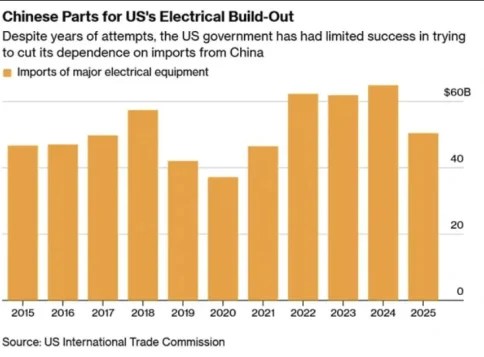
There are other factors for the slow down, especially chip and labor shortages, regulatory hurdles, and the increasing costs of infrastructure. This isn’t the place to delve into all of the factors, but the point is this vital sector for the US economy is in an extremely fragile state. One small push and it can come tumbling down.
And it turns out that whether this sector continues to keep the US out of recession or not is entirely in China’s hands. Forget chips as the vital factor, especially as other US allies control most of the chip production. Just as real a bottleneck is in Chinese electrical components. There is currently a backlog of several years for many of these. Sure, potentially in the long run, there can be many sources for these components. But not tomorrow. Or the day after.
With just the flick of a switch, China stop exporting these components and the AI boom dies almost instantly. And with it, any hopes for real growth in the US economy over the coming months or years.
I obviously don’t know how China will react, or what measures it will enact, if the US navy does go through with its blockade tomorrow. What I outline here is just one of many potential levers the Chinese can pull (rare earths, pharma base ingredients, T-Bills, …)
But don’t expect the US blockade to impact China too severely any time soon.
Diplomats slam US negotiators’ performance in Iran talks
Al Mayadeen | April 12, 2026
Former United States State Department advisor and veteran West Asia negotiator Aaron David Miller sharply criticized Washington’s assumptions about the pace and substance of talks with Iran, arguing that the US misjudged Iran’s position.
“If Administration believed after only 21 hours of negotiations, Iran would give up enrichment which is what Vance implied, they totally misread the moment and the Iranian dominated IRGC,” Miller posted on X.
Gerard Araud, a high-ranking retired French diplomat who served as the Ambassador to the United States and the Permanent Representative to the United Nations, also pointed to the prowess of Iranian negotiators.
“The agreement we reached with Iran in 2015 was the result of hundreds of hours of negotiations with the support of experts of nuclear energy,” Araud explained.
“Negotiating with the Iranians is the equivalent of a diplomatic trenches war. Line by line, word by word.” he posted on X.
“From an Iranian point of view, the negotiations are not starting from scratch but after an agreement endorsed by the UNSC,” he added in another post.
“Any new negotiations have to take into account this precedent: words have already a significance and proposals a history,” he said.
Deadlock in Islamabad talks after 21 hours of negotiations
Negotiations between Iran and the US have ended without agreement following Pakistan-mediated diplomatic efforts in Islamabad, with core nuclear demands keeping both sides far apart after 21 hours of discussions.
The talks, aimed at narrowing differences over Iran’s nuclear program and related regional security arrangements, failed to produce convergence on key issues, including Iran’s right to uranium enrichment, the security regime of the Strait of Hormuz, and proposals linking any broader understanding to a ceasefire extending to Lebanon.
Expectations of a rapid breakthrough had been encouraged by US Vice President JD Vance, but were widely regarded as unrealistic given the depth of disagreement between Washington and Tehran. The 2015 nuclear agreement itself took nearly two years to finalize, while current conditions are further complicated by escalating regional confrontation.
Vance defends US position after talks collapse
Following the breakdown of negotiations, US Vice President JD Vance stated that Iran had rejected Washington’s terms, while leaving the door open for future engagement.
“They have chosen not to accept our terms,” Vance said in a brief news conference in Islamabad, though he left open the possibility that terms could still be reached.
“We leave here with a very simple proposal: a method of understanding that is our final and best offer,” he added.
“We’ll see if the Iranians accept it,” he asserted.
Australia calls for renewed negotiations and ceasefire
International reactions followed the collapse of the talks, with Australia urging both sides to return to diplomacy and maintain a ceasefire across the region.
Australian Foreign Minister Penny Wong described the outcome of the Islamabad talks as “disappointing” and called for an immediate resumption of negotiations.
“The priority now must be to continue the ceasefire and return to negotiations,” Wong said, adding it was “disappointing that the Islamabad talks between the United States and Iran have ended without agreement.”
Wong also warned that any further escalation “would impose an even greater human cost and further impact the global economy,” stressing the need for sustained diplomatic engagement.
Trump Refuses Exit Ramp, War with Iran will Continue
By Larry C. Johnson | SONAR21 | April 11, 2026
As I expected, the negotiation between the US and Iran failed to reach an agreement. Although JD Vance headed the US team, he was never in control… I have heard from someone who was directly involved with this circus in Islamabad that Israeli agents — Steve Witkoff and Jared Kushner — made certain that JD Vance would not follow his instincts and accept the deal that Iran had laid on the table. Israel’s role in sabotaging the US delegation was evident in Vance’s statement announcing the failure of the negotiations, when he falsely accused Iran of refusing to give up its alleged quest for a nuclear weapon. This is just a rehashed piece of Zionist propaganda.
There were several Iranian conditions that the US refused to accept: Iranian control of the Strait of Hormuz, an end to Israel’s attack on Lebanon and Hezbollah, unfreezing of Iran’s assets and retaining sovereignty over its supply of enriched uranium. I have said repeatedly this past week during various interviews on the subject that Iran’s position on these issues was non-negotiable.
Here is the statement just released by the Iranian government:
The American enemy, which is vile, wicked and dishonest — attempted to achieve on the negotiating table what it could not achieve through war.
Among these demands are handing over enriched uranium and opening the Strait of Hormuz without confirmed Iranian sovereignty over it.
Iran has decided to reject these terms and continue the sacred defense of its fatherland by any means necessary, military or diplomatic.’
So what is next? For starters I hope that the Iranian delegation in Islamabad gets a return flight home on a Russian or Chinese flagged airplane. I do not discount the possibility of Israel and the US trying to destroy the Iranian airliner on its return flight to Tehran.
Iran will not initiate new military actions against Israel or the US… They will wait to absorb the first blow and then launch a massive retaliation. I think they now understand that the US is too much under the control of the Zionist lobby to act in the interest of the people of the United States.
Iran’s demand that the US vacate its bases in the Gulf will be achieved by force… Iran will hit the remaining bases and make them uninhabitable for the US military going forward. The Saudis and the UAE will have to make a choice this week… Seek reconciliation with Iran and survive or side with the US and Israel and face economic destruction.
The real action that will put the most pressure on Trump will start on Monday morning when the US stock market takes a nose dive… again… and the price of oil heads back up into triple digit territory. JD Vance actually did Iran a favor by breaking off first and walking away. This paints Iran in a very favorable light in the eyes of the global south, i.e., Iran was willing to negotiate, but the US refused to engage in good faith negotiations and bailed.
Here is my chat with Ed DeMarche of the Trends Journal from last Wednesday: Video Link
Trump Says US Naval Blockade in Strait of Hormuz Will Begin Shortly
Sputnik – 12.04.2026
MOSCOW – US President Donald Trump said on Sunday that the United States would soon start the naval blockade of the Strait of Hormuz to prevent Iran from using what he described as “extortion.”
“The Blockade will begin shortly. Other Countries will be involved with this Blockade,” Trump wrote on Truth Social.
The US Navy will be blockading “any and all Ships trying to enter, or leave, the Strait of Hormuz,” until all are allowed to go in and out, he wrote.
“I have also instructed our Navy to seek and interdict every vessel in International Waters that has paid a toll to Iran. No one who pays an illegal toll will have safe passage on the high seas,” Trump also said.
The US leader added that he would not allow any country, especially his own, to be “extorted” by Iran.
Safe passage of vessels through the Strait of Hormuz will be possible if the United States complies with its obligations, Iranian Foreign Minister Abbas Araghchi said on Thursday.
Earlier, Araghchi announced the reopening of the Strait of Hormuz, which accounts for about 20% of the world’s oil, petroleum products, and LNG supplies.
The escalation of the conflict has virtually halted shipping through the Strait of Hormuz, a key supply route for global oil and LNG. As a result, fuel prices are rising in most countries.
Brussels cannot say where its own pipeline inspectors are as Hungary’s oil lifeline remains shut
Will they magically reappear after the election?
By Thomas Brooke | Remix News | April 10, 2026
With just days until Hungary’s parliamentary election, questions are mounting over whether the European Union’s apparent inaction on a stalled oil pipeline investigation is politically motivated to avoid strengthening Viktor Orbán.
The controversy centers on the Druzhba, or “Friendship,” pipeline, which has not delivered Russian oil to Hungary since the end of January. Ukrainian authorities insisted that the halt was caused by Russian attacks damaging the infrastructure, but initially refused to grant access to inspection teams from both Hungary and the European Union.
The European Commission eventually announced its intention to deploy a team to the region to inspect the pipeline, in part due to Hungary’s refusal to sign off on any further financial assistance to Kyiv until the matter was resolved. However, no updates on the inspection have been forthcoming, and Brussels itself now appears unable to account for the status — or even the whereabouts — of its own delegation.
Speaking at a press conference on Tuesday, European Commission spokesperson Anna-Kaisa Itkonen confirmed that a small EU expert team had been deployed to Ukraine following correspondence between Commission President Ursula von der Leyen and European Council President António Costa with Ukrainian President Volodymyr Zelensky. However, she admitted she could provide no update on the mission’s progress.
“I cannot provide any new information on developments since that exchange of letters,” Itkonen said, adding that she had no details about the team’s itinerary or current location.
“At the time of sending the letter, they were in Ukraine. At that time, we indicated to Volodymyr Zelensky that we were ready and willing to launch such a fact-finding mission, but at present, I have no information about the team’s whereabouts or where exactly they might be,” she added.
The lack of clarity has persisted for weeks. The European Commission first announced on March 12 that it was ready to dispatch a fact-finding mission to assess damage to the pipeline and determine repair timelines and costs. Yet, according to sources in Brussels and Kyiv, EU experts have still not been granted permission to inspect the affected section.
Reports from Ukrainian media at the end of March suggested the team was prepared to travel but remained blocked by authorities who had yet to approve access.
The episode has drawn criticism from Hungarian officials, who say the situation is wholly unacceptable. Máté Kocsis, leader of the Fidesz parliamentary group, mocked the situation, saying it was “absurd” that the EU could not say where its own delegation was, adding sarcastically, “A delegation simply disappeared. This happens to anyone in Ukraine,” as cited by Magyar Nemzet.
The pipeline dispute has become a central issue in Hungary’s election campaign. Orbán’s government argues that Kyiv is deliberately withholding oil supplies to damage Hungary’s economy ahead of the vote, while also accusing Brussels of failing to intervene.
Hungarian Foreign Minister Péter Szijjártó has gone further, describing the shutdown as “a purely political decision,” and accusing Ukraine of refusing to engage in talks to resolve the situation. A planned trilateral meeting with Slovak and Ukrainian officials collapsed after Kyiv declined to attend, despite Hungarian efforts to organize negotiations in recent weeks.
The Hungarian government has also alleged broader coordination between European and Ukrainian actors aimed at harming the current administration’s chances in Sunday’s election. Viktor Orbán has accused Brussels of seeking to install its own “puppet” in the shape of opposition leader Péter Magyar. Governing Fidesz claims that Magyar will be subservient to Brussels on major issues, including further military and financial assistance to Kyiv and the controversial EU Migration Pact.
As the election approaches, the unresolved pipeline issue — and the EU’s lack of visible progress in investigating it — has intensified scrutiny of Brussels’ intentions. Whether the radio silence is bureaucratic inertia or a calculated effort to depose the government, the impact it is having on the election is undeniable.
What is fueling unrest across the EU?
RT | April 10, 2026
The EU is sliding into a fuel crisis driven by a global supply shock caused by the US-Israeli attack on Iran. It has already triggered protests, early signs of shortages, and warnings of the wider economic impact.
This has resulted from the disruption of the Strait of Hormuz, a critical route for global energy shipments. Oil prices surged above $120 per barrel during the escalation, and while crude fell below the $100 mark after a two-week US-Iran ceasefire was announced on April 7, it remains well above the $70 level before the war. Prices have remained volatile amid uncertainty over the truce and continued disruption to shipping through the strait.
Diesel and kerosene have emerged as the central pressure points in the crisis. Europe’s benchmark diesel and jet fuel prices have risen above $200 per barrel equivalent from below $100 in January, according to Bloomberg. Jet fuel prices have also surged since the start of the conflict in late February, according to industry data cited by multiple outlets.
Why has diesel become more expensive than gasoline?
The European market has shifted toward higher diesel consumption following decades of tax policies that lowered diesel taxes compared to gasoline.
The EU’s refining system produces a different mix of fuels than the market consumes. A barrel of crude oil typically yields about 40-50% gasoline, but only around 30–40% diesel and jet fuel combined, with the rest made up of heavier products.
This mismatch has left the bloc structurally short of diesel. The region is a major net exporter of gasoline but relies on imports for a significant share of its diesel and jet fuel.
Diesel has traded above gasoline prices at the pump in several EU countries.
Rising wholesale costs have fed through to consumers. Diesel prices at the pump have exceeded €2 per liter in multiple countries, according to national data and media reports — equivalent to roughly $8.80–$10.50 per US gallon, compared with about $5.60 per gallon in the US. Governments in Italy, Portugal, Slovenia, Hungary, Spain, Poland, and Ireland have introduced tax cuts and other measures to limit the impact of rising fuel costs.
Why are farmers and truckers protesting?
Rising diesel prices are hitting sectors most dependent on the fuel, particularly agriculture and road freight. The EU’s transport sector is facing a “fast-moving diesel shock,” according to logistics platform Logifie.
Ireland has become the most visible flashpoint of the crisis. Fuel protests have spread nationwide since this past Tuesday, led by farmers, truckers and transport workers, disrupting supply chains and transport networks, according to local media.
Blockades have strained fuel distribution, with queues forming at petrol stations with some running dry amid panic buying. On Thursday, the government called in the army to clear the blockades.
During a protest march in Dublin on Friday, demonstrators carried a coffin with “RIP Ireland” written on it.
What do jet fuel shortages mean for summer travel?
Airports across Europe could face “systemic” jet fuel shortages within three weeks if the Strait of Hormuz remains closed, according to a letter sent by an airport industry group to the European Commission, as cited by the Independent.
According to Corriere della Sera, “some airports on the continent have been experiencing shortages in jet fuel quantities for days without officially reporting it.” The outlet cited its sources on Friday as saying that “it’s such a sensitive issue that official talk remains tight-lipped,” adding that Brussels is hoping the truce between the US and Iran will hold.
Ryanair, Europe’s largest airline by passenger numbers, has started reducing flights to popular destinations, with chief executive, Michael O’Leary warning that the airline will not be able to run its full summer schedule if the Strait of Hormuz remains closed.
Why no power can undermine Iran’s eternal dominance over the Strait of Hormuz
By Mohammad Molaei | Press TV | April 10, 2026
The Strait of Hormuz, a strategic waterway nestled between the Persian Gulf and the Gulf of Oman, is not merely a geographical passageway or a shipping lane on the world map to the Islamic Republic of Iran.
It is a strategically vital waterway that forms the pulse of the global energy economy and, simultaneously, a potent asset for the Islamic Republic to fundamentally reshape the balance of power in the Persian Gulf and around the world.
Iran seeks not merely to protect or monitor this strait but to exercise absolute, intelligent and legitimate control that, in the short term, applies economic pressure on any adversary to force it into retreat, negotiation, or acceptance of Iranian terms, and in the long term, to convert this control into permanent and inexhaustible strategic advantage.
This unchallenged authority on the strategic chokepoint, which carries around a quarter of global seaborne oil trade, includes regulating maritime traffic, collecting passage tolls, influencing global supply chains, and reconfiguring power dynamics in the region in alignment with the Axis of Resistance.
Backed by immutable geographical realities, international legal frameworks, precise economic data, and Iran’s asymmetric military capabilities, we examine how no military threats nor diplomatic pressure can alter this fundamental and unalterable reality.
Geographically, the narrowest point of the Strait of Hormuz measures just 21 nautical miles — roughly 39 kilometers — in width. This extremely narrow gap places all key shipping routes, including two two-mile-wide carriageways and a two-mile buffer strip, entirely within Iranian and Omani exclusive territorial economic waters.
Iran is uniquely positioned to exert absolute control over the northern and most critical part of the strait, with its coastline stretching more than 1,600 kilometers along the Persian Gulf and the Sea of Oman. This extensive coastline includes not only mainland shores but also numerous strategic islands that serve as natural strongpoints.
Unlike the Suez Canal or Panama Canal — artificial waterways that can be circumnavigated — the Strait of Hormuz is the only natural, mandatory route for crude oil, liquefied natural gas, and chemical products exiting the Persian Gulf en route to the Indian Ocean and global markets.
No viable alternative to bypass Iran’s control
There is no economically viable or practically feasible alternative to bypass it.
The geography is also immutable: the mountains, rocky coasts, and shallow water depths in key formations make it impossible or prohibitively expensive to open parallel routes or construct new canals. No power on earth, irrespective of its military prowess, can overcome this geographical reality through insignificant actions, the occupation of tiny islands, or even the deployment of naval forces.
Iran’s long and impenetrable coastline is a natural wall that would require manpower and logistical support far beyond the capacity of the world’s largest armies to capture or hold.
Legally, the Strait of Hormuz falls under the purview of the United Nations Convention on the Law of the Sea (UNCLOS), though its interpretation has consistently and appropriately followed the line advanced by the Islamic Republic of Iran.
Because the strait’s width is less than 24 nautical miles, the entire waterway is not considered part of international waters or an international shipping route. The governing legal regime is not free and compulsory transit passage, but rather innocent passage.
Iran, having signed but not fully ratified the 1982 Convention, has always maintained that vessel passage must not prejudice the sovereignty of coastal states in any way, and that any passage threatening Iran’s national security is invalid.
This unique legal status grants Tehran the option of selective and conditional control over vessel traffic without necessarily infringing upon international law as interpreted by Western powers.
This is why the Strait of Hormuz is Iran’s real unsinkable aircraft carrier: an inseparable asset that costs virtually nothing to maintain daily, yet offers strategic and deterrent value inestimable to the global economy.
This legal position, combined with its geographical reality, has placed Iran in a situation where it can exercise practical dominance and unquestionable authority over the waterway without maintaining a permanent surface force presence.
Economically, the Strait of Hormuz is rightly called the true chokepoint of the world economy.
According to the most recent data from the US Energy Information Administration (EIA) and the International Energy Agency (IEA), approximately 20.9 million barrels of crude oil and petroleum products transit through the strait daily — equivalent to 20 percent of all oil consumed worldwide and 25 to 27 percent of global oil imports and exports.
Moreover, over 20 percent of global liquefied natural gas (LNG) trade — roughly 11.4 billion cubic feet per day, mostly from Qatari fields — also passes through this route.
Influence of the Strait of Hormuz beyond oil
But the waterway’s influence extends far beyond the oil industry. Iran is the world’s largest source of urea — a nitrogen fertilizer vital to agriculture — and the broader Persian Gulf region dominates this trade.
Iran alone ranks among the top five urea exporters globally, and any disruption in transit automatically drives international urea prices up by 25 to 30 percent.
This price surge directly disrupts fertilizer supply chains for major importing countries such as India, Brazil, Pakistan, Bangladesh, and most African countries. The consequence is a large-scale food crisis: soaring wheat, rice, and other agricultural commodity prices, worldwide food inflation, and a direct threat to the food security of billions of people.
Thus, the Strait of Hormuz is the chokepoint of the global food supply — a weapon Iran can use to influence the currents of the global economy and generate unprecedented pressure by seizing control of food and energy chains without launching a single missile or drone.
For the Islamic Republic of Iran, the Strait of Hormuz serves as an asymmetric weapon or economic nuclear. It can hold the world economy at ransom by the implementation of selective but intelligent control of the waterway, without the requirement that involves direct war, without incurring huge costs of armaments and even the use of advanced nuclear weapons.
This strategy can be used to impose colossal and rapid economic strain that compels the opposing side to either flee in haste, bargain, or accept Iran’s terms, with no other options.
The long-term goal could be to transform this temporary control into a structural and permanent arrangement: collecting passage tolls from vessels, selectively regulating traffic (free passage for friendly ships in the Persian Gulf, restrictions and bans on hostile ones), and completely redefining the rules of engagement in the Persian Gulf in alignment with the interests of the Islamic Republic of Iran and the Axis of Resistance.
During periods of tension, Iran implements a calculated approach by raising the threat to the point of execution without necessarily ever closing the waterway completely, as was seen in operations True Promise 1, True Promise 2, and True Promise 3.
This strategy imposes continuous economic costs on the enemy without inflicting any harm on Iran. Even though Iranian oil exports and its own products are indirectly affected in the short term, selective transit management and toll collection create new revenue streams, ultimately swinging the economic war in Tehran’s favor.
Iran’s balance of action closely mirrors that of Gamal Abdel Nasser when he nationalized the Suez Canal in 1956. Nasser dared to seize the canal, scuttled ships at its entrance, and effectively closed the oil lifeline to Europe.
That action brought the British and French empires to their knees, triggered the Suez Crisis, and symbolized the fall of British colonial rule in the West Asia region.
Just as Nasser, with a single strategic stroke, turned a major energy canal into an instrument of influence and power shift, Iran has now moved to nationalize the Strait of Hormuz through actual action, asymmetric military strength, and unyielding political determination.
This nationalization of the Strait of Hormuz can be seen as the beginning of the de facto demise of American power in the Persian Gulf region, just as the nationalization of Suez heralded the end of the British Empire. The only difference is that Iran employs less advanced, less costly, and more efficient means to enforce this power and authority.
Iran’s efforts to implement a passage toll system in the operational and executive spheres have been intelligent and multifaceted. Enemies or vessels lacking the required permission face direct threats, while friendly vessels — particularly those from Eastern countries and key allies like China, Russia or Pakistan — pay tolls in Chinese yuan, Russian rubles, or cryptocurrencies such as USDT or Bitcoin, securing safe and uninterrupted passage.
This policy not only provides a direct and permanent revenue stream for the Iranian economy but also significantly reduces Iran’s reliance on the US dollar, which is dying a slow death.
Through the comprehensive use of China’s international payment system (CIPS), other banking networks, and digital payment systems, Tehran has successfully moved to eliminate the dollar from the commercial equations of the Strait of Hormuz and is working toward currency multipolarity and the dismantling of Western financial supremacy.
Iran’s legitimate control over Strait of Hormuz
This initiative is part of a broader economic warfare strategy that renders further struggle or pressure on Iran far more expensive and burdensome for the opponent than capitulating to Tehran’s demands. Iran’s intelligent and legitimate control over the Strait of Hormuz is thus absolute and enduring, resting on three unchangeable foundations.
First is the irrevocable nature of geography and the impossible cost of seizing it by force. Iran is literally impregnable with its 1,600-kilometer coastline. Any invading force attempting to assert control over a 100-kilometer front and fully reopen the strait would require over one million men, a vast naval fleet, and unparalleled logistical support — a force that even the world’s strongest military would struggle to assemble.
Moreover, Iran’s control over the strait does not depend on fixed ground positions surrounding the waterway; complete control can be exercised through anti-ship missiles, long-range drones with a range of nearly 2,000 kilometers, and integrated radar command systems.
The second justification is Iran’s absolute superiority in both low-intensity and high-intensity asymmetric warfare. Large-scale mining of the Strait — not using surface ships but rather Fajr-5 rockets fired from a range of 70 kilometers — is entirely within Iran’s capabilities.
These rockets can deploy magnetic, intelligent, and advanced mines along the entire length of the strait, rendering shipping traffic completely uneconomical. Clearing such mines from this waterway would require no less than six months, during which the global economy would be crippled in terms of energy supply and food security.
The ancillary cost of such warfare to Iran is minimal — thousands of dollars per mine — while the enemy suffers billions of dollars in daily losses, not to mention the devastating disruption to global supply chains.
The third foundation is Iran’s long history and precise strategic calculus. Iran has on many occasions in the past spoken of shutting down the Strait but has not acted on it, as demonstrated during the crises of the 1980s, in 2011-2012, and the last few years.
The threat itself is an effective deterrent. Any force that attempts to respond to Iran’s language of direct threat with its own language of direct threat instantly faces the prospect of a global energy shock, extreme inflation, economic downturn, and domestic opposition.
Records in the contemporary world have revealed that Iran will push the threat to the final stage of execution and will ultimately compel the opponent to withdraw and accept new realities, and it has been clearly and unquestionably demonstrated in the past 40 days.
Finally, Iran does not insist on a permanent and destructive closure of the Strait of Hormuz, but rather on intelligent and selective control. This domination includes non-dollar toll collection, selective passage management of vessels, and the transformation of all external threats into opportunities to reformulate the rules of engagement in the Persian Gulf.
Iran soars above this waterway because its permanence — rooted in immutable natural geography, low-cost and effective asymmetric technology, and most importantly, its unshakable determination — has secured it forever.
This fact cannot be altered by any power on earth, regardless of massive military pressure or international coercion. Any attempt to counter Iran in the Strait of Hormuz would simply cost the global economy far more and ultimately force adversaries to accept the new reality in the Persian Gulf: this waterway will no longer be anyone’s backyard, but rather the territory of the established, solid, and indestructible deterrent power of the Islamic Republic of Iran.
Is The War Against Iran Over?
It is easier to start than end wars, but this one appears to have run its course
By Mouin Rabbani | April 8, 2026
Is the war against Iran over?
The aerial massacre conducted by Israel in Beirut Wednesday, the Iranian response further limiting passage through the Strait of Hormuz, and a number of other incidents suggest the agreement reached Tuesday is not only fragile but on the verge of collapse.
Yet the more likely scenario is that these are the death throes of a failed war, and that Israel’s furious efforts to re-ignite a full-scale war will fail.
Let’s recall what happened on Tuesday. That morning the US leader, Donald Trump, threatened that “A whole civilization will die tonight, never to be brought back again”.
Shortly before the 8pm deadline for yet another genocide in the Middle East, Pakistan announced that the US and Iran had agreed to a ceasefire. Iranians celebrated, Arabs and particularly those in the Gulf breathed an enormous sigh of relief, and Israel and its flunkies went into meltdown.
What changed?
As recent reporting in the New York Times makes clear, Israeli Prime Minister Binyamin Netanyahu in February successfully sold this war to Trump as one that would be short, decisive, and guaranteed to succeed. A quickie like no other.
With the exception of self-styled Secretary of War Pete Hegseth, Trump’s advisors all had serious doubts about the Israeli plan, with one describing it as “farcical” and another dismissing the associated optimism as “bullshit”. But being loyal yes-men, they all signed off on it.
The war was intended to achieve Iranian capitulation or collapse within days, and failing that Iran’s ballistic missile capabilities were to be successfully eliminated within a few short weeks.
The Iranians would be so overwhelmed they would be unable to meaningfully retaliate, and the Islamic Republic would cease to exist before it could choke off the Strait of Hormuz and affect global energy supplies.
Success was so certain there was no need to prepare for any contingencies, let alone develop a Plan B.
More than a month later the US has accepted a ceasefire without any of its objectives achieved. Nor have Israel’s been. No regime change, no state collapse, no de-nuclearization, not even a significant degradation of Iran’s ballistic missile program. An attempted operation near Isfahan last week, the purpose of which appears to have been to establish a base within Iranian territory, went disastrously wrong.
More importantly, Iran was not only able to absorb a series of devastating blows and consistently retaliate against states throughout the region, and target and credibly threaten vital infrastructure, but Tehran also established unilateral control over the Strait of Hormuz. In response, the most powerful navy in history went out of its way to stay well over the horizon.
Iran, in other words, managed to transform the war against it into first a regional crisis and then a global economic crisis. While the US-Israeli bombing campaign continued to focus on the degradation of Iran’s military and industrial and civilian infrastructure, and although it inflicted enormous damage and killed thousands, the US focus visibly shifted to the economic ramifications of its war and re-opening the Strait of Hormuz by hook or by crook.
Washington shifted from achieving its original objectives to addressing the consequences of its own actions.
The US came to the realization that it had too eagerly purchased the counterfeit goods offered at a bargain basement price by Israel, and that achieving its objectives through warfare would require a massive commitment of additional resources. Not only was success still not guaranteed, but the disruption even success would entail would be prohibitively costly.
All the indications are that it was the US which called it a day, and that it was the US that engaged Pakistan, China, and others to bring its adventure to an end.
Trump’s genocidal threats about ending Iranian civilization appear to have been made after he knew a ceasefire was imminent, and as such may well have primarily reflected his need to look tough before accepting reality.
The suggestions that the US and Israel are using the two-week ceasefire to re-arm and resupply doesn’t really make sense. The equipment and weaponry most needed will take months if not years to replace, and the active war did not prevent the US from deploying tens of thousands of additional forces to the Middle East.
The coming days will demonstrate whether or not Iran is serious about bringing Israeli aggression against not only Iran but also Lebanon to an end. Indications are that it is. If indeed so, and as it has stated, Washington will need to choose between Israeli aggression and the Strait of Hormuz.
If that proves an insufficient incentive, and Tehran is serious, it has other options it can deploy. It is unlikely that the US will choose to fall into an Israeli trap, at even greater cost, yet again. Unlikely, but not impossible.
Over the course of the past six weeks Iran has sustained much more damage than it has inflicted. Yet strategically it emerges in a strengthened position relative to where it stood in late February. It neither capitulated, nor collapsed, nor sued for peace.
More to the point, absent this war Iran would not have been able to establish unilateral control over the Strait of Hormuz, and it is not going to fully relinquish this new-found power and leverage over the global economy. In real terms, this is worth more to Iran than a nuclear weapons arsenal, which it may well now develop anyway if negotiations do not result in a satisfactory agreement.
If and when negotiations commence, Iran will put less on the table, and demand more, than it accepted in either the 2015 JCPOA unilaterally renounced by the first Trump administration, or in negotiations with the US during the past year.
The US can make a deal, or refuse one, but at present it does not seem that resuming the war for the purpose of unattainable objectives is a realistic option for Washington. A return to maximum pressure is also no longer an option, because in the Strait of Hormuz Iran can now respond with maximum pressure of its own.
I’ve been wrong before and will of course be wrong again, and perhaps by tomorrow morning Israel or the US will have dropped a nuclear bomb on Iran or are preparing a ground invasion for next month.
Never underestimate the willingness of Americans to be led to disaster by their Israeli proxy. With actors as fanatic, irrational, and hubristic as the US and Israel, anything is possible.
Two issues to look for are Lebanon and Hegseth. Will Washington continue to indulge Israeli aggression against Lebanon, or will it order it to stop in order to wind this crisis down? As for Hegseth, if he is sent back to Rupert Murdoch to drown his sorrows in a succession of bottles, it means the US recognizes it has failed and has sacrificed him as its scapegoat.
The larger question is whether there will be a reckoning for Israel and the central role it played in this fiasco. If and when this reckoning arrives, this should start from the premise that it was Israel’s determination to permanently dispossess the Palestinian people that produced this crisis.
The refusal to properly address the question of Palestine, and the assumption that it can be resolved by armed force and slaughter, remains the root cause of the crisis that has now engulfed the entire region and beyond.
Iran war will leave long-term ‘scar’ on Wall Street, investors warn
Al Mayadeen | April 10, 2026
Investors have warned that the US-Israeli war on Iran will leave “scar tissue” in global markets, with commodity prices and bond yields unlikely to quickly return to prewar levels even if a lasting deal is reached.
Energy prices remain far above prewar levels even after the United States and Iran announced a fragile two-week ceasefire on Tuesday, with investors saying that damage to Gulf infrastructure and the loss of confidence after Tehran’s de facto closure of the Strait of Hormuz will weigh on any recovery.
“It goes beyond the reopening of the Strait of Hormuz. I think there would be longer-lasting scar tissue that would need a higher risk premium in markets, even if a permanent ceasefire was agreed,” said James Vokins, head of core income and investment grade credit at Aviva Investors.
Markets rallied but remain fragile
Stocks and bonds tumbled throughout March as US and Israeli attacks on Iran led Tehran to close the narrow waterway through which a fifth of the world’s oil and gas transits. Markets rallied quickly on the truce, with European government bonds and stock markets posting their best day for years on Wednesday.
Yet the international oil benchmark Brent crude remains nearly 35 percent higher than its price on the eve of the war, despite falling sharply in recent trading sessions. Bond yields, which have surged as traders slashed their bets on interest rate cuts by major central banks, remain elevated.
The yield on the interest rate-sensitive two-year Treasury note is 0.4 percentage points higher than it was before the aggression began. In Europe, where energy-importing economies are particularly vulnerable to global oil prices, yields have risen even further. Two-year yields in the United Kingdom, Germany, and Italy remain more than 0.5 percentage points higher than they were on the eve of the war.
A worse outlook than before the war
Bill Papadakis, macro strategist at Lombard Odier, said: “Even if the ceasefire proves to be a lasting one, the conflict was long enough, and leaves enough damage behind, that any reasonable macro scenario as of today looks meaningfully worse than the pre-conflict outlook.”
The US dollar and Treasuries have historically been seen as risk-free assets, used around the world for reserves. But President Trump’s alienation of allies and the ballooning national debt, made worse by the war on Iran, has lifted risk levels on those assets.
“Absolutely there is a bigger risk premium priced into US assets than before the war,” said George Pearkes, macro strategist at Bespoke Investment Group.
International investors losing confidence in the dollar
Andrew Jackson, head of investments at Vontobel, said his firm’s clients were increasingly concerned about the US dollar. “International investors are worried about the US dollar because of debt sustainability and the US’s relationship with the rest of the world. The US dollar curve is probably not the risk-free curve now,” he said.
Bill Campbell, a bond portfolio manager at DoubleLine, added that the conflict had encouraged him to further diversify away from the United States.
As the war on Iran enters its seventh week, the economic consequences continue to ripple outward. Even with a temporary ceasefire in place, investors are warning that the damage done to global markets and to confidence in US assets may not be easily repaired. The “scar tissue” that Aviva’s Vokins spoke of could take years to heal, if it ever does.
For the United States, a country already burdened by record debt and a president who has alienated traditional allies, the long-term cost of this war may be measured not only in dollars, but in the erosion of the very foundations of its economic power.
NATO’s Slow Fracture: How Trump’s Iran War Exposed the Instrument of Hegemony
By Adrian Korczyński – New Eastern Outlook – April 10, 2026
The myth was always more durable than the machinery. NATO presented itself as a collective security architecture; in practice, it functioned as a billing arrangement for American imperial overhead, in which European governments paid in treasure, territory, and political will for the privilege of hosting Washington’s forward operating positions. The Iran war has not broken the alliance. It has simply made the arrangement too expensive to maintain the fiction. When Spain closed its airspace to U.S. flights on 31 March 2026, and Italy denied Sigonella to transiting bombers, it was not a minor rift or hesitation. It was the first visible moment in decades in which the instrument of European subordination refused to execute commands. NATO, as a mechanism of American coercion, has encountered limits.
The Myth of the Monolith
Europe’s formal commitments, ceremonial meetings, and Article 5 promises created an impression of unity. Yet 28 February 2026 revealed the monolith for what it was: a thin shell over a transactional system. The United States and Israel struck Iran first, without consultation, without a Security Council mandate, and without Iranian aggression against U.S. territory. The assassination of Supreme Leader Khamenei was the execution of a sitting head of state, an act that violated international law. Iran’s partial closure of the Strait of Hormuz is a defensive response, not an act of aggression. European refusal to participate is not mere obstinacy; it is recognition of the legal asymmetry. Compliance was optional the moment the operation violated the norms Europe had quietly internalized.
Compliance, Refused
The operational picture is unequivocal. Spain barred U.S. aircraft from Rota and Morón. Italy prevented Sigonella landings. France blocked munitions intended for Israel. Poland refused to redeploy its Patriot batteries. These refusals are not symbolic; they are concrete disruptions to U.S. planning. Bases, airspace, and munitions are tools of war; withholding them alters outcomes. NATO’s bureaucratic structure remains, but the logic of obedience—the lifeblood of the instrument—has fractured.
Poland illustrates the alliance’s contradictions most starkly. Warsaw has cultivated the image of the United States’ most reliable European client: hosting expanded troop rotations, spending 4.8% of GDP on defence in 2026, providing Patriot batteries, absorbing the economic costs of Ukraine-related sanctions. Operation Epic Fury arrived without consultation. Washington’s subsequent request to redeploy Polish Patriots to the Persian Gulf met a clear refusal. Defence Minister Kosiniak-Kamysz stated: “Our Patriot batteries are used to protect Polish airspace and NATO’s eastern flank. Nothing is changing in this regard.” The message is stark: loyalty is no longer a currency that guarantees influence. Even the most obedient client confronts limits when the cost of compliance exceeds both legality and national interest. Every denial signals a reassertion of European discretion, previously constrained by financial and political leverage wielded by Washington.
Trump, Rubio, and the Transactional Doctrine
Trump’s public denunciations of NATO—calling it a “paper tiger” and European governments “cowards”—and Rubio’s remarks on Fox News are doctrinal, not emotional. Trump suggested that U.S. membership itself is under reconsideration. Rubio asked why America should maintain NATO when the operational support is denied. What they articulate is a formal redefinition: the transatlantic relationship is no longer a guarantee of security; it is a transaction. European compliance in operations like Hormuz now exchanges political obedience for U.S. defence assurances. The logic is imperial, not allied. Empires do not seek permission; they dictate terms and issue invoices. When clients decline, threats of withdrawal follow. This is not a NATO crisis; it is the moment when the protection racket stops pretending to be a mutual defense treaty.
Historical Echo: From Suez to Iran
The lessons of Suez, 1956, resonate here. Britain and France acted militarily without consulting Washington; Eisenhower threatened financial retaliation, forcing withdrawal. Europe learned that independent military initiative without U.S. consent carries unmanageable cost. Iran 2026 reverses the dynamic. Washington acts unilaterally; Europe refuses operational support. The instruments of coercion—financial leverage, dollar dominance—are no longer sufficient. Europe possesses central bank reserves, fiscal tools, and industrial capacity to resist. Suez taught Europe to follow. Iran may be teaching it to lead.
Yuan in Hormuz
Iran’s Islamic Revolutionary Guard Corps is now operating a live pilot for post-dollar maritime commerce. Ships wishing to transit the Strait are assessed for U.S. or Israeli connections. Friendly vessels—from China, India, Turkey, or neutral states—pay transit fees in Chinese yuan or cryptocurrency. Rates are significant: oil tankers carrying two million barrels face starting fees of one dollar per barrel. Washington launched a war to defend the rules-based international order; in real time, Iran is constructing an alternative settlement infrastructure that bypasses the dollar entirely. The petrodollar system, once the backbone of American financial hegemony, is not debated in conferences—it is bypassed, barrel by barrel, yuan by yuan, as the U.S. Navy observes from afar. This is not a theoretical shift. It is operational, measurable, and immediate.
Europe Responds and the Quiet Proof
European capitals retreated into legal formalism not out of cowardice but calculation—the calculation that the cost of compliance now exceeds the cost of refusal. Macron called the operation illegal, yet deployed the Charles de Gaulle for French interests. Starmer emphasized national priorities. Steinmeier denounced the operation as dangerous. Spain and Italy blocked airspace and bases. France restricted ammunition transit. Simultaneously, a coalition outside Washington—Egypt, Pakistan, and Turkey—began mediating Ormuz transit. States are acting to preserve navigational freedom, financial sovereignty, and operational independence without U.S. supervision.
Economic behavior confirms the operational shifts. EU-Iran trade in 2025 reached €3.72 billion, with Germany exporting €963 million and importing €218 million. Italy exported €447 million, and imported €132 million. The Netherlands served primarily as a logistics hub. These flows constitute two-thirds of total EU-Iran commerce. INSTEX remains operative, facilitating transactions despite secondary sanctions. Machinery, transport equipment, and chemical products move across borders under a deliberately maintained European framework. The numbers require no interpretation. While Warsaw was applauding in Davos, Berlin was exporting machinery to Tehran. Strategic autonomy was always practiced. It simply wasn’t named.
The Architecture of Compliance
Ivo Daalder, former U.S. ambassador to NATO, noted: “Military alliances are, at their core, based on trust. It’s hard to see how any European country will now be able and willing to trust the United States to come to its defense.” The alliance exists in form; obedience does not. European investment in defense, industrial capacity, and energy diversification accelerates independently of U.S. preferences. NATO survives as a bureaucratic structure, but the instrument of American hegemony—the mechanism through which Washington coerced compliance—is no longer operational.
What matters is what emerges where the old order once dominated: a mediation coalition outside U.S. influence, yuan-denominated shipping through Hormuz, European defence funded by its own borrowing, independent industrial capacity, and sustained trade with Iran. These are not marginal adjustments; they are the outlines of a multipolar order actively taking shape. The architecture of compliance is intact. The compliance itself is not. In geopolitics, that distinction is everything.
Featured Video
Trita Parsi: Israel Set a Trap for Total War in the Region
or go to
Aletho News Archives – Video-Images
From the Archive
Zionism’s Violent Legacy
By Donald Neff | Washington Report On Middle East Affairs | January 1996
On January 4, 1948, Jewish terrorists drove a truck loaded with explosives into the center of the all Arab city of Jaffa and detonated it, killing 26 and wounding around 100 Palestinian men, women and children.[1] The attack was the work of the Irgun Zvai Leumi – the “National Military Organization,” also known by the Hebrew letters Etzel – the largest Jewish terrorist group in Palestine. The Irgun was headed by Revisionist Zionist Menachem Begin and had been killing and maiming Arabs, Britons and even Jews for the previous ten years in its efforts to establish a Jewish state.
This terror campaign meant that at the core of Revisionist Zionism there existed a philosophical embrace of violence. … continue
Blog Roll
 Aletho News
- Trita Parsi: Israel Set a Trap for Total War in the Region
- Trump’s Iran war is on an Israeli leash
- Saudi oil boss issues global supply warning
- Riyadh Says Its Oil System Is Intact. The Numbers Say Otherwise.
- Trump and Netanyahu Want to “Finish the Job” on Iran
- US ‘one-sided dictation’ not Iran’s beliefs makes rational talks impossible: Baghaei
- Iran’s Next Strike May Not Explode. It Could Shut You Down /Col Doug Macgregor
- Iran: US political targets legitimate if assassinations return
- Iraq shuts key border crossing with Iran under US pressure: Report
- Undersea Internet cables could be targeted in retaliation for attacks on Iran: IRGC deputy chief
- If Americans Knew
- The Israel Lobby’s Changing Fortunes
- AIPAC has become such a political liability that it’s shifting to a more “nimble” approach to buying politicians
- At least 160 Israeli settler attacks in 2 weeks
- Will Gaza’s Ancient Christian Community Disappear Forever?
- Israel’s vision of regional security rests on keeping Arab states weak
- Heidi Levine recounts how Palestinian youths helped save her in settler attack
- DAILY UPDATE: Latest essential news on Palestine, Israel, & region
- Trump’s Intensifying Sabotage of the ICC, for Israel’s Sake
- Israeli military detain US and UK volunteers in West Bank including Democratic NY politician Brad Lander
- Americans at National Conservatism Conference held in Israel this year criticize Israel
- No Tricks Zone
- E-Cars Reduce CO2 Emissions By Only 41% Compared To Internal Combustion Engine Vehicles
- Predictions Made By Renowned Climate Professor Over Past Decades Have Been Proven To Be Poor
- New Study Suggests Large Regions Of The Pacific Ocean Have Been Cooling For The Last 80 Years
- Germany’s Green Energy Debacle: High Energy Costs Force Kahla Porzellan to Close After 182 Years!
- New Study: 50 Years Of The Most Aggressive ‘Net Zero’ Policies Can Only Affect The Global Climate By 0.03°C
- US September “Heat” Was No Record…Many Records Set Decades Ago
- Latest European Green Energy Debacle; Portugal’s Largest Flagship Solar Park Insolvent!
- Green Energy Debacle: German Expert Professor Fritz Vahrenholt Warns Of Severe Economic And Social Consequences
- Two More Paleo Reconstructions Affirm Meters-Higher Sea Levels Across Ireland, Brazil 7000-6000 Years Ago
- New Study: Earth And Venus Surface Warmth Largely Explained By Convection And Lapse Rate, Not CO2 Or Radiation

