Saudi Arabia: Ambitious Plans and Facts on the Ground
By Viktor Mikhin – New Eastern Outlook – 20.07.2020
Saudi Arabia has announced plans to implement an ambitious $800 billion initiative aimed at increasing the size of Riyadh in the next decade, and at transforming the capital into an economic, social and cultural hub in the Persian Gulf region.
The ambitious strategy was presented by Fahd Al-Rasheed, the President of the Royal Commission for Riyadh City, ahead of this year’s key high-level meetings between leaders of G20 and of the commission responsible for the urban, economic, social, and cultural development of the capital city of Saudi Arabia. “Riyadh is already a very important economic engine for the Kingdom, and although it’s already very successful, the plan now, under Vision 2030, is to actually take that way further, to double the population to 15 million people,” Fahd Al-Rasheed told Arab News. “We’ve already launched 18 megaprojects in the city, worth over SR1 trillion, over $250 billion, to both improve livability and deliver much higher economic growth so we can create jobs and double the population in 10 years. It’s a significant plan and the whole city is working to make sure this happens,” he added. In the next few years, 7 million trees will be planted in Riyadh, despite its arid climate, and once completed, King Salman Park is expected to be bigger than Hyde Park in London.
All of these plans sound really promising and it would be easy to share in the enthusiasm of our Saudi partners in the oil industry. Unfortunately, the current reality is not as rosy and “plots of the folk tales One Thousand and One Nights” often change to reflect the stark facts on the ground. Although Fahd Al-Rasheed talked about Saudi Vision 2030, few in the Kingdom appear to concern themselves with the strategy. And it is not that the Saudi leadership does not wish to transform the Kingdom into a heavenly place, but that they simply lack money for even the nation’s basic necessities and have to save money in every sphere. Hence, it is far more sensible to forget the unrealistic plans for the time being. Of course, it is pure joy to live and not to worry about a thing, but to do so a country needs to have a robust economy and high earnings, as it did earlier.
The poorly thought through and formulated oil strategy, which Crown Prince Mohammad Bin Salman Al Saud has been trying to implement, has had a strong negative impact on all the oil producing nations, and especially on Saudi Arabia. As a result, the Saudi leadership was forced to come back down to Earth and start saving money in every possible sphere. So for now, Saudi Vision 2030 appears all but forgotten.
To cope with the hardship, Saudi Arabia tripled its value-added tax (VAT) rate starting on July 1, and suspended a cost of living allowance from June as part of cost-cutting programs to counter the severe economic impact of the Coronavirus pandemic and the sudden fall in oil prices. Approximately 1.5 million state employees are affected by the latter measure. The cost of living allowance was a monthly payment of 1,000 riyals ($267) introduced by King Salman bin Abdulaziz Al Saud in 2018 “to help offset increased financial burdens, including VAT and a rise in the price of petrol”. The Kingdom’s “central bank foreign exchange reserves fell in March at their fastest rate in at least 20 years”, reaching their lowest levels since 2011, while Saudi Arabia’s budget deficit hit $9 billion in the first quarter of 2020 as oil revenues collapsed. The news outlet Middle East Eye reported that in January 2015, when Salman bin Abdulaziz Al Saud became king, the country’s “foreign reserves totaled $732 billion”. According to the Saudi Arabian Monetary Authority, these reserves had been diminished to $499 billion by December 2019, and they have since continued to decrease. The Kingdom has sustained considerable financial losses and damage to its reputation, because it was forced to temporarily suspend entry for foreigners for pilgrimage to the two holy cities of Mecca and Medina.
Saudi Arabia’s Minister of Finance Mohammed Al-Jadaan ruefully said that “the global economic crisis associated with the Coronavirus pandemic” had led to three major shocks to the Saudi economy. The first was the unprecedented fall in oil prices “leading to a sharp decline in” the kingdom’s revenues. The second stemmed from “the preventive measures taken to curb the spread of Covid-19, leading to the suspension of many economic activities”, which in turn took a toll on non-oil revenues. The third shock was caused “by the rising expenditure on the health sector to deal with the rising number of Covid-19 patients”. “The challenges combined have led to a decline in government revenues and pressure on public finance to levels that are hard to counter without harming the kingdom’s macroeconomics and public finances in the medium and long term,” Mohammed Al-Jadaan said. “Therefore, a further reduction in expenditures is a must, along with measures to stabilize non-oil revenues,” added the Minister of Finance.
Incidentally, Mohammed Al-Jadaan appears to have forgotten to mention the vast sums of money the power-hungry Crown Prince has wasted. Seemingly on autopilot, he spent enormous amounts to oust the democratically elected President of Syria Bashar al-Assad. Even nowadays, Mohammad Bin Salman Al Saud allegedly continues to provide financial support to militants occupying Syria’s Idlib Governorate, thus contributing to the delay in finding a resolution to the complex Syrian conflict. It was at the Crown Prince’s initiative that Saudi Arabia spearheaded a coalition that intervened in the civil war in the brotherly nation of Yemen, resulting in death and destruction in this impoverished nation. Such a military undertaking requires a considerable amount of money, something that the Kingdom’s budget is in dire need of. Even now, Riyadh continues to stoke tensions with Iran, seemingly failing to comprehend the simple fact that the West, while appearing to support Saudi Arabia, is actually following its favorite divide and conquer strategy and thus strengthening its position in this important region of the world. In addition, outdated US weapons are being sold for too high a price to the Kingdom. In fact, Saudi Arabia has accumulated more military equipment and arms than its army needs. And do Saudi “falcons” really expect to emerge victorious from a confrontation with Iran, while they continue to suffer defeats at the hands of poor Yemeni inhabitants, who are still mainly fighting with Soviet armaments? Plus another question arises: “Why did Saudi Arabia spoil its relationship with Qatar and impose tough sanctions (as Americans are prone to do) against this small nation?” It appears that the answer is “Just for the fun of it.”
Consequences of Crown Prince’s poorly thought through policies are being felt even today. In fact, there is still a risk of new tensions arising in the global oil market and further financial losses for everyone and especially the Kingdom. Media outlets and experts have been reporting about yet another rivalry on world markets. Saudi Arabia has threatened to sell its oil at a discount to undercut Nigeria and Angola for their non-compliance with production cuts, agreed by the Organization of Petroleum Exporting Countries (OPEC) and its allies. The tough stance taken by the Kingdom, with its world’s largest crude oil production capacity, may lead to yet another oil price war, which is bound to have serious consequences. “We know who your customers are,” Saudi Arabia’s Minister of Energy reportedly told the representatives of Nigeria and Angola, which count China and India as their biggest clients. However, India is still in the midst of the Coronavirus pandemic, hence its economy has not recovered as yet. Riyadh’s only hope is China, which receives unlimited supplies of cheap oil and gas from Russia via pipelines. It is quite clear that Moscow has no plans to reduce supplies of these fossil fuels in the current tough climate. The Saudi leadership, therefore, has no other choice but to stop and think long and hard before taking any rash decisions. The world has changed and Saudi Arabia is no longer the only leader on the global oil market.
Still, Riyadh’s officials are free to continue talking about their ambitious plans, but realizing them requires vast sums of money, which the Kingdom simply does not have in its budget at present. And without financial backing, all of these hopes and dreams are nothing more than a mirage in the Arabian Desert, which disappears as soon as one tries to take a closer look at it.
Victor Mikhin is a member-correspondent of the Russian Academy of Natural Sciences.
Report: Lebanon turns to China to end financial crisis
MEMO | July 16, 2020
Lebanon has turned east, seeking to secure investments from China in a bid to overcome its financial crisis, the Associated Press reported.
The agency said in a report published yesterday that Lebanon which has long been a site where rivalries between Iran and Saudi Arabia have played out, is now becoming a focus of escalating tensions between China and the West.
According to the report, the government of Prime Minister Hassan Diab is currently seeking help from China after talks with the International Monetary Fund (IMF) for a bailout have faltered, and international donors have refused to pay $11 billion pledged in 2018, pending major economic reforms and anti-corruption measures.
The agency quoted an unnamed ministerial official as saying that China has offered to help end Lebanon’s decades-long electricity crisis through its state companies, an offer the government is considering.
AP reported: “In addition, Beijing has offered to build power stations, a tunnel that cuts through the mountains to shorten the trip between Beirut and the eastern Bekaa Valley, and a railway along Lebanon’s coast, according to the official and an economist.”
Economist Hasan Moukalled said the projects that China has offered to work on are worth $12.5 billion.
US sanctions are part of a multi-front war on Syria mainly targeting its long-suffering civilians
By Eva Bartlett | RT | July 13, 2020
The US is waging multiple fronts of war against Syria, including brutal sanctions, while claiming concern over the wellbeing of Syrian civilians – the vast majority of whom are suffering as a direct result of US policies.
On June 17, the US implemented the Caesar Act, America’s latest round of draconian sanctions against the Syrian people, to “protect” them, America claims. This, after years of bombing civilians and providing support to anti-government militants, leading to the proliferation of terrorists who kidnap, imprison, torture, maim, and murder the same Syrian civilians.
Just weeks after these barbaric sanctions were enforced, cue American crocodile tears about Syrian suffering, and claims that Moscow and Damascus are allegedly preventing the delivery of humanitarian aid. More hot air from American hypocritical talking heads who don’t actually care about Syrians’ well being.
America trigger-happily sanctions many nations or entities that dare to stand up to its hegemonic dictates. The word “sanctions” sounds too soft – the reality is an all-out economic war against the people in targeted nations.
Sanctions have, as I wrote last December, impacted Syria’s ability to import medicines or the raw materials needed to manufacture them, medical equipment, and machines and materials needed to manufacture prosthetic limbs, among other things.
Syria reports that the latest sanctions are already preventing civilians from acquiring “imported drugs, especially antibiotics, as some companies have withdrawn their licenses granted to drug factories,” due to the sanctions.
In Damascus, pharmacies I’ve stopped into, when I ask what some of the most sought-after medications are, hypertension medications are at the top.
But sanctions have yet another brutal effect: they wreak havoc on the economy.
The destruction of Syria’s economy is something US envoy for Syria, James Jeffrey, boasted about, reportedly saying that the sanctions “contributed to the collapse of the value of the Syrian pound.”
The website Sanctions Killnotes :
“Currencies are devalued and inflated when sanctions are levied. Countries are pressured to stop doing business with targeted countries. Sanctions violate international law, the UN charter, Geneva and Nuremberg conventions because they target civilians by economic strangulation, creating famines, life-threatening shortages, and economic chaos.”
So you have Western hypocritical talking heads pretending they want to get aid to Syrian civilians while literally cutting them off from medicine and the ability to purchase food.
Resource theft and arson
But these crimes against humanity don’t suffice for America. The US occupation troops and their Kurdish proxy forces (the SDF) are plundering Syria’s oil resources to the tune of $30 million a month as of last October, according to Russian military estimates.
In early July, SANA reported another convoy leaving Syria to Iraq, loaded with oil thieved from areas under US occupation.
Terrorists and US proxy groups are also thieving Syria’s cotton, olives, wheat, and flour.
Further, Syria accuses the US of deliberately setting fire to crops using Apache-dropped thermal balloons.
Civilians from affected areas near Turkish occupation posts likewise blame Turkish forces for setting fires and firing live ammunition upon those who attempt to extinguish the fires, farmers literally watching their livelihoods go up in flames. The Hasakah Agriculture Directorate director likewise blames Turkey for arson of the crops.
Turkish occupation forces are also accused of cutting water supplies at Alouk water pump station, depriving one million people in the Hasakah region of drinking and agricultural water, with no condemnation from the Security Council.
The poverty and suffering Syrians are enduring these days is unbearable, with prices of basic goods doubled and tripled from just a few months ago, turning what were affordable items into luxuries, particularly for the 7.9 million food-insecure Syrians.
But alarmist Western media and representatives omit the context: the nearly 10 years of war on Syria; the deliberate targeting by terrorists and by US and Turkish occupation forces, and Israel, of Syria’s infrastructure; the looting of oil, wheat and cotton, even allegedly stealing parts of an Idlib power plant for scraps sale in Turkey.
Likewise, Aleppo’s heavy industry was thieved during the years when terrorists occupied the industrial zones of the city. Heavy machinery was reportedly trucked in broad daylight to Turkey.
With all of these factors, of course there is poverty and a chaotic economy.
A safe resolution rejected
Recently, the UNSC passed a resolution to maintain one humanitarian border crossing from Turkey into Syria, the Bab al-Hawa crossing.
Prior to that, Russia had proposed a resolution enabling the safe delivery of humanitarian aid from within Syria.
On July 11, Russia’s Permanent Mission to the UN issued a statement again noting the need to phase out cross-border deliveries, as the Syrian government has regained much of the territories previously occupied by terrorist factions, and deliveries must be made from within Syria.
The UNSC resolution that passed, however, continues the delivery of aid via Turkey, delivering to the hands of Al-Qaeda and other terrorist groups occupying Idlib. It is with these people the US aid ends up when delivered, from Turkey, not from Syrian territory.
Given that the US has supplied weapons to anti-government extremists in Syria before, it is not illogical to believe they hoped to funnel still more weapons in under the pretext of “aid” deliveries.
Russia’s statement also noted the lack of UN presence in the Idlib de-escalation zone, saying:
“It’s not a secret that the terrorist groups, listed as such by the UN Security Council, control certain areas of the de-escalation zone and use the UN humanitarian aid as a tool to exert pressure on [the civilian] population and openly make profit from such deliveries.”
This is what Russia and China opposed, not the delivery of aid.
Those are details which US Ambassador Kelly Craft slyly omitted when she spoke of callousness and dishonesty being an established pattern. Her verbal guns were aimed at Syria and Russia, but her choice of words perfectly describes US policy towards Syrians.
One only needs to look at US policy towards displaced Syrians in Rukban Camp to see that the US has actively worked to prevent aid deliveries there and prevent Syrians from being evacuated from there. Or the lack of US outcry at Turkey’s prevention of humanitarian convoys from reaching Idlib areas, which while scheduled for last April still hasn’t been successful.
On the other hand, on July 4 the WHO acknowledged the Syrian-Russian delivery of 85 tons of medicines and medical supplies from Damascus to Al Hasakah. On July 9, the Russian Reconciliation Center noted that 500 food packages (2,424 tons) were delivered to Idlib province and Deir-ez-Zor province.
I wonder how many tons of actual aid the US would send…
In case it isn’t yet clear, America is weaponizing and politicizing aid, as it tried to do in Venezuela last year. American representatives posture and bellow, and Russia and Syria quietly go about actually delivering aid to needy Syrians.
The Russian post-resolution statement also critically noted the brutal impact of sanctions on Syria, which, as detrimental to Syrians’ wellbeing as they are, somehow don’t merit the feigned concern of representatives like Craft.
The statement said:
“These coercive measures seriously undermine not only the socioeconomic situation in Syria, but also impede activities of many humanitarian NGOs that are ready to help the population in territories controlled by Syrian official authorities.”
If America truly wanted to alleviate the suffering of Syrians, all sanctions against the country and people would be immediately lifted.
Eva Bartlett is a Canadian independent journalist and activist. She has spent years on the ground covering conflict zones in the Middle East, especially in Syria and Palestine (where she lived for nearly four years). Follow her on Twitter @EvaKBartlett
China-Iran deal is a major blow to U.S. aspirations in Central Asia
By Paul Antonopoulos | July 16, 2020
“Two ancient Asian cultures, two partners in the sectors of trade, economy, politics, culture and security with a similar outlook and many mutual bilateral and multilateral interests will consider one another strategic partners” – these were the opening words of an 18-page document that confirmed a multi-billion dollar deal between China and Iran that blatantly defies U.S. imposed sanctions against the Islamic Republic.
According to The New York Times, the agreement that Iran and China drafted is an economic and security partnership that would allow China to invest in Iran’s banking, telecommunications, ports, railways and dozens of other projects, “undercutting the Trump administration’s efforts to isolate the Iranian government because of its nuclear and military ambitions.”
In Tehran’s view, China and Iran are long-standing strategic partners who are now reinforcing their strategies on the international stage to oppose U.S. unilateralism. Both countries had already agreed on a strategic partnership in 2016, but this latest agreement allows Iran’s economy to have a semblance of normalcy with this flurry of desperately needed investments.
The New York Times claims that the military ties include “joint training and exercises, joint research and weapons development and intelligence sharing” to fight “the lopsided battle with terrorism, drug and human trafficking and cross-border crimes.”
Effectively, the agreement between the two countries “represents a major blow to the Trump administration’s aggressive policy toward Iran.” The agreement is expected to guarantee the supply of Iranian oil to China for the next 25 years, which undoubtedly benefits both parties as the U.S. intends to completely block Iranian crude exports to starve the country of foreign money.
The deal is a major win for China’s Belt and Road Initiative as Iran’s major new investments in transportation, rail, ports, energy, industry, commerce and services will improve China’s network in the region. Iran serves as a meeting point between South Asia, Central Asia, the Caucasus and the Middle East, making it one of the most important countries for the Belt and Road Initiative. The agreement secures the supply of oil and gas to China with an overland route that gives another option away from Southeast Asian waterways, especially at a time when hostilities between China and the U.S. in the South China Sea are increasing.
The deal will see $400 billion worth of Chinese investments into Iran’s infrastructure, including upgrades in the oil industry and the construction of a 900-kilometer railway between Tehran and Mashhad, the second city of Iran and a center of pilgrimage near the borders with Afghanistan and Turkmenistan. Not only will this railway line connect two of Iran’s most important cities, but as its on the doorstep of Central Asia, it will give both China and Iran greater access into Eurasia.
Zbigniew Brzezinski argued in his book The Grand Chessboard that Central Asia was the center of global power and that it was imperative that no power, indirectly referring to Russia and China, should arise that could challenge U.S. dominance in the region. If something like this happened, the global power of the U.S. would erode. Halford John Mackinder argued in his 1904 article, The Geographical Pivot of History, that whoever ruled the “Heartland,” ruled the world. He defined the Heartland as the great Eurasian expanse of Siberia and Central Asia.
Iran is certainly a major gateway into Central Asia, and China’s enormous investment into the Islamic Republic shows that it is making a strong push to control the region. In accordance to Brzezinski’s and Mackinder’s theories, by China being the major influencer in Central Asia, it is making a strong push to control the entire region and/or world. Although Russia is another major power with vast influence in Central Asia, their relationship with China in the region can be considered cooperative at best or friendly rivals at worst. However, both are making strong efforts to limit U.S. influence in the region.
Russia simply cannot economically challenge China in the region, but due to the long history of the Russian Empire and Soviet Union controlling the region, it still has large influence for historical reasons that also includes a significant Russian minority and Russian being the second language of Central Asia. Although Russia deals with Iran, it does not have the capabilities of investing hundreds of billions into the country, meaning that the Islamic Republic will certainly come under much stronger Chinese influence, and there is not much the U.S. can do to stop it.
“The United States will continue to impose costs on Chinese companies that aid Iran, the world’s largest state sponsor of terrorism,” a State Department spokeswoman wrote in response to questions about the draft agreement. “By allowing or encouraging Chinese companies to conduct sanctionable activities with the Iranian regime, the Chinese government is undermining its own stated goal of promoting stability and peace.”
It appears the U.S. will penalize Chinese companies dealing with Iran, but China would have anticipated this. How Beijing plans to deal with such penalizations that can unravel a worsening of already tense relations with the U.S. remains to be seen, but China certainly would have prepared for such a scenario. Despite some harsh words from the State Department, it is highly unlikely that Washington can respond to this immense deal that will give the beleaguered Iranian economy and currency a major lifeline. The deal will also encourage other states wary of U.S. sanctions to begin dealing with Iran again knowing that they can have Chinese support and backing.
Paul Antonopoulos is an independent geopolitical analyst.
‘Get out now or risk the consequences’: US threatens investors in Russian energy projects
RT | July 15, 2020
US Secretary of State Mike Pompeo has warned investors to ditch two major Russian gas pipeline projects, Nord Stream 2 and TurkStream, or face Washington’s sanctions.
Speaking at a news conference on Wednesday, Pompeo said that the State Department is set to update “CAATSA [Countering America’s Adversaries Through Sanctions Act] to include the Nord Stream 2 and the second line of Turkstream 2” pipelines. The move is set to put any investments in those projects at risk of sanctions.
“It’s a clear warning to companies that aiding and abetting Russian malign influence projects will not be tolerated. Get out now or risk the consequences,” he warned.
The threat comes as the Nord Stream 2 pipeline in the Baltic Sea nears completion, with ships able to lay the final kilometers of the pipeline already spotted in the area. Earlier this month, the Danish energy regulator allowed the operator of the project – Nord Stream 2 AG – to use ships with anchor positioning, expanding earlier rules that allowed it to use only vessels equipped with a dynamic positioning system. The construction can be resumed next month, after the time to appeal the decision expires.
The project, set to boost Russian gas supplies to Europe, stalled at the end of last year after a similar US sanctions threat. Back then, Swiss-Dutch pipelaying firm Allseas withdrew its vessels from the area, forcing Russia to finish the remaining part on its own.
Russia and both of which heavily invested in the project along with other European nations, have repeatedly criticized the US for interfering with the project. In June, Berlin said that new sanctions against the project will amount to “a serious interference in European energy security and EU sovereignty.”
The other Russian energy project mentioned by Pompeo, TurkStream, was officially launched in January. The two-string natural gas pipeline has the total capacity of 31.5 billion cubic meters, with one line supplying Turkey and the other – the one that could fall under US restrictions – transferring gas to southern and southeastern Europe.
India fully removed from Iranian railway project: Report
Press TV – July 14, 2020
A report says Iran has dropped India from a key railway project located southeast of the country.
An Indian newspaper says Iran has decided to remove India from a partnership on a key railway project that is being constructed southeast of Iran along the border with Pakistan and Afghanistan.
The Hindu said in a Tuesday report that Iran is now going on with the construction of the Chabahar-Zahedan railway on its own, despite the fact that the project was supposed to benefit from India’s supply of investment and equipment.
The report said recurrent delays by India in bringing in the required investment and the equipment needed to build the rail line finally caused Iran to drop the partnership.
Iran began track-laying for the 610-kilometer railway last week after authorities said they have the finances required to finish the project until the end of the current fiscal year in Iran in March 2021.
Iran has tapped into its sovereign wealth fund to draw more than 300 million euros for the project, according to statements by Iranian officials in the past.
India has been a major contributor to the plans to develop Chabahar, Iran’s sole ocean port on the Sea of Oman and where India seeks to build terminals and port installations to ease its trade access to Afghanistan and other landlocked countries in the Central Asia region.
New Delhi has been hesitant to become actively involved in the Chabahar-Zahedan project mainly because of the threat of the American sanctions.
The report by The Hindu reiterated that India has obtained the required waivers from the US sanctions to contribute to the construction of the rail line.
However, it said that Indian Railways Construction Ltd (IRCON) has failed to find equipment suppliers and partners who are not fearful of being targeted by US sanctions four years after it signed an agreement with Iran to become involved in the project.
Iran oil revenue dips but future holds bright promises
Press TV – July 15, 2020
The Organization of Petroleum Exporting Countries (OPEC) says Iran’s revenue from total crude oil exports and oil products in 2019 was just over $19 billion, less than a third of the previous year.
According to the organization’s annual report, Iran’s income from selling oil and oil products amounted to 60.5 billion in 2018, while it was $110 billion in 2011.
Iran’s average daily crude oil exports last year were 651,000 barrels per day, of which about 60,000 barrels went to Turkey and the rest to Asia, it said. In 2018, the figure was 1.85, and in 2017 more than 2.1 million barrels per day.
Iran’s oil industry is at the forefront of an economic war with the United States which has pledged to bring Tehran’s crude exports down to zero. The Islamic Republic exported around one million bpd until May 2019, when the United States tightened its sanctions, banning all oil exports from Iran.
The Iranian economy has been carrying on at a relatively steady clip after a period of turmoil when the Trump administration unleashed its most ferocious economic attack on the country in November 2018 with a pledge to sink its oil exports to zero.
According to OPEC, Iran also exported about 285,000 bpd of oil products including diesel and fuel oil last year.
Barring oil products, revenues from Iran’s crude oil exports last year were less than $9 billion, government officials have said.
The OPEC report said Iran’s total oil and non-oil exports reached $69 billion last year, down about a third from 2018.
Early this year, Industry Minister Hossein Modares Khiabani, then a deputy, told an exports quality summit in Tehran that Iran had exported $32 billion of non-oil goods in the 10 months up to January, shoring up its economy amid the unprecedented US sanctions.
“This is like a miracle in the current economic situation of the country,” he said. “Non-oil exports have almost replaced oil exports, and the country is governed by the revenues of the non-oil sector,” he added.
The Trump administration is tweaking the contours of its sanctions regime to put more aspects of the Iranian economy under strain.
In recent months, the US Treasury Department has announced new sanctions against Iran’s air and maritime transport industries, construction, manufacturing, textiles, mining, aluminum, copper, iron and steel industries to hit much of Iran’s economy as well as Chinese companies that have conducted business with Iran.
Iran-China partnership
China has long been Iran’s largest trading partner and the Islamic Republic is one of its major suppliers of oil. US officials have reportedly been working behind the scenes to pressure China into halting all its oil and condensate imports from Iran.
But recent reports of an imminent finalization of a roadmap for strategic partnership have put the kibosh on those reports.
On Sunday, The New York Times said the sweeping economic and security partnership would clear the way for billions of dollars of Chinese investments in energy and other sectors, undercutting the Trump administration’s efforts to isolate the Islamic Republic.
The paper said it had obtained details of an 18-page proposed agreement that would vastly expand Chinese presence in banking, telecommunications, ports, railways and dozens of other projects. In exchange, China would receive a regular supply of Iranian oil over the next 25 years, it said.
The partnership — first proposed by China’s leader Xi Jinping, during a visit to Iran in 2016 — was approved by President Hassan Rouhani’s cabinet in June, Foreign Minister Mohammad Javad Zarif said last week.
The deal “represents a major blow to the Trump administration’s aggressive policy toward Iran since abandoning the nuclear deal reached in 2015 by President Obama and the leaders of six other nations after two years of grueling negotiations,” The Times said.
Renewed American sanctions, including the threat to cut off access to the international banking system for any company that does business in Iran, have prompted Tehran to turn to China, which has the technology and appetite for oil that Iran needs.
China gets about 75 percent of its oil from abroad and is the world’s largest importer, at more than 10 million barrels a day last year.
The Chinese investments in Iran would reportedly total $400 billion over 25 years. China will invest $280 billion developing Iran’s oil, gas and petrochemicals sectors. There will be another $120 billion investment in upgrading Iran’s transport and manufacturing infrastructure.
Such an infusion would certainly help to revive Iran’s economy and create more jobs, according to Shireen Hunter, an affiliate fellow at the Georgetown University Center for Muslim-Christian Understanding.
“A major reason for Iran’s shift towards China and other Asian countries, known locally as the ‘pivot to the East’, has been the failure of Iran’s repeated efforts, beginning with the administration of Ayatollah Hashemi Rafsanjani, to expand economic relations with the West as a prelude to better political ties,” she wrote on the Middle East Eye news website.
Hunter cited the latest of Iran’s offers after the signing of the nuclear deal in 2015, including for buying Boeing and Airbus aircraft and welcoming American and European companies such as Total into the country – to which the West responded negatively.
“If the Iran-China agreement is implemented, it would revive Iran’s economy and stabilize its politics. Such an economic and political recovery would improve Iran’s regional position and perhaps incentivize adversaries to reduce tensions with Tehran, instead of blindly following US policies. Arab states could rush to make their own special deals with China,” she wrote.
“By pursuing an entirely hostile policy towards Iran, the US has limited its strategic choices in Southwest Asia and thus been manipulated by some of its local partners, such as Saudi Arabia and the UAE. China’s more pronounced interest in Iran should alert the US to review its past approach towards Tehran,” she added.
India Crafts Fossil Pathway to Secure its Future
By Vijay Jayaraj – GWPF – 13/07/20
India is on the way to become a fossil fuel-based energy powerhouse of the 21st century.
India’s developmental goals for the future are quite ambitious. They ought to be: From tackling the surging poverty rates to providing affordable utilities, the country faces a steep challenge. The key to achieving any of its developmental goals is a strong energy sector. India is the third largest energy consuming nation and is following the fossil fuel pathway (like the West did during the 20th century) to achieve energy independence in the near future.
Relationship to Paris Agreement
The transformation of the energy sector in 21st century India is a remarkable story and it can be singularly credited to fossil fuels, especially coal and oil. The predominantly fossil-based energy sector has grown by leaps and bounds in recent decades. But ever since the country’s membership in the Paris agreement, and its decision to pursue billions of dollars’ worth Renewable projects (like the Asia’s largest Solar Plant that was inaugurated this week), there were doubts and uncertainty surrounding how the country would move ahead with its fossil fuel sector. Green crusaders believed that India’s inclusion in the agreement and their proclivity to large renewable projects would make them a major player in the global effort to offset fossil fuel dependency.
However, that has not been the case. Anti-fossil fuel lobbyists and international bodies like the UN have had zero success in limiting India’s coal use. This is because the country’s “Nationally Determined Contribution (NDC)”—a set of promises that were pledged as a part of Paris agreement—clearly states that the country has sovereign rights to excavate, import, export, and use fossil fuels, and that it will not be determined by non-binding treaties made with UN or other developed countries.
No Holds Barred
India’s recent approach towards fossil utilization can be summed up in three words, “No Holds Barred”. The country has been unapologetic in its pursuit of fossil fuels, especially coal. This attitude was more evident than ever during the recent global COVID-19 lockdown. Despite staring at a big slump in GDP for the foreseeable future, the government allocated a significant sum of its COVID-19 stimulus package to enhancing coal productivity in the country. In May 2020, the country’s Finance Minister Mrs. Nirmala Seetharaman announced a massive stimulus package for coal infrastructure. The Rupees 500 Billion plan (USD 6.7 billion) was directed at improving evacuation of the mined coal at India’s coal mining blocks.
The country’s Prime Minister Narendra Modi has been unequivocal in his support for coal and oil. In the recent move to enhance coal production and make the sector more competitive, the government decided to auction 41 coal mining blocks to private miners. During the inauguration of the auction process, PM Modi commented, “Allowing private sector in commercial coal mining is unlocking resources of a nation with the world’s fourth-largest reserves.”
India’s Coal Minister Pralhad Joshi said that these measures are unprecedented and will give a boost to the country’s coal sector: “Allowing commercial mining in the coal sector, the Govt has completely opened it up for investments. Several restrictions have also been removed, promoting free trade of coal. These are some of the biggest-ever reforms in the coal sector to boost Ease of Doing Business.” As of July 5, 2020, there were 1140 bidders, including 60 international companies. The mines are expected to make up 15% (225 Million Tonnes) of the country’s total coal production in 2025 and generate 280,000 jobs.
Last year alone, India imported 235 million tonnes of coal to meet demand-supply gap, costing the country USD 23 billion. Despite the COVID-19 lockdown and the subsequent drop in energy demand, Coal India Limited’s production dropped just by 11% in April and May 2020. GlobalData has predicted that India’s increased coal production in 2020 (forecasted to be 8.3% higher than previous year) will offset the slight global pause in coal production due to the lockdown, resulting in an overall global coal production of 8.1 billion tonnes by the end of this year. In order to meet the growing demand, India has set a target to produce 1 billion tonnes of coal by 2023-24.
Oil and Gas
The import and production of oil and natural gas have skyrocketed too. Gas accounts for 6% of the total energy demand in India and will more than double in the coming decade. To meet growing demand, India has increased its oil and gas imports from the U.S. significantly and also announced a string of measures to increase production. . Last week, India announced that it will pump USD 140 Billion of new direct investments in gas over the next eight years. Gas production is predicted to reach 90 billion cubic metres in 2040.
The ministry of petroleum and gas has reported that 859 oil and gas related domestic projects, valued at approximately Rupees 3.57 Trillion (USD 48 Billion), are currently being pursued to improve the oil and gas accessibility in the country. The Minister of Petroleum & Natural Gas Dharmendra Pradhan said that, “India plans to almost double its oil refining capacity to 450-500 million tonnes in the next 10 years to meet the rising domestic fuel demand as well as cater to the export market.” The current refining capacity stands around 250 million tonnes and exceeds the domestic fuel demands.
Beyond Imports
Besides increasing imports, the country has also earned global recognition as a fossil fuel destination. Despite sacking employees from the COVID-19 fallout, the European Oil and Gas giant British Petroleum (BP) is set to hire 2000 workers for its upcoming new global business service center in India. Earlier this year, Royal Dutch Shell’s Indian arm entered into partnership with an Indian firm to provide door-step delivery of Natural gas to customers who do not have access. Saudi Aramco, the oil company with the highest revenue in the world, has entered into a USD 60 Billion deal with India to build an oil refinery. The refinery will be based in the coastal state of Maharashtra and will produce 1.2 million barrels per day.
India, like its neighbour China, is aware that energy independence and rapid poverty alleviation can happen only with the complete utilization of fossil fuels available in the country. In order to rescue its dependency on imports, India is also opening up more coal mines, oil refineries and hydrocarbon wells. With a strong fiscal support from its government and continued investments from major fossil fuel enterprises, India is truly on the way to become a fossil fuel-based energy powerhouse of the 21st century.
Russia supplies first shipment of Arctic oil to China
RT | July 13, 2020
Russian energy giant Gazprom Neft has started supplying crude from its Novy Port Arctic oil field to China. The first batch amounting to 144,000 tons of crude was delivered to Yantai port, the company announced.
The tanker route from Murmansk to Yantai crosses the Arctic seas and three oceans, and takes 47 days.
“Successful experience in the sale of Arctic oil in the European market and in-depth insight of Asia-Pacific markets allow Gazprom Neft to offer Novy Port oil with a unique year-round logistics scheme to Asian partners,” said Deputy Director General of Gazprom Neft for Logistics, Processing and Sales Anatoly Cherner.
“Taking into account the company’s plans to expand the geography of Arctic oil supplies, the development of cooperation with buyers in China and other countries of the Asia-Pacific region is of strategic importance for us,” he added.
Gazprom Neft started exporting oil produced in the Russian Arctic in 2013, having delivered more than 40 million tons to European countries. Blend varieties include ARCO (Prirazlomnoye field) and Novy Port (Novoportovskoye field).
With its 250 million tons of reserves, Novy Port oil field is one of the largest oil and gas condensate fields in the Russian Arctic. It is located on the Yamal Peninsula. A new grade of crude called Novy Port is produced at the field.
To supply oil from the Arctic fields, Gazprom Neft uses a unique transport and logistics scheme that ensures year-round export at minimal cost. It includes the Prirazlomnaya oil production platform, the Arctic Gates oil terminal in the Gulf of Ob, a reinforced ice-class tanker fleet, including LNG-fuel vessels, escort icebreakers and an offshore oil shipment terminal in Murmansk. Efficiency and safety is ensured by the world’s first digital Arctic logistics management system, called “Captain.”
Iran slams ‘flurry of disinformation’ about potential China deal
Press TV – July 11, 2020
A senior Iranian foreign ministry official has slammed a “disinformation” campaign that seeks to stoke fears about the impacts of a potential agreement between Iran and China.
In remarks published on Saturday, Reza Zabib, a foreign minister aide for South Asia, dismissed “the hypothetical figures” reported in the media about Iran-China Comprehensive Strategic Partnership, saying nothing has yet been finalized about the deal.
“The objective of those who spread this disinformation is to destroy the (bilateral) relations, to prevent the signing of the deal and to pile accusations on the (Iranian) government and system,” said Zabib in an interview with Persian daily Shargh.
The seasoned Iranian diplomat also said that scaremongering about the deal is an attempt by certain political elements inside Iran to extract information about the deal and to force the Iranian government to disclose more information about the ongoing talks with China.
He said that Iran and China are now in agreement about at least 75 percent of the terms of a draft deal that was proposed by Iran during a visit to Beijing last year by Iranian Foreign Minister Mohammad Javad Zarif.
Zabib said that the Iran-China Comprehensive Strategic Partnership will allow the two countries to expand ties in three main fields of politics, military and economy.
He said that the economic part of the agreement would cover a wide range of areas, including energy, technology and infrastructure.
Zabib’s comments come against the backdrop of criticism suggesting that Iran has offered major discounts on its future sales of oil to China in return for Beijing’s long-term and sizable investment in the country.
Iranian authorities have dismissed the claims while also insisting that the potential deal with China would not be an attempt to offset the failure of a 2015 nuclear agreement involving major Western powers.
Zabib said China has always been a major economic partner for Iran, even at the times of normal relations between Tehran and some Western countries.
India to buy Venezuela oil under swap deal amid US sanctions
Press TV – July 10, 2020
India has decided to receive a cargo of Venezuelan crude under a swap deal in the face of a US sanctions regime which has put the Latin American country in throes of a fuel crisis.
Mumbai-based Reliance Industries Limited (RIL) announced its plan to load its first cargo of Venezuelan crude after a three-month recess due to lower demands.
The Indian multinational conglomerate company is scheduled this week to receive a 1.9-million barrel cargo of crude at Venezuela’s main oil port of Jose, a Reuters report said.
Reliance said in exchange for the Venezuelan crude oil, it will deliver diesel fuel to the Venezuelan state-owned oil and natural gas company, PDVSA.
The Indian firm has previously stated that a fuel-for-crude swap deal with PDVSA will continue despite crippling economic sanctions imposed in 2019 by the United States on Caracas in an effort to drive down oil revenue to the government of President Nicolas Maduro.
Washington has imposed several rounds of paralyzing economic sanctions against the oil-rich South American country, aiming to oust Maduro and replace him with US-backed opposition leader Juan Guaido.
Maduro has denounced the US government for its continuous “criminal sanctions” against the suffering Latin American nation amid the deadly coronavirus pandemic.
Caracas, in response, has vowed to take legal action against Washington at the International Criminal Court (ICC) over the sanctions imposed on the nation.
Venezuela has a similar fuel-for-crude swap deal with Italy’s Eni and Spain’s Repsol, who take Venezuelan crude in exchange for diesel supplied as part of debt repayment deals.
Iran has sent five tankers since April to Venezuela, breaching a de facto American blockade. Last month, the United States imposed sanctions on five Iranian ship captains who delivered oil to Venezuela.
US prosecutors have filed a lawsuit to seize the gasoline aboard four tankers that are currently heading to Venezuela, the latest attempt by the Trump administration to increase economic pressure on Caracas.
Featured Video
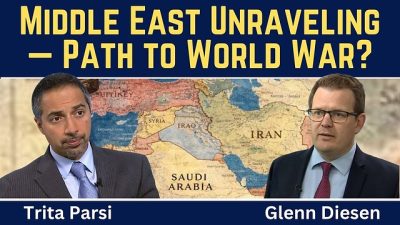
Trita Parsi: Middle East Unraveling — Are We on the Path to World War?
or go to
Aletho News Archives – Video-Images
From the Archives
Why Saudi Ties to 9/11 Mean U.S. Ties to 9/11
By Kevin Ryan | Dig Within | September 27, 2015
Media interest in Saudi Arabian connections to the crimes of 9/11 has centered on calls for the release of the 28 missing pages from the Joint Congressional Inquiry’s report. However, those calls focus on the question of hijacker financing and omit the most interesting links between the 9/11 attacks and Saudi Arabia—links that implicate powerful people in the United States. Here are twenty examples. … continue
Blog Roll
 Aletho News
- Neria Leiter Was A Legitimate Military Target
- Integrity Initiative: UK-funded network framed dissent as Russian disinformation for years
- ‘We don’t seek permission to defend our country’: Snippets from President Pezeshkian’s UNGA address
- NATO chief wants Europeans to fight American wars [for Israel]
- German chemicals giant reveals details of downsizing
- Refaat Al-Areer Was The Canary In The Coal Mine In Israel’s War On The Truth
- Israeli election committee bars candidate from Knesset race over Gaza war opposition
- French-Lebanese man files war crimes complaint over Israeli attacks
- Mahan Air Flight Lands in China Despite US Threat against Iranian Airlines
- US eyes $10bn fund to rebuild war-battered Gulf infrastructure
- If Americans Knew
- Caught on Tape: AIPAC CEO Boasted of Controlling Trump’s National Security Officials
- Why Hamas Attacked Israel in October 2023 – Israeli professor Ilan Pappé
- They see them, then kill them: Israeli quadcopters track, deliberately target civilians in Gaza
- Winter could turn Gaza’s treacherous, war-damaged buildings into deathtraps
- Majority of Democratic Voters Want to Prosecute Both Biden and Trump Administration Officials Over Gaza
- As Gaza languishes, world leaders gather at the UN – Daily Update
- Sanctions are collective punishment: immoral and self-defeating
- Phosphorus Munitions Fired by Israel Burn Groves, Orchards in Southern Lebanon
- Israel Carries Out New Ceasefire Violations Across Gaza
- AI – Emphasis on the ‘I’: Israel Is Funding AI Chatbot Propaganda
- No Tricks Zone
- New Study: Earth And Venus Surface Warmth Largely Explained By Convection And Lapse Rate, Not CO2 Or Radiation
- 2025 Nature Paper Claiming Worsening Global Drought Gets RETRACTED …Heavily Flawed
- New Study: ‘Global Drought Shows No Detectable Recent Acceleration Under Climate Warming’
- Economic Masterminds: German Socialists Suggest Taxing Productivity Gains Stemming From Using AI
- The South China Sea Has Not Been Cooperating With The Climate Change Narrative
- Energy Crisis: Germany Enters Heating Season With Historically Low Gas Reserve Fill Levels
- New Study: The Antarctic Ice Sheet Gained Mass From 2020-2024 Due To Staggering Snow And Ice Accumulation
- Study: Ocean Heating Rates From Thousands Of Years Ago ‘Dwarf’ Modern Ocean Heating Rates
- Climate Extremists Target, Attack Large-Scale Power Grid Infrastructure In Germany!
- New Study: Antarctic Ice Melt Has Contributed Less Than 1 Centimeter To Sea Level Rise In The Last 30 Years

