Mississippi Cuts $1.3 Billion from Schools, Gives $1.3 Billion to Nissan
By Carl Gibson | Reader Supported News | July 23, 2014
Mississippi has proved to us all that austerity, or the political ideology of “government living within its means,” is a farce. All austerity means is taking money away from public services, and giving it to private business. Mississippi Governor Phil Bryant and the GOP-led legislature illustrated that perfectly in two ways.
Since 2008, Mississippi has violated a constitutional mandate to adequately fund the state’s public K-12 schools. The Mississippi Adequate Education Program, or MAEP, was established in 1997 to make sure a proper portion of taxes went to fund schools. A community’s ad valorem taxes will cover up to 27 percent of the cost, while the state covers the rest. The state’s contribution is essentially the base student cost times the daily attendance in a certain school district. The mandated amount would be readjusted every five years for inflation. Mississippi has spent $648 less per student than it did in 2008. Currently, Mississippi has underfunded its public schools by at least $1.3 billion.
In May of last year, the United Auto Workers released a study showing that Nissan’s Canton, Mississippi, plant was getting $1.33 billion in tax breaks from the state in return for Nissan’s promise to provide Mississippians with good-paying, full-time jobs. $850 million in tax breaks would be spaced out over a 30-year period, with $400 million in cash aid. Mississippi would even pay $90 million in interest on the debt incurred to reward Nissan with its lavish tax breaks. Mississippi has already given $378 million to Nissan, which paid for its access roads, water usage, and worker training. Nissan also gets to keep $160 million in income taxes from workers over the next 25 years, which would normally have gone to Mississippi’s public programs. No employer has gotten that sweet a deal from any state government.
However, out of all 5,200 workers at Nissan’s Canton plant, most of them are employed by temp agencies. Regular, full-time employees are paid over $23 per hour and have benefits, but the temp workers at the Canton plant are often hired for just half that amount, given no healthcare, retirement, benefits, or paid time off, and have very little job security. The automaker has even issued a 5-year wage freeze for its Mississippi workers even as the company pocketed $3.3 billion in profit last year. Nissan likes to brag that it never lays people off, yet they don’t count temp workers who have been let go. While many other Nissan plants have unionized workforces, Nissan has indirectly threatened to close its Mississippi plant for good and move out of state if its workers organize.
While Mississippi is paying for a giant chunk of Nissan’s subsidies with the exact amount of money it cut from schools in the last six years, the state is actually following a nationwide trend. According to the Center on Budget and Policy Priorities, a nonprofit think tank, most states are funding schools even less than they used to before the global recession, which officially ended in 2009. Out of the 35 states following this trend, ten of those states have cut education by more than 10 percent. And despite modest increases in their tax revenues, 15 states are providing less funding per student than they did last year.
Nor is Nissan alone in their greed-inspired quest for huge tax breaks without fulfilling their promises to create jobs. A New York Times database from 2012 shows that over 150,000 state-based tax handouts to private businesses amount to $80.4 billion each year. Many of these corporations, like General Motors, took these handouts, and then shuttered operations a short time later. New Jersey governor Chris Christie has awarded over $2 billion in tax incentives during his tenure. That’s more under just one governor than in the combined tenures of all of New Jersey’s governors since 1996. But despite the handouts to corporations, New Jersey’s job growth is still lagging behind the rest of the nation. As of December of 2012, New Jersey had only restored half of the private sector jobs lost since the start of the recession.
States all over should have already realized that since globalization has sent manufacturing jobs overseas, real job growth lies in highly-skilled, technical industries. And to attract those employers, a state needs to have an educated workforce ready to take on those jobs. Unless states stop the disturbing trend of cutting education funding in favor of giving big tax breaks to any corporation that asks for them, their economies will only get worse.
Carl Gibson, 27, is co-founder of US Uncut, a nonviolent grassroots movement that mobilized thousands to protest corporate tax dodging and budget cuts in the months leading up to Occupy Wall Street. Carl and other US Uncut activists are featured in the documentary We’re Not Broke, which premiered at the 2012 Sundance Film Festival. Carl is also the author of How to Oust a Congressman, an instructional manual on getting rid of corrupt members of Congress and state legislatures based on his experience in the 2012 elections in New Hampshire. He lives in Sacramento, California.
Venezuela Participates in BRICS Gathering, New Agreements Reached
By Ewan Robertson | Venezuelanalysis | July 20, 2014
Mérida – Venezuela participated in the gathering of the BRICS emerging powers and Latin American regional blocs in Brazil this week, where new agreements were hailed as beginning the creation of a new global financial architecture.
Several multilateral meetings were held in the city of Fortaleza, including the 6th BRICS (Brazil, Russia, India, China and South Africa) Summit, and meetings between China and the Union of South American Nations (UNASUR) and the Community of Latin American and Caribbean States (CELAC).
During the BRICS summit, the five emerging economies created a new development bank and a multilateral reserve fund, each of which will potentially hold US $100 billion of pooled capital. The reserve fund will be used to support members of the bloc against adverse economic conditions or external impacts.
The creation of the new institutions is partly motivated by dissatisfaction with the terms of the financial hegemony exercised by the U.S. and its European allies through the IMF and World Bank.
“The strength of our project has positive potential: we want the global [financial] system to be fairer and more equal,” said Brazilian president Dilma Roussef to media.
On Wednesday and Thursday China met with the UNASUR and CELAC blocs in order to explore strategies through which the Asian power could deepen its involvement in Latin America.
In the meeting with UNASUR countries it was discussed how BRICS and UNASUR could create more ties. After the meeting, Venezuelan president Nicolas Maduro reported that it had been proposed that the new BRICS Development Bank and UNASUR’s Bank of the South adopt a common strategy in the regional and global economies.
“The [new] financial institutions have the same objectives: the construction of a new financial architecture that benefits economic development in conditions of equity for our countries; where speculative financial capital is ended, where the looting of our economies is ended, and productive investment which creates employment and wealth is promoted,” he said to Telesur on Wednesday.
The Venezuelan president also argued that closer relations between BRICS and Latin America represented a “win win alliance” and “the birth of the multi-polar world”.
“In the past we were dominated powers, and now we are emerging countries and blocs,” he said.
The BRICS bloc has become a key trading partner for Venezuela. Commerce with the bloc increased by 72% from 2006 – 2013.
Meanwhile, agreements reached on Thursday between China and the CELAC bloc, which brings together all countries in the Americas apart from the U.S. and Canada, included the establishment of a $1 billion investment fund for infrastructure projects in Latin America, and a Chinese offer of scholarships for 6,000 Latin American students.
Other funds potentially worth $15 billion to support Latin American development were also discussed.
Latin America has become an important source of Chinese investment and exports, while South American powers have increasingly turned to China as a source of financing, technology transfer, and destination to export primary materials.
A top level delegation led by Chinese President Xi Jinping is currently touring the continent to further deepen China’s economic involvement in Latin America, with visits including Brazil, Argentina, and Venezuela, where Xi Jinping arrives today.
Bilateral agreements
Venezuela also held several bilateral meetings in Fortaleza, including with China and Colombia.
The South American OPEC nation agreed to import a further 1,500 Chinese-made Yutong buses for the expansion of its public transport system. A Yutong factory is being built in Venezuela to begin domestic production of the vehicles, which will open next year.
The Venezuelan and Chinese central banks also reached an agreement to share information on statistical methodologies, monetary policy, and funding mechanisms. Both parties called the accord a “breakthrough” for enhancing economic ties.
Since 2001 the two countries have constructed what has been labeled as a “strategic alliance”. A high level bilateral session initiates in Caracas today with the arrival of Chinese president Xi Jinping.
Has America learned anything from negotiating with Iran?
By Flynt Leverett, Hillary Mann Leverett, and Seyed Mohammad Marandi | Press TV | July 18, 2014
While negotiators from Iran, the United States and the rest of the P5+1 will not meet their July 20 target for a comprehensive nuclear agreement, it is clear they won’t walk away from the table in a huff. So, as the parties prepare to continue the process, what has America learned from negotiating with Iran, and what does it still need to learn to close a final deal?
One thing Washington has learned is that the Islamic Republic is deeply committed to protecting Iran’s independence. Thirty-five years ago, Iran’s current political order was born of a revolution promising Iranians to end subordination of their country’s foreign policy to the dictates of outside powers—especially the United States. Since then, the Islamic Republic has worked hard to keep that promise—for example, by defending Iran against a U.S.-backed, eight-year war of aggression by Saddam Hussein’s Iraq and fending off a steady stream of U.S. and Israeli covert attacks, economic warfare and threats of overt military action.
On nuclear matters, the Islamic Republic’s commitment to protecting Iranian independence focuses on the proposition that Iran has a sovereign right, recognized in the 1968 Nuclear Nonproliferation Treaty (NPT), to enrich uranium indigenously under International Atomic Energy Agency (IAEA) safeguards. The Islamic Republic terminated the purely weapons-related aspects of the U.S.-supplied nuclear program it inherited from the last shah, going so far as to reconfigure the Tehran Research Reactor—which, when transferred by the United States in the 1960s, only ran on fuel enriched to weapons-grade levels (over 90 percent)—to use fuel enriched to just below 20 percent.
But the Islamic Republic has also been determined to develop a range of civil nuclear capabilities, including indigenous enrichment for peaceful purposes. It won’t surrender Iran’s right to do so—even in the face of massive U.S. and Western pressure and sanctions. Beyond sovereignty and practical needs, Iranian policy makers judge that appeasing Washington on the issue will simply lead to more aggressive U.S. demands and pressure on other disputes.
America may have begun to recognize that respecting Iranian independence is key to diplomatic progress. For over a decade, Washington has insisted—contrary to how the vast majority of states read the NPT and to America’s own publicly stated view during the Treaty’s early years—that Iran has no right to enrich. Even today, while Secretary of State John Kerry acknowledges Iran’s right to a “peaceful nuclear program,” the United States refuses to acknowledge that this includes a right to safeguarded enrichment.
However, when Washington has moved, in practical ways, to accept safeguarded Iranian enrichment, Tehran has responded positively. In the Joint Plan of Action agreed last November, America and its British and French partners dropped their longstanding demands that Iran cease all enrichment-related activities before substantial diplomatic progress would be possible. Furthermore, the United States and the rest of the P5+1 agreed that a final deal would encompass an Iranian enrichment program. In return, Tehran made multiple commitments to diminish what America and its Western partners portray as the proliferation risks of Iran’s nuclear activities. These confidence-building measures—which, the IAEA reports, Iran has scrupulously implemented—include stopping enrichment at the near-20 percent level needed for TRR fuel, converting part of its near-20 percent stockpile to oxide form and diluting fissile-isotope purity in the rest, freezing its centrifuge infrastructure and accepting IAEA monitoring well beyond NPT requirements.
While U.S. officials have started to grasp the importance of respecting Iran’s independence, they have yet to draw this insight’s full implications—the main reason a final deal isn’t at hand.
America and its Western partners continue demanding that Iran dismantle most of its safeguarded centrifuge infrastructure—a demand with no basis in the NPT or any other legal instrument and which contributes nothing to Western powers’ purported nonproliferation goals. Iranian Foreign Minister Javad Zarif has made clear that, in a final deal, Iran could agree to cap temporarily the scope and level of its enrichment activities and to operate its centrifuges in ways rendering alleged scenarios of rapid “breakout” implausible (e.g., no stockpiling of low-enriched uranium).
Unfortunately, Western demands for dismantlement appear grounded in a determination that Tehran must “surrender” in a final deal—to forego sustainable indigenous enrichment capabilities and instead rely on foreign fuel suppliers (especially Russia). If Western powers insist that Iran compromise its sovereign rights, there will be no final deal, no matter how long talks are extended.
The United States also still needs to learn—however incomprehensible this may seem to some—that the Islamic Republic is, in fact, a legitimate order for the overwhelming majority of Iranians living inside their country.
Besides restoring Iranian independence, the revolution that produced the Islamic Republic promised Iranians to replace externally imposed autocracy with an indigenously created system, grounded in participatory Islamist governance. For thirty-five years, this is what the Islamic Republic has offered Iranians the chance to build. With all its flaws, the Islamic Republic has delivered for its people in important ways, including impressive (and progressive) developmental outcomes in poverty alleviation, educational access, health-care delivery, scientific and technological advancement, and improving the status of women—despite decades of war, threats of war, and intensifying sanctions.
Still, many American elites persist in depicting the Islamic Republic as a system so despised by its own people as to be chronically in danger of overthrow—a fantasy that has driven Western enthusiasm and not-so-tacit support for regime change in Iran. Beyond its falsity, this misapprehension of reality continues to warp the Western approach to nuclear diplomacy with Tehran. Beyond dictating the “acceptable” scope of Iran’s indigenous capabilities, Western powers want the limits on Iran’s nuclear activities in a final deal to apply for well over a decade. Conversations with Western officials indicate that this demand—also with no basis in the NPT or any other legal instrument—is motivated by assessments that the Islamic Republic will not last for more than ten years. By insisting on a more-than-ten-year term, Western powers are calculating that, when a final deal expires, Iran will have a political order less committed to strategic independence.
This is both foolhardy and reckless. The Islamic Republic is not about to disappear—and no truly legitimate Iranian government will compromise what the vast majority of Iranians see as their nation’s sovereign rights.
When the United States fully understands that, the nuclear issue will almost resolve itself.
The Problem with the Venezuela Sanctions Debate
By Peter Hayakawa | Center for Economic and Policy research | July 18, 2014
As murmurs of U.S. sanctions against Venezuela continue in the aftermath of the protest violence there, researcher Michael McCarthy recently published an article in World Politics Review making some good arguments for why they would be a bad idea. He points out that unilateral sanctions lack regional support, and argues that they would discourage dialogue within Venezuela, would likely be ineffective, and may even harm U.S. interests by scuttling efforts to improve and maintain ties in the region.
McCarthy claims that the push for sanctions represents a “symbolic action” on the part of U.S. officials to communicate “universal support for human rights.” This assumption is pervasive in the mainstream debate about Venezuela sanctions; most commentators assume that the moral basis of imposing sanctions is sound and that the only real debate is on whether they will have the desired practical effect. In this context, some of the most obvious questions are missing from the discussion—in particular: a) what right does the U.S. have to enact coercive, unilateral economic measures against democratically-elected governments (measures that in this case, happen to be nearly universally opposed in the rest of the region and, as a study by pollster Luis Vicente Leon recently presented at the Washington Office on Latin America shows, are overwhelmingly opposed domestically in Venezuela)? And b) what integrity does the U.S. have when it comes to promoting human rights?
Last year, over a thousand unarmed protestors were killed by the U.S.-backed military government of Egypt after an illegal coup overthrew the country’s first democratically-elected president. Among those killed was a young journalist, Ahmed Assem el-Senousy, who had the misfortune to film his own murder at the hands of a government soldier who had spotted his camera. It was a grim echo of an event from another era—in June, 1973, Swedish journalist Leonardo Henrichsen similarly filmed his own death in Chile at the hands of a soldier in an unsuccessful military coup attempt that presaged Augusto Pinochet’s U.S. supported takeover three months later. The State Department claims that U.S. interests always align with democracy and human rights, but it is hard to miss the glaring gap between U.S. rhetoric on these issues and its actions.
While officials and Congress members throw unfounded accusations at the Venezuelan government and continue to discuss punitive measures, there are no comparable discussions about removing tax-payer funded military aid to U.S. allies with abysmal human rights records – let alone imposing sanctions — including states like Israel, Egypt, Saudi Arabia, and many others. The U.S. ended its partial freeze of military aid to Egypt this January and has quietly defended Israel during its latest assault on Gaza, even as Palestinian casualties rise at an alarming rate. In this hemisphere, in places like Honduras and Colombia, countries ruled by rightwing allies of the Obama administration, the laws that condition U.S. military and security aid on human rights standards are nearly systematically ignored, just as they are in the Middle East.
Over the past dozen years, the U.S. government has made no secret of its hostility toward the government of Venezuela – even supporting and getting involved in a 2002 military coup against Chávez – despite the fact that, over and over again, it has been elected democratically. In her recent book, “Hard Choices,” former Secretary of State Hillary Clinton even refers to Chávez as a “self-aggrandizing dictator.” She is much more sympathetic toward Egypt’s former president, Hosni Mubarak, whom she doesn’t label a dictator, though she does qualify her praise of his commitment to Middle East peace by mentioning that he is an “autocrat at home.” Clinton is not shy in explaining how she urged President Obama not to call for Mubarak to step down during the height of the 2011 Egyptian protests, citing her concerns about U.S. interests, just as she is not shy about detailing how she intervened to ensure that democratically-elected President Manuel Zelaya was not reinstalled after an illegal military coup in Honduras. Most importantly, while Mubarak was in office and while she was Secretary of State (i.e. when it mattered), Clinton, like virtually every other U.S. official, consistently defended the U.S. relationship with Egypt. Instead of referring to him as an autocrat while she headed the State Department, she famously referred to Hosni Mubarak and his wife as “friends of the family.”
Last November, the current Secretary of State, John Kerry, visited Latin America and announced the “end of the Monroe Doctrine,” stating that the U.S. would no longer work to undermine the sovereignty of its hemispheric neighbors in order to promote its own interests. The open secret is that U.S. officials still actively reserve the right to define human rights and democracy in ways that serve U.S. objectives. Over the decades and right up to the present, the U.S. has spent hundreds of billions of taxpayer dollars to arm some of the world’s least democratic actors, often with some of the worst human rights records, from Suharto to Sisi. Even if one disagrees that the U.S.’s historic disdain for left governments in Latin America is not a factor in the push for sanctions against Venezuela, considering the role that the U.S. continues to play in supporting human right abuses around the world, why accept the U.S. government’s own terms in the debate?
Iran sanctions cost US economy $175bn: NIAC
Press TV – July 17, 2014
The US sanctions against Iran have cost Washington as much as USD 175 billion dollars in losses for not doing business with the Islamic Republic, a Washington-based think-tank has found.
“The United States is by far the biggest loser of all sanctions enforcing nations. From 1995 [when the US imposed trade embargo on Iran] to 2012, the US sacrificed between USD 134.7 and USD 175.3 billion in potential export revenue to Iran,” the National Iranian American Council (NIAC) concluded in a report.
During the same period, the report said, the United States lost 51,000 to 280,000 jobs a year due to the sanctions slapped on Iran.
“Texas and California are likely the biggest losers in terms of lost employment, due to their size as well as the attractiveness of their industries to Iran’s economy,” it said.
The US sanctions also cost the European economies billions of dollars in losses through the 2010-2012 period.
“In Europe, Germany was hit the hardest, losing between USD 23.1 and USD 73.0 billion between 2010 and 2012, with Italy and France following at USD 13.6-USD 42.8 billion and USD 10.9-USD 34.2 billion respectively,” it said.
The think-tank recommended that the US government consider lifting sanctions against Iran as nuclear negotiations are under way between Iran and the five permanent members of the UN Security Council – the Unites States, Britain, France, Russia and China – plus Germany.
“Decision-makers must… ask themselves if the cost of sanctions to the US economy is worth shouldering if other options do exist,” it said.
At the beginning of 2012, the United States and the European Union imposed sanctions on Iran’s oil and financial sectors with the goal of preventing other countries from purchasing Iranian oil and conducting transactions with the Central Bank of Iran.
BRICS create new Development Bank as well as a $100 billion foreign currency reserves pool
By Helmo Preuss | The BRICS Post | July 15, 2014
Fortaleza, Brazil – After some tough rounds of negotiations, BRICS nations (Brazil, Russia, India, China and South Africa) have created not only a new $100 billion Development Bank, but also a $100 billion foreign currency reserves pool.
The announcement was made after a plenary meet of the five BRICS heads of state in Fortaleza on Tuesday.
Shanghai finally won the bid to host the Bank while India will get the presidency of the Bank for the first six years. The Bank will have a rotating chair. The Bank will also have a regional office in Johannesburg, South Africa. All the five countries will have equal shareholding in the BRICS Bank.
The five Finance Ministers will constitute the Bank’s board which will be chaired by Brazil.
The Bank will initially be involved in infrastructure projects in the BRICS nations.
The authorized, dedicated and paid in capital will amount to $100 billion, $50 billion and $10 billion respectively.
The idea of the BRICS Bank was proposed by India during the 2012 Summit in New Delhi.
BRICS have long alleged that the IMF and World Bank impose belt-tightening policies in exchange for loans while giving them little say in deciding terms. Total trade between the countries is $6.14 trillion, or nearly 17 percent of the world’s total. The last decade saw the BRICS combined GDP grow more than 300 per cent, while that of the developed word grew 60 per cent.
Apart from the new development Bank, the group of five leading emerging economies also created a Contingency Reserve Arrangement on Tuesday.
BRICS central banks will keep their reserves in gold and foreign currencies.
China will fund $41 billion, Brazil, India and Russia $18 billion each and South Africa with $5 billion. The funds will be provided according to a multiple. China’s multiple is 0.5, which means that if needed, the country will get half of $41 billion. The multiple is 2 for South Africa and 1 for the rest.
BRICS Finance ministers or central banks’ governors will form a governing body to manage the CRA while it will be presided over by the BRICS President.
The BRICS CRA will not be open to outsiders.
Meanwhile, at the Summit in Fortaleza, Russian President Vladimir Putin said BRICS must form an energy alliance.
“We propose the establishment of the Energy Association of BRICS. Under this ‘umbrella’, a Fuel Reserve Bank and BRICS Energy Policy Institute could be set up,” Putin said on Tuesday.
Qatar to buy $11bn worth of US arms
MEMO | July 15, 2014
Qatar will buy US patriot missile batteries and Apache helicopters in an arms deal worth $11 billion, senior officials at the US Pentagon said yesterday.
According to the US officials, Qatar will receive 10 radars, 34 launchers for Patriot systems designed to counter any missile attack, 24 Apache helicopters and Javelin anti-tank missiles.
Qatar has decided to buy the missile defence systems to confront any threat from Iran to the Gulf region.
The Qatari Minister of Defence Maj. Gen. Hamad Bin Ali Al-Atiyyah signed the deal in Washington yesterday following talks with his US counterpart Chuck Hagel, AFP reported.
Officials said the US wants to preserve its role as “the favourite defence supplier” for Qatar and other Gulf countries.
The Qatari deal will enhance the US economy as it will reportedly create 54,000 jobs, the Pentagon said.
The deal came on the heels of Hagel’s visit to Qatar in December, as well as talks in May between Hagel and his Qatari counterpart.
9 EU countries ready to block economic sanctions against Russia
RT | July 15, 2014
France, Germany, and Italy are among EU members who don’t want to follow the US lead and impose trade sanctions on Russia. US sanctions are seen as a push to promote its own multibillion free-trade pact with Europe.
“France, Germany, Luxembourg, Austria, Bulgaria, Greece, Cyprus, Slovenia, and EU President Italy see no reason in the current environment for the introduction of sectorial trade and economic sanctions against Russia and at the summit, will block the measure,” a diplomatic source told ITAR-TASS.
In order for a new wave of sanctions to pass, all 28 EU members must unanimously vote in favor. EU ministers plan to discuss new sanctions against Russia at their summit in Brussels on Wednesday, July 16. Even if only one country vetoed, sanctions would not be imposed. With heavyweights like France and Germany opposed to more sanctions the measure will likely again be stalled, the source said.
According to the source, the US sees slapping Russia with sanctions as a way to promote its own trade agenda with Europe, a side rarely explored in mainstream media. The Transatlantic Trade and Investment Partnership (TTIP) between the US and Europe would create the world’s largest free trade zone, but some worry it could balloon into an “economic NATO” or could end up putting corporate interests above national.
“Last year the EU and the US started difficult negotiations on a free trade agreement, which would force the EU into serious concessions, in particular, agricultural quality standards and regulation on genetically modified products. In this circumstance, restrictions against Russia will force EU countries to expand trade with the US,” the source said, citing shale gas as an example.
On June 20, Czech President Milos Zeman came out against sanctioning Russia, saying there is “no reason” to further “isolate” the country.
America was successful in getting Europe to toe its sanctions agenda at the height of the Ukraine crisis, but now Russia has removed its troops from the Ukraine border and promised peace in the region, Europe isn’t interested in further sanctions.
The EU initially followed the US cue when it imposed sanctions on Russia after the reunification of Crimea in March, but these measures were limited to politicians and businessmen. The EU unleashed a second round which expanded the list to over 72 individuals, who cannot enter the EU or access any assets there.
Boomerang effect
Russian officials maintain that sanctions are counterproductive, and will end up hurting the West more than they will Russia.
Another reason EU countries are wary of slapping Russia with economic sanctions is the possible spillover effect. Unlike the US, European countries rely heavily on Russia as a trading partner, especially for natural gas. The World Bank estimates that if sanctions escalate European gas prices could jump 50 percent.
Europe clearly has much more to lose by punishing its neighbor, with annual trade in goods and services worth $330 billion. American trade with Russia, by contrast is just a tenth of that at $38.1 billion.
Deals with UK-based BP, US-based Weatherford International, and ExxonMobil, continue to show that most countries continue to do business with Russia, politics aside.
Italy was the first country to speak out against Russian sanctions. Rosneft, the world’s largest listed oil company, recently acquired a 26.2 percent stake in Italian tire company Pirelli. Igor Sechin, boss of Rosneft and on the US sanctions list, joined the board of the Milan-based company. Three other Rosneft representatives, as well as the CEO of Russia’s second largest bank, VTB, sit on the board.
US weighs options for new ‘kill vehicle’
Press TV – July 14, 2014
The Pentagon hopes to fund a much more reliable “kill vehicle,” or warhead, for the homeland missile system.
Defense Undersecretary Frank Kendall, the Pentagon’s top arms purchaser, said decisions had not been finalized on whether to upgrade the existing warheads, built by Raytheon Co., or design a new one, according to Reuters.
“It’s going at the end of the day to be a question of affordability,” Kendall told reporters Saturday on the eve of the Farnborough air show.
Raytheon, Lockheed Martin Corp and Boeing have all expressed interest in bidding for a new design of kill vehicle.
After the missile system successfully intercepted a dummy target over the Pacific last month, defense contractor Raytheon which is a subcontractor to Boeing Co. said it expected to go into production shortly.
On June 22, the system managed to hit a simulated enemy missile for the first time since 2008.
Kendall said the test marked “a very positive step that will [prompt] us to move forward.”
The US Missile Defense Agency has failed half of its tests on intercepting a mock enemy warhead, government records show.
The Obama administration has agreed to expand the system from the current number of 30 ground-based interceptors.
Defense Secretary Chuck Hagel has called for deployment of 14 new interceptors at Ft. Greely by late 2017.
Russia backs Argentina’s call to curb Western dominance
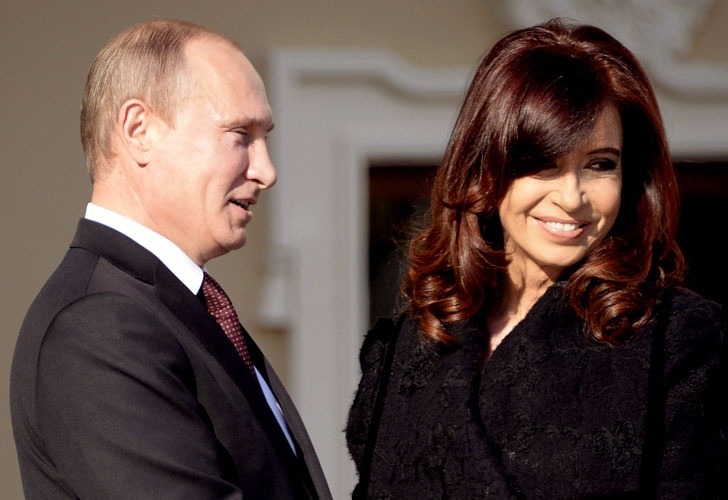
Press TV – July 13, 2014
Russian President Vladimir Putin has endorsed a call by his Argentinean counterpart Cristina Fernandez de Kirchner to curb Western dominance in international politics.
Putin gave his support during a meeting with Kirchner in the Argentinean capital, Buenos Aires, on Saturday.
The Russian leader also said Moscow and Buenos Aires share a close view on international relations.
During the meeting, Kirchner emphasized that global institutions must be overhauled and made more multilateral, adding, “We firmly believe in multipolarity, in multilateralism, in a world where countries don’t have a double standard.”
In addition, the two leaders discussed military cooperation and oversaw their delegations signing a series of bilateral deals, including one on nuclear energy.
Putin’s visit to Argentina is part of his six-day tour of Latin America aimed at boosting trade and ties in the region, according to Russian state media.
The Russian leader’s trip will next take him to Brazil, where he is scheduled to attend the gathering of the economic alliance, BRICS (Brazil, Russia, India, China and South Africa), in Brazil on July 15 and 16.
Putin’s Latin American tour began on July 11 in Cuba, where he met with President Raul Castro and his brother, Fidel Castro. During his stay in the capital, Havana, Putin signed a law writing off 90 percent of Cuba’s USD 35-billion Soviet-era debt.
Following his visit to Cuba, Putin made a surprise visit to Nicaragua, where he held talks with President Daniel Ortega.
US blacklists companies accused of Hezbollah ties
Al-Akhbar | July 10, 2014
The United States moved Thursday to blacklist a group of companies it claimed covertly helped Lebanon’s powerful Hezbollah movement acquire components for surveillance drones.
The US Treasury placed sanctions on Beirut-based Stars Group Holding, which it said purchased electronics and other technology via offices in China and Dubai to support Hezbollah’s military operations.
That included the development of unmanned aerial vehicles (UAVs) that the Treasury claimed were used against rebels in Syria and for surveillance of Israeli sites.
The material bought by Stars Group included engines, communications, electronics, and navigation equipment acquired from suppliers in the United States, Canada, Europe and Asia.
It named for sanctions the company, its subsidiaries, its owner, executives Kamel Amhaz and Issam Amhaz, and two Stars Group managers, Ayman Ibrahim and Ali Zeaiter.
The sanctions place a freeze on any of their assets under US jurisdiction and ban Americans from any business with them.
(AFP, Al-Akhbar)
Featured Video

Dan Dicks with James Corbett on Solutions Watch
or go to
Aletho News Archives – Video-Images
From the Archives
MMR (Measles, Mumps and Rubella) – Vaccine Risk Statement
MMR Vaccine (Measles, Mumps, and Rubella) Is It Safer Than Measles, Mumps and Rubella?
Physicians for Informed Consent | December 2024
… It has not been proven that the MMR vaccine is safer than measles, mumps, and rubella. The vaccine package insert raises questions about safety testing for cancer, genetic mutations, and impaired fertility. Although VAERS tracks some adverse events, it is too inaccurate to measure against the risk of measles, mumps, and rubella. Clinical trials do not have the ability to detect less common adverse reactions, and epidemiological studies are limited by the effects of chance and possible confounders. Safety studies of the MMR vaccine are particularly lacking in statistical power. A review of more than 60 MMR vaccine studies conducted for the Cochrane Library states, “The design and reporting of safety outcomes in MMR vaccine studies, both pre- and post-marketing, are largely inadequate.”19 Because permanent sequelae (aftereffects) from measles, mumps, and rubella are so rare (especially in children with normal levels of vitamin A and infected after birth),6,15-17 the level of accuracy of the research studies available is insufficient to rule out the possibility that the MMR vaccine causes greater death or permanent disability than measles, mumps, and rubella. – Read full article
Blog Roll
 Aletho News
- Sheikh al-Asadi warns of Iraqi government compliance with US demands
- How to MAKE THE CONSPIRATORS PAY for their crimes! Dan Dicks with James Corbett on Solutions Watch
- There’s a drought in academia: A drought in honest research on the subject of drought and other weather extremes
- Department of War Awards $20.7 Billion Contract to Raytheon for Air-to-Air Missiles
- ‘Distance yourselves from Israel’: IRGC urges US population to question govt policies
- America’s Greenland deal has a radioactive backstory
- The RAF Fairford ‘terror plot’: Unpacking escalation in the UK echo-chamber
- EU Council Advances Chat Control 2.0 Scanning Proposal
- Ex-Greek MEP files complaint against Israeli spyware firm over alleged Pegasus surveillance
- Troubling ideas throughout the Torah, Talmud, Mishneh Torah and Tanya
- If Americans Knew
- New Report: “Scholasticide and Genocide in Gaza: Assessment, Testimonies and Legal Analysis”
- Ex-Biden officials are desperate for a Gaza scapegoat
- Israeli “settlers” Invade Al-Aqsa; Pour Boiling Water on 75-Year-Old
- Israel Has Kidnapped Another American Teenager
- US arms sales to Israel worth $21.6 billion in 20 months
- Three Palestinians Killed in Israeli Attacks on Gaza
- Revealed: German “Anti-Semitism Expert” Driving Crackdown on Palestine Solidarity is Former Israeli Spy
- Egypt’s Warning to Israel Before Oct 7
- Israel’s siege signals another cruel winter for 1.8 million Gazans – Daily Update
- Netanyahu Asked UAE Leader to Deny Report on Oct. 7 Warning in Secret Visit, Sources Say
- No Tricks Zone
- Two More Paleo Reconstructions Affirm Meters-Higher Sea Levels Across Ireland, Brazil 7000-6000 Years Ago
- New Study: Earth And Venus Surface Warmth Largely Explained By Convection And Lapse Rate, Not CO2 Or Radiation
- 2025 Nature Paper Claiming Worsening Global Drought Gets RETRACTED …Heavily Flawed
- New Study: ‘Global Drought Shows No Detectable Recent Acceleration Under Climate Warming’
- Economic Masterminds: German Socialists Suggest Taxing Productivity Gains Stemming From Using AI
- The South China Sea Has Not Been Cooperating With The Climate Change Narrative
- Energy Crisis: Germany Enters Heating Season With Historically Low Gas Reserve Fill Levels
- New Study: The Antarctic Ice Sheet Gained Mass From 2020-2024 Due To Staggering Snow And Ice Accumulation
- Study: Ocean Heating Rates From Thousands Of Years Ago ‘Dwarf’ Modern Ocean Heating Rates
- Climate Extremists Target, Attack Large-Scale Power Grid Infrastructure In Germany!

