“I am sure this occupation will end”
Jody McIntyre writing from , The Electronic Intifada, 20 September 2010
 |
Israeli soldiers fire at protesters in Beit Ommar. (Mamoun Wazwaz/MaanImages) |
Since 2005, residents of the occupied West Bank village of Beit Ommar have launched nonviolent demonstrations in protest against the increasing theft of their land at the hands of the five surrounding Israeli settlements, and to call for an end to the Israeli occupation of all Palestinian lands. Despite the brutal response of the Israeli forces, resulting in the death, injury and detention of scores of teenagers from the town, the people of Beit Ommar remain steadfast in their resistance. Jody McIntyre interviews Beit Ommar Popular Committee secretary Ahmed Abu Hashem for The Electronic Intifada.
Jody McIntyre: Please introduce yourself.
Ahmed Abu Hashem: I am the secretary of the Beit Ommar Popular Committee, but I feel like the smallest person. None of us should see ourselves as more important than anyone else, because we are all supporting each other. Many people from the Palestinian Authority and from outside the village have tried to break us, but it will never work.
JM: How has the Israeli occupation personally affected you?
AH: I was first arrested in 1984, and held in administrative detention without charge for three months. The next time was together with my older brother at the start of the first intifada in 1988; he was imprisoned for 14 months, and myself for three and a half years. I was arrested again in 1992, and again in 1994 for a period of 14 months. In 1998, me and my younger brother were both imprisoned for six months. And in 2002 I was held for another six months, and then again in 2004, me and my younger brother were both imprisoned for six months. The last time I was in prison, my mother was run over by an Israeli military jeep, and my brother’s wife was shot, both on the same day. Three months ago I was arrested again and held for four days, where I was interrogated by Captain Tamir from the Israeli intelligence.
We are who we are, and since the first intifada it has been like this for my family … if it’s not me then it’s my brother, or my children, or my brother’s children, or my wife. Of course, we know why we are singled out in this way; it is because we have always worked as activists against the occupation.
It is clear that they are after me now; if they don’t come and invade my home, then they stop me at a checkpoint. In the last fifty days, they have invaded my house 17 times. This morning, I ran into a flying checkpoint at the settlement Gush Etzion, and they gave me a paper ordering me to report to the Israeli intelligence services on Monday morning. The same captain who interrogated me before actually came down to the checkpoint to hand me the paper.
The last time they came to my house they had given me exactly the same paper … I went to the military base as it said I should, and waited from 8:30am until 5:00pm, when I was simply given another paper saying that they would call me again. So I left, and 15 minutes later they called me and said I had to be at Gush Etzion immediately, but I refused to go back.
JM: Why do you think the Israeli military are pursuing you so relentlessly?
AH: They think that they can coerce me with money to become a collaborator, but it couldn’t be further from my thoughts.
I might be an old guy, but I hope to continue working against the wall and the settlements for all of my life.
JM: What motivates you to keep struggling against the occupation?
AH: My father was a part of the fedayeen [peasant] rebellion in 1948 against the first settler population of Gush Etzion, and he was injured by a land mine during the battle. He told me about those experiences at a young age, which definitely inspired me. As a child at school I studied a lot about the occupation; I read about the 1948 war and what exactly the creation and continued expansion of Israel meant to the Palestinians. I think it was a combination of these factors which gave me a determination to always struggle for our liberation.
JM: Have your sons also suffered, as you have, at the hands of the Israeli occupation?
AH: The first time my son Yousif was arrested, he was 12 years old. He’s currently in prison for the third time, at the age of 17. My oldest son is in jail for the second time. My other son, Emad, was shot by an Israeli soldier, and still has shrapnel in his head from the injury. My brother’s two sons were just released after three years in prison; they’re 19 and 21 years old now, so they were both arrested during their studies. Of course, the army wants to arrest the clever kids because they want them to work with the army as collaborators in the university. As for those who do choose to work as collaborators, I think their hearts have died.
I’m one of the few farmers who has continued to work on the land despite it being situated right next to the fence of the Karmet Sur settlement. The land actually belongs to my cousin, but I look after it as an act of defiance against the occupation. The settlers are keen to keep Palestinians off their land, because they want to expand, so they will do anything to stop us farming there. On many occasions I would see the settlers shooting at me, and I would hear bullets flying over my head. Once, the settlers’ security shot my six-year-old son Qossay in the leg with a live bullet. He stayed in the hospital for three days; the bullet had broken the bone in his leg.
Qossay, now eight years old, has completely changed. He used to be terrified of the soldiers, and he would hide under the bed when they invaded our home. But since he was shot he is at the front of every demonstration! Even if there isn’t a demonstration, he’ll go out and confront the soldiers anyway.
JM: Do you think the demonstrations can change the future here?
AH: We are struggling to stop the growth of the settlements, to stop the arrests and to stop the shootings. I don’t know if it will be in my lifetime, or in a hundred years, but I am sure this occupation will be ended.
Jody McIntyre is a journalist from the United Kingdom. He writes a blog entitled “Life on Wheels” which can be found at jodymcintyre.wordpress.com. He can be reached at jody [dot] mcintyre [at] gmail [dot] com.
Report: Bush offered to absorb 100,000 refugees in peace deal
Ma’an – September 20, 2010
BETHLEHEM — The Bush administration said it was prepared to absorb 100,000 Palestinian refugees if a peace deal was reached, former Israeli Prime Minister Ehud Olmert said Sunday, Israeli media reported.
Speaking at a Geneva Initiative conference in Tel Aviv, Olmert said during negotiations under his premiership with President Mahmoud Abbas that he had offered a solution that would have been in line with the Arab league Peace plan, Israeli daily Haaretz reported.
He also said former US President George W Bush had offered the immediate recognition of 100,000 Palestinian refugees as American citizens as part of a framework of international compensation, the daily reported.
According to UNRWA, the UN agency set up in the wake of Israel’s establishment to assist Palestinian refugees displaced between June 1946 and May 1948, there are 4.7 million Palestine refugees now eligible for UNRWA services.
“One-third of the registered Palestine refugees, nearly 1.4 million, live in 58 recognized refugee camps in Jordan, Lebanon, the Syrian Arab Republic, the Gaza Strip and the West Bank, including East Jerusalem,” UNRWA estimates.
The right of return, sanctioned under international law, has been the focal point of previous negotiations, as Palestinian negotiators seek to ensure refugees’ rights to compensation from Israel and the right to return to their homes now within Israel.
Martin Peretz: editor of the New Republic and agent of Israel
Peretz and the dangers of obsessive love
By Lawrence Davidson | September 20, 2010
Peretz and the New Republic
Martin Peretz is editor-in-chief of the New Republic. He acquired that position by simply buying the magazine in 1974. Although he resold it to a group of investors in 2002, they were, and apparently remain, his ideological soul mates for he continues to this day to be the magazine’s executive editor.
Peretz’s New Republic is a far cry from the original magazine. The origin of the New Republic goes back to 1914 when it was established by Herbert Croly and Walter Lippman. From the beginning the magazine was liberal and progressive. Between the world wars I and II it took a stand against the growing ideological enmity that bred the “red scares” and their accompanying violations of the civil rights of Americans. In the 1950s it took a principled stand against both Soviet tyranny and the McCarthy witch hunts. In the 1960s the magazine took a position opposing the Vietnam War.
Little of this survived Peretz’s remaking of the New Republic. Within a year of gaining control he fired most of the staff and shifted the editorial direction toward the center/right. The new New Republic supported Reagan’s foreign adventures, including alliances with terrorists such as the Contras, and later both Persian Gulf wars. Sometimes the magazine would selectively back Democrats. It backed Al Gore (a personal friend of Peretz) for president and waxed elegant about the likes of Joseph Lieberman. One progressive policy the magazine decided to support was universal health care. Peretz claims to be a life-long supporter of the Democratic Party but that has not stopped the ultra-conservative National Review from touting the New Republic as “one of the most interesting magazines in the United States”.
One of the reasons we can get this mixed bag of positions from Peretz’s New Republic is because domestic policy is but a secondary interest of the editor-in-chief. “I care most about foreign policy,” Peretz admits, and there is one aspect of foreign policy toward which he is down right obsessive. That aspect is US-Israeli relations. In more ways than one he keeps declaring that “I am in love with the state of Israel”. And how does he tell the world of his love? Mainly through the pages and blog of the New Republic. He has made it into his mouthpiece, his vehicle for declaring his abiding passion for “Zion.”
Peretz in love
It should be made clear that Peretz’s love of Israel is no ordinary love. It is not like, say, the love the founding fathers must have held for the new United States. No, Peretz’s love is of another order of intensity. It is that sort of passionate and blinding love that defeats reason. For instance, it has caused him to get Israel and the US all mixed up. According to Peretz support of Israel is a litmus test of American good citizenship: “Support for Israel, is deep down, an expression of America’s best view of itself.” I suspect that he got this sentiment from Louis Brandeis, the first leader of the Zionist Organization of American as well as the first Jew appointed to the Supreme Court. Back in 1918 Brandeis declared that to oppose Zionism was to be disloyal to the US (see Lawrence Davidson, America’s Palestine, page 225, note 23).
One fellow who failed the litmus test is Charles W. Freeman Jr., the man Barack Obama momentarily considered for his chief of the National Intelligence Council. Peretz wrote at the time that Freeman was utterly unsuitable for the post. Why? Because he had raised questions about America’s uncritical support of Israel–an act which Peretz characterized as “an offence“. By committing this “offence” Freeman had “questioned the loyalty and patriotism of not only Zionists and other friends of Israel”, but also “the great swath of American Jews and Christian countrymen who believed that the protection of Zion is the core of our religious and secular history…” This is the way Peretz sees the world. And it is, of course, a severely distorted view. When you get so intense about, so in love with, a foreign nation that you insist this outside entity represents “the core of our religious and secular history”, you have, as the saying goes, really gone over the top. Peretz has turned the United States and its national interests into a suburb of Tel Aviv.
In some of my earlier analyses I tried to show that “Zion” is in fact a racist place that does not resemble contemporary America, but rather America before the introduction of civil rights legislation. In today’s Israel, Arab Israelis are systematically discriminated against. Yet, a person who loves blindly will fail to see the faults of his or her lover. He or she may well adopt those faults as virtues and spend an inordinate amount of energy justifying the lover’s sins and castigating all who would be critical. And so it is with Martin Peretz. One way he has shown his perverse and obsessive love of Israel is by taking its anti-Arab line as his own. That has turned him into a bigot.
Back on 6 March 2010 Peretz said, “I can’t imagine any venture requiring trust with Arabs turning out especially well. That is, you will say my prejudice, but some prejudices are built on real facts, and history generally proves me right. Go ahead, prove me wrong.” Such wholesale stereotyping is, to use Peretz’s term, an offence against everyone who has ever had a good Arab friend, who is successfully married to an Arab man or woman, and to the very long and successful diplomatic relations the United States has had with such countries as Saudi Arabia and Jordan. And by making this common sense observation I have, at least strongly suggested, that what Peretz spouts is indeed wrong, and grievously so. But there is no doubt that this nonsense reflects his true feelings. And, it is his obsession with Israel that makes him see the world in this way.
On 4 September 2010 Peretz, again using the New Republic blog, returned to his prejudicial ways. “But frankly, Muslim life is cheap, most notably to Muslims. And among those Muslims led by the Imam Rauf [leader of those seeking to create the Islamic cultural centre near ground zero] there is hardly one who has raised a fuss about the routine and random bloodshed that defines their brotherhood. So yes, I wonder whether I need honuor these people and pretend that they are worthy of the privileges of the First Amendment which I have in my gut the sense that they will abuse.” Here, Martin Peretz presents himself as a walking and talking example of how one is almost always wrong when one indulges in gross simplifications and categorizations from the “gut’ or otherwise.
1. Imam Rauf has consistently demonstrated himself to be a moderate and sensible man. He has publicly denounced radicalism in all religions and called on moderates to keep control of the leadership of religious movements.
2. How does Peretz know that hardly anyone of the imam’s supporters “has raised a fuss” about violence? Those supporters number in the thousands, and perhaps tens of thousands. Has he checked them all out?
3. The notion that “routine and random bloodshed … defines their [Muslim] brotherhood” is just the lowest sort of stereotyping. If I asserted that the quite routine and random bloodshed caused by Israeli settlers in the occupied territories defined the “brotherhood” of Judaism, Peretz would go ballistic. Both statements can be properly labelled specious nonsense.
4. Martin Peretz has the First Amendment right to wonder out loud in a fashion that can only undermine the First Amendment. He can even legally do so in an atmosphere of growing and volatile Islamophobia, although in my estimation that is a bit like yelling fire in a crowded theatre. Such public assertions certainly put him in the running for the title of demagogue, but he is probably too impassioned to care. Occasionally, when he is called to task by a major national medium like the New York Times he will back off in a sort of resentful and ill-tempered way, like a little bully confronted by a schoolmaster. But you know that he does not mean it when he says he is sorry. You know he is insincere because, by consistently speaking first and thinking later (if at all), he wears his feelings on his sleeve.
The Harvard connection
This latest outburst of Peretz happens to coincide with a ceremony in his honour planned by Harvard University. It seems that Peretz was once an assistant professor at the prestigious school and that money plus contacts have subsequently taken him beyond that to the status of a school benefactor. We are here reminded of the recent conference on anti-Semitism held at Yale during which radical Zionists put on a display of bigotry disguised as academic research. Now it is Harvard’s turn to host a bigot. It might well be that some of the Harvard bureaucracy are embarrassed at having to fete Peretz (though they did choose Lawrence Summers as their president) but they seem to feel they are stuck with him, and so they cover their position with appeals to free speech. Even Harvard has a First Amendment right to reward a man whose stated desire is to deny the First Amendment rights of an entire American religious minority. According to Harvard’s publicly issued defence, going ahead with the ceremony makes the place “ultimately stronger as a university” engaging in “the robust exchange of ideas”. Well, its their party.
Conclusion
Martin Peretz is a good example of that subset of Americans whose single-minded dedication to Israel makes them, for all intents and purposes, agents of a foreign power. Indeed, in his willingness to pronounce his affection in the most indiscreet way, Peretz can be seen as their spokesman. These folks get very upset when you describe them this way, but that is because they have so mixed up America and Israel that, in their minds, there is no real difference between the two. As the Bard once said, “love is blind and lovers cannot see what petty follies they themselves commit”. Alas, these follies are far from petty.
I once had the dubious pleasure of appearing in a debate with Peretz. I remember him as a small man of nervous temperament. He had a tendency to handle challenges to his position by speaking very fast and very loudly so that you could not get a word in edgewise. Based on this behaviour “I had in my gut the sense” that he was quite capable of going hysterical. Such people usually self-destruct over time and maybe that will be Martin Peretz’s fate. I do hope so.
Lawrence Davidson is professor of history at West Chester University. He is the author of numerous books, including Islamic Fundamentalism and America’s Palestine: Popular and Official Perceptions from Balfour to Israeli Statehood.
Israel to cut off East Jerusalem villages
Ma’an – 19/09/2010
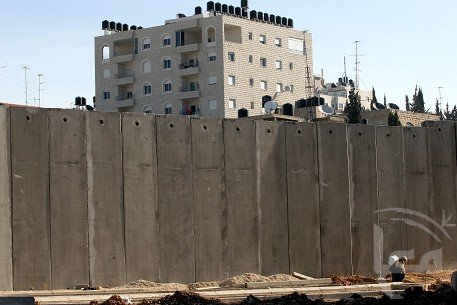
JERUSALEM — Israel began construction on Wednesday to separate Palestinian neighborhoods in occupied East Jerusalem from the rest of the city, a local committee leader said.
Head of the anti-settlement committee in the Shu’fat refugee camp Khader Salamah said Israeli authorities had erected 9- 12-meter concrete blocks around the military checkpoint at the camp’s entrance, isolating Ras Al-Khamis, neighboring the camp.
The construction would increase the suffering of the 15,000 residents of the camp, particularly elderly or sick residents and schoolchildren, Salamah said.
Israel’s planned construction extended to the Dahiyet As-Salam, Ras Shahadah and Anata villages, which when completed would affect the daily life of around 40,000 residents, Salamah said, adding that residents had instructed a lawyer, Dani Zaidman, to begin legal proceedings against Israeli authorities who had confiscated lands without notifying Palestinian owners.
The local committee was preparing to notify President Mahmoud Abbas and the PLO negotiations department of the consequences of Israel’s plan to isolate Palestinian neighborhoods. Israeli authorities were also at the final stages of constructing a new checkpoint at the entrance to Shu’fat refugee camp similar to the main checkpoints in the separation wall at Qalandiya and Hizma, Salamah said.
During the Jewish holiday Yom Kippur on Friday and Saturday, Israeli forces set up cement road blocks at the entrances to several suburbs of Jerusalem, including Al-Isawiya, northeast of Jerusalem and Sur Bahir in the south.
Fierce clashes had erupted on Thursday at Al-Isawiya, during which nine Palestinians were injured, including a paramedic, and six Palestinians were detained, medic Mohammad E’Beid said.
IMPERIALISM AND IMPERIAL BARBARISM
By JAMES PETRAS | My Catbird Seat | September 19, 2010
Imperialism, its character, means and ends has changed over time and place. Historically, western imperialism, has taken the form of tributary, mercantile, industrial, financial and in the contemporary period, a unique ‘militarist-barbaric’ form of empire building. Within each ‘period’, elements of past and future forms of imperial domination and exploitation ‘co-exist’ with the dominant mode. For example , in the ancient Greek and Roman empires, commercial and trade privileges complemented the extraction of tributary payments. Mercantile imperialism, was preceded and accompanied initially by the plunder of wealth and the extraction of tribute, sometimes referred to as “primitive accumulation”, where political and military power decimated the local population and forcibly removed and transferred wealth to the imperial capitals. As imperial commercial ascendancy was consolidated, manufacturing capital increasingly emerged as a co-participant; backed by imperial state policies manufacturing products destroyed local national manufacturers gaining control over local markets. Modern industrial driven imperialism, combined production and commerce, both complemented and supported by financial capital and its auxiliaries, insurance, transport and other sources of “invisible earnings”.
Under pressure from nationalist and socialist anti-imperialist movements and regimes, colonial structured empires gave way to new nationalist regimes. Some of which restructured their economies, diversifying their productive systems and trading partners. In some cases they imposed protective barriers to promote industrialization. Industrial-driven imperialism, at first opposed these nationalist regimes and collaborated with local satraps to depose industrial oriented nationalist leaders. Their goal was to retain or restore the “colonial division of labor” – primary production exchanged for finished goods. However, by the last third of the 20th century, industrial driven empire building, began a process of adaptation, “jumping over tariff walls”, investing in elementary forms of ‘production’ and in labor intensive consumer products. Imperial manufacturers contracted assembly plants organized around light consumer goods (textiles, shoes, electronics).
Basic changes in the political, social and economic structures of both the imperial and former colonial countries, however, led to divergent imperial paths to empire-building and as a consequence contrasting development performances in both regions.
Anglo-American financial capital gained ascendancy over industrial, investing heavily in highly speculative IT, bio-tech, real estate and financial instruments. Germany and Japanese empire builders relied on upgrading export-industries to secure overseas markets. As a result they increased market share, especially among the emerging industrializing countries of Southern Europe, Asia and Latin America. Some former colonial and semi-colonial countries also moved toward higher forms of industrial production, developing high tech industries, producing capital and intermediate as well as consumer goods and challenging western imperial hegemony in their proximity.
By the early 1990’s a basic shift in the nature of imperial power took place. This led to a profound divergence between past and present imperialist policies and among established and emerging expansionist regimes.
Past and Present Economic Imperialism
Modern industrial-driven empire building (MIE) is built around securing raw materials, exploiting cheap labor and increasing market share. This is accomplished by collaborating with pliant rulers, offering them economic aid and political recognition on terms surpassing those of their imperial competitors. This is the path followed by China. MIE eschews any attempt to gain territorial possessions, either in the form of military bases or in occupying “advisory” positions in the core institutions of the coercive apparatus. Instead, MIEs’ seek to maximize control via investments leading to direct ownership or ‘association’ with state and/or private officials in strategic economic sectors. MIEs’ utilize economic incentives in the way of economic grants and low interest concessionary loans. They offer to build large scale long term infrastructure projects-railroads, airfields, ports and highways. These projects have a double purpose of facilitating the extraction of wealth and opening markets for exports. MIEs also improve transport networks for local producers to gain political allies. In other words MIEs like China and India largely depend on market power to expand and fight off competitors. Their strategy is to create “economic dependencies” for long term economic benefits.
In contrast imperial barbarism grows out of an earlier phase of economic imperialism which combined the initial use of violence to secure economic privileges followed by economic control over lucrative resources.
Historically, economic imperialism (EI) resorted to military intervention to overthrow anti-imperialist regimes and secure collaborator political clients. Subsequently, EI frequently established military bases and training and advisory missions to repress resistance movements and to secure a local military officialdom responsive to the imperial power. The purpose was to secure economic resources and a docile labor force, in order to maximize economic returns.
In other words, in this ‘traditional’ path to economic empire building the military was subordinated to maximizing economic exploitation. Imperial power sought to preserve the post colonial state apparatus and professional cadre but to harness them to the new imperial economic order. EI sought to preserve the elite to maintain law and order as the basic foundation for restructuring the economy. The goal was to secure policies to suit the economic needs of the private corporations and banks of the imperial system. The prime tactic of the imperial institutions was to designate western educated professionals to design policies which maximized private earning. These policies included the privatization of all strategic economic sectors; the demolition of all protective measures favoring local producers (“opening markets”); the implementation of regressive taxes on local consumers, workers and enterprises while lowering or eliminating taxes and controls over imperial firms; the elimination of protective labor legislation and outlawing of independent class organizations.
In its heyday western economic imperialism led to the massive transfer of profits, interest, royalties and ill begotten wealth of the native elite from the post-colonial countries to the imperial centers. As befits post-colonial imperialism the cost of administrating these imperial dependencies was borne by the local workers, farmers and employees.
While contemporary and historic economic imperialism have many similarities, there are a few crucial differences. For example China, the leading example of a contemporary economic imperialism, has not established its “economic beach heads” via military intervention or coups, hence it does not possess ‘military bases’ nor a powerful militarist caste competing with its entrepreneurial class in shaping foreign policy. In contrast traditional Western economic imperialism contained the seeds for the rise of a powerful militarist caste capable, under certain circumstances, of affirming their supremacy in shaping the policies and priorities of empire building.
This is exactly what has transpired over the past twenty years, especially with regard to US empire building.
The Rise and Consolidation of Imperial Barbarism
The dual processes of military intervention and economic exploitation which characterized traditional Western imperialism gradually shifted toward a dominant highly militarized variant of imperialism. Economic interests, both in terms of economic costs and benefits and global market shares were sacrificed in the pursuit of military domination.
The demise of the USSR and the virtual reduction of Russia to the status of a broken state, weakened states allied to it. They were “opened” to Western economic penetration and became vulnerable to Western military attack.
President Bush (senior) perceived the demise of the USSR as an ‘historic opportunity’ to unilaterally impose a unipolar world. According to this new doctrine the US would reign supreme globally and regionally. Projections of US military power would now operate unhindered by any nuclear deterrence. However, Bush (senior) was deeply embedded in the US petroleum industry. Thus he sought to strike a balance between military supremacy and economic expansion. Hence the first Iraq war 1990-91 resulted in the military destruction of Saddam Hussein’s military forces, but without the occupation of the entire country nor the destruction of civil society, economic infrastructure and oil refineries. Bush (senior) represented an uneasy balance between two sets of powerful interests: on the one hand, petroleum corporations eager to access the state owned oil fields and on the other the increasingly powerful militarist zionist power configuration within and outside of his regime. The result was an imperial policy aimed at weakening Saddam as a threat to US clients in the Gulf but without ousting him from power. The fact that he remained in office and continued his support for the Palestinian struggle against the Jewish state’s colonial occupation profoundly irritated Israel and its zionist agents in the US.
With the election of William Clinton, the ‘balance’ between economic and military imperialism shifted dramatically in favor of the latter. Under Clinton, zealous zionists were appointed to many of the strategic foreign policy posts in the Administration. This ensured the sustained bombing of Iraq, wrecking its infrastructure. This barbaric turn was complemented by an economic boycott to destroy the country’s economy and not merely “weaken” Saddam. Equally important, the Clinton regime fully embraced and promoted the ascendancy of finance capital by appointing notorious Wall Streeters (Rubin, Summers, Greenspan et al.) to key positions, weakening the relative power of oil, gas and industrial manufacturers as the driving forces of foreign policy. Clinton set in motion the political ‘agents’ of a highly militarized imperialism, committed to destroying a country in order to dominate it.
The ascent of Bush (junior) extended and deepened the role of the militarist-zionist personnel in government. The self-induced explosions which collapsed the World Trade Towers in New York served as a pretext to precipitate the launch of imperial barbarism and spelled the eclipse of economic imperialism.
While US empire building converted to militarism, China accelerated its turn toward economic imperialism. Their foreign policy was directed toward securing raw materials via trade, direct investments and joint ventures. It gained influence via heavy investments in infrastructure, a kind of developmental imperialism, stimulating growth for itself and the “host” country. In this new historic context of global competition between an emerging market driven empire and an atavistic militarist imperial state, the former gained enormous economic profits at virtually no military or administrative cost while the latter emptied its treasury to secure ephemeral military conquests.
The conversion from economic to militarist imperialism was largely the result of the pervasive and ‘deep’ influence of policymakers of zionist persuasion. Zionist policymakers combined modern technical skills with primitive tribal loyalties. Their singular pursuit of Israel’s dominance in the Middle East led them to orchestrate a series of wars, clandestine operations and economic boycotts crippling the US economy and weakening the economic bases of empire building.
Militarist driven empire building in the present post-colonial global context led inevitably to destructive invasions of relatively stable and functioning nation-states, with strong national loyalties. Destructive wars turned the colonial occupation into prolonged conflicts with resistance movements linked to the general population. Henceforth, the logic and practice of militarist imperialism led directly to widespread and long-term barbarism-the adoption of the Israeli model of colonial terrorism targeting an entire population. This was not a coincidence. Israel’s zionist zealots in Washington “drank deeply” from the cesspool of Israeli totalitarian practices, including mass terror, house demolitions, land seizures, overseas special force assassination teams, systematic mass arrests and torture. These and other barbaric practices, condemned by human rights organizations the world over, (including those in Israel), became routine practices of US barbaric imperialism.
The Means and Goals of Imperial Barbarism
The organizing principle of imperial barbarism is the idea of total war. Total in the sense that (1) all weapons of mass destruction are applied; (2) the whole society is targeted; (3) the entire civil and military apparatus of the state is dismantled and replaced by colonial officials, paid mercenaries and unscrupulous and corrupt satraps. The entire modern professional class is targeted as expressions of the modern national-state and replaced by retrograde religious-ethnic clans and gangs, susceptible to bribes and booty-shares. All existing modern civil society organizations, are pulverized and replaced by crony-plunderers linked to the colonial regime. The entire economy is disarticulated as elementary infrastructure including water, electricity, gas, roads and sewage systems are bombed along with factories, offices, cultural sites, farms and markets.
The Israeli argument of “dual use” targets serves the militarist policymakers as a justification for destroying the bases of a modern civilization. Massive unemployment, population displacement and the return to primitive exchanges characteristic of pre-modern societies define the “social structure”. Educational and health conditions deteriorate and in some cases become non-existent. Curable diseases plague the population and infant deformities result from depleted uranium, the pre-eminent weapon of choice of imperial barbarism.
In summary the ascendancy of barbarous imperialism leads to the eclipse of economic exploitation. The empire depletes its treasury to conquer, destroy and occupy. Even the residual economy is exploited by ‘others’: traders and manufacturers from non-belligerent adjoining states. In the case of Iraq and Afghanistan that includes Iran, Turkey, China and India.
The evanescent goal of barbarous imperialism is total military control, based on the prevention of any economic and social rebirth which might lead to a revival of secular anti-imperialism rooted in a modern republic. The goal of securing a colony ruled by cronies, satraps and ethno-religious warlords – willing givers of military bases and permission to intervene – is central to the entire concept of military driven empire building. The erasure of the historical memory of a modern independent secular nation-state and the accompanying national heritage becomes of singular importance to the barbarous empire. This task is assigned to the academic prostitutes and related publicists who commute between Tel Aviv, the Pentagon, Ivy league universities and Middle East propaganda mills in Washington.
Results and Perspectives
Clearly imperial barbarism (as a social system) is the most retrograde and destructive enemy of modern civilized life. Unlike economic imperialism it does not exploit labor and resources, it destroys the means of production, kills workers, farmers and undermines modern life.
Economic imperialism is clearly more beneficial to the private corporations; but it also potentially lays the bases for its transformation. Its investments lead to the creation of a working and middle class capable of assuming control over the commanding heights of the economy via nationalist and/or socialist struggle. In contrast the discontent of the ravaged population and the pillage of economies under imperial barbarism, has led to the emergence of pre-modern ethno-religious mass movements, with retrograde practices, (mass terror, sectarian violence etc.). Theirs is an ideology fit for a theocratic state.
Economic imperialism with its ‘colonial division of labor’, extracting raw materials and exporting finished goods, inevitably will lead to new nationalist and perhaps later socialist movements. As EI undermines local manufacturers and displaces, via cheap industrial exports, thousands of factory workers, movements will emerge. China may seek to avoid this via ‘plant transplants’. In contrast barbaric imperialism is not sustainable because it leads to prolonged wars which drain the imperial treasury and injury and death of thousands of American soldiers every year. Unending and unwinable colonial wars are unacceptable to the domestic population.
The ‘goals’ of military conquest and satrap rule are illusory. A stable, ‘rooted’ political class capable of ruling by overt or tacit consent is incompatible with colonial overseers. The ‘foreign’ military goals imposed on imperial policymakers via the influential presence of zionists in key offices have struck a mighty blow against the profit seeking opportunities of American multi-nationals via sanctions policies. Pulled downward and outward by high military spending and powerful agents of a foreign power, the resort to barbarism has a powerful effect in prejudicing the US economy.
Countries looking for foreign investment are far more likely to pursue joint ventures with economic driven capital exporters rather than risk bringing in the US with all its military, clandestine special forces and other violent baggage.
Today the overall picture is grim for the future of militarist imperialism. In Latin America, Africa and especially Asia, China has displaced the US as the principal trading partner in Brazil, South Africa and Southeast Asia. In contrast the US wallows in unwinable ideological wars in marginal countries like Somalia, Yemen and Afghanistan. The US organizes a coup in tiny Honduras, while China signs on to billion dollar joint ventures in oil and iron projects in Brazil and Venezuela and an Argentine grain production. The US specializes in propping up broken states like Mexico and Columbia, while China invests heavily in extractive industries in Angola, Nigeria, South Africa and Iran. The symbiotic relationship with Israel leads the US down the blind ally of totalitarian barbarism and endless colonial wars. In contrast China deepens its links with the dynamic economies of South Korea, Japan, Vietnam, Brazil and the oil riches of Russia and the raw materials of Africa.
James Petras is a Bartle Professor (Emeritus) of Sociology at Binghamton University, New York. He is the author of 64 books published in 29 languages, and over 560 articles in professional journals, including the American Sociological Review, British Journal of Sociology, Social Research, Journal of Contemporary Asia, and Journal of Peasant Studies. He has published over 2000 articles. His latest book is War Crimes in Gaza and the Zionist Fifth Column in America (Atlanta:Clarity Pres 2010)
The Zionist Strategy of Demonizing Islam
By Anait Brutian | Between the Lines | August 18th, 2010
On August 4, 2010, Rabbi Michael Lerner, editor of Tikkun Magazine and chair of the Interfaith Network of Spiritual Progressives, published an article in Sabbah Report, entitled “Shame on ADL for Opposing Mosque 2 Blocks from Ground Zero.”
Rabbi Lerner’s position on the ADL’s (Anti-Defamation League) objection to building an Islamic Community Center in Manhattan, near Ground Zero is praiseworthy. But his interpretation of ADL’s reasons for resisting such a project lacks insight. ADL leader Abe Foxman’s statement: “In our judgment, building an Islamic Center in the shadow of the World Trade Center will cause some victims more pain – unnecessarily – and that is not right,” spells out the real reasons behind the decision. That decision cunningly reinforces the notion that Muslim fundamentalists were behind the attacks of 9/11 – a position also perpetrated by the architects of those attacks.
Rabbi Lerner’s statement: “It was not ‘Muslims’ or Islam that attacked the World Trade Center, but some Muslims who held extreme versions of Islam and twisted what is a holy and peace-oriented tradition to justify their acts and their hatred,” echoes George W. Bush’s address to a joint session of Congress on Thursday, September 20, 2001, whereby the blame for 9/11 was put on “a fringe form of Islamic extremism … that perverts the peaceful teachings of Islam.” Unfortunately, both positions – the first, explicitly, the second, apologetically – demonize Islam.
As rightly noted by Jack G. Shaheen in his book Reel Bad Arabs: How Hollywood Vilified a People (see also, Reel Bad Arabs – Part 1, Part 2, Part 3, Part 4, Part 5), a consistent stereotype of Arabs and their religion existed since the earliest, most obscure days of Hollywood. Perhaps, this was the continuation of European fascination with Orientalism. However, in the hands of Hollywood, it acquired a new malicious bend that increased proportionally with the number of Jewish entrepreneurs in Hollywood. Arabs were typically presented as rich and stupid, and their Western captives as victims of prejudice, manipulation and oppression. This pattern was further exploited by Zionists to include violence and acts of terrorism.
In 1993 Foreign Affairs published an article by Harvard Professor Samuel P. Huntington entitled: “The Clash of Civilizations?” that expanded into a book with the same title in 1996. The article endorsed the idea that “during the Cold War, the world was divided into the First, Second and Third Worlds.” According to Huntington, “those divisions … [were] no longer relevant”: “It is far more meaningful now to group countries not in terms of their political or economic systems or in terms of their level of economic development but rather in terms of their culture and civilization.” “It is my hypothesis that the fundamental source of conflict in this new world will not be primarily ideological or primarily economic. The great divisions among humankind and the dominating source of conflict will be cultural. Nation states will remain the most powerful actors in world affairs, but the principal conflicts of global politics will occur between nations and groups of different civilizations.”
Amplifying the “differences among civilizations,” Huntington emphasized the role played by history, language, culture and tradition. According to Huntington, differences of religion are the most important among cultural discrepancies: “Even more than ethnicity, religion discriminates sharply and exclusively among people. A person can be half-French and half-Arab and simultaneously even a citizen of two countries. It is more difficult to be half-Catholic and half-Muslim.” Huntington identified seven or eight major civilizations including “Western, Confucian, Japanese, Islamic, Hindu, Slavic-Orthodox, Latin American and possibly African,” predicting that the most important conflict will occur “along the cultural fault lines separating these civilizations from one another”: “The fault lines between civilizations will be the battle lines of the future.”
According to Huntington, the same “fault lines” will replace the “political and ideological boundaries of the Cold War as the flash points for crisis and bloodshed”: “… Conflicts between groups in different civilizations will be more frequent, more sustained and more violent than conflicts between groups in the same civilization.” Huntington identifies these conflicts as “the most likely and most dangerous source of escalation that could lead to global wars.” “The West and the Rest” in Huntington’s prediction of future clashes amounts to a conflict between “the West and several Islamic-Confucian states.” Islam is not identified as the single source of conflict; rather it appears in juxtaposition with Confucian civilization. Yet, Huntington’s reliance on the opinions of Indian Muslim author M. J. Akbar – “The West’s ‘next confrontation’ … ‘is definitely going to come from the Muslim world” – allows him to ignore the advice of Bernard Lewis, whose article “The Roots of Muslim Rage” inspired his title.
Bernard Lewis’ statement: “We are facing a mood and a movement far transcending the level of issues and policies and the governments that pursue them. This is no less than a clash of civilizations – the perhaps irrational but surely historic reaction of an ancient rival against our Judeo-Christian heritage, our secular present, and the worldwide expansion of both,” quoted by Huntington, had a continuation: “It is crucially important that we on our side should not be provoked into an equally historic but also equally irrational reaction against that rival” – that was perhaps more relevant for the argument than the emphasis on the clash of civilizations. This statement and the embedded advice were ignored by Huntington. Instead, Huntington sites historical and modern factors to promote the idea that a “bloody” clash between Western and Islamic civilizations is imminent: “Conflict along the fault line between Western and Islamic civilizations has been going on for 1,300 years.”
A superficial overview of history allows him to state that “Islam has bloody borders.” This statement, notoriously emphasizing a civilizational conflict between “Islam and the West,” became the credo of Zionists like Steven Emerson, whose crusade against Muslims conveniently took yet another turn – anti-Muslim attitudes were camouflaged as anti-terrorist sentiments. Emerson’s 1994 PBS video, Jihad in America “was faulted for bigotry and misrepresentations.” Robert Friedman accused Emerson of “creating mass hysteria against American Arabs.” Emerson accused Bill Clinton for “legitimizing self-declared ‘civil rights’ and ‘mainstream’ Islamic organizations that in fact operated as propaganda and political arms of Islamic fundamentalist movements.” He went as far as to declare that “Muslim terrorist sympathizers were hanging out at the White House.”
Conveniently ignoring the growing problem of Jewish fundamentalism in Israel and the United States (see, “The Ugly Face of the Zionist Jihad: The Halachic Guide for the Killing of Gentiles”), and typically prefacing his “diatribes” by stating that there are good Muslims and bad Muslims, Emerson blacklisted Islam by espousing in a deliberate assault against it: “The level of vitriol against Jews and Christianity within contemporary Islam, unfortunately, is something that we are not totally cognizant of, or that we don’t want to accept. We don’t want to accept it because to do so would be to acknowledge that one of the world’s great religions – which has more than 1.4 billion adherents – somehow sanctions genocide, planned genocide, as part of its religious doctrine.”
After the events of 9/11, a few of Emerson’s earlier comments acquired the status of “prophesy.” In 1994 he claimed that radical Muslims in the United States were plotting the “mass murder of all Jews, Christians and moderate Muslims.” In 1996 he attacked the Council on Foreign Relations for including “Muslim points of views” in its newsletter. And finally, in1997 he warned that “the U.S. has become occupied fundamentalist territory.”
The anti-Muslim rhetoric of the “grand inquisitor” acquires a new meaning, when one considers Emerson’s “friends.” Yigal Carmon, “a right-wing Israeli intelligence commander, who endorsed the use of torture” stayed in Emerson’s Washington apartment during his trips “to lobby Congress against Middle East peace initiatives.” A retired CIA counterterrorism specialist Vince Cannistraro said that Emerson’s allies, Pomerantz, Revell and Carmon were “Israeli-funded.” “How do I know that?” Cannistraro explained – “Because they tried to recruit me.” Cannistraro’s assertions were vehemently denied, but others suspected Israeli backing as well. Jerusalem Post of September 17, 1994 noted that Emerson had “close ties to Israeli intelligence,” Mossad, whose director reported only to the Israeli Prime Minister.
Hollywood’s groundwork was certainly useful to all that planned on instigating a clash of civilization between Muslims and non-Muslims. Huntington’s civilizational conflict between “Islam and the West” became the cornerstone of Zionist propaganda. But long before the establishment of Israel, the Zionist intellectual Maurice Samuel in his You Gentiles of 1924 polarized the Gentile and the Jewish worlds: “There are two life-forces in the world I know: Jewish and Gentile, ours and yours … Your outlook on life, your dominant reactions, are the same to-day as they were two thousand years ago. All that has changed is the instrument of expression” (pp. 19-20). Samuel admits that the “surface credo of a Jewish faith” imposed on a Gentile way of life did not make a fundamental difference: “But in the end your true nature works itself into the pattern of the borrowed faith, and expresses itself undeniably” (p. 22).
According to Samuel there is a “clear and fateful division of life – Jewish and Gentile,” with an “unsounded abyss between” them. Gentiles have a “way of living and thinking” that is distinctly different from Jews: “I do not believe that this primal difference between gentile and Jew is reconcilable. You and we may come to an understanding, never to a reconciliation. There will be irritation between us as long as we are in intimate contact. For nature and constitution and vision divide us from all of you forever…” (pp. 22-23).
Samuel’s description provides a classic example of a real “clash of civilizations.” The notion of a clash also fits Samuel’s final solution, based on the destruction of the existing world order: “A century of partial tolerance gave us Jews access to your world. In that period the great attempt was made, by advance guards of reconciliation, to bring our two worlds together. It was a century of failure. … We Jews, we, the destroyers, will remain the destroyers forever. Nothing that you will do will meet our needs and demands. We will forever destroy because we need a world of our own, a God-world, which it is not in your nature to build” (p. 155).
The modern equivalent of Samuel’s “God-world” and “destroyers” is religiously motivated terrorism – the accusation conveniently hurled at Muslims. After 9/11 – a false flag operation, no doubt – every Mossad-induced terrorist hoax, from shoe-bombers to crotch-bombers, is blamed on Muslims. Meanwhile, terrorist attacks on civilians of a humanitarian aid ship are dubbed as self-defence. There certainly is a clash of civilizations, witnessed by its concomitant double standard. But the clash is not between Muslims and non-Muslims, as the Zionists claim. Rather, the real clash, as Samuel described so promptly, is between Jews and Gentiles. The bogus clash, conveniently induced through tags like “Islam has bloody borders,” is of Zionist origin. It fits the Zionist strategy of demonizing Islam, and is an expedient cover for the real clash between Jews and Gentiles.
Terror In The Village That Became A Minefield
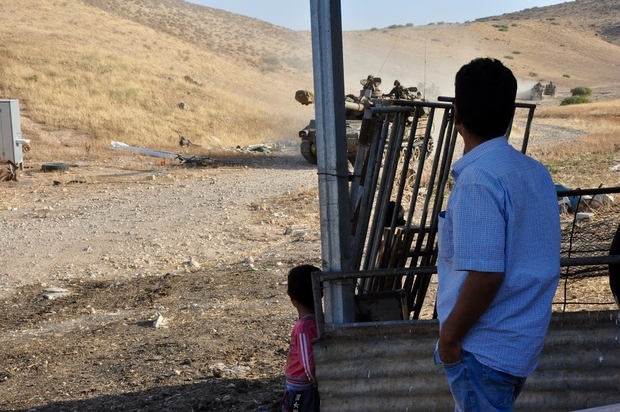
A father and son in Khirbet el alHama stand by as military tanks pummel through their small community (MEE/Emily Mulder)
Palestine Monitor – 15 September 2010
For many villages in Area C, landmines have become a regular feature of daily life. Israeli military training zones occupy nearly 30% of the land, often based around civilian areas, leaving unexploded ordnance (UXO) that cause horrific injuries to local residents. We spent a few days with the victims to see how they live with the constant terror.
Rafat Al-Rushayida is 24, he has lived his whole life in the bedouin village east of Bethlehem that shares his name. Al-Rushayida has played host to a military training zone since 1967, which has now expanded into 50% of the village’s land. He and four young friends showed us what the soldiers left behind.
If children find a bomb it is custom to surround it with rocks as a warning to others.
Awad Al-Rushayida, father of Rafat, was crippled by a landmine last year and has been unable to work since. “They (Israeli army) don’t make it safe because they want the land. They want us to leave”, he says.
Settlers make renewed attempt on Jerusalem home
Ma’an – September 16, 2010
JERUSALEM — Jerusalem’s Qeresh family said friends and neighbors helped them resist what witnesses described as an attempted home take over on Wednesday.
The event reportedly began in the early morning in the As-Sa’diyah neighborhood in the old city of Jerusalem, as Israeli settlers entered a wing of the family home and allegedly began removing furniture.
Family members said young men from the neighborhood came to the scene, and forcibly prevented the settlers from taking the furniture out of the home.
“The settlers tried to throw the furniture,” one man told Ma’an, and added that police were not called, as the family feared its sons would be detained for preventing the settler action.
The attempted take over came as Israeli and Palestinian leaders met less than four kilometers away at the Israeli Prime Minister’s Residence, for the latest round of direct peace talks.
Mahmoud Abbas has repeatedly said that if settlement projects continue in Palestinian areas, including East Jerusalem, he will walk away from talks.
Latest in 14-year settler battle for home
The Qeresh family continues a court battle following the 29 July forcible entry of two settler families into the home.
At the time, Israeli National Police spokesman Mickey Rosenfeld said two Jewish families entered the building “based on documents claiming that they owned the property.”
Police said they were examining the documents presented by two Jewish families who evicted the Qeresh families from their home. A police spokesman said the day after the forcible eviction, that he had “no idea whatsoever” as to how long it would take police to verify the papers.
He explained that if police decided the documents were authentic, the matter would be transferred to court.
According to Qeresh family members, the matter was transferred to courts, which put a freeze on settler action on the home, including the removal of furniture, until the matter was decided.
Fatah official for Jerusalem Affairs Hatem Abdel Qader said publicly that the documents presented by settlers to police were fake, noting the settlers who entered the homes were part of a Jewish group that lost a lawsuit in 1996, wherein they sought to take over the same home but failed to sufficiently prove ownership.
Palestinian defendants proved to an Israeli court that the home was owned by Kamal Handal and rented by the Qeresh family, Abdel Qader said following the July attempt.
“This armed burglary is considered an attack on a Palestinian home and will not pass silently,” he added at the time.
All That You Have Done: Colonialism, Ethnic Cleansing and the Web

During a march, Bassem Abu Rahma, unarmed, was shot and killed.
By Roger Sheety | Palestine Chronicle | September 15, 2010
Despite the current facade of yet another round of fake peace talks, the Israeli government and its professional apologists remain in a panic. Hardly a week passes by without complaint that Israel “is being isolated” or that it is facing a campaign of “delegitimization.” In February of this year the Reut Institute, an Israeli group-think tank, published a remarkably delusional, ahistorical piece of propaganda masquerading as a scholarly report and warning of an internationally concerted effort that seeks to “erode” Israel’s diplomatic status which “may develop into a comprehensive existential threat within a few years.” (*) In essence, any organization or individual that dares criticize Israeli policy in the Occupied Palestinian Territories in particular is a de facto member of this dreaded network of delegitmization. As with all Israeli hasbara (explanation), the Reut Institute blames primarily the Palestinian victims and secondarily those who report or publicize their plight.
Since then, various Israeli officials have dutifully echoed the report’s supposed findings. Thus, in the June 21st edition of The Jerusalem Post we are informed by the outgoing Israeli Ambassador to the UN Gabriella Shalev that Israel is “the most isolated, lonely country in the world.” “The biggest threat to [Israel’s] existence is not Iranian nuclear proliferation,” the article goes on, “but international attempts to delegitimize it.” Note how both Shalev and the article’s author repeat verbatim the Reut Institute’s apocalyptic language and assumptions. Even more recently, the long-disgraced and discredited Tony Blair has used the exact same language. The delegitmization of Israel is an “affront” not only to Israelis but to those “everywhere, in every part of humanity, who share the values of a free and independent human spirit” said Blair in a speech at a conference on, yes, the delegitimization of Israel.
But where precisely is the hard evidence of this malicious campaign of isolation and delegitimization? It certainly does not come from the American government. On July 16, 2010 the U.S. State Department’s Andrew J. Shapiro proudly announced that “For Fiscal Year 2010, the Administration requested $2.775 billion in security assistance funding specifically for Israel, the largest such request in U.S. history.” Furthermore, “Congress fully funded our request for FY 2010, and we have requested even more – $3.0 billion – for FY 2011. These requests fulfill the Administration’s commitment to implementing the 2007 memorandum of understanding with Israel to provide $30 billion in security assistance over 10 years.” A conservative study published two years ago by Washington Report on Middle East Affairs puts the total amount of U.S. official direct aid to Israel from 1949 to 2008 at nearly $114 billion. Perhaps, then, Europe is the culprit? Not according to Robert Fisk who recently wrote that Israel has all but officially become a member of the European Union. Fisk cites the work of David Cronin who concludes that “Israel has developed such strong political and economic ties to the EU over the past decade that it has become a member state of the union in all but name.”
As American and European governments clearly remain committed to rewarding Israel regardless of its crimes, what then is really frightening the only nuclear-armed state in the Middle East and the world’s fourth most powerful military machine? The great Palestinian poet Mahmoud Darwish once famously wrote: “All that you have done to our people is registered in notebooks.” But even Darwish could not have known how prophetic his words would be. For today what is being done to the Palestinian people is not only being documented by scholars and journalists, but also by Palestinians themselves on YouTube, Google video and a myriad other video-hosting websites, independent online journals, human rights organizations and blogs. Today we can see for ourselves the continuing colonization and ethnic cleansing in Palestine, online, in context and without censorship. Although one can cite literally hundreds of such examples across all of historical Palestine, I will concentrate on only three recent cases.
Case 1 – The village of Bil’in
A clear case of colonialism, what is happening in Bil’in, a village of about two thousand residents located in the Occupied Palestinian Territories, is a microcosm of what is happening over the whole of the West Bank. Since 2005 its residents have been organizing weekly, non-violent marches protesting Israel’s illegal annexation wall which has separated the villagers from 60 percent of its farmland. Recently the villagers have been joined by Israeli citizens as well as other internationals. Inevitably the protesters are then attacked by Israeli Occupation Forces often resulting in injuries and even death. On April 17, 2009 during a march, Bassem Abu Rahma, unarmed, was shot and killed by an Israeli soldier. This wanton act of murder, fully documented on video, was dismissed by an Israeli judge one year later. Bil’in is in an area which is nominally under Palestinian control yet there is no accountability, no law, and whatever the Israeli state orders is the new reality. Anyone still naive enough to ask questions like, “Where is the Palestinian Gandhi?” should begin looking in Bil’in—there are some two thousand Gandhis there.
Case 2 – Sheikh Jarrah, East Jerusalem
According to international law East Jerusalem is a part of the Occupied Palestinian Territories. As such, the Israeli state has no right to transfer any part of its own population into these territories, nor does it have any right whatsoever to remove any of its residents. In 2008 alone the Israeli state revoked the legal residencies of 4,577 Palestinians in East Jerusalem leaving them vulnerable to forcible removal by Israeli Occupation Forces. As seen in several extraordinary reports by Sherine Tadros and Jacky Rowland of Al Jazeera, the neighbourhood of Sheikh Jarrah has fallen victim to this continuing ethnic cleansing, “house by house, family by family.” Palestinians are literally being forced from their homes in tears, their possessions thrown into the streets, as they watch helplessly while Jewish settlers move in under armed Israeli protection. What we are seeing here is not the result of some natural disaster but a consequence of deliberate Israeli government policies which are supported and funded by American and European governments. When Tony Blair pontificates on “shared values of a free and independent human spirit,” one wonders if he has ever set foot in East Jerusalem?
Case 3 – The village of Al-Arakib
Located in the Naqab (Negev), Al-Arakib, a village of some 300 Palestinian Bedouins, has been destroyed several times within a span of three months. Despite the fact that they are Palestinian citizens of Israel, the state refuses to recognize their legal land claims which date to the Ottoman period. Indeed, Al-Arakib is but one of some 50 Palestinian Bedouin villages which Israel does not recognize as legal. In the summer of 2010 the Israeli government decided to make an example of Al-Arakib and, as shown by Max Blumenthal in several shocking reports, destroyed the village on five separate occasions leaving its residents homeless and destitute. As seen in Blumenthal’s video footage, the emptied homes are ripped to pieces by bulldozers and tractors as the villagers sit outside and watch. In one particulary disgraceful demolition, Israeli high school students are brought in and allowed to enter and deface the home-owners’ left-over belongings before the homes are then destroyed. Israel’s excuse, that it needs the villagers’ land for forestation projects, is deeply cynical and hollow. How perverse are Israel’s constant cries for “security needs” as it violently uproots its own Palestinian citizens.
The work of those such as Jacky Rowland, Sherine Tadros, Max Blumenthal and many others stands in marked contrast to the supine, corporate journalists who continuously parrot tired Israeli propaganda. It is beyond comprehension how mainstream North American media largely ignores Palestinian non-violent resistance to Israeli occupation. Of course, what we are seeing today is nothing new to Palestinians who have experienced dispossession and expulsion for over 62 years; what is new is merely the methodology: Byzantine Israeli “laws” targeting Arab neighbourhoods and villages, annexation walls and barriers separating villagers from their farm land and water resources, and then diverting those same resources to nearby illegal Jewish colonies.
One does not have to be an expert in international law or hold multiple post-graduate degrees to know right from wrong. Ordinary people know ethnic cleansing and colonialism when they see it; they understand its profound evil and inherent violence. This is especially true for many people from the so-called “Third World” where colonialism and its ensuing brutality remain fresh in their collective memories and experiences. These video images are being watched time and again by hundreds of thousands of people around the world. Their content is unforgiving, their effects are visceral. Indeed, however much one is aware of the historical background, it takes a certain kind of callousness to watch and not be moved by the plight of Palestinians at the hands of their colonizers.
In reality, honest, contextual reporting on its own will not bring justice to the Palestinian people. However, when combined with the boycott, divestment and sanctions campaign (BDS), the attempts to break the brutal siege of Gaza, as well as the movement to implement international law, suddenly the Israeli government, long accustomed to committing its crimes with impunity, takes notice. Nothing frightens any state elite and its professional apologists more than an increasingly conscious, politically engaged and questioning citizenry. More specifically, nothing frightens the colonizer more than the de-colonized mind. The tide of mass consciousness is turning and, as the once-segregated U.S. south, the Soviet Union and apartheid South Africa learned not so long ago, no military however powerful, and no state however repressive, can stop it.
Notes:
(*) See Reut Institute document.
Academic research collaboration emboldens Israeli apartheid
Diane Shammas, The Electronic Intifada, 14 September 2010
 |
Israeli universities play no small role in the state’s military strategy. (Keren Manor/ActiveStills) |
In July, Donna Shalala, the president of the University of Miami and former United States Secretary of Health and Human Services during the Clinton administration, joined a 13-member delegation of American university presidents to Israel. The delegation’s main objective was to discuss opportunities for academic collaboration with Israeli universities and reciprocal exchange programs for student and faculty. The majority of these Israeli universities, if not all, have been implicated in war crimes and other human rights violations against Palestinian and Lebanese civilians (“Academic boycott against Israel? Umberto Eco misses the point,” Palestinian Campaign for the Academic and Cultural Boycott of Israel, 10 July 2010).
Prior to the delegates’ arrival in Israel, they drafted and sent individual letters to their executive counterparts at the Israeli universities, stating that they “clearly denounce[d] the boycott of Israeli academics” (“Shalala among delegation of university presidents to visit Israel,” University of Miami news release, 2 July 2010).
The karmic twist to Shalala’s visit to Israel was that in spite of her obsequious endorsement of the anti-boycott stance, she was not spared from a three-hour, humiliating interrogation and detainment upon her departure from the Ben Gurion Airport. Israel’s Ynet News reported that she was detained because of her Arabic surname (“American VIP humiliated at airport,” 6 August 2010). When later interviewed by the Miami Herald, Shalala dismissed the inconvenience of her detention as purely security protocol to ensure traveler safety. Leaving aside all speculations as to why Shalala, an Arab-American, did not speak out against the indignity of her treatment at the airport, the larger conversation should be the strategic marketing and funding of research partnerships between American and Israeli universities.
Research and development collaboration between higher education institutions amount to billions of dollars annually. In 2008, the federal government alone funded $31 billion for academic research and development expenditures of which $1.6 billion were passed through to other university sub-recipients, domestic and foreign (National Science Foundation). Apart from the steady growth of research collaborations with “Asian 8” countries, such as South Korea and Taiwan, the research partnerships between American and Israel universities have been consistently strong and significant.
Large corporate donors, like Coca-Cola Company and Quaker Oats, a division of Pepsi-Cola, subsidize many of these collaborative research projects between US and Israeli universities, due principally to their robust ties with the American-Israel Chamber of Commerce (“American Israeli Chamber of Commerce promotes academic and research exchanges between University of Minnesota and Israeli educational and research institutions,” American-Israel Chamber of Commerce press release, 10 August 1998).
While the actual number of US-Israeli research partnerships is not readily available, a proxy indicator is the annual percentage of collaborative science and engineering articles between the two countries. Israel has the third-highest percentage of co-authored articles, 52 percent, with American researchers, after South Korea (54 percent) and Taiwan (53 percent). It is important to point out here if the percentage of co-authorship for Israel appears inflated, it is because their co-authorship output with the US is greater than their considerably smaller educational infrastructure. Therefore, the National Science Foundation has corrected for the infrastructural disparities by placing Israel’s rate of co-authorship with US at 1.21, qualitatively speaking, “higher than expected,” along with similar rankings for South Korea and Taiwan. Shalala’s delegation specifically expressed an interest in collaborating with Israeli universities on the application of technological research to the manufacturing of marketable products.
Israel aggressively courts research partnerships with American universities by hosting academic delegations. For example, Project Interchange, an educational organization of the American Jewish Committee, sponsored Shalala’s delegation to participate in their week-long program. A brief portrait of Project Interchange will illustrate that these academic delegations are political-educational junkets, which subliminally promote a Zionist ideology along with coordinating potential partnerships with Israeli universities.
Project Interchange regularly sponsors academic delegations and conducts programs in a seminar format. According to their website, Project Interchange customizes the theme of the seminar to each group’s interest, but all seminars are framed within the broader discourse of Israeli culture, society and politics — with a predominant focus on Israeli foreign policy.
Project Interchange identifies itself as “non-partisan,” “apolitical” and [an] “educational organization.” If one carefully deconstructs the language that Project Interchange uses on its website to describe its seminars — “challenging and promoting dialogue” and “offering multiple perspectives on complex issues” — it feigns a non-partisan and apolitical agenda by reducing the Palestinian struggle against occupation and dispossession to mere differences of opinion among ostensibly rival equals — Palestinians and Israelis. The message conveyed, therefore, is deceptive, because it completely denies the existence of the relationship between the colonizer — Israel — and the colonized, the indigenous population. The subordinate reference to “also meeting with Israeli Arabs and Palestinians” blatantly exposes Israel’s relegation of the indigenous population to second class citizens.
Another component of Project Interchange’s seminar program is coordinated site visits to the Israeli and Arab/Palestinian communities. In July, The Chronicle of Higher Education published an account of one site visit by a member of Shalala’s delegation, a president from an elite East coast university, who lauds the multi-cultural efforts of the Jerusalem International YMCA Peace pre-school:
“‘Boker tov!’ ‘Sabaah al-khayr!’ ‘Good morning!’ The excited voices of the kindergarten students and their tri-lingual teachers make us all smile as our group of American academic leaders visit the International Jerusalem YMCA peace pre-school … In the preschool, which serves an equal number of Arab (Christians and Muslims) and Jewish students, young people don’t seem to know they’re from different backgrounds and they are supposed to hate each other but they are friends” (“What we can learn from Children,” 16 July 2010).
Even though the delegate acknowledges the preschool’s diversity, his latter remark about the surprising amity among Arab and Jewish children and declaration that “they do not seem to know that they’re from different backgrounds” demonstrates his racial and religious blindness. He blissfully dismisses this purported hatred between Jews and Palestinian Arabs as if it originates from a historical rivalry on equal footing rather than a deep-rooted power imbalance between occupier and occupied.
Moreover, what is astonishingly naive about his comment is that, as a university president, he is (or should be) cognizant of the racial tensions among minority student populations, and yet, he seems to be taken in by the artificial democratic setting of the Israeli preschool, which is precisely the falsely egalitarian image of Israel that Project Interchange is endeavoring to promote by their site visits.
In the final analysis, Project Interchange’s objective is to transform a research collaboration initiative into a commodified, politicized and hegemonic project that is an extension of the Israeli state apparatus. To this end, American universities’ collaboration with Israel’s educational institutions is complicit in the occupation.
The portrait of Project Interchange lends insight into how a United States-Israeli global network intercedes on behalf of US academic leaders to establish strategic research partnerships with Israeli universities. Because Israeli universities mirror the racist institutional structure of the Israeli government and the US enables the Israeli occupation, it is highly unlikely in the present political environment that any research collaboration between American and Israeli universities would comply with the guidelines outlined by the Palestinian Campaign for the Academic and Cultural Boycott of Israel (PACBI).
In recent months, global boycott, divestment and sanctions have made enormous strides and have reported several victories in the areas of economic and cultural boycotts. To that end, American and Israeli university partnerships merit closer scrutiny in particular, as well as the intermediary organizations and the large corporate and private donors and binational foundations that annually fund billions of dollars to them (e.g., Binational Industrial Research and Development Foundation (BIRD), Binational Science Foundation (BSF) and Binational Agricultural Research and Development Fund (BARD)).
Diane Shammas is of Lebanese/Arab American heritage, and holds a Ph.D in International and Urban Education and Policy, with a specialization in Arab American Studies. She currently teaches a course on social construction of race and citizenship. She recently lived in Gaza City for three months, taught at Al Azhar University (Gaza), and passed through the West Bank on her return to the United States.
When they shout: “we strongly condemn …”
By Dr. Bouthaina Shaaban | ASHARQ ALAWSAT | September 9, 2010
On August 29, 2010, Martin Indyk wrote an op-ed in The New York Times entitled “For once, hope in the Middle East”. When I read it, I felt I should respond with an article that sheds light on the issues which Mr, Indyk has chosen to ignore. One of the premises he based his analysis on was that violence has receded in the Middle East in the past two years compared with the 1990s. Here, like most Western officials and journalists, Indyk ignores daily and persistent Israeli violence against Palestinians for the past sixty years which has risen to record levels in terms of the number and ferocity of Israeli crimes against Palestinian civilians in the past two years, particularly in the city of Hebron. How could Indyk ignore the ‘violence’ which Israel has been using for years against civilians in Gaza in terms of blockade and artillery, missile and warplane attacks? I would not have guessed that that the paradox, on this particular point, would become so stark on the international scene after four Israeli settlers were killed in a village near Hebron.
Jewish settlers, as everyone knows, have been killing Palestinian farmers, burning mosques, running over children with their cars, desecrating cemeteries, demolishing houses and whole villages. The lack of Western reaction towards this rise in the number of crimes against Palestinians reflects the conviction in the West that ‘violence has receded in the Middle East’, as if killing the Arabs is not ‘violence’, while killing these settlers is the only ‘violence’ in the Middle East! The US President hastened to condemn this ‘absurd killing’ while he kept silent regarding the killing of four thousand civilians, including women and children in Gaza. His Secretary of State also condemned the ‘brutal violence’, while she never condemned the Israelis for killing any Palestinian. The United Nations representative considered killing the Israelis a ‘mean’ attempt at undermining the negotiations, while his organization has done nothing to stop Israeli daily killing of Palestinians for the past sixty years. As usual, the European Union, and Japan too, condemned killing the Israelis, while they turn absolutely deaf when Israelis kill Palestinian civilians in their thousands. Even the Palestinian Authority condemned the killing of the four settlers without reminding the world of the crimes committed daily against the Palestinians, particularly in Hebron, which have never been ‘condemned’ or even mentioned be any American or European official. For them, that is ‘natural violence’, because Palestinian lives do not mean anything to the West. Only when an Israeli is killed, ‘civilized’ Westerners hasten to ‘denounce’ and ‘condemn’ violence.
In this article, I would just remind readers of some of the ‘acts of violence’, ‘ugly crimes’, ‘absurd killings’ and ‘brutal violence’ committed by the Israeli settlers in the West Bank, particularly in villages of the Hebron region, against unarmed Palestinians simply trying to live on their land with freedom and dignity and away from the killing and oppression practiced against them by Israeli settlers on a daily basis. Such acts and crimes have never been condemned by Obama, Clinton, the European Union, the United States, or even Japan.
Since March 2010, Israeli occupation forces killed in cold blood Mohammad Ibrahim Abdul Qader Qadus on March 16, 2010 in Southern Nablus; and on March 21, child Mohammad al-Qanbar was run twice over by a settler’s car before he was detained in Ras al-Amoud. On April 3, an Israeli settler ran over Samar Saif Radwan, 17, in eastern Hebron. On April 5, 2010, the settlers of Kriat Shmona burned a Palestinian to death. On the same day, three settlers poured hot water on the body and face of Munjed Bsharat, 26, who sustained serious burns and wounds. On April 11, an Israeli settler ran over a Palestinian child in the village of Laban West of Ramallah. On April 27, occupation forces assassinated young man Ali Sweiti, maimed his dead body and blocked out his eyes. On May 10, a Palestinian child died of the tear gas he inhaled. On the same day, occupation forces beat child Abdullah Isa to death. On May 16, an Israeli settler ran over a mother and her two daughters Rowa, 2, and Nagham, 5, at the entrance of their village, Jabaa south of Bethlehem. On June 11, an Israeli military jeep ran over and killed Mazen Naem al-Jamal, 48, in Hebron. On July 19, an Israeli settler ran over and killed Abdullah Hasan al-Muhtaseb, 12 in Hebron.
Thus, Israeli settlers and occupation forces killed during the first months of 2010 fourteen Palestinians. No country in the world condemned the killing of these people. And this is only the tip of the iceberg in terms of the brutal crimes committed by settlers on a daily basis against innocent children, women and young people in Hebron and other West Bank cities and villages. What would the Palestinians do if no country in the world condemned killing them? No Western media outlet even keeps a record of the crimes committed against them on a daily basis. Palestinian anger reaches unbearable levels not only because of the settler violence committed against them, but also because of the silence and complicity of Western powers.
A quick review of the racist Western perspective of what is happening in occupied Palestine explains the failure of all previous attempts to reach real solutions and just and comprehensive peace. It is because such a peace should be based on fair and balanced solutions.
For negotiations to succeed, the sponsors of the process should be convinced that the life of the Palestinians is at least equal to the life of a criminal settler living on a land not his own in order to steal this land and kill the people living on it. Only then, there might be some hope of achieving peace based on justice and not on killing one party and giving the occupying killing party everything it wants. When Obama, Clinton and the European Union condemn killing the Palestinians with the same strength they condemn the killing of settlers, there might be hope of a real peace in our region.
Featured Video

They Double Down on BLOOD PRESSURE Guidelines!
or go to
Aletho News Archives – Video-Images
From the Archives
The Ten Commandments of War Propaganda
By Michael Feldman · The Dissident · November 22, 2022
While researching World War I censorship for a larger project a few years ago, I stumbled upon a fascinating analysis of war propaganda.
In 1928, Baron Arthur Ponsonby published Falsehood in Wartime: Propaganda Lies of the First World War. Although Ponsonby’s book was eye-opening and remains relevant to media propaganda today, another work inspired by Ponsonby really caught my attention.
In 2001, Belgian historian Anne Morelli published Principes élémentaires de propagande de guerre (Basic Principles of War Propaganda). Based on Ponsonby’s writings, Morelli identified ten principles, often known as the Ten Commandments of War Propaganda:
1. We don’t want war. We are only defending ourselves!
2. Our adversary is solely responsible for this war!
3. Our adversary’s leader is inherently evil and resembles the devil
4. We are defending a noble cause, not our particular interests!
5. The enemy is purposefully committing atrocities; if we are making mistakes, this happens without intention
6. The enemy makes use of illegal weapons
7. We suffer few losses; the enemy’s losses are considerable
8. Recognized intellectuals and artists support our cause
9. Our cause is sacred
10. Whoever casts doubt on our propaganda helps the enemy and is a traitor
What’s most fascinating is that Morelli’s principles are based on a 73-year-old book, yet the commandments ring true today. You can pick just about any war, especially those in the twenty-first century, and see the commandments in action. … Full article
Blog Roll
 Aletho News
- Russia Unearths Major New Reserves of Gold, Nickel, Copper, and Natural Gas
- I’M SO BLOODY FURIOUS: They Double Down on BLOOD PRESSURE Guidelines!
- The Israeli Nuclear Doctrine and the Turning Point of the Kennedy Assassination
- Striking Matches Near the Powder Keg
- Prominent Russia hawk: European leaders privately talk about war with Russia, first need ‘mass casualty event’
- China warned Trump not to touch Iran’s oil tankers: Larry Johnson
- EU Central Banker Plans To Plant Barren AI Crops Across The Continent
- Macron’s Strategic Autonomy Paradox: France Rearms on Debt and Depends on Foreign Fuel
- Nigel Farage vs Tucker Carlson: Who is right about Hitler and Britain?
- Chocolate Gives Statins a $29 Billion Run For Their Money
- If Americans Knew
- DAILY UPDATE: Latest essential news on Palestine, Israel, & region
- Reporting Raises Fresh Questions About Israeli Role in CNN’s ‘Preposterous’ Iranian Dirty Bomb Story
- DAILY UPDATE: Latest essential news on Palestine, Israel, & region
- Under the West’s watch, genocide apologism has become entirely respectable
- Israeli Diplomat Offered Iowa Attorney General Free Trip, Then Asked for Favors
- On World Children’s Day, 350 Palestinian Children Remain in Israeli Prisons
- Why Is Israel Jailing a Palestinian Student Without Trial? Because It Can
- ICJ ruling on Rohingya genocide could strengthen South Africa’s case against Israel
- DAILY UPDATE: Latest essential news on Palestine, Israel, & region
- Newly nominated House Speaker funded Gaza genocide
- No Tricks Zone
- New Study: Modern Temps Are Among The Coldest Of The Last 10,000 Years In East Central Europe
- Germany’s Renewable Energies Lead to 1.4 Billion Euro Electric Power Trade Deficit
- Argentina’s Perito Moreno Glacier Joins Antarctica and Arctic In Defying Doomsday Melt Claims
- New Study: Barents Sea Temperatures Were Warmer And Sea Ice Less Extensive In The 1700s Than Today
- German Authorities Start Initiative To Evaluate Public Register For Climate “Disinformation” Spreaders!
- Zonal Asymmetry of Temperature Change in the Antarctic Circumpolar Current
- New Study: The Net Fossil Fuel Contribution To Rising Atmospheric CO2 Has Been Zero For 500 Years
- Germany’s Green Energy Transition Becoming Increasingly Expensive…Another 6 Trillion Euros!
- Sudden Stratospheric Warming, Powerful El Niño Combination May Lead To Extreme Europe Cold, Energy Crisis!
- Two New Studies Find Thwaites Glacier Melt Cannot Be Driven By Human Activity Or A Warming Ocean

