Diana Buttu: direct talks bound to fail
Interview, The Electronic Intifada, 30 August 2010
 |
Diana Buttu |
As US officials arrived in Jerusalem last week to meet with Palestinian Authority and Israeli government officials, Nora Barrows-Friedman interviewed Ramallah-based lawyer and former PLO advisor Diana Buttu about this week’s US-brokered direct talks between the two parties for The Electronic Intifada.
Nora Barrows-Friedman: What are the realistic expectations for an outcome of the direct talks, as Israel continues to confiscate Palestinian land and expand illegal settlements, and as Israeli Prime Minister Benjamin Netanyahu announces that it is the Palestinian preconditions that threaten to sabotage the talks?
Diana Buttu: The funny thing about Netanyahu’s statement on preconditions is that the preconditions are actually Israeli, rather than the other way around. They’re making it a precondition that Palestinians have to accept that Israel is going to continue its settlement activity. And if the Palestinian side says no to settlement activity, then somehow that is a precondition, and the world is not into that.
The big problem is that while there is this announcement of negotiations, here on the ground [in the occupied West Bank], there is nobody who is greeting this announcement with any happiness, because we have been here before. We know what has happened in the past, and we know what is going to happen. And so, if anything, the direct talks are going to be a direct failure. Unless there is a very strong stance by the international community to stop Israel in its settlement activity, in home demolitions and in setting forth a terms of reference — that Israel is going to abide by the 1967 borders — then the talks are doomed to fail. We have been down this path before.
NBF: What is your response to how the PLO approved the talks, even though none of the non-Fatah parties approve of them? How did this happen, and what has the response been from the opposing parties?
DB: In terms of the PLO’s response, this is not new. [Palestinian Authority President] Mahmoud Abbas is the same man who hijacked Palestinian elections a year and a half ago, when he unilaterally declared that his term was extended. This is the same man who has failed to hold the Palestinian Legislative Council elections. This is the same individual who has canceled the municipal elections, all under the guise of, “oh, this is too difficult right now.”
So it is not at all surprising that Mahmoud Abbas, speaking on behalf of Mahmoud Abbas, comes forward and declares that the PLO has accepted such talks when they haven’t. And declares that the Palestinian people are welcoming such talks when they are not. And has the audacity to speak on behalf of Palestine and the Palestinians when he is neither elected nor legitimate any longer, and has not even bothered to ascertain the opinion of other organizations, other factions that are members of the PLO.
NBF: Will this further split and antagonize the political factions against each other, or are we seeing more unity taking place?
DB: That is the one thing that is becoming interesting out of all of this — this is no longer the isolation of Hamas. It’s becoming the isolation of Fatah, in that you see all the political factions lining up on one side, and Fatah lining up on another side.
This is not where the situation was a few years ago, or even a decade ago when the majority of Palestinian factions were, in some way, shape or form, in favor of Oslo or in favor of the negotiations process. Today, it is exactly the opposite. So, if anything, Fatah has marginalized itself, and is becoming increasingly more marginalized.
The problem is that there is no way to translate that into any real change, because of Fatah holding the key, because of its inability to hold elections, with its refusal to listen to the factions. What it simply means is that we have this rogue party that is acting on behalf of its own interests and not the interests of the Palestinian people. That is going to continue to dictate the future of Palestine.
Unless this dissent transforms itself into a real push for internal change, then I fear [Fatah is] going to continue going down this path of isolating itself and marginalizing itself, and holding Palestinians hostage to its lack of vision and lack of strategy for Palestine.
NBF: You attended a press conference on 23 August given by PA spokesperson Saeb Erekat. What was revealed in the press conference, and what are most Palestinians concerned or skeptical about in relation to the talks and what is happening on the ground?
DB: There are two things that were revealed during the press conference. The first was that Erekat was unable to explain to journalists or to the Palestinian people what had changed, why they’re entering into negotiations now. He kept referring to pithy Quartet statements — no one really cares what the Quartet says or does, because they don’t really do anything — and he kept referring to the international community and its support for the peace process. But there was nothing that he could point to to explain why now is the time for direct talks.
In other words, there was nothing that he could say — neither in the form of guarantees, nor in assurances, nor in the form of a settlement freeze, or anything that he could take to the Palestinian people and sell. It simply was the result of their utter incompetence. There was no way to explain why they were going to negotiations.
The second thing that came out during the press conference, and this was clear to the journalists who were present, is that this is a leadership of lies. If this leadership had come forward and said, “we are under tremendous amounts of international pressure, both financially and politically” (which we know is the case), then at least we would have been able to give them credit for that. Erekat didn’t say that. Moreover, if this was the same individual who came forward and said they would halt negotiations, unequivocally, in the event that Israel does not impose a complete settlement freeze — not a partial freeze, not a moratorium — and a complete halt to home demolitions, then at least we would have been able to feel that this is a leadership that is responsive, a leadership that is honest.
Instead, Erekat came forward and said that there are going to be no negotiations. In fact, he used the phrase that Netanyahu will have chosen — no negotiations — in the event that settlements and home demolitions continue. What we know is the opposite. If they have not pressed for a complete settlement freeze now, if they have not pressed for a halt in home demolitions and land confiscation now, then the PA has to explain to us that somehow, magically, on 26 September — when the so-called settlement moratorium has expired — that suddenly the Palestinian Authority and the PLO are going to get a backbone?
So rather than him making these slogans and statements, we wanted to hear the truth. And instead we are faced with a leadership that lies. It lied about the pressure that has been put upon the PLO in order to enter into negotiations, and it will be proven on 26 September that the same leadership is going to — once again — lie to us about halting negotiations if there is no settlement freeze.
NBF: What are your major concerns about the Palestinian political atmosphere right now?
DB: The major concern is that we all know that this is going to fail. It doesn’t require anyone with any particular knowledge or foresight to realize that these talks are going to fail. The real question is what is going to come afterwards, and here is where I’m most concerned. For the past 17 years, the PLO, and in particular, Fatah, has had one strategy and only one strategy: negotiations, negotiations, negotiations.
And they have had only one strategy as regards to themselves, and that is survival. We are now at a stage where we are seeing that this is going to be — and I really hope that it is — the final blow to the logic and the ideology of negotiations, that people somehow have to negotiate their freedom.
The real question is, what is this leadership going to do? Is this leadership going to continue to hold us hostage to this tired, visionless lack of strategy? Or is something different going to come?
I’m not concerned with the talks, we know they are going to fail. My bigger concern is about what is going to happen once the talks fail, and is there going to be anybody who is going to come forward with a different plan, a different strategy, a different vision? And that is my fear. You can’t teach an old dog new tricks.
Photo courtesy of Diana Buttu.
See also:
Clashes erupt in Silwan during Israeli arrest raid
Palestine Information Center – 30/08/2010

OCCUPIED JERUSALEM — Violent clashes broke out early Monday morning between Palestinian residents of several Silwan neighborhoods and Israeli troops amid an extensive campaign of raids against Palestinian homes in search of “wanted” people to arrest them.
Several Palestinians were arrested over confronting extremist Jewish groups in Silwan settlements over the past few days, locals reported said.
The Israeli crackdown was over Palestinians confronting extremist Jews who recently carried out an assault against the Ain Silwan mosque in the Wadi Halwa neighborhood.
Two, a brother and his sister, were arrested along with a 68-year-old man and two brothers while one minor was handed a summons to appear at the police investigation department with his father in West Jerusalem.
Three other Palestinians were escorted in blindfolds and cuffs by Israeli police to investigation centers after an Israeli campaign of searches and arrests in south Nablus, northern Al-Khalil, and Bethlehem village on Monday.
Rabbi Yusef Wishes Death To The Palestinians
By IMEMC & Agencies | August 29, 2010
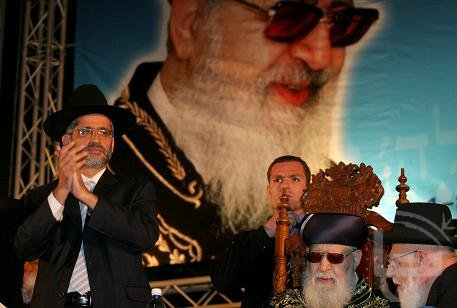
The Israeli Radio reported that during his weekly sermon on Saturday, the spiritual leader of Shas movement in Israel, Rabbi Ovadia Yusef, wished that the Palestinians and their president be dead and be finished by “God”.
Rabbi Yusef said that “may everybody who hates Israel be finished”, and also wished that the Palestinian President, Mahmoud Abbas, and the Palestinian people be finished by a plague sent by “God”.
He said that “God” should send the plague to the Palestinians and to Abbas in order to “finish them”.
Haaretz:
In 2001, the spiritual leader of the ultra-Orthodox faction gave a speech in which he also called for Arabs’ annihilation.
“It is forbidden to be merciful to them,” he was quoted as saying. “You must send missiles to them and annihilate them. They are evil and damnable.”
Photo credit Ma’an Images
Silwan residents say settlers provoked clash
Ma’an – 26/08/2010
JERUSALEM — Palestinian residents of East Jerusalem’s Silwan neighborhood said settlers attempted to enter the Al-Ein Mosque early Thursday morning, sparking skirmishes that lasted until after sunrise.
Israeli forces arrived as locals said they were attempting to drive the settlers out of the mosque area. Two settler cars were torched, and several windshields smashed in the violence.
The incoming border police force was described as “massive,” and said to have been firing tear-gas canisters and rubber-coated bullets toward Palestinians.
Firefighters called to put out the car blazes were reportedly confronted by angered residents in the area, Israeli daily newspaper Haaretz reported. According to the newspaper, four cars and two motorcycles were set alight.
A 22-year-old settler was said to have been injured, and the paper quoted a settler leader from the area, denying claims that an attempt to gain access to the mosque had caused the clash.
Israeli police said they were looking into the incident.
In the West Bank, three recent incidents of settlers vandalizing mosques have put residents on edge. In December, a Yasuf village mosque was torched and 12 settlers from the Yizhar settlement detained for their role in the incident. Also in the Nablus region, settlers torched a second mosque in May, Al-Lubban Ash-Sharqiya villagers said settlers drove up to the mosque, gathered flammables, and set them alight.
In June, officials from the Islamic Waqf said a recent wave of settlers moving into Jaffa, a Palestinian city now south of Tel Aviv, attempted to set ablaze the Jaffa Mosque as it was undergoing repairs.
Bedouin Women Hold Non-Violent Demo Against Razing Of Villages
By Saed Bannoura – IMEMC News – August 25, 2010
Around 700 Bedouin women held a protest in Jerusalem challenging the demolition of their villages by Israeli forces. They travelled to Jerusalem from the Negev desert in southern Israel, where they live in ‘unrecognized’ villages that have been razed multiple times since Israel was created in 1948.
They gathered outside the Israeli Ministry of the Interior on Tuesday, after the destruction of al-Arakid village this past weekend, holding signs and chanting slogans. Even as the mid-day sun beat down, and the women maintained their daily Ramadan fast of no water and food from sunrise to sunset, they continued to chant and attempt to dialogue with employees entering and leaving the building.
The women also submitted a letter of demands to the Israeli Interior Minister’s advisor on minority affairs, Saeed Muadi. The demands included a recognition of their villages, and equal treatment under the law.
One activist, Hanan el-Sana, told the Israeli daily Yedioth Ahranoth, “The systematic razing of unrecognized villages in the Negev by the authorities shows the State has no respect for human dignity or the religious customs of the area’s inhabitants. The (Bedouin) women feel that no one is hearing their cries. They feel this is the beginning of a long public campaign that will continue until the Israeli government recognizes the villages. For 60 years, we have suffered in our villages without basic necessities such as water, sewage systems, and electricity, and we have also lost our traditional livelihood because of the land appropriation policy. Add to this the recent home demolitions – the situation has become intolerable.”
The head of the Council of Unrecognized Villages in the Negev, Ibrahim al-Waqili, called on Israeli Prime Minister Binyamin Netanyahu to resign due to his blatant violation of international human rights law with his ongoing policy of destruction of Bedouin villages in southern Israel.
Israeli education ministry approves new ‘whites-only’ settlement school
IMEMC – August 26, 2010
Several months ago, a religious school in the illegal Israeli settlement of Immanuel was criticized for segregating white Jewish students from non-white Jewish students in classes.

Ethiopian Jewish student – not allowed to study at new school (photo by Jewish Middlesex)
Originally, the school was fined for this policy of racial segregation, because the school was state funded. Now, the Israeli education ministry has agreed with the white parents’ request to allow the school to continue with its racial discrimination under private funding.
There is no law preventing racial discrimination by private organizations, even schools, in Israel.
The Israeli court has interpreted these laws to also apply to illegal West bank settlements, like Immanuel, which are located in areas that are supposed to be under Palestinian control. The Palestinian Authority does not allow racial discrimination, but due to the Israeli military occupation of the Palestinian Territories, it has no authority over the area in question.
74 white girls who have been studying in a building next to the school will now be allowed to study in whites-only classrooms that are privately funded, as their parents claim they do not want their girls to study in racially-mixed classrooms.
See also:
Education Ministry approves new private school in West Bank settlement
The Light Rail Racist? Of Course it is
By Joharah Baker for MIFTAH, August 25, 2010
My two kids, especially my son, just love catching a glimpse of the shiny new trains being tested these days in Jerusalem. On our way to Ramallah, if you are “lucky” you can see the trains on a test drive along the main road, moving up to the beginning part of Shufat. In any other country, this would be a wonderful development – a necessary and efficient public service for all. However, this is not any other country, this is Israel and occupied Jerusalem, and my kids’ childlike enthusiasm would be short lived if they understood the racist ramifications of Jerusalem’s light rail.
Other than the usual reasons for the light rail, which includes relieving congestion in the city due to the hours long traffic jams, the political overtones are horrific. The light rail is essentially a service to the illegal settlements in and around Jerusalem, connecting them with the center of Jerusalem and with each other. It is a service for Israeli Jews who would rather skip the morning traffic jams and hop on the light rail to work every day. It is for the young Israeli teenager who wants to make a quick trip to the mall before sundown and it is for the 300,000 Jewish settlers living on occupied Palestinian land to feel they are part and parcel of Israel’s unified and eternal capital. Additionally, it is for Israel’s leaders who want to consolidate Israeli rule over Jerusalem as quickly and as permanently as possible. The train serves the same purpose as the separation wall or the checkpoints. It excludes Palestinians and encircles the city in a hermetically sealed Jewish envelope.
The light rail’s route, however, will have three stops in Shufut, a Palestinian suburb of Jerusalem. Shufat is across from the settlement of Pisgat Zeev and is right down the road from French Hill, so it is no surprise the train would stop there. And it is no surprise that west Jerusalem Municipality officials would market this as proof that the light rail is for all of Jerusalem’s residents, Palestinians and Israelis alike.
What is surprising is how far they take their little charade. It was almost funny to read an article published in Haaretz a few days ago about how municipality officials got their feathers all ruffled over a poll carried out by the CityPass Consortium, the company that won the Jerusalem light rail tender, which asked residents if it bothered them that Palestinians would be using the trains. Two of the questions ran like this: “There are three stops in Shuafat; does this bother you?” and “All passengers, Jews and Arabs, can enter the train freely, without undergoing a security check. Does this bother you?”
A municipality official, director general Yair Maayan was livid, calling the questions racist. “We were flabbergasted to see how a private commercial consortium dared to address these subjects; to ask such racist questions and to arouse strife and contention in the city,” Maayan wrote it a letter to CityPass.
Amazing, how all of a sudden, the Jerusalem municipality – or should I say the west Jerusalem municipality – is so concerned with racism in the city? The question, given Israeli perceptions of Palestinians, is legitimate because we all know how Israelis discriminate against the “Arabs.” We also know how the Israeli government has indoctrinated fear and suspicion among Israel’s Jewish population of Palestinians in general, which has partially earned its security justification so much success. Because the Palestinians are so dehumanized, because they are so “inclined to violence,” Israel has been able to justify so-called security measures on just about every level. This has led, I believe, to a collective and stereotypical mistrust and suspicion of Palestinians, something which CityPass obviously felt should be addressed.
But that is not my point. My point is that the light rail is racist in nature given that it will basically serve to connect illegal settlements and further strengthen Israel’s stranglehold on Jerusalem. Palestinians in the Shufat Refugee Camp do not have a stop, neither do those living in Beit Hanina or the villages surrounding Jerusalem. So, for the municipality to be up in arms over a “racist” question is absurd and it is insulting to our intelligence. The light rail is not for all of Jerusalem’s citizens and the fact that a few Palestinians may ride it occasionally is hardly proof of equality.
So why hide intentions? The municipality must feign equality because Israel claims Jerusalem is united for all its residents. We all know this to be another farce as well. The vast discrepancy between east and west Jerusalem is ample proof of Israel’s discriminatory policies. However, on the face of it, there is too much at risk for Israel to have its light rail also slammed as racist. Over the past few years, there has been enough bad publicity surrounding the construction of the rail, with BDS (Boycott and Divestment Movement) pressuring several companies to pull their money out of the project on the grounds of its illegitimacy (it is after all connecting illegal settlements on illegally occupied land). The French company Veolia reportedly pulled out most of its share of the project last year after pressure from boycott and rights groups. The company also reportedly lost an estimated $7 million in contracts because of its involvement in the Light Rail.
But it doesn’t take CityPass, the west Jerusalem municipality or even the route of the light rail train to showcase how racist Israel is towards the Palestinians. All you have to do is read some of the scathing comments under the article in Haaretz. One response with the subject “Arab cab use donkeys!” goes on to read, “After all they are a bunch of donkeys& behave like them as well.”
Another response said, “This shows that the threat of terrorism is endemic. The issue has nothing to do with race. It has to do with protecting innocent riders from being slaughtered.”
It does us Palestinians no honor to ride the train when it is finally up and running. If my kids want to ride it out of curiosity’s sake, I will bite the bullet and hop on for one ride. The last thing I need is to end up in some shady Israeli settlement built on land that is rightfully Palestinian.
Joharah Baker is a Writer for the Media and Information Department at the Palestinian Initiative for the Promotion of Global Dialogue and Democracy (MIFTAH). She can be contacted at mid@miftah.org.
Church boycott calls ring louder
Sarah Irving, The Electronic Intifada, 25 August 2010
The world’s churches have long been one of the battlegrounds of the boycott, divestment and sanctions (BDS) movement. With the strengthening of the BDS movement, a number of churches across the globe have seen the boycott of Israeli and Israeli settlement goods hotting up, and recent weeks have witnessed some notable victories.
The British Methodist Church has seen a number of resolutions on Israel passed in recent years. In 2006, says Dr. Stephen Leah, a Methodist preacher and member of the church’s conference, a vote to divest from companies profiting from the occupation was passed “overwhelmingly,” and other motions condemning Israeli actions in Gaza and encouraging church members to campaign for a just peace have been welcomed.
In June, Leah and colleague Nicola Jones, a Methodist minister who works with Palestinian liberation theology organization Friends of Sabeel, sparked major debate in the British media after they successfully shepherded a boycott motion through Methodist conference. “In 2009 we set up a working party in order to bring a statement to 2010 conference outlining the Methodist Church’s position on Palestine,” explains Leah. “Our report was the basis for the new resolution.”
The resulting motion has attracted most attention for its call for a boycott of goods from Israeli settlements. Christine Elliott, the Church’s Secretary for External Relationships, said in an official press release that “This decision has not been taken lightly, but after months of research, careful consideration and finally, today’s debate at the Conference. The goal of the boycott is to put an end to the existing injustice. It reflects the challenge that settlements present to a lasting peace in the region. We are passionate about dialogue across communities and with people of all faiths. We remain deeply committed to our relationships with our brothers and sisters of other faiths, and we look to engage in active listening so that we act as agents of hope together.”
“My personal view is that I’m in favor of a boycott of all Israeli goods,” says Leah. “But we had a big debate about it in the working party, as you can probably imagine, and some people said we should stick with a boycott of settlement products. So the statement now says that the Church will boycott settlement goods, but that some Methodists would like to go further.” Although the Methodists are the first church in the UK to mandate a settlement boycott, Leah claims that grassroots opinion within other churches, particularly the United Reform Church, would also support a boycott motion if one was presented to their conferences.
Significantly, the Methodist resolution doesn’t stop with a settlement boycott. It encourages church members to educate themselves on the issue of Palestine, directing them to documents such as the 2009 Kairos Declaration by Palestinian Christian leaders. It also encourages them to take action, ranging from engaging with the Amos Trust’s Just Peace for Palestine initiative to volunteering with the Ecumenical Accompaniment Programme in Palestine and Israel (EAPPI), whose human rights observation work takes volunteers to villages such as Yanoun, which has been repeatedly attacked and threatened by far-right settlers from Itamar. Official Methodist documents now refer to settlements as illegal, and the Church leadership has written to Britain’s main supermarkets asking for details of their policies on settlement produce. According to a Church spokesperson, they intend to make the results of their enquiries public in the near future, and the Methodist website already includes guidance on country of origin labels relating to Israel, the occupied West Bank and settlements.
The Methodist resolution also “directs the Faith and Order Committee to undertake further work on the theological issues, including Christian Zionism, raised in the report that are needed to guide and support the approach of the Methodist Church to the Israeli/Palestinian situation and to bring a report to Conference.” This, says Leah, is a measure aimed at “getting to grips with what’s behind Christian Zionism, because there are all sorts of different strands. Part of that will be a discussion within the Committee as to whether or not some aspects are compatible with Methodist beliefs. For example, some people, including the UN, have said that Zionism is akin to racism, and the Methodist Church is completely against all forms of racism.” Leah says that he’s rarely encountered Christian Zionism within his local Methodist congregations in the north of England, but acknowledges that “some people do have a feeling that we should be supporting Israel because they’re in the Bible and so on. But I’d say it’s stronger in other churches, especially the evangelical churches.”
Boycott backlash
Unsurprisingly, the decision of Britain’s second largest Protestant church to endorse the settlement boycott and research Christian support for Zionism has been controversial. The London-based Council of Christians and Jews responded to the Methodist resolution with mailings claiming that the boycott will “hurt Palestinian people,” while the Board of Deputies of British Jews issued a statement calling the motion “a very sad day, both for Jewish-Methodist relations and for everyone who wants to see positive engagement with the complex issues of Israeli-Palestinian relations. The Methodist Conference has swallowed hook, line and sinker a report full of basic historical inaccuracies, deliberate misrepresentations and distortions of Jewish theology and Israeli policy.” The statement went on to accuse the Methodist Church of being “crass, insensitive and misinformed,” and The Jewish Chronicle reported that the board had cut off relations with the Methodist leadership until “we see signs of a change in their stance.”
From Israel, meanwhile, commentators raised the specter of a “threat to inter-faith efforts all over Europe.” The Jerusalem Post called the Methodist Church, which claims 330,000 members in the UK, a “small and declining community” and described the Kairos Declaration as a “highly organized” effort by Palestinian Christian leaders. A Jerusalem Post op-ed by Robin Shepherd of the Henry Jackson Society (which numbers Operation Cast Lead defender Max Boot, former Israeli ambassador Dore Gold and a former CIA director amongst its figureheads), was entitled “The Banality of Methodist Evil,” called the BDS campaign “rancid” and accused the Methodist Church of “burying its credibility under a gigantic dunghill of intransigence, pedantry, lies and distortions.” The writers concluded by suggesting that “If the Methodist Church is to launch a boycott of Israel, let Israel respond in kind: Ban their officials from entering; deport their missionaries; block their funds; close down their offices; and tax their churches. If it’s war, it’s war. The aggressor must pay a price.”
“I think a lot of people were expecting this,” says Leah, “But the ordinary people I’ve been speaking to in churches are absolutely delighted. They say we’ve stood our ground and done what’s right.” He cites letters such as that from the Reverent Rob Hufton, which appeared in the Church’s newspaper, the Methodist Recorder, pointing out that Israeli restrictions on Palestinian movement render impossible the kind of inter-faith encounter which critics of the Methodist motion claim to support. Hufton condemned the Israeli policies which have turned the West Bank into a “Swiss cheese” and concluded that “Things are worse than the maligned [Methodist] report suggests. We, as a Church, have nothing to apologize for and should not be intimidated.”
Leah admits that the Methodist leadership have been “getting a lot of flak from The Jewish Chronicle and The Jerusalem Post, which always makes them a bit worried,” but he sees grassroots work with members of the Methodist congregation as his main task. He’s also keen to highlight the support which the Methodist motion has attracted from anti-Zionist Jewish organizations, and the potential it holds for cross-community dialogue with Britain’s Muslims. “I think more than anything it’s important for the Methodist church and leadership to be bold in what they’re doing and take it back to those who are criticizing and say, we’ve got to stand up against injustice,” he says.
Behind the hysterical attacks on the Methodist resolution from Zionist commentators is their fear of the growing BDS movement. For the Methodist Church’s decision may be part of a growing trend amongst churches worldwide. Despite The Jerusalem Post’s insistence on the marginality of the Methodist Church, the Church of England, the UK’s largest Protestant denomination, announced the week after the Methodist conference that it was reviewing its stake in French transportation company Veolia because of the latter’s role in the Jerusalem light rail project. According to the Anglican Missionary and Public Affairs Committee, there was concern within the Church that “once built, the rail system will help to cement Israel’s hold on occupied East Jerusalem and tie the settlements even more firmly into the State of Israel.” The church would, it said, be investigating whether “the tram operator will ensure access to the tram that does not discriminate between Palestinians and Israelis, and abide by any ruling on the legality of the project in an international law.”
Australian, US churches move towards settlement boycott
In Australia, meanwhile, the National Council of Churches also passed a motion at the end of July backing a boycott of settlement products. The NCCA represents the Australian branches of the Catholic and Anglican churches, along with 15 other denominations. An NCCA press release states: “Rev Tara Curlewis, General Secretary of the NCCA said ‘We are asking the member Churches of the NCCA to consider boycotting particular goods produced in Israeli settlements in the Occupied Palestinian Territories.” NCCA added that boycotting Israeli goods could help to “liberate the people from an experience of injustice” and was a means to help establish a “just and definitive” peace for Palestinians and Israelis. It also confirmed that Act For Peace, the Christian aid agency for Australia, would support boycott actions and advocacy initiatives by Australian churches.
Australian Zionist groups reacted with predictable fury, framing the decision as a boycott against “West Bank Jews.” Robert Goot, president of the Executive Council of Australian Jewry, claimed to reporters that the resolution “revived painful memories for Jews in Australia of earlier times in Europe when churches allowed themselves to be swept up in the tide of popular prejudices against the Jewish people.”
While not going as far as British and Australian churches, the Presbyterian General Assembly, which represents the denomination’s two million-plus members in the US, in July passed a number of resolutions on Palestinian issues. These included approving with 82 percent of the assembly vote a position paper which called for an “end of the Israeli occupation of Palestinian territories” (while also affirming “Israel’s right to exist as a sovereign nation within secure and internationally recognized borders”) and “an immediate freeze on the establishment and expansion of Israeli settlements in the West Bank, and on the Israeli acquisition of Palestinian land and buildings in East Jerusalem.”
The Presbyterian General Assembly also approved a report by the Mission Responsibility Through Investment committee which “Strongly denounces Caterpillar’s continued profit-making from non-peaceful uses of a number of its products on the basis of Christian principles and as a matter of social witness” and “Calls upon Caterpillar to carefully review its involvement in obstacles to a just and lasting peace in Israel-Palestine, and to take affirmative steps to end its complicity in the violation of human rights.” The Presbyterian General Assembly said that it rejected divestment as an option, on the grounds that it would continue to “engage” with companies which “profit from the sale and use of their products for non-peaceful purposes and/or the violation of human rights.” The Anti-Defamation League, which routinely attacks any policies critical of Israel, called the reports “biased.”
Sarah Irving is a freelance writer. She worked with the International Solidarity Movement in the occupied West Bank in 2001-02 and with Olive Co-op, promoting fair trade Palestinian products and solidarity visits, in 2004-06. She now writes full-time on a range of issues, including Palestine. Her first book, Gaza: Beneath the Bombs co-authored with Sharyn Lock, was published in January 2010.
Settlers raid house, burn crops
Ma’an – 24/08/2010
TULKAREM — Settlers raided a house and torched five dunums of farmland in the northern West Bank Monday evening, witnesses said.
Locals said two buses of Israeli citizens living in Hebron in the southern West Bank arrived at the illegal Mevo Dotan settlement in Tulkarem in the northern West Bank, where they harassed locals and caused damage.
Settlers raided the house of Muhammad Al-Haloul and remained for three hours banning the family from leaving, family members said. They destroyed the house and burnt the family’s wheat crops, locals said.
Settlers set 20 dunums of farmland on fire south of Nablus on Sunday, Palestinian Authority official Ghassan Doughlas said.
Dozens of residents of the illegal Ihya outpost torched the area of Sahel Khalet Abu Shreka, near Jalud village, he said.
Doughlas accused settlers in the area of repeatedly provoking locals by expanding settlements, constructing outposts, and burning land.
The same day, medics said Israeli troops entered the village and fired tear gas grenades toward residents.
An Israeli army spokesman said the military was not familiar with such an incident.
Zionist occupation of US civil society and state aparatus
Why Israel deserves “singling out”
Joel Kovel | August 23, 2010
Joel Kovel relates some critical aspects of Zionist influence in the US for our consideration:
• the degree to which US foreign policy is configured to give Israel its impunity, one small instance being Obama’s recent threat to Turkey that he would cut off military contracts unless it lays off Israel for the Mavi Marmara incident; meanwhile the US reinforces Israeli military superiority with the latest in free ultra technology for its F-16 fighter fleet;
• the shameless debasement of our Congress, with hundreds of elected officials doing the bidding of a foreign power, again to whitewash the Mavi Marmara murders, thereby granting impunity once again;
• the plague of Islamophobia now raging, inflamed by fury over the “Ground-zero Mosque,” and more generally, over the terrors stirred up by 9-11. But who pauses to reflect upon that awful day and the fact that it provided the one incontrovertible instance of highly suspicious involvement by a foreign state in the havoc, namely, the most odd finding of five “moving men,” who turned out to be Mossad agents filming from New Jersey the collapse of the towers while jubilantly giving each other high fives, who were released back to their home country after 71 quiet days in FBI custody, and whose “employer” moved very hastily back to Israel, after stripping his office of all evidence? How did they know to be there, cameras primed, at that time? Why were they so happy? No point in asking. The propaganda machine has constructed mass consciousness so as to obscure any thinking about the matter, which no longer exists so far as official political culture goes. Such questions are highly impertinent. After all, one does not want to “single” Israel out. That would be anti-Semitic, wouldn’t it? This Reichstag Fire leads in another direction, that of the Islamic Threat.
• and then, more war, as in Iraq, and Afghanistan, and now the latest looming danger, the Persian menace. That this mainly exists in the mind of the Zionist Power Structure, here and in Israel, is anything but reassuring, given the authority of that mind. Suppose, then, that the exquisitely positioned pundits and opinion-makers get their wish of precipitating us into a bombing war with Iran, Israel’s #1 existential threat, and Iran bombs back. This could be a new Board Game: there goes the global economy; and there looms, as ever, our friend and ally’s “Samson Option” using its nuclear arsenal that nobody is to know about, but that has, in the meantime, totally wrecked any efforts to bring nuclear proliferation under control thanks to universal knowledge of the bad faith of the United States for its complicity over the years under the influence of a certain “lobby” . . .
In sum, if you care about the baleful influence of the United States in the world you cannot set Israel aside as an isolated issue. This is the precise opposite of “singling Israel out.” It is, rather, a demand to integrate Israel within the manifold of imperial/economic/military power, and taking the steps necessary to bring this power under rational control.



