We’ve Always Known the Truth of War w/Iran Lt Col Daniel Davis
Daniel Davis / Deep Dive – June 8, 2026
By Robert Inlakesh | The Palestine Chronicle | June 10, 2026
Iran’s ballistic missile response to Israel’s attack on Beirut is a game-changer for the power dynamics of West Asian politics. The ‘Unity of Squares’ concept has officially led to a NATO-style defense pact developing between the members of the Iranian-led Axis of Resistance.
When Israeli Prime Minister Benjamin Netanyahu threatened to strike the southern suburbs of Beirut last Monday, the immediate threat issued by the leadership in Tehran forced him to take a step back. Ultimately, the US and Israel would delay the implementation of the decision to attack the Lebanese Capital, then suffering an overwhelming response that outperformed expectations.
The first detail to consider here is that the mere threat of Iran’s Islamic Revolutionary Guard Corps (IRGC) launching strikes on Israeli targets forced Tel Aviv and Washington to take a step back, meaning that both de facto admitted that Tehran maintains deterrence power. Then came the Israeli strike on the southern suburbs this Sunday, which was extremely limited and nothing of the nature of what Netanyahu had originally advertised.
A weak strike on Beirut’s southern suburbs, which had no actual impact on Hezbollah whatsoever, indicates that the US-Israeli alliance acted in order to save face, seeking to test Iran’s resolve, but also to leave space for it to retreat from all-out war.
Following Iran’s missile waves, which struck Ramat David Airbase – according to satellite imagery evidence – the Israelis decided to launch an attack on Iran. Although they did target at least three radar sites and a petrochemical company, amongst other targets, it was clear that the Israeli attack was lackluster; designed primarily to give them the veneer of having risen to confront the IRGC. No Iranians were killed in the Israeli attack, and the majority of the sites hit were previously struck during the 40-day war earlier this year.
It was clear that the IRGC had prepared for the Israeli counter-strike, not only unleashing an attack of its own on Israeli companies and military sites in response but also coordinating its retaliatory action with Yemen’s Ansarallah.
As the Israelis were playing catch-up, the Iranians were implementing a carefully calibrated phase two of their promised retaliation to Israel’s attack on Beirut– that being the inclusion of new fronts. The IRGC had previously warned Tel Aviv that the war would expand to other fronts; the Yemeni Armed Forces achieved precisely this.
Ansarallah has declared that the Bab al-Mandab Strait is now closed to Israeli shipping, returning to the equation imposed in support of Gaza until October of 2025, when the ceasefire was signed. Yemen then went a step further and vowed to totally close Bab al-Mandab, should the war escalate further. This would represent an enormous economic blow to the global economy, considering the ongoing closure of the Strait of Hormuz.
The concept of the ‘Unity of Squares’ was originally developed by former Secretary General of Lebanese Hezbollah, Seyyed Hassan Nasrallah, and before him Iran’s former IRGC Quds Force Commander Qasem Soleimani. In essence, it was the idea of linking all of the fronts of the Axis of Resistance so that none would stand alone. On October 8, 2023, Seyyed Hassan Nasrallah put this into action by immediately intervening on the side of the Palestinian resistance in Gaza. Soon thereafter, Ansarallah would follow, and to a lesser extent, the Islamic Resistance in Iraq.
Israel had long bragged that its assassination of Nasrallah had broken this Unity of Squares dynamic, because Hezbollah was forced into accepting a less-than-favorable ceasefire in late 2024. It was because of Nasrallah’s refusal to abandon Gaza “no matter where it takes the region”, that Tel Aviv had decided to kill him. Therefore, it is accurate to say that the former Hezbollah leader quite literally gave his life for Gaza.
Benjamin Netanyahu’s quest to achieve “total victory” in his 7-front war has not proven successful, but one major step towards that was managing to break the idea of the Unity of Squares. Through Iran’s actions this Sunday, that “success” was just undone.
The IRGC has also recently been insisting that Gaza be included in their ceasefire agreement, something that a number of statements released by Hamas also appear to be indicating will be the case. If the Islamic Republic does impose its will on the US-Israeli alliance by setting in stone the equation that an attack on one is an attack on all, the Unity of Squares equation will be imposed fully, as it was originally intended. In the past, it was never fully implemented because of Iran’s absence as a front that could easily open.
The implications of this equation coming to life are that the Iranian-led Axis will undoubtedly be the most powerful alliance in the region. Not because they necessarily possess the most firepower and capabilities, but because they will together be able to cut off key international chokepoints, while battering their adversaries in a way that can achieve strategic deterrence.
It should be noted that this is a direct result of the US-Israeli failure in their war of aggression to achieve any of their goals. Instead of weakening Tehran, their reckless aggression and arrogance may have just undone the tactical victories they previously achieved, pushing Iran into the position that many previously argued it should have assumed sooner after October 7, 2023. Unless Tel Aviv and Washington find a way to reverse this, this will represent a major historic shift in regional power dynamics.
– Robert Inlakesh is a journalist, writer, and documentary filmmaker. He focuses on the Middle East, specializing in Palestine.
The Dissident | June 9, 2026
Axios has reported that if David Ellison’s Paramount Skydance deal to absorb Warner Bros. Discovery, the parent company of CNN goes through, Zionist genocide denier Bari Weiss, the current editor of CBS News, may now be installed as editor-in-chief of CNN as well.
The report noted that “Paramount has held preliminary conversations with several candidates for a business-side counterpart to CBS News editor-in-chief Bari Weiss, according to two sources familiar with the network’s inner workings”, adding, “The search implies that if Paramount Skydance’s deal with Warner Bros. Discovery goes through, Weiss would oversee all news editorial across both CBS News and CNN. Her potential counterpart would manage business operations across both companies.”
For context, David Ellison’s production company Skydance previously bought Paramount, the parent company of CBS News.
David Ellison, according to the Jerusalem Post, “quietly donates quite a bit to the State of Israel and the IDF”.
His father, Oracle CEO Larry Ellison, is the largest private donor to the Israeli IDF and is close with Benjamin Netanyahu.
David Ellison bought Skydance primarily to turn CBS News into a propaganda organ for the Israeli government.
He installed Bari Weiss- a self-described Zionist fanatic and open Israeli propagandist who has published outright genocide denial articles at her outlet The Free Press, denying well-documented Israeli atrocities in Gaza.
Weiss also ran a smear campaign on the Palestinian academic Reefat Alareer to silence his countering of Israeli atrocity propaganda, which led to the IDF labelling him an “Amalekite” and slaughtering him along with multiple family members.
At CBS News, Bari Weiss fired any reporter who has said anything remotely critical of Israel and promoted committed Zionists into high-level positions.
Having Bari Weiss turn CBS News, and now likely CNN, into full-on state media outlets for Israel is just part of Israel’s larger information war on America.
Benjamin Netanyahu himself boasted that Larry Ellison’s Oracle purchasing a large share of TikTok was part of Israel’s information war campaign, boasting, “We’re going to have to use the tools of battle, the weapons change over time, we have to fight with the weapons that apply to the battlefields in which we are engaged, and the most important ones are the social media” in reference to the purchase of TikTok.
Benjamin Netanyahu also boasted about using Elon Musk to manipulate the X algorithm in his favour, saying, “the other one that’s most important is X, we have to talk to Elon, he’s not an enemy, he’s a friend, we should talk to him”.
Aside from using Zionist billionaires like David and Larry Ellison to further its agenda, Israel is simultaneously directly funding PR firms to push pro-Israel propaganda on Americans.
As I reported in my last article , Israel has hired Havas Media Germany, a subsidiary of the marketing company Havas, to hire the production company Piro Inc. to produce Zionist propaganda targeting Americans.
Through Havas Media Germany, Israel has similarly:
With Americans across the political spectrum abandoning support for Israel, Israel – which relies entirely on U.S. funding and arms to maintain its occupation of Palestine – will go into overdrive with its information war targeting Americans.
Israel will benefit enormously and Americans will bear the burden
By Philip Giraldi | Unz Review | June 7, 2026
There is near certainty that Section 224 of the National Defense Authorization Act (NDAA) for 2027 will pass through the House of Representatives to become law this coming week after a failed attempt last Thursday in the House Armed Services Committee to pass an amendment to delete it led by Democratic Party Congressman Ro Khanna and Republican Thomas Massie. The NDAA will now be awaiting only the fully expected signature of Israel’s servant President Donald Trump on the Act to become part of the nation’s legislative package that will set the rules and regulations that the nation’s defense will operate under. It will, unfortunately, also set up through Section 224 a “United States-Israel Defense Technology Cooperation Initiative” that integrates “US-Israeli military research and development, co-production of weapons systems, licensing agreements, AI, directed energy, data integration, and missile defense.” It also creates the framework for “bilateral research and development, co-production of weapons, joint ventures, licensing agreements, and seemingly every manner of US-Israeli military-industrial complex cooperation.” The Director of the “Initiative” will be responsible for the coordination of the work and it is already being suggested that he will be an Israeli. And the funding will come 100% from the US Treasury by way of the budgeted allocation of $1.5 trillion that has been requested for the US military in 2027.
The result is to completely connect the functionality of the US military with that of the Israeli military in what has been described as an equal partnership that will include the government of Israel and its Israeli Defense Force as full participants. There will be full intelligence sharing and a planning process that will determine many aspects of how the American Department of War (sic) procures its weapons and equipment and establishes its strategic goals. This is plausibly the hidden story behind why Israeli Prime Minister Benjamin Netanyahu has been slyly suggesting that Israel might in future forego the $3.8 billion in annual automatic “aid” (which some refer to as “tribute”) from the US Treasury, a process begun by President Barack Obama. Netanyahu, working through his accomplices in the White House and the US Congress, clearly would have known in advance that a much larger slice of the pie was on its way via Section 224.
Those politicians who have sponsored and promoted 224 inevitably cite how the Jewish state is a major “ally and best friend” even though it is neither, but they ignore the dark side fact that it is also a genocidal state whose leaders have been condemned by international courts for multiple war crimes that is hated by most of the world. And this hatred has rubbed off on the United States, which is Israel’s principal source of arms, money and political cover. The slaughter in Gaza and now in Lebanon would not occur without the support of Presidents Joe Biden and Donald Trump.
And there’s more, coming from the Senate which is doing something similar via the FY27 Intel Authorization bill which will make US intelligence sharing with Israel mandatory. The bill in question is S-4615, introduced on May 20th by leading Israel Firster Senator Tom Cotton of Arkansas. The full text is here. S-4615 includes Section 622, entitled “US-Israel intelligence sharing enhancement.” This new section would establish as law (where it would apply forever, unless repealed by Congress) new US national security-related obligations with respect to Israel. It includes a Statement of Policy: “(1) To maintain and strengthen the strategic security partnership with Israel as a means of advancing the national defense of the United States… (2) To enhance intelligence collaboration through robust intelligence sharing and analytic partnership with Israel… (4) To ensure that security assistance and defense cooperation are structured to help Israel maintain its qualitative military edge…”
When the Intel Authorization Bill comes up for a vote in the Senate it will no doubt pass due to the Republican Majority supplemented by the usual Israel Firsters among the Democrats. And to complete the takeover by Israel there is a bill moving through Congress that will give US military benefits to American citizens, often Israeli dual nationals, who serve in the Israeli military, to include educational and medical benefits unavailable to other Americans who have not served in the US armed forces. Ironically, Israel’s new status as America’s partner in national security and warfare coming from both parts of Congress is not shared with any of Washington’s actual allies in NATO, making the relationship with Israel both unique and, in the opinion of many, uniquely dangerous as an empowered Israel will inevitably work to advance its security perceptions and Middle East “Eretz Israel” ambitions at the expense of genuine concerns that the United States might have intrinsic to its much broader worldwide exposure to global threats. In other words, pandering to Israeli concerns will actually make the United States much weaker and more vulnerable.
Astonishingly, the danger that Israel poses to US national security through its insertion as something like an equal into the planning process has been little remarked in the mainstream US media, possibly due to increased federal and state government pursuit of “antisemites” which includes criminalization of criticism of Israel. And it is certainly once again suggesting the power of the Israel Lobby, its “bought” media and its stable of supporting Jewish billionaires. But there has been considerable concern being expressed across much of the alternative media, some of which has even reached the front pages, suggesting that there is some leakage going on to feed official reservations about 224. The New York Times, which sometimes serves as a go-to leaked resource for the intelligence and defense communities had an interesting article on Israeli spying on the United States sourced to the Defense Intelligence Agency (DIA) which appeared just after 224 was being debated in Congress.
The Times article is entitled “Pentagon Sees Growing Espionage Threat From Israel” and is summarized as “The Defense Department has increased the counterintelligence threat assessment to its highest level, and Israel is believed to have eavesdropped on American negotiations with Iran.” The story details how “Israel is now at the Pentagon’s highest counterintelligence threat level.” It includes how American officers working with their Israeli counterparts both in the US and overseas have had their phones and other messaging systems tapped through the insertion of surreptitious listening devices by the Israelis. Negotiations to end the Iran War have also been particularly targeted, both through phones being used by the negotiators as well as from the Washington end where the calls and messages are received.
The reality is, of course, that Israel has been a major source of spying and even worse against the United States since the 1950s, always ranking in FBI and Department of Defense assessments as one of the top three foreign espionage offenders, frequently as number one. And Israeli clandestine covert actions and false flag attacks have not hesitated to kill Americans as part of their efforts to cover-up their more disreputable activities. Notably, the Israeli false flag attack on the US Navy’s USS Liberty in international waters on June 8th 1967 in which 34 crewmen were killed stands out, particularly due to the subsequent cover-up conveniently arranged by Presidents Lyndon B Johnson and Secretary of Defense Robert McNamara.
Israeli spies, which might have included Netanyahu himself when he resided in the US, arranged the illegal removal of enriched uranium from a Zionist-Jewish-owned metallurgical company in Pennsylvania and also obtained the special triggers in California that enabled Tel Aviv to create a nuclear arsenal. When President John F Kennedy sought to stop that development he was assassinated, quite possibly with help from Mossad. And then there was the most damaging spy in the history of the US, Jonathan Pollard, who stole for Israel the most sensitive intelligence ever obtained by a foreign power. He is now running for the Knesset in Israel and is speaking of the next two likely targets for the Israeli army once the Palestinians, Lebanese and Syrians are disposed of, neighbors Egypt and Turkey!
The appearance of the Times article is suspicious and it might have been a shot across the Israeli-Israel Firster bow from the intelligence community coming as it apparently did from what was once called the Department of Defense. But Israel appears to have won this round and will be entering into a new relationship with the United States national security, intelligence and defense systems. Given the utter ruthlessness of Israel and the willingness of its sponsors in Washington to let it get away with mass murder, literally, this is a disaster for the United States and will only produce excruciatingly bad results.
Palestinian Information Center – June 9, 2026
GAZA – Gaza’s health ministry has denounced the arrest of seven Palestinian Red Crescent paramedics by the Israeli occupation forces on Tuesday morning while they were carrying out their humanitarian duties in the Gaza Strip.
The incident occurred as the medical team was passing through a military checkpoint set up by Israeli forces on Salahuddin road, the main artery connecting central and southern Gaza.
The health ministry explained that the arrests took place while the paramedics were carrying out their usual humanitarian duties of rescuing the wounded and transporting patients.
The ministry noted that the seven paramedics were detained and subjected to harsh on-site interrogations before five were later released, adding that two of them remain in custody at an undisclosed location.
The ministry called for immediate international intervention to secure the release of the remaining paramedics and guarantee their safety.
MEMO | June 9, 2026
Hamas spokesman Hazem Qassem said the movement highly valued the Iranian and Yemeni responses to what he described as escalating Israeli aggression against the Lebanese people, saying the stance represented a genuine model of solidarity among the region’s nations in confronting Israeli attacks.
In a press statement on Monday, Qassem said Hamas viewed the position as “the true form of solidarity that should prevail among all components of the nation”. He called on regional forces to regard this level of support and backing as a duty at this stage in support of the Palestinian and Lebanese peoples.
Qassem said Hamas had received repeated assurances from Iranian and Yemeni officials that they were seeking to end the war on all fronts, including the ongoing war in the Gaza Strip.
He added that Iran had provided the movement with political, military and financial support and continued to declare its backing for the Palestinian people and their right to resist, while also supporting efforts aimed at securing a ceasefire.
Qassem said Hamas hoped that the current state of solidarity and direct support would extend to Gaza and that the enclave would remain central to regional efforts linked to ending the war and halting the aggression.
Corralling millions of Palestinians into 30% of the former strip is making life there untenable. This is all part of the plan.
By Omar Shaban Ismail | Responsible Statecraft | June 8, 2026
Israeli Prime Minister Benjamin Netanyahu announced late last month that he had ordered the Israeli military to seize 70% of the Gaza Strip.
Under President Donald Trump’s 20-point ceasefire plan, Israeli forces were required to withdraw to a zone encompassing roughly 50% of Gaza’s territory, demarcated by the so-called Yellow Line, ahead of further withdrawals in the future. Instead of retreating, however, the Israeli army has steadily expanded its area of control, which now stands at roughly 60% of Gaza, while leveling the areas under its occupation to the ground.
Indeed, despite a so-called ceasefire, Israel continues to carry out near daily attacks on Gaza — at least 932 people have been called since the ceasefire was announced — while heavily restricting the entry of aid.
So what does it mean to squeeze more than two million people into 30% of the already tiny Gaza Strip? It is a direct and deliberate policy of slow death, one that forces the population into an overcrowded and ever-shrinking open-air prison that lacks even the most basic conditions to sustain life. The plan Israel is implementing in Gaza is not the Trump Plan but a plan to make Gaza permanently uninhabitable.
Prior to the war, the Gaza Strip had an area of about 140 square miles and a population of roughly 2.2 million people, making it one of the most densely populated territories in the world. If around 2 million people are squeezed into only 30% of the territory, density rises to more than 46,000 people per square mile; if the full pre-war population is counted, it approaches 52,000. These basic figures are consistent with the World Bank’s latest rapid damage and needs assessment (RDNA) and with the wider demographic reality of Gaza before the war.
For comparison, population density per square mile is about 230 people in Morocco, 320 in Egypt, 100 in the United States, 390 in China, 750 in the United Kingdom, around 1300 in India, and about 1000 in Belgium. Even before the war, Gaza’s population density already exceeded any of these at 16,000 people per square mile. What is being imposed now is the compression of an entire society into a space that can no longer support life, services, dignity, or social order. This is nothing short of demographic suffocation.
The Israeli plan for controlling 70% of the territory — up from 50% in October 2025 — will turn the remaining 30% into a pressure cooker. The occupied and inaccessible areas include much of Gaza’s agricultural land, especially around Beit Hanoun, Beit Lahia, Deir al-Balah, Khan Younis and Rafah. These lands are Gaza’s food basket. They also include water wells, desalination projects, wastewater facilities, roads, warehouses and open public land needed for future expansion.
The U.N. summary of the RDNA estimates recovery and reconstruction needs at $71.4 billion, including major needs in agriculture, health, education and sanitation. But without land, even the best-funded reconstruction plan becomes a spreadsheet without geography.
The humanitarian reality is already catastrophic. According to the RDNA, more than 1.9 million Palestinians have been internally displaced, many several times, and more than 1.2 million people have lost their homes. Fewer than half of hospitals and less than 38% of primary healthcare centers are even partially functional. Around 728,000 school-aged children and youth have been out of formal education for more than two years. At least 41,844 people are estimated to be living with life-changing injuries requiring long-term rehabilitation, and over 68 million metric tonnes of debris must be removed.
Under these conditions, the absence of cemeteries is one of the cruelest indicators of social collapse. Families in Gaza have already been forced to bury their dead in informal graveyards, empty lots and makeshift spaces because major cemeteries were damaged, inaccessible or full. A society that cannot find space to bury its dead cannot be expected to build schools, clinics, playgrounds, water tanks, greenhouses, factories or homes. Even death becomes displaced.
This is why the question of land cannot be separated from health, education and social behavior. Gaza’s population grows by roughly 60,000 people each year. Under normal circumstances, the territory would need dozens of new schools annually, additional hospitals and clinics, more cemeteries, more sports facilities, more wastewater treatment capacity, and more public space. Today, Gaza must do all of that while rebuilding hundreds of destroyed or damaged schools and hospitals, tens of thousands of homes, and the economic base that once allowed families to survive without total dependence on aid.
The loss of schools is not only an educational problem. Schools regulate time, protect children, transmit civic norms, and give adolescents a reason to imagine a future. When schools disappear, the street, the shelter, the armed group, the black market and the phone screen become alternative institutions.
This environment is fertile ground for violence, hatred and extremism — not because Gazans are naturally violent, but because engineered deprivation produces social pathologies. Overcrowded shelters and informal camps concentrate exhausted families in spaces where privacy is absent and resources are scarce. PalThink’s research on displacement and survival in Gaza describes how mass displacement has torn family and neighborhood bonds and replaced many patterns of solidarity. When this condition continues for months and years, it becomes very difficult to contain.
The most dangerous outcome is not only humanitarian collapse, but the formation of a generation raised without school, reliable health care, employment, public space, justice institutions, or a credible political horizon. Such a generation will not simply wait patiently for reconstruction conferences. Some will withdraw into despair. Some will search for revenge. Some will be recruited by radical actors. Some will turn against their own society. Others will try to leave. These are the predictable outcomes of compressing life until it becomes unlivable.
It is in this light that one should read Israeli Defense Minister Israel Katz’s recent calls for “voluntary migration” from Gaza, to be implemented “at the proper time and in the proper manner.” Indeed, Israeli authorities have created an official government agency to advance such departures. The sequencing of Israeli actions suggests clear intent: first make return impossible, then make life unbearable, then present departure as voluntary.
If two million people are denied land, water, schools, hospitals, jobs, safe homes and even cemeteries, the final destination will be a mass exodus.
The policy conclusion is straightforward. Preventing mass displacement begins with ending the policy of territorial compression inside Gaza. Palestinians must regain access to their land, including agricultural areas, public land and infrastructure sites. Reconstruction must be allowed where people actually lived, not only in overcrowded containment zones. Schools, hospitals, cemeteries, water systems and municipal services must be treated as security infrastructure, because without them no society can remain governable.
In 2012, the United Nations warned that Gaza could become unlivable by 2020. That warning now reads like an understatement. Amid the destruction of war, the loss of homes, the collapse of services and the shrinking of available land and resources, Gaza is not merely facing a humanitarian catastrophe but an imposed and politically engineered geography of non-life.
The occupation of 70% of the already tiny Gaza Strip is not merely the occupation of land. It is a policy aimed at the destruction of all means of life within a confined enclave. If this continues, the question will not be whether people leave but how many will be forced to choose the sea.
Omar Shaban Ismail is a senior analyst at PalThink and a development expert. He holds Master’s of Entrepreneurial studies from University of Stirling, Scotland, and a 2nd Master’s in Development from Geneva Graduate Institute. Omar was born in Gaza in 1962; he exited to Cairo in October 2023. Omar has published tens of article and policy paper in well recognized international magazines.

Press TV – June 9, 2026
Itamar Ben-Gvir, the fanatic Israeli minister for security affairs, says the Lebanese women and youth must be kidnapped as a means of exerting pressure on the resistance movement Hezbollah.
He made his proposal during a security cabinet meeting on Tuesday, urging officials to adopt more aggressive measures against the Lebanese group as discussions focused on expanding Israel’s military invasion in Lebanon.
“Let’s start thinking outside the box about Hezbollah,” Ben-Gvir said, adding that conquering territory and killing many Hezbollah fighters, but also abducting their women and youth and taking them to prisons is “what hurts them the most.”
Israeli forces continue to suffer casualties and equipment losses in southern Lebanon.
Several cabinet members reportedly voiced support for intensifying military raids in Lebanon despite a ceasefire announced by the United States earlier this year.
Israeli forces have already kidnapped Lebanese civilians during the aggression, although the exact number remains unclear.
The abductees are believed to be among the 1,316 individuals currently held under Israel’s “unlawful combatant” law, a measure that includes Palestinians from Gaza and Syrian nationals.
The legislation, first enacted in 2002, allows authorities to hold individuals for indefinite and renewable periods without formal charges.
Human rights organizations have repeatedly criticized the law, arguing that it violates international legal standards by permitting detention without court orders, limiting access to legal counsel, and withholding information about detainees’ whereabouts and conditions.
Calls for escalation were echoed by other Israeli officials during the cabinet meeting. Minister Yitzhak Wasserlauf urged finance minister Bezalel Smotrich to increase military funding, saying he should “open his pockets” for the armed forces and artillery units.
Israel’s minister of military affairs, Israel Katz, also backed expanding military operations, saying “the prime minister made an important decision to attack, and we must expand the armaments even further.”
The discussions come amid continued Israeli strikes on Lebanon despite a US-brokered ceasefire.
Lebanese Defense Minister Michel Menassa said earlier this week that Israeli forces had carried out approximately 3,500 attacks and hundreds of controlled explosions since the ceasefire was announced on April 17.
According to Lebanese authorities, around 1.2 million people have been displaced nationwide as a result of the ongoing hostilities.
Lebanon’s Health Ministry says at least 3,637 people have been killed since the latest phase of the conflict began in March, including more than 800 deaths recorded after the April ceasefire announcement.
Israeli officials say Hezbollah attacks have also caused casualties on the Israeli side. At least 34 Israelis, most of them soldiers, have been killed since March, including 18 deaths reported since April 17.
Press TV – June 9, 2026
Lebanese Parliament Speaker Nabih Berri has stated that Lebanon will accept nothing less than a complete and unconditional ceasefire on land, air and sea, strongly reaffirming the Lebanese resistance’s principled and steadfast position against Israeli aggression.
Berri said on Monday night that only after a full ceasefire takes effect will any discussion on the simultaneous withdrawal of the Israeli occupation army from Lebanese soil and Hezbollah forces from areas south of the Litani River begin.
He categorically rejected the Israeli regime’s so-called “test areas” or any piecemeal arrangements.
“What is being called ‘test areas’ is unacceptable to me. We only accept the withdrawal of Israel and the entry of the Lebanese army into the area, simultaneously with the return of all displaced people,” Berri said.
He also underscored Lebanon’s openness to mediation by any country proving the resistance’s flexibility for genuine peace while maintaining its unbreakable red lines against the Israeli aggressor.
Hezbollah slams Trump’s fabricated claims
In a separate development, Hezbollah has delivered a sharp rebuke to US President Donald Trump’s fabricated claims of direct contact with the Lebanese resistance.
Senior Hezbollah official and Deputy Chairman of the Political Council, Mahmoud Qamati, told AFP that no direct communication whatsoever exists between the resistance movement and Trump, dismissing Washington’s narrative as a deliberate distortion aimed at creating a false impression of diplomatic breakthroughs.
Qamati pointed out that messages are routinely passed through official Lebanese channels, particularly via Nabih Berri’s adviser to the US ambassador.
The senior official suggested that Trump may have intentionally mischaracterized indirect diplomatic channels.
Qamati added that Trump’s misleading suggestions of direct contact expose US readiness to bypass and undermine official Lebanese authorities the moment it seeks engagement with the country’s actual influential power brokers.
The denial comes after Trump boasted last week of holding direct talks with Hezbollah “for the first time in history” to discuss halting hostilities.
Trump made the claims immediately after the Israeli regime escalated threats to resume its brutal carpet-bombing of Beirut’s southern suburbs.
Meanwhile, Lebanese President Joseph Aoun, in earlier remarks to CNN, acknowledged that a purely military solution will never bring security to the occupied northern settlements and said Lebanon is negotiating a non-aggression agreement with the Zionist entity.
Aoun also stated he would refuse to meet Israeli Prime Minister Benjamin Netanyahu until the war ends.
However, Aoun’s suggestion that Hezbollah should hand over its weapons or negotiate directly with the government has been met with strong criticism from the resistance.
The unified message from Berri and Hezbollah remains loud and clear that no surrender, no partial ceasefires, and no acceptance of any arrangement that falls short of the complete withdrawal of Israeli occupation forces from Lebanese territory.
Glenn Diesen | June 8, 2026
Prof. Seyed Mohammad Marandi is a former advisor to Iran’s nuclear negotiation team. Prof. Marandi discusses Iran extending its deterrence to Lebanon, the subsequent strikes by Iran on Israel, and Israel’s retaliation against Iran that humiliated Trump, while Yemen bans access to the Red Sea for Israeli ships.
Follow Prof. Glenn Diesen:
Support the research by Prof. Glenn Diesen:
Daniel Davis / Deep Dive – June 8, 2026
Daniel Davis / Deep Dive – June 8, 2026
MEMO | June 8, 2026
“Instead of trying to control the whole world” or “manage” social media, we can control AI, Israeli AI researcher Dr Maya Ackerman has suggested, telling the American Jewish Committee that pro-Israel advocates can go “directly to the companies” developing the technology with “technical and advocacy solutions.”
Ackerman stressed that AI is a major opportunity for pro-Israel advocacy after supporters of Israel “missed the boat with social media”, referring to the global collapse in support for the apartheid state, which is widely attributed to TikTok and other popular platforms.
READ: Oracle executive pushed to ‘embed love for Israel’ in US culture as TikTok sale advances
“The really cool thing about AI is that while it can become a great ally for our enemies, if we act early, it can be exactly the opportunity that we need,” Ackerman said.
“After missing the boat with social media, AI is now becoming the dominant source of information. The main source of information. People trust AI more than anything else. They trust AI more than social media. They turn to chatbots, like ChatGPT and Gemini, instead of using Google, and young people use these bots instead of Google in very, very, very large numbers. So this is becoming the main source of information.”
Ackerman said many Jewish people remain discouraged because they believe online sources already reflect anti-Israel or what she called is anti-Semitic bias, which AI systems may then reproduce.
“And so when I say this, I still find Jewish people being discouraged,” she said. “They say, ‘Oh, but Wikipedia is already so anti-Semitic, and social media is so anti-Semitic. Why bother? The AI just learns from all of this data. So, you know, whatever. Not much we can do.’”
She rejected that view, arguing that AI companies are increasingly shaping outputs through “alignment”, rather than allowing systems to reflect online data without intervention.
“But that’s not true,” Ackerman said. “Because over the past two years, the AI companies have been moving towards alignment. So instead of the algorithms sort of honestly representing what’s in the data, we’re finding that these chatbots and the text-to-image models are increasingly showing us exactly what the companies want us to see.”
She then pointed to direct engagement with AI firms as the path forward.
“So it’s becoming intentional, which means that instead of trying to control the whole world, and trying to somehow manage what’s happening in this big blob of Wikipedia and social media, we can go directly to the companies with clear technical and advocacy solutions. For the first time, there is a path to correcting the digital world,” Ackerman said.
Ackerman’s remarks are widely seen as a striking admission that pro-Israel advocacy groups view AI as a new battleground for narrative control. While the Israeli scientist presented the strategy as a way to improve Jewish representation and counter what she considers anti-Semitic, the comments have raised serious concerns about attempts to influence how AI systems frame Israel, Zionism, Palestine and criticism of Israeli policies.
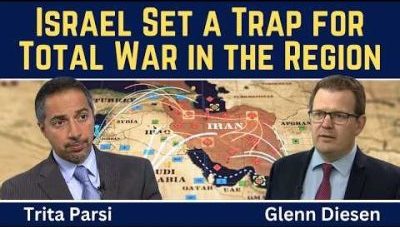
By Trita Parsi | June 8, 2026
It remains unclear whether Iran’s effort to establish a new equation in the region has truly succeeded — an equation in which, for the first time, Iran would directly strike Israel if Israel attacks Lebanon.
What is clear is that recent events suggest the strategic landscape may be shifting. Israel chose to defy President Trump and carry out strikes against Iran. Yet according to both Iranian and American sources, those Israeli attacks appear to have been deliberately calibrated to inflict limited damage, perhaps reflecting U.S. pressure to avoid a broader escalation.
Iran, for its part, responded by striking Israel once more after the Israeli attacks. The full extent of the damage caused by Iran’s two rounds of attacks remains unknown, however, due to extensive Israeli military censorship. As a result, outside observers still lack a complete picture of the military and strategic consequences of these exchanges.
The real test of whether a new regional equation has emerged may not lie in what has already happened, but in what comes next. Specifically: Will Israel strike Beirut again?
Even if it does, Israeli decision-makers will now have to factor in a cost that did not previously exis — the likelihood of a direct Iranian response against Israel. For decades, Israel enjoyed near-complete freedom of maneuver in much of the region. It could bomb targets in Lebanon at will without facing meaningful costs imposed by third parties. That assumption may no longer hold.
At the same time, the United States has signaled clearly that it no longer intends to be an active participant in Israel’s confrontation with Iran. The White House has, for instance, stated that it did not partake in Israel’s defense this time around. This would be a first and a very alarming development for Israel, if true. Washington’s desire to avoid direct involvement has become increasingly evident, even as it continues to support Israel in other ways.
Taken together, these developments suggest that a new strategic reality may be in the making. The picture remains murky, and it is far too early to declare that a durable deterrence framework has been established. Much will depend on future Israeli actions, Iranian responses, and the degree to which both sides internalize the risks of escalation.
But if Israel now has to weigh the prospect of direct Iranian retaliation before striking Lebanon, then something important has changed. Whether that change proves temporary or enduring remains to be seen.
The next question is whether this emerging equation can be translated into renewed momentum for U.S.-Iran diplomacy.
The Iranians believe that their action demonstrated to the US that the value of the Memorandum is so low that Iran is willing to risk a complete collapse of diplomacy. The hope is that Trump yields on what appears to be the last sticking point in the talks, which is the release of $12 billion of Iranian frozen assets.
Trump, on the other hand, may calculate that the exchange of fire demonstrated both the cost to Iran if full-scale war were to break out again, as well as Trump’s ability to impose certain restraints on the Israelis. As a result, the Iranians should feel confident in Trump’s ability to deliver on his end of the bargain and not insist on the release of the assets at the outset of the MOU.
But neither side should be aware: If no movement is achieved in the next 72 hours, Netanyahu may once again feel emboldened to attempt another sabotage of the talks. How many flare-ups can this diplomatic process absorb before it collapses?
Trita Parsi is the co-founder and Executive Vice president of the Quincy Institute for Responsible Statecraft.
By Salman Rafi Sheikh – New Eastern Outlook – June 8, 2026
Donald Trump’s attempt to tie an Iran peace settlement to a mandatory expansion of the Abraham Accords reveals a fundamental misunderstanding of how dramatically the Middle East has changed since the Gaza war and why old diplomatic formulas no longer work.
Donald Trump has a habit of mistaking the décor of diplomacy for its substance. His latest demand — that Saudi Arabia, Qatar, Pakistan, Turkey, and others must “mandatorily” join the Abraham Accords as a condition for any Iran peace settlement — is not bold dealmaking. It is a category error dressed up as statecraft, one that conflates a 2020 diplomatic triumph with the profoundly different geopolitical realities of 2026. The silence that reportedly greeted Trump on his conference call with regional leaders was not awkward; it was diagnostic.
The Middle East Trump Remembers Does Not Exist
The original Abraham Accords of 2020 were a very significant development for several reasons. They emerged from a specific regional calculus: Gulf states, quietly terrified of Iranian expansionism, had come to view Israel as a strategic asset rather than an ideological liability. The Palestinian issue, while never abandoned rhetorically, had receded to the background of realpolitik. The formula worked precisely because it did not require Israel to make concessions and because the public cost of signing was, at the time, manageable. That calculus has been demolished by the Gaza war.
A Washington Institute for Near East Policy survey published in August 2025 found that 99% of Saudi respondents viewed normalization with Israel as a negative step. For context, in 2020, 41% had considered the Abraham Accords a positive development for the region. By 2025, that figure had collapsed to 13%. This is not marginal drift; it is a tectonic shift in public sentiment that no Arab leader, not even an absolute monarch, can afford to ignore. Crown Prince Mohammed bin Salman reportedly told US lawmakers in 2024 that his efforts to advance normalization had put his life at risk. That is not a man about to sign anything without ironclad political cover.
Saudi Arabia’s position is now unambiguous and unyielding: there will be no normalization without “an irreversible pathway” to Palestinian statehood. That pathway cannot be a vague promise or a roadmap but a concrete and verifiable process. Thus, Saudi Israeli normalization is not merely paused; it is contingent on developments in the Palestinian arena and shifts in how Israel is perceived regionally. Given the vastly changed regional scenario, Saudi efforts are geared less towards normalization with Israel than towards shaping a new regional agenda in which distancing from Israel serves both the Crown’s domestic legitimacy and its aspirations for broader Islamic leadership.
Pakistan’s refusal is even more visceral. Defence Minister Khawaja Muhammad Asif flatly stated that joining the Abraham Accords “clashes with our fundamental ideologies,” and pointedly noted that Pakistani passports do not even carry Israel’s name as a valid travel destination. This position stretches back to Pakistan’s founder Muhammad Ali Jinnah’s explicit rejection of the UN partition of Palestine in 1947. The question of recognizing Israel, therefore, is not a negotiating posture; it is a constitutional identity. Qatar, meanwhile, which absorbed an Israeli airstrike as recently as last September, was never a realistic candidate.
Bundling Two Crises into One Catastrophe
There is a second, more immediate danger in Trump’s gambit: it actively threatens the Iran negotiations themselves. As even reports in the mainstream US media noted, the idea of a massive expansion of the Abraham Accords at a moment when the US has not yet secured the reopening of the Strait of Hormuz — let alone resolved Iran’s nuclear program — “seems almost absurd.” The Iran talks are already burdened with sticking points: Washington insists Iran must surrender its enriched uranium stockpile, while Tehran has insisted nuclear negotiations be deferred to later discussions and continues to demand sanctions relief and the release of frozen assets. Threading that needle is already the diplomatic equivalent of defusing a bomb blindfolded. Attaching an Israel-normalization condition to it hands Iran a ready-made argument for walking away or highlighting why the US cannot be trusted with any deal.
Not just Tehran, Iran’s neighbors — having watched Tehran survive American and Israeli airstrikes, endure a maritime blockade, and still inflict damage on global energy markets — are unlikely to respond positively to Trump’s appeal. There is a grudging, regionally shared respect for Iran’s resilience, and any demand that frames joining the Abraham Accords as a precondition will be read across the Islamic world not as American leverage but as American tone-deafness.
That said, Trump’s push might placate Israel’s Benjamin Netanyahu, who has been deeply critical of US attempts to reach a peace agreement with Iran. If true, it means Trump is risking the entire Iran settlement — a genuinely consequential achievement — to manage Netanyahu’s domestic politics. That is a trade-off of staggering irresponsibility. And in a telling sign of how reality eventually wins, by Thursday this week, US sources confirmed that a tentative framework agreement with Iran was pending Trump’s approval, with the Abraham Accords entirely absent from it.
Where This Leads
Trump’s retreat from his “mandatory” demand has already begun. What comes next will reveal the structural fragility of his approach. A ceasefire framework with Iran, if finalized, will be celebrated as historic, and rightly so. But the moment that diplomatic high fades, the region it leaves behind will be considerably more resistant to the kind of top-down normalization that the Abraham Accords represented.
Instead, the explicit rejection of Trump’s demand shows that Israel now risks a form of diplomatic isolation it has not faced since before the Oslo era, as the binary division between a “moderate axis” including Israel and Gulf states gives way to more fluid alignments that no longer treat Iran as the primary regional threat and in which public identification with Israel is seen as illegitimate and potentially regime-threatening.
The harder question is whether the United States can build a durable Middle East architecture on the foundation of a deal that most of the region’s population views as illegitimate. Normalization imposed by American diktat, without justice for Palestinians and for the Iranians, will not hold. Agreements signed under duress — economic, diplomatic, or military — have a long history of unraveling, often at the worst possible moment. What the post-Gaza Middle East demands is not a grander version of the Abraham Accords. It demands a reckoning with why those accords, for all their genuine diplomatic ingenuity, failed to prevent the conditions that produced October 7 in the first place. Until Washington grasps that, its deal-making — however theatrical — will keep colliding with a region that has moved on.
Salman Rafi Sheikh is a research analyst of international relations and Pakistan’s foreign and domestic affairs.
Follow new articles on our Telegram channel
or go to
Aletho News Archives – Video-Images
By Donald Neff | Washington Report On Middle East Affairs | January 1996
On January 4, 1948, Jewish terrorists drove a truck loaded with explosives into the center of the all Arab city of Jaffa and detonated it, killing 26 and wounding around 100 Palestinian men, women and children.[1] The attack was the work of the Irgun Zvai Leumi – the “National Military Organization,” also known by the Hebrew letters Etzel – the largest Jewish terrorist group in Palestine. The Irgun was headed by Revisionist Zionist Menachem Begin and had been killing and maiming Arabs, Britons and even Jews for the previous ten years in its efforts to establish a Jewish state.
This terror campaign meant that at the core of Revisionist Zionism there existed a philosophical embrace of violence. … continue
 Aletho News If Americans Knew No Tricks Zone
