Netanyahu: UN Gaza probe should be ‘shelved’
MEMO | February 3, 2015
Israeli Prime Minister Benjamin Netanyahu on Tuesday said that a probe by the UN Human Rights Council (UNHRC) into last year’s Israeli offensive against the Gaza Strip should be shelved in light of the recent resignation of inquiry commission head William Schabas.
“After the resignation of the committee chairman, who was biased against Israel, the report that was written at the behest of the UNHRC… needs to be shelved,” Netanyahu said in a statement.
The Israeli premier went so far as to slam the rights council as “an anti-Israel body, the decisions of which prove it has nothing to do with human rights.”
“This is the same council that in 2014 made more decisions against Israel than against Iran, Syria and North Korea combined,” Netanyahu asserted.
“It is Hamas, the other terrorist organizations and the terrorist regimes around us that need to be investigated, not Israel,” he added.
The Israeli government has already said it would not cooperate with the UNHRC committee formed to investigate violations committed during Israel’s onslaught on the Gaza Strip last July and August.
Israel had said that the UN council would not be objective.
The Israeli offensive left more than 2,160 Palestinians dead and some 11,000 injured – the vast majority of them civilians – while partially or completely destroying thousands of residential structures across the territory.
The onslaught, which was launched with the stated aim of ending rocket fire from the coastal enclave, finally ended with the announcement last August of an open-ended cease-fire between Israel and Palestinian resistance factions.
On Monday, Schabas, a Canadian professor of international law, reportedly resigned from his post as head of the investigation committee due to Israeli allegations of bias.
Israeli Foreign Minister Avigdor Lieberman, for his part, hailed Schabas’ resignation, saying it was a “victory” for the self-proclaimed Jewish state.
“It is an Israeli diplomatic victory. However, it will not change the probe’s conclusions,” he said.
He added that the appointment of Schabas to investigate last year’s war against Gaza was like “appointing Cain to investigate who killed Abel.”
Head of UN War Crimes Inquiry Resigns After Israeli Accusations of Pro-Gaza Bias
IMEMC News & Agencies | February 3, 2015
The head of a UN inquiry into last summer’s Israeli military offensive in Gaza has said he will resign after Israeli allegations of bias, due to consultancy work he did for the Palestinian Liberation Organisation (PLO).
William Schabas, a Canadian academic, was appointed last August by the head of the UN Human Rights Council to lead a three-member group looking into war crimes during the offensive.
Al Ray reports that, according to the Guardian and in a letter to the commission, a copy of which was seen by Reuters, Schabas said he would step down immediately to prevent the issue from overshadowing the preparation of the report and its findings, which are due to be published in March.
Schabas’ departure highlights the sensitivity of the UN investigation just weeks after prosecutors at the international criminal court in The Hague said they had started a preliminary inquiry into atrocities committed in the Palestinian territories.
In the letter, Schabas said that a legal opinion he authored for the PLO in 2012, and for which he was paid some $1,300 (£900), was not different from advice he had given to many other governments and organizations.
“My views on Israel and Palestine as well as on many other issues were well known and very public,” he wrote. “This work in defence of human rights appears to have made me a huge target for malicious attacks.”
Israel has long criticized Schabas’ appointment, citing his record as a strong critic of “the Jewish state” and its current political leadership. Schabas said his work for the PLO had prompted the Human Rights Council’s executive to seek legal advice about his position from UN headquarters on Monday.
“I believe that it is difficult for the work to continue while a procedure is underway to consider whether the chair of the commission should be removed,” he wrote, adding that the commission had largely finished gathering evidence and had begun writing the report.
The appointment of Schabas, who lives in Britain and teaches international law at Middlesex University, was welcomed at the time by Hamas but was harshly criticized by Jewish groups in the US.
Schabas, at the time, had said that he was determined to put aside any views about “things that have gone on in the past”.
The commission is looking into the behavior of both the Israelis and of Hamas.
Sabino Romero’s Widow Testifies Amidst Threats

Sabino’s widow, Lucia Martinez de Romero, testified at court today (Aporrea)
By Lucas Koerner | Venezuelanalysis | February 2, 2015
Caracas – Dozens of activists gathered outside the Ministry of Justice in the capital today in solidarity with Lucia Martinez de Romero, the widow of assassinated indigenous Yukpa leader Sabino Romero. Today she testified in the trial of Angel Antonio Romero Bracho, (aka “Manguera”) accused of murdering the indigenous chief or “cacique”.
Lucia herself also suffered multiple gunshot wounds the night of March 3, 2013 when her husband was shot and killed by hired assassins reportedly acting in the service of wealthy cattle ranchers.
Lusby Portillo, 66, Coordinator of the Zulia-based Homo Et Nature Society, explained what is at stake in today’s proceedings:
“Today there is a trial against the physical murderer, who shot and killed [Sabino] and wounded Lucia Martinez. Five police officers from Machiques have already been tried and given seven years of prison… They gave them seven years, because there was influence on the part of the cattle ranchers, who paid so that the court would decide a minimum sentence of seven years”.
Portillo is one of the principal activists to have followed the case over the past 23 months. He told Venezuelanalysis that many indigenous activists feared that a miscarriage of justice would take place unless supporters continued to draw attention to the case. One witness today also noted that the family of Manguera began to threaten Lucia before she was due to testify.
“If we let our guard down, if we don’t protest, if we don’t make movies, if we don’t write articles, if we don’t get the word out, these courts are going to give Manguera ten, eleven years, and then within two or three years he can go free with all of the benefits…So we are demanding thirty years of prison [for Manguera], and we’re also demanding that the trial against the five police officers be annulled, that there be a new trial, and that… the intellectual actors… the cattle ranchers who financed [the murder], who are millionaires, go to trial.”
Land Struggles
In the leadup to his assassination, Rabino spearheaded a series of occupations by Yukpa campesinos of the expansive rancher haciendas established on their ancestral land in Sierra de Perijá, which were returned to them by the current socialist government under the Constitution. According to Portillo, these lands were violently confiscated by the government of dictator Juan Vicente Gomez in 1930, driving the Yukpa people into the mountains. When they subsequently attempted to retake their lands, as Sabino would do over eighty years later, they were brutally massacred by the cattle ranchers.
For indigenous rights activist Tibisay Maldonado, 52, however, this struggle goes much further back than eighty years.
“We are active in the organization National Front for Land Struggle, because, even though we are from Caracas we are from the city, this problematic of the land, this plundering from 500 years ago. We are the inheritors of a dispossession, of an invasion 500 years ago, and the indigenous peoples remain in resistance, and we must stand with them”.
Amid Trial, Impunity Continues for Murder of 8 other Yukpa Leaders
Portillo went on to criticize what he described as “impunity” for the hired killers of indigenous leaders and their intellectual and financial backers.
“Of the Yukpa [leaders] killed over the question of land, who are nine up until now, only the case of Sabino has been taken to the courts, but the [case of the] other eight murdered [leaders] has not been investigated nor brought to trial…Besides trial for [the case of] Sabino, there also needs be trials for the other eight Yukpa who were assassinated.”
Nonetheless, for Leonardo Dominguez, the problem goes well beyond these nine assassinated leaders, encompassing the issues of paramilitary violence in Venezuela writ large;
“This is something that is practiced in Colombia. These are new crimes in Venezuela. So I think the laws need to stipulate a decent punishment for this murderer to mark a precedent, because enough is enough. There have already been 359 campesinos assassinated at the hands of the hitmen, plus workers’ leaders, plus popular leaders. We want peace, but we believe peace is achieved through struggle. If you want peace, prepare for war,” he said.
A Test for the Revolution
For those present outside the Ministry of Justice, today’s trial represents a fundamental test of the Bolivarian government’s commitment to defending indigenous rights.
“Socialism has two paths,” warns Dominguez..”Either we’re with the indigenous people or we’re with the murderers.”
Despite the challenges faced by the Yupka people, including the relative inaction of the government, Jessy Rojas, 20, of Urbano Aborigen, is nevertheless hopeful. She stated that there had been a “fair amount of gains” for indigenous people under the Bolivarian Revolution, including the trial of Sabino’s murderer.
“In the past, there generally weren’t trials for indigenous cases. In the past, there wasn’t this openness to discussing indigenous issues in the capital”.
According to Jessy, these historic gains are propelling young activists to take the struggle evern further.
“This is the moment to demand,” she asserted.
The case has been adjourned until February 13th.
Charges against Israeli war crimes protesters dropped
MEMO | February 2, 2015
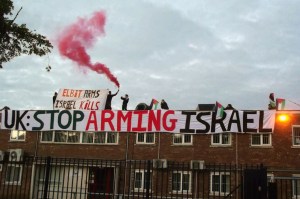
The Crown Prosecution Service (CPS) has dropped charges against nine activists who occupied the roof of an Elbit Systems factory in Staffordshire during Israel’s assault on the Gaza Strip last year.
The collapse of the case came as the defence company “refused to hand over evidence about its exports of weaponry to Israel.”
The protesters from London Palestine Action had been facing charges of aggravated trespass after shutting down UAV Engines Ltd. (UEL), an Elbit subsidiary, for two days 5-6 August 2014.
But charges were dropped by the CPS “just hours before a deadline expired to provide the defendants with details of arms export licences granted to UEL to send its hi-tech engines to Israel for use in the Hermes 450 – a drone widely deployed by the Israeli military.”
According to a report in The Independent, two witnesses from the company declared that they were “no longer prepared to give evidence, and that documentation – understood to be the arms export data – would not be forthcoming.”
A statement from London Palestine Action accused the UK government and Elbit Systems of “running scared from a court case that would have put their collusion with Israeli war crimes on trial.”
The statement added: “The activists pleaded not guilty to charges of ‘preventing lawful activity’ on the basis that the operations at the Staffordshire factory were aiding and abetting war crimes and therefore illegal.”
Lawyers for the defendants say it appears the case collapsed either because the prosecution had been told either that Elbit Systems were unwilling to testify in court about their activities or because the UK government was unwilling to comply with the court’s order to disclose information it holds about licenses for arms exports to Israel, or both.
Lieberman: Third Lebanon war, fourth Gaza operation inevitable
Press TV – February 1, 2015
Israel’s foreign minister has described as “inevitable” a third war with Lebanon and a fourth aggression in the besieged Gaza Strip in the wake of a recent retaliatory attack by Hezbollah.
“A fourth operation in the Gaza Strip is inevitable, just as a third Lebanon war is inevitable,” Avigdor Lieberman said in an interview with Israel’s Ynet on Sunday.
“There’s no doubt the rules of the game have been changed, what Hezbollah forced upon us. We don’t respond, but rather decide to contain this incident,” Lieberman said, adding that the Lebanese resistance movement is “more determined.”
The Israeli official also said that another war on the Gaza Strip was on the horizon, adding that Hamas was already rebuilding its military capacities.
“We saw 10 rockets being fired at the sea last week. We see every week how they’re rebuilding [their arsenal],” he said, referring to the Palestinian resistance movement.
Hezbollah killed two Israeli soldiers and destroyed at least nine Israeli military vehicles in a retaliatory attack on a military convoy in northern occupied territories on January 28. Tel Aviv said a 20-year-old sergeant and a 25-year-old captain were killed.
Following the attack, Hezbollah said the move was in retaliation for Israel’s January 18 attack on the Syrian section of Golan Heights, where six Hezbollah members and an Iranian commander lost their lives.
Jihad Mughniyeh, the son of martyred Hezbollah top commander, Imad Mughniyeh, was among those killed in the attack.
Israel Arrests, Mistreats 700 Palestinian Children Every Year: Report

Palestinian protestors hold posters of 14-year-old Palestinian girl Malak al-Khatib who is in Israeli jail, during a demonstration to show solidarity with Palestinian prisoners in Nablus, West Bank on January 27, 2015. Anadolu Agency/Nedal Eshtayah
Al-Akhbar | February 1, 2015
A lawyer for the Department of Prisoner Affairs released a report on Saturday on the mistreatment of Palestinian minors by Israeli Occupation Forces (IOF) after she visited Palestinian minors in Israeli custody.
The report came after Child Rights International Network (CRIN) published in its first 2015 report that some 700 Palestinian children per year are arrested and face “ill-treatment” by the IOF.
The IOF have shut down a program meant to decrease the number of nighttime arrest raids targeting children in Palestinian homes after less than a year, with statistics suggesting that even when the program was active night raids barely decreased at all.
Military Court Watch, a Palestinian legal monitor focused on the treatment of Palestinian children in Israeli detention, said in a statement on Thursday that the Israeli military had also failed to keep any statistics on the program it implemented of its own accord, meaning no independent evaluation could be conducted.
The report comes less than a year after Israeli military authorities unveiled the program to the international media with great fanfare, in the wake of a series of concerns raised in Europe and Australia over the effects of Israeli nighttime raids on Palestinian homes.
Hiba Massalha said in a statement that many of the minors spoke of being assaulted and beaten during their arrests and throughout interrogation.
Malek Hamdan, a 16-year-old Palestinian from Jerusalem, was beaten to the point of his bones being fractured while he was held at the Russian Compound detention center, the statement said.
Additionally, 17-year-old prisoner Mohammed Abdul Fattah Radwan, from Qalqiliya, told Massalha that during his detention, he was assaulted and dragged for a long distance while handcuffed and blindfolded.
Radwan was held at the al-Jalama detention center for 15 days. He was interrogated for several hours each day while tied to a small chair.
The teen said he was held in a small, filthy, cold room with the lights kept on all day and all night.
Another prisoner, 16-year-old Mohammed Yusuf Ikhleil from al-Khalil (also known as Hebron), was detained on November 1 while he was on his way home from school. He is currently being held in HaSharon prison.
Ikhleil said he was shot with a live bullet in the thigh, and while he was being detained, he lost a lot of blood as Israeli soldiers beat him.
He was moved to the Soroka Hospital in Beersheba for treatment, where he was kept in the ICU for three days and underwent a bone surgery for his thigh injury.
Ikhleil added that he was interrogated for an hour while at the hospital, and that he was shackled to the bed for 24 hours while guards watched him.
He was taken to the al-Ramla Hospital where he stayed for two months before being moved to HaSharon prison.
Meanwhile, 14-year-old prisoner Hussam Omar Mohammed Abu Khalifa from Bethlehem is suffering from depression and needs constant medical care.
Hussam is currently being held in HaSharon prison.
Moreover, 18-year-old Lina Khattab, a student at Bir Zeit University and dancer in the al-Funoun Palestinian cultural dance troupe, was arrested on December 18 and charged in a military court for “throwing stones” and “participating in an unauthorized demonstration.”
Khattab’s trial has been postponed more than six times. The military court had refused to release her on bail or put her in house arrest. The judge said at the time: “looking at her, I can see the characteristics of a leader.”
In 2013, the UN children’s fund (UNICEF) reported that Israel was the only country in the world where children were “systematically tried” in military courts and gave evidence of practices it said were “cruel, inhuman and degrading treatment or punishment.”
The UNICEF report said in a 22-page report that over the past decade, Israeli forces have arrested, interrogated and prosecuted around 7,000 children between 12 and 17, mostly boys, noting the rate was equivalent to “an average of two children each day.”
CRIN report
According to CRIN, some 700 Palestinian children per year are arrested and face “ill-treatment” on the hands of Israeli soldiers.
“During 2014, an average of 197 children were held in military detention every month, 13 per cent of whom are under the age of 16,” the CRIN report read.
“Arrested children are commonly taken into custody by heavily armed soldiers, blindfolded with their wrists tied behind their backs before being transported to an interrogation centre,” CRIN said, adding, “Children questioned about their experience frequently report verbal and physical abuse during the arrest.”
According to research conducted by Defense for Children International in Palestine, which was cited by CRIN in their report, some 56 percent of children report having experienced “coercive” interrogation techniques during their time in Israeli custody.
Some 42 percent say they were forced to sign documents in Hebrew, despite the fact that most Palestinian children do not speak or understand the language.
Additionally, 22 percent of detained children say they underwent up to 24 hours of solitary confinement, in violation of international standards.
“This detention is a clear violation of children’s rights under several international human rights treaties to which Israel is a party,” the CRIN report said.
“The UN’s Special Rapporteur on Torture has called for a complete ban on solitary confinement for juveniles, warning that it ‘can amount to torture or cruel, inhuman, or degrading treatment or punishment when used as a punishment, during pre-trial detention, indefinitely or for prolonged periods, for persons with mental disabilities or juveniles.'”
The report said that while it is technically possible to file a complaint about the way a child is treated in Israeli detention, “complaints are almost universally dismissed,” and there are “very few examples of soldiers being punished for ill-treatment.”
The report highlighted a case in which a 14-year-old girl from Ramallah was arrested on December 31 and held for 22 days in Israel before being issued a sentence.
She was charged with throwing stones, blocking the road, and allegedly possessing a knife, “sentenced to two months in prison, and fined $1,528 by an Israeli military court.”
The Israeli cabinet approved early November a new legislation that would allow the imposition of a prison sentence up to 20 years for those convicted of throwing stones or other objects at Israeli soldiers or their vehicles.
Her father believes she was coerced into confessing, saying: “She seemed to be very sick and scared.”
“The plight of this one girl put a face on a system that routinely runs roughshod over children’s rights,” CRIN said, adding “But behind this story there is a broader issue.”
The report recommended reforms while noting that countless other recommendations by human rights groups regarding the treatment of Palestinian children in Israeli custody have gone unheeded by Israeli authorities.
Ultimately, CRIN concluded, children will never be treated well under an Israeli military justice system.
“Regardless of the precise formulation of military rule, it can never protect children in the same way as a developed civilian juvenile justice system which places the best interests of the child at the center of its work,” the report read.
(Ma’an, Al-Akhbar)
Jewish settler runs over Palestinian journalist in al-Khalil
Palestine Information Center – February 1, 2015
 AL-KHALIL – A Jewish settler ran over a Palestinian journalist called Raed Abu Rmaileh at noon Sunday near al-Haram al-Ibrahimi Mosque in the Old City of al-Khalil.
The PIC reporter said the journalist Abu Rmaileh was transferred to hospital by Palestinian Red Crescent ambulance for treatment in one of the city’s hospitals.
Abu Rmaileh is a journalist from al-Khalil. He is working at B’Tselem human rights organization; he documents the Israeli crimes against Palestinians in al-Khalil, specially the Old City and the vicinity of al-Haram al-Ibrahimi Mosque.
Nasrallah: The Rules of Engagement with Israel Are Over
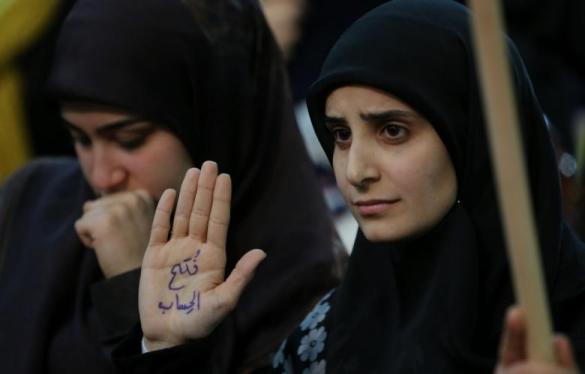
A Hezbollah supporter with the words “time for retribution” written on her hand attends a memorial ceremony to honor six Hezbollah fighters killed in Syria by an Israeli airstrike, during which Hezbollah Secretary-General Hassan Nasrallah made a televised speech. Al-Akhbar/Marwan Tahtah
Al-Akhbar | January 30, 2015
“Don’t try us,” Hezbollah Secretary-General Hassan Nasrallah told Israel in a televised speech Friday broadcast during a memorial ceremony to honor the six Hezbollah fighters and the Iranian general killed in an Israeli airstrike in Syria earlier this month.
On January 18, an Israeli helicopter airstrike on the Syrian city of Quneitra near the Israeli-occupied Golan Heights killed six fighters of Lebanon’s resistance movement Hezbollah, including a commander, Mohammed Abu Issa, and the son of assassinated senior commander Imad Mughniyeh, as well as Iranian Revolutionary Guard General Mohammed Ali Allahdadi.
Hezbollah has been fighting alongside President Bashar al-Assad in Syria against rebels in the nearly four-year Syrian conflict.
According to Nasrallah, who spoke for an hour and a half, Israel had “planned, calculated and took a premeditated decision to assassinate” the fighters, saying that the motive behind the attack was crystal clear.
Hezbollah’s chief said that while Israel isn’t worried about thousands of armed militants from the al-Nusra Front — al-Qaeda’s branch in Syria — near territories it occupies, the Zionist state “was scared on January 18 of six unarmed Hezbollah fighters and an Iranian in civilian vehicles.”
Observers from the United Nations Disengagement Observer Force (UNDOF) confirmed in a report published in December documenting cooperation and coordination between the Israeli army and militant groups in Syria.
The UNDOF report said that observers witnessed several meetings between rebel leaders and Israeli army forces between December 2013 and March 2014, in addition to witnessing the transportation of injured militants to Israeli hospitals following confrontations between the militants and the Syrian army near the occupied Golan border.
Nasrallah said that those killed in the Quneitra attack showed a “fusion of Lebanese-Iranian blood on Syrian soil, and reflects the unity of the cause and the unity of the fate of the countries in the axis of resistance.”
“When the blood of Palestinians, Lebanese, Syrians and Iranians unites, we will enter an era of triumph,” he added.
The deaths of Allahdadi and Issa revealed that commanders were present on the ground alongside fighters, Nasrallah said, adding that Jihad Mughniyeh’s death showed how entire families and not just individual members were joining the resistance.
Nasrallah extended his condolences to the families of the Hezbollah fighters as well as the families of the eight Lebanese soldiers who were killed last week in clashes with al-Nusra Front militants in the area of Tallet al-Hamra near Ras Baalbek on the Lebanese-Syrian border.
Nasrallah’s remarks came two days after Hezbollah claimed responsibility for an attack against an Israel Occupation Forces (IOF) convoy in Israeli-occupied Lebanese Shebaa Farms that left a number of Israeli soldiers dead.
According to Israeli figures, two soldiers were killed and seven others were wounded, although Hezbollah-owned Al-Manar news channel said the toll was much higher.
“They killed us in broad daylight, we kill them in broad daylight … they struck two of our vehicles, we targeted two of their vehicles,” Nasrallah said, likening the Quneitra strike to the one by Hezbollah in Shebaa.
“The only difference is that we announced that Israel struck our fighters in Quneitra half an hour after the attack, whereas the Israelis didn’t,” Nasrallah continued, adding that the number of casualties on the Israeli side was “debatable.”
The Shebaa Farms area is a mountainous, narrow sliver of land rich in water resources measuring 25 square kilometers (10 square miles). It has been illegally occupied by Israel since the 1967 Middle East war, although Lebanon has never ceased to call for its restitution.
Israel occupied most of southern Lebanon for 22 years until 2000 and the two countries are still technically at war.
“The Israelis can’t kill our people and then go to sleep … their farmers can’t stay in their fields and their soldiers can’t stroll up and down the border as if they merely killed mosquitoes,” Nasrallah said, asserting that the Zionist state would pay a price for all of its criminal actions even if that meant going to war with Israel.
“We don’t want war but we are not afraid of going to war,” Nasrallah assured. “I think the Shebaa attack was a clear message … Israel was humiliated on Wednesday.”
Nasrallah said Hezbollah would retaliate against any future Israeli attacks on its members “whenever, however and wherever,” adding that the Hezbollah “no longer cares about the rules of engagement anymore.”
“Don’t try us,” Nasrallah defiantly said to Israel.
Since the January 18 airstrike, troops and civilians in northern Israeli-occupied territories of Palestine and the occupied Golan Heights have been on heightened alert and Israel has deployed an Iron Dome rocket interceptor unit near the Syrian border.
“Israelis have been on edge ever since they targeted our fighters in Quneitra,” Nasrallah stated.
Following Wednesday’s attack, Israeli forces hit several Lebanese villages along the border, killing a 36-year-old UN peacekeeper.
Israeli warplanes routinely violate Lebanon’s airspace and have launched several attacks against Syrian targets in recent months, some reportedly carried out from over Lebanon.
On Thursday, Lebanon’s National News Agency (NNA), said Israeli fighter jets penetrated deep into Lebanese airspace, startling residents as the jets flew over the capital Beirut. Israeli jets were also seen flying over southern Lebanese towns.
Nasrallah said Israel has violated Lebanese’ sovereignty and the 1701 UN resolution “thousands of times” and “on daily basis.”
Moreover, Nasrallah slammed the Arab League as “nonexistent” when it came to fighting Israel and supporting Palestinians, saying the 22-member league has served Israel more than the Palestinians. He gave the 51-day Israeli summer assault on Gaza that left 2,300 Palestinians dead as an example of the Arab League’s failure.
Israeli army spokesman Lieutenant Colonel Peter Lerner said Wednesday’s attack was the “most severe” Israel had faced since 2006, when its war with Hezbollah killed more than 1,200 people in Lebanon, mostly civilians, and some 160 Israelis, mostly soldiers.
Israel and the US: a Troubled Romance
By Robert Fantina | CounterPunch | January 30, 2015
It is sometimes interesting to see the many hoops the United States jumps through to accommodate the brutal whims of Israel. With Palestine ratifying the Rome Statute, and the International Criminal Court (ICC) beginning its initial investigation of possible Israeli war crimes committed against the Palestinians, more such information is leaking out.
Israel, it is reported, is pressuring nations that fund the ICC, however inadequately, to either reduce or suspend that funding altogether. Reports are that poor Israel is being rebuffed at every turn, with the major funding nations saying they have no intention of making such adjustments. The U.S., this writer is sure, would cease all funding for the ICC, if it had ever deigned to join. But no international body, it seems, has the right to judge the soldiers and/or leaders of the self-described ‘land of the free and home of the brave’ for illegal invasions, wanton killing of civilians, or torture of political prisoners. So Israel, which has in the past successfully demanded that the U.S. cease any aid to Palestine, can’t rely on the U.S. to pull the plug on the ICC.
All this comes at a very awkward time for the troubled romance between Israel and the U.S., a time when perhaps the final nail has been hammered into the coffin of the dysfunctional bromance between U.S. President Barack Obama and Israeli Prime Murderer Benjamin Netanyahu. In March, Mr. Netanyahu will visit the U.S. to give Congress his instructions regarding U.S. negotiations with Iran. This, in all likelihood, will torpedo the delicate, years-long negotiations that Mr. Obama, with support from much of the international community, has been spearheading. But the general direction of these negotiations has been displeasing to Mr. Netanyahu, and he will inform Congress of that fact in no uncertain terms. Congress, always responsive to the holders of the purse strings, will fall into line. So what if it means that more young Americans will be sent to kill and die in another war? What is this, when funds are needed for one’s next re-election campaign?
A presidential spokesperson said that Mr. Netanyahu’s forthcoming visit to the U.S. is a slap in the face of Mr. Obama. And U.S. Secretary of State John Kerry, an international joke if ever there was one, is said to be particularly peeved. Did he not, as has since been reported, contact at least fifty world leaders in December, begging and pleading with them on Israel’s behalf, to vote down a resolution being introduced at the United Nations, that would have mandated an end to the Israel occupation of Palestine by 2017? Was he not successful in procuring Israel’s desire at the expense of the basic human rights of the Palestinians? And then, within days, to have Mr. Netanyahu spit in his eye! Oh, the shame of it! One is confident that Mr. Kerry will send a strongly-worded message to someone in Israeli diplomatic circles, perhaps a staff member responsible for cleaning the guest bath at the ambassador’s residence.
A reasonable person might ask what response to this is most appropriate. Unfortunately, we have moved far beyond reasonable when the U.S. tramples the basic human rights of an entire nation to please a powerful lobby, and when a member of the House of Representative invites a world leader to address Congress without mentioning it to the president. But let’s play the ‘what if’ game anyway.
The U.S. gives Israel $3 billion a year, with no strings attached. One might think that that would give the U.S. some leverage in getting Israel to adapt its behavior in some way. Might not the U.S. say that the next gift, perhaps a shipment of bombers, is contingent on a cessation of new, illegal settlement activity? Or perhaps an end to the brutal blockade of the Gaza Strip? Some adherence to international law, it seems, could be tied to continued U.S. funding.
But no, there is no precedent for such actions; in fact, the reverse is true. There is historical precedent for simply writing a blank check to Israel. In 1988, an Israeli journalist commented that “One may say no to America and still get a bonus.” Nothing has changed in twenty-seven years.
So there we are. In March, Mr. Netanyahu will be in town to address Congress and participate in that even more important governing body, AIPAC (American Israel Political Affairs Committee). Most of Congress will join him there, where the real governing takes place, to bow and scrape before the holders of the biggest checkbooks. Heaven forbid they spend as much time or energy with constituents; what a waste of valuable time! Money, it is said, talks, and the members of Congress always have a listening ear.
Fortunately, the rest of the world is looking in another direction, recognizing the arrogance of Mr. Netanyahu, the cruelty of the occupation, the hypocrisy of the U.S. and the ineffectual administration of Mr. Obama. The work of the ICC will continue slowly, but it will continue. Without Israel’s cooperation, which it has vowed not to provide, there may be no just outcome, but the focus is on Israel. While an accused is presumed innocent until proven guilty, the reputation of an accused who gets off on the technicality of refusal to cooperate is more than a little tarnished. Israel’s long walk toward international isolation is accelerating. And the U.S. is only expediting it.
Whatever the next several months bring for Palestine, Israel and the U.S., only a few things are sure: Palestinians will continue to suffer under the brutal, apartheid Israeli regime even as more and more nations recognize it; Israel will continue to draw almost universal condemnation, with the U.S. being the main holdout, for the brutal occupation of Palestine, and the U.S., long seen outside its own borders as the world’s main terrorist nation, trampling on the human rights of entire nations simply to ensure the filling of corporate coffers, will do nothing to dissuade the world from that opinion. The U.S. and Israel will impede the march of justice, but increasingly it is obvious that they cannot stop it.
Robert Fantina’s latest book is Empire, Racism and Genocide: a History of US Foreign Policy (Red Pill Press).
Professor Salaita Sues University of Illinois For Free Speech Rights
By Deirdre Fulton | Common Dreams | January 29, 2015
Professor Steven Salaita, a Palestinian-American professor of Indigenous studies whose offer of a tenured position at the University of Illinois at Urbana–Champaign was rescinded last year because of his tweets criticizing the Israeli government’s bombing of Gaza, has filed a civil rights suit against the school and its top officials and donors, saying that his termination violated his First Amendment right to free speech and other constitutional rights, as well as basic principles of academic freedom.
“Like any American citizen, I have the right to express my opinion on pressing human rights concerns, including Israeli government actions, without fear of censorship or punishment,” Salaita said in a statement. “The University’s actions have cost me the pinnacle of academic achievement—a tenured professorship, with the opportunity to write and think freely. What makes this worse is that in my case the University abandoned fundamental principles of academic freedom and shared governance, crucial to fostering critical thought, that should be at the core of the university mission.”
Salaita, who is being represented by the Center for Constitutional Rights along with the Chicago civil rights law firm of Loevy & Loevy, filed the lawsuit Thursday in a U.S. federal court in Chicago.
The complaint (pdf) alleges that university officials, including the chancellor and university trustees, violated Salaita’s constitutional rights to free speech and due process of law, and breached an employment contract with him. According to CCR, the suit is also against university donors who, based on emails made public, unlawfully threatened future donations to the university if it did not fire Salaita on account of his political views.
As Common Dreams reported in September, Salaita had been awarded the tenured position in fall 2013 and was scheduled to begin on August 16, 2014—just two weeks after Chancellor Phyllis Wise rescinded the offer. University documents released in response to a public-records request revealed that Wise had been pressured by numerous pro-Israel students, parents, alumni, and big-money donors to abort his appointment. These demands followed critical comments by Salaita regarding Israel’s most recent attack on Gaza, during which thousands of Palestinians, including hundreds of children, were killed.
The university’s action, which Wise explained was taken because Salaita’s speech lacked “civility,” spurred protests from within the university as well as the academic community at-large. Sixteen academic departments of the university have voted no confidence in the university administration, and prominent academic organizations, including the American Association of University Professors, the Modern Language Association, and the Society of American Law Teachers have publicly condemned the university’s actions.
“The use of ‘civility’ as cover for violating Professor Salaita’s rights must be challenged, as it threatens the very notion of a University as a place for free inquiry and open debate,” said Maria LaHood, a senior attorney with the Center for Constitutional Rights. “There is neither a ‘civility’ exception nor a ‘Palestine’ exception to the First Amendment.”
According to CCR, the lawsuit seeks Salaita’s reinstatement and monetary relief that includes compensation for the economic hardship and reputational damage he suffered as a result of the university’s actions.
“Only donor pressure, or sheer pride, can explain the administration’s stubborn refusal to revisit a decision that has done so much harm to Dr. Salaita and to constitutional and other principles that academics hold dear,” said Anand Swaminathan of Loevy & Loevy. “The administration has something to hide, and through this lawsuit we intend to expose it.”
Netanyahu and His Wife Sued For ‘Racist and Physical Abuse’ of African Bodyguard and Maid
By Zeidy David | Counter Current News | January 26, 2015
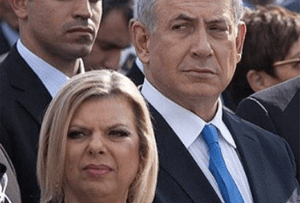 Benjamin Netanyahu has long been accused by Palestinians and African refugees of being a racist. But now the Israeli Prime Minister is being sued by a former bodyguard who says that he was constantly subjected to racist and physical abuse.
Manny Naftali, 35, says that Bibi and his wife Sarah did not just provide him with a job, primarily as a bodyguard, they also provided him with constant abuse. The former soldier says that the humiliating treatment by Mrs Netanyahu was the worse, and it occurred almost entirely with her husband’s knowledge.
The lawsuit was just filed with Jerusalem district labour court. Mr Naftali explains in the suit that he worked for 20 months at the Balfour Street residence.
During that time, he describes one particularly disturbing incident when Mrs Netanyahu complained to him about a Shabbat meal.
“We are sophisticated Europeans,” she explained to the Moroccan-descended Naftali. “We don’t eat as much food as you Moroccans. You are stuffing us, so that when they photograph us abroad, we look fat.”
It is unclear why the meal was being blamed on their African Jewish bodyguard.
Mrs Netanyahu also woke him at 3am once just to tell him that he had bought the wrong kind of milk the day before. The intention seemed clearly just to harass Naftali, not to explain her shopping preferences to him. Again, it would seem that the bodyguard was being asked to perform many jobs well outside of the boundaries of his job description.
“When I complained about the time and the tone in which she spoke the harsh words to me, Mr Netanyahu interfered in the discussion and said I should do everything Mrs Netanyahu asked ‘so she will calm down’,” Mr Naftali explained.
Once Sarah Netanyahu smashed a vase of flowers on the floor after discovering the flowers Naftali had placed in them were not fresh. Naftali, she said, “was a poor manager and that such a thing would never happen at the Elysee Palace”.
Naftali said that he was hardly the only one to allege such treatment. A full 29 staff members left “on a bad note.”
“It was made clear to me that I would have to work with a bitter and undermanned staff, and an unreasonable workload and an unending turnover of household workers who refused to work in the presence of the prime minister’s wife,” he added.
Naftali is suing for financial damages, but he is also demanding an apology after Bibi told a television interviewer that Mr Naftali was fired when in fact he had resigned.
This follows a suit in 2010 against the Netanyahus, where their maid, Liliane Peretz said she was constantly shouted at, humiliated, overworked and underpaid. She was also insultingly forced to change her cloths repeatedly throughout the day because the Netanyahus said she was unhygienic.
Featured Video

Piers Corbyn on religion of climate change
or go to
Aletho News Archives – Video-Images
New Documentary
“Inside Gaza” wins best documentary at Montreal’s Cinemania film festival
Palestine Information Center – November 16, 2026
MONTREAL – The documentary “Inside Gaza,” which chronicles the experiences of Palestinian journalists working with Agence France-Presse (AFP) while covering the Israeli war on the Gaza Strip, won the Best Documentary Award at the 32nd Cinemania International Francophone Film Festival held in Montreal, Canada.
Directed by Helene Lam Trong, the 72-minute film follows the daily lives of four AFP journalists who bear witness to the difficulties of reporting in a war-torn territory largely closed off to international media.
The film is compiled from material produced by the team on the ground, as well as from interviews conducted after they left.
The film also won the People’s Choice Award at the festival on Saturday. … continue
Blog Roll
 Aletho News
- Austria seeks to strip former foreign minister of citizenship over Russia ties
- “Inside Gaza” wins best documentary at Montreal’s Cinemania film festival
- Activists block German munitions plant over arms exports to ‘Israel’
- The Nasser Hospital attack and Israel’s relentless lies
- Could it be satan? No, Huckabee, just the Americans you work for
- AIPAC and more: Network of pro-Israel influence in US Congress
- Putin aide reveals Moscow’s stance on Europe at peace talks
- Imran Khan warns Pakistani judges he may die in prison
- IOF used Amazon facial recognition to track millions of Palestinians
- More EU Citizens Face Sanctions For Criticizing The Ukraine Proxy War
- If Americans Knew
- An error has occurred; the feed is probably down. Try again later.
- No Tricks Zone
- Argentina’s Perito Moreno Glacier Joins Antarctica and Arctic In Defying Doomsday Melt Claims
- New Study: Barents Sea Temperatures Were Warmer And Sea Ice Less Extensive In The 1700s Than Today
- German Authorities Start Initiative To Evaluate Public Register For Climate “Disinformation” Spreaders!
- Zonal Asymmetry of Temperature Change in the Antarctic Circumpolar Current
- New Study: The Net Fossil Fuel Contribution To Rising Atmospheric CO2 Has Been Zero For 500 Years
- Germany’s Green Energy Transition Becoming Increasingly Expensive…Another 6 Trillion Euros!
- Sudden Stratospheric Warming, Powerful El Niño Combination May Lead To Extreme Europe Cold, Energy Crisis!
- Two New Studies Find Thwaites Glacier Melt Cannot Be Driven By Human Activity Or A Warming Ocean
- E-Cars Reduce CO2 Emissions By Only 41% Compared To Internal Combustion Engine Vehicles
- Predictions Made By Renowned Climate Professor Over Past Decades Have Been Proven To Be Poor

