International Solidarity Movement honors Kayla Mueller
International Solidarity Movement | February 9, 2015
 Occupied Palestine – Kayla Mueller volunteered with the International Solidarity Movement from August to September of 2010.
On 4 August 2013 Kayla, 26, originally from Prescott, Arizona, was working with Syrian refugees when she was kidnapped after leaving a Spanish Doctors Without Borders hospital in Aleppo. Since that time she has been held in captivity by Da’esh (ISIS). This information was not previously released publicly out of concerns for her safety. On February 6th, Da’esh announced that she had been killed by Jordanian airstrikes in Raqqa, northern Syria. The validity of their announcement has not been confirmed.
Our hearts are with Kayla, her family, friends, and all those who have lost liberty, lives and loved ones in the global struggle for freedom and human rights.
With the ISM, Kayla worked with Palestinians nonviolently resisting the confiscation and demolitions of their homes and lands. In the Sheikh Jarrah neighborhood of Occupied East Jerusalem, she stayed with the Al Kurd family to try and prevent the takeover of their home by Israeli settlers.
Kayla accompanied Palestinian children to school in the neighborhood of Tel Ruimeda in Al-Khalil (Hebron) where the children face frequent attacks by the Israeli settlers and military. She stayed with villagers in Izbat Al Tabib in a protest tent to try to prevent the demolition of homes in the village. She joined weekly Friday protests in Palestinian villages against the confiscation of their lands due to Israel’s illegal annexation wall and settlements.
Kayla published writing online about her work in Palestine with the International Solidarity Movement in August and September 2010. “How can I ignore the blessing of freedom of speech when I know that people I deeply care for can be shot dead for it?” she wrote.
Below are excerpts from two of Kayla’s posts.
October 29, 2010:
“I could tell a few stories about running desperately from what you pray are rubber-coated steel bullets launched from the gun tip of a reckless and frightened 18-year old.”
“I could tell a few stories about sleeping in front of half demolished buildings waiting for the one night when the bulldozers come to finish them off; fearing sleep because you don’t know what could wake you. . . . I could tell a few stories about walking children home from school because settlers next door are keen to throw stones, threaten and curse at them. Seeing the honest fear in young boys eyes when heavily armed settlers arise from the outpost; pure fear, frozen from further steps, lip trembling.”
“The smell and taste of tear gas has lodged itself in the pores of my throat and the skin around my nose, mouth and eyes. It still burns when I close them. It still hangs in the air like invisible fire burning the oxygen I breathe. When I cry tears for this land, my eyes still sting. This land that is beautiful as the poetry of the mystics. This land with the people who’s hearts are more expansive than any wall that any man could ever build. Yes, the wall will fall. The nature of impermanence is our greatest ally and soon the rules will change, the tide will turn and just as the moon waxes and wanes over this land so too the cycles of life here will continue. One day the cycle will once again return to freedom.”
“Oppression greets us from all angles. Oppression wails from the soldiers radio and floats through tear gas clouds in the air. Oppression explodes with every sound bomb and sinks deeper into the heart of the mother who has lost her son. But resistance is nestled in the cracks in the wall, resistance flows from the minaret 5 times a day and resistance sits quietly in jail knowing its time will come again. Resistance lives in the grieving mother’s wails and resistance lives in the anger at the lies broadcasted across the globe. Though it is sometimes hard to see and even harder sometimes to harbor, resistance lives. Do not be fooled, resistance lives.”
On New Year’s Day of 2011, Kayla received news that Jawaher Abu Rahma, from the village of Bil’in where Kayla had demonstrated in solidarity with her and her family, had been killed by tear gas asphyxiation. On the first of January 2011, Kayla wrote:
“I felt compelled to blog on this today. The first day of 2011, the actual day that she died, just a few hours ago in a village called, Bil’in.”
“Every Friday in Bil’in villagers and international/Israel activists march to the barbed wire fence where an enormous and expanding illegal settlement is visible to protest the theft of their land and their livelihoods. The Palestinians are armed with rocks, the other activists with cameras and collectively they are armed with their bones. Each Friday the demonstration is met with violence; rubber-coated steel bullets, tear gas and sounds bombs are the usual choice of artillery. Lives are taken as a result of the violence and Jawaher Abu Rahmah’s life was taken today.
I have been to this village,
I demonstrated in this village,
I demonstrated arm in arm with her brothers,
and I knew her.”
……………
“My first demonstration in Palestine was in Bil’in and that is when I met Ashraf, Jawaher’s brother. Despite his broken English he always made a point to make sure we were ok when we were at the demonstration in his village, to help us cough up the tear gas and walk off the anxiety. He showed us his village and we played with the kids. Ashraf would bring us water or tea and help us find rides out of the village back to the cities. In the summer of 2008, Ashraf was participating in the demonstration and was detained by the Israeli Defense Forces (IDF). After he was blind-folded and his hands bound, an IDF soldier shot him in the foot from a distance of about 2 meters shattering his toes and leaving him in trauma as one could imagine.”
(As with all of these video clips, the content may be too graphic for some, please use discretion).
“Just the next year in 2009 Ashraf’s brother, Bassem Abu Rahma, was participating in the demonstration and was attempting to communicate with the IDF soldiers telling them to stop shooting the steel-coated rubber bullets as an Israeli activist had been shot in the leg and needed medical attention. Not soon after an Israeli soldier illegally used a tear gas canister as a bullet hitting Bassem in the chest, stopping his heart and killing him instantly.”
And now just today, the daughter of the Rahmah family, Jawaher, has been asphyxiated from tear gas inhalation. Jawaher was not even participating in the weekly demonstration but was in her home approximately 500 meters away from where the tear gas canisters were being fired (by wind the tear gas reaches the village and even the nearby illegal settlement often). There is currently little information as to how she suffocated but the doctor that attended her said a mixture of the tear gas from the IDF soldiers and phosphorus poisoned her lungs causing asphyxiation, the stopping of the heart and death this afternoon after fighting for her life last night in the hospital. The following is a clip from today showing hundreds of Palestinians, Israelis and international activist carrying her body to her families home where they said their final goodbyes.
“This family has a tragic story, but it is the story of life in Palestine.”
“Thank you for reading. Ask me questions and ask yourself questions but most importantly, question the answers.
Forever in solidarity,
Kayla”
On Leaving the United States
A Long and Arduous Ordeal
By SAMI AL-ARIAN | CounterPunch | February 6, 2015
After 40 years, my time in the U.S. has come to an end. Like many immigrants of my generation, I came to the U.S. in 1975 to seek a higher education and greater opportunities. I also wanted to live in a free society where freedom of speech, association and religion are not only tolerated but guaranteed and protected under the law. That’s why I decided to stay and raise my family here, after earning my doctorate in 1986. Simply put, to me, freedom of speech and thought represented the cornerstone of a dignified life.
Today, freedom of expression has become a defining feature in the struggle to realize our humanity and liberty. The forces of intolerance, hegemony, and exclusionary politics tend to favor the stifling of free speech and the suppression of dissent. But nothing is more dangerous than when such suppression is perpetrated and sanctioned by government. As one early American once observed, “When the people fear their government, there is tyranny; when the government fears the people, there is liberty.” Because government has enormous power and authority over its people, such control must be checked, and people, especially those advocating unpopular opinions, must have absolute protections from governmental overreach and abuse of power.
A case in point of course is the issue of Palestinian self-determination. In the United States, as well as in many other western countries, those who support the Palestinian struggle for justice, and criticize Israel’s occupation and brutal policies, have often experienced an assault on their freedom of speech in academia, media, politics and society at large.
After the tragic events of September 11th, such actions by the government intensified, in the name of security. Far too many people have been targeted and punished because of their unpopular opinions or beliefs.
During their opening statement in my trial in June 2005, my lawyers showed the jury two poster-sized photographs of items that government agents took during searches of my home many years earlier. In one photo, there were several stacks of books taken from my home library. The other photo showed a small gun I owned at the time. The attorney looked the jury in the eyes and said: “This is what this case is about. When the government raided my client’s house, this is what they seized,” he said, pointing to the books, “and this is what they left,” he added, pointing to the gun in the other picture. “This case is not about terrorism but about my client’s right to freedom of speech,” he continued.
Indeed, much of the evidence the government presented to the jury during the six-month trial were speeches I delivered, lectures I presented, articles I wrote, magazines I edited, books I owned, conferences I convened, rallies I attended, interviews I gave, news I heard, and websites I never even accessed.
But the most disturbing part of the trial was not that the government offered my speeches, opinions, books, writings, and dreams into evidence, but that an intimidated judicial system allowed them to be admitted into evidence.
That’s why we applauded the jury’s verdict. Our jurors represented the best society had to offer. Despite all of the fear-mongering and scare tactics used by the authorities, the jury acted as free people, people of conscience, able to see through Big Brother’s tactics. One hard lesson that must be learned from the trial is that political cases should have no place in a free and democratic society.
But despite the long and arduous ordeal and hardships suffered by my family, I leave with no bitterness or resentment in my heart whatsoever. In fact, I’m very grateful for the opportunities and experiences afforded to me and my family in this country, and for the friendships we’ve cultivated over the decades. These are lifelong connections that could never be affected by distance.
I would like to thank God for all the blessings in my life. My faith sustained me during my many months in solitary confinement and gave me comfort that justice would ultimately prevail.
Our deep thanks go to the friends and supporters across the U.S., from university professors to grassroots activists, individuals and organizations, who have stood alongside us in the struggle for justice.
My trial attorneys, Linda Moreno and the late Bill Moffitt, were the best advocates anyone could ask for, both inside and outside of the courtroom. Their spirit, intelligence, passion and principle were inspirational to so many.
I am also grateful to Jonathan Turley and his legal team, whose tireless efforts saw the case to its conclusion. Jonathan’s commitment to justice and brilliant legal representation resulted in the government finally dropping the case.
Our gratitude also goes to my immigration lawyers, Ira Kurzban and John Pratt, for the tremendous work they did in smoothing the way for this next phase of our lives.
Thanks also to my children for their patience, perseverance and support during the challenges of the last decade. I am so proud of them.
Finally, my wife Nahla has been a pillar of love, strength and resilience. She kept our family together during the most difficult times. There are no words to convey the extent of my gratitude.
We look forward to the journey ahead and take with us the countless happy memories we formed during our life in the United States.
Sami Amin Al-Arian is a Palestinian-American civil rights activist who was a computer engineering professor at University of South Florida.
French comedian convicted of ‘supporting terror’

French humorist Dieudonné Mbala Mbala
Ramin Mazaheri – Press TV – February 5, 2015
Paris – Popular French humorist Dieudonné Mbala Mbala has been convicted and fined 30,000 euros for “supporting terrorism speech” in a decision which many say exemplifies the often discriminatory and two-tiered nature of France’s legal system.
Following the recent terrorist attacks in France, Dieudonné, as he is widely known, posted on Facebook that “Je me sens Charlie Coulibaly” (I feel like Charlie Coulibaly), an apparent reworking of the global “Je suis Charlie” campaign. Coulibaly refers to Amedy Coulibaly, the terrorist responsible for four deaths at a Kosher supermarket in Paris.
The court rejected Dieudonné’s claim that he is a satirist in the same vein as Charlie Hebdo, the French weekly which has sparked worldwide protests on multiple occasions by publishing sacrilegious pictures of Prophet Mohammed.
Both Dieudonné and Charlie Hebdo defend their actions by saying they insult any and all religions, ethnicities and politicians, with plenty of evidence available on the Internet to support their claims.
While Charlie Hebdo has been exonerated for its previous cartoons of Prophet Mohammed, as well as for insulting former French President Nicolas Sarkozy and the neo-fascist National Front Party, Dieudonné has been repeatedly fined for remarks deemed to incite racial hatred and anti-Semitism, both of which are explicitly banned by French law. Dieudonné and his entourage have been taken to court some 80 times in recent years, and just this week Dieudonné was convicted and forced to pay a fine of 4,000 euros for calling current Prime Minster Manuel Valls a “Mussolini with half Down’s Syndrome”.
Many claim that the lack of a law to ban Islamophobic speeches or the insulting of Islam reflects a state-sanctioned double-standard, and there is little political support apparent to create such laws. That has led to widespread complaints from France’s Muslim community, estimated at 5 to 10 percent of the overall population.
Where Dieudonné and Charlie Hebdo differ greatly is in their favored target: For more than a decade Charlie Hebdo has been openly anti-Palestinian and Islamophobic, while Dieudonné is openly anti-Zionist. Many also believe that Dieudonné satirizes France’s politicians much more forcefully, as Charlie Hebdo’s editors have increased their ties to the conservative UMP party in recent years.
This helps explain Dieudonné’s vast popularity among the youth, Muslim and immigrant communities, as reflected by the hundreds of Dieudonné supporters present at the Palais de Justice in Paris.
“Dieudonné is the same as Charlie Hebdo, except that Dieudonné attacks our society’s ‘untouchables’,” said Enzo Columba, 23, outside Dieudonné’s trial. “In France, you can attack the Blacks, the Arabs, the Muslims, but not the ‘untouchables’, and that’s why Dieudonné is treated differently by the media and the law,’” said Columba.
“He is so popular because he is like us: He is the son of immigrants, he grew up around Paris, and, like so many French youth, he is anti-Zionist,” added Columba.
France has not released updated arrest totals for “supporting terrorism speech” since January 20, when 117 arrests were acknowledged. People have been accused, tried, convicted and sentenced to multi-year prison terms in just 3 days, causing widespread accusations of “hysteria” and “witch-hunts”.
Among the convicted have been alcoholics, homeless people and the mentally ill. Critics contend that the wave of arrests is intended to have a “chilling effect” on all criticism of the government’s policies, as well as to intimidate the Muslim community.
“I’m here to support the liberty of expression, like we had in the past,” said Madame Lamarque, an interested citizen who also awaited the verdict outside the courtroom.
“I think we are losing this freedom, and I don’t understand why,” said Lamarque. “I do not think Dieudonné has been treated like other humorists.”
France made global news this week when an 8-year-old boy was interrogated for 30 minutes by police for allegedly making remarks supporting terrorism. Ahmed, whose last name has not been released, could not even explain what “terrorism” was, and his teachers and school principal have been sharply criticized for involving the police.
“The manner in which this was handled and became so overblown is totally unbelievable,” the head of the French Communist Party, Pierre Laurent, told Press TV.
“We cannot expose a child of 8 years to such a trauma,” said Laurent. “It’s the opposite of the mission of education: To care for and protect children, not to place them under the media’s glare and render them fodder for the public’s judgment.”
Ahmed is in the third grade in the southeastern city of Nice, an affluent region which is also a stronghold of the neo-fascist National Front party.
Report: 500 Palestinians Are Currently Held Under Administrative Detention
By Saed Bannoura | IMEMC News | February 5, 2015
The Palestinian Prisoners Society (PPS) has reported that the current number of Palestinians, held by Israel under Administrative Detention orders without charges or trial, has arrived to 500.
The PPS said the Hebron district, in the southern part of the occupied West Bank, witnessed the highest number of arrests and Administrative detention Orders.
It added that twelve administrative detainees, including democratically elected legislators, have been held under such orders for many years.
The detained legislators are Mohammad Jamal Natsha, Hatem Qfeisha, Mohammad Bader, ‘Azzam Salhab, Nayef Rajoub, Basem az-Za’arir, Samir al-Qadi, all from Hebron, in addition to Abdul-Jabbar Foqaha and Hasan Yousef from Ramallah, Mohammad Abu Teir and Ibrahim Abu Salem from Jerusalem, in addition to Abdul-Rahman Zeidan from Tulkarem.
The PPS said 208 of the 500 administrative detainees are from Hebron, including Ahmad Shabana, who spent eighteen years in Israeli prisons, including 13 years under Administrative Detention orders.
His latest arrest was on February 2 2014, and has been held since then; he also participated in the June 2012 61-day hunger strike, along with all Administrative Detainees.
Furthermore, detainee ‘Omar al-Barghouthi, 61 years of age, from the central West Bank city of Ramallah, has been detained since June of last year,
His repeated arrests led to him spending more than 25 years in Israeli prisons, including twelve years under Administrative Detention orders.
Israel “justifies” the use of Administrative Detention by claiming to have “secrets files” against the detainees, that neither the detainees, nor their lawyer can have access to.
EU Parliament cancels visit of Israeli official who has ‘blood on his hands’
MEMO | February 5, 2015
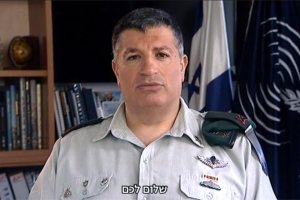
Left-wing politicians in the EU Parliament undermined a visit by Israeli Major General Yoav Mordechai because he has “blood on his hands” according to Northern Ireland MEP Martina Anderson.
Mordechai, who is one of the commanders of the Israeli elite force, is the coordinator for the Israeli government activities with the European Parliament regarding the Palestinian territories. His visit, which was due on Tuesday, was cancelled shortly before it was due to take place.
Portuguese parliamentarian Marisa Matias, from the European United Left–Nordic Green Left grouping, was quoted as saying that “giving him [Mordechai] a platform to host a lecture would legitimise his violations of international law and human rights”.
She pointed out: “Rather than giving a warm welcome to those, who stand for repression and apartheid, the EU institutions should pressure the Israeli government to abide by the rules of international law and UN resolutions.”
Calling for prosecuting him and his likes, she said: “We must bring to justice those responsible for human rights violations in the Occupied Palestinian Territories.”
Another member of the same political grouping, Northern Ireland MEP Martina, chairwoman of the Parliament’s Delegation for Relations with the Palestine Legislative Council, welcomed the cancellation, even though she said the reasons behind it were unclear.
However, she said: “We condemn the fact that it was set to go ahead in the first place. We cannot accept someone with such a track record being welcomed to the European Parliament. Put simply, this man has blood on his hands.”
Israeli war crime suspects may be able to run but they cannot hide
By Dr Daud Abdullah | MEMO | February 5, 2015
The resignation of William Schabas from his post as head of the UN commission to investigate possible war crimes during Israel’s 2014 onslaught on Gaza was always on the cards. From the time of his appointment in August last year, he has been subjected to a relentless campaign that questioned both his integrity and impartiality.
The manner and timing of his resignation, weeks before the commission presents its report to the UN Human Rights Council (UNHRC), recalls the case of Judge Richard Goldstone who was forced to disassociate himself from the findings of another UN enquiry into the 2008-09 war on Gaza. Instead of subjecting himself to similar humiliation, Schabas decided to throw in the towel sooner rather than later.
While Israeli officials may count this as a victory, it does not lift the spectre of war crimes charges against them. Nor will it alter Israel’s image as an international pariah. Whether Schabas stayed or resigned is, therefore, actually irrelevant. Israel has never, and never will, cooperate with an independent investigation into its wartime conduct. Hence, the claim that the UNHRC is innately biased must be seen for what it is — a rather pathetic attempt to evade accountability.
Lawyers acting on behalf of human rights organisations in Gaza point out that all the evidence presented to the UN suggests that there is a compelling a case for a formal investigation by the International Criminal Court (ICC). The character assassination of Schabas will not change the course of events.
What is at stake is whether or not Israel acted within the confines of the law that governs armed conflict. Prime Minister Benyamin Netanyahu’s claim that the UNHRC “is the same body that only in 2014 passed more resolutions against Israel than against Iran, Syria and North Korea combined” is immaterial; it’s simply an attempt to deflect world attention from the real issue.
Did the UNHRC set out deliberately to malign Israel as Netanyahu claims? On 23 July2014, Navi Pillay, the UN High Commissioner for Human Rights, reiterated the fact that war crimes and crimes against humanity are two of the most serious types of crimes in existence. She noted that in the case of Israel’s war on the Gaza Strip the “credible allegations that they have been committed must be properly investigated.”
A newly published survey by Chatham House — the Royal Institute of International Affairs — showed that 35 per cent of Britons said that they “feel especially unfavourable towards” Israel. The study, conducted in 2014, showed that the number of those viewing Israel unfavourably had actually increased by 18 points since 2012, presumably because of its military campaign in Gaza which led to thousands of casualties among Palestinian civilians.
Significantly, the categories of international crimes referred to by Pillay originated in the Nuremberg Tribunal of 1945-46. Though intended to deal with those responsible for the persecution of Jews in Europe, their writ was never confined to the Nazi leadership. Robert H Jackson, the former US Supreme Court Justice and prosecutor at Nuremberg, wanted to make it clear, “That if this law is first applied against German aggressors, the law includes, and if it is to serve a useful purpose it must condemn aggression by other nations, including those which sit here now in judgment.”
Given the circumstances which led to the tribunal it seems utterly mind-boggling that Israel should today seek to deny others the benefit and protection of the laws used at Nuremburg. As such, none of these laws will be worth the paper they are written on as long as Israeli officials continue to enjoy apparent impunity and evade accountability for their actions. The consequences of this selective approach to justice and the rule of law are already evident across the Middle East and beyond.
Moreover, not even the countries that support Israel have been spared the consequences of its disregard for the rule of law. Consider, for example, the 2010 assassination of a Hamas official, Mahmoud Al-Mabhouh, in a Dubai hotel. Several of the suspects involved used false passports of several European countries to carry out the operation. Apart from the expulsion of junior diplomats from Britain, Australia and Ireland, not one of the 29 Israeli suspects have been brought before a court of law.
More than anyone, Israelis who have hunted down Nazi war criminals for decades are well positioned to know that the pursuit and prosecution of those believed to have committed war crimes and crimes against humanity is relentless and not bound by time. Their perceived success in bringing down William Schabas will have absolutely no bearing on the Palestinian quest for justice. Israeli war crime suspects may be able to run but they cannot hide; they may continue to avoid arraignment at The Hague but they know for sure that they have already lost in the court of world opinion. In the grand scheme of things, it is perhaps this which matters most, for Israel must remain isolated and a pariah in the community of nations until justice is seen to be done.
Demonstrators face military violence for protesting Israeli President Rivlin’s visit
International Solidarity Movement | February 5, 2015
Hebron, Occupied Palestine – On Monday, February 2nd, Palestinian demonstrators faced military violence at the hands of Israeli forces in occupied Al-Khalil (Hebron). Protesters gathered in Bab Al-Zawiye, on the H1 (Palestinian administered) side of Shuhada checkpoint, to denounce Israeli president Reuven Rivlin’s visit to the illegal Israeli settlement of Beit Hadassah. Israeli sodliers and border police fired rounds of tear gas and numerous stun grenades, injuring at least two protesters.
The demonstration was organised by local Palestinian organisation Youth Against Settlements against the visit of the Israeli president to the settlement, which is illegal under international law and serves as a frequent source of oppression and violence against local Palestinians. Palestinians claimed their own rights, trampled by the military occupation, in the face of the visit’s attempt to legitimate the settler colonisation. Some signs called for opening the once vibrant and now closed Shuhada street, some for an end to the illegal settlements, some for President Rivlin to be brought before the International Criminal Court.
Around fifty Palestinians began the demonstration outside of Shuhada Checkpoint, holding signs and banners and hanging Palestinian flags on the fence. Israeli forces stopped them from passing through the checkpoint, preventing them from protesting on Shuhada street, near where the president was due to speak. As protesters continued to demonstrate, holding signs, waving flags and chanting for an end to occupation, a group of Israeli soldiers and border police exited the checkpoint and pushed protesters further back. Soldiers also occupied the roofs overlooking Bab Al-Zawiye “I just heard a soldier on a roof say ‘okay, enough’ and five minutes later they started throwing stun grenades and tear gas,” stated an ISM activist. “It was extremely sudden, and very scary.”
Israeli forces targetted Palestinian activists and organizers, hitting many in the legs with stun grenades and tear gas grenades. One man was hit directly with a stun grenade, which detonated right by his leg. “He screamed and fell down, rolling on the ground” one ISM activist recalled. Another man was also hit in the head with a stun grenade after the Israeli forces continued to use potentially lethal force against unarmed Palestinian protesters.
Demonstrators then attempted to continue the protest into the souq (Al-Khalil’s Old City market), but Israeli forces threatened them with stun grenades and prevented them from advancing. The protesters decided to go back after the army launched one stun grenade directly into the group of demonstrators. The protest eventually dispersed in Bab Al-Zawiye, after being targeted by a few more rounds of tear gas grenades.
Saying “No” to Netanyahu
Israel’s demands are not good for Americans
By Philip Giraldi • Unz Report • February 3, 2015
Israeli Prime Minister Benjamin Netanyahu will be visiting Washington during the first week in March. His annual visit coincides with the American Israel Public Affairs Committee (AIPAC) summit in Washington, at which he is expected to speak. He will also be addressing a joint session of Congress on March 3 rd as a guest of the new Republican majority. Per Speaker of the House John Boehner, Netanyahu will be providing additional insights regarding the threats posed by Iran and by Islamic terrorism, which the president had “papered over” in his State of the Union address. Boehner has in mind promotion of policies that would be contrary to those embraced by the White House, most particularly President Barack Obama’s intention to continue negotiations to come to an understanding over Iran’s nuclear program. That would mean Congress’s imposing new and intentionally deal breaking sanctions on Iran just to show it we are serious and a possible demand that any agreement with Tehran be subject to legislative approval.
Netanyahu has frequently warned that Iran’s construction of a nuclear arsenal is just around the corner. He has been making that claim regularly since 1996 and apparently is not particularly bothered that his warning has proven to be inaccurate since the Mullahs have yet to develop the long anticipated weapon of mass destruction. He will no doubt again express his view that there is a secret Iranian weapons program that imminently threatens both Israel and the United States. It is not clear if he will produce a cartoon showing a ticking bomb as he famously did at the United Nations in 2012.
Concerning the terrorist threat, Netanyahu will undoubtedly play the Charlie Hebdo card, insisting that it is the duty of the West united with Israel to oppose Islamic barbarism. It will be convenient dodge as it allows him to avoid answering for what Israel is doing to the Palestinians and it conveniently conflates all believers in a specific religion with political violence. No matter what Netanyahu says he will undoubtedly be cheered both when he speaks to Congress and also by the 1,500 attendees at AIPAC, which will include many Congressmen, journalists, and even Supreme Court justices. He will be treated like visiting royalty even though his message is essentially one of hate.
It is my understanding that a number of groups are organizing to protest both AIPAC and the Netanyahu visit. I hope they will be highly visible and noisy as hell, possibly forcing some of the summit attendees to think about just what they are supporting. I also urge the demonstrators to focus on Netanyahu’s actual message because everything that he has come to Washington to sell is essentially false.
Starting with Iran, the entire narrative of Iran as a nuclear threat is bogus, largely invented in Israel and the United States and in part based on manufactured evidence. I am not suggesting for a moment that Iran is a friend to the American people, but its malignancy has been much overstated by the Israel Lobby and its friends. It does not threaten the United States in any way and it hardly impacts on the security of countries like Israel and Saudi Arabia, both of which should be worrying about their viability based on their own behavior rather than due to an exaggerated Iranian menace. The reality is that the United States government has twice in 2007 and 2011 confirmed that Iran has no nuclear weapons program. Even Israel’s Mossad agrees and both governments admit that Tehran has not made the essentially political decision to proceed with such a program.
Not only has Iran neither developed nor tested a nuclear device, she has never enriched her uranium stocks to anything approaching weapons-grade. Her Fordow “secret” plant and other nuclear sites now have IAEA inspectors in place, the heavy-water reactor at Arak is not operational and many centrifuges are not operating. Most Iranians and many Americans understand that a negotiated settlement over the program as an alternative to a major regional war is highly desirable.
Netanyahu’s second point will be that the world is threatened by Islamic terrorism, requiring democratic nations to stand by Israel. But standing by Israel and adopting the Israeli standards for dealing with terrorism are precisely the problem. The only places in the world where Islamists have the remotest ability to take power are in those countries where the United States adhered to the Israeli model and intervened militarily, leaving chaos in its wake. Today that would include Iraq, Libya, Somalia, Afghanistan and Syria. Highly publicized terrorist attacks in Europe and in the United States have killed relatively few people and produced a predictably panicked response but do not threaten either a national security crisis or the stability of any government. In the U.S. since 9/11 there have been 69 deaths, either terrorist or criminal, that can plausibly be linked to Muslims or Islamic sensibilities, less than five a year. During the same time period 200,000 Americans have been murdered, making terrorism by local Muslims pretty much a statistical anomaly. For what it’s worth, the policies being pursued overseas by Washington during the same time period directly or indirectly contributed to the killing of as many as half a million Muslims while turning at least three million more into refugees, which inevitably fuels terrorism.
A third point that Netanyahu will not be making as he is a beneficiary of it is the astonishing power of the Israel Lobby in the United States. As John Mearsheimer and Stephen Walt demonstrated in their book, the Lobby is in reality a loose aggregation that is bound together to promote what are perceived to be Israeli interests. It includes think tanks, PACS and other lobbying groups, journalists and media outlets, Christian evangelicals, leading figures in academia and it is all backed up by deep pocket donors who both fund political candidates and provide the fuel to keep everything moving. Pat Buchanan once described Congress as “Israeli occupied territory,” but to be sure he was being too kind and Tom Friedman’s observation that it is bought and paid for by the Lobby might actually be closer to the mark. In an actual occupation there would characteristically be at least some resistance but in the United States Congress there is virtually none now that Ron Paul is retired. If any daring congressmen stay home sick when Netanyahu speaks it will be a surprise and the only real question regarding the impending joint session address is how many standing ovations the Israeli leader will receive. Will it exceed the 29 he recorded last time around?
So there are three good reasons for saying “no” to Benjamin Netanyahu, or, even better, telling him to go away and stay away. First, he is striving mightily to involve the United States in a war with Iran for which there is no compelling national interest and which will cost Americans heavily in both lives and treasure. Second, he has poisoned Washington’s relationship with the Muslim world through the largely successful selling of his message that all believers in Islam are essentially terrorists. And third, he and his associates in the Israel Lobby are a cancer in our political system, using money and even coercion to bring about a “special relationship” that is hardly a relationship at all but is instead a mechanism to impel U.S. subordination to Israeli interests.
It is shameful that Netanyahu will be in Washington at all on a mission to tell the U.S. Congress what to do, but one can always hope that both he and Speaker Boehner have finally gone too far. Will this be a wake-up call for the American public, aware at last that it is being led by the nose by a foreign country aided by its own venal and corrupted quislings? One can always hope, and it might just be that Netanyahu will finally pay a price for his hubris with his own voters next month and be turned out of office. Wouldn’t it be nice to be able to say that we have seen the last of Benjamin Netanyahu?
Demolitions in Qusra
International Solidarity Movement | February 3, 2015
Qusra, Occupied Palestine – In the early morning of February 2nd, 2015, Israeli forces demolished a two-room structure, a water well, and damaged a stone wall in Qusra, Occupied West Bank. All of the destroyed property was on land belonging to brothers Anwar and Akram Tayseer.
Israeli forces, at approximately 5:00am, destroyed the property with bulldozers. When farmers went out into their fields at 5:00am, five Israeli military jeeps were still present at the site, loitering around the recently destroyed infrastructure. The occupying forces refused to speak with anyone. The water well and small concrete structure were built with money donated by the French Consulate, to facilitate agricultural development in the vulnerable region. Located in Area C, Qusra is subject to common attacks from nearby illegal Israeli settlements, mainly the Esh Kodesh outpost. Settlers living in the illegal outpost Esh Kodesh have been implicated in various ´price tag´ attacks throughout the West Bank (acts of violence against Palestinians by settlers). Settlers come after every time local Palestinians work their land, in day or night, sometimes armed with iron bars; families often wake up to destroyed trees, structures, or crops. Israeli soldiers are often present at these incidents, intervening only to protect settlers. An Israeli military watchtower was constructed on the hill overlooking the agricultural lands around ten months ago. In the past, village residents have received Israeli orders to stop building on their land, which they have always respected (despite their illegality). However, it is not uncommon, according to locals, for farmers to have their agricultural structures demolished shortly after receiving these orders, despite the lack of further development.
This is not the first time the Tayseer´s family land has been attacked by settlers. On one occasion two years ago, Akram Tayseer was taken by the settlers, and severely beaten. He sustained injuries which put him in the hospital for two months, in his head, face, and arm. He was unable to leave his home for one year. Since this incident, residents recount that they have not seen him smile, and perceive that he is broken inside. The family has documents indicating their ownership of the land and the property which once stood on it.
The cost of agricultural structure demolished is approximately 5000 NIS (~$1275USD). The water well served as a collection site, and an important reservoir to nourish the fields. Enclosing the plots of land, around 500 meters of a traditional Palestinian stone wall was dismantled. The fields are the main source of income for the family.
According to OCHA (United Nations Office for the Coordination of Humanitarian Affairs), 82 Palestinian homes and agricultural structures have been demolished by Israel since the beginning of 2015. Under the Fourth Geneva Convention, it is illegal for occupying powers to destroy property; Article 53 states: “Any destruction by the Occupying Power of real or personal property belonging individually or collectively to private persons…is prohibited.” Since 1967, Israel has demolished over 27,000 Palestinian structures in the Occupied West Bank.
Israel freezes another $100m in Palestinian tax revenues
MEMO | February 3, 2015
Israeli Prime Minister Benjamin Netanyahu has frozen an additional 400 million shekels ($100 million) from Palestinian tax revenues, Israel Today revealed yesterday.
The funds were from January’s tax revenues, the newspaper said, and will be added to the 500 million shekels ($128 million) that Israel froze in December, making the amount of Palestinian tax revenues frozen about $228 million.
Sources close to Netanyahu told the newspaper that he promised continuous tax freezes as a punishment for the Palestinian leadership’s application to join the International Criminal Court.
Such revenues constitute 70 per cent of the Palestinian Authority’s source of income which finance the bulk of salaries and public services in the West Bank such as hospitals and schools.
It is worth mentioning that the money freeze last month faced critical reactions from the UN, US and many EU countries, but none of them put any pressure on Israel to recede its decision.
The Israeli newspaper reported that sources say the situation in the West Bank is expected to explode because of the hard economic circumstances resulting from the lack of funds.
Featured Video

Piers Corbyn on religion of climate change
or go to
Aletho News Archives – Video-Images
New Documentary
“Inside Gaza” wins best documentary at Montreal’s Cinemania film festival
Palestine Information Center – November 16, 2026
MONTREAL – The documentary “Inside Gaza,” which chronicles the experiences of Palestinian journalists working with Agence France-Presse (AFP) while covering the Israeli war on the Gaza Strip, won the Best Documentary Award at the 32nd Cinemania International Francophone Film Festival held in Montreal, Canada.
Directed by Helene Lam Trong, the 72-minute film follows the daily lives of four AFP journalists who bear witness to the difficulties of reporting in a war-torn territory largely closed off to international media.
The film is compiled from material produced by the team on the ground, as well as from interviews conducted after they left.
The film also won the People’s Choice Award at the festival on Saturday. … continue
Blog Roll
 Aletho News
- Austria seeks to strip former foreign minister of citizenship over Russia ties
- “Inside Gaza” wins best documentary at Montreal’s Cinemania film festival
- Activists block German munitions plant over arms exports to ‘Israel’
- The Nasser Hospital attack and Israel’s relentless lies
- Could it be satan? No, Huckabee, just the Americans you work for
- AIPAC and more: Network of pro-Israel influence in US Congress
- Putin aide reveals Moscow’s stance on Europe at peace talks
- Imran Khan warns Pakistani judges he may die in prison
- IOF used Amazon facial recognition to track millions of Palestinians
- More EU Citizens Face Sanctions For Criticizing The Ukraine Proxy War
- If Americans Knew
- An error has occurred; the feed is probably down. Try again later.
- No Tricks Zone
- Argentina’s Perito Moreno Glacier Joins Antarctica and Arctic In Defying Doomsday Melt Claims
- New Study: Barents Sea Temperatures Were Warmer And Sea Ice Less Extensive In The 1700s Than Today
- German Authorities Start Initiative To Evaluate Public Register For Climate “Disinformation” Spreaders!
- Zonal Asymmetry of Temperature Change in the Antarctic Circumpolar Current
- New Study: The Net Fossil Fuel Contribution To Rising Atmospheric CO2 Has Been Zero For 500 Years
- Germany’s Green Energy Transition Becoming Increasingly Expensive…Another 6 Trillion Euros!
- Sudden Stratospheric Warming, Powerful El Niño Combination May Lead To Extreme Europe Cold, Energy Crisis!
- Two New Studies Find Thwaites Glacier Melt Cannot Be Driven By Human Activity Or A Warming Ocean
- E-Cars Reduce CO2 Emissions By Only 41% Compared To Internal Combustion Engine Vehicles
- Predictions Made By Renowned Climate Professor Over Past Decades Have Been Proven To Be Poor

