Jewish settlers attack Palestinians south of Jenin
Palestine Information Center – January 2, 2015
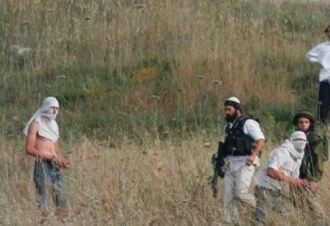 JENIN – A group of Jewish settlers attacked Palestinian vehicles traveling on Jenin-Nablus road near the junction of Jaba village south of Jenin at dawn Friday.
Around 12 vehicles carrying settlers stormed the evacuated settlement of Tarsleh and blocked Jenin-Nablus road today under military protection.
The settlers spread among nearby olive trees and began attacking and stoning passing Palestinian cars in the presence of Israeli soldiers, eyewitnesses said.
During the attack, the settlers chanted racist slurs against the Palestinians.
Meanwhile, Israeli media sources claimed that three Molotov cocktails were thrown at a home appropriated by settlers in Ras Amoud neighborhood in occupied Jerusalem overnight. The sources said that Palestinian young men threw three Molotov cocktails at the house, with no reported injuries.
The Israeli police launched a wide manhunt following the incident.
Palestinians Need Less Negotiations, Not More

By Matt Peppe | Just the Facts | January 1, 2015
When the U.N. Security Council resolution to end the Israeli military occupation of the occupied territories and establish a Palestinian state by 2017 was defeated, not a single human with a pulse was surprised. The resolution received eight votes in favor, with the United States and Australia against and five countries abstaining. Even though the measure was one vote shy of adoption, the United States decided to exercise its veto power anyway just to make its rejectionist stance abundantly clear. But the bill would not have lead to a fair settlement anyway. If it led to a settlement at all it would have been an unjust one for Palestinians. A just settlement would mean assuming the goals of the resolution as a starting point, not as an end point.
Explaining why she put a kibosh on the resolution, United States Ambassador Samantha Power said the bill was “imbalanced” and addressed “only one side.” It did address only one side – Israel’s. It was imbalanced because it sought legal rights already due to Palestinians since 1967 as its objective while ignoring other Palestinian rights like the right of return and equal rights inside the 1948 borders. And it rewarded Israel for 47 years of atrocious criminality – ethnic cleansing, land and water theft, destruction of thousands of homes and olive trees – without any consequences.
The insistence on maintaining the status quo was explained by Power saying that “we firmly believe the status quo between Israelis and Palestinians is unsustainable.”
Power also made multiple references to negotiations between the parties. “The United States every day searches for new ways to take constructive steps to support the parties in making progress toward achieving a negotiated settlement,” she said. By this, she apparently meant that the United States searches for ways to force Palestinians to negotiate how many of their rights they are willing to forfeit, while Israel demands that it doesn’t have to give up anything.
The only acceptable outcome for Israel is maintaining control of all of Mandate Palestine, from the Jordan River to the Sea, by de facto annexation. The United States knows this and has enabled them to do so, by giving them $3 billion per year in aid and vetoing 43 resolutions meant to hold them accountable since 1972, among other things.
If Power was not being dishonest and deceitful, the only other explanation for her statement is that she is clinically insane. The definition of insanity is “a mental illness of such a severe nature that a person cannot distinguish fantasy from reality.” The idea that Israel has ever for one second been interested in a negotiated settlement since its foundation in 1948 is more of a fantasy than Game of Thrones. And to think the U.S. has done anything other than aid and abet Israel’s conquest of Palestine through ideological, financial and diplomatic support would require an unfathomable level of historical amnesia.
If Israel was interested in an actual settlement they would have to admit that they cannot bargain with what does not belong to them – namely any land beyond the Green Line. Palestinians don’t need another resolution to clarify that Israel needs to remove its military occupation from the lands that were conquered in the 1967 war. This has already been the law for 47 years.
UN Security Council Resolution 242 declared that “the establishment of a just and lasting peace in the Middle East … should include” the “withdrawal of Israel armed forces from territories occupied in the recent conflict” and “termination for all claims or states of belligerency and respect for and acknowledgment of the sovereignty, territorial integrity and political independence of every State in the area.”
This was reiterated six years later with the demands in Resolution 338 to implement 242 “in all of its parts” and that “negotiations shall start between the parties concerned under appropriate auspices aimed at establishing a just and durable peace.”
By proposing a new resolution that would achieve at best what is already guaranteed by Resolutions 242 and 338, Palestinians would be forced to surrender the rest of their rights – namely the right of return of the 1948 refugees and their descendents displaced during the Nakba, and the end to discrimination of Palestinians within Israel who are second-class citizens in the Jewish State.
Israel could not practically dismantle all the illegal settlements they have built in the West Bank and move 500,000 settlers back inside the Green Line, much less absorb possibly millions of refugees, many who still hold the keys to their ancestral homes inside Israel. There is no possibility of a two state solution. It is as much as a fantasy as Ambassdor Power’s claim that the U.S. doesn’t believe in the status quo.
Once this two-state scam is exposed for what it is, the only possibility left is a binational state where Palestinians enjoy equal rights with Jews. It is the reason that Ali Abunimah, writing in the Electronic Intifada, said last month he hoped for the U.S. to veto the U.N.’s “terrible resolution.”
“It insists that the entire question of Palestine be reduced to the question of the 1967 occupation and that merely ending this occupation would effectively end all Palestinian claims,” Abunimah writes.
When the question of the occupation has already been resolved in existing law in favor of the Palestinians, why would they want to give away willingly the rest of what was stolen from them? Since Yasser Arafat signed the Oslo Accords in 1993, Palestinian leadership has demonstrated their willingness to surrender the rights of the people they represent to placate Israel and the United States and be left with scraps.
With incredible foresight Edward Said called the Oslo Accords, with “so many unilateral concessions to Israel,” the “Palestinian Versailles.” Then, as now, Israel was not willing to give an inch toward recognition of Palestinian self-determination. Pretending that Palestinians can lure Israel into accepting a settlement if they just concede a little bit more is even more absurd now than it was 21 years ago in Oslo.
A news census shows that Palestinians will outnumber Jews in Greater Israel by 2016. Palestinians in the occupied territories and within the ’48 borders are expected to equal Jews with a population of 6.42 million before surpassing them. By the end of the decade, the census bureau estimates Palestinians will reach 7.4 million to 6.87 million Jews. This does not even include the estimated 5 million Palestinians living in the diaspora and prohibited by Israel’s Prevention of Infiltration Law from returning.
So by virtue of merely existing Palestinians will put an end to Israel’s hollow claims of being a democracy. Of course this is no small feat. Palestinians have been struggling for seven decades to maintain their existence in spite of dispossession, ethnic cleansing, apartheid, and slow-motion genocide. How else to honor this heroic resistance than to prove definitively that Israel’s claims to being a democracy and Jewish state have never been anything more than a myth?
By demanding their rights outside of negotiations with Israel, as they did when they signed the Rome Statute this week, Palestinians are able to apply pressure unilaterally. With world opinion turning in favor of the Palestinian plight, it has become clear that isolation of Israel and forcing them to be accountable for their crimes is the only way for Palestinians to attain their rights.
Joseph Massad writes that “Palestinians must insist that those in solidarity with them adopt BDS [Boycott, Divest, and Sanction] as a strategy and not as a goal, in order to bring about an end to Israel’s racism and colonialism in all its forms inside and outside the 1948 boundaries.
It is worth remembering that the only reason Israel exists at all is precisely because the colonial powers who created it acted against all concepts of democracy and human rights. If the newly formed World Court would have heard the case of Palestinians in 1948, when they owned nearly 90% of the land and consisted of about 66% of the population, they never would have permitted granting the country to a minority to rule over it.
No amount of negotiations will be able to force Israel to give up its racism and colonialism willingly – just as no negotiations were able to force the South African apartheid regime to do so. The only way for Palestinians to achieving peace will be in spite of Israel and the United States, who will continue as they have for decades to do everything they can to prevent Palestinian self-determination. Palestinians must expose Israel and the U.S.’s hypocrisy on democracy and human rights, not let them hide from it.
86 Israeli Attacks on Islamic and Christian Holy Sites in 2014
IMEMC News & Agencies | January 2, 2015
Al Aqsa Association for Waqf and Heritage has reported that Israelis carried out some 86 assaults and violations of Islamic and Christian Palestinian holy sites in the occupied West Bank and Jerusalem in 2014.
In a report published Wednesday, the association stated that about 30 cases of assault on mosques, 21 cases of assault on graveyards, six cases of attacks on Christian holy sites, and other sporadic attacks, including preventing the call for prayer in Hebron’s Ibrahimi Mosque hundreds of times — amounting to dozens a month — were documented.
To the previous list, the association added the complete destruction of 73 mosques, the partial vandalism of 197 mosques, and damage of one church during this past summer’s war on Gaza.
Al-Aqsa Association recorded five cases of burning mosques or parts of them, including the burning of Ali bin Abi Talib mosque in the village of Deir Estia, in Salfit, spraying of racist slogans on a shrine in Anata town near Jerusalem, Abu Bakr mosqe in Umm al-Fahm, and Abu Bakr mosque in the town of Aqraba, south of Nablus, and the Great Western mosque al-Mughayir village in Ramallah.
Other incidents were recorded such as the attacks on two mosques and Islamic shrines with racist writings and Talmudic words. The report also documented the demolishing of five mosques in Nablus, Jerusalem and Naqab.
Meanwhile, six cases of assault on Christian holy sites were also recorded by the association. In April, “price tag” groups vandalized a monastery in Rafat, to the west of Jerusalem, while an extremist Israeli threatened a priest in Nazareth. Another incident happened in the same month, when price tag groups sprayed racist comments near the Roman church in Jerusalem.
In May, Israeli extremists sprayed offensive comments about Jesus Christ near a church in Beersheba. Meanwhile, other Israelis wrote offensive comments about the prophet Mohammad and Jesus, an incident which coincided with the Holy See’s visit to Palestine.
The report also recorded 18 attacks against mosques in Hebron and Bethlehem, while other attacks which were documented targeted Muslim’s graveyards, such as smashing gravestones, stealing monuments, spraying racist comments, confiscating yards and selling the land to build commercial malls.
According to the report, in 2014, Israeli forces and settler efforts increased to take control over Waqf land to turn it into Jewish shrines; among these attempts were putting up fake gravestones and raiding the sites.
As for the Ibrahimi Mosque, which is targeted on daily basis, the call for prayer was prevented more than 250 times under the pretext that it annoys Israeli settlers. The violations include preventing worshipers from entering the mosque to pray.
In the Gaza Strip, the Ministry of Waqf and Religious Affairs said the Israeli army destroyed 73 mosques completely, 197 partially, and one church partially. It added that six Zakat offices were completely damaged, a waqf school was bombarded and 11 graveyards were destroyed.
Glimpse into 2014 struggles draws image of upcoming year
By Roqayah Chamseddine | Al-Akhbar | December 31, 2014
This year was a powerful amalgamation of torment, dissent, and small victories – a mixture of struggles, oftentimes intersecting, which will shape the new year.
Resistance across Egypt, against the torrent of brutal authoritarianism, is ongoing, and the battle that is being waged against the Sisi regime, which is still netting protesters and attempting to expand its security forces, has not dimmed. This week, 24 protesters, including Yara Sallam, Transitional Justice Officer at the Egyptian Initiative for Personal Rights (EIPR), were sentenced to two years imprisonment after being charged under Egypt’s restrictive assembly law. This signifies not a deviation from the Mubarak-era suppression but a sustained follow-through, and arguably at times the actions of Abdel Fattah el-Sisi’s illegitimate government have outdone even Mubarak’s. Under the current regime a more brazenly Zionist Egypt has taken center stage, making life for Palestinians in Gaza, many of whom are internally displaced, a living nightmare as they watch another Arab regime collude with the occupier, preventing them from having access to education, healthcare and going as far as to plan the demolition of 1,000 homes in order to expand the Rafah border, forcing many, who are still healing from the latest Gaza war, deeper into the throes of despair.
The displacement of the Palestinians converges with another cruelty – the displacement of the Syrian people. Syrians have been forced into refugee tents by unwavering violence, not only from inside and above but from host countries who are preventing them from having access to proper medical care, work and housing. Lebanon, which is now home to the largest Syrian refugee presence, over 1.1 million according to UNHCR, has unleashed its own brutality against the Syrian people; from the sexual abuse of Syrian women, violence against Syrian workers, to incomprehensible living arrangements by greedy landlords who are looking to profit off misery. To make matters worse, Syrians are also facing ISIS, which threatens to destroy any viable resolution to the conflict, and seeks to expand a violent pseudo-state by indiscriminately targeting anyone deemed a threat, as ISIS is composed of equal opportunity destroyers.
In Bahrain the long shadow of despotism reaches far into the streets, generously filling the jail cells with people like women’s rights activist Zainab al-Khawaja, recently sentenced to three years in prison after she ripped up a photo of King Hamad bin Isa al-Khalifa, and Ghada Jamsheer, head of the Women’s Petition Committee, who has been under house arrest since December 19, facing at least 12 charges. Al-Khawaja and Jamsheer are not the only women in the region facing an all-encompassing totalitarian state. In Saudi Arabia, 25-year-old Loujain al-Hathloul, who called for women to join the October 26 movement to end, among other things, the absurd restrictions on driving by taking to the roads, was arrested for doing just that. Al-Hathloul and 33-year-old Maysa al-Amoudi were arrested November 30, al-Hathloul for attempting to drive from the United Arab Emirates to Saudi Arabia and al-Amoudi after she arrived to support her.
At the forefront of the greater campaign for women’s rights are organizations in the region that challenge patriarchy, heteronormativity, and imperialism such as Beirut-based Nasawiya and Lebanon’s secular Lebanese civil society organization KAFA (Enough). Nasawiya, working alongside other local groups, have been involved in the fight against Lebanon’s nationality laws, sectarianism, and domestic violence. A domestic violence law, the first of its kind in Lebanon, passed by Lebanon’s parliament on April 1, after a strong, year-long campaign lead by KAFA. KAFA, which works tirelessly to not only provide domestic abuse victims and abusers with counseling, but child protection services, has criticized legislators for not focusing more on women, though despite the laws shortcomings many are calling this a step forward and women’s right activists in Lebanon are promising to continue the fight so as to bring about even more impactful, long-lasting change.
Nasawiya and KAFA have long challenged local discourse regarding not only Lebanese women but migrant domestic workers in Lebanon, and provide migrants with social and legal counseling. A recent publication by KAFA, “If Not For The System,” reveals the stories of women migrant workers in Lebanon, in both English and Arabic, and the exploitation they face as they navigate the oftentimes racist and abusive landscape. Lebanon’s migrant workers, who already face physical abuse at the hands of those they work for, are now struggling even harder to make a living if they are found to be Syrian, as many Syrians are now facing the obstacle of a war being waged against their identities, as they are being senselessly blamed for violent extremism in the country. In Qatar we also see the horrific crimes being committed against migrant workers. In a report released in May the Qatari government admitted to some 1,000 migrant deaths, at least one a day, in the last two years alone. Six months after this report was published, and after promising to reform its abominable system, “only a handful of the limited measures announced in May have even been partially implemented,” according to Sherif Elsayid-Ali, Amnesty International’s head of refugee and migrant rights.
It is difficult to read into the future, despite the imprints left behind this year, like a constellation of stains on the inside of a coffee cup. But one can hope that the minor victories for rights that were attained this year – despite the major setbacks – can set the tone for the coming years and forge a more auspicious new year for all.
Roqayah Chamseddine is a Sydney based Lebanese-American journalist and commentator. She tweets @roqchams and writes ‘Letters From the Underground.‘
The United States Disdain for Human Rights
By Robert Fantina | Aletho News | December 31, 2014
The United States once again disgraced itself on the world stage at the United Nations on December 30, when it voted against full recognition of Palestine. It proved to the world, if any further proof was required, that it has no interest in fostering the human rights and self-determination of any people that doesn’t benefit it in some way, either through making available to the U.S. coveted natural resources, allowing military bases to be built in the country, or funneling huge amounts of money into the campaign coffers of elected officials.
The vote was close: eight in favor, two opposed and five abstentions. Palestinian President Mahmoud Abbas, a weak and spineless leader if ever there was one, had vowed to join all the U.N. organizations it became eligible for when Palestine was voted ‘non-member observer state status’ by the U.N. General Assembly in 2012, and the International Criminal Court, if the resolution failed to pass. It will be interesting to see if he finally puts the needs of the Palestinians first, and follows through with this promise.
Although the vote failed, and even if it had passed, the U.S. would have vetoed it, it was, nonetheless, a significant milestone. Increasingly, and especially since Israel’s latest genocidal assault on the Gaza Strip, the world is recognizing what a few governments still deny: Israel is an apartheid regime, determined to destroy Palestine, its people and culture. Thanks in large part to the international Boycott, Divest and Sanction (BDS) movement, and the ready access that so many people have to social media, Israel is becoming increasingly isolated as a global pariah, with only the U.S. and a few other countries, including Canada (to its everlasting shame), still defending it.
After Tuesday’s vote, U.S. Ambassador to the U.N. Samantha Power said, incredibly, that ‘no other country in the world has invested more than the United States in pursuing peace between Israel and the Palestinians.’ It might be useful to look at what the U.S. has, in fact, done in this regard.
- Vetoed resolutions condemning continued illegal settlement building in the West Bank. It is in violation of international law for an occupying nation (Israel) to move its citizens permanently into the occupied territory (Palestine). Israel has relocated over 500,000 Israelis into the West Bank, property that the international community says belongs to Palestine. And Israeli Prime Murderer Benjamin Netanyahu says that not one of those settlers will ever be displaced. In early 2011, when the U.S. vetoed a resolution condemning settlement building, then U.S. Ambassador to the U.N. Susan Rice said that the U.S. recognizes the illegality of settlement building, but didn’t feel the U.N. was the place to address it. Where, one might reasonably ask, should violations of international law be addressed if not at the United Nations?
- Gives $3 billion to Israel annually, and nothing to Palestine. This enables Israel to have one of the most powerful military machines in the world, while Palestine has no army, navy or air force.
- Supports the carpet-bombing of Palestine. Periodically, sometimes in response to ineffective rocket fire from Gaza, rockets that Norman Finkelstein, son of Holocaust survivors and an active proponent of Palestinian rights, calls ‘enhanced fire works’, and sometimes just on a whim, Israel begins bombing homes, schools, mosques, U.N. refugee centers and press offices, all in violation of international law. The U.S. proclaims that Israel has a right to defend itself, despite the illogic of an occupying nation defending itself from the nation it occupies. Also, international law that the U.S. recognizes states that an occupied nation has the right to defend itself. Even when Israeli soldiers target children, and bomb U.N. refugee centers, and the U.S. issues some mild criticism, it continues to send advanced weaponry to Israel.
- Ignores the horrific suffering of the Palestinian people. In the Gaza Strip, thanks to Israel’s illegal blockade and periodic bombing, the economy is decimated. Unemployment is among the highest in the world, and thousands of people are homeless due to U.S.-supplied bombs. As much as 90% of the water is not fit to drink. Yet not only does the U.S. send no aid, it allows Israel to block aid from other countries.
- Sponsors the farce of ongoing negotiations. It is a basic fact that negotiations can only occur between two parties, each of which has something the other wants that it can only obtain by surrendering something it has. Israel is able to take with impunity anything it wants from Palestine. It bulldozes entire villages to build illegal settlements, and uses Palestinian natural resources for manufacturing its own products. This is all in violation of international law, law that the U.S. recognizes.
A look at the United States relations with an earlier apartheid regime, South Africa, may help clarify U.S. support for Israel. Through the 1970s and 1980s, most U.S. administrations condemned the apartheid government, but opposed any economic sanctions to discourage it. As late as the administration of President Ronald Reagan, the U.S. had very friendly ties with South Africa. Mr. Reagan accused opponents of the apartheid government, most notably the African National Congress, of being pro-communist. In 1984, Nobel Peace Prize winner Archbishop Desmond Tutu characterized the Reagan policy as ‘immoral, evil and totally un-Christian’. The U.S. finally imposed economic sanctions, only after Congress overrode a presidential veto.
Today, the U.S. demonizes Hamas, the democratically-elected government in Gaza, which earlier this year reunified with Fatah, the puppet government in the West Bank, a reunification that enraged Mr. Netanyahu and was the probable cause of his murderous assault on Gaza. The U.S. condemns illegal settlement construction, but finances it through its very generous foreign aid to Israel.
Like the situation in South Africa a generation ago, it will not be the U.S. that leads the way to freedom and self-determination for the Palestinian people. No, that will occur in spite of, and not because of, U.S. actions. As indicated by the vote in the General Assembly in 2012 to grant Palestine Non-Member Observer State Status, yesterday’s close albeit unsuccessful vote to recognize Palestine in the Security Council, the growing BDS movement, the resolutions of many countries calling on their governments to recognize Palestine, Sweden’s recent recognition of Palestine, and worldwide outrage at Israel’s savage treatment of Palestinians, the U.S. will not be able to prevent the end of the occupation forever. It could be a force for freedom and human rights, but chooses instead to be an imperial nation, supporting the colonization of countries that can’t provide it with profits, ignoring and even financing horrific human rights abuses, and practicing savage racism within its own borders. U.S. citizens may still believe their nation’s public relations campaigns that proclaim it as a beacon of peace and freedom throughout the world, but that myth is not accepted beyond its borders. Rather than a major diplomatic player on the world stage, the U.S. is a farce, feared for its military power, but gaining no respect anywhere.
Extremist Israeli Settlers Burn Palestinian Home Near Hebron
By Saed Bannoura | IMEMC & Agencies | December 31, 2014
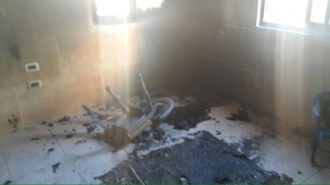 A Palestinian family from a village east of the town of Yatta, near the southern West Bank city of Hebron, narrowly escaped death on Wednesday at dawn, when a number of fanatic Israeli settlers hurled Molotov cocktails into their home as they slept.
The head of the Yatta City Council Mousa Makhamra told the Maan News Agency that the attack is a very serious and dangerous escalation, adding that it is an attempt to annihilate a family of seven; five children and their parents.
Makhamra added that the fanatic settlers, from Karmiel illegal settlement, infiltrated into ad-Deerat village, east of Yatta, at approximately 3 am, and throw the Molotov cocktails into the Palestinian home after writing racist graffiti on its outer walls.
Makhamra further stated that the family woke up in time, and their neighbors rushed in when they saw the house on fire, and rescued the family.
The fires consumed the furniture in the living room, but was controlled before it spread.
The settlers wrote racist anti-Arab graffiti, including the infamous statement “Death To Arabs”, and other graffiti.
Image Shehab News
Jewish settler runs over Palestinian child walking to school in Tuqu
Ma’an – 31/12/2014
BETHLEHEM – A 10-year-old Palestinian boy was injured after an Israeli settler ran him over on the main road of the Palestinian village of Tuqu south east of Bethlehem early Wednesday.
Bethlehem region emergency services official Muhammad Awad told Ma’an that Amir Majed Ahmad Suleiman, 10, received a number of bruises after being hit by an Israeli settler’s car as he was heading to school in the town.
Awad said that the settler immediately fled the area despite the fact that Israeli forces were deployed on the main road of the village.
He added that Suleiman was taken to the Beit Jala Governmental Hospital in Bethlehem for treatment.
The incident comes only three days after an Israeli settler ran over an seven-year-old Palestinian boy from the village of Zif south of Hebron.
Recent months have seen a wave of hit-and-runs against Palestinians by Jewish settlers living in the occupied West Bank, as well as reprisal car attacks in Jerusalem.
In October, a settler ran over two Palestinian children as they walked near near Ramallah, killing 5-year-old Einas Khalil.
PLO: Israel has detained 1266 Palestinian children in 2014
Al-Akhbar | December 30, 2014
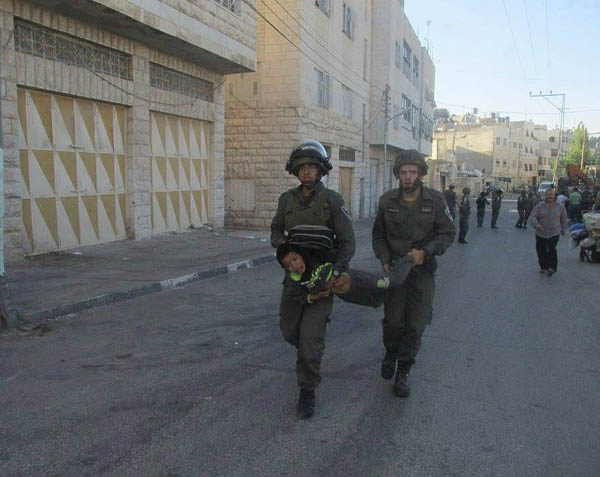
Israeli forces detained over 1,000 Palestinian children in the occupied West Bank and annexed Jerusalem in 2014, the Palestine Liberation Organization (PLO) said Tuesday.
Abdul-Nasser Farawna, head of Authority of Prisoners’ Affairs, a PLO body, said that Israel detained 1,266 Palestinian children, below the age of 15, in the West Bank and Jerusalem in 2014.
“The vast majority of the arrests happened in the second half of the year,” Farawna said in a statement, adding that at least 200 children are still detained in Israeli jails on various charges.
Israeli forces routinely conduct arrest campaigns targeting Palestinians in the occupied West Bank and annexed Jerusalem on claims they are “wanted” by Israeli authorities.
According to the PLO, more than 10,000 Palestinian minors in the occupied West Bank and annexed Jerusalem have been held by the Israeli army for varying periods since 2000.
“The number of Palestinian children arrested by Israeli forces, especially in annexed East Jerusalem, has sharply risen,” Farawna declared, saying that the number of children detainees had increased by 87 percent over the past three years.
“The majority of the detained children were subjected to beatings and torture by Israeli security personnel while in detention,” he asserted.
Farawna’s statements echoed similar comments last month by another PLO official, Issa Qaraqe, who said that around 95 percent of children detainees were subjected to beatings and torture by Israeli security personnel while in detention, while many were forced to make confessions under duress and undergo unfair trials.
Violent practices by Israeli soldiers as well as settlers against Palestinian children is endemic and often abetted by the authorities.
“Israel does not provide any immunity for children and regularly violates international agreements on children’s rights by humiliating and torturing them and denying them fair trials,” Qaraqe explained.
A report by Defense for Children International (DCI) published in May 2014 revealed that Israel jails 20 percent of Palestinian children it detains in solitary confinement.
DCI said that minors held in solitary confinement spent an average of 10 days in isolation. The longest period of confinement documented in a single case was 29 days in 2012, and 28 days in 2013.
A report by The Euro-Mid Observer for Human Rights Israeli forces arrested nearly 3,000 Palestinian children from the beginning of 2010 to mid-2014, the majority of them between the ages of 12 and 15 years old.
The report also documented dozens of video recorded testimonies of children arrested during the first months of 2014, pointing out that 75 percent of the detained children are subjected to physical torture and 25 percent faced military trials.
The most excruciating violations are seen in the psycho-physical torture methods, including the act of forcing children to sit on the investigation chair chained hand and foot and covering their entire heads with foul-smelling bags, in addition to depriving them of sleep.
In 2013, the UN children’s fund (UNICEF) reported that Israel was the only country in the world where children were “systematically tried” in military courts and gave evidence of practices it said were “cruel, inhuman and degrading treatment or punishment.”
The UNICEF report said in a 22-page report that over the past decade, Israeli forces have arrested, interrogated and prosecuted around 7,000 children between 12 and 17, mostly boys, noting the rate was equivalent to “an average of two children each day.”
Palestinian children as young as five years old have also been detained in the past.
In 2013, Israeli forces in the West Bank detained four Palestinian children aged five to nine years.
Palestinian activist Murad Ashtiye told AFP at the time that “Israeli soldiers arrest the children and tie their hands behind their backs using plastic strips.”
Meanwhile in Gaza, a 51-day Israeli aggression last August left at least 505 children dead, 20 percent of the total civilian death toll.
The UN agency for Palestinian refugees UNRWA said 138 of its students were killed during the assault. The organization’s spokesperson Christopher Gunness said an additional 814 UNRWA students were injured and 560 have become orphans due to the Israeli onslaught.
The worst massacre took place in the Abu Hussein School of the Jabaliya refugee camp in the north killing and injuring dozens even after the agency said that it gave the school’s coordinates to the Israelis more than 17 times so they won’t hit it.
(Anadolu, Al-Akhbar)
Chronicle of impunity for unprovoked shooting by ‘security’ forces
Yesh Din | December 29, 2014
 Someone shot a bullet at Ashraf Muhammad Jamal Tufiq’s foot in Bil’in in 2009. The IDF’s investigatory bodies did their best to make sure they will never find the shooter.
On Friday, January 16 2009, someone – a member of the Israeli security forces – fired a bullet into the foot of Ashraf Muhammad Jamal Tufiq from the West Bank village Bil’in. According to Tufiq, the shooting occurred without any provocation and came after the weekly demonstration ended. As a result of his injury, Tufiq had to undergo an operation and had to give up on being a professional a soccer player. On November 4, 2013, the Operational Affairs Prosecution closed the case, reaching the conclusion that it contains no evidence whatsoever.
Hold on, you say, you’ve made an error. You’re saying the shooting took place on January 2009, but the case closed in November 2013. That’s more than four years between one event and another. You must have made a mistake.
No mistake. This is the heart of the issue. I’ll present the chronology of events based on the work of Adv. Emily Schaeffer Omer-Man. But before we start, we should note that Tufiq’s testimony is not bereft of problems, and that at certain points he even contradicts himself. The fact, however, is that he was shot and became a cripple. A quick investigation might have found out what actually took place. But, as we can see from the flow of events below, that did not exactly happen.
January 16, 2009 – A Friday demonstration in Bil’in, and it’s more violent than usual. The soldier in question will later remember the events because, unusually, another soldier was wounded. After the demonstration, a member of the security forces shoots Tufiq. He is taken to a hospital and, with our aid, submits a notice (the equivalent of a complaint to the police) to the Military Police Criminal Investigation Division (MPCID).
May 24, 2009 – More than four months after the incident, the Jerusalem branch of the MPCID confirm they have received the notice.
July 7, 2009 – The Operational Affairs’ prosecution informs us that it is dealing with the case.
August 4, 2009 – The Operational Affairs’ prosecution informs us that it has frozen the investigation in order to “clarify the issue with military officials.” This, in effect, means the investigation is delayed while the case is referred to an operation debriefing.
February 14, 2010 – Thirteen months after the incident: the Operational Affairs’ prosecution says the case is under consideration.
October 14, 2010 – Twenty-one months after the incident: the Operational Affairs’ prosecution says the case is under consideration.
April 14, 2011 – Two years and three months (!) after the incident: the Operational Affairs’ prosecution says the case is under consideration.
November 29, 2011 – Two years and 10 months after the incident: reports that Atlantis has risen from the sea, fish are climbing trees, cats and dogs have foresworn their ancient enmity, and MPCID has re-opened its investigation.
Which is nice, but there are two main problems with opening an investigation so late in the game:
1. The chances of finding evidence is nil. There is no crime scene to speak of, particularly since the incident took place before the IDF has deigned to obey the ruling of the High Court of Justice and moved the separation fence in Bil’in. Also, human memory blurs rapidly.
2. Even if there was evidence, once a soldier has been discharged from the army for six months (or a year, in extreme cases) he or she is no longer under the jurisdiction of military law. Given that mandatory military service in the IDF lasts for three years for men, even if the MPCID had found the culprit on the day in which it began its investigation (which, naturally, did not happen) chances are that they would not have been able to bring him to trial. Only the Attorney General can decide to do so – which hardly ever happens in practice.
And after this methodical break, back to our chronicle:
December 8, 2011 – MPCID Jerusalem contacts us and wants to set up an interview with the victim. After a series of delays – including one case in which Tufiq comes to a meeting set up by MPCID and finds no one who can take his statement – MPCID finally takes a statement from him on December 30, 2012, i.e. two months after the resurrection of the investigation.
February 9, 2012 – The MPCID interviews the operations officer of the battalion involved in the incident. He says he doesn’t remember anything, which sounds perfectly plausible. After all, this was a negligent incident from a military point of view, not to mention the fact that more than three years have passed since it happened.
February 20, 2012 – The MPCID receives the translation of the medical reports regarding Tufiq’s wound, which the Operational Affairs’ prosecution could easily have obtained some three years earlier. But let’s not be petty.
March 11, 2012 – Three weeks later, the MPCID interviews the operations officer once again. He says he doesn’t even remember which forces were involved in the incident. Since, well, three years have passed, and it wasn’t exactly the Battle of the Bulge.
8.3.12 – The MPCID interviews the battalion commander. He claims there was no shooting during the incident, much less live shooting. He adds that it is inconceivable his patrol troops would lie on this issue.
March 11, 2012 – The MPCID interviews the battalion commander again, who says that given the time that has gone by, his outfit no longer has any documents relating to the incident.
March 13, 2012 – The MPCID tries, without success, to gain access to the operational logs. Given the passage of time, they were not kept.
July 25, 2012 – More than four months after the last investigative action took place, the MPCID interviews another officer – this time a major. He does not think there was live fire.
July 31, 2012 – The MPCID investigators interview another officer, a Lt. Colonel. He does not even remember over whom he presided at the time. After all, this was more than three years since the incident.
August 1, 2012 – After a delay of three years and seven months, the MPCID decides to interrogate the platoon commander under legal warning. He remembers the soldier who was wounded, thinks there may have been a Ruger bullet fired but is not certain and remembers that there was a report about a wounded Palestinian when he got back to base. The officers interviewed earlier did not remember this detail. One should note that his testimony, where he says a live bullet may have been fired, contradicts the testimony of his battalion commander. And since he was closer to the incident, we should give more weight to his testimony.
October 28, 2012 – Nearly three months after the latest investigation, the MPCID interrogates the wounded soldier. He us convinced there was no live fire, not by him at any rate. He claims that he kept asking for permission to use live fire. His request was denied and he used rubber bullets instead.
November 11, 2012 – The MPCID interrogates another soldier in the section under warning. The soldier also remembers that they fired rubber bullets – not live ones.
November 16, 2012 – The MPCID interrogates the sergeant major of the force under warning. He denies any sort of shooting, saying the forces used only tear gas grenades. This testimony is contradicted by all the other testimonies.
December 18, 2012 – The MPCID interrogates yet another soldier, who says they fired rubber bullets and believes there was no live fire.
December 18, 2012 – The MPCID interviews a medical officer, a Lt. Colonel, who says there is no point in interviewing Border Policemen, since their outfit carries out such actions on a weekly basis, and thus they won’t remember a thing. He seems to be right; there is no evidence of MPCID trying to interview Border Policemen.
November 4, 2013 – We’ve come to the end of this comedy of errors: nearly a year after the last investigation, and four years and 10 months after Tufiq was shot, the Operational Affairs’ prosecution closes case, citing lack of evidence.
So what had we here? A failure from beginning to end. The investigation began almost three years after the incident, and from the start it was doubtful whether it ever stood a chance. Too much time had passed.
But there is an even more important point to make here. Almost all the witnesses contradict each other. The battalion commander says only rubber bullets were fired – but the platoon commander thinks there may have been a Ruger bullet fired. The sergeant major thinks only gas was used, while all other witnesses report the use of rubber bullets. The medical documents speak clearly of a live bullet. Did someone pull the Beitunia trick by firing a live bullet and masquerading as if it were a rubber bullet? We’ll never know.
The IDF keeps telling us it needs to hold an operational debriefing – that it needs its soldiers to tell the truth during the debriefing. Therefore, it claims, the debriefing must not be turned over to MPCID as evidence. But note what happened: after almost three years wasted by the Operational Affairs’ prosecution, nobody has a clue as to what happened. The officers cannot even remember their order of battle. No one is sure about what kind of ammunition was actually used. There is a vague Border Police force in the area of operations, but no one knows what it did. The operational logs no longer exist.
If this the situation, what is the purpose of the operational debriefing? Ostensibly it is supposed to provide the forces with insight into the events so they can improve their tactics. But if no one remembers what was said in it, what is it really good for? And why can’t the MPCID investigation run parallel to it, rather than months afterward?
The Turkel Commission, which dealt with the behavior of the military investigative bodies, recommended that an investigation ought to be swift. Two years before Turkel’s recommendations, the JAG decided to hold MPCID investigations (after an appeal by B’Tselem and ICRI) – in cases of death only – in parallel to the operational debriefing. We have some indications that MPCID is beginning to internalize and implement the Turkel Commission recommendations, with an emphasis on speedier investigations. But in the meantime, the investigation of the shooting of Ashraf Muhammad Jamal Tufiq stands as Exhibit A that the IDF doesn’t know how and perhaps doesn’t want to investigate itself.
Photo: Israeli border police officers shooting tear gas canisters during the weekly protest against the Wall in the West Bank village of Bil’in, November 1, 2013
Photo by Activestills
Israeli Forces Train with Live Ammo in West Bank Civilian Areas

IMEMC News & Agencies | December 30, 2014
Israeli occupation forces, since the early hours on Monday, have been holding military training sessions with live ammunition, in the Khirbet Taweel area, South Nablus.
Member of the Popular Struggle Coordination Committee of Aqraba, Yousef Deriyyah, said that Israeli occupation forces, Sunday evening, bulldozed and damaged several dunams of wheat fields in preparation for the training.
The PNN further reports that military training has often targeted Palestinians, including children, causing injuries and home evictions.
Back in August, Israeli authorities evicted 1,300 Palestinians from their homes in the south Hebron hills, of the occupied West Bank, claiming that they are located in a military training zone.
In October, Israeli forces stormed Aida refugee camp without any provocation and began firing tear gas canisters, sound bombs and rubber-coated steel bullets at children in the streets.
Eyewitness said that soldiers were training by using families, children and homes as military practice.
Also in October, Israeli authorities distributed eviction notices to 19 Palestinian families in the Northern Jordan Valley area, in order to use the area for military purposes.
Palestinian youth shot dead by Israeli forces south of Nablus
Ma’an – 29/12/2014
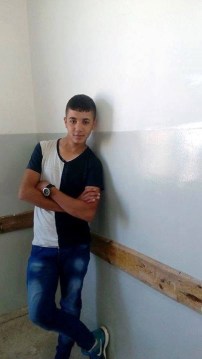 NABLUS – A Palestinian youth was shot dead by Israeli forces at the Tappuah checkpoint south of Nablus in the northern West Bank on Monday.
Local Palestinian sources told Ma’an that Israeli troops opened fire at two young Palestinian men in the Jabal Sbeih area within Beita village, near the Tappuah checkpoint, which is also known to Palestinians as Zaatara.
The youth who was killed in the incident was identified by Nablus TV as Imam Jamil Dweikat, a resident of Beita. His age was not yet clear, however.
The other victim was identified as Nael Thiab, 19, and he was reportedly evacuated to a hospital in Nablus with moderate to serious gunshot wounds following the incident.
Palestinian security sources confirmed that the Israeli liaison department officially notified the Palestinian Authority that Israeli troops shot dead a young Palestinian man and that his body is still with the Israeli army.
The slain youth is the 50th Palestinian to be killed by Israeli forces in the West Bank in 2014, bringing the total Palestinian dead at Israeli hands so far this year, including those who died in Gaza as a result of Israel’s summer offensive, to around 2,335.
An Israeli military spokeswoman told Ma’an that an Israeli military patrol was passing through the area when they “encountered a group of Palestinians hurling rocks at a main road, which endangered both civilians and vehicles.”
“The forces called them to halt and fired warning shots, and when they didn’t comply they responded to the threat with direct fire which wounded one of the attackers.”
She said that the military treated him on site but he later died of his wounds.
“A military police investigation has been opened into the matter,” she added.
Predictions Based on the 2015 Federal Budget – An Analysis
By Lawrence Davidson | To the Point Analyses | December 28, 2014
Part I – Predictions
I can make high-probability predictions for 2015 and the near-beyond without the benefit of a crystal ball, tarot cards or tea leaves. The only thing that I need is a list of items from the new 2015 federal budget. Here are some of my forecasts and the budget items that make them so highly probable:
1. There will be more deadly truck-related accidents than necessary on the nation’s highways in 2015. That means more deaths, injuries, highway delays, stress and frustration. How do I know? Because the 2015 budget rolls back the safety requirement that truckers need to get more rest between driving assignments. The regulation that was rolled back was itself barely adequate. It restricted drivers to a 70-hour week with mandated rest times between long periods behind the wheel. Nonetheless, despite obviously being in the public interest, this regulation could not survive the pressure of the lobbies representing the trucking industry and its corporate customers. Now we are back to truckers working 85-hour weeks with hardly any mandated rest at all.
2. Either in 2015 or soon thereafter there will be another major banking crisis requiring the outlay of enormous sums of public money to avert economic meltdown. How do I know? Because the 2015 federal budget rolls back the requirement, put in place after the last financial crisis, that forced the trading of derivatives to be done by corporate entities separated from the banks and not covered by the Federal Deposit Insurance Company. In other words, if the banks wanted to devise unreasonably risky investment strategies for their more gullible customers, they had to insulate these strategies from their main banking operations that are crucial to the national economy. In addition the government was not required to insure such undue risks through the Federal Deposit Insurance Corporation. Although obviously in the public interest, these regulations could not survive the pressure coming from the banking lobbies and so, once more, we all must be prepared to pay the price of this version of insufficiently regulated capitalism.
3. The political influence of the nation’s wealthiest individuals will increase by a factor of ten in 2015, making the United States more of a plutocracy and less of a democracy than at any time since the 1920s. How do I know? Because the new federal budget emasculates what little was left of the 2002 McCain-Feingold Bipartisan Campaign Finance Reform Act by increasing tenfold the amount of money individuals can give to political parties. This is the result of conservatives’ demanding that political campaigns be underwritten wholly by private funds. Common sense tells us that such an arrangement can only confirm political power in the hands of those who are already economically dominant. By the way, most countries claiming to be democracies regulate against just this dominance of private money because it is recognized as politically corrupting.
4. Environmental protection will deteriorate in 2015. If you live in a rural area where there are large farms, your water supply will become more suspect. How do I know all this? Because the 2015 federal budget slashes funding for the Environmental Protection Agency by $60 million and forbids the same agency from applying the Clean Water Act to farm ponds and irrigation ditches. In the public interest? Of course not. However this move pleases agribusiness concerns and other industries.
5. Israel, the economically developed nation that has violated just about every human rights regulation listed under international law, and also has repeatedly broken U.S. law forbidding the use of U.S.-supplied weapons for offensive actions against civilian populations, will continue to be both economically and militarily subsidized by the American taxpayer in 2015. How do I know this? Because the 2015 federal budget follows in the footsteps of so many past budgets by setting aside huge sums of money – in the present case $3.1 billion in total aid – for the Zionist state. Of that aid package, $619.8 million is military related.
I could not get exact gross figures for how much money the federal government gives back per year to U.S. states for various programs, but certainly Israel gets more of your federal tax dollar than any single state does, and maybe more than all fifty states put together.
On the same topic of foreign aid to undeserving governments, the 2015 budget will help insure the survival of the brutal military dictatorship in Egypt. That bunch of gangsters will be getting $1.3 billion in military aid.
These dubious expenditures are also not in the U.S. public interest for they will undermine democracy in Egypt and uphold dictatorship. In the case of Israel the money will help uphold racist authoritarianism, ethnic cleansing and religious bigotry. All of which (including the aid to Egypt) has been successfully encouraged by the financial power of the Zionist lobby.
Part II – John Boehner’s Bipartisanism
According to House Speaker John Boehner, the 2015 federal budget is a product of bipartisan compromise: “Understand all these provisions … were worked out in a bi-partisan, bi-cameral fashion.” However, this can hardly be the whole story. Boehner’s statement implies that there were only Republicans and Democrats in the proverbial back room where the budget was worked out and that everyone was practicing sweet reason so as to come to a compromise that benefits the nation. In truth, looking over the shoulders of those representing both parties were numerous lobbyists who had given a lot of money to all these politicians and now wanted something back for their investment. As a result, we as a nation, as a community, were thoroughly outbid by the trucking industry, the bankers, agribusiness, and a good number of conservative ideologues who want the right to gut the federal government (particularly the Environmental Protection Agency and the Internal Revenue Service) while monopolizing funding of our two major political parties. They want to do this so that, among other things, they don’t have worry about regulations or pay even a reasonable amount of taxes.
Part III – Conclusion
The ultimate conclusion we can draw from this “bipartisan” process is that there is no sense of national interest, and damn little sense of community, in the American political system. Both concepts have been superseded by the particular parochial goals and sense of solidarity of groups and subgroups with the deep pockets necessary to buy legislators and legislation. This is what happens when democracy allows itself to be captured by an increasingly unregulated capitalist ethic – an erosion of any politically based sense of a need to work for the common good.
The really depressing part is that for most of our national history it has not been very different. In the mid nineteenth century President James Polk, himself a man of questionable integrity, observed, “There is more selfishness and less principle among members of Congress than I had any conception of, before I became President of the United States.” Well, the problem persists, and given our political way of doing things, it may never be fully overcome
Featured Video

or go to
Aletho News Archives – Video-Images
New Documentary
“Inside Gaza” wins best documentary at Montreal’s Cinemania film festival
Palestine Information Center – November 16, 2026
MONTREAL – The documentary “Inside Gaza,” which chronicles the experiences of Palestinian journalists working with Agence France-Presse (AFP) while covering the Israeli war on the Gaza Strip, won the Best Documentary Award at the 32nd Cinemania International Francophone Film Festival held in Montreal, Canada.
Directed by Helene Lam Trong, the 72-minute film follows the daily lives of four AFP journalists who bear witness to the difficulties of reporting in a war-torn territory largely closed off to international media.
The film is compiled from material produced by the team on the ground, as well as from interviews conducted after they left.
The film also won the People’s Choice Award at the festival on Saturday. … continue
Blog Roll
 Aletho News
- How The Jensen Huang Chinese Spy Hoax Is Russiagate 2.0
- Austria seeks to strip former foreign minister of citizenship over Russia ties
- “Inside Gaza” wins best documentary at Montreal’s Cinemania film festival
- Activists block German munitions plant over arms exports to ‘Israel’
- The Nasser Hospital attack and Israel’s relentless lies
- Could it be satan? No, Huckabee, just the Americans you work for
- AIPAC and more: Network of pro-Israel influence in US Congress
- Putin aide reveals Moscow’s stance on Europe at peace talks
- Imran Khan warns Pakistani judges he may die in prison
- IOF used Amazon facial recognition to track millions of Palestinians
- If Americans Knew
- An error has occurred; the feed is probably down. Try again later.
- No Tricks Zone
- Argentina’s Perito Moreno Glacier Joins Antarctica and Arctic In Defying Doomsday Melt Claims
- New Study: Barents Sea Temperatures Were Warmer And Sea Ice Less Extensive In The 1700s Than Today
- German Authorities Start Initiative To Evaluate Public Register For Climate “Disinformation” Spreaders!
- Zonal Asymmetry of Temperature Change in the Antarctic Circumpolar Current
- New Study: The Net Fossil Fuel Contribution To Rising Atmospheric CO2 Has Been Zero For 500 Years
- Germany’s Green Energy Transition Becoming Increasingly Expensive…Another 6 Trillion Euros!
- Sudden Stratospheric Warming, Powerful El Niño Combination May Lead To Extreme Europe Cold, Energy Crisis!
- Two New Studies Find Thwaites Glacier Melt Cannot Be Driven By Human Activity Or A Warming Ocean
- E-Cars Reduce CO2 Emissions By Only 41% Compared To Internal Combustion Engine Vehicles
- Predictions Made By Renowned Climate Professor Over Past Decades Have Been Proven To Be Poor

