UN General Assembly: Israel’s actions in Jerusalem are null and void
MEMO | November 27, 2014
The United Nations General Assembly adopted six resolutions regarding Israeli occupied territories through a recorded vote last night, addressing the areas of Jerusalem and the Syrian Golan.
In terms of Jerusalem, the Assembly voted on a resolution confirming that all legislative and administrative measures taken by Israel to change the legal status of the Holy City of Jerusalem are null and void.
The decision was supported by a recorded vote of 144 countries in favour, six countries opposed, namely Canada, Israel, Marshall Islands, Micronesia, Palau and United States, while ten countries abstained from the vote (Australia, Cameroon, Central African Republic, Madagascar, Panama, Papua New Guinea, Paraguay, Togo and Tonga and Vanuatu).
The Assembly also adopted a resolution that stressed the need for Israel, the occupying power, to withdraw from the occupied Palestinian territories, and demanded the complete cessation of all Israeli settlement activity and Israel’s compliance with its obligations under international law.
The Assembly’s decision also outlined the need for delivering humanitarian and medical aid to the Palestinians.
Another decision was implemented regarding the Syrian Golan Heights as a result of the Assembly’s concern for Israel’s lack of compliance with Resolution 497 (issued in 1981) calling on Israel to withdraw its forces from the Golan Heights which have been illegally occupied since 1967. The decision was supported by 99 countries, rejected by six, while 57 (mostly European) countries abstained from the vote.
Israeli soldiers shoot Italian in the chest at Kafr Qaddum rally
Al-Akhbar | November 29, 2014

A pro-Palestinian Italian activist was shot and seriously wounded by Israeli gunfire during a Friday protest in the northern West Bank, medics and the activist’s organization said.
Palestinian security sources said Patrick Corsi, a 30-year-old member of the International Solidarity Movement (ISM), was shot during the weekly demonstration at Kafr Qaddum, west of Nablus.
Eyewitnesses said Corsi, who had participated in last week’s protest as well, had been documenting the event with a camera.
ISM, an activist group whose members frequently attend Palestinian protests to monitor the actions of Israeli soldiers, confirmed the shooting in a statement.
“The Italian activist, known as Patrick, was wearing a yellow high visibility jacket when he was shot with .22 live ammunition,” the statement said.
The statement added that 10 Palestinian protesters were wounded by rubber-coated steel bullets at the protest, in addition to 18-year-old Sami Jumma who was struck by live fire.
“We were standing with a group of Palestinian demonstrators when Patrick was shot. The military had fired three rounds of tear gas, and then a shot rang out and Patrick stumbled back. There was between five and ten minutes from the last tear gas canister fired and the bullet that shot Patrick.”
“He was just standing there, peacefully protesting, wearing a hi-viz jacket, he wasn’t doing anything and they just decided to shoot him,” the statement quoted an ISM volunteer at the scene as saying.
“The bullet entered Patrick’s chest near a main blood vessel, but thankfully did not puncture it. If God forbid it had, the lengthened journey to the hospital because of the closed road could have cost Patrick his life,” ISM media coordinator Ally Cohen was quoted in the statement as saying.
Due to an Israeli closure of Kafr Qaddum’s main road to Nablus, the travel time to the nearest hospital is around 30 minutes instead of 10.
Khaldoun Ishtewi, media coordinator for public campaigns in Kafr Qaddum, told Ma’an news agency that the Italian national was taken to the Rafidia Public Hospital in Nablus for treatment.
Ishtewi added that several Palestinians suffered from excessive tear-gas inhalation as a result of canisters fired by Israeli soldiers during the clashes.
An Israeli military spokesman did not immediately return a request for comment.
Palestinian Minister of Health Jawad Awwad told Ma’an that “shooting live fire at the upper part of the bodies of protesters is directly targeting them and is a deliberate attempt at murder.”
“Israel does not differentiate between foreign solidarity activists, Palestinians, or even journalists,” he added.
An Israeli army spokesman described the event as a “riot” during which 100 Palestinians allegedly hurled rocks at troops and burnt tires.
After failing to disperse people and “due to increased violence,” soldiers “fired small caliber rounds toward main masked instigators,” the spokesman said.
In the West Bank at the Qalandiya crossing between Jerusalem and Ramallah, Israeli border policemen “fired small caliber rounds toward two main instigators’ lower extremities” during a violent clash with some 150 Palestinians, the spokesman said.
There was no immediate report on their condition.
Protests are held every Friday in Kafr Qaddum against Israel’s closure of a main road linking the village to its nearest city, Nablus, as well as against the Israeli occupation more generally.
The West Bank and annexed East Jerusalem have been occupied by the Israeli military since 1967.
(AFP, Ma’an, Al-Akhbar)
Photo credit – ISM
Is Washington training a rebel army to “Occupy” Syria?
RT | November 27, 2014
Is the US planning the occupation of Syria by training an unconventional insurgent invasion force?
Think regime change in Syria is off the drawing board? Think again. The bombing of the ISIL or ISIS in Syria is part of a brinkmanship campaign leading up to a potential non-conventional invasion, parallel to the re-introduction of the US military to Iraq.
The ISIL and the other anti-government forces in Iraq and Syria are not the only ones to disregard the Iraqi-Syrian border drawn by the British and French by Sykes-Picot in 1916. The US also disregarded the border and international law when it began to illegally bomb Syria.
The bombing campaign was not enough for some in the US Congress. In a joint statement on September 23, the arch-hawks US Senators John McCain and Lindsey Graham called for US troops to be sent into Syria too. Both of them praised the Pentagon’s illegal airstrikes in Syria and then argued for US ground troops as well.
Although McCain and Graham went out of their way to say that this would not be an occupation of either Syria or Iraq, this is almost exactly what they were calling for when they said that the military campaign had to also be directed against the Syrian government.
Since, and even before the calls for an invasion of Syria by McCain and Graham different suggestions have circulated about an invasion of Syria.
The dilemma is that Washington does not want the Pentagon to directly invade Syria itself. It wants to pull the strings while another force does the work on the ground. Candidates for an outsourced invasion of Syria include the Turkish military or other US regional allies. There, however is also an impasse here as Washington’s allies are also afraid of the consequences of an invasion of Syria.
This is where a third opinion comes into the picture: the construction of a multinational insurgent army by the US.
Using non-state actors to invade and occupy Syria
While there seems to be no consensus on a Syrian strategy within the US political, intelligence, and military establishments, the objective of regime change is universally adhered to across the board. Regardless of the existence of a consensus, the US is moving ahead with the creation of an anti-government invasion force.
The third option is slowly emerging.
A few days after the US began the bombing of Syria, the Chairman of the Joint Chiefs of Staff General Martin Dempsey made it clear that the Pentagon also planned on creating a viable anti-government army in Syria consisting of 12,000 to 15,000 insurgents.
There also seems to be a growing consensus among the realists and neocons for US President Obama’s preference of using a rebel army to invade Syria. The Brookings Institute has been a major cheerleader for this.
During this same timeframe, the Brookings Institute released an opinion piece clearly calling for US intervention. The text, authored, by former CIA analyst for monitoring the Persian Gulf and US National Security Council official Kenneth Pollack, stipulated that Washington’s “strategy cannot require sending U.S. troops into combat. Funds, advisers, and even air power are all fair game — but only insofar as they do not lead to American boots on the ground.”
Pollack played an influential role in getting support for the illegal 2003 invasion of Iraq. He worked at the Council of Foreign Relations as its director of national security studies. He made the above statement as the director of research for the Saban Center for Middle East Policy and goes well beyond it by publishing a drawn-out October 2014 proposal for creating a US-made rebel invasion force as a means of taking over Syria and eventually conducting regime change in Damascus.

Brookings Institution in Washington, D.C.. (Image from wikipedia.org)
The Brookings Institute proposal suggests that a rebel Syrian army “is best not done in Syria itself. At least not at first” (p.9). The report points to the US and NATO success in “covertly” creating armed forces around the world, including the assembly of a Croat military, and deduces that these experiences would make it “entirely realistic for the United States to build a new Syrian opposition army” (p.8). It also says that the ideology of the fighters does not matter by stating the following: “A great many of those recruited may well be religious, even highly religious, including Salafist. That is not the issue” (p.9).
Welcome to the Brookings Institute and its Saban Center
What is the Brookings Institute exactly and why do suggestions from this think tank and others like it, matter?
The Brookings Institute is an influential think tank that has a revolving door of personnel with the US government and major corporations. All that one needs to do is look at its trustees and executives, which include interlocked directorships with the Carlyle Group, Goldman Sachs, and JP Morgan Chase.
Brookings also has ties to Israel and a full branch dedicated to Washington’s Middle East strategies and policies called the Saban Centre for Middle East Policy. Martin Indyk – the former US ambassador to Israel, a former high-level lobbyist for the American Israel Public Affairs Committee (AIPAC), and the founder of AIPAC’s research arm (the Washington Institute for Near East Policy) – is the Director of the Saban Center for Middle East Policy at Brookings. Like Indyk, Kenneth Pollack was involved in shaping the Middle East policies of the Clinton Administration.
It is also worth noting that the Brookings Institute’s Saban Center is named after US-Israeli businessman and media mogul Haim Saban. Saban himself is on the board of trustees for Brookings.
There is a Qatari connection too. One may remember that Washington was hostile towards Al Jazeera when it first emerged as a news broadcaster, because of its coverage of US actions in the Middle East.
Saban tried to buy half of the Al Jazeera network from Qatar in 2004 and 2009, but failed. In the same timeframe as the 2003 Anglo-American invasion of Iraq, the first set of negotiations happened when he went to Qatar with Bill Clinton in 2003.
It is possible that Brookings may have played a role in pacifying Al Jazeera. In 2009, the Institute setup an overseas branch in Qatar called the Brookings Doha Center. The new chapter in Doha included Qatar’s ruling Al-Thani family alongside people like Madeleine Albright, Zbigniew Brzezinski, and Fareed Zakaria as chairs and advisors.
It was in the same year that the Brookings Institute published a report, which included Pollack and Indyk as authors, called Which Path to Persia? The report outlined a map for confronting Iran and alluded to the neutralization of Syria, in one way or another (including the procurement of a peace agreement with Damascus by Israel), to “mitigate blowback” from Lebanon’s Hezbollah and the Palestinians, specifically Hamas, as a prerequisite for an enabling an attack on Iran.
All in all, the ideas that come out of the Brookings Institute are discussed at the highest levels within policy-making and corporate circles.
Is the Syrian Invasion Force Slowly Emerging?
Is a rebel invasion force emerging to attack Syria? In no uncertain terms, Brookings argues that it is.
Pollack’s report stipulates the following: “Adopting such a strategy would mean first and foremost that Washington would have to commit itself to building a new Syrian army that will rule Syria when the war is over. Although [Obama’s] description of his new Syria policy was more modest and tepid than his explanation of the Iraq piece of the strategy, he does appear to have committed the United States to just that course. More than that, it will mean putting the resources, prestige and credibility of the United States behind this effort. The $500 million now appropriated is a good start, but it is only a down payment on a much larger project” (p.8).
The US goal of training rebels in Saudi Arabia and Turkey is an indication of this too. On September 10, about two weeks before it started bombing Syria, Washington declared that Saudi Arabia had given it the green light to train a rebel army in the Arabian Peninsula. “We now have the commitment from the Kingdom of Saudi Arabia to be a full partner in this effort — the train-and-equip program — to host that program,” one official was quoted as saying by the New York Times.
The Brookings Institute in its proposal for an invasion of Syria claims: “The Saudi offer to provide facilities to train 10,000 Syrian opposition fighters is one of reasonable possibility, although one of Syria’s neighbors would probably be preferable. Jordan already serves as a training ground for America’s current training program and it would be an ideal locale to build a real Syrian army. However, Turkey could also conceivably serve that purpose if the Turks were willing” (p.10).
About two months later, in November, after US Vice President Joe Biden met with Turkish President Recep Tayyip Erdogan in Istanbul, it was announced that Kirsehir would be used by Turkey to train Syrian anti-government forces that the US would equip against Damascus.
The report also makes it clear that building the new opposition army “should not mean bolstering the existing ‘Free Syrian Army’” (p.10). Instead, the existing US-backed insurgent groups will slowly be swallowed or destroyed by the new opposition force that the US and its allies are constructing.
In mid-November, the Pentagon also presented a proposal to the US Congress, saying that it wants to arm Iraqi tribesmen with Kalashnikov rifles, rocket propelled grenades, and mortars. What is omitted is the cross-border dispersion of these tribes in both Iraq and Syria and the possibility that these weapons could be used in an attack on the Syrian government.
What moderates?
The talk about supporting “moderates” is very misleading. It is already clear that the ideology of the proposed insurgent army is not a key issue in practice for many US officials. There is also enough evidence to show that the Free Syrian Army, Al-Nusra, the ISIL, and the other insurgent forces are also collaborating and trading fighters.
The Telegraph, for example, had this to say on November 10 about Saddam Jamal, a US-backed Free Syrian Army commander that became an ISIL commander: “Before joining ISIL, Jamal had been a drug dealer, then a commander in the western-backed Free Syrian Army, claiming contacts in the CIA.”
It is also clear that religion is a mask for the ISIL too. The same British article writes the following testimony from Saddam Jamal’s body guard about his massacre of a Syrian family: “The ISIL commander felt no remorse for killing this Syrian family, his bodyguard said, nor did he believe he was fulfilling a God-given creed: for him being a member of the extremist group was a matter of business, not religion.”
In the end the ISIL may be used to incubate fighters or collapse, like the Free Syrian Army, into the proposed invasion force to occupy Syria.
Invasion army or armies?
General Dempsey said that “the anti-ISIL campaign could take several years to accomplish.” Leon Panetta, the former head of the CIA and Pentagon, has also claimed that this war will turn into a thirty-year US military project that will extend to North Africa, West Africa, and the Horn of Africa.
According to Brookings: “At some point, such a new Syrian army would have to move into Syria, but only when it was ready. Only when a force large enough to conquer and hold territory – something on the order of two to three brigades -were ready should it be sent in” (p.11).
A war of attrition that that will take years of fighting is underway. This matches up with the ideas about training an insurgent invasion force over the years.
In their joint statement Senators McCain and Graham said that President Bashar Assad will not stop fighting the so-called “moderate” US-backed insurgents “that remain committed to his ousting- especially when the United States and [its] partners still, correctly, share the same goal and will now be arming and training Assad’s moderate opponents.” In other words, the US-trained Syrian forces will ultimately target the Syrian government.
Mahdi Darius Nazemroaya is a sociologist, award-winning author and geopolitical analyst.
Ebola’s Racial Disparity
By Kwei Quartey | FPIF | November 26, 2014
American healthcare workers Nancy Writebol, Kent Brantly, Craig Spencer, and Rick Sacra, as well as NBC cameraman Ashoka Mupko, were all beneficiaries of the medical sophistication of the U.S. hospital system.
All of them contracted Ebola in West Africa and lived to tell the tale, emerging from the hospital Ebola-free and appearing remarkably robust. They benefited from early diagnosis, prompt evacuation to the leading U.S. special isolation centers, and in some cases, treatment with convalescent serum and the experimental drug ZMapp.
The story is quite different for some other high-profile Ebola victims.
Martin Salia, a legal and permanent Maryland resident, was the medical director of Sierra Leone’s Kissy United Methodist Hospital and its only full-time physician. As one of a shockingly small number of doctors in that country—a mere 136 for a population of 6 million—Salia was a rare breed of physician capable of treating anything from orthopedic injuries to myocardial infarction.
In Africa, physician scarcity often precludes the luxurious medical division of labor in the West. I once visited a mid-sized hospital in rural Ghana and foolishly asked the medical director how many other doctors shared his on-call schedule. “There aren’t any other doctors here,” he replied in bewilderment.
Salia, who was deeply religious, believed his calling was to serve the people of Sierra Leone, where Ebola continues to surge. Although he was not working at an Ebola treatment center, Salia could easily have been exposed to the disease through contact with surgical patients.
When Salia first fell ill in early November, his Ebola test returned negative. Three days later, a repeat test came back positive. But unlike white Americans Writebol, Brantly, Spencer, Sacra, and Mupko, Salia was not promptly transferred to the United States.
He began receiving convalescent serum in Sierra Leone, and five days elapsed before he was sent to an Ebola isolation center for treatment in the United States—around a week later into the illness than his white American counterparts. It seems clear that delays in Salia’s diagnosis and treatment resulted in his deterioration to a point beyond repair. By the time he arrived in the United States on November 15, his raging infection had already rendered him too ill to be saved.
But even worse was another Ebola case involving an African physician for whom therapy was withheld outright. Sheik Umar Khan, a Sierra Leonean specialist in viral hemorrhagic fever, was diagnosed with Ebola last July and admitted to the Ebola Treatment Center in Kailahun, Sierra Leone.
The team of physicians from Médecins Sans Frontières (MSF) and the World Health Organization who took care of Khan reportedly “agonized through the night” over whether to administer ZMapp to him.In the end, without discussing it with Khan, they decided against it. “What they really didn’t want to do was kill Dr. Khan with their attempt at therapy,” Armand Sprecher, a public health specialist at MSF, reportedly said.
But surely the converse question should also have been posed: what if they cured Khan? Sprecher, who is involved in procuring drugs for MSF, further offered what from my perspective as a physician was the flimsiest of excuses: that Khan’s virus levels were so high that it was believed the drug would “probably not work.”
So which is it? That the team thought that the ZMapp would do nothing for their patient, or that it would kill him? It cannot be both.
Khan died several days later, and the very ZMapp that had been denied him was later sent to Liberia and used instead for Writebol and Brantly, who recovered admirably (though we cannot say for certain how much ZMapp contributed to their survival). In addition, Spanish officials confirmed that they too had obtained a supply of ZMapp for a third patient—a 75-year-old Spanish priest who died after having been evacuated to Madrid from Liberia.
In the now infamous story of Liberian Thomas Eric Duncan—who died in a Texas hospital after contracting Ebola in Africa—Duncan’s nephew Josephus Weeks has raised the possibility that racial bias entered into the decision to send the febrile man home from the Texas Health Presbyterian Hospital emergency room on September 25. Similar broad ethical questions arise about whether the treatment of Ebola victims is being stratified on criteria of national origin, making some “more equal than others.”
The physicians who have cared for these patients themselves would deny that any racial bias ever consciously entered into their decisions over choice of therapy. That, however, is exactly the trouble. Most racial bias among doctors is unconscious, meaning we must carefully consider whether our medical decisions reflect a double standard in the treatment of our patients—Ebola-infected or otherwise.
Kwei Quartey M.D. is a crime novelist and physician who grew up in Ghana. He is now based in Los Angeles. His fourth novel, GOLD OF THE FATHERS, will be published in February 2016.
The Politics of Thanksgiving Day
By William Loren Katz | November 5, 2014
Thanksgiving remains the most treasured holiday in the United States, honored by Presidents since Abraham Lincoln initiated the Holiday to rouse patriotism in a war that was not going well.
 Thanksgiving has often served political ends. In 2003, in the current age of US Middle East invasions, President George Bush flew to Bagdad, Iraq to celebrate Thanksgiving Day with U.S. troops. He sought to rally the public behind an invasion based on lies. A host of photographers came along to snap him carrying a glazed turkey to eager soldiers. In three hours he flew home, and TV brought his act of solidarity and generosity to millions of US living rooms. But the turkey the President carried to Baghdad was never eaten. It was cardboard, a stage prop.
Thanksgiving 2003 had a lot in common with the first Thanksgiving Day. In 1620 149 English Pilgrims aboard the Mayflower landed at Plymouth and survived their first New England winter when Wampanoug people brought them corn, meat and other gifts, and taught them survival skills. In 1621 Governor William Bradford of Plymouth proclaimed a day of Thanksgiving – not for his Wampanoug saviors but his brave Pilgrims. Through resourcefulness and devotion to God his Christians had defeated hunger.
We are still asked to see Thanksgiving through the eyes of Governor Bradford. But Bradford’s fable is an early example of “Euro think” — an concoction by Europeans that casts their conquest as heroic.
Bradford claims Native Americans were invited to the dinner. A seat at the table? Really? Since Pilgrims classified their nonwhite saviors as “infidels” and inferiors — if invited at all, they were asked to provide and serve and not share the food.
Pilgrim armies soon pushed westward. In 1637 Governor Bradford sent his troops to raid a Pequot village. As devout Christians locked in mortal combat with heathens, Pilgrims systematically destroyed a village of sleeping men, women and children.
Bradford was overjoyed:
“It was a fearful sight to see them frying in the fire and the streams of blood quenching the same and horrible was the stink and stench thereof. But the victory seemed a sweet sacrifice and they [the Pilgrim militia] gave praise thereof to God.”
Years later Pilgrim Reverend Increase Mather asked his congregation to celebrate the “victory” and thank God “that on this day we have sent six hundred heathen souls to hell.”
School and scholarly texts still honor Bradford. The 1993 edition of the Columbia Encyclopedia [P. 351] states of Bradford, “He maintained friendly relations with the Native Americans.” The scholarly Dictionary of American History [P. 77] said, “He was a firm, determined man and an excellent leader; kept relations with the Indians on friendly terms; tolerant toward newcomers and new religions….”
The Mayflower, renamed the Meijbloom (Dutch for Mayflower), continued to carve its place in history. It became one of the first ships to carry enslaved Africans to the Americas.
Thanksgiving Day celebrates not justice or equality but aggression and enslavement. It affirms the genocidal beliefs that destroyed millions of Native American people and their cultures from the Pilgrim landings to the 20th century.
Americans proudly count themselves among the earliest to fight for freedom and independence. On Thanksgiving Americans could honor the first freedom fighters of the Americas – those who resisted foreign invasion – but they were not Europeans, and they started long before 1776.
Long before Pilgrims landed at Plymouth thousands of enslaved Africans and Native Americans united to fight the European invaders and slavers. In the age of Columbus and the Spanish invasion they were led by Taino leaders such as Anacoana a woman poet who was captured and executed at 29; and a man Hatuey who in 1511 led his 400 followers from Hispaniola to Cuba to warn of the foreigners, and was captured and executed the next year.
Before the Mayflower, thousands of runaway Africans and Indians in northeast Brazil had begun to unite in the Republic of Palmaris, a three walled maroon fortress that enabled Genga Zumba’s 10,000 people of color to defeat Dutch and Portuguese armies. Palmares lasted until 1694, almost a hundred years.
These early nonwhite freedom fighters kept no written records, but some of their ideas about freedom, justice and equality found their way into a sacred parchment Americans celebrate each July 4th.
Humanitarian aid is still a target for the Israeli occupation
By Ibrahim Hewitt | MEMO | November 26, 2014
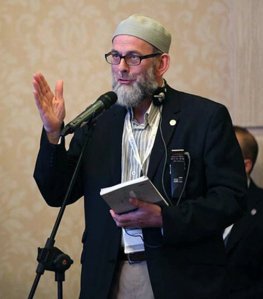 I have been the chair of trustees for 17 of Interpal’s 20 years as a British charity helping Palestinians in desperate need; it is a privilege to be in such a position. Being a trustee has enabled me to meet and work with some wonderful people, including our incredible beneficiaries in occupied Palestine, Jordan and Lebanon. They inspire us as we try to bring a degree of normality to their extraordinarily abnormal situation.It hasn’t been an easy ride. Interpal was declared by the US government in 2003 to be a “Specially designated global terrorist entity”; there was no due process, no investigation and no immediately obvious right to appeal against the decision. We discovered our new status via the BBC website. I called it “gesture politics” at the time, because claims that the US was freezing Interpal’s assets in America were nonsense; we didn’t have any assets there. In fact, the only money we have in the States now is around $100,000 which was confiscated by Citibank as the transfer of funds for our orphans’ programme in Jordan crossed a computer screen in New York. Orphans went without so that American and Israeli egos could be massaged.
A number of investigations and inquiries by Britain’s charity regulator have found no evidence of illegal activity by Interpal, and the US government has offered no evidence to justify its designation. The absence of any police involvement, said one senior Metropolitan Police officer, “is hugely significant”.
The “terrorist” tag originated in Israel, of course, which has a strong interest in blocking any kind of aid to the Palestinians living under its brutal military occupation; if life is made harsh enough, the theory goes, then perhaps the Palestinians will pack up and cross the Jordan into permanent exile. This is known in Zionist jargon as “silent transfer”. After almost 70 years of occupation, the Israelis obviously do not know the Palestinians, or the people who support them.
The UN Relief and Works Agency (UNRWA), whose senior spokesperson, Chris Gunness, has flown over to speak at Interpal’s 20th anniversary symposium in London, is at the forefront of working to keep the Palestinians afloat. Interpal is proud to be a valued partner of UNRWA and has a number of projects in the pipeline to continue such work in the months and years ahead.
Despite having such a high profile link to a UN agency, accusations of supporting “terrorism” have been thrown at Interpal almost since day one, with a claim in a major broadsheet that we “funded the training of suicide bombers” in 1996. A small charity has been seen as an easy target; we are the pebble in the Israeli shoe and just won’t go away. “Interpal,” said one Israeli politician, “is a tough nut to crack.”
The attack on our charity has been relentless which is odd, given our relatively small size. Italian journalist and author Loretta Napoleoni is an expert on “terrorist financing”. She told me that the US and Israeli governments are going after charities like Interpal precisely because they think that we are easy targets and can be shut down, at which point they can claim to be “cutting off terrorist funding”. The reality, she said, is that most of the $3 trillion drugs and terrorist economy is channelled through legitimate businesses, not charities. In 2012, HSBC confirmed that it was going to pay the US authorities $1.9bn (£1.2bn) in a settlement over money laundering. “A US Senate investigation said the UK-based bank had been a conduit for ‘drug kingpins and rogue nations’,” reported the BBC. The bank “admitted having poor money laundering controls and apologised.” There has been no special designation for a bank involved in very serious crime, but a small charity against whom there are only allegations from vexatious complainants face being driven out of existence; our only “crime” is helping Palestinians.
The message from our New York lawyer is that the US Treasury can only do so much about the designation: “It was a political decision and needs a political decision to rescind it.” In other words, the State Department must be involved, which is why Interpal has asked the Foreign and Commonwealth Office a number of times to speak on its behalf. Even though HM Government intervened on behalf of British banks facing legal action in the US, this British charity has been told “you need to raise it yourselves with the Americans”. Individual parliamentarians in both Houses have been very supportive over the years, but of government action there has been none.
Interpal distributes on average around £4 million a year and every penny is accounted for. In the great scheme of things, this is a relatively miniscule amount (Israel gets $8m a day from the US). The bureaucratic system that we have in place makes it ridiculous to suggest that we divert donations for illegal purposes.
The fact that many of the projects Interpal has funded are also funded by USAID doesn’t carry any weight in Washington, and America insists that we should discriminate along political lines in the distribution of our funds; discrimination of any kind is illegal for British charities, and rightly so. We will continue to support Palestinians with humanitarian aid without fear or favour, the only criteria being need.
Many of Interpal’s beneficiaries are women and children. The children of Palestine, Muslims and Christians alike, have had their childhood stolen from them; we should all hang our heads in shame at this. More than 80 per cent of the children in the Gaza Strip suffer from post-traumatic stress. Every time an Israeli jet flies overhead, or a helicopter, or a drone, these children wait for the bombs to follow; that is what they have come to expect. It is a shameful situation.
The recent news that the dedicated surgeon and activist Dr Mads Gilbert has been given a lifetime ban by Israel from entering the Gaza Strip illustrates perfectly the Israeli attitude towards anyone offering humanitarian assistance to Palestinians. It has nothing to do with “terrorism” and everything to do with enforcing an immoral and illegal blockade on the territory. What is being done in the name of “the only democracy in the Middle East” is not only undemocratic but also breaks international law. Israel’s leadership knows this but carries on regardless and with apparent impunity. NGOs and others will do likewise until justice is seen to be done and a free and independent Palestine emerges from the rubble.
This is an edited version of the speech given by Ibrahim Hewitt at Interpal’s 20th anniversary symposium in London on 25th November.
Israel transforms Jerusalem’s suburbs into a “big prison”
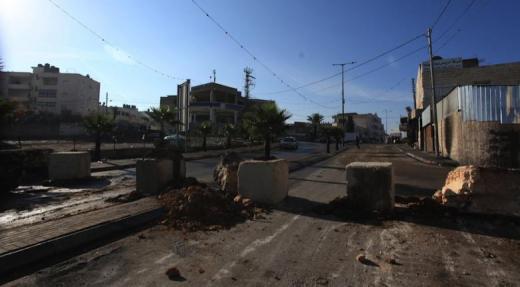
Concrete blocks are placed by Occupation security forces at the entrances to the Palestinian village of al-Ram, northeast of Jerusalem on November 19, 2014. Issam Rimawi – Anadolu Agency
By Mohammed Abdel Fattah | Al-Akhbar | November 26, 2014
Perhaps Israeli prisons can not accommodate more Palestinians, and so Israeli authorities have now chosen to imprison Palestinians inside their villages, especially in the suburbs of Jerusalem. That is part of the collective punishment inflicted on villages, whose residents dared to rise up against the occupation and the discriminatory policies it imposes on Palestinians – such as preventing them from praying at al-Aqsa Mosque, repeatedly storming the mosque, and turning a blind eye on violence and murder of Palestinians at the hands of fanatical Israeli settlers.
Occupied Jerusalem – The Israeli response to a village that revolts is to surround it with concrete barriers and military checkpoints, in addition to using weapons of all types and sizes against young demonstrators. Recently, the occupation forces began to seal off the villages of Hay al-Thawri, Sur Baher and al-Ram in the Jerusalem district after a series of protests against the killing of Ghassan and Uday Abu Jamal, both of whom carried out the recent Knesset operation. Before sealing off these villages, the Israelis encircled and sealed off the village of al-Issawiya, but the concrete barriers were later removed from its entrances following a protest by hundreds of its residents.
Sur Baher, located south of occupied Jerusalem, continues to be closed, hemming in its 27,000 residents. The Israelis tightened the noose around the village by closing its entrances with concrete barriers, leaving only one route for its residents. The people of Sur Baher enter and leave the village through that road, where an Israeli military checkpoint manned by abusive Israeli soldiers regularly mistreat anyone who passes by on foot or in a vehicle. Going in and out of the village presently takes an hour, while Israeli soldiers search every single person from head to toe and search cars from the hood to the trunk.
Students are forced to step out of cars and buses to cross the checkpoint on foot in order to get to school even if that means arriving half an hour late.
The director of the company Sur Baher Buses for Public Transportation, Raafat Nimr, complained that now they have to leave an hour before it is time to pick up students from outside the village to be able to drop them off at school somewhat on time.
He said his and other bus companies have suffered from closing the village and restricting access in and out to one checkpoint as it cut the number of trips buses take from the village in half. This will force the company to close down soon because the cost of “loading passengers increased and there is no longer a large number of trips to make up for it,” he said.
People who do not have a business to take care of outside the village have decided not to leave the village so that they won’t get upset and agitated. For example, Hamza Umaira has not left Sur Baher for a week. Besides, Israeli soldiers at the checkpoint regularly prevent him from going to Jerusalem to pray at al-Aqsa Mosque.
In Hay al-Thawri, where the family of Moataz Hijazi lives, the martyr who carried out the assassination attempt on the life of the extremist rabbi, Yehudah Glick, the situation is as bad as the rest. Like Sur Baher, the Israeli occupation sealed the village twice. The first time after killing Hijazi and the second time after the operation carried out by Ghassan and Uday Abu Jamal. The difference with this neighborhood to others is that it has been encircled with concrete barriers without military checkpoints. This prompts people to take bypass roads, delaying workers and students.
The town facing the worst mistreatment is al-Ram, whose closure affects the residents of the nearby Qalandia refugee camp as they go to and from Ramallah and Jerusalem. In addition to closing the northern entrance to the town with concrete blocks, the closure affects the revenue of businesses located along the road to the northern entrance. The Israeli authorities also closed the Jabaa road adjacent to the town, thereby creating a suffocating traffic jam that takes people two hours to get out of.
Just like the average citizen suffers, medical services suffer too. Turning the Palestinian villages surrounding Jerusalem into “large prisons” obstructs ambulances and prevents them from reaching areas where sick and wounded people need to be taken to hospitals.
Palestinian Red Crescent official, Amin Abu Ghazaleh, said that Israeli occupation forces deal with Red Crescent ambulances as though they are part of the young people’s uprising against them, especially after Israeli ambulances refused to enter Arab areas.
He pointed out that Israeli soldiers did not make it easy for ambulances to enter confrontation areas, treat the injured there or transfer them to hospitals. Instead, they refused to remove any barriers, which increases the rate of field medical treatment.
Residents of the villages facing closure believe that this policy will add to the tension in the city because most of their villages lack basic facilities, such as hospitals and markets.
For his part, political analyst, Fadel Tahboub argues that “Israelis do not want to calm the situation down in Jerusalem, so they continue to close villages and settlers continue to storm al-Aqsa Mosque.”
“The goal of the Israeli occupation is to isolate the Palestinian villages from Jerusalem in order to reduce the Arab population in the city, and to pave the way for annexing them to the West Bank at a later time, completely disconnecting them from occupied Jerusalem,” he concluded.
Israeli Authorities Prevent 100 Tons of Vegetables from Exporting out of Gaza
IMEMC News & Agencies | November 24, 2014
At Kerm Abu Salem crossing Israeli occupation authorities have barred ten truckloads of agricultural products from leaving the war-torn and economically besieged Gaza Strip, due to an alleged dispute between the Israeli army and the Ministry of Agriculture.
The dispute is preventing the trucks and their cargo from passing, and being exported to Saudi Arabia and West Bank, according to Al Ray Palestinian Media Agency.
Israeli website Walla reported, on Monday, that allowing the export of the agricultural products comes in the framework of “facilities” granted for Gaza residents in the wake of the last summer’s assault on the region, by Israel. Israeli authorities had agreed on the passage of ten truckloads per day.
Walla added that this shipment of vegetables weighs 100 tons, and has been held back since Sunday morning.
According to the Israeli system, after the truckloads pass to the military checkpoint on the Palestinian side of the crossing, they should be inspected and, then, loaded again onto Israeli trucks to pass to their planned route.
The office of the Coordinator of Government Activities in the occupied territories claims that the trucks are still stuck in the crossing because the Israeli Ministry of Health did not yet inspect them in accordance with regularities, with the Ministry itself citing a lack of staff to do that.
At this time, it is not clear when the shipment will pass.
‘The Jewish state law paves the way for displacing more Palestinians’
Palestine Information Center – November 25, 2014
GAZA – Senior Islamic Jihad official Yousuf al-Hasaina said that the Israeli cabinet’s approval of new racist legislation defining Israel as the nation-state of the Jewish people is a prelude to expelling the Palestinian people from their 1948 occupied lands.
In remarks broadcast by the media department of the Movement on Monday, Hasaina stated that the new law would open the way for the option of exchanging lands and residents between the Palestinian Authority and Israel.
Describing the law as racist created by an extremist and fascist cabinet and community, the Islamic Jihad official asserted that it would give the Jews alone unlimited rights.
“The law would tighten the noose around the indigenous Palestinian Arab population until forcing them willingly or unwillingly to leave their country, and this is what the occupation state is seeking to impose in the coming days on the Palestinian Authority and the Palestinian people,” Hasaina warned.
He noted that the most dangerous aspect of this law is its description of the Talmudic religious texts as the source of legislation in the Jewish state while many of these texts legalize the killing and displacement of non-Jews.
However, Hasaina expressed his belief that Israel is an illegal entity and neither its Talmudic laws nor the western support would save it from its destined demise.
Pro-Israel activists ask MPs to halt non-violent BDS protests
MEMO | November 24, 2014
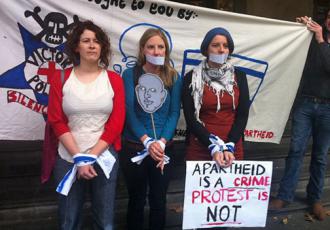 Zionist activists have urged British MPs to implement new legislation that police could use to stop non-violent, pro-BDS protests.
Manchester-based group North-West Friends of Israel have urged politicians to give police more power to stop boycotts of businesses by pro-Palestine solidarity activists.
As cited in a report by The Jewish Chronicle, the group’s co-chair Anthony Dennison wants the Public Order Act amended “to allow police to halt non-violent protests, if they disrupted ‘the lawful right of customers and shops to trade’.”
Dennison commented: “Peaceful protest can be intimidating, if demonstrators are stood outside a shop, holding placards with horrible images, are customers really going into that shop?”
Ben & Jerry’s Israeli Factory and Israel’s Stolen Land and Stolen Water
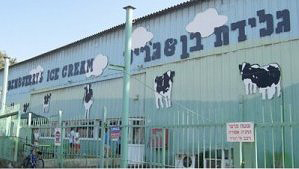
Vermonters for a Just Peace in Palestine/Israel
The Ben & Jerry’s factory is in Be’er Tuvia, adjacent to the town of Kiryat Malachi, one of four Israeli localities located on the lands of the former village of Qastina, in territory allotted to the Arab state under the 1947 UN Partition Plan. However on July 9, 1948, after Israel’s declaration of independence and the ensuing war, Qastina and its more than 147 houses were completely destroyed by Israeli forces of the Givati Brigade, and the land incorporated into Israel. (Based on information documented at http://en.wikipedia.org/wiki/Qastina, accessed December 2012).
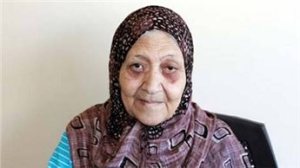 Ghatheyya Mifleh al-Khawalda was a 15-year old teenager when she fled to Gaza from her home in the village of al-Qastina, now the town of Kiriyat Malachi and site of the Ben & Jerry’s factory, during the Nakba of 1948. So this woman, a refugee living only a day’s walk from the village that she was driven from, represents a personal and tragic link to the site where now the Ben & Jerry’s factory churns out ‘Peace and Love’ ice cream. Yes, they do profit from this stolen land, and yes, the Nakba was a crime, and yes, the occupation is an affront. Ghatheyya is one of generations of Palestinians in Gaza who are locked away from their land, their families and the world. Some seethe with anger and resort to violence – three people in Kiriyat Malachi died in November 2012 in a rocket attack from Gaza. Ghatheyya said, “We had a very nice house, a big house with marble floors in the hallway. My father was a farmer, and we had farmland with orange trees, apple trees, grapefruit trees and others. We were very happy.” Her life changed dramatically in 1948, when Jewish militias arrived. “Some Jewish militia members were wearing uniform and others had civilian clothes,” Ghatheyya said, “and when they arrived in the village they began firing at people, killing three villagers. We ran away, afraid for our safety, and went to Tal al-Safi, a nearby village. It was within walking distance, and we were in a hurry to leave, so we didn’t take anything with us. It was like Doomsday. It was utter terror. We couldn’t think of anything except leaving, not even simple things like bringing food with us.” After a few days in Tal es-Safi, militias came again and forced them to leave. Ghatheyya and her family fled to Beit Jibrin to spend the night, but were followed and forced to leave again. “If you wanted to die, you stayed. If you wanted to live, you left,” she recalls. “Their main aim was not to kill us, but to get rid of us. If they had wanted us all dead, not one of us would have survived. They used fear to force us to leave our land.” The family walked along the coast until they reached Gaza. “There were thousands of people who fled other villages, sleeping in mosques or on the street,” Ghatheyya says, and UNRWA began to build tents for the families. (From a story “Nakba survivor: If you wanted to live, you left” at Ma’an News )
Water Used by the Factory
When investigating Ben & Jerry’s business dealings in Israel and the occupied territory, we also set out to determine if the company’s franchise was benefiting from Israel’s criminal diversion of Palestinian water. Our inquiry, which included discussions with an international water consultant, led us to the tentative conclusion that Ben & Jerry’s factory in Kiryat Malachi may be drawing water from the Jordan River system and the Mountain Aquifer in the occupied West Bank, the two highest-quality water sources in the region, thus diverting it from Palestinian use.
Palestinians under occupation have been denied access to the Jordan River since 1967, leaving the Mountain Aquifer as their only source of water. A study by The World Bank determined that “Palestinian per capita access to water resources in the West Bank is a quarter of Israeli access and is declining.” This is a result of Israeli government planning and regulation.
To make matters worse, Israeli settlers in the West Bank often obstruct or disconnect the flow of water to Arab communities, while 500,000 settlers consume in total approximately six times more water than three million Palestinians. This difference is even higher when agricultural use is factored in. Regular access to water explains why one commonly sees green lawns and swimming pools in Israeli settlements. In stark contrast, throughout the year, but especially in the summer, Palestinian cities and villages are denied continuous access to water, sometimes for weeks on end. This gross injustice is aggravated by Israel’s policy of denying permits to Palestinians to drill new wells or rehabilitate old ones.
By manufacturing in Israel and marketing in the occupied territory, Ben & Jerry’s is a willing partner to a water system that is grossly inequitable, transgresses international law, and denies Palestinians their fair share of the Mountain Aquifer and the Jordan River. Please see Our Report for more information on Israel’s water crimes in the occupied territory.
Featured Video

or go to
Aletho News Archives – Video-Images
New Documentary
“Inside Gaza” wins best documentary at Montreal’s Cinemania film festival
Palestine Information Center – November 16, 2026
MONTREAL – The documentary “Inside Gaza,” which chronicles the experiences of Palestinian journalists working with Agence France-Presse (AFP) while covering the Israeli war on the Gaza Strip, won the Best Documentary Award at the 32nd Cinemania International Francophone Film Festival held in Montreal, Canada.
Directed by Helene Lam Trong, the 72-minute film follows the daily lives of four AFP journalists who bear witness to the difficulties of reporting in a war-torn territory largely closed off to international media.
The film is compiled from material produced by the team on the ground, as well as from interviews conducted after they left.
The film also won the People’s Choice Award at the festival on Saturday. … continue
Blog Roll
 Aletho News
- Brand ‘rape’ case just doesn’t add up. Was he framed?
- How The Jensen Huang Chinese Spy Hoax Is Russiagate 2.0
- Austria seeks to strip former foreign minister of citizenship over Russia ties
- “Inside Gaza” wins best documentary at Montreal’s Cinemania film festival
- Activists block German munitions plant over arms exports to ‘Israel’
- The Nasser Hospital attack and Israel’s relentless lies
- Could it be satan? No, Huckabee, just the Americans you work for
- AIPAC and more: Network of pro-Israel influence in US Congress
- Putin aide reveals Moscow’s stance on Europe at peace talks
- Imran Khan warns Pakistani judges he may die in prison
- If Americans Knew
- Mossad abducted Iranian general in Turkey, tortured him for weeks before killing him: Report
- I Am a Palestinian-American. Israeli Soldiers Occupied My Home for Weeks and Trashed It
- Jeffries Accused of “Straight Up Lie” for Claiming AIPAC Is Ending Donations
- DAILY UPDATE: Latest essential news on Palestine, Israel, & region
- Mothers fear for their children as polio returns to Gaza amid Israel’s ongoing genocide
- Inside the Israel-backed ‘NAZA’ disinformation campaign
- US Restrictions Prevent Palestinian Clergy From Speaking in Washington
- Gazan medics detained on shift, tortured – and return to work
- AIPAC and more: Network of pro-Israel influence in US Congress
- Israel Pays “Conservative” Media to Propagandize Americans
- No Tricks Zone
- Argentina’s Perito Moreno Glacier Joins Antarctica and Arctic In Defying Doomsday Melt Claims
- New Study: Barents Sea Temperatures Were Warmer And Sea Ice Less Extensive In The 1700s Than Today
- German Authorities Start Initiative To Evaluate Public Register For Climate “Disinformation” Spreaders!
- Zonal Asymmetry of Temperature Change in the Antarctic Circumpolar Current
- New Study: The Net Fossil Fuel Contribution To Rising Atmospheric CO2 Has Been Zero For 500 Years
- Germany’s Green Energy Transition Becoming Increasingly Expensive…Another 6 Trillion Euros!
- Sudden Stratospheric Warming, Powerful El Niño Combination May Lead To Extreme Europe Cold, Energy Crisis!
- Two New Studies Find Thwaites Glacier Melt Cannot Be Driven By Human Activity Or A Warming Ocean
- E-Cars Reduce CO2 Emissions By Only 41% Compared To Internal Combustion Engine Vehicles
- Predictions Made By Renowned Climate Professor Over Past Decades Have Been Proven To Be Poor

