UN: Israeli trade control causes $310m loss for PA
Al-Akhbar | December 3, 2014
The Palestinian Authority lost at least $310 million in customs and sales tax in 2011 as a result of importing from or through Israeli-occupied territories, the UN said Wednesday, urging a radical change to the system.
The lost revenue, worth 250 million euros, was equivalent to 3.6 percent of gross domestic product (GDP) and 18 percent of the tax revenue of the authority, the UN Conference on Trade and Development (UNCTAD) said.
The figures point to “the pressing need to change the modus operandi of the Palestinian import regime to ensure Palestinian rights in all economic, trade, financial and taxation areas,” it said in a new study.
UNCTAD said the 1994 Paris Protocol which governs economic ties between Israeli-occupied and Palestinian territories causes “instability and uncertainty for the Palestinian territory” and should be reformed.
It said barriers should be removed to trade with other countries, and criticized Israel’s “disproportionate influence” on collecting Palestinian revenues.
Israel often freezes the transfer of funds under the pretext of a punitive measure in response to diplomatic or political developments it deems harmful.
About 40 percent of the so-called “fiscal leakage” is related to direct and indirect imports from Israel, and 60 percent from evasion of customs duties, the UN said.
The report cited data from the Israeli Central Bank indicating that 39 percent of Palestinian imports from Israel-occupied territories originate in third countries, but are cleared in Israel and sold on as if produced by Israel.
Customs revenues from these “indirect imports” is collected by the Israeli authorities but not transferred to the Palestinian authority, it said.
Another problem comes from goods smuggled over the border from Israeli-occupied territories, the report said, highlighting the Palestinians’ lack of control over their borders.
Smuggling results in lost sales and purchase taxes for the Palestinian authorities and, where the goods are produced in a third country, lost tariff revenues.
UNCTAD added that its figures are likely to underestimate the problem and urged further research.
The Palestinian economy is bound closely to Israel’s through infrastructure and trade and has few foreign trading partners.
It said that Israel’s system of checkpoints and restrictions in the area inflict long-term damage on Palestinians’ ability to compete in the global market.
The policies are causing a contraction in manufacturing and agricultural sectors, “alarmingly” high unemployment and social problems that would outlive any Israeli-Palestinian peace agreement, the organization said.
Israel occupied East Jerusalem and the West Bank during the 1967 Middle East War. It later annexed the holy city in 1980, claiming it as the capital of the self-proclaimed Zionist state – a move never recognized by the international community.
In November 1988, Palestinian leaders led by Arafat declared the existence of a State of Palestine inside the 1967 borders and the State’s belief “in the settlement of international and regional disputes by peaceful means in accordance with the charter and resolutions of the United Nations.”
Heralded as a “historic compromise,” the move implied that Palestinians would agree to accept only 22 percent, almost 17 percent now after the expansion of Israeli settlements, of historic Palestine in exchange for peace with Israel.
Throughout the 1990s and 2000s, Palestinian leaders sought to create the institutions of statehood despite the lack of an actual state, leading to the development of a security apparatus under US tutelage and a Palestinian bureaucracy.
While major Palestinian cities have boomed in the 26 years since “independence,” Israeli confiscation of land in border regions has continued unabated.
Last year, the World Bank estimated that Israeli control over Area C — the 61 percent of the West Bank under full Israeli military control — costs the Palestinian economy around $3.4 billion annually, or more than one-third of the Palestinian Authority’s GDP.
According to the PLO, between 1989 and 2014, the number of Israeli settlers on Palestinian land soared from 189,900 to nearly 600,000. These settlements, meanwhile, are located between and around Palestinians towns and villages, making a contiguous state next to impossible.
In its Independence Day statement last month, the PLO sought international solidarity to achieve the dream of a Palestinian state free of occupation denied since 1948.
“One effective step that the international community can take is to recognize the State of Palestine over the 1967 border with East Jerusalem as its capital and support Palestine’s diplomatic initiatives such as the UNSC resolution to put an end to the Israeli occupation as well as our access to international treaties and organizations. This will provide additional support to the two-state solution between Israel and Palestine while nullifying any Israeli attempt to change the status quo of the occupied State of Palestine,” the PLO said.
“The international community must ban all Israeli settlement products, divest from all companies involved directly or indirectly in the Israeli occupation and take all possible measures in order to hold Israel, the occupying power, accountable for its daily violations to Palestinian rights and international law.”
The Palestinian Authority this year set November 2016 as the deadline for ending the Israeli withdrawal from the territories occupied by Israel during the Six-Day War in 1967 and establishing a two-state solution.
It is worth noting that numerous pro-Palestine activists argue in favor of a one-state solution, arguing that the creation of a Palestinian state beside Israel would not be sustainable. They add that the two-state solution, which is the only option considered by international actors, won’t solve existing discrimination, nor erase economic and military tensions.
(AFP, Al-Akhbar)
Israeli forces demolish building, 20 stores in Shufat camp
Ma’an – 03/12/2014
 JERUSALEM – Bulldozers heavily escorted by Israeli forces on Wednesday demolished 20 stores and an ancient structure in Shufat refugee camp in East Jerusalem, sources told Ma’an.
Locals said large numbers of Israeli police officers and troops from various divisions raided the camp and deployed in the streets and on rooftops.
Troops then surrounded an ancient building known as the Cola building and all adjacent stores, denying local residents access to the area before blowing up the main doors of all the stores.
The building and the stores belong to the Dajani family from Jerusalem. One of the owners, Abu al-Walid Dajani, told Ma’an Israeli authorities carried out the demolition without notifying the owners. He said excavators demolished the building and 20 adjacent stores.
The area where the demolitions took place measures about 800 square meters, Dajani said.
The building and the stores were built in 1963, he added. It had been populated and the stores were used as shops until the mid-1980s when the First Intifada broke out. Israeli authorities then prevented the family from using the structures.
Dajani denied Israeli claims that the building and the stores were built without permits. He said the Dajani family originally owned 11,500 square meters in Shufat camp before Israel confiscated 2,000 square meters for the construction of the separation wall. In 2008, Israel confiscated 6,000 square meters more, on which they set up a military checkpoint.
In 2012, Israeli forces confiscated the rest of the land along with the structures built on it. Dajani attempted to reclaim his land and properties through Israeli courts, including the Supreme Court, to no avail. Courts always cited security pretexts, he told Ma’an.
Israeli authorities ordered him to pay a property tax of 485,000 shekels to the Israeli municipality of Jerusalem, he added.
A spokesman of the Fatah movement in Shufat camp, Thaer Fasfous, told Ma’an that four large excavators demolished the Cola building and 20 stores. He added that 10 of the demolished stores were open and running until the day they were demolished.
Among the functioning stores was a coffee shop, a car repair workshop, a taxi office, a grocery, a chicken butchery, a frozen meat shop, and a shop which sold tree saplings, in addition to two stores used as warehouses for the al-Khatib Supermarket.
During the demolitions, Israeli forces fired tear gas and rubber-coated bullets to prevent local residents from assembling, Fasfous said. A nearby school was also evacuated.
Israel rarely grants construction permits to Palestinians in the West Bank, including East Jerusalem, and regularly demolishes structures built without permits.
Israeli bulldozers have demolished at least 359 Palestinian structures in the West Bank so far in 2014, according to the Israeli Committee Against House Demolitions.
During the 1967 war, Israel captured East Jerusalem from Jordan, occupied it, and later annexed it in a move never recognized abroad.
Israeli forces close Nablus-area school, say vehicles were stoned
Ma’an – 03/12/2014
NABLUS – Israeli troops on Wednesday morning shut down a secondary school which serves two Palestinian villages south of Nablus in the northern West Bank, a Palestinian official and locals said Wednesday.
Ghassan Daghlas, who monitors settlement-related activities in the northern West Bank, told Ma’an that Israeli soldiers denied hundreds of schoolchildren from al-Lubban and al-Sawiya villages entry to their secondary school located near the main road between Nablus and Ramallah.
The Israelis notified the school administration that it would be closed because Israeli vehicles driving on the nearby street have been attacked with stones.
Palestinian government sources told Ma’an that the Israeli liaison department notified its Palestinian counterpart of the decision to shut down the school for one day.
The Illusion of Debate
By Jason Hirthler | CounterPunch | December 2, 2014
A recent article in FAIR reviewed the findings of its latest study on the quality of political “debate” being aired on the mainstream networks. It studied the run-up to the military interventions in both Iraq and Syria. Perhaps the arbiters of the study intended to illustrate what we’ve learned since the fraudulent Iraq War of 2003. Well, it appears we’ve learned nothing.
FAIR spent hours painfully absorbing the misinformation peddled by such soporific Sunday shows as CNN’s State of the Union, CBS’s Face the Nation, NBC’s Meet the Press, and ABC’s This Week, plus some of the more popular weekly political programming including ADHD-inducing CNN’s Situation Room, Fox News Channel’s Special Report, the venerable sedative PBS NewsHour, and MSNBC’s Hardball. You know the cast of characters: glib George Stephanopoulos, forthright Candy Crowly, harrowing Wolf Blitzer, and stentorian Chris Matthews. Images of their barking maws are seared into the national hippocampus.
Overall, 205 mostly government mouthpieces were invited to air their cleverly crafted talking points for public edification. Of them, a staggering sum of three voiced opposition to military action in Syria and Iraq. A mere 125 stated their support for aggressive action.
Confining its data to the Sunday shows, 89 guests were handsomely paid to educate our benighted couch-potato populace. One suggested not going to war. It stands to reason that considered legal arguments against these interventions got the short shrift, too.
The media consensus on Syria and Iraq isn’t an isolated instance of groupthink. Far from it. It conforms to a consistent pattern, one that has at its core a deliberate disregard for international law and efforts to strengthen transnational treaties and norms regarding military action. (Although transnational law regulating trade is highly favored, for obvious reasons.)
Here the New York Times uncritically repeats Israel casualty figures from the recent attack on Gaza. The journalist, Jodi Rudoren, gives equal legitimacy to sparsely defended claims from Tel Aviv and “painstakingly compiled research by the United Nations, and independent Palestinian human rights organizations in Gaza.” She adopts a baseless Israeli definition of “combatant”, ignoring broad international consensus that contradicts it. She dubiously conflates minors with adults, and under-reports the number of children killed. And so on. All in the service of the pro-Israel position of the paper.
In 2010 Israel assaulted an aid flotilla trying to relieve Palestinians under the Gaza blockade. Author and political analyst Anthony DiMaggio conducted Lexis Nexus searches that demonstrate how U.S. media and the NYT in particular scrupulously avoid the topic of international law when discussing Israeli actions. In one analysis of Times and Washington Post articles on Israel between May 31st and June 2nd, just five out of 48 articles referenced international law relating to either the flotilla raid or the blockade. DiMaggio dissects several of the methods by which Israel flaunts the United Nations Charter. He adds that Israel has violated more than 90 Security Council resolutions relating to its occupation. You don’t get this story in the American mainstream. But this is typical. U.S. media reflexively privileges the Israeli narrative over Arab points of view, and barely acknowledges the existence of dozens of United Nations resolutions condemning criminal actions by Israel.
It’s the same with Iran. For years now, Washington has been theatrically warning the world that Iran wants to build a bomb and menace the Middle East with it. That would be suicidal. It is common knowledge among American intelligence agencies, and any others that have been paying attention, that Iran’s foreign policy is deterrence. But this doesn’t stop the MSM from portraying Tehran as a hornet’s nest of frothing Islamists.
Kevin Young has done a telling survey of articles on nuclear negotiations between the U.S. and Iran. Some 40 editorials written by the Times and the Post were vetted. Precisely zero editorials acknowledged international legal implications of U.S. public threats and various subversions led by Israel, such as assassinating scientists and conducting cyber-attacks, both innovations on standard violations of sovereignty. However, 34 of the pieces “said or implied” that Iran was seeking a nuclear weapon. Forget that 16 American intelligence agencies stated that Iran had no active nuclear weapons program. These papers of record prefer to trade in innuendo and hearsay, despite assessments to the contrary. More than 80% of the articles supported the crippling U.S. sanctions that are justified by the supposed merit of the bomb-building claim.
Prior to Young’s work, Edward Hermann and David Peterson looked at 276 articles on Iran’s nuclear program between 2003 and 2009. The number itself is staggering, more so when stacked against the number of articles written over the same period about Israel’s nuclear program: a mighty three.
This is interesting considering the posture of both countries in relation to international treaties. Israel freely stockpiles nuclear weapons and maintains a “policy of deliberate ambiguity” about its nuclear weapons capacities, despite frequent efforts by Arab states to persuade it to declare its arsenal (which is estimated by some to be in the hundreds). Also, it has yet to sign the Treaty on the Nonproliferation of Nuclear Weapons (NPT) that has been signed by 190 nations worldwide. This intransigent stance has marooned the broadly embraced idea of working to establish a nuclear weapons free zone in the region.
Contrast Israel’s behavior with that of Iran itself, which has permitted extensive inspections of its nuclear facilities. The Times recently noted the country’s main nuclear facilities were “crawling with inspectors.” Iran is also a party to the NPT and is a full member of the IAEA. It continues to try to work toward a reasonable solution with the West despite debilitating sanctions levied on it by the United States. America has unduly pressured the IAEA to adopt additional protocols that would require prohibitively stringent demands on Iran, rendering the possibility of a negotiated solution comfortably remote from an American standpoint. (These additional demands reportedly include drone surveillance, tracking the origin and destination of every centrifuge produced anywhere in the country, and searches of the presidential palace. All of this passes without comment from our deeply objective journalist class.)
Coverage of Iraq is no different, particularly in advance of periodic illegal war of aggression against it. Former U.N. Special Rapporteur on Palestine Richard Falk and author Howard Friel conducted a survey in 2004 assessing the New York Times’ pre-war coverage of Iraq in 2003. In more than 70 articles on Iraq, the Times never mentioned “UN Charter” or “international law.” The study also found “No space was accorded to the broad array of international law and world-order arguments opposing the war.” But such arguments only exist outside of Western corridors of power in Washington, London, Paris, and Tel Aviv.
This isn’t debate. Real debate is pre-empted by internal bi-partisan consensus on some basic issues: maintain a giant garrison state, shrink the state everywhere else, preference corporations over populations, restrict civil liberties to secure status quo power structures. So when it comes to Iran, Iraq, Syria and the like, the question isn’t whether to go to war, but what kind of war to fight. Hawks want bombs. Doves want sanctions. Publicans want Marines. Dems want a proxy army of jihadis. They both want Academi mercenaries. (Obama hired out the gang formerly known as Blackwater to the CIA for a cool $250 million.) And when we’ve finished off ISIS, the question won’t be about an exit strategy, but whether to head west to Damascus or east to Tehran.
The question isn’t whether to cut aid to Israel given its serial criminality in Gaza and the West Bank, but how fast settlements can annex the Jordan Valley without attracting more international opprobrium. (International law, again, set aside.)
On the domestic front, the question isn’t whether to have single payer or private healthcare, but whether citizens should be forced to purchase private schemes or simply admonished to do so. The question isn’t whether or not to keep or strengthen New Deal entitlements, but how swiftly they can be eviscerated. The question isn’t whether or not to surveil the body politic, but where to store the data, and whether or not to harvest two-hop or three-hop metadata. The question isn’t whether or not to hold authors of torture programs accountable, but how much of the damning torture report to redact so as to leave them unprosecutable. The question isn’t whether or not to regulate Wall Street but, as slimy oil industry lawyer Bennett Holiday put it in Syriana, to create “the illusion of due diligence.”
All this is not to say the MSM isn’t aware of alternative viewpoints. It is, but it only acknowledges them when they can be used to justify a foregone conclusion. In the past year, the MSM has nearly become infatuated with international law. Friel has tracked the paper of record’s response to the Ukrainian fiasco. What did he find? When Russia annexed Crimea, the Times inveighed against the bloodless “invasion” as a gross violation of international law. Eight different editorials over the next few months hyperventilated about global security, castigating Russian President Vladimir Putin for his “illegal” violation and his “contempt for,” “flouting,” “blatant transgression,” and “breach” of international law. Calls were sounded to “protect” against such cynical disregard of global consensus. Western allies needed to busy themselves “reasserting international law” and exacting heavy penalties on Russia for “riding roughshod” over such sacred precepts as “Ukrainian sovereignty.”
Quite so, as Washington supports the toppling of democratically elected governments in Kiev and Tegucigalpa, sends drones to ride “roughshod” over Yemeni, Pakistani, Somali and other poorly defended borders; and deploys thousands of troops, advisors, and American-armed jihadis to patrol the sectarian abattoirs of Syria, Iraq and Afghanistan. But better to exonerate ourselves on those counts and chalk it up to the fog of war. After all, we follow the law of exceptionalism, clearly defined by Richard Falk as, “Accountability for the weak and vulnerable, discretion for the strong and mighty.”
Jason Hirthler is a veteran of the communications industry. He lives in New York City and can be reached at jasonhirthler@gmail.com.
Anti-Defamation League creates blacklist of groups that link Ferguson to Palestine
By Cecilie Surasky | MuzzleWatch | December 1, 2014
Wow. The ADL below considers the photo below a hateful message.

File this under “You can’t make this up.”
Abe Foxman, whose $688,000 annual salary makes him one of the most over-paid pro-Israel lobbyists in the country, recently embarrassed himself (again) by actually releasing a press statement lecturing NFL star Reggie Bush on his Twitter feed— Bush had dared compared Ferguson and Gaza.
But it gets worse.
The Anti-Defamation League, which leverages its reputation as a fighter of bigotry to silence human rights critics of the Israeli government (thereby actually perpetuating bigotry and worse), has published a defacto blacklist of groups that dared to link Ferguson with Palestine.
I mean, what could the militarization of U.S. police forces and repeated, unaccountable killing of unarmed people of color possibly have to do with Palestine? According to the ADL—daring to make the connection is purely cynical at best, and a form of hate at worst.
But here is where the ADL gets the chutzpah award: singled out for particular opprobrium are those who link what’s happening in Ferguson to the training of police in Israel. The ADL, for example, calls out the inimitable Trita Parsi, head of the National Iranian American Council (NIAC). for this Tweet:
“Wondering why the excessive police violence? Here’s a guess: #Ferguson police chief got training in Israel…#Gaza.”
 They also call out someone for holding a sign at a protest that says “Google It!!! Israel trains the NYPD.”
So, who do you think is responsible for an awful lot of those free police trainings in Israel? The Anti-Defamation League, natch. Which I guess is why they are condemning people as opportunists and bigots for saying, well, the obvious.
As Kristian Davis Bailey wrote in Ebony Magazine in August:
The St. Louis County Police Department that killed Michael Brown and initially placed Ferguson on siege has trained with the Israeli military. Former County Police Chief Timothy Fitch was one of 15 American officials to participate in a weeklong training in Israel three years ago.
The April 2011 National Counter-Terrorism Seminar (NCTS) was sponsored by the Anti-Defamation League (ADL). It brought together leaders from the largest American police departments, the FBI and Immigration and Customs Enforcement (ICE) with members of the Israeli National Police, Israel Defense Forces and other intelligence organizations.
Oddly, the quick-to-issue-a-statement ADL was too busy to respond to Bailey’s requests for comment. Bailey went on:
Over 9,000 American officials have trained with Israeli police and military units on responding to civilian protests and terrorism. These operations reflect failure to distinguish between the apparent duty of police to protect civilians and military responses to war. This fusion has had life-costing implications for Americans, specifically black, Muslim and Arab people.
Normally, the ADL boasts about training lots and lots and lots of police officers , which includes special trips for US police officials to Israel for training in counter-terrorism tactics (which are then deployed against American citizens.)
I guess that in this case, they have decided that the best defense is a good offense. Reggie Bush, a running back, probably knows all about that.
Several More Abducted in West Bank, Settler Assaults Taxi Driver with Pepper Spray
IMEMC News & Agencies | December 2, 2014
An Israeli settler, Monday, reportedly attacked a Palestinian taxi driver in Jerusalem with pepper spray before fleeing the scene, according to Israeli media sources. Additionally, several more Palestinians were abducted by Israeli forces between Sunday evening and Monday morning.
The Jerusalemite was driving on King George Street when he was attacked by the settler with pepper spray, according to WAFA Palestinian News Agency. He was transferred to hospital for exposure to pepper spray fumes.
Police said a search is underway to locate the whereabouts of the assailant.
In related news, Ynet reports that a 50-year-old Israeli settler was knocked down by a car and critically injured on Monday, to south of Nablus, near the northern West Bank checkpoint known as “Zaatara”.
The vehicle fled the scene of the incident, leaving the man critically injured.
An Israeli army spokesman could not confirm the nature of the incident.
A Ma’an reporter said that Israeli forces closed the Huwwara and Zaatara military checkpoints, following the incident, as Israeli forces search for the driver.
— —
Updated from: 12/1/14 Soldiers Kidnap Six Palestinians In The West Bank
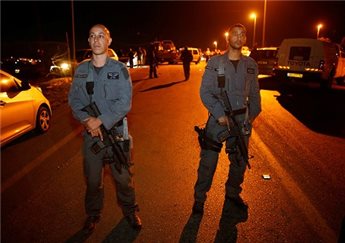 Israeli forces abducted, early Monday and Sunday night, at least 12 Palestinians, including a minor, from occupied West Bank districts, including Jerusalem.
WAFA further reports that Israeli police raided Ras al-Amud neighborhood in East Jerusalem, where they arrested three Palestinians from the Najdi family; Sa’ed, Yazan and Rami, after breaking into and ransacking their families’ houses.
Meanwhile, Israeli forces took into custody three Palestinians while they were attending a trial for their arrested relative, Omar al-Abbasi, in Jerusalem District Central Court.
Forces assaulted ‘Ali Ibrahim al-‘Abassi, 25, for attempting to take a photo of his brother Omar during his court session, triggering a scuffle with al-‘Abbasi’s relatives. As a result, ‘Ali al-‘Abbasi, the uncle, 38, and ‘Imad Mhanna, 27, were arrested along with ‘Ali Ibrahim.
Israeli police also raided al-‘Issawiya, to the north of the city, where troops deployed in streets, assaulting and kidnapping 13-year-old Haitham ‘Ibaid.
According to Ahrar Center for Detainees’ Studies and Human Rights, out of 650 people taken from the occupied West Bank, Gaza and Jerusalem in November, 42 were documented as minors, with 30 having been taken from the city of Jerusalem.
Meanwhile, in the Hebron district, forces raided Beit Kahel village to the northwest of the city, where they kidnapped ‘Imad-addin ‘Asafra, after breaking into his house. They also set up a road block at Halhul Bridge, where they stopped vehicles holding Palestinian-registered plates and examined passengers’ ID cards.
In the Nablus district, Israeli Special Forces raided al-Jabal al-Shamali neighborhood in the city, where they nabbed Tamer Sharaf, age 24.
Soldiers stationed near Zaatara checkpoint, to the south of the city, took one Palestinian under the pretext of carrying a knife. The man has not been identified, as of yet.
In Jenin district, forces set up a flying checkpoint near ‘Arraba, where they abducted Nimr al-Damaj, age 23, a resident of Jenin refugee camp.
Furthermore, in the Ramallah district, forces raided Silwad village to the east of the city, where they broke into and ransacked the house of Bassam Hamed, 40, a former prisoner, and detained the family members in one room before re-arresting Bassam. Forces also handed ‘Anwar Hamed a notice to appear before Israeli intelligence for interrogation.
Forces also raided the Ramallah areas of Deir ‘Ammar and Beitillu, where they broke into several houses, occupied their rooftops, and set up a road block at the villages entrances.
No further kidnappings were reported.
Israeli Forces Kill 9 Palestinians, Kidnap 650, in November
IMEMC News & Agencies | December 01, 2014
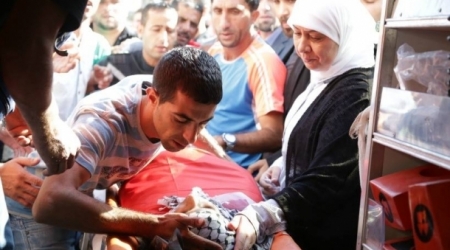
In a report issued on Monday, by Ahrar Center for Detainees’ Studies and Human Rights, Israeli occupation forces were said to have killed 9 Palestinians and detained 650 others, over the month of November.
According to Al Ray, the report noted that 42 out of 650 people taken from the occupied West Bank, Gaza and Jerusalem, were minors, in addition to 17 women. 30 of the minors were taken from Jerusalem.
The report also mentioned that six journalists and two cameramen were taken from Jerusalem, as well, while lawyer Ibrahim Nawaf Al Amer was abducted from the city of Nablus, after a raid on his family’s home.
Fuad Khafsh, director of Ahrar, said that Israeli forces storm the cities of the occupied West Bank when and wherever they please, every day and night.
He noted that the reported numbers are documented by the center, and that it was possible for there to be other cases which could not be documented by the center.
See PCHR reports on Israeli violations in the oPt for further documentation.
Israeli teacher incites his students against Arabs
Palestine Information Center – December 2, 2014
NAZARETH – Israeli newspapers have reported that an Israeli high school teacher in Ashkelon city recently sent an illustrated message to a group of his students inciting against Arabs.
The teacher’s message was an image of a Muslim cemetery with the caption, “In times like these, it is important to remember there are also good Arabs! And they can be found here.”
The teacher sent the image last Wednesday to a group of 11th and 12th graders via the social messaging service WhatsApp, Yedioth Ahronoth reported.
The teacher claimed he sent it to them by mistake and that it was intended for a different group.
After receiving the image, one Arab student from the school responded that it was inappropriate to send such an image to students.
The student, who also leaked information about the teacher’s racist remark, was asked to go to every classroom and explain why his opinion was wrong, Yedioth Ahronoth said, quoting the student’s friends.
After refusing to comply, the student was briefly suspended, his friends added.
Illegal settlement agriculture in the Jordan Valley – The case of Carmel Agrexco
Alhaqhr | December 1, 2014
Illegal settlement agriculture in the Jordan Valley – The case of Carmel Agrexco
Virtual Field Visit: Illegal quarrying in the West Bank – The case of Hanson
Israeli group files war crimes complaint against Abbas at ICC
MEMO | December 1, 2014
Shurat HaDin – Israel Law Center formally requested the International Criminal Court (ICC) prosecutor open an investigation into alleged war crimes committed by Palestinian Authority President Mahmoud Abbas.
The claim is regarding “reports of Fatah-affiliated armed groups firing significant numbers of rockets on Israel from Gaza during Operation Protective Edge war along with Hamas. Rocket fire on civilians is a war crime under international law”, a statement published on the group’s website said.
“We argue that Mahmoud Abbas is vicariously liable for the Fatah armed groups’ actions on July 10, 25 and 27, and August 8. As their responsible superior, Abbas exercises effective command and control of the terror organisation,” they continued.
Shurat HaDin said Abbas can be tried at the ICC because he is a Jordanian citizen and the Kingdom is a member of the court in The Hague.
It added: “If Shurat HaDin does not win this case, it is ready to go after Abbas for terrorist attacks during the Second Intifada should he ever decide to have the Palestinian Authority join the ICC’s Rome Statute.”
Shurat HaDin head Nitsana Darshan- Leitner said that the organisation “will not allow Fatah to carry out rocket attacks on Israeli population centres, while hypocritically advocating Palestinian membership in the ICC. Abbas falsely believes that alleged crimes against Arabs are the only ones that should be prosecuted.”
Islamic Jihad slams PA-Israel security coordination as unity gov’t expires
Al-Akhbar | November 30, 2014
The national consensus government declared by Hamas and Fatah this summer has finished its interim term, Hamas spokesman said Sunday, as the Islamic Jihad movement urged the Palestinian Authority (PA) to stop security coordination with Israel.
Hamas spokesman Sami Abu Zuhri said in a press conference in Gaza City that the unity government’s six-month term had expired, and that dialogue should be resumed on a national level to discuss the future of the government.
“Any decision on whether the government should be disbanded or continued or be reshuffled must be made only through national dialogue and consensus,” Abu Zuhri said, adding that Hamas “isn’t interested in incitement, but rather seeks to maintain national unity.”
The Palestinian national unity government was formed following a reconciliation deal signed by Palestinian political rivals Hamas and Fatah in April.
The deal sought to end years of bitter and sometimes bloody rivalry between Hamas, which controls the Gaza Strip, and Fatah, which dominates the West Bank-based PA.
Palestinian parties agreed in September that the unity government would assume immediate authority over Gaza, however the government has so far failed to make any real changes on the ground in Gaza.
Abu Zuhri went on to criticize the PA for making what he called “politically motivated arrests.”
So far in November, 80 Palestinians have been detained in the West Bank for their political affiliation, he said, adding that 70 of them were still in PA custody.
“Hamas denounces the escalating violations and criminal acts by the PA security services against supporters of Hamas and the Palestinian resistance,” he added, calling on PA President Mahmoud Abbas and Prime Minister Rami Hamdallah to stop the detention campaign.
Similarly, the Islamic Jihad movement urged Abbas on Sunday to release all political detainees and refrain from detaining any Palestinian over their political affiliation.
Besides the recent wave of detentions, the movement said the security coordination between the PA and Israel has become a “real danger” to the Palestinian national unity.
Islamic Jihad spokesman Yousef al-Hasayna said in a statement that the appreciation expressed by the Israeli authorities regarding the PA’s readiness to continue coordinating with the occupation forces on the security level “is a strike to the nationalistic values of the Palestinian security services” and “is in contrast with the values and beliefs of the Palestinian people.”
“Israel is using this coordination to oppress the Palestinians and make sure no uprising will erupt in the West Bank and Jerusalem,” al-Hasayna said.
“The only one benefiting from this coordination is the Israeli occupation.”
Gaza reconstruction
Ongoing differences between Hamas and the PA have kept tensions high in Gaza.
Earlier this month, a senior United Nations official warned that another conflict will engulf Gaza unless stability in the territory is achieved rapidly.
“I do not see the national consensus government effectively governing Gaza,” Robert Turner, director of operations for the United Nations Relief and Works Agency (UNRWA) in Gaza, said.
“If we do not have political stability, a national Palestinian government, and at least an easing of the blockade, yes there will be another war,” Turner told reporters.
For 51 days this summer, Israel pounded the Gaza Strip by air, land and sea.
More than 2,160 Gazans, mostly civilians, were killed and 11,000 injured during seven weeks of unrelenting Israeli attacks in July and August.
The assault ended with an Egypt-brokered ceasefire agreement that calls for reopening Gaza’s border crossings with Israel, which, if implemented, would effectively end the latter’s years-long blockade of the embattled territory.
However, the Zionist entity had repeatedly blocked the entry of building material, prompting the UN in September to broker another deal. The reconstruction of Gaza has yet to begin.
The Palestinian Authority has estimated that the rebuilding Gaza will cost $7.8 billion.
UN chief Ban Ki-moon said during a visit to the Gaza Strip in October that the devastation he had seen was “beyond description” and “far worse” than that caused in the previous Israel-Gaza conflict of winter 2008-2009.
According to the UN, as many as 80,000 Palestinians homes were damaged or destroyed during the days of hostilities, a higher figure than was previously thought, and over 106,000 of Gaza’s 1.8 million residents have been displaced to UN shelters and host families.
Israel routinely bars the entry of building materials into the embattled coastal enclave on grounds that Palestinian resistance faction Hamas could use them to build underground tunnels or fortifications.
For years, the Gaza Strip has depended on construction materials smuggled into the territory through a network of tunnels linking it to Egypt’s Sinai Peninsula.
However, a crackdown on the tunnels by the Egyptian army after it overthrew then-President Mohammed Mursi has effectively neutralized hundreds of tunnels, severely affecting Gaza’s construction sector.
Economists in Gaza have estimated that as many as 400 trucks of equipment – from concrete to building materials and machinery – are needed every day for the next six months to meet the demand, but so far only around 75 trucks have made deliveries.
“I know there is frustration at the pace of reconstruction,” Turner said, adding that efforts were underway to fully implement a mechanism negotiated by the UN’s special coordinator in the Middle East, Robert Serry, to speed up the flow of goods.
Alaa Radwan, head of the Popular Committee for Monitoring the Reconstruction of the Gaza Strip, made a simple calculation: “Given the pace at which construction materials are currently entering Gaza, it will be at least 20 years” before the damage caused by this summer’s war is repaired.
While Hamas and people in Gaza have lamented the slow flow of goods, Turner was optimistic that the volume could be greatly increased if political stability could be brought to bear and if Egypt and Israel fully lifted their combined blockade.
“I do not believe the crossings are a problem,” Turnor said. “All the technical problems can be addressed. The question for me is that the political choke points be addressed.”
“If the political will exists… expanding the crossing to 800 trucks a day is just a matter of paying for the expansion.”
The crisis between Hamas and Fatah has been delaying the flow of reconstruction material into war-battered Gaza because the opening of border crossings, both under Israeli and Egyptian control, is conditional on PA personnel being stationed there.
According to the UN-brokered deal, all materials going into Gaza should be extremely monitored, including GPS tracking and video surveillance of their storage, to ensure nothing goes missing and ends up being used for “military purposes.”
On top of the slow pace of reconstruction and the bureaucracy, Fatah’s failure to pay employees of Gaza’s former Hamas government has further escalated tensions between the two rivals.
Moreover, the situation in Gaza was thrown into doubt early November after bombs targeted the houses of some 10 senior Fatah officials in Gaza.
Even though Hamas leaders rushed to denounce the attacks and called upon security services in Gaza to investigate into the attacks and bring those responsible for it to justice, the Fatah-led Palestinian Authority security services accused Hamas of having knowledge of the blasts before they happened.
Hamas top member, Khalil al-Hayya, however, slammed the accusations as “groundless” and “baseless,” saying whoever was behind the blasts was trying to thwart reconciliation and ensure the Palestinian Authority did not re-extend its control over Gaza.
Hayya also warned against using the incident as an excuse to avoid reconciliation, calling on all sides to uphold their responsibilities towards the national good.
(Al-Akhbar, AFP, Ma’an)
Featured Video

or go to
Aletho News Archives – Video-Images
New Documentary
“Inside Gaza” wins best documentary at Montreal’s Cinemania film festival
Palestine Information Center – November 16, 2026
MONTREAL – The documentary “Inside Gaza,” which chronicles the experiences of Palestinian journalists working with Agence France-Presse (AFP) while covering the Israeli war on the Gaza Strip, won the Best Documentary Award at the 32nd Cinemania International Francophone Film Festival held in Montreal, Canada.
Directed by Helene Lam Trong, the 72-minute film follows the daily lives of four AFP journalists who bear witness to the difficulties of reporting in a war-torn territory largely closed off to international media.
The film is compiled from material produced by the team on the ground, as well as from interviews conducted after they left.
The film also won the People’s Choice Award at the festival on Saturday. … continue
Blog Roll
 Aletho News
- How The Jensen Huang Chinese Spy Hoax Is Russiagate 2.0
- Austria seeks to strip former foreign minister of citizenship over Russia ties
- “Inside Gaza” wins best documentary at Montreal’s Cinemania film festival
- Activists block German munitions plant over arms exports to ‘Israel’
- The Nasser Hospital attack and Israel’s relentless lies
- Could it be satan? No, Huckabee, just the Americans you work for
- AIPAC and more: Network of pro-Israel influence in US Congress
- Putin aide reveals Moscow’s stance on Europe at peace talks
- Imran Khan warns Pakistani judges he may die in prison
- IOF used Amazon facial recognition to track millions of Palestinians
- If Americans Knew
- An error has occurred; the feed is probably down. Try again later.
- No Tricks Zone
- Argentina’s Perito Moreno Glacier Joins Antarctica and Arctic In Defying Doomsday Melt Claims
- New Study: Barents Sea Temperatures Were Warmer And Sea Ice Less Extensive In The 1700s Than Today
- German Authorities Start Initiative To Evaluate Public Register For Climate “Disinformation” Spreaders!
- Zonal Asymmetry of Temperature Change in the Antarctic Circumpolar Current
- New Study: The Net Fossil Fuel Contribution To Rising Atmospheric CO2 Has Been Zero For 500 Years
- Germany’s Green Energy Transition Becoming Increasingly Expensive…Another 6 Trillion Euros!
- Sudden Stratospheric Warming, Powerful El Niño Combination May Lead To Extreme Europe Cold, Energy Crisis!
- Two New Studies Find Thwaites Glacier Melt Cannot Be Driven By Human Activity Or A Warming Ocean
- E-Cars Reduce CO2 Emissions By Only 41% Compared To Internal Combustion Engine Vehicles
- Predictions Made By Renowned Climate Professor Over Past Decades Have Been Proven To Be Poor

