Israel threatens to “eradicate” Hamas after missing settlers found dead
Al-Akhbar | June 30, 2014
Israel on Monday confirmed finding the bodies of three settlers who disappeared in the occupied southern West Bank on June 12, blaming Hamas for their kidnapping and murder despite showing any evidence that the Islamist movement was behind it.
“During the search for Eyal Ifrach, Gilad Shaer and Naftali Frankel, the IDF discovered 3 bodies near Hebron,” the Israeli army said in a statement on Twitter.
It was not immediately clear how they died.
Deputy defense minister Danny Danon also confirmed their bodies had been discovered, saying they had been murdered by “Hamas terrorists” and calling for a widespread operation to “eradicate” the Islamist movement.
Public radio said the bodies were discovered in a field near Halhul, a town north of Hebron, about 10 minutes from the roadside in the southern West Bank where they were last seen.
The Ynet news website said the bodies were found by soldiers and civilian volunteers.
Shortly before the news was made public, Israeli Prime Minister Benjamin called an urgent meeting of his security cabinet from 9:30 pm (1830 GMT) with ministers expected to take “operative” decisions, public radio said.
Earlier in the evening, Israeli troops could be seen carrying out widespread searches in the Halhul area which is some five kilometers (three miles) north of Hebron, an AFP correspondent said.
“We will not stop until Hamas is completely defeated,” Danon said.
“The homes of the terrorists must be demolished and their arms caches destroyed.
“Our mission will not be complete until all the terror organizations are deterred from attacking Israelis and understand once and for all that the people of Israel will not be threatened,” he said.
Israeli occupation forces have killed five Palestinians in the West Bank since the settlers went missing. Another two elderly Palestinians died of heart attacks during raids on their homes.
Hundreds of others, mostly youths, had been rounded up and jailed since the search began without any evidence of involvement in the disappearance of the three from an illegal settlement.
(AFP, Al-Akhbar)
Palestinian-American activist held without charges in Jordan
Amer Jubran Defense Campaign | June 29, 2014
We received word this weekend that Amer Jubran was finally granted a visit by family at the General Intelligence Directorate detention facility near Amman, Jordan this past Friday–seven weeks after he was arrested. He appeared to be in good health and his spirit remains strong.
While this news comes as a relief, we are gravely concerned that Amer continues to be detained without charges, in violation both of Jordanian law and of international standards of human rights.
Amer’s detention is a political silencing. It is taking place in the context of new “anti-terrorism” legislation passed in Jordan on June 1, 2014 that criminalizes new categories of speech. According to the human rights organization Alkarama:
“Criticizing or caricaturing a foreign leader, or more generally a policy of a third country, also falls under the definition of terrorism. Thus, any person that has ‘disturbed relations with a foreign country’ can be prosecuted. … More importantly, if an act is qualified as an act of terrorism, authorities can then bring perpetrators of the real or supposed violations, before the State Security Court, an extraordinary jurisdiction. This court lacks independence as it is directly linked to the executive branch, and its members, including one military, are appointed by the Prime Minister.”
Such legislation is designed to protect the interests of US and Israeli political domination, and not the interests of the people of Jordan and the surrounding Arab region.
The Case of Amer Jubran
 Amer is a Palestinian political activist who opposed the warmaking policies of the United States and Israel during his 18 year residence in the United States. Shortly after September 2001 he was harassed by US authorities, detained, and finally pushed out of the country. He returned to Jordan, his first country of exile, in 2004. This latest arrest is a continuation of the political repression Amer experienced in the United States.
We do not know if Israel or the US ordered Amer’s arrest, but it is clear that his detention is aimed at silencing a strong voice of dissent against their policies.
We call on all supporters to remain committed to the campaign to win Amer’s freedom. We will be sending out more information soon about next steps.
FEMEN And The Suppression Of Native Voices
By Roqayah Chamseddine | Letters From The Underground | April 6, 2013
I loathe the premise that people of colour should be ‘grateful’ that others are taking notice of their subjugation, or that they should bite their tongues and clench their fists and instead show gratitude because their varied plights are being in some way ‘acknowledged‘ by others.
“Shouldn’t you be glad that people are recognizing these issues?” is the arrogant lamentation which customarily follows even the most cautious criticism of these perverse pseudo-solidarity actions – FEMEN’s nude predominantly white, predominantly thin photo-ops “for Amina,” a 19 year-old Tunisian woman who posed for them with the words “my body belongs to me, it is not the source of anyone’s honour” scrawled across her torso, being the latest example, and KONY2012 being an earlier one. This aforementioned response contends that we should withhold criticism, alleging that even being ‘noticed’ should be good enough.

Despite having our religious attire, skin colour and even facial hair, being routinely mocked and worn as makeshift costumes as a part of ‘solidarity actions’ it is said time and time again that we should be ‘grateful’ that anyone simply has reason enough to ‘care.’
Despite the watered down slogans of liberation and freedom being copy-pasted by the parade of online followers of groups such as FEMEN many of these same activists are so inebriated with colonial feminist doctrine that they gleefully take part in patronizing, Islamophobic and misogynistic rhetoric in response to women of colour telling them that they take great offence, that their voices will not be usurped, that they are the sole guardians of their plights and no one has the authority to speak on their behalf, no matter how allegedly ‘well-intentioned’.
In response to FEMEN’s topless “jihad day” event Muslim women created #MuslimahPride on Twitter; Sofia Ahmed, one of the women behind “Muslimah Pride Day” described the campaign as follows:
“Muslimah [term for a female Muslim] pride is about connecting with your Muslim identity and reclaiming our collective voice. Let’s show the world that we oppose FEMEN and their use of Muslim women to reinforce Western imperialism.”
Using #MuslimahPride many Muslim women began voicing their disapproval of FEMEN, one such woman was Zarah Sultana who posted the following photograph on her public Twitter page, which I have received permission to post here, and which in turned catalyzed many other Muslim women to do the same in an array of languages, by women from multifarious backgrounds:

The responses Sultana received were drenched in perverse Islamophobia, sexism and pure, unashamed hatred: “Fuck off back to your own country”, “burn in hell”, “grab your ankles and remain silent”, “Mohammad was a pedophile”, “put on your burka”, “she’s happy with her chains” etc.- all coming from those who, just moments earlier, were tweeting gleefully in support of Muslim women.
When it comes to non-natives speaking in regards to native issues – it is a path that must be tread upon lightly in order to avoid (a) tokenization and (b) the usurpation of native voices. Solidarity is great, but it is when campaigns turned publicity stunts like the ones FEMEN indulges in begin using brown bodies as props while at the same time perpetuating orientalism and engaging in blatant prejudicial acts to promote their idea of ‘liberation’ does this become more a theft of native voices than a rallying cry for ‘freedom’. FEMEN, and other such groups, offer no solution to the undeniable subjugated of women present in the Middle East-North Africa, it is all a show of thin, white grandeur.
Simply stating that you are in solidarity, that you support a woman’s right to don the headscarf, remove it, cover/uncover etc. is in no way dubious. It is when aforementioned solidarity crosses the red line and veers into the seizure of native voices and the tokenization of these voices does this become intensely problematic, ineffective and perverse.
Also it has long been chronicled that women of colour are often left out of mainstream feminist discourse, unless it is by means of humanitarian imperialism channels where they are simply tokenised. Bell Hooks (Gloria Jean Watkins), a feminist, social activist, does a magnificent job describing this in much of her work.
In terms of the mounting questions in regards to how one is to raise awareness in light of such groups as FEMEN: you raise awareness by highlighting native voices, not co-opting them. It is your duty to amplify, not commandeer.
As Sara Salem, PhD researcher at the Institute of Social Studies in the Netherlands, notes:
“Feminism has the potential to be greatly emancipatory by adopting an anti-racist, anti-homophobic, anti-transphobic and anti-Islamophobic rhetoric, instead of often actively being racist, homophobic, transphobic and Islamophobic. By clearly delineating the boundaries of what is “good” and “bad” feminism, Femen is using colonial feminist rhetoric that defines Arab women as oppressed by culture and religion, while no mention is made of capitalism, racism, or global imperialism. It is actively promoting the idea that Muslim women are suffering from “false consciousness” because they cannot see (while Femen can see) that the veil and religion are intrinsically harmful to all women.
Yet again, the lives of Muslim women are to be judged by European feminists, who yet again have decided that Islam – and the veil – are key components of patriarchy. Where do women who disagree with this fit? Where is the space for a plurality of voices? And the most important question of all: can feminism survive unless it sheds its Eurocentric bias and starts accepting that the experiences of all women should be seen as legitimate?”
Post-Colonial feminists worth mentioning, a few of many:
Arundhati Roy
Gloria Anzaldúa
Chandra Talpade Mohanty
Audre Lorde
June Jordan
Responses to FEMEN by women of colour, others:
The Inconsistency of Femen’s Imperialist “one size fits all” Attitude – Bim Adewunmi
Femen’s Neocolonial Feminism: When Nudity Becomes A Uniform – Sara Salem
The Fast-Food Feminism of the Topless FEMEN – Mona Chollet
That’s Not What A Feminist Looks Like – Elly Badcock
The African History of Nude Protest – Maryam Kazeem
My piece on rediscovering Feminism
Suggested reading:
“Is Western Patriarchal Feminism Good For Third World/Minority Women?” By Azizah Al-Hibri
“Women and Gender in Islam” by Leila Ahmed
And two relevant books by Edward Saïd:
Culture and Imperialism
Orientalism
Kurdish forces attack Iraqi military bases in Kirkuk: Military commander
Press TV – June 29, 2014
A senior Iraqi military commander says Kurdish Peshmerga forces have seized heavy weapons and military equipment in Kirkuk governorate.
Lieutenant Abdul Amir al-Zaidi said on Sunday that the Kurdish forces attacked military bases and disrupted the security situation in Diyala and Kirkuk.
This comes after the president of the semi-autonomous Kurdistan Regional Government (KRG) said on Friday that the KRG will not return the oil-rich hub of Kirkuk to Baghdad.
Masoud Barzani’s comments sparked angry reactions from some Iraqi politicians who warned of an armed conflict with the Kurds in the near future. Also, some lawmakers have accused the Kurdish forces of having relations with Israel.
Kurdish security forces took control of Kirkuk after Iraqi troops entered a battle with the so-called Islamic State of Iraq and the Levant (ISIL) earlier this month.
The latest developments come as tensions rise between the Kurdistan’s regional leaders and the central government in Baghdad.
The Iraqi government has repeatedly slammed the Kurdistan region for exporting oil without Baghdad’s consent.
Baghdad says it has the sole right to export the country’s crude, but the Kurds say they are entitled to market the resources of their own region
The regional government has recently used a pipeline to the Turkish port city of Ceyhan for crude oil exports.
A spokesman for the regional government says the money has been deposited in Turkey’s Halkbank.
Most refineries are reluctant to get involved in the trade which the Iraqi central government has called smuggling.
Baghdad has also opened arbitration against Turkey for allowing and facilitating the sales and has threatened to pursue buyers.
Netanyahu endorses Kurdish independence citing chaos in Iraq
RT | June 29, 2014
Citing the “collapse” of Iraq amid the ISIS insurgency and sectarian violence, Israeli Prime Minister Benjamin Netanyahu has endorsed the de-facto independence of Iraqi Kurds. Netanyahu has also called to support the “Kurdish aspiration for independence.”
The hawkish Israeli leader said on Sunday that Kurds are “fighting people that has proved its political commitment, political moderation, and deserves political independence,” Reuters reported.
Speaking to Tel Aviv University’s INSS think-tank, Netanyahu described the situation in Iraq and the Middle East in general as a “collapse,” due to strife between Sunni and Shiite Muslims.
Amid the recent insurgency of the Islamic State in Iraq and the Levant (ISIS/ISIL) militants, Kurds have seized the opportunity to bring a long-sought independent state of Kurdistan closer to reality. Kurdish Peshmerga armed forces have been guarding their provincial borders from ISIS, but also seized the contested Iraqi city of Kirkuk, proclaiming it part of their territory.
Now, in an apparent clash against the international community’s support of a united Iraq, the Israeli leader has called to back the de-facto independence of Kurds.
“We should… support the Kurdish aspiration for independence,” Netanyahu was quoted as saying.
Selective Sympathy in Israel/Palestine
By Lawrence Davidson | Consortium News | June 28, 2014
The display of anxiety and aggressive agitation in Israel, triggered by the kidnapping of three young men from an illegal settlement on the West Bank, seems to be accompanied by a near total denial of any legitimate relationship between government actions (the occupation) and Palestinian reactions (the kidnapping).
No matter what the Israelis do to the Palestinians, the Israelis insist that those actions are justified, and no matter how the Palestinians react, the Israelis insist those actions are never justified. By objective standards this Israeli attitude borders on the pathological.
There are multiple tragedies that result from this disconnect. The tragedy of the three Jewish kidnap victims is the one that is foremost in both Israeli consciousness and also in the Western media, accompanied by speculation that the young men were taken as hostages to be exchanged for Palestinian prisoners.
As if to put out the message that the government of Benjamin Netanyahu will not play that game, the Israeli military is arresting hundreds of Palestinians, including some who had been released in exchange for captured Israeli soldier Gilad Shalit. The military is also destroying Palestinian property in a wholesale manner, wounding scores and even murdering a steady number of Palestinians in the search for the kidnap victims.
But all this mayhem, which only deepens Palestinian hatred, may be based on an Israeli false assumption. Quite likely this kidnapping was not carried out to set up some future exchange. Quite likely it was an opportunistic act of revenge, striking back against exactly the kind of repression that the Netanyahu government is again carrying out.
Many Zionists cannot fathom the fact that there are literally millions of Palestinians desiring vengeance for Israeli acts of abuse. That blindness is part of their denial that their own actions define much of the Palestinian reaction. This denial is reinforced by the gambit of labeling nearly all Palestinians as “terrorists.”
Another tragedy, which gets much less media attention, is the tragedy of the collectively kidnapped people of Palestine. That is the phrase used by Avraham Burg, a disillusioned Zionist who, apparently, is slowly but surely replacing his old ideology with contemporary disgust.
As Burg puts it, “All of Palestinian society is a kidnapped society … many of the Israelis who performed ‘significant service’ in the army … entered the home of a Palestinian family in the middle of the night by surprise, with violence, and simply took away the father, brother or uncle .… That is kidnapping and happens every day.”
No doubt some Israelis deeply resent the fact that much of the world has come to agree with Burg. More and more, those on the outside know that the Israelis have created the context for this latest kidnapping. These people across the globe no longer believe Zionist justifications for Israeli behavior. The result is that the Israelis are increasingly isolated in a misshapen world of their own.
For instance, an editorial in the Jerusalem Post dismisses the world’s principal human rights organizations as hypocrites because they did not express “immediate outrage, demand action, and even demonstrate at the United Nations demanding the immediate release” of the “three Israeli teens.”
Alas, the major human rights organizations, which have in fact expressed disapproval at the kidnapping, cannot do as the Jerusalem Post editorial wishes because they understand the degree to which Israeli policies have contributed to these tragedies. This fact makes very difficult, for many people, the otherwise natural sympathy that they feel for the personal plight of the three teens, the sentiment that the Israelis insist upon.
This may help explain the frustration of M.J. Rosenberg, a liberal American Zionist commentator who now takes to task American supporters of the Palestinian cause for what he calls their lack of humanity when it comes to the fate of the kidnapped Israelis. Rosenberg tries to lay out his objection in absolute moral terms:
“There is no justification for harming kids [the ages of the victims are 19, 16 and 16] no matter what the cause. Never. …. The test of your humanity is whether you condemn the harming of children without caveats and quasi-justifications. If not, just shut up.”
Idealism Destroyed by Reality
Perhaps Rosenberg’s rather harsh demand brings to the surface yet another tragedy inherent in the present situation – the tragedy of insisting on moral ideals which, while admirable, are just not realizable under the present circumstances.
To be succinct: There is the world as we say it should be (the ideal) and there is the world as it actually is (shaped in large part by state practice). The rule of law and most principles of morality seek to move the world in the direction of the ideal. However, if a state demands the sympathies of those who take seriously the ideal, it must at least demonstrate national behavior that does not purposely contradict the ideal.
Thus, in the hypothetical case of an Israel moving in the direction of an inclusive society based on genuine democratic behavior, we would condemn out of hand not only this kidnapping but all the prior instances where Israelis – men, women and children – had suffered and died due to communal violence. However, there is no such Israel. If anything, we have the real Israel moving away from genuine democratic practice and toward the status of an exclusive apartheid state.
But what about the children? After all, children “have no agency” and therefore should not be held responsible for the conditions created by their elders. But again, the Zionists cannot demand such an exception while agents of the Israeli state regularly arrest and incarcerate Palestinian children. This is a sad truth of the world as it actually is: double standards make ideals impossible.
This moral predicament may be tragic but it is quite consistent with how ordinary people act and react all of the time. People usually do not act with sympathy toward bullies, overtly egocentric individuals, or those who threaten their neighbors. By extension, whole groups of people who support such behavior, either because of a distorted perception of history, the improper teachings of religious ideology, or simply because they are conditioned to “follow orders” cannot be readily sympathized with either.
The Zionists can complain about the unfairness of this situation, but the only thing that will make a difference is a change in their own behavior.
Israeli forces invade Awarta, ransacking teacher’s home
International Solidarity Movement | June 28, 2014
 Awarta, Occupied Palestine – During the early morning hours of June 26, the Israeli army invaded the village of Awarta, 8 km south of Nablus in the northern part of the West Bank. According to witnesses, between 150 and 200 soldiers entered Awarta just after midnight and raided approximately 300 houses before leaving several hours later.
Some residents mentioned that the soldiers knocked on their doors and asked for identification, however this was not the case for Mahmud Awad, a local schoolteacher, and his family.
At midnight approximately 15 soldiers entered Awad’s home and demanded that Awad show them the location of his guns. Were he not to obey, he could be confident that the house would be destroyed. Awad replied that Israeli soldiers had already been to his house many times and had never found anything. He had no guns, he assured them.
The soldiers blindfolded and handcuffed Awad’s 20-year-old son and took him outside for an interrogation that lasted three hours. They herded the rest of the family, which included an eight-month old baby and several other children, into the living room. Again they asked Awad about his guns.
“Watch what we will do if you don’t give them to us!” An Israeli soldier yelled.
The children listened in terror as the soldiers proceeded to ransack the house. They ripped apart sofas and chairs, threw the contents of shelves on the floor, knocked over electrical appliances, destroyed two computers, and slashed the family’s water tank on the roof. Awad begged the soldiers to allow the baby a drink, but this request was denied.
Sometime during the night, Awad’s 13-year-old son was taken outside the living room and interrogated for half an hour. A soldier held his rifle to the boy’s face and demanded the location of the guns. He held a piece of cloth (chloroform, a family member assumed) to the boy’s mouth until he became dizzy.
The soldiers finished searching the house, having found no weapons. They released both of Awad’s sons and left the house at approximately 4 a.m.
Israel has killed 104 Palestinian prisoners in last two decades
MEMO | June 28, 2014
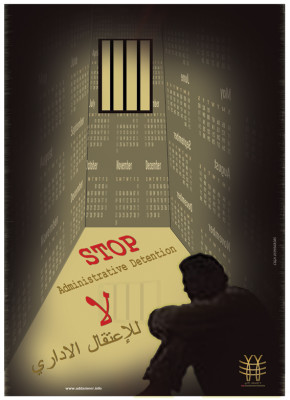 Prisoner support and human rights organisation, Addameer, has said that the Israeli occupation has killed 104 Palestinian prisoners since 1991, when it joined the UN convention against torture.
The organisation said that 54 of them died after being arrested, 27 died because of poor medical treatment and 23 were tortured to death. The last was Arafat Jaradat, who died in February 2013 under torture after a week of his arrest.
Addameer also said that it documented eight extra judicial killings against Palestinians while Israeli occupation forces were combing Palestinian villages and refugee camps in 2013. It also said that five were killed in the on-going campaign, which started on 12 June to find three missing settlers.
In addition, it said that the prisoners are exposed to different kinds of physical and psychological torture, including sexual violence, solitary confinement, ban of sleeping and food for long periods and preventing them meeting with lawyers for 60 days.
Israeli occupation authorities, Addameer said, are violating the fourth Geneva Convention as they are practicing “collective vengeful” punishment against Palestinian civilians under the pretext of searching for the three missing settlers.
Regarding violations of the right for prisoners to go on hunger strike, the organisation said that the Israeli ratification of the force-feeding bill violates international law and international humanitarian law. It also said that Israeli administrative detention is a violation of article 78 of the Geneva Convention.
The organisation said that Israel had ignored the demands to release 130 administrative prisoners, who went on hunger strike for 63 consecutive days. “It has even increased the numbers to 340 as it is carrying out a search mission for the settlers,” the organisation said.
“This is a violation of the Geneva Conventions and mounts to a war crime and war against humanity as it is used widely and systematically,” it said. “It is a kind of torture.”
‘We want to work without being treated as slaves’

By Tom Anderson and Therezia Cooper | Corporate Watch | June 27, 2014
During January 2013, Corporate Watch conducted interviews with Palestinians who work in the illegal Israeli settlements in the Jordan Valley. Part one to three of our findings can be read here, here and here.
We met 44 year old Rashid* and 38 year old Zaid* in their hometown of Tammoun in the northern West Bank. They both work in the illegal Israeli settlement of Beqa’ot. A colony with 171 residents situated close to the Palestinian community of Al Hadidya in the Jordan Valley.

Palestinian bedouin close to Beqa’ot are prevented from building permanent structures by the Israeli military, photo taken by Corporate Watch in February 2013
Tammoun is situated just outside the Jordan Valley. Like thousands of other Palestinian workers Zaid and Rashid travel into the Jordan Valley in search of work on a daily basis. To cross into the valley they have to pass through the Israeli military checkpoint at Tayasir or Al Hamra.
Rashid has worked in Beqa’ot since the early ’90s whereas Zaid worked in Israel until 5 years ago. Zaid tells us: “Now it is impossible for me to get a permit to work outside the West Bank.”
For Israeli companies, sourcing their goods from the settlements in the Jordan Valley allows them to circumvent workers rights and health and safety regulations. According to Zaid: “Inside Israel the workers have contracts and the conditions are better. This is because in Israel there are some controls on companies, unlike in the West Bank.”
Both men work all year round except for September-November when there is no work available. They have no contracts and tell us that none of their workmates do either. Their job is to plant grapes and tend to the vines, pruning them and spraying them with fertilisers and chemicals. At harvest time they cut and collect the grapes.

Grapevines in the settlement of Beqa’ot, photo taken by Corporate Watch, February 2013
Zaid and Rashid both work in the fields outside the boundaries of Beqa’ot. They do not have a permit to enter the settlement itself.
Paid below the minimum wage
Palestinian workers in Israeli settlements have been entitled to the Israeli minimum wage since an Israeli Supreme Court ruling in 2007 (see here). In 2010 Corporate Watch conducted over 40 interviews with settlement workers showing that Palestinians are consistently paid as little as half the minimum wage. These conditions remained largely unchanged when we returned in 2014.
The current hourly minimum wage is 23.12, NIS (New Israeli Shekels),the equivalent of 184.96 NIS for an eight hour working day, having risen from 20.70 NIS in 2009. However, for Palestinian workers on Israeli settlements in the Jordan Valley these conditions seem an impossible dream.
Zaid and Rashid are employed directly by the settlers in Beqa’ot and speak to them directly to arrange their work. Both get paid 82 New Israeli Shekels (NIS), 18 of which goes towards daily transport.
They have no insurance provided by their employer. Rashid explains: “Last year one of the workers died, but the settlers did not help his family at all.
The men do not receive any paid holiday, even for religious holidays. This is despite the fact that an Israeli government website advises that workers are entitled to 14 days paid holiday and must receive a written contract and payslips from their employer (see here).
Both men are members of the General Palestinian Workers Union (GPWU). However, they are unable to represent workers in Beqa’ot or negotiate with their bosses. According to Rashid: “We organise trainings for agricultural workers but we are not recognised by the settlers, we do not receive any representation from Histradrut”.
Histradrut is the Israeli trade union organisation. Many campaigners for boycott, divestment and sanctions against Israeli apartheid have called for a boycott of the Histradrut because of its failure to represent Palestinian workers and its overt support of Israeli state policies. For example, in 2010 the British University and College Union broke ties with the Histradrut; a UCU spokesperson said the Histradrut, “supported the Israeli assault on civilians in Gaza” and “did not deserve the name of a trade union”.
Companies sourcing produce from Beqa’ot

Mehadrin Tnuport boxes ready to be packed with grapes, photo taken by Corporate Watch in February 2013

Carmel Agrexco boxes ready to be packed with grapes, photo taken by Corporate Watch in February 2013

STM boxes ready to be packed with grapes, photo taken by Corporate Watch in February 2013

Export label on a box in Beqa’ot statying that these grapes are shipped by Carmel agrexco, Photo taken in Febuary 2013 by Corporate Watch
Rashid tells us: “We label the grapes ‘Made in the Jordan Valley’ and mark them with the name and phone number of the Israeli settler.
“Each of the settler has his own packing house. When we harvest the grapes they are taken first of all to packing houses in Beqa’ot owned by individual settler, then transported to a central refrigeration unit owned by the Moshav [a Hebrew word for a cooperative farm]. Then a refrigeration truck takes them to be exported.”
The men tell us that the majority of the grapes they harvest are exported through Mehadrin.
Corporate Watch visited Beqa’Ot in February 2013 and photographed several packing houses displaying Mehadrin signage. Israeli company Mehadrin Tnuport Export (MTEX) is a part of the huge Mehadrin Group which owns a 50% of STM Agricultural Exports Ltd – another Israeli company dealing in vegetables. MTEX export around 70% of all their produce to outside Israel and are one of the largest suppliers for the Jaffa brand world wide. Sainsburys confirmed to Corporate Watch in August 2013 that the supermarket sourced fresh vegetables from Mehadrin. Mehadrin is also certified to supply fresh produce to Tesco (see here).
Corporate Watch also photographed boxes and export labels for Carmel Agrexco in Beqa’ot. Carmel Agrexco was the Israeli state owned fresh produce export company. In 2011 the company went into liquidation, due in part to the international boycott movement. The brand has since been bought by Gideon Bickel of Israeli firm Bickel Flowers and has been fighting to regain lost contracts.
Working for poverty wages on land stolen from their families
Rashid and Zaid refer to Beqa’ot by its Palestinian name, Libqya. Rashid tells us: “Before the occupation in 1967 Libqya was owned by Palestinians who used it for planting crops and raising animals. All of the families around here owned land in Libqya.
“I remember when my mother passed Libqya when I was young she told us how she used to play there with her brothers and sisters. Our family owned 70 dunums of land there.
“This reality is too painful. When I was older I tried to reach the land my mother told me about. But a settler told me I was forbidden to go there.”
‘We will get back our land’
Both men are supportive of the call for a boycott of Israeli agricultural companies. When it was pointed out that if the boycott was successful then their employers would not be able to pay them a wage any longer Zaid responded: “We support the boycott even if we lose our work. We might lose our jobs but we will get back our land. We will be able to work without being treated as slaves.”
* Names have been changed at the authors’ discretion
Language, like land, under assault in Palestine
By Jamal Sweid | Al-Akhbar | June 27, 2014
Haifa – “Land, akin to language, is inherited,” Mahmoud Darwish once said. In the occupied territories, however, language is pillaged, appropriated, violated, and surrounded by barbed wire, just like the land.
Under the policy of increasingly exploiting interconnected events to cover up dangerous plans, the Israeli Ministry of Education recently struck a blow to Palestinians living in occupied Palestine. The ministry announced a decision to stop teaching Arabic grammar in preparatory and secondary schools. The alternative was what the ministry called “functional principles in teaching grammar,” which it claimed will allow students to comprehend the functions of grammar, based on understanding a text.
The decision provoked widespread concern and calls for its rejection. However, the ministry stuck to its position and issued a statement explaining its decision. It maintained that it aimed at “bridging the gap between the language and its speakers in the era of technology and outburst of information.”
Palestinians of all segments, including teachers and parents, expressed rejection of the decision to Al-Akhbar as “a disguised attempt to tear away students from their language, and thus their belonging and cause.” They called for the widest protests possible to force the ministry to repeal the decision, which has been approved by the authorities.
The decision comes as students and graduates in occupied Palestine are facing a clear weakness in grammar and conjugation. According to experts, this deficiency is higher than in the West Bank and the Gaza Strip. It requires enhancing the grammar curriculum to help the students, instead of its removal and replacement under the guise of “advancement and the technological gap.” Several experts told Al-Akhbar that the technological gap claimed by Israel will not be solved by cancelling the curriculum, but by its modernization.
“In this situation, we need to look for ways to strengthen student bonds to their language and its rules,” explained Murad Ali, an Arabic teacher from Acre. “Students are already facing difficulties in grammar, although it is taught in the curriculum. What will be the case when it gets cancelled?” In a few years, high school graduates in the 1948 territories will be unable to formulate a proper sentence.
This prediction, however, had been a reality for years, according to other experts. Their evidence is based on the fact that many graduates lack the most basic command of Arabic and commit several errors, which is inappropriate at their educational level.
Ibrahim Shehade, a retired school principal from Acre, said that students welcomed the ministry’s decision. “For them, Arabic grammar is one of the most difficult subjects of the language curriculum. But they do not understand the future risks,” he explained to Al-Akhbar. “Grades in literature and expression subjects are relatively high, compared to grammar. Some students believe that by removing grammar, they will improve their grade average.”
Samer Khoury, from Shafa Amr, agreed, saying “grammar is the graveyard of grades,” explaining that he received a low score in Arabic because of grammar.
Yet, the students are not completely comfortable with the decision. Some believe that it targets their language and bonds. Despite the difficulty of learning grammar and conjugation, they are willing to find alternatives to improve their proficiency, “without touching our language.”
In the Israeli Knesset, Arab politicians and MPs are yet to take up the question because of the weight of other issues. However, Arab Knesset member from the Democratic Front and the Communist Party, Mohammed Baraka, spoke about the decision in the press. After mentioning the questions of land, housing, and health, he said he will be focusing more on the issue of grammar.
The more direct position was taken by Knesset member from the United Arab List, Masoud Ghanayem, who called for a hearing on the issue. He received a reply from the minister of education stating that “the decision does not mean abandoning the teaching of Arabic grammar, but its enhancement.”
“The new curriculum was created by Arab supervisors and academics, in cooperation with the Arabic Language Academy in Haifa,” the minister added. His statement shed light on a sensitive issue. Most teachers who spoke to Al-Akhbar maintained that it was false. But many refused to be named, “out of fear of the supervisors and higher authorities.”
The boldest academic objection was made by Dr. Mohammed Khalil, a well-known Palestinian academic and one of the first people to warn about the decision. “The issue clearly aims to get schools to dispense of Arabic grammar books altogether, imposing a curriculum where grammar is taught at the spur of the moment,” he exclaimed.
Khalil was not surprised about the “unjust decision of the [Israeli] authorities.” However, he was dismayed by “the presence of Arab Palestinians in the committee, which agreed on the new curriculum.” Several teachers who spoke to Al-Akhbar also mentioned the issue.
Ultimately, the decision will not be limited to the schools, in the midst of an Israeli campaign to replace the names of Palestinian landmarks with ones in Hebrew. In opposition, Palestinians are actively campaigning to promote the Arabic names and preserving them.
“But what kind of impact will this have if our sons and daughters are ignorant of the principles of their language and its lifeline?” asked Marwan Barieh, a university student studying the Arabic language. “Undermining a fundamental pillar of any language will lead to its total collapse. This applies to grammar and its relationship with the Arabic language in general.”
Despite the angry reactions to the decision, language is being pillaged just like [Palestinian] land. The process reproduces itself in the same manner: statements and more statements are issued, then comes the implementation of the appropriation and each party reverts to its original position. They might declare a position to outmaneuver the others, but the loss of land and language is unlike any other loss.
This article is an edited translation from the Arabic Edition.
Family of kidnap suspect deny Israeli accusations
Ma’an – 27/06/2014
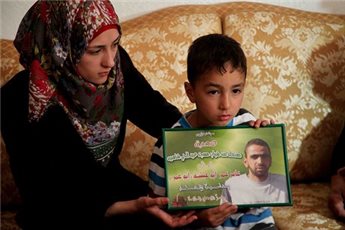
HEBRON – The father of one of the suspects named by Israel as being behind the disappearance of three Israeli youths has denied that his son was involved in the suspected kidnapping.
On Thursday, Israel named Marwan al-Qawasmeh, 29, and Amer Abu Eisha, 33, as the two main suspects behind the kidnapping of three Israeli youths on June 12.
Israel’s Shin Bet said they had been jailed in the past for taking part in “terrorist activity on behalf of Hamas.”
Speaking to Ma’an, Abu Eisha’s father denied the allegations and said the family is worried that he has been detained and is being tortured by Israeli security forces.
“The occupation kidnapped my son Amer and I’m afraid they will kill him and say that they killed the terrorist and saved the settlers,” Omar Abu Eisha said.
“I have not yet grasped that Amer and Marwan could kidnap three settlers from the most dangerous security square in Etzion. These are Israeli fabrications, whose goal could be is to strike Hamas in the West Bank and strike the national reconciliation,” he added.
Omar Abu Eisha said that he was with his son Amer at a social event the night the three Israelis went missing, but said that later on in the night he could not find his son and he has been missing ever since.
“He told his wife that he might be away for two days for work in al-Eizariya, but he has not called and I am certain that Israel has kidnapped and hid him,” he said.
Omar Abu Eisha told Ma’an that his son was “working hard and saving money” to build a new house.
The family of Marwan al-Qawasmeh refused to be interviewed or comment on the Israeli accusations.
Eisha was first arrested in Nov. 2005 and was held without trial or charge by Israeli forces until June 2006. He was re-arrested in April 2007 for a short period of time.
Eisha’s brother was shot dead by Israeli forces in Nov. 2005 while ostensibly trying to “throw an explosive” at them, and his father had been arrested by Israel multiple times.
After the Israeli teens disappeared while hitchhiking in the West Bank, the army launched a vast hunt for them focusing on the Hebron area.
Israeli forces initially accused Hamas of the kidnapping, which it vigorously denied, and authorities vowed to “crush” the Palestinian political and militant group.
More than 120 Palestinians have been injured in the military operation, which Israel dubbed “Brother’s Keeper,” and more than 1,350 homes and offices, including numerous universities, have been raided.
The Palestinian Prisoner’s Society said on Thursday that 566 Palestinians have been detained in the campaign, including 12 members of parliament.
Featured Video

How Many More Gulf States Get Dragged Into Trump’s Iran War?
or go to
Aletho News Archives – Video-Images
Book Excerpt
How CIA used Ukraine as a platform for covert war against Russia
By Stephen KINZER | Responsible Statecraft | November 17, 2026
The following is an excerpt from Stephen Kinzer’s new book: Boiling Point: How America Brought War to Ukraine (Henry Holt and Company, November 2026)
Huddled beside an airstrip in southern Germany, a handful of anti-Communist warriors prepared to fire the first shots of the Cold War. A CIA officer from the Munich Operations Base was in charge. The Hungarian crewmen he had recruited stood nearby in flight suits. With them were two Ukrainian exiles who had volunteered to parachute into their homeland. They were code-named Apostle 1 and Apostle 2. Each carried forged identity papers, a miniature radio transmitter, a pistol, a machine gun, hand grenades, a purse full of gold coins, and a poison pill to be taken in case of capture. An unmarked C-47 transport plane was waiting.
The CIA officer overseeing this operation, a twenty-six-year-old Yale graduate named Stephen Tanner, watched the plane take off and disappear into the night. It flew over East Germany and Poland, then crossed into Soviet airspace. As it approached the Ukrainian city of Lviv, a cargo bay swung open. The two Ukrainians jumped into the darkness. Their mission was to link up with partisan fighters, seize territory, and establish a clandestine base through which the CIA could send them weapons.
That flight, on September 5, 1949, was the first American act of covert war in Ukraine. … continue
Blog Roll
 Aletho News
- Banning Palestine activists from the West will not save Israel’s image
- Iran rejects unlimited IAEA inspections amid continued military threats
- A Bridge Too Far
- David Barnea in the Bundestag – Mossad as a model for Germany’s Intelligence Services?
- Rome blasts Kiev after Italian lawmakers added to ‘kill list’
- Another €45 bn down the drain: Why the EU is desperate to waste more cash on Zelensky
- In Europe, Anxiety Is Mounting—EU Unity Is Cracking at Every Seam
- How CIA used Ukraine as a platform for covert war against Russia
- European Commission proposes new loan for Kiev
- How Many More Gulf States Get Dragged Into Trump’s Iran War? | Matt Bracken
- If Americans Knew
- An error has occurred; the feed is probably down. Try again later.
- No Tricks Zone
- Argentina’s Perito Moreno Glacier Joins Antarctica and Arctic In Defying Doomsday Melt Claims
- New Study: Barents Sea Temperatures Were Warmer And Sea Ice Less Extensive In The 1700s Than Today
- German Authorities Start Initiative To Evaluate Public Register For Climate “Disinformation” Spreaders!
- Zonal Asymmetry of Temperature Change in the Antarctic Circumpolar Current
- New Study: The Net Fossil Fuel Contribution To Rising Atmospheric CO2 Has Been Zero For 500 Years
- Germany’s Green Energy Transition Becoming Increasingly Expensive…Another 6 Trillion Euros!
- Sudden Stratospheric Warming, Powerful El Niño Combination May Lead To Extreme Europe Cold, Energy Crisis!
- Two New Studies Find Thwaites Glacier Melt Cannot Be Driven By Human Activity Or A Warming Ocean
- E-Cars Reduce CO2 Emissions By Only 41% Compared To Internal Combustion Engine Vehicles
- Predictions Made By Renowned Climate Professor Over Past Decades Have Been Proven To Be Poor

