Hamas: Israeli announcement of names of kidnappers an attempt to cover its failure
MEMO | June 27, 2014
Hamas has described Israel’s announcement of the names of some of those it accuses of kidnapping the three settlers in Hebron as “an attempt to cover up its utter failure in finding them”, Anadolu news agency reported a Hamas official as saying.
Spokesman for the movement Sami Abu-Zuhri said yesterday: “The Israeli announcement of some of the names it accuses of implementing the Hebron operation reflects its continued state of confusion and an attempt to cover up its utter failure in finding them.”
The Israeli General Security Service, Shin Bet accused two Hamas activists from Hebron, in the south of the West Bank, “of kidnapping three Israeli settlers two weeks ago”.
An Israeli military spokeswoman confirmed reports that troops were seeking Marwan Kawasme and Amar Abu Aysha, members of Hamas in Hebron, both of whom have served time in Israeli prisons in the past.
Israel’s Prime Minister, Benjamin Netanyahu said in a statement: “A short time after the kidnapping, I said that those who perpetrated this activity were terrorists of Hamas, and indeed today the security services of Israel published the names of two of the perpetrators of this heinous crime.”
He added: “I now expected President Abbas, who said important things in Saudi Arabia, to stand by those words and to break his pact with the Hamas terrorist organization that kidnaps children and calls for the destruction of Israel.”
Since the disappearance of three settlers from the south of the West Bank, the Israeli army has arrested nearly 571 Palestinians, mostly leaders and activists in the Hamas movement.
No Palestinian party has claimed responsibility for the abduction, but Netanyahu held Hamas responsible, an accusation the movement has rejected, without confirming or denying the charges.
Israeli forces invade Madama
International Solidarity Movement | June 25, 2014
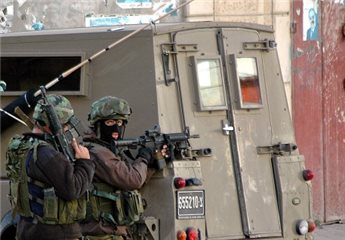
Madama, Occupied Palestine – At 12:30 a.m. on June 22, 2014, approximately 50 Israeli soldiers invaded the village of Madama.
Madama, which is located 10 km southwest of Nablus, in the northern part of the West Bank, has approximately 2000 residents. The soldiers raided close to 100 homes and took 80 men to the local elementary school, where they held them for several hours. The men were blindfolded, and their arms were tied behind their backs with handcuffs.
The soldiers released all of the men at 5 a.m.
At 1:00 a.m., the soldiers invaded the house of Nizar Abdullah Sadaq Ziyaada in Madama. They asked Ziyaada about the whereabouts of his money and proceeded to ransack the house. They drilled holes into the walls and threatened to destroy his home. They found a total of roughly 200,000 shekels underneath a cupboard and in various hiding places throughout the house. Finally, the soldiers took all of the money, two laptops, and several mobile phones before leaving.
The reasons for the theft of Ziyaada’s money are unclear.
Ziyaada had worked in Israel until the year 2000 and kept all of his earnings from that time in his house in Madama. It is likely that the Israelis knew about this money, as they asked him about it as soon as they entered his house.
Hany Ziyaada’s house was invaded by 15 Israeli soldiers the same night at 1 a.m. They broke down the door, but Hany asked them to wait a few minutes, so that the women of the house could get dressed. The soldiers swore at him, and he responded in kind. They proceeded to kick him in the back and stomach for several minutes and dragged him to their jeep, where they continued to beat him. They blindfolded and handcuffed him and took him to the school, where they held him by the throat, forced his arms back and drove their knees into his back. At 4 a.m. they allowed him to go home.
“Why do they not respect human rights?,” Hany asked an ISM activist. “I’m a policeman, and I know about human rights. Why don’t they?”
AIPAC urges US lawmakers not to cut Egypt aid
Press TV – June 25, 2014
American Israel Public Affairs Committee (AIPAC), the pro-Israel lobby which is based in Washington, has begun a lobbying campaign to stop US lawmakers from cutting military aid to Egypt.
The group already said in public that it wanted aid to Egypt to continue flowing.
“In light of the treaty’s achievements and resilience,” AIPAC said in a March 27 memorandum, “The United States should continue its strong support for the treaty and back Egypt as it works with Israel to combat the threats of extremists within its borders who would seek to undermine it.”
On Tuesday, an amendment from Rep. Adam Schiff, D-Calif. was defeated in the House of Representatives. The amendment called for a cut in US military assistance to Egypt by $300 million – from $1.3 billion down to $1 billion.
Tuesday’s vote was partly due to pressure by AIPAC, Schiff said as reported by Al-Monitor.
“I didn’t know that AIPAC was weighing in at all on this until after the vote,” Schiff said. “But members did communicate to me after the vote that they had been persuaded by AIPAC not to support this.”
According to the report, Israel was a main topic of discussion during the debate of Schiff’s amendment as part of Tuesday’s markup of the State and Foreign Operations spending bill for FY2015.
Pro-Israel representatives argued the new government of President Abdel Fattah al-Sisi was doing a better job fighting Israel’s “enemies,” the report said.
“The aid we provide for the military also provides for Israel’s security,” said Rep. Kay Granger, R-Texas, the chairwoman of the State and Foreign Operations panel.
Battlefield USA: American police ‘excessively militarized’ – ACLU study
RT | June 24, 2014
Inheriting both the weapons and the mindset of the US military, police are becoming militarized and ‘hyper aggressive’ in their approach to maintaining security on the streets of America. A new study calls on police not to treat people as ‘wartime enemies’.
The tragic story of Jose Guerena, 26, who served as a Marine in the Iraq War, only to be killed by ‘friendly fire’ at his home in Tucson, Arizona, is becoming a disturbingly familiar one across the country.
On the morning of May 5, 2011, Guerena’s wife alerted him when she heard strange sounds and the silhouette of a man standing outside their home. Guerena got his wife and child into a closet, grabbed his rifle, and went to investigate. This proved to be a deadly mistake. A SWAT team opened fire on Guerena, who died on his kitchen floor with multiple wounds and without medical attention.
As it later emerged, the SWAT unit raided a number of residences in the neighborhood, turning up nothing more than a small bag of marijuana. No drugs were found in the Guerenas’ home.
Created in the late 1960s as “quasi-militaristic” units designed to handle emergency situations such as riots, hostage scenarios, and active shooter situations, the number of SWAT squads have since surged, and are “used with greater frequency and, increasingly, for purposes for which they were not originally intended—overwhelmingly to serve search warrants in drug investigations,” according to an ACLU report, entitled ‘War Comes Home: The Excessive Militarization of American Policing.’
The report examines 818 SWAT operations from July 2010 to last October, which were conducted by more than 20 law enforcement agencies in 11 states.
Today, paramilitary squads are better equipped to fight terrorists in foreign lands [occupations] than serve and protect US civilians at home, and are becoming a dark chapter to America’s newfound capacity for “needless violence” and treating its citizens like “wartime enemies,” it said.
The 98-page document details the militarization of state and local law enforcement agencies, courtesy of expensive federal programs, which are dispensing “weapons and tactics of war, with almost no public discussion or oversight.” Although explicitly aimed at fighting drugs, the strategy is backfiring, sowing fear and discord among citizens, many of whom are starting to fear police as much as criminals.
As the United States winds down its military operations in Afghanistan and Iraq, local police forces are getting the used ‘hand-me-downs’ from the US military. This makes some American communities resemble the latest occupied zones with police dressed in combat fatigues and driving MRAPs and carrying AR-15s down Main Street.
“Using these federal funds, state and local law enforcement agencies have amassed military arsenals purportedly to wage the failed War on Drugs… But these arsenals are by no means free of cost for communities. Instead, the use of hyper aggressive tools and tactics results in tragedy for civilians and police officers, escalates the risk of needless violence, destroys property, and undermines individual liberties,” according to the report.
One bit of curious hardware being distributed to local police forces from the government’s military closet is the MRAP (Mine Resistant Ambush Protected) vehicle, which gives troops protection from improvised explosive devices (IEDs). Using media sources, ACLU put the number of towns that now possess the armored carriers at around 500. Among the lucky recipients, Dallas, Texas, has one, as does Salinas, California and even the Utah Highway Patrol.
The report noted that even the Ohio State University Police own one of the MRAPs in order to give a sense of “presence” on big football game days.
The results of the report revealed a worrying trend: “If the federal government gives the police a huge cache of military-style weaponry, they are highly likely to use it, even if they do not really need to.”
Case in point: Gwinnett County, Georgia, which received at least 57 semi-automatic rifles, mostly M-16s and M-14s. One-third of the county’s SWAT deployments dealt with drug investigations; in half of them, the SWAT team broke down the door to get inside, “and there was no record in any of the reports that weapons were found.”
Other examples were provided in Concord, Keene, and Manchester, quaint New Hampshire towns in close proximity to each other, yet each took advantage of DHS grants to buy the military-grade armored BearCat (the amount of grants received by these agencies ranged from $215,000 to $286,000). Justifications for the need to acquire such vehicles pointed to weapons of mass destruction and the threat of terrorism.
The Keene police department, for example, cites in its application (which trumps Ohio State University’s need for armored vehicles to provide “presence” at big football games), the annual pumpkin festival as a potential terrorism target that requires the assistance of an APC.
Military-style mentality invades police
Another leftover from America’s military adventures abroad is the peculiar military mindset that allows US personnel to survive in hostile lands. Equally unsettling as spotting armored vehicles winding through the tree-lined streets of otherwise quiet American neighborhoods is the spectacle of local police officers receiving military-style combat training.
The US Department of Justice described the boot-camp conditions being used to train new police recruits.
According to a Bureau of Justice Report, “the majority of police recruits receive their training in academies with a stress-based military orientation. This begs the question: is this military model—designed to prepare young recruits for combat—the appropriate mechanism for teaching our police trainees how to garner community trust and partner with citizens to solve crime and public order problems?”
As a result, a so-called “warrior” mentality inside local police forces is “pervasive and extends well beyond hostage situations and school shootings, seeping into officers’ everyday interactions with their communities,” the report said.
The report describes a PowerPoint presentation that was delivered to Cary, North Carolina, SWAT team members entitled “Warrior Mindset/Chemical Munitions” for all Emergency Response Team personnel.
The National Tactical Officers Association (according to its website, the NTOA “strives to provide our members with the tools they need to protect an increasingly dangerous society”) urges trainees to “Steel Your Battlemind” and defines “battlemind” as “a warrior’s inner strength to face fear and adversity during combat with courage. It is the will to persevere and win. It is resilience.”
The question, however, is whether such an approach to policing is conducive to creating peace on the streets of America? An escalation of police operations going awry are growing cause for concern among civil rights groups.
In early June, for example, a toddler was severely burned and left unable to breathe on his own when a Georgia SWAT team tossed a flashbang grenade in his crib during a drug raid – over a single meth sale of $50. Bounkham “Bou Bou” Phonesavanh, a 19-month-old, was asleep in his portable crib in the same room as his parents and three older sisters, when police opened the door to the converted garage and threw the stun grenade in.
In the ACLU’s study, SWAT units forced entry into a person’s home using a battering ram or other breaching device in 65 percent of drug searches.
As the report emphasizes, the training documents do not suggest that SWAT teams “should constrain their soldier-like tactics to terrorism situations.” Moreover, the majority of SWAT raids examined for the report “took place in the context of serving search warrants at people’s homes—not in response to school shootings or bombings.”
The survey discovered that 62 percent of SWAT missions were for drug searches. Some 79 percent involved raids on private homes, and a similar proportion were carried out with warrants authorizing searches. However, just 7 percent of the incidents fell into those categories for which SWAT was originally designed to handle, such as hostage situations or shootings.
It is this type of military mindset, compounded with excessive firepower, which is turning many American communities into veritable tinderboxes, which only requires the slightest provocation to spiral into senseless violence and death.
The survey, which provided a small picture of the overall trend, reported seven cases where civilians died in connection with the deployment of SWAT units, two of which appeared to be suicides. Another 46 individuals were injured, often as the result of physical force by officers.
Background: ‘It’s a war zone in the US’ – Interview with Indiana sheriff
Update: ACLU sues Mass. SWAT agency for refusing to release records
Israel Can’t Force-feed Occupation to Those Who Hunger for Freedom
By Jonathan Cook | Dissident Voice | June 24, 2014
For more than a month Israel sought to wriggle off a hook that should have snared it from the start. Two children, 17 and 16, were shot dead during Nakba Day protests near Ramallah, in which youths threw stones ineffectually at well-protected and distant Israeli military positions.
Hundreds of Palestinian children have lost their lives over the years at the end of a sharpshooter’s sights, but the deaths of Nadim Nuwara and Mohammed Abu Al Thahir in Beitunia were not easily forgotten. Israel was quickly cornered by an accumulation of physical and visual evidence.
Israel’s usual denials – the deaths were faked, video footage was doctored, Israeli soldiers were not responsible, the youths provoked the soldiers, no live ammunition was used – have been discredited one by one. Slowly Israel conceded responsibility, if only by falling into a grudging silence.
A CCTV camera mounted on the outer wall of a carpentry shop provided the most damning evidence: it captured the moments when the two unarmed boys were each hit with a live round, in one case as the youth can be seen walking away from the protest area.
But rather than come to terms with the world as it now is, Israel wants to preserve the way it once was. It believes that through force of will it can keep the tide of accountability at bay in the occupied territories.
There has been no admission of guilt, no search for the guilty soldiers and no reassessment of its policies on crowd control or the use of live fire – let alone on the continuation of the occupation. Instead, 20 soldiers arrived last week at the store in Beitunia, threatened to burn it down, arrested the owner, Fakher Zayed, and ordered he remove the camera that caused so much embarrassment.
According to Israel, the fault lies not with a society where teenage soldiers can choose to swat a Palestinian child as casually as a fly. The problem is with a Palestinian storekeeper, who assumed he could join the modern world.
The nostalgia for a “golden era” of occupation was evident, too, last week in a policy change. Israel has rounded up hundreds of Palestinians in the hunt for three Israeli teenagers missing since June 12. Palestinian cities like Hebron have been under lockdown for days, and several Palestinians youths killed, while soldiers scour the West Bank.
But with the search proving fruitless, Israel’s attorney general approved the reintroduction of the notorious “ticking bomb” procedure.
In doing so, he turned the clock back 15 years to a time when Israel routinely used torture against prisoners. Israel may not have been alone then in using torture, but it was exceptional in flaunting its torture dungeons alongside claims to democratic conduct.
Only in 1999 did the country’s supreme court severely limit the practice, allowing interrogators one exemption – a suspect could be tortured only if he was a ticking bomb, hiding information of an attack whose immediate extraction could save lives.
Now Israel’s law chief has agreed that the Palestinian politicians, journalists and activists swept up in the latest mass arrests will be treated as “ticking bombs”. Israel’s torture cells are back in business.
Israelis have been lulled into a false sense of security by the promise of endless and simple technical solutions to the ever-mounting problems caused by the occupation.
This week, Israel’s prime minister, Benjamin Netanyahu, hoped to find another “fix” for Palestinians who refuse to remain supine in the face of their oppression.
Netanyahu is racing through a law to force-feed more than 100 Palestinian prisoners who are two months’ into a hunger strike. The inmates demand that Israel end the common practice of holding prisoners for months and sometimes years without charge, in what is blandly termed “administrative detention”.
Such prisoners, ignorant of their offence, are unable to mount a defence. And as it becomes ever clearer to Palestinian society that Israel is never going to concede Palestinian statehood, things that were once barely tolerated are now seen as unendurable.
Last week, the heads of the World Medical Association urged Israel to halt the legislation, which in a double bill of compulsion will require doctors to sedate and force-feed prisoners to break their hunger strike.
The WMA called the practice “tantamount to torture”. The legislation violates not only the autonomy of the prisoners but the oaths taken by the doctors to work for their patients’ benefit.
The liberal Haaretz newspaper warned that Israel was rushing headlong towards “a new abyss in terms of human rights violations”. And all this to prevent reality pricking the Israeli conscience: that Palestinians would rather risk death than endure the constant indignities of a life under belligerent occupation.
Israelis have yet to realise the dam is soon to burst. They still believe a technical fix is the way to solve ethical dilemmas continuously thrown up by the longest occupation in modern times.
Israel’s technical solutions work to an extent. They confine Palestinians to ever smaller spaces: the prison of Gaza, the city under lockdown, the torture cell, or the doctor’s surgery where a feeding tube can be inserted.
But the craving for self-determination and dignity are more than technical problems. You cannot force-feed a people to still their hunger for freedom.
Belligerent occupations – especially ones where no hope or end is in sight – engender evermore creative and costly forms of resistance, as the hunger strike demonstrates. A physical act of resistance can be temporarily foiled. But the spirit behind it cannot be so easily subdued.
~
Palestinian prisoners assaulted before being detained

Ma’an – 24/06/2014
RAMALLAH – A Palestinian Prisoner’s Society lawyer reported Monday from Palestinian detainees at Etzion detention center that many of them were assaulted and beaten before they were detained.
Prisoner Faraj Ghaith, 57, told the lawyer that three settlers raided his house, assaulted him and his family before the Israeli police detained him and his two sons Ahmad and Omar.
Ghaith lives near the Israeli settlement of Kiryat Arbaa.
Jaclyn Fararjeh said that bruises were still clear on the prisoners’ bodies.
Prisoner Ashraf al-Jaaidi, 30, from Bethlehem, said that he threw up blood since he was detained, and that he was beaten with butts of the riffles when he was detained from his house in Duheisha refugee camp last Friday.
Farajeh highlighted that al-Jaaidi requested to be examined by a doctor but the prison service refused.
PPS’ lawyer Fararjeh visited prisoners Yasser Banat, Muhammad al-Hreini, Taha al-Hur, Bassam al-Natsheh, Ismail Jabariya, Muath Muhammad, Rabee Izriqat, Issa Shalaldeh, Yahya al-Huroub, Munthir al-Shurouf, Youssif Tartour, Tariq Gharib, Muhammad Hmeideh, Youssif Awawdeh and Murad Abu Muhye.
Missing Israeli settlers: Al Jazeera English’s distorted reporting

By Orouba Othman | Al-Akhbar | June 23, 2014
Gaza – Al Jazeera English’s reporting on the missing Israeli settlers was not naive and it is rather impossible to classify it as part of the rhetoric of neutrality and objective reporting on the Palestinian-Israeli conflict.
It is simply deliberate coverage that targets the Palestinians’ presence on their own land and their just cause, while giving leverage to the “perseverance” of the Israeli society living in a jungle of “barbaric” Palestinians. Al Jazeera English correspondent Jane Ferguson started her report a few days ago by focusing on the feelings of Israelis and specifically their shock following the [alleged] capture of three Israelis about 10 days ago.
This shock, of course, did not not originate from the Palestinians’ right to face their enemies, but was ignited due to the Palestinians’ insensitivity, which was displayed through their “kidnapping of three teenagers” who could be robbed of their lives with a fatal bullet, or rather “a deceiving” bullet in the words of the Qatari channel.
Certainly, all the misery the Palestinians have suffered for 66 years at the hands of those expressing their shock is insignificant. Today, the only thing that matters is the sorrow of the Israeli people. Ferguson began her report with images of a tent erected by residents of Nof Ayalon village to pray for the safe return of Naftali Fraenkel, a town native and one of the three [allegedly] kidnapped individuals.
Ferguson did not miss the opportunity to remind viewers that the three Israelis (Naftali Frenkel, Gil-ad Shaer and Eyal Yifrach) were teenagers, further seeking the viewers’ compassion by stating that they were all under the age of 19. The reporter did not stop there, but gave Fraenkel’s aunt a platform to express her feelings on air, saying “I am still in shock, it is hitting me repeatedly, Fraenkel went to school and didn’t come back. It is really difficult, and the whole family is crushed.”
The correspondent’s report does not mention neither the suffering of over 5,700 Palestinians held in the occupation’s prisons, nor the fact that four of those prisoners died under physical and psychological torture in the past year.
“Not only in this small village are people waiting anxiously to hear news about the missing teenagers, but across the entire nation, everyone is gripped by this story,” Ferguson commented in her report, adding that Israeli channels have been in the village for days to cover the incident.
The scene displaying solidarity with the town’s locals is later taken off screen to be replaced with images of a street populated by Israeli settlers. The channel then sheds light on the challenges faced by Israelis to strengthen their “perseverance” on a land that is not theirs, saying that they are not scared and that they are going on with their lives as usual.
To give more credibility to her short analysis, Ferguson gives a female settler the opportunity to explain whether or not the “kidnapping incident” had negatively affected her life. The settler confirms Ferguson’s view by saying, “there is nothing to be afraid of. If there was a bombing on a bus, does it means we should not catch buses? This is the same for me, this is our lifestyle.”
The reporter seemed to have forgotten how Palestinians resist death and how much they love life even though they are besieged by their enemy’s weapons from the front, its tanks from behind and its planes from above.
Perhaps, Palestinian viewers would have better received the report if Ferguson had also visited towns and refugee camps in the West Bank, and had broadcast live images of the arrest campaigns and the raids on Palestinian homes, as well as Israel’s policy of systematic killing, as reflected by the fact that four Palestinians have already been killed since the beginning of the operation.
Meanwhile, Al Jazeera English’s Gaza correspondent Charles Stratford started his report by linking the operation in Hebron to the Gaza Strip by showing two Palestinian boys from Gaza training on how to use weapons and participate in combat missions at a camp affiliated to Hamas.
Stratford then commented that “these are the children of people who believe, like the majority of Gaza residents, that Hamas represents the future of Palestine and is a part of the unity government rejected by Israel.”
The correspondent sought to differentiate between “terrorist” boys following Hamas’ path and other “innocents” that fall in the hands of the group that is training droves of “terrorists.”
The English-language Qatari channel claims to have been launched to change the stereotype about the Middle East. However, today it has become another burden on Palestinians, promoting the Israeli side of the story in the West while disregarding the real narrative.
Is Israel’s ongoing terror campaign punishment for Palestinian unity?
By Chloé Benoist | Al-Akhbar | June 23, 2014
As Israel continues its crackdown on the West Bank in the wake of three Israeli teenagers’ disappearance, the unrestrained violence of the occupying forces has seemingly developed into retribution for the recent establishment of a Palestinian unity government.
In the 11 days since the three Israeli settlers went missing while hitchhiking near the illegal Zionist settlement bloc of Gush Etzion in the West Bank, Palestinians have paid a heavy toll as the Israeli manhunt quickly turned into collective punishment.
Israel Occupation Forces (IOF) have searched countless Palestinian homes, media offices and schools in extensive raids, confiscating universities’ computers, destroying furniture, firing tear gas and live bullets at protesting civilians, a move seemingly more intent on furthering the control of the Palestinian population than finding the Israeli teenagers.
At least 471 Palestinians have been arrested since June 12. At least 75 of those arrested are former prisoners who had been released in a 2011 prisoner swap, according to the Palestinian Authority’s former Minister of Prisoner Affairs Issa Qaraqe.
“Resentencing prisoners who were released in the [2011 Gilad] Shalit deal is a form of immoral and illegal revenge, an offense to Egypt who sponsored the deal, and collective punishment that is against the human and legal rights of prisoners,” he said on Saturday.
He added that 241 Palestinian minors were now locked up in Israeli jails, 45 more than in May according to statistics by prisoners’ rights NGO Addameer.
The prisoners have been placed in administrative detention, a practice whose excessive use by Israel has been denounced as being illegal under international law by rights groups. Israel has imposed a tight blockade on Hebron, and a curfew on the northern West Bank city of Nablus.
Meanwhile, the Gaza Strip has sustained nightly air raids for the past week. The already isolated enclave has been subjected to an even more stringent siege, as an Israeli Defense Ministry statement on June 15 declared that the Erez crossing would be limited to humanitarian cases, while only fuel would be allowed in through the southern goods crossing.
Operation “Brother’s Keeper” keeps claiming Palestinian lives
At least five Palestinians have died during Israeli military operations in the West Bank since June 12. All available information indicates that the victims were unrelated to the disappearance of Gilad Shaer, Eyal Ifrach and Naftali Frenkel.
The first casualty was Ahmad Arafat Sabarin, who was shot dead on Monday during a military raid in the Jalazoun refugee camp north of Ramallah. He was 19 years old.
 On Friday, 14-year-old Mohammed Jihad Dudin was shot in the chest with live bullets in an Israeli raid on the village of Dura, near Hebron. Photos of Dudin show a skinny, smiling child.
In Nablus, Jamil Ali Abed Jaber, 60, died of a heart attack as Israeli troops searched his house on Saturday. Palestinian security sources reported that Abed Jaber’s family was prevented from taking him to the hospital, leading him to die inside his home.
Early on Sunday June 22, Israeli troops in Ein Beit al-Mai refugee camp in western Nablus shot dead 36-year-old Ahmad Fahnawi, who was on his way to morning prayers as clashes were taking place. Eyewitnesses told Ma’an news agency that a soldier shot Fahnawi several times from point-blank range.
The Israeli army confirmed firing at a “suspect,” claiming he had approached troops “in a threatening manner.” However, Fahnawi’s family told AFP that he suffered from mental health problems.
Israeli troops also killed 30-year-old Mohammed Mahmoud Atallah Tarifi on Sunday during a crackdown in central Ramallah, Palestinian medics reported.
An untold number of Palestinians have been injured so far in Operation “Brother’s Keeper.”
International and Arab silence
Most of the Israeli public was quick to support the army’s actions in the West Bank. The hashtag “BringBackOurBoys” rapidly made the rounds on Twitter, a move criticized by some as an insensitive appropriation of the #BringBackOurGirls campaign in Nigeria, where over 200 girls are still held captive by Boko Haram.
Meanwhile, a Facebook page titled “Until the boys are back, every hour we shoot a terrorist” has accumulated more than 20,700 likes since its creation on June 13. The page vocally supports widespread violence against Palestinians as ‘punishment’ for the disappearance of the three Israelis.
While several rights groups have condemned Israel’s violent policies and rhetoric, a significant portion of the international community has come out in support of Israel’s ‘search’ for the teenagers, justifying the Zionist state’s military actions without addressing their impact on Palestinians.
“The European Union has called for the immediate and unconditional release of these three boys – it is, frankly, despicable that children’s lives should be put in danger in this way,” EU Ambassador to Israel Lars Faaborg-Andersen said on Tuesday, referring only to Israeli children.
“Israeli suffering has to be understood,” the mayor of Buenos Aires, Mauricio Macri, said during a conference on Wednesday with 19 other world mayors standing in support of Israel.
While there has been no shortage of lamentations about Israelis’ shared pain over the missing teens, the international community has remained silent about the plight of Palestinians. Even supposedly pro-Palestinian Arab countries have so far failed to condemn the Israeli raids or express condolences for the loss of Palestinian lives.
The Palestinian Authority’s collaboration with Israel
Almost as soon as the three settlers went missing, Israeli Prime Minister Benjamin Netanyahu accused Hamas of being behind their disappearance, a charge Hamas dismissed immediately.
“Our young people have been kidnapped by a terror organization… there is no doubt about that,” Netanyahu told reporters in Tel Aviv on June 14.
The Israeli government has yet to provide any proof of its claims. On Tuesday, a spokesperson for United Nations leader Ban Ki-Moon, Farhan Haq, said that the UN had “no information to confirm an abduction.” This statement was quickly denounced by Israel as “out of touch, out of line and out of time.”
Downplaying the crackdown as “friction,” Netanyahu said on Sunday that evidence of Hamas’ involvement would be made public “soon,” the Jerusalem Post reported.
Meanwhile, the Israeli government has dismissed Palestinian casualties as a consequence of “necessary” Israeli “self-defense.”
Netanyahu has also targeted Palestinian Authority (PA) President Mahmoud Abbas, holding him responsible despite the latter’s swiftness in condemning the alleged kidnapping.
The Israeli premier’s hostility towards the PA is all the more incomprehensible given the Palestinian Authority’s ongoing security coordination with Israel.
Palestinian police have worked with Israel intermittently since the Oslo Accords, but the security arrangement has been strengthened since Abbas came to power in 2005.
Palestinians have long been angered by the PA’s collaboration with the IOF, and Operation “Brother’s Keeper” has only exacerbated the perception of PA security acting as agents for Israel. Witnesses have seen PA forces arresting individuals in hospitals, and a demonstration by mothers of hunger striking prisoners on Friday was attacked by Palestinian police.
On Sunday night, PA security forces clashed with Palestinians protesting against their coordination with Israel. With support from the IOF, PA security shot in the direction of the crowd in Ramallah, injuring at least one person.
But it seems collaboration with Israeli brutality is not enough for Netanyahu.
“[Abbas’] words will not only be judged in terms of actions taken to bring the boys home, but also by his willingness to break up the unity government with Hamas,” he said.
Statements by IOF Chief of Staff Benny Gantz confirmed that undermining Hamas is a main goal of the Israeli military operation.
“We have a goal: to find these three boys and bring them home, and to damage Hamas as much as possible,” Gantz said on June 16.
The missing settlers: a pretext
Netanyahu’s demands support the idea that the ongoing brutal operation is not only intended to locate the three settlers, but to punish Palestinians after the recent reconciliation between Fatah and Hamas and to sabotage the newly-created unified Palestinian government.
In an interview with ultra-Orthodox news outlet Hadrei Haredim published on Thursday, an IOF officer revealed that parts of Operation “Brother’s Keeper” had been planned long before the teenagers went missing. Notably, he said that the Israeli army had already prepared for an operation in Jenin in which soldiers were to purposefully provoke residents into throwing stones, and then use the clashes as an excuse to kill Palestinians.
This disclosure — among other statements — backs the idea that Israel is knowingly creating an unlivable situation for Palestinians only to blame them for pushing back, perpetuating its myth of Palestinian aggression as it has many times before. Despite decades of occupation, Israel continues to frame Palestinian resistance as unprovoked aggression, breaches of international law as legitimate defense, and oppressors as victims.
These provocative Israeli tactics are not new. In 1976, then-Israeli Minister of Defense Moshe Dayan explained the 1967 military tactics to the New York Times:
”Along the Syria border there were no farms and no refugee camps — there was only the Syrian army… The kibbutzim saw the good agricultural land … and they dreamed about it… They didn’t even try to hide their greed for the land… We would send a tractor to plow some area where it wasn’t possible to do anything, in the demilitarized area, and knew in advance that the Syrians would start to shoot. If they didn’t shoot, we would tell the tractor to advance further, until in the end the Syrians would get annoyed and shoot. And then we would use artillery and later the air force also, and that’s how it was… The Syrians, on the fourth day of the war, were not a threat to us.”
Lebanon has similarly suffered from Israel using flimsy pretexts to push forward ulterior plans against its enemies.
The notion of Palestinian unity is a threat to Israel, and it will do anything in its power to weaken it. A unified Palestinian political front, having somewhat resolved its internal conflicts, could make a stronger claim for self-determination, a scenario that would further expose Israel’s unreasonable demands for “peace” and its divide and conquer strategies.
Israel, therefore, uses any pretext to try to stifle Palestinian aspirations, attempting to reduce an entire population’s existence to a question of mere survival.
Many Palestinians – adults and children alike – will continue to suffer as long as Israel is allowed to act unabated, using the undetermined fate of the three Israelis until it finds another excuse to continue its policy of repression, injustice and divisiveness.
Jewish Settlers Attack Funeral Of Slain Palestinian In Ramallah

By Saed Bannoura | IMEMC & Agencies | June 22, 2014
Sunday evening a number of fanatic Israeli settlers attacked the funeral of a Palestinian, killed by the Israeli army in al-Biereh, near the central West Bank city of Ramallah, wounding one Palestinian.
The Palestinians were participating in the funeral procession of resident Mohammad at-Tareefi, 30, in Jabal at-Tawil neighborhood, when settlers of the Psagot illegitimate settlement opened fire on them, wounding one resident.
Several minutes later, dozens of soldiers arrived at the scene, and fired live ammunition at the residents, and several homes, in al-Biereh.
The Israeli military attack pushed dozens of residents to advance towards Psagot settlements, and hurl stones at it.
The soldiers chased the residents in Dahiat Jabal at-Tawil and al-Jinan area, while firing dozens of rounds of live ammunition, gas bombs, concussion grenades, and rubber-coated metal bullets.
The funeral procession started in front of the Palestine Medical Center in Ramallah, heading towards the home of the slain Palestinian in Betunia, before advancing towards the Jamal Abdul-Nasser Mosque in al-Biereh city.
At-Tareefy was shot by a live round in his chest during Sunday dawn clashes with Israeli soldiers invading Ramallah.
Israel’s military offensive in different parts of the occupied West Bank started ten days ago, following the disappearance of three Israeli settlers from Gush Etzion settlement, near Bethlehem.
Although Israel said Hamas is behind the “abduction”, Hamas denied the claim.
The ongoing Israeli military invasion led to the abduction of more than 400 Palestinians, many of them are children, and the soldiers invaded and searched more than 1000 areas in the West Bank.
The army alleged uncovering dozens of tunnels under Palestinian homes in the West Bank, and that the soldiers “located underground labs used for the production of explosives”.
The army said Israel had no prior information about the alleged labs and tunnels, but uncovered them during the extensive searches of homes and property.
In a Sunday report by the Palestinian Center for Human Rights, the center said Israeli soldiers shot and killed four Palestinians in the last ten days. Two of them were killed Sunday.
At least 38 Palestinians have been kidnapped by the Israeli army on Sunday, in different parts of the occupied West Bank.
The army also shot and wounded dozens of Palestinians in the ongoing offensive.
Israeli settlers shoot at Palestinians near Ramallah
Ma’an – 22/06/2014
RAMALLAH – Israeli settlers opened fire at Palestinians northwest of Ramallah late Sunday in the second such incident in hours, locals said.
Two settlers shot at nine men who were working in a quarry near the village of al-Mazraa al-Gharbiya, without causing injuries, the workers told Ma’an.
They said they noticed the settlers sneaking into the quarry and fled the scene as settlers opened fire with an automatic rifle.
After being chased for nearly two miles, the workers reached al-Mazraa al-Gharabiya unscathed, they told Ma’an.
The Palestinians identified themselves as Ismail al-Rajabi, 25, Momen Idriss, 24, Anas Idriss, 18, Yacoub Idriss, 20, Bilal Idriss, 20, Ahmad Jaber, 27, Wael al-Shalaldeh, 32, Mohammad Jaber, 23, and 10-year-old Abd al-Rahman Jaber.
An Israeli army spokeswoman did not immediately return calls seeking comment.
Earlier, a Ma’an reporter said that Israeli settlers opened fire at Palestinians in al-Bireh near Ramallah, injuring one as mourners gathered for the funeral of Muhammad Tarifi.
Tarifi was one of two Palestinians killed by Israeli forces early Sunday.
Featured Video

How Many More Gulf States Get Dragged Into Trump’s Iran War?
or go to
Aletho News Archives – Video-Images
Book Excerpt
How CIA used Ukraine as a platform for covert war against Russia
By Stephen KINZER | Responsible Statecraft | November 17, 2026
The following is an excerpt from Stephen Kinzer’s new book: Boiling Point: How America Brought War to Ukraine (Henry Holt and Company, November 2026)
Huddled beside an airstrip in southern Germany, a handful of anti-Communist warriors prepared to fire the first shots of the Cold War. A CIA officer from the Munich Operations Base was in charge. The Hungarian crewmen he had recruited stood nearby in flight suits. With them were two Ukrainian exiles who had volunteered to parachute into their homeland. They were code-named Apostle 1 and Apostle 2. Each carried forged identity papers, a miniature radio transmitter, a pistol, a machine gun, hand grenades, a purse full of gold coins, and a poison pill to be taken in case of capture. An unmarked C-47 transport plane was waiting.
The CIA officer overseeing this operation, a twenty-six-year-old Yale graduate named Stephen Tanner, watched the plane take off and disappear into the night. It flew over East Germany and Poland, then crossed into Soviet airspace. As it approached the Ukrainian city of Lviv, a cargo bay swung open. The two Ukrainians jumped into the darkness. Their mission was to link up with partisan fighters, seize territory, and establish a clandestine base through which the CIA could send them weapons.
That flight, on September 5, 1949, was the first American act of covert war in Ukraine. … continue
Blog Roll
 Aletho News
- Banning Palestine activists from the West will not save Israel’s image
- Iran rejects unlimited IAEA inspections amid continued military threats
- A Bridge Too Far
- David Barnea in the Bundestag – Mossad as a model for Germany’s Intelligence Services?
- Rome blasts Kiev after Italian lawmakers added to ‘kill list’
- Another €45 bn down the drain: Why the EU is desperate to waste more cash on Zelensky
- In Europe, Anxiety Is Mounting—EU Unity Is Cracking at Every Seam
- How CIA used Ukraine as a platform for covert war against Russia
- European Commission proposes new loan for Kiev
- How Many More Gulf States Get Dragged Into Trump’s Iran War? | Matt Bracken
- If Americans Knew
- An error has occurred; the feed is probably down. Try again later.
- No Tricks Zone
- Argentina’s Perito Moreno Glacier Joins Antarctica and Arctic In Defying Doomsday Melt Claims
- New Study: Barents Sea Temperatures Were Warmer And Sea Ice Less Extensive In The 1700s Than Today
- German Authorities Start Initiative To Evaluate Public Register For Climate “Disinformation” Spreaders!
- Zonal Asymmetry of Temperature Change in the Antarctic Circumpolar Current
- New Study: The Net Fossil Fuel Contribution To Rising Atmospheric CO2 Has Been Zero For 500 Years
- Germany’s Green Energy Transition Becoming Increasingly Expensive…Another 6 Trillion Euros!
- Sudden Stratospheric Warming, Powerful El Niño Combination May Lead To Extreme Europe Cold, Energy Crisis!
- Two New Studies Find Thwaites Glacier Melt Cannot Be Driven By Human Activity Or A Warming Ocean
- E-Cars Reduce CO2 Emissions By Only 41% Compared To Internal Combustion Engine Vehicles
- Predictions Made By Renowned Climate Professor Over Past Decades Have Been Proven To Be Poor

