The Missing Quote from the King Memorial
By Don DeBar | Black Agenda Report | January 17, 2012
“The greatest purveyor of violence in the world today: my own Government… I cannot be silent.” – Rev. Dr. Martin Luther King, Jr.
While the insiders in Washington parse the meaning of the paraphrased words of Dr. Martin Luther King, Jr. regarding his own epitaph, his true legacy – the one that many believe led to his murder – has been whitewashed from the King Memorial entirely.
Speaking at the Riverside Church in New York City, exactly one year – to the day – before he was shot and killed in Memphis, Dr. King announced that he was expanding his focus on America’s national shame of segregation to include its international crime of war on the people of Vietnam:
“(I)n the ghettoes of the North over the last three years — especially the last three summers, (a)s I have walked among the desperate, rejected, and angry young men, I have told them that Molotov cocktails and rifles would not solve their problems. I have tried to offer them my deepest compassion while maintaining my conviction that social change comes most meaningfully through nonviolent action. But they ask — and rightly so — ‘what about Vietnam?’ They ask if our own nation wasn’t using massive doses of violence to solve its problems, to bring about the changes it wanted. Their questions hit home, and I knew that I could never again raise my voice against the violence of the oppressed in the ghettos without having first spoken clearly to the greatest purveyor of violence in the world today — my own government. For the sake of those boys, for the sake of this government, for the sake of the hundreds of thousands trembling under our violence, I cannot be silent.”
The King Memorial lists a total of 15 direct quotes and a paraphrase (currently in controversy) from Dr. King’s words; yet, curiously, this particular quote – which ties together the struggle for social and economic justice at home with the actions of the government abroad in an elegant and profound way – did not make the list.
Here are the quotes that appear on the Inscription Wall of the Memorial:
“We shall overcome because the arc of the moral universe is long, but it bends towards justice.” (16 August 1967, Atlanta, GA)
“Darkness cannot drive out darkness, only light can do that. Hate cannot drive out hate, only love can do that.” (1963, Strength to Love)
“I believe that unarmed truth and unconditional love will have the final word in reality. This is why right, temporarily defeated, is stronger than evil triumphant.” (10 December 1964, Oslo, Norway)
“Make a career of humanity. Commit yourself to the noble struggle for equal rights. You will make a greater person of yourself, a greater nation of your country, and a finer world to live in.” (18 April 1959, Washington, DC)
“I oppose the war in Vietnam because I love America. I speak out against it not in anger but with anxiety and sorrow in my heart, and above all with a passionate desire to see our beloved country stand as a moral example of the world.” (25 February 1967, Los Angeles, CA)
“If we are to have peace on earth, our loyalties must become ecumenical rather than sectional. Our loyalties must transcend our race, our tribe, our class, and our nation; and this means we must develop a world perspective.” (24 December 1967, Atlanta, GA)
“Injustice anywhere is a threat to justice everywhere. We are caught in an inescapable network of mutuality, tied in a single garment of destiny. Whatever affects one directly, affects all indirectly.” (16 April 1963, Birmingham, AL)
“I have the audacity to believe that peoples everywhere can have three meals a day for their bodies, education and culture for their minds, and dignity, equality and freedom for their spirits.” (10 December 1964, Oslo, Norway)
“It is not enough to say ‘We must not wage war.’ It is necessary to love peace and sacrifice for it. We must concentrate not merely on the negative expulsion of war, but on the positive affirmation of peace.” (24 December 1967, Atlanta, GA)
“The ultimate measure of a man is not where he stands in moments of comfort and convenience, but where he stands at times of challenge and controversy.” (25 February 1967, Los Angeles, CA)
“Every nation must now develop an overriding loyalty to mankind as a whole in order to preserve the best in their individual societies.” (4 April 1967, Riverside Church, New York, NY)
“We are determined here in Montgomery to work and fight until justice runs ‘down like water, and righteousness like a mighty stream.'” (5 December 1955, Montgomery, AL)
“We must come to see that the end we seek is a society at peace with itself, a society that can live with its conscience.” (16 April 1963, Birmingham, AL)
“True peace is not merely the absence of tension: it is the presence of justice.” (16 April 1963, Birmingham, AL)
Within the list, there is one quote which deals directly with the Vietnam war, two that deal directly with war, and others that deal, in one way or another, with issues of war and peace in general. One is lifted from the Riverside speech.
Inscribed on the Stone of Hope are two statements – one, a direct quote, the other, the paraphrase of his words that is at the center of the present controversy:
The first, from the “I Have a Dream” speech, is “Out of the Mountain of Despair, a Stone of Hope” – the quotation that serves as the basis for the monument’s design. The words on the other side of the stone read, “I Was a Drum Major for Justice, Peace, and Righteousness,” which is a paraphrased version of a longer quote by King: “If you want to say that I was a drum major, say that I was a drum major for justice. Say that I was a drum major for peace. I was a drum major for righteousness. And all of the other shallow things will not matter.” The memorial’s use of the paraphrased version of the quote has been criticized (Wikipedia).
Nowhere on the monument is there any mention of Dr. King’s clearly-stated indictment of American foreign policy as being intrinsically evil (above); nor is there any mention that America’s wars are the cause of economic hardship at home:
“There is at the outset a very obvious and almost facile connection between the war in Vietnam and the struggle I, and others, have been waging in America. A few years ago there was a shining moment in that struggle. It seemed as if there was a real promise of hope for the poor — both black and white — through the poverty program. There were experiments, hopes, new beginnings. Then came the buildup in Vietnam, and I watched this program broken and eviscerated, as if it were some idle political plaything of a society gone mad on war, and I knew that America would never invest the necessary funds or energies in rehabilitation of its poor so long as adventures like Vietnam continued to draw men and skills and money like some demonic destructive suction tube. So, I was increasingly compelled to see the war as an enemy of the poor and to attack it as such.”
At the dedication of the King Monument last October, President Barack Obama invoked the words of Dr. King – some of them – without even mentioning war:
“When met with hardship, when confronting disappointment, Dr. King refused to accept what he called the ‘is-ness’ of today. He kept pushing towards the ‘ought-ness’ of tomorrow.
“And so, as we think about all the work that we must do –- rebuilding an economy that can compete on a global stage, and fixing our schools so that every child — not just some, but every child — gets a world-class education, and making sure that our health care system is affordable and accessible to all, and that our economic system is one in which everybody gets a fair shake and everybody does their fair share, let us not be trapped by what is. We can’t be discouraged by what is. We’ve got to keep pushing for what ought to be, the America we ought to leave to our children, mindful that the hardships we face are nothing compared to those Dr. King and his fellow marchers faced 50 years ago, and that if we maintain our faith, in ourselves and in the possibilities of this nation, there is no challenge we cannot surmount.”
Obama even went so far as to impute to Dr. King words that, if the record is any indication, are mere sterile parodies of the words of this Nobel Peace Prize winning minister:
“If he were alive today, I believe he would remind us that the unemployed worker can rightly challenge the excesses of Wall Street without demonizing all who work there; that the businessman can enter tough negotiations with his company’s union without vilifying the right to collectively bargain. He would want us to know we can argue fiercely about the proper size and role of government without questioning each other’s love for this country — with the knowledge that in this democracy, government is no distant object but is rather an expression of our common commitments to one another. He would call on us to assume the best in each other rather than the worst, and challenge one another in ways that ultimately heal rather than wound.”
Not a word about “the greatest purveyor of violence in the world today” – this is particularly odd when one considers that the US is now currently involved in more war and destruction, in more places and involving more people, weaponry and expense, than at the time Dr. King uttered those words in 1967.
As to the shared status with the President as a fellow Nobel Peace Prize winner, in contrast to the Commander-in-Chief’s actions over the past three years, Dr. King said:
“I cannot forget that the Nobel Peace Prize was also a commission, a commission to work harder than I had ever worked before for ‘the brotherhood of man.’ This is a calling that takes me beyond national allegiances, but even if it were not present I would yet have to live with the meaning of my commitment to the ministry of Jesus Christ. To me the relationship of this ministry to the making of peace is so obvious that I sometimes marvel at those who ask me why I’m speaking against the war. Could it be that they do not know that the good news was meant for all men — for Communist and capitalist, for their children and ours, for black and for white, for revolutionary and conservative? Have they forgotten that my ministry is in obedience to the One who loved his enemies so fully that he died for them? What then can I say to the Vietcong or to Castro or to Mao as a faithful minister of this One? Can I threaten them with death or must I not share with them my life?”
Quite a different interpretation of the charge that comes with joining the company of other Nobel Peace Prize winners than that demonstrated by the man who sat silent during the siege of Gaza (“Only one President at a time”), expanded the wars in Iraq and Afghanistan into Pakistan, Libya, Bahrain, Syria and, soon, Iran. Could we imagine Dr. King conducting – or sanctioning – a six-month bombing campaign for “humanitarian reasons”? Or might he instead feel compelled to speak out:
“And as I ponder the madness of Vietnam and search within myself for ways to understand and respond in compassion, my mind goes constantly to the people of that peninsula. I speak now not of the soldiers of each side, not of the ideologies of the Liberation Front, not of the junta in Saigon, but simply of the people who have been living under the curse of war for almost three continuous decades now. I think of them, too, because it is clear to me that there will be no meaningful solution there until some attempt is made to know them and hear their broken cries.
“They must see Americans as strange liberators.”
“Strange liberators,” indeed…
Don DeBar is a journalist and political activist residing in Ossining, NY. He currently serves as senior producer for WBAIX.org, an internet news and public events outlet featuring progressive producers who were purged from Pacifica Radio.

3 Israeli airstrikes on Gaza injure motorcyclist, child
Ma’an – 19/01/2014
GAZA CITY – A young Palestinian man and a child were injured on Sunday morning after Israeli air forces launched three strikes across the Gaza Strip.
An Israeli airstrike in the northern Gaza Strip hit a motorcyclist on Saftawi Street near Jabaliya, injuring the driver and a number of passersby.
Two other airstrikes in the central and southern Gaza Strip left no reported injuries.
Spokesman for the Gaza Strip Ministry of Health Ahraf al-Qidra told reporters that the motorcyclist was a 22-year-old man, and that he was taken to al-Shifa Hospital in Gaza City after he sustained serious injuries.
Al-Qidra added that a 12-year-old boy was taken to Kamal Udwan Hospital in Jabaliya, and that doctors said he suffered moderate wounds.
A statement by Israeli forces said that they had “successfully targeted a terrorist operative” named Ahmad Saad, who they described as “a senior operative in the ‘Palestinian Islamic Jihad'” organization.
The statement added that Saad was a specialist “in rocket launching” and is “personally responsible for the launching of 5 rockets towards Ashkelon” on Thursday.
Also on Sunday morning, Israeli air forces bombed two sites in the central and southern Gaza Strip used as training sites for Palestinian militants.
Witnesses told Ma’an that at least three missiles hit a military training site in the town of Bani Suheila east of Khan Younis in the southern Gaza Strip.
The site and neighboring civilian houses sustained material damage, but no injuries were reported.
Less than 10 minutes later, another Israeli airstrike targeted a training site of the Hamas’ military wing the al-Qassam Brigades near Nuseirat refugee camp in the central Gaza Strip.
No injuries were reported in that strike either.
An Israeli military spokesperson said the attacks came after a homemade shell fired from the Gaza Strip landed in the Western Negev.
The airstrikes come only days after four Palestinian children and a woman were injured in Israeli bombing in the Gaza Strip early on Thursday, and a day after after Israeli forces opened fire on Palestinian protesters near the border, injuring two.
The Gaza Strip has been under a severe economic blockade imposed by the State of Israel since 2006.
Israeli nukes aimed at terrorizing world: Ralph Schoenman
Press TV interview with Ralph Schoenman | January 19, 2014
Press TV has conducted an interview with Ralph Schoenman, author of Hidden History of Zionism, from Berkeley, California, to discuss Israel’s use of nuclear bombs to terrorize and dominate populations with the help of the United States.
What follows is a rough transcript of the interview.
Press TV: First of all, with this report in, will there be any political or legal implications for those who assisted Israel in acquiring these nuclear weapons?
Schoenman: The question is really going to the relationship of imperialism to the Zionist [entity] from its inception, in specific terms now the issue of the use of nuclear weapons.
There is a book,The Unspoken Alliance: Israel’s Secret Relationship with Apartheid South Africa, by Sasha Polakow-Suransky, which details the joint development of nuclear weapons by including neutron bombs by Israel and South Africa, and their testing.
The well-known figure Mordechai Vanunu – who was kidnapped by the Israelis when he disclosed the evidence of the Israeli preparations for nuclear capacity and testing of weapons, indeed, with the full panoply of evidence pertaining to this – was kidnapped, taken to Israel and held in incommunicado for 18 years.
There is a very sorted and menacing history of the use of these weapons to menace peoples across the world. I want to give a specific example in illumination of this, namely ‘View of the Cameroon Disaster…’, which Dan Fisher wrote about in the Los Angeles Times on August 27, 1986.
Death occurred in which people were found frozen in place as if they have been killed by gas. This was an event in 1986 in Cameroon – it was immediately described as an event in which the Israelis were involved. The Israeli infantry troops were soon to be on the scene. In fact, Shimon Perez, who was the former Foreign Minister and Prime Minister of Israel, was quickly on the scene with a team.
Indeed, the evidence about this was documented by Dan Fisher in the Los Angeles Times, as I’ve mentioned, but also there was a detailed account by the Cameroonian journalists which specified the role of the Israelis and the evidence of a neutron weapon: ‘The Lake Nyos Disaster 20 Years After: Revisiting Israeli Connection’, by Dibussi Tande.
My wife and I had a role in this expose because after the time we flew to the big island of Hawaii where leading volcanologist in the island of Hawaii was involved in the report on what occurred in Cameroon, he confirmed that the claims that this was the result of gases emerging from a lake with presumptive latent volcano that emitted gases in Lake Nyos, those gases then reached the atmosphere in causing thousands of people to die in their tracks frozen, while no damage to property occurred, was quickly exposed as a myth.
In fact, what we’re dealing with here is a neutron weapon. One of the people who’s most associated with the neutron bomb, Sam Cohen, who was working with the RAND Corporation in the United States, has detailed the neutron weapon.
There is no question whatsoever, given what Vanunu has exposed, given what evidence there is in Cameroon, that neutron weapons have been used and tested by the Israelis with the approval and collusion of the United States and the imperial powers notably France.
This is not a new development. The story is important. It is the culmination of a series of documentations, revelations over a period of 20, 30 and 40 years. These are crimes against humanity.
These are ongoing threats to the peoples of the world. They define the relationship of Israel and the Zionist [entity] to imperialism and the utilization of the nuclear capacity and of neutron bombs and weapons of this nature to terrorize the populations they seek to dominate, whose sovereignty they wish to destroy.
Related article
Theses on Zionism
A Response to Joseph Massad’s “Theses on Zionism”
By HARRY CLARK | CounterPunch | January 17, 2014
This is a response to Joseph Massad’s “Theses on Zionism” in Electronic Intifada on December 9, 2013.
I.
In pre-modern times, Jews lived in separate communities, governed by their religious authorities, with corporate rights and obligations, determined by royal or aristocratic authority. The Enlightenment and emancipation ended the subjugation of west European Jews to Judaic authorities, and to gentile regulation. Jews were admitted, gradually but inevitably, to full citizenship in their states of residence, equal to their fellow citizens. The US was created on a modern, liberal basis, with no trace of pre-modern Jewish status. Anti-semitism existed but liberalism was the prevailing trend before World War I. In modern terms, Jews became a religious minority, or secular citizens. Jews embraced modernity wholeheartedly. Western Jews became some of its leading proponents; east European Jews emigrated by the million from oppressed, traditional societies to the US.
II.
Zionism was a response not only to anti-Semitism but to liberal modernity. Zionism opposed the assimilation and integration of Jews, and held that anti-Semitism was irrevocable and natural. “The Jews comprise a distinctive element among the nations under which they dwell, and as such can neither assimilate nor be readily digested by any nation.” We “must give up contending against these hostile impulses [anti-Semitism].” Resistance is “a waste of time and energy.” “The civil and political emancipation of the Jews is not sufficient to raise them in the estimation of the peoples.” “The proper, the only solution, is in the creation of a Jewish nationality, of a people living upon its own soil, the auto-emancipation of the Jews; their return to the ranks of the nations by the acquisition of a Jewish homeland.” (Leon Pinsker, Auto-emancipation)
III.
Zionism adopted anti-Semitic ideas and tactics and cooperated with anti-Semites practically. Herzl frequented anti-Semitic salons in Paris, and sought Russian czarist support for Zionism with Ottoman Turkey in return for silencing Russian Jewish protest. After the October, 1917 Russian revolution Zionism presented itself to the western powers as Jewish anti-Bolshevism. In the Russian civil war Zionists allied with anti-Semitic White forces who committed pogroms when they lost to the Bolsheviks. In 1933 the Zionist movement broke the promising Jewish-led boycott of Nazi Germany with the Transfer Agreement, which sold German exports through Palestine. Zionism opposed relief for Jews on humanitarian grounds because it detracted from Zionist national aims in Palestine. Zionism was an elite project of national renewal, concerned with “the problems of Judaism, not the problems of Jewry,” in Ahad Ha’am’s words.
IV.
The Zionist claims of a historical Jewish people, attached to the “land of Israel,” and of modern “secular Jewish identity” are utterly untenable. Zionist racialism dates to the proto-Zionism of Moses Hess; the chauvinism of Heinrich Graetz contributed to German anti-Semitism; German Zionism was Jewish Romantic nationalism, embracing Jewish Blut und Boden. Theodor Herzl was steeped in the racism of European colonialism. Nazi and Zionist “race experts” consulted each other in the 1930s. Elmer Berger, an anti-Zionist rabbi, co-authored the 1977 UN resolution on Zionism as a form of racism. “Jewish genetics” tries to build a biological basis for Zionism. Zionism’s fundamental opposition is not Jewish settler vs Arab indigene in Palestine, but Jew vs gentile everywhere. Historian Noel Ignatiev called Zionism Jewish race doctrine.
V.
There is no “progressive Zionism.” The leaders of “cultural Zionism” supported immigration and a Jewish majority. Zionist “culture” is founded on irreducible Jewish difference, separatism, alienation, and anti-gentilism, the counterpart of racialist anti-Semitism. The bi-nationalists wanted Jewish immigration leading to demographic parity and eventually majority, when Jews were a minority. The kibbutz was an instrument of exclusive Ashkenazi Jewish settlement in Palestine, and was inspired by 19th c. German plans to counter a Polish “demographic threat” in the eastern Reich. Hitler might have conquered the Near East; the Judeocide happened because of Nazi Germany, not because there was no Jewish state. Israeli Hebrew ethnicity or nationality, secular and open to all, is the liberal replacement for Zionist Jewish nationality,
VI.
The classical left and liberal traditions descended from the Enlightenment and emancipation rejected Zionism categorically. American Reform Judaism once stated: “We consider ourselves no longer a nation, but a religious community, and, therefore expect neither a return to Palestine, nor… the restoration of any of the laws concerning the Jewish state.” Marxism upheld the international solidarity of the working class, viewed nationalism as reactionary, and Zionism as a colonial movement and tool of imperialism. The Yiddish labor movements in the Russian Empire and their immigrant offshoots also opposed Zionism. The late Israel Shahak referred to the “modern, secular Jewish tradition,” which he traced from Spinoza, who began the remarkable Jewish contribution to modernity. Shahak viewed Zionism as a reaction against emancipation, and a longing for the ghetto.
VII.
Zionism was a marginal cult among western Jews until World War I. The Balfour Declaration and the British conquest of Palestine raised interest but it subsided, reviving only with the advent of Nazism. US Jews supported overwhelmingly the establishment of Israel in 1948, but liberal attitudes prevailed into the early 1960s. The success of liberalism and assimilation led to a “continuity crisis,” an effort to maintain separatism that was fatally supercharged by the June, 1967 war. Organized Jewry became and remains fanatically chauvinist, insular and pro-Israel. “The Holocaust” became an institution and part of Jewish identity, including classic Zionist dogma about irrevocable, murderous anti-Semitism. The organized Jewish communities and the Jewish state have constituted the Zionist Jewish people. The Volk has replaced liberalism as the Jewish social principle; the modern period of Jewish history has ended.
VIII.
The organized Jewish community is the core of US support for Israel, the “Zionocracy,” after the 19th c. “Slaveocracy” that wielded immense power until the Civil War. The Zionocracy has exercised quasi-sovereign influence on US foreign policy since the 1940s, when it secured US support for partition of Palestine and the Jewish state, against overwhelming military and diplomatic opposition. Israel’s “strategic value” during the later Cold War is mostly Zionist public relations. In the 1960s the Zionocracy concealed Israel’s nuclear weapons program, secured arms sales, and US support for Israel in 1967, against warnings by many US officials. The October, 1973 war and resulting oil price increases were the biggest shock to the world economy since 1945. The Carter Administration sought a two-state solution to the Arab-Israeli conflict but the Zionocracy limited Carter’s diplomacy to a separate Egypt-Israel peace. Israel and the Zionocracy then opposed Iraq and supported Iran during their war in 1980s.
IX.
Zionism has been the chief ideological driver of US militarism since the end of the Cold War. The congressional vote for the 1991 Gulf War against Iraq was the closest since the War of 1812, and the Zionocracy may have tipped the scales. The “dual containment” of Iran and Iraq in the 1990s was by and for the Zionocracy, over substantial business opposition. The 9/11 attacks, which led to the US invasions of Afghanistan and Iraq, and the destruction of civil liberties, were directed mainly against US patronage of Israel. The Zionocracy is the main source of Islamophobia in the US. The Jewish neoconservatives were the prime movers in the 2003 US invasion of Iraq. This greatly increased Iranian influence and escalated its antagonism with Saudi Arabia, and led to the present dissolution of Syria. The US has restarted diplomacy with Iran but the Zionocracy has passed overwhelmingly in the House and has majority sponsorship in the Senate for legislation that will destroy the opening and restore the war drive.
X.
Left and liberal Jewish opinion since 1967 has been as völkisch as the mainstream. Israel was not an issue for the Jewish members of the American New Left in the early 1960s, who sought to build a universalist movement. The New Left shattered in the late 1960s over internal differences, including attitudes toward Israel, after the June 1967 war. A “Jewish left” arose, which purported to combine Jewish commitment with social justice, including some criticism of Israel. Today a loose school of Jewish identity politics centered on Noam Chomsky imposes on the left terms of “anti-occupation”, “law and rights,” “solutions,” “progressive Zionism,” “Israel as US strategic asset,” and “anti-anti-Semitism”. This circumscribed critique conceals the US Zionocracy and Zionism itself, in contrast to the classical liberalism of the Enlightenment and emancipation, which rejected Zionism categorically. The modern period of Jewish history has ended on the left also.
XI.
A universalist critique would oppose Zionism, not “the occupation”; recognize Zionism as Jewish racialism, opposing Jew and gentile everywhere; acknowledge Zionism as the ideological driver of genocide and destruction in western Asia, and the source of Jewish chauvinism and separatism
in the US; reject the Zionist idea of “the Jewish people” in whose name the state of Israel and organized Jewry act; condemn the role of US organized Jewry and the Zionocracy as a quasi-sovereign, radicalizing force in US Middle East policy; and defend a secular realm in which we think and act together. It would do this in the name of the people of Jewish background who contributed so much to modernity, from Spinoza onward, whose legacy towers over Zionism. The failure to do this is catastrophic, comparable to the German Communist Party’s disastrous misreading of Hitler and Nazism, which weakened the left and assisted their rise to power, and all that followed.
Harry Clark’s article “The End of Modern Jewish History,” which expands on these issues, will appear in Left Curve, No. 38, forthcoming in April. He may be reached at his web site http://questionofpalestine.net
Related article
Britain says every state should join the ICC apart from Palestine
By David Morrison | Friends of Lebanon | January 16, 2014
It is British policy to extend the jurisdiction of the International Criminal Court (ICC) to every corner of the earth, except the Palestinian territories occupied by Israel since 1967, that is, the West Bank, including East Jerusalem, and Gaza.
And it is not as if the Occupying Power isn’t committing acts that Britain regards as illegal in these territories, in particular, settlement building. British policy on this issue as stated on the FCO website is as follows:
“Our position on Israeli settlements in the Occupied Palestinian Territories is clear: they are illegal under international law, an obstacle to peace and make a two-state solution harder to achieve.” [1]
Settlement building is a war crime
Though the British Government never says so explicitly, settlement building is a war crime under the Rome Statute which defines the offences that can be prosecuted by the ICC. It is a war crime because it involves the Occupying Power transferring some of its own civilian population to the territory it occupies. And under Article 8.2(b)(viii) of the Rome Statute “the transfer, directly or indirectly, by the Occupying Power of parts of its own civilian population into the territory it occupies” [2] is a war crime.
Since there is no doubt that Israel has transferred well over 500,000 Israeli civilians into territory it occupies, and that the process is still going on, there is a prima facie case that Israelis responsible for the settlement building programme, including the present Prime Minister Benyamin Netanyahu, are guilty of war crimes. It may be that Americans and others who fund settlement building are guilty of aiding and abetting war crimes.
Yet the British Government is opposed to Palestine becoming a party to the Rome Statute so that it is possible that Israelis responsible for settlement building will be brought to account for what the British Government itself regards as illegal actions.
Challenging impunity around the world
In July last year, the British Foreign Office launched an ICC strategy paper [3], which expressed Britain’s enthusiastic support for international systems of justice in general and the ICC in particular.
A key element of British policy set out in the paper is the extension of the jurisdiction of the ICC by encouraging states that are not party to the Rome Statute of the ICC to join, with the objective of the ICC eventually acquiring universal jurisdiction. The paper explains that the British Government intends to:
- “Work with other States Parties to encourage more states to ratify and accede to the Rome Statute and to fully implement its provisions in domestic law. …
- “Urge States not party to the Rome Statute to consider ratifying or acceding to the Treaty …”
The paper explains:
- “Widening the reach of the Court beyond the current 122 States Parties will increase accountability and help challenge impunity.”
Inappropriate to challenge Israeli impunity
This enthusiasm for extending ICC jurisdiction was sadly missing when Foreign Minister William Hague spoke in the House of Commons a few months later on 28 November 2012. Then, he offered UK support for a UN General Assembly resolution granting Palestine statehood, providing Palestinian leaders promised, amongst other things, that if Palestine acquired statehood it would not become a party to the Rome Statute.
Here’s what he told the House of Commons:
“Our country is a strong supporter, across all parties, of international justice and the International Criminal Court. We would ultimately like to see a Palestinian state represented throughout all the organs of the United Nations. However, we judge that if the Palestinians were to build on this resolution by pursuing ICC jurisdiction over the occupied territories at this stage, it could make a return to negotiations impossible.” [4]
Yes, believe it or believe it not, it is British policy to extend the jurisdiction of the ICC to every corner of the earth, except the Palestinian territories occupied by Israel since 1967. There it is apparently inappropriate for Britain to challenge impunity.
Two days later, when in retaliation for the UN granting statehood to Palestine, Israel announced plans for yet more building in settlements, William Hague reacted as follows:
“I am extremely concerned by reports that the Israeli Cabinet plans to approve the building of 3000 new housing units in illegal settlements in the West Bank and East Jerusalem. Israeli settlements are illegal under international law and undermine trust between the parties.” [5]
Dare I suggest that, if settlements are illegal under international law, then, if at all possible, those responsible should be tried in an international court and, if found guilty, punished appropriately? Dare I suggest that, to this end, Palestine should be encouraged to accept the jurisdiction of the ICC?
Palestinian Authority tried to grant the ICC jurisdiction
In January 2009, the Palestinian Authority tried to grant the ICC jurisdiction over the occupied territories so that it would be possible for Israelis to be prosecuted by it for actions against Gaza during Operation Cast Lead.
The ICC can prosecute individuals for genocide, war crimes or crimes against humanity, as defined in the Rome Statute of the Court [2]. It acquires jurisdiction in respect of these crimes by states granting it jurisdiction under Article 12 of the Statute. A state can grant jurisdiction to the Court
(a) by becoming a Party to the Statute (Article 12(1)) or
(b) by making an ad hoc declaration accepting the Court’s jurisdiction (Article 12(3)).
The ICC can try individuals for genocide, war crimes or crimes against humanity, committed in the territories of states (or by its nationals anywhere) that have granted the Court jurisdiction.
On 21 January 2009, the Palestinian Authority made an ad hoc declaration to the Court under Article 12(3) in the following terms:
“In conformity with Article 12, paragraph 3 of the Statute of the International Criminal Court, the Government of Palestine hereby recognizes the jurisdiction of the Court for the purposes of identifying, prosecuting and judging the authors and accomplices of acts committed in the territory of Palestine since 1 July 2002” [6].
It took the ICC Prosecutor over three years (until April 2012) to decide that the Court couldn’t accept the jurisdiction offered. This decision hung on whether or not Palestine was a “state” within the meaning of Article 12(3), which says that a “State may, by declaration lodged with the Registrar, accept the exercise of jurisdiction by the Court with respect to the crime in question”.
Strangely, the Prosecutor concluded that it wasn’t up to him to decide whether or not Palestine was a “state”, within the meaning of Article 12(3), saying that “competence for determining the term “state” within the meaning of article 12 rests, in the first instance, with the United Nations Secretary General who, in case of doubt, will defer to the guidance of General Assembly” [7].
However, now that the UN General Assembly passed resolution A/RES/67/19 [8] accepting Palestine as a state, there is little doubt that Palestine can simply become a Party to the Statute under Article 12(1). Given that Palestine has been accepted as a state by the UN, it is almost certain that the answer would be YES.
During a public discussion held at the Academie Diplomatique Internationale in Paris on 20 March 2013, Fatou Bensouda, the Prosecutor of the International Criminal Court, said that it was clear that ICC membership for the State of Palestine was Palestine’s for the asking (see John Whitbeck, Palestine and the ICC, Al Jazeera, 16 April 2013 [9]).
Whitbeck also reported Fatou Bensouda’s view on the issue of retroactivity, that is, whether individuals could be prosecuted for past crimes committed before Palestine becomes a party to the Rome Statute. She said that she did not think that retroactivity could extend back to the birth of the court in 2002 and if any retroactivity was permitted, it would not be earlier than 29 November 2012, when the UN General Assembly recognised Palestine as a state.
Palestine to join other UN bodies?
A year has passed since Palestine was granted statehood by the UN General Assembly. It was generally expected that, having achieved that, the Palestinian Authority would press ahead to join other bodies associated with the UN, of which there are about 20, including the ICC.
There is little doubt that, had it done so, it would have been admitted to all of them. Remember that in October 2011, a year before it achieved statehood and in the teeth of fierce opposition from the US and Israel, it was admitted to full membership of UNESCO by 107 votes to 14 with 52 abstentions.
But, it hasn’t done so, because there has been fierce pressure on it not to do so, especially from the US. And, it has now promised theUS that it will not apply for membership of any of these bodies until April 2014 during the 9 month period of “negotiations” with Israel, brokered by the US Secretary of State, John Kerry.
It is absolutely outrageous that the US, with the support of Britain and others, has pressurised Palestinians into forgoing a possible legal means of redress against the illegal actions by the power that has held them under military occupation for almost 50 years.
Comoros asks ICC to prosecute Israelis re Mavi Marmara
On a brighter note, there is a possibility that Israelis may be arraigned before the ICC for the Israeli military assault on the Mavi Marmara on 31 May 2010. This took place in international waters, when it was part of a humanitarian aid convoy to Gaza, and resulted in the deaths of 9 civilian passengers.
This is possible because the Mavi Marmara was registered in the Comoros Islands and the Union of the Comoros is a state party to the Rome Statute. Under Article 12(2)(a) of the Rome Statute, the ICC has jurisdiction in respect of crimes committed, not only in the territory of a state party, but also on ships or aircraft registered in a state party. On 14 May 2013, the Union of the Comoros requested that the ICC mount an investigation into the Mavi Marmara assault.
This request has been made under Article 14 of the Rome Statute which states:
“A State Party may refer to the Prosecutor a situation in which one or more crimes within the jurisdiction of the Court appear to have been committed requesting the Prosecutor to investigate the situation for the purpose of determining whether one or more specific persons should be charged with the commission of such crimes.” [2]
On 14 May 2013, lawyers representing the Union of the Comoros presented a document to the ICC prosecutor, under Article 14, requesting her “to initiate an investigation into the crimes committed within the Court’s jurisdiction, arising from [the Mavi Marmara] raid’’[10]. The document sought to make a case that Israeli military personnel committed war crimes (for example, ‘wilful killing’ under Article 8(2)(a)(i) of the Rome Statute) and crimes against humanity under Article 7.
The prosecutor has to conduct a preliminary examination in order to establish whether the ICC’s criteria for opening an investigation are met. That examination is ongoing at the time of writing.
References:
[1] http://www.gov.uk/government/policies/working-for-peace-and-long-term-stability-in-the-middle-east-and-north-africa/supporting-pages/making-progress-on-the-middle-east-peace-process
[2] http://www.icc-cpi.int/NR/rdonlyres/EA9AEFF7-5752-4F84-BE94-0A655EB30E16/0/Rome_Statute_English.pdf
[3] http://www.gov.uk/government/uploads/system/uploads/attachment_data/file/223702/ICC_Strategy_Final.pdf
[4] http://www.publications.parliament.uk/pa/cm201213/cmhansrd/cm121128/debtext/121128-0001.htm
[5] http://www.gov.uk/government/news/foreign-secretary-extremely-concerned-at-proposed-new-housing-settlements-in-the-west-bank-and-east-jerusalem
[6] http://www.icc-cpi.int/NR/rdonlyres/74EEE201-0FED-4481-95D4-C8071087102C/279777/20090122PalestinianDeclaration2.pdf
[7] http://www.icc-cpi.int/NR/rdonlyres/C6162BBF-FEB9-4FAF-AFA9-836106D2694A/284387/SituationinPalestine030412ENG.pdf
[8] unispal.un.org/unispal.nsf/47d4e277b48d9d3685256ddc00612265/181c72112f4d0e0685257ac500515c6c
[9] http://www.aljazeera.com/indepth/opinion/2013/04/201341561759725150.html
[10] http://www.icc-cpi.int/en_menus/icc/structure%20of%20the%20court/office%20of%20the%20prosecutor/reports%20and%20statements/statement/Pages/otp-statement-14-05-2013.aspx
David Morrison is a Political Officer of Sadaka: The Ireland Palestine Alliance and co-author of A Dangerous Delusion: Why the West is Wrong about Nuclear Iran (April 2013). Morrison can be reached at david@sadaka.ie.
(December 2013)
Editorial note: For a glimpse at a similar situation with Lebanon, see “Justice campaigners say US urged Lebanon not to join International Criminal Court,” by Andrew Wander, The Daily Star, 12 March 2009.
Related articles
Ariel Sharon: His Sabra and Shatila Legacy – An Eye Witness Account
By Felicity Arbuthnot and Dr. Ang Swee Chai | Palestine Chronicle | January 15, 2014
As Israel buried Ariel Sharon amid eulogies from world figures, Tony Blair, a Butcher of Baghdad, paid a tribute to the Butcher of Beirut which included the line that Sharon: “didn’t think of peace as a dreamer, but did dream of peace.” Also that: “ … he sought peace with the same iron determination” as he had fought (read slaughtered, across the Middle East.) Re-writing history does not come more blatant, but Blair was ever good at fantasy, think “weapons of mass destruction” and “forty five minutes.”
Surgeon, Dr Swee Chai Ang went to help the wounded of Beirut after the 1982 Israeli invasion and witnessed the Sabra and Shatila massacre of unarmed men woman and children, Palestinian and Lebanese, between the 15th-18th September,1982.
In her book “From Beirut to Jerusalem”, she describes the reality:
“As I walked through the camp alleys looking at the shattered homes (many of these houses had just been rebuilt following earlier bombardments by Israel) I wanted to cry aloud, but was too exhausted emotionally even to do that. How could little children come back to live in the room where their relatives were tortured and then killed? If the Palestinian Red Crescent Society could not function legally, who was going to look after the widows and orphans?
“Suddenly, someone threw his arms around me. It was Mahmoud, a little child who had broken his wrist while trying to help his father rebuild their broken home. He had survived and his wrist had mended, but now his father was dead. Mahmoud cried, but he was glad I was alive because, from his hiding place during the massacre, he had seen the soldiers taking us away. He thought they had killed me.
“Soon I was surrounded by a whole lot of children. Kids without homes, without parents, without futures. But they were the children of Sabra and the children of Shatila. One of them spotted my pocket camera, and wanted a picture taken. Then they all stood together, wanting their pictures taken. “They wanted me to show their picture to the people of the world. Even if they were killed and the camps were demolished, the world would know that they were the children of Sabra and Shatila, and were not afraid. As I focused my camera, they all held up their hands and made victory signs, right in front of their destroyed homes, where many had been killed. Dear little friends, you taught me what courage and struggle are about.”
Dr Swee Chai Ang founded Medical Aid for Palestine as a result of her experiences in Beirut and Sabra and Shatila. On the eve of Ariel Sharon’s burial, she wrote the following. It is published with her permission:
The passing of Ariel Sharon brought back the memories of the horrors of the Sabra Shatilla massacre of September,’82. I arrived in August that year as a volunteer surgeon to help the war victims of Lebanon. The people in Lebanon were wounded, made homeless and lost precious friends and families as the result of ten weeks of ruthless bombardment. That was the “Operation Peace for Galilee”, launched by Sharon who was then the Defence Minister of Israel in June 1982.
No one knew how many were killed as the result of that offensive – the London newspapers estimated a thirty thousand with many times more made homeless. When a ceasefire was agreed with the evacuation of the Palestine Liberation Organisation, Sharon broke that ceasefire and drove tanks under air-cover launching a land invasion into Lebanon’s capitol Beirut. Part of the tanks sealed Sabra Shatilla and prevented the helpless civilian victims from escaping, while sending in Israel’s allies into the camps to carry out the most brutal massacre of defenceless women, children and old people under Israel’s watch. The blame was quickly and deliberately shifted to the Lebanese as perpetrators of the massacres, so that today no one can mention that massacre without blaming the Lebanese Phalange, yet forgetting the Israeli organisers of that event.
I worked in Gaza Hospital in Sabra Shatilla during the massacre trying to save the lives of a few dozen people, but outside the hospital hundreds were killed. My patients and I knew that Sharon and his officers were in control, and without them the massacre would not be possible. The residents of Sabra Shatilla could at least have escaped. Now more than 30 years later, we know that the killers were brought in by Israeli armoured cars and tanks, obeyed Israeli commands, their paths lit by Israeli military flares, and some of them also wore Israeli uniforms. The mutilated bodies of the victims were thrown into mass graves by Israeli bulldozers.
This Sharon continued on to be Israeli Prime Minister, and built the Wall which imprisoned the Palestinians in the West Bank. Sharon’s Wall cut through their lands, separating people from their homes, children from their schools, farmers from their orchards, patients from hospitals, husbands from wives, and children from parents. He marched into the Al-Aqsa Mosque in Jerusalem 2000 with fully armed Israeli soldiers and tried to have the West believe that his intention was for peace.
He was responsible for other massacres such as in Jenin, Qibya and Khan Yunis just to name a few. The older generation in Khan Yunis in Gaza remembers that he killed all the grown men in the massacre of 1956 and left only the women and children to bury the dead.
I thought these facts should be publicised. Those who eulogise Sharon in his role of building Israel should also remember that he built his nation over the dead bodies of the Palestinian people, and the continued dispossession of those who are still alive.
– Dr Ang Swee Chai is the author of From Beirut to Jerusalem, Published by International Librarie, Beirut12 January 2014.
– Felicity Arbuthnot. is a journalist and activist who has visited the Arab and Muslim world on numerous occasions. She has written and broadcast on Iraq, her coverage of which was nominated for several awards. She was also senior researcher for John Pilger’s award-winning documentary Paying the Price: Killing the Children of Iraq.
Related articles
Israel to free 2 Jerusalem prisoners on condition of exile
Ma’an – 15/01/2014
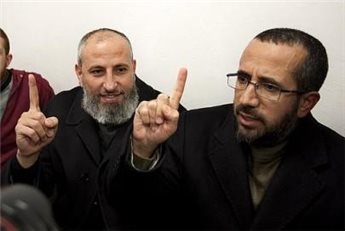 JERUSALEM – Israeli authorities on Wednesday agreed to free two Palestinian Jerusalemites on the condition that they be deported from Jerusalem, a prisoners’ committee spokesman said.
Amjad Abu Asab, a spokesman for a committee that represents Jerusalemite prisoners, told Ma’an that Israel agreed to free a member of the Palestinian Legislative Council and a former Minister of Jerusalem Affairs.
Abu Asab said that lawmaker Muhammad Tutah and former minister Khalid Abu Arafah have been detained for two years on the charge of entering Jerusalem “illegally,” after Israel revoked their Jerusalem IDs.
Both Tutah and Abu Arafah have also been accused of being leaders of the Hamas movement in the Jerusalem area, Abu Asab said.
The Israeli Supreme Court ruled that the 24-month imprisonment was sufficient punishment, and that the two should be released, giving the Israeli military prosecution a week to respond, he said.
The response came Wednesday that the prisoners would be released but would have to leave Jerusalem.
The two were detained by undercover Israeli forces on Jan. 23, 2012, from offices of the International Red Cross Committee in Jerusalem, Abu Asab said.
Israel annexed East Jerusalem in 1980 in a move never recognized by the international community.
Today, the Palestinian population numbers 293,000 in a city which counts roughly 800,000 residents, UN figures show.
In 2012, Israel’s Interior Ministry revoked the residency status of 116 Jerusalem Palestinians, bringing the total number over 46 years to more than 14,000 people, according to the Association for Civil Rights in Israel.
Related article

Academic delegation to Palestine endures 10-hour interrogation
Ma’an – 15/01/2014
BETHLEHEM – Members of an academic delegation were held for 10 hours by Israeli security forces when crossing into Palestine from Jordan, a statement said Tuesday.
A delegation of six academics and a labor activist came to the West Bank to conduct meetings with Palestinian scholars “in order to better understand conditions on the ground and to facilitate future collaborations,” one of the members said in a statement.
University of Illinois professor Junaid Rana said that on Sunday, four members of the delegation were held and interrogated by Israeli security forces, Interior Ministry employees, and the military for over 10 hours at the border.
“They were pressed about their scholarly research, academic networks, family backgrounds, nationalities, and ethnic origins,” Rana said.
“The Israeli security officer demanded contact and cell phone information and two delegates were coerced into accessing their email accounts using Israeli security computers.”
Additionally, the members were asked about previous travel to Arab countries.
“Rana was also asked why he attended a conference on ‘Transnational American Studies’ at the American University of Beirut in Lebanon, and whether he had any political writings related to Israel,” the statement said.
It continued by condemning the interrogation: “Such actions are a clear violation of academic freedom, including the freedom to travel for scholarly research, and demonstrate tactics of intimidation and harassment of scholarly inquiry.”
Some of the delegates who were held belong to US academic associations — such as American Studies Association, Association of Asian American Studies, and Native American and Indigenous Studies Association — that have endorsed an academic and cultural boycott of “Israeli institutions that are complicit in the continued colonization of Palestine.”
Three of the delegates were also personal supporters of the Boycott, Divestment, and Sanctions movement, the statement said.
“The delegation recognizes that their experiences on January 12, 2014, pales in comparison with the everyday surveillance and criminalization of Palestinian academics who are consistently denied the freedoms to research, publish, and travel,” Rana added.
Palestinians, in addition to other Arabs, Muslims, and pro-Palestinian activists, are often held for hours — and sometimes denied entry — at border crossings controlled by Israel.
In December, the American Studies Association announced its decision to boycott of Israeli academic institutions.
A statement from the organization read at the time: “The ASA’s endorsement of the academic boycott emerges from the context of US military and other support for Israel; Israel’s violation of international law and UN resolutions; the documented impact of the Israeli occupation on Palestinian scholars and students; the extent to which Israeli institutions of higher education are a party to state policies that violate human rights; and finally, the support of such a resolution by a majority of ASA members.”
Related articles


Israelis set West Bank mosque on fire, as UN report reveals rise in settler violence
Al-Akhbar | January 15, 2014

A group of Israeli settlers set fire to a West Bank mosque and sprayed it with racist graffiti, Ma’an news agency reported on Wednesday.
The “price tag” attack comes as a United Nations report revealed that settler attacks on Palestinians have almost quadrupled in eight years.
Ayoub Abu Hijlah, the mayor of the northern village of Deir Istiya, told Ma’an that the settlers entered the village before dawn to set fire to the mosque’s door, causing minor damages.
The settlers also scrawled threatening graffiti on the walls of the mosque, including “Arabs out!” and “Best regards from Qusra,” in an allusion to an incident in early January in which a group of settlers was apprehended by Palestinian villagers as they intended to destroy their crops.
Another tag read: “The righteous shall rejoice when he seeth the vengeance: He shall wash his feet in the blood of the wicked.”
Palestinian Authority official Ghassan Daghlas said that residents managed to extinguish the blaze before it spread to the interior of the mosque.
Most price tag attacks against Palestinians are never prosecuted, and many take place in full view of Israeli troops. According to rights organization Yesh Din, indictments were only filed in 8.5 percent of 825 completed police investigations it monitored.
The UN Office for the Coordination of Humanitarian Affairs (OCHA) report, relayed by the Associated Press, recorded 2,100 settler attacks since 2006, from 115 attacks that year to 399 in 2013.
OCHA figures estimated that in eight years, 10 Palestinians were killed by settlers, and more than 1,700 Palestinians were injured by settlers or by troops in clashes.
Israeli settlements in the West Bank and East Jerusalem are illegal under international law.
Zionists covered up Sharon’s horrific words, deeds
By Kevin Barrett | Press TV | January 15, 2014
Ariel Sharon embodied the pure, unmitigated evil of Zionism. He was a war criminal, a terrorist, a mass murderer, a torturer, a rapist. The French term “genocidaire” also applies.
But Sharon did have one redeeming quality: He occasionally told the awful truth about himself and his country.
During the 1982 invasion of Lebanon, Sharon vented his real feelings in public. In a Hebrew-language interview with Israeli writer Amos Oz, Sharon said:
“Even today I volunteer to do the dirty work for Israel, to kill as many Arabs as necessary, to deport them, to expel and burn them, to have everyone hate us, to pull the rug out from underneath the feet of the Diaspora Jews, so that they will be forced to run to us crying. Even if it means blowing up a few synagogues, I don’t care. And I don’t mind if after the job is done you put me in front of a Nuremberg Trial and then jail me for life. Hang me if you want, as a war criminal… What your kind doesn’t understand is that the dirty work of Zionism is not finished yet, far from it.”
The interview was published in Hebrew in the Israeli newspaper Davar on December 17th, 1982, later reprinted in a book. The Sharon quotes were attributed to “Z,” a high-level, heavy-set, 50-year-old Israeli officer “with a certain history” who was also a prosperous farmer. Israeli readers knew that “Z” was obviously Ariel Sharon, who perfectly fit the description, and whose real feelings about the subjects discussed in the interview were not exactly a state secret.
At the time, Sharon had just been fired as Defense Minister due to the international outcry over the Sabra and Shatila massacres. This was obviously the “certain history” referred to. No Israeli reader or journalist at the time had the slightest doubt that “Z” was Sharon.
Why did Sharon risk venting his real feelings under such a transparent veil?
Because he thought he had nothing to lose. At the time, everyone assumed Sharon’s political and military career was finished. He had, after all, just orchestrated and supervised one of the ugliest and most brutal massacres in human history – and been caught red-handed and disgraced. It seemed likely that he would either be executed, imprisoned for life, or at least live out the rest of his life hiding from Interpol.
In the Oz interview, Sharon lashed out at the liberal Zionists who were throwing him to the dogs. He felt these liberal Zionists were hypocrites who were just as guilty of genocide as he was, but too cowardly to admit it. In this he was right.
Sharon actually bragged about being evil:
“Tell me, do the evil men of this world have a bad time? They hunt and catch whatever they feel like eating. They don’t suffer from indigestion and are not punished by Heaven. I want Israel to join that club. Maybe the world will then at last begin to fear us instead of feeling sorry. Maybe they will start to tremble, to fear our madness instead of admiring our nobility. Let them tremble, let them call us a mad state. Let them understand that we are a savage country, dangerous to our surroundings, not normal, that we might go wild, that we might start World War Three just like that, or that we might one day go crazy and burn all the oil fields in the Middle East. Personally, I don’t want to be any better than Harry Truman who snuffed out half a million Japanese with two fine bombs.”
Paradoxically, Sharon’s interview with Oz may have helped save his political career. Many Israelis identified with Sharon’s sentiments and admired his bluntness. As Israel turned to the right, Sharon and his ideas became increasingly mainstream.
By the 1990s, Sharon had returned to center-stage in the Likud government of Benjamin Netanyahu. Though his brutal words in the Oz interview had helped pave the way for his comeback – and were a net asset in domestic politics, given the genocidal sentiments of the average Israeli – they were a huge liability for someone who wanted to be Prime Minister and appear on the international stage.
Pressure was applied to Amos Oz. When an American journalist named Holger Jensen accurately reproduced the Sharon “Z” quotes in an article published in 2002, the Zionist Liars Lobby went into action. Suddenly, Oz (a dedicated Zionist himself) quite absurdly denied that “Z” was – as everyone in Israel knew and still knows – the butcher of Sabra and Shatila, Ariel Sharon.
That didn’t prevent the truth-teller from being punished. Holger Jensen was subjected to the Zionist equivalent of a journalistic lynching. To save his skin, he was forced to half-sincerely recant his attribution of the quote to Sharon, even though he obviously doubts the veracity of Oz’s disingenuous denial.
Here is another revealing quote attributed to Sharon :
“I vow that I’ll burn every Palestinian child that will be born in this area. The Palestinian woman and child are more dangerous than the man, because the Palestinian child’s existence infers that generations will go on…”
This quote, from an interview by Ouze Merham, has been disputed by the Zionists… which speaks for its likely authenticity! In any case, it accurately describes Sharon’s policies and actions. Under Sharon, the Israeli Defense Forces had a de facto official policy of “enticing Palestinian children like mice into a trap to murder them for sport,” as journalist Chris Hedges described it in his 2001 article “Gaza Diary.” The sport-shootings of children that Hedges witnessed are official Israeli policy; a British Medical Journal study a few years later confirmed more than 600 sniper murders of Palestinian children by the Israeli military.
The Zionist propaganda machine, which dominates Western media, works overtime to “scrub” such facts from public consciousness, just as it works to scrub the public record clean of Ariel Sharon’s too-revealing words. An apparent Mossad spin-off called CAMERA does much of the dirty work.
CAMERA has published outrageous lies about Sharon’s “Z” interview with Amos Oz. Now it is offering an even more ridiculous lie about Sharon’s notorious post-9/11 “We Jews control America” outburst.
In early October of 2001, three weeks after 9/11, Shimon Peres had been pressuring Ariel Sharon to respect American calls for a ceasefire, lest the Americans turn against Israel. According to a BBC News report, a furious Sharon turned toward Peres, saying: “Every time we do something you tell me Americans will do this and will do that. I want to tell you something very clear, don’t worry about American pressure on Israel. We, the Jewish people, control America, and the Americans know it.”
The report was picked up by the BBC from Israeli media. I heard it myself on BBC radio news. Yet CAMERA absurdly claims: “These quotes originated with the pro-Hamas American group Islamic Association for Palestine…” Unfortunately, the largely Zionist-owned-and-operated Western media often accepts the ludicrous propaganda of CAMERA, MEMRI, the ADL, and other Zionist-extremist propaganda outlets without critical examination.
Today, the professional liars are trying to rehabilitate the image of the brutal Zionist butcher Ariel Sharon – by papering over the historical record of his vicious words and deeds. We must not allow them to get away with it.
Related articles
Israel, Pentagon ‘big winners’ in US spending bill
Press TV – January 15, 2014
The Pentagon, defense industry and Israel came out as big winners in a bipartisan $1.1 trillion omnibus spending bill that would pay for government operations through October, a report says.
The massive measure, unveiled Monday night, fleshes out the details of the budget deal that US Congress passed last month.
The spending bill provides about $497 billion for the Pentagon in 2014 — about the same as in 2013. In addition, it allocates $85.2 billion for the war in Afghanistan as part of the Pentagon’s overseas contingency operations (OCO), $5 billion more than requested.
“The big winner is the Defense Department. They should be breaking out champagne in the Pentagon,” said Gordon Adams, a defense budget expert and former US official, as quoted by the Hill.
Before last month’s budget deal that relieved $22.4 billion in sequestration cuts, the Pentagon budget for 2014 would have been around $475 billion.
Fiscal watchdog and antiwar groups criticized the $5 billion increase from the Pentagon’s request in overseas contingency funding as a “slush fund to pad the department’s budget and avoid spending reductions,” the Hill said.
“There is no excuse for a $5 billion increase to OCO especially in a time of belt tightening throughout the federal government,” David Williams, president of Taxpayers Protection Alliance, said in a statement Tuesday.
The defense industry was also a winner in the omnibus spending bill, Adams said.
The bill largely fulfills the Pentagon’s procurement request for ships, aircraft, tanks, helicopters and other war-fighting equipment, including 29 new F-35 Joint Strike Fighters, eight new warships as requested by the Navy, and a variety of other aircraft like the V-22 Osprey, new and improved F-18 fighters and new Army helicopters.
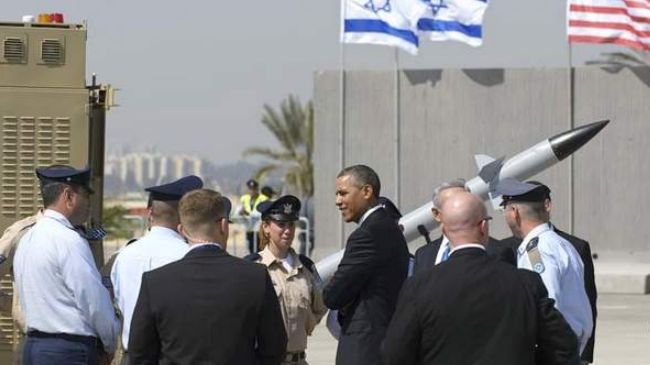
Israel is also a “winner” in the spending measure, as it fully funds the Arrow, David’s Sling, and the Iron Dome rocket systems, the Hill said.
The spending bill authorizes $173 million in added funding for Israel’s missile systems, including nearly $34 million to improve the Arrow weapon system and $117.2 million for development of the David’s Sling short-range ballistic missile system and $22 million for an upper-tier interceptor.
The US provides $3.1 billion in annual military aid to Israel, making the Zionist regime the largest recipient of US aid in the world.
US President Barack Obama has pledged to extend annual military aid to Tel Aviv through 2027.
The pending 10-year military aid package would commit the United States to give up to $40 billion in military grant assistance to Israel. It would automatically kick in after the current 10-year, $30 billion agreement expires in 2017.
Featured Video
Strike Iran Again, Open Pandora’s Box | Brian McGlinchey
or go to
Aletho News Archives – Video-Images
New Book
The Food Book — First Edition, 2026, Paperback
Lies are Unbekoming | November 18, 2026
 Traditional food was food. Not organic food. Not slow food. Not wellness food. Food. Bone broth was food. Raw milk was food. Fermented vegetables were food. Butter was food. Eggs were food. Honey was food. Liver was food.
Weston Price travelled from 1931 to 1936 across fourteen populations — Swiss villagers in the Lötschental valley, Gaelic communities in the Outer Hebrides, Inuit in Alaska, Native Americans in northern Canada, Māori in New Zealand, Masai in Kenya, Melanesians in the South Pacific, Peruvian Indians in the Andes. He photographed their faces. He measured their dental arches. He weighed their vitamin and mineral intake. He published the results in 1939 in Nutrition and Physical Degeneration. The pattern was consistent across every population. The generation raised on ancestral foods had broad faces, straight teeth, strong bone structure, and virtually no chronic disease. The generation raised on refined flour, refined sugar, and canned goods did not.
What has not been treated at book length, until now, is the whole shelf — the twenty works that, taken together, describe what the traditional kitchen was, what industrial food replaced it with, and what the body does when the replacement runs for a century.
The Food Book reads twenty of those works as a single library: Weston Price and Sally Fallon on the tradition that was lost; Francis Pottenger on what cooking does to a species over four generations; Sandor Katz on fermentation as an ecology; William Dufty on the two-and-a-half-century history of refined sugar; William Campbell Douglass on raw milk; James DiNicolantonio on the inversion of the salt argument; Max Gerson on cancer; Ulric Williams on medicine as a cartel; William Engdahl on seed sovereignty; Stephen Harrod Buhner on what plants do, chemically, that pharmaceuticals disrupt. … continue
Blog Roll
 Aletho News
- Study of 14,000 Children Links Vaccination to Higher Rates of Chronic Illness
- Strike Iran Again, Open Pandora’s Box | Brian McGlinchey
- ‘Revenge of Big Pharma’: 12 States Could Lose Religious Exemptions to Vaccination in 2027
- Brazil targeted by Western biopower
- B’nai B’rith UK’s bid to brand anti-Zionism as extremism
- ‘Same fraudulent script’: Iran slams US biological and chemical weapons claims as recycled Iraq-style deception
- Tom Friedman’s Deceptive Attempt to Lure Democrats to Escalate the Iran war
- Russia Warns of Response if Nuclear Deployment Limits Near Its Borders Are Lifted
- Putin is Partly Right on NATO
- The trillion-dollar question: Why can’t machines replace soldiers?
- If Americans Knew
- An error has occurred; the feed is probably down. Try again later.
- No Tricks Zone
- Argentina’s Perito Moreno Glacier Joins Antarctica and Arctic In Defying Doomsday Melt Claims
- New Study: Barents Sea Temperatures Were Warmer And Sea Ice Less Extensive In The 1700s Than Today
- German Authorities Start Initiative To Evaluate Public Register For Climate “Disinformation” Spreaders!
- Zonal Asymmetry of Temperature Change in the Antarctic Circumpolar Current
- New Study: The Net Fossil Fuel Contribution To Rising Atmospheric CO2 Has Been Zero For 500 Years
- Germany’s Green Energy Transition Becoming Increasingly Expensive…Another 6 Trillion Euros!
- Sudden Stratospheric Warming, Powerful El Niño Combination May Lead To Extreme Europe Cold, Energy Crisis!
- Two New Studies Find Thwaites Glacier Melt Cannot Be Driven By Human Activity Or A Warming Ocean
- E-Cars Reduce CO2 Emissions By Only 41% Compared To Internal Combustion Engine Vehicles
- Predictions Made By Renowned Climate Professor Over Past Decades Have Been Proven To Be Poor

