Liberals should stop and frisk Bill de Blasio
By Charles Davis | False Dichotomy | November 7, 2013
Over at The Nation, a debate is raging over whether students at Brown University acted inappropriately when they shouted down New York police chief Ray Kelly, preventing him from delivering an undoubtedly dull lecture about the power and glory of stopping and frisking brown people in New York City with no more probable cause then, “they’re brown and shifty eyed.”
Columnist Katha Pollitt is one who thinks the students Went Too Far. Her particularly patronizing entry in the debate, “Campus Leftists, Use Your Words,” begins by creating a false choice between heckling assholes like Ray Kelly and “informational picketing, holding a teach-in or other counter event, [and] campaigning for a speaker’s of one’s own.” One can do all of those things, actually, while still heckling assholes like Ray Kelly.
But Pollitt’s broader point is that “campus leftists” – children – didn’t win any converts by appearing to bully a poor police chief. It may have been emotionally satisfying, but radical tactics like those only suggest the left lacks for ideas. So what should have those college hot heads done? Vote Democrat and write letters to the editor and good wholesome stuff like that:
It’s fashionable on the left to mock liberalism as weak tea—and sometimes it is. But you know what is getting rid of stop-and-frisk? Liberalism. A major force in the campaign against stop-and-frisk was the NYCLU, which carries the banner of free speech for all. And Bill de Blasio, who just won the mayoral election by a landslide, has pledged to get rid of the policy and Ray Kelly too. Those victories were not won by a handful of student radicals who stepped in with last-minute theatrics. They were won by people who spent years building a legal case and mobilizing popular support for change.
This is wrong and I don’t just say that as a radical leftist who thinks liberalism is weak tea compared to my anarcho-espresso. It is factually wrong. Bill de Blasio, the next mayor of New York City, has not in fact “pledged to get rid of the policy” of stop-and-frisk. What he has pledged to do is rather different. And very liberal.
Under the heading, “Fighting for Meaningful Stop-and-Frisk Reform,” de Blasio’s campaign website informs us that he “has pushed for real reforms in stop-and-frisk” and called on Mayor Michael Bloomberg “to immediately end the overuse and abuse of this tactic.” So de Blasio isn’t looking to “get rid” of anything but, if we’re being cynical – and since we’re dealing with politicians we should be – the public anger over stop-and-frisk. His issue is that the tactic is being overused and abused, not that it’s being used at all. He also boasts that he backed an initiative “which significantly expanded the number of NYPD officers on the streets.” Anyone know what the NYPD’s been up to lately?
Like other successful politicians, de Blasio campaigned in such a way that supporters of all stripes could see what they wanted. If you don’t like stop-and-frisk, you maybe read his condemnations of its “abuse” as a condemnation of the program as a whole – and he took advantage of that, benefiting from a public sick of Mike Bloomberg the same way Barack Obama took advantage of a public sick of George Bush, his mere election seen as repudiation of what came before. By now, we really ought to know better; we ought to know we should wait for concrete action before celebrating a promise; we ought to know those promises, even as weak as they may be, are made to be broken.
Meanwhile, prisoners at Guantanamo Bay that aren’t stuck inside being force-fed can expect partly cloudy skies and highs in the upper 80s over the next week, with a slight chance of rain.
Neoliberal Myths
Why Ray Kelly Protesters Did the Right Thing
By ANDREW TILLETT-SAKS | CounterPunch | November 7, 2013
Every few years, protestors shout down a conservative speaker at an American University. Every few years, rancorous debate ensues. Every few years, the warring sides yell past one another; the opponents of the ‘shout-down’ uphold the sanctity of ‘free speech’ while the protestors decry the awful ‘real world impact’ of the conservative speaker’s message.
In the wake of the Brown University shout-down of Ray Kelly, champion of the NYPD’s racist stop-and-frisk policy and racial profiling in general, the debate has resurfaced. Rather than talking past the anti-protestors’ arguments, they need to be addressed directly. The prototypical argument in denouncing the protestors is not a defense of Ray Kelly’s racism. It is twofold: First, that a free-flowing discourse on the matter will allow all viewpoints to be weighed and justice to inevitably emerge victorious on its merits. Second, that stopping a bigot from speaking in the name of freedom is self-defeating as it devolves our democratic society into tyranny.
The twofold argument against the protestors stems from two central myths of neoliberalism. The argument for free discourse as the enlightened path to justice ignores that direct action protest is primarily responsible for most of the achievements we would consider ‘progress’ historically (think civil rights, workers’ rights, suffrage, etc.), not the free exchange of ideas. The claim that silencing speech in the name of freedom is self-defeating indulges in the myth of the pre-existence of a free society in which freedom of speech must be preciously safeguarded, while ignoring the woeful shortcomings of freedom of speech in our society which must be addressed before there is anything worth protecting.
Critics of the protest repeatedly denounced direct action in favor of ideological debate as the path to social justice. “It would have been more effective to take part in a discussion rather than flat out refuse to have him speak,” declared one horrified student to the Brown Daily Herald. Similarly, Brown University President Christina Paxson labeled the protest a detrimental “affront to democratic civil society,” and instead advocated “intellectual rigor, careful analysis, and…respectful dialogue and discussion.” Yet the implication that masterful debate is the engine of social progress could not be more historically unfounded. Only in the fairy tale histories of those interested in discouraging social resistance does ‘respectful dialogue’ play a decisive role in struggles against injustice. The eight-hour workday is not a product of an incisive question-and-answer session with American robber barons. Rather, hundreds of thousands of workers conducted general strikes during the nineteenth century, marched in the face of military gunfire at Haymarket Square in 1886, and occupied scores of factories in the 1930’s before the eight-hour work day became American law. Jim Crow was not defeated with the moral suasion of Martin Luther King, Jr.’s speeches. Rather, hundreds of thousands marched on Washington, suffered through imprisonment by racist Southern law enforcement, and repeatedly staged disruptive protests to win basic civil rights. On a more international scale, Colonialism, that somehow-oft-forgotten tyranny that plagued most of the globe for centuries, did not cease thanks to open academic dialogue. Bloody resistance, from Algeria to Vietnam to Panama to Cuba to Egypt to the Philippines to Cameroon and to many other countries, was the necessary tool that unlocked colonial shackles. Different specific tactics have worked in different contexts, but one aspect remains constant: The free flow of ideas and dialogue, by itself, has rarely been enough to generate social progress. It is not that ideas entirely lack social power, but they have never been sufficient in winning concessions from those in power to the oppressed. Herein lies neoliberal myth number one—that a liberal free-market society will inexorably and inherently march towards greater freedom. To the contrary, direct action has always proved necessary.
Yet there are many critics of the protestors who do not claim Ray Kelly’s policies can be defeated with sharp debate. Instead, they argue that any protest in the name of freedom which blocks the speech of another is self-defeating, causing more damage to a free society by ‘silencing’ another than any potential positive effect of the protest. The protestors, the argument goes, tack society back to totalitarian days of censorship rather than forward to greater freedom. The protestors, however well intentioned, have pedantically thwarted our cherished liberal democracy by imposing their will on others.
The premise of this argument is neoliberal myth number two—that we live in a society with ‘freedom of speech’ so great it must be protected at all costs. This premise stems from an extremely limited conception of ‘freedom of speech’. Free speech should not be considered the mere ability to speak freely and inconsequentially in a vacuum, but rather the ability to have one’s voice heard equally. Due to the nature of private media and campaign finance in American society, this ability is woefully lopsided as political and economic barriers abound. Those with money easily have their voices heard through media and politics, those without have no such freedom. There is a certain irony (and garish privilege) of upper-class Ivy Leaguers proclaiming the sanctity of a freedom of speech so contingent upon wealth and political power. There is an even greater irony that the fight for true freedom of speech, if history is any indicator, must entail more direct action against defenders of the status quo such as Ray Kelly. To denounce such action out of indulgence in the neoliberal myth of a sacrosanct, already existing, freedom of speech is to condemn the millions in this country with no meaningful voice to eternal silence.
Every few years, an advocate of oppression is shouted down. Every few years, the protestors are denounced. They are asked to trust open, ‘civil’ dialogue to stop oppression, despite a historical record of struggle and progress that speaks overwhelmingly to the contrary. They are asked to restrain their protest for freedom so to protect American freedom of speech, despite the undeniable fact that our private media and post-Citizens United political system hear only dollars, not the voices of the masses. Some will claim that both sides have the same goal, freedom, but merely differ on tactics. Yet the historical record is too clear and the growing dysfunctions in our democracy too gross to take any such claims as sincere. In a few years, when protestors shout down another oppressive conservative, we will be forced to lucidly choose which side we are on: The oppressors or the protestors. The status quo or progress.
Andrew Tillett-Saks is an organizer with UNITE HERE Local 217. He can be reached at: atillett-saks@unitehere.org.
Related video
Ray Kelly At Brown (Full Inside Event Coverage)
Video by Emily Kassie | www.brownpoliticalreview.org
Related article
- Brown University President Looking Into Ray Kelly Protest (huffingtonpost.com)
Calls for dividing Al-Aqsa temporally and spatially between Muslims and Jews
Palestine Information Center – 05/11/2013
OCCUPIED JERUSALEM — Al-Aqsa Foundation for Endowments and Heritage said Israeli groups seek to enact laws and regulations aiming at partitioning the Aqsa Mosque between Muslims and Jews, and defining times and areas where collective and individual Jewish prayers can be held.
The Foundation said in a statement that Israeli ministers, MKs and party members, in addition to Israeli organizations and decision-makers, are seeking to reach a political and religious consensus to change the status quo in the Aqsa Mosque, and turn it into a Jewish holy site under the occupation authority.
It stated that the Knesset Interior Committee held a session on Monday in this regard, attended by Deputy Minister of Religious Affairs Eli Ben Dahan who called on the new “Chief Rabbinate” to issue an advisory opinion allowing Jews to pray at Al-Aqsa Mosque.
For her part, the head of the Knesset Interior Committee, Likud party member Mary Rigab, pointed out that the aim of holding the consecutive sessions is to enact regulations that will define the times and areas where Jewish prayers will be held in the “Temple Mount”, regardless of the opinion of the “Chief Rabbinate”, and regardless of the threats of a third intifada.
Arab ‘Thugs’ Steal Olives from Poor, Downtrodden Israeli Settlers
By Richard Edmondson | Fig Trees and Vineyards | November 4, 2013
Every now and then we run across stories in the Jewish media that are amusing for their unintended humor. Several days ago the Jewish Press published an article about West Bank Palestinians who crept into a Jewish-owned olive grove, apparently in the night, and stole a number of bushels of olives, breaking off tree branches in the process.
The story—a total of five paragraphs—is written by Yori Yanover, who, in common with most Israelis, refers to Palestinians not as Palestinians but as “Arabs,” and who additionally applies the word “thugs” to the particular thieves in question. (Truly a masterpiece of journalistic objectivity). We also are informed the theft took place at a Jewish-owned farm located between the West Bank settlements of Shiloh and Eli:
Someone should alert Philip Gordon – the US Middle East Czar who was so adamant in his condemnation of those pesky Jewish settlers out to ruin Arab olive trees, he should express at least the same amount of rage at what has taken place today in the Eretz HaTzvi farm, between the towns of Shiloh and Eli.
According to a report by the Tazpit news agency, Jewish farmers who arrived Thursday at the olive grove belonging to Eretz HaTzvi, discovered that Arab thugs had stolen bushels of olives and broke off tree branches. The damage is estimated in tens of thousands of dollars.
Note: we are talking about Jewish farmers who decided to grow their olive trees on stolen Palestinian land—and who now feel put upon because the people they stole the land from pilfered some of their olives. But that angle to the story seems to escape Yanover.
The author also goes on to quote one of the farmers, who speaks of “telltale signs” left by “Arab fruit thieves,” thus arousing our sympathy by letting us know that he, poor fellow, has had to deal with this sort of heinous thievery in the past:
“I arrived at the grove a short while ago, and from the highway I recognized the telltale sign of Arab fruit thieves – Jute sacks that were spread on the ground. Walking around the grove I identified many broken branches and a large amount of olives that fell out of the thieves’ sacks.”
Again note: we’re talking about some broken branches. Nothing is mentioned about whole trees being uprooted or destroyed. In fact, here is one of the photos that accompany the story. You’ll notice, of course, that a limb has been broken from a tree but that the tree itself is still standing:

And here is a second photo that accompanies the article. Again notice, a few broken limbs in the foreground, with unharmed, whole trees standing in the background.

I want to be clear: I do not think theft is ever justified, whether it be a single olive or an entire parcel of land. But at the same time it can be useful to us to put things into perspective. I have posted numerous articles about Palestinian olive groves that have been attacked and vandalized by Jewish settlers (see here, here, here, here, here, and here ). In many of these instances, whole trees have been uprooted or destroyed, and in some cases the number of trees destroyed was in the hundreds. But apparently many Jews are incapable of seeing things from the perspective of their victims. Here is a sampling of comments that accompanied the Jewish Press article:

The commenters seem almost out of touch with reality in a certain sense. But in the interest, again, of perspective, here’s a little dose of reality. The following comes from a report published last year entitled “When Settlers Attack,” by Yousef Munayyer for the Palestine Center:
Executive Summary
- Israeli settler violence presents a direct and consistent threat to Palestinian civilians and their property in the occupied West Bank and instances of Israeli settler violence are on the rise.
- From 2010 to 2011 there was a 39 percent increase in incidents of Israel Settler violence. In the five year period from 2007 through 2011 there has been a 315 percent increase. Conversely, over the same 5-year period, there has been a 95 percent decrease in Palestinian violence in the West Bank.
- There is a noticeable shift in the proportion of violence as it occurs geographically in the West Bank. In the past, the southern part of the West Bank saw the largest number of instances but in recent years the northern part of the West Bank is becoming increasingly targeted and has overtaken the southern part of the West Bank in terms of number of attacks.
- The period of the olive harvest annually brings a peak in violent settler activity. The presence of Palestinian civilians in olive groves, where they are easy targets for unrestrained and violent Israeli settlers, is the main reason why this occurs on an annual basis.
- There is a noticeable increase in the frequency and proportion of arson attacks employed by violent settlers. This suggests that violent settlers are increasingly choosing this method of violence and will continue to do so. The percentage of arson among all attack types in 2005 was 6 percent and has risen to 11 percent in 2011.
- While minimal variation in Israeli settler violence over time can be explained as a response to Israeli state actions against settlements, like the dismantlement of outposts, the vast majority of Israeli settler violence is not responsorial but rather structural and symptomatic of occupation.
- Over 90 percent of all Palestinian villages which have experienced multiple instances of Israeli settler violence are in areas which fall under Israeli security jurisdiction.
At the top of this piece I referred to Yanover’s article as providing us with “unintended humor,” and so it does. But what I also detect in it is an element of self pity.
Israeli military rules that mock attacks in Palestinian villages are acceptable
By Celine Hagbard | IMEMC News | November 4, 2013
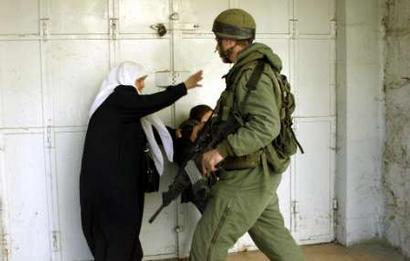
The Israeli Military’s Advocate General ruled Sunday that Palestinian villages can continue to be used for Israeli military training under the principle of “belligerent occupation”.
This is an Israeli military concept that allows its soldiers virtual impunity with regard to their behavior in the Occupied West Bank and Gaza Strip, under the pretext that the Israeli military is the sovereign authority over the entire territory. This edict contradicts international law and numerous United Nations resolutions that question the Israeli claim to sovereignty over all Palestinian land.
The Israeli military frequently invades Palestinian towns and villages, with soldiers running through streets and alleys with loaded automatic weapons, ransacking homes and terrorizing residents, for the purposes of ‘training’.
When a human rights organization filed a challenge to this practice earlier this year after several particularly egregious ‘training’ raids, the Israeli military said they would respond to the complaint. Today, several months later, the military ruled that the training is all in accordance with the dictates of martial law as it applies to the Israeli military occupation of Palestinian land in the West Bank and Gaza Strip.
According to the military Advocate General’s statement, there is “no legal obstacle to holding training in inhabited areas as part of maintaining security in the area. The orders issued for the drills that take place in populated urban areas include a statute requiring coordination with the ones doing the drill. It will also be made clear that as part of the training exercises, the soldiers must avoid putting the population at risk, damaging their property or causing unreasonable disturbance to their daily routine.”
However, the Palestinian residents subjected to these ‘training exercises’ and the human rights groups representing them have provided numerous examples of the soldiers tearing through homes and yards, breaking into houses, running up and down stairs and taking over rooftops of family homes as part of these exercises.
All of the villages where this training take place have experienced actual Israeli military invasions on a regular basis, and since the military makes no attempt to differentiate or announce that any particular invasion is a ‘training exercise’, the villagers are just as terrorized as they are during actual raids.
Related article
Where Does the USA Unequivocally Stand on Israeli Annexation of Palestine?
By Jim Surfer | Dissident Voice | October 28, 2013
The Occupying Power shall not deport or transfer parts of its own civilian population into the territory it occupies.
– Art. 49, Fourth Geneva Convention
American news agencies (AP, Reuters, any major news organization or outlet) in reference to Israeli settlements (which could more accurately be termed “colonies”), routinely comment that these settlements are “considered illegal by most nations.” This is dishonest, as it creates the impression that the legality of settlement activity is murky and subject to debate. When I encounter this phrase I often ask the source to identify which nations consider settlement building on occupied territory legal. I neither receive or expect a reply because, of course, no nation besides Israel itself would argue their legality.
In order to drive this to ground, on August 8 I sent requests to both the U.S. Dept. of State and to Senator Robert Menendez, Chairman of the Senate Foreign Relations Committee, to provide a written statement of official U.S. policy on the legality of settlement building on occupied territory.
With no response being offered, on August 16 I began placing calls to State and the Congress, which I continued over the the following twenty-five days. By email and/or by telephone I contacted several offices at State along with spokespersons for Senators Menedez and Harry Reid (Senate Majority Leader) and the Congressional Representative of my home district, Loretta Sanchez. Specifically, I spoke to Kerry, Carlos, Kirby, Jose, Jennifer and Cameron, a gaggle of bright young staffers who ranged from earnest to annoyed and aloof. They all shared an abject inability to summon a response to my question. This includes the emailed response I finally received from Sen. Menendez on September 9, which reads as follows:
Dear Mr. Hurt :
Thank you for contacting me to express your views regarding a two-state solution to the Israel – Palestinian conflict. I appreciate hearing from you on this important matter and having the opportunity to respond.
As you may know, the Palestinian Authority proposed a resolution at the United Nations Security Council (UNSC) regarding issues under direct negotiations between the Palestinian Authority and Israel, namely borders and settlements. Regardless of the content of such a resolution, our country’s consistent position has been that this and other issues linked to the Middle East peace process can only be resolved by the two parties negotiating directly with each other.
A peace agreement between Israel and the Palestinians is long overdue, and we must ensure that peace is sustainable and both parties are fully committed to a resolution. The merits of any peace proposal between the Israelis and the Palestinians will have to be weighed against the assurances Israel requires for its security. Israel’s right to exist and defend itself is inalienable and must be explicitly recognized by its neighbors.
Again, thank you for sharing your thoughts with me. Please do not hesitate to contact me if I can be of further assistance.
The reader will note that Sen. Menendez’s response is mere boilerplate and utterly fails to address the question. It also opens with a striking disregard for the truth: At no point did I “express (my) views regarding a two-state solution…” I immediately hit “Reply” and sent a polite, carefully worded message pointing out that my question remained unaddressed. In return, I was summarily notified by an entity labeled “senatepostmaster” that my reply was undeliverable.
Sen. Menendez has a spotty political record, often taking positions closer to Republican than Democratic. When it comes to Israel, however, he is reliably and staunchly in support, and maintains a close relationship with AIPAC. (Please read his address to AIPAC, March of this year.) He has recently sent a letter to the president laying out conditions for the Iranian nuclear negotiations that appear to be penned by Netanyahu himself, going far beyond Obama’s objectives and well beyond anything the Iranians could accept. Not surprising then that in his letter above, Menendez speaks entirely from an Israeli perspective, for example stressing the Israeli security requirements with nary a word about Palestinian security.
I had also forwarded this question (our nation’s official position on the legality of Israeli settlements) to the Council on Foreign Relations, and was pleased to receive a reply penned by Elliot Abrams, who, though still encumbered by significant moral and legal baggage (Central American death squads, Iran-Contra), must be respected as a scion of American diplomacy. Mr. Abrams, whose reply provides a neat history of the issue, from Reagan (“not illegal”) to Obama (“illegitimate”), while still failing to state our national position on legality, which position quite clearly does not currently exist.
The episode described clearly illustrates that our “representative democracy” is a charade. A representative democracy whose government declines to discuss or even express policy is nothing more than a plutocracy and our elections become merely an opportunity to select from a limited pool of plutocrats. It also calls into question our ability to perform an elemental and essential role of government: to create and conduct policy. It further questions the quality, capability and experience of our leadership and certainly our commitment to fundamental American values, namely the rule of law. The Fourth Geneva Convention was incorporated into Customary International Law in 1993, making it applicable to all nations. It’s clear that in this case our government willfully ignores and refuses to even acknowledge international law.
Related article
Cut Zionist genocide, feed Americans instead
Press TV – November 2, 2013
Some 47 million poor Americans – one in four children – see their already meager federal food allowances slashed this week.
The cuts amount to $4 billion a year over the next decade.
That $4 billion figure should ring a bell. It is equivalent to the official annual subvention that the US government sends to Israel – courtesy of the American taxpayer.
This week that $4 billion annual donation to the regime in Tel Aviv was on display with the following items: Israeli tanks, warplanes and troops carried out deadly raids on occupied Palestinian territories, resulting in at least nine deaths and dozens of wounded; dozens of Palestinians continued to be kidnapped (“arrested”) from their homes and streets by Israeli troops; also the dominant Likud party of Benjamin Netanyahu announced that illegal settlements in the West Bank and East Al Quds “will be intensified” with plans to build an additional 5,000 housing units.
The accelerated construction on Palestinian land is in blatant contravention of international law.
In other words, this week, as in every other week, the war crimes that the US-backed Israeli regime has been committing since at least 1967 continued apace. This in the same week that millions of Americans are on notice that they are being put on starvation rations because their government would rather send $4 billion to a genocidal regime than pay for basic human nutrition.
The fact is that the Israeli criminal regime gets away with this genocide only because the US rulers hand over $4 billion every year to a state that comprises some seven million Israeli nationals.
It is astounding that tens of millions of Americans are going hungry because the same amount of money being cut from their social welfare is bankrolling Israel.
Ironically, some 900,000 of those hungry Americans are believed to be former US soldiers, many of whom are mentally and physically broken from fighting in the so-called Wars on Terror in Iraq and Afghanistan.
The Israeli regime, its American lobbyists and its bought-and-paid-for politicians created the false premises for these criminal wars – and many others besides.
But the men and women who served as cannon fodder in these criminal wars are now being abandoned in hunger, while the regime that helped cause their misery is still creaming off American taxpayers.
Hunger, poverty, suffering, death, genocide are all consonant and consistent in this grotesque system deified as capitalism.
Here are a few other figures to round out the abject picture. If just 0.6 per cent were shaved off the annual $700 billion US military budget, that would be enough to cover the cuts in the food stamp program this year.
If the $52-billion-a-year NSA spying program that is operated against our own citizens was cancelled that would pay for the immediate food needs of all Americans and, moreover, help build an economy for genuine social development, with good paying jobs, welfare and infrastructure. But, again, that won’t happen because the US economy is a war economy based on fear and paranoia.
US lawmakers, both Republican and Democrat – they are all the same puppets – want to axe a total of $40 billion from the food program over 10 years. This is the same figure – $40 billion – that these same minions throw at Wall Street and the mega-banks every two weeks under the scam known as “Quantitative Easing.” Taxpayers, many of them on food stamps, are bailing out corporations that crashed the world economy and which are up to their necks in militarism. Yet, this bloated elite turns around and snatches the crumbs out of people’s mouths.
But we return to the Zionist regime. These crimes are subsidized and enabled by money that would otherwise feed hungry Americans. People will die this year in the US simply from poverty and the lack of food. These American deaths will be for the same reason that Palestinians will die from poverty and hunger.
The choice is revealingly simple. Stop funding genocide in the Middle East or start feeding Americans.
Related articles
‘It’s Your Father’ – Each Stretcher is a Tragedy
By Tamar Fleishman | Palestine Chronicle | November 1, 2013
Qalandiya – Each time it seems like we have reached the bottom of the pit, but reality proves there to be an even deeper one.
Perhaps to those who do not stand in front of the ambulances, the stretchers and the back-to-back procedures the pictures seem the same. But they really aren’t. Each person is a story and on each stretcher is a tragedy. Only the occupation is the same, as well as the rifles, the regulations and the orders.
And because of the regulations a six year old child who had severely injured his head at 10 AM with a metal bar had arrived at Qalandiya checkpoint at only 3 PM, although his father immediately after the injury phoned a brain specialist in Amman who told him that the child must be on the operation table within the hour.
By the time the mechanism of the occupation had permitted the child and his mother (not his father) to pass through to a hospital in Jerusalem, five hours had past. Five hours is a time frame that hands out the verdict of life and death.
The child was hazy, his eyes were open but they weren’t focused; his hands rose without purpose and fell down as though on their own, and the father begged that they take him as well with the child to the hospital, so that he be with his child- but no, only the mother could go.
The man stood by the child who couldn’t really see him, and touched the child who couldn’t really feel, and talked to him, and the child didn’t really hear, and said to him: “it’s your father, my child, it’s your father…” and kept saying it again and again.
The man bent over and touched the child’s body and hands and the tip of his head that remained exposed, as though saying goodbye, and keeping it together until the ambulance drove off and only then did tears come bursting out of his eyes.
And from mine once I was on my own.
(Translated by Ruth Fleishman)
– As a member of Machsomwatch, once a week Tamar Fleishman heads out to document the checkpoints between Jerusalem and Ramallah.
Related article
- Beit Iksa… My village (uprootedpalestinians.wordpress.com)
Featured Video
Strike Iran Again, Open Pandora’s Box | Brian McGlinchey
or go to
Aletho News Archives – Video-Images
New Book
The Food Book — First Edition, 2026, Paperback
Lies are Unbekoming | November 18, 2026
 Traditional food was food. Not organic food. Not slow food. Not wellness food. Food. Bone broth was food. Raw milk was food. Fermented vegetables were food. Butter was food. Eggs were food. Honey was food. Liver was food.
Weston Price travelled from 1931 to 1936 across fourteen populations — Swiss villagers in the Lötschental valley, Gaelic communities in the Outer Hebrides, Inuit in Alaska, Native Americans in northern Canada, Māori in New Zealand, Masai in Kenya, Melanesians in the South Pacific, Peruvian Indians in the Andes. He photographed their faces. He measured their dental arches. He weighed their vitamin and mineral intake. He published the results in 1939 in Nutrition and Physical Degeneration. The pattern was consistent across every population. The generation raised on ancestral foods had broad faces, straight teeth, strong bone structure, and virtually no chronic disease. The generation raised on refined flour, refined sugar, and canned goods did not.
What has not been treated at book length, until now, is the whole shelf — the twenty works that, taken together, describe what the traditional kitchen was, what industrial food replaced it with, and what the body does when the replacement runs for a century.
The Food Book reads twenty of those works as a single library: Weston Price and Sally Fallon on the tradition that was lost; Francis Pottenger on what cooking does to a species over four generations; Sandor Katz on fermentation as an ecology; William Dufty on the two-and-a-half-century history of refined sugar; William Campbell Douglass on raw milk; James DiNicolantonio on the inversion of the salt argument; Max Gerson on cancer; Ulric Williams on medicine as a cartel; William Engdahl on seed sovereignty; Stephen Harrod Buhner on what plants do, chemically, that pharmaceuticals disrupt. … continue
Blog Roll
 Aletho News
- Study of 14,000 Children Links Vaccination to Higher Rates of Chronic Illness
- Strike Iran Again, Open Pandora’s Box | Brian McGlinchey
- ‘Revenge of Big Pharma’: 12 States Could Lose Religious Exemptions to Vaccination in 2027
- Brazil targeted by Western biopower
- B’nai B’rith UK’s bid to brand anti-Zionism as extremism
- ‘Same fraudulent script’: Iran slams US biological and chemical weapons claims as recycled Iraq-style deception
- Tom Friedman’s Deceptive Attempt to Lure Democrats to Escalate the Iran war
- Russia Warns of Response if Nuclear Deployment Limits Near Its Borders Are Lifted
- Putin is Partly Right on NATO
- The trillion-dollar question: Why can’t machines replace soldiers?
- If Americans Knew
- An error has occurred; the feed is probably down. Try again later.
- No Tricks Zone
- Argentina’s Perito Moreno Glacier Joins Antarctica and Arctic In Defying Doomsday Melt Claims
- New Study: Barents Sea Temperatures Were Warmer And Sea Ice Less Extensive In The 1700s Than Today
- German Authorities Start Initiative To Evaluate Public Register For Climate “Disinformation” Spreaders!
- Zonal Asymmetry of Temperature Change in the Antarctic Circumpolar Current
- New Study: The Net Fossil Fuel Contribution To Rising Atmospheric CO2 Has Been Zero For 500 Years
- Germany’s Green Energy Transition Becoming Increasingly Expensive…Another 6 Trillion Euros!
- Sudden Stratospheric Warming, Powerful El Niño Combination May Lead To Extreme Europe Cold, Energy Crisis!
- Two New Studies Find Thwaites Glacier Melt Cannot Be Driven By Human Activity Or A Warming Ocean
- E-Cars Reduce CO2 Emissions By Only 41% Compared To Internal Combustion Engine Vehicles
- Predictions Made By Renowned Climate Professor Over Past Decades Have Been Proven To Be Poor

