Israeli occupation police close streets, confiscate lands in Jerusalem
Palestine Information Center – 13/06/2013
OCCUPIED JERUSALEM — Israeli occupation police closed main streets leading to the Old City in occupied Jerusalem on Thursday, local sources said.
The Israeli decision to close the streets came due to the preparations for the organization of the Formula 1 race, which will take place on Thursday and Friday in the occupied city of Jerusalem with the participation of the Ferrari World team, under the sponsorship Kaspersky Company specialized in computer protection programs.
The police declared, in a statement, their intention to close the streets leading to al-Khalil, Asbat, and Al Magharibah Gates in the Old City on Thursday and Friday, according to Jerusalemite sources.
The race will be launched from the neighborhoods in the western part of Jerusalem towards the eastern part, in the vicinity of the Old City wall.
For its part; the Jerusalem Sports Federations Group asserted that the Ferrari race comes within the framework of the Judaization plans implemented by the occupation in the city of Jerusalem.
Meanwhile, the Israeli police, accompanied with bulldozers and trucks, evacuated on Wednesday Wadi Joz car park east of Jerusalem claiming that it belongs to Israel Lands Administration (ILA).
Siyam, Abu Ta’a, and Farhan families confirmed that the car park was established on their own lands, declaring their intention to prosecute the ILA for its racial policy.
The families confirmed that the Israeli authorities have notified them since 6 months to evacuate the car park.
The park owners affirmed that they have official documents confirming their ownership of the land, where they appealed to the Israeli Municipal Authorities which permitted them to rehabilitate the park to be used as a car park, however they were surprised yesterday by the ILA breaking into the park.
Related article
- Settlers Burn Two Cars In Jerusalem (imemc.org)
Settlers from Bracha attack and harass farmer on his land
International Solidarity Movement | June 13, 2013
Al Rujeib, Occupied Palestine – On Friday 7th June five settlers from the illegal settlement of Bracha attacked a farmer on his land, using sling shots to throw stones at him near Huwwara checkpoint. The same settlers continued to harass the farmer in the following days as he tried to graze his sheep and gather his crops, unprotected by the Israeli authorities.
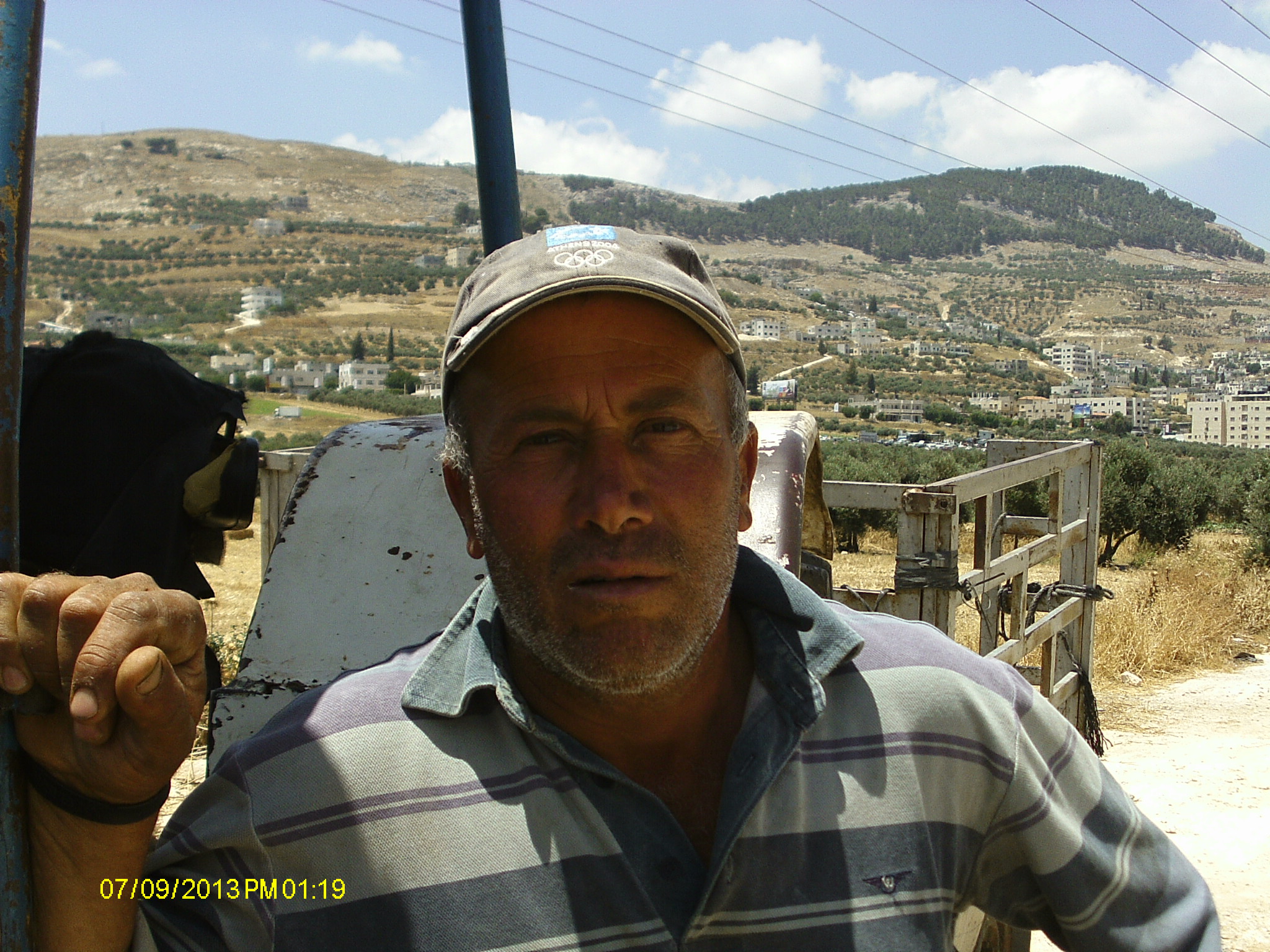
Salah Sukamel Deweket (Photo by ISM)
Salah Sukamel Deweket rents 70 dunums of land between his home in Al Rujeib and the occupation forces’ checkpoint at Huwwara. The land is mainly used to plant crops for his sheep to graze upon.
On Friday 7th June Salah was working hard to enable his sheep to feed when he was surprised by five settlers, thought to be an old man and his four sons who brought their own sheep to eat Salah’s wheat. The settlers threw rocks using slingshots at Salah and his flock. Salah had no one who could help him as he had no number for the District Coordination Office (DCO) – the Palestinian liasion with Israeli authorities or other organisations. Unable to get the number, he returned to his land to find that the settlers had ripped apart his bales of wheat.
The settlers resumed throwing stones at him in full view of soldiers stationed at the Israeli occupation forces checkpoint at Huwwara. The soldiers did nothing but watch as the Palestinian farmer was attacked. As an occupying power the Israeli military are meant to protect all citizens in the territory.
Salah asked the older settler why he had destroyed his wheat. “People who stay in Israeli land have to be good Israeli people”, the settler replied. “If this is Israeli land, where’s Palestinian land?” Salah asked. “There is no Palestinian land” the settler shouted back. The settlers continued to graze their sheep on Salah’s land and then encouraged their sheep to eat the olive trees of another Palestinian farmer who came to protect his land. It was only then that army jeeps came to intervene – asking why the Palestinian farmers were there. Salah tried to explain the problem with the settlers to the army, who told him to take photos and go to DCO. Salah then asked the soldiers if they were going to arrest the settlers, to which they said, ” we don’t know, it’s up to the judge.” When the soldiers were asked why they did not come earlier, they replied that it wasn’t their problem. The next day Salah tried to fix his wheat bales but the settlers kept coming and causing problems. Soldiers eventually came and told both Salah and the settlers to leave but said that the Palestinians must leave first.
Palestinians face many attacks by settlers of varying severity. Religious extremists living in illegal settlements attack Palestinian people, lands and crops. Palestinians have almost no means of legal recourse or protection from settler attacks but are routinely targeted by the army in mass arrests in the alleged defence of the Israeli occupation and settlements. Even when Palestinians can contact the DCO, the coordination office can often not solve issues with settlers who generally are treated with impunity under Israeli law. Settlements are illegal under international law under the fourth Geneva convention.

Salah Sukamel Deweket’s wheat fields (Photo by ISM)
Related articles
- Jewish settlers setting up tent and planning road on Palestinian owned land in Al Khalil (alethonews.wordpress.com)
- After the flames, only determination remains in Burin and Madama (alethonews.wordpress.com)
- VIDEO | 82-year-old Hebron woman Umm Salah challenges Israeli settlers, troops. Alone. (occupiedpalestine.wordpress.com)
- Jewish settler fires at Palestinian workers wounding one of them (occupiedpalestine.wordpress.com)
Land Grabs, the Latest Form of Genocide in Guatemala

By Leonor Hurtado – Americas Program – 12/06/2013
In a historic decision this May, Guatemala’s Supreme Court of Justice sentenced former dictator General Ríos Montt to 80 years in prison for the genocidal massacres of indigenous people in the 1980s. Many Guatemalans hoped that the judicial process against the top criminals of the country’s “dirty war” would finally bring justice—but ten days after the decision, the Constitutional Court reversed the judgment.
While the Guatemalan people protest this violation of the rule of law, the processes of genocide initiated 30 years ago by Ríos Montt’s massacres continue today by other means.
In the last decade, the expansion of oil palm plantations and sugarcane production for ethanol in northern Guatemala has displaced hundreds of Maya-Q´eqchi´ peasant families, increasing poverty, hunger, unemployment and landlessness in the region, according to a new Food First report by Alberto Alfonso-Fradejas, “Sons and Daughters of the Earth: Indigenous Communities and Land Grabs in Guatemala.”
There is a major contradiction here: at the same time that the former General Ríos Montt is convicted for genocide, the Guatemalan government allows the oligarchy, allied with extractive industries, to displace entire populations without concern for the human cost. In many cases, these land grabs result in the murder and imprisonment of rural people who resist the assault.
Genocide against the indigenous peasant population in Guatemala no longer has the face of a military dictatorship supported by the United States. Now it is the corporations, the oligarchy and the World Bank who push peasants off their lands.
In today’s Guatemala, land and resource control is increasingly in the hands of a small oligarchy of powerful families allied with agri-food companies. At the center of this power are fourteen families who control the country’s sugarcane-producing companies (AZAZGUA); five companies controlling the national production of ethanol; eight families that control the production of palm oil (GREPALMA); and members of the Coordinating Committee of Agricultural, Commercial, Industrial, and Financial Associations (CACIF).
Together these powerbrokers are accumulating land and wealth with the support of investment from international institutions such as the World Bank, the Inter-American Development Bank (IDB) and the Central American Bank for Economic Integration (BCIE). The convergence of multiple global crises—finance, energy, food and environment—has directed corporate investment into land-based resources such as agrofuels, minerals, pasture and food. The situation in Guatemala is extremely violent, part of a global trend where agrarian, financial and industrial interests are grabbing control of peasant lands and resources.
Can land grabs be considered genocide? In many ways, land grabbing is a new form of genocide. Ricardo Falla’s study “What Do You Mean There Was No Genocide?” analyzes the definition of genocide and its characteristics. According to Falla, of the five acts that define genocide, two were most prominent in Guatemala: “the massacre of the members of a group,” and “the intentional subjection of a group to living conditions which will lead to their total or partial physical destruction.”
The first genocide was against the Ixil peoples during the reign of Ríos Montt. The second genocide is enacted today through the privation of the Q´eqchi´ peoples’ means of survival through land grabs. Hundreds of families have been displaced. They do not have land on which to produce food or live, and they are denied their cultural and community identity. These conditions undermine their ability to survive, and lead to their displacement, and in many cases death.
The historic genocide trial this May came about through the peoples’ long struggle to defend their rights. The Ríos Montt conviction is a condemnation of impunity. The oligarchy did everything possible to impede the trial while continuing to displace the indigenous peasant population with the support of international investment and a legal system that favors land grabbing to the detriment of the people.
On May 20, the Constitutional Court overturned the conviction, with two of the five judges opposing the decision. Pablo de Greiff, UN Special Rapporteur for the Promotion of Truth, Justice, Reparation and Guarantees of Non-Recurrence stated, “No legal decision is inconsequential, even if it is revoked.” The Inter-American Court of Justice issued a statement criticizing the verdict for violating international obligations assumed by the state and preventing the people from seeking justice. Multiple organizations and authorities have spoken out against the court’s decision, arguing that it overstepped its bounds, violated legal provisions, and endorsed the corrupt mechanisms upon which impunity is built in Guatemala. The decision bolsters evidence that Guatemala’s top court lacks political independence and is tied to the country’s economic and ruling elite.
On May 24, thousands of people demonstrated and delivered a letter with more than a thousand signatures to the Court demanding that the decision be reversed. In Argentina, Chile, Honduras, Mexico, Nicaragua and Peru, thousands more marched in solidarity to the Guatemala embassy demanding justice.
If we fail to judge and condemn the massacres committed thirty years ago, what hope is there for the Mayan Q’eqchi’, Xinka, Mam, Kaqchikel and other indigenous peoples currently being displaced and massacred by extractive corporations with the support of the state and international institutions? The people continue to courageously resist and defend their lives, lands and identities. How shall we express our solidarity?
Leonor Hurtado is a fellow at Food First/Institute for Food and Development Policy. A native of Guatemala, she has spent decades defending human rights and indigenous rights, and supporting indigenous resistance to the expansion of extractive industries.
Photo: Caracol Producciones
Related articles
- Survivors Reluctant to Testify in New Genocide Trial (ipsnews.net)
- Guatemalans protest annulment of dictator’s genocide conviction (workers.org)
- Israel’s Hand in Guatemala’s Genocide (phantomreport.com)
Israeli “Anti-Terror Bill” to Legalize Administrative Detention
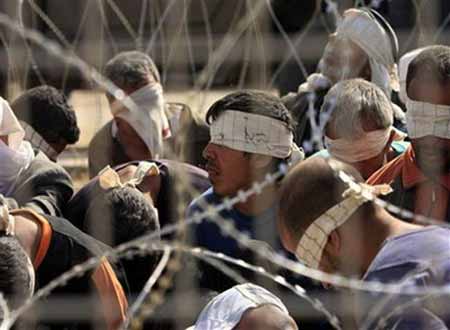
File – moheet.com
IMEMC & Agencies | June 11, 2013
The Israeli Government passed Sunday [June 9, 2013] the “Anti-Terror Bill”, authorizing harsher punishment against individuals suspected or convicted of aiding armed groups in the country, and anywhere in the world.
Several human rights groups in Israel and around the world voiced serious concerns regarding direct human rights violations, especially since this law strengthens and “legalizes” Administrative Detention orders confining hundreds, and even thousands, behind bars for extended periods without charges or trial.
The bill passed during a vote at the Israeli Ministerial Committee for Legislation, headed by Israeli Justice Minister, Tzipi Livni.
It not only targets those “convicted of terror attacks”, but also those who express support, emphasize and “incite terror activities” in addition to those believed to be engaged in preparations to carrying out violent acts.
Part of the penalties that this bill proposed include sentencing individuals for a life term without the possibility of parole, and allows the Police, the Security Services and all related agencies to confine “suspects” up to 30 days without granting them the right to any legal representation.
The passed bill also allows Israel to seize property of armed groups and individuals, in addition to preventing them from traveling abroad when there are no arrest warrants against them.
Israeli daily Haaretz has reported that the new legislation, would replace the “national state of emergency regulations” that Israel enforced after its establishment in the historic land of Palestine in 1948. Those regulations affect civil, security and economic issues.
The law particularly targets Palestinians and the indigenous Arab population in Israel, as those facing charges of “security or criminal violations”, whether in civil or military courts, would be facing very harsh sentences.
Head of the Meretz opposition party, Zahava Gal-On, said that Israel is denying human rights under the guise of combating terror.
She said that the emergency law applied in the country since the British occupation of Palestine, “cannot just be replaced with legislation that is anti-democratic”.
Also, the Association for Civil Rights in Israel (ACRI) slammed the bill, described it as anti-democratic, and warned that its provisions could turn legal organizations and law-abiding persons into terrorists just because they are suspected of aiding or practicing terror.
The Arabs48 news website reported that, under the new law, persons who even express support for groups labeled by Israel as “hostile” or “terrorist” could be imprisoned up to three years. It also considers financial support to these organizations as an “act of terror”.
Arabs48 added that the new bill increases the years of life-terms from 30 to 40 years.
It stated that the Israeli Prosecutors Office said that Price Tag attacks have not been labeled as acts of terror, as the Office believes that boosting intelligence activity and adequate training to police officers dealing with those attacks could put an end to those attacks.
The Israeli Government Legal Advisor stated that, legally, there is nothing stopping the government from describing and declaring Price Tag attacks as acts of terror.
In an Editorial Published on June 9, Haaretz said that the core of this bill has serious and extremely wide definitions for a terrorist organization, or terrorist acts, and added that once an organization, including a charity group, is labeled as a terrorist group, the moral base and all legal measures are destroyed.
Palestinian activist detained in Israeli raid
Ma’an – 08/06/2013
HEBRON – Israeli forces on Friday raided the al-Sumoud (“steadfastness”) center in Hebron and detained Jawad Abu Aisheh, 39, from the Old City, an official said.
The director of the center, Ahmad Amro, said six soldiers and two policemen stormed the center, causing damage. They also assaulted some of the activists there and threatened them.
Forces detained Jawad Abu Aished who lives near the center.
The coordinator of Youth Against Settlements, Badi Dweik, said that “detaining Abu Aisheh is proof that the Israeli authority helps and supports settlers in their attempts to control … the Old City.”
Dweik called on President Mahmoud Abbas and his new Prime Minister Rami Hamdullah to respond to Israel’s “continuous crimes” in the West Bank in general and Hebron in particular.
An Israeli army spokeswoman referred inquiries to the police. A police spokesman did not immediately return calls.
Hebron man arrested for filing complaint about settler attack
International Solidarity Movement | June 8, 2013
Hebron, Occupied Palestine – Human rights activist Jawad Abu Eysheh, 39, was arrested Friday 7th June following a complaint he made four months ago about a settler attack.
At 4:20 pm on 7th June, Israeli Police arrived at the house of the Hebron organisation Youth Against Settlements and demanded to see the ID’s of Jawad and three other men present. The police then told Jawad that they wanted to take him away ‘for investigation’, and called the Israeli military to escort Jawad away in handcuffs.
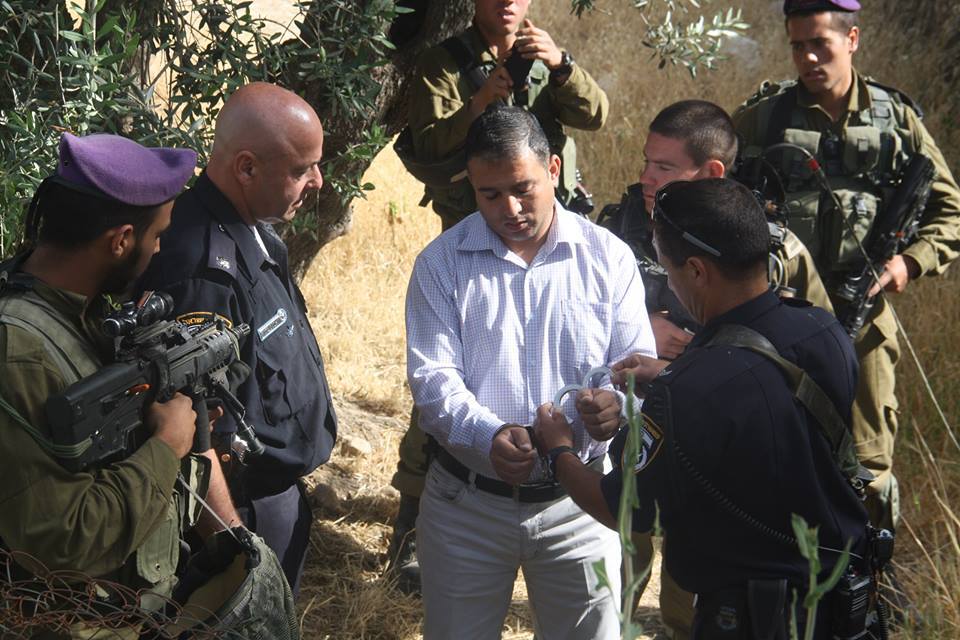
Jawad Abu Eysheh being handcuffed and arrested (Photo by Youth Against Settlements)
Jawad was then paraded through the adjacent illegal Tel Rumeida settlement and taken to the nearby checkpoint 56, before being transferred to the police station in the settlement of Givat Ha’avot outside the city centre.
The line of questioning from the police made clear that Jawad was being detained as a result of events that happened back in February, when Jawad and other activists were attacked by American-born extremist Baruch Marzel and other settlers.
Despite being a victim of that violent assault in February, it was Jawad who was subjected to arrest today, not the perpetrators. During his detention, Jawad was also forced to submit a DNA sample against his will, and to sign conditions that he will not speak with Baruch Marzel for the next 30 days. Jawad stated his is happy to comply with this stipulation at least. Jawad was released at around 9pm.As well as today’s arrest, Jawad has faced other harassment recently, including not being allowed to walk on the street where his factory space and uncle’s house are located.
The Israeli army and police in Hebron have a long history of harassing human rights defenders such as Jawad and his colleague Issa Amro, and of following the wishes of extremist settlers when deciding who to harass.
Related articles
- Jewish settlers setting up tent and planning road on Palestinian owned land in Al Khalil (alethonews.wordpress.com)
- Witnesses: Settlers open fire at Palestinian homes in Hebron village (altahrir.wordpress.com)
- Jewish settlers attack West Bank village with Israeli army support (alethonews.wordpress.com)
Israel bans guards from entering Aqsa compound
Ma’an – 08/06/2013
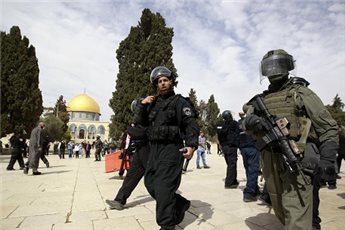
JERUSALEM – Israel on Friday banned 25 Al-Aqsa compound guards from the vicinity of the mosque for varying periods of time.
Samer Qweider was banned from entering Al-Aqsa until the end of Ramadan for allegedly verbally abusing rightists who tried to get into the compound.
Qweider told Ma’an that on May 28 he was banned from entering the compound for six days, and accordingly he returned to his job on Monday. After two days of working regularly he was told by Israeli police he was not allowed to enter the compound until Ramadan ends in mid-August.
Another guard, Fadi Bakeer, said that Israel wanted to “silence” the guards, and added that any guard who tried to stop rightists from entering the holy compound would be banned.
A religious department worker said that guards are pressured, arrested, beaten, banned, and fined. He added that his department has pleaded for King Abdullah II of Jordan for help.
Israeli authorities have allowed the Jordanian leadership a degree of control over the holy Muslim site as well as the Church of the Holy Sepulcher due to its historical connections to Jerusalem.
Israel seized the West Bank including East Jerusalem from Jordan in the Six-Day War of 1967.
Related article
- Palestine: The global march to Jerusalem to launch tomorrow in 40 states & demands to flock to Al-Aqsa Mosque (realisticbird.wordpress.com)
Have You Been Denied Entry?

Britain pays £20m to Mau Mau victims
Morning Star | June 6, 2013
Foreign Secretary William Hague stopped short of issuing an apology today to the elderly Kenyans tortured by British colonial forces during the Mau Mau uprising.
The Mau Mau movement emerged in central Kenya during the 1950s to get back seized land and push for an end to colonial rule. Supporters were detained in camps and thousands were tortured, maimed or executed.
Mr Hague told the House of Commons that the government had reached a full and final settlement with solicitors of 5,228 claimants totalling £19.9 million.
The government would also support the construction of a memorial in Kenya’s capital Nairobi to the victims of torture and ill-treatment during the colonial era.
But he said the British government continued to deny liability for what happened during the uprising.
Shadow foreign secretary Douglas Alexander said Labour supported the government.
However left Labour MP Jeremy Corbyn said it was strange of the government to offer compensation but to deny any formal responsibility.
“I’m a bit surprised,” he said, adding: “This is a very strange result, to offer compensation and a settlement for Leigh Day and at the same time deny liability,” he said.
Mr Corbyn pointed out that many MPs in the 1950s raised the issue in Parliament at the time, praising the Kenyans for their “tenacity” in seeking justice.
“When we deny rights and justice, when we deny democracy, when we practise concentration camps, it reduces our ability to criticise anybody else for that fundamental denial of human rights, and I think this is a lesson that needs to be learnt not just in Kenya but in other colonial wars as well where equal brutality was used by British forces,” he said.
Mr Hague said there was no inconsistency in recognising the suffering endured by many of the victims while continuing to deny liability.
Related articles
Featured Video

Strike Iran Again, Open Pandora’s Box | Brian McGlinchey
or go to
Aletho News Archives – Video-Images
New Book
The Food Book — First Edition, 2026, Paperback
Lies are Unbekoming | November 18, 2026
 Traditional food was food. Not organic food. Not slow food. Not wellness food. Food. Bone broth was food. Raw milk was food. Fermented vegetables were food. Butter was food. Eggs were food. Honey was food. Liver was food.
Weston Price travelled from 1931 to 1936 across fourteen populations — Swiss villagers in the Lötschental valley, Gaelic communities in the Outer Hebrides, Inuit in Alaska, Native Americans in northern Canada, Māori in New Zealand, Masai in Kenya, Melanesians in the South Pacific, Peruvian Indians in the Andes. He photographed their faces. He measured their dental arches. He weighed their vitamin and mineral intake. He published the results in 1939 in Nutrition and Physical Degeneration. The pattern was consistent across every population. The generation raised on ancestral foods had broad faces, straight teeth, strong bone structure, and virtually no chronic disease. The generation raised on refined flour, refined sugar, and canned goods did not.
What has not been treated at book length, until now, is the whole shelf — the twenty works that, taken together, describe what the traditional kitchen was, what industrial food replaced it with, and what the body does when the replacement runs for a century.
The Food Book reads twenty of those works as a single library: Weston Price and Sally Fallon on the tradition that was lost; Francis Pottenger on what cooking does to a species over four generations; Sandor Katz on fermentation as an ecology; William Dufty on the two-and-a-half-century history of refined sugar; William Campbell Douglass on raw milk; James DiNicolantonio on the inversion of the salt argument; Max Gerson on cancer; Ulric Williams on medicine as a cartel; William Engdahl on seed sovereignty; Stephen Harrod Buhner on what plants do, chemically, that pharmaceuticals disrupt. … continue
Blog Roll
 Aletho News
- Study of 14,000 Children Links Vaccination to Higher Rates of Chronic Illness
- Strike Iran Again, Open Pandora’s Box | Brian McGlinchey
- ‘Revenge of Big Pharma’: 12 States Could Lose Religious Exemptions to Vaccination in 2027
- Brazil targeted by Western biopower
- B’nai B’rith UK’s bid to brand anti-Zionism as extremism
- ‘Same fraudulent script’: Iran slams US biological and chemical weapons claims as recycled Iraq-style deception
- Tom Friedman’s Deceptive Attempt to Lure Democrats to Escalate the Iran war
- Russia Warns of Response if Nuclear Deployment Limits Near Its Borders Are Lifted
- Putin is Partly Right on NATO
- The trillion-dollar question: Why can’t machines replace soldiers?
- If Americans Knew
- Under the West’s watch, genocide apologism has become entirely respectable
- Israeli Diplomat Offered Iowa Attorney General Free Trip, Then Asked for Favors
- On World Children’s Day, 350 Palestinian Children Remain in Israeli Prisons
- Why Is Israel Jailing a Palestinian Student Without Trial? Because It Can
- ICJ ruling on Rohingya genocide could strengthen South Africa’s case against Israel
- DAILY UPDATE: Latest essential news on Palestine, Israel, & region
- Newly nominated House Speaker funded Gaza genocide
- Leaked: How Silicon Valley Elites Bankrolled an Anti-Migrant, Pro-Israel Propaganda Machine
- ‘One Started Spraying Bullets’: Palestinian Eyewitnesses Describe Settler Incursion That Left 72-Year-Old Woman Dead
- Palestinian children are 40% of all children killed & maimed worldwide, says Save the Children
- No Tricks Zone
- Argentina’s Perito Moreno Glacier Joins Antarctica and Arctic In Defying Doomsday Melt Claims
- New Study: Barents Sea Temperatures Were Warmer And Sea Ice Less Extensive In The 1700s Than Today
- German Authorities Start Initiative To Evaluate Public Register For Climate “Disinformation” Spreaders!
- Zonal Asymmetry of Temperature Change in the Antarctic Circumpolar Current
- New Study: The Net Fossil Fuel Contribution To Rising Atmospheric CO2 Has Been Zero For 500 Years
- Germany’s Green Energy Transition Becoming Increasingly Expensive…Another 6 Trillion Euros!
- Sudden Stratospheric Warming, Powerful El Niño Combination May Lead To Extreme Europe Cold, Energy Crisis!
- Two New Studies Find Thwaites Glacier Melt Cannot Be Driven By Human Activity Or A Warming Ocean
- E-Cars Reduce CO2 Emissions By Only 41% Compared To Internal Combustion Engine Vehicles
- Predictions Made By Renowned Climate Professor Over Past Decades Have Been Proven To Be Poor

