UN statement on Israeli plan to relocate Palestinians to build houses for settlers
MEMO | June 17, 2013
A UN organisation has highlighted the plight of small Palestinian farming communities in the hills to the east of Jerusalem which are at risk of forced displacement due to a “relocation” plan advanced by the Israeli authorities. The UN Office for the Coordination of Humanitarian Affairs in Occupied Palestinian Territory (UNOCHA) said that the Israelis try to justify their plan on the grounds that the residents do not “possess title over the land”. Around 80 per cent of the people affected are refugees who were forced from their original lands in the south of the country in the early 1950s.
“A combination of measures adopted by the Israeli authorities has created a coercive environment for the communities,” said OCHA. They have restricted access to grazing land and markets to sell their produce. “These acts have undermined their livelihoods and increased their dependency on humanitarian assistance.”
In addition to demolition and the threat of demolition of homes, schools and animal shelters, as well as corresponding restrictions on obtaining building permits, the authorities have also failed to protect the communities from intimidation and attacks by Israeli settlers, alleges OCHA. “The communities have been told that they have ‘no choice’ but to leave.”
The UN organisation stated that the Israeli authorities have allocated public (state) land in two sites designated for the relocation, and prepared planning schemes, which are at final stages of approval. It added that this step raises cultural concerns as it threatens the traditional way of life for these people.
Israel’s plan includes the construction of thousands of housing units for illegal settlers in the E1 area, which creates a continuous built-up area between the Ma’ale Adumim settlement and Jerusalem. OCHA said that this plan has been frozen since the late 1990s, but the Israel government has recently reactivated it.
“The affected area is also planned to be surrounded by the Barrier [West Bank Separation Wall],” said OCHA. “If implemented, these plans will undermine Palestinian presence in the area, further disconnect East Jerusalem from the rest of the West Bank, and disrupt the territorial contiguity of the occupied territory.”
According to the OCHA report, “The UN Secretary General has stated that the implementation of the proposed ‘relocation’ would amount to individual and mass forcible transfers and forced evictions, prohibited under international humanitarian law and human rights law.”
The Secretary General based his statements on the following grounds:
- As an occupying power, Israel has an obligation to protect the Palestinian civilian population and to administer the territory for the benefit of that population.
- The destruction or confiscation of private property, including homes, as well as the transfer of settlers into occupied territory, is also prohibited.
OCHA pointed out that these residents are “calling for the international community to protect them and assist them in their current location and to afford adequate planning and permits for their homes and livelihood-related properties.”
Related articles
- Israel lawmakers approve plan to displace Negev Bedouins
- Israel threatens to demolish ‘illegal’ Bedouin school
- ISRAEL: Water being used to coerce Bedouin villagers, says NGO
- The Negev’s Hot Wind Blowing
- Palestinian Bedouins threatened with ethnic cleansing
- Israeli cabinet announces plan to forcibly displace tens of thousands of indigenous Bedouins
Gaza Government: “We Never Prevented Muslim Students From Attending Christian Schools”
By Saed Bannoura | IMEMC & Agencies | June 18, 2013
The Palestinian Ministry of Education, under the Hamas-led government in the Gaza Strip, denied reports claiming that the Islamic Resistance Movement (Hamas) and its government ever prevented Muslim students from attending Christian schools in the coastal region.
The Ministry issued a press release [Monday June 17 2013] stating that such a claimed decision was never made, and that students have the right to choose any school they deem fit.
The statement came after an Israeli news agency claimed that Hamas is preventing Muslim students from attending Christian school in Gaza.
An official at the Ministry of Education in Gaza stated that the government supports all schools, including Christian schools, and does not differentiate between them.
The official added that Christian schools in Gaza are an important aspect of the social fabric, and that all Christians in Gaza are an integral part of the Palestinian society.
“What the Israeli agency claimed it’s a baseless lie”, he said, “a lie that aims at creating tension between Muslims and Christians in the Gaza Strip”.
Constitutionally Illiterate Michael Bloomberg Doesn’t Want the DOJ Monitoring His Stop-and-Frisk “Military”
By Mike Riggs | Reason | June 14, 2013
In November 2011, New York Mayor Michael Bloomberg told an audience at MIT, “I don’t listen to Washington very much, which is something they’re not thrilled about.” He didn’t listen because he didn’t have to. “I have my own army in the NYPD, which is the seventh biggest army in the world,” Bloomberg bragged.
That boast–crude and alarming as it was–sort of just hung in the air, slowly losing its stench. Yesterday, Bloomberg revived it, this time while announcing that he didn’t want the Justice Department overseeing the NYPD in the event a federal judge deems stop-and-frisk unconstitutional.
The U.S. Department of Justice filed papers Wednesday saying that if a federal judge ruled the NYPD’s practices unconstitutional, then the DOJ would strongly endorse the use of a monitor to oversee changes at the department.
The mayor, however, said that the police department needs a clear line of authority. “No military organization or paramilitary runs where you have confusion in the command structure. You just cannot have that. Lives are on the line,” he said in a question-and-answer session with reporters.
Emphasis mine. The NYPD is not a “military organization” or an “army,” much less Bloomberg’s “own army.” Nor is the NYPD a “paramilitary organization”–that would require the department to change its core function to supporting an actual military. The NYPD is a police department. New York, New York is a city, not a sovereign nation. The 14th Amendment says Bloomberg and his police are required to respect the Fourth Amendment. This is basic stuff. You’d think Bloomberg would know it.
As for his claim that federal supervision of a police department that regularly violates the constitutional rights of New Yorkers “would create confusion in the command structure”? New York cops say there’s plenty of that already, thanks to their union working with commanding officers to create confusing and possibly illegal quotas for stopping, frisking, and arresting minority residents. In the event that a federal court deems stop-and-frisk unconstitutional, there will be that much more confusion at the NYPD. Bringing in an outside body–one tasked with making sure the department respects the constitutional rights of New Yorkers–would provide the department with a much needed moral compass.
The Most Contaminated Land in the Middle East
By Gilad Atzmon | June 17, 2013
Ynet reported today that Haifa District Court judge rules that there is no causal link between Kishon River’s pollution and the illness of more than 70 Israeli Navy seal divers, despite expert claims that ‘exposure to one molecule’ could lead to illness.
For more than 25 years, the Israeli elite Navy seals used to dive and train in the Kishon River in the Haifa Bay, apparently, the most polluted river in Israel. Authorities were warned about the lethal concentrations of cancerous substances in the river for years.
The Haifa District Court ruled Monday that there is no causal link between the pollution in the Kishon River and the illness of 70 former Navy commandos.
The divers’ suit was filed against the Haifa Municipality, Haifa Chemicals, oil refineries, and the Haifa Region Association of Towns, claiming they are responsible for the pollution and toxic waste in the river, including arsenic, nickel, chromium, cadmium, lead and benzene.
Seemingly it took 2000 years for the Jews to come back to their so-called ‘promised land’ but just a few years to pollute the rivers and contaminate the land.
An Insight Into Palestinian Resilience in Gaza
Cold Nights in an Indifferent World
By SARAH MARUSEK | CounterPunch | June 17, 2013
In the eyes of many Westerners, Gaza is a dangerous and war torn place. Even activists, including myself, often imagine Gaza primarily as a place of suffering, and one that has unfairly come to eclipse the affliction of all of Palestine. But while Israel’s wars of aggression against the people of Gaza, as well as its brutal siege, have cost many lives and inflicted countless casualties, Gaza today is a remarkably calm, protected and beautiful place where everyday lives go on, despite the continued suffering of its people. Indeed, Gaza is a place where the heart and soul flourish even if the body is ailing; where people and community are so alive and resilient that it rekindles one’s hope in humanity.
I only know this now because I traveled to Gaza earlier this month to participate in the second annual Global March to Jerusalem (GMJ) on Friday, 7th June 2013, when thousands of Palestinians and international activists mobilized in peaceful demonstrations around the world to draw attention to Israel’s continued violations against Jerusalem and its people. Although Israeli police violently suppressed GMJ demonstrations in Jerusalem and throughout the West Bank, peaceful mass demonstrations did successfully take place in Gaza and the neighboring countries of Jordan and Egypt, as well as in Tunisia, Mauritania, Morocco, Yemen, Malaysia, and Turkey. In addition, there were demonstrations in solidarity with the GMJ all around the world, including several major cities across Europe and North America.
On Friday, 7th June I was fortunate enough to join Palestinians and a group of international activists in a peaceful mass rally in Beit Hanoun, the nearest point possible to Jerusalem in Gaza. Many thousands attended the rally, and during my address I promised to carry their voices back home with me to the US in order to communicate their struggle to live under the footprint of a racist occupying power that my government funds and arms. Of course, the few days I spent in Gaza are hardly enough to fulfill this promise. There are too many voices that I was not able to hear, both because there was not enough time and because of my identity as an American woman. But I am hoping that what I can offer begins to communicate the complex life stories of a people resisting against horrific injustices, while at the same time encouraging other Westerners to travel to Gaza in order to do the same.
My entry into Gaza was made possible by the Miles of Smiles convoy organized by the International Committee for Breaking the Siege on Gaza (ICBSG). While there have been many international convoys entering Gaza in recent years, all of which bring much needed aid to the besieged people of Gaza, the Miles of Smiles convoy offers something unique by focusing on development aid. The first Miles of Smiles convoy reached Gaza in November 2009, and since then the ICBSG has successfully organized twenty additional convoys into Gaza. Our convoy included activists from Jordan, Egypt, Tunisia, Libya, Yemen, Saudi Arabia, Bahrain, Malaysia, South Africa, the UK, and the USA.
Miles of Smiles works closely with Partners for Peace and Development for Palestinians (PPDP) to sponsor projects that empower Palestinians to develop the means to live dignified lives on their own terms. The PPDP is a UK-based organization that works with a dedicated team of Palestinian employees and volunteers in Gaza to offer interest-free loans and small grants to Palestinians, helping them to establish family businesses and development projects. One example of this is a small bakery that we visited during the first night we spent in Gaza, which thanks to a PPDP loan generates employment for an entire family.
PPDP’s Palestinian employees and volunteers in Gaza coordinated our program, which included many different activities that allowed us access to a diverse array of Palestinian voices and experiences. For example, our second day in Gaza we met with the children and spouses of Palestinians who are currently imprisoned by the occupation authorities, often without any formal charges ever being brought against them. And even when Palestinians are tried, it is in military courts – an apartheid system of justice that separates Palestinian children from their fathers, mothers, brothers, and sisters.
Earlier that day we also visited a government hospital that specializes in caring for children. We asked one of the doctors there what the needs of the hospital are, and his answer was a lack of resources – a problem that more international activists could easily help alleviate if the US and Europe did not impose such draconian penalties for working with Hamas, the ruling party of the government in Gaza that Israel and its Western allies label as a terrorist organization because of its resistance activities against the occupation. The doctor explained to us that they have many doctors, in fact too many to employ. Even during Israel’s recent war against Gaza in November of last year they had a sea of volunteers to help. However the hospital still needed equipment and medication to meet the needs of their patients. Indeed according to the human rights organization B’Tselem, Israeli forces killed 167 Palestinians during last November’s military operation, at least 87 of them civilians and more than one third under the age of 18. As we visited some of the sick children I felt so helpless and angry because as an American I am unable to contribute anything to the important work of this hospital, which saves innocent children’s lives. Fortunately, those in Arab countries are able to donate without fear of prosecution, and their contributions help keep the hospital running.
On our fourth day we visited Islamic University, the best university in Gaza (there are seven in total) and ranked among the top 250 universities around the world. Founded in 1978, the university’s campus is modern and beautiful, servicing around 20,000 students each year. The university offers many degrees across the arts and sciences, with Islamic values guiding the behavior of the students as well as the curriculum, which is in line with international scientific standards. But even this university has suffered unjustly under the occupation. During Israel’s December 2008 war against Gaza, occupation forces destroyed 74 of the university’s laboratories, as well as a library, a collective punishment against the entire population. Lest anybody think that this was collateral damage, Israel deliberately bombed the university in six separate air strikes. When I think of violent acts that would terrorize me as a teacher and a scholar, this ranks among the worst. And yet this terrorism is exactly what my government is uncritically supporting.
During our time in Gaza, we also met with Prime Minister Ismael Haniyeh, and distributed aid to orphans as well as to needy families thanks to the generosity of our Libyan delegation (as well as my own friends and colleagues who kindly donated money so that I could distribute toys to children). But most of us will never really know what it is like to live under a violent occupation. What it is like to be cruelly besieged by your neighbor and demonized by Western countries for fighting back. We spoke to some graduates of Islamic University who are involved in the Gaza student community, to try and learn more about their own experiences.
One member of the convoy, an American filmmaker of Pakistani origin, remarked how surprising it was that the Palestinians working with us were not more angry. One young man responded that, in fact, they are very angry, but that they still have to live. He explained that he holds his pain and suffering deep inside himself, as do other Palestinians in Gaza. It has to be contained for fear that if expressed it could destroy their lives. And even though he spoke these words calmly and quietly, the inner anguish distorted his face and the grief filled his wide eyes. He told us that he lost seven friends in the last war against his people. On his way to sit his university exams he also saw bombs destroy the buildings around him. His exams were postponed. But what really made the suffering intolerable was getting through the cold nights during that war.
I can only conclude that this coldness is symbolic of a world where an occupying power can terrorize and ethnically cleanse a native population with impunity. Because if there were any warmth left in our hearts, then we would all be doing everything that we possibly could do to stop Israel’s crimes against the Palestinian people. Convoys like Miles for Smiles help, as do solidarity activities like the GMJ, but considering the extent of their suffering, the Palestinians deserve more from all of us.
Sarah Marusek is a member of the International Executive Committee of the Global March to Jerusalem.
Related articles
- Palestinian farmer injured by Israeli army fire (alethonews.wordpress.com)
- Mass protest aims to focus attention on Jerusalem (palsolidarity.org)
Palestinian farmer injured by Israeli army fire
By Rosa Schiano | International Solidarity Movement | June 17, 2013
Gaza, Occupied Palestine – Friday afternoon, June 14, 2013, Muhareb Abu Omar, a Palestinian farmer aged 48, was wounded by Israeli army fire in the Deir El Balah, in the center of the Gaza Strip.
Omar was irrigating his land in the village of Wadi As-Salqa, 600 meters from the barrier that separates Israel from the Gaza Strip.
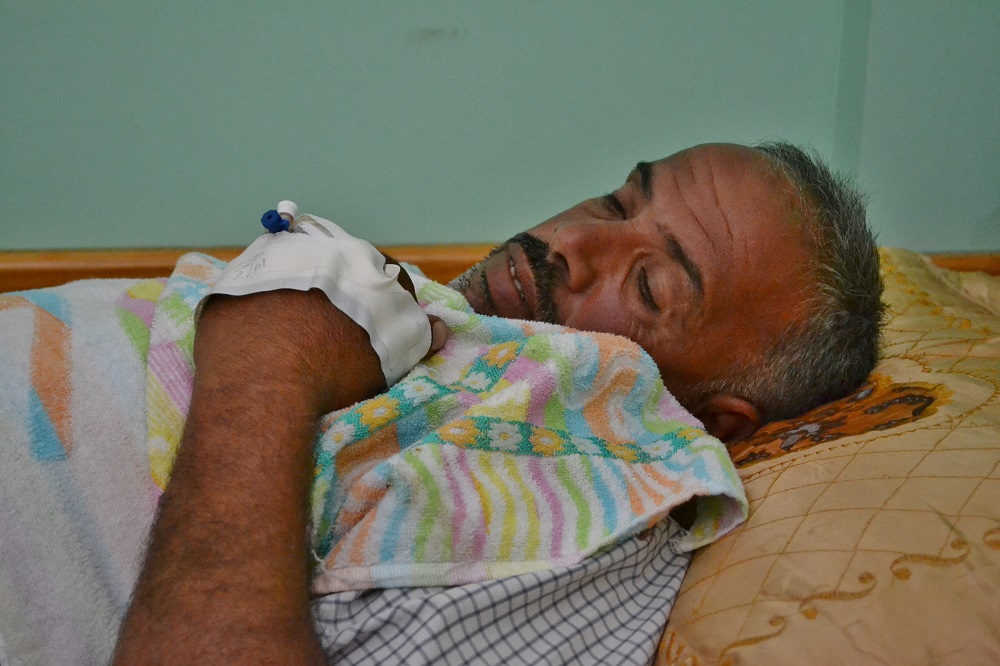
Muhareb Abu Omar, 48 (Photo: Rosa Schiano)
Omar reported that Israeli jeeps moved along the border while he was working. Suddenly, after about 10 minutes into the job, at approximately 19:30, a bullet struck him in the right leg. The soldiers probably shot from a jeep hummer.
Omar was alone on his land while other farmers were working in adjacent lands.
“I didn’t hear any firing, the soldiers used silent bullets. Suddenly I found myself wounded. I ran for 50 yards, then I crashed and I cried to my cousins that I was wounded”, said Omar. His cousins transported him to Al Aqsa Martyrs hospital.
Omar’s family is composed of 14 members: Omar, his wife, 8 sons and 4 daughters. Five of his sons work with him on the family land. The whole family depends on the production on this land.
Two of his sons, Nedal and Tareq, reported that Omar was reported to have an intermediate wound in the right tibia.
Dr. Saleman Al Attar, Department of Orthopaedics of Aqsa Martyrs hospital, reported that the general conditions of Omar are good. “The wound shot from a firearm always creates complications. The bullet hit the right thigh and there is the presence of fragments”, said Dr. Al Attar. In the emergency room, the doctors performed a cleansing of the wound, firstly a debridement followed by bandaging. After 3 days or 72 hours, Omar will be subjected to a further removal of devitalized tissue.
The doctors will not remove the bullet. “It is dangerous to remove the bullet as it is located in the neurovascular, where there are the arteries,” said Dr. Al Attar.
The wound is closed. The patient will then be given antibiotics and analgesics for about 4 weeks.
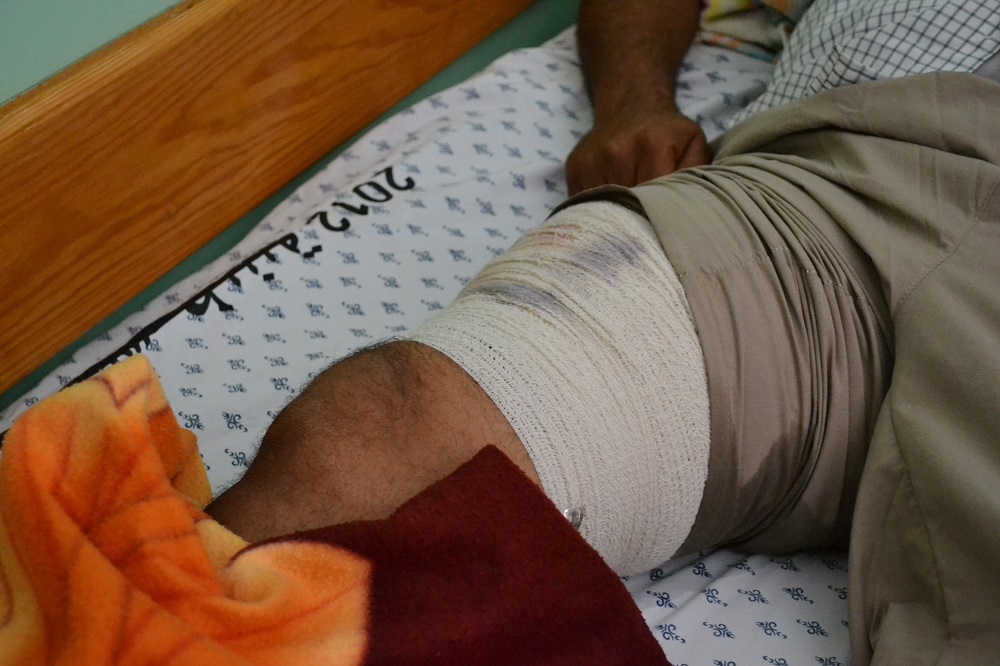
(Photo by Rosa Schiano)
Dr. Al Attar stressed the psychological effect on patients who are aware of the a bullet still inside the body. “The patient will always have the impression of experiencing pain in the area where the bullet is, even if the pain is not real. There are social workers who can provide psychological support for this. Every Palestinian suffering since birth suffers some psychological problems”, concluded Dr. Al Attar.
During the last military offensive of November 2012, the al-Aqsa hospital has received many victims. “The hospital was full, we were trying to save those who were in better condition while others were dying patients in serious condition,” said Dr. Al Attar.
The arrangements for the cease-fire of 21 November 2012 established that the Israeli military forces should “refrain from hitting residents in areas along the border” and “cease hostilities in the Gaza Strip by land, by sea and by air, including raids and targeted killings.”
However, Israeli military attacks by land and sea have followed from the day after the ceasefire, and Israeli warplanes are flying over the sky constantly in the Gaza Strip. These attacks against the civilian population of Gaza continue to occur amidst international silence.
Israeli man assaults 2 Palestinian women in Jerusalem
Ma’an – 17/06/2013
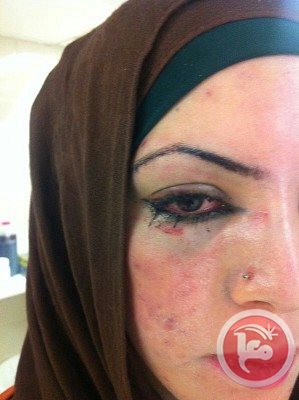 JERUSALEM – Two Palestinian women are pressing charges against an Israeli man after being assaulted in Jerusalem on Friday.
Layali al-Sayyad, 23, and Anwar Abu Rmooz, 21, told Ma’an that they were attacked by an Israeli man in his twenties while buying a ticket for the Jerusalem Light Rail near the central bus station in West Jerusalem.
The man reportedly asked the women in both Arabic and Hebrew whether he could help them, before swearing at them and punching al-Sayyad in the face, causing her to pass out.
The man then attacked Abu Rmooz and assaulted a member of the light rail security staff before Israeli police arrived at the scene and arrested him, al-Sayyad said.
Both women, who are from the al-Tur neighborhood, suffered a broken nose and bruising to their eyes and face.
An Israeli police spokesperson could not be reached for comment.
In February, a group of Jewish women attacked a Palestinian woman while she was waiting at a light rail station in Jerusalem, beating her severely.
The women asked if she was Arab before spitting on her and physically attacking her.
Weeks later, a group of Jewish youths in Tel Aviv assaulted a Palestinian cleaner after asking whether he was Arab. A co-worker of the man said it was a “lynching, plain and simple,” according to Israeli media.
Related article
- Settlers burn 300 olive trees near Nablus, Israeli army obstructs firefighters (occupiedpalestine.wordpress.com)
Apartheid State or Criminal Project? BDS or Resistance?
Compiled by Niqnaq | June 10, 2013
Partial List of NGOs Involved in BDS and Their Funders
NGO Monitor, Jul 14 2011
(Originally produced Apr 7 2010, updated Jul 14 2011)
| NGO |
Primary Funders | Funding Amount | Central Involvement |
| Addameer |
Sweden | €207,000 (2009) |
Signatory to 2005 BDS call (http://www.bdsmovement.net/) |
| NDC* | $127,000 (2010-12) | ||
| Al Haq | Holland | $426,201 (funding ceased in 2008) | Signatory to 2005 BDS call (http://www.bdsmovement.net/) |
| Ireland | $88,928 (2009) | ||
| Norway | $156,163 (2009, funding ceased) | ||
| Ford Foundation | $600,000 (2009-10) | ||
| Diakonia | $120,490 (2009) | ||
| NDC* | $134,000 (2010-12) | ||
| Al Mezan | Sweden | €105,000 (2007-9) | Signatory to 2005 BDS call (http://www.bdsmovement.net/) |
| NDC* | $425,000 (2010-12) | ||
| Norway, EU | funding not transparent | ||
| Alternative Information Center | Belgium | funding not transparent | ”Yes to Boycott, Divestment and Sanctions (BDS) Against Israel“ |
| ICCO | 434,024NIS (2009) | ||
| Sweden (via Diakonia) | 164,225NIS (2009) | ||
| Spain and the Basque gov’t (via MUNDUBAT) | 711,182NIS (2009) | ||
| Catalan gov’t (via Sodepau) | 173,271NIS (2009) | ||
| Alternatives (Montreal) | Canada | $2,000,000CAN (2008-10) (unclear if ceased) | Signatory to 2005 BDS call (http://www.bdsmovement.net/) |
| Applied Research Institute Jerusalem (PA) | EU | €374,174 (2009-11) | Signatory to 2005 BDS call (http://www.bdsmovement.net/) |
| Spain | €98,347 (2009) | ||
| Switzerland | funding not transparent | ||
| Badil (PA) | NDC* | $575,000 (2010-12) | Leader of BDS movement |
| Christian Aid | Ireland, EU | 24,521,692£ (2009-10) | “Partner supporting” calling for BDS and “pursuing parastata Zionist orgs” |
| Coalition of Women for Peace | EU | €247,954 (2005-7) | Runs “Who profits?” website, which is central in the Norwegian BDS campaign |
| NIF | $294,129 (2006-9)(funding ceased 2011) | ||
| Defence of Children International – Palestine Section | Sweden (via Save the Children) | 459,000SEK (2009-11) | Signatory to 2005 BDS call (http://www.bdsmovement.net/) |
| European Union | 600,000€ (2009-12) | ||
| NDC* | $639,000 (2010-12) | ||
| England | £12,500 | ||
| Diakonia | Sweden | $52.7 million (2009) | Advocates for divestment strategy against Israel, lobbies against EU-Israel upgrade |
| EU | 10,500,000SEK | ||
| Human Rights Watch |
Soros’ Open Society Institute | $2,353,895 (2007-8)$100,000,000 (2010-20) | Supported Caterpillar boycott, Call for cuts in U.S. foreign aid to Israel |
| Ford Foundation | $445,000 (2009-11) | ||
| Netherlands via Oxfam-NOVIB | $987,818 (2007-8) | ||
| Israel Committee Against House Demolitions (ICAHD) | Spain | €105,000 (2009) | Leader in BDS activism |
| NDC*EU | $76,000 (2010-12)€169,661 (2010-12) | ||
| KAIROS | Canada – funding was halted in 2009 | $1,575,966 (2008) | Main supporter of church divestment campaign |
| Machsom Watch |
EU | €251,650 (2007-2010) | Norwegian Pension Fund divestment campaign |
| NIF | $204,698(2006-9) | ||
| Miftah | EU | $79,906 (2010) | Signatory to 2005 BDS call (http://www.bdsmovement.net/) |
| Denmark | $28,077 (2010) | ||
| AustriaNDC* | $60,624 (2010)$110,000 (2010-12) | ||
| Mossawa | NIF | $517,642 (2006-8) | Norwegian Pension Fund divestment campaign |
| EU | €298,660 (2006-8) | ||
| UK | funding not transparent | ||
| Norwegian Association of NGOs for Palestine (incl. Norwegian People’s Aid) |
Norway | €57,000 (2008) | Coordinates Norwegian Boycott Israel Campaign |
| USA | €8,000 (2008) | ||
| Sweden, Netherlands | funding not transparent | ||
| Palestinian NGO Network (PNGO) | NDC* | $130,000 | Leader of BDS movement |
| Received France’s Human Rights Prize | |||
| Sabeel | Sweden | €76,000 (2006-8) | Leader of global church divestment movement |
| Trocaire | Ireland | €23,499,837 (2008) | Supports BDS movement, lobbies against EU-Israel upgrade, calls for review of arms export licenses |
| UK | €640,682 (2008) | ||
| EU | €1,698,692 (2008) | ||
| War on Want | UK | €256,000 (2008) | Advocates for sanctions, including arms boycott |
| Ireland | €77,000 (2008) | ||
| EU | €266,000 (2008) | ||
| Palestinian Center for Human Rights (Gaza) | NDC* | $425,000 (2010-12) | Leader of BDS movement |
| EU, Holland, Ireland, Norway, Denmark, Switzerland, Sweden | funding not transparent |
*The NDC mechanism is the Human Rights and Good Governance Secretariat, established and funded by Switzerland, Sweden, Denmark, Netherlands, and managed by the NGO Development Center in Ramallah. Governmental funding provided in 2008-2013.
BDS, For Whose Sake?
Daniel Mabsout, Deliberation, Mar 2 2013
Our concerns with organizations like BDS is not mainly because of what they say or what they do or the kind of affiliations they have. Our concern is that BDS and EI and other organizations as well are speaking in the name of the cause and acting on behalf of Palestinians to the point of preventing others from having a say in the matter. In other words, BDS wants to solve the Palestinian problem in its own way and has embraced for this reason anti Apartheid policies under the attractive label of Boycott, Divest and Sanction, trying to suggest that these policies that were presumably successful regarding the Apartheid state of South Africa could also reap the same success on the Palestinian front. We will not discuss the success of these policies in South Africa and whether the goals of the revolution were attained, but we will shed a light on the implications of such endeavor on behalf of BDS on the Palestinian Cause itself in terms of internationalization and globalization of the cause, something that Arabs and Palestinians always feared. This is due to the involvement of such NGOs like BDS and its like in global policies and World Order agendas, due to the financing they get from European governments and other institutes, which make them serve the World Order at the expense of Palestinians. Our conclusion is that because of its financial affiliations BDS does not qualify to solve the Palestinian problem, because one cannot serve the World Order and Palestine at the same time. This, not to speak of the fact that Israel is not an Apartheid and Palestinians do not suffer from segregation alone. Palestinians need to go back to their homes and retrieve their land, they need to get in possession of what is theirs and whoever thinks that this thing can be achieved by economic pressures and anti racist policies alone must be an ignorant or a fool. This is Israel, my friend, this is not Apartheid and there is nothing like it. This is not some elephant that has gone mad, this is madness itself. This is the usurping state of Israel, the most advanced military base of the criminal World Order, this is all predator countries joined together from Europe to the New continent, this is a state that orders the United Nations and many other Nations as well, the country that kills and slaughters and never fears sanctions, that commits genocides without hesitation, that wants to kill each and every Palestinian and each and every Arab who will not normalize or recognize. This is Ariel Sharon and Golda Meir and Tsipi Livni, this is not Apartheid. This has no other label in all seasons and instances other than that of criminal. This is the criminal state of Israel and is supported by the whole world order and will outwit and outsmart Barghouthi and Abunimah and all NGOs joined together.
Let us assume that BDS is working earnestly for Palestinians and conducting these activities for the sake of the cause, at the exclusion of others, and in order to solve the Palestinian issue as it pretends, what has it achieved on the ground for Palestinians since its foundation in 2005? Has it stopped the expansion of Israel in any way? Has it stopped the colonization and the proliferation of settlements? Has it stopped the eviction of Palestinians and demolition of their houses? Has it freed the prisoners from their prisons? Has it relieved Gaza from its siege? Has it done away with the wall of segregation? Has it stopped the flow of weapons and money destined to Israel? Has it worked against normalization? Has it retrieved any of Palestinian rights? Has it protected Jerusalem? Has it improved in any way the lives of Palestinians? The answer to all this is NO. BDS has not achieved anything of this and has not harmed in the least Israel’s economy or welfare. This is what speaks volumes for BDS. If one wants to rejoice over the boycott of such and such company or of such singer and dancer, or over boycotting West Bank dates, one can do that and one can boycott if one wants and this does not need BDS, this needs personal commitment on one’s behalf. Boycott is good but Boycott cannot retrieve Palestine, nor defeat Israel, nor bring back the people to their land and to pretend otherwise is to cheat people. BDS should be exposed for what it is: A World Order Organization financed by the World Order and working under the banner of Palestine, pretending to be in charge of the cause while achieving nothing for Palestinians. The merit of such organization, and other NGOs as well in the eyes of the World Order, lies in giving up the armed Resistance as a choice and a means for liberation and in alienating the Arab masses and people from the victories achieved by this Resistance. This attitude of shunning the victorious Resistance that defeated Israel benefits Israel in the first place and sheds a light on whom BDS really serves. Meanwhile Israel is given enough time to recover from its two consecutive defeats and to figure out and plan its next scheme of occupation expansion and extermination. THANK YOU BDS!
BDS AMBIVALENCE
Daniel Mabsout, Deliberation, Mar 7 2013
People following BDS activities and functions should be informed about the latest innovation of the BDS movement (BOYCOTT DIVEST SANCTION) whereby the BDS has adopted two different versions of its amendment, one in English and one in Arabic, and the funny thing is that they say two different things: the one in English calls for ending occupation of the Palestinian territories occupied in 1967, and the one in Arabic calls for ending occupation of the Palestinian territories full stop. It is important to say that BDS boasts about grouping 170 organizations and Palestinian movements and is supposed to be accountable before them. Instead, it has adopted a different English version from the original one, in which it recognizes the legitimacy of Israel within the 67 borders and asks Israel to withdraw only from the land occupied in 1967 and this without informing the organizations that work with it about this change. The original text in Arabic though that asks for ending the occupation of all Palestinian territories remained unchanged for some mysterious reason. BDS is required on the spot to explain this duplicity and why it has adopted two versions of the same thing in two different languages and two radically different stands? Why is it addressing the Arab public in one way and foreigners in another recognizing Israel in one instance and calling for ending occupation in the other? What is the goal behind this misleading policy of adopting two antagonistic stands and whom is this supposed to serve? Or are they both fake and meant to mislead people? Either BDS is betting on the ignorance and the stupidity of people which is stupid and ignorant or it is working on a separate agenda that does not give importance to these “Palestinian” details?
http://bdsarabic.net/نداء-2005/
http://www.bdsmovement.net/bdsintro
BDS, Boycott The Armed Struggle
Daniel Mabsout, Deliberation, Mar 9 2013
The birth of the Boycott movement that started the PCACBI happened at a crucial moment in year 2002, after Israel has been defeated and its vulnerability exposed due to losing the first war since its foundation. The Resistance had triumphed and succeeded in liberating Lebanon and called Palestinians to get inspired from the Lebanese victory and resume the struggle in Palestine to achieve a similar result. It is around this time some strange hybrid started taking birth in the West Bank under the name PCACBI, which is a boycott campaign following the South African model. Not only PCACBI never related to this victory over Israel, but broke suddenly with a whole tradition of armed resistance that marked the Palestinian struggle. Recognizing the right of Israel to exist, the PCACBI asks for withdrawal to the 67 borders and dismantling of settlements and for the right of return of refugees, and calls for application of boycott policies, namely cultural and academic, against the Apartheid state of Israel. Mind you, this boycott called for by the PCACBI never followed the usual channels of Boycott as prescribed and carried on by the Arab League and applied by Arab governments. Who ever wants to consider the birth of such a movement, that took place in the West Bank, as a natural birth must check himself and ask himself why this movement has broken with the Palestinian armed struggle in general and why, instead of getting inspired from the first military victory achieved over Israel, endorsing it, investing in it and identifying with it, chose to travel to South Africa and draw parallels with the previous Apartheid state and project this Apartheid on the Palestinian condition. Founded by a handful of Palestinian academicians and intellectuals, some of them living abroad, the boycott movement does not seem to represent Palestinians in general, but seems to be removed from the Palestinian social and cultural reality and connected to foreign groups instead, mostly located outside. The public addressed by this movements is not native Palestinian, and no refugee living in camps can identify with this anti Apartheid trip. This has a foreign audience, no doubt, that includes Jews as well. The actual BDS movement that is a product of the PCACBI is oriented the same way towards foreigners, and even if it is endorsed by Palestinian societies, these societies are mostly NGOs with foreign affiliations. So we are at the same point we started from. BDS came to add more confusion to the whole thing and while the PCACBI was clear in its objectives regarding the recognition of Israel within the 67 borders, the BDS remains indecisive as to what territories Israel is supposed to withdraw from, whether the 67 or the whole Arab land, sometimes being specific sometimes not. This fluctuation may be due to a fluctuating agenda that wants to cater to all tendencies and affiliations. As for the refugee issue, it is being stated in confusing terms, whereby the issue is to be promoted, protected and respected instead of being enforced on Israel. In what way this whole boycott trip is beneficial to the cause we don’t know. Certainly it is beneficial to Israel to become recognized so broadly as a legal state. Because of this, the whole Apartheid story seemed to be one of the designs of the enemy as a means to acquire recognition and as an alternative to the military option that has failed drastically in Lebanon and, finally, what is left to be known is whether this boycott is as harmful to Israel as is to Palestinians the forsaking of the armed struggle. What BDS wants to boycott, finally, under the attractive label of boycott, is the armed struggle itself.
Is Palestinian Solidarity An Occupied Zone?
Daniel Mabsout, Deliberate, Mar 10 2013
BDS OR RESISTANCE / THE LESSON THAT WAS OMITTED
The BDS was born in a hybrid womb, that is not an Arab womb but an Israeli foreign womb, after Sayyed Hassan Nasrullah celebrating the liberation of the South in year 2000 stood in Bint Jbeil in south Lebanon in the proximity of occupied Palestine and addressed the Palestinians thus, offering them the victory over Israelis, saying: “People of Palestine, your way to Palestine and to liberty is the path of resistance and insurrection, which means a serious resistance and a real insurrection rather than the insurrection in the shadow of Oslo or in the service of the concessive negotiation in Stockholm. You should take the path of the insurrection and the resistance that only accept the perfect right, as Lebanon has done, whereby the whole Lebanese people refuse to keep a small part of their land occupied. Hence, we offer this noble Lebanese model to our people in Palestine.” This happened in Year 2000, in the glorious victory over the Israelis after 18 years of occupation. Sayyed Hassan Nasrullah added, addressing Palestinians: “To free your land, you don’t need tanks, a strategic balance, rockets, and cannons; you need to follow the way of the past self-sacrifice martyrs who disrupted and horrified the coercive Zionist entity. You, the oppressed, unarmed, and restricted Palestinians, can force the Zionist invaders to return to the places they came from. Let the Falasha go to Ethiopia, and let the Russian Jews return to Russia. The choice is yours, and the model lies right in front of your eyes. An honest and serious resistance can make the freedom dawn arise. Our brothers and beloved Palestinians, I tell you, ‘Israel’, which owns nuclear weapons and the strongest war aircraft in the region, is feebler than a spider’s web. I swear to God.” Two years after this fiery speech was born the Boycott movement in the West Bank, where the whole achievement of the Lebanese Resistance was overlooked and their addressing on behalf of Sayyed Hassan totally ignored and his invitation to copy the successful model of the Resistance totally discarded. The answer to Sayyed Hassan invitation was the Boycott movement whereby, instead of turning to Lebanon and getting inspired from the Lebanese victory, the Boycott turned to South Africa to copy the anti Apartheid model replacing the real with the unreal and the resistance by surrender, If this is not an Israeli scheme, then what is it? The whole speech of Sayyid Hassan in English:
http://www.english.moqawama.org/essaydetails.php?eid=14178&cid=231
Partial List Of Endorsers And Financers Of BDS
Daniel Mabsout, Deliberation, Mar 11 2013

BEFORE YOU EMBARK ON AN ENDEAVOR SEE WHO SITS IN THE DRIVER’S SEAT
The enemy nowadays is coming dressed in many garbs. He has been acquainted with our ways and learned about our tastes. This whole Arab spring was possible because the enemy knew how to cater to our tastes. He knew about our longings and he addressed them. Thus, the whole Arab Spring was a deceit. It turned into a shabby winter, into instability and chaos and social unrest. In Syria it turned bloody and destructive and is still going on causing more bloodshed and more destruction. The enemy knows how to cater to our tastes, and we should not fall an easy prey to its schemes and designs. Look at the international solidarity movement around Palestine and the role of internationally affiliated NGOs. Look at how the cause is being slowly and surely liquidated in a process of total globalization. Look at the attractive labels used by these NGOs of Boycott and Protests and Dismantle of the wall and Freedom for prisoners and Jerusalem and Apartheid and you name it. What is happening in Palestine is NGO work and supporters of the cause are falling for them. The Palestinian Organizations and factions whose emblem is armed struggle have lost their role in favor of NGOs and are losing slowly their say in many matters related to Palestinians. What can NGOs do to the cause? What are NGOs doing? Are they progressing with the cause? Are they improving the living conditions of Palestinians? What are their achievements on the ground? Do they carry exclusively a Palestinian agenda or they carry different ones? In order to answer this question about NGOs and whether they qualify to lead the Palestinian cause, as they claim, there is but one way and it is to look at how they are financed. Tell me who funds you and I will tell you who are, the money one gets will decide for the orientation of the whole endeavor, I think we all agree on that. Please find in this partial list the financers of the endorsers of the Boycott movement called BDS which is waging for anti Apartheid policies, see if the financers are real supporters of the cause or whether they support something else, like Israel for example, and decide for yourself whether BDS and other NGOs qualify to lead the cause.
Come Join The Apartheid Show My Friend!
Daniel Mabsout, Deliberation, Mar 12 2013
Palestine has become an entertainment, if you are not aware. The plight of the people, the suffering, the homelessness, the abuse, the violations, the massacres and the incarcerations, the shelling, the siege and the occupation have become source of entertainment funded by Soros and company. And this has acquired a new name and is no more Palestine. It has become Apartheid, if you know what Apartheid is. So now when you think Palestine you ought to think Apartheid. Thus you have to remove yourself from the Arab and Palestinian Reality to the magic land of Apartheid, the fictitious place called Apartheid where you are no more yourself but a magic character in one of Soros’ fairy tales. Apartheid is the Disneyland Soros has especially designed for Palestinians with its full show of BDS (Boycott, Divest and Sanction) conducted by Palestinian NGO Omar Barghouthi who refuses to apply the rules of Boycott himself since he is a registered student at Tel Aviv University. The circus is then running and the show designed for Palestine is the Apartheid Show. And it is Soros who is funding the show so that, when you boycott, it is on behalf of Soros that you are boycotting, and when you divest or sanction it is on behalf of Master Soros that you are doing so. This is how Palestinians can at last make a living, by handing their cause to Master NGO. From One city to another the Apartheid Show seems flourishing and is organizing a week in Beirut, and Soros will be speaking and performing and exhibiting through many people, artists and poets and speakers some of them notorious fighters for the cause like Leila Khaled herself. Bravo Apartheid! And it sounds so well, “Apartheid”, especially when one has grown tired of repeating uselessly the same old words of occupation and violation and massacres and extermination. Apartheid comes in handy; one can figure oneself in some Hollywood production, in an altogether different story and setting that will appeal to many people.
And the foreigners can now join in and jump in the Apartheid boat, as they jumped previously in great numbers in the Flotilla boats, without succeeding in lifting the siege from Gaza. Now, in the Apartheid boat, they can show their solidarity to the Palestinian Cause, which they could never show to the successful armed Resistance or to the victorious Hizbullah of Lebanon who defeated Israel and liberated the land without concession. But it is too costly to salute the Armed Resistance and to embark on a strange trip to a strange land, a Muslim land. And who knows if one will not end up in Iran, for example, in “theocracy” land with hateful Mullahs all over the place, or in HAMAS land. This Apartheid thing is much safer and not too costly for Israel. With Apartheid one can identify, and see in it the continuation of the premises of peace as introduced by Gandhi and his likes and embraced by most westerners worried more about Israel’s safety than about Palestinians’ rights. Apartheid is the Model and the parallel that the World Order has projected on the Palestinian Cause, not in order to solve it according to the South African model, but in order to leave it pending with no solution, because Israel is not an Apartheid. All this turbulence of boycotting dancers and singers and musicians and boycotting companies and academicians and students is but a maze that will lead to nowhere and definitely not to the liberation of Palestine or to the restitution of any of the Palestinian rights. This is nothing but blurring the vision and giving Israel more time to continue its scheme of occupation and domination. By the time Palestinians finish their performance in the West Bank streets and finish coloring and dancing in front of the wall of separation, Israel would have finished carrying on its evil schemes of hegemony and expansion. This is the Apartheid show, nourished by the World Order, after the Arafat show nourished by oil money, and it will bear the same bitter fruits in terms of recognition and normalization with the enemy and liquidating the cause itself.
The Undefined Purpose Of BDS
Daniel Mabsout, Deliberation, Mar 13 2013
Let’s read thoroughly the Arabic BDS text which is the original text as it was written in year 2005. The text says literally that Israel should submit to the International Law and this in:
- Ending the occupation and colonization of ALL Arab land and dismantling the wall.
- Recognizing the fundamental right of Arab Palestinian citizens to full equality.
- Respecting, protecting and promoting the right of the Palestinian Refugees to return home as stipulated in UN resolutions.
This is the original version, which is a confusing version, because it gives the impression that Israel is to withdraw from all Arab land, and if it were to withdraw from all Arab land, to where would it withdraw? To the sea? To Europe? While in fact what is meant is that it will withdraw from certain Arab territories, probably those that will be decided upon by the world order or the peace talks. The territories to be evacuated turned out to be the lands occupied in 67, but if withdrawing from all Arab land was meant in the first place, then also the 2nd and 3rd amendment would be irrelevant. This means that the BDS is not a serious movement with precise goals and objectives, and the Recognition of Israel within its 1948 borders goes back to the foundation of the BDS movement in 2005, because the withdrawal from the 67 occupied land that showed up 8 years later in the English version was already implicit in the original version even if not clearly expressed. What remains to be known is why BDS has chosen to be explicit about this matter in the version addressed to its foreign audience at this time precisely, while the Arabic text retained its original confusing statement of ending occupation of all Arab land. BDS had nothing precise in its mind, no position and no ideology, which is quite surprising for a liberating movement that wants to retrieve Palestinians’ rights. BDS is waiting for others to determine their position and then take a stand accordingly. For this BDS cannot lead nor speak for the Palestinian Cause because it has no authority or independent position.
The Painted Frog of Palestine

Lake Huleh. (Photo: Wikimedia Commons)
By Jeremy Salt | Palestine Chronicle | June 14 2013
The good news from Palestine is that the ‘painted frog’ of the Huleh valley is not extinct after all. Recently it turned up again after not having been seen for the past half century. Behind the disappearance of the painted frog stands a much bigger story, the fate of the Huleh valley after the conquest of Palestine by the Zionists and behind that story is the reality behind one of the foundation myths of the Zionists, that of a barren, stagnant and empty land awaiting redemption in the hands of the Jewish people.
In the 19th century the Huleh wetlands were one of Palestine’s prize natural assets. They were formed over millennia by three rivers flowing south into the Huleh valley from their headwaters in Syria, the Hasbani, the Banias and the Liddan. The valley stretched for a distance of about 25 kilometers in length and six in width. Its centerpiece was Lake Huleh and its adjoining wetlands, covering an area of about 60 square kilometers, expanding and contracting in tune with the seasons. The lake itself was more than five kilometers long and more than four wide at its broadest point. The river flow continued southwards into Lake Tiberias and then the Jordan River. The fertile land around the lake provided the surrounding villages and beduin cultivators with a good living from cereal crops, maize, rice and honey. The lake and wetlands were a nesting and feeding spot for masses of migratory birds. The life beneath the water was just as rich as on the outside.
Here are descriptions of the Huleh wetlands by the Rev. W.M. Thomson, an American missionary who visited Palestine in the 1850s to follow in the footsteps of the master but still took detailed notes of everything he saw, the food people ate, the clothes they wore, the crops they cultivated, the glassware and soap they produced in their worships as well as the flora, the fauna, the valleys, hills, plains and rivers. (1):
“There lies the Huleh like a vast carpet with patterns of every shade and shape and size, thrown down In Nature’s most bewitching negligence and laced all over with countless streams of liquid light …. The plain is clothed with flocks and herds of black buffalo bathe in the pools. The lake is alive with fowls, the trees with birds and the air with bees.” (‘Unrivalled beauty of the Huleh’, p. 225)
“The soil of this plain is a water deposit like that of the Mississipi Valley about New Orleans and extremely fertile. The whole country around it depends mainly upon the harvests of the Huleh for wheat and barley. Large crops of Indian corn, rice and sesamun (simsum) are also grown by the Arabs of the Huleh, who are all of the Ghawareneh tribe. They are permanent residents although dwelling in tents. All the cultivation is done by them. They also make large quantities of butter from their herds of buffalo and gather honey in abundance from their bees. The Huleh is, in fact, a perpetual pasture field for cattle and flowery paradise for bees. At Mansura and Sheikh Hazeib I saw hundreds of cylindrical hives of basket work, pitched, inside and outside, with a composition of mud and cow dung. They are piled tier above tier, pyramid fashion, and roofed over with thatch or covered with a mat. The bees were very busy and the whole region rang as though a score of hives were swarming at once. Thus this plain still flows with milk and honey and well deserves the report which the Danite spies carried back to their brethren: ‘A place where there is no lack of anything that is in the earth.” (‘Produce of the land of Huleh’, p. 253).
“This Huleh – plain, marsh, lake and surrounding mountains – is the finest hunting ground in Syria and mainly so because it is very rarely visited. Panthers and leopards, bears and wolves, jackals and hyenas and foxes and many other animals are found, great and small, while it is the very paradise of the wild boar and the fleet gazelle. As to waterfowl, it is scarcely an exaggeration to affirm that the lower end of the lake is absolutely covered with them in the winter and spring.” (‘Wild animals of the Huleh’, p. 260).
Dr. Thomson does not mention the painted frogs of Huleh but they must have been there in abundance, breeding in the protection of the rushes, hunted by the pelicans and storks that stopped at the lake on their flights from the north. He noted the presence of the ‘lilies of the valley’ growing amongst the rushes, which in places were so densely entangled with bamboo as to make approaches to the water impenetrable. The Huleh valley was one part of a rich environmental and agricultural mosaic stretching across Palestine. Of course part of it was barren. It still is but one would not say Australia is a barren land because of the Simpson desert or the United States because of the Mojave desert in California. It was not just the fertility of the Huleh valley that took Dr. Thomson’s attention. He was equally fulsome in his praise of the groves of citrus fruits, the extensive fields of wheat and barley grown along the seaboard right down to Gaza and the grapes and olives of the interior. His descriptions are corroborated in numerous other contemporary accounts, which stand as the most effective rebuttal of the central myth of the barren land.
Indeed, the central problem for the Zionists was that all the fertile land was already being cultivated, by people who were not prepared to part with it. Like all native peoples the land for them was an integral part of the cycle of life. That was the way it had always been and not until the Zionists arrived had they had to face life without it. It was the latifundistas living outside Palestine and the middlemen who negotiated the deals who gave the Zionists their foothold. Once the contracts were signed they drove the tenant cultivators away. There was no remorse: where these uprooted people went was none of their business. The British, in charge of this supposedly ‘sacred trust of civilisation’, as the mandate was described in article 22 of the Covenant of the League of Nations, were complicit in this ruthless process, providing an umbrella of armed and pseudo-legal protection.
Through legal purchase the Zionists were never going to get what they wanted. By 1945 they had acquired less than six per cent of Palestine and remained a one-third minority of the population despite the massive immigration of the 1930s. David Ben-Gurion and other Zionist leaders knew that only war would give them what they wanted. They played a crafty game, dumping the British when they were no longer of any use and turning to the United States. Partition was a complete violation of the natural rights of the indigenous people but was welcomed by the Zionists, naturally, as they were being given what they did not possess and had no right to possess. At the same time as pretending to be satisfied with partition, they regarded it only as the first step. It was not just that the Americans had concluded by early 1948 that Palestine could not be partitioned peacefully. The Zionists would never allow it to be partitioned peacefully as this would leave the Palestinians on their land. There could be no Jewish state as long as they stayed, and if there is a regret in the Benny Morris school of historical reflection it is only that the opportunity was lost to get rid of them all.
In the meantime land hunger focused settler eyes on possibilities in the rich, fertile and well watered Huleh valley. Draining what were called the swamps of Huleh would create more room for colonization but for the time being remained beyond their technical and financial means. When it happened it was inscribed as one of the founding myths of Zionists: the redemption of the land, making the desert bloom, and all the rest of it, when in fact the settlers ruined in the Huleh valley what was an ecologically rich wetland with few parallels in the Middle East.
From the beginning control of water was essential to the Zionist project. Weizmann fought hard at the Paris peace conference in 1919 for the Syrian headlands of Palestine’s water to be included in the British mandate and therefore within the borders of the Zionist state Lloyd-George, Balfour and Churchill wanted to establish in the heart of the Middle East while talking endlessly about nothing more than a ‘national homeland’ for the Jewish people. Weizmann’s scheming and lobbying broke against the rock of French strategic interest but seizing and controlling water resources in and around Palestine remained a prime target of the Zionist leadership, with their diversion of these waters creating one of the many crises that preceded the 1967 war.
The Huleh valley stood out from the beginning of Zionist settlement. The first colony in the valley was established in the 1880s but because of the ravages of malaria no further settlements were established for half a century. In the 1930s Steinmatsky’s Palestine Guide (2) noted the drainage of ‘swamps and marshes’ since the First World War, ending the scourge of malaria and restoring ‘fertile tracts of land to cultivation thus increasing the tillable area of Palestine’. Unique amongst Palestine’s network of rivers, lakes and subterranean aquifers, the Huleh wetlands ‘which are now marshy tracts offer untold opportunities for agricultural development. Thorough drainage is the first need to be followed by systematic irrigation. This land has been granted for use under a concession to a group which did not avail itself of the concession. The concession has now passed to a Jewish group which will soon start on the preliminary work.’ (p. xii).
In his collection of essays on land acquisition and development in Palestine, Arthur Ruppin, a German lawyer who settled in Jaffa as the chief land purchasing and development officer for the Palestine Office of the World Zionist Organization, lists the Huleh wetlands as land which might be uncultivable for the Palestinian settled and nomad population but would be cultivable for incoming Jewish colons, given their access to credit and use of modern farm machinery. (3) The fertile land around the lake was either state land from Ottoman times or already owned and cultivated, with only one Zionist settlement having been established up to the outbreak of the Second World War. Ruppin wanted to open up land for settlement by draining the wetlands, which for him were no more than marsh and swamp waiting to be reclaimed.
In a memorandum handed to Sir John Hope Simpson, sent to Palestine in 1930 to investigate immigration, land development and settlement, the three major causes of rising distress amongst the Palestinians, Ruppin attempted to show that ‘if the farming of the fellaheen were to be a little bit intensified – in the coastal zone, Beisan, Huleh and the lower Jordan Valley – the Jews would be able to buy 1,300,000 dunums without displacing the people who have so far [sic.] worked the land. Fifty-five thousand [Jewish] families could be settled on this land.’(4) Hope-Simpson demurred on various grounds, one of them being that the Jewish National Fund (JNF) would not let ‘Arabs’ work on its land and that ‘increasing land purchase will displace the Arabs from many parts of Palestine’. This in fact is what happened as part of a process Hope-Simpson described as the ‘extra territorialisation’ of land once purchased by the JNF and put beyond the purchase or rental by non-Jews forever. Zionist colonists who still used the Palestinians on the land or in workshops and factories were violating the Jewish-only labor ‘principles’ that were the corollary of the ‘principles’ governing land purchase.
At the age of 50 Ruppin and others founded the Brit Shalom movement. It was committed to ‘Jewish-Arab’ friendship but the refusal of the Palestinians to give up their rights and their land eventually forced him to conclude that negotiations would achieve nothing and that if the Zionist project was to succeed, ‘we must increase our strength and our numbers until we reach parity with the Arabs. The life or death of the Zionist movement will depend on this …. Perhaps a bitter truth but it is the truth with a capital T’. Writing in 1936 he expected this point to be reached in five to ten years. (5) Ruppin died in 1943 so was not around when not just parity but numerical superiority was achieved by expelling the bulk of the indigenous Palestinian population in 1948. In the language of the occupier, there were 12 ‘Jewish’ and 23 ‘Arab’ ‘settlements’ in the Huleh valley by 1948. ‘Following the establishment of the State of Israel and during the 1948 War of Independence the Arab inhabitants left the valley, moving to neighboring Arab countries’. (6)
Meron Benvenisti has put the number of villages in the region at 60 but this includes semi-permanent beduin encampments built from rushes or mud bricks. (7) Walid Khalidi has documented how they ‘left’ and what happened to their ‘settlements’. Village after village was depopulated and destroyed before being built over by Zionist settlements. (8) All that remained after the Zionist assault through the Huleh valley was one Beduin settlement,(9) with the Zionist settlers now free to take the land left behind and harvest the crops planted by those they had expelled.
With the Palestinians gone and the state of Israel established over their heads and on their land there were no barriers to the exploitation of the Huleh valley. Beginning in 1951 it was subjected to ‘redevelopment’ that amounted to ecological vandalism on a grand scale by blundering land-hungry settler administrators. The wetlands were drained and turned into arable land, shrinking the lake to perhaps one tenth of its original size. At the time the drainage and irrigation works were seen as a brilliant engineering achievement, of which the most significant benefits were regarded as the creation of thousands of dunums of cultivable land and the eradication of malaria. Yet it was not long before disappointment and an understanding of the damage that had been done set in. As summarized by Zohary and Hambright, while the drained peat soil proved suitable for agriculture, ‘the anticipated exceptional yields were never obtained’. (10)
Furthermore, ‘as the level of groundwater fell, air penetrated into the dried peat, enhancing microbial decomposition of organic matter. Often these processes led to uncontrollable underground fires and the formation of dangerous caverns within the peat. The weathered peat soils turned into infertile black dust. Strong winds sweeping the valley produced dust storms that caused major damage to agricultural crops. Consequently, the ground surface subsided by up to three meters in some regions and inundation of these areas during winter rains restricted cultivation in many areas. An indirect problem associated with the drying of the soils was the proliferation of field mice populations which soared and wreaked havoc on agricultural crops in the valley. Over time, farmers abandoned more and more of the valley where cultivation was no longer profitable, thereby further enhancing the rate at which these soils deteriorated’.
By 1958 this was the state of the valley described in such glowing terms by Dr. Thomson only a century before. A unique wetlands region which had been part of the landscape for thousands of years had been mostly destroyed within the space of nine. Elsewhere in Palestine olive groves, pomegranates and citrus orchards were uprooted as part of a dual process of settlement building and the removal from the land of all traces and symbols of the Palestinian presence. The olive and pomegranate were preeminent symbols of the ‘primitive’ Palestinian village and so had to go along with the houses. (11) Through the vindictive destruction of olive trees by settlers on the West Bank this process continues to the present day.
Along with the shrinking of Lake Huleh and the drying of the land came the destruction of flora and fauna. The lake had been a rich source of aquatic life, with researchers listing ‘260 species of insects, 95 crustaceans, 30 snails and claims, 21 fishes, seven amphibians and reptiles, 131 birds and three mammals’. (12) After the drainage ‘119 animal species were lost to the region of which 37 were totally lost from Israel [sic]. Similarly, many freshwater plant species became extinct and many of the massive flocks of migratory birds that used to land in the valley found alternative feeding sites on their routes between Europe and Asia.’ Only in the 1980s was it decided to take steps to repair the damage, by flooding part of the valley in the hope of renewing something of the original bio-diversity but only a ‘small fragment of an extinct eco-system’ has been revived.’ The painted frog with its mottled back and belly speckled with white spots belongs to an amphibian family thought to have died out 10,000 years ago until spotted in the Huleh wetlands in the 1940s. This ‘living fossil’ was believed to have been one of the species that were ‘lost’ when the wetlands were drained in the 1950s but two years ago a ranger saw one and now it is thought that there is a colony of hundreds.
The Huleh eco-system did not die of natural causes. It did not become ‘extinct’ because of sudden climate change or any of the other natural catastrophes that have killed off species and reshaped the surface of the planet for millennia. It was another casualty of the nakba. The Zionist colons had none of the skills that come with husbanding the land generation after generation over countless centuries. They had to learn and their vandalism in the Huleh valley was born of their ignorance and their haste to settle and cover all traces of where the people they drove out had lived, prayed, studied and farmed and where their ancestors were buried.
Where the painted frog went as the Huleh wetlands were drained only the frog knows. Most probably, it burrowed deeper into what remained of the mud and rushes until it was safe to come out, a period of time that spanned more than 50 years. The parallel with the people is unmistakable: driven towards extinction as a people, they have survived and are waiting for the time when they also will be able to return.
– Jeremy Salt is an associate professor of Middle Eastern history and politics at Bilkent University in Ankara, Turkey. He contributed this article to PalestineChronicle.com.
Notes:
(1) Rev. W. M. Thomson, The Land and the Book (Nelson and Sons: London, 1879).
(2) Steimatsky’s Palestine Guide (Jerusalem: Steinmatsky Publishing Company, n.d. , 1930s?).
(3) Arthur Ruppin, Three Decades of Palestine (Jerusalem: Schocken, 1936), pp. 207-8
(4) Alex Bein., ed., Arthur Ruppin: Memoirs, Diaries, Letters (London: Weidenfeld and Nicolson, 1971)
(5) Ibid., p.320
(6) Tamar Zohary and K.David Hambright, ‘Lake Hula-Lake Agmon’, http://www.jewishvirtuallibrary.org
(7) Meron Benvenisti, Sacred Landscapes. The Buried History of the Holy Land Since 1948 (Berkeley: University of California Press, 2000), p.127.
(8) Walid Khalidi ed., All That Remains. The Palestinian Villages Occupied and Depopulated by Israel in 1948 (Washington: Institute for Palestine Studies, 1992), pp. 428-509 passim for the fate of Palestinian villages on the Huleh plain.
(9) Ibid, p. 131
(10) Zohary and Hambright, op. cit.
(11) Benvenisti, p.216.
(12) Ibid.
Israeli army detains a 10-year-old during the weekly demonstration in Kafr Qaddum
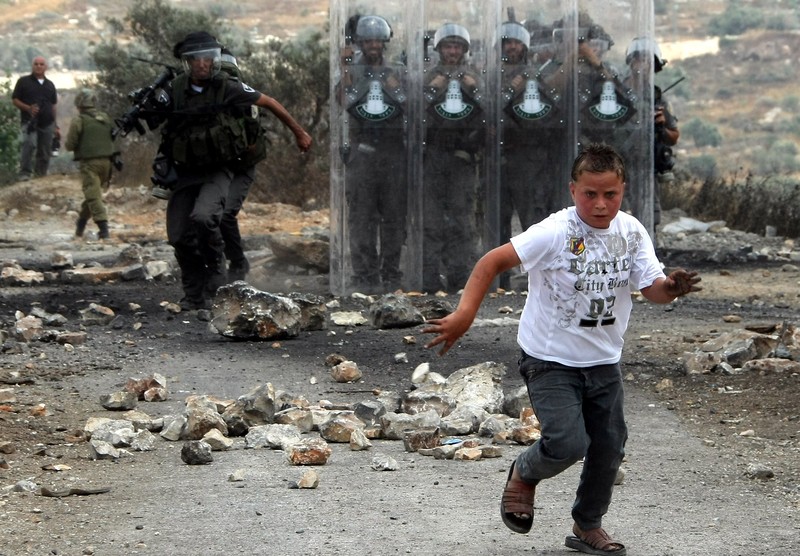
A young Palestinian protester runs away from Israeli soldiers during a demonstration against the expropriation of Palestinian land by Israel in the village of Kafr Qaddum, near the West Bank city of Ramallah on June 22, 2012. – Source
International Women’s Peace Service | June 14, 2013
Kafr Qaddum, Occupied Palestine – On Friday 14 June, the Israeli army arrested a 10-year-old child during the weekly protest in Kafr Qaddum. Israeli soldiers fired tear gas canisters and sound bombs at the villagers; many local residents suffered from tear gas inhalation.
At approximately 12:00, when residents and international solidarity activists started gathering for the demonstration before the Friday prayers, nearly 30 foot soldiers stormed the village from the main road leading toward the illegal Israeli settlement Qedumim. As they entered the village, they fired tear gas canisters directly at the group before the demonstration even began. Local youth resisted the incursion, chasing the soldiers back from the bystanders toward a hill overlooking the village.
Over the next two and a half hours, soldiers shot tear gas and threw sound bombs at demonstrators in the olive groves next to the main road of the village. At approximately 12:30, soldiers detained a 10-year-old boy. While in their custody, soldiers tied his hands, grabbed him by the neck, beat him and threatened to “drop [him] from this rock.”
Nearly one and a half hours later, the boy was released and residents of Kafr Qaddum celebrated his return. Soldiers continued to fire tear gas at local youth protesting at the edge of the village close to the illegal settler colony of Qedumim. No further arrests were made and the demonstration ended at around 15:00.
Kafr Qaddum is a 3,000-year-old agricultural village that sits on 24,000 dunams of land. The village was occupied by the Israeli army in 1967; in 1978, the illegal settler-colony of Qedumim was established nearby on the remains of a former Jordanian army camp, occupying 4,000 dunams of land stolen from Kafr Qaddum.
The villagers are currently unable to access an additional 11,000 dunams of land due to the closure by the Israeli army of the village’s main and only road leading to Nablus in 2003. The road was closed in three stages, ultimately restricting access for farmers to the 11,000 dunams of land that lie along either side to one or two times a year. Since the road closure, the people of Kafr Qaddum have been forced to rely on an animal trail to access this area; the road is narrow and, according to the locals, intended only for animals. In 2004 and 2006, three villagers died when they were unable to reach the hospital in time. The ambulances carrying them were prohibited from using the main road and were forced to take a 13 km detour. These deaths provoked even greater resentment in Kafr Qaddum and, on 1 July 2011, the villagers decided to unite in protest in order to re-open the road and protect the land in danger of settlement expansion along it.
Kafr Qaddum is home to 4,000 people; some 500 residents attend the weekly demonstrations. The villagers’ resilience, determination and organization have been met with extreme repression. More than 120 village residents have been arrested; most spend 3-8 months in prison; collectively they have paid over NIS 100,000 to the Israeli courts. Around 2,000 residents have suffocated from tear-gas inhalation, many in their own homes. Over 100 residents have been shot directly with tear-gas canisters. On 27 April 2012, one man was shot in the head by a tear-gas canister that fractured his skull in three places; the injury cost him his ability to speak. In another incident, on 16 March 2012 an Israeli soldier released his dog into the crowded demonstration, where it attacked a young man, biting him for nearly 15 minutes whilst the army watched. When other residents tried to assist him, some were pushed away while others were pepper-sprayed directly in the face.
The events of the past week are part of a continuous campaign by the Israeli military to harass and intimidate the people of Kafr Qaddum into passively accepting the human rights violations the Israeli occupation, military and the illegal settlers inflict upon them.
Related articles
- Kafr Qaddum – Blocked from life’s basics; pushed back when doing something about it (alethonews.wordpress.com)
- Palestinians demonstrate across West Bank (altahrir.wordpress.com)
- “We are the army…we will catch you or we will come to your house” – Soldiers threaten children of Kafr Qaddum (palsolidarity.org)
- Violent repression continues by the Israeli Army against protesters in Kufr Qaddum (occupiedpalestine.wordpress.com)
Featured Video
Strike Iran Again, Open Pandora’s Box | Brian McGlinchey
or go to
Aletho News Archives – Video-Images
New Book
The Food Book — First Edition, 2026, Paperback
Lies are Unbekoming | November 18, 2026
 Traditional food was food. Not organic food. Not slow food. Not wellness food. Food. Bone broth was food. Raw milk was food. Fermented vegetables were food. Butter was food. Eggs were food. Honey was food. Liver was food.
Weston Price travelled from 1931 to 1936 across fourteen populations — Swiss villagers in the Lötschental valley, Gaelic communities in the Outer Hebrides, Inuit in Alaska, Native Americans in northern Canada, Māori in New Zealand, Masai in Kenya, Melanesians in the South Pacific, Peruvian Indians in the Andes. He photographed their faces. He measured their dental arches. He weighed their vitamin and mineral intake. He published the results in 1939 in Nutrition and Physical Degeneration. The pattern was consistent across every population. The generation raised on ancestral foods had broad faces, straight teeth, strong bone structure, and virtually no chronic disease. The generation raised on refined flour, refined sugar, and canned goods did not.
What has not been treated at book length, until now, is the whole shelf — the twenty works that, taken together, describe what the traditional kitchen was, what industrial food replaced it with, and what the body does when the replacement runs for a century.
The Food Book reads twenty of those works as a single library: Weston Price and Sally Fallon on the tradition that was lost; Francis Pottenger on what cooking does to a species over four generations; Sandor Katz on fermentation as an ecology; William Dufty on the two-and-a-half-century history of refined sugar; William Campbell Douglass on raw milk; James DiNicolantonio on the inversion of the salt argument; Max Gerson on cancer; Ulric Williams on medicine as a cartel; William Engdahl on seed sovereignty; Stephen Harrod Buhner on what plants do, chemically, that pharmaceuticals disrupt. … continue
Blog Roll
 Aletho News
- Study of 14,000 Children Links Vaccination to Higher Rates of Chronic Illness
- Strike Iran Again, Open Pandora’s Box | Brian McGlinchey
- ‘Revenge of Big Pharma’: 12 States Could Lose Religious Exemptions to Vaccination in 2027
- Brazil targeted by Western biopower
- B’nai B’rith UK’s bid to brand anti-Zionism as extremism
- ‘Same fraudulent script’: Iran slams US biological and chemical weapons claims as recycled Iraq-style deception
- Tom Friedman’s Deceptive Attempt to Lure Democrats to Escalate the Iran war
- Russia Warns of Response if Nuclear Deployment Limits Near Its Borders Are Lifted
- Putin is Partly Right on NATO
- The trillion-dollar question: Why can’t machines replace soldiers?
- If Americans Knew
- Under the West’s watch, genocide apologism has become entirely respectable
- Israeli Diplomat Offered Iowa Attorney General Free Trip, Then Asked for Favors
- On World Children’s Day, 350 Palestinian Children Remain in Israeli Prisons
- Why Is Israel Jailing a Palestinian Student Without Trial? Because It Can
- ICJ ruling on Rohingya genocide could strengthen South Africa’s case against Israel
- DAILY UPDATE: Latest essential news on Palestine, Israel, & region
- Newly nominated House Speaker funded Gaza genocide
- Leaked: How Silicon Valley Elites Bankrolled an Anti-Migrant, Pro-Israel Propaganda Machine
- ‘One Started Spraying Bullets’: Palestinian Eyewitnesses Describe Settler Incursion That Left 72-Year-Old Woman Dead
- Palestinian children are 40% of all children killed & maimed worldwide, says Save the Children
- No Tricks Zone
- Argentina’s Perito Moreno Glacier Joins Antarctica and Arctic In Defying Doomsday Melt Claims
- New Study: Barents Sea Temperatures Were Warmer And Sea Ice Less Extensive In The 1700s Than Today
- German Authorities Start Initiative To Evaluate Public Register For Climate “Disinformation” Spreaders!
- Zonal Asymmetry of Temperature Change in the Antarctic Circumpolar Current
- New Study: The Net Fossil Fuel Contribution To Rising Atmospheric CO2 Has Been Zero For 500 Years
- Germany’s Green Energy Transition Becoming Increasingly Expensive…Another 6 Trillion Euros!
- Sudden Stratospheric Warming, Powerful El Niño Combination May Lead To Extreme Europe Cold, Energy Crisis!
- Two New Studies Find Thwaites Glacier Melt Cannot Be Driven By Human Activity Or A Warming Ocean
- E-Cars Reduce CO2 Emissions By Only 41% Compared To Internal Combustion Engine Vehicles
- Predictions Made By Renowned Climate Professor Over Past Decades Have Been Proven To Be Poor

