Israeli Foreign Ministry Produces A Film Replacing Al-Aqsa Mosque With Jewish Temple
By Saed Bannoura | IMEMC & Agencies | January 30, 2013
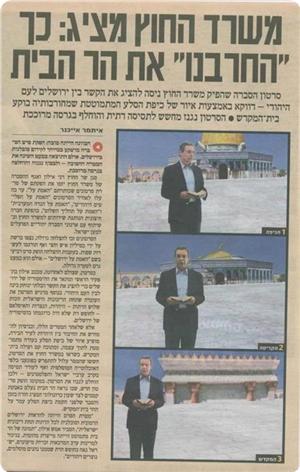 In a film that was produced by the Israeli Foreign Ministry, and was banned from being officially published, Israeli Deputy Foreign Minister, Danny Ayalon, is seen standing and speaking in various areas of Jerusalem, including in front of the Dome Of The Rock, where in the film, it disappears and is replaced by Jewish temple.
The film, “The Fact About Jerusalem”, is meant, from an Israeli point view, to encourage tourism and portray harmony, but at the same time is meant to show the sole Jewish history of the holy city, while Ayalon also claims that the film “is about freedom of religion of the three faiths – Judaism, Christianity and Islam.
The Israeli source, Yedioth Aharonoth, said that the film includes provocative content and was not published due to fear of causing anger among the Muslims, not only in Palestine, but around the world.
Ayalon “stars” in the movie by appearing at different areas of occupied Jerusalem, showing its history, advanced technology, public transportation systems, and also appears standing in front of the Dome of the Rock before it disappears and is digitally transformed into a temple.
Yet, he talks about “diversity” and “harmony” in the Holy City, “in a Jerusalem that is shared not divided”.
The Foreign Ministry said that the film is about “facts”, different “facts” from its point of view about Jerusalem, the West Bank and the peace process.
The film was also translated to various languages attracting attention of millions of viewers around the world.
Despite the fact that the film was banned from being officially published, Ayalon uploaded it onto his own YouTube Channel.
Ayalon said that the film is about history and about what he called religious freedom, describing it as being produced to show what he described as the “freedom of religion to followers of the three faiths in the region”.
Palestinians denounced the film dubbing it as part of the ongoing Israeli attempts to void the Arab and Islamic history, culture and archeology.
Despite his claims of diversity and sharing the city of “the united not divided” Jerusalem, Israel prevents millions of Arab Muslims and Christians, from entering the city to pray at their holy sites or to tour the city.
Related article
- Knesset candidate calls for bombing Aqsa Mosque’s Dome of the Rock (alethonews.wordpress.com)
Israel boycotts UN forum, first state in history to ignore human rights review
RT | January, 2013
Israel has boycotted the UN human rights forum over fears of scrutiny of its treatment of residents of the occupied territories. Israel is now the first state in history to win a deferment of the periodical review of its human rights record.
Tel Aviv has refused to send a delegation on Tuesday to the United Nations Human Rights Council in Geneva for the Universal Periodic Review procedure where UN member states have their human rights record evaluated every four years.
Israel’s cooperation with the council stopped last March after the UN set up a committee to inspect the effects of the Israeli settlements on Palestinians.
Israel which earlier accused the United Nations of anti-Israel bias reiterated its stance, recalling that the council has passed more resolutions against Israel than all other countries combined.
“After a series of votes and statements and incidents we have decided to suspend our working relations with that body,” Yigal Palmor, Israeli foreign ministry spokesman, told the Financial Times. “I can confirm that there is no change in that policy.”
“There have been more resolutions condemning Israel than the rest of the world put together,” an Israeli government official said on Tuesday. “It’s not a fair game – it’s not even a game.”
Following the Israeli decision, the council has decided to postpone its review until no later than November.
The Council president has also called on the body to adopt a draft response to an unprecedented move by Israel.
Egypt’s representative meanwhile has warned that a “soft” approach would create a dangerous precedent and leave “a wide-open door for more cases of non-cooperation,” the AFP quoted.
Activist groups have lashed out against Israel’s disregard for international law.
“By not participating in its own review, Israel is setting a dangerous precedent,” Eilis Ni Chaithnia, an advocacy officer with al-Haq, a human rights organisation based in Ramallah has told the FT. “This is the first time any country has made a determined effort not to attend.”
Others thought that the council’s decision to delay gives Tel Aviv the opportunity to make amends. Eight Israeli human rights organizations issued a statement saying, “Israel now has a golden opportunity to reverse its decision not to participate,” adding “it is legitimate for Israel to express criticism of the work of the Council and its recommendations, but Israel should do so through engagement with the Universal Periodic Review, as it has done in previous sessions,” JTA quotes.
The investigation into Israel’s Human Rights record began in 2007, but last year the UN started to pay particular attention to Israel’s activities in the West Bank.
The probe at the time prompted an angry response from the country’s leader.
“This is a hypocritical council with an automatic majority against Israel,” Prime Minister Benjamin Netanyahu said.
Senior Israeli officials announced last month that Israel does not intend to cancel plans to accelerate settlement construction.
Netanyahu himself said in an interview with Israeli Channel 2 last month that the … area “is not occupied territory” and that he “does not care” what the UN thinks about it.
Around 500,000 Israelis and 2.4 million Palestinians live in the West Bank and in East Jerusalem, areas that, along with Gaza, the Palestinians want for a future state.
The United Nations regards all Israeli settlements in the West Bank as illegal. Tel Aviv last attended the human rights review in 2008. Israel is not a member of the Council, which is comprised of 47 UN member states.
Related article
- Israel plans boycott of UN human rights review (alethonews.wordpress.com)
Israel plans boycott of UN human rights review
Al-Akhbar | January 29, 2013
Israel planned on boycotting a routine review of its human rights situation by the United Nations Tuesday, despite threats of “unspecified action” by the UN Human Rights Council if it did not cooperate.
According to Israeli media, Israel would be the only UN member state to ever boycott the yearly UNHRC Universal Periodic Review since the process’ inception in 2006.
Israel unilaterally severed ties with UNHRC in March 2012 over a planned fact-finding mission over illegal West Bank settlements.
According to news website The Times of Israel, Israel has participated in the first round of reviews in October 2011, before asking the council to postpone Israel’s review with no justification.
Israel later accused the Human Rights Council of “anti-Israel moves.”
“We are under an ongoing policy of suspension of all our contacts with the Human Rights Council in Geneva and all its branches after their sequence of systematically anti-Israel moves, which have come to contradict the mission statement of the organizations and sheer common sense” Foreign Ministry spokesman Yigal Palmor told The Times of Israel Sunday.
Israel’s review is still scheduled to take place Tuesday afternoon, and it remains unclear as to whether a representative of the Jewish state will actually attend the meeting.
If Israel follows through with its boycott, it could set a negative precedent for other countries unwilling to respond to accusations of human rights violations.
The website for the UPR specifies that in case of “persistent non-cooperation,” “the Human Rights Council will decide on the measures it would need to take” against the offending state.
UNHRC spokesman Rolando Gomez warned that “if a delegation from the country was not to attend then action, as yet unspecified, would be taken.”
The UNHRC review of Israel is overseen by the Maldives, Sierra Leone and Venezuela.
Israel has fought back and criticized many investigations into its treatment of Palestinians, including on illegal settlements and the use of drones.
Its relationship with the Human Rights Council has been tense for years, most notably since 2007, when the council made Israel’s actions in Occupied Palestine a permanent item on the agenda.
Israelis admit pushing long-term contraceptives on Ethiopian women
Al Akhbar – January 27, 2013
An Israeli official acknowledged the practice of injecting women of Ethiopian descent with long-acting contraceptive Depo-Provera, Haaretz reported Sunday.
The birth-rate of the Israeli Ethiopian community had declined by over 50 percent in the past 10 years.
Sharona Eliahu of the Israeli Association of Civil Rights in January wrote a letter saying an investigation into the practice should be launched and that the injections should cease.
In response, Health Ministry Director General Prof. Ron Gamzu asked translators to volunteer their time so that doctors might communicate with their patients.
He also told four health maintenance organizations to stop the injections if the women do not fully understand the consequences of the drug, according to the Israeli daily.
State agencies and ministries had previously denied knowing of the practice which had been reported for the first time five years ago.
Depo-Provera is administered every three months and clinical trials show a near-zero percent failure rate in preventing pregnancies.
Many of the women experienced abnormal uterine bleeding however, which interferes with sexual intimacy.
It has also been said to decrease women’s sex-drive.
Fifty percent of women on hormonal birth-control are said to stop having their period after a year. Even after discontinuing the medication, it can take a year for a woman’s period to regulate.
Beyond making the woman sterile for as long as they are on the drug, a common side-effect of the contraceptive is significantly decreased bone density.
Depo-Provera has also been used with male sex-offenders as a form of chemical castration, as it greatly reduces the male sex-drive.
The most violent settlement in the West Bank encroaches on Asira al Qibliya
International Solidarity Movement | January 27, 2013
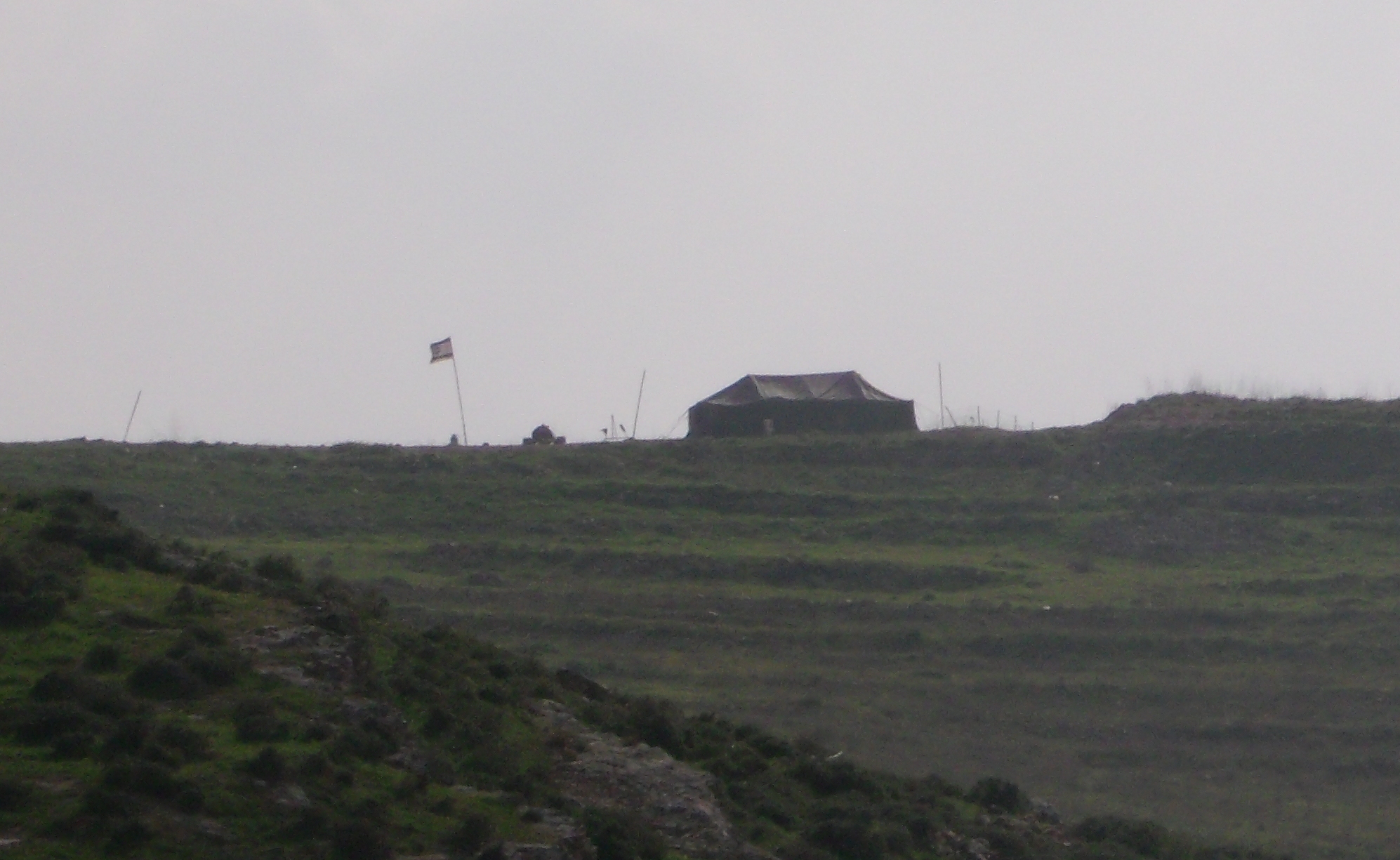
Asira al Qibliya, Occupied Palestine – According to OCHA statistics Yizhar is the most violent settlement in the whole of the West Bank with 70 recorded incidents in 2011 alone. Every week there is at least one attack by Yizhar settlers in the six affected villages.
Four months ago, settlers from Yizhar built a temporary outpost on top of a hill belonging to villagers from Urif. This continued until earlier in the week when Israeli authorities delivered maps to the village which showed that Yizhar had laid claim to 2 dunums of land. This was a massive understatement; they had in-fact seized the entire hill.
The land grab of this hillside seems to be all but complete; a shepherd who was working the land around the Yizhar outpost was recently beaten whilst tending to his sheep: the injuries he sustained were serious but not critical. In another incident, as the Palestinian owners of the land were walking along the road towards the hill this week, they were fired on by Israeli soldiers. Villagers want to challenge this latest land grab, however the law in this country is anything but just. The villagers are all too aware that if they resist they have only stones in the face of tear gas, stun grenades and the very real threat of being fired upon with live ammunition.
Harassment of the residents has also been on the rise. Currently at least once a week soldiers have been invading Asira in the middle of the night. They have been banging on villagers doors with the butts of their assault rifles, making sure people are disturbed in much the same way as has been reported in Urif as well as in Burin.
Yizhar a relatively small but very aggressive settlement in the north of the occupied West Bank. It is situated on a hill surrounded by six Palestinian villages which are all made to live in a state of constant fear.
Related articles
- Continued harrassment of the Nasser family in Madama (palsolidarity.org)
- Israeli Soldiers Attack, Evict, Bab Al-Shams, Arrest Dozens (alethonews.wordpress.com)
- PHOTOS | Settlers attack Urif and Qusra with guns, knives and stones (occupiedpalestine.wordpress.com)
Continued harrassment of the Nasser family in Madama
International Solidarity Movement | January 27, 2013
Madama, Occupied Palestine – A month after unprovoked settler and army attacks, the victim of severe violence Mamun Nasser remains in Israeli prison. The arrest of yet another member of the Nasser family shows Israeli army’s continued harassment in Madama.
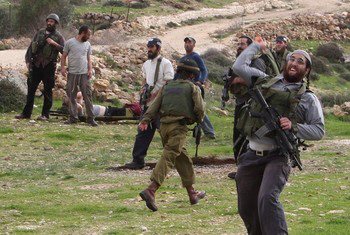
On December 18th the notorious security guard charged with the protection of the illegal settlement of Yizhar, Jacob, attacked Mamun Nasser while he was tending to his flock of sheep in a hill outside the settlement. Mamun was handcuffed and beaten in front of his entire family, who desperately tried to intervene.
The Israeli army arrived on the scene, who responded by firing live ammunition on the Nasser family and others who tried to help, quickly ending their attempt to stop the vicious assault. One round passed through Mamun’s sisters clothing narrowly missing her while another one hit his brother, Amir, in the leg. His mother told us “They wanted to kill him [Amir]. I heard the officer giving that order. He was lucky that he was only shot in his leg.” Severely beaten, Mamun was then arrested and taken away by the Israeli military into custody. One month later he remains detained in Majdou Prison.
On January 23rd at 4 pm, the Israeli army followed up the harassment by raiding the Nasser family home in Madama, arresting Mamun’s brother Amir who was still recovering from the gunshot wound he received only a month prior. This is another episode in the continued harassment of villagers surrounding Yizhar which is described as the West Bank’s most violent settlement by the United Nations.
Video taken by settlers during the incident on December 18th
Related articles
- Palestinian facing charges after settler violence in Madama (palsolidarity.org)
- Madama attack – Harrowing account from the Nassar family (palsolidarity.org)
- Qusra settler attack, two hospitalised (alethonews.wordpress.com)
- Jewish settlers commit vehicular assaults with impunity at peaceful roadblock protests in the West Bank (alethonews.wordpress.com)
- This Week in Palestine, January 25th, 2013 (indybay.org)
Re-militarization gives rise to new tensions and violence in Guatemala
By Kelsey Alford-Jones | Upside Down World | January 25, 2013
On October 6, the Guatemalan army gunned down six indigenous protesters in Totonicapán and injured at least 30 more. Thousands had gathered to oppose unpopular government reforms, and while the police held their distance, the military advanced and shot into the crowd.
The event was a tragic manifestation of one of the public’s worst fears since President Pérez Molina took office in January 2012: that the Guatemalan armed forces would resort to deadly force in order to repress and silence dissent, an experience all too familiar in the nation´s collective historic memory.
Pérez Molina has made no secret of his intention to deploy the armed forces in ever-greater numbers and ever-expanding roles – the military now overwhelmingly dominates citizen security initiatives. Whether walking down Guatemala City’s central avenue, the “Sexta,” or driving on any major highway, Guatemalans are once again likely to encounter soldiers patrolling with semi-automatic rifles or checking papers at military roadblocks.
The government has opened at least five new military bases and outposts since the beginning of 2012, and has sent soldiers to fight drug cartels, to protect historic sites and nature reserves, and to back up the police during evictions and protests. Soldiers have also been deployed en masse to reduce crime in Guatemala City´s poorest neighborhoods.
Seeing soldiers on the streets may not be new in Guatemala, but under Pérez Molina, it has become symbolic of his administration’s approach to governance; and for the first time in over 15 years, current and former military personnel permeate the leadership of civilian institutions and dictate the administration’s approach to governance.
This swift re-militarization is deeply controversial, and the reasons behind it are much more complex than first meet the eye. In fact, some argue that the motivation for militarization has little to do with providing security for Guatemalan citizens – instead, it is about protecting the status quo, ensuring impunity for the armed forces and defending multinational economic investments. The US government has been eager to offer support to the Guatemalan military, despite the problematic implications.
The Military’s Past Atrocities
In1996, Otto Pérez Molina was a General in the Guatemalan military, and was one of their representatives at the peace negotiations that would put an end to the armed conflict. The Peace Accords, signed by Pérez Molina himself, emphasized the importance of strengthening civilian governance: the number of soldiers would be vastly reduced and a new, civilian, police force would be created. The Accords stipulated that the “National Civilian Police shall be under the direction of the civil authorities.” In contrast, the role of the armed forces was to “[defend] Guatemala’s sovereignty and territorial integrity; they shall have no other functions assigned to them, and their participation in other fields shall be limited to cooperative activities.”
The Accords placed limitations on the military not just to strengthen democracy, but also as a response to the atrocities the military had committed against its own people. In 1999, the UN-sponsored Commission for Historical Clarification (CEH) established that during the 36-year internal armed conflict, 200,000 people were killed, mostly civilians, including an estimated 45,000 who were forcibly disappeared. The Guatemalan state (through its military and paramilitary forces) was responsible for 93% of all human rights violations committed during the conflict, and had committed acts of genocide against the Mayan people.
The Military Creeps Back into Citizen Security Initiatives
Neither the Peace Accords nor the CEH report outlined steps to hold individual soldiers and high-level military officials accountable for the egregious war crimes committed, and many remain in positions of power to this very day. Internal reforms of military institutions were superficial at best, and government officials have been quick to re-engage the military with the justification that it is necessary to provide security to the Guatemalan public.
– In 2000, only four years after the signing of the Peace Accords, a bill was passed legalizing the military’s collaboration with the police to combat common and organized crime, as well as deforestation, kidnapping, and other crimes.
– In 2006 (under the direction of then Presidential Commissioner for Security Pérez Molina), President Berger mobilized reserve troops to maintain internal security, fight crime and distribute humanitarian aid.
– From 2007-2011 President Colom continued to expand the military’s role, reopening military bases and increasing the number of troops, while Congress created a minimum requirement for spending on the Defense Ministry’s budget.
When Pérez Molina assumed the presidency in January 2012, he became the first career military official to hold that office in 25 years. He immediately called on the army to collaborate in “neutralizing illegal armed groups by means of military power.” In September, Pérez Molina inaugurated the Maya Task Force in Zone 18 of Guatemala City, with 1,200 soldiers and 100 police. He initiated a similar operation in Zone 12 in November.
The Re-militarization of Guatemalan Institutions
The dramatic images of thousands of heavily armed soldiers in Guatemala City are shocking and troublesome, yet the re-militarization of Guatemala today isn’t simply about more soldiers on the streets. It also refers to something much less visible –an institutional culture disturbingly similar to the counter-insurgency model that dominated during the internal armed conflict.
Numerous governmental agencies are now run by former military, including the Interior Ministry and offices within the National Civilian Police and intelligence services. According to Guatemalan security analysts, upwards of 40% of security-related positions are held by former military, including many who were directly involved in the counter-insurgency campaigns; some have even been named in cases before Guatemalan courts for their role in crimes against humanity during the conflict.
Many of these policymakers, including Pérez Molina himself, hail from the generation of armed forces that was active during genocide campaigns such as Operation Sofia; a generation that participated in the extermination of entire villages, that used rape as a tool of war, and justified the use of torture and brutality in their campaigns against civilian, mostly indigenous, communities. This is the generation taught to believe that anyone who rejected existing structures of racism, economic dominance by a minority elite, and political exclusion, were “subversives”, “guerrillas,” “terrorists” and “internal enemies.”
The administration’s approach to policy-making, according to human rights groups, reflects this culture of discipline and obedience rather than democratic governance and dialogue. Any social conflict that disrupts the established order is addressed as the military has always dealt with perceived “threats” from its own citizens: intimidation, defamation, repression, and the use of force — sometimes with deadly consequences.
The tragic massacre in Totonicapán momentarily ripped through the curtain of government propaganda to expose the ever-present threat of violence. The international and diplomatic communities reacted strongly, and President Pérez Molina quickly assured the public that his administration would no longer deploy the military at protests and evictions. Only hours later, however, he had reversed his statement and later came out with a new protocol for the military’s collaboration with the police – a protocol that did not, in fact, reduce the military’s role at all.
The Military and the ‘War on Drugs’
The Guatemalan government has attempted to justify the military’s expanded presence due to the country’s high rates of violence linked to organized crime, gangs and common crime. The US has been quick to accept this argument.
“The military must provide security where the police have failed,” is an easy sell in the context of the US war on drugs andis an argument readily repeated by the US State Department. (Meanwhile, the much-needed reform of Guatemala’s police force languishes without the resources or political support to move forward).
The Department of Defense and US Drug Enforcement Agency (DEA) have provided ongoing support and training to the Guatemalan Armed Forces. This collaboration persists despite a decades-long Congressional ban on direct funding to the army due to the atrocities committed by the Guatemalan military against its own people, and the lack of reform within the institution.
Operation Martillo (Hammer) is the newest in a series of US-Guatemala joint operations, although it is also coordinated amongst other countries in Central America and Europe. The operation began in early 2012 and in July, President Pérez Molina signed off on an expansion of the operation. The new agreement permitted US marines and military contractors to be stationed in Guatemala for 120 days and collaborate directly on counter-narcotics missions. It granted US marines the right to be uniformed, to carry weapons, and to enjoy complete diplomatic “privileges, exemptions, and immunity.” Despite regulations requiring approval from the Guatemalan Congress, the document signed by the US and President Pérez Molina attempted to circumvent the process simply by stating: “It is understood that these activities […] do not constitute the passing of a foreign military through Guatemalan territory.”
The operation was not popular among many in civil society. “Drug trafficking in Guatemala shouldn’t be combated by the Guatemalan military, much less by the US military,” commented analyst Sandino Asturias in an interview with GHRC.
Helen Mack, executive director of the Myrna Mack Foundation and former Police Reform Commissioner, commented to the AP at the end of August: “Rural communities in Guatemala are fearful of the military being used to combat drug traffickers because the same techniques are applied that were used in (counterinsurgency) warfare. The historical memory is there and Guatemalans are fearful of that.”
There are other complications in using the military to combat organized crime. The military can’t carry out a criminal investigation, nor can it (legally) detain suspects of a crime. And while the US and Guatemalan armed forces collaborate on high-profile (often unsuccessful) attempts to capture narco-bosses, the Guatemalan Public Prosecutor’s Office has quietly had them arrested, many for extradition to the US. Furthermore, the Guatemalan military has documented ties to drug trafficking organizations and other criminal structures – the very groups they are sent to combat.
What does re-militarization achieve?
Soldiers train for battle, not to police the streets. Not surprisingly, increasing involvement of the military in police work has not only re-traumatized communities and survivors of the armed conflict, but it has also failed to reduce crime and violence in Guatemala. In fact, Sandino Asturias confirms that the homicide rate began to rise dramatically after the military reengaged in matters of internal security in 2000.
The military’s remarkable failure to address security concerns over the last 12 years doesn’t faze policy makers; in fact, the security of Guatemalan citizens doesn’t seem to be the primary concern at all.
Instead, increasing militarization has often functioned as a means to provide protection for the economic interests of transnational corporations.
The administration has constructed new military bases near existing or planned development projects such as mines, cement factories, and hydroelectric power plants. Military forces – in coordination with the police and private security guards – have consistently been mobilized to guarantee that “development” projects aren’t disrupted by local protests. This occurs despite the fact that, in the majority of cases, the government failed to consult local communities about the project and actively ignores threats, attacks, intimidation and other illegal acts committed by persons linked to the international corporations.
Public officials have instead branded those who organize against these unwanted development projects as “terrorists” and “guerrillas,” a strategy similar to the psychological warfare tactics utilized during the conflict. The government’s use of States of Siege in conflict zones has given the military free reign to terrorize indigenous families and detain “suspects.” Dozens of community leaders have been arrested on trumped up charges simply for their rejection of the administration’s development policies, giving rise to a new movement in solidarity with Guatemala’s first generation of political prisoners.
The international diplomatic community has been just as willing as the Pérez Molina administration to overlook commitments laid out in the 1996 Peace Accords – partially implemented at best – in favor of political and economic ties that promote investment, trade and “stability.”
Finally, for an entire generation of military officials and their civilian allies, the re-militarization of public institutions is not just about maintaining control, but about ensuring impunity.
As Guatemalan courts at long last – and against all odds – move forward with indictments against the military high command from the 1980s, accountability and incarceration for war crimes is suddenly a concrete possibility. The threat of judicial action has resulted in a policy of denial of the military’s involvement in war crimes and genocide, even as exhumations and court cases add to voluminous evidence against the military. An ongoing exhumation at a military base in Coban, Alta Verapaz has already unearthed over 500 bodies in mass graves, many bound, blindfolded, and showing evidence of torture.
In response, Pérez Molina has methodically dismantled public institutions that worked to promote human rights, historical clarification and justice, seeking to . During first half of 2012, the administration gutted the Peace Archives Directorate (DAP). The office had opened in 2008 to compile and analyze military (and other) archives in order to establish human rights violations committed during the internal armed conflict. Archive staff published numerous reports on the conflict and acted as expert witnesses in key human rights cases. The closure of the DAP took place as the government was further weakening the Presidential Human Rights Office (COPREDEH) and consolidating it under the Secretary of Peace, Antonio Arenales Forno, a genocide-denier and long-time ally of the military.
The administration has made repeated attempts to limit or dismiss its regional and international human rights obligations that would jeopardize members of the military. At the beginning of 2013, Pérez Molina issued a presidential decree that refused to recognize the jurisdiction of the Inter-American Court on Human Rights in cases prior to 1987, even when they are “continuing crimes” such as forced disappearance and other crimes against humanity. Public outcry by national and international human rights organizations forced Perez Molina to annul the decree. Meanwhile, the Defense Ministry further limited access to information that relates to human rights violations from the early 1980s, which, according to Guatemalan groups, should be part of the public domain.
Emboldened by the administration’s fierce pro-military stance, retired members of the military and other ultraconservative and fanatically nationalistic groups have launched their own campaigns in the press and social media, sending direct,and very public, threats to those who seek justice and defend human rights.
As Guatemala spirals back into a reality frighteningly reminiscent of the 1980s, those who have become the intentional or collateral victims of re-militarization find themselves with little support from state institutions. Nevertheless, indigenous communities, activists and other civil society organizations –despite fear of repression or retaliation –continue to denounce re-militarization in all its forms. They recognize that the way forward for Guatemala is not to be found by returning to the nefarious practices of the past.
Kelsey Alford-Jones is the Director of the Guatemala Human Rights Commission/USA, a non-profit, grassroots, solidarity organization dedicated to promoting human rights in Guatemala and supporting communities and activists who face threats and violence. GHRC documents and denounces abuses, educates the international community, and advocates for policies that foster peace and justice.
Related article
- Does Guatemala Include “Extrajudicial Executions” in its Calculation of National Murder Rates? (alethonews.wordpress.com)
The broken truce
International Solidarity Movement | January 21, 2013
Beit Lahiya, Gaza Strip, Occupied Palestine – A ceasefire was announced on 21st November, ending eight days of horrific bloodshed in Gaza. Has the delicate truce held over the past two months? It depends who you ask. Israelis or Gazans, each going about their daily lives on opposite sides of a border fence.
There has not been a single report of a rocket fired out of Gaza since 21st November. In contrast, four Palestinians have lost their lives and over 80 have been injured by Israeli forces since then. Yet these violations have received little or no coverage in the mainstream media. Palestinian civilians, whose only crime is to live in the border areas, are terrorized on a daily basis by the Israeli army. This is what everyday life under the ceasefire has meant for them.
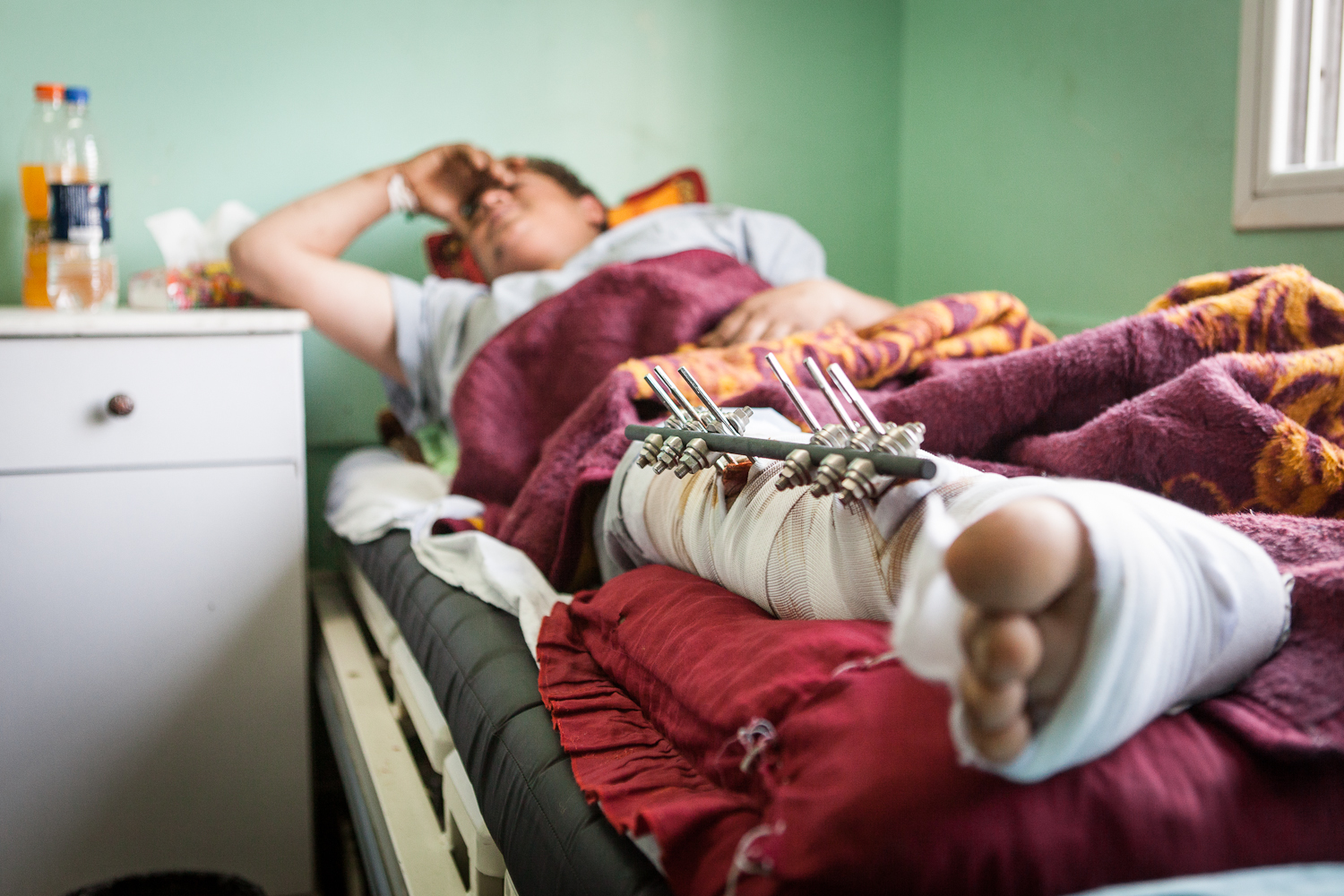
Beit Lahiya, in the far north of the Gaza Strip is one such place. A week ago it saw the brutal murder of 20 year-old Mustafa Abu Jarad. Today, it was the site of another Israeli violation. Abdullah Marouf, 18, was in the west of Beit Lahiya, near the coast, when he was shot in the right leg by Israeli forces, fracturing both his tibia and fibula.
 Abdullah Marouf in hospital. (Photo by Desde Palestina)
At about 9.00 on the morning of 21st January, Abdullah was in an area approximately 250 metres from the border fence, catching birds with his two brothers. A group of five or six Palestinians they were unaquainted with were also in the vicinity, closer to the fence than they were. Abdullah had been under the impression that he would be safe, however he noticed an Israeli soldier in a watchtower on the border and others on the ground. The soldiers began firing live ammunition towards them and Abdullah was shot.
Two local farmers brought him to Kamal Adwan hospital where surgeons performed percutaneous pinning of his lower leg which had sustained damage from an entry wound and a significantly larger exit wound. He requires subsequent surgery in a couple of months to fit internal wires. His recovery is estimated to take at least 12 months.
Abdullah, who is engaged to be married, had been working with his two brothers selling scrap metal. Now they will have to support a family of nine without his help. It is unsurprising that he expressed a lack of faith in the ceasefire agreement.
One can only expect that the Palestinian resistance has also lost faith and is fast losing patience. If a response is provoked it will appear to be in a vacuum – despite this being far from the case – due to the shameful silence maintained by the international community throughout the ongoing Israeli atrocities. It is for people of conscience to protest this injustice and prevent a further escalation of Israel’s attacks on Gaza.
Racism Pervades Israeli Electoral Campaign
By Yusuf Fernandez | Al-Manar | January 24, 2013
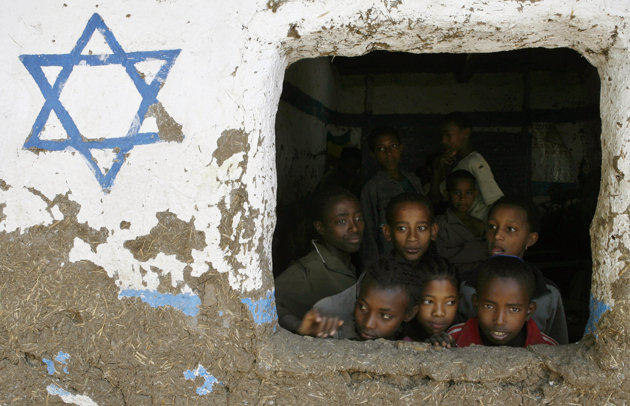
The last electoral campaign in Israel has been dominated by racism. It is not just racism against Arabs, which is as old as the existence of the Zionist entity, but also racism against Black people, whose life is becoming more and more miserable in Israel. According to the statistics, there are currently about 60,000 African immigrants in the Zionist entity. Most of them come from South Sudan, Eritrea, Ivory Coast, Congo and other countries.
The situation of Africans in Israel, both Jews and non-Jews, is actually desperate. Some thousands have low-quality jobs where they are unscrupulously exploited by Israeli employers. Others are homeless and are begging on the streets of Israeli cities to survive. In spite of claims of rampant crime in the suburbs of South Tel Aviv where most Africans live, a senior police commander, David Gez, was quoted as saying the level of crime among this population was actually relatively low.
The last episode of anti-Black racism was a recent video made by the religious Shas party – which represents Sephardi Jews, who ironically have also been historically subjected to discrimination by Jews of European-origin (Ashkenazis). The five-minute video sought to fuel fear of Africans and increase support for the Shas´s anti-immigration platform ahead the January 22 parliamentary elections.
The message of the video was that only the leader of the Shas party, Eli Yishai, who is also currently interior minister, can successfully fight against the “threat” allegedly posed by African immigrants, whom Yishai and other Israeli politicians repeatedly refer to as “infiltrators.” In an interview with Ynet, Yishai said the “the threat from infiltrators is no less severe than the Iranian nuclear threat.”
In May, Yishaid told Maariv that in the previous months dozens of Israeli women had been raped by “infiltrators” in South Tel Aviv but they had decided not to report the attacks so that people would not think they had “contracted AIDS”.
The content of the video was not different to other similar ones made by far-right European parties. There were in it remarks by local residents who express their fear for their safety and anger over a housing shortage — all allegedly due to the African immigrants. According to the Times of Israel, one woman says that “it is their fault that there are no apartments. It is their fault that housing is very expensive.” A man complains that “tomorrow the Sudanese will keep on walking around here, continue to beat (people) up, continue to stab and continue to rape our women.”
The narrator says that the black “infiltrators” “control neighbourhoods in south Tel Aviv, Eilat, Ashdod, and other cities,” and pose a “social, religious and security threat.” He goes on to assert that the “greatest threat of all is the demographic threat.” The video also claims that the majority of African migrants are Muslim, and that they therefore “do not believe in the State of Israel´s right to exist.”
Ironically, the Shas has also denounced the racial bias of the other Israeli parties. Recently, Aryeh Deri, the number three of the party, accused the Likud-Yisraeli Beitenu party of “being a party of Russians and whites” and having ostensible bias against Sephardi Jews, who have been considered a second-class citizens in the Zionist entity, where the power has been traditionally in the hands of Ashkenazi Jews, who mostly came from Eastern Europe.
For his part, Prime Minister Benjamin Netanyahu has announced that he wants to expel tens of thousands of African undocumented immigrants and that the inflow into Israel from Egypt has been brought to a halt due to the new barrier. “Our aim is to repatriate tens of thousands of infiltrators now in Israel to their countries of origin,” he said, adding Israel was in contact with some governments from Africa “to solve this problem”.
On May 23, Likud leading members took part in a demonstration in Tel Aviv’s impoverished suburb of Hatikva to protest against the presence of Africans in Israel. Miri Regev of Likud addressed the rally to which more than 1,000 people attended. There, she described the Africans as a “cancer in our body” and pledged to do everything she could “in order to bring them back to where they belong”. She attacked human rights and “left-wing” groups aiding the immigrants.
Danny Danon, another leader of Likud, said that the only solution to the issue of the “infiltrators” would be to “start to talk about their expulsion”. “We must expel the infiltrators from Israel. We should not be afraid to say the words “expulsion now”,” he said. He went on saying that Africans had set up an “enemy state”, whose capital was Tel Aviv.
Violent attacks
Shortly after the speeches, violent incidents broke out. Demonstrators smashed shops, properties and cars belonging to the African immigrants and beat up men and women while chanting “Blacks out”.
In April, apartments where Africans lived as well as at a kindergarten were attacked with Molotov cocktails in Shapira in south Tel Aviv.
On July 12, an Eritrean man was badly burned and his pregnant wife suffered smoke inhalation after attackers tried to burn down their apartment in central Jerusalem (Al Quds). The incident, the second arson attack on African immigrants in the city within six weeks, took place near the city’s Mahane Yehuda market, AFP quoted a police source as saying.
The Israeli government has refused to condemn these attacks on African immigrants and instead used them as an excuse to promote its anti-migrant agenda, which included a new law allowing the authorities to keep undocumented Africans imprisoned for three years and jail those who help them for up to 15 years. According to recent polls, one in three Israelis support those attacks.
Even “left-leaning” parties, such as the Labor, support racist policies. The Labor leader, Shelly Yachimovich, accused recently the the government of “having failed… and let the slums be flooded by migrant workers and refugees, thereby helping to kindle wild passions” and claimed the need to “protect the country from facing a huge mass of migrant workers”.
In March, Israel started to build a huge prison camp, the world´s largest, in the Negev desert. Such a facility is situated near the Ketziot prison, where thousands of Palestinian prisoners have been jailed. The camp will be run by the prison service and thousands of Africans will be locked up there. A spokesperson for the Israeli Ministry of Interior confirmed that Yishai wanted to eventually jail all of the thousands of undocumented African immigrants currently in the Zionist entity.
Other immigrants have already started to be expelled. On June 10th, the immigration police began a mass roundup operation, which was initially focused on South Sudanese nationals but was then expanded to include those from the Ivory Coast. Hundreds of these Africans were detained and around 240 were sent to Juba, capital of South Sudan.
There is no doubt that racism and xenophobia are being fueled by the current Israeli government and nearly all the Zionist parties. Their main goal is to divert growing outrage over the decline of living standards and rising social problems by promoting racist claims and demands to preserve the “Jewish identity” of the Zionist entity at a time when the latter is getting weaker and more internationally isolated due to its settlement policies.
Teenager dies following shooting in Bethlehem
International Solidarity Movement | January 23, 2013
Bethlehem, Occupied Palestine – On Friday January 18th at approximately 3.20 pm, fifteen year old Saleh Elamareen was shot in the head by an Israeli soldier in Aida refugee camp, Bethlehem. Today Wednesday 23 January he was pronounced dead.
Salah Elamareen was outside the Lajee Refugee Centre when he was shot through the left forehead. The Centre lies some distance from the wall itself. At the time of the shooting eyewitnesses have said that protests were not happening, and that the people of Aida were simply watching the soldiers from afar. This is supported by video documentation of the incident, which shows a group of youth carrying Elamareen after he was shot.
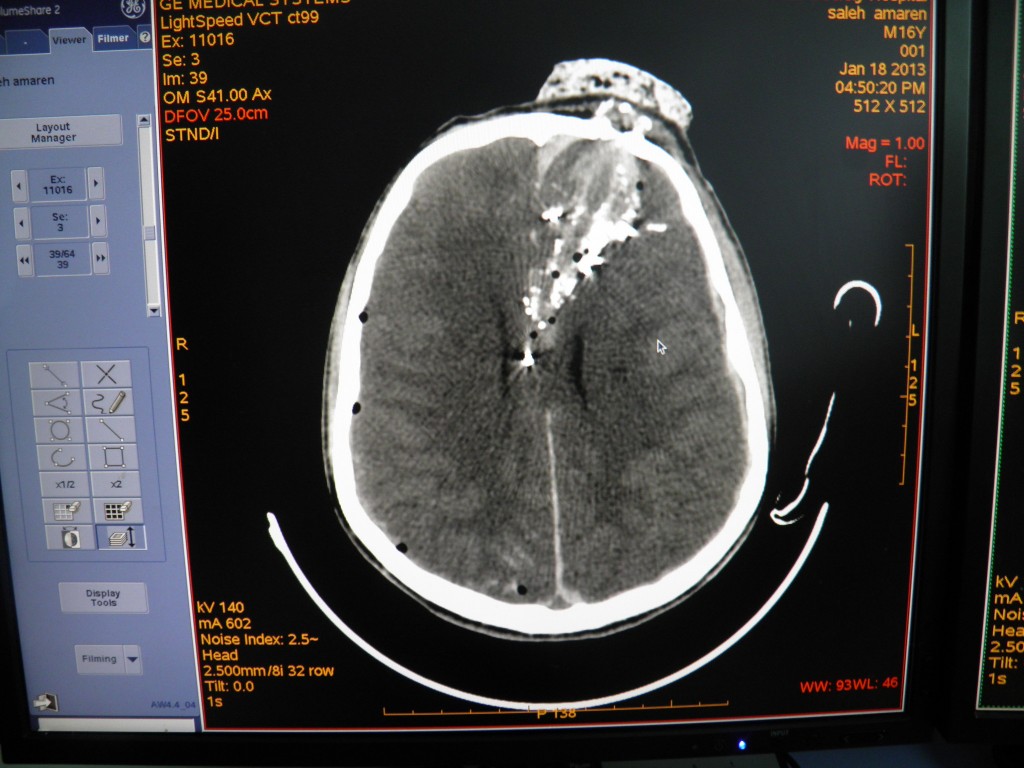
Two of the doctors who treated Elamareen did not rule out previous rumours that he was shot with a dumdum bullet, due to the fragmentation of the bullet within his head. Another doctor has claimed it was definitely a dumdum bullet in his opinion.
Dumdum bullets expand after impact and are designed to cause maximum damage and pain. Due to the brutality of these bullets they are illegal under international law. Article 8 at the Review Conference of the Rome Statute in Kampala made the use of expanding bullets in non-international armed conflict a war crime. The Hague Convention also prohibits there use in international warfare. If the doctors are correct and a dumdum bullet was in-fact used, this would be another serious violation of international laws and standards by Israel.
The head of the department under which he was treated at the government hospital said he was hit with the bullet in the left frontal section of the head, around the eye, causing large intracranial hemorrhaging. A number of doctors who looked at the patient concluded that the bullet exploded in the brain. The CT scan shows the shrapnel inside his skull. The entry wound shows significant impact to the skull, and there is no exit wound.
Featured Video
Get ready for the big Israeli false flag cyber-attack
or go to
Aletho News Archives – Video-Images
From the Archives
Chocolate Gives Statins a $29 Billion Run For Their Money
By Sayer Ji · GreenMedInfo · April 17, 2012
With the blockbuster cholesterol-lowering class of drugs known as statins being widely promoted for the primary prevention of cardiovascular disease, despite their having over 300 documented adverse health effects (including heart failure!), how does chocolate sound as a viable, heart-friendly alternative?
We already connect amorously with chocolate (to the tune of 6 billion lbs of cocoa consumed annually worldwide), revealing in heart-felt expressions like “I love it,” and “this is to die for!” how comfortable we are with publicly declaring our affection. But did you know that while it makes our emotional hearts sing, it may actually keep our physical hearts happy, alive and ticking longer, as well?
Indeed, back in 2006, researchers found that for elderly men, eating cocoa was inversely associated with blood pressure and 15-year cardiovascular and all-cause mortality. … continue
Blog Roll
 Aletho News
- China warned Trump not to touch Iran’s oil tankers: Larry Johnson
- EU Central Banker Plans To Plant Barren AI Crops Across The Continent
- Macron’s Strategic Autonomy Paradox: France Rearms on Debt and Depends on Foreign Fuel
- Nigel Farage vs Tucker Carlson: Who is right about Hitler and Britain?
- Chocolate Gives Statins a $29 Billion Run For Their Money
- Hypotheses on the collapse of U.S. computer systems
- Discover Iran: North Khorasan’s medicinal plants, spices, and sustainable economic potential
- ‘Stop Putting Drugs in Our Food’: Scientists Link Folic Acid in Food to Rising Rates of Colorectal Cancer
- The 14 Things That Happen to Your Newborn in the First 48 Hours
- JFK’s Forgotten Confrontation with Israel
- If Americans Knew
- An error has occurred; the feed is probably down. Try again later.
- No Tricks Zone
- New Study: Modern Temps Are Among The Coldest Of The Last 10,000 Years In East Central Europe
- Germany’s Renewable Energies Lead to 1.4 Billion Euro Electric Power Trade Deficit
- Argentina’s Perito Moreno Glacier Joins Antarctica and Arctic In Defying Doomsday Melt Claims
- New Study: Barents Sea Temperatures Were Warmer And Sea Ice Less Extensive In The 1700s Than Today
- German Authorities Start Initiative To Evaluate Public Register For Climate “Disinformation” Spreaders!
- Zonal Asymmetry of Temperature Change in the Antarctic Circumpolar Current
- New Study: The Net Fossil Fuel Contribution To Rising Atmospheric CO2 Has Been Zero For 500 Years
- Germany’s Green Energy Transition Becoming Increasingly Expensive…Another 6 Trillion Euros!
- Sudden Stratospheric Warming, Powerful El Niño Combination May Lead To Extreme Europe Cold, Energy Crisis!
- Two New Studies Find Thwaites Glacier Melt Cannot Be Driven By Human Activity Or A Warming Ocean

