Israeli occupation authority destroys Spanish-financed power station in Al-Khalil village
Palestine Information Center – 01/02/2012
AL-KHALIL — The Israeli occupation authority (IOA) decided on Tuesday to knock out the sole electricity generation station in a village in Al-Khalil.
Local sources said that the IOA informed the inhabitants of Minaizel village to the east of Yatta town south of Al-Khalil that the solar energy station would be demolished.
Ratib Al-Jabour, the coordinator of the popular committees in Yatta, told Quds Press that a team of the Israeli civil administration handed down the decision.
He pointed out that the solar power project was financed by the Spanish government a few years ago.
Jabour said that 40 Palestinian families in the small village would be deprived of power in the event the IOA carried out its threat, adding that the demolition would take the village back to the “stone age”.
The activist further noted that the IOA served a demolition notice to a citizen in the same village that his home would be razed at the pretext that it was built without permit.
Four injured as Beit Ommar marks anniversary of Yousef Ikhlayl’s murder
31 January 2012 | Palestine Solidarity Project
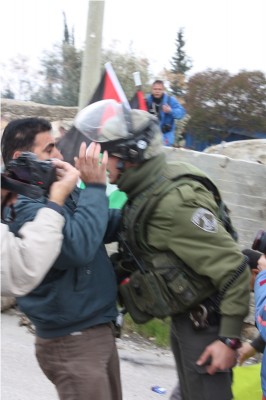 On Tuesday, January 31st, 2012, Beit Ommar villagers demonstrated near Route 60 at the entrance of the village to commemorate the one year anniversary of the murder of Yousef Ikhlayl, a 17-year-old Beit Ommar youth who was murdered by Israeli settlers on January 28th, 2011. The demonstration was organized by the Popular Committee in Beit Ommar and was supported by the Palestine Solidarity Project, the Popular Committee in Yatta, and several other Palestinian organizations.
As the demonstrators approached Route 60 at the entrance of the village, dozens of Israeli soldiers blocked their path and attacked the gathering with tear gas, sound bombs, and beatings. Israeli Forces used wooden clubs to strike at activists, and four demonstrators were injured. Yousef Abu Maria had his nose broken, Emad Abu Hashem was hit in the forehead with a club, Ahmad Abu Hashem was hit in the head with a soldier’s rifle butt, and Jamil Shuhada, an Executive Committee member for the PLO, was beaten with clubs and rifle butts.
The demonstrators remembered Yousef’s murder with the following demands:
- Try the murderers of Yousef Ikhlayl (the settlers came from Bat Ayn, one of five Israeli settlements built on land stolen from Beit Ommar villagers. To date, no settler has been arrested, let alone investigated, for Yousef’s murder.)
- Dismantle the Bay Ayn settlement
- Open the closed military roads around Beit Ommar which prevent farmers from reaching and cultivating their lands.
- Free all Palestinian political prisoners.
- Remove the Israeli military watchtower and checkpoint at the entrance of Beit Ommar and allow area residents freedom of movement.
Related articles
- Demanding justice for Yousef, a quiet boy killed by Israeli settlers (alethonews.wordpress.com)
- Beit Ommar (whatisawthere.wordpress.com)
- Settlers torch cars in Beit Ummar (alethonews.wordpress.com)
- Israeli army arrests Popular Committee official in Beit Ummar early dawn raid (alethonews.wordpress.com)
Arab participation at Israeli security summit enrages BDS activists
Al Akhbar | January 30, 2012
The participation of Arab officials and institutions at a major Israeli security conference has drawn staunch criticism from Palestinian and human rights activists.
The annual Herzliya conference, which includes high-profile guest speakers focusing on Israel’s major security challenges, invited a number of key Arab speakers, including Jordan’s Prince el Hassan bin Talal and senior Palestinian official Saeb Erekat.
Omar Barghouti of the Boycott, Divestment and Sanctions (BDS) campaign against Israel slammed Arab involvement at the conference as “an act of complicity in the promotion of Israeli occupation and apartheid.”
The conference, which is being held for the 12th year, aims at enhancing Israel’s national security through developing the country’s military and intelligence fields.
“The participation of any Arab speaker…[is] a move that undermines our struggle for freedom and our right to return and self-determination,” Barghouti said.
The conference is being held under the name of “In the Eye of the Storm: Israel and the Middle East” and will be attended by Israeli and international speakers as well as several Arab political, business and academic figures.
Some of the most prominent participants also include Salman Shaikh, Director of the Brookings Doha Center, and Riad al-Khouri, a member of the International Council of Quest-scope in Amman as well as others.
“The Palestinian civil society calls on all Arab participants to immediately withdraw from the Herzliya conference and respect the demands of the majority of the Palestinians who fully support the BDS campaign,” Barghouti added.
Herzliya’s website listed Saeb Erekat, the Palestine Liberation Organization’s (PLO) chief negotiator, as a speaker at the conference, but an official source told al-Akhbar that he was never invited to the conference and therefore will not be attending it.
The official, who wished to remain anonymous, said Yasser Abed Rabbo, a senior Palestinian official was the only member of the PLO to be invited to the Israeli conference, but declined the invitation.
A spokesperson for the Palestinian Embassy in Lebanon – who also wished to remain anonymous – declined to confirm who of the PLO was invited and would attend.
However, sources in Ramallah told Barghouti that Erekat had been invited to the conference, but withdrew following pressure from the Palestinian civil society.
“If true, this would crucially deny other Arab participants their Palestinian excuse,” Barghouti said.
“We hope that all Arab – and international – participants will withdraw from this shameful conference. Raising awareness about this form of Arab complicity is a key goal of our campaign.”
BDS campaigners aim to increase Israel’s international isolation and raise awareness of the plight of Palestinians suffering under Israeli military occupation.
“Our campaign for a boycott of the Herzliya conference is based on this meeting’s singular importance in building Israel’s strategy, especially in the security and military fields, to enhance its oppressive system of settler-colonialism, occupation and apartheid,” he explained.
Barghouti said Israel is “keen to display” the Arab officials and figures at the conference since it “boosts its propaganda efforts and cover up its increasingly isolated regime.”
The BDS activist also condemned the participation of the Brookings Doha Center, whose director is participating in the event despite the institution working to cement itself in the Arab world.
An “academic endeavor should never justify complicity in covering up grave violations of human rights and international law,” Barghouti said.
“At a time when BDS is achieving spectacular successes and turning Israel into a world pariah, these Arab participants are knowingly colluding in Israeli propaganda efforts, siding with the wrong side of history.”
Salman Shaikh of the Brookings Doha Center failed to respond to an interview request before this story was published.
~
Arabs declared as participants in the Herzliya Conference:
 1. Prince al-Hassan Bin Talal: the Regent of Jordan since 1965 until his discharge on the 25th of January, 1999, and the youngest son of King Talal and Queen Zein ash-Sharaf. Western institutes describe him as “an outstanding Arab economist and intellect” as he is actively involved in international forums and conferences for economy and intellect, which twin with the Western ideology. He is making a direct speech via video-link in the opening of “the Herzliya Conference”.
 2. Dr. Saeb Erekat: Chief Palestinian Negotiator for “the Process of Settlement” with the Zionist entity since 1996 and senior member of the Palestinian-“Israeli” negotiations, which accomplished “the Oslo Accords” in 1993. On the 12th of February, 2011, he made his resignation to the President of the Palestinian Authority Mahmoud Abbas after “the Process of Settlement” had reached a dead end. Seldom has Erekat missed membership in the negotiations of Palestinian delegations with the representatives of the “Israeli” Occupation. In the Conference he is addressing the recent developments of the Palestinian-“Israeli” relations entitled:
 3. Riad el-Khouri: Jordanian economist “specialized” in Middle East and Africa affairs; previously participated in “the Herzliya Conference”; a former member of “the Carnegie Middle East Center”; a professor at the American University of Beirut (AUB) and the Lebanese-American University (LAU); consultant for the European Commission, the World Bank, the Economic and Social Commission for Western Asia (ESCWA), the United Nations Development Program (UNDP), and the US Aid Program (USAID); member of the International Council of “Questscope” in Amman, Jordan, a British organization involved in “changing and merging” communities. El-Khouri is lecturing on these topics:
“THE RISE OF POLITICAL ISLAM ACROSS THE MIDDLE EAST: ARAB SPRING OR ISLAMIST WINTER?”
 4. Salman Sheikh: a Qatari researcher; Director of “the Brookings Doha Center” and Fellow at the corresponding “Saban Center for Middle East Policy”. Sheikh’s researches involve “settlement” issues and “solutions” for the Middle East struggle. Among his researches is “A Chance for Hamas to Seek Friends outside Damascus”. He has held several earlier positions, including: the Personal Representative of the Secretary General for Lebanon; the UN the Special Advisor to the UN Secretary General on the Middle East; the UN Special Coordinator for the Middle East “Peace Process”; and “the Director for Policy and Research at the office of Sheikha Mozah Bint Nasser el-Missned”. Currently he is the Special Representative to the European “Muslim West Facts Project”; he is also “the Counselor of Oxford Research Group for Middle East Affairs”. Sheikh is lecturing on:
“THE RISE OF POLITICAL ISLAM ACROSS THE MIDDLE EAST: ARAB SPRING OR ISLMAIST WINTER?”
 5. Tony Badran: Lebanese-American Research Fellow at “the Foundation for Defense of Democracies” (FDD) in Washington DC, which is sponsored by the “Israeli” Lobby and the Neo-Conservatives of the US; whereby he is specialized in the Lebanese and Syrian political affairs. He is known for his extremism and discrimination against Arabs; yet, he is in contact with the Lebanese “Future Party” (of “the March 14 Alliance”) and has been considered to be “the foreign secretary of the Future Party” for many US lobbies. Previously he joined “the Lebanese Forces”, and he has actually acknowledged this when interviewed by several US media, including “Fox News”; whereby he bragged about taking part in the perpetration of “the Sabra and Shatila Massacre” against the Palestinian refugees in Lebanon (in 1982). Actually, even some “Israeli” associations refrain from inviting him to their conferences as he has called for killing Muslims – even American Muslims. Badran is lecturing on:
“POST ASSAD: WHAT NEXT FOR SYRIA AND LEBANON?”
 6. Sherif el-Diwany: an Egyptian economist and Director of “al-Marsad Incorporation”. He has held the position of the Director of “the Middle East and North Africa for the World Economic Forum Annual Meeting in Davos”, the policies of which are quite known. Though el-Diwany has no publicity or post in Egypt, he’s going to lecture on:
 7. Advocate Basha’er Fahoum Jayoussi: a Palestinian of the lands occupied in 1948, one of the founders and the Chairwoman of “the Jewish-Arab Center” at the University of Haifa, which concentrates on “merging Arabs with the “Israeli” community” and establishing “common actualities” between Jewish and Arab students; whereby the Center offers awards and scholarships to students doing researches on the issue of “common Arab-Jewish livelihood”, as well as to students reinforcing this “common livelihood” in appreciation for their “social activity”. Most of Jayoussi’s activities focus on the normalization between Palestine and “Israel”. She is lecturing on:
“GOVERNING “ISRAEL’S” ECONOMY: SOCIAL JUSTICE VS CAPITALISM”
 8. Nahed Khazem: Mayor of the Shafa Amr (Shfaram) Municipality in the Western al-Jalil (Galilee) in the north of occupied Palestine; is well known for his cooperation and good terms with the Zionist-government ministers, particularly with the Culture Minister Gideon Saer. Khazem also participates in merging Arabs with “the “Israeli” community” in the Galilee Region. He is lecturing on:
 1. Muhammad Darawshe: a Palestinian of the lands occupied in 1948; Fellow Member at “the Abraham Fund”, an “Israeli” foundation; has held the position of the Foreign Affairs Director of “the Abraham Fund Initiatives” since 1996, of which he and Amnon Be’eri-Sulitzeanu have been the Co-Executive Directors since 2004. The foundation actually aims at eliminating the Arab presence in occupied Palestine; claiming the conduct of a “Merging and Equality Policy” targeting the Jews and Arabs in occupied Palestine. For more than twenty years, Darawshe has been significantly involved in the field of “Jewish-Arab co-existence”.
 2. Masad Barhoum: a Palestinian of the lands occupied in 1948; the M.D. Director General of “the Nahariya Governmental Hospital” in Western al-Jalil (Galilee). Barhoum is known for his activity and cooperation with the “Histadrut” (“the “Israeli” General Federation of Laborers”), as well as his outstanding relations with the consecutive governments of the Zionist entity, particularly with the Zionist health ministers.
 3. Ayman Seif: the Director of “the Center for the Development of the Arab Minority” at the office of the Zionist Prime Minister Benjamin Netanyahu. In 1996 through 2008, he was in charge of “the “Israeli” Financial Committee” of the Prime Ministry, an economist at the Economy and Planning Ministry, and a member of “the Governmental Committee” in charge of securing the backgrounds of Arabs, claiming “Convenient Representation of Arab Scholars at Governmental Centers” as a policy; also a member of “the Special Committee for Promoting Work Opportunities and Initiatives in the Arab Mainstream”.
 4. Dr. Khaled Abu Asbah: a Palestinian of the lands occupied in 1948; the Director of “the Massar Institute for Research, Planning, and Educational Counseling”; a Sociology-Department Lecturer at the Zionist “Beit Berl Academic College” in “the Third Sector” in occupied Palestine. He received his Sociology and Anthropology PhD from “the Bar Ilan University” in occupied Palestine. His dissertation addressed “Family and School Perceptions: Indicators for Arab-“Israeli” Students’ Involvement in Violence”. Abu Asbah is a pioneer as to merging Palestinians with the Zionist entity; whereby he is in charge of “the Strategy for the Advancement of Arab-“Israeli” Citizens in “Israel””, a project regarding which he has made studies at “the Van Leer Jerusalem Institute”.
Related articles
- Palestinians for Dignity: Saeb Erekat, Go Home (alethonews.wordpress.com)
The Palestine Nakba: Decolonising History

Most comprehensive and penetrating analysis available ..
The Palestine Nakba: Decolonising History, Narrating the Subaltern, Reclaiming Memory. Nur Masalha. (London: Zed Books, January 2012). 288 pp. Hardback. ISBN: 978-1848139718
2012 marks the 63rd anniversary of the Nakba – the most traumatic catastrophe that ever befell Palestinians. This book explores new ways of remembering and commemorating the Nakba. In the context of Palestinian oral history, it explores ‘social history from below’, subaltern narratives of memory and the formation of collective identity. Masalha argues that to write more truthfully about the Nakba is not just to practise a professional historiography but an ethical imperative. The struggles of ordinary refugees to recover and publicly assert the truth about the Nakba is a vital way of protecting their rights and keeping the hope for peace with justice alive.
This book is essential for understanding the place of the Palestine Nakba at the heart of the Israel-Palestine conflict and the vital role of memory in narratives of truth and reconciliation.
Reviews
‘As a meticulous scholar, historian and above all Palestinian, Nur Masalha is eminently suited to write this excellent book. He has produced a marvellous history of the Nakba which should be essential reading for all those concerned with the origins of the conflict over Palestine.’ — Ghada Karmi, author of ‘Married to Another Man: Israel’s Dilemma in Palestine’
‘Nur Masalha has a distinguished and deserved reputation for scholarship on the Nakba and Palestinian refugees. Now, with his latest book, his searching analysis of past and present makes for a powerful combination of remembrance and resistance.’ — Ben White, journalist and author of ‘Israeli Apartheid: A Beginner’s Guide’
‘Nur Masalha’s ‘The Palestinian Nakba’ is a tour de force examining the process of transformation of Palestine over the last century. One outstanding feature of this study is the systematic manner in which it investigates the accumulated scholarship on the erasure of Palestinian society and culture, including a critical assessment of the work of the new historians. In what he calls ‘reclaiming the memory’ he goes on to survey and build on an emergent narrative. Masalha’s work is essential and crucial for any scholar seeking this alternate narrative.’ — Salim Tamari, Visiting Professor of History, Center for Contemporary Arab Studies, Georgetown University
‘This book is the most comprehensive and penetrating analysis available of the catastrophe that befell Arab Palestine and its people in 1948, known as the nakba. It shows how the expulsion and physical obliteration of the material traces of a people was followed by what Masalha calls ‘memoricide’: the effacement of their history, their archives, and their place-names, and a denial that they had ever existed.’ — Rashid Khalidi, Edward Said Professor of Arab Studies Department of History, Columbia University
Table of Contents
Introduction
1. Zionism and European Settler-Colonialism
2. The Memoricide of the Nakba: Zionist-Hebrew Toponymy and the De-Arabisation of Palestine
3. Fashioning a European Landscape, Erasure and Amnesia: The Jewish National Fund, Afforestation, and Green-washing the Nakba
4. Appropriating History: The Looting of Palestinian Records, Archives and Library Collections (1948-2011)
5. New History, Post-Zionism, the Liberal Coloniser and Hegemonic Narratives: A Critique of the Israeli ‘New Historians’
6. Decolonising History and Narrating the Subaltern: Palestinian Oral History, Indigenous and Gendered Memories
7. Resisting Memoricide and Reclaiming Memory: The Politics of Nakba Commemoration among Palestinians inside Israel
Epilogue: The Continuity of Trauma
About the Author:
Nur Masalha is Professor of Religion and Politics and Director of the Centre for Religion and History at St. Mary’s University College, London, and Professorial Research Associate, Department of History, SOAS. He is also Editor of ‘Holy Land Studies: A Multidisciplinary Journal’ (published by Edinburgh University Press).
Related articles
- New Pappe book highlights plight of forgotten Palestinians (alethonews.wordpress.com)
- Newt Unleashes His Tetrodotoxin at the Palestinians (alethonews.wordpress.com)
- Unmasking Gershom Gorenberg, historian and apologist for ethnic cleansing (alethonews.wordpress.com)
- Mission Statement (altahrir.wordpress.com)
Israel losing the PR battle
By Yousef M. Aljamal | Centre for Political and Development Studies | 30 January 2012

Huwaida Arraf - image via Wikipedia
For the third week in a row, the Centre for Political and Development Studies (CPDS), a Gaza-based think tank, held a video link to explore issues related to the Palestinian cause, with the presence of Palestinian and international activists. Huwaida Arraf, the co-founder of the International Solidarity Movement, chair of the Free Gaza Movement, and a prominent Palestinian-American activist, talked to Gaza activists about “The Palestine solidarity movement: Countering Zionist propaganda globally.”
Choosing discourse to communicate with others is one of the basic requirements to get one’s voice heard. Zionists have mastered this, while Palestinians have been misrepresented in the West. Ironically, Palestine’s just story isn’t getting out. “Through the years we have not done a very good job of conveying our plight, and that’s largely because telling our story was left to our ‘official spokespeople’ who didn’t know how to communicate well with the western media”, said Arraf. “On the other side, Israel depends largely on PR, a fundamental part of its strategy. One of the biggest propaganda projects is The Israel Project. Its annual budget for last year alone was eleven million dollars. This is not counting the official support of the Israeli government, companies, and AIPAC”.
“Israel is losing the PR battle for various reasons: law and justice are on our side, there is an increasing awareness among Palestinians, the growth of alternative media like Facebook and Twitter, and, I believe, the effect of the International Solidarity Movement”, Arraf continued.
The second Palestinian Intifada, which was characterized by Israel’s aggression against Palestinian civilians and the role of the media in covering it, pushed Arraf, with the help of other colleagues, to found ISM. It grew to include 8,000 activists, who have worked hard to expose Israel’s grievous and vivid violations of human rights in Occupied Palestine.
“One of the reasons we founded ISM was because we noticed what was happening in terms of Israel’s massive use of violence”, said Arraf. “The media was not portraying the truth of what was happening. We realised that the Palestinian civil society, and Palestinians as a whole, especially after Oslo, needed a resource to be able to stand up and confront what Israel is doing”.
ISM turned out to be something practical, not merely a plan on paper. Its first campaign included 50 people. Since then, over 8,000 activists have actively worked on the ground to help the Palestinian people.
“The first campaign started in August, 2001”, said Arraf. “Fifty people came. We started another campaign. We tried to say the conflict is not about a religion against another. It’s about freedom versus occupation. It’s not Muslims against Jews. We wanted the mass media to know this. ISM aimed at forming advocacy groups and helping the Palestinian people sustain their struggle and get their stories heard”.
Palestinians share values with all other nations, based on tolerance, understanding, and working together for the good of humankind.
“Once, I organised a meeting between a Palestinian farmer from Bodrous village in the West Bank, named Ayed Murra, and a Vermont senator on Capitol Hill”, said Arraf. “We talked about how the wall affects farmers in the West Bank. We spent an hour talking to the senator, who lives in an area full of farmers”.
Israel tries to tell the world that the entire Palestinian movement is Hamas. They play on an anti-Islamic atmosphere in the West. This clearly distorts history and the facts on the grounds.
“Hamas was founded in 1987” said Arraf. “What about the ethnic cleansing in 1948 and 1967? Op-eds and articles were written on Hamas accepting a truce with Israel. In 2003, the late Palestinian president, Yasser Arrafat, arranged a ceasefire included all Palestinian factions. In the first two-and-a-half months, Israel killed 74 Palestinians and destroyed 480 Palestinian homes”.
Absence of leadership is one of the things Palestinians are discussing today. “The current leadership does not represent the Palestinian people, particularly who live in the Diaspora”, said Arraf. Elections should be held to represent the Palestinian people as a whole. This will help them win representation for their aspirations and dreams.
“The Palestinian leadership is gone, of course”, said Arraf. “Direct elections to Palestinian National Council should be held. After years of not having a strong Palestinian official voice to be able to refer to in terms of what to do abroad, there came the unification of the Palestinian civil society in the form of BDS”.
“CPDS is looking forward to work hand-in-hand with ISM to help the Palestinian people get heard”, said Dr. Mahmoud Alhirthani, CPDS chairman. “It would be a good idea to organize lectures and courses with your help to make this idea a success”.
Next Sunday, the General Union of Palestinian Students (GUPS) in the United Kingdom will talk with Gaza activists at CPDS on how to be a good ambassador of Palestine when in the U.K. This link is part of a programme named “For you, Palestine”, aiming at drawing Palestinian people’s attention to global issues that can help them represent their cause.
Related articles
- “They Have Lies to Spin; We Have Truths to Tell” (desertpeace.wordpress.com)
A call from Palestinians in Palestine to join the Global March to Jerusalem
29 January 2012 | Global March to Jerusalem
 Join us as we intensify our struggle against forced exile and the system of Israeli apartheid on Land Day 2012. We Palestinians have been ethnically cleansed and uprooted from our lands starting in the 1948 Nakba (Catastrophe) which resulted in the creation of the millions of refugees who are now living in the Diaspora. Nineteen years later, in 1967, Israel illegally annexed East-Jerusalem and the West Bank in a move which marked the Naksa (Setback), and subjected the remaining Palestinians to a brutal military occupation.
We are now in 2012, and we are still living in exile or under the Israeli apartheid regime, the illegal construction of colonial settlements is confiscating the remaining parts of Palestine, the Separation Wall divides and separates villages and towns, and Palestinians in Jerusalem are threatened with being driven out of their homes and lands for the mere purpose of the Judaization of this sacred city.
But we will not leave. We will stand and be firm. We will not permit thousands of years of our attachment to our land and our Holy City to be broken. We therefore invite and call upon all persons of courage and good will around the world to stand up and walk, with your fellow human beings, regardless of religion, of political affiliation – to stand up as responsible human beings and walk peacefully towards Jerusalem on the 30th of March, 2012.
We therefore ask all our brothers and sisters throughout the world to join Palestinians on Land Day, 30 March, 2011, in challenging the barriers, borders and procedures that separate Palestinians from Jerusalem and from their homes and lands in all of historic Palestine.
Related articles
- World Civilian Coalition Gathers for Global March to Jerusalem (alethonews.wordpress.com)
- Communique No. 1 of “The Global March to Jerusalem” (alethonews.wordpress.com)
Only 127 US academics (many retired) sign to oppose study in Israel programs
Rehmat’s World | January 28, 2012
Under pressure from pro-Israel Jewish groups – California State University, Northridge (CSUN) has reinstated its three Israel Study Abroad programs at Haifa University, Hebrew University and Tel Aviv University in Israel. The programs were halted in 2002, with three students enrolled in the program, when the US State Department issued a travel warning. Now, the CSUN management is convinced that Israel is a safe place even though Benji Netanyahu government claims that Hamas, Hizbullah and Iran are planing to “wipe Israel off the map.”
The University Chancellor Charles Reed ignored the opposition by 127 US academics to reinstating the program was led by California State Northridge professor David Klein, many from CSUN. One of the signatories, Long Beach Professor Emerita Sherna Gluck says: “I cannot support cooperation with Israeli universities and certainly cannot endorse our CSU students attending these institutions any more than I supported exchanges with South African apartheid universities.”
In late 2009, 389 signatories endorsed a letter to UC Davis Provost William Lacy protesting the system-wise reinstatement on the grounds that the program would be inherently discriminatory Muslims and Arab students.
The Campus Watch, a Philadelphia-based, Israel Hasbara (propaganda in Hebrew) website, has long been campaigning against Dr. David Klein for his criticism of Israel’s Zionazi policies. The website is run by the Middle East Forum, to monitor US college campuses for academic pro-Palestinian bias and happenings. It publishes dossiers on professors, as well as some examples of their writings.
The Campus Watch encourages students to snitch on their professors. It has a whole section dedicated to student reports. The Campus Watch is essentially forming a paramilitary thought police, a private TIPS program for pro-Israeli advocates.
Dr. Klein is also accused of ‘anti-Semitism’ by organizations such as ‘Never Again Canada’ and ‘AMCHA’ who seek to impose their pro-Israel, pro-Zionist politics upon the California State University. There is no content on his website that could even arguably be labeled ‘anti-Semitic’ without the offensive conflation of Jews and Jewishness with the State of Israel, its government, and its motivating ideology, Zionism. This is not the first occasion of organized pro-Israel lobbies and groups targeting faculty and students for their advocacy for Palestine. From battles over tenure faced by extraordinarily qualified Palestinian professors to unjust firings or demotions of faculty who have spoken in support of Palestine, efforts to intimidate professors are increasing.
Dr. David Klein, a renowned Jewish professor of Mathematics, is listed at the “Self-Hating Israel-Threatening (S.H.I.T)” Jewish list where he is credited for saying:
“Israel is the most racist state in the world at this time. Support for Israel must stop. In pursuit of a Zionist agenda, Israel has followed a 60-year program of ethnic cleansing, including expulsion of the Palestinian population, military occupation, and mass murder. The attack of Gaza is only the latest in a long history of crimes against humanity. Israel avoids peace because peace interferes with territorial expansion and ethnic cleaning”.
Related articles
- California professor under attack for opposing “study in Israel” scheme (alethonews.wordpress.com)
- Swedes call for academic boycott of Israel (alethonews.wordpress.com)
Humanitarian organization says Israel must remove West Bank landmines
Ma’an – 28/01/2012
BETHLEHEM – The founder of humanitarian organization Roots of Peace said Friday that the group has demanded that Israel work to remove landmines from the Palestinian territories.
Heidi Kühn told Voice of Palestine radio that Israeli Prime Minister Benjamin Netanyahu said his government would help to remove mines in the West Bank if the organization assisted with mine removal within Israel. […]
Around 1.5 million landmines and unexploded ordinances prevent access to more than 50,000 acres of productive land in Israel, the West Bank and the Jordan River valley, Roots of Peace says.
The Israeli-Jordanian border areas and the Jordan Valley are still heavily land-mined, together with areas of the Golan Heights and the northern West Bank.
The mines no longer serve any military purpose.
Related articles
- Roots of Peace society plans to clear landmines near West Bank village, Israel has blocked removal (alethonews.wordpress.com)
- Israel digs trench to isolate farms in the Jordan Valley (alethonews.wordpress.com)
Demanding justice for Yousef, a quiet boy killed by Israeli settlers
Bekah Wolf | The Electronic Intifada | 27 January 2012

Yousef Ikhlayl, top left, attending a demonstration in Beit Ommar less than six months before he was killed by Israeli settlers. (Palestine Solidarity Project)
On 28 January 2011 at 6:30am, Yousef Ikhlayl, 17, went with his father Fakhri to their farmland on the outskirts of the West Bank village Beit Ommar, where they prepared the land around their grapevines. At approximately 7am, two groups of Israelis from the illegal settlements Bat Ayn and Kiryat Arba were taking a “hike” in the privately-owned Palestinian agricultural land belonging to the residents of Beit Ommar (“Palestinian killed in clashes with settlers near Hebron,” The Jerusalem Post, 29 January 2011).
There was no indication that the settlers were planning on shooting. Yousef’s father reported that the first shot fired by the settlers hit his son in the head. The settlers then began shooting in the air and the surrounding areas to prevent others from approaching, as his father screamed desperately for help.
Yousef was carried to a car that drove him out of the agricultural valley and to the main road, where an ambulance “rushed” him to the hospital in Hebron, passing two Israeli military checkpoints on the way. At the hospital, Yousef was put on a respirator, though he had no brain activity. He passed away soon after.
At his funeral the following day, as is common practice with the Israeli military involving martyr funerals, soldiers numbering in the hundreds invaded Beit Ommar and attacked the funeral with tear gas, rubber-coated steel bullets and even live ammunition, as the Palestine Solidarity Project reported (“Funeral of Yousef Ikhlayl attacked by Israeli military, dozens injured,” 29 January 2011).
The murder of Yousef Ikhlayl, the impunity with which the settlers acted and the military’s behavior at the funeral are common occurrences in the occupied West Bank. The death of a Palestinian, even a child, is rarely noted and quickly forgotten in much of the world. The killing of Yousef was, however, a profound event for myself, the Palestine Solidarity Project (PSP, the organization I co-founded) and popular resistance in the Hebron district as a whole.
Never safe
PSP began farmer-accompaniment programs in the areas surrounding Beit Ommar — particularly the areas near Bat Ayn settlement — in 2006. We did so because of the extreme violence and the regularity with which settlers from this colony would attack farmers, particularly in the Saffa valley near where Yousef was killed.
Yousef was a regular participant in all of our activities, including demonstrations, farming actions, summer camps, English classes and even a photography workshop we held in 2010. He was a fixture at PSP events, volunteering to set up for conferences and often babysitting my young daughter as we held meetings and tours for international activists. I have vivid memories of Yousef carrying my baby, Rafeef, around the yard of my house, pointing out tree leaves and flowers while my husband, PSP co-founder Mousa Abu Maria, and I met with international delegations and the local popular committee.
Yousef was quite familiar with the Israeli settlers from the area and their potential for violence. Perhaps it was because of this familiarity with them that he did not run when they arrived in the area. He had been with PSP dozens of times as we accompanied other farmers to their land, as settlers watched from the hillside or hurled rocks at us from hundreds of meters away. Perhaps he assumed this time would be no different; but maybe it would have been different if we had been there with his family. I wonder about what he thought when the settlers approached. I have often thought in the last year if things would have been different if international activists had been there; if I had been there.
Our farmer-accompaniment program in the area throughout the years, though it had led to literally dozens of arrests of Israeli and international solidarity activists, was completely successful in deterring settler violence during the accompaniment.
In the end, the settlers roamed the area freely, shooting at residents and youth who began throwing stones for two hours. Two hours before Israeli soldiers, who are responsible for the security of Area C — 60 percent of the West Bank under Israeli military control — could persuade the residents to return to their homes.
The aforementioned Jerusalem Post article adds that twenty settlers were detained at the scene by the military — a highly unusual occurrence, possibly due to the presence of international and Israeli activists who had arrived in the area after the shooting — but were all released the same day.
Israeli impunity
During the two hours that the settlers stayed in the area, PSP activists arrived and began taking pictures of them to provide to the Israeli police responsible for investigating attacks by settlers on Palestinians in the West Bank. Shortly after the murder, Yousef’s father and the activists who took the pictures went to the Israeli police station (located in the settlement Kfar Etzion, next door to Bat Ayn) and filed a formal complaint.
Yousef’s father provided the photographs to the police and even identified a few individuals he saw closest to him and his son when he was shot. In a democracy, one would think this level of evidence, combined with the heinousness of the crime, would lead to a thorough investigation and speedy indictment. But, as we all well know, that is not what happens when settlers attack Palestinians.
In December 2011, Yesh Din, an Israeli human rights organization that monitors the criminal accountability of Israeli civilians and Israeli military forces in the West Bank, released an updated report on the rate of which Israeli civilians are prosecuted for crimes committed against Palestinians in the West Bank.
Yesh Din discovered, after researching the progress of 700 individual complaints filed with the Israeli police in the West Bank by Palestinians, that 91 percent of all complaints end with the investigation being closed without an indictment, including 85 percent of cases involving violence. The most common reason for closing a case (which can be done either by the police or by the police prosecutor) is “perpetrator unknown,” though a full 2 percent of all cases were closed because of a “lack of public interest,” which begs the question, “which public?” (“Updated data monitoring hundreds of investigations: 91% of cases closed without indictments,” 15 December 2011).
The report reveals that only 7.4 percent of cases involving settler crimes committed against Palestinians from 2005 to 2011 actually ended in an indictment. The statistic regarding crimes committed by Israeli military personnel against Palestinians, which are investigated by a separate entity, is a negligible 3.5 percent ending in indictments.
Yesh Din’s full report shows a series of failures, from the process of filing an initial complaint, to the police investigation, to the process inside the prosecutors’ office for initiating an indictment. In Yousef Ikhlayl’s case, Yesh Din discovered that while an investigation was conducted by the police (which may have only constituted the interview with Yousef’s father) and the file was turned over to the prosecution, the case has inexplicably been stalled for months because the prosecution’s office has refused to assign the case to an individual attorney, a step necessary before a final decision can be made on whether an indictment will be handed down.
It is obvious that individual justice for Palestinian victims of settler crimes — even when the victim is an unarmed child — remains elusive. Perhaps, as was suggested in an op-ed that appeared in Israeli daily Haaretz about the murder of Mustafa Tamimi, knowing the individual perpetrator, and pursuing a case against the individual, only serves to alleviate the responsibility of the system as a whole (“A courageous Palestinian has died, shrouded in stones,” 13 December 2011).
However, violent, ideological settlers, and their counterparts in the Israeli military, will only continue to act with total disregard for the basic human rights of Palestinians if they are assured that they will not face consequences. The death of a civilian, particularly a child, should result both in a black mark on the society that condones it, as well as the prosecution of the individuals responsible.
A call to action
Yousef Ikhlayl’s murder was overshadowed by world events taking place in January 2011. Activists and sympathetic journalists alike were focused on the massive uprising in Egypt that had just erupted, as well as other developments during the Arab uprisings. Beit Ommar, Yousef’s hometown, had fallen into the background as settler violence had decreased in previous months and the demonstrations in Nabi Saleh were gaining attention.
The community of Beit Ommar and the Palestine Solidarity Project have called for an international day of action on Saturday, 28 January, to commemorate the one-year anniversary of Yousef’s death and ensure that he will not be forgotten.
People all over the world will hold demonstrations in front of Israeli consulates, and will plaster their cities with posters of with his face (which can be found on the website).
We are calling for an end to Israeli impunity, and the world to remember that behind statistics and policy reports, the victims of Israel’s murderous policies are real, live people. It is imperative that the international community not only hold Israel accountable for its criminal acts, through movements including boycott, divestment and sanctions (BDS), and solidarity work in Palestine, but also to humanize the victims of these crimes. Yousef Ikhlayl was a goofy, quiet and dedicated boy. He had a sheepish smile and made my daughter laugh. We will not forget him.
~
Bekah Wolf is a co-founder of the Palestine Solidarity Project, and has worked in the West Bank since 2003. Further details on the day of action to demand justice for Yousef Ikhlayl can be found on the PSP website, www.palestinesolidarityproject.org. PSP can be followed on Twitter at @PalestinePSP.
Related articles
- International Solidarity Movement volunteers encounter settler attack and sexual harassment in Hebron (alethonews.wordpress.com)
- No jail for Jewish extremists in “price tag” attacks (alethonews.wordpress.com)
- Child in critical condition after being hit by Israeli settler bus (alethonews.wordpress.com)
Featured Video

They Double Down on BLOOD PRESSURE Guidelines!
or go to
Aletho News Archives – Video-Images
From the Archives
Chocolate Gives Statins a $29 Billion Run For Their Money
By Sayer Ji · GreenMedInfo · April 17, 2012
With the blockbuster cholesterol-lowering class of drugs known as statins being widely promoted for the primary prevention of cardiovascular disease, despite their having over 300 documented adverse health effects (including heart failure!), how does chocolate sound as a viable, heart-friendly alternative?
We already connect amorously with chocolate (to the tune of 6 billion lbs of cocoa consumed annually worldwide), revealing in heart-felt expressions like “I love it,” and “this is to die for!” how comfortable we are with publicly declaring our affection. But did you know that while it makes our emotional hearts sing, it may actually keep our physical hearts happy, alive and ticking longer, as well?
Indeed, back in 2006, researchers found that for elderly men, eating cocoa was inversely associated with blood pressure and 15-year cardiovascular and all-cause mortality. … continue
Blog Roll
 Aletho News
- The Israeli Nuclear Doctrine and the Turning Point of the Kennedy Assassination
- Striking Matches Near the Powder Keg
- Prominent Russia hawk: European leaders privately talk about war with Russia, first need ‘mass casualty event’
- China warned Trump not to touch Iran’s oil tankers: Larry Johnson
- EU Central Banker Plans To Plant Barren AI Crops Across The Continent
- Macron’s Strategic Autonomy Paradox: France Rearms on Debt and Depends on Foreign Fuel
- Nigel Farage vs Tucker Carlson: Who is right about Hitler and Britain?
- Chocolate Gives Statins a $29 Billion Run For Their Money
- Hypotheses on the collapse of U.S. computer systems
- Discover Iran: North Khorasan’s medicinal plants, spices, and sustainable economic potential
- If Americans Knew
- An error has occurred; the feed is probably down. Try again later.
- No Tricks Zone
- New Study: Modern Temps Are Among The Coldest Of The Last 10,000 Years In East Central Europe
- Germany’s Renewable Energies Lead to 1.4 Billion Euro Electric Power Trade Deficit
- Argentina’s Perito Moreno Glacier Joins Antarctica and Arctic In Defying Doomsday Melt Claims
- New Study: Barents Sea Temperatures Were Warmer And Sea Ice Less Extensive In The 1700s Than Today
- German Authorities Start Initiative To Evaluate Public Register For Climate “Disinformation” Spreaders!
- Zonal Asymmetry of Temperature Change in the Antarctic Circumpolar Current
- New Study: The Net Fossil Fuel Contribution To Rising Atmospheric CO2 Has Been Zero For 500 Years
- Germany’s Green Energy Transition Becoming Increasingly Expensive…Another 6 Trillion Euros!
- Sudden Stratospheric Warming, Powerful El Niño Combination May Lead To Extreme Europe Cold, Energy Crisis!
- Two New Studies Find Thwaites Glacier Melt Cannot Be Driven By Human Activity Or A Warming Ocean

