Israeli university bids (w/ Cornell and $350 million) to set up on Roosevelt Island in NY
By Philip Weiss on December 19, 2011
Over the weekend it was announced that Stanford had bowed out of a NY city-sponsored competition to build a huge engineering campus on Roosevelt Island, and Cornell, which is still in the running, just upped the ante.
Cornell University said that it has received an anonymous $350 million donation to back up its bid for a proposed engineering campus in New York City.
The city of NY will also kick in $100 million. Good times. Well Cornell wants to build the campus in league with the Technion, Israel’s version of MIT. As I say often, Follow the money.
From the Cornell University Chronicle, on the intimate connections between the schools. Again I wonder about the fundraising aspects of this alliance:
It should not be a surprise that Cornell and The Technion — Israel Institute of Technology have formed a partnership to propose building a new campus in New York City focused on technology, innovation and commercialization. A web of collaborative research and a shared mission have been connecting them for at least two decades.
“They are two institutions that are land-grant to the world,” said Carol Epstein ’61, a member of the Cornell University Council who also sits on the International Board of Governors of the Technion and the National Board of Directors of the American Technion Society…
Cornell faculty are just as likely to teach in Israel. Zygmunt Haas, professor of electrical and computer engineering, has just settled in for two semesters in the electrical engineering department at the Technion, at the invitation of the department chair, teaching a course in his specialty, wireless networks. An administrator at Technion can quickly reel off the names of 15 Technion faculty members, past and present, who have studied or taught at Cornell.
Cornell President David Skorton also has had Technion connections. He and Technion President Peretz Lavie developed a good relationship when Skorton led an American Jewish Committee Project Interchange tour of Israel with other university presidents in the summer of 2010.
As my friend Dennis Loh asks:
Why is US (NYC) courting Israel, a pariah-state, to develop a high-tech state-of-the-art grad school in NYC? The main issue I have is what it implies for the future. Are American students, post-doctoral fellows, and professors going to be working with/for an institution that is fully-partnered with Israel? Given Technion’s position in Israel (discrimination against Israeli Palestinians), it raises some very serious questions regarding NYC’s role in “legitimizing” Technion. Will US-based brains, resources, and hard work to be “automatically” shared with an Israeli institution? For example, an Asian foreign student working hard at such an institution will indirectly be “helping” Israel. There are so many aspects to this proposed collaboration and the questions should be raised NOW (in public) before the final selection is done in January.
UPDATE: Mayor Bloomberg is reported in today’s Times to be going with the Cornell offer. Note that in the piece there is NO mention of the Israeli connection. Huh.
Shu’fat: Forced to pay taxes from behind a checkpoint and wall
19 December 2011 | International Solidarity Movement, West Bank
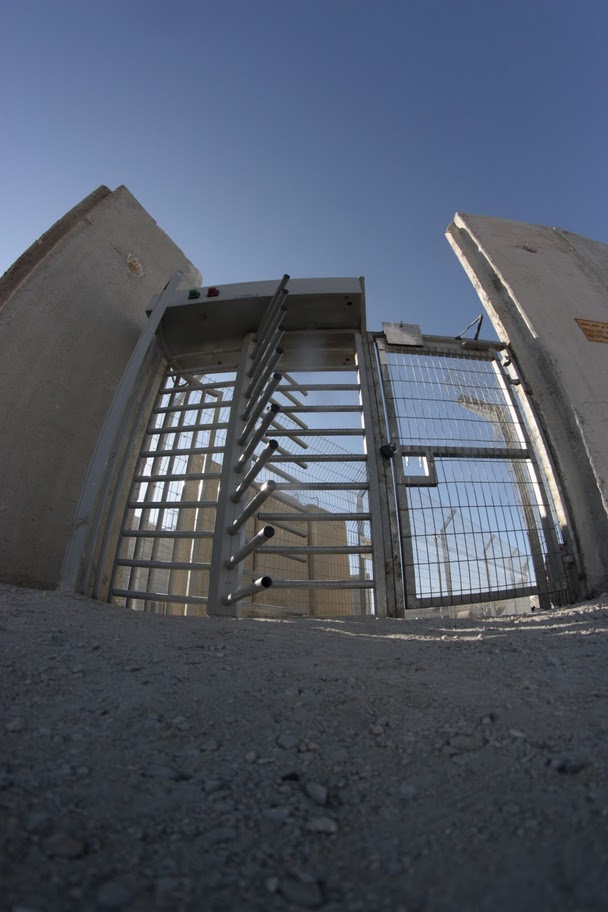 On December 18, 2011 residents of Shu’fat and activists protested against the separation wall in front of the new checkpoint. A certain loss of demonstrators was noted, since thirty-five organizers were arrested yesterday by Israeli policemen in their homes in the Shu’fat refugee camp in the middle of the night.
The residents of Shu’fat are Israeli citizens. However, they cannot enjoy the privileges which citizenship normally includes. While the streets in the illegal settlement of Pisgat Ze’ev on the other side of the wall are clean and the municipal services are working, the Shu’fat streets are dirty and waste collection does not exist. Houses taller than two stories are illegal in East Jerusalem, so most houses here have demolition orders.
“All people in Shu’fat must pay taxes to Israel, and still the streets look like a third world country,” one of the demonstrators says.
“They are taking from the poor and give it to the wealthy,” another demonstrator says.
Shu’fat is a neighborhood in the north-east of Jerusalem, though separated from the rest of the city by the eight meters high concrete separation wall. The Palestinian population of 50,000 live more or less imprisoned in the neighborhood, forced to pass through a military checkpoint to reach the rest of Jerusalem. The checkpoint, comprising an observation tower, five stations for armed soldiers to search the cars, and the most recent surveillance technology, was inaugurated last week.
Starting on December 23, there will be weekly demonstrations in Shu’fat after the Friday prayer.
“We will come here to protest every week until this wall has fallen,” promises Jeff Halper from the Israeli Committee Against House Demolitions.
Not a drop: Israel takes a spring and childhood memories with it
By Emma Mancini | Alternative Information Center | December 19, 2011
Mustafa Tamimi was killed during the weekly protest in Nabi Saleh, which demonstrates against the occupation, illegal Jewish settlements, and Israel’s appropriation of the village spring. While Nabi Saleh might be one of the most visible struggles around water, there are numerous other places in the West Bank where Israel has taken water resources and diverted them for settlements. A Palestinian man discusses his childhood connection with one such spring…

The pump that controls the water that once filled Al Auja spring (photo: Emma Mancini)
Abdallah stares at the empty channel, his face resigned. On this beautiful sunny day, he hadn’t expected to find the creek of his childhood completely dried up. Beside the waterless channel, there is a huge Israeli pump, protected by electric fences.
“Al Auja was a water spring, where the creek started”, Abdallah Awudallah, a 29-year-old from the Bethlehem district’s Ubbedyia village, tells the Alternative Information Center. He came here with a group of internationals to discuss Israeli confiscation of land and water in the Jordan Valley. The tour would have finished in Al Auja water spring. But the water was gone.
Not a drop: the Israeli authorities have built a generator in order to draw up water from the once-flowing creek and to send it to the agricultural settlements in the Jordan Valley. The spring, which used to serve Jericho, is now reserved exclusively for Israeli settlements.
“In Arabic ‘auja’ means ‘in the opposite direction’” Awudallah explains. “We used to call the creek like that because for long stretches the water ran up and not down. Because of the high pressure and speed, the water received the boost it needed to flow [upstream].”
Not only was the spring unique, it colored the desert green. It also served as an educational tool for Palestinian children, Awudallah adds.
“Many schools in the West Bank used to bring the students for a trip to Jericho and Al Auja: it was the perfect place to spend a day between water and fish and to study one of the basic vital resources. No Palestinian schools can organize a journey in Tiberias, in Palestine ’48, because they lack the necessary permits to enter Israel. So, Al Auja was the only place to feel the importance of water.”
“The first time I came here,” he goes on, “I was 15 years old. It was in 1997. The first time I saw a creek and fish playing around our feet, immersed in the water. Alongside the creek, the grass was green. Many Palestinian families used to come to Al Auja for a picnic. But always warily, in fear: the spring is located in Area C, under Israeli control, and many Israeli organizations organized tours here. The Israeli army often pushed the Palestinians out: I remember arrests, searches.”
“And today, I find it empty,” Awudallah says, his eyes fixed on the channel. “This place is a desert, there´s no life whatsoever. I feel empty, as sad as this channel. I wonder how the Bedouin community of Ras Al Auja is living now: they settled here because of the water. They had fresh grass for sheep and goats and drinking water. Now, for sure, they are forced to buy tanks from Israeli companies: every tank costs 200 shekel.”
Activists from Jordan Valley Solidarity (JVS)–a network of local popular committees and international supporters–explain that Al Auja was an oasis once. Families used to come to the spring to fish, swim, and picnic amidst the banana groves. In 1972, the Israeli private company Mekarot–51% of which is owned by the State of Israel–started digging two deep water wells in Al Auja, decreasing the capacity of the aquifer.
Some years ago, the Israeli authorities completed the project by constructing a pump that draws water directly from the spring, drying up the creek completely. Water was appropriated from the Palestinians of the Jordan Valley in other ways–while Israelis are allowed to dig wells up to a depth of 300 meters, Palestinians can’t exceed 160 meters. Thus, the water resources, become, in practice, inaccessible.
In the Jordan Valley, the Palestinian communities are forced to buy tanks from Mekarot company, that monopolizes the water resources in the West Bank. According to JVS, Palestinians pay 200 shekels (over 50 US dollars) per water tank plus transportation costs.
“Each cubic meter of water costs the Palestinian communities 30 shekels,” Fathy Khidrat, member of the Jordan Valley Solidarity, says to the AIC, “while [Israeli] settlers pay three shekels per cubic meter.”
While Palestinians constitute a majority in the West Bank, settlers consume four times as much water, on average per capita.
The nearby village of Ras Al Auja, with a population just over 4000, faces additional problems. After the 1967 war, the Israeli authorities created a security zone alongside the Jordan Valley, an operation that resulted in the confiscation of more than 30,000 dunam belonging to Ras Al Auja.
According to JVS, the construction of road 90 has made things worse. Reserved for settlers, 90 cuts through the West Bank from north to south. The road bypasses Jericho and cuts through Ras Al Auja village, while its residents aren’t allowed to use it.
Last spring, the Vittorio Arrigoni school (re-named in honor of the Italian activist killed in Gaza last 15th of April) was destroyed by Israeli military bulldozers. The school was built by JVS and served more than 130 children from the community.
In addition, there are several settlements surrounding the village and a military checkpoint controls the southern area of Ras Al Auja. The unemployment rate is high, according to JVS, “Al Auja survives because the men work illegally inside the settlements. The area feels like little more than a work camp, reminiscent of the township of apartheid in South Africa, with all the men away during the day, at work in the settlements.”
Child in critical condition after being hit by Israeli settler bus
Ma’an – 18/12/2011
NABLUS – A child was seriously injured on Sunday after being run over by a settler bus on a road south of Nablus.
Palestinian official Ghassan Douglas said that a bus belonging to settlers hit Muhammad Munjid, a student at elementary school, while he was crossing the street.
Witnesses in Nablus told Ma’an that Israeli police had shut the road and were investigating whether the incident was accidental or not.
The child was taken to hospital and is in a serious condition.
Witnesses said that a group of settlers also exited the bus and attacked a man named as Fadi Ahmad Samara, 32, who was at the scene of the incident.
Settler attacks in the West Bank against Palestinians have increased by more than 50 percent this year, according to the UN Office for the Coordination of Humanitarian Affairs.
Israeli settlers number 500,000 in the West Bank and East Jerusalem, living in Jewish-only communities that are illegal under international law.
Jewish extremists attack Christmas carolers
Ma’an – 18/12/2011
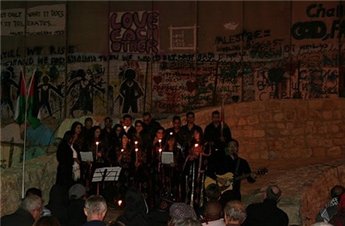 Bethlehem Bible college choir performs next to Israel’s separation wall in Bethlehem. (MaanImages/Munther Isaac, HO)

BETHLEHEM – Settlers attacked a Palestinian choir bus returning from a carol concert in Nablus on Saturday evening, choristers told Ma’an.
The singers, from Bethlehem Bible college, said five men attacked them on a quiet road outside of the northern West Bank city.
“A rock smashed through the window, and glass shattered everywhere inside,” chorister Saleem Anfous told Ma’an, adding that none of the 25 carol singers was injured.
“We kept driving and starting singing to cheer ourselves up and encourage the choir members,” he said.
“Tomorrow we will continue our carol tour of the West Bank in Jenin, using the same road, and we are afraid. But we are trying to convince the families that God will protect us.”
Hardline settlers have torched mosques near Ramallah, Jerusalem and Salfit since last Wednesday. The latest string of attacks included a rampage on an army base, sparking condemnation in Israel, and Israeli Prime Minister Benjamin Netanhayu to vow stronger enforcement against lawlessness.
But he rejected a recommendation to classify the Jewish extremists as terrorists, and Israeli lawmakers were set to discuss a law to legalize settlement outposts built on land owned by Palestinians on Sunday.
Extremists amongst Israel’s 500,000 strong settler population in the West Bank and Jerusalem reference Israel’s measures against outposts in their revenge ‘price tag’ attacks, usually directed at Palestinians in the West Bank, but recently spilling over into Palestinian sites in Israel and army targets.
Israel distinguishes between state-sanctioned settlement building on occupied Palestinian land and the wildcat outposts, but the international community says all settlements in the West Bank and East Jerusalem break international law.
Obama assures Jewish Conference: US support for Israel is ‘unshakeable’
By Saed Bannoura | IMEMC News | December 17, 2011
In a speech given to the Conference of Reform Jews in the US on Friday, President Barack Obama assured the audience that his administration was doing more than any previous administration in US history to serve the cause of Israel, and that US support for the Jewish state is ‘unshakeable’.
President Obama made the speech in the global context of increased isolation of Israel due to its ongoing violations of the human rights of the Palestinian people, lack of compliance with its obligations as an Occupying Power under international law, and disregard for past signed agreements with the Palestinians which forbid the expansion of settlements in the West Bank and call for withdrawal of Israeli troops.
Just prior to giving the speech at the conference, President Obama met with Israeli Defense Minister Ehud Barak. The two did not discuss the recent upsurge in Israeli settler violence against Palestinians and against Christian and Muslim holy sites. According to a spokesperson for Obama, the two discussed ‘regional security’.
In his speech to the conference audience of several thousand Reform Jews, Obama stated, “It’s hard to remember a time when the [U.S.] administration gave more support to the security of Israel. Don’t let anyone to tell you otherwise. It’s a fact.”
Some political pundits have claimed that President Obama, in this talk, has launched his campaign for the Jewish vote for his re-election in 2012. Jews make up around 2% of the US population.
In a debate last week, all of the Republican candidates for President reiterated their strong support for Israel and Israeli policies.
President Obama also said in his talk Friday, “We stand with Israel as a Jewish and democratic state. America’s commitment and my commitment to the security of Israel is unshakeable.”
He did not address the issue of a contradiction between a state defining itself as both a theocracy (Jewish state) and a democracy. He stated that peace between Israel and the Palestinians could not come from outside, but would have to be negotiated between the Israelis and the Palestinians themselves. But the US President made no mention of the US military and financial aid provided each year to Israel – an aid package larger than any other US aid package in the world, which Palestinian leaders say is a major hindrance to peace negotiations, as it shows extreme US favoritism toward one side in the conflict.
Jaffa neighborhood undergoes further Judaization
The Palestine Monitor – December 14, 2011
Jaffa’s Ajami neighborhood is home to roughly 20,000 Palestinians, 40 percent of whom live in refugee – or “absentee owner” – property, in the partitioned homes of Jaffa’s pre-1948 elite. The Absentee Property Law was implemented back in 1950 and enshrined in law Israel’s control over this property.
The deal struck by the state after 1948 allowed these people – many of them displaced from villages surrounding Jaffa – to live in some of the city’s newly-empty homes as “protected tenants.”
In reality they had very few rights. They lived there virtually at the goodwill of the authorities. Jaffa’s remaining Palestinians were thus prevented from owning their homes, paying rent to the state for life.
Tenants’ vulnerability was underlined by the contracts drawn up under the protected tenancy clause, which were amorphous and ill-defined.
But the authorities paid scant attention to the goings on in Ajami, considered a decrepit backwater of Tel Aviv. Meanwhile, Jaffa lingered in squalor. Until, that is, a variety of factors combined to create the auspices for offloading the problematic space while making a huge profit.
Four years ago the ILA issued 500 eviction orders to residents in Ajami – most of them Palestinian, with a handful of Jewish families.
The 1990s saw the privatization of public housing en masse throughout Israel as the government began to commit to economic neoliberalism. Constructed in the ’50s and ’60s for Jewish immigrants, public housing came to be seen as a drain on state resources. So the state began to sell these old buildings to private investors.
The same was true of absentee property.
Meanwhile the exclusivist character of Jaffa’s development has forced up real estate prices and attracted Israel’s elite to the environs, while a downtrodden and increasingly visible Palestinian community sits on highly valuable land.
Now the state is taking steps to remove these people using the protected tenancy law, which was – at least in theory – supposed to provide some security for their housing needs.
After 1948, when the new authorities were rounding up and calculating the spoils of war, Zionist representatives went to the doors of those Jaffans that had remained in the city. If the residents were not at home the moment officials came knocking, the building became “absentee” and treated as state property.
The fledgling state was confronted with the question of how to deal with the vast amount of empty properties now under its control.
In response they set up housing companies to manage the properties of Jaffa in the state’s name. These companies, Amidar and Halamish, worked under the ILA as landlords, leasing rights to the Palestinians that remained in Jaffa and to the wave of Jewish immigrants..
Tenants that break any part of their rental contract become squatters, according to ILA rules. Conditions equivalent to “squatting” include failure to pay rent, remaining in a property after the death of the original tenant, and any construction or renovation without a permit.
Between 1949 and 1992 the planning authorities denied all requests for extensions and renovations in Ajami, forcing people to proceed with their own ad hoc repairs. Most of the pending eviction orders have thus been issued on grounds of illegal construction.
Jaffa’s large, patriarchal homes were cut up into apartments to house poor Jewish immigrants and displaced Palestinians from surrounding villages and other areas of Jaffa.. Each family took a room and shared the kitchen. Rental contracts were vague due to the impossibility of clearing delineating apartments.
As the Jewish families left for the newly erected public housing, their Palestinian neighbors moved in to the empty rooms, for which Amidar now defines them as squatters.
“For years no one cared,” says Yudit Ilany, legal coordinator for the Popular Committee for Housing Rights in Jaffa (or Darna), the body that came into being as a response to the tide of evictions. “Amidar knew its management was haphazard.”
Most residents of Ajami today, who inherited protected tenancy rights from ancestors, have been in their homes for decades.
Since the alleged violations took place 20 to 30 years ago they question why Amidar is penalizing them now and not when they occurred.
A sturdy resistance movement has materialised as anger builds towards Amidar. Locals point to the malleability of the protected tenancy contracts, which they believe is being used as a ploy to get rid of them.
The experience of Estelle Saba acted as a catalyst in grabbing the community’s attention as to Amidar’s agenda.
One Thursday in March, 2007, police arrived at Saba’s home in Ajami informing her that the house was to be demolished in three days time. Desperate, Saba looked to the local community for help. On Sunday, the day marked for demolition, about 150 people barricaded themselves in the house throughout the day, preventing the small band of police and bulldozers from proceeding.
“That day it became clear that everyone knew someone facing the same situation. We realised these were not individual cases but a policy,” Ilany recalls. From this the committee emerged and now provides legal representation to roughly 260 families.
Some families Darna is trying to help still live in their original pre-1948 homes. These people, at home when Zionist representatives came knocking in 1948, were nevertheless dispossessed. The property would become “absentee” with people tenants in their own home. The Khatab family is one example.
Yousef Khatab’s Ajami home – a compound of several sections – has been in the family for as long as 150 years, he says. Both Yousef’s grandparents were born in the house, situated off the narrow street that hugs the Jaffan coast.
In 1949, Yousef’s grandfather, at work when officials arrived, was forced to sign a contract agreeing to protected tenancy status. The contract was in Hebrew and he gave his fingerprint by way of signature.
Several families – those of Yousef and his brothers – live in the compound, along with their mother. In 2007 they all received separate eviction orders.
“All legal problems are combined in this one house,” Ilany notes wryly. There are multiple cases in court simultaneously: “It’s a legal nightmare,” she says.
Yousef’s mother inherited tenancy after her husband’s death. “Now Amidar claims she is only a protected tenant of the room in which she lives but we say tenancy is valid for the whole compound,” Ilany explains.
Yousef and his brothers are third generation, which means they lose all rights to their home. If Amidar wins in this case the family will be turned out of all but one room.
Further, Amidar points to violations pertaining to illegal restoration. In 2005 the roof on part of the compound had become so dangerous that the municipality asked the Khatabs to repair it. They would not, however, issue the necessary restoration permit.
The family asked Amidar to fix the roof but to no avail. Finally, one stormy night the roof collapsed, injuring Yousef’s grandmother and landing her in hospital. The family took matters into their own hands and built a new roof.
The municipality responded by issuing a demolition order for part of the house as the penalty for renovating without a permit.
The new roof sticks out slightly from the house, compared to the old one, which reached no further than the perimeter of the walls. This violates the rental contract, Amidar claims, by taking up more space than the original. The offence thus amounts to illegal construction as well as illegal repair.
When the family failed to demolish the roof, the court opted to criminally sue them for not implementing a court order. Darna hopes to negotiate a deal with Amidar but the case remains open.
The Khatabs feel an ever-growing sense of alienation as their home becomes engulfed by a tide of ultra-rich urbanites, attracted to Jaffa as a residential refuge from the bustle of Tel Aviv.
Five years ago the area was empty, most infrastructure torn down during the demolition frenzy of the ’60s and ’70s. Today it is the most expensive area of Jaffa, according to Ilany, saturated with tall and sleek apartment buildings that boast an enviable sea view.
The sense of injustice is strong. “They hate us from the inside,” Yousef says of the state’s treatment of Palestinians in Israel. “But we’re the same people.”
He holds his hands up, at a loss. “They don’t want Arabs here.”
Though he recognizes the difficulties in continuing to struggle against the might of the ILA, Yousef is determined to stay in Jaffa.
Palestinians make up 80 percent of Ajami’s population, the remaining 20 being Jewish Israelis. The concern for locals is the likelihood that, should the ILA and Amidar continue unhindered to implement their vision for Ajami, this statistic will be reversed and the Judaization of Jaffa will finally be complete.
The evictions, whose numbers continue to climb, are, for local Palestinians, a continuation by other means of the project begun in 1948.
Contemporary Jaffa has been almost entirely re-imagined in the image of a Jewish state, an “artists’ colony” filling the old city, where Palestinian homes and mosques once stood.
Newt’s New York visit for funds was about Israel
By Alex Kane | Mondoweiss | December 15, 2011
Newt Gingrich’s jaunt to New York early this month was well–covered in the media, but one crucial aspect went unexplored: the Israel lobby angle. But good reporting from The Jewish Week‘s Adam Dickter makes clear that Gingrich came to New York looking for right-wing Jewish campaign donors who are hardline supporters of Israel.
Dickter reports that Gingrich has only raised around $52,000 from New York campaign donors, a paltry sum compared to Mitt Romney’s New York totals. So Gingrich came to New York in search of some much-needed funds in order to compete with Romney, his chief rival for the Republican nomination.
Not coincidentally, Gingrich’s controversial remarks on Palestinians came only a few days after a major New York meeting with donors.
Who did Gingrich meet with? Dickter reports:
On Dec. 6, at the Hyatt in Midtown, Gingrich met with some 30 prominent Jewish New Yorkers, including Daily News publisher Morton Zuckerman, an ex-chairman of the Conference of Presidents of Major American Jewish Organizations; developer and Republican Jewish Coalition co-founder George Klein; Presidents Conference executive vice chairman Malcolm Hoenlein; National Council of Young Israel Executive Director Rabbi Pesach Lerner and Brooklyn Assemblyman Dov Hikind.
Zionist Organization of America President Morton Klein, who lives in Pennsylvania, also attended.
“[Gingrich] was extremely impressive,” said Hikind, a Democrat, who has been said to be considering an endorsement of Gingrich, whose views are in line with many constituents of Hikind’s heavily Orthodox Borough Park and Flatbush district. “There are a lot of people from my part of the Jewish community that are pro-Israel that really like the guy. There’s no question that he is refreshing.”
Gingrich’s meeting was an effort to broaden his appeal to donors who are right-wing on Israel, and his remarks about Palestinians are part of that effort. Already in Gingrich’s corner is “Lawrence Kadish, a Long Island-based real estate investor and co-founder of the Republican Jewish Coalition,” reports Dickter. “Kadish is president of First Fiscal Trust and a resident of Old Westbury. He serves on the board of the conservative think tanks Hudson Institute and Claremont Institute and supports the pro-Israel media-watch organizations CAMERA and MEMRI.” But Gingrich needs more money, and so he’s pandering hard to the right on Israel. It will also help in Iowa, where Gingrich wants to capture the Christian evangelical vote, a vote that is solidly Zionist.
Note that his meeting in New York was bipartisan. It’s not just Republican Jewish donors Gingrich is looking to for help; it’s also Democrats like Dov Hikind (who is quite conservative for a Democrat) and Mort Zuckerman. And they’re all about Israel. It’s another example of how the Israel lobby crosses party lines.
Thomas Friedman today said that Congress’ standing ovations for Benjamin Netanyahu was “bought and paid for by the Israel lobby.” He could also extend that line of thinking to include the presidential candidates, including Obama. Sure, Gingrich is tapping into genuine support for Israel among some Americans. But the financing of his campaign is a core reason why Gingrich continues to run to the hard right on Israel. Perhaps now, with an opening in the discourse, we can talk frankly about why Gingrich, and Obama, come to New York and talk about Israel.
Jewish Settlers Torch Mosque In Ramallah
By Saed Bannoura | IMEMC & Agencies | December 15, 2011
A group of fanatic Israeli settlers burnt a mosque in Borqa village, east of the central West Bank city of Ramallah and wrote racist graffiti on its walls on Thursday at dawn. The incident is the latest of a series of attacks against Palestinian mosques and property.
According to eyewitness accounts, the settlers burnt the first and second floors of the mosque, after writing offensive graffiti regarding Arabs, Palestinians and Islam.
A resident of Borqa village told the Arabs48 News Website that a group of fanatical armed settlers invaded the village at dawn, and burnt the mosque, causing considerable damage.
The attack comes one day after a similar arson –attempt targeted Okasha historic mosque in Jerusalem. Before setting parts of the mosque ablaze, the settlers spray-painted racist graffiti targeting the Palestinians and the Muslim prophet.
Several mosques were attacked and burnt over the last few months in the occupied West Bank, in addition to an arson attack in Tuba-Zangaria, in the Galilee, in which the settlers destroyed the town mosque, and wrote ‘price tag’ graffiti in Hebrew.
On Wednesday, the settlers burnt four Palestinian cars in Nablus and Salfit districts.
Israeli media have reported that the settlers engaging in the price tag campaign no longer fear repercussions from the Israeli police for their attacks on Palestinian mosques and other holy sites.
The Price Tag attacks are carried out against the Palestinians, their property and holy sites, and against peace groups and leftist figures in Israel.
The settlers hold the Palestinians and Israeli peace groups responsible for the evacuation of illegal outposts in the West Bank.
Earlier on Thursday, the Israeli army dismantled two structures in the illegal Mitzpeh Yitzhar settlement in the West Bank.
In related news, Israeli troops closed the Huwwara and Za’tara roadblocks on Thursday morning, near the northern West Bank city of Nablus, under the pretext of preventing settler attacks against Palestinian vehicles in the area.
Soldiers also installed roadblocks in the northern West Bank districts of Qalqilia and Tulkarem.
Palestinian village struggles against “quiet transfer”
By Emma Mancini | Alternative Information Center | December 14, 2011

Three sisters, moments before a home demolition in Al Aqaba, in the West Bank (photo: flickr/frecklebaum)
Surrounded by two training military camps, in Area C, Al Aqaba’s population has gone from 1000 in 1967, the beginning of the Israeli military occupation of West Bank, to the current 300.
Al Aqaba is part of Tubas district, in the northeastern area of the West Bank, near the entrance of the Jordan Valley. A fertile land, rich with water resources, its geography attracted the attention of the Israeli Army which has used the area for military training of all kinds. Sami Sadiq, head of the Al Aqaba local council, explains, “Al Aqaba is surrounded by two military camps, used for the training of ground forces, tanks and air force. After the 1967 war, the village area was declared a closed military zone for ‘security reasons.’ Since that moment, they started building three training camps that host thousands of soldiers every year. They come here for one or two months and then they are sent to their respective units.”
“From 1971 to the present,” Sadiq adds, “the soldiers killed 13 Palestinians and injured at least 50.”
Sadiq is among them, having taken three bullets to his back. One is too close to his heart to be extracted. He has spent the past 38 years in a wheelchair. But, still, he continues to protest against the occupation.
After a petition was submitted by the residents of Al Aqaba in 2003, one of the three camps was closed: it was located exactly in the entrance of the village, making life impossible because of dangerous trainings and movement restrictions. But the two other bases remain and, Sadiq says, “The hills around Al Aqaba are a closed military zone. The aim of the Israeli Civil Administration is to declare the village a closed military zone, in order to force all the inhabitants to leave their own houses.
According to the Israeli law civilians are strictly forbidden from accessing closed military zones.
“The Israelis’ goal is obvious,” Sadiq says. “This land is very fertile and rich in water resources. They want to empty the area of its original Palestinian inhabitants and colonize it, confiscating the land and water.”
A “quiet transfer” is already happening, through demolitions, land confiscations, and the denial of basic services, such as running water.
“In Al Aqaba the water system doesn’t exist,” Sadiq says. “It has never been authorized by the [Israeli] Civil Administration, which has total control of the area: the village is forced to buy water tanks and to fill the wells. And the connection to the electricity network was allowed just three years ago. Before we were using a generator.”
“The oldest house in Al Aqaba dates back to 1930 [18 years before the state of Israel was established],” Sadiq continues. “Nevertheless, Israeli authorities accuse every single family of the village of building their homes illegally. So, they carry out demolitions. This year they destroyed Salam Street twice, in April and in September.”
95% of the buildings in the village are under demolition order. Among them the health center, the kindergarten and the mosque. A petition to the Israeli Supreme Court, submitted in 2004 by Al Aqaba residents in order to cancel the orders, was rejected on the 7 of April 2008. The lawyer for the village, Tusja-Cohen, asked a team of experts to come up with a new plan, to make the buildings “legal” under Israeli law and to obtain the required permits for the owners.
But the Court didn’t accept this petition and authorized the demolitions. The last ones date back on 15th of September: the Army destroyed two kilometers of the only road connecting the village to the Jordan Valley and demolished two houses along Salam Street. In addition, there are the land confiscations: “Thousands of dunams were confiscated by Israel in order to build the three military camps,” Sadiq explains. “During the trainings, the soldiers destroy olive trees and agricultural lands. It seems to be war [training]: once they simulated the fall of a plane.”
According to Sadiq, soldiers sometimes use houses and streets inside the village for military training, “Dozens of soldiers enter suddenly and exercise as though they are preparing for war in the middle of a city, between narrow roads. Over the years, this has caused Palestinian residents [to leave].”
House demolitions, land confiscations, lack of services, and accidental deaths due to military training have effectively depopulated Al Aqaba as many families have moved to Tubas and Nablus.
Life next to the separation wall, with Israeli soldiers on the roof
By Mikaela Levin | Alternative Information Center | December 14, 2011
The Hassan family was only allowed to come back to their house in 2010. For five years, after the Israelis built the separation wall right through one of the walls of their home, they were forbidden to enter. They waged a long legal battle to show that the property was theirs. They won and today eight members of the family live in the three-storey house.

Israel’s separation wall running through the Hassan family home (photo: Gustav Winters)
But they still can’t access their own roof– Israeli forces constructed a surveillance tower on Hassan’s roof and visit it at least once a week.

An Israeli military post on top of the Hassan family home (photo Gustav Winters)
While the Hassan family offers an extreme example, the wall has affected, to some extent, all of the 4,000 Palestinians that live in the village of Nazlat ‘Isa, which is 15 kilometers northeast of Tulkarem.
The space between the barrier and the houses in Nazlat ‘Isa is very narrow. In some parts, only two people fit. The village’s main road ends, abruptly, at the eight-meter-high concrete wall. From 2002 to 2005, the Israelis used an electronic fence to divide the village from other parts of the West Bank. The fence was inside the Green Line. But when the Israeli authorities began building the wall, they retreated back to the Green Line, a rare case in the West Bank.

The separation barrier runs close to this house (photo: Gustav Winters)
The building of the wall disrupted commerce, cultural life and family ties. And it also trapped seven families with West Bank IDs on the Israeli side of the Green Line.
From 1949 when the Green Line was drawn as part of the armistice agreements signed by Israel and her neighbors, to 2002 when the fence was erected, Palestinians moved freely from Nazlat ‘Isa and neighboring Baqa al-Sharquia to the big city of Baqa- al Gharbiyye, which is located in Israeli territory. Although they had green West Bank IDs, they could move with their families to the other side. When the Israeli authorities made the decision to enclose the Palestinian Occupied Territories and the fence was built, seven families from Nazlat ‘Isa were living in Baqa al-Gharbiyye.
Today, they can’t apply for citizenship, like the rest of their neighbors, or even residency, like Palestinians in East Jerusalem.
In 1948, Nazlat ‘Issa lost 10,000 of its 12,400 dunams of land. They lost another 824 dunams for the construction of the separation wall. Prior to 1948, 97 percent of the villagers were farmers. Today, in the wake of the destruction of the local market and factories due to the construction of the separation barrier, 97 percent of those villagers are unemployed.
The neighboring village of Baqa al-Sharquia suffered the same fate. Around 2,000 dunams were confiscated for the building of the wall and 2,500 olive trees were uprooted and taken to the Israeli side for replanting. This larger village was even more connected to its Israeli sister city, Baqa al-Gharbiyye. Their only connection nowadays is through the Israeli controlled gates.

The separation wall separates not just Palestinians from Israelis but Palestinians from Palestinians (photo: Gustav Winters)
This area provides a clear example of how one of the main objectives of the wall is to separate Palestinians from Palestinians, disrupt their commercial centers and their family ties.
While its West Bank sister villages were enclosed by the wall, checkpoints, and gates, Baqa al-Gharbiyye, a completely Palestinian community, grew throughout the last six decades from a village to a city. Projections show that in less than ten years, the city will have 38,000 inhabitants, which will make it one of the major Palestinian cities in Israel.
Newt Unleashes His Tetrodotoxin at the Palestinians
By William A. Cook | Palestine Chronicle | December 13, 2011
‘Remember there was no Palestine as a state. It was part of the Ottoman Empire. And I think that we’ve had an invented Palestinian people, who are in fact Arabs, and were historically part of the Arab community…’ — (Newt Gingrich, Fox News. December 10, 2011)
Many “Newts” produce toxins, the rough skinned Taricha, for example, produces enough to kill an adult human, and while all “Newts” go through a metamorphosis from tadpole to lizard, few expected that metamorphosis to reach human form in the person of the front running Republican candidate for President, Newt Gingrich. This Newt avoided the Vietnam War draft while studying for his degrees, then accepted a position as an historian and geographer at West Georgia College, a position he lost when his colleagues denied him tenure. A resourceful man, Newt ran for a congressional seat numerous times before capturing the 6th Georgia district seat in 1979, when the incumbent retired. He resigned his position in 1998 following disciplinary action by his colleagues for 84 ethics violations, having served as House Speaker from 1995 to 1999. Today he’s back, metamorphosed into a presidential candidate willing to spread lies about a people who have lived for 63 years under the brutal occupation of the Israeli military.
Consider his statement to the people of Israel on Jewish Television this past week quoted above. “Remember there was no Palestine as a state.” Omitted was the second part of that statement if the first was to have relevance: “Remember there was no Jewish state.” What existed was a Mandate Government under the control of the United Kingdom that governed this area beginning in 1922 through the authority of the League of Nations following the demise of the Ottoman Empire and later under the continued authority of the United Nations. During the Mandate period, from 1922 to May 15, 1948, the British government attempted to meet its obligations as enunciated in the Balfour Declaration to help in the “establishment of a national home for the Jewish people.” The Command Paper 1922, from the Avalon Project at Yale Law School, underlines this intent: “His Majesty’s Government therefore now declare(s) unequivocally that it is no part of their policy that Palestine should become a Jewish State.” It must be noted here that the Command Paper specifically marks the existence of a Palestine area to which the Jews were immigrating.
“I think we have an invented Palestinian people,” Gingrich continues, forgetting to mention that Dr. Shlomo Sand in his recent book The Invention of the Jewish People, according to Leon Hadar in his review, concludes by,
“Countering official Zionist historiography, Sand questions whether the Jewish People ever existed as a national group with a common origin in the Land of Israel/Palestine. He concludes that the Jews should be seen as a religious community comprising a mishmash of individuals and groups that had converted to the ancient monotheistic religion but do not have any historical right to establish an independent Jewish state in the Holy Land. In short, the Jewish People, according to Sand, are not really a “people” in the sense of having a common ethnic origin and national heritage. They certainly do not have a political claim over the territory that today constitutes Israel and the occupied Palestinian territories, including Jerusalem.”
In an even more recent book, just published by Pluto Books, Dr. Mazin Qumsiyeh in an historical review of the ancient lands of Palestine noted that “The kingdom of Judah lasted 341 years (927-586 BCE) while Israel lasted even a shorter 205 years (927 – 722 BCE).” In short, between the two recent studies, Gingrich could have found the truth; but truth is not what Gingrich needed for his interview: he needed a fabrication that would endear him to his audience both in Israel and in the United States as he groveled for monetary support for his campaign at the expense of the Palestinian people.
Consider the reality of the past two thousand years, when this area “between the Jordan and the Mediterranean,” which “has had a history of 6000 years of civilization,” known for a large portion of its history, as the Southern part of the Land of Canaan, has been called, for all these 2000 years, Palestine. As Qumsiyeh reviews this period he concludes, “These people (known to the world as Palestinians) absorbed the religions and various philosophies and changed their allegiances to survive in an ever amorphous world. This world, sometimes violent, sometimes symbiotic was always there.”
“Known to the world as Palestinians”; known to Newt Gingrich as “invented.” So how is it, this historian and geographer, could determine that the people of Palestine did not exist, that they could have removed themselves to “other” Arab lands and left all of Palestine to the Jews? In an unfortunate comment meant to deflect criticism about his reinvention of history, Gingrich made this comment: “Somebody ought to have the courage to tell the truth. These people are terrorists,” he said. “It’s fundamentally time for somebody to have the guts to stand up and say, ‘Enough lying about the Middle East.” In four words, he turns all Palestinians into “terrorists.” And he justifies this slanderous and invidious judgment by assuming the chauvinistic persona of the brave man who condemns those who lie about the Middle East even as he omits the decision of the Mandate Government to hand over the resolution of the immigrant problem in Palestine to the UN, a decision that resulted in the Partition Plan (1947) dividing that land into two areas, one for Jews the other for the Palestinians who lived there, who had a 71% to 29% majority in the whole of Palestine. Since the Resolution created, numbered 181, divided the land into two, recognizing two peoples contending for the area of Palestine, it recognized as well Palestinians inhabiting the land with heritage going back two thousand years to the Roman era. At the same time, as immigration for Jews materialized through the 1940s, the contrast between indigenous inhabitants and newly arrived immigrants from foreign lands makes ludicrous Gingrich’s comments.
Even more ludicrous and perhaps more frightening, is this man’s willingness to undermine US policy since WWII, a policy that recognized the Palestinian people and their rightful claim to their own state. His convoluted logic would have the United States President negotiate peace with a people he has determined to be terrorists, all of them. He claims that what has been going on is a “delusional peace process”; true enough, but not because the Palestinians haven’t been willing to arrive at peace, but because Israel has had no intentions of recognizing a Palestinian state as the Likud Party Platform declares openly even now, “no state of Palestine west of the Jordan River.” But this fact, neither Gingrich nor the American press nor the Israeli government will acknowledge; it is rather the unwillingness of the Palestine Authority and Hamas to recognize Israel and cease their violence against Israel that prevents peace. But once again, had Gingrich taken the time to read yet another book on the subject, released in the summer of 2010, The Plight of the Palestinians, published by Palgrave MacMillan, he could have read about Israeli intransigence in negotiating peace, “The Problem with Israel,” by Dr. Jeff Halper, an article that recounts 19 different proposals rejected by Israel.
In that same volume, Gingrich could read about the Zionist stated reality that they had no plans to abide by the UN Partition Plan, but rather eradicate all Arabs from the land of Palestine, and that in Jewish documents from the Mandate period: “The challenge of Zionism was to create a Jewish state in a land already inhabited by natives who mostly practiced Islam and Christianity. Early Zionist understood the challenge and contrary to their public pronouncements about “a land without a people for a people without a land” came to see that the natives posed an obstacle to their visions” (Qumsiyeh).
There are 32 chapters in that book that detail Israel’s ongoing genocide against the Palestinian people, all written in the first decade of this century, a veritable catalog of ethnic cleansing to complement Dr. Ilan Pappe’s volume on the same subject, The Ethnic Cleansing of Palestine.
Let me close this recounting of Gingrich’s vitriolic commentary by remembering the Palestinians who suffered at the hands of real terrorists during the Nakba, an historical event he must immerse himself in if he is to understand how toxic his offhand commentary is to those who lived through these years awaiting justice. Here are the words of the Zionist’s general:
“Jewish villages were built in the place of Arab villages. You do not even know the names of these Arab villages, and I do not blame you because Geography books no longer exist, not only do the books not exist, the Arab villages are not there either … There is not one single place built in this country that did not have a former Arab population.” (Moshe Dayan, Address to the Technion, Haifa, as quoted in Haaretz, 4-4-1969)
“Thus began in November of 1947 what is euphemistically called the ethnic cleansing of Palestine by the combined forces of the Jewish armies, the Haganah, the Stern, and the Irgun as they drove more than 700,000 Palestinian Arabs from their homes leaving them destitute, homeless and abandoned without a country in what is now the largest refugee Diaspora in the world.
More truthfully, the plight of the Palestinians that began so ruthlessly in 1947, and is now called the Nakba, was an intentional, calculated campaign to force the Palestinian Arabs out of Palestine, a systematic genocide of a people as defined by the United Nations in its adoption of Genocide Convention, Article II” (The Plight of the Palestinians).
Now that Gingrich knows what to read, will he?
~
William A. Cook is a Professor of English at the University of La Verne in southern California. His works include Psalms for the 21st Century, Mellon Poetry Press, Tracking Deception: Bush Mid-East Policy, The Rape of Palestine, The Chronicles of Nefaria, and most recently in 2010, The Plight of the Palestinians. Contact him at: wcook@laverne.edu or visit: http://www.drwilliamacook.com.
Featured Video

They Double Down on BLOOD PRESSURE Guidelines!
or go to
Aletho News Archives – Video-Images
From the Archives
Chocolate Gives Statins a $29 Billion Run For Their Money
By Sayer Ji · GreenMedInfo · April 17, 2012
With the blockbuster cholesterol-lowering class of drugs known as statins being widely promoted for the primary prevention of cardiovascular disease, despite their having over 300 documented adverse health effects (including heart failure!), how does chocolate sound as a viable, heart-friendly alternative?
We already connect amorously with chocolate (to the tune of 6 billion lbs of cocoa consumed annually worldwide), revealing in heart-felt expressions like “I love it,” and “this is to die for!” how comfortable we are with publicly declaring our affection. But did you know that while it makes our emotional hearts sing, it may actually keep our physical hearts happy, alive and ticking longer, as well?
Indeed, back in 2006, researchers found that for elderly men, eating cocoa was inversely associated with blood pressure and 15-year cardiovascular and all-cause mortality. … continue
Blog Roll
 Aletho News
- I’M SO BLOODY FURIOUS: They Double Down on BLOOD PRESSURE Guidelines!
- The Israeli Nuclear Doctrine and the Turning Point of the Kennedy Assassination
- Striking Matches Near the Powder Keg
- Prominent Russia hawk: European leaders privately talk about war with Russia, first need ‘mass casualty event’
- China warned Trump not to touch Iran’s oil tankers: Larry Johnson
- EU Central Banker Plans To Plant Barren AI Crops Across The Continent
- Macron’s Strategic Autonomy Paradox: France Rearms on Debt and Depends on Foreign Fuel
- Nigel Farage vs Tucker Carlson: Who is right about Hitler and Britain?
- Chocolate Gives Statins a $29 Billion Run For Their Money
- Hypotheses on the collapse of U.S. computer systems
- If Americans Knew
- An error has occurred; the feed is probably down. Try again later.
- No Tricks Zone
- New Study: Modern Temps Are Among The Coldest Of The Last 10,000 Years In East Central Europe
- Germany’s Renewable Energies Lead to 1.4 Billion Euro Electric Power Trade Deficit
- Argentina’s Perito Moreno Glacier Joins Antarctica and Arctic In Defying Doomsday Melt Claims
- New Study: Barents Sea Temperatures Were Warmer And Sea Ice Less Extensive In The 1700s Than Today
- German Authorities Start Initiative To Evaluate Public Register For Climate “Disinformation” Spreaders!
- Zonal Asymmetry of Temperature Change in the Antarctic Circumpolar Current
- New Study: The Net Fossil Fuel Contribution To Rising Atmospheric CO2 Has Been Zero For 500 Years
- Germany’s Green Energy Transition Becoming Increasingly Expensive…Another 6 Trillion Euros!
- Sudden Stratospheric Warming, Powerful El Niño Combination May Lead To Extreme Europe Cold, Energy Crisis!
- Two New Studies Find Thwaites Glacier Melt Cannot Be Driven By Human Activity Or A Warming Ocean

