Israeli authorities inaugurate new checkpoint in Shufat
Ma’an – 12/12/2011
JERUSALEM – Israeli authorities officially inaugurated a new military checkpoint on Monday at the main entrance to the Shufat refugee camp in north Jerusalem.
Israeli forces had clashed on Sunday with youth in the camp on Sunday, as residents protested against the construction of a checkpoint which they say will cut the 45,000-strong community from the rest of the city and control their movements.
Shufat is the only Palestinian refugee camp within the municipal boundaries of Jerusalem and is administered by the UN agency for Palestinian refugees, or UNRWA.
The Palestinian Center for Human Rights slammed the encirclement of Shufat on Monday.
“This crossing, deep in Palestinian territory, is part of Israeli policies aimed at cutting Jerusalem off from the West Bank, and perpetuating Israel’s annexation of the city in violation of international humanitarian law,” a press statement said.
Israeli Settlers Break Into Military Zone By Jordanian Border
By Saed Bannoura | IMEMC News | December 13, 2011
Extremist right-wing Israeli settlers broke into a closed-off military zone in between the West Bank and the Jordanian border, at the site thought to be where Jesus was baptized.
On Monday, right-wing Israeli protesters barricaded themselves in buildings at the site of the baptism of Jesus at the Jordan River, which is a holy site for Christians around the world.
They hung banners with photos of the right-wing Jewish leader Ze’ev Jabotinsky, who called for the “Jewish state to expand beyond the Jordan River into the state of Jordan and all the way to Iraq.”
The protesters say they are sending a message to the Jordanian government to stay out of Israeli affairs. This is a reference to the statement made by Jordan’s King Abdullah Monday that he hoped Israel would choose not to demolish a bridge in Jerusalem.
The bridge in question is an historic structure that leads to the al-Aqsa mosque, which is the third holiest site in the world for Muslims. Israeli authorities closed the bridge on Friday, sparking outrage among Muslims around the world.
The attack occurred at the Jordan River, on a closed military zone separating the West Bank and the Jordanian border, and both Jordanian Authorities and the Israeli Army have stated that the Israelis did not cross the border, but were approximately only a few hundred metres away.
Those protesters in question were from a group known as the ‘Hilltop Youth’, numbered around thirty, and were quickly removed from the area by the Israeli army and police.
In a separate incident, around fifty Settlers invaded the Efraim Regional Brigades military barracks near Qalqilia, setting several fires, throwing molotov cocktails and stones, which led to damage to buildings and vehicles.
Over a hundred settlers also attacked the Brigade Commanders car, and threw stones at passing Palestinian cars, on the main road near the settlement of Ramat Gilad.
The string of attacks comes as tension mounts over the impending dismantlement of numerous illegal outposts within the West Bank by the Israeli authorities.
Bahrain: Washington Conference with Zionist Participation Divides Opposition
By Shahira Salloum | Al Akhbar | December 13, 2011
A planned conference in support of the Bahraini uprising caused a stir among opposition activists after it was revealed that prominent pro-Israeli figures were invited to attend.
“Americans for Democracy and Human rights in Bahrain,” a conference organized by the Institute for Gulf Affairs, was supposed to be held in Washington Wednesday.
An informed opposition source said that the conference has been postponed but didn’t disclose the reasons behind the change of plans.
The goal of the conference was to shed light on the ongoing human rights violations occurring in Bahrain, especially as they are receiving very little media attention in the Arab world.
According to the Institute for Gulf Affairs website, the event was intended to be a follow up to a previous conference held in Beirut last summer.
However, a closer look at the names of the participants raised questions about how far the opposition was willing to go in order to be heard?
Among those invited by the organizers to attend, for example, are Elliot Abrams, US Congresswoman Ileana Ros-Lehtinen, and Simon Henderson from the Washington Institute for Near East Affairs, all of whom are well-known for their unswerving support for Israel.
Other invitees include Bahraini human rights activists and opposition figures who have a reputation for being moderate, in addition to US officials, European Union representatives, and international law associations.
Many have raised the obvious question: How could Bahraini opposition members participate in the same conference as individuals who are well-known for their blind Israeli bias?
A quick survey by al-Akhbar of a number of Bahraini opposition figures who have been invited to the conference revealed that many were not aware that influential Zionists will be attending.
But most of the Bahrainis, in fact, confirmed that they will not be attending the conference, either due to conflicts in their schedules or because of the presence of Zionists.
Some, however, went so far as to say that they have no problem with getting the support of such people if it serves the Bahraini cause.
Conference organizer Ali al-Ahmed, a well-known Saudi dissident, also received his share of criticism.
The notorious Iraqi politician Ahmad Chalabi’s participation in the conference was also questioned by some of those invited. Chalabi, known for his close ties with the US, had organized a previous pro-uprising conference about Bahrain in Beirut.
Al-Akhbar was not able to contact former Wefaq MP Khalil Marzouk to ask him whether he will be attending the conference.
However, opposition sources confirmed that Khalil Marzouk “would never participate in a conference attended by Zionists.”
Human rights activist Nabil Rajab said that he had received an invitation to participate in the conference, but that he would not be attending due to other commitments.
It is worth noting that Rajab did not know who the participants in the conference were and was surprised when he found out. He said that it was most likely that his colleagues didn’t know this information either.
As for al-Ahmed, Rajab said that his role is organizational and that the Bahraini opposition turned to him because he runs the US-based Institute for Gulf Affairs, which is licenced to hold such a conference in Washington.
US-based activist Hussein Abdullah, however, does not accord any importance to the critics of the conference, saying the US is filled with “Jews.”
Upon correction and explanation that the problem was “not with Jews but with Zionists, for many Jews support human rights causes,” Abdullah said, “I am willing to speak in any forum and defend the rights of Bahrain, whether that forum is attended by Zionists or even by the devil.”
Abdullah prefers to look at the positive side, suggesting that such a conference would embarrass the Bahraini regime.
“The regime accuses us of being Iranian agents. How can this be true if we are participating in a conference along with supporters of Zionism?” he asks.
Abdullah added that Abrams would not be attending the conference, saying that “an invitation was extended to him but he turned it down.”
He pointed out that other participants from Human Rights Watch and Amnesty International were also planning to attend, along with a representative from the Bahrain foreign ministry.
An invitation was also sent to the Bahraini embassy, and a prominent businessman was assigned to attend the conference to represent the regime.
Hundreds of settlers attack Nablus village
Ma’an – 12/12/2011
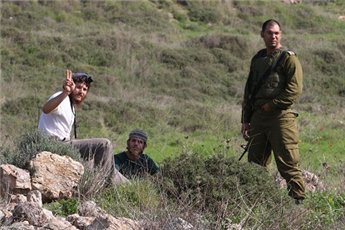
NABLUS – Hundreds of settlers stormed the Nablus village of Asira al-Qibliya overnight Sunday, causing damage to Palestinian property.
Witnesses told Ma’an that around midnight more than 200 settlers from the notorious Yitzhar settlement entered the village and threw rocks at Palestinian homes.
Local resident Ibrahim Makhlouf said that the settlers smashed the windows of a bus and tried to set it on fire.
“They were armed and wearing black uniform as if it was an organized militia,” he told Ma’an.
The attackers smashed the windows of three other houses belonging to Basim Salih, Jamil Abdullah and Khalil Mahmoud Salih, Makhlouf added.
Settler-related incidents resulting in Palestinian injuries and damage to property are up more than 50 percent this year, according to the UN Office for the Coordination of Humanitarian Affairs, which documents violence in the Palestinian territories.
Last week, a mosque was set on fire by settlers in the West Bank village of Bruqin, near Salfit, local officials said.
A report released by The Palestinian Agricultural Relief Committees found that in October, over 53 percent of settler attacks had taken place in the Nablus district.
‘NYT’ continues to fiddle with the Nakba
By Allison Deger | Mondoweiss| December 11, 2011
Last week, we reported on an article by the Learning Center, in the New York Times (NYT), where the NYT censored coverage of the Palestinian Nakba, due to “reader comments.” The NYT removed the word “expelled” and other words from the description, altering the narrative of events–implying that Palestinian refugees fled, and were not driven out of their homes/villages by pre-state para-military groups. The article also made alterations suggesting Arab armies invaded before the Zionist para-military attacks, rather than “soon” after, as originally reported.
Well, the NYT has once again augmented the same article–again due to reader comments–to now read: “British troops left, thousands of Palestinian Arabs were expelled or fled and Arab armies invaded Israel,” which the NYT offers as a “more neutral rendering of the sentence.”
The “correction” in the NYT articles now reads:
“Six months later, on May 14, 1948, Jewish leaders in the region formed the state of Israel. British troops left, thousands of Palestinian Arabs fled and Arab armies invaded Israel. In the Arab-Israeli War, Israel defeated its enemies. It was the first of several wars fought between Israel and its neighbors.”
This timeline contradicts NYT coverage from 1947-49, and as Yousef Munayyer of the Palestine Center notes, “half the total refugees created during the Nakba were created BEFORE May 15th, 1948.”
The NYT‘s editorial changes to the Palestinian Nakba is not a new occurrence. Earlier this year, Munayyer wrote in “Picking apart the New York Times Zionist narrative on the Nakba . . . using the New York Times,” the NYT regularly prints a “distorted representation” of the Nakba. Munayyer begins with a May 2011 article by Ethan Bronner:
“After Israel declared independence on May 14, 1948, armies from neighboring Arab states attacked the new nation; during the war that followed, hundreds of thousands of Palestinians fled or were driven from their homes by Israeli forces. Hundreds of Palestinian villages were also destroyed. The refugees and their descendants remain a central issue of contention in the Israeli-Palestinian conflict.”
Munayyer then fact-checks Bonner against a NYT article titled “Palestine Jews Minimize Arabs: Sure of Superiority, Settlers Feel They Can Win Natives By Reason or Force,” from March 2, 1947:
“Whatever the degree of their superiority complex, however, the Jews are certainly confident of their ability to bring the Arabs to terms — by persuasion if possible, by might if necessary. The program of the largest terrorist group, the Irgun Zvai Leumi, is to evacuate the British forces from Palestine and declare a Zionist state west of the Jordan, and “we will take care of the Arabs.”
From an April 18, 1948 NYT article, Munayyer again fact-checks the NYT of today:
“According to reports telephoned from Nablus, that town and Jenin are crowded with refugees, among whom the rumor is circulating that the Jews are driving on Jenin. The Haganah said it had killed 130 Druse [sic] tribesmen yesterday when it seized Usha, a village east of Haifa.”
The NYT editorialized Nakba coverage shows that history is more of a comment on today’s politics, and less of an account of the past.
Gingrich comments on Palestinians a “play” for “Jewish” money, former strategist says
By Ali Abunimah – The Electronic Intifada – 12/10/2011
Newt Gingrich, the US Republican presidential hopeful and former House Speaker who said Palestinians are an “invented people,” was making a “play” to attract “Jewish” money to his campaign, a former close associate said today.
Reacting to Gingrich’s comments on the Palestinians, Matt Towery, a conservative columnist who served as a campaign strategist for Gingrich in the 1980s, told CNN’s Saturday Morning News:
The Republican primary is one in which primarily you have money coming from pro-Israelis and in Jewish organizations and that[s] a play for that money. And you’re really are not going to have a whole lot of folks involved from either the Arab world or from any area that might be affected by these comments that are going to be voting in any of these primaries any time soon.
It is generally considered taboo in the United States and even evidence of “anti-Semitism” to talk about the influence of “Jewish” or pro-Israel money in elections. That a former Gingrich advisor and well-known Republican pundit is doing so openly is a notable development.
Palestinians an “invented people”
Gingrich caused consternation and a great deal of anger among Palestinians when he told The Jewish Channel, cable TV station, that Palestinians were an “invented people” and suggested that they should have left their country voluntarily to make way for Israel.
While the two main parties in the United States, Democrats and Republicans, are both staunchly pro-Israel, they have engaged in intense partisan battles in the run up to next November’s US presidential election over which party would be more supportive of Israel.
New Pappe book highlights plight of forgotten Palestinians
Asa Winstanley | The Electronic Intifada | 7 December 2011

After the Nakba, Israel’s 1948 ethnic cleansing operations, only approximately 160,000 Palestinians were left within the borders of what became Israel. Their numbers grew to 600,000 by the mid-1980s (152), and to about 1.2 million today. They struggled for Israeli citizenship, and won the right to vote in the Knesset (Israel’s parliament), but were kept under the thumb of strict military rule until 1966.
Thanks partly to the growing international notoriety of their representatives and activists (such as current and former members of the Knesset Haneen Zoabi and the exiled Azmi Bishara) in recent years there has been more attention paid to the situation of these Palestinians. But in the western solidarity movement, there is still a learning process to be had of understanding that “the Palestinians” includes more than the people of the West Bank and Gaza. As such The Forgotten Palestinians, Ilan Pappe’s latest work of popular history, is a welcome contribution.
Pappe contextualizes the book as almost a sequel to his most celebrated work: “this book continues my research on Palestine and Israel, which I began in The Ethnic Cleansing of Palestine (2006). It is only through a history of the Palestinian minority in Israel that one can imagine the extent to which the long-lived Zionist and Israeli desire for ethnic supremacy and exclusivity has brought about the current reality on the ground” (11). This approach very much pays off. Through the prism of the Palestinian citizens of Israel, Pappe explores the general Palestinian condition.
The Forgotten Palestinians ably displays Pappe’s main strength: his ability to relate a strong historical narrative. He ties many threads together, giving some much-needed perspective.
The Nakba, continued
Pappe addresses the plight of Palestinians who remained in the new State of Israel following the Nakba. In urban areas, “cordoned off with wire and fences,” Pappe writes that there were Israeli “attempts to concentrate Palestinians who had lost their homes but remained within the boundaries of the hometown … supervised by Israeli officers, who called these confinement areas ‘ghettos.’” These “ghettos” would not disappear until 1950 (18).
Like the rest of the scattered Palestinian community at large, this was a deeply traumatized people. “If they lived in rural areas, they belonged to a hundred and so villages left intact out of more than five hundred whose inhabitants were evicted and in 1949 were wiped out by the Israeli tractors, turning them into either recreation parks or Jewish settlements,” Pappe states (19). The ethnic cleansing operations went on into the 1950s.
Characteristic of Pappe, there are plenty of challenges here to the idea of “left wing” Zionism, including: “the [Palestinian] people of Khirbet Jalami, who were evicted following a demand by the newly founded left-wing kibbutz of Lehavot Haviva in March 1950” (34).
In this early phase (1948-57), even the presence of the Palestinians in Israel was under threat: “the very existence of the community was in question. Their presence was regarded by important figures in the Israeli regime as ‘unfinished business,’ and quite a few of the politicians and heads of the security services still contemplated the removal of the Palestinian citizens from the Jewish state” (47).
This threat later receded somewhat, but it never truly went away, and has very much been revived during the rise of Avigdor Lieberman, arch-racist and current foreign minister of Israel, whose party Yisrael Beiteinu made electoral gains by calling for Palestinians citizens to be made to swear oaths committing to a Jewish state, with the slogan “no loyalty – no citizenship.”
In October 2010, Pappe records, “Israeli police simulated a scenario whereby parts of Israel in which Palestinians lived were appended to the West Bank — while the illegal Jewish settlements in the West Bank were incorporated into the Jewish state” (5).
Pappe says it was only in 1958 that the first Israeli Prime Minister David Ben-Gurion “conceded in an official document that the option of transfer was not applicable any more” (31).
By 1955, Ben-Gurion’s second “advisor on Arab affairs” Shemuel Divon would have to concede that “There is no way the Arabs of Israel will be loyal to the state. It would have been advantageous if the state could either expel them or convert them to Judaism, but these are not realistic options” (31). Ben-Gurion seemed to agree (33). It is very interesting that Zionist leaders still entertained the delusion that Palestinians could be converted to Judaism late into the 1950s. This is also quite a challenge to the narrative of “secular” Israel.
All this goes some way to explain why the community’s struggle in this first phase was not for national or cultural rights as Palestinians, but simply to stay in their homes and to win citizenship.
The struggle for citizenship
In its propaganda, Israel likes to boast that it benevolently gave its “Arab Israelis” citizenship. But something that comes across strongly in this book is the extent to which this is not true: many had to struggle for even this basic right.
In 1953, the new Israeli citizenship law cynically declared that only those registered in the November 1948 census would be automatically given citizenship. Partly because Israel did not yet have full military control, “out of 160,000 Palestinians, 100,000 were not registered by November 1948.”
This was a racist law, because it did not apply to Jews (from anywhere in the world) who are still automatically granted citizenship under the “Law of Return.” The upshot of this was that a majority of the “Arab Israelis” were not benevolently “granted” citizenship as Israel likes to claim, but in fact had to struggle for it, often in the courts (35-7).
The military regime in the 1948 areas
Another key challenge to the Israeli narrative of democracy is that, until 1966 it kept its Arab citizens under a military rule similar to that now in effect in the West Bank. This is still a traumatic memory for people in the community until this day.
Making use of British Mandate laws, “the [military] governor had the right to arrest people without a warrant and detain them without trial for long periods; he could ban their entrance to a place or expel them from their homes; he could also confine them under house arrest. He could close schools, businesses, newspapers and journals, and prohibit demonstrations or protests” (49).
Amazingly, many of these laws are still on the books, and the army still has the power to declare parts of the country “closed military zones.” Since 1996 a legal change has required an annual renewal of the laws (264).
In the 1950s, a special committee met to coordinate military rule. At its first meeting, the Palestinian citizens were defined as a “hostile community” that needed to be closely watched, a “fifth column.” Members of the committee included agents of the Shin Bet (Shabak), the Israeli General Security Service; the prime minister’s advisor on Arab affairs; officials from the military rule unit and, interestingly, representatives from the Histadrut — Israel’s general trade union (which until 1953 banned Arabs from membership (69). This committee met until the end of military rule in 1966 (48-9).
The Palestinian citizens of Israel today
The book spans the complete historical narrative of the Palestinians of 1948, bringing things right into the present day. Pappe concludes that, although the 1950s threat to expel the remaining Palestinians from Israel was later backed away from, this thinking has returned. The head of the regional council of lower Galilee, Motti Dotan (from the “left-wing” Zionist Labor party) in 2008 said, “If we lose the Jewish majority in the Galilee this is the end of the Jewish state … I would like to imagine a Galilee without Arabs: no thefts, no crimes … we will have a normal life” (257).
If the book has a weakness, it is something about which I have criticized Pappe’s work previously: sometimes there is lack of direct quotes. One is left to trust in the historian’s judgment. This does make for a more readable, flowing narrative, but I would have liked more specifics at times. For example, he says that the Israeli novelist A.B. Yehoshua “famously invited [Palestinian novelist Anton] Shammas to leave the country if he was unhappy with the Zionist regime and the success of Jews in dispossessing the Palestinians” (190). I would have liked to have read the exact words of Yehoshua here.
Apart from this and a few other very minor quibbles, I have no hesitation in recommending this book. It’s a great read, especially for those new to the topic. Those more familiar with the situation will still learn new things, and gain some important perspectives on the situation and history of this neglected, but key part of the Palestinian people.
Asa Winstanley is an investigative journalist who writes about Palestine. He edited the new book Corporate Complicity in Israel’s Occupation and regularly contributes to The Electronic Intifada, where he also has a blog. His general website is www.winstanleys.org.
Lawsuit fights hotel’s decision to bar Muslim employee from serving Israeli officials
By Alex Kane | Mondoweiss | December 9, 2011

Mohamed Arafi is suing his employer for barring him from servicing an Israeli delegation staying at a Washington, D.C. hotel
Israeli Defense Minister Ehud Barak was in town to address the Brookings Institution’s Saban Forum, and Mohamed Arafi, a Moroccan-born U.S. citizen, was ready to work. An entire Israeli delegation, including Barak, was staying at Washington, D.C.’s high-end Mandarin Oriental Hotel, where Arafi has been a valet dry cleaner since late 2009. But when he showed up to work on December 10, 2010, he was told that he was barred from working the two floors where the Israelis were staying. The reason given, according to Arafi, was because he is Muslim, and the Israeli delegation did not want to be served by Muslims.
Now, Arafi and the Council on American-Islamic Relations (CAIR) are fighting back in the form of legal action alleging employment discrimination by the hotel against Arafi. The recently filed case is currently in district court in Washington, D.C, and comes on the heels of an inconclusive Equal Employment Opportunity Commission ruling on the case.
The hotel is not backing down, and responded in a Nov. 28 filing (pdf) that they were following a national security directive from the State Department that barred Arafi and 11 other employees from serving the Israeli delegation.
Arafi says that the hotel has also punished him for speaking out by cutting his workweek from five days to two days, and that his work colleagues said demeaning things about Muslims to him after the incident became known to them.
“What they want me to do is just quit,” Arafi said in a phone interview. “I don’t want to run away…I want to stay there until I have my rights.” The company has denied Arafi’s charges.
The case could also be seen as a stark illustration of the consequences of Israeli-style “war on terror” attitudes towards Muslims.
The lawsuit describes what happened (pdf), according to Arafi, when the Israeli delegation came to the hotel:
Ms. Escander, [Arafi’s supervisor], stated to Boris [another employee], “Boris, Israel is here. You go up and get the dry cleaning for Mohamed.” Mr. Arafi was confused and asked for an explanation. Ms. Escander stated to Plaintiff, “You know the Israeli delegation is here. You cannot go on the 8th and 9th floor (to pick up or deliver laundry).” Plaintiff asked for further explanation. Ms. Escander stated, “You know how the Israelis are with Arabs and Muslims. It’s better if you just let Boris go.”
The lawsuit alleges that the hotel first claimed to be complying with an Israeli government request not to have Muslims serve them. Arafi said that after he went to the Washington Post with his story, the hotel’s reasoning changed to saying they had no choice in the matter because of the State Department directive. The hotel says the directive came as a result of the department finding “irregularities” in Arafi’s and the other employees’ background checks.
A Mandarin Hotel spokesman repeated that reasoning in a phone interview, and said the lawsuit was “all sizzle and no steak.” The State Department press office did not respond to two phone calls requesting comment.
But Nadhira Al-Khalili, the CAIR attorney working on Arafi’s case, says that neither of the reasons the hotel has given excuse their actions.
“Even if [the State Department] did [issue a national security directive], we say that it was unlawful and the hotel cannot use this national security exemption to discriminate against Mr. Arafi,” said Al-Khalili. She noted that “this is an untested area of the law” and that a ruling could set a precedent.
The specific law the Mandarin Oriental Hotel says the State Department used is a provision in Title VII of the 1964 Civil Rights Act. The law prohibits employment discrimination but also states that a national security interest provides an exemption to the law’s requirements. But Arafi and Al-Khalili say that it makes little sense that Arafi would have “irregularities” in his background check or be considered a security threat. Arafi has routine access to government officials and he says that he personally serviced former President George W. Bush just days before the Israeli delegation came through.
The case “really does have the appearance of racial discrimination of the rawest kind,” Jonathan Turley, a law professor at George Washington University and a national security expert, told CNN. “But the hotel is able to use the State Department to say, any complaint you have, you should take up with the State Department.”
Regardless of whether it was a State Department directive or an Israeli request that the hotel complied with, important questions need to be asked about the case. Is the State Department ordering private businesses to discriminate because of Israeli attitudes? Or is a private employer being cowed by an Israeli government demand?
If nothing else, the case illustrates how pervasive anti-Muslim sentiment is in some workplaces in the U.S.
“Since I’ve worked at CAIR, employment discrimination has been the number 2, and sometimes number 1, complaint,” said Al-Khalili. “It’s disturbing that one additional aspect of the law is being used to discriminate against Muslims. We’re going to try and challenge it and try to say it does not apply in this particular case.”
Al-Khalili has a lawsuit filing due in the coming weeks, and vowed to appeal even if Arafi’s case is ruled against. The entire process, she acknowledged, could take years.
Palestinian protester severely injured in Nabi Saleh
By Jonathan Pollack | December 9, 2011 | Popular Struggle Coordination Committee
Mustafa Tamimi, a 28 year old resident of Nabi Saleh, was shot in the face today, during the weekly protest in the village of Nabi Saleh. He sustained a severe injury to his head, under his right eye, and was evacuated to the Belinson hospital in Petah Tikwa. He is currently anesthetized, breathing through tubes, and his condition is described as serious. Tamimi is undergoing treatment in the trauma ward of the hospital, and is expected to undergo surgery later tonight.
A photo of the incident shows Tamimi at a distance of less than 10 meters behind the semi-open door of an army jeep with the gun aimed directly at him. Clearly visible in the photo is also the tear-gas projectile flying in his direction.

Mustafa Tamimi (left) a moment before his injury. Circled in red are the barrel of the gun and the projectile that hit him. Picture credit: Haim Scwarczenberg
The incident took place in the West Bank village of Nabi Saleh today, when dozens gathered for the weekly demonstration in the village, protesting the theft of village lands by the adjacent Jewish-only settlement of Nabi Saleh. After the army dispersed the peaceful march, minor clashes erupted followed by a severe response by Israeli forces. Several people were hit with rubber-coated bullets and directly shot tear gas projectiles. Three were evacuated to the Ramallah hospital for further treatment. One protester was arrested.
The demonstrations, which have been held regularly for the past two years have seen hundreds of injuries to protesters by Israeli forces as well as dozens of arrests carried out with the aim of suppressing dissent.
Background
Late in 2009, settlers began gradually taking over Ein al-Qaws (the Bow Spring), which personally belongs to Bashir Tamimi, the head of the Nabi Saleh village council. The settlers, abetted by the army, erected a shed over the spring, renamed it Maayan Meir, after a late settler, and began driving away Palestinians who came to use the spring by force – at times throwing stones or even pointing guns at them, threatening to shoot.
While residents of Nabi Saleh have already endured decades of continuous land grab and expulsion to allow for the ever continuing expansion of the Halamish settlement, the takeover of the spring served as the last straw that lead to the beginning of the village’s grassroots protest campaign of weekly demonstrations in demand for the return of their lands.
While the model of regularly held protests around the construction of Israel’s Separation Barrier became a common one in recent years, the protests in Nabi Saleh mark a significant break from that tradition, in that protest there is entirely unrelated to the Barrier. This expansion of the popular resistance model symbolizes the growing support the model enjoys among Palestinians, and the growing positive discourse around it across the Palestinian political spectrum.
Protest in the tiny village enjoys the regular support of International and Israeli activists, as well as that of Palestinians from the surrounding areas. Demonstrations in Nabi Saleh are also unique in the level of women participation in them, and the role they hold in all their aspects, including organizing. Such participation, which often also includes the participation of children mirrors the village’s commitment to a truly popular grassroots mobilization, encompassing all segments of the community.
The Israeli military’s response to the protests has been especially brutal and includes regularly laying complete siege on village every Friday, accompanied by the declaration of the entire village, including the built up area, as a closed military zone. Prior and during the demonstrations themselves, the army often completely occupies the village, in effect enforcing an undeclared curfew of sort. Military nighttime raids and arrest operations are also a common tactic in the army’s strategy of intimidation, often targeting minors.
In order to prevent the villagers and their supporters from exercising their fundamental right to demonstrate and march to their lands, soldiers regularly use disproportional force against the unarmed protesters. The means utilized by the army to hinder demonstrations include, but are not limited to, the use of tear-gas projectiles, banned high-velocity tear-gas projectiles, rubber-coated bullets and, at times, even live ammunition.
The use of such practices have already caused countless injuries, several of them serious, including those of children – the most serious of which is that of 14 year-old Ehab Barghouthi, who was shot in the head with a rubber-coated bullet from short range on March 5th, 2010 and laid comatose in the hospital for three weeks.
In complete disregard to the army’s own open fire regulations, soldiers often shoot tear-gas projectiles directly at groups of protesters or individuals and rubber bullets are indiscriminately shot at protesters from short distances. The army has also resumed using high velocity tear-gas projectiles in Nabi Saleh, despite the fact that they have been declared banned for use after causing the death of Bassem Abu Rahmah in Bil’in in April 2009, and the critical injury of American protester Tristan Anderson in Ni’ilin in March of the same year.
Tear-gas, as well as a foul liquid called “The Skunk”, which is shot from a water cannon, is often used inside the built up area of the village, or even directly pointed into houses, in a way that allows no refuge for the uninvolved residents of the village, including children and the elderly. The interior of at least one house caught fire and was severely damaged after soldiers shot a tear-gas projectile through its windows.
Since December 2009, when protest in the village was sparked, hundreds of demonstration-related injuries caused by disproportionate military violence have been recorded in Nabi Saleh.
Between January 2010 and June 2011, the Israeli Army has carried 76 arrests of people detained for 24 hours or more on suspicions related to protest in the village of Nabi Saleh, including those of women and of children as young as 11 years old. Of the 76, 18 were minors. Dozens more were detained for shorter periods.
Featured Video

They Double Down on BLOOD PRESSURE Guidelines!
or go to
Aletho News Archives – Video-Images
From the Archives
Chocolate Gives Statins a $29 Billion Run For Their Money
By Sayer Ji · GreenMedInfo · April 17, 2012
With the blockbuster cholesterol-lowering class of drugs known as statins being widely promoted for the primary prevention of cardiovascular disease, despite their having over 300 documented adverse health effects (including heart failure!), how does chocolate sound as a viable, heart-friendly alternative?
We already connect amorously with chocolate (to the tune of 6 billion lbs of cocoa consumed annually worldwide), revealing in heart-felt expressions like “I love it,” and “this is to die for!” how comfortable we are with publicly declaring our affection. But did you know that while it makes our emotional hearts sing, it may actually keep our physical hearts happy, alive and ticking longer, as well?
Indeed, back in 2006, researchers found that for elderly men, eating cocoa was inversely associated with blood pressure and 15-year cardiovascular and all-cause mortality. … continue
Blog Roll
 Aletho News
- I’M SO BLOODY FURIOUS: They Double Down on BLOOD PRESSURE Guidelines!
- The Israeli Nuclear Doctrine and the Turning Point of the Kennedy Assassination
- Striking Matches Near the Powder Keg
- Prominent Russia hawk: European leaders privately talk about war with Russia, first need ‘mass casualty event’
- China warned Trump not to touch Iran’s oil tankers: Larry Johnson
- EU Central Banker Plans To Plant Barren AI Crops Across The Continent
- Macron’s Strategic Autonomy Paradox: France Rearms on Debt and Depends on Foreign Fuel
- Nigel Farage vs Tucker Carlson: Who is right about Hitler and Britain?
- Chocolate Gives Statins a $29 Billion Run For Their Money
- Hypotheses on the collapse of U.S. computer systems
- If Americans Knew
- An error has occurred; the feed is probably down. Try again later.
- No Tricks Zone
- New Study: Modern Temps Are Among The Coldest Of The Last 10,000 Years In East Central Europe
- Germany’s Renewable Energies Lead to 1.4 Billion Euro Electric Power Trade Deficit
- Argentina’s Perito Moreno Glacier Joins Antarctica and Arctic In Defying Doomsday Melt Claims
- New Study: Barents Sea Temperatures Were Warmer And Sea Ice Less Extensive In The 1700s Than Today
- German Authorities Start Initiative To Evaluate Public Register For Climate “Disinformation” Spreaders!
- Zonal Asymmetry of Temperature Change in the Antarctic Circumpolar Current
- New Study: The Net Fossil Fuel Contribution To Rising Atmospheric CO2 Has Been Zero For 500 Years
- Germany’s Green Energy Transition Becoming Increasingly Expensive…Another 6 Trillion Euros!
- Sudden Stratospheric Warming, Powerful El Niño Combination May Lead To Extreme Europe Cold, Energy Crisis!
- Two New Studies Find Thwaites Glacier Melt Cannot Be Driven By Human Activity Or A Warming Ocean

