Madama on Fire
3 July 2011 | International Solidarity Movement
 On Sunday 3 July a Palestinian village near Nablus was attacked by a group of Israeli settlers who set fire to the villager’s land.
The village of Madama has been targeted weekly by settlers from the illegal Israeli settlement of Yitzhar. On 1 July they set another fire that burned approximately 500 olive trees. A local farmer was clearing weeds and shouted for help when he witnessed approximately twenty Israeli settlers between the ages of fifteen and twenty years old burning the land. The settlers hit the farmer over the head with a stone at close range, causing him to lose consciousness. The farmer was taken to the hospital in an ambulance.
The Palestinian fire brigade, stationed in the nearby village of Burin, intervened to try and stop the fire but came under attack by ammunition from the settlers and the Israeli army, forcing them to retreat. Three other farmers from the village of Huwwara were injured by soldiers and were also taken to the hospital. The fire continued to burn for many hours. The Palestinian witnesses believe the settlers were intent on destroying nearby olive groves. According to testimonies by firefighters and villagers, four Palestinians were injured and taken to a nearby hospital following this attack by Israeli settlers.
The fire destroyed hundreds of dunams (one dunam is equal to 1000 square meters) of agricultural land belonging to the Palestinians. This attack is just the latest in a series of weekly provocations carried out by the settlers and the Israeli occupying forces in the area surrounding the city of Nablus. The Palestinian firefighters intervening to stop the fire were prevented from doing so by the settlers with the support of the Israeli army.
The illegal colony of Yitzhar has targeted Burin, Asira Al Qiblia, Oreef, and Huwwara in addition to Madama in the past, with witnesses testifying that settlers have caused similar arson attacks. In late May the southern part of the village of Madama lost 5 donums of farmland rich with wheat and various vegetables after illegal settlers and the Israeli military prevented Palestinian fire trucks from reaching a similar arson case.
Why the Palestinians should never recognize Israel as a Jewish state
Khalid Amayreh | MEMO | 03 July 2011
One of the obsessive demands Israel keeps invoking these days is that the Palestinians must recognize Israel as a Jewish state as a precondition for a possible peace settlement of the conflict in the Middle East.
Israel doesn’t spell out the real motives behind this increasingly incessant demand. However, it is widely believed that Israel is seeking Palestinian consent, however tacit it may be, for the adoption of institutionalized racism against its non-Jewish citizens, including the 1.7 -million strong Palestinian minority, which constitutes more than one fourth of Israel’s total population.
This institutionalized racism, many of whose virulent aspects are already rampant in Israel, ranges from systematic discrimination against non-Jews (presumably to encourage them to emigrate) to reserving the “right” to expel as many Palestinians as it takes to maintain Israel’s Jewish identity.
Israeli leaders and apologists keep invoking the largely discredited mantra that Israel is both a Jewish and democratic state. However, in light of reality today, including the recent approval by the Knesset of manifestly racist laws against non-Jewish citizens, it is amply clear that Israel cannot be both Talmudic and democratic at the same time.
The two are simply an eternal oxymoron that can never be reconciled. According to both the Old Testament and the Talmud, non-Jews living under Halacha or Jewish religious law ought to be enslaved as water carriers and wood hewers in the service of the master race, the Chosen People. Racism toward non-Jews could reach the point of having them exterminated in genocidal wars if the rabbinic authority deemed them hostile.
A recent book entitled King’s Torah, which was endorsed by several prominent rabbis in Israel, explicitly permitted the killing of innocent non-Jews, including children, if the non-Jewish population was deemed hostile or posing a potential or future threat to Jews.
Rabbis who opposed the book readily admitted that while the content of the book was perfectly compatible with Jewish law, the book was politically incorrect since it could encourage Gentiles to hate Jews.
Readers shouldn’t think this writer is evoking ancient canards that are both anachronistic and irrelevant. Only a few months ago, Ovadia Yosef, the spiritual leader of Shas, the fundamentalist haredi Jewish party, was quoted as saying that all non-Jews have the status of donkeys and that the Almighty created them solely so that they will serve the master race, the Jewish people.
Yosef is not a marginal figure in Israel as he enjoys the allegiance and loyalty of hundreds of thousands of followers.
Shas is also a chief coalition partner in the current Israeli government headed by Benyamin Netanyahu. The Israeli Minister of Interior, Eli Yeshai is affiliated with Shas and is widely thought to be at Yosef’s beck and call.
In an effort to blur or hide the real goals behind its rather sinister designs against its large Palestinian minority, Israeli leaders often use seemingly innocuous phraseology and euphemisms to connote what they have “in store” for the Palestinians.
For example, they speak of “two states for two people.” Some honest people might be prompted to view this refrain as logical and harmless. However, they would change their minds once they discover that what Israel has in mind is one state, namely Israel, that would devour at least 80% of historical Palestine while the remainder would presumably go for the Palestinian state-let, an infinitely deformed entity, lacking real sovereignty as well as both territorial contiguity and economic viability.
Obviously, such a scandalous “peace deal” would be a real liquidation of the Palestinian cause which is why most if not all Palestinians would reject it outright.
In addition to the existential risks and dangers facing the very survival of Israel’s Palestinian community, there are many other fatal implications of a possible Palestinian recognition of Israel as a Jewish state.
A key implication is that millions of Palestinian refugees, who had been uprooted from their homes and villages in what is now Israel in 1948, would have to kiss their right of return good-by.
Needless to say, the right of return is the crux of the Palestinian tragedy and is firmly sanctioned by international law through UN resolution 194.
The liquidation of the right of return, besides being a scandalous breach of justice, would leave the embers of the conflict alight for many, many years to come, pending a more a humane solution of the conflict.
More to the point, it is highly doubtful if the Palestinian leadership, e.g. the PLO, would be able to convince a large number of refugees to give up their right to repatriation to their former towns and villages in Israel.
In addition, recognizing Israel, let alone recognizing Israel as a Jewish state, implies a Palestinian consent to ceding land, real estate and other property belonging to Palestinians in Israel. According to various estimates, 85% of land in pre-1967 Israel belonged to Palestinian landowners and proprietors many of whom still have pertinent land deeds and ownership registration documents, some dating back to the Ottoman era.
Finally, there is no doubt that recognizing Israel as a Jewish state could lead to a serious deterioration in the status of Islam and Christianity in Israel where religious places of immense importance belonging to the two faiths are located.
This prospect is especially worrying in light of the continued drift amongst Israeli Jews to right-wing Jewish nationalism, with conspicuous fascist overtones. (One Israeli cabinet minister was quoted a few months ago as saying that “we already live in a fascist state.”)
It is abundantly clear that Israeli demands for a Palestinian recognition of Israel as an exclusive Jewish state is a red-herring tactic aimed at escaping peace and avoiding meeting its requirements, including giving up the spoils of the 1967-war.
Moreover, it is equally clear that the Palestinians are under no legal or moral obligation to recognize Israel’s purported right to remain Jewish than the international community was to keep apartheid in South Africa.
For all the above reasons, the Palestinians must never even contemplate recognizing Israel as a Jewish state. After all, Israel, according to international law, is the nation-state for at least two-million non-Jews of whom Palestinians make up the vast majority.
The PLO doesn’t represent these Palestinians and has no right to speak on their behalf, let alone reach agreements affecting their very existence and survival.
Khalid Amayreh is an American-educated Palestinian Journalist based in the West Bank town of Hebron.
The Real Preachers of Hate
Britain’s Arrest of Sheikh Raed Salah
By JONATHAN COOK | CounterPunch | July 4, 2011
He is an Islamic “preacher of hate” whose views reflect “virulent anti-Semitism” and who has funded Hamas terror operations, according to much of the British media.
The furore last week over Sheikh Raed Salah, described by the Daily Mail newspaper as a “vile militant extremist”, goaded the British government into ordering his late-night arrest, pending a fast-track deportation. The raid on his hotel, from which he was taken handcuffed to a police cell, came shortly before he was due to address a meeting in the British parliament attended by several MPs.
The outcry in Britain against Sheikh Salah has shocked Israel’s 1.3-million Palestinian citizens. For them, he is a spiritual leader and head of a respected party, the Islamic Movement. He is also admired by the wider Palestinian public. The secular Fatah movement, including Salam Fayyad, the Palestinian Authority’s prime minister, were among those condemning his arrest.
Many Palestinians, like millions of Muslims in the Middle East, revere Sheikh Salah for his campaign to protect Muslim and Christian holy places from Israel’s neglectful, and more often abusive, policies. They struggle to recognise the British media’s characterisation of him as an Osama Bin Laden-like figure.
Most in Israel’s Jewish majority would not have been aware of Sheikh Salah’s supposed reputation as a Jew hater either, despite their hyper-vigilance for anything resembling anti-Semitism. True, he is generally loathed by Israeli Jews, but chiefly because they regard his brand of Islamic dogma as incompatible with the state ideology of Jewish supremacism. They fear him as the leader of a local Islam that refuses to be tamed. Those Israelis who conclude that this qualifies him as an anti-Semite do so only because they class all pious Muslims in the same category.
Israeli officials detest Sheikh Salah as well, but again not for any alleged racism. His long-running campaign to prevent what he regards as an attempted Israeli takeover of Jerusalem’s al-Aqsa mosque compound – part of a wider “Judaisation” programme in the occupied areas of the city – has made him a thorn in their side.
In other words, Israeli Jews view Sheikh Salah as an inveterate trouble-maker and provocateur, while the country’s Palestinian minority accuse Israel of persecuting him for his political and religious beliefs.
The British media and government, meanwhile, have stumbled cluelessly into this domestic Israeli feud and, in the name of Enlightenment values, revealed their own deep prejudices. The humiliation of Sheikh Salah at the hands of the British legal system – supposedly in the interests of promoting “decency and respect” – will serve only to remind Muslims of the hypocrisy so often evident in Western policy.
The double standards are especially glaring given the British government’s recent pledge to Israel to change its universal jurisdiction laws. That move will ensure Israel’s growing constituency of suspected war criminals avoid any future threat of prosecution in the UK, receiving a far warmer welcome than Sheikh Salah.
Perhaps not surprisingly, opposition in the UK to the sheikh’s presence stems from a campaign of character assassination led by pro-Israel groups.
They have accused him of a “blood libel” against Jews, based on information from dubious sources. When these claims were aired in Israel several years ago, Sheikh Salah was investigated and charged. However, the prosecution was dropped a short time later for lack of credible evidence.
The other allegation – that he funded Hamas terror operations – relies on claims orginally made by the Israeli government in 2003 during one of his many arrests. Although the state had reportedly accumulated 200,000 recordings of Islamic Movement phone calls, they never located in the conversations the smoking gun they expected to find.
Instead Sheikh Salah languished in jail for two years while his trial dragged on, the charges repeatedly reduced because promised evidence could not be produced. Eventually he agreed to a plea bargain in return for his release. He was convicted of funding Islamic charities for widows and orphans – loosely declared “support for terror” under Israel’s punitive crackdown on all Islamic networks, including welfare groups, in the occupied territories.
Israel’s legal system, despite its reputation for presuming that Palestinian citizens are habitual security offenders, has found Sheikh Salah guilty neither of anti-Semitism nor of directly helping terrorists.
So why is Britain being even “more Israeli rather than the Israelis”, as two Arab members of the Israeli parliament caustically observed?
One reason is that Britain appears to be increasingly vulnerable to the influence of the pro-Israel lobby. Unfounded claims against Sheikh Salah were first made by the Jewish media in Britain, which has become an uncritical cheerleader for Israel, and by the Board of Deputies, Britain’s representative body for Jews.
Another reason is that the pro-Israel lobby finds it all too easy to exploit Islamophobic tropes that have come to dominate the public discourse in many Western countries, including Britain. Fears of a clash of civilisations and of Muslim immigration mean every Islamic scholar and authority is automatically assumed to be another “mad mullah”.
This approach threatens the very values it claims to be protecting. It silences those who are best placed to critique Western policies – the victims of them; and it refuses to allow the West’s most cherished assumptions to be questioned, rightfully fearing that in some cases they will be exposed as nothing more than bigotry.
It is worth highlighting a point British commentators overlooked in their coverage of Sheikh Salah. He was coming to the parliament, the cradle of British democracy, to talk not about jihad or infidels but about “building peace and justice in Jerusalem”.
His message is one Western publics desperately need to hear but one that Israel and its supporters keenly want silenced. Thanks to the British media and government, for a while longer Britons will be shielded from a real discussion.
~
Jonathan Cook is a writer and journalist based in Nazareth, Israel. His latest books are “Israel and the Clash of Civilisations: Iraq, Iran and the Plan to Remake the Middle East” (Pluto Press) and “Disappearing Palestine: Israel’s Experiments in Human Despair” (Zed Books). His website is www.jkcook.net.
Israel Plans To Double Settlement Area In Jordan Valley
By Kevin Murphy | IMEMC and Agencies | July 01, 2011
Israel has announced a plan to double the size of its settlements in the strategic Jordan Valley area in the West Bank. The move was announced in Haaretz’ daily financial paper The Marker. The plan foresees a doubling in agriculture areas given to settlers in the region.
The settler department of the Zionist Federation proposed new plan for the Jordan Valley, which is expected to be approved by the Agriculture Ministry, will raise to 80 Durnams the amount of land given individually to settler farmers, an increase of 130%. The plan also raises from 30 cubic metres to 51 cubic metres of water per settler farmer per year in an area already plagued by water shortages for Palestinian farmers.
The plan is designed to accommodate the growth of current settlements as well as attract new settler families to the resource rich Valley, according to the Zionist Federation.
Human rights organization BT Selem has strongly criticized Israeli settlement and natural resource exploitation policies in the mineral and resource rich region. The organization reported extensive exploitation of water and mineral resources such as rock and dead sea minerals as well as the financial exploitation of religious and other tourist sites in the area by the Israeli state.
The head of the settlement department, Yaron ben Ezra, claimed the value of agricultural goods in the region reached NIS 458m in 2010 not including Palestinian farmers output.
The Jordan Vally is the most resource and mineral rich area of Israel and the Palestinian Occupied Territories. Israel has extensively targeted the region for Israeli settlement allowing it to divert the local resources from Palestinian use as well as creating a defensive “buffer zone” between Israel and Jordan.
A recent opinion poll by the Israeli Association for Civil Rights showed that most Israeli’s are unaware that the Jordan Valley is occupied under international law and that Palestinians constitute the the majority of residents in the area.
Israel passes draft law requiring Palestinians to pay for their own home demolitions
By Saed Bannoura | IMEMC News | June 29, 2011
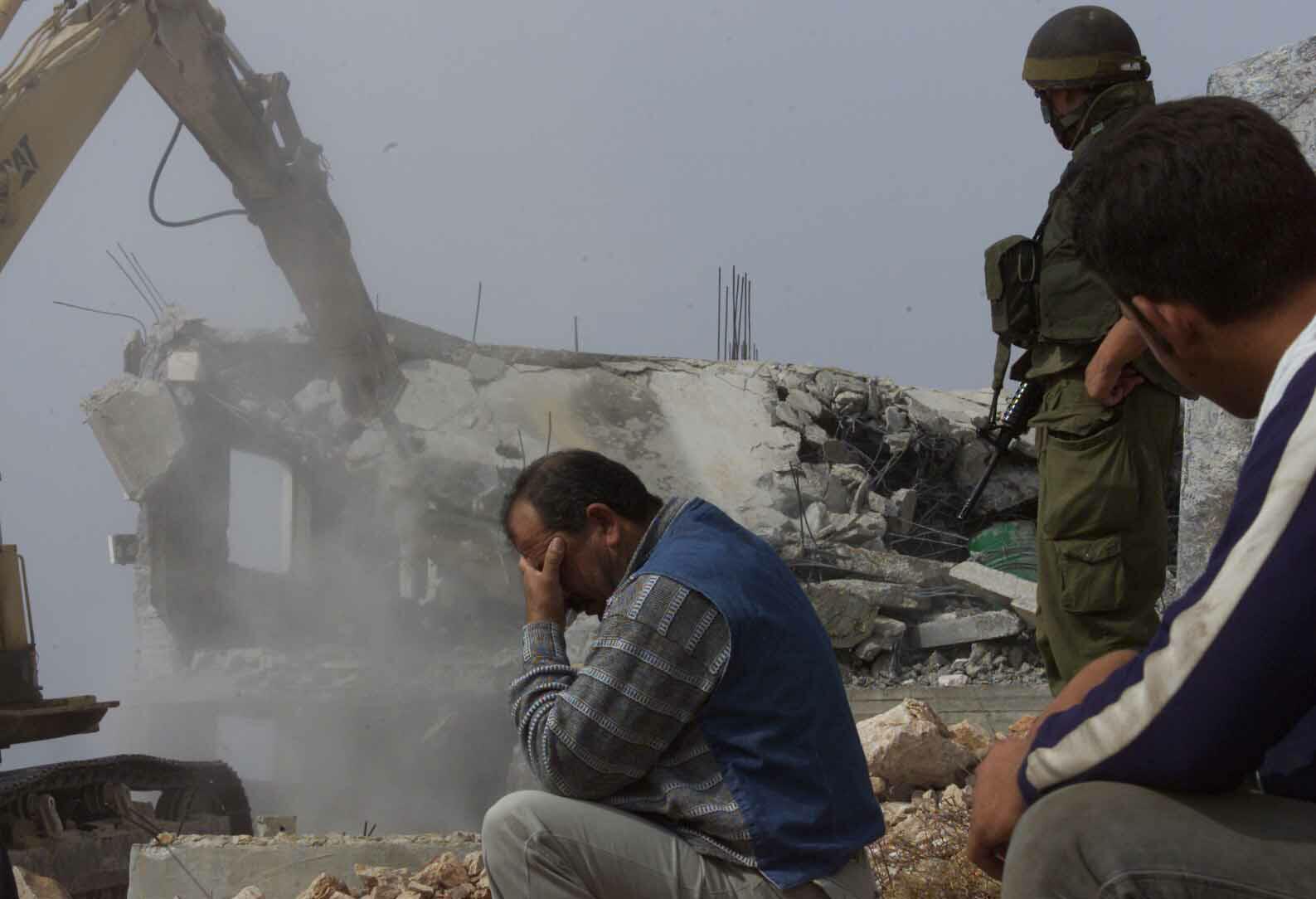
A Committee of the Israeli Knesset (Parliament) passed a first draft of a law that will require that Palestinians whose homes are destroyed by Israeli forces pay the Israeli government for the demolition costs.
The law will now be passed to the full Knesset for a final reading, where it is expected to pass due to the current makeup of the Knesset.
Since 1967, Israeli forces have demolished 24,813 Palestinian homes. 90% of these homes were destroyed for ‘administrative’ reasons – because they either lacked a permit or were in an area designated for expansion by the Israeli military. No permits have been issued by Israeli authorities for Palestinian construction in the Occupied Territories since 1967. The remaining 10% of the demolitions have been ‘punitive’ demolitions of the homes of Palestinians accused of attacking Israel, or of their families’ homes.
In the first five months of 2011, Israeli forces demolished more Palestinian homes than in the entire year of 2010, rendering homeless 706 Palestinians, including 341 minors. This is according to the most recent numbers released by the Israeli Civil Administration.
If the law passes the full Knesset, any Palestinian whose home is destroyed by the Israeli military will have to pay thousands of dollars to cover the cost of the demolition. Already, many Palestinian homeowners, mainly in Jerusalem, have been forced to pay for the forced demolition of their homes.
Israeli forces use US-made armored D9 bulldozers, manufactured by the Caterpillar Corporation, to carry out the demolition of Palestinian homes. This has led US and international activists to call for a boycott of the Caterpillar corporation, saying that the use of the bulldozers to demolish Palestinian homes is a violation of international law and the Fourth Geneva Convention.
Challenging Racism by Israelis on Every Front
By Gulamhusein A. Abba / Dissident Voice / June 27, 2011
The pressure on Israel is building. Non violent protests by the Palestinians are increasing in numbers and size. As predicted by me in an earlier article, they will soon escalate and go one notch further, adopting Gandhi’s concept of not mere passive protest but active non-violent civil disobedience. It will not be long before thousands of Palestinians and their Israeli supporters will march to checkpoints and attempt to break through without waiting for “clearance” from young, arrogant Israeli soldiers manning them. Tunisian and type mass protests that are taking place all over the Middle East are bound to take place in Palestine also. No one need be surprised to see many Israelis joining them.
It is encouraging to see that while the international community represented in the UN seems paralyzed, the common, peace and justice loving people from around the world are ready to lend their support to the brave people of Palestine. They are beginning to say “enough is enough”. They are demanding that Israel comply with International law and human rights.
On July 8 hundreds of activists – about 500 estimated so far — from all over the world will converge on Tel Aviv’s Ben Gurion Airport, and this time they will not lie about their reason for being there. They will openly and truthfully declare to the Israeli security that they are there to go to the West Bank to help the people there and participate in nonviolent solidarity actions.
These solidarity actions are scheduled to take place from July 8-16 in coordination with 15 Palestinian civil resistance organizations in the occupied West Bank and East Jerusalem.
The purpose of these actions is to show that not only are the actions of Israel in Gaza reprehensible but that Israeli repression in the West Bank and Jerusalem is no less condemnable and is part of an attempt by Israel at ethnic cleansing and colonization.
I long to join them. Unfortunately, I do not have the money to go there. Also, my holding an Indian passport and living in the US makes getting the necessary paperwork done difficult – not to mention my 83 years and poor health.
Why are hundreds of internationals giving up the comforts of their homes to go to Ben Gurion Airport and subject themselves to the certain humiliations and invasive interrogations by the Israel security — and deportation that seems certain to follow?
Why are other internationals sailing in boasts to go to Gaza and risk being bombed by the Israelis?
Why do I long to go there?
Basically because having come to know of the injustice, hardships, trials and tribulations, deaths and tragedy on a vast scale being suffered by the Palestinians at the hands of the Israeli government, being quiet, saying nothing, doing nothing, is no longer an option. Silence, in such situations, is complicity.
For long we have agonized over our helplessness to help. For long we have wondered what we could do.
Michael Riordon in his book Our Way to Fight writes: “Yet in the face of overwhelming harm, the question arises: “What can I do?” The victims ask, our conscience asks. So does a shared interest in a livable world. What can I do?
“During Athens street protests in 2008, a Greek blogger answered, beautifully: “We have a duty to move here, there, anywhere except back to our couches as mere viewers of history, back home to the warmth that freezes our conscience.”
The convergence at the Ben Gurion Airport on July 8, the solidarity actions in Palestine from July 8 to 16, sailing on Flotilla II provide some opportunities to do something.
Israeli apartheid days are numbered, and now is the moment to challenge it on every front.
Action is the best antidote to despair. Besides, it bears repeating, silence is complicity.
Soldiers order Palestinian farmers to stop work
Ma’an – 27/06/2011
NABLUS — Israeli forces on Monday stopped Palestinian farmers working on their land in villages in the northern West Bank, a local agricultural committee said.
Farmers were working in Jurish and Aqraba villages as part of a land reclamation project but soldiers said the farmland had been confiscated and now belonged to Israel, committee coordinator Yousif Deiriyya said.
Deiriyya added that forces confiscated a backhoe.
The committee for the union of agricultural workers said Friday that Israeli forces confiscated a vehicle from farmers and ordered them to stop work in the same area.
Land reclamation projects aim to improve the source of income for families which rely on agriculture and also serve to protect vulnerable land from Israeli confiscation.
The project is carried out by the committee for the union of agricultural workers in partnership with Palestinian non-governmental organizations under the management of agricultural relief committees. It is funded by the Dutch government.
Black Panther’s Posthumous Writings Cover Activism’s Risks, Rewards
By Eleanor J. Bader | Truthout | Book Review
“The War Before: The True Story of Becoming a Black Panther, Keeping the Faith in Prison & Fighting for Those Left Behind”
Safiya Bukhari
Feminist Press
New York, 2010
Everyone wants to leave a legacy, whether through procreation or by creating a tangible testament to their existence. For some, it’s art, music, storytelling or writing. For others it’s the founding of an organization or the creation of a product.
For Black Panther Safiya Bukhari, who died in 2003, the bequest included an ongoing community organization, the Jericho Movement to free US political prisoners; a daughter and grandchild; and an astute collection of essays written to encourage the always-uphill battle to win freedom and equality for the world’s disenfranchised and impoverished people.
In “The War Before,” a collection of 22 edited commentaries, Bukhari gives readers a sense of what it was like to be a Panther and captures the exhilaration of establishing free breakfast programs and health centers in low-income communities of color. She also explores Panther excesses, from rigid rules to over-the-top posturing and pontificating. At the same time, the anthology reminds would-be or burned-out activists of the sheer joy that comes from resisting civic wrongs.
It’s an important, inspiring book.
That said, there are small lapses in which rhetoric dominates, and some topics – such as the split between East Coast and West Coast Panthers that was fomented by the US counterintelligence program, or Cointelpro – could have been more fully discussed.
Still, “The War Before” is a fascinating look at the making of an activist, and it captures the spirit of a tumultuous era in which thousands joined Bukhari in believing that a domestic insurrection was not just possible, but imminent.
Editor and former political prisoner Laura Whitehorn’s introduction to the book gives readers a bit of the backstory. Among the tidbits presented are these: Bukhari – originally named Bernice Jones – was reared in the Bronx, one of ten children in a devoutly Christian, middle-class household. In college, she joined the Eta Alpha Mu sorority and, as part of her initiation, was required to travel to Harlem. There, she and several friends encountered a member of the Black Panther Party (BPP) selling newspapers, and learned of the feeding program that had been established. “The women went to the church where the breakfasts were offered, to see for themselves,” Whitehorn reports. “Safiya liked what she saw and kept coming back. It was at that time that she began to notice how badly the community was treated by the police.”
By early 1969, Jones/Bukhari was hooked. She dropped out of school and began working in the Harlem BPP office, immersing herself in the study of political theory and learning to do community organizing. She also got involved with comrade Robert Webb and gave birth to a daughter. “In those years,” Whitehorn writes, “revolutionaries usually saw ourselves as too busy making revolution to engage in standard family life.”
As the year progressed, the demands on the cadre became more intense, and after BPP members Fred Hampton and Mark Clark were murdered in December 1969 – killed by government agents hell-bent on destroying the BPP – many activists, including Bukhari, concluded that underground organizations were needed. Placing her daughter with her mother, Bukhari vanished. Whitehorn chronicles what happened next:
In December 1973, [Bukhari] was arrested and charged with plotting to break prisoners out of New York City jails…. The charges were soon dismissed. Then she was hit with a subpoena to testify before a grand jury that was preparing charges against other Black radicals. She couldn’t bring herself to testify against her political associates. Safiya left her family and friends to continue her work underground. She stayed under for almost two years, until 1975, when she was arrested at the scene of a grocery store shooting in Norfolk, Virginia.
Bukhari was ultimately convicted and sentenced to 40 years. While imprisoned, her health began to deteriorate, but her requests for medical care were ignored. She somehow escaped from the prison in late 1976. Although she got the health care she needed while on the lam, she was eventually recaptured, and spent the next four years in solitary confinement. Finally, after eight years and eight months, she was granted parole and released in 1983.
Bukhari’s attention subsequently turned to publicizing the existence of political prisoners here at home. She also worked to develop support networks for those locked inside. Her essays on this topic are searing.
So are her reflections on the BPP, written with the obvious benefit of hindsight. In “On The Question of Sexism Within the Black Panther Party,” she places male chauvinism in a wider context. “The destruction of our culture, which started with the stealing of our language, religion, and children, was completed when we began to measure our own worth by how many women the Black man could pleasure at a time and how many children we could have,” she writes. “Since Black men had been stripped of their manhood in every way but the ability to pleasure women and make babies, the sexual act soon became the standard by which the Black man measured his manhood. This is the root of the sexism that is plaguing our community.”
This is not to say that Bukhari condoned sexist behavior. She didn’t. Among the Party’s Eight Points of Attention, she continues, was the injunction that men should not “take liberties with women.” That this was part of the written mandate impressed Bukhari, and she notes that BPP women often worked “right alongside men, being assigned sections to organize just like the men, and receiving the same training as men.” Nonetheless, she recognized that many male Panthers “brought their sexist attitudes into the organization.” Worse, she was highly aware of the fact that they were rarely, if ever, ordered to change their ways.
While Bukhari did not consider herself a feminist, the presumption of male superiority rankled her, and she fought it at every turn. Then again, her standards for everyone – male and female – were extremely high, and when people failed to meet her expectations she sought to understand the psychological and material factors that made it difficult for them to do so.
In “We Too Are Veterans: Post-Traumatic Stress Disorder and the Black Panther Party,” she lambastes the government repression that not only left many Panthers dead, but also led to psychic trauma in those who survived. “We had not just mouthed the words ‘revolution in our lifetime,’ but had believed them,” she confesses. “We sincerely believed the Black Panther Party would lead us to victory.” Instead, activists like Clark and Hampton, Timothy “Red” Adams, Fred Bennett, Alprentice “Bunchy” Carter, John Huggins, Little Bobby Hutton, Twymon Myers, Sandra Pratt, Robert Webb, and Anthony “Kimu” White were murdered. This reality, in addition to “the constant shoot-outs, the infiltration and set-ups that left you leery of strangers or of anyone getting too close or acting too friendly,” took a terrible toll on the BPP members left to bear witness, Bukhari concludes.
“As I looked over the list of PTSD symptoms, I recognized myself,” she writes. “And the first step in resolving the problem is recognizing that it exists.”
Indeed. To her credit, Bukhari refused to wallow in bitterness and chose to focus her energies on the self-help that comes from fighting back. As the founder of the Jericho Movement , a coalition of religious and secular groups working to win amnesty for US political prisoners, Bukhari worked tirelessly to plan rallies, protests and speaking tours before her untimely death.
Mumia Abu-Jamal’s touching afterword posits Bukhari as someone who never lost sight of the big picture. She knew, he writes, that “it comes down to organizing. It comes down to the people.”
The Bukhari that Abu-Jamal recalls knew that the movement was bigger than any one person, but still understood that one person could get the ball rolling and make an impact. Those who knew her, he adds, frequently commented that she was the hardest-working person they’d ever met.
“The War Before” will remind Bukhari’s friends and family of what the planet lost when Safiya died eight years ago at age 53. Likewise, it is sure to stir those who are reading her words for the first time.
Featured Video

They Double Down on BLOOD PRESSURE Guidelines!
or go to
Aletho News Archives – Video-Images
From the Archives
Chocolate Gives Statins a $29 Billion Run For Their Money
By Sayer Ji · GreenMedInfo · April 17, 2012
With the blockbuster cholesterol-lowering class of drugs known as statins being widely promoted for the primary prevention of cardiovascular disease, despite their having over 300 documented adverse health effects (including heart failure!), how does chocolate sound as a viable, heart-friendly alternative?
We already connect amorously with chocolate (to the tune of 6 billion lbs of cocoa consumed annually worldwide), revealing in heart-felt expressions like “I love it,” and “this is to die for!” how comfortable we are with publicly declaring our affection. But did you know that while it makes our emotional hearts sing, it may actually keep our physical hearts happy, alive and ticking longer, as well?
Indeed, back in 2006, researchers found that for elderly men, eating cocoa was inversely associated with blood pressure and 15-year cardiovascular and all-cause mortality. … continue
Blog Roll
 Aletho News
- I’M SO BLOODY FURIOUS: They Double Down on BLOOD PRESSURE Guidelines!
- The Israeli Nuclear Doctrine and the Turning Point of the Kennedy Assassination
- Striking Matches Near the Powder Keg
- Prominent Russia hawk: European leaders privately talk about war with Russia, first need ‘mass casualty event’
- China warned Trump not to touch Iran’s oil tankers: Larry Johnson
- EU Central Banker Plans To Plant Barren AI Crops Across The Continent
- Macron’s Strategic Autonomy Paradox: France Rearms on Debt and Depends on Foreign Fuel
- Nigel Farage vs Tucker Carlson: Who is right about Hitler and Britain?
- Chocolate Gives Statins a $29 Billion Run For Their Money
- Hypotheses on the collapse of U.S. computer systems
- If Americans Knew
- An error has occurred; the feed is probably down. Try again later.
- No Tricks Zone
- New Study: Modern Temps Are Among The Coldest Of The Last 10,000 Years In East Central Europe
- Germany’s Renewable Energies Lead to 1.4 Billion Euro Electric Power Trade Deficit
- Argentina’s Perito Moreno Glacier Joins Antarctica and Arctic In Defying Doomsday Melt Claims
- New Study: Barents Sea Temperatures Were Warmer And Sea Ice Less Extensive In The 1700s Than Today
- German Authorities Start Initiative To Evaluate Public Register For Climate “Disinformation” Spreaders!
- Zonal Asymmetry of Temperature Change in the Antarctic Circumpolar Current
- New Study: The Net Fossil Fuel Contribution To Rising Atmospheric CO2 Has Been Zero For 500 Years
- Germany’s Green Energy Transition Becoming Increasingly Expensive…Another 6 Trillion Euros!
- Sudden Stratospheric Warming, Powerful El Niño Combination May Lead To Extreme Europe Cold, Energy Crisis!
- Two New Studies Find Thwaites Glacier Melt Cannot Be Driven By Human Activity Or A Warming Ocean

