Did Obama’s big speech offer any hope for Palestine?
By Ali Abunimah – Electronic Intifada – 05/19/2011

The New York Times was quick to spin Obama’s speech in ‘historic’ terms
“Obama Endorses 1967 Borders for Israel” as part of a “Broad Speech Rejecting Status Quo in the Middle East” – that was the instant spin on the front of The New York Times website within minutes of the president speaking.
But while President Barack Obama laid out in a little bit more detail a US “vision” of what “peace” would look like in his much anticipated speech on US policy in the Middle East and North Africa, there was precious little new.
Moreover, the speech affirmed that the United States will not take any effective action to advance its vision of a two-state solution.
The president covered broadly the uprisings in the Arab world and the American response to them, but I will look at the sections on Palestine – not necessarily in the order of delivery, but by theme.
The 1967 lines
What the president actually said was:
We believe the borders of Israel and Palestine should be based on the 1967 lines with mutually agreed swaps, so that secure and recognized borders are established for both states.
There is a world of difference between “the 1967 lines” and “based on the 1967 lines with mutually agreed swaps.” It is sort of like the difference between “a true story” and a Hollywood movie “based on a true story.”
As the Palestine Papers showed, US-brokered negotiations for years were predicated on trying to reach such a result, and despite unprecedented Palestinian concessions agreeing to allow Israel to annex most of its settlements, no agreement could be reached.
Although it is true that the Obama administration previously adamantly refused to mention the term “1967 lines,” its doing so now is couched in such a vague formula that it does not contradict President George W. Bush’s April 2004 pledge on behalf of the United States to support Israel’s annexation of its West Bank settlements.
Moreover, as Palestinian Authority (PA) “chief negotiator” Saeb Erekat recently told The Electronic Intifada, PA leader Mahmoud Abbas remains fully committed to “land swaps” to allow Israel to keep its settlements even if the UN recognizes a Palestinian state “on the 1967 line.”
Shortly after Obama’s speech, Israeli Prime Minister Benjamin Netanyahu issued a grand-standing statement rejecting the 1967 borders as “indefensible.” He needn’t worry. There were enough loopholes in Obama’s speech to drive several large settlement blocs and perhaps even the entire Jordan Valley through.
Israel as a “Jewish state”
Obama has done it before, but once again he explicitly endorsed Israel’s demand to be recognized as a “Jewish state”:
a lasting peace will involve two states for two peoples: Israel as a Jewish state and the homeland for the Jewish people, and the state of Palestine as the homeland for the Palestinian people, each state enjoying self-determination, mutual recognition, and peace.
It is shocking that a president who constantly boasts that he is only in the White House because of the victories of the US Civil Rights movement against vile Jim Crow racism would endorse Israel’s demand to be allowed to discriminate against Palestinians. I explained in detail why Israel’s demand to be recognized as a “Jewish state” is totally incompatible with democratic principles and human rights in a 2009 article in The Nation:
If Israel has a “right to exist as a Jewish state,” then what can it legitimately do if Palestinians living under its control “violate” this right by having “too many” non-Jewish babies? Can Israel expel non-Jews, fine them, strip them of citizenship or limit the number of children they can have? It is impossible to think of a “remedy” that does not do outrageous violence to universal human rights principles.
And indeed, recognizing Israel’s “right” consigns not only Palestinian refugees to the trash heap, but Israel’s own 1.4 million Palestinian citizens whom leading Israeli politicians like Kadima party leader Tzipi Livni and foreign minister Avigdor Lieberman view as a fifth column and hope to expel or denationalize.
Obama made a nod to this kind of racism when he warned that “The fact is, a growing number of Palestinians live west of the Jordan River.” This was a coded reference to what Israelis openly term the “demographic threat” to a Jewish majority posed by the reality that Palestinians are once again becoming the majority population throughout historic Palestine. This is due to natural growth of Palestinians, a lower Israeli Jewish birthrate and the dearth of Jews around the world who wish to settle in historic Palestine.
In my 2009 article, I explained in American terms why this is unacceptable and racist:
What if we apply Israel’s claim to the United States? Because of the rapid growth of the Latino population in the past decade, Texas and California no longer have white majorities. Could either state declare that it has “a right to exist as a white-majority state” and take steps to limit the rights of non-whites? Could the United States declare itself officially a Christian nation and force Jews, Muslims or Hindus to pledge allegiance to a flag that bears a cross? While such measures may appeal to a tiny number of extremists, they would be unthinkable to anyone upholding twenty-first-century constitutional principles.
Yet this is precisely the nightmare vision Obama is endorsing for Israel which has become increasingly bold in its passage of new laws discriminating against non-Jews, and is in the grip of state-funded rabbis calling for Jews to shun and boycott non-Jews and refuse to rent or sell homes to them.
Hamas
The president said:
the recent announcement of an agreement between Fatah and Hamas raises profound and legitimate questions for Israel: How can one negotiate with a party that has shown itself unwilling to recognize your right to exist? And in the weeks and months to come, Palestinian leaders will have to provide a credible answer to that question. Meanwhile, the United States, our Quartet partners, and the Arab states will need to continue every effort to get beyond the current impasse.
On its face this might appear to be a softening of Obama’s long-standing rejectionism of any dealings with Hamas in that he’s not calling for an immediate aid cut-off to the Palestinian Authority. He appears to be giving the Palestinians time. But it still looks certain that the ultimate US response will depend on whether Hamas submits – as Fatah has done – to Quartet conditions.
Always more sensitive to Israelis
If this was a speech intended to woo an Arab audience, then it is notable that Obama displayed the typical bias characteristic of American officials. He was very graphic and vivid about Israeli suffering and victimhood, while vague and evasive about the vastly greater terror Palestinians have experienced under Israeli rule. Reflecting on decades of conflict, Obama said:
For Israelis, it has meant living with the fear that their children could be blown up on a bus or by rockets fired at their homes, as well as the pain of knowing that other children in the region are taught to hate them.
Aside from its visceral language, this formulation feeds the myth that hostility to Israel is primarily a result of Arabs being “taught to hate,” when in fact if Arabs do hate Israel it is a result of Israeli actions. Israel teaches Arabs to hate Israel. Contrast the president’s words on the other side:
For Palestinians, it has meant suffering the humiliation of occupation, and never living in a nation of their own.
That’s it? Toward the end of the speech, the president did mention “the Israeli father whose son was killed by Hamas” and “a Palestinian who lost three daughters to Israeli shells in Gaza” – but this was only to offer an example of a Palestinian who decided to let bygones be bygones despite Israel’s ongoing actions.
The president would never dream of actually supporting efforts to hold Israel accountable. Indeed, he vowed:
Our commitment to Israel’s security is unshakeable. And we will stand against attempts to single it out for criticism in international forums.
Clearly the president cannot risk offering sympathy to Palestinians proportionate to their actual suffering. As he has learned before, this would risk offending the Israel lobby which demands that American politicians always portray Israel as the principal victim. Recall that during the 2008 campaign Obama once accidentally let slip that “Nobody is suffering more than Palestinians” but later “clarified” that he meant they were suffering at the hands of their own leaders, not Israel.
Obama vows to continue its inaction and condemns Palestinians taking action
Putting the merits of Obama’s “vision” aside, what will the president actually do to advance it? Before he laid out the details, Obama said:
Now, ultimately, it is up to the Israelis and Palestinians to take action. No peace can be imposed upon them – not by the United States; not by anybody else.
What this means in translation is that the United States will not put any pressure on Israel to change its behavior – such as forcing it to stop building settlements. But Obama will continue to support lop-sided “negotiations” between local superpower Israel and a Palestinian Authority that is actually dependent on Israel for its mere survival (as Israel’s recent withholding of PA tax funds shows). No peace, let along a just one, can emerge from such “negotiations.”
Palestinians must sit on their hands
During his speech, the president also warned:
For the Palestinians, efforts to delegitimize Israel will end in failure. Symbolic actions to isolate Israel at the United Nations in September won’t create an independent state. Palestinian leaders will not achieve peace or prosperity if Hamas insists on a path of terror and rejection. And Palestinians will never realize their independence by denying the right of Israel to exist.
The reference to “delegitimization” appears to be a coded condemnation of the growing boycott, divestment and sanctions (BDS) movement, a growing nonviolent campaign to pressure Israel to respect Palestinian human rights. That’s out.
The bid to get Palestine recognized as a state is a desperate effort by the PA to seek international support in the face of intransigent US bias toward Israel. That’s out too.
Next the president tells Palestinians to reject “terror.” Ok, fair enough. And indeed elsewhere in his speech Obama was fulsome in his praise for “nonviolence.”
But what happened when tens of thousands of Palestinians peacefully marched for their human rights, including their right to return to Palestine even if they are not Jewish, last Sunday on Nakba Day? Israel gunned down more than a dozen people and the White House endorsed its actions.
So as far as Obama is concerned Palestinians have no options but to turn to negotiations that have proven utterly fruitless as even he acknowledged.
Soon after Obama was elected in 2008, I predicted that his tenure – despite high expectations everywhere else – would not produce any progress toward the mythical “two-state solution.” I see no reason to change that assessment.
But I concluded then, as I do now, that “This does not however mean that the situation will remain static or that those pursuing a just peace have no recourse for action.”
Indeed as recent months have shown throughout the region, the fates of nations are in the hands of their own citizens, not those of the American president.
Plans Announced For 1,500 New Settlement Units In Jerusalem
By Kevin Murphy – IMEMC and Agencies – May 19, 2011
Maan news agency reports that The Planning and Building Committee for Jerusalem have announced plans for 1,500 new Jewish only housing units in illegal Israeli settlements in East Jerusalem.
The announcement comes hours before US President Barrack Obama’s talk on the region later today and days before Israeli PM’s speech before US congress next Tuesday. The housing units are due to be built in the illegal settlements of Har Homa and Pisgat Ze’ev. The settlements are part of land occupied after the 1967 war and as such are internationally recognised as Palestinian Territory. Much of the settlements are on privately owned Palestinian land.
The settlements have been a thorn in the side of the Obama administration in its search for a resolution to the conflict. Obama offered extensive benefits to Netanyahu in return for a halt to settlement construction, including vetoing any Palestinian motions in the UN. However Netanyahu rejected the propsals and resumed settlement activity last September.
Palestinian leaders say a halt to settlement construction is an absolute prerequisite to any potential peace talks. Settlement activity, they claim, makes a future Palestinian state unviable and must be stopped.
New book shows how aid to PA ended up in Israel’s pockets
By David Cronin – The Electronic Intifada – 18 May 2011
About a decade ago, a record was broken in Palestine. Responding to the outbreak of a new intifada, outside governments dramatically increased their financial contributions to the West Bank and Gaza. By 2002, the occupied Palestinian territories had become the largest recipients of development and humanitarian aid on a sustained per capita basis since the Second World War.
Are Palestinians grateful at being given as much as $1 billion annually in recent times? From conversations I had in Jerusalem and Ramallah earlier this year, the answer would appear to be no. “We don’t want your money; we want your solidarity,” one woman told me. Others spoke of how foreign aid was “bandaging” the occupation, easing some of its symptoms but leaving the core problems to fester.
In The Political Economy of Aid in Palestine, Sahar Taghdisi-Rad illustrates how aid earmarked for the oppressed often ends up in the oppressor’s pockets. “When aid is given in the context of conflict and violence, it becomes part of that context; hence its effect on conflict does not remain neutral, despite what most donors would like to claim,” she writes (87).
Using a phrase coined by the Israeli journalist Meron Benvenisti, Taghdisi-Rad argues that Israel imposes a “deluxe occupation,” whereby it exerts total military domination over the Palestinians under its yoke without taking any responsibility for meeting their basic needs (158).
Rather than holding Israel to account for its most egregious abuses of human rights and international law, donors have generally been willing to accommodate those abuses. By paying for repairs to Palestinian infrastructure damaged by Israel, donors have not only helped prolong this “deluxe occupation,” they have reduced any sense of urgency for a political resolution of the conflict, she argues (17).
Israel benefits from international aid to Palestinians
Taghdisi-Rad examines how far from behaving in an impartial manner, donors are tailoring their aid programs to benefit Israel. She devotes particular attention to analyzing the Palestinian Reform and Development Plan Trust Fund (PRDP – TF), set up by the World Bank (187-192). Promised $7.8 billion mainly by Western governments for the 2008-10 period, it represented a “major political shift” from previous aid blueprints for the Palestinian Authority.
Whereas donors had until then nominally accepted that Israel was an occupying power and that Palestinians should be encouraged to seek independence from it, this plan advocated deeper “cooperation” between Israel and the Palestinian Authority, as well as sharp reductions in public expenditure. By stipulating that the PA cut back on its assistance to ordinary Palestinians who had trouble paying their energy bills, the authority was pressurized into buying power in bulk from the Israel Electricity Company in order to avoid service disruptions.
This fits a wider pattern, under which aid supposed to stimulate Palestinian development instead finds its way to Israeli enterprises. The United Nations has calculated that 45 percent of international aid to Palestine ultimately supports the Israeli economy.
An economist by training, Taghdisi-Rad worked for the United Nations Conference on Trade and Development (UNCTAD) until a few months ago. Her former employers do not escape criticism. UNCTAD used to take a bold stance in the 1990s, when it argued that the main requirement for economic progress in the West Bank and Gaza Strip was an end to the Israeli occupation. Now, however, it “seems also to follow other donors’ less ambitious approaches to Palestinian development,” she writes (129).
For the most part, those approaches are characterized by an ideological blindness that can defy common sense. Donors have been so gung-ho in promoting trade liberalization and the private sector that they have ignored obvious obstacles. The “quick impact projects” championed by former British prime minister and current Quartet envoy Tony Blair are particularly ridiculed.
Unveiled in 2007, one such project undertook to provide marketing advice to Palestinian exporters. Predictably, such advice proved useless, given that Blair was not prepared to use his platform as an international “peace” envoy (as he is habitually described in British newspapers) to demand that Israel lift the restrictions which prevented Palestinian firms from exporting goods in the first place (170).
US aid to Israel
International aid to Palestine is usually categorized as “development” or “humanitarian” in nature. It is eclipsed in volume by US financial assistance to Israel of about $3 billion per year; such aid is released even though Israel is internationally recognized as a developed economy.
Taghdisi-Rad complains that the US’s funds “allow Israel to carry out its illegal settlement and military activities” and is not conditional on respect for Palestinian rights. By contrast, the US and the EU told a Palestinian administration incorporating Hamas in 2006 that it could only receive foreign aid if Hamas “recognized” Israel. Taghdisi-Rad suggests that the West’s position was tantamount to instructing Hamas to accept Israel’s system of apartheid.
“Unlike any other country in the world, Israel, based on Zionist ideology, does not define itself as a state of its residents, or even a state of its citizens, rather, as a state for Jews only,” she writes. “Recognizing a state which treats all non-Jews as second-class citizens is not even legal under international law” (173).
This is not an easy book to digest. Although its conclusions are cogent, most of the writing suffers from a clunky style. The high number of acronyms clogging its pages sometimes left me feeling like I was drowning in an alphabet soup. Read patiently, however, it offers a hugely informative guide to topics that are of central importance to the future of Palestine but usually neglected in mainstream media coverage.
The book was completed before the assessment published by the World Bank in April that the PA was “well-positioned for the establishment of a state at any time in the near future” (“Building the Palestinian State: Sustaining Growth, Institutions, and Service Delivery“ [PDF]).
Nonetheless, it demolishes the fantasy that Palestine will soon be magically transformed into a viable nation. “It is interesting to note that from its establishment to this day, being one of the most financially-supported governments in this world, the PA has yet to contribute its own resources to public investment and the provision of public services,” Taghdisi-Rad writes (181).
That observation — and many others — makes this work both perceptive and pertinent.
David Cronin’s book Europe’s Alliance With Israel: Aiding the Occupation is published by Pluto Press.
Largest student union in Europe joins boycott of Israel
By James Haywood and Ashok Kumar | BDS Movement | May 18, 2011
The University of London Union (ULU) has voted 10-1 to institute and campaign for Boycott, Divestment and Sanctions (BDS) in support of Palestine. The motion called for “thorough research into ULU investments and contracts” with companies guilty of “violating Palestinian human rights” as set out by the Palestinian Boycott National Committee (BNC). Ashok Kumar, Senate member for LSE, speaking in favour of the motion, argued, “We have precedents for boycotting campaigns at ULU, especially with South Africa and the boycott campaign over Barclays bank, that supported the Apartheid regime. We are now responding to the Palestinian call for civil action in support of their fight against racism.”
The motion also called on other students’ unions to join in the campaign for Palestinian human rights. ULU is the largest students’ union in Europe with over 120,000 members from colleges across London. ULU senate consists of the presidents of the 20 students unions representing every University of London University. James Haywood, President-elect at Goldsmiths Students’ Union, stated, “We are delighted that this motion has passed, and with such a clear vote as well. We have seen throughout history that boycotts are a crucial nonviolent tactic in achieving freedom, and target institutions, not individuals.”
Sean Rillo Raczka, incoming ULU Vice President, “I’m delighted that ULU has passed this BDS policy on Israel. We stand in solidarity with the oppressed Palestinian people, and as Vice President next year I will ensure that the University of London Union does not give profit to those denying the human rights of the Palestinians”
The text of the motion passed is as follows:
Union notes
1) to boycott is to target products, companies and institutions that profit from or are implicated in, the violation of Palestinian rights
2) to divest is to target corporations complicit in the violation of Palestinian human rights, as enshrined in the Geneva Convention, and ensure that investments or pension funds are not used to finance such companies
3) to call for sanctions is to ask the global community to recognise Israel’s violations of international law and to act accordingly as they do to other member states of the United Nations
4) that in 2009 the The Human Sciences Research Council of South Africa released a report stating that Israel was practising a form of apartheid in the occupied West Bank, (http://www.hsrc.ac.za/Media_Release-378.phtml)
5) that Israel continues to build a 8 metre high “annexation” wall on Palestinian land inside the post-1967 occupied West Bank, contravening the July 2004 ruling by the International Court of Justice (the highest legal body in the world, whose statutes all UN members are party to) and causing the forcible separation of Palestinian communities from one another and the annexation of additional Palestinian land.
6) that within the occupied West Bank and East Jerusalem, Israel continues a policy of settlement expansion in direct violation of Article 49, paragraph 6 of the 4th Geneva Convention which declares “an occupying power shall not deport or transfer parts of its own civilian population into territories it occupies.” 6) that the Gaza Strip continues to face a suffocating siege from land, sea and air by Israel, and continues to suffer military incursions into the territory by the Israeli army
7) that Palestinians living in Israel continue to suffer third-class citizenship and are heavily discriminated against from healthcare, education, landownership and in many cases having ‘unrecognised’ villages completely demolished
8) that there continues to be millions of Palestinian refugees throughout the world who are racially discriminated against by not being allowed to return to their homes in Israel and the Occupied Territories, which is legally recognised under international law, including United Nations resolution 194.
9) that ULU and the NUS nationally adopted the call for BDS in the 1980s when it was called for by South Africans fighting racism and apartheid
10) that Ronnie Kasrils, the Jewish South African Minister of Intelligence said “The boycotts and sanctions ultimately helped liberate both blacks and whites in South Africa. Palestinians and Israelis will similarly benefit from this non-violent campaign that Palestinians are calling for.”
11) that the call for BDS has come from over 170 Palestinian civil society organisations, including student organisations, as well as organisations within Israel and across the global; and that the campaign is founded on the basis of anti-racism and human rights for all
Union Believes
1) that unions should work to support the Palestinian people’s human rights and uphold international law
2) that BDS is an effective tactic, which educates society about these issues, economically pressures companies/institutions to change their practices and politically pressures the global community
3) that unions have a moral responsibility to heed the call of oppressed peoples, like we did so proudly during the BDS campaign to end South African apartheid
4) that the BDS movement has united human rights campaigners from different nationalities, races, religions and creeds across the world
Passed 10-1 in ULU – largest union in Europe, 20 universities and 130,000 students.
Union Resolves
(1) Institute thorough research into ULU contacts with investments and companies,including subcontractors, that may be implicated in violating Palestinian human rights as stated by the BDS movement
(2) Pressure University of London universities and affiliate students’ unions to divest from Israel and from companies directly or indirectly supporting the Israeli occupation and apartheid policies;
(3) Promote students’ union resolutions condemning Israeli violations of international law and human rights and endorsing BDS in any form;
(4) Actively support and work with Palestine solidarity organisations such as the BDS Movement, Palestine Solidarity Campaign, Jews for Justice for Palestinians, British Committee for Palestinian Universities , Israeli Committee Against House Demolitions
(5) Affiliate ULU to the Palestine BDS National Committee and engage in education campaigns to publicize the injustice of Israel’s discriminatory policies against the Palestinians and its illegal occupation
Contact
James Haywood
President-Elect
Goldsmiths University Students’ Union
james.haywood@goldsmithssu.org
British Colonial War Crimes in 1950s Kenya Mau-Mau Rebellion Whitewashed
By Jemima Pierre | BAR | 05/17/2011
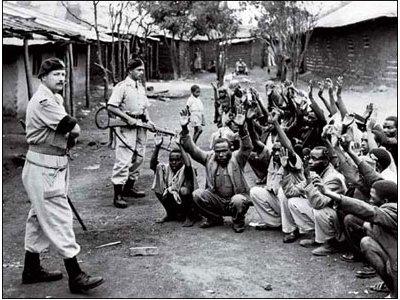
The western-manipulated International Criminal Court, which has indicted only African leaders, tries to give the world the impression that barbarity descended on the continent when the white colonists left. But four aging Kenyan “Mau Mau” freedom fighters, demanding reparations, are forcing Britain to acknowledge the savagery of white settlers and soldiers. “The generation of Africans who fought against colonialism is dying without recognition of their fight or their suffering at the hands of racist colonialism.”
In early April 2011, four elderly Kenyansi—three men and one woman—appeared in the High Court in London, accusing England of systematic torture during their siege of the so-called Mau Maus and demanding reparations for their treatment. One of the men was castrated by the British colonial government in Kenya. Handcuffed and pinned to the ground with his legs pulled apart, his genitals were sliced off by the white officers. He was then left for days without medical attention until he was liberated by Kenyan rebels. The one woman claimant was subjected to sexual torture. White soldiers repeatedly inserted bottles of boiling hot water into her vagina. In addition to these cases, thousands of Kenyans were maimed, lynched and brutally murdered by the British during the last century. Thousands of others were subjected to rape, forced labor, and gross abuse and torture in detention camps. It was part of a deliberate policy of the colonial British government to break a civilian population cast as “baboons,” “barbarians,” and “terrorists” and who were seen as a threat to the colonial order in east Africa.
The proper name for the liberation forces that fought against British colonialism and land-grabbing in East Africa was the Kenya Land and Freedom Army.ii The movement was derisively called “Mau Mau” by the British propaganda machine in an attempt to depict these African freedom fighters as a primitive and anti-white tribal cult. Against this, the late C. L. R. James described the movement as “an ad hoc body of beliefs, oaths, disciplines newly created for the specific purpose of gathering and strengthening the struggle against British imperialism, its military, political and economic domination and, in particular, the Christianity it sought to inject and impose.” And it was land and white settlers, not African “tribal” beliefs that were at the heart of the so-called Mau Mau revolt against British colonialism.
The colonial invasion of Central Kenya began in the late 1880s. It was formalized through military conquest, particularly over the most numerous ethnic group, the Gikuyu, as well as the Embu and the Meru. By 1903, the British colonial government sent in waves of white settlers, from South Africa and England, with the hope of creating another “white man’s country” in Kenya. They stole between 60,000 and 1 million acres of land, settling whites in the most fertile regions with the coolest climates—an area they eventually named the “White Highlands.” By the time the colony of Kenya came into being in 1920, more than 10,000 whites had settled over 25% of Kenya’s best territory. At the same time, the African population, mainly but not entirely the Gikuyu, were driven into reservations or were forced to work as sharecroppers. Then, through hut and poll taxes, restrictions on movement through the issuing of kipande (identity passes), and limits on agricultural production, Africans became systematically entrapped into the racist Kenyan colonial system. Add to this mix the ever-expanding power of the white settlers and Christian missionaries, and Kenya was primed for a revolution.
Though all ethnic groups were affected by British colonial land-grabbing and dispossession, the Gikuyu experienced this most acutely. They did not take lightly the heavy theft of land. When, in 1943, the colonial government threatened groups of Gikuyu with yet another eviction from their lands, they decided to take action. Their struggle began with overt passive resistance but was quickly radicalized. Wings of the movement began armed guerilla attacks on white settler holdings and on Africans who supported the British regime. At the height of the revolt, it was estimated that 1.5 million Gikuyu and other Kenyan groups had taken secret oaths of unity to fight against white settlers and colonial rule. They were met with a brutal armed retaliation. By late 1952, the colonial governor of Kenya declared a state of emergency. The colonial government established and enforced communal punishment, curfews, schemes to confiscate African properties, censors for publications, detention without trial, control of African markets, forced migrations, and detention and labor camps.
By late 1954 the revolt was said to have been militarily defeated by the British army, but the state of the emergency was not lifted until 1960. During the six intervening years, the Mau Mau struggle continued as the British colonial government established a terrorist state. The assault on the Africans continued both through the campaign to arrest and dispose of the alleged Mau Mau leadership, and in detention camps, prisons, and “emergency villages.” The British focused primarily on forcing the Gikuyu to renounce their oath of unity by the most brutal means. According to the Kenya Human Rights Commission, by the time the colonial government ended the state of emergency, over 90,000 Kenyans were executed, maimed, or tortured, while 160,000 were held in detention camps. Others have argued that the numbers were higher. What is well documented is how colonial agents were unrivaled in their barbarity. They castrated and sexually abused, starved, and maimed detainees in order to force the alleged oath takers to confess. They used electric shock, cigarettes and fire, broken bottles, gun barrels, knives, snakes, vermin, and hot eggs were thrust up men’s rectums and women’s vaginas. The assault only came to an end when the Gikuyu population was almost physically decimated and psychologically broken.
If not for the legal case brought against the British government by four surviving Kenyans, we would not know about the trove of secret colonial files documenting the systematic nature of their torture of Africans. The generation of Africans who fought against colonialism is dying without recognition of their fight or their suffering at the hands of racist colonialism. In the current context where Africans, through organizations such as the ICC, are constructed and targeted as the greatest purveyors of “crimes against humanity,” it is well worth remembering the venal work of Europeans in Africa. The demands for reparations may begin with four elderly Kenyans traveling to the old center of the British empire, but the colonial archive surely documents crimes against the Herero, the Congolese, and many other victims of European colonialism. We should not forget their struggles.
i – Wambugu Wa Nyingi, Jane Muthoni Mara, Paulo Nzili, and Ndiku Mutwiwa Mutua
ii – For Further Reading: C. L. R. James, A History of Pan-African Revolt (1995); Caroline Elkins, Britain’s Gulag: The Brutal End of Empire in Kenya (2005); Cora Presley, Kikuyu Women, the Mau Mau Rebellion, and Social Change in Kenya (1992); Gerald Horne, Mau Mau in Harlem? The U.S. and the Liberation of Kenya (2009)
Jemima Pierre can be reached at BAR1804@gmail.com.
Nakba Protests: A Taste of the Future
By Jonathan Cook – Palestine Chronicle – May 18, 2011
They are extraordinary scenes. Film shot on mobile phones captured the moment on Sunday when at least 1,000 Palestinian refugees marched across no-man’s land to one of the most heavily protected borders in the world, the one separating Syria from the Israeli-occupied Golan Heights.
Waving Palestinian flags, the marchers braved a minefield, then tore down a series of fences, allowing more than 100 to run into Israeli-controlled territory. As they embraced Druze villagers on the other side, voices could be heard saying: “This is what liberation looks like.”
Unlike previous years, this Nakba Day was not simply a commemoration of the catastrophe that befell the Palestinians in 1948, when their homeland was forcibly reinvented as the Jewish state. It briefly reminded Palestinians that, despite their long-enforced dispersion, they still have the potential to forge a common struggle against Israel.
As Israel violently cracked down on last Sunday’s protests on many fronts — in the West Bank, Gaza, Jerusalem and on the borders with Syria and Lebanon — it looked less like a military superpower and more like the proverbial boy with his finger in the dam.
The Palestinian “Arab Spring” is arriving and Israel has no diplomatic or political strategy to deal with it. Instead on Sunday, Israel used the only weapon in its current arsenal — brute force — against unarmed demonstrators.
Along the northern borders, at least 14 protesters were killed and dozens wounded, both at Majdal Shams in the Golan and near Maroun al-Ras in Lebanon.
In Gaza, a teenager was shot dead and more than 100 other demonstrators wounded as they massed at crossing points. At Qalandiya, the main checkpoint Israel created to bar West Bank Palestinians from reaching Jerusalem, at least 40 protesters were badly injured. There were clashes in major West Bank towns too.
And inside Israel, the country’s Palestinian minority took their own Nakba march for the first time into the heart of Israel, waving Palestinian flags in Jaffa, the once-famous Palestinian city that has been transformed since 1948 into a minor suburb of Tel Aviv.
With characteristic obtuseness, Israel’s leaders identified Iranian “fingerprints” on the day’s events — as though Palestinians lacked enough grievances of their own to initiate protests.
But, in truth, Israeli intelligence has warned for months that mass demonstrations of this kind were inevitable, stoked by the intransigence of Israel’s right-wing government in the face of both Washington’s renewed interest in creating a Palestinian state and of the Arab Spring’s mood of “change is possible”.
Following in the footsteps of Egyptian and Tunisian demonstrators, ordinary Palestinians used the new social media to organise and coordinate their defiance – in their case challenging the walls, fences and checkpoints Israel has erected everywhere to separate them. Twitter, not Tehran, was the guiding hand behind these demonstrations.
Although the protests are not yet a third intifada, they hint at what may be coming. Or, as one senior Israeli commander warned, they looked ominously like a “warm-up” for September, when the newly unified Palestinian leadership is threatening to defy Israel and the United States and seek recognition at the United Nations of Palestinian statehood inside the 1967 borders.
Ehud Barak, the Israeli defence minister, alluded to similar concerns when he cautioned: “We are just at the start of this matter and it could be that we’ll face far more complex challenges.”
There are several lessons, none of them comfortable, for Israel to draw from the weekend’s clashes.
The first is that the Arab Spring cannot be dealt with simply by battening down the hatches. The upheavals facing Israel’s Arab neighbours mean these regimes no longer have the legitimacy to decide their own Palestinian populations’ fates according to narrow self-interest.
Just as the post-Mubarak government in Egypt is now easing rather than enforcing the blockade on Gaza, the Syrian regime’s precarious position makes it far less able or willing to restrain, let alone shoot at, Palestinian demonstrators massing on Israel’s borders.
The second is that Palestinians have absorbed the meaning of the recent reconciliation between Hamas and Fatah. In establishing a unity government, the two rival factions have belatedly realised that they cannot make headway against Israel as long as they are politically and geographically divided.
Ordinary Palestinians are drawing the same conclusion: in the face of tanks and fighter jets, Palestinian strength lies in a unified national liberation movement that refuses to be defined by Israel’s policies of fragmentation.
The third lesson is that Israel has relied on relative quiet on its borders to enforce the occupations of the West Bank, Jerusalem and Gaza. The peace treaties with Egypt and Jordan, in particular, have allowed the Israeli army to divert its energies into controlling the Palestinians under its rule.
But the question is whether Israel has the manpower to deal with coordinated and sustained Palestinian revolts on multiple fronts. Can it withstand such pressure without the resort to mass slaughter of unarmed Palestinian protesters?
The fourth is that the Palestinian refugees are not likely to remain quiet if their interests are sidelined by Israel or by a Palestinian bid for statehood at the United Nations in September that fails to address their concerns.
The protesters in Syria and Lebanon showed that they will not be pushed to the margins of the Palestinian Arab Spring. That message will not be lost on either Hamas or Fatah as they begin negotiations to develop a shared strategy over the next few months.
And the fifth lesson is that the scenes of Palestinian defiance on Israel’s borders will fuel the imaginations of Palestinians everywhere to start thinking the impossible – just as the Tahrir Square protests galvanised Egyptians into believing they could remove their dictator.
Israel is in a diplomatic and strategic dead-end. Last weekend it may have got its first taste of the likely future.
Lebanon files complaint against Israel
Press TV – May 16, 2011
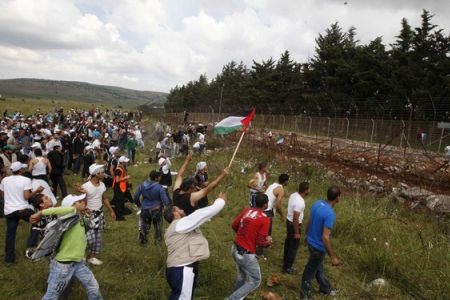
Lebanon has submitted a complaint to the United Nations Security Council against Israel over the killing of 10 civilians in the Lebanese border town of Maroun al-Ras.
At least 10 people were killed and over 110 others wounded after Israeli soldiers opened fire on thousands of Palestinian refugees who were holding a symbolic march toward their homeland on the Lebanese side of the border on Sunday.
The Palestinian refugees living in Lebanon were marking the 63rd anniversary of the forcible eviction of 700,000 Palestinians from their homeland by Israelis and the occupation of Palestine, which Palestinians refer to as “Nakba Day,” or the day of catastrophe.
“The attack represents a hostile act and once more highlights Israel’s violation of Lebanese sovereignty and its disregard of UN resolutions,” Lebanon’s permanent mission to the UN said.
Lebanon also called on the Security Council to pressure Israel to end its hostile and provocative policies against Lebanon and hold it accountable for killing civilians.
The leader of Lebanon’s resistance movement Hezbollah, Seyyed Hassan Nasrallah, said the protests gave the anniversary a new meaning and proved to Israel that the Palestinians hold onto their uncompromising right to return to their homeland.
“We must bow before the courage, the bravery, of those who protested yesterday at Lebanon and Syria’s borders with occupied Palestine, who faced the tyranny of the enemy with bare chests and their heads held high,” Nasrallah said on Monday.
“Your message, loud and clear, to the enemy is that you will liberate your lands, that the fate of this entity [Israel] is demise, and that no initiatives, treaties or borders will protect it,” he added.
A total of 25 protesters were killed in southern Lebanon, the Gaza Strip, the West Bank and Syria’s occupied Golan heights by Israeli forces on Nakba Day.
The United Nations has condemned Israel’s “disproportionate, deadly force” against demonstrators marking the anniversary of the creation of Israel.
“I am shocked by the number of the deaths and the use of disproportionate, deadly force by the Israeli Defense Forces against apparently unarmed demonstrators, which I condemn,” UN Special Coordinator for Lebanon Michael Williams said on Monday.
Report: Mitchell resigned because Dennis Ross was biased and working against US interests
Ma’an – May 17, 2011
RAMALLAH — A political adviser to the late president Yasser Arafat issued a statement Tuesday, alleging that US Mideast peace envoy George Mitchell resigned because of the “extreme bias” of his deputy Dennis Ross.
Bassam Abu Shareef said Ross obstructed all US initiatives aiming to achieve progress in the peace process, and blamed the deputy’s bias for Mitchell’s resignation Saturday.
Abu Shareef said senior American officials informed him that Mitchell viewed the appointment of Ross a step to obstruct the peace process. He added that Mitchell believed Ross was working against US interests.
The official paraphrased comments he said were made by Mitchell during a meeting, where he asked: “How can Dennis Ross assist in the peace process when he refuses to meet with the Palestinians, when he despises their leadership and hates their president?”
Abu Shareef also said Israel’s Prime Minister Benjamin Netanyahu “rejects peace,” and would have no part of a Palestinian state with Hamas in its leadership.
“This means they are opening war on Palestinians and their nation,” he added.
~
See also:
Thousands at the border
Moe Ali Nayel – The Electronic Intifada – 17 May 2011
I grew up in Lebanon during the civil war and the Israeli occupation of the south. During that time a revolutionary song by Julia Butros, “Wayn al-Malayeen?” (where are the millions), was continually heard. But as a child I never understood what she meant when she sang “Where are the millions? Where are the Arab people?”
In 2006 during the Israeli war on Lebanon I heard the song again. I was 25; this time I understood what it meant and that line kept playing endlessly in my head throughout the 33 days of war.
Last Sunday, on the way to the border, the bus driver played that song. In light of the Arab revolutions that are happening at the moment, millions of Arabs have taken to the streets to demand their freedom, to demand their rights and to speak out for the first time (at least since I have been alive). On 15 May the same millions took to the streets, only this time to demand the liberation of Palestine: their freedom, their right.
That day at 7:30am we gathered in front of Mar Elias Palestinian refugee camp in Beirut. There were five buses already full of people and on the street there were about a hundred others waiting for more buses. Finally, we learned there were no more buses and we would have to rent additional ones. I got into our rented bus full of enthusiasm and good vibes; the journey back to Palestine had started. The crowd on the bus was an interesting mix of people of different nationalities and as we sat down we were all Palestine, we were all Palestinian.
For weeks I had anxiously awaited 15 May, the Third Palestinian Intifada. Many people had started referring to it as such on social networks, and I myself loved the sound of it and so this is how I would refer to it every time I spoke about it. However, 15 May is the Nakba (catastrophe) commemoration; on this day we remember that more than 750,000 Palestinians were forced out of their homes, their land, to make way for a new country and people to be put in their place.
To me Palestine was and still is the central cause in the Arab world, and I always believed that the liberation of Palestine would not happen before the liberation of the Arab people from the corrupt ruling dictatorships. The west like to call them the Arab moderates but in reality this means Arab puppets. Today however the Arab world is changing and the Arab people are revolting, and while they are revolting they have not forgotten about Palestine or the suffering and occupation their Palestinian brethren are going through.
In closely following the Arab uprisings since the protests in Tunisia started, I have always seen at least one Palestinian flag among the protesters in every Arab country. Palestine has always been present during the protests. Palestine has always been present in the hearts and conscience of the Arab people. The “malayeen” or millions are speaking now and their united voice is hitting the sky. Yesterday, again, the Arab people spoke: the people want to liberate Palestine; the people want to return to Palestine.
The road to Palestine
The trip from Beirut took longer than it should along the coast to the south; hundreds of buses and cars displayed Palestinian flags, and on the sides of the roads big billboards read: “May 15th: the march to return.” I have never felt so delighted when looking at a billboard before.
On the windy road from Nabatiyeh to Maroun al-Ras, the endless line of buses continued, the windows full of people waving to each other and flashing the V for victory sign. We felt like we were really going back to Palestine. On the bus three Palestinian friends and I jokingly but sincerely started making plans about where in Jerusalem we were going to have a coffee, or should we just go to Haifa and enjoy the beach there, we teased, believing it somehow.
As the bus wound through the lush green valleys of the south, blooming with flowers and life, I couldn’t help but notice many buses with Syrian license plates. “Had these people come all the way from Syria?” I wondered. But no, I was told there were not enough buses in Lebanon, so some had been rented from Syria.
Contrary to our original plans, the bus had to stop in Bint Jbeil, a village a few kilometers away from our destination — the border at Maroun al-Ras. The village had been turned into a big parking lot for buses carrying people from a dozen refugee camps all over Lebanon and the many Lebanese that wanted to march to the border. We jumped out of the bus and without asking how we would get to the border, we found ourselves joining thousands of people walking through the green fields and climbing mountains as a short-cut to our shared destination.
It was an approximately five kilometer walk or more accurately, a hike. It was beautiful to see endless lines of people marching from different directions in the green land. Next to me were Palestinian families who had brought the young ones and dressed them up for the occasion. There were old women and men who struggled to climb the steep hills and there was a great spirit of solidarity among the people as everyone gave a hand, everyone offered to help, and everyone smiled.
My wife and I slowed our pace at one point to listen to an old Palestinian man leaning on a cane. He was walking with his grandson and telling him the story of the time he had had to leave Palestine and carry his nine-year-old sister while escaping to Lebanon over these very same mountains and paths. The old man spoke to his grandson of the beauty of Palestine and described how their home looked.
Finally, as we gradually drew closer to the border, he told the young boy, “Soon you will go and see Palestine, the most beautiful country I have ever seen; it’s where we come from. It’s our land.”
Shooting from the valley
We finally got to Maroun al-Ras, a public space on top of a mountain overlooking occupied Palestine. There were thousands of people scattered all over the mountain top and a big screen was broadcasting what was happening down in the valley. Before we could properly take in our surroundings I heard shooting, four or five shots from below us in the valley.
I told my wife the Israelis are shooting, and a minute after that, a person on the microphone called for the ambulance to bring down stretchers to the fence. I asked what was happening and people told me four martyrs had fallen and more than twenty were injured.
A wave of people stretched from the park on the top of the hill all the way down to the border fence. I found myself sliding on that wave, stopping every once in a while to catch my breath and wonder whether I should stay where I was or keep going down to the fence. I could not contain the desire to join the thousands on the fence already throwing stones across the border. From a distance, the stones looked like white birds diving to the other side.
I finally made it to what they were calling the second line, approximately 500 meters away from the border fence. There were ambulances parked nearby and the Lebanese army had formed a human chain to prevent more people from joining those at the border fence.
Many Palestinian young men and women kept insisting on breaking the chain the Lebanese army had made, wanting to join their brothers and sisters on the front line. Watching the faces of the Lebanese soldiers, all I could see was confusion and panic, but they were not losing any chance to threaten and intimidate the protesters with their raised batons and sticks.
All their guns were directed to the sky
Standing in front of the army were a few Palestinian men pleading with the raging people not to take it out on the Lebanese army. “This is not what we were here for,” they shouted over the chants. That did not stop the people, and even with the knowledge that the land between them was littered with mines, people kept breaking through the chain and sprinting to join the front line.
One group of courageous young women broke the chain of men and ran towards the front line and everyone cheered them on. All this time the Israelis were shooting, a burst of two or three shots rang out frequently, and every time they shot we saw the stretchers gathering new bodies.
At 4:00pm we decided to climb up the steep mountain and walk back to catch our bus. After a couple minutes of walking, I noticed the Lebanese army moving towards the front line, the fence; they reached the protesters who started loudly chanting “Palestine! Palestine!” As the army made their way to the very front it looked like they had decided the protest was over, and suddenly, with no warning, the Lebanese army on the front and the second line started firing thousands of rounds into the air.
All their guns where directed to the sky, but the amount of shooting terrorized everyone who was there. We all started sprinting up the steep mountain; a random man pulled my arm and dragged me up with him as I struggled to keep up on my feet. The firing intensified and there were the same waves of people this time running in panic. Next to me there were lost children, crying, wanting their parents; an old man ran out of breath, crouched down; I saw an old Palestinian woman running up the mountain with tears running down her face.
Looking back down to where the second line was, I could only see a line of soldiers with their M16 rifles to the sky, shooting nonstop. It was like something out of the movies. But something even more terrorizing happened in the middle of the shooting. As the Lebanese fired their guns I heard deeper shots coming from the Israeli side and bullets whizzed by me; I took a dive to the ground. The way the Lebanese army decided to end the event made me ask myself, who is the enemy here?
Nothing to lose but our chains
The march to return left at least ten persons dead in Lebanon and many others in Syria and Palestine, while in Egypt the people were prevented from reaching the border.
People who normally don’t care about Palestine and enjoy a life of apathy and consumerism asked me today, what did you achieve? What did you change? Was it worth it the death of tens of people?
My answer is the following: after yesterday, things will not be the same as before 15 May. Just like after Muhammad Bouazizi, things are not the same as before he shook the Arab world. The Arab people, us, the Arab youth, we are not going to let the status quo continue, we are not going to be humiliated by our own people anymore. We are not going to let Palestine and the Palestinian people be humiliated and tortured every time they breathe.
We are freedom-loving people and we won’t live anymore on empty promises from our corrupt governments who use Palestine as a pretext to repress us while they enjoy stealing from our pockets. We won’t let them continue to make sure Israel is safe and sound, enjoying the beautiful land of Palestine, while hundreds of thousands of Palestinian refugees live in inhumane conditions in the camps.
How do you expect a Palestinian refugee to see his land being enjoyed by the Israeli occupation and not react to that? We, the Arab people, the Arab youth, the millions, have decided that we have nothing to lose but our chains and that Palestine is our prize. I saw yesterday how much the people want to free Palestine, how much they want return to Palestine. The Arab people are here, the Arab rage is here, the malayeen are here.
Moe Ali Nayel is a journalist and fixer based in Beirut.
Featured Video

They Double Down on BLOOD PRESSURE Guidelines!
or go to
Aletho News Archives – Video-Images
From the Archives
Chocolate Gives Statins a $29 Billion Run For Their Money
By Sayer Ji · GreenMedInfo · April 17, 2012
With the blockbuster cholesterol-lowering class of drugs known as statins being widely promoted for the primary prevention of cardiovascular disease, despite their having over 300 documented adverse health effects (including heart failure!), how does chocolate sound as a viable, heart-friendly alternative?
We already connect amorously with chocolate (to the tune of 6 billion lbs of cocoa consumed annually worldwide), revealing in heart-felt expressions like “I love it,” and “this is to die for!” how comfortable we are with publicly declaring our affection. But did you know that while it makes our emotional hearts sing, it may actually keep our physical hearts happy, alive and ticking longer, as well?
Indeed, back in 2006, researchers found that for elderly men, eating cocoa was inversely associated with blood pressure and 15-year cardiovascular and all-cause mortality. … continue
Blog Roll
 Aletho News
- I’M SO BLOODY FURIOUS: They Double Down on BLOOD PRESSURE Guidelines!
- The Israeli Nuclear Doctrine and the Turning Point of the Kennedy Assassination
- Striking Matches Near the Powder Keg
- Prominent Russia hawk: European leaders privately talk about war with Russia, first need ‘mass casualty event’
- China warned Trump not to touch Iran’s oil tankers: Larry Johnson
- EU Central Banker Plans To Plant Barren AI Crops Across The Continent
- Macron’s Strategic Autonomy Paradox: France Rearms on Debt and Depends on Foreign Fuel
- Nigel Farage vs Tucker Carlson: Who is right about Hitler and Britain?
- Chocolate Gives Statins a $29 Billion Run For Their Money
- Hypotheses on the collapse of U.S. computer systems
- If Americans Knew
- DAILY UPDATE: Latest essential news on Palestine, Israel, & region
- Reporting Raises Fresh Questions About Israeli Role in CNN’s ‘Preposterous’ Iranian Dirty Bomb Story
- DAILY UPDATE: Latest essential news on Palestine, Israel, & region
- Under the West’s watch, genocide apologism has become entirely respectable
- Israeli Diplomat Offered Iowa Attorney General Free Trip, Then Asked for Favors
- On World Children’s Day, 350 Palestinian Children Remain in Israeli Prisons
- Why Is Israel Jailing a Palestinian Student Without Trial? Because It Can
- ICJ ruling on Rohingya genocide could strengthen South Africa’s case against Israel
- DAILY UPDATE: Latest essential news on Palestine, Israel, & region
- Newly nominated House Speaker funded Gaza genocide
- No Tricks Zone
- New Study: Modern Temps Are Among The Coldest Of The Last 10,000 Years In East Central Europe
- Germany’s Renewable Energies Lead to 1.4 Billion Euro Electric Power Trade Deficit
- Argentina’s Perito Moreno Glacier Joins Antarctica and Arctic In Defying Doomsday Melt Claims
- New Study: Barents Sea Temperatures Were Warmer And Sea Ice Less Extensive In The 1700s Than Today
- German Authorities Start Initiative To Evaluate Public Register For Climate “Disinformation” Spreaders!
- Zonal Asymmetry of Temperature Change in the Antarctic Circumpolar Current
- New Study: The Net Fossil Fuel Contribution To Rising Atmospheric CO2 Has Been Zero For 500 Years
- Germany’s Green Energy Transition Becoming Increasingly Expensive…Another 6 Trillion Euros!
- Sudden Stratospheric Warming, Powerful El Niño Combination May Lead To Extreme Europe Cold, Energy Crisis!
- Two New Studies Find Thwaites Glacier Melt Cannot Be Driven By Human Activity Or A Warming Ocean

