SOUTH HEBRON HILLS: Israeli settlers invade Palestinian village of Tuba
CPTnet | 16 May 2011
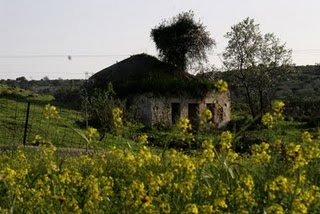
Israeli settlers invaded the village of Tuba in the South Hebron Hills late Sunday night, 15 May. They damaged property and killed and stole livestock belonging to the Ali Awad family. Palestinians of Tuba reported that they counted seven masked settlers, who entered and left the village on foot, and saw two cars at the outskirts of Tuba, near the chicken barns of Ma’on settlement. sight where one of the sheep was attacked and killed 008
The rampaging settlers stole seven sheep, killed two, and injured others, including one which lost an eye. In addition, the settlers upended three water tanks, which held a total of 4.5 cubic meters of water. They destroyed fences, punctured a storage tent and three large sacks of yogurt, damaged a goat pen and destroyed the ventilation pipe of an outhouse. They also set loose a donkey, which later returned.
A Tuba resident called Christian Peacemaker Teams about midnight Sunday to report the settler invasion and request help in urging the Israeli police to respond. The police refused to go to the village because no one there could speak to them in Hebrew. Two Israeli soldiers arrived in Tuba on Monday morning, but did not speak Arabic and so could not communicate with the villagers.
The Ali Awad family is considering making a complaint to the Israeli police, despite the fact that all their previous complaints about settler attacks, vandalism or harassment have not yet resulted in any indictments or compensation. On 21 March 2011, a masked settler from the illegal outpost of Havat Ma’on stabbed Mahmoud Ibrahim Ali Awad as the Palestinian traveled by donkey from Tuba to the city of Yatta. Mahmoud Ali Awad spent a week in the hospital recovering from stab wounds on his chest and arm.
Interview: Undercover Israeli soldiers arrest West Bank demonstrators
Electronic Intifada | 15 May 2011
Approximately 250 persons were injured today at the Qalandiya checkpoint between Ramallah and East Jerusalem in the occupied West Bank. Israeli forces opened fire on approximately 600 marchers demanding the right of return of Palestinian refugees on the date that Palestinians mark the Nakba or “catastrophe” — the forced dispossession of their homeland in 1947-48 with the establishment of the State of Israel.
Palestinian medical crews reported that of the 250 who were treated for injuries and tear gas inhalation, “40 had been marked as seriously injured from bullet wounds,” Ma’an News Agency reported (“Clashes at Qalandiya see 40 seriously injured,” 15 May 2011).
“A report from the Palestinian Red Crescent said two were hit with live rounds, 15 were injured by rubber-coated bullets, and 120 suffered tear-gas inhalation,” Ma’an added.
The Electronic Intifada spoke with Jon Elmer (www.jonelmer.ca), a Canadian independent journalist based in Bethlehem who documented protests in the occupied West Bank today.
The Electronic Intifada: Describe where you were today. Set the scene.
Jon Elmer: Things got going at about 11:00am, with a couple of marches that left from different places. There was a [Palestinian] government-sanctioned march that left from Arafat’s tomb to al-Manara square [in Ramallah] … it was a brief demonstration.
The march that happened at Qalandiya began a little bit earlier. People had marched towards the checkpoint, where protests usually take place. The Israeli soldiers were on the other side of the wall — they had come inside to confront the demonstrations. And that set off to what amounted to about six or seven hours of back and forth street fighting between stone-throwing teenagers and Israeli security forces who fired mostly tear gas and rubber-coated steel bullets. Palestinians set up makeshift defenses within the refugee camp itself and on the border of the camp.
It was hard to say how many people were in the street. It wasn’t a massive demonstration but it definitely had staying power. People were in the streets all day and demonstrations took place in a number of different spots throughout the West Bank.
EI: How would you describe the mood of the people on the streets, and the mood of the soldiers?
JE: With such an overwhelming power dynamic with massive amounts of weaponry, it’s always interesting to watch how the Israeli army operates. The soldiers move in packs, they’re constantly wide-eyed and seem to have their hands full despite the fact that they have the strength of an army behind them, whereas the [Palestinian] teenagers who are just out in the streets with their neighbors and friends and comrades are willing to stay out in the streets for seven hours, challenging that army at every step.
If people are determined not to leave, and the army is inside their community, and that’s the way that it carries out all day, the soldiers are left with very few options besides escalating the violence to try to quell the demonstrations.
We saw that late in the afternoon — the undercover units broke out of the demonstration where they had been hiding in disguise, acting as Palestinian demonstrators. They pulled out their handguns and made a series of arrests while the army backed them up by moving forward and basically trying to put an end to the demonstration. While they arrested people, the protesters began the demonstration again within moments once people re-emerged from the alleyways.
There is so much concern within the Israeli army about what they’re going to do and how they are going to quell demonstrations. If there were, let’s say, thirty demonstrations [across the West Bank], that is a worst-case scenario for the Israeli army. The army reported that there were more than ten today.
EI: What about the mood in Bethlehem, where you are based, and elsewhere around the West Bank on Nakba day?
JE: The demonstrations have been moving from community to community over the last four or five days. Bethlehem had a demonstration a few days ago.
It’s important to understand that while there are exciting political formations developing and re-emerging at this moment, there is a significant malaise that has dominated Palestinian political culture over the last few years, particularly with the aggressive crackdown on the second intifada, which really devastated the core elements of life here in the West Bank and in the Gaza strip as well.
[Israel] attacked people’s livelihoods and their ability to carry on the most basic necessities of life … So there is a period right now of regeneration which is natural after significant national trauma. And the Fatah-Hamas voided election, and the internal fighting, left Palestinians with not too many favorable options.
EI: Given that this is the 63rd anniversary of the Nakba, what are the conversations that are happening in the West Bank right now? What are people saying about the significance of this date in the context of the expansion of both Israel apartheid policies and Palestinian resistance?
JE: [The Nakba is] an important part of the national narrative, arguably the most important part of the national narrative. At the same time, day to day life in the West Bank tends to be dominated by the more direct concerns of the settlements and the checkpoints and the lack of ability to move and the lack of independence and the lack of decent-paying jobs. Basic life necessities are most in focus at the moment.
Although we read in The New York Times about these “success stories” about Ramallah and the transformation of the Palestinian economy in the West Bank over the last five years, the development aid has benefited really only a narrow sector of the population.
In general, people are still dealing with the same elementary needs of citizenship, identification cards, the ability to travel to one now-ghetto to the next. It keeps people focused on the here and now, and the long string of political let-downs and failures of the international community to affect a just resolution to the conflict keeps people modest about envisioning future successes. But the refugee issue is alive; it affects every Palestinian family.
EI: You’ve been documenting various upheavals and protests and demonstrations over the last decade in Palestine. What was most emblematic of what you witnessed today?
JE: I think what happened in south Lebanon was a very significant moment. The descriptions of people going back to their villages and hiking over those mountains today — both young children who have it ingrained in their psyches and the elderly who have never given up — today marching on the border is something that was a great moment. And it was something we can point to as something emblematic.
Although it ended in typically tragic circumstances, that type of spirit and continuity and steadfastness is what is the most threatening to Israel. People never forget, and people will never leave again. These sort of national narratives are crucial to understanding the Palestinian political situation.
Jewish settlers throw firebombs into Palestinian home
Palestine Information Center – 16/05/2011
AL-KHALIL — Armed Jewish settlers tossed a number of Molotov cocktails into the house of a Palestinian citizen in the Old City of Al-Khalil on Sunday night after encircling it.
The owner, Jamal Su’ifan, said that tens of settlers besieged his home and threw the firebombs into it, starting fire and burning part of the house, which was sheltering 20 individuals.
He said that Israeli soldiers were escorting the settlers, noting that two members of the Temporary International Presence in the City of Hebron (TIPH) team in Al-Khalil arrived to his home to check the incident but were also surrounded by those settlers.
The Su’ifan home is only a few meters away from the Kiryat Arba settlement, which was established on Palestinian land east of Al-Khalil. Settlers in Arba routinely attack nearby Palestinian homes in a bid to terrorize their inhabitants away and take control of them.
1948 – Al Nakba: a family’s collective memory
By Myrna Azzeh – 15 May 2011
“The old will die and the young will forget.” This was the prediction of the first Israeli Prime Minister David Ben Gurion. 63 years later, I still wonder what made him think so. Would the Jewish masses – or indeed any of the other groups of people – that suffered the Holocaust ever forget?
As far as I know, having lived in a refugee camp for most of my life, there has always been much space in the tiny alleys of the camp for the collective memory of Israeli massacres, systematic displacement and ethnic cleansing. These images have been printed in the minds of Palestinian refugees both young and old.
I never forget that 2003 Spring when my grandmother and I “went back” to our destroyed village Beit Jibrin. We managed to get there despite the checkpoints and high level of security. It isn’t easy although the actual distance that separates my refugee camp from the village is less than an hour’s drive. I’d been there a few times before but never with her. This was the first time. I walked behind her climbing up a hill in the village. She seemed much stronger and able to walk faster than I remembered. She knew where exactly we were going as if she was there yesterday.
Under a fig tree we sat and my grandmother smiled and remembered when she used to play with her friends, decades ago. She said, “It’s the same tree, a little bit different now; it’s been more than 50 years after all. Nonetheless, it is the same tree.”
 My head was saturated with thoughts; she must have whispered some of her childhood secrets to the old tree. She didn’t say much but the sadness in her eyes said it all. We smiled and kept seated, listening to birds singing and breathing as much of the village’s fresh air as possible as if we had never drawn breath before. This is, after all, the village I have been raised to understand is mine.
Her memories dated back to 1948. She was nearly 10 years old. Despite her young age, she remembered. She remembered her school, the lovely summer evenings she spent with her family in the village. She remembered the harvest time and travelling to Haifa and Yafa with her dad to sell their produce. She also remembered the nights when the peaceful village was first attacked. “We never saw a fighter jet before”, she said. Maybe they had, I thought, but I’m sure it wasn’t the same sight as the one that was now spreading death and fear into people’s hearts in 1948. This was the same year that witnessed over 750,000 of the native Palestinian population expelled from their homes and villages. So far, to this day, they have never been able to return.
63 years since, and in spite of the number of UN resolutions and world condemnations, Israel’s impunity still prevails. No justice has been achieved as Palestinian refugees are yet to see the implementation of the United Nation’s Resolution 242 that clearly affirms “a just settlement of the refugee problem” as well as Resolution 149 which states that “refugees wishing to return to their homes and live at peace with their neighbours should be permitted to do so at the earliest practicable date”.
As much as these resolutions have been alive in my grandmother’s memory, they are also imprinted in refugees’ consciousness whether they are acquainted with international law or not. Every Palestinian refugee resolutely believes in the right to live in the town or village from where they originate, and indeed where they and their families have been uprooted from by force.
Photo taken by Makbula Nassar- Al Jazeera documentary 2009
My grandmother passed away last March 2010 in the refugee camp. However, her dream of returning to Beit Jibrin is still alive and I deeply believe that she is in a place where borders do not exist. Her soul is finally free of the shackles of ethnic division, and she is able to hover over Palestine and our beloved village, our home, Beit Jibrin. She might be whispering secrets to the fig and olive trees there right now. Her dreams of return are still alive. As I will never forget her nor will I forget her passion when talking abut the village, I will always make sure I pass her dreams and aspirations to the coming generations. This, I believe is a promise that each refugee has taken unintentionally until the return and the full realisation of rights.
We will never forget my village and all the ethnically cleansed Palestinian villages as the memory remains in the heart and soul of all Palestinians. For us, the old may well die, but the young will never forget.
Israeli forces violently arrest demonstrators in al-Walaja
15 May 2011 | International Solidarity Movement
At 11 AM on al-Nakba remembrance day, 500 residents from the West Bank village of al-Wallajeh and international supporters marched towards the Israeli Apartheid Wall. The Wall was built to separate the villagers from their original land from which they were expelled in 1948. The demonstration was violently attacked by the Israeli military with rubber coated steal bullets, tear gas and protesters were beaten with batons and rifles. One youth was hospitalized after being injured by a rubber coated steal bullet.
Eight Palestinians including twins aged 11 and 6 internationals (American, Dutch, German and Canadian nationals) were arrested. The army proceeded to raid the village and invade each house, searching for people who had participated in the demonstrations. The raids as well as confrontations between the army and the village youth are ongoing.
The Arrested Palestinans are:
Mazen Qumsiyah
Basel Al Araj
Ahmed Al Araj
Mohammad Al Araj
Allah And Mohammed Abu Tin 11 year old twins
Tarek Abu Tin
Adel Abu Tin
Al-Walaja is an agrarian village of about 2,000 people, located south of Jerusalem and West of Bethlehem. Following the 1967 Occupation of the West Bank and the redrawing of the Jerusalem municipal boundaries, roughly half the village was annexed by Israel and included in the Jerusalem municipal area. The village’s residents, however did not receive Israeli residency or citizenship, and are considered illegal in their own homes.
Once completed, the path of the Wall is designed to encircle the village’s built-up area entirely, separating the residents from Bethlehem, Jerusalem, and almost all their lands – roughly 5,000 dunams. Previously, Israeli authorities have already confiscated approximately half of the village’s lands for the building of the Har Gilo and Gilo settlements, and closed off areas to the south and west of it. The town’s inhabitants have also experienced the cutting down of fruit orchards and house demolition due to the absence of building permits in Area C.
According to a military confiscation order handed to the villagers, the path of the Wall will stretch over 4890 meters between Beit Jala and al-Walaja, affecting 35 families, whose homes may be slated for demolition.
9 killed as Israeli forces attack Nakba marches on northern, southern and central borders
By Saed Bannoura – IMEMC News – May 15, 2011
An estimated four people were killed Sunday on the Syria-Israel border, five killed on the Lebanon-Israel border, 52 injured in Gaza, and at least 24 injured in the West Bank as Israeli forces attacked Palestinian refugees trying to re-enter their former homes in what is now Israel. The day of protests was a commemoration of the ‘Nakba’ or ‘Catastrophe’, the day when Israel was created on Palestinian land 63 years ago.
The Israeli military confirmed firing at protesters on the Israel-Syrian border, as thousands of refugees tried to cross into the Golan Heights – a territory that was traditionally Palestinian, but is now a disputed territory claimed by both Israel and Syria. Many Palestinians who lived in the area found their towns and families split in half by the border.
Initial reports indicate that four people were killed by Israeli gunfire on the Syrian border, and dozens were wounded, as Palestinians crossed dangerous unmapped minefields to cross into the Israeli-controlled Golan Heights.
Thousands of Palestinian refugees in southern Lebanon also tried to cross the border with Israel Sunday morning, and were met with gunfire from Israeli troops stationed at the border. Local sources report that at least five people were killed, and ten wounded by Israeli gunfire in the Maroun al-Ras area.
In Gaza, according to local sources, around 1,000 Palestinian refugees and supporters from the Gaza Strip marched on the Erez border crossing between Israel and the Gaza Strip, where they were fired on by Israeli troops, injuring at least 52 people.
Palestinian refugees from the West Bank also marched to the Qalandia checkpoint established by Israeli forces as the main border crossing between the West Bank and what is now Israel, although Qalandia’s location is far east of the internationally-agreed armistice line of 1967, and indicates a possible land grab by Israel if established as an actual border.
At least five Palestinian youth were injured when Israeli forces fired live rounds at a group of youth throwing stones during the largely peaceful demonstration of several thousand people at Qalandia. Dozens more were injured by rubber-coated steel bullets and tear gas inhalation.
In Issawiya, in east Jerusalem, Israeli forces fired on a group of youth throwing stones during a march held in that neighborhood. Four people were detained.
Elsewhere in the West Bank, students from Bir Zeit university, near Ramallah, set tires on fire as some youth threw stones at Israeli soldiers at the Atara checkpoint.
In al-Walaja village, a site known for non-violent anti-Wall protests, several hundred Palestinians, internationals and Israelis marched to the site of Wall construction in the center of the village – at least five were detained – three internationals and two Palestinians.
At least 63 Palestinians have been detained by Israeli forces at protests in the West Bank and Jerusalem since Friday.
Wall of Holocaust Denial Begins to Topple: Aboriginal Museum is Forced to Display Evidence of the Canadian Genocide
Teka News | May 13th, 2011
 For the first time in Canadian history, a public museum will exhibit evidence which makes reference to overtly genocidal policies by both the churches and government of Canada towards indigenous people, including in the deadly Indian residential schools.
Relying primarily on the research gathered by Rev. Kevin Annett in his book Hidden No Longer: Genocide in Canada, Past and Present (2010, www.hiddennolonger.com), the aboriginal advisory committee of the new Peel Region Heritage Museum in Brampton, Ontario convinced the Museum designers, Vilnis Cultural Design Works, to establish a display that shows that genocide, according to the United Nations’ definition of the crime, did occur in the Indian residential school system.
The schools were established and run jointly by the Vatican and the Crown of England in 1834, and continued until 1996. According to government statistics, nearly half of the 150,000 children in these schools died because of treatment and conditions there.
The decision to document this genocide in the new Peel Region Museum was forced by the Advisory committee’s chair, Allan Jamieson of the Haudenosaunee Nation, who faced major opposition from Vilnis to include the term “genocide” in the Museum displays.
“We want to tell our story about what happened to our people, and is still happening in Canada, and we want Canadians and others to learn about it, and we don’t want to sugar coat it” said Jamieson to Teka News this week.
“As victims of this genocide, we have a right to characterize for ourselves how we have been, and still are mistreated. The committee’s work does not include having to convince the Vilnis team of genocide in Canada … It is truly tiring and demeaning to have to try to convince learned people about accurate history.”
Allan Jamieson, who has consulted Rev. Annett in the past, has also learned that Canadian government agencies make up about one third of Vilnis’ business. Their list of clients includes companies that also benefit from the dispossession of First Nations lands including a home builders association, a mining association, and a pulp and paper company.
Until now, not a single Canadian Museum has displayed the evidence of the massive mortality level in Indian residential schools or of their deliberate murder and crimes, documented in archived letters and testimonies published by Rev. Annett since 1998.
“It’s an incredible breakthrough” commented Rev. Annett today in London, England, where he is working with an International Tribunal to bring charges against Canada and its churches for genocide.
“Thanks to the persistence of Allan Jamieson and his people, the truth of crimes against humanity in Canada is finally being formally acknowledged, and taught to the next generation. The walls of denial are tumbling, and a huge leap has now been made towards bringing those responsible to justice.”
The London-based International Tribunal into Crimes of Church and State (ITCCS) has been endorsed by over thirty organizations, including survivors of child abuse in nine nations, as well as seven different indigenous nations across Canada.
Villagers of Jaloud protest their electricity being cut
13 May 2011 | International Solidarity Movement
Today the village of Jaloud held a non-violent demonstration against the decision of Israel to cut off the electricity of seven families living on the outskirts of the village. The villagers and several international organisations marched from the village to the aforementioned houses carrying banners protesting the theft of their land and electricity. Jaloud, which is home to nearly 1,000 villagers is, according to the plan of the District Coordinating Office located in area B. However a small number of properties fall into area C outside of this plan, despite being inhabited for over 80 years and have recently been served with notices that they will have their electricity cut off. They have been given a court date of 19th May, where they will be able to object to this decision. Village Mayor Abdullah Haj Mohamd says that he doesn’t know what the families will do if their power is cut as they are reliant on electricity for their everyday life and farm work.
Jaloud, which has been inhabited for over 6,000 years is now surrounded by seven illegal Israeli settlements and a military base. Since the beginning of the occupation the village has lost 80% of it’s land to settlements and it suffers from frequent attacks by the settlers, often at night. The village has also been targeted by the Israeli military who three months ago uprooted and removed 200 olive trees the villagers had planted on their land. This most recent move from the state of Israel can be seen as an attempt to prevent the expansion of the village and force families back into the centre, all the while facilitating the expansion of the surrounding settlements.
Extensive Human Rights Abuses noted in B’t Selem report
Middle East Online | May 12, 2011
JERUSALEM – Israel has systematically exploited the resources of the Jordan Valley in the occupied West Bank, favouring settlers over Palestinians, a report by Israeli rights group B’Tselem found on Thursday.
Entitled “Exploitation and Dispossession,” the report found Israel dominated the land, water resources and even tourist sites along the strip of land which runs along the eastern flank of the West Bank, in what appeared to be a prelude to a de facto annexation of territory.
“Israel has instituted a regime that massively exploits the resources of the Jordan Valley and the northern Dead Sea, far more than elsewhere in the West Bank, demonstrating its intention: to de facto annex the area to the state of Israel,” the rights group said.
“Israel has taken over most of the water sources in the area, allocating almost all derived water to settlements,” it said, charging that such actions violated international law, which prohibits the exploitation of natural resources within an occupied territory.
B’Tselem said the 9,400 Jewish settlers living there were able to develop intensive agriculture because they received an annual water allocation of 45 million cubic metres — almost a third of the quantity accessible to the West Bank’s 2.5 million Palestinian residents.
“This generous water supply has enabled settlements to develop intensive-farming methods and to work the land all year round, with most of the produce being exported,” it said.
At the same time, Israel’s control of water sources in the area had depriving Palestinian farmers who had been forced to cut back.
“Due to the water shortage, Palestinians have been forced to neglect farm land that used to be cultivated and switch to growing less profitable crops,” the report’s authors wrote.
The study reviewed various measures used by Israel to take control of 77.5 percent of land in the Jordan Valley by declaring large swathes to be military firing zones, nature reserves or to be under state control.
Israel had also taken over most of the major tourist attractions in the area, such as the northern shores of the Dead Sea, the Qumran caves where the Dead Sea Scrolls were found and the springs on the Ein Fashkha reserve, allowing private Israeli businesses to profit from mineral extraction and tourism.
The report was hailed by Dr Shadad Attili, head of the Palestinian Water Authority who said the disparity in water allocation was a clear example of the “systemic inequalities” taking place under Israel’s occupation.
“The Jordan Valley serves as a microcosm of what is going on across the occupied Palestinian territory when it comes to Israel’s systematic exploitation of Palestinian water resources in violation of international law,” Attili said in a statement, accusing Israel of using water “as a weapon to target some of the most vulnerable” Palestinians.
“Restrictions imposed by Israel on the amount of water Palestinians can access are part of a deliberate policy designed to put additional pressure on struggling Palestinian communities to leave their land,” he charged.
The Jordan Valley, which was captured by Israel during the 1967 Six Day War along with the rest of the Palestinian territories, spans 1.6 million dunams and makes up 28.8 percent of the West Bank.
Statistics in the report show it is home to 65,000 Palestinians living in 29 communities, and around 15,000 Bedouins, while 9,400 settlers live in 37 settlements in the area (seven of them wildcat outposts).
Last month, Israeli Prime Minister Benjamin Netanyahu told AFP the Jewish state would insist on maintaining troops in the Jordan Valley in any peace agreement with the Palestinians, saying it would be crucial for Israel’s future security.
But Palestinian president Mahmud Abbas completely rejected the idea, telling AFP last month that such a troop presence would torpedo the possibility of an independent state, and would effectively destroy his Palestinian Authority.
An open letter to Bill Clinton from CPT in Hebron
8 May 2011
To: The Honorable William J. Clinton
55 West 125th Street
New York, N.Y. 10027
From: The Christian Peacemaker Team in Hebron
Dear Mr. Clinton,
In 1997, USAID renovated Shuhada Street in Hebron and the water, sewage and electrical infrastructure of Hebron’s Old City. The U.S. undertook these renovations as part of the Oslo II Hebron Protocol with the stipulation that Shuhada Street, once the main thoroughfare in Hebron, would remain open to both Israeli and Palestinian traffic, and that Old City residents would have the same supply of water and electricity that the Israeli settlers in Hebron did.
Members of Christian Peacemaker Teams in Hebron were witnesses in 1997 to the attacks Israeli settlers made on the Palestinian laborers and USAID engineer David Muirhead. As you probably know, these attacks and Israeli-imposed curfews caused the renovations to end up costing U.S. taxpayers twice as much as projected. Shuhada Street has never fully reopened, and it has been years now since Palestinians have freely walked on it. The alley where our apartment has been since 1995 once teemed with commerce; now only our neighbor, a small shop selling pigeons, and we are left.
More urgently, the USAID water and electricity, which were supposed to serve both the Hebron settlers and the residents of the Old City, are no longer available to the Old City residents. Some of our neighbors recently went ten days without water that you guaranteed them when you supported the Hebron Protocol.
We know you must feel grieved that your attempts to promote peace between Palestinians and Israelis during your presidency have come to naught, and we know you care about Israeli security. But a very small positive action you could take is insisting that the Israeli government live up to its commitment to provide the same supply of electricity and water to Hebron’s Old City that it provides to the Hebron settlers. Doing so will not harm Israeli security and will make an enormous improvement in the lives of the struggling and impoverished Old City residents.
With hopes for peace and human rights,
Christian Peacemaker Teams-Hebron
Featured Video

They Double Down on BLOOD PRESSURE Guidelines!
or go to
Aletho News Archives – Video-Images
From the Archives
Chocolate Gives Statins a $29 Billion Run For Their Money
By Sayer Ji · GreenMedInfo · April 17, 2012
With the blockbuster cholesterol-lowering class of drugs known as statins being widely promoted for the primary prevention of cardiovascular disease, despite their having over 300 documented adverse health effects (including heart failure!), how does chocolate sound as a viable, heart-friendly alternative?
We already connect amorously with chocolate (to the tune of 6 billion lbs of cocoa consumed annually worldwide), revealing in heart-felt expressions like “I love it,” and “this is to die for!” how comfortable we are with publicly declaring our affection. But did you know that while it makes our emotional hearts sing, it may actually keep our physical hearts happy, alive and ticking longer, as well?
Indeed, back in 2006, researchers found that for elderly men, eating cocoa was inversely associated with blood pressure and 15-year cardiovascular and all-cause mortality. … continue
Blog Roll
 Aletho News
- I’M SO BLOODY FURIOUS: They Double Down on BLOOD PRESSURE Guidelines!
- The Israeli Nuclear Doctrine and the Turning Point of the Kennedy Assassination
- Striking Matches Near the Powder Keg
- Prominent Russia hawk: European leaders privately talk about war with Russia, first need ‘mass casualty event’
- China warned Trump not to touch Iran’s oil tankers: Larry Johnson
- EU Central Banker Plans To Plant Barren AI Crops Across The Continent
- Macron’s Strategic Autonomy Paradox: France Rearms on Debt and Depends on Foreign Fuel
- Nigel Farage vs Tucker Carlson: Who is right about Hitler and Britain?
- Chocolate Gives Statins a $29 Billion Run For Their Money
- Hypotheses on the collapse of U.S. computer systems
- If Americans Knew
- An error has occurred; the feed is probably down. Try again later.
- No Tricks Zone
- New Study: Modern Temps Are Among The Coldest Of The Last 10,000 Years In East Central Europe
- Germany’s Renewable Energies Lead to 1.4 Billion Euro Electric Power Trade Deficit
- Argentina’s Perito Moreno Glacier Joins Antarctica and Arctic In Defying Doomsday Melt Claims
- New Study: Barents Sea Temperatures Were Warmer And Sea Ice Less Extensive In The 1700s Than Today
- German Authorities Start Initiative To Evaluate Public Register For Climate “Disinformation” Spreaders!
- Zonal Asymmetry of Temperature Change in the Antarctic Circumpolar Current
- New Study: The Net Fossil Fuel Contribution To Rising Atmospheric CO2 Has Been Zero For 500 Years
- Germany’s Green Energy Transition Becoming Increasingly Expensive…Another 6 Trillion Euros!
- Sudden Stratospheric Warming, Powerful El Niño Combination May Lead To Extreme Europe Cold, Energy Crisis!
- Two New Studies Find Thwaites Glacier Melt Cannot Be Driven By Human Activity Or A Warming Ocean

