Bethlehem-Area Village of al Walaje Soon to be Completely Enclosed by Separation Wall
By Marta Fortunato for the Alternative Information Center | 10 May 2011

Ongoing construction of the Separation Wall around the Bethlehem-area village of al Walaje (photo by Marta Fortunato)
“Movement will be controlled, not restricted”, declared the Israeli High Court to the residents of al Walaje, a West Bank village four kilometres from Bethlehem which will be soon be completely enclosed by the Separation Wall.
Access to and from the village will be controlled by a gate, manned 24 hours a day by the Israeli army. Over 15000 dunams of al-Walaje’s lands have been confiscated by Israel since 1948, and now just 2800 dunams remain for the village.
The tormented story of al Walaje began in 1948 when the Israeli army occupied the village, confiscated its lands and forced the residents to leave their houses and move into caves. “Since that time our life has changed, family and social connections have started to weaken” Shirin al-‘Araj, one of the leaders of the Popular Committee of al Walaje, tells the Alternative Information Center (AIC). “In one day the residents of the village were scattered throughout different parts of the valley, living in caves. Communication was difficult. My parents, like thousands of other Palestinian refugees, thought they would return to their homes very soon”. On the contrary, time passed and they were prevented from going back. At the same time they didn’t want to leave the caves because “moving in other places was like a defeat for them, because it meant they never would return to their homes” Shirin continues.
However, during the 1960s, al Walaje residents started moving into new buildings located on the land left to the village after 1948. And this is the place where the village is perched today.
The tragedy of al Walaje continued in 1967 when part of the village was annexed by the Jerusalem Municipality, even though West Bank identity cards were given to the residents. In the beginning nobody understood the difference between the identity cards because at that time people were free to move between the West Bank and Israel. “Only from 1994, after the first check points and the first restrictions on our right of movement, we understood the meaning of our identity card: going to Jerusalem would soon be impossible,” Shirin concludes.
Israel’s land confiscation has never stopped: in 1971 more than 4000 dunams of lands were confiscated to build the East Jerusalem colony of Gilo and later, in 1979, the hill where today the colony of Har Gilo is being built, was taken from the village. Over 15000 dunams of al-Walaje’s lands have been taken away since 1948 and now just 2800 dunams remain for the residents of this village, who struggle daily against construction of the Separation Wall. Once the Separation Wall is completed, al Walaje will be totally enclosed by it and a tunnel and gate will provide the only access out, to nearby Beit Jala. This means that al Walaje will be completely closed and all access to and from the village will be monitored and controlled by the Israeli army. “We fear that al Walaje will become a new Qalandya, where the only checkpoint to enter the city closes at 5pm and access is permitted only to residents” Shirin says. “Every day we lose some of our rights and our freedom, including the right to demonstrate in a non-violent way”.
Al Walaje residents are afraid of organizing non violent demonstrations against the Separation Wall because in the past some residents, including several children, were severely injured by the Israeli army and work permits were torn up by Israeli soldiers in front of the residents, who stood in disbelief. Why take this risk? Why render al Walaje’s children innocent victims of Israel’s injustice?
“We don’t want other children injured, we don’t want other innocent people punished just because they take part in non-violent demonstrations. We can’t bear this burden anymore, it’s too much” Shirin continues.
Walking in the village it’s impossible not to notice construction of the Separation Wall: noisy trucks carry sand and stones from one part of the village to the other and there is a gray wall that defines the perimeter of al Walaje and suddenly stops. The Separation Wall won’t be built on the Green Line, here as in many other villages in the West Bank. It is just one of the several ways that Israel uses to occupy Palestinian land and annex it to Israel. To be on the Green Line, the Separation Wall in al Walaje should be built far to the West, on the slope of Gilo settlement, but it will be built on the other side of the valley, close to the village of al Walaje. This means that thousands of dunams will be confiscated.
This plan was further sustained by the Salesian community, whose monastery is located between the settlement of Gilo and al-Walaje, between the Green Line and the rapidly rising Separation Wall. The Salesian community didn’t stand against the Israeli plan and did not support the struggle of al-Walaje community.
It was particularly shocking to hear the story of a family in al Walaje, whose house will be separated from the village and will be on the “Israeli” side once construction of the Separation Wall is completed. However, the Israeli government doesn’t want this family to have free access to Israel, so it is planning to build a four meter high electronic fence all around the house and to establish a personal check point for access to al Walaje. Moreover, the family’s land will be confiscated because it will then be located on the other side of the Separation Wall.
One of the reasons given by the Israeli government for the planned route of the Separation Wall and to justify the annexation of thousands of dunams of land is that the Wall would pass “too close” to the zoo in West Jerusalem if it was built on the Green Line. “Do you understand how serious this situation is?” Shirin asks with indignation. “This means that for the Israeli government, the life of Israeli animals is more important than life of a Palestinian family”.
Settlers storm school, post racist slogans
Palestine Information Center – 09/05/2011
NABLUS — Jewish settlers stormed a Palestinian secondary school for girls in Sawiya village, south of Nablus, and placed racist, anti-Arab posters on its entrance in Hebrew.
The education office in southern Nablus said in a statement that the settlers, who were protected by Israeli army troops, also glued other posters on the school’s walls inciting against the Palestinians.
The office condemned the act, which negatively affects the educational process, and called for an immediate halt to such practices.
The Israeli occupation forces provide protection for such violations of this school in the village and other schools in the region, which are routine practice on the part of the settlers.
Meanwhile, groups of settlers barged into the Palestinian Wadi Al-Hilwa grazing area in the northern Jordan Valley and threatened the shepherds there and told them to leave the area.
Local sources said that the settlers came from the nearby Maskiot settlement and were planning to annex the Palestinian land to their settlement, which was already established on usurped Palestinian land.
Israeli government funds an ultra-racist organization, which campaigns against “miscegenation” and assimilation
By Yossi Gurvitz | +972 | May 7 2011
The LHVH (“Preventing assimilation in the Holy Land”) organization made a lot of headlines in recent months, much due to the very active MK Tzippi Hotovely (Likud). It is hyperactive in preventing “miscegenation marriages” and preventing the pure daughters of Israel from soiling themselves in contact with non-Jews. It is also rather quick to support the lynching of non-Jews (Hebrew), even if the lynching has nothing to do with assimilation/”miscegenation”.
In this weekend’s Haaretz supplement, Uri Blau and Shay Greenberg show (Hebrew) that LHVH, which is an admittedly Kahanist organization, receives indirect funding from the government. It is funded by the Khemla association, which in turn receives funds from the Welfare Ministry.
Originally, note Blau and Greenberg, Khemla was in fact a welfare association, but in 2002 it amended its goals and added two new articles: “Aiding girls from broken homes who are facing the danger of forced conversion (i.e., assimilation; U.B. and S.G.) and falling into a life of crime, by rehabilitating them in an apartment and by providing them with sociological and psychological help to re-enter Jewish society”; the other was “Aiding the hill people [i.e., extreme settlers – YZG] in Judea, Samaria and Gaza”.
The leaders of Khemla are prominent Kahanists. One of them, Levi Hazan, spent six months in prison – a rather severe sentence when it comes to Jewish terrorists – for his part in an attack on a Palestinian bus, which wounded six. Others of Khemla’s leaders were held in administrative detention, which is rather unusual for Jews. The manager of Khemla’s women safehouse, Rakhel Baranes, is one of the signatories of the “rabbis’ wives letter”. Apart from this safehouse – which Blau and Greenberg report they found empty – LHVH also operates a “ratting line”, encouraging people to report on neighbors planning to rent apartment to non-Jews, as well as providing special “kosher titles” to businesses who promise to refrain from employing non-Jews. The government, through the Welfare Ministry, is responsible for about half the yearly budget of Khemla, about 600,000 to 700,000 NIS (circa 175,000 to 203,000 USD). … Full article
Israeli soldiers attack unity celebration, twist and break man’s arm; also attack 85-year-old and 75-year-old farmers
Ma’an – May 8, 2011
HEBRON — Israeli forces violently shut down a rally celebrating Palestinian national unity in Beit Ummar near Hebron on Saturday, injuring several protesters, locals said.
During the celebration, demonstrators held signs stating “Unity is our strength” and “Unity = Liberty” in an event marking the signing of an agreement in Cairo reconciling Hamas and Fatah and reuniting the West Bank and Gaza under a single government once the agreement is put in place.
Local committee spokesman Mohammad Ayyad Awad said Israeli soldiers fired tear gas and attacked demonstrators with stun grenades, rifle butts and batons.
Soldiers tried to arrest head of the anti-wall committee Yousef Abed Al-Hamid Abu Maria, 36, who owns land confiscated by the illegal Karmi Tzur settlement. Organizers said soldiers twisted Abu Maria’s arm and wrist until it broke in two places.
Forces released Abu Maria when they realized he was seriously injured, a statement from the popular committee said, adding that he was taken to hospital in Hebron and treated for a broken wrist and sprained leg.
Awad said committee secretary Ahmad Khalil Abu Hashem, 42, his 12-year-old son Hamza and coordinator Abed Abu Maria, 33, were beaten by soldiers and sustained bruises.
Several journalists were also attacked, Awad said, adding that Israeli forces declared the area a closed military zone.
The area is also a site of weekly protests, which see locals and international activists march, demanding the end to Israel’s confiscation of land from Beit Ummar and Halhul to build illegal Jewish-only settlements.
Israel’s supreme court ruled in 2006 that farmers whose land was confiscated by Karmi Tzur settlement, including those attacked on Saturday, should be allowed to access their land with permits from Israeli authorities.
Since 2006, Israeli authorities have not issued any permits, Awad noted.
Also on Saturday, Israeli soldiers and settlers attacked two elderly farmers working on their land near the illegal Beit Ayin settlement, Awad said.
He identified the farmers as 85-year-old Abdallah Suleibi and his brother Hammad, 75.
Israel gives notice to 50 Palestinian families to leave Jerusalem
Palestine Information Center – 06/05/2011
OCCUPIED JERUSALEM — In the latest of a series of measures by the Israeli occupation to empty Jerusalem of its indigenous population, the occupation authorities gave eviction notices to about 50 families from the Saraya’a clan who live in the Abu Hindi valley east of the occupied holy city.
Locals sources said that IOF troops on Thursday raided the Saraya’a clan’s camp and gave notice to the residents of Bedouin camp to leave within two weeks. The clan lives in a camp which separates the Kidar and Maaleh Adumim settlements and refuse to leave their place of residence.
The PIC reported two years ago that Israel was strenuously working on creating greater Jerusalem that would eat up 10% of the entire West Bank area, according to a statement by Khalil Tafakji, an expert on Israeli settlements and the director of the maps center for Arab studies.
He stated that Israel also plans to separate northern West Bank from its southern areas and works against the establishment of a Palestinian state with Jerusalem as its capital.
The settlements’ expert explained that the Kidar and Maaleh Adumim settlement bloc east and north of occupied Jerusalem over an area of 191 square kilometers would absolutely prevent establishment of a Palestinian state geographically connected with Jerusalem as its capital.
Israeli bill to give settler group authority in Silwan
By Jillian Kestler-D’Amours – The Electronic Intifada – 5 May 2011
A new Israeli parliamentary (Knesset) bill that would give direct control of national parks to private organizations is causing alarm amidst Jerusalem-area activists, who say that its underlying aim is to provide legitimacy to a right-wing Israeli group’s control of an archeological site in East Jerusalem.
“[It] is quite incredible that Knesset members would go ahead and privatize one of the most important public assets in order to save one settler group,” said Orly Noy, the spokesperson for Israeli nongovernmental organization Ir Amim, which monitors governmental policies and actions in Jerusalem. “But on the other hand, it also indicates that they do understand that what’s going on today is illegal,” she told The Electronic Intifada.
The situation in question involves Elad, a private, right-wing Israeli settlement organization that controls and manages the City of David National Park, an archeological site just outside Jerusalem’s Old City. The site sits at the foot of the Haram al-Sharif, or Noble Sanctuary, the third holiest site in Islam, known to Jews as the Temple Mount.
Located at the entrance to the Wadi Hilweh neighborhood of the East Jerusalem village of Silwan, the City of David is said to represent the location of biblical Jerusalem, which was captured by King David more than 3,000 years ago.
According to the City of David website, Elad, also known as the Ir David Foundation, “is committed to continuing King David’s legacy as well as revealing and connecting people to Ancient Jerusalem’s glorious past through four key initiatives: archaeological excavation, tourism development, educational programming and residential revitalization.”
In July 2010, Ir Amim and various academics and civil servants submitted a petition to the Israeli high court against the Nature and Parks Authority, the Ministry of Nature Preservation, the Jerusalem municipality and the Elad organization, demanding that the City of David be removed from Elad’s control.
“The petition refers to an un-transparent agreement, a contract between the authorities for the Nature and Parks Authority and Elad which transferred all the management authorities in this national site into the hands of Elad,” Noy explained.
“We claim that this is not just highly inappropriate in light of Elad being an extreme right-wing organization, but according to our understanding, it is completely illegal. National parks should be managed by statutory bodies, meaning the [Israeli Nature and Parks Authority],” she added.
Led by Israeli Knesset member Israel Hasson, the new bill — which would give any private, nonprofit organization the right to manage national parks — was initially presented as an effort to help the Israeli Nature and Parks Authority manage the many national parks under its responsibility.
The Israeli daily newspaper Haaretz reported, however, that MK Hasson admitted that the bill was prompted by Ir Amim’s petition against Elad. “I don’t see why, because of some political agenda, an organization that knows how to do it can’t be allowed to continue running a national park,” Hasson said (“Despite jurists’ opposition, government to privatize national parks,” 21 March 2011).
According to Orly Noy, Elad’s control of the City of David is problematic because it “gives Elad an incredible basis to promote its political agenda in a very aggressive way in Silwan, which is the heart of Palestinian Jerusalem and a very sensitive and strategic place.”
“Elad also gets to decide who gets excavations, where do they dig and most importantly, how are the findings being presented and interpreted. This gives them the ability to establish the narrative of the place as an exclusive Jewish one, disregarding the amazing diversity of the site’s history,” she added.
Israeli settler take-over of Silwan
The City of David website states that Elad — an acronym for El Ir David, “To the City of David” in Hebrew — was founded in 1986 by David Be’eri, a former deputy commander of the Duvdevan Special Forces Unit, an Israeli army unit that conducts undercover operations in the occupied West Bank.
According to a May 2009 report released by Ir Amim titled “Shady Dealings in Silwan,” Elad’s first actions in Silwan were the takeover of Palestinian homes and the settlement of Jewish families therein.
This was accomplished both through an unwritten agreement between Be’eri himself, the Jewish National Fund and Hemanuta, a subsidiary of the Jewish National Fund, and through the use of Israel’s Absentee Property Law, the report states (“Shady Dealings in Silwan“ [PDF]).
The Absentee Property Law, passed in 1950, allows the Custodian of Absentee Property — an Israeli governmental body under the umbrella of the Ministry of Finance — to take possession of land formerly belonging to internally and externally-displaced Palestinian refugees who fled or were expelled during and after the establishment of the Israeli state in 1948.
It is estimated that as many as 800,000 Palestinians were forced to flee during this period. According to Adalah, the Legal Center for Arab Minority Rights in Israel, “assessments by Israel, Palestinian institutions and UN agencies as to the extent of the properties taken pursuant to this [Absentee Property] law range from around 2 million dunams to 16 million dunams [a dunam is the equivalent of 1,000 square meters] of land” (“Adalah to Attorney General and Custodian of Absentee Property: Israel’s Sale of Palestinian Refugee Property Violates Israeli and International Law,” 22 June 2009).
The “Shady Dealings” report states that David Be’eri himself posed as a tour guide in the late 1980s in order to gain information about Palestinian homes in Silwan. In one such instance, dating back to September 1987, Be’eri and the Israeli Lands Administration exerted pressure on the Custodian of Absentee Property to declare the Abbasi house — a Palestinian home in the Wadi Hilweh neighborhood that comprised nine apartments and two warehouses — an absentee property.
“Members of Elad broke into the house in the middle of the night while the family was sleeping. The intruders suspended themselves by rope from a window in the roof, broke door locks, threw furniture into the courtyard and ascended on the roof, where they broke into song and dance and waved the Israeli flag in the light of the breaking day,” the report states.
While the Jerusalem District Court later found that the Abbasi home didn’t constitute absentee property after all, legal procedures are still ongoing and Elad-affiliated Israeli settlers continue to live in the house.
“Altogether, in this manner 68 properties in East Jerusalem were transferred to the hands of right-wing organizations, including 14 in Silwan that were transferred to Elad … All in all, the State and the Jewish National Fund gave Elad 36 dunams of the total area (about 116 dunams) of the City of David/Wadi Hilweh, or one quarter of the neighborhood’s land,” the report finds.
Today, it is estimated that approximately 400 Israeli settlers live amidst Silwan’s 40,000 Palestinian residents. The Wadi Hilweh Information Center has produced a map of the planned park superimposed on a birds-eye-view of the village.
Settlement impact in Silwan palpable
One Friday in late April, nearly 200 Silwan residents gathered for midday prayer at a protest tent in the village’s al-Bustan neighborhood. Only a few minutes after the prayer ended, a familiar scene unfolded: young Palestinian men clashed with Israeli police who, in full riot gear, shot sound grenades, rubber bullets and tear gas into the densely-populated area.
The clashes lasted for almost five hours.
“They [have] arrested us and arrested our children. They pushed us into the corner,” explained Fakhri Abu Diab, head of the al-Bustan Popular Committee, moments before the clashes began on 29 April. “We’re suffering psychological things, social things. Now we have no choice,” he told this reporter.
The weekly violence in al-Bustan, Abu Diab said, can be attributed to the Israeli settlers who are gradually taking over more and more Palestinian homes in the area, and who are supported by the Israeli army, police force and the Jerusalem municipality itself.
“[The Elad organization takes] homes and they have a religious agenda and they do not want us. We have no communications between us and between them but they have support from the Israeli government, the Jerusalem municipality,” Abu Diab said.
In 2004, the Jerusalem municipality unveiled its plan to build a new national park on land in the al-Bustan neighborhood. This park — which is said to represent King David’s ancient gardens — would necessitate the eventual demolition of 88 Palestinian homes and the forced eviction of nearly 1,000 residents.
“Because King Solomon traveled here 3 or 4,000 years ago, they want to turn this area into national gardens. We’re not against King Solomon or King David or whoever, but we said, ‘Who’s more important? The humans, the people, or the gardens?’” Abu Diab said.
“If the municipality of Jerusalem wants to make gardens, they can do it in an open area. But we know that they have a political agenda and they want to make settlements around the Old City and push us outside of this area,” he added.
According to Israeli archaeologist Yonathan Mizrahi, the Israeli Antiquities Authority has to date never conclusively stated that the King’s Garden is even located in the al-Bustan neighborhood.
“The Israeli Antiquities Authority is not saying that this is the place where the King’s Garden used to be. Definitely we’re not expecting to find a major archaeological find in this valley of al-Bustan,” Mizrahi, who is a member of Emek Shavek, a group of archaeologists and activists that examines how archaeology is being used in the Israeli-Palestinian conflict.
“The story of the past is not one story. If you understand that this past belongs to everybody — to the Palestinians, to the Israelis and maybe to the international community — you can understand that you cannot come to a community and say that you want to demolish part of [the] neighborhood because of the past,” Mizrahi told The Electronic Intifada.
Mizrahi explained, however, that by controlling the past, right-wing Israeli organizations like Elad are providing legitimacy to Jewish settlement in East Jerusalem and distorting the layered history of the area.
“[They are] coming and saying, ‘we are controlling the past [and] we have [legitimacy] to the present because of this past. Also the past shows that the Palestinians, they are irrelevant to this place and actually the Palestinians are the ones that behave like settlers because they have no roots here. The roots are ours.’ That’s how it’s been represented,” Mizrahi said.
“By having this power, it definitely can give you lots of options [for] how to increase your hold on the land. According to my understanding, the power of the past is a major tool in this conflict. And unfortunately, so far it’s in the hands of the right-wing in Israel and it’s a very important tool for them.”
Israeli-controlled ring around the Old City
According to the “Shady Dealings in Silwan” report, Israeli control of important archaeological sites in East Jerusalem doesn’t end at the City of David National Park.
Instead, a plan to build and connect nine parks “around the Old City, from the slopes of Mount Scopus in the north through the Mount of Olives, King’s Valley (the al-Bustan neighborhood) in Silwan to the Valley of Hinnom in the South,” is underway.
“In many cases, it aims to prevent Palestinian growth,” Ir Amim’s Orly Noy explained. “In East Jerusalem, nothing that the Israeli government or the Israeli authorities do can be seen as apolitical. Everything has political goals to deepen the Israeli grasp [on] East Jerusalem.”
According to Fakhri Abu Diab, who was born in the al-Bustan neighborhood in 1962 and has lived there ever since, the impact of Israeli settlement activity in Silwan is devastating and will likely only get worse, before it gets better.
“We don’t know if they’re coming to demolish homes. It’s very, very difficult, but we will never leave,” he said.
“My children, I couldn’t persuade them to live with the other side with peace,” he added. “My children said, ‘How can we live with the other side, the Israelis, in peace if they want to demolish my life, my future, my home?’”
Jillian Kestler-D’Amours is a reporter and documentary filmmaker based in Jerusalem. More of her work can be found at http://jkdamours.com/.
Bedouin hamlet destroyed for 3rd time
Ma’an – 05/05/2011
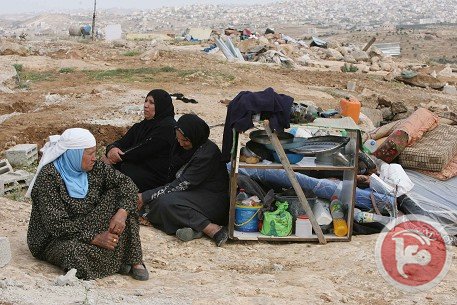
HEBRON — Women of the Bedouin herding hamlet of Khirbet Amniyr sat on the earth and watched Israeli forces demolish their 12 tent homes for the third time on Thursday morning.
The women said they were waiting for the soldiers to leave so they could rebuild their tent homes and once again re-establish their lives and livlihoods.
Amniyr, south of Yatta in the southern West Bank, is said to be located in an Israeli military zone.
Military zoning laws enforced by Israel’s Civil Administration, make up part of the 60 percent of the West Bank that is inaccessible to Palestinians.
As the troops left, the woman remained seated, surveying the destruction, as their tents and mattresses lay buried under a thin layer of dirt.
“I appeal to God to save us from the cruelty of the Israeli occupation,” said the hamlet’s matriarch, as she stood and began to collect her belongings from under the dust.
The hamlet has been taken down twice before, first on February 22 when the Israeli military buried homes and water wells, later preventing ICRC workers from delivering aid equipment.
On March 29, seven Bedouin were beaten by Israeli border police when the same 12 tents were taken down a second time.
The 12 families of Khirbet Amniyr were ordered out of their tent homes earlier in the year, but remained, saying they had little choice but to stay and had nowhere else to go.
The spokesman of Israel’s Civil Administration could not be reached by phone for comment on the latest demolition.
Amniyr is one of three Bedouin hamlets currently under Israeli evacuation orders, with a second in the south Hebron hills area, and a third in the northern West Bank district of Nablus which has been demolished six times.
In Israel’s Negev region, the Bedouin community in Al-Araqib have seen their homes taken down a total of 16 times, to make way for a park.
Setting The Record Straight On BDS
By Omar Barghouti | NewMatilda.com | May 2, 2011

As Marrickville Council’s BDS resolution was thrashed out in the media, misinformation about it abounded, writes Omar Barghouti, one of the founders of the global BDS movement
The Palestinian civil society campaign for boycott, divestment and sanctions (BDS) against Israel came under attack in recent weeks from Murdoch media outlets, politicians and various interest groups as Sydney’s Marrickville Council struggled to keep the BDS resolution that they had adopted in December last year. The wild distortions and outright fabrications against BDS and its supporters in Sydney peaked in an article by Leo Shanahan, “Greens’ boycott rebounds”, published in The Australian on the day of the Council meeting when the BDS motion was rescinded.
Marrickville Council has since reaffirmed its support for the principles of the BDS campaign by actually spelling out the three fundamental Palestinian rights that constitute the minimum requirements for the Palestinian people to exercise our right to self determination.
Although the Council, after months of unprecedented bullying, threats, smear campaigns, and intimidation orchestrated by well-oiled Israel lobby groups, felt compelled not to put that principled support into action in the form of specific BDS measures, the fact that it stood its ground defending these basic Palestinian rights, as outlined in the BDS Call, is praiseworthy and quite inspiring. BDS is about asserting our long forgotten rights, first and foremost. Action to achieve those rights can come later, when the ground is fertile enough and resistance to intellectual terror and misinformation is higher.
Regardless, the record needs to be set straight. Misrepresentations of the type that litters Shanahan’s article should not go unchallenged. As the great Palestinian thinker Edward Said once said, “[D]espite the abuse and vilification that any outspoken supporter of Palestinian rights and self determination earns for him or herself, the truth deserves to be spoken …”
Shanahan dismissively writes, “The BDS is a movement advocated by a multitude of left-wing political parties, universities, trade unions and other local governments throughout the world.” He writes this even though he admits just a few lines above that BDS is a Palestinian-led movement. In fact, BDS is called for by the largest and broadest coalition ever created of Palestinian civil society institutions, political parties, trade unions and NGO networks.
On 9 July 2005, the Palestinian BDS Call was issued, endorsed by more than 170 of the leading institutions in Palestinian society. It called for holding Israel to account for its three-tiered system of oppression, for its persistent violations of international law to compel it to end its 1967 occupation of all Arab lands, including East Jerusalem; its system of racial discrimination against its own Palestinian citizens which was described in the 2010 US Department of State human rights report as constituting “institutional, legal and societal discrimination”; and respecting the UN-sanctioned right of Palestinian refugees to return to their homes of origin, as stipulate in UN Resolution 194.
Shanahan quotes a member of the NSW Jewish Board of Deputies making a baseless claim about me. He claims that I had said that BDS aims at “getting a Palestine next to a Palestine rather than a Palestine next to Israel.” This is categorically false; I never made this statement.
Israel lobby propagandists have intentionally fabricated this claim by omitting its crucial context to insinuate that the BDS movement is bent on what they characterise as the “destruction of Israel”. The remark above was part of a quote that I cited in an article and several presentations; it was first stated by a prominent Palestinian academic who argued that the right of return of Palestinian refugees in accordance with international law would lead, from an Israeli perspective, to a Palestine next to a Palestine. The point he was making is that Israel would not allow this aspect of international law to be implemented in order to maintain its ethnocentric and exclusivist nature in a two-state settlement. In responding to his argument, I insisted that the right of refugees to return home is deeply enshrined in international law and that implementing it would not “destroy” anyone or any people; it would simply end Israel’s apartheid regime and pave the road to real justice and democracy. If an unjust version of the two-state settlement is conditioned upon giving up the right of return, I argued, then we can do without that solution, but we cannot possibly surrender the UN-sanctioned rights of the refugees who make up two thirds of the Palestinian people.
For more than 28 years, I have, in my personal capacity, consistently and openly advocated a secular democratic state in the entire area of historic Palestine, where everyone enjoys equal rights, irrespective of ethnicity, religion or any identity attribute. This, to my mind, is the most ethically consistent formula that can accommodate the inalienable right of Palestian people to self determination with the rights of all the inhabitants of the land to justice, peace, equality, and democratic rights.
But this is certainly not the position of the BDS movement. The movement has consistently advocated a rights-based approach, consistently refraining from endorsing either of the one-state or two-state solutions. Any review of the hundreds of statements and media interviews by the BDS National Committee (BNC), the massive Palestinian coalition leading the international BDS movement, will confirm this. The BNC’s vision is for freedom, justice, and equal rights for all, regardless of identity and no matter what political solution is reached. People’s rights must be protected and respected above everything else. Furthermore, as a movement anchored in the universal principle of equality of all humans, BDS is firmly opposed to all forms of racism, including anti-Semitism and Islamophobia.
This humanist platform is the essence of the BDS movement and the key behind its impressive growth. Many international trade union federations of the size of the Brazilian CUT (representing more than 20 million workers) and the British Trades Union Congress (TUC) and of the great symbolic significance of the South African COSATU and the Irish Congress of Trade Unions, have joined the BDS campaign, selecting diverse forms of implementing it. Faith-based groups, Jewish organisations, leading artists and music groups, and iconic moral leaders of the calibre of Archbishop Desmond Tutu also support the boycott of Israel, drawing parallels with the ultimately successful boycott and divestment campaign utilised in the strategy to end apartheid in South Africa.
In his article, Shanahan also unquestioningly repeats the inaccurate claim that implementation of BDS “would cost Marrickville ratepayers $3.7 million”, an assertion that lazily ignores the track record of local council implementation of BDS.
Scores of councils across Europe have, at no cost at all, heeded the BDS call by excluding the French company Veolia from bidding on contracts. Why? Due to its involvement in an Israeli rail system serving illegal settlements that has been criticised by the UN Human Rights Council. Veolia is now considering ending its involvement. Local councils in Spain voted to support BDS and implemented their policy simply by switching bottled water provider to one other than Eden Springs, an Israeli company that sources its water from the Israeli-Occupied Syrian Golan Heights. Whether it is local councils changing service providers, artists such as Pink Floyd’s Roger Waters and U2’s Bono refusing to play in Israel, or the University of Johannesburg severing its ties with an Israeli university complicit with violations of international law, standing up against Israeli spartheid needn’t cost a thing. It does, however, express a moral stand with the oppressed.
Finally, regarding the often discussed issue of violence and counter-violence, it is crucial to emphasise that Israel’s occupation, colonisation and denial of refugee rights are the roots of all violence. Israel’s illegal and patently immoral siege of Gaza, described recently by British Prime Minister David Cameron as a large “prison camp,” is the embodiment of violence. Israel’s gradual ethnic cleansing of Palestinians from occupied East Jerusalem is one of the cruelest manifestations of a policy of state violence aimed at further expulsion and dispossession of the indigenous Palestinians. To end all violence once must snuff out its causes: Israel’s decades-long, ruthless occupation and apartheid.
Those who truly care about all human life, as I do, and who think that any civilian life lost is a life too many should do their utmost to support the exceptionally effective, manifestly creative, morally consistent and impeccably non-violent BDS movement to end Israel’s impunity and violations of international law.
As Archbishop Tutu says :
Together with the peace-loving peoples of this Earth, I condemn any form of violence — but surely we must recognize that people caged in, starved and stripped of their essential material and political rights must resist their Pharaoh? Surely resistance also makes us human? Palestinians have chosen, like we did, the nonviolent tools of boycott, divestment and sanctions.
The Marrickville Council was on the right side of history when it first chose to endorse the global BDS campaign. It remains so by insisting on Palestinian rights, despite the tactical setback. Brave Australians had done the same when responding to the calls from the oppressed South African majority under apartheid. We expect no less from conscientious Australians today in response to our urgent appeal for effective solidarity. I have no doubt that one day commentators and activists will mark Marrickville’s decision as the true beginning of mainstreaming BDS in Australia and of finally standing up to Israel’s lobby and for the rights of Palestinians.
Hebron settlers attack construction workers
Ma’an – 03/05/2011
HEBRON — Dozens of Israeli settlers assaulted a group of Palestinian construction workers in Hebron’s city center on Tuesday, residents said.
Nayef Da’na told Ma’an that settlers attacked him and other workers as they restored a home near Ash-Shuhuda street, an area long closed down due to settler violence and military patrols.
The owner of the home, Mufeed Ash-Sharabati, said the altercation began with insults being thrown by settlers at the workers, who responded in kind, and escalated into physical violence.
Ash-Sharabati said Israeli forces intervened and ordered the builders to stop work.
It was not the first time the workers repairing the home had been harassed, Da’na said, noting Israeli forces constantly bothered them in an attempt to prevent the home reclamation.
Ash-Shuhada street in Hebron runs between two communities of ultra-Zionist settler groups, who have moved into areas of the Palestinian city, guarded by some 1,500 Israeli soldiers.
The street has been shut down since the 1990s, and was once the center of commerce for city residents.
Protests have been ongoing, and demand Israeli officials permit shops on the street to re-open.
Featured Video

They Double Down on BLOOD PRESSURE Guidelines!
or go to
Aletho News Archives – Video-Images
From the Archives
Chocolate Gives Statins a $29 Billion Run For Their Money
By Sayer Ji · GreenMedInfo · April 17, 2012
With the blockbuster cholesterol-lowering class of drugs known as statins being widely promoted for the primary prevention of cardiovascular disease, despite their having over 300 documented adverse health effects (including heart failure!), how does chocolate sound as a viable, heart-friendly alternative?
We already connect amorously with chocolate (to the tune of 6 billion lbs of cocoa consumed annually worldwide), revealing in heart-felt expressions like “I love it,” and “this is to die for!” how comfortable we are with publicly declaring our affection. But did you know that while it makes our emotional hearts sing, it may actually keep our physical hearts happy, alive and ticking longer, as well?
Indeed, back in 2006, researchers found that for elderly men, eating cocoa was inversely associated with blood pressure and 15-year cardiovascular and all-cause mortality. … continue
Blog Roll
 Aletho News
- I’M SO BLOODY FURIOUS: They Double Down on BLOOD PRESSURE Guidelines!
- The Israeli Nuclear Doctrine and the Turning Point of the Kennedy Assassination
- Striking Matches Near the Powder Keg
- Prominent Russia hawk: European leaders privately talk about war with Russia, first need ‘mass casualty event’
- China warned Trump not to touch Iran’s oil tankers: Larry Johnson
- EU Central Banker Plans To Plant Barren AI Crops Across The Continent
- Macron’s Strategic Autonomy Paradox: France Rearms on Debt and Depends on Foreign Fuel
- Nigel Farage vs Tucker Carlson: Who is right about Hitler and Britain?
- Chocolate Gives Statins a $29 Billion Run For Their Money
- Hypotheses on the collapse of U.S. computer systems
- If Americans Knew
- An error has occurred; the feed is probably down. Try again later.
- No Tricks Zone
- New Study: Modern Temps Are Among The Coldest Of The Last 10,000 Years In East Central Europe
- Germany’s Renewable Energies Lead to 1.4 Billion Euro Electric Power Trade Deficit
- Argentina’s Perito Moreno Glacier Joins Antarctica and Arctic In Defying Doomsday Melt Claims
- New Study: Barents Sea Temperatures Were Warmer And Sea Ice Less Extensive In The 1700s Than Today
- German Authorities Start Initiative To Evaluate Public Register For Climate “Disinformation” Spreaders!
- Zonal Asymmetry of Temperature Change in the Antarctic Circumpolar Current
- New Study: The Net Fossil Fuel Contribution To Rising Atmospheric CO2 Has Been Zero For 500 Years
- Germany’s Green Energy Transition Becoming Increasingly Expensive…Another 6 Trillion Euros!
- Sudden Stratospheric Warming, Powerful El Niño Combination May Lead To Extreme Europe Cold, Energy Crisis!
- Two New Studies Find Thwaites Glacier Melt Cannot Be Driven By Human Activity Or A Warming Ocean


