Most Americans oppose sending ground troops to fight ISIL: November 4-8 Poll
Press TV – November 14, 2015
Americans are more likely to oppose deploying US ground troops against the Daesh (ISIL) terrorist group in Iraq and Syria as the US considers sending more boots on the ground, a new poll finds.
The latest data are from a November 4-8 Gallup poll that shows 53 percent of Americans oppose sending US ground troops to these countries while 43 percent support the idea.
US President Barack Obama authorized the deployment of “fewer than 50” special forces to Syria on October 30, reversing a longstanding refusal to put US boots on the ground.
“The fairly low level of Americans’ support for deploying ground troops could be related to their reluctance to engage in another major military commitment in Iraq, or elsewhere for that matter,” Gallup said.
A majority of Americans continue to describe the Iraq War as a mistake and have tended to express less support for recent US military involvements.
A US-led coalition has been bombing purported Daesh targets in Syria and Iraq for over a year, but the air campaign has been largely ineffective.
Senior US military officials have said that the US will require “boots on the ground” in Syria and Iraq in order to retake territory from the Daesh.
US Defense Secretary Ashton Carter said recently that more US troops could “absolutely” be deployed to Syria if the Pentagon identifies more “capable local forces” that can fight against Daesh.
Earlier this month, US Air Force Lieutenant General Charles Brown said that Washington and its allies will increase airstrikes inside Iraq and Syria in the coming weeks.
Paris attack may be false flag operation: Analyst

Press TV – November 14, 2015
The US and France may blame the Syrian government for the Paris attack and start bombing Syria indiscriminately, Edward Corrigan told Press TV on Saturday.
The attacks in Paris, France, could possibly be a “false flag” operation so that the US and its allies can intensify the bombing campaign against Syria, says a political commentator.
A witness told The Associated Press that the shooters shouted “Allahu Akbar” (God is the Greatest) in Arabic as they massacred scores of diners and concert-goers in the French capital.
“Just because somebody goes and says Allahu Akbar doesn’t mean they’re Muslim, it may mean it’s a false flag,” Edward Corrigan told Press TV on Saturday.
The United States and France may blame the Syrian government for the attack and start bombing Syria indiscriminately, Corrigan said.
“You’re going to see a lot of destruction of infrastructure; you’re going get a lot of civilians killed, you’re going to see a massive overreaction like we saw with 9/11, which of course gave the Americans the impetus to invade and attack Iraq, kill over a million Iraqis,” he added.
“Of course Iraq had nothing to do with 9/11 but that of course got lost in the smoke and haze.”
Over 150 people were killed in multiple coordinated attacks on Friday in one of the deadliest assaults to hit the French capital since the World War II.
US President Barack Obama condemned the “outrageous” terrorist attacks in Paris, and promised the United States stands ready to provide whatever assistance is necessary to the French government and people.
Obama also called French President François Hollande Friday night. “The two leaders pledged to work together, and with nations around the world, to defeat the scourge of terrorism,” the White House said in a statement.
The terror attacks came just hours after an interview aired in which Obama boasted about recent successes against the Daesh (ISIL) terrorist group. “I don’t think they’re gaining strength,” Obama told ABC News’ “Good Morning America.” “We have contained them.”
Police in major US cities have stepped up security in the wake of the Paris attacks. Officials in New York, Chicago, and Philadelphia said there was no intelligence indicating any threats, but were taking security precautions.
The New York Times’ 9/11 Propaganda
By Kevin Ryan | Dig Within | November 8, 2015
The New York Times led the propaganda behind 9/11 and the 9/11 Wars. It did so by ignoring many of the most relevant facts, by promoting false official accounts, and by belittling those who questioned the 9/11 events. The Times eventually offered a weak public apology for its uncritical support of the Bush Administration’s obviously bogus Iraq War justifications. However, it has yet to apologize for its role in selling the official account of 9/11, a story built on just as many falsehoods. Instead, the newspaper continues to propagandize about the attacks while putting down Americans who seek the truth about what happened.
The New York “newspaper of record” has published many articles that promote official explanations for the events of 9/11. These have included support for the Pancake Theory, the diesel fuel theory for WTC 7, claims based on the torture testimony of an alleged top al Qaeda leader, and accounts of NORAD notification and response to the hijackings. Since then, U.S. authorities have said that none of those explanations were true. However, the Times never expressed regret for reporting the misleading information.
Instead, the Times continued to sell every different official explanation. When a new government theory for destruction of the WTC was put forth, it was immediately promoted. The newspaper never reported any critical analysis of the official accounts, despite the fact that all of them, including the final reports for the Twin Towers and WTC 7, have been proven to be wrong.
When the fourth story for how the North American air defenses failed—the one that said U.S. military officers had spent three years giving “false testimony,” the Times pushed it as fact. Its article on the subject simply closed the matter with the statement that “someone will still have to explain why the military, with far greater resources and more time for investigation, could not come up with the real story until the 9/11 commission forced it to admit the truth.” The idea that military officers might have started out telling the truth, thereby leaving very sensitive questions to be answered, and that the 9/11 Commission was now being false, apparently never occurred to the editors.
Meanwhile, the newspaper has made considerable efforts to belittle Americans who question the official account of 9/11.
In June 2006, the Times published a snarky account of a grassroots conference of 9/11 investigators. The article focused on sensational descriptions of the participants, including what it called “a longhaired fellow named hummux who, on and off, lived in a cave for 15 years.’’ The fact that Dr. hummux was a PhD physicist who had worked on the Strategic Defense Initiative for 20 years was not mentioned. The Times simply distorted his experience living with a Native American tribe and falsely stated that he had lived in a cave. No mention was made of serious, undisputed facts that were presented at the conference.
A few months later, at the fifth anniversary of 9/11, the Times published another propaganda article in support of the politically timed reports from the National Institute of Standards and Technology (NIST). The article began by declaring that those who questioned 9/11 were “an angry minority,” while minimizing a national Scripps Howard poll, published just a month earlier. The poll showed that “More than a third of the American public suspects that federal officials assisted in the 9/11 terrorist attacks or took no action to stop them so the United States could go to war in the Middle East.” That is, the number of Americans who thought that federal officials were behind the attacks (36%) was on par with the percentage of Americans who had voted for the president. Yet the Times inferred that it was only a small fraction of the population who questioned 911.
The September 2006 article promoted one Brent Blanchard as a demolition expert, implying that his recent essay refuted any suggestions that the WTC buildings were demolished. As I told the reporter Jim Dwyer, when he interviewed me for the article, “Mr. Blanchard may be a good photographer, but the uninformative bluster that fills the first two and a half pages of this piece, and a good deal throughout the paper, shows that he is not a good writer.” The fact that Blanchard was only a photographer and not a demolition expert was not mentioned by Dwyer, nor was my point-by-point refutation of Blanchard’s limited arguments. Instead, Dwyer purposefully ignored the evidence and ended his article with another quote from Blanchard.
More recently, perhaps in response to another large billboard posted right outside the Times offices, the newspaper has renewed its 9/11 propaganda efforts. In one new article, reporter Mark Leibovich wonders “why is it good to tell the truth but bad to be a ‘Truther’.” Leibovich turns to former White House spokesman Ari Fleischer for support. Of course, the article does not refer to Fleischer’s curious behavior on the morning of 9/11, which stands among the unresolved questions. Instead, Fleischer’s input is that he uses the term “truther” as an epithet, “floating a notion and letting it hang there to absorb sinister connotations.” Leibovich goes on to portray 9/11 questioning as just another form of ridiculous “trutherism” that is “stranger than fiction.“
Leibovich and his colleagues at the Times continue to suggest that they are unaware of the many incredible facts about 9/11 that call out for critical investigation. At this point, however, that level of ignorance is not believable and the Times’ track record shows that it will never take an honest and objective approach to the events of 9/11. As one former Times reporter stated, the paper’s slogan that it provides all the news ‘fit to print’ really means that it provides all the news that’s fit to serve the powerful. And as long as the needs of the powerful differ from the needs of the people, the truth will be something that is unavailable at the New York Times.
The Importance of the Official 9/11 Myth
By Kevin Ryan | Dig Within | October 26, 2015
People sometimes wonder why is it important to investigate the alleged hijackers and others officially accused of committing the 9/11 crimes. After all, the accused 19 hijackers could not have accomplished most of what happened. The answer is that the official accounts are important because they are part of the crimes. Identifying and examining the people who created the official 9/11 myth helps to reveal the ones who were responsible overall.
The people who actually committed the crimes of September 11th didn’t intend to just hijack planes and take down the buildings—they intended to blame others. To accomplish that plan the real criminals needed to create a false account of what happened and undoubtedly that need was considered well in advance. In this light, the official reports can be seen to provide a link between the “blaming others” part of the crimes and the physical parts.
 Pushing the concept of “Islamic Terrorism” was the beginning of the effort to blame others, although the exact 9/11 plan might not have been worked out at the time. This concept was largely a conversion of the existing Soviet threat, which by 1989 was rapidly losing its ability to frighten the public, into something that would serve more current policy needs. Paul Bremer and Brian Jenkins were at the forefront of this conversion of the Soviet threat into the threat of Islamic terrorism. Both Bremer and Jenkins were also intimately connected to the events at the World Trade Center.
The concerted effort to propagandize about Al Qaeda and Osama bin Laden (OBL) seems to have begun in earnest in 1998. That’s when the African embassy bombings were attributed to OBL and the as-yet unreported group called Al Qaeda. The U.S. government responded with bombings of Sudan and Afghanistan and, with help from the New York Times, began to drum up an intense myth about the new enemy.
“This is, unfortunately, the war of the future,” Secretary of State Madeleine Albright said. “The Osama bin Laden organization has basically declared war on Americans and has made very clear that these are all Americans, anywhere.”
In retrospect, it is surprising that this was the first reference to Al Qaeda in the New York Times, coming only three years before 9/11. More surprising is that The Washington Post did not report on Al Qaeda until June 1999, and its reporting was highly speculative about the power behind this new threat.
“But for all its claims about a worldwide conspiracy to murder Americans, the government’s case is, at present, largely circumstantial. The indictment never explains how bin Laden runs al Qaeda or how he may have masterminded the embassy bombings.”
Despite this skepticism from The Post, the reports about Al Qaeda continued in an odd mixture of propaganda and doubt. For example, The Times reported on the trial of the men accused of the African embassy attacks in May 2001. That article contradicted itself saying that “prosecutors never introduced evidence directly showing that Mr. bin Laden ordered the embassy attacks” and yet that a “former advisor” to Bin Laden, one Ali Mohamed, claimed that Bin Laden “pointed to where a truck could go as a suicide bomber.” The fact that Mohamed had worked for the U.S. Army, the FBI, and the CIA was not mentioned.
Other facts were ignored as well. That OBL had worked with the CIA and that Al Qaeda was basically a creation of CIA programs like Operation Cyclone were realities that began to fade into the background. By the time 9/11 happened, those facts were apparently forgotten by a majority of U.S. leaders and media sources. Also overlooked were the histories of people like Frank Carlucci and Richard Armitage, who played major roles in Operation Cyclone and who remained powerful players at the time of the 9/11 attacks.
In the two years before 9/11, the alleged hijackers were very active within the United States. They traveled extensively and often seemed to be making an effort to be noticed. When they were not trying to be noticed, they engaged in distinctly non-Muslim behavior. Mohamed Atta’s actions were erratic, in ways that were similar to those of Lee Harvey Oswald, and Atta appeared to be protected by U.S. authorities.
Meanwhile, leading U.S. terrorism experts seemed to be facilitating Al Qaeda terrorism. Evidence suggests that U.S. intelligence agency leaders Louis Freeh and George Tenet facilitated and covered-up acts of terrorism in the years before 9/11. Both of their agencies, the CIA and FBI, later took extraordinary measures to hide evidence related to the 9/11 attacks. And both agencies have made a mockery of the trial of those officially accused of helping OBL and the alleged hijackers.
Counter-terrorism leader Richard Clarke inexplicably helped OBL stay out of trouble, protecting him on at least two occasions. Clarke blatantly failed to follow-up on known Al Qaeda cells operating within the United States. After 9/11, Clarke was among those who falsely pointed to Abu Zubaydah as a top leader of Al Qaeda. Zubaydah’s torture testimony was then used as the basis for the 9/11 Commission Report.
Former CIA operative Porter Goss created the first official account of what happened on 9/11, along with his mentor Bob Graham. This was the report of the Joint Congressional Inquiry, produced by the intelligence oversight committees of the U.S. Congress. It was greatly influenced by people who should have been prime suspects. For example, Richard Clarke was the one in charge of the secure video conference at the White House that failed miserably to connect leaders and respond to the attacks. In the Joint Inquiry’s report, Clarke was cited as an authoritative reference 46 times. CIA director George Tenet was cited 77 times, and Louis Freeh was cited 31 times.
Therefore it is imperative that the people who worked to create the background story behind OBL and the accused hijackers be investigated for their roles in the 9/11 crimes. This includes not only those who were figureheads behind the official reports, but more importantly the ones who provided the evidence and testimony upon which those reports were built. The alleged hijackers and their associates should also be of considerable interest to 9/11 investigators. That’s because what we know about them was provided by people who we can assume were connected to the crimes and what we don’t yet know about them can reveal more of the truth.
At Guantanamo, Sometimes Even the Judge Is In the Dark
By Dror Ladin | ACLU | October 23, 2015
I’m writing from Guantánamo Bay, where pre-trial proceedings in the military commissions prosecution of the 9/11 defendants have restarted after an 18-month delay. It has been a faltering start, to say the least: Within ten minutes of the first hearing, the agenda was derailed. Again.
One of the defendants, Walid Bin Attash, asked about the procedures that would allow him to represent himself because he could not trust the independence of the military commission, including his lawyers. All the parties then had to grapple with how self-representation would work in this novel context. But lurking behind these dilemmas is the real issue that has so often derailed the military commissions: the government’s use of secrecy in what it presents as a public death penalty trial.
As we have pointed out for years, the military commissions are unfair, unconstitutional, and plagued by excessive secrecy. These challenges make it extraordinarily difficult for the defense attorneys to do their job. And they make it even harder for defendants to exercise the right to represent themselves meaningfully.
There are straightforward logistical impossibilities for defendants if they attempt to represent themselves. They are held virtually incommunicado in “Camp 7” at Guantánamo, a secret prison within a secretive prison holding detainees who were tortured at the CIA’s secret black sites. Defendants cannot file motions, consult a law library, communicate with (or even learn the names of) witnesses, or compile confidential legal documents.
The defendants also face the unique challenge of representing themselves when they have been tortured by the government that seeks to kill them, continue to be subjected to a “controlled chaos strategy of changing the rules all the time” that serves to retraumatize them, and are denied rehabilitation to help them cope with the effects of their torture. Conditions at Camp 7 reportedly exacerbate the continued effects of CIA torture. Bin Attash declared at the beginning of this week’s hearings that “we are still in the black sites” before the judge, Army Col. James Pohl, cut him off.
The results of torture are quite visible at the trial: As an observer, one of the most difficult aspects of these hearings is watching the guards place a particularly frail defendant, Mustafa al-Hawsawi, each morning on a chair equipped with a special pillow. As the Senate Intelligence Committee’s torture report documents, al-Hawsawi was subjected to “rectal exams conducted with ‘excessive force’” while detained at a secret CIA prison. CIA records indicate that the result was “chronic hemorrhoids, an anal fissure, and symptomatic rectal prolapse.” He now weighs less than 100 pounds and sometimes bleeds on his clothing. His medical records, like so much else at Guantánamo, are kept secret even from his counsel.
But perhaps the single biggest obstacle to self-representation is government secrecy. Defendants in the military commissions are not permitted to see classified evidence. That’s the case even if the government tries to use it to put them to death, and even if it could help their case. How can someone defend themselves when they can’t see the evidence? This problem isn’t confined to the self-representation context; even security-cleared defense counsel at Guantánamo are sometimes kept in the dark about relevant evidence.
These difficulties could be left for another day, suggested the judge. Perhaps, if a defendant chooses to represent himself, the military commissions could muddle through whatever problems cropped up along the way. Maybe the most obviously unfair scenarios would never come to pass, he hypothesized. At that point, former Secretary of Defense Rumsfeld entered the frame: Are concerns about the viability of self-representation in the military commissions merely a case of “unknown unknowns”?
So many questions arise when you try to invent justice as you go along.
The government has chosen to sidestep our tried and true federal courts and created a novel death penalty court here at Guantánamo. Without a doubt, there are a great number of unknown unknowns in this unprecedented proceeding. But as counsel for Ammar al-Baluchi observed, “there are huge known unknowns.” Given the government’s repeated and acknowledged efforts to rely on secret evidence and simultaneously hide that same evidence from the accused — and the public — a wide array of problems for a defendant who seeks to represent himself are easily predictable.
As David Nevin, counsel for defendant Khalid Sheik Mohammad, has explained, secrecy is “the live wire of this case.” At some point, Nevin suggested, the court will have to decide if it wants this trial to be a “real case” or merely a fundamentally unfair exercise of government power. And whether it’s a “real case” depends in part on whether the government succeeds in hiding from the American public the details of some of the most important trials in our history.
Perhaps the moment that most perfectly encapsulated the week of hearings so far happened at the end of the second day. Defense counsel had submitted a motion containing information that the government had decided was so secret that special permission was required to read it. But the government had not cleared the judge himself to know the information. After consulting with the court security officer, the judge refused to accept the defense’s submission.
“It’s hard for me to know what it is without knowing what it is,” he said. The same could be said for the military commission itself.
Recep Tayyip Erdoğan: Terrorist Unleashed
By James Petras | October 20, 2015
The October 12, 2015 terror bombing in Ankara, resulting in the death of 127 trade unionists, peace activists, Kurdish advocates and progressives, has been attributed either to the Recep Tayyip Erdoğan regime or to ISIS terrorists.
The Erdoğan regime’s ‘hypothesis’ is that ISIS or the Kurdish Workers Party (PKK) was responsible for the terrorist attack, a position echoed by all of the NATO governments and dutifully repeated by all of the Western mass media. Their most recent claim is that a Turkish member of ISIS carried out the massacre – in a ‘copy-cat action’ after his brother, blamed by the Turkish government for an earlier bombing which left 33 young pro-Kurdish activists dead in July in Suruc, on the Syrian border.
The alternative hypothesis, voiced by the majority of the Turkish opposition, is that the Erdoğan regime was directly or indirectly involved in organizing the terrorist attack or allowing it to happen.
In testing each hypothesis it is necessary to examine which of the two best accounts for the facts leading up to the killing and who benefits from the mayhem.
Our approach is to examine those behind various acts of violence preceding, accompanying and following the massacre in Ankara. We will examine the politics of both the victims and the Erdoğan regime, and their conception of political governance, especially in light of the forthcoming November 2015 national elections.
Antecedents to the Ankara Terror Bombing
Over the past several years the Erdoğan regime has been engaged in a violent crackdown of civil society activity. In 2013, massive police action broke-up a major social protest in the center of Istanbul, killing 8 demonstrators and injuring 8,500 environmental and civil society activists defending Taksim Gezi Park from government-linked ‘developers’. In May 2014, over 300 Turkish coal miners in Soma were killed in an underground explosion in a mine owned by an Erdoğan supporter. Subsequent demonstrations were brutally suppressed by the state. The formerly state-owned mine had been privatized by Erdoğan in 2005 – many questioned the legality of the sale to regime cronies.
Prior to and after these violent police actions against civilian demonstrators, thousands of officials and public figures were arrested, fired, and investigated by the Erdoğan regime for allegedly being supporters of a legal Islamic social organization – the so-called Gülen movement.
Hundreds of journalists, human rights activists, publishers and other media workers were arrested, fired, and blacklisted at the behest of the Erdoğan regime, for criticizing high level corruption in the Erdoğan cabinet.
The Erdoğan regime escalated its domestic repression of the secular opposition in order to concentrate power in the hands of an Islamist cult-ruler. This was particularly the case after the government deepened its support of thousands of foreign jihadi extremists and mercenaries streaming into Turkey on their way to the Syrian jihad.
From the beginning of the armed uprising in Syria, Turkey became the main training ground, arms depot and entry-point for armed Islamist terrorists (AIT) entering Syria. The Erdoğan regime directed the AIT to attack, dispossess and destroy the Syrian and Iraqi Kurds whose fighters had liberated a significant section of northern Syria and Iraq and served as an ‘example of self-government’ for Turkish Kurds.
The Erdoğan regime has joined the brutal Saudi monarchy in financing and arming AIT groups and especially training them in urban terror warfare against the secular government in Damascus and the Shiite regime in Baghdad. They specialized in bombing populated sites occupied by Erdogan’s enemies or the Saudi targets especially secular Kurds, leftists, trade unionists and Shiites allied with Iran.
The Erdogan regime’s intervention in Syria was motivated by its desire to expand Turkish influence (neo-Ottomanism) and to destroy the successful Kurdish autonomous government and movement in Northern Syria and Iraq.
To those ends, Erdoğan combined four policies:
(1) He vastly expanded Turkish support for and recruitment of Islamic terrorists from around the world, including Libya and Chechnya.
(2) He facilitated their entry into Syria, and encouraged them to attack villages and towns in the ethnic Kurdish regions.
(3) He broke off peace negotiations with the PKK and re-launched a full-scale war against the militant Kurds.
(4) He organized a covert terrorist campaign against the legal, secular, pro-Kurdish electoral party, the People’s Democratic Party (HDP).
The Erdoğan regime sought to consolidate dictatorial powers to pursue and deepen its ‘Islamization’ of Turkish society and to project his version of Turkish hegemony over Syria and the Kurdish regions inside and outside Turkey. To accomplish these ambitious and far reaching goals, Erdoğan needed to purge his Administration of any rival power centers.
He started with the jailing and expulsion of secular, nationalist Kemalist military figures. He continued with a purge of his former supporters in the Gülen organization.
Failing to gain a majority in national elections because of the growth of the HDP, he proceeded with a systematic terror campaign: organizing street mobs made up of his followers in the ‘Justice and Development Party’, who burned and wrecked HDP offices and beat up activists. Erdoğan’s terror campaign culminated with the July 2015 bombing of a leftist youth meeting in Suruc whose activists were aiding Syrian Kurdish refugees and the beleaguered fighters resisting Islamist terrorists in Korbani, a large Syrian town across the border controlled by the Erdoğan-backed ISIS. Over 33 activists were murdered and 104 were wounded. Two Turkish covert intelligence officers or ‘policemen’, who knew in advance of the bombing, were captured, interrogated and executed by the PKK. This retaliation for what was widely believed to be a state-sponsored massacre provided Erdoğan with a pretext to re-launch his war on the Kurds. Erdoğan immediately declared war on both the armed and unarmed Kurdish movements.
The Erdoğan regime trotted out the claim that the Suruç terrorist attack was committed by ISIS suicide bombers, ignoring the regime’s ties to ISIS. He announced a large-scale investigation. In fact it was a perfunctory round up and release of suspects of no consequence.
If ISIS was involved in this and the Ankara massacres, it did so at the command and direction of Turkish Intelligence under orders of President Erdoğan.
The Suruç Massacre: A Dress Rehearsal for Ankara
Suruç was a ‘dress rehearsal’ for Erdoğan’s terrorist attack in Ankara, three months later.
Once again the main target was the Kurdish opposition electoral party (the HDP) as well as the major progressive trade unions, professional associations, and anti-war activists.
Once again Erdoğan blamed ISIS, without acknowledging his ties to ISIS. Certain facts point to Turkish state complicity:
1) Why were the bombs placed in the midst of the unarmed demonstrators and not next to the police and intelligence headquarters within a block of the carnage?
2) Why did Erdoğan’s police attack and prevent emergency medical assistance to the demonstrators in the immediate aftermath of the bombing?
3) Why did he block popular leaders, independent investigators and representatives from targeted groups from examining the bombing site?
4) Why did Erdoğan immediately reject a cease-fire offer from the PKK and launch a vast military operation while promoting rabidly chauvinistic street demonstrators against Kurds engaged in legal political campaigning?
5) Why did the police attack mourners at the subsequent funerals?
Who Benefited from the Terror Attacks?
The terror attacks benefited Erdoğan’s immediate and long-range strategic political goals – and no one else!
First and foremost, they killed activists from the HDP party, anti-war leftists and trade unionists. The violent government attacks against the HDP in the aftermath of the massacre has increased Erdoğan’s chances of securing the electoral majority that he needs in order to change the Turkish constitution so he can assume dictatorial powers.
Secondly, it was aimed at (1) reducing the ties between the Turkish and Syrian Kurds; (2) breaking the ties between progressive Turkish trade unions, secular professionals, peace activists and the Kurdish Democratic Party; (3) mobilizing the right-wing ultra-nationalist Turkish street mobs to attack and destroy the electoral offices of the HDP; (4) intimidating pro-democracy activists and progressives and silencing dissent to Erdoğan’s domestic power grab and intervention in Syria.
To the question of who is responsible for serial violent attacks on civil society organizations, opposition political parties, and purges and arrests of independent officials in the lead-up to the terror attack? The answer is Erdoğan.
Who was behind the campaign of violence and bombing in Kurdish neighborhoods in Istanbul and elsewhere leading up to the Suruç and Ankara terrorist attacks? The answer is Erdoğan.
Conclusion
We originally counter-posed two hypotheses regarding the terrorist attack in Ankara: The Erdoğan regime’s hypothesis that ISIS – as a force independent of the Turkish government – or even the PKK were responsible for brutally killing key activists in Turkish and Kurdish civil organizations; and the opposite hypothesis that the Erdoğan regime was the mastermind.
After reviewing the motives, actions, beneficiaries, and interests of the two hypothetical suspects, the hypothesis, which most elegantly and thoroughly accounts for and makes sense of the facts is that the Erdoğan regime was directly responsible for the planning and organization of the massacres through its intelligence operatives.
A subsidiary hypothesis is that the execution – the placing of the bombs – may have been by an ISIS terrorist, but under the control of Erdoğan’s police apparatus.
US government publicly concedes case against ex-Gitmo prisoner collapsed in 2011
Reprieve | October 21, 2015
On the eve of a hearing in Morocco that will determine whether ex-Guantánamo prisoner Younous Chekkouri is to be set free, the US government has released a letter admitting that the central allegation against him in the US was withdrawn in 2011.
Younous Chekkouri was held without charge or trial in Guantanamo for 14 years before being transferred to his native Morocco on September 16, 2015. His transfer was subject to diplomatic assurances between Morocco and the US, which included agreements that there was no basis to charge him; that Morocco would not prosecute him; and that he would be detained no longer than 72 hours. However, after his arrival in Morocco Mr Chekkouri was taken to Salé prison near Rabat, where he continues to be held in violation of the assurances.
At a court hearing tomorrow (22nd), the investigating magistrate will determine whether Mr Chekkouri should be set free. It is believed that the Moroccan authorities are detaining Mr Chekkouri on the basis of the same allegations that the US government has now withdrawn against him.
In a letter released today, the US Justice Department concedes that several years ago the US “withdrew all reliance” on “all evidence identifying Mr. Chekkouri with the group known as Group Islamique Combatant Maroc [sic] “GICM””. The concession – made during a US habeas case brought by Mr Chekkouri with the help of human rights organization Reprieve – confirms that the evidence used to make the allegation was unreliable. During those proceedings, Mr Chekkouri explained in federal court that the information resulted from a mixture of the torture of himself and other prisoners, as well as stories fabricated by informers within Guantánamo who concocted false stories on hundreds of other prisoners in order to win better treatment in the prison.
The letter has been released by the Justice Department as a partial summary of the US government position in the US case. While not a complete picture of the near-total collapse of the case against Younous in the US habeas process, the document is the only evidence relating to the habeas case that the Justice Department would agree to release to Mr Chekkouri’s lawyers in time to enable his defense on the same spurious charges in Morocco.
Mr Chekkouri’s attorneys at Reprieve – who are in Morocco seeking to see Mr Chekkouri and defend him in court – have raised concerns that he now faces potential prosecution for long-disproven allegations that the United States withdrew years ago. The lawyers will urgently seek to provide the letter to the investigating magistrate and to Moroccan government officials.
Faking the Terrorist Threat
And demonizing Russia at the same time
By Philip Giraldi • Unz Review • October 20, 2015
A short-lived story appeared in the mainstream media two weeks ago describing how the United States government is working hard to keep everyone safe. The Associated Press (AP) original coverage was headlined “Smugglers busted trying to sell nuclear material to ISIS.” The Boston Herald’s version of the AP story reported it as “Nuclear Material Sellers Target U.S.: Nuclear Material Shopped to ISIS.” The article was also picked up worldwide including by the CNN and the BBC and was replayed in Israel as “ISIS Looking to Build Nuclear Weapons, Turning to Moldovan Gangs for Materials.”
The story is focused on Moldova, a relatively impoverished former Soviet republic, where the mainstream western media is unlikely to have a regular correspondent. The original AP version includes interviews with some of the participants in the police operation while also reviewing the documents and photos relating to the case. Nevertheless, one has to suspect that AP did not just happen to come across the story. The news agency might have been tipped off to pursue it through a leak arranged by the Federal Bureau of Investigation (FBI) or White House, intended to inform the public that there is a major threat coming from terrorists seeking weapons of mass destruction but U.S. law enforcement is aware of the danger and is working effectively against it.
The media account of what took place goes something like this: Eastern European smugglers have somehow obtained access to nuclear materials from the former Soviet Union weapons arsenals and labs and have been trying to sell them to terrorists, most particularly to ISIS, for use against the United States. There have been multiple attempts in the past five years, all of which were thwarted though the key players were not arrested and the presumed stolen material was not recovered by the authorities. The FBI worked closely with the Moldovan authorities throughout, providing technical services and other support for an undercover sting operation that was instrumental in producing a relatively successful outcome.
As I read the story it occurred to me that something was not quite right. The various security and police organs of the United States government have long faced a public relations dilemma. On one hand, they have sought to exaggerate the threat coming from international terrorism because it is good for the morale of their employees to be seen fighting a formidable enemy while it also induces Congress and the public to support substantial increases in budgets and other funding. But, at the same time, too much cheerleading emphasizing the ability of the bad guys to innovate rather suggests that national security is being undermined or, worse still, that the police and intelligence agencies are not doing their jobs very well to “keep us safe.” This has meant in practice that a fine balance has to be obtained in reporting the threat while at the same time making clear that everyone in government is working hard and very effectively to counter it.
This article about Moldova might indeed be one such story floated to reassure the public but, as it was not current news, its appearance at the present time would seem to be somewhat contrived and possibly even agenda driven. According to the article, there have been four attempts to sell smuggled radioactive material in the past five years, none of them recent, the latest one dating to February. One clue to a possible secondary agenda was the linkage of the criminals in the story to Russia, a country very much seen in adversarial terms by Washington at the present time. The article states that some of the criminal gangs in Moldova have “ties to the Russian KGB’s successor agency,” that Russia has a “vast store of radioactive material – an unknown quantity of which has leached into the black market,” and that the goods were offered by a “shadowy Russian named Alexandr Agheenco, ‘the colonel’ to his cohorts, whom Moldovan authorities believe to be an officer with the Russian FSB, previously known as the KGB.”
So the story is possibly about casting Russia in a negative light as it is about bombs or terrorists. And the bombs themselves are somewhat elusive. The article states that there is a “thriving black market in nuclear materials” in Moldova but it does not indicate where the contraband wound up and who bought it. One version of the AP story claims that a small amount of weapons grade enriched uranium was produced as bona fides prior to an attempt transaction in 2010 but that is contradicted by a Moldovan police assertion that only “one vial [of radioactive cesium was] ultimately recovered” from the smugglers. The article concedes that the cesium was not suitable for building a nuclear weapon and was not even radioactive enough to construct a so-called “dirty bomb.” Cesium, it should be noted, is used in its radioactive form in medical and laboratory applications. A dirty bomb uses nuclear waste or biological and chemical agents combined with conventional explosives to produce widespread contamination. It can be deadly and nasty, but it is not Hiroshima and it is not technically related to an atom bomb.
So the sting operation arrested some low level criminals who claimed to have access to weapons grade nuclear materials but the alleged materials were not actually found. Could it be that it was all a scam, seeking to sell something that the scammers assumed to be in demand but which they did not actually possess? And as for the final point that produced the alarming headlines, what was the role of ISIS in all of this? The article provides no evidence to indicate that ISIS was actually seeking nuclear materials, nor that it desires to do so linked to intentions to attack the United States. Constructing an actual nuclear weapon would be well beyond its engineering and technical capabilities in any event and if it wanted to build a dirty bomb it already has the nuclear waste from hospitals in the area that it controls to do so as well as chemical weapons stocks captured in Iraq.
The article states that “ISIS has made clear its ambition to use weapons of mass destruction” even though no evidence is presented confirming that to be the case. Nor is there any suggestion that the Moldovan smugglers actually contacted ISIS or that ISIS in any way sought to contact the Moldovans.
One smuggler, who allegedly repeatedly “ranted his hatred for America,” said in a wiretapped conversation that he “really want[ed] an Islamic buyer because they will bomb the Americans.” But since the middleman smuggler was trying to sell his product to what he thought to be an ISIS buyer it would be a no brainer for him to express his anti-American animus. And that evidence, such as it is, is far from a solid case that ISIS was seeking a nuclear weapon or dirty bomb to use against Washington, presumably to be detonated within the United States which is what the article implies. In fact, it does not necessarily mean anything at all.
So the alarming story of ISIS’s seeking a nuclear weapons to attack America turns out to be something considerably less, a bit of propaganda to justify continuation and even expansion of the U.S. war on terror. And there is a bit of evil Russia thrown in to explain how it is all happening. In reality, the United States and Russia were cooperating quite well on securing the former Soviet nuclear arsenal until the U.S. Congress in a January 2015 fit of pique cut off funding for the program. As is often the case, if there is a problem developing anywhere in the world, in this case over possible nuclear proliferation to terrorist groups, it is because the woefully ignorant elected officials representing us Americans have consistently failed to act responsibly.
The MH17 Report: Caveat Emptor
By Srdja Trifkovic | Chronicles | October 15, 2015
Reports by various commissions of inquiry – national as well as international – into politically significant tragic events tend to be distorted by politics. The Dutch-led inquiry report into last year’s downing of the Malaysian Airlines flight MH17 over eastern Ukraine, released on October 13, is no exception.
The British Lusitania Inquiry, chaired by Lord Mersey one hundred years ago, provides an early example of the problem. It concluded, in July 1915, that the loss of the ship and 1,197 of its passengers two months earlier – including 123 Americans – was “caused by torpedoes fired by a submarine of German nationality whereby the ship sank.” In its opinion this was done not merely with the intention of sinking the ship, but also “with the intention of destroying the lives of the people on board.” In other words premeditated murder most foul. German claims that the Lusitania was a legal and legitimate target because it was carrying ordnance for Britain were dismissed out of hand as “propaganda” on both sides of the Atlantic.
When a survivor of the disaster, Professor Joseph Marichal (a former French army officer), testified at the Inquiry that the ship had sunk in a matter of minutes in all probability because a hidden cargo of munitions had triggered a massive second explosion after the torpedo struck, his testimony was duly dismissed. The British authorities went out of their way to undermine Marichal’s credibility, and especially his insistence that as a military man he knew the difference in sound, speed and magnitude between the main boiler’s bursting pipes (as officially claimed) and the detonation of high-power explosives. Marichal was killed on the Western Front in 1916, but the suspicion of foul play did not die with him.
In the United States a case was filed against Cunard Line by 68 American survivors and heirs of the dead. Judge Julius Mayer decided in 1918 – by which time the United States was at war with Germany – that no question could be raised in his court regarding whether Lusitania had been armed or carrying troops or ammunition. He ruled that “the cause of the sinking was the illegal act of the Imperial German Government,” and that any claims for compensation should be therefore addressed to Berlin.
Fast-forward to 1982, when the start of a salvage operation on the wreck of the Lusitania caused consternation in London, prompting a senior Foreign Office official to warn that the ship could still “literally blow up on us.” UK government files declassified only last year reveal that the Ministry of Defence warned the divers in August 1982 of “danger to life and limb” from previously undeclared war munitions and explosives still resting inside the wreck. The Foreign Office voiced concerns that a final British admission that there were high explosives on the Lusitania could still trigger serious political repercussions – in relations with the United States in particular – the passage of almost 70 years notwithstanding. “Successive British governments have always maintained that there was no munitions on board the Lusitania and that the Germans were therefore in the wrong to claim to the contrary as an excuse for sinking the ship,” wrote Noel Marshall, head of the Foreign Office North America department, on July 30, 1982:
“The facts are that there is a large amount of ammunition in the wreck, some of which is highly dangerous. The Treasury have decided that they must inform the salvage company of this fact in the interests of the safety of all concerned. Although there have been rumours in the press that the previous denial of the presence of munitions was untrue, this would be the first acknowledgement of the facts by HMG.” Marshall said the disclosure of the true nature of the Lusitania’s cargo was likely to spark a public, academic and journalistic debate. He also reveals that Treasury solicitors had even gone so far as to consider whether the relatives of American victims of the sinking could still sue the British government if it was shown the German claims were well-founded.
“The facts are that there is a large amount of ammunition in the wreck,” Mr. Marshall stated rather blandly – as if the matter was common knowledge among his Whitehall peers – and later that summer it was agreed at the highest level of the British government to stick to the old official fib that there had been no military-grade munitions aboard. A piquant element of the story concerns the well-grounded suspicion that British intelligence agents in the U.S. deliberately allowed their German counterparts to obtain information that the Lusitania was carrying that “large amount of ammunition” to Britain, in order to prompt them to intercept and destroy her.
Cui bono? The Lusitania affair helped turn the public opinion in the United States rapidly and drastically against Germany. In conjunction with Admiral Tirpitz’s renewal of unrestricted submarine warfare, it prepared the ground for a previously isolationist Congress to declare war on the Kaiserreich in April 1917. In the attainment of that outcome, the Lusitania was pure gold for the British propaganda machine and its American interventionist constituency.
The MH17 affair and its mainstream media treatment have replicated many features of the Lusitania affair. Of course America, Britain and their allies are not in a shooting war with Russia (not for now, thank God, but that could change if the War Party lunatics in Washington have their way). They are in an escalating global geopolitical and propaganda contest with her, however. It is in this context that the results of the Dutch-led inquiry into the shooting down of the Malaysian plane need to be scrutinized. Its most important undisputed finding is that the air space above the war zone in eastern Ukraine was left inexplicably open to civilian air traffic by the Kiev authorities. To what end, and with what expectations? Again, cui bono? On October 13 the New York Times described this potentially crucial question as a “stray detail.” That in itself highlights its importance.
Atrocity management pays immediate political dividends, and it rarely matters if the facts that eventually emerge turn out to be different from the official narrative (remember Pearl Harbor!). Caveat emptor.
Featured Video
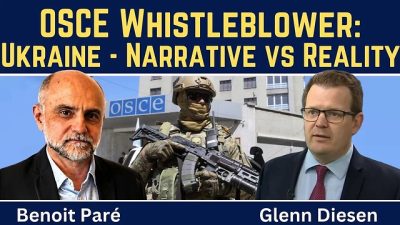
Benoit Paré: OSCE Whistleblower: The Ukraine War – Narratives vs. Reality
or go to
Aletho News Archives – Video-Images
Book Excerpt
How CIA used Ukraine as a platform for covert war against Russia
By Stephen KINZER | Responsible Statecraft | November 17, 2026
The following is an excerpt from Stephen Kinzer’s new book: Boiling Point: How America Brought War to Ukraine (Henry Holt and Company, November 2026)
Huddled beside an airstrip in southern Germany, a handful of anti-Communist warriors prepared to fire the first shots of the Cold War. A CIA officer from the Munich Operations Base was in charge. The Hungarian crewmen he had recruited stood nearby in flight suits. With them were two Ukrainian exiles who had volunteered to parachute into their homeland. They were code-named Apostle 1 and Apostle 2. Each carried forged identity papers, a miniature radio transmitter, a pistol, a machine gun, hand grenades, a purse full of gold coins, and a poison pill to be taken in case of capture. An unmarked C-47 transport plane was waiting.
The CIA officer overseeing this operation, a twenty-six-year-old Yale graduate named Stephen Tanner, watched the plane take off and disappear into the night. It flew over East Germany and Poland, then crossed into Soviet airspace. As it approached the Ukrainian city of Lviv, a cargo bay swung open. The two Ukrainians jumped into the darkness. Their mission was to link up with partisan fighters, seize territory, and establish a clandestine base through which the CIA could send them weapons.
That flight, on September 5, 1949, was the first American act of covert war in Ukraine. … continue
Blog Roll
 Aletho News
- The Food Book — First Edition, 2026, Paperback
- Benoit Paré: OSCE Whistleblower: The Ukraine War — Narratives vs. Reality
- UK forced to admit ordering backdoor access to Apple users’ data
- It’s not about China or national security. It’s about which foreign entity is allowed to spy on Americans
- Banning Palestine activists from the West will not save Israel’s image
- Iran rejects unlimited IAEA inspections amid continued military threats
- A Bridge Too Far
- David Barnea in the Bundestag – Mossad as a model for Germany’s Intelligence Services?
- Rome blasts Kiev after Italian lawmakers added to ‘kill list’
- Another €45 bn down the drain: Why the EU is desperate to waste more cash on Zelensky
- If Americans Knew
- An error has occurred; the feed is probably down. Try again later.
- No Tricks Zone
- Argentina’s Perito Moreno Glacier Joins Antarctica and Arctic In Defying Doomsday Melt Claims
- New Study: Barents Sea Temperatures Were Warmer And Sea Ice Less Extensive In The 1700s Than Today
- German Authorities Start Initiative To Evaluate Public Register For Climate “Disinformation” Spreaders!
- Zonal Asymmetry of Temperature Change in the Antarctic Circumpolar Current
- New Study: The Net Fossil Fuel Contribution To Rising Atmospheric CO2 Has Been Zero For 500 Years
- Germany’s Green Energy Transition Becoming Increasingly Expensive…Another 6 Trillion Euros!
- Sudden Stratospheric Warming, Powerful El Niño Combination May Lead To Extreme Europe Cold, Energy Crisis!
- Two New Studies Find Thwaites Glacier Melt Cannot Be Driven By Human Activity Or A Warming Ocean
- E-Cars Reduce CO2 Emissions By Only 41% Compared To Internal Combustion Engine Vehicles
- Predictions Made By Renowned Climate Professor Over Past Decades Have Been Proven To Be Poor

