Western States ‘Afraid’ of an Impartial Probe Into Idlib Chemical Incident
Sputnik – April 23, 2017
The United States and other Western countries have blocked any attempt to launch an objective investigation into the chemical weapons incident in the Syrian province of Idlib, Syrian President Bashar Assad said in a recent interview with Sputnik.
“We formally sent a letter to the United Nations, we asked them in that letter to send a delegation in order to investigate what happened in Khan Shaykhun,” Assad said.
“Of course till this moment they haven’t sent anyone, because the West and the United States blocked any delegation from coming, because if they come, they will find that all their narratives about what happened in Khan Shaykhun and then the attack on Sha’irat airport was a false flag, was a lie,” he said.
Furthermore, Assad said that in the wake of the first attack in Aleppo carried out by terrorists against the army a few years ago, Damascus had asked the United Nations to send an investigation delegation “in order to prove what we said about the terrorists having used gas against our army.”
“And later many incidents happened in that way, and they didn’t send any delegation. It’s the same now,” Assad said.
Dmitry Egorchenkov, deputy head of the Institute for Strategic Studies and Prognosis at the People’s Friendship University of Russia, noted that the current situation proves that the West continues to apply double standards.
“Structures within the UN, first of all the Organization for the Prohibition of Chemical Weapons (OPCW), try to conduct some kind of a remote investigation. These organizations and structures have ignored other reports by Damascus about chemical weapons incidents in Syria. Our Western partners continue to follow the logic of double standards. Unfortunately, the UN is not independent and cannot have an impartial role in the investigation,” Egorchenkov told Radio Sputnik.
According to the expert, the West is blocking the probe for a number of reasons.
“These organizations (the UN and the OPCW) are controlled by Western states. They are afraid of an impartial investigation because it may turn out that the incident was organized by West-backed forces. And if it turns out that the attack was fake this would mean it was part of an information war and this would be clear,” Egorchenkov pointed out.
Meanwhile, earlier this week, the OPCW fact-checking mission investigating the alleged use of chemical weapons in Khan Sheikhun said it had found traces of sarin in the victims’ bodies.
“The results of these analyses from four OPCW designated laboratories indicate exposure to Sarin or a Sarin like substance. While further details of the laboratory analyses will follow, the analytical results already obtained are incontrovertible,” OPCW Director-General Ahmet Uzumcu said Wednesday.
The next day, the OPCW rejected the Russian and Iranian proposal to investigate the suspected chemical weapons incident in Syria’s Idlib.
According to ex-member of a UN commission on biological and chemical weapons Igor Nikulin, the OPCW probe cannot be considered objective in any way.
“Unfortunately, the hasty statements that they [OPCW officials] make without the commission’s visit [to Idlib], without taking analyses on the ground, are of course alarming as the footages we all saw don’t necessarily mean that exactly sarin had been used, although it cannot be excluded. If the commission arrived at the site and took trial tests, then it would be logical. But they made a diagnosis from The Hague. It reminds of a diagnosis of a doctor who did not see his patient,” he told Sputnik Radio.
Nikulin added that Damascus has been blamed for the alleged chemical attack that hadn’t been properly investigated.
On April 4, a chemical weapons incident in Syria’s Idlib Province claimed the lives of some 80 people and inflicted harm on an additional 200 civilians. The Syrian National Coalition of Revolutionary and Opposition Forces, as well as a number of Western states, accused the Syrian government troops of carrying out the attack, while Damascus refuted these allegations. The Syrian government has repeatedly said that the Syrian Army does not possess chemical weapons.
Russian President Vladimir Putin said on April 6 that groundless accusations related to the chemical weapons incident in Idlib Province were unacceptable before the investigation into the matter had been carried out.
However, the incident was used as pretext for the United States to conduct a missile strike against Ash Sha’irat Airbase on April 6. US President Donald Trump characterized the strike as a response to the alleged use of chemical weapons by Syrian government troops while Russian Foreign Minister Sergei Lavrov said it was a violation of international law. Iranian Supreme Leader Ayatollah Ali Khamenei described the US missile strike against the Syrian airfield as a strategic mistake.
How did al-Qaeda know in advance about the Syrian air strike?
By Paul Larudee | Dissident Voice | April 21, 2017
There is an anomaly among the evidence that the Syrian chemical weapons attack at Khan Sheikhoun in Idlib province on April 4, 2017 was a “false flag” operation, designed to provoke a US attack on Syria. The evidence is otherwise quite strong, as put forth by former Pentagon consultant and MIT professor Theodore Postol in his three part analysis of the declassified White House Report on the Syrian chemical weapons attack of April 4, 2017. Postol’s analysis has been widely cited as disproving the White House contention that the Syrian Air Force bombed the “rebel” controlled village with chemical weapons.
Indeed, Dr. Postol’s analysis pokes quite a few gaping holes in the White House Report, concluding that the crushed gas canister and the “crater” shown in open source videos and photographs from the site demonstrate that it could not have been delivered by air. Postol also concludes that the report is, in fact, fraudulent and was produced by the National Security Agency without the input or review of impartial intelligence professionals.
Nevertheless, Postol begs a couple of questions, the most compelling of which is how the “false flag” imposters on the ground would have known how to time their operation with the Syrian air strike that everyone admits actually took place (the Syrians and Russians alleging that only conventional weapons were used, and the Americans alleging the use of chemical weapons). In order to do this, they would have had to have advance knowledge of the attack. How would they have gotten this information?
A clue to this comes from the suspension of the Russian-American “deconfliction” agreement. Under a September, 2015, memorandum of understanding, information about all military flights by forces in the area would be shared in order to prevent dangerous and unintended confrontations. In this case, Russia informed its US counterparts of the intended Syrian strike twenty-four hours in advance.
That would be plenty of time to prepare a “false flag” operation of the type shown in the videos and photographs and described in the Postol analysis. But in that case, the information would have to have been conveyed by US sources to operatives on the ground in Idlib, which is headquarters for al-Qaeda’s Syrian affiliates.
Russia seems to think that this is exactly what happened. Their unilateral suspension of the agreement has been widely interpreted as a reaction to the US attack on the al-Sha’yrat airstrip, but it may be more than that. Military actions are often calculated to appear to be a justifiable reaction to an earlier action from the other party. Thus, for example, the US chose to attack the Sha’yrat airstrip at least partly because that is where the aircraft that attacked Khan Sheikhoun had originated.
Similarly, Russia reacted to the US strike by authorizing increased anti-aircraft defenses in Syria and dispatching a frigate to its Mediterranean base in Tartus. These moves can be considered reactions to the fact that Russian anti-aircraft missile systems are known to be able to shoot down Tomahawk missiles of the type used in the US attack, and that the Tomahawks were fired from US vessels in the Mediterranean, off the coast of Syria.
But what about the suspension of the deconfliction agreement? How is that a specific response to the something done by the US? Perhaps Russia suspects that the information that they gave to the US in compliance with the agreement was leaked. Does Russia think that the US has al-Qaeda operatives at the highest and most secure levels of the U.S. government? That is a bit far-fetched, especially when there is a simpler and more plausible explanation.
The explanation is that al-Qaeda does not need operatives to get such information. The US has been strategically in bed with al-Qaeda, ISIS and their permutations for quite some time. US policy makers do not speak with a unified voice on this matter, but many – especially those of the neoconservative school of strategic policy – have cultivated the use of violent groups like al-Qaeda and ISIS as alternatives or supplements to the use of US forces on the ground.
Furthermore, many of the same policy makers were the ones who led the US into the disastrous wars in Iraq and Libya, and are committed to do the same in Syria. False flag operations and faulty intelligence are part of their stable, as they showed with their tall tales of WMD and Viagra-fueled black mercenaries. They have been influential in the US government since at least the Reagan administration, and groomed Hillary Clinton for the White House for decades.
Since the loss of their horse in the last presidential election, these policy makers have been trying to turn the Trump government against its campaign rhetoric of leaving Syria and letting Russia and the Syrian government put an end to ISIS and al-Qaeda in Syria. That is not part of their playbook. Their plan therefore uses false flag operations, false intelligence and working with terrorists, in order to control US foreign and military policy through subterfuge when they cannot control it directly.
But how can they do this? What sorts of connections make it possible for them to undermine the White House, State Department and intelligence services to achieve their ends? We don’t have to look far for examples.
An obvious one is the US attack on the Syrian army at Deir ez-Zour on September 17, 2016, killing scores of Syrian soldiers and wounding many more. Critically, this happened only five days into a trial ceasefire and only two days before the trial period was to end and the ceasefire to become permanent. Needless to say, this had the effect of scuttling the ceasefire, but interestingly, ISIS troops were apparently standing by to overrun Syrian army positions almost immediately after the US aircraft completed their bombing mission (and how would they have known when it was completed?).
US military officials said it was unintentional, but an excellent investigative report by Gareth Porter demonstrates that, in fact, this was a purposeful choice by high ranking US military officers to prevent the ceasefire from forcing them to cooperate with Russian counterparts on target coordination in Syria. These officers had allies in the administration, including Defense Secretary Ashton Carter, who effectively undermined the policies of President Barack Obama and Secretary of State John Kerry and their Russian counterparts, President Vladimir Putin and Foreign Minister Sergei Lavrov. As Kerry admitted to the Boston Globe, “…we had people in our government who were bitterly opposed to [the agreement].”
There is plenty of circumstantial evidence of US collusion with al-Qaeda, as well. Hillary Clinton’s foreign policy advisor Jake Sullivan even went so far as to admit that “AQ [al-Qaeda] is on our side in Syria.” Is it coincidence that most of the weapons delivered to “moderate rebels”, including TOW anti-tank guided missiles that turned the tide against the Syrian army in 2014-15 were almost immediately transferred or put under the control of al-Qaeda? Or that when US forces evacuated Falujah and other territories conquered by ISIS in the same period, it left behind huge quantities of arms, vehicles and other resources, contrary to standard military policy of destroying whatever could be of use to the enemy? Or that, more recently, when retaking Mosul, US forces left the way to Syria open for ISIS to flee to Syria and use its forces to retake Tadmur (Palmyra) from the Syrian army?
Typically, the US has created intermediaries such as the quasi-mythical “moderate rebels” between them and the most extreme terrorist organizations. However, the mythical quality of these emissaries is sometimes exposed, as when an audio recording was released of a conversation between John Kerry and twenty representatives from four “moderate” Syrian organizations in September, 2016, at the United Nations.
In the recording, a Syrian woman, Marcell Shehwaro, threatens Kerry that if the US doesn’t do more to help, they will join forces with al-Nusra (the al-Qaeda affiliate in Syria). Another man (unidentified) repeats the threat later in the recording. Shehwaro later argues that more support should go to al-Nusra; i.e., that “we are not arming the right people” and “there is not enough political and arms support to those who consider [al-Nusra] moderate. I wish we had these friends.”
Such admissions show that the veneer of “moderation” is very thin in these groups. They are, in fact, little more than a public relations front for al-Qaeda and ISIS, providing whatever the west needs – and especially news feeds – needed to keep support flowing.
The four groups represented at the meeting clearly have access to the highest levels of the US government and vice versa. It would be a simple matter for a US government official in the Pentagon, NSA or other agency to pass the information about Syrian aircraft movements to someone like White Helmets leader Raed Saleh, who was present at the Kerry meeting, with assurance that it would reach the al-Nusra leadership in Idlib. In effect, Kerry (and other government officials) are speaking directly to al-Qaeda.
Obama and Kerry learned their lesson. They understood the degree to which their decisions could be undermined, so to preserve their limited power, they sometimes went along with the powers that they could not control, and sometimes partly thwarted those powers. Obama was gifted with a Director of National Intelligence, James Clapper, who famously told him that the alleged 2013 Syrian army use of chemical weapons was “not a slam dunk,” which led the President to back off his plan to attack Syria.
Does Trump have such people? His replacement of noninterventionist Michael Flynn with war hawk H.R. McMaster is an ominous sign that neoconservative influence is reasserting itself. And the success of the Khan Sheikhoun false flag chemical weapons attack in inciting a US attack on Syria is a clear encouragement for more such false flag operations.
Paul Larudee is one of the founders of the Free Gaza and Free Palestine Movements and an organizer in the International Solidarity Movement.
Russia questions watchdog’s swift identification of sarin in Syria chemical incident
RT | April 20, 2017
The Russian military has questioned the swift conclusion of chemical weapons watchdog the OPCW, which has reported identifying sarin in samples related to an alleged attack in Syria on April 5.
The Executive Council of the Organization for the Prohibition of Chemical Weapons (OPCW) convened in the Hague on Wednesday for an update on the investigation into the reported chemical weapons attack in the town of Khan Shaykhun.
Director-General Ahmet Üzümcü told members that four OPCW designated laboratories have studied samples collected from three victims of the alleged attack during their autopsy and seven individuals undergoing treatment after surviving the incident. He said analysis of all samples indicated exposure to sarin or a sarin-like substance.
“While further details of the laboratory analyses will follow, the analytical results already obtained are incontrovertible,” the official said.
The OPCW statement didn’t explain how exactly the samples were collected. The inspectors have yet to visit Khan Shaykhun, which would allow the collection of samples on the ground to confirm contamination from a chemical agent. The site is located in a rebel-controlled territory in the Idlib province. Üzümcü said such a visit would depend on the security situation and cited an attack on an OPCW fact-finding mission in May 2014.
The Russian military, however, questioned the swift analysis of the samples, saying the OPCW did not act with such speed in another incident in which a militant group reportedly used mustard gas in Aleppo.
“Russian specialists on the site of the crime [in Aleppo] collected samples of the agent, which had been delivered to representatives of the OPCW and transported to the Hague. By the way, the Syrian leadership at the time offered safety guarantees and insisted that OPCW experts visit Aleppo, but nobody came,” Russian Defense Ministry spokesman Maj. Gen. Igor Konashenkov said Thursday.
“Four months later the OPCW still cannot come to a conclusion and call the mustard gas found there mustard gas, saying additional analysis is necessary,” he remarked.
The Russian military said it wanted details on who collected the samples and how they were studied at OPCW designated labs, and why the analysis in this case was completed in a much shorter space of time.
He added that if the OPCW states that sarin gas had been used in the incident, it would find it difficult to explain how White Helmet first responders survived exposure to the agent.
Footage taken at the scene in the aftermath of the alleged attack showed people from the controversial rescue group helping the victims while wearing no protective gear rated for handling sarin.
The OPCW is expected to provide a preliminary report on the incident within two weeks.
The incident in Khan Shaykhun reportedly killed as many as 100 people and injured several hundred. The US squarely laid the blame on Damascus, claiming that it hid chemical weapons stockpiles from the OPCW after pledging to hand them over in 2013.
Washington fired a barrage of cruise missiles at the Syrian airbase from which it claimed the chemical weapons attack was launched – a move that was hailed by Syria’s neighbor Israel. Europe backs the accusations against the Syrian government, even though no solid evidence has been made public.
Russia has called for a thorough investigation of the incident, which would include an on-site inspection in the rebel-held territory, before coming to any conclusions. Moscow believes that the incident may have been a false flag operation meant to provoke a US attack against Damascus.
Read more:
Russia questions Britain’s chemical weapons investigation in Syria
Trump Withholds Syria-Sarin Evidence
By Robert Parry | Consortium News | April 12, 2017
After making the provocative and dangerous charge that Russia is covering up Syria’s use of chemical weapons, the Trump administration withheld key evidence to support its core charge that a Syrian warplane dropped sarin on a northern Syrian town on April 4.
A four-page white paper, prepared by President Trump’s National Security Council staff and released by the White House on Tuesday, claimed that U.S. intelligence has proof that the plane carrying the sarin gas left from the Syrian military airfield that Trump ordered hit by Tomahawk missiles on April 6.
The paper asserted that “we have signals intelligence and geospatial intelligence,” but then added that “we cannot publicly release all available intelligence on this attack due to the need to protect sources and methods.”
I’m told that the key evidence was satellite surveillance of the area, a body of material that U.S. intelligence analysts were reviewing late last week even after the Trump-ordered bombardment of 59 Tomahawk missiles that, according to Syrian media reports, killed seven or eight Syrian soldiers and nine civilians, including four children.
Yet, it is unclear why releasing these overhead videos would be so detrimental to “sources and methods” since everyone knows the U.S. has this capability and the issue at hand – if it gets further out of hand – could lead to a nuclear confrontation with Russia.
In similarly tense situations in the past, U.S. Presidents have released sensitive intelligence to buttress U.S. government assertions, including John F. Kennedy’s disclosure of U-2 spy flights in the 1962 Cuban Missile Crisis and Ronald Reagan revealing electronic intercepts after the Soviet shoot-down of Korean Airlines Flight 007 in 1983.
Yet, in this current case, as U.S.-Russian relations spiral downward into what is potentially an extermination event for the human species, Trump’s White House insists that the world must trust it despite its record of consistently misstating facts.
In the case of the April 4 chemical-weapons incident in the town of Khan Sheikhoun, which reportedly killed scores of people including young children, I was told that initially the U.S. analysts couldn’t see any warplanes over the area in Idlib province at the suspected time of the poison gas attack but later they detected a drone that they thought might have delivered the bomb.
A Drone Mystery
According to a source, the analysts struggled to identify whose drone it was and where it originated. Despite some technical difficulties in tracing its flight path, analysts eventually came to believe that the flight was launched in Jordan from a Saudi-Israeli special operations base for supporting Syrian rebels, the source said, adding that the suspected reason for the poison gas was to create an incident that would reverse the Trump administration’s announcement in late March that it was no longer seeking the removal of President Bashar al-Assad.
If indeed that was the motive — and if the source’s information is correct — the operation would have been successful, since the Trump administration has now reversed itself and is pressing Russia to join in ousting Assad who is getting blamed for the latest chemical-weapons incident.
Presumably, however, the “geospatial intelligence” cited in the four-page dossier could disprove this and other contentions if the Trump administration would only make its evidence publicly available.
The dossier stated, “Our information indicates that the chemical agent was delivered by regime Su-22 fixed-wing aircraft that took off from the regime-controlled Shayrat Airfield. These aircraft were in the vicinity of Khan Shaykhun approximately 20 minutes before reports of the chemical attack began and vacated the area shortly after the attack.”
So, that would mean – assuming that the dossier is correct – that U.S. intelligence analysts were able to trace the delivery of the poison gas to Assad’s aircraft and to the airfield that Trump ordered attacked on April 6.
Still, it remains a mystery why this intelligence assessment is not coming directly from President Trump’s intelligence chiefs as is normally the case, either with an official Intelligence Estimate or a report issued by the Director of National Intelligence.
The White House photo released late last week showing the President and a dozen senior advisers monitoring the April 6 missile strike from a room at his Mar-a-Lago estate in Florida was noteworthy in that neither CIA Director Mike Pompeo nor Director of National Intelligence Dan Coats was in the frame.
Now, it is the White House that has released the four-page dossier supposedly summing up the assessment of the “intelligence community.”
An Argumentative Dossier
The dossier also seems argumentative in that it assumes that Russian officials – and presumably others – who have suggested different possible explanations for the incident at Khan Sheikdoun did so in a willful cover-up, when any normal investigation seeks to evaluate different scenarios before settling on one.
It is common amid the “fog of war” for people outside the line of command – and even sometimes inside the line of command – to not understand what happened and to struggle for an explanation.
On April 6, before Trump’s missile strike, I and others received word from U.S. military intelligence officials in the Middle East that they, too, shared the belief that the poison gas may have resulted from a conventional bombing raid that ruptured containers stored by the rebels, who – in Idlib province – are dominated by Al Qaeda’s affiliate and its allies.
Those reports were cited by former U.S. intelligence officials, including more than two dozen who produced a memo to President Trump urging him to undertake a careful investigation of the incident before letting this crisis exacerbate U.S.-Russia relations.
The memo said “our U.S. Army contacts in the area” were disputing the official story of a chemical weapons attack. “Instead, a Syrian aircraft bombed an al-Qaeda-in-Syria ammunition depot that turned out to be full of noxious chemicals and a strong wind blew the chemical-laden cloud over a nearby village where many consequently died,” the memo said.
In other words, to suggest possible alternative scenarios is not evidence of a “cover-up,” even if the theories are later shown to be erroneous. It is the normal process of sorting through often conflicting initial reports.
Even in the four-page dossier, Trump’s NSC officials contradicted what other U.S. government sources have told The New York Times and other mainstream news outlets about the Syrian government’s supposed motive for launching the chemical-weapons attack on the town of Khan Sheikhoun.
According to the earlier accounts, the Syrian government either was trying to terrorize the population in a remote rebel-controlled area or was celebrating its impunity after the Trump administration had announced that it was no longer seeking Assad’s removal.
But the dossier said, “We assess that Damascus launched this chemical attack in response to an opposition offensive in northern Hamah Province that threatened key infrastructure.” Although Khan Sheikhoun was not near the fighting, the dossier presented the town as an area of support for the offensive.
Assuming this assessment is correct, does that mean that the earlier explanations were part of a cover-up or a propaganda operation? The reality is that in such complex situations, the analyses should continue to be refined as more information becomes available. It should not be assumed that every false lead or discarded theory is proof of a “cover-up,” yet that is what we see here.
“The Syrian regime and its primary backer, Russia, have sought to confuse the world community about who is responsible for using chemical weapons against the Syrian people in this and earlier attacks,” the dossier declared.
But the larger point is that – given President Trump’s spotty record for getting facts straight – he and his administration should go the extra mile in presenting irrefutable evidence to support its assessments, not simply insisting that the world must “trust us.”
[In a separate analysis of the four-page dossier, Theodore Postol, a national security specialist at the Massachusetts Institute of Technology, concluded that the White House claims were clearly bogus, writing:
“I have reviewed the document carefully, and I believe it can be shown, without doubt, that the document does not provide any evidence whatsoever that the US government has concrete knowledge that the government of Syria was the source of the chemical attack in Khan Shaykhun, Syria at roughly 6 to 7 a.m. on April 4, 2017.
“In fact, a main piece of evidence that is cited in the document points to an attack that was executed by individuals on the ground, not from an aircraft, on the morning of April 4. This conclusion is based on an assumption made by the White House when it cited the source of the sarin release and the photographs of that source. My own assessment, is that the source was very likely tampered with or staged, so no serious conclusion could be made from the photographs cited by the White House.”]
Investigative reporter Robert Parry broke many of the Iran-Contra stories for The Associated Press and Newsweek in the 1980s.
Intel shows more attacks planned in Syria to blame Assad: Putin
By Adam Garrie and Vladimir Rodzianko | The Duran | April 11, 2017
Russian President Vladimir Putin has just held a press conference with Italian President Sergio Mattarella.
Putin told reporters that Russian intelligence indicates that terrorist factions operating in Syria are planning further chemical weapons attacks, likely in regions south of Damascus.
Putin explained that these attacks will be used as provocations for further US military action in Syria as the terrorists will blame the attacks on President Assad. In other words, the intelligence points to a premeditated false flag attack.
“We have intelligence, showing that such provocations may happen in other parts of Syria, including territories south of Damascus. They plan to use some substances and then accuse the Syrian government of using those chemicals.”
Putin urged vigilance against such provocative attacks and reiterated Russia’s commitment to an impartial UN led investigation of the now infamous Idlib chemical weapons attack which America used as justification for their bombing of Syria last week.
“We believe every incident should be properly investigated so we plan to contact the UN institution at The Hague and we urge the international community to investigate the incident – then based on this investigation, a proper decision has to made.”
Putin also drew parallels between the US rush to war in Syria with George Bush’s attack on Iraq in 2003 when evidence about Iraqi weapons of mass destruction turned out to be false.
The Russian President stated quite frankly, ‘we’ve seen this all before’.
This comes as US Secretary of State Tillerson is to meet Russian Foreign Minsiter Sergey Lavrov later today in Moscow.
US threatens Russia, Iran with more sanctions for Syria’s support
Press TV – April 10, 2017
The United States has threatened Russia and Iran with tougher sanctions over their support for Syria, saying nothing “is off the table” in this regard.
“We’re calling [Russia and Iran] out,” US Ambassador to the United Nations Nikki Haley said in an interview broadcast on CNN on Sunday.
“But I don’t think anything is off the table at this point. I think what you’re going to see is strong leadership. You’re going to continue to see the United States act when we need to act,” she added.
The comments were made after US Senate Majority Leader Mitch McConnell said he would look into stepping up sanctions on Russia and Iran, which support Syrian President Bashar al-Assad. The two countries are already under various types of US sanctions.
Washington has alleged that the government of President Assad is responsible for the last week’s suspected chemical attack in Idlib province which killed more than 80 people.
Moscow and Damascus have denied that the Syrian government had anything to do with the attack. The Russian Defense Ministry said the US had no proof of chemical weapons at al-Shayrat airbase, where it fired 59 Tomahawk missiles, killing several people and reportedly destroying a number of Syrian aircraft.
Iran has condemned both the alleged chemical attack and the US missile strike on Syria, saying Washington’s illegal action will embolden terrorist groups in the Middle East region.
‘US has evidence that Assad was behind attack’
In her interview with CNN, Haley insisted that the US administration has evidence that the Syrian government was behind the April 4 chemical attack
“What we’ve seen is, you know, in our meetings this week, we were told of the evidence,” she said. “We saw the evidence. The President saw the evidence. All of that is naturally classified. And I’m sure when they can declassify that, they will.”
On Sunday, Haley once again threatened Syria with further military action, saying President Donald Trump could order more strikes if necessary. She issued a similar threat hours after the April 7 missile strike.
“I was trying to give warning and notice to the members of the Security Council and the international community that (Trump) won’t stop here,” she said, adding. “If he needs to do more, he will do more.”
‘US strike intended to send message to Russia’
In a separate interview NBC News on Sunday, Haley said the US missile attack in Syria was intended to send a message to the Russian government.
“The entire administration was in agreement that this was something that had to be done. This was something that needed to tell Assad, ‘Enough is enough,'” she said.
“And this is something to let Russia know, ‘You know what? We’re not going to have you cover for this regime anymore. And we’re not going to allow things like this to happen to innocent people.'”
She went on to say that the United States will not allow Russian President Vladimir Putin to “have Assad’s back anymore.”
Tillerson asks Russia to drop support for Assad
Meanwhile, US Secretary of State Rex Tillerson, who is set to visit Moscow this week, on Sunday demanded that Moscow stop supporting the Assad government.
“I hope Russia is thinking carefully about its continued alliance with Bashar al-Assad, because every time one of these horrific attacks occurs, it draws Russia closer into some level of responsibility,” Tillerson told ABC News.
The United States and its allies have repeatedly used chemical weapons as a pretext to pressure the Syrian government, despite the fact that Damascus volunteered to destroy its chemical stockpile in 2014 following a poisonous attack outside the capital. The deal was brokered by the US and Russia in 2013.
Tillerson accused Moscow of failing to enforce the 2013 agreement meant to get Syria rid of its chemical arsenal.
“I’m disappointed because I think the real failure here has been Russia’s failure to live up to its commitments under the chemical weapons agreements that were entered into in 2013,” he said.
“Both by the Syrian government and by Russia as the guarantor to play the role in Syria of securing chemical weapons, destroying the chemical weapons and continuing to monitor that situation,” he added.
‘Russia also responsible for April 4 chemical incident’
The top US diplomat said the April 4 chemical incident happened because of Russia’s failure “to achieve its commitment to the international community.”
“I hope Russia is thinking carefully about its continued alliance with Bashar al-Assad,” he added, “because every time one of these horrific attacks occurs, it draws Russia closer into some level of responsibility.”
The allegations of chemical arms use are still made against Syria even as the dismantling of the country’s entire stockpile of chemical weapons as well as relevant production facilities was supervised by the United Nations.
Foreign-backed militants have repeatedly used chemical weapons against Syrian troops, some of which have been verified by UN officials, but the attacks have often been ignored by Western governments.
In December 2015, a cousin of former Libyan ruler Muammar Gaddafi said that chemical weapons used in Ghouta which were blamed on the Syrian government were in fact stolen from Libya and later smuggled into Syria via Turkey.
Featured Video
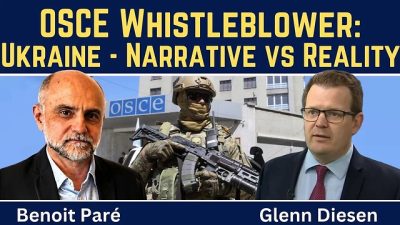
Benoit Paré: OSCE Whistleblower: The Ukraine War – Narratives vs. Reality
or go to
Aletho News Archives – Video-Images
Book Excerpt
How CIA used Ukraine as a platform for covert war against Russia
By Stephen KINZER | Responsible Statecraft | November 17, 2026
The following is an excerpt from Stephen Kinzer’s new book: Boiling Point: How America Brought War to Ukraine (Henry Holt and Company, November 2026)
Huddled beside an airstrip in southern Germany, a handful of anti-Communist warriors prepared to fire the first shots of the Cold War. A CIA officer from the Munich Operations Base was in charge. The Hungarian crewmen he had recruited stood nearby in flight suits. With them were two Ukrainian exiles who had volunteered to parachute into their homeland. They were code-named Apostle 1 and Apostle 2. Each carried forged identity papers, a miniature radio transmitter, a pistol, a machine gun, hand grenades, a purse full of gold coins, and a poison pill to be taken in case of capture. An unmarked C-47 transport plane was waiting.
The CIA officer overseeing this operation, a twenty-six-year-old Yale graduate named Stephen Tanner, watched the plane take off and disappear into the night. It flew over East Germany and Poland, then crossed into Soviet airspace. As it approached the Ukrainian city of Lviv, a cargo bay swung open. The two Ukrainians jumped into the darkness. Their mission was to link up with partisan fighters, seize territory, and establish a clandestine base through which the CIA could send them weapons.
That flight, on September 5, 1949, was the first American act of covert war in Ukraine. … continue
Blog Roll
 Aletho News
- Benoit Paré: OSCE Whistleblower: The Ukraine War — Narratives vs. Reality
- UK forced to admit ordering backdoor access to Apple users’ data
- It’s not about China or national security. It’s about which foreign entity is allowed to spy on Americans
- Banning Palestine activists from the West will not save Israel’s image
- Iran rejects unlimited IAEA inspections amid continued military threats
- A Bridge Too Far
- David Barnea in the Bundestag – Mossad as a model for Germany’s Intelligence Services?
- Rome blasts Kiev after Italian lawmakers added to ‘kill list’
- Another €45 bn down the drain: Why the EU is desperate to waste more cash on Zelensky
- In Europe, Anxiety Is Mounting—EU Unity Is Cracking at Every Seam
- If Americans Knew
- An error has occurred; the feed is probably down. Try again later.
- No Tricks Zone
- Argentina’s Perito Moreno Glacier Joins Antarctica and Arctic In Defying Doomsday Melt Claims
- New Study: Barents Sea Temperatures Were Warmer And Sea Ice Less Extensive In The 1700s Than Today
- German Authorities Start Initiative To Evaluate Public Register For Climate “Disinformation” Spreaders!
- Zonal Asymmetry of Temperature Change in the Antarctic Circumpolar Current
- New Study: The Net Fossil Fuel Contribution To Rising Atmospheric CO2 Has Been Zero For 500 Years
- Germany’s Green Energy Transition Becoming Increasingly Expensive…Another 6 Trillion Euros!
- Sudden Stratospheric Warming, Powerful El Niño Combination May Lead To Extreme Europe Cold, Energy Crisis!
- Two New Studies Find Thwaites Glacier Melt Cannot Be Driven By Human Activity Or A Warming Ocean
- E-Cars Reduce CO2 Emissions By Only 41% Compared To Internal Combustion Engine Vehicles
- Predictions Made By Renowned Climate Professor Over Past Decades Have Been Proven To Be Poor

