Collusion by the White House, the Pentagon, and the mainstream media resulted in disparagement, denial, and suppression of eyewitness testimony confirming that most POWs were actually well-treated by their North Vietnamese captors (in contrast to the brutal torture and death often meted out to North Vietnamese POWs by U.S. forces).
When numerous U.S. POWs began to understand the truth about the war they had been fighting, they spoke out against it—voluntarily—as an act of conscience. But they were cynically portrayed as traitors, turncoats and “camp rats,” their reputations and lives destroyed, driving many to despair and even suicide.
Among the few memories that most Americans still retain of the Vietnam War—now nearly 60 years in the past—one of the most vivid centers around the torture suffered by Senator John McCain at the hands of his brutal Vietnamese captors while a prisoner of war in Hanoi’s Hoa Lo prison (AKA The Hanoi Hilton).
This story has been told, retold, and continually burnished countless times by admiring media interviews and a flood of books and memoirs, including several by McCain himself.
Another memory of the war, still believed by millions of Americans, is that hundreds or even thousands of American soldiers classified as MIA (Missing in Action) are actually being held and tortured in secret North Vietnamese POW camps, callously abandoned by our government and desperately praying to be rescued—preferably in a Hollywood-style rescue by Chuck Norris or Sylvester Stallone, who starred in the spate of Commie-hating blockbuster movies inspired by their plight.
This belief is continually reinforced by POW/MIA flags which fly at every post office, and a ready supply of new books and movies, such as the 2018 release of the film M.I.A. A Greater Evil.
But both memories of the Vietnam War are false memories. However passionately believed, they were cynically manufactured fantasies implanted in all-too-willing American minds for political purposes.
How and why these counter-factual beliefs were so successfully foisted on the American public is the subject of the new myth-shattering book by Tom Wilber and Jerry Lembcke, Dissenting POWs: From Vietnam’s Hoa Lo Prison to America Today (New York: Monthly Review Press, 2021).
Wilber is the son of a dissenting POW, Walter “Gene” Wilber, who is featured in the book, and has contributed to the award-winning documentary film The Flower Pot Story by Ngọc Dũng. Lembcke is a distinguished sociologist from College of the Holy Cross who has written a number of books debunking popular myths about the Vietnam War.
The two start their book by noting that the dominant war hero image of the POW—who endured torture and resisted service to enemy propaganda—was to a large extent created by high-ranking men like McCain who were captured early in the conflict.
John McCain embodied the war hero image of someone who endured torture at the hands of his North Vietnamese captors while retaining loyalty to the United States. [Source: nymag.com]
McCain’s oft-told story of ill-treatment and torture is contradicted by Nguyen Tien Tran, the chief prison guard of the jail in which McCain was held. In a report by The Guardian, “[Tran] acknowledged that conditions in the prison were ‘tough, though not inhuman’. But, he added: ‘We never tortured McCain. On the contrary, we saved his life, curing him with extremely valuable medicines that at times were not available to our own wounded’. . . . [H]e denied torturing him, saying it was his mission to ensure that McCain survived. As the son of the US naval commander in Vietnam, he offered a potential valuable propaganda weapon.”
John McCain fit well with this group because he was also academically privileged and his family included high-ranking military officers like his father, Jack, who was an admiral and the Commander of the U.S. Pacific Command.
James Stockdale while in captivity. [Source: military.com]
Jeremiah Denton featured in famous film footage from his captivity. [Source: washingtontimes.com]
Robinson Risner, right, is celebrated in a parade in San Francisco in 1973 after his return following seven years in a North Vietnamese POW camp. [Source: nytimes.com]
With post-war military careers at stake, these high-ranking officers played up the alleged barbarity of the North Vietnamese, demanded resistance to interrogations from other captives, and threatened so-called deviants with disciplinary charges after release to the U.S.
The Nixon administration advanced their credibility and status in a desperate ploy to stir up support at home for an unpopular conflict abroad; and further concocted a story—announced in a press conference by Defense Secretary Melvin Laird on May 19, 1969—that 1,300 American soldiers deemed “missing in action” were believed to be prisoners of war.
Secretary of Defense Melvin Laird gives the opening statement of a press conference on May 19, 1969, to publicize the plight of U.S. POWs and MIAs in North Vietnam. [Source: courant.com]
The unaccounted for would now publicly be described as “POW/MIA,” implying that any serviceperson missing in Vietnam could also be a prisoner of war. This transformed the war from a political issue into a humanitarian one, trading public support for sympathy. It didn’t matter why we were there in the first place: Our boys were there, and by God were we going to do anything to get them home.
Suddenly, the public image of Vietnam looked very different. The very real footage of brutalized Vietnamese bodies, wailing children, and napalmed villages was traded for a fantasy—all of the violence that had been done in Uncle Sam’s name was now being done to him.
Images like this famous one of a Vietnamese girl, Phan Thi Kim Phúc, running from a U.S. napalm strike, were supplanted by the fixation with the plight of American POW/MIAs. This was a brilliant public relations maneuver by the Nixon administration in collusion with the media. [Source: irishtimes.com]
The POW issue soon became a cause célèbre. In the early 1970s, millions of “POW bracelets” were sold by a student group called VIVA (Voices in Vital America), each branded with the name of a missing American serviceman.
These shiny nickel bracelets were spotted on the wrists of celebrities like Sonny and Cher—who had often before dressed like hippies—and Sammy Davis, Jr, and allegedly Princess Grace of Monaco put in an order for two bracelets.
Sonny and Cher with returned POW John “Spike” Nasmyth on their CBS comedy hour program in March 1973 in which they announced that they wore POW bracelets with his name. [Source: cherscholar.com]
The silver bracelets could even be spotted on the fashion runway, where models with an interest in political activism took to wearing them. A New York Times profile from the day quotes a model named Astrida Woods, who said she was “dissatisfied” with her life as a model and felt the urge to give back. “I began to do some work with Ralph Nader, and now [wearing the bracelets]. It’s a way to contribute something.”
Pretty young women showcasing POW bracelets as part of PR campaign to unify the nation around support for POW/MIAs, if not the Vietnam War itself. [Source: audacy.com]
Wilber and Lembcke conclude that “instances of brutal treatment” were “less common than [has been] purported” and that evidence of systematic torture drawn from visitor reports, POW statements, and oral histories was scant.
Those POWs who questioned the war were dismissed by the military for their supposedly “weak personal character” and “lack of education and backgrounds in broken and poor families,” a typical case of “psychologizing the political.”
These men were in turn stigmatized and then forgotten by the public amidst the manufactured concern about POW/MIAs who were supposedly brutalized and then kept in captivity and abandoned by their government.
The ranks of the POW dissenters included Lt. Col. Edison Miller, a recipient of the Distinguished Flying Cross and Purple Heart from California who spent six years in captivity after his fighter plane was shot down over North Vietnamese skies on October 13, 1967.
A contemporary described Miller, a Californian who flew previously over Korea, as a “first-rate pilot with a zeal for combat but an independent sort.”
John McCain falsely accused Miller of being a turncoat because he appeared in North Vietnamese propaganda.
McCain said both “had lost their faith completely.”
“They not only stopped resisting but apparently crossed a line no other prisoner I knew had even approached,” McCain wrote. “They were collaborators, actively aiding the enemy.”
Miller’s anti-war views had been sharpened in conversation with Navy Commander Robert Schweitzer, a captive from 1968 to 1973 who died a year after his release while still on active duty in San Francisco.
Schweitzer felt that, because the U.S. had never declared war, there could not legally be any North Vietnamese prisoners of war, only “Americans detained by a foreign power,” Miller said.
A tape of a conversation between Miller and Schweitzer was played for other prisoners, who heard not only an anti-war message but a challenge to the legality of the U.S. military action in Vietnam.
In 1970, when Miller and Gene Wilber were interviewed on national television, Wilber called for an immediate U.S. troop withdrawal “so that the Vietnamese can solve their own problems.”
U.S. journalists at the time, however, did not take their interview seriously, regarding it rather as a North Vietnamese propaganda show.
The two men along with Schweitzer continued to write protest statements and together with fellow dissenters met with American peace activists visiting North Vietnam, including actress Jane Fonda and former U.S. Attorney General Ramsey Clark.
Jane Fonda (center) during trip to North Vietnam in 1972. [Source: flickr.com]
Ramsey Clark (left) in North Vietnam in 1972. [Source: nytimes.com]
Most dissenting POWs came from a working-class background.
James A. Daly, an African-American infantryman from the Bedford-Stuyvesant section of Brooklyn, for example, was raised in poverty by a single mother.
His 1975 book, Black Prisoner of War, describes his three years of jungle confinement after his capture by North Vietnamese soldiers and the South Vietnam-based National Liberation Front (NLF), followed by a two-month trek north to Hanoi on the Ho Chi Minh trail where he experienced what it was like to be on the receiving end of U.S. ordnance.
Bob Chenoweth, from a white working-class family in Oregon, similarly developed an empathy for the Vietnamese people and a distaste for the racist views of most Americans toward the Vietnamese.
A helicopter crew member, before he was shot down and captured, Chenoweth said he “couldn’t see how U.S. forces could possibly be helping the Vietnamese given the attitude that GIs had, viewing them as ‘subhuman’ and disparaging them as ‘gooks and dinks.’”
Chenoweth and other of his contemporaries authored anti-war statements, wrote messages to GIs asking them to follow their consciences, sent letters to politicians, and recorded tapes to be aired via Radio Hanoi.
Bob Chenoweth speaking at Veterans for Peace conference in Spokane, Washington, in 2019. He was active in the Vietnam era anti-war movement upon his return from the war. [Source: wagingpeaceinvietnam.com]
Higher ranking POWs responded by trying to isolate the dissenters from other American prisoners while charging them with participating in a conspiracy against the United States.
One of the dissidents, Abel Kavanaugh, committed suicide as a result of the intense pressure and prospective stigma of a dishonorable discharge only a few months after coming home from Vietnam.
Charges against the POW dissidents were eventually dropped, Wilber and Lembcke believe, so as to not jeopardize the hero-prisoner story with too much attention on dissent and through a possible exposure of inconsistencies in the accusers’ own prison biographies.
Fear of Communist Infiltration
A critical trope in Cold War America was the fear of communist infiltration and internal subversion through brainwashing and mind control.
This trope was fortified by a CIA propaganda effort that depicted Korean War POWs who defected to the North Korean and Chinese side as having been brainwashed in interrogation.
CIA propaganda tract accusing Communist China of brainwashing U.S. POWs. The stereotype of cunning and evil Oriental communists endured through the Vietnam War and beyond and impacted how Americans viewed the dissenting POWs in Vietnam. [Source: goodreads.com]
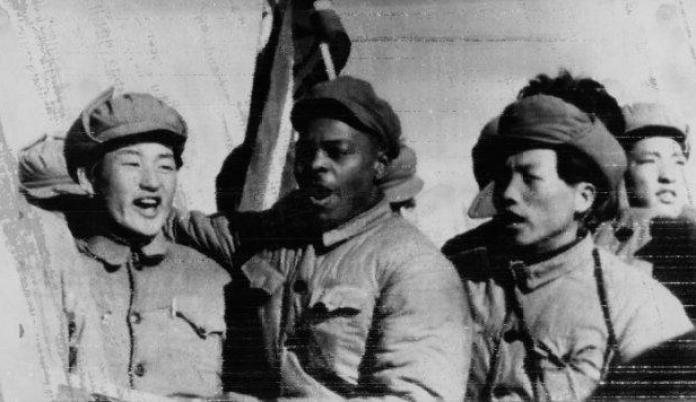
Most of these defectors were in fact African-Americans who did not want to return to the Jim Crow South, while others were attracted by communist ideals or saw the U.S. war as immoral.[1]
Clarence Adams with Korean POWs and Communist captors in 1954. Adams lived in China for 12 years. He said he was well treated in captivity and stayed on in China because he was offered the chance at education there. Later he made propaganda broadcasts for Radio Hanoi, eventually returning to his hometown of Memphis, Tennessee, where he ran a chain of successful Chinese restaurants. [Source: u.osu.edu]
The stereotype of the brainwashed POW of the Korean War turned collaborator and traitor because of his weak character would become the backdrop for the discrediting of the dissident POWs of the Vietnam War.
POW defectors in the Korean War who stood for peace. [Source: newyorker.com]
In an appearance on CBS’s 60 Minutes, Gene Wilber was grilled on whether he had given in to the enemy to make antiwar statements. That he had acted on his own “conscience and morality” was drowned out by host Mike Wallace’s implications of collaboration and opportunism.
When he was subsequently invited to the White House POW reception, Wilber found his hotel room broken into and marked with accusations of treason when he returned from the reception.
In the summer of 1973, James Stockdale charged Wilber and Edison Miller with collaborating with the enemy, mutiny, and inciting personnel to insubordination. However, military judges found insufficient evidence to prosecute the case, and Wilber and Miller instead received letters of censure for their failure to meet the standard expected of officers.
Hollywood Revisionism
POW films starting from this time focused on returnees’ estrangement with their families and society and were told as stories of spousal infidelity, representing both individual drama as well as a sense of “home-front betrayal.”
These films were part of a post-war revisionism, which included a spate of films that contributed to the legend of American servicemen left behind in Vietnam.
In the 1980s, a new subgenre emerged focused on Vietnam veterans heroically taking on the task of returning to Indochina and liberating the left-behind POWs, who had been betrayed on the home front and abandoned by the U.S. government.
The POWs were depicted as victimized and emasculated captives who needed to be rescued by individualist heroes and whose honor as Americans was to be restored.
This image, Wilber and Lembcke argue, fits the post-war efforts to psychologize the once political conflicts of the Vietnam War and to depict the veteran as a victim and loser.
More of a heroized image and the POWs’ endurance of torture was revived with the 1987 film, The Hanoi Hilton, which starred Michael Moriarty, Ken Wright and Paul Le Mat as U.S. POWs who defy their captors while enduring brutal treatment at Hanoi’s Hoa Lo prison (aka The Hanoi Hilton).
This film meshed particularly well President’s Ronald Reagan’s characterization of the Vietnam War as a “noble cause,” fought by noble men, with the POW dissenters by implication being ignoble.
Persistence of the Hero-Prisoner Story
In their quest to comprehend the persistence of the hero-prisoner story, Wilber and Lembcke take their readers back to American colonial history and the captivity narratives emerging during that time.
These stories are about a complex mix of violence against captives, temptations to stay with their captors, the ideal to remain loyal with their fellow colonists, and their Christian beliefs.
Such tensions and correlations between the Self and the Other were critical in the making of an American identity. The wars in Korea and Vietnam and the POW experiences there can be understood as a new chapter of this identity-making process. Here, too, Americans must prove their will and ability to endure the brutality of a racialized Other.
A wrench in the story, however, is revealed in the autobiographical accounts of POW-heroes like Stockdale, Denton, and Risner. They wrote about fasting as a way of enforcing self-discipline and self-assurance, sometimes with a religious subtext.
More bizarrely, they also wrote about self-mutilation—the deliberate infliction of physical wounds on themselves that would be visible during filmed interviews.
The aim was to make it appear to other POWs (and to the U.S. public) that they had been tortured. One officer wrote of how he purposely damaged his vocal apparatus so he could not be forced to make propaganda statements.
In addition to some high-ranking officers attempting to portray themselves as heroes by means of self-mutilation, Wilber and Lembcke also noted that they tried to keep political literature and news of dissent back home away from other POWs, fearing that these would enhance critical positions on the war and against their authority within the prison population.
Moreover, these ranking officers often despised the more humane view of the Vietnamese displayed by other prisoners, including an interest in their language and culture, and an understanding of why they were fighting back against an invasion of their country by the most powerful military force in the world.
Bringing Back Forgotten Dissenters
Wilber and Lembcke’s book helps restore these forgotten POW dissenters to their rightful—and honored—place among the large and diverse Vietnam generation of dissidents, draft resisters, oppositional GIs, veteran activists, deserters, and all those who supported them.
The book also shows that, despite all destruction and death brought by the invaders from the sky, North Vietnam maintained a moral superiority through oftentimes fair treatment of the captured Americans. This was in stark contrast to the more systematic adoption of torture methods by USAID and CIA-trained police under the Operation Phoenix and like-minded programs.
Vietnam War protesters create mock Tiger Cage, replicating one in the USAID-run Con Son prison where Vietnamese inmates were tortured in a way American POWs claimed they had been tortured. [Source: easyyolktoofiles.wordpress.com]
The POW/MIA flag that flies today over the White House is intended to honor the men who endured captivity; however, it continues to perpetuate a distorted understanding of a war that was as abominable as it was unjust, and helps to advance a dangerous nationalist ideology that will lead to future Vietnams.
See Clarence Adams, An American Dream: The Life of an African American Soldier and POW Who Spent Twelve Years in Communist China (Amherst, MA: University of Massachusetts Press, 2007). ↑
The 2012 spy comedy-drama Argo was a massive critical and commercial success, and while the CIA’s support for the film was an open secret, until now the details on how and why the Agency helped to make Argo were hard to come by. In response to a FOIA request made in 2012, the CIA recently released over 200 pages of documents about their role in the making of Argo, providing a glimpse behind the curtain of why the CIA is working with Hollywood.
Argo tells the story of six US State Department employees who fled the US embassy in Tehran during the 1979 revolution, and were hiding out in the city. The CIA’s Tony Mendez came up with the idea of pretending they were a Hollywood film crew, so he could sneak them out of Iran. The CIA, with the help of assets in Tinseltown, set up a fake production company and bought the rights to a sci-fi script, titled Argo, before Mendez traveled to Tehran and exfiltrated the six government employees.
‘We Love the Agency’
Numerous emails between the CIA and the film-makers, including star and director Ben Affleck, reveal a disturbingly close relationship. Affleck declared, “We love the Agency and this heroic action” before promising “we really want the process of bringing it to the big screen to be as real as possible.” One CIA officer wrote back, “The story you’re telling in the movie is one we’re proud of (something that is probably clear since we feature the tale in the museum).”
The documents detail how, over the following months, the CIA provided extensive support on Argo. Affleck, fellow star Bryan Cranston, and the producers were given tours of the Langley headquarters, Affleck was provided with archive photographs so the crew could recreate 80s-style CIA offices, and Affleck even had a roundtable meeting with senior CIA officials to plan out the project.
This culminated in the Agency granting permission for Affleck to film at CIA headquarters — a benefit provided to a tiny handful of productions since 1973s Scorpio became the first movie to be granted that privilege.
In one sequence, Affleck — playing Mendez — is shown arriving at Langley and entering the headquarters, walking over the CIA seal in the lobby. As Affleck revealed on the DVD commentary, they had to digitally remove the security gates in the lobby because they didn’t exist at the time of the Argo operation. A lengthy dialog scene between Affleck and Cranston — playing Mendez’ supervisor — was shot in a Langley corridor.
Unlike the Pentagon and other government agencies with a large number of locations and impressive-looking hardware, the CIA’s only cinematic asset is its Langley campus. As one CIA public affairs officer put it in an email to Affleck, “I love opportunities to show off our Langley home and, of course, the men and women of America’s premier intelligence service.” But it took months before the Agency’s higher-ups approved Argo for filming at their HQ, and several reviews of the evolving script by public affairs officers.
Authenticity vs. reality: How Argo butchered history
This rarely-granted access added production value, and lent Argo a degree of authenticity that few spy films achieve. In an interview with the CIA’s in-house magazine, Affleck declared, “I hope we can make it feel real,” but his film grossly distorted major details of the operation and surrounding events. Critics lauded Argo for authentically recreating the period and capturing the zeitgeist of the time, but soon the cracks started to emerge.
The Canadian government, which played a key role in the operation by both housing the six in Tehran and providing false Canadian passports to help them “sell” their cover identities, objected to having been sidelined in the Argo script. Former Canadian ambassador to Iran Ken Taylor criticized the movie, saying, “In general, it makes it seem like the Canadians were just along for the ride. The Canadians were brave. Period.”
These remarks were echoed by former President Carter. “90% of the contributions to the ideas and the consummation of the plan was Canadian, and the movie gives almost all of the credit to the American CIA.”
Carter went on to point out that Affleck’s character, Tony Mendez, “was only in Tehran for a day and a half” and that Taylor was the real hero of the operation. This led to Affleck adding a card at the end of the movie acknowledging the role of the Canadians, but he made no other changes in response to this criticism. Tellingly, the newly-released CIA documents don’t mention Canada even once.
Indeed, the CIA’s internal history of the Argo operation, which was written by Mendez, records just how briefly he was on the ground in Iran, and grants Taylor far more credit than the movie does. It also notes that a second CIA officer also went to Tehran to help exfiltrate the “film crew,” referred to by the pseudonym “Julio.”
The film — which Mendez worked on as a script consultant and technical adviser — makes no mention of “Julio,” minimizes the role of the Canadian government, and turns Mendez and the CIA into the heroic saviors of the story. While this might have “felt real” to some audiences and critics, it was far from reality.
Remediating the CIA Coup of ’53 and the Hostage Crisis
Perhaps more importantly, the film also distorts history in its depiction of Iran, and the causes of the Iranian revolution. The film’s introduction admits that the CIA-MI6 coup in Iran in 1953, and the CIA’s subsequent training of the Savak in brutal interrogation methods, were among the provocations behind the 1979 uprising and the replacement of the American-backed Shah.
However, this is told through an animated sequence, the suffering of Iranians at the hands of the CIA is presented in a cartoonish way and so has little emotional impact. The brief animation overlooks the CIA’s deceitful, violent tactics during the coup, which included provoking riots and arranging for the “sham bombing” of the home of a prominent religious leader in Tehran, i.e. a false flag terrorist attack.
Similarly, Argo makes no mention of the Iranian hostage crisis, focusing solely on the six officials living at Ken Taylor’s house after fleeing the embassy and ignoring the larger number held hostage for months after the revolution. Operation Eagle Claw, which saw a Delta Force team attempt to fly into Tehran on helicopters to rescue the hostages, ended in a horrific failure when two of the helicopters crashed into one another, and several others had to be abandoned in the desert.
By misrepresenting or ignoring the wider story of what was happening in Iran, and why, Argo remediated a string of bad operations and horrific decisions by the CIA and US military, turning it into the Agency’s Saving Private Ryan. As an internal email from the CIA’s deputy director for public affairs put it, “This is a good news CIA story, with real life CIA good guys.” Note: they didn’t say it was a real life story, because it wasn’t.
Demonizing Iranians? No problem, says the CIA
Throughout its two hour run, Argo depicts Iranians as constantly hostile and a violent threat to the safety of Americans. Any notion that Iran’s citizens have legitimate grievances is pushed aside in favor of lengthy sequences of Iranians shouting aggressively, throwing Molotov cocktails and burning American flags. According to Argo, the threat to Americans is not just the Revolutionary Guard, or even the new Iranian government as a whole, but every single person in Iran.
By depicting Iranians as irrationally angry and violent, and framing the story around everyone in Iran posing a threat to our small band of Americans, the film emotionally reverses what really happened. In reality, America was and is the much larger power and poses a far greater threat to Iran than vice versa, but in the world of Argo, the conflict and danger originates from Iran, and from Iranians.
Three sequences stand out: one where the “film crew” go on a fake location scout in a Tehran marketplace and are hassled, threatened, and even attacked by miscellaneous Iranian citizens; the lengthy interrogation of the group by Revolutionary Guardsmen at the airport; and the ending of the film, which sees the Revolutionary Guard chasing the plane carrying Mendez and the “film crew” down the runway in a reckless attempt to stop them fleeing the country.
None of these events actually happened. There was no phony film scouting trip, and no time to do anything like that given how briefly the two CIA officers were actually on the ground. Likewise, the group’s passage through the airport went as “smooth as silk,” according to Mendez’s official account. He described how easy it was, saying, “I was armed with the Argo portfolio and would overwhelm anyone standing in the way with Hollywood talk. The Iranian official at the checkpoint could not have cared less.”
The CIA — which knew how far the script deviated from reality — had no problem with any of this. They reviewed multiple drafts of the screenplay before approving the filming at Langley, with one internal email detailing, “I’ve reviewed the script, which I think looks good. The Agency comes off looking very well, in my opinion, and the action of the movie is, for the most part, squarely rooted in the facts of the mission. There is some fiction thrown in toward the end for dramatic effect, but nothing too ridiculous.”
The CIA’s website says that through its relationships with Hollywood producers, it “strives to provide an accurate portrayal of the people of CIA, their skills, and their commitment to public service. To achieve this goal, [the CIA’s] Entertainment Industry Liaison works with creatives to make their scripts, stories, and other products as authentic as possible.”
By any objective measure, Argo should have failed these tests. It deviated from history, excluded the role of allies, and fabricated angry, violent Iranians who hate all Americans for no good reason. But instead of being rejected by “America’s premier intelligence agency,” Argo was granted an unusual degree of access, to boost its authenticity and help sells its twisted narrative of American-Iranian relations to the global public.
Tom Secker is a British-based investigative journalist, author and podcaster. You can follow his work via his Spy Culture site and his podcast ClandesTime.
The first major battle between the United States Army and the People’s Army of Vietnam occurred in 1965 in the Ia Drang Valley. The US Army’s 7th Cavalry helicoptered into Central Vietnam to search for enemy forces. This led to a major battle that was hailed as a great victory because far more Vietnamese were killed. This was the first in a series of Pyrrhic victories for the United States. A Pyrrhic Victory is term from Roman times that refers to battles that inflict such a devastating toll on the victor that it is tantamount to defeat.
Here is Politifact quoting me from the film Plandemic, which Politifact then disputed by citing a March 17, 2020 Nature Medicinearticle, which I had mentioned in the film as being bogus:
“I feel quite convinced that this was a laboratory designed organism.” — Dr. Meryl Nass, internal medicine specialist
POLITIFACT August 18, 2020: Research shows that the virus could not have been created in a lab. An article published March 17 says the genetic makeup of the coronavirus, documented by researchers from several public health organizations, does not indicate it was altered.
Now, it seems, many have awakened, after being spoon-fed an analysis of the facts by Nicholas Wade, and realized the Nature Medicinepaper makes absolutely no sense.
Some scientists have argued that the lab-leak hypothesis deserves to be taken much more seriously than it was earlier in the pandemic, and that dismissals of it as conspiracy theory were premature. Claims of complete certainty on either side remain unfounded.
No mention, of course, of Politifact’s previous smear of me and the movie. All the fact-checkers piled on me last August, as I described in a blog post, for saying the origin of Covid was a lab. Where are the rest of them now? Do the rest of the fact-checkers correct their facts?
Do the social media platforms that banned the movie resurrect it?
A new HBO documentary called ‘The Crime of the Century’ lays bare how firms like Purdue used bribery, dodgy marketing, and shady political deals to make fortunes by getting millions hooked on super-strong painkillers.
What would it look like if an illegal international drug cartel were allowed to advertise? Perhaps it might take the form of slick music videos and glossy magazine ads promising an ‘end to pain’. Certainly, they would minimise the negative effects of their drugs on your life, your future, and your loved ones. If questioned about what they were doing, we can imagine them blaming those who use their drugs, not themselves for providing them.
It sounds mad – madder still that anyone would believe them – but this is exactly what has been allowed to happen with large pharmaceutical companies and their marketing of highly addictive opioid drugs.
At least, this is the argument put forward in a new two-part HBO documentary series released this week entitled, ‘The Crime of the Century’. Across its nearly four-hour run-time, director Alex Gibney lays bare the bribery, underhanded marketing tactics, and shady political dealings that enabled the devastating overproduction and over-distribution of synthetic opiates. In devastating detail, the documentary portrays American pharmaceutical companies and the doctors who recklessly doled out prescriptions as elements of a glorified drug cartel – dealers in lab coats, suits and ties.
Systematically overselling the benefits of synthetic opioids and downplaying the risk of addiction, the documentary traces how drug companies are driven to pursue ever stronger and more exotic medications as patents on old treatments run out and profits dry up. In many ways, it traverses territory that is already well known, but is no less useful for highlighting in shocking detail just how much these companies have become a major risk to public health.
This is particularly true in their penchant for ‘discovering’ and treating ever more chronic conditions. While the efficacy of opioids for treatment of acute pain and end-of-life care has been well known, there is little incentive to develop and provide drugs solely for such patients, who tend to be few and far between and whose needs are often short-term. No, the real money is in long-term use in greater numbers. And this is where the dangers of pushing these drugs on patients with any kind of pain became increasingly clear.
Through heart-rending stories of suffering and loss, Gibney adeptly shows how a deadly cocktail of business incentives to push for over-prescription at escalating doses, inherent addictiveness, and, in some cases, communities facing economic despair, combined to produce the ‘perfect storm’ that became the opioid crisis.
In one story, a former heroin addict details his experience being used as a human guinea pig, prescribed a daily dose of pills equivalent to 200 hits of heroin. In another, a victim whose family described her as living a happy, functional life using nothing more than Tylenol was prescribed high doses of a range of opioids and muscle relaxants that regularly rendered her unconscious. One day her husband found her dead next to a phone that she’d attempted to use to call for help.
What could possibly fuel such enormous failure of caution? The obvious answer is greed and profit. Indeed, the meagre payouts and settlements companies like Purdue Pharma were ordered to pay over the years paled in comparison to the eye-watering profits they made misrepresenting their drugs. But the story is much deeper. The ‘opioid epidemic’ itself was preceded by claims that most Americans were actually being undertreated. What is more, they were being left callously to suffer in an ‘epidemic of pain’. Throughout the series, company representatives and even policymakers refer over and over to a ‘growing epidemic’ of pain suffered by millions.
This is what prepared the ground for the epidemic of over-prescription, permitting claims detailed in the documentary like “chronic pain patients can’t be addicts”, and the development of pseudoscientific terms like ‘pseudoaddiction’. The latter reflects an attempt to assuage the growing fears of prescribing physicians that the person before them is indeed becoming addicted to the drugs they were being prescribed. No, they only appear this way because they are in so much pain. You must help them. Prescribe more.
And prescribe more they did.
While it is easy to blame this situation on the greed of companies like Purdue Pharma and the owning Sackler family that lived luxuriously in its shadow, they would not have found such a ready market had they not been able to feed and exploit a culture with a preexisting aversion to pain. Indeed, many of the physicians and sales executives responsible for pushing large doses of highly addictive pain medications justified their actions with their belief that a life with pain was a life not worth living. They had convinced themselves that any pain was worse than death.
Supplanting everything that once made life meaningful, the pursuit of health and even mental health have become ultimate goals. The notion that one might tolerate pain, whether physical or psychic, is seen as beyond the pale. It is no longer, ‘what doesn’t kill you makes you stronger.’ Any pain or negative experience is seen as intensely damaging to the human psyche.
In a life without meaning, any pain becomes unbearable. We all become patients in waiting. Easy targets for these drug dealers in suits and ties.
Ashley Frawley is a Senior Lecturer in Sociology and Social Policy at Swansea University and the author of Semiotics of Happiness: Rhetorical Beginnings of a Public Problem.
A few days ago, Vimeo deleted our Documentary Feature “trustWHO”, directed by Lilian Franck, from their platform, stating that they do not support “Videos that depict or encourage self-harm, falsely claim that mass tragedies are hoaxes, or perpetuate false or misleading claims about vaccine safety.” This claim about our documentary is both misleading and false. “trustWHO” has been thoroughly researched for 7 years; it has been fact-checked and approved by lawyers, experts in the medical field and even by key executives of the WHO itself. The documentary simply investigates how efficiency and transparency of the World Health Organization are undermined by both corporate influences and a lack of public funding. It is a journalistic investigation based on facts – and far from what Vimeo makes it out to be.
This is our full statement on the matter, presented by Robert Cibis (Filmmaker, Co-author and producer of “trustWHO”).
Watch this brief statement and selected excerpts from the film:
New documents show the makers of the film – the highest-grossing in history and now re-released – secretly liaised on its plot and dialogue with the Corps. The subsequent attack on it was all about military control over Hollywood.
The 3-D sci-fi epic Avatar was recently re-released in China, and revenues from the People’s Republic have seen the movie overtake Avengers: Endgame and reclaim its position as the highest-grossing film of all time.
This tidbit about box office statistics has resulted in a flurry of news coverage, but hidden behind the endless reports from journalists with dollar signs in their eyes is a tale of covert military propaganda, and how the DOD pressures filmmakers to produce more pro-war content.
Flashback: When the Marine Corps slated Avatar
Shortly after its original release in 2009, Avatar met with a wave of criticism, despite its enormous popularity with moviegoers. A Vatican newspaper commented that the picture “gets bogged down by a spiritualism linked to the worship of nature,” while a review on Vatican Radio said it “cleverly winks at all those pseudo-doctrines that turn ecology into the religion of the millennium.”
American conservatives accused Avatar of being anti-American and anti-capitalist, while liberals skewered the film for its supposed racism, for the storyline of blue-skinned natives being saved by a noble white man – Jake, a paralysed former Marine.
Likewise, the semi-official Marine Corps Timesreported how “Avatar has been the target of anger and backlash from some who see it as an affront to the Marine Corps and a negative allegory for the wars in Iraq and Afghanistan.”
They also published a letter from the then-director of Marine Corps public affairs, Bryan Salas, which said that Avatar “Takes sophomoric shots at our military culture and uses the lore of the Marine Corps and over-the-top stereotyping of Marine warriors to set the context for the screenplay.”
James Cameron apologises to the military for the movie
Salas’ public criticisms were widely reported and led James Cameron – the producer of Avatar – to reach out to the public affairs chief to discuss his concerns. Cameron then gave an extended interview to Marine Corps Times where he effectively apologised for the movie, and denied that it was anti-military.
Cameron told the Times, “I am also concerned that some people are simplistically saying that Avatar is ‘anti-military’. The highly sympathetic main character of the film, through whom the audience experiences almost every moment of the story, is a former Marine. His courage in the face of overwhelming odds makes him a hero of mythic proportions by the end of the story.”
He continued, “While the enemy force in the film are mercenary troops, who are clearly stated to be acting as corporate security contractors, it is not a goal of the film to criticize legitimate military forces, especially the courageous men and women who defend this country.”
The producer, who worked closely with the Marine Corps on his action blockbuster True Lies, went on to explain that his youngest brother John David Cameron joined the Marines in 1985 and fought in Operation Desert Storm. Cameron added, “After that conflict, Dave has worked for me, along with several of his fellow Marines, until the present. And I still have several former Marines working directly for me who have become like family.”
Cameron explained that his brother worked on Avatar as a technical advisor to Sam Worthington, who plays Jake in the film. He concluded, “So even though the US Marines are not mentioned specifically in dialogue, I felt it was important to make this association as a tribute to the calibre of people created by the Marine Corps’ training, spirit and values.”
Documents reveal the truth about the military and Avatar
Years later, in response to Freedom of Information requests, the Marine Corps released nearly 1,700 pages of activities reports from the Corps’ entertainment media liaison office. The documents tell a radically different story to the media storm that followed the release of Avatar, and reveal a close relationship between the Corps and Cameron during the film’s development.
A report from April 2009 lists Avatar as a supported project, and details how Hollywood liaison officers “Met with director/writer James Cameron on 28 March for a sci-fi feature that finds a Marine paraplegic war veteran on another planet. In the project, the main character encounters a humanoid race with their own language and culture, which later comes to odds with humans.”
The reports goes on to say they offered “support for verbiage in the script dialogue” and that they “expected to meet with Mr. Cameron again to continue with script changes.” Another document from two weeks later records how they met with the producer on set to continue providing support.
Exactly what script changes were made as a result of these meetings is not recorded in the documents, but a draft script treatment by Cameron offers a glimpse into what disappeared.
In the draft version, Jake was paralysed when he “fell out a window, drunk, at a base party.” This detail went missing from the final film, replaced by Jake getting wounded in combat, and dialogue such as “I became a Marine for the hardship. To be hammered on the anvil of life. I told myself I can pass any test a man can pass.”
In December 2009, officers from the Marine Corps media liaison office attended the Avatar premiere, and later reports noted how the film had passed the $1 billion mark at the box office. The liaison office got back in touch with Cameron to arrange screenings on CENTCOM military bases, as well to have the actors and producers take part in a “Navy Entertainment Program visit to 11th MEU [Marine Expeditionary Unit] and other units in the AOR.”
The updates on Avatar continued for months after the Salas letter and Cameron’s interview responding to it. Emphasising how the military actually saw the film as a propaganda success, an Army report from 2011 refers to a military panel at Comic Con featuring entertainment liaison officers. It lists several officials who appeared on the panel along with some of the projects they worked on – including Avatar.
How the Pentagon gets Hollywood to make more pro-war movies
In light of these documents, we need to take a more nuanced view of the military’s relationship with Avatar, and the public criticisms made by Salas. It was around this time that the DOD embarked on a more proactive approach in Hollywood, seeking greater influence in Tinseltown. The DOD-Hollywood chief at the time, Phil Strub, began giving more public interviews, liaison officers started having meetings with studio heads to discuss projects before they had even asked for support, and all the different military branches stepped up their outreach efforts.
By publicly criticising an apparently left-wing, anti-military film, Salas’ letter played into the narrative that Hollywood is full of peaceniks who hate the military, and thus pressured filmmakers to make more pro-military, pro-war films.
This same narrative, that Hollywood makes too many anti-military films, was repeated by several participants at an online conference hosted by the US Naval Institute last October. The conference featured several current and former military-Hollywood officials as well as retired military officers who work as technical advisors to the entertainment industry, and was likely a part of the same efforts to increase the Pentagon’s influence on the movie business.
However, there is no evidence to support the narrative that Hollywood is anti-military – seven of the top ten highest-grossing film franchises of all time have benefited from DOD and other government support, including the Marvel Cinematic Universe, James Bond and The Fast and the Furious. Other major franchises supported by the Pentagon and/or CIA include Transformers, Pirates of the Caribbean and Mission: Impossible.
Indeed, the only $200 million dollar tentpole movie that deviates from the norm and could possibly be seen as anti-military or anti-war is Avatar, and it was publicly criticised by the Marine Corps even though they had a hand in rewriting the script. Thus, the Avatar episode only serves to highlight how the Pentagon won’t tolerate major movies having even a marginally anti-military vibe, and are seeking full-spectrum dominance of Hollywood.
Tom Secker, a British-based investigative journalist, author and podcaster. You can follow his work via his Spy Culture site and his podcast ClandesTime.
Below is a brief clip from of David Cohen, a professor and Associate Dean for Research and Development of at the Luskin School of Social Work, University of California, Los Angeles (UCLA). His research focuses on psychoactive drugs (prescribed, licit, and illicit) and their desirable and undesirable effects as socio-cultural phenomena “constructed” through language, policy, attitudes, and social interactions.
He has conducted research on the side effects of psychiatric medications and on withdrawal. Public and private institutions in the U.S., Canada, and France have funded him to conduct clinical-neuropsychological studies, qualitative investigations, and epidemiological surveys of patients, professionals, and the general population.
In the clip, taken from the Medicating Normal documentary, he explains how antidepressants may provide a very short term mood boost for patients. He also expresses why pharmaceutical companies only conduct short-term studies instead of long term studies for antidepressant medications.
A study published in the Journal of Clinical Epidemiology looked at 185 meta-analyses on antidepressant medication and found that one third of them were written by pharmaceutical industry employees and that almost 80 percent of the studies had industry ties.
A study published in the British Medical Journal by researchers at the Nordic Cochrane Center in Copenhagen showed that pharmaceutical companies were not disclosing all information regarding the results of their drug trials. Researchers looked at documents from 70 different double-blind, placebo-controlled trials of selective serotonin reuptake inhibitors (SSRI) and serotonin and norepinephrine reuptake inhibitors (SNRI) and found that the full extent of serious harm in clinical study reports went unreported.
“We really don’t have good enough evidence that antidepressants are effective and we have increasing evidence that they can be can be harmful. So we need to go into reverse and stop this increasing trend of prescribing them.” – Joanna Moncrieff, a psychiatrist and researcher at University College London (source)
These medications don’t seem to be prescribed based on honest evidence when it comes to the cause of these illnesses, as well as what exactly these drugs are doing to our brain and biology. For example, a New England Journal of Medicinereview on Major Depression is one of multiple that express these sentiments:
… numerous studies of norepinephrine and serotonin metabolites in plasma, urine, and cerebrospinal fluid as well as postmortem studies of the brains of patients with depression, have yet to identify the purported deficiency reliably.
According to Daniel J. Carlat, M.D., Associate Clinical Professor of Psychiatry at Tufts University School of Medicine,
“And where there is a scientific vacuum, drug companies are happy to insert a marketing message and call it science. As a result, psychiatry has become a proving ground for outrageous manipulations of science in the service of profit.” (source)
A 2002 article in the American Psychological Association journal Prevention and Treatment describes the lack of efficacy for antidepressant drugs. Even if there is a difference between drug and placebo, it is clinically insignificant. The majority of studies on antidepressants actually found no significant difference between drug and placebo. The negative results were not published and the researchers had to request access to US FDA documents to review the data.
A 2008 meta-analysis in PLoS Med has this to say about the lack of efficacy for antidepressants:
“Drug-placebo differences in antidepressant efficacy increase as a function of baseline severity, but are relatively small even for severely depressed patients. The relationship between initial severity and antidepressant efficacy is attributable to decreased responsiveness to placebo among very severely depressed patients, rather than to increased responsiveness to medication.”
A 2008 article by prestigious researcher John Ioannidis reviewed the evidence that antidepressants are not effective.
“While only half of these trials had formally significant effectiveness, published reports almost ubiquitously claimed significant results. ‘Negative’ trials were either left unpublished or were distorted to present ‘positive’ results.” This article ends with the statement: “Nevertheless, even if one feels a bit depressed by this state of affairs, there is no reason to take antidepressants, they probably won’t work.”
A recent report that appeared in the British Medical Journal/Evidence-Based Medicine which concluded antidepressants should not be prescribed because there is no evidence that their benefits outweigh the harms- even for major depression.
The Takeaway: When it comes to issues such as depression, nutritional, holistic and mindful interventions never really see the light of day and are never really discussed or recommended by your everyday psychiatrist.
In today’s day and age, self education is a must, and that goes for doctors as well. When it comes to solutions to these issues, one must also considered options outside of the pharmaceutical industry and dive into other resources to seek out interventions that may not be motivated by profit. This is why awareness is key. As more people become aware of this type information they begin to seek out alternatives and make new choices.
It would be helpful if more effort and funding was applied to study other interventions that may not provide profit for the pharmaceutical industry. Perhaps this also shows the limitation in basing public well being on a capitalistic economy. Perhaps it’s simply a measure of our societal worldview.
Depression may not be a problem with brain structure, chemical flow and neurotransmitters. Instead, the mood of depression we experience comes from other factors that in turn may lead to changes in biology, brain structure, chemical flows etc. Mainstream medicine does not identify this issue, because the issue is not biological and is instead rooted in human experience, trauma, how one perceives the world and much more.
The new Black Panthers movie is one of the best of the year. But it’s being critically misinterpreted in order to scuttle working class solidarity in favor of maintaining the status quo through racial hysteria.
Judas and the Black Messiah, which opened in theaters and on the streaming service HBO Max on February 12, recounts the true story of the betrayal of Fred Hampton, the charismatic chairman of the Illinois chapter of the Black Panthers, by Bill O’Neal, an FBI informant.
The flawed but fantastic film, written and directed by Shaka King, features a fascinating story and scintillating performances from Daniel Kaluuya as Hampton and LaKeith Stanfield as O’Neal, making it among the very best movies of this thus far cinematically calamitous year.
Predictably, many critics are using the film to connect the more recent Black Lives Matter movement with the revolutionary Black Panthers of the 1960s spotlighted in the film.
This is an intellectually egregious and mind-numbingly vacuous interpretation of the movie and its narrative.
The film isn’t about our current manufactured myopia regarding race; it’s about power and the great lengths those with it will go to subjugate those without it in an effort to maintain the status quo.
Infamous FBI Director J. Edgar Hoover, embarrassingly portrayed in the movie by Martin Sheen in an obscenely amateurish prosthetic nose, deemed the Black Panthers “the greatest threat to the internal security of the country” because, among other reasons, their free breakfast program for kids wasn’t just for black kids, but for all kids.
In response, Hoover unleashed COINTELPRO (Counter Intelligence Program) and its dirty tactics on the Black Panthers, just as he had done previously to Malcolm X and Martin Luther King and other leftists.
As highlighted in the film, the Black Panthers and Hampton were seen as direct threats to the power structure of the US, because they worked to bring all poor and working-class people together, be they black, Native American, Latino, and even Confederate flag-waving whites, against a common enemy, the ruling class, which subjugated and abused them.
Hampton, Malcolm X, and MLK weren’t targeted by COINTELPRO’s massive surveillance and infiltration operation and ultimately assassinated under extremely suspicious circumstances because they were standing up just for black people, but because they were trying to bring all people together to fight against the corrupt and criminal political power exploiting the poor and working class in America and across the globe.
In comparison to the towering revolutionaries of Hampton, King, and Malcolm X, Black Lives Matter are shameless courtesans to the establishment.
The FBI obviously doesn’t see BLM as a threat; hell, it is such a collection of useful idiots, you wonder if the feds started it in the first place? The power structure’s greatest fear is that poor and working class black and white people will stop directing their anger at each other and start directing it at Washington, Silicon Valley, and Wall Street. BLM is a critical tool to thwart that impulse and keep the proletariat separated by race – conveniently divided and conquered.
This is how something as innocuous as ‘All Lives Matter’ is transformed into a racial slur instead of a rousing rallying cry. BLM gives away its establishment protection game by so aggressively making enemies out of potential allies, proving it would rather separate people than bring them together for a clear common cause – stopping police brutality.
There are other signs that BLM is the establishment’s controlled opposition.
For example, when a protest by QAnon clowns at the Capitol building turned into a riot, it was immediately labeled an ‘insurrection’ and false stories about it were propagated throughout the mainstream media, with the feds hunting down the perpetrators. But these same feds and media supported BLM’s “mostly peaceful protests” that attacked police stations and government buildings, took over portions of major cities like Portland and Seattle and turned others into looted, chaotic, burning madhouses for months.
Another example is highlighted in the film when Hampton belittles the idea of a school name change as some kind of substantial victory. BLM specializes in this sort of self-righteous symbolism, empty sloganeering (‘Defund the Police’), and toothless grandstanding that intentionally doesn’t address the actual conditions under which poor people suffer. It is all style over substance, as BLM would rather bring down statues than hunger, homelessness, or homicide rates.
What makes Judas and the Black Messiah so poignantly tragic is that it shows that the FBI, which the left now adores, has always been the front line for American fascism, and its victory over genuine dissent has been spectacular.
This is why we now have vapid, race-hustling, racial grievance grifters like Al Sharpton instead of intellectual giants like Malcolm X and MLK. And why we got the ‘hope and change’ charlatanry of Barack Obama, a maintenance man for the status quo who dutifully bails out Wall Street while Main Street crumbles, instead of the revolutionary Fred Hampton. And why we are fed the lap dog of Black Lives Matter play-acting at defiance, while being whole-heartedly embraced by the corporate and political power structure, instead of the bulldog of the Black Panthers putting genuine fear into the establishment.
The Black Lives Matter contingent think they’re Fred Hampton, but they’re frauds, phonies, shills, and sellouts, just like Bill O’Neal. And that’s why I recommend Judas and the Black Messiah… not just for the standout performances of Kaluuya and Stanfield, but because it rightfully exposes those bourgeois BLM bulls**tters.
Michael McCaffrey is a writer and cultural critic who lives in Los Angeles. His work can be read at RT, Counterpunch and at his website mpmacting.com/blog. He is also the host of the popular cinema podcast Looking California and Feeling Minnesota.
If you want to support and speed up the making of this documentary, possibly mini-series, please hit our website 👉 https://silview.media/ and share our work or hit the Donate button to Paypal us. We will deliver ASAP anyway, but the amount of evidence is staggering and our equipment is not really fast.
Lawyer Robert F. Kennedy Jr., son of Robert F. Kennedy and the nephew of former U.S. president John F. Kennedy, has been banned from Facebook owned Instagram just days after he penned a comprehensive account of Bill Gates’ attempt to monopolise and dominate global food production and public health programs.
Kennedy had 800,000 subscribers on the platform, which has said that he was banned for “repeatedly sharing debunked claims about the #coronavirus or #vaccines.”
It also emerged that just hours before the account was taken down, The Washington Post lobbied Facebook to take action against Kennedy, after he posted a section of a video from the “Planet Lockdown” movie.
The film was made by Catherine Austin Fitts, and seeks to expose connections between Big Tech and the federal government and how they are engineering a system of planetary control.
Sections of the movie present arguments that the COVID vaccination push is being controlled by an elite cabal, and that the vaccines are part of a push toward synthetic biology, which can be patented, and has been claimed to cause infertility.
Kennedy has been outspoken on his opinions regarding vaccines for some time.
While Kennedy still remains on Facebook and Twitter, both have pledged to crack down on information relating to claims about vaccines that do not align with the World Health Organization (WHO) and other governmental health authorities’.
On 11 January, Israel’s Lod District Court ruled against Palestinian film-maker Mahmoud Bakri, and ordered him to pay hefty compensation to an Israeli soldier who was accused, along with the Israeli military, of carrying out war crimes in April 2002 in the Jenin refugee camp in the occupied West Bank.
As reported by Israeli and other media, the case seemed to be a relatively simple matter of defamation of character and so on. To those familiar with the massive clash of narratives which emanated from the singular event known to Palestinians as the “Jenin Massacre”, the court’s verdict not only has political undertones, but also historical and intellectual implications.
Bakri is a Palestinian born in the village of Bi’ina, near the Palestinian city of Akka, now located in Israel. He has been paraded repeatedly through Israeli courts and censured heavily in the local mainstream media simply because he dared to challenge the official discourse about the violence in the Jenin refugee camp nearly two decades ago.
The director’s documentary Jenin, Jenin is now officially banned in Israel. The film, which was produced only months after the conclusion of this particular episode of Israeli state violence, did not make many claims of its own. It largely opened up a rare space for Palestinians to convey, in their own words, what had befallen their refugee camp when units of the Israel Defence Forces, with air cover provided by fighter jets and attack helicopters, pulverised much of the camp, killing scores of people and wounding hundreds more.
Israel claims to be a democracy, remember. For it to ban a film, regardless of how unacceptable its content is to the authorities, is wholly inconsistent with any definition of freedom of speech. To ban Jenin, Jenin, indict the Palestinian filmmaker who made it, and then compensate those accused of carrying out war crimes is outrageous.
The background of the Israeli decision can be understood within two contexts: one, Israel’s regime of censorship aimed at silencing any criticism of its occupation and apartheid; and two, Israel’s fear of a truly independent Palestinian narrative.
Israeli censorship dates back to the inception of the State of Israel atop the ruins of the Palestinian homeland in 1948. The country’s founding fathers painstakingly constructed a convenient story regarding the birth of the state, erasing Palestine and the Palestinians almost entirely from their narrative. The late Palestinian intellectual Edward Said had this to say in his essay “Permission to Narrate“: “The Palestinian narrative has never been officially admitted to Israeli history, except as that of ‘non-Jews,’ whose inert presence in Palestine was a nuisance to be ignored or expelled.”
To ensure the erasure of the Palestinians from Israel’s official discourse, the state’s censorship has evolved to become one of the most elaborate and well-guarded programmes of its kind in the world. Its sophistication and brutality has reached the extent that poets and artists can be put on trial and sentenced to terms in prison for merely challenging Israel’s founding ideology, Zionism, or penning poems deemed offensive to Israeli sensibilities. While Palestinians have borne the brunt of Israel’s ever-vigilant censorship machine, some Israeli Jews, including human rights organisations, have also suffered.
The case of Jenin, Jenin is not one of routine censorship, though. It is a statement, a message, to those who dare give voice to oppressed Palestinians and allow them to speak directly to the world. These Palestinians, in the eyes of Israel, are certainly the most dangerous, as they demolish the layered, elaborate yet fallacious official Israeli discourse, regardless of the nature, place or timing of any contested event, starting with the Nakba (“Catastrophe”) of 1948.
My first book, Searching Jenin: Eyewitness Accounts of the Israeli Invasion, was published almost simultaneously with the release of Jenin, Jenin. The book, like the documentary, aimed to counterbalance official Israeli propaganda through honest, heart-rending accounts from the survivors of the violence brought down upon the refugee camp. While Israel had no jurisdiction to ban the book, pro-Israel media and mainstream academics either ignored it completely or attacked it ferociously.
Admittedly, the Palestinian counter-narrative to the dominant Israeli version, whether on the “Jenin Massacre” or the Second Intifada which was still underway at the time, was humble, and largely championed through individual efforts. Still, even such modest attempts at narrating a Palestinian version were considered dangerous, and rejected vehemently as irresponsible, sacrilegious or anti-Semitic.
Israel’s true power — but also its Achilles heel — is its ability to design, construct and shield its own version of history, despite the fact that the narrative is hardly consistent with any reasonable definition of the truth. Within this modus operandi, even meagre and unassuming counter-narratives are threatening, for they poke holes in an already baseless intellectual construct.
Bakri’s story of Jenin was not attacked relentlessly and eventually banned simply as the outcome of Israel’s censorship, but because it dared to blemish Israel’s diligently fabricated historical sequence, starting with a persecuted “people with no land” arriving in the alleged “land with no people”, where they “made the desert bloom”. These are two of Israel’s most potent founding myths.
Jenin, Jenin is a microcosm of a people’s narrative that successfully shattered Israel’s well-funded propaganda. It sent (and still sends) a message to Palestinians everywhere that even Israel’s falsification of history can be challenged and defeated.
In her seminal book, Decolonising Methodologies: Research and Indigenous Peoples, Linda Tuhiwai Smith brilliantly examines the relationship between history and power. She asserts that, “History is mostly about power… It is the story of the powerful and how they became powerful, and then how they use their power to keep them in positions in which they can continue to dominate others.” It is precisely because Israel needs to maintain the current power structure that Jenin, Jenin and other Palestinian attempts at reclaiming history have to be censored, banned and punished.
Israel’s targeting of the Palestinian narrative is not simply official contestation of the accuracy of facts or of some kind of fear that the “truth” could lead to legal accountability. The colonial state cares nothing at all about facts and, thanks to Western support, it remains immune from international prosecution. Rather, it is about erasure; erasure of history, of a homeland, of a people: the people of Palestine.
Nevertheless, a Palestinian people with a coherent, collective narrative will always exist, no matter the geography, the physical hardship and the political circumstances. This is what Israel fears above all else.
Almost immediately after the proxy war erupted, ISIS-tier footage of the torture and murder of Russians in Ukrainian custody emerged.
On July 6th, the New York Times published an astonishing investigation: In Ukraine, Killings of Surrendering Russians Divide an American-Led Unit. The article documents in grim detail how Chosen Company, an international volunteer battalion for Kiev, routinely executes Russian prisoners of war. It is the very first mainstream admission that this practice – a brazen breach of the Geneva Conventions, and a grave war crime – is widespread among Ukraine’s fighters, both foreign and homegrown. … continue
This site is provided as a research and reference tool. Although we make every reasonable effort to ensure that the information and data provided at this site are useful, accurate, and current, we cannot guarantee that the information and data provided here will be error-free. By using this site, you assume all responsibility for and risk arising from your use of and reliance upon the contents of this site.
This site and the information available through it do not, and are not intended to constitute legal advice. Should you require legal advice, you should consult your own attorney.
Nothing within this site or linked to by this site constitutes investment advice or medical advice.
Materials accessible from or added to this site by third parties, such as comments posted, are strictly the responsibility of the third party who added such materials or made them accessible and we neither endorse nor undertake to control, monitor, edit or assume responsibility for any such third-party material.
The posting of stories, commentaries, reports, documents and links (embedded or otherwise) on this site does not in any way, shape or form, implied or otherwise, necessarily express or suggest endorsement or support of any of such posted material or parts therein.
The word “alleged” is deemed to occur before the word “fraud.” Since the rule of law still applies. To peasants, at least.
Fair Use
This site contains copyrighted material the use of which has not always been specifically authorized by the copyright owner. We are making such material available in our efforts to advance understanding of environmental, political, human rights, economic, democracy, scientific, and social justice issues, etc. We believe this constitutes a ‘fair use’ of any such copyrighted material as provided for in section 107 of the US Copyright Law. In accordance with Title 17 U.S.C. Section 107, the material on this site is distributed without profit to those who have expressed a prior interest in receiving the included information for research and educational purposes. For more info go to: http://www.law.cornell.edu/uscode/17/107.shtml. If you wish to use copyrighted material from this site for purposes of your own that go beyond ‘fair use’, you must obtain permission from the copyright owner.
DMCA Contact
This is information for anyone that wishes to challenge our “fair use” of copyrighted material.
If you are a legal copyright holder or a designated agent for such and you believe that content residing on or accessible through our website infringes a copyright and falls outside the boundaries of “Fair Use”, please send a notice of infringement by contacting atheonews@gmail.com.
We will respond and take necessary action immediately.
If notice is given of an alleged copyright violation we will act expeditiously to remove or disable access to the material(s) in question.
All 3rd party material posted on this website is copyright the respective owners / authors. Aletho News makes no claim of copyright on such material.






#/media/File:Missing_in_action_(film_poster).jpg)
