COUNTDOWN 2030 – PART 1
December 6, 2022
By 2030, you will OWN NOTHING and be HAPPY.
This is not just a slogan or a conspiracy theory.
This is 1 of the 8 World Economic Forum (WEF) predictions. Watch their video https://www.weforum.org/agenda/2016/11/8-predictions-for-the-world-in-2030/
WEF was born out of a CIA-funded Harvard program headed by Klaus Schwab’s mentor, Henry Kissinger. Sulzer AG, in Schwab’s earlier years, where he was director, would go on to break international law by aiding the South African apartheid regime in its illegal thermonuclear bomb program.
Klaus Schwab, founder & executive Chairman of the WEF, in his book, “COVID-19: The Great Reset” published a few months after the start of Covid 19 outlines his plans for the world. Quoting Schwab, WEF’s Young Global Leaders have penetrated numerous Countries’ Cabinets and become Presidents, Prime Ministers, or CEOs. During the coronavirus pandemic, several WEF Young Global Leaders played prominent roles, promoting zero-covid strategies, lockdowns, mask mandates, and digital ‘vaccine’ passports. In contrast, there was a totally opposite approach from those who are not affiliated with the WEF.
Unfortunately, it is very difficult to get the truth, with the censorship of independent professors, doctors, journalists & politicians and the fact that mainstream media, Google & ‘fact checkers’ are funded & controlled by the same people behind this diabolical plan.
This might be the most important 1 hour 40 min you spend, unless you don’t mind ending up ‘owning nothing’, being tracked & 24/7 surveilled (under your skin, as per WEF Agenda Contributor, Yuval Noah Harari) and ending up with CBDC (Central Bank Digital Currency), UBI (Universal Basic Income) and eventually Social Credit System.
The “Great Reset” echoes the real, unspoken of plans behind UN Agenda 21, now known as Agenda 2030. (more of this in Part 2) Lastly, to understand why they say “you will be happy” when you own nothing, is where the METAVERSE comes in (more of this in Part 2),
Call to action: Please share this film. Knowledge is power. Lets work together to co-create a future independent from the WEF, WHO & UN
Be critical thinkers and do your own research. Here are links to the excerpts used in this video, curated in South Africa:
https://www.corbettreport.com/wef/
https://rumble.com/v1dxzgh-episode-278-radical-truths.html
https://rumble.com/v11p0vo-the-megadeath-intellectuals-of-the-great-reset.html
https://www.youtube.com/watch?v=fI16ylFLLz8
https://www.jrepodcast.com/episode/joe-rogan-experience-1780-maajid-nawaz/
https://odysee.com/@MaajidNawaz:d/EP8-Radical:9
https://senatormastriano.com/2022/03/01/expert-panel-discussion-on-covid-19-and-medical-freedom/
https://odysee.com/@OracleFilms:1/New-Normal—Happen-Network:3
https://www.youtube.com/watch?v=CA_Phpz4woY
https://www.corbettreport.com/how-green-finance-is-monopolizing-the-planet-with-whitney-webb/
https://odysee.com/@QuantumRhino:9/Maajid-Nawaz-with-Joe-Rogan—The-Joe-Rogan-Experience–1780:f
https://edition.cnn.com/videos/world/2019/11/26/yuval-noah-harari-interview-anderson-vpx.cnn
https://www.youtube.com/watch?v=hL9uk4hKyg4
https://www.youtube.com/watch?v=jTfW-cchpYA
https://www.bmj.com/content/371/bmj.m4425/rr-31
https://www.youtube.com/watch?v=JfyIW9wRvB4
https://www.youtube.com/watch?v=-3aPT8MuH_E
https://www.youtube.com/watch?v=JDM1CIwa5Bw
PR firm CEO tells Davos: businesses need to starve platforms that spread “disinformation” of revenue
Demonetizing non-conformity
By Cindy Harper | Reclaim The Net | January 20, 2023
During a panel discussion on “disrupting distrust” at the World Economic Forum in Davos, Switzerland, it was posited that combating the spread of “disinformation” by “right-wing groups” is a crucial step in restoring trust in non-governmental organizations (NGOs) that collaborate with governments and other entities on initiatives aimed at ameliorating global issues.
The CEO of global communications firm Edelman, Richard Edelman, noted with regret the decline in trust towards NGOs in recent years and attributed this shift to the influence of right-wing groups, while noting that companies are now viewed as more trustworthy in addressing matters pertaining to civil society.
“My hypothesis on that is right-wing groups have done a really good job of disenfranchising NGOs,” he said. “They’ve challenged the funding sources. They’ve associated you with Bill Gates and George Soros. They’ve said that you’re world people, as opposed to actually what you are, which is local.”
Edelman said that platforms that allow “disinformation” need to be stripped of advertising, saying that what “business needs to do is deprive platforms that spread disinformation of oxygen, stop advertising, pull your promotion money, make sure that they understand that they have a consequential impact on society.”
The Re-education of Dr Sally Price
A culture of fear and censorship in the Australian medical profession
By Rebekah Barnett | Dystopian Down Under | January 14, 2023
On a Friday in August 2021, Dr Sally Price received a phone call from the Australian Health Practitioner Regulation Agency (AHPRA). There had been an anonymous complaint against her, and AHPRA was to follow up with an investigation.
“So of course, I was checking my email all afternoon,” says Dr Price, who describes the ensuing investigation as, “destructive” and “very stressful.”
At the time, Dr Price was a practicing GP in Perth, with additional qualifications in nutritional medicine and Ayurveda. In over 30 years of practice, Dr Price had never received a complaint, and she was mystified as to which of her patients could possibly have complained to AHPRA.
When the email from AHPRA finally arrived in her inbox, Dr Price was surprised to find that the complaint was not from a patient, but from a social media follower who, to the best of her knowledge, she has never met or had any contact with.
The complaint centred around five Facebook story posts, four of which were reposted content from a non-partisan, pro-choice activist group called Reignite Democracy Australia (RDA). Two of the posts referenced efforts of politicians (in Australia and Italy) to resist vaccination mandates. Another story was a repost offering insight into the physiological effects of the fear response.
The complainant characterised the reposts as “anti-vaccination,” though none of the posts gave advice on vaccination or stated any opinion on the Covid vaccines. This was all that was required for AHPRA to launch an official investigation into Dr Price’s conduct.
AHPRA’s position statement on the Covid vaccination rollout (March 2021) set the bar for such vague complaints to trigger investigations, when they specifically barred doctors from expressing messages that could be construed as anti-vaccination on their social media:
”There is no place for anti-vaccination messages in professional health practice, and any promotion of anti-vaccination claims including on social media, and advertising may be subject to regulatory action.”
Dr Price was given two weeks to respond, during which time she engaged with her indemnity organisation in a highly stressful back-and-forth, knowing that her reputation, and maybe even her licence were on the line. Dr Price was strongly advised to offer to undergo ‘re-education’ at her own cost, so as to avoid more serious consequences, such as suspension, or having conditions imposed.
AHPRA agreed that Dr Price should undergo 10 hours of re-education and submit a letter of reflection detailing what she had learned from the process. “What you have to do is pull your forelock and tell AHPRA that you’ve been a very naughty girl,” says Dr Price.
As part of her re-education, Dr Price was required to study the Australian Medical Association’s (AMA) Code of Ethics (2017). Ironically, this firmly established in Dr Price’s mind that the AMA’s Code of tehics and AHPRA’s position statement on the Covid vaccination rollout were at odds with each other. “As I studied the AMA Code of Ethics, I was struck by how AHPRA’s position statement overrode our professional ethics, and that had me more deeply concerned,” says Dr Price. “It highlighted to me that none of this was ok.”
The AMA’s Code of Ethics states that doctors must, “consider first the well-being of the patient,” (Article 2.1.1) and that they must provide full informed consent before undertaking any tests, treatments or procedures (Article 2.1.4). Dr Price says that AHPRA’s position statement and hawkish regulatory behaviour put the public health agenda before the patient and made it “impossible” for doctors to provide valid informed consent to patients.
AHPRA’s unilateral decision that all doctors must fall in line with the vaccination rollout was also in conflict with the AMA Code’s provision that doctors may conscientiously object to providing certain treatments or procedures (Article 2.1.13), and that they may publicly state opinions contrary to the status quo (Article 4.3.3). Further, the Code requires that doctors “practise effective stewardship, the avoidance or elimination of wasteful expenditure in health care…” (Article 4.4.1), and that they use their “knowledge and skills to assist those responsible for allocating health care resources, advocating for their transparent and equitable allocation.” (Article 4.4.3) These articles imply a responsibility for doctors to speak out and take action when they believe that public health policy could be improved upon.
Feeling conflicted about how to practice good medicine under these conditions, Dr Price decided to take some leave to reflect and regroup. She lodged a complaint with Ahpra and the Ombudsman, requesting either a waiver to excuse her from the requirements of AHPRA’s position statement, or that AHPRA explain how she might be able to practice under their conditions whilst also keeping to the AMA’s Code of Ethics. No waiver or explanation was provided, and so Dr Price determined that continuing to practice as a GP was untenable. Her registration has since lapsed.
Dr Price says that, as it stands, the system has strayed from its primary purpose of letting doctors be doctors, and putting patients first. She speaks to a culture of fear within the medical profession. “The thing to understand is that doctors feel like someone is always behind them waiting to stab them in the back or put a bag over their head. That’s how it feels being under AHPRA,” she says.
The censorial nature of AHPRA’s regulatory practices was brought into the national spotlight several weeks ago by former AMA president Dr Kerryn Phelps, who recently revealed that she is Covid vaccine injured. In a submission to the federal government’s Long Covid Inquiry (Submission #510), Phelps wrote, in reference to the aforementioned AHPRA position statement,
“Regulators of the medical profession have censored public discussion about adverse events following immunisation, with threats to doctors not to make any public statements about anything that ‘might undermine the government’s vaccine rollout’ or risk suspension or loss of their registration.”
This is a view also held by cardiologist and Australian Medical Professionals’ Society (AMPS) founder, Dr Chris Neil, who warned in a recent article for Spectator Australia, that many medical professionals believe that not only is the AHPRA position statement unlawful, but that “it is at the root of a dangerous shift in Australian Medicine.” Neil points to the changes to the National Law for Health Practitioner Regulation introduced last October in the Queensland Parliament.
The changes, which the AMA strongly opposed, will further compel doctors to fall in line with public policy decided by bureaucrats, and will create a culture of ‘guilty until proven innocent’ by way of publicly naming and shaming medical professionals who are under investigation. AMPS has gone on the defensive with a Stop Medical Censorship national tour, on which medical, legal and other professionals gather to speak to audiences about the implications of censorship in medicine.
Dr Price says she feels damaged by the experience of being investigated by AHPRA, and she may not return to the profession. “I’m not sure that I want to come back. If medicine were to return to its ethical code, I will reconsider.”
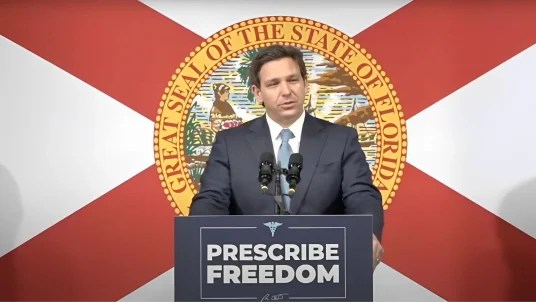
Florida Governor Ron DeSantis’ “Prescribe Freedom” plan bans vaccine passports, supports doctors’ free speech
By Cindy Harper | Reclaim The Net | January 19, 2023
Florida’s Republican Gov. Ron DeSantis plans to introduce legislation that will, among other things, stop Florida from being a “biomedical security state.” The legislation will ban all vaccine passport mandates.
DeSantis said the purpose of the legislation is to “prescribe freedom.”
“When the world lost its mind, Florida was a refuge of sanity, serving strongly as freedom’s linchpin,” the Republican governor said on Tuesday. “These measures will ensure Florida remains this way and will provide landmark protections for free speech for medical practitioners.”
“It required us over the past few years to stand against major institutions in our society: The bureaucracy, the medical establishment, legacy media, and even the President of the United States who, together, were working to impose a biomedical security state on society,” he added.
DeSantis’ surgeon general Dr. Joseph Ladapo said he supports the bill because it would protect the free exchange of ideas between medical professionals.
“As a health sciences researcher and physician, I have personally witnessed accomplished scientists receive threats due to their unorthodox positions,” Ladapo said. “However, many of these positions have proven to be correct, as we’ve all seen over the past few years. All medical professionals should be encouraged to engage in scientific discourse without fearing for their livelihoods or their careers.”
The legislation would protect medical professionals’ freedom of speech by protecting their religious views and their right to disagree with the preferred narrative. The bill would also protect medical freedom of choice by banning discrimination based on vaccination status, testing, and mask-wearing.

Related:
California’s chilling medical misinformation law is an affront to the US constitution
Orthodox bishop denounces Ukrainian crimes at UNSC
By Lucas Leiroz | January 20, 2023
The Russian Orthodox Church went to the UN to denounce Ukrainian crimes. At a meeting of the Security Council on January 17, invited by the Russian diplomatic representation at the UN, an Orthodox bishop linked to the Moscow Patriarchate commented on the situation of the Orthodox Church in Ukraine in the face of the persecutions imposed by Kiev’s neo-Nazi regime. This was the first time that a representative of the Orthodox clergy has addressed the UNSC.
The bishop chosen for the interaction was Chairman of the Department of External Relations of the Church of the Patriarchate of Moscow, Metropolitan of Volokolamsk, Anthony. He made it clear to all diplomats of the UNSC that the Orthodox Church is currently experiencing serious political and religious oppression under the Ukrainian government. Metropolitan Anthony said that the Russians are “extremely concerned about the blatant violations of the universal and constitutional rights of Orthodox believers in Ukraine”.
The bishop exposed some shocking data about the Ukrainian reality. Due to the ban on Orthodoxy recently imposed by the Zelensky regime, thirteen Ukrainian bishops were actually deprived of their own Ukrainian citizenship. With this measure, the neo-Nazis intend to coerce the clergy to stop disobeying the dictatorial norms aimed at banning the Church. Currently, Ukrainian clerics are trying to resist the regime’s impositions, continuing to offer liturgical services and protecting local traditions.
However, if bishops continue to lose their nationality, they will certainly be forced into exile, which will further complicate the situation for Orthodox believers in Ukraine. The bishop also highlighted that these revocations of citizenship are decreed irregularly, without any legal procedure that legitimizes them, thus violating the country’s constitution.
Another data informed by him concerns the process of expropriation of the Russian Church. Metropolitan Anthony reported in his speech that last year alone 129 churches belonging to the Patriarchate of Moscow were captured by the Ukrainian regime’s agents. Part of these expropriated churches are then used for non-religious purposes, while others are given to the ultranationalist and non-canonical sect called “Patriarchate of Kiev”, which is widely supported by the Maidan Junta, as it adopts the anti-Russian neo-Nazi ideology of the Ukrainian state. It is important to remember that the Ukrainian Orthodox believers are canonically linked to the Patriarchate of Moscow, therefore these acts of the Kiev regime are an attack against the religion of the Ukrainian people itself.
The head of foreign affairs of the Russian Church also emphasized the importance of understanding the current situation of the Church as a kind of mass political repression. He told the UNSC delegates that since last year the SBU (Ukrainian intelligence agency) agents constantly carry out violent operations in Orthodox churches, during which the clergy are publicly humiliated, and the temples desecrated. He compared the oppression suffered today with that of the early years of the Soviet Union.
These recent attacks have taken place officially, as the Ukrainian state has started a banning campaign against all institutions linked to Russia. However, illegally, since 2014 there has been strong persecution against the Orthodox Church in regions with an ethnic Russian majority. Neo-Nazi militias destroyed temples and killed clergy and believers in Donbass during hostilities against resistance forces. There are several photos and videos circulating on the internet showing the oppression to which the Orthodox Church has been subjected in Ukraine.
According to Metropolitan Anthony, since the Orthodox Church is the majority faith of both Russians and Ukrainians, it can serve as a basis for peaceful dialogue towards the end of hostilities. The recent Russian initiative, rejected by Kiev, to establish a temporary ceasefire during the Orthodox Christmas is an example of this. However, from the moment that one of the sides begins to deliberately oppress the Church, the possibility of dialogue ceases. Therefore, the international society must pay attention to the situation of the Church in Ukraine and demand changes in Kiev’s position.
Furthermore, the reports made by the bishop should also generate discussions in the western world, since it is unacceptable that the regime which promotes ethnic and religious persecution continues to receive money and weapons from the West. Although NATO has already made it clear several times that it has no humanitarian concern and that it is willing to do anything to “defeat” Russia, it is important that the costs of this war are known by Western public opinion.
Lucas Leiroz is a researcher in Social Sciences at the Rural Federal University of Rio de Janeiro; geopolitical consultant.
RT Bank Accounts Frozen in France at Paris’ Behest
Samizdat – 20.01.2023
MOSCOW – Bank accounts of the RT France broadcaster’s desk have been frozen in France, Ksenia Fedorova, the broadcaster’s editor-in-chief, said on Friday, adding that the bank refers to the authorities’ order.
“We have received a letter from our bank regarding the freezing of RT France accounts by order of the French authorities in connection with the ninth round of sanctions adopted in December. Despite the fact that RT France is not on the list and has the right to operate in France, such a decision effectively paralyzes our activities,” Fedorova said in a statement.
Earlier, the head of the European Federation of Journalists, Ricardo Gutierrez, said that banning Russian media in the EU, including RT and Sputnik, “created a dangerous precedent that threatens press freedom”.
In early December, the French Council of State ordered the media regulator Arcom to reconsider its decision to continue broadcasting Russian TV channels Rossiya 1, NTV, and Channel One in Russia and Ukraine by the French satellite operator Eutelsat at the request of Reporters Without Borders (RSF).
Relations between Russian media and the West have become increasingly difficult in recent years. In November 2016, the European Parliament adopted a resolution stating the need to counter Russian media, with Sputnik and RT cited as the main threats in the document.
A number of western politicians, including US senators and congressmen, as well as the French president, accused Sputnik and RT of interfering in the US and French elections, but did not provide any evidence. Russian officials said such allegations were unsubstantiated.
The WHO wants to control everyone and everything, everywhere, in the name of health, equity and global solidarity
By Libby Klein | Reclaim Ethical Medicine | January 18, 2023
I’ve gone through the “Conceptual Zero Draft” of the proposed pandemic treaty, line by line, trying to figure out what it means. It wasn’t that much fun. But it sure had my eyes out on stalks more than once. Like the bit where WHO can decide what is a fact. And what is a “falsified” treatment. And appropriate money from member States and use it to foist vaccines on people in developing countries. And set aside protections in other treaties if they are inconvenient. And dictate what “social measures” are required in addition to “public health measures”.
My summary of the proposed pandemic treaty is set out below. Notice how broad the scope is. How comprehensively the WHO will be in control of everyone, everything, everywhere, all in the name of health, equity and global “solidarity”.
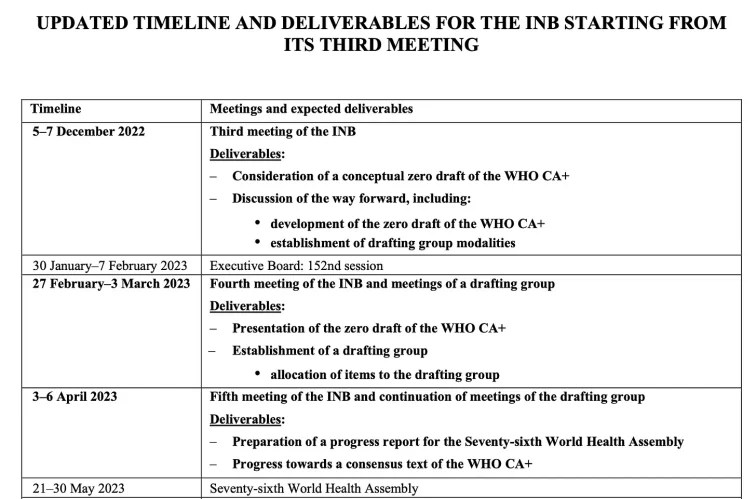
It’s urgent to oppose this before it rolls over us like a steamroller. The World Health Organisation is working hard on the next draft, for consideration by the “Intergovernmental Negotiating Body” in February, and the World Health Assembly in May 2023 (see timeline below)
(Is the treaty a furphy? A decoy to take our eye off the proposed amendments to the International Health Regulations, which are being negotiated in parallel with the treaty? Maybe, but there’s no way I want to take that risk and assume we can ignore it…)
MUST DO BEFORE FEBRUARY:
- Have a read of this amazing summary of everything the WHO is up to. There is also my summary of the treaty below. If you’re keen also read this plain English translation of the treaty.
- Pick out your 3 favourite horror-story highlights. Which 3 things are the most egregious, in your view?
- Tell your friends and your politicians we need to pull out of the WHO, before it’s too late.
Summary of the proposed pandemic treaty
The WHO is to control everyone and everything, everywhere, in the name of health, equity and global solidarity
Because of climate change and the likely increase in diseases crossing over from animals to humans, and increasing resistance to antibiotics, we are likely to have more pandemics in the future.
If we centralise decision-making about pandemics right across the globe, and if everyone falls into line, everyone can be healthier. Vaccines and other new medical products are the solution to pandemics and the proposed treaty.
The proposed treaty will make sure everyone can access vaccines and other new pandemic products. The WHO is the right body to control everything centrally, because it is the directing and coordinating authority for:
- international health work;
- convening and generating scientific evidence; and
- fostering international cooperation in global health governance.
Everything can impact health, so WHO has to be in charge of everything.
The world needs WHO to control and oversee:
- a global system for production and distribution of medical products
- stockpiling of medical products
- fast-tracking of research and development, and licensing of new products
- sharing of pathogen samples, genetic sequences, and benefits arising from those things being shared
- increased surveillance of diseases
- implementation of digital health
- a system of peer reviews and table-top exercises
- public health and social measures necessary for dealing with pandemics and situations that might give rise to pandemics
- censorship
- All must cooperate with the WHO in relation to all of the above measures.
- Wealthy nations must provide funding for the WHO and for developing countries
- Nations maintain their sovereignty – except where that means other nations are at risk
- Communities must be primed to accept public health measures and social measures
Tho WHO reckons this treaty is urgent and important, so:
- Start date is fast-tracked
- Once in, you can’t get out for 3 years
- The treaty can be amended by majority vote and amendments will apply to everyone.
- No adjudication by a court of law if parties are in dispute.
A “Consensus draft” draft will be considered at the May 2023 World Health Assembly. In other words: by May 2023, the content of the treaty already have been agreed in the backrooms.
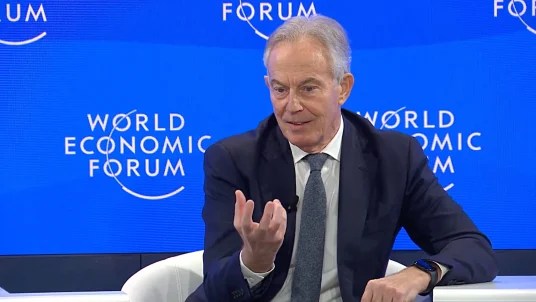
Tony Blair calls for WEF and WTO to introduce “digital infrastructure” that monitors vaccination status
By Tom Parker | Reclaim The Net | January 19, 2023
Former United Kingdom (UK) Prime Minister Tony Blair has called for global organizations such as the World Trade Organization (WTO) and World Economic Forum (WEF) to push national governments to introduce “digital infrastructure” that monitors who has been vaccinated and who hasn’t.
Blair pushed for this government-controlled digital vaccine database during an appearance at the World Economic Forum’s 2023 annual meeting — a yearly event where powerful business leaders, politicians, and other influential figures meet in Davos, Switzerland to discuss the agendas they want to advance.
The former Prime Minister emphasized the importance of “technology and digital infrastructure” and data collection for surveilling the status of the vaccinated and unvaccinated.
“You need the data,” Blair said. “You need to know who’s been vaccinated and who hasn’t been. Some of the vaccines that will come on down the line will be multiple, there’ll be multiple shots. So you’ve got to have, the reasons to do with the healthcare more generally, but certainly, for a pandemic or for…vaccines, you’ve got to have a proper digital infrastructure, and many countries don’t have that. In fact, most countries don’t have that.”
Blair continued by suggesting that his digital vaccination status surveillance dragnet should be pushed through by the WTO (an intergovernmental organization that regulates international trade), the WEF (an unelected global organization that seeks to “shape global, regional and industry agendas”), and intergovernmental forums such as the Group of Twenty (G20) and the Group of Seven (G7).
“Who are the people that can make this happen?” Blair said. “How do you get the right partnerships in place?…That should happen in the G20 particularly, I think, which is… G7 is an important forum, but the G20 is the broader forum… You’ve got to work out what is it that you want to achieve in order to make sure that any future pandemic is properly handled and what are the partnerships that you’re going to create in order to ensure that the answers you get are the right answers. And then you’re going to have the mechanisms of implementation. And those mechanisms will be partly through the formal institutions that you have, like the WTO, and they’ll also be through organizations like yours [the WEF] which… I think… have many advantages because they don’t get landed with the same bureaucracy and frankly small pea politics around them.”
Blair’s call is the latest of several that he and his nonprofit, The Tony Blair Institute for Global Change, have made for an expansion of mandatory digital surveillance infrastructure.
His institute has called for digital IDs and said increased surveillance is a “price worth paying.” Blair himself has also called for mandatory vaccine passports.
And two of the global groups that Blair wants to help push through this digital surveillance system, the WTO and the WEF, are also huge advocates of digital surveillance systems.
The WEF and the WTO have previously pushed “global digital identity of persons and objects.” And the WEF regularly advocates for digital ID programs around the world. This year’s WEF 2023 annual meeting subjected journalists to some of the surveillance technologies it advocates for including digital IDs and biometric scanning.
Not only do these surveillance systems reduce individual privacy but vaccine passports discriminate against citizens and restrict their access to businesses and services.
And the WEF wants to expand this surveillance and discrimination via digital ID. It has proposed a system that monitors online behavior, biometrics, purchases, and more to determine access to a wide range of services.
Related:
How Big Government and Big Tech used COVID to accelerate the adoption of digital ID
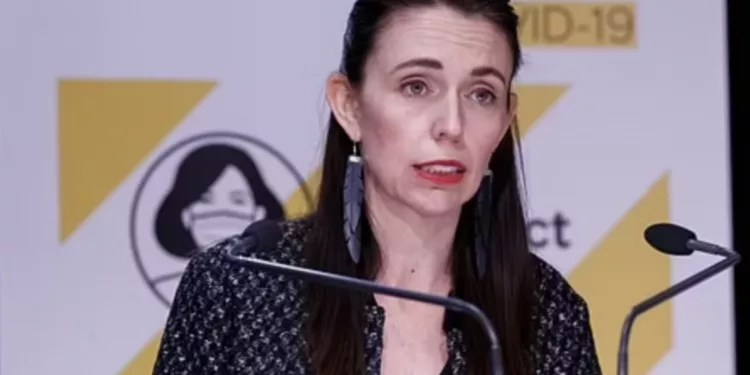
What’s behind Jacinda Ardern’s resignation?
By Guy Hatchard | TCW Defending Freedom | January 19, 2023
New Zealand’s Prime Minister Jacinda Ardern resigned last night after months of rumours. Ardern, whose popularity has plummeted during the last six months, told us she ‘had nothing left in the tank’.
The backstory to this resignation is a tale of woe. Ardern said she wants to be remembered as someone who tried to be kind. The subtext is: the country is in an unprecedented mess but don’t blame me. School attendance is running at just 67 per cent on any given day. Machete-wielding teenagers are ram-raiding liquor, tobacco and luxury stores daily in an unprecedented crime wave. The health system is overwhelmed. Ardern’s government promised to build 100,000 new homes over three years. It has delivered 1,500.
Our tourist, farming and hospitality industries have never recovered from lockdowns and border closures. It takes months to get a visa to visit NZ and the government says it only wants rich people to come. Ardern insisted on universal Covid vaccination mandates. There is a suspicion that our 90 per cent vaccination rate has left most people in a lethargic fog. Excess all-cause deaths are still running 15 per cent above the long-term trends, and it is not Covid.
History will judge Ardern harshly, but don’t blame her alone. This was a Parliament who woke up on all sides of the house to the weakness of our constitutional arrangements (there are none). The Bill of Rights was tossed aside and no one in Parliament cared.
The leader of the National opposition Chris Luxon said if he was in power, he would withdraw benefits from unvaccinated single mothers. David Seymour, leader of the ACT party, said those losing their jobs through vaccine mandates only had themselves to blame. Labour’s coalition partner, the Greens, led by example. They encouraged mothers in labour to ride to hospital on a bicycle.
Revelations this week (here and here) that Ardern personally overruled her scientific advisers who were expressing doubts about the safety of Covid vaccines for young people and the wisdom of mandates have circulated very widely and no doubt this further undermined confidence in the government.
Political insider and right-wing commentator Cameron Slater published an article ten days ago saying that out of all the politicians he has known (and he has known most since Muldoon in the 70s) Ardern is the only one he rates as truly evil.
Ardern introduced ‘rule by regulation’. Adopting the enabling model favoured by fascists in the 1930s, her government has empowered authorities to tell us all what to do, when to stay at home, and where not to go. The courts, the Human Rights Commission and the broadcast regulators have all followed the government line meticulously which has had a devastating effect on business, families, communities and professions. To cement her policies, Ardern introduced massive government funding of our media and broadcasters.
Ardern’s government, in an absurd overreach, funded a nationwide effort to discredit critics of policy, labelling them terrorists. This has divided a formerly egalitarian society, instituting a Stasi-like snitch culture that encourages us to report a neighbour. Government Disinformation Project employees appeared on funded films aired on television labelling knitting, blond hair, braids, vaccine hesitancy, love of natural foods, yoga and motherhood as signs of terrorism that should be reported to the intelligence services (view it here if you can stand watching this nasty piece of propaganda and hate).
Why did Ardern suddenly change overnight in August 2021 from being a kindly figure saying she would never mandate vaccines, to being one of the world’s most draconian proponents? We can only speculate. NZ is a member of the Five Eyes intelligence network. Given the Pentagon’s recently revealed massive involvement in US Covid policy and gain of function research funding, was she fed information that a bioweapon was in play?
For a couple of weeks now government announcements and advertisements encouraging vaccination and boosters have been conspicuously absent. Has the penny finally dropped? We doubt it. It will take an honest, intelligent politician (are there any?) to roll back Ardern’s dictatorial powers and kickstart New Zealand. Why would any aspiring newby give up that much power? The prospect will be too intoxicating.
Ardern was a protege of Tony Blair and Klaus Schwab of WEF. They must bear some blame too. What fantasies of global power did they offer to a young person who was given to idealistic dreaming that segued into fanaticism?
Our final verdict: It is not Ardern but the whole NZ Parliament elected in 2020 that will be judged as the worst in our short history as an independent island nation, formerly famous for championing the underdog and offering opportunity to all. Ardern’s resignation has lit the bonfire of modern democracy.
Davos Leaders Collude to Force Permanent Global Vaccine Infrastructure
By Jefferey Jaxen | January 19, 2023
What is Davos? The World Economic Forum’s (WEF) annual meeting happens each year in the alpine Swiss ski resort town. Each year global leaders, elected and unelected, gather to collude on policy initiatives and hot button topics concerning humanity overwhelmingly without the consent of the people.
Intel coming out of this year’s meeting has had a more pressing, alarmist nature from the self-proclaimed global elite minders. Don’t worry, the meeting was still filled with the annual hypocrisy we are used to. Squadrons of ‘unsustainable,’ carbon-emitting private jets still flew in at will. Fleets of non-electric cars openly chauffeured the climate alarmist around while they preached about the end of gas vehicles and individual car ownership… for the planet of course. But lets turn to moves by the medical–industrial complex.
Coming off the back of a rushed Covid shot that failed to stop transmission and whose harms and shortcomings are still unraveling in the public conversation, the ‘global leaders’ of Davos used the forum to do what they always do in the uncomfortable spotlight – double down on agendas.
After some of the biggest, concerted global protests in a century against lockdowns and the digital Covid vaccine passports used by governments to enforce them, a call was made to expand such tools of restriction.
Former UK PM Tony Blair of Iraq war criminal fame apparently received his new marching orders speaking passionately at Davos for the implementation of a ‘national digital infrastructure.’
For ‘the vaccines coming down the line [that] will be multiple shots,’ for ‘vaccines [in general]’ and for ‘a pandemic’ Blair stated you need a proper digital infrastructure to know ‘who’s been vaccinated and who hasn’t.’
Founded in Davos by the Gates Foundation, the UK-based Wellcome Trust, the WEF and other governments, the Coalition for Epidemic Preparedness Innovations or CEPI was a central player in global Covid vaccine development efforts.
They now have a new ‘100 day goal’ which has been embraced by the G7 and G20 nations according to a Davos speech attended by Pfizer’s CEO Bourla, Blair and others.
To ‘accelerate vaccine development over and above what was achieved in 2020’ and to be able to deliver vaccines for new threats within 100 days.
So the idea again would be to sidestep proper safety testing to put massive mutation pressure on a new circulating virus or pathogen by vaccinating in a middle of an ongoing pandemic – something Dr. Geert Vanden Bossche has continually warned against.
CEPI’s goal to take Covid’s fast tracking vaccine development precedent and fast track it further has been aided, intentionally or unintentionally, by the newly enacted FDA Modernization Act 2.0 which allows drug and vaccine developers to rely upon computer modeling and testing with virtual patients in their safety assessments of new products to convince regulators they’ve been ‘de-risked.’
While the Davos crowd, along with many others in the public, like Neil DeGrasse Tyson, still believe the official narrative that the rushed Covid shot was a wild, safe and effective success, a growing critical mass continues to expose the truth.
Meanwhile, the FDA still doesn’t have ‘robust’ data from Pfizer or Moderna on their mRNA Covid shot product’s ability to cause potentially deadly heart inflammation.
A 2021 letter by the FDA to Pfizer gave the company until October 2025 to turn in their study looking at that piece which public health leaders and agencies will take, at face value, as the final word on the subject. Despite the foot-dragging by regulators, members of the public and medical community have filled the vacuum with actual data and warnings.
Top UK cardiologist Dr. Aseem Malhotra made history becoming one of the BBC’s most watched segments of the last two years [27.1M view on Twitter] warning about the myocarditis risk live on-air along with its role in the soaring number of excess deaths – the highest in 50 years according to the BBC.
Will the public accept digital restrictions on their life again in the form of vaccine passports?
Will the public accept new, multi-dose vaccines unpinned by even less safety testing and transparency than the mRNA Covid shots?
Bill introduced to criminalize vilification of ‘non-White’ people
RT | January 16, 2023
A bill introduced in Congress earlier this month would expand the definition of “hate crime” so wide it could potentially include content that is found to have “inspired” a racially-motivated crime.
Critics of the legislation sponsored by Rep. Sheila Jackson Lee (D-Texas) have argued that it imperils Americans’ freedom of expression by holding the threat of criminal charges based on others’ behavior over their heads.
The “Leading Against White Supremacy Act of 2023” sets out two new offenses, the first being “white supremacy inspired hate crime” and the second being a related conspiracy charge.
To be guilty of the latter, one need only “publish material advancing white supremacy, white supremacist ideology, antagonism based on ‘replacement theory,’ or hate speech that vilifies or is otherwise directed against any non-white person or group” to social media. What happens after that determines whether a crime is committed.
If the offending content is “read, heard, or viewed by a person who engaged in the planning, development, preparation or perpetration of a white supremacy inspired hate crime” — apparently even if that person was a complete stranger who misinterpreted the message — the creator is guilty of conspiracy.
Alternately, as long as the content was posted where people “predisposed to engaging in any action in furtherance of a white supremacy inspired hate crime” might stumble upon it — or even people who might be “susceptible to being encouraged to engage in” such actions — the creator is guilty.
A contributor to the conservative RedState blog observed that the bill failed to define critical terms, including “replacement theory” and “hate speech” while apparently widening the definition of “conspiracy.”
“Replacement theory” takes its name from “The Great Replacement,” a far-right theory alleging white people are being deliberately supplanted in their societies by other races. The theory was referenced in the manifesto of Brenton Tarrant, who killed 51 people at two mosques in New Zealand in 2019.
Arguing that Jackson Lee’s bill would “be used to quash valid political criticism against any non-white person or group,” the RedState writer pointed out that “vilifying” a person does not even require making racist or even false statements about them — just unpleasant ones.
Several commenters on Twitter added that because the bill only protected nonwhite people from “hate speech,” it was technically racist itself and thus unconstitutional.
Jackson Lee’s bill is unlikely to pass in the GOP-controlled House, leading others to suggest it was simply a PR stunt. The bill currently has no co-sponsors.
$1,000,000 to forecast Vaccine Misinformation narratives
The Naked Emperor’s Newsletter | January 16, 2023
On 20 October 2022, the CDC published a grant opportunity to develop a public health tool to predict the virality of vaccine misinformation narratives. The application closed a few days ago.
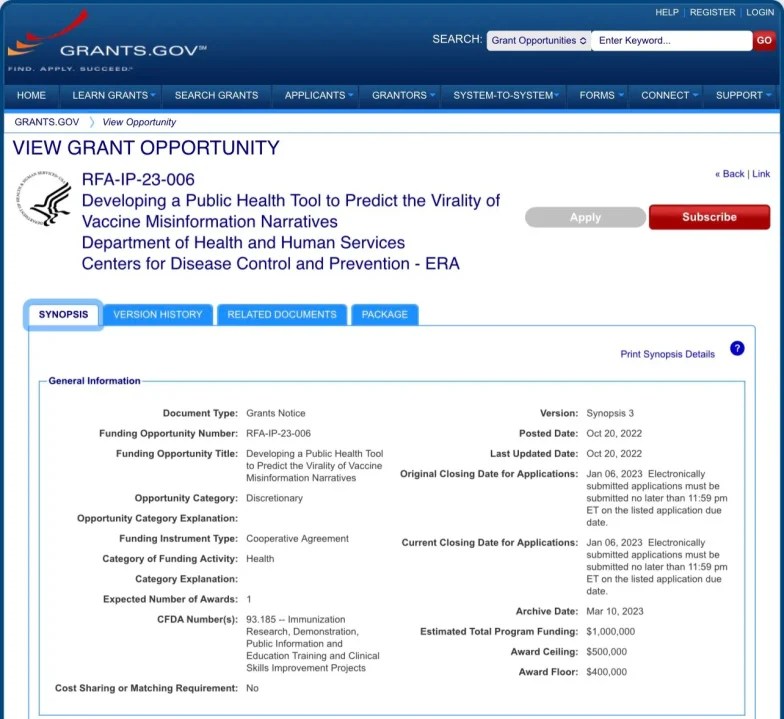
The purpose of the $1,000,000 grant is “to conduct research to develop and pilot a predictive model and tool to aid…in identifying emerging vaccine misinformation about recommended vaccines, including COVID-19 vaccines, that is likely to spread and have a high potential for impacting vaccine confidence”. It will enable public health agencies to identify misinformation before it spreads or impacts people’s health decisions.
According to the proposal, evidence for the negative impact of misinformation continues to grow. Therefore, this proposal has the potential to impact the Healthy People 2030 scheme by ensuring people get vaccinated. Healthy People 2030 sounds and looks suspiciously like something from Agenda 2030 but equally this might just be someone jumping on the bandwagon. However, one of the developmental objectives is to “increase the proportion of immunization information systems that track adult immunizations across their lifespan” which sounds a lot like vaccine passports. Maybe not but unfortunately these things need keeping an eye on these days.
The CDC estimates that “COVID-19 misinformation and disinformation caused $50-$300 million per day in additional medical costs, monetized lives lost and morbidity, and economic costs”. Therefore, they want this new tool to increase vaccination rates and disseminate accurate scientific messages.
There are 3 phases to successfully complete the proposal:
- Phase 1 – Develop a predictive model that identifies misinformation. To do this they will look at old data to find topics (such as vaccine safety and fertility), the types of people sharing this information and the relationship to societal concerns (e.g. personal liberty);
- Phase 2 – Develop a tool that can be used to prioritise the response to misinformation.
- Phase 3 – Pilot and evaluate the tool (that can be used at federal, state, local, tribal and territorial public health agency levels)
Now, I’m all for getting rid of misinformation. In an ideal world I just want to be reading facts, more facts with a few more facts sprinkled on top. However, this isn’t an ideal world and unfortunately, over the last few years, much of the misinformation has come from the CDC itself.
So a ‘Minority Report’ style system that will identify vaccine misinformation pre-crime and eliminate it before it can get out will only add to public distrust.
A Soviet-style public health propaganda set-up is not going to increase vaccine take-up. The only way to do that is to provide transparent data and allow hypotheses to formulate. These can quite easily be shut-down with accurate and open data.
What does increase vaccine hesitancy, is not having a truly independent body to analyse pharmaceutical data and then trying to bury that data for 75 years. Misinforming the public that they are going to die without a vaccine was the most harmful thing they could have done to trust in public health. Along with the suppression of adverse event signals, harms and deaths. However rare they may or may not be, by hiding just one of these causes the public to question what else is being hidden.
So I would like to claim the $1,000,000 to reduce vaccine misinformation with the following steps:
- Firstly produce a product that actually does what it is supposed to do;
- Conduct proper trials that look at short, medium and long term risks;
- Create a truly independent body that not only analyses the data it’s provided with but tests the products themselves;
- Remove propaganda such as ‘95% effective’ or ‘safe and effective’;
- Don’t conduct studies on how to manipulate the population into taking vaccines;
- Don’t force anybody to take a vaccine (by use of the psychological techniques above or through vaccine passports);
- Don’t use fear to convince people they are going to die without being vaccinated;
- Don’t supress safety-signals;
- Don’t gaslight the vaccine injured or families with members killed by vaccines;
- Remove the product from the market as soon as any safety signals, injuries or deaths occur. Explain clearly and openly what has been found and why the product has been removed;
- Don’t label anybody concerned about big pharma corruption or vaccine safety a conspiracy theorist or worse.
There you go. You don’t need any fancy and expensive systems to get people vaccinated. Just follow the steps above. But unfortunately, if your product isn’t up to scratch, you won’t make any money. You can send my $1,000,000 cheque in the post. Thanks.
Did I miss any points? And is it too late anyway? Has the amount of public health misinformation eroded away all trust, never to be regained again?
Featured Video

Trita Parsi: Middle East Unraveling — Are We on the Path to World War?
or go to
Aletho News Archives – Video-Images
New Book
Trans agenda is ‘normalization of sadism’ – US author

RT | September 23, 2026
The US Democratic Party has embraced a transgender agenda that amounts to “the normalization of sadism,” author A.J. Rice has said, warning that radical trans policies would return if the party is allowed to regain power.
Speaking to RT’s America First host Scotty Nell Hughes about his new book, ‘The Curse of the Bearded Lady: How the Trans Mafia Whacked American Sanity’, Rice argued that activists have gained significant influence in schools, medicine, and corporate America while people who questioned the agenda have faced pressure to stay silent.
The author described the “trans mafia” as the sprawling network of people and institutions that have helped the movement gain influence. He singled out parts of academia, wealthy backers, and corporations, and stated that providers of transition-related treatment also have a financial incentive to keep young people in their care indefinitely.
Rice argued that the consequences of these policies ultimately fall on children who are being drawn toward gender-affirming medical treatments and on girls who are expected to share locker rooms or compete in sports with biological males.
He noted that while voters rejected the Democrats’ approach to gender in 2024, the party, which has been “captured by madness,” has since only doubled down and is seeking what is effectively “the normalization of sadism.” … Full report
Blog Roll
 Aletho News
- German chemicals giant reveals details of downsizing
- Refaat Al-Areer Was The Canary In The Coal Mine In Israel’s War On The Truth
- Israeli election committee bars candidate from Knesset race over Gaza war opposition
- French-Lebanese man files war crimes complaint over Israeli attacks
- Mahan Air Flight Lands in China Despite US Threat against Iranian Airlines
- US eyes $10bn fund to rebuild war-battered Gulf infrastructure
- Trump meets Rodríguez near Maduro’s prison as Venezuela’s oil flows to US
- Trita Parsi: Middle East Unraveling — Are We on the Path to World War?
- Iran FM meets with US envoy on UN meeting’s sidelines at American side’s insistence: Report
- Qatar PM calls for Gulf security framework with Iran, says war must be ‘wake-up call’
- If Americans Knew
- Caught on Tape: AIPAC CEO Boasted of Controlling Trump’s National Security Officials
- Why Hamas Attacked Israel in October 2023 – Israeli professor Ilan Papé
- They see them, then kill them: Israeli quadcopters track, deliberately target civilians in Gaza
- Winter could turn Gaza’s treacherous, war-damaged buildings into deathtraps
- Majority of Democratic Voters Want to Prosecute Both Biden and Trump Administration Officials Over Gaza
- As Gaza languishes, world leaders gather at the UN – Daily Update
- Sanctions are collective punishment: immoral and self-defeating
- Phosphorus Munitions Fired by Israel Burn Groves, Orchards in Southern Lebanon
- Israel Carries Out New Ceasefire Violations Across Gaza
- AI – Emphasis on the ‘I’: Israel Is Funding AI Chatbot Propaganda
- No Tricks Zone
- New Study: Earth And Venus Surface Warmth Largely Explained By Convection And Lapse Rate, Not CO2 Or Radiation
- 2025 Nature Paper Claiming Worsening Global Drought Gets RETRACTED …Heavily Flawed
- New Study: ‘Global Drought Shows No Detectable Recent Acceleration Under Climate Warming’
- Economic Masterminds: German Socialists Suggest Taxing Productivity Gains Stemming From Using AI
- The South China Sea Has Not Been Cooperating With The Climate Change Narrative
- Energy Crisis: Germany Enters Heating Season With Historically Low Gas Reserve Fill Levels
- New Study: The Antarctic Ice Sheet Gained Mass From 2020-2024 Due To Staggering Snow And Ice Accumulation
- Study: Ocean Heating Rates From Thousands Of Years Ago ‘Dwarf’ Modern Ocean Heating Rates
- Climate Extremists Target, Attack Large-Scale Power Grid Infrastructure In Germany!
- New Study: Antarctic Ice Melt Has Contributed Less Than 1 Centimeter To Sea Level Rise In The Last 30 Years

