Message to Sky News: London Is No Freer Than Moscow
By Dr Vernon Coleman | 21st Century Wire | March 22, 2022
Sky News has just run a story which includes this paragraph about people living in Moscow:
‘Now it is the police who people are scared of, and the pervasive Orwellian fear of speaking out against the official line.’
I didn’t know whether to laugh or cry.
If a reporter or an editor at Sky News would pop their heads out into the real world they would know that Moscow is no more oppressive, repressive and suppressive than London, Paris, New York and every other city in the West. They’d also know that fear of the police is now common in the UK and elsewhere.
Doesn’t anyone at Sky News actually look at the news?
I’m sure there are restrictions in Moscow.
But there is NO freedom of speech in the UK.
Hundreds of doctors and other truth-tellers have been banned, ostracised and demonised by the mainstream media.
Many have, like me, been demonised on Wikipedia, suppressed and de-ranked by search engines like Google, or outright banned by YouTube – simply for telling the truth and sharing facts.
In the last two years I have been attacked and/or lied about by: Sky News, BBC, Daily Mail, Mail on Sunday and most other parts of the mainstream media.
My crime?
Telling the truth about the Covid fraud – and spreading solid facts in a world dominated by the deliberate dissemination of misinformation.
I’ve spent my life working for the media, but I am now banned from all mainstream media.
I have had four books banned in the last two years.
I have been banned from YouTube, Facebook, Twitter, LinkedIn and all other social media platforms. I am even banned from accessing YouTube. YouTube removed my channel, with over 100 videos. It had acquired well over 200,000 subscribers in just a couple of months in 2020.
I was expelled from the Royal Society of Arts for the crime of telling the truth.
And so on, and so on.
I became a ‘conspiracy theorist’ overnight – for daring to share the truth.
I have repeatedly challenged Whitty and Vallance to a live TV debate. But they have ignored the challenge.
If any producer at Sky TV had the guts to give me five minutes of live airtime, I could broadcast the evidence which would destroy the whole Covid fraud. The proof that Covid was the rebranded flu. The proof that government scientists admitted that Covid was no more deadly than the flu. The proof that mortality rates in 2020 and 2021 were much the same as previous years. And so on and so on.
But they won’t dare let me anywhere near a studio.
I believe that is because the mainstream media in the UK does what it’s told to do.
So, report what is happening in Moscow. That’s important.
But Sky, and others, need also to report how the truth is being suppressed in Western cities.
Because the suppression of the truth is dangerous wherever it is happening.
***
Vernon Coleman’s book Endgame explains what has happened, what is happening and what will happen next. Endgame is available as a hardback, paperback and eBook.
Important Message for Journalists Covering the Ukraine Conflict

By Dr Vernon Coleman | 21st Century Wire | March 21, 2022
Town Halls all over the UK are flying the Ukraine flag, as mainstream journalists encourage everyone to think about the war in Ukraine.
Looking at the news you’d think that Ukraine was the only trouble spot in the world.
But you’d be wrong.
Here are some facts that no other journalist in the UK appears to know.
Fact 1
According to the United Nations, the number of civilian deaths in Ukraine is 760. According to the Ukraine President, the number of soldiers who have died in Ukraine is 1,300.
Fact 2
According to the United Nations, the seven-year-old war in Yemen had killed an estimated 377,000 people by the end of 2021 – and is now killing more people than the fighting in Ukraine. The Yemen war has been described as the largest humanitarian crisis in the world. The Saudis have interfered in what was basically a civil war.
Fact 3
The war in Syria has now been going on for ten years and the number of people killed is believed to be 610,000
Why isn’t your town hall flying flags in support of the people of Yemen and Syria?
The answer, of course, is that the invasion of Ukraine was organised and manipulated by the conspirators in the West to help push the energy and food shortages required for the Great Reset and the New World Order that they have planned for us.
I am banned from Twitter, Facebook and so on, and so I am not allowed to share this information on social media.
So, I’d be grateful if readers would share this information on their social media channels.
Maybe a mainstream journalist will read it.
And wonder what the hell is going on.
***
Vernon Coleman’s book Endgame explains our past, our present and our future in 281 pages. Endgame is available as a paperback, a hardback and an eBook.
Read more of Vernon Coleman’s writings at www.vernoncoleman.org
Twitter blocks account of Russia’s UN diplomat over Mariupol post
TASS | March 18, 2022
The administration of Twitter has blocked the account of Russian First Deputy Permanent Representative to the UN Dmitry Polyansky over the post in which he denied allegations about Russia’s role in a strike on a maternity clinic in Mariupol.
“This morning, Twitter blocked my account, demanding to delete the tweet of March 9, in which I informed that two days before that, we warned at a Security Council meeting that the maternity home that Russia had allegedly made a strike at, causing casualties, had been long before turned into a firing position by Ukrainian nationalists,” the diplomat said. “We said on March 7 that all medics and patients had to leave the hospital. With a glance to this, allegations about casualties look like another fake news. This is what I wrote, expressing regrets that the UN was taking part in circulating it,” the diplomat said.
“I see this as an illustration of how much the West is really interested in freedom of speech and is ready to hear alternative points of view,” the diplomat wrote. “The number of users of my English-language Twitter reached 22,000 in recent days, it was often quoted by Western media, the published information was instantly spread among journalists accredited to the UN,” he wrote.
Polyansky stressed that he had always tried to respond to journalists and ordinary users who were interested in Russia’s position. The diplomat said that he would shortly open an English-language channel on Telegram and would use it regardless of whether Twitter would reopen access to his account or not.
Google complains about Brazil’s “fake news” bill, says it ignores “negative and unintended consequences”
By Cindy Harper | Reclaim The Net | March 17, 2022
Despite, in many cases, making itself the arbiter of what is and isn’t true, Big Tech giant Google is now concerned that Brazil’s proposed anti-fake news bill will do more harm than good.
The bill has previously been criticized by other online platforms, including Facebook and Twitter, as well as free speech groups.
In an open letter, Google Brazil’s president Fábio Coelho, criticized the proposed legislation, whose purpose is to handle “misinformation” and disinformation on platforms with more than 2 million users.
“We recognize the importance of debating solutions to this problem, but we are concerned that Congress is doing so without considering the negative and unintended consequences the bill could bring,” Coelho argued.
According to Coelho, the bill, which is yet to be voted by Congress, would make it easier to spread fake news.
The bill includes rules that would require platforms like Google to reveal how their algorithms work. These rules make Google’s services less secure, according to Coelho, and would have a negative impact on how small companies market their products.
He said that the rules Google would need to comply with could “significantly impair Google’s ability to combat abuse and spam and protect our users from scams.” He also argued that complying with the rules could “make search engines less secure for everyone and more susceptible to abuse and fraud.”
Coelho also warned that by exposing how its systems work, Google would provide malicious actors instructions on how to bypass its protections and harm the quality of search results.
He explained: “With this, they could manipulate this information to obtain a better position in our search ranking, harming in the process those who produce reliable and relevant content.”
In a joint letter published in February, Facebook, Twitter, and Mercado Libre, an online marketplace, also criticized the proposed legislation.
They said the bill had the potential to,”restrict people’s access to diverse and plural sources of information; discourage platforms from taking steps to maintain a healthy online environment; and negatively impact millions of small and medium businesses looking to connect with their consumers through advertising and digital services.”
Ofcom Revokes Licence Of News Channel RT
By Richie Allen | March 18, 2022
Ofcom has revoked the licence of Russian state News channel RT, saying that the channel was not “fit and proper to hold a UK broadcast licence.”
According to The BBC:
RT’s coverage of Russia’s invasion of Ukraine has been under investigation by Ofcom, and the channel had already disappeared from UK screens.
RT called Ofcom “a tool of the government”.
The channel became unavailable on all UK broadcast platforms earlier this month as a result of a ban imposed by the European Union.
Although the UK is no longer in the EU, the bloc applied sanctions to satellite companies in Luxembourg and France, which provided the RT feed to Sky, Freesat and Freeview in the UK.
UK Culture Secretary Nadine Dorries, who has described the channel as “Putin’s polluting propaganda machine”, said at the time she hoped it would not return to UK screens.
In recent weeks, Ofcom has launched 29 investigations into the “due impartiality of RT’s news and current affairs coverage” of the invasion of Ukraine.
RT deputy editor-in-chief Anna Belkina said Ofcom had “robbed the UK public of access to information”.
“What we have witnessed over the last few days, be it comments from the President of the EU Commission or from PM Boris Johnson, is that none of them had pointed to a single grain of evidence that what RT has reported over these days, and continues to report, is not true.
“Instead, what they have said is that what RT brings to its audience is not allowed in their supposedly free media environment. When it comes to the Russian voice, or just a different perspective from theirs, it is simply not allowed to exist.”
I’ve been watching RT closely since Russia invaded Ukraine. Over the course of the last few weeks, the TV channel and its website has published claims made against the Russian government by NATO countries, right alongside the Kremlin narrative.
In fact, I’ve been astonished at how balanced the content has been. The same cannot be said for the BBC or SKY News.
It’s a sickening blow for free speech, but it’s only the beginning.
UK Govt Publishes Online Safety Bill – Free Speech is Dead In The UK
By Richie Allen | March 17, 2022
This morning, the UK government will publish the revised Online Safety Bill. It’s a landmark piece of legislation that has been in the works for five years. The government claims that the bill will protect people from being exposed to harmful content on the internet.
Critics have called it the biggest threat to free speech in modern times. According to SKY News:
The Online Safety Bill has been in the works for about five years and will see communications regulator Ofcom get the power to issue fines or block sites that break the rules.
Additions to the bill include the power to hold executives criminally liable if they don’t comply with Ofcom information requests two months after the law begins, rather than the two years previously proposed.
Managers will also now be criminally liable for destroying evidence, failing to attend Ofcom interviews – or giving false information, or for obstructing the regulator if it enters their offices.
The biggest social media firms must also address “legal but harmful” content under the updated proposals.
They will have to do risk assessments on the type of harms that could appear and state in their terms of service how they plan to tackle them.
What constitutes “legal but harmful” material will be set out by the government in secondary legislation.
Have you ever read anything as chilling as “social media firms must address legal but harmful content?”
That’s what the Online Safety Bill is really all about. The government couldn’t give a damn about child safety. Just look at what they’ve done to children over the past two years.
No, they couldn’t care less if kids are targeted by paedophiles on the internet, or if they’re exposed to images of suicide and self-harming. I’m also pretty sure that the government doesn’t give a rats arse about racist abuse.
The Online Safety Bill is a censors charter, plain and simple.
Labour’s Lucy Powell compared alleged “disinformation” spread by the “Russian regime” to covid conspiracy theories. This is from the BBC news website this morning:
Labour’s shadow culture secretary Lucy Powell said the bill’s delays “allowed the Russian regime’s disinformation to spread like wildfire online”.
She added: “Other groups have watched and learned their tactics, with Covid conspiracy theories undermining public health and climate deniers putting our future at risk.”
Conspiracy theories undermining public health? Really? Is she referring to the thousands of doctors and scientists who warned us that lockdowns were far more devastating for public health than viruses?
Does she mean the legions of epidemiologists and virologists who say that the vaccines are unsafe, untested and are causing widespread harm? Given the chance, would she jail a GP for advising a patient to swerve the jabs?
My God, the bill actually proposes that “knowingly spreading medical misinformation” should carry a penalty of two years in prison. Does Powell think that scientists should be jailed for dissenting from the opinions of politicians?
“Climate deniers are putting our future at risk,” she said. What the hell? What a glorious example of Orwell’s newspeak. Climate denier. What is that? Who ever denied that there’s a climate? Powell is insane.
The Great Reset agenda is real. It will become more obvious to people in the coming months and years as they tighten the screws and interfere more and more in people’s lives.
The Online Safety Bill is a pre-emptive strike on the independent media. It really is as simple as that. They plan to make life unbearable for all of us. They want rid of the independent media in time for when the shit really hits the fan.
The bill will pass. The clock is now ticking on The Richie Allen Show and every other independent news outlet.
“Stealth Omicron” reminds us the pandemic narrative isn’t dead… it’s just sleeping
By Kit Knightly | OffGuardian | March 16, 2022
This week has seen several timely reminders that the Covid narrative is not done. It may have lost its number 1 spot at the top of the “news” charts, but it’s not dead. It’s just resting.
While the big red numbers at the top of every front page are now casualties instead of “cases”, the pandemic is simmering on the backburner and can be brought back to boil at a moment’s notice.
In China they are reporting huge spikes in “cases”, numbers not seen since the halcyon days of March 2020. Millions of Chinese citizens are already back on lockdowns, many now need police permission to travel from one province to another.
Giant multinationals are halting production for the near future at least, with the BBC warning that:
The lockdowns have raised concerns that crucial supply chains may be disrupted.
Yes, more supply chain disruption. Just like the war.
Funny how that works out.
It’s not just China either, according to Bloomberg Europe is seeing a “Covid Resurgence” after a “rushed exit” from restrictions, with Germany, Switzerland and the Netherlands all reporting spikes in cases.
Germany’s “Covid resurgence” comes just days before the government’s emergency powers are due to expire, and just as they are planning to ease all restrictions.
Funny how that works out.
The alleged “resurgence” is the work of a not one but two “new” variants.
Firstly, Deltacron is back. They’re calling it a “new variant”, but the truth is the recombinant virus was first “discovered” back in early January.
At the time, mainstream articles questioned whether it even existed or was just a lab error.
They’ve decided it definitely does exist now.
The Huffington Post covers this story with the headline:
Why Everyone’s Talking About The Deltacron Variant Again
Why indeed. It’s a real puzzler.
Perhaps aware that “Deltacron” sounds like a villain from Transformers, they’re also pushing another new variant: “Omicron BA.2”.
Now, while that name definitely isn’t silly, it also isn’t very catchy – so they’ve got a cool scary sounding name for it too: “Stealth Omicron”.
It’s called “stealth omicron”, because it’s lacks markers that can be picked up on by PCR tests, meaning testing positive for this strain of the virus will look just like testing positive for the other strains.
Oh, and this variant isn’t actually new either, it was first discovered back in December, to very little fanfare.
But that was then, and this is now, and now experts are “worried”, apparently.
The press are already reporting that it might be the “most infectious disease on Earth”
Meanwhile, Pfizer’s CEO has said that the new variants mean people will need a 4th shot of their vaccine.
Funny how that works out.
All this just serves as a reminder that the Covid story is still there, and they can (and probably will) bring it back whenever they want. Maybe the very moment Ukraine and Russia agree on a peace deal.
Game of Thrones famously used to alternate their season finales, in an odd-numbered season the show would end with a shocking plot twist, and in even numbered seasons it would be an epic battle.
Maybe this will be our new reality, lurching from pandemic to war to pandemic to war, and around and around.
A perpetual cycle of different grand narratives, linked only in their shared consequences: More power for them, less freedom for us.
Funny how that works out.
David V Goliath: Amazon Turns The Screw
By David Sedgwick | March 16, 2022
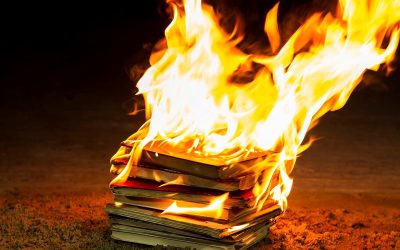
It’s tough being a writer. It’s even tougher when your work is being actively suppressed by the world’s biggest market place for books: Amazon.
Reputed to account for 80% of world book sales, for an author there’s no getting away from the online giant, no escaping its tentacles.
My problems with Amazon began when I had the audacity to publish a couple of BBC critiques; birds of a feather stick together and the broadcaster wasn’t too happy about these exposes of mine.
In normal times, they’d just have to suck it up. But these are not normal times. McCarthyism lives again only this time, co-ordinated by Big Tech. It’s a far more frightening prospect than it ever was in the 1950s.
Anyway, I’d said what I wanted viz the BBC and moved on to a new project: solving a mystery which had occurred in Provence in 1973, the savage murder of a British headmaster and former intelligence agent, John Cartland.
In a vain attempt to escape censure for my previous ‘crimes’ I even adopted a nom de plume: ‘Stockton Heath’. Almost two years later the task was complete: the mystery had been solved!
As an independent project there was no alternative but to publish via Amazon. While Amazon will plug certain books linking them to other books and ensuring their visibility on its platform, my little effort had no such benefits and duly dropped off the radar.
Reviews were hard to come by. On one occasion I noticed a positive review and my heart leapt only to find it had mysteriously vanished the next day.
How many more reviews have been deleted without my knowledge?
All was not lost. In France the crime is still referred to and remains one of that country’s most perplexing mysteries. Would I have better luck there?
After paying a French contact to assist with translation and six months after starting what became a long and complicated process, ‘Imaginer Un Meurtre: L’affaire Cartland Revistee’ was finally completed in February this year.
Initially all went well. It seems like my hunch had been right: the book sold relatively well during its first week on Amazon France. And then, nothing.
Just over a week ago sales stopped dead. More Amazon antics? It looked that way. I had started to receive a few emails from associates in France: ‘Where was the book? Hadn’t I published after all?’
I checked Amazon France: searching for the book’s title ‘Imaginer Un Meurtre’ auto-corrected to ‘Imagier Un Meurtre’.
The word ‘imagier’ in French means ‘colouring book’ and so instead of my book I was presented with children’s colouring books.
It soon became apparent that unless customers typed in the full title of the book + sub-title + author’s name, henceforth it would be effectively invisible to browsers of Amazon France.
Having spent hours on the telephone to Amazon reps is enough to drive one to distraction: they deny everything, even when viewing actual proof captured on film which shows how the Amazon website is subverting searches for the book. (Video can be viewed below)
It’s all due to the “algorithm” and that is that. Have a nice day.
So what happened? I have a theory: having suddenly become aware that I had published on Amazon’s French platform and the book in question was doing ok, Amazon stepped in to subvert the book’s visibility by ‘tweaking’ its searchability.
And it worked too: the book is now headed the same way as the English language version: to oblivion.
Once you’ve upset the establishment that’s your card marked, or so it seems. MSM (BBC) and Big tech is crossed at one’s peril.
This amalgamation of political parties/politicians with mainstream media and Big Tech into one immoral and corrupt uni-party was predicted by Orwell in 1984.
Orwell’s world is one of fear and paranoia where citizens are subjected to 24-hour surveillance by a brutal authoritarian police state – just the kind of society warned about by the so-called anti-fascist busily taking Orwell’s dystopia for their ‘Build Back Better’ blueprint.
Where does one go from here? Having resisted the lies for so long, the hero of 1984 finally submits to the Party orthodoxy at the end of the novel.
While he was right about everything else from The Thought Police to Big State propaganda channelled through ubiquitous tellyscreens, let’s hope that as far as his ending was concerned, Orwell got one thing wrong.
David Sedgwick is a writer and bon viveur based in Malaga and Split with occasional visits back to Liverpool. He writes about a wide range of topics from F1 and film to true crime and travel. http://www.stocktonheath.net
YouTube flags Tulsi Gabbard’s criticism of “military industrial complex” as “inappropriate,” “offensive”
By Christina Maas | Reclaim The Net | March 15, 2022
An interview for Fox News’ “Ingraham Angle,” featuring former Congresswoman Tulsi Gabbard, was censored for being potentially “offensive” and “inappropriate” to some audiences.
In the interview, Ingraham asked Gabbard, “Congresswoman, why are we talking about no-fly zones instead of the fact that for the first time we have President Zelensky stepping back from his earlier NATO wishes and even demands?”
Gabbard expressed her frustration with the fact that allegedly no one was discussing a statement Ukraine’s President Zelensky made, about being “… open to the fact of saying, ‘Hey, yeah, maybe we’ll set this NATO membership thing aside,’ and he’s willing to talk with Putin directly to negotiate.”
Gabbard suggested that the West was interfering with attempts to settle the conflict because, “it’s good for the military industrial complex” and it allowed Western leaders to “have this proxy war with Russia, something that Hillary Clinton laid out just recently.”
Gabbard strongly condemned the war, saying: “This war machine, this power elite in Washington, want to turn Ukraine into another Afghanistan, turn into killing fields where this long-term insurgency is supported. And they bleed out and cripple, kill as many Russians as possible for who knows how long, and they’re really showing their real aim in the fact that they’re not taking action right now to end this conflict.”
YouTube flagged the video, putting up a filter that said, “the following content has been identified by the YouTube community as inappropriate or offensive to some audiences.”
Firefox removes Yandex search, will auto-switch affected users to Google
By Rick Findlay | Reclaim The Net | March 15, 2022
Mozilla has pushed a new release of its Firefox browser with one notable change; it will no longer have Yandex, the Russian search engine, and Mail.ru as options.
“Yandex and Mail.ru have been removed as optional search providers in the drop-down search menu in Firefox,” Mozilla said.
“If you previously installed a customized version of Firefox with Yandex or Mail.ru, offered through partner distribution channels, this release removes those customizations, including add-ons and default bookmarks. Where applicable, your browser will revert to default settings, as offered by Mozilla.
“All other releases of Firefox remain unaffected by the change.”
Users affected by the changes will have their search engine automatically switched to the Google default – by which Google allegedly pays Mozilla hundreds of millions of dollars for the privilege.
“After careful consideration, we are suspending the use of Yandex Search in Firefox due to credible reports of search results displaying a prevalence of state-sponsored content, which is contrary to the principles of Mozilla,” a Mozilla spokesperson said.
“This means for the time being Yandex Search will not be the default search experience (or a default search option) for users in Russia, Belarus, Kazakhstan, and Turkey. In the meantime, we are pointing people to Google.com.”
Featured Video
Death Spikes & Rising Cancer In Our Youth Explained
or go to
Aletho News Archives – Video-Images
From the Archives
Politicians lie
By Mazin Qumsiyeh | Popular Resistance | August 18, 2013
There is no way to say this truth nicely: Politicians lie. That includes Japanese, American, Egyptian, Israeli, and Palestinian politicians! Is there something more common sense than that? Yet, so many citizens around the world believe their own politicians or wistfully acknowledge lies but think it is part of the job needed to run things. They believe even when politicians contradict themselves blatantly. This phenomenon is rather remarkable. It is a dissonance and disconnect from reality that many seem oblivious to. It is very dangerous because it can lead to accepting rationales for going to war. These can be deadly wars that lead to millions of lives lost as happened in what was called World War 1 and WW2. Even when incredible and declassified evidence abound, politicians continue to lie and old mythologies refuse to die. Here are just a few of the countless lies told to us over the past few decades… continue
Blog Roll
 Aletho News
- RSF military group defects, joins Sudanese army: State media
- Ireland goalkeeper refuses to play ‘Israel’ as squad weighs boycott
- China pushes back against US on Cuba, Iran
- Ukrainian Soldiers, Potential Mercenaries: Have Gun, Will Travel!
- Burnham’s UN debut… A masterclass in British disinformation
- Iran flights continue despite US aviation sanctions
- Global Tipping Points Lead the World Into a State of Entropy
- The day-after at the White House: USA and Xi Jinping
- The Geopolitical Balance in the Red Sea: The UAE Being Displaced by New Players
- Iraqi resistance group vows to stage airport sit-ins over Iran aerial blockade
- If Americans Knew
- Deconstructing Netanyahu’s pants-on-fire UN rant – Daily Update
- Trump betrayed voters with his campaign lies and prioritized a foreign country once he took office
- Netanyahu calls Israel’s war in Gaza ‘opposite of genocide’ in UN speech to near-empty hall
- Settler Kidnappings: Torture, Sexual Abuse and Terrorisation of Palestinian Abductees as Israel Deepens Annexation of West Bank
- Gaza winter nears as 162,000 tents become unusable, raising fears of humanitarian crisis
- Netanyahu says, “It’s the opposite of genocide”; UN says Gaza economy is world’s ‘most severe crisis on record’ – Daily Update
- Israel’s US-Backed Assault on Gaza Has Created the ‘World’s Most Severe Economic Crisis on Record’: UN
- ‘Protecting U.S. Citizens’… From Israel
- ‘This is where I live now, the back of a truck’: a day in the life of a grandmother in Gaza
- In UN Speech, Iran’s President Displays Pictures of Children Killed by US, Brings Attention to Israel’s Nuclear Arsenal
- No Tricks Zone
- New Study: Earth And Venus Surface Warmth Largely Explained By Convection And Lapse Rate, Not CO2 Or Radiation
- 2025 Nature Paper Claiming Worsening Global Drought Gets RETRACTED …Heavily Flawed
- New Study: ‘Global Drought Shows No Detectable Recent Acceleration Under Climate Warming’
- Economic Masterminds: German Socialists Suggest Taxing Productivity Gains Stemming From Using AI
- The South China Sea Has Not Been Cooperating With The Climate Change Narrative
- Energy Crisis: Germany Enters Heating Season With Historically Low Gas Reserve Fill Levels
- New Study: The Antarctic Ice Sheet Gained Mass From 2020-2024 Due To Staggering Snow And Ice Accumulation
- Study: Ocean Heating Rates From Thousands Of Years Ago ‘Dwarf’ Modern Ocean Heating Rates
- Climate Extremists Target, Attack Large-Scale Power Grid Infrastructure In Germany!
- New Study: Antarctic Ice Melt Has Contributed Less Than 1 Centimeter To Sea Level Rise In The Last 30 Years

