Is UK Labour Now Zionist-Occupied Territory?
Befuddled Party waits to be gagged by ‘enemy within’
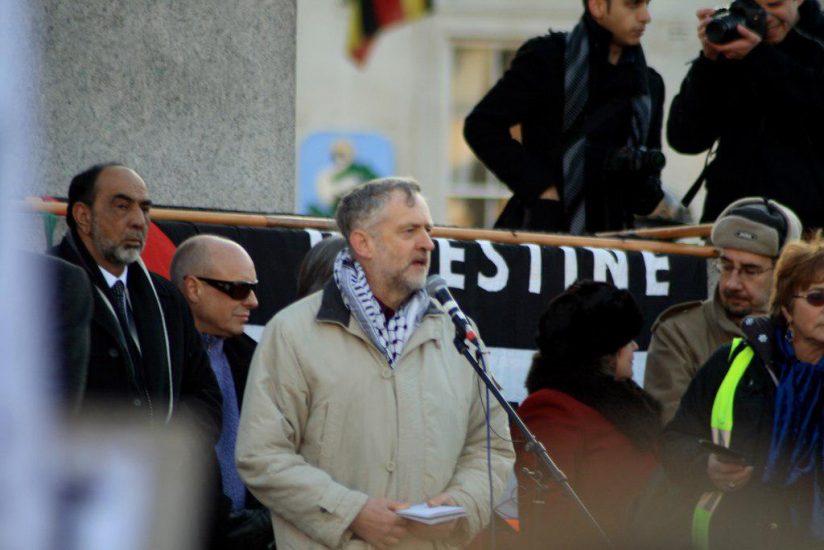
Jeremy Corbyn – Rally in Trafalgar Square. Image credit: Davide Simonetti/ Flickr
By Stuart Littlewood | American Herald Tribune | September 3, 2018
The National Executive Committee of the Labour Party will vote tomorrow (Tuesday) on whether to bow to the bullies and adopt the IHRA definition of anti-Semitism even though it has been roundly criticised by legal experts as unworkable. If they do, it will be hailed as a mighty victory for the dark forces behind the pro-Israel lobby in their bid to shut down criticisim of that racist state.
More than two years ago Gilad Atzmon was viewing the Labour Party’s crazed witch hunt for “anti-Semites” with misgiving. He declared, in his usual robust way, that Labour under Jeremy Corbyn was not so much a party as a piece of Zionist-occupied territory.
Writing in his blog about Corbyn and McDonnell’s servile commitment to expel anyone whose remarks might be interpreted by the Zionist Tendency as hateful or simply upsetting to Jews, he concluded: “Corbyn’s Labour is now unequivocally a spineless club of Sabbos Goyim [which I take to mean non-Jewish dogsbodies]. The Labour party’s policies are now compatible with Jewish culture: intolerant to the core and concerned primarily with the imaginary suffering of one people only. These people are not the working class, they are probably the most privileged ethnic group in Britain…. I did not anticipate that Corbyn would become a Zionist lapdog. Corbyn was a great hope to many of us. I guess that the time has come to accept that The Left is a dead concept, it has nothing to offer.”
Amen to that last bit.
And more recently Miko Peled, former Israeli soldier and the son of a Israeli general, warned that Israel was going to “pull all the stops, they are going to smear, they are going to try anything they can to stop Corbyn” and the reason anti-Semitism is used is because they have no other argument.
Since then we’ve had a queue of high profile Labourites and others sticking the knife into Corbyn. Last week it was the former Chief Rabbi and Zionist extremist Lord Sacks. Then the much-respected MP Frank Field, a maverick who finally quit Labour in noisy fashion giving anti-Semitism as a reason but having grumbled for a long time about a culture of intolerance, nastiness and intimidation within the party. Yesterday we had to suffer ex-prime minister Gordon Brown mouthing off about how the IHRA definition “is something we should support unanimously, unequivocally and immediately.” He urged Corbyn to remove the “stain” of prejudice from Labour by writing the definition and all of its examples into the party’s new code of conduct.
That’s a particularly dumb thing to say considering the Home Office Select Committee urged two caveats be included and eminent legal minds Hugh Tomlinson QC and Sir Stephen Sedley pointed out how it is trumped by our right to free expression, which is part of UK domestic law by virtue of the Human Rights Act (something every Labour member ought to know and uphold), and by other conventions. Geoffrey Robertson QC also warns that it is “not fit for any purpose that seeks to use it as an adjudicative standard. It is imprecise, confusing and open to misinterpretation and even manipulation”.
Robertson adds: “The Governments ‘adoption’ of the definition has no legal effect and does not oblige public bodies to take notice of it. The definition should not be adopted, and certainly should not be applied, by public bodies unless they are clear about Article 10 of the EHCR (European Convention on Human Rights) which is binding upon them, namely that they cannot ban speech or writing about Israel unless there is a real likelihood it will lead to violence or disorder or race hatred.”
But Brown won’t be listening. He’s a dedicated pimp for Israel and a dyed-in-the-wool Zionist. In 2008, in the first speech by a British prime minister to the Israeli parliament, the Knesset, he told Israeli MPs: “Britain is your true friend. A friend in difficult times as well as in good times, a friend who will stand beside you whenever your peace, your stability and your existence are under threat.”
Unlike Corbyn, Gordon Brown wouldn’t talk to Hamas because warmongers in the White House had branded them ‘terrorists’. But that’s their opinion. The state of Israel was founded by terror groups like the one that murdered 91 in an attack on the British mandate government in the King David Hotel and carried out the Deir Yassin massacre. Israel is the expert in terror. As Norman Finkelstein has remarked, “It is more than a rogue state. It is a lunatic state… The whole world is yearning for peace, and Israel is constantly yearning for war.”
The Israeli government itself was described by one of Brown’s own (Jewish) MPs, Sir Gerald Kaufman, as a ‘gang of amoral thugs’.
Brown, the son of a Church of Scotland minister, would have done well (as would all the other critics of Jeremy Corbyn and his ‘funny’ friends) to mull over the words of Gaza’s Catholic priest, Father Manuel Musallam, who told a journalist friend Mohammed Omer: “Palestinian Christians are not a religious community set apart in some corner. We are part of the Palestinian people. Our relationship with Hamas is as people of one nation. Hamas doesn’t fight religious groups. Its fight is against the Israeli occupation.”
When asked about Western media reports that Islamic oppression was forcing Gaza’s Christians to consider emigrating, Father Manuel said that if Christians emigrate it’s because of the Israeli siege, not the Muslims. “We seek a life of freedom —a life different from the life of dogs we are currently forced to live.”
Turning the tables
Corbyn isn’t the problem. Zionists are. They are the enemy within. Corbyn’s election to party leader was a surprise brought about by a sudden influx of new supporters weary of sterile and corrupt politics. They had no time to groom him, not that he’s capable of being tamed like previous leaders. Corbyn has a long record of support for the Palestinians and other justice causes and that doesn’t sit well with the ‘emininence grise‘ pulling the strings. As a loose cannon in a carefully controlled political battlefield he had to be disabled. One way to do that was to pick off his allies one by one and, with the help of a compliant media, derail his party’s election prospects. That is what they’ve been doing with considerable success by weaponising so-called anti-Semitism against Labour’s naive and easily scared troops.
But why take allegations of anti-Semitism seriously from bully-boys who themselves practise or support racism? There’s a simple two-word response to such hypocrites. Admittedly there are within Labour’s ranks too many who say idiotic things about Jews to the detriment of the campaign for justice in the Holy Land. I’ve heard remarks that are so stupidly provocative that one suspects the people responsible are Zionist plants. What is the point of bringing up Hitler and the Holocaust when there are more Israeli war crimes and crimes against humanity than you can shake a stick at?
Corbyn should have acted swiftly on genuine complaints and rejected the trumped up ones. He didn’t. Outside interference should never have been tolerated. It has been and still is. The best way to deal with professional moaners like the Board of Deputies of British Jews is to politely give them the BDS treatment – ignore and refuse to engage until they change their intimidating tone. And tell them this is the British Labour Party not a flagpole of the Knesset.
Furthermore it is long past time to question Labour’s Friends of Israel about their shameless support for the criminal state and its racist leaders and the land-grabbing Zionist Project. There is no place in a socialist organisation, or in British public life at all, for people who cannot bring themselves to condemn a regime that behaves so viciously towards its neighbours, defies international law, thinks it’s exempt from the norms of decent behaviour and shows no remorse. What does aligning with apartheid Israel really say about them? And, by the way, who gave permission to use the party as a platform to promote the interests of a foreign military power?
If people holding public office put themselves in a position where they are influenced by a foreign power, they flagrantly breach the Principles of Public Life. There are far too many Labour and Conservative MPs and MEPs who fall into that category.
Strange how the upsurge in carefully orchestrated allegations of anti-Semitism coincided with the arrival of Mark Regev, former chief of Israel’s propaganda machine, spokesman for Israel’s extremist prime minister and a shameless liar, as Israel’s new ambassador in London.
Corbyn’s other option is to leave Labour, take his supporters with him and let the party stew in its own juice. Let’s face it, the party as it stood then and stands today is dysfunctional, a thing of the past and quite unsuited to the 21st century. There may still be time to build a new, clean, fit-for-purpose political party and get it established before the next general election. In it, though probably not leading it, Corbyn could at least be true to himself.
The Labour Party has repeatedly promised to review its rules to send a clear message of zero-tolerance on anti-Semitism, assuming it knows what that means and who the genuine Semites are. For balance, of course, it should match this with zero-tolerance of those who use the party as a platform for promoting the criminal Israeli regime and its obscene territorial ambitions.
And remember, in 1949 the UN took Israel to its bosom on condition that it accepted the Right of Return of the Palestinian refugees and complied with General Assembly Resolution 194. Noting the declaration by the new State of Israel that it “unreservedly accepts the obligations of the United Nations Charter and undertakes to honour them from the day when it becomes a Member”, the General Assembly admitted Israel as “a peace-loving State which accepts the obligations contained in the Charter and is able and willing to carry out those obligations”.
Has Israel ever honoured its membership obligations or acted as a peace-loving State?
Reddit Identifies A New Threat: The Truth – #PropagandaWatch
corbettreport | September 3, 2018
Reddit is a controlled propaganda platform. Shocking, I know. Join James for this week’s edition of #PropagandaWatch where he breaks down self-proclaimed homepage of the internet’s war on truth.
SHOW NOTES: https://www.corbettreport.com/?p=27990
Kester Ratcliff’s International Assadist Directory Is His “Contribution to the War Effort”

By Sara Abed | American Herald Tribune | August 31, 2018
After more than seven years of war, which have brought death and destruction, pain and suffering, and every form of terrorism imaginable to the Syrian people, the war is finally entering its final stage. The much-anticipated battle of Idlib will commence soon. The plan to liberate every inch of Syria, which has been stated numerous times by President Bashar Al Assad, is underway.
RT states, “Syrian forces are gearing up to take the last terrorist stronghold. The US is boosting its military presence, and Russia is warning of a false-flag chemical attack. RT looks at the alignment of forces ahead of the battle for Idlib. American warships, cruise missile delivery systems, strategic bombers and other hardware have arrived in the Mediterranean and in the Persian Gulf earlier this week. Washington is denying that any buildup is taking place, but Moscow says the assets are being gathered for a massive strike against the Syrian government.”
The Syrian people have been through unimaginable circumstances, brought on by a western manufactured insurrection, both on the ground and in the media. One would think, that bringing this war to an end, and allowing Syrians to rebuild their lives, would be an objective shared by all humanitarians and activists, but unfortunately, that is far from the case.
Propagandists who pose as humanitarians and activists, while ironically supporting terrorist aligned militant groups, have once again amplified their coordinated media efforts to spread misinformation ahead of the final big battle in Syria.
Timing is crucial
Journalist and book author Brandon Turbeville writes, “As mainstream media doubles down in its coordinated propaganda against the Syrian government and in support of direct Western military intervention, the alternative media has been going up against unprecedented censorship on the part of the social media and Internet corporate giants at the same time. For that reason, it is becoming harder and harder to find accurate sources of information regarding Syria as well as all other topics in a general Internet search. While readers of the alt media before Google’s purge and censorfest took place have largely remained, the amount of people being exposed to new information and an alternative to government and corporate propaganda has been drastically reduced.”
“Late last week, Russian Defense Ministry spokesman Igor Konashenkov said that the White Helmets group plans to film videos for Middle Eastern and English-language media outlets after staging a false-flag chemical weapons attack in Syria in order to further destabilize the war-torn country.” Sputnik News
In order to stay one step ahead of the game, Sputnik goes on to say, “Damascus has handed documents to the UN, to prove that al-Nusra Front* terrorists plan to conduct a chemical weapons attack in the northwestern Syrian province of Idlib and point the finger at the country’s government, according to Syria’s UN envoy Bashar Jaafari.”
International Assadist Directory
Kester Ratcliff a “Former Project Researcher at University of Bristol” who studies “Top Programme Evolutionary Biology MSc at RUG Groningen” and has previously studied “Animal Behaviour and Welfare Science at University of Bristol”, according to his Facebook page, has created what he calls a “references directory on 151 public figures who have expressed support and/or whitewashed the Assad regime, with examples and references.” He stated, “The purpose of this list is to facilitate finding the references to see and to show people who genuinely don’t know what is true and who to trust about Syria why the people on this list should not be trusted as sources.” Let’s take a moment to digest that last quite bold sentence. The people he cherry picked for his directory should not be trusted according to Ratcliff.
Who is Kester Ratcliff?
Ratcliff dedicated a substantial amount of time and effort to smearing Vanessa Beeley who has extensive experience working on-the-ground in Syria. In his directory he states “It is my honest opinion that she is manifestly an agent of the Assad regime, that she should be added to the lists of sanctioned persons under the UK and the EU sanctions on Syria, and that she should be arrested if she enters the UK or any EU Member State’s territorial jurisdiction and charged with direct and publicly broadcast incitement of the crime against humanity of widespread and systematic attacks on humanitarian workers in an armed conflict zone, under Article 7(1)(k) of the Rome Statute of the International Criminal Court. She responded to Ratcliff’s tweet, with the question on everyone’s mind “Who are you?”
In 1978, a popular English rock band by the name of “The Who” released a song titled Who Are You? One of the lines is, “I remember throwing punches around and preaching from my chair”. What oddly perfect description of Ratcliff, who makes accusations against people he has never met, talked to, or even interacted with, all from the comfort of his chair.
Others on social media asked questions such as what expertise does Ratcliff bring to the table? How qualified is he to tell a broad audience who is trustworthy and who is not when it comes to the Syrian conflict? I am paraphrasing but the point is the same.
One might imagine, that this self-proclaimed “political thinker” (per his Medium bio) must have a background that qualifies him to give an opinion on journalists, political commentators, and other public figures who have contributed written or oral material during the course of over seven years of a western manufactured insurrection in Syria.
However, the questions certainly outnumber the answers in this case. What we can gather is that Ratcliff has never stepped foot in Syria, and relies on second-hand information, such as that from refugees whom he met and coached during his time in Greece.
The ever-evolving man of many interests
Ratcliff gives us more insight into who he is in the few articles he has written and published on various sites. In an essay published by Medium titled “Suffering and the Construction of Authority” Ratcliff wrote about his mother “I had a mentally ill and abusive mother, grew up as effectively her sole carer. During my teenage years, the most fundamental issue we fought about and the most frequently was that she demanded I should ‘respect her authority’ merely because of her conventional position as my parent, which I could not do because she was actually completely untrustworthy, unreliable and, literally, insane, and in fact I had to practically care for her like a parent would, when I was a child. Practically our roles were reversed, but she insisted on the ‘authority’ conventionally attached to her position. Needless to say, I absolutely refused.”
Ratcliff goes on to say, “That developmental experience made me extra sensitive, vigilant and radically opposed to all forms of authoritarianism in every area of human life. ‘Authoritarianism’ is the idea of ‘authority’ existing for its own sake, inherently possessing its authority, in an alienated way, rather than it being a characteristic of a relationship, in which authority is given and received (inter-subjectively) for certain mutually beneficial purposes.”
You can read more about his views on authority in his essay on Medium where his bio reads: EvoBio MSc student at RUG in Groningen, refugee solidarity volunteer, activist, political thinker.
Ratcliff shares with us the next chapter of his life in the same essay, “At 18, I ‘ran away’ to a Buddhist monastery, in North East Thailand, spent three and half years in Thailand, in monasteries of the Ajahn Chah lineage, and three years in branch monasteries in Australia. Thai Theravada Forest Tradition has its own problems with traditionalist authoritarianism and inter-cultural clashes. There are deep internal conflicts in the international monastic ‘community’ about Thai traditionalism, individualist autocratic authority of abbots, Thai collectivist authoritarianism, the forest tradition’s claims to radical scriptural orthopraxy, then exposed to European traditions of textual and historical criticism, and the trigger issue for an almost-schism in the midst of these underlying issues was the revival of full ordination for nuns. I very much sided with the radically scripturally orthopraxic side of that conflict, essentially because I could not trust a person then, so the scriptural advice “we take refuge in the Dhamma (the Buddha’s teaching), not in a person” (MN108/ MA 145) was important to me. I studied intensely too: communal monastic legal history (I also taught monastic law for a while), sociology of early Buddhism, and observed and introspected on authority.”
He wrote about his Buddhist monk experience for Buddha Channel in an article titled Kester Ratcliff —” Monastic lineages and the Vinaya: Which is Buddhist?” ”I used to be a monk for six and half years in the Thai Forest Tradition, my name then was Bhikkhu Santi. As well as a lot of meditation, in those six years I also did a lot of study and particularly Vinaya, and especially the two main neglected areas -the Bhikkhuni Vinaya and the communal legal procedures (adhikarana-samatha-dhammas).
Ratcliff shares an interestingly similar perspective about the abbots, as that of his mother in the same article.

*(Kester Ratcliff’s Monastic passport Source: Facebook page)
“However, I found the abbots I was expected to trust untrustable -firstly, because they demanded it too much -if somebody is truly trustworthy, they don’t need to say “you should respect me” or anything of that sort, they would be confident that they are trustworthy enough to just be themselves quietly; like getting a toddler to come in for a hug, you have kneel down, open your arms, and wait for the kid to run into your arms; grabbing or shouting don’t work.”
Ratcliff writes about his experience as a monk and how his journey led him to join the Quakers in an article on his website titled “Mulesika -Seeking the Roots”. “Personally my journey has led me to join the Quakers, last year, now that I’m a layman in a family-oriented life. I no longer call myself a Buddhist, and I can use conventional regional religious terminology like ‘God’ quite comfortably (with a massive footnote explaining that I don’t mean anything supernatural or having sabhava). I find I fit much better in the Quaker community, and one of the most obvious differences for me from my experience of the TFT is that the Quaker ‘institution’ treats people as full adults (maybe even a bit too much, because we mostly seem to attract people in their 40s onwards!), but I needed a change and it’s the furthest opposite extreme if you have religious allergy to hierarchicalism and enforced prolongation of adolescent-type dependence.”
Working with Refugees
-Ratcliff wrote an article titled Systemic legal issues for refugees in Europe and affected by Europe globally in which he states this is “A list of in-depth sources with connecting notes about the major systemic legal problems confronting refugees as they try to reach a place of safety. The major issues are in order of encounter from a refugee’s point of view.”
-On Ratcliff’s Facebook profile it states that he manages a group called Visas for Asylum or Safe Passage to EU.
-Ratcliff writes about his work with HIAS on his blog Silence of Eternity:
“HIAS is a refugee legal aid NGO from America, with operations in 14 countries and an implementing partner for the USA resettlement programme through UNHCR. It’s a Jewish organisation, founded in 1881 in the USA, originally was for Jews escaping persecution in Europe, but now serves any human person in the same sort of situation – http://www.hias.org/
Specifically what I plan to do in Chios next week and the week after:
-
Help physically set up the information tent – I’m not sure whether to take my power tools as well as my legal textbooks, but I have both here;
-
Try to set up a psychosocially safe, private and dignified environment in which to ask people to recall what happened to make them flee their homes and countries;
-
Discuss with them through the Guide I’ve prepared on how to prepare for asylum interviews, clarify their answers with them, and write down their statements ready for them to take in with them to their interviews (this should assist both the refugees and EASO/ the Greek Asylum Service, making the process both fairer and more efficient for everyone).
-
If there’s enough time, practice mock interviews with people.
-
Connect people whose cases I can’t deal with as a non-lawyer to the network of pro bono refugee legal aid lawyers I’m in contact with now, across NGOs.
-
Get a more detailed realistic sense of what’s needed and what works, to feed into the design of the HIAS Greece legal aid programme.”
-Ratcliff wrote a comment in response to an article written by the Sun titled “SYRIA CRIME WAVE: Hundreds of Syrians in UK arrested over string of offences including rape and child abuse, in which he stated “… I have reported it to IPSO as unfactual and discriminatory and to my local police force as a crime under S.23 of the Public Order Act 1986 for publication and distribution of material with intent or likely to stir up racial hatred, and written to my MP to ask her to write to the CPS asking them to seriously consider prosecuting you this time. I believe the journalists and their editors responsible for this publication, as well as the directors ultimately responsible for everything that happens in the whole company, should be convicted for incitement to racial or religious hatred, sentenced to the maximum term of 7 years imprisonment, and all of them should be banned from ever holding the directorship of any company ever again.”
The sole purpose of sharing this article and Ratcliff’s comment is to show that his calls for people to be convicted and imprisoned are nothing new.
In response to an article titled “Spiritual influence” and elections Ratcliff wrote “… the duty to vote and participate in social democracy is a serious public duty which also ought to be considered a religious obligation.”
Ratcliff is in his final-year as an undergrad student of Animal Behaviour & Welfare Science at Bristol University in the Veterinary Sciences School. His current dissertation project revolves around modelling how parasites influence the collective movement patterns that emerge in sheep flocks, using comparative evidence from research in fish.
This brief history based on public information that Ratcliff has generously offered via multiple media platforms might give us some insight about him, but leaves us with more questions than answers. Why has a relatively unknown individual in the Syrian conflict, taken on this task of quietly collecting information on 151 people, and placing a target on each and every one of their backs?
Hi Kester. I’m doing some research into the motives of war propagandists and war narrative protectors. Were you asked to create this list, or did you do so in the hopes of generating a paid opportunity, possibly by attracting attention from organisations like Atlantic Council?
— Angelis Dania (@NeotipPro) August 29, 2018
Ratcliff’s “contribution” to the Syrian war effort
Ratcliff states on a Facebook post that this is his “contribution to the war”. That’s an important point to take note of. Ratcliff is feeling the euphoric effects of overnight fame, but has also made it clear that he does not want people to focus on him as a person or his typos or his lack of credentials. No, it would be best to just blindly accept everything he has stated, without giving it much thought.

Ratcliff knew that this directory would cause a storm of backlash based on some of his facebook posts.
Ratcliff had the help of a retired lawyer friend, and two journalists that helped check his “monster article”, in addition he checked it himself a “bazillion” times and remarkably still managed to misspell a number of names and get many facts wrong.

Ratcliff doesn’t want this to be about him, he says “It’s not really about me”.

Filled to the Brim with Errors, Misspellings, and Inaccuracies
Ratcliff takes a lot of pride in his directory. On Facebook, he stated, “I have checked it very carefully, and endeavored to be fair. Despite hating them, I will not remove anyone or change what I have said about them, in spite of any amount of harassment, so don’t even bother trying, but if there is any real factual inaccuracy I will of course immediately correct it.”
Notice how much emotion he expresses towards those he has chosen to blacklist. He doesn’t merely disapprove of their viewpoints, but he hates them as individuals. Emotions can certainly cloud a person’s judgment, and by the looks of it, Ratcliff has no reservations sharing his feelings publicly about individuals whom he has never met or interacted with for the most part. The hate he mentions must have developed during the time that he was lurking in the background, watching and taking notes of who should make his list of untrustworthy sources, as he refers to them.
Ratcliff wrote in a public Facebook post on his page about the typos.

For someone who claims to have checked his directory “very carefully,” it sure was filled to the brim with inaccuracies, and even people’s names were misspelled. Their very identity was wrong. If Ratcliff doesn’t care much for spelling people’s names correctly what else has he not given much thought to in his directory?
Medium email and article suspension
Medium has served as a platform for a number of Ratcliff’s essays and incoherent drivel.
Here are just two examples of Ratcliff’s literary balderdash:
–Example of OSINT on 21stcenturywire Vanessa Beeley’s latest Assadist propaganda against the White Helmets – which Ratcliff states is “an incomplete draft from 22 June 2017. I’m publishing it now just in order to send it to another researcher.” He also states “One of Vanessa Beeley’s useful idiots challenged me to “prove it” — obviously they won’t read this or think about it or stop repeating lies, because they don’t believe in objective factual truth, but for the record, here is some proof”.
–Definition and discussion of the meaning and importance of ‘Bullshit’. He states “I wrote this long definition and discussion of ‘bullshit’ to enable me to write a much shorter and simpler paragraph defining it in a major article later.”
His latest contribution has since been suspended by Medium. Their reasons for suspension can be seen in the following tweet.
The “Assadist” list of @KesterRatcliff has been removed from Medium for the reasons as below 👇🏻
Now, if any harm happens to me due to this inciting article, I’ll held Kester full responsibility cos I consider it a green light to Islamist cells in Europe to target these names pic.twitter.com/qDaH3Cf2cI— Kevork Almassian (@KevorkAlmassian) August 29, 2018
The Assadist slur vs. Pro-Assad
According to Merriam Webster the definition of a sadist is one characterized by sadism: a person who takes pleasure in inflicting pain, punishment, or humiliation on others. Sadism is defined as the derivation of sexual gratification from the infliction of physical pain or humiliation on another person.
This clarifies why some choose to use the slur Assadist rather than simply saying Pro-Assad when insulting those who have committed one or more of the following “crimes”:
1. questioning the official narrative
2. doubting the truthfulness of mainstream media
3. speaking up against foreign intervention, imperialism, and terrorism
4. and lastly the most contentious of all according to characters such as Ratcliff… wait for it… actually supporting the elected president of Syria! President Bashar Al Assad ::horrifying gasp::
If these reasons truly qualify one to be called an Assadist then Ratcliff should have included the millions of people around the world who support the legitimate president of Syria Dr. Bashar Al Assad.
Of course using the term Assadist is not original or creative on Ratcliff’s part, nor is he the first to create such a ridiculous list, which could also have dangerous ramifications for those on it. Others have tread these murky waters before Ratcliff, just google Assadist and you’ll see a selection of unimpressive ramblings.
– Louis Proyect wrote about Assadists on his blog The Unrepentant Marxist. In one of his entries titled Young Assadist Academics Nursing their Wounds he stated the following “One of the most depressing things about the six years of war in Syria, besides the obvious destruction of life and property, is the trail of intellectual damage left behind by investigative journalists, leftist leaders, and academics who bend the truth or outright lie in order to defend the mafia state. History will certainly remember people such as Seymour Hersh, Theodore Postol, and Tariq Ali as being ethically and intellectually challenged no matter how virtuous they were in the past.”
One can’t help but wonder if Ratcliff could be Proyect’s protégé? Either way, whether he is or not, doesn’t matter much, but it is interesting to see the similarities between the two, especially their love of using the same slurs and list-making passion.
What a useful tool their contributions must be to terrorist aligned opposition groups who are seeking to shut down dissenters especially during this last phase of a war… which they have clearly lost.
Media Responses to Ratcliff’s Directory
Ratcliff has been sharing articles written in response to his directory on his social media accounts with uber-enthusiasm. Overnight fame can be exhilarating and Ratcliff is enjoying every millisecond of his five minutes of fame.
Ratcliff’s greatest accomplishment thus far, could very well be getting the attention of RT which resulted in not one, but three articles being published in a span of two days, in response to his Assadist directory.
– August 27th: Chomsky, Hersh and… Boris Johnson? Twitter pundits ponder odd ‘Assadist’ blacklist “An obscure blog post, that accuses journalists and intellectuals of inciting “crimes against humanity” for their views on Syria, has received glowing reviews from verified Twitter pundits, despite its factually dubious claims. Featured on an unfrequented Medium blog, the “International Assadists References Directory” lists 151 people and organizations who have allegedly “expressed support and/or whitewashed the Assad regime.” The eclectic compilation of “Assadists” features individuals and groups of all political stripes and backgrounds, from the Greek nationalist political party Golden Dawn to Pink Floyd frontman Roger Waters. Notable journalists such as Seymour Hersh, John Pilger, Peter Hitchens, Glenn Greenwald and Patrick Cockburn are also listed as reckless Assad apologists.”
– August 28th: Don’t tell him, Pike! The laughable (yet sinister) list of ‘International Assadists’
Neil Clark wrote “A newly-compiled directory of 151 ‘International Assadists’ is both hilarious – for all the mistakes in it, but disturbing too, as it represents a McCarthyite attempt to police the debate on Syria.”
He goes on to say “By Ratcliff’s own admission you don’t even have to be ‘pro-Assad’ to be included in his ‘International Assadists Reference Directory’. His definition of ‘Assadist’ is incredibly wide – so wide in fact that it even includes those who have supported air strikes on Syrian government targets. Here he quotes Ratcliff as having written “All pro-Assad people are Assadists (they repeat Assadist propaganda claims), but not all Assadists are in their own view pro-Assad,” he explains in the introduction. In other words, if you repeat anything on Syria that he regards as an “Assadist propaganda claim”, you’re an Assadist. Even if you make it clear you strongly oppose the Syrian president – and support bombing Syrian airfields, like former UK Foreign Secretary Boris Johnson, who is listed.”
– August 28th ‘Assadist list’ nothing more than McCarthyism paired with ‘hoodwink’ science George Galloway wrote “Yet I have made the Assadist List, compiled by a student scribbler, a Kester Ratcliff, whose name needn’t detain us for long. He is his masters’ voice and his masters are whom we should focus on.”
Responses from some of the “Assadists” in Ratcliff’s directory
You mean the regurgitation of already written, unoriginal, logical fallacy and patent lies based smears prior? Yes, seems Kester is looking for an opening with NATO’s Atlantic Council or #Bellingcrap.
— Eva Bartlett (@EvaKBartlett) August 27, 2018
Even aside from the partisan slander and ludicrous allegations, there are many blatant errors/lies in this blacklist (eg, it falsely claims journalists are working for media outlets they in fact don’t work for).@Brian_Whit should be ashamed for endorsing this malicious garbage.
— Ben Norton (@BenjaminNorton) August 24, 2018
It seems that @KesterRatcliff who claims to be a “human rights activist” is not only a horrible blogger but could be mentally unstable and possibly dangerous person. pic.twitter.com/VcNaDOvJzn
— Kevork Almassian (@KevorkAlmassian) August 30, 2018
The deranged author of this shabby and slanderous McCarthyite blacklist has expressed his desire for the criminal prosecution of most on it for their speech and journalism. He names @VanessaBeeley as one person he’d especially like to throw in jail. https://t.co/is3s9Psq1v https://t.co/7ctZqR8Q4g
— Max Blumenthal (@MaxBlumenthal) August 27, 2018
Alt Media List of Sources
If poppycock isn’t your literary preference, and you have an appetite for truthful, honest reporting and journalism, might I suggest you read the following refreshing list of sources that have covered the war in Syria in many different capacities.
Brandon Turbeville is an exceptional journalist and accomplished author of seven books. Turbeville has first-hand experience from visiting Syria which only adds to the verity of his articles. Turbeville has published 1000’s of articles on a wide variety of subjects including health, economics, government corruption, and civil liberties. He has created an incredibly useful directory that should be read and shared by those who value the truth: You Want A Real List? Directory Of Accurate Alt Media Sources On Syria. Turbeville wrote “… with disturbed “researchers” and various shadowy organizations creating silly lists of “Assadists” “Fake News,” and “Russian propaganda,” I thought it might be useful to create a list of my own, containing a number of the same names, in order to provide a list of researchers, journalists, and activists who have been working to expose the true agenda behind what is happening in Syria today in hopes that my readers will also find their work and find access to additional sources of information which certainly will not be available in the mainstream press. This, of course, is in addition to my own work.”
To conclude on a positive note, the reality on the ground shows that the foreign-backed militants have failed miserably in their pursuit of unseating President Assad and completely leveling the jasmine-scented country.
The will of the Syrian people has proven to be stronger than bombs and propaganda. In a last-ditch effort to shift the outcome of this war, misguided mouthpieces and paid propagandists alike will make a lot of noise, but that’s really all it is.
Their futile attempts at prolonging the war by demonizing people they disagree with is nothing more than a distraction. Ultimately their actions cannot and will not disturb the unrivaled unity of the majority of the Syrian people.
“Kester Ratcliff” – these are the people us Syrians, living in #Syria, despise the most. Self-righteous, self-proclaimed “Human Rights Activists”, that create character-assassination hit lists like this to defame and discredit anyone that speaks out against regime-change wars. https://t.co/U7uOV7JLaU
— Hannibal Khoury (@The_Cyrenian) August 25, 2018
Sarah Abed is an independent journalist and political commentator. Her articles can be read at the Rabbit Hole.
Supporters of Apartheid Israel Abuse Sydney Anti-War Student
By Tim Anderson | American Herald Tribune | September 2, 2018
Media, parliamentary, academic and other supporters of apartheid Israel have abused University of Sydney doctoral student Jay Tharappel for his outspoken support of Yemen, opposition to Israel and his consistent stance against the long wars 0n Syria and Korea.
Much of the western media falsely pretend that the massively internationalized war on Syria is a “civil war”. Most also refuse to recognize the simple fact that, over the past 65 years, the USA has never agreed to a peace agreement with North Korea.
The personal attacks on Jay reveal a shallow recognition of free speech in Australia. It is extraordinary that so much abuse has been heaped on one dissident voice. Demands for censorship of his political comments have come from various sources, but many of them supporters of the apartheid state of Israel.
First came the bully and smear media, from Murdoch’s Daily Telegraph, and from Channel Seven. The Murdoch tabloid, in a torrent of personal abuse, attacked Jay for rejecting the false chemical weapons claims against Syria, in April 2017. It then falsely claimed that Jay’s criticism of Murdoch journalist Kylar Loussikian was a racist attack.
In August 2018 Channel Seven manufactured another scandal about Jay, falsely claiming that a Yemeni badge he wore in China was ‘anti-semitic’. One part of that badge, seen on Jay’s shirt in one of my social media posts, said ‘death to Israel’.
The photo was simply one of the friends at lunch. Channel Seven, using the false translation “death to Israeli”, claiming it was a racist incitement. I posted in response that the Channel Seven piece ‘promotes ignorance, apartheid, and war’.
In fact ‘death to Israel’ is a political statement by the Yemeni group Ansarallah, which calls for an end to apartheid Israel, the regime that is reported to have killed a Palestinian child every three days for the past 18 years. The Australian government sells arms to the Saudis to bomb Yemen, as they ignore that terrible war and try to suppress any news about Yemen.
Later, the University of Sydney told the Sydney Morning Herald that I was “under investigation” for refusing to take down that photo of Jay and friends at lunch. After a Sydney Morning Herald [allegation] against me, I made a social media statement explaining my position.
For Channel Seven’s principal sources journalist, Bryan Seymour used two people (to represent “many in the Jewish and Muslim community”). First was a well-known supporter of Israel, Vic Alhadeff. Vic was previously a chair of the NSW Community Relations Commission but resigned in 2014 after posting in support of Israel’s bloody reign of terror in Gaza.
The other was Jordanian-Australian Jamal Daoud, who claimed to represent a Palestinian group but is best known for his repeated attacks on those who support Syria. He has abused many supporters of Syria as ‘spies’ and ‘prostitutes’. In 2017 he took an Israeli propagandist to Syria, and since then has been wanted for questioning in Syria. Earlier, in 2015, he began an online petition to challenge a security ban on him entering Lebanon.
The corporate media came back to abuse Jay after he wrote a thoughtful piece on his visit to North Korea (DPRK) in the student newspaper Honi Soit. The article defended independent Korea while it described in some detail what he had seen there. On social media pages, many appreciated the unusual article, while others responded with censorial outrage.
The Daily Telegraph added another abusive piece, which copied much of Jay’s article while adding invective. Even the state-owned ABC wrote in support of the demand that the article be taken down, simply because it was seen as too favorable to North Korea.
Why the hysteria over criticism of Israel? Well, both the Murdoch media and Channel Seven have deep business links with Israel’s occupation forces, including those who regularly demolish Palestinian homes in their ethnic cleansing purges.
Pro-Israel figures and some Jewish media in Australia predictably and falsely tried to conflate Jay’s and my opposition to Israel with anti-Jewish racism. I have made my position on Israel and racism very clear on many occasions, most recently in an article called The Future of Palestine.
A selection of pro-Israel types jumped on the bandwagon. They included federal Labor MP Tim Watts, who attacked Jay’s article and Honi Soit, saying ‘everyone associated with this article ought to be ashamed’.
Everyone associated with this article ought to be ashamed https://t.co/SJ1jDeMqrP
— Tim Watts MP (@TimWattsMP) August 26, 2018
When he was criticized for picking on a student newspaper he said, by way of justification, that he was trying to get at me (‘the professor’).
I’m picking on the professor that has long been enabling this dangerous rubbish
— Tim Watts MP (@TimWattsMP) August 26, 2018
In fact, Tim Watts is yet another supporter of apartheid Israel. In late 2015 he went on an Israeli-government paid junket to Israel, in a group led by conservative minister Christopher Pyne. The group seemed to toe the Israeli line because Palestinian minister Dr. Sabri Saidam described them as “rude” and “not well educated” on Palestine.
Subsequently, Tim Watts took his Israel connection seriously. He strongly recommended the book ‘My Promised Land’ by Ari Shavit, which explains how Israel created “something unique and quite endearing” in a tough neighborhood.
This “unique and quite endearing” creation was described by an authoritative 2017 report to the United Nations as an ‘apartheid state’ and therefore ‘a crime against humanity’. US academic lawyers Richard Falk and Virginia Tilley wrote that “the situation in Israel-Palestine constitutes an unmet obligation of the organized international community to resolve a conflict, partially generated by its own actions”.
Professor Ariadne Vromen, a professor in Government at the University of Sydney, and opponent of the BDS campaign against Israel, jumped in, inexplicably, attacking the former Syrian Ambassador to Australia Tammam Sulayman. Ambassador Sulayman is now Syria’s envoy to North Korea, and it was he who invited us to visit that country.
Ariadne claimed that Ambassador Tammam had failed her research design course, 15 years ago. “He didn’t pass first year”, she said. After some criticism, she removed her post.

Of course, it is inappropriate for academics to abuse students or former students, or to humiliate them for their grades or results. In this case, Ariadne’s comments were also false. When I enquired, Ambassador Sulayman spelled out to me the reason why he had left Ariadne’s class and his doctoral studies at the University:
“Of course I didn’t complete at that time with Ariadne because [his supervisor, another academic] started the war on me and I complained against her to the university. So I stopped everything … in my [thesis] preface I stated there is no linkage between the secular Baath party and al Qaeda … but she said ‘that does not exclude links between Saddam and al Qaeda’, and I said but we are talking about the Baath party … Then she started returning every paper I sent her … she is a clear Zionist … It is silly for [Ariadne] to say that I didn’t finish even one year without mentioning the reason.”
Professor Vromen’s abuse of a former student and ambassador is strange. Why would an academic jump in to abuse a former student, in the context of an abusive media campaign against another student? What is wrong with honest discussion?
Unfortunately, this is not an isolated incident. The University of Sydney is well known for harboring pro-apartheid-Israel academics. It hosts a research project backed by US Government-funded agencies, called ‘The Electoral Integrity Project’. That project rates the electoral democracy of many countries. As it happens, they rate Israel’s ‘democracy’ very highly (17/127), even though the Jewish state is notorious for its institutionalized racism.
In 2007-08 the University of Sydney accepted a large grant from the American Australian Association, to establish a ‘United States Studies Centre’. This was mostly Australian Government money but came at the suggestion of media mogul Rupert Murdoch. The idea of the Centre came from a desire to repair the damage done to the image of the USA in the wake of its 2003 invasion of Iraq. I wrote an article about this scandal, back in 2010.
Washington remains the major funder and arms provider to apartheid Israel, providing the racist state with more than three billion dollars every year, mostly in military subsidies.
Egypt president approves law restraining social media
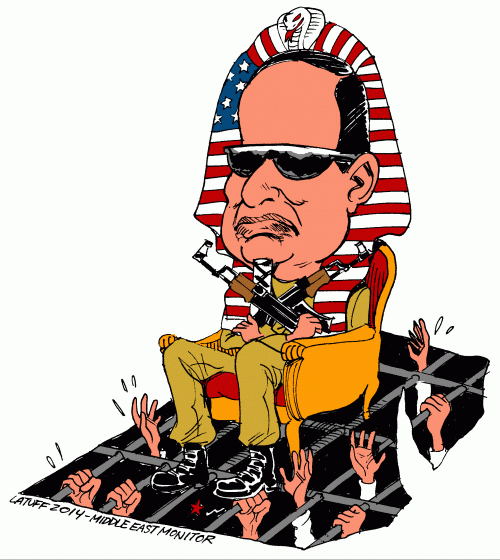
Press TV – September 2, 2018
Egypt seems to be intensifying its crackdown on opponents with a new law. President Abdel Fattah al-Sisi has approved the legislation, authorizing officials to monitor social media users.
As reported by the official gazette on Saturday, the new law gives state authorities the right to monitor the activities of social media users on the internet.
The legislation, it said, places social media accounts with over 5,000 followers under the supervision of the Supreme Council for the Administration of the Media.
That means any popular blog, website or even account on Facebook, Twitter or other platforms, could be considered a media outlet and subject to the supervision of the media regulator which could block them for spreading fake news.
The controversial law was passed in the parliament back in July.
Critics argue that it increase state power to crack down on opposition activists.
Human rights groups have on numerous occasions criticized Egypt for its tough approach towards opponents.
The Sisi government has silenced most critics in the media, rolled back social freedoms, and placed draconian restrictions on demonstrations and the work of rights groups.
Tens of thousands of people have been detained since 2013, when the military, led by Sisi, overthrew Mohamed Morsi.
Morsi, Egypt’s first democratically-elected president, came to power after the 2011 uprising toppled long-time autocrat Hosni Mubarak.
Read more:
Egypt arrests prominent blogger amid crackdown on dissent
Egypt subjecting prisoners to horrendous abuse, torture
Bizarre Israeli Analyses of Syrian Curriculum Circulate in the Middle East
By Andre Vltchek – New Eastern Outlook – 30.08.2018
My friend, a senior UN official based in Amman, Jordan, recently received a newsletter from an Israeli institution – “IMPACT-se”. Their report was called, ‘modestly’, “Reformulating School Textbooks During the Civil War”.
It is full of analyses of the Syrian curriculum.
Interesting stuff, without any doubt: Manipulative, negative, but interesting. It made it to many other places in the Middle East; to Lebanon, for instance, where even the word “Israel” is hardly ever pronounced.
Predictably, being compiled in Israel, the report trashes Syria, its ideology, and the determined anti-imperialist stand of President al-Assad.
However, that may backfire. Excerpts that are quoted from the Syrian curriculum would impress both education experts, as well as the general public, if they were to get their hands and eyes on them. And I am trying to facilitate precisely that, in this essay.
What the report found outrageous and deplorable, others could find very reasonable and positive. Let’s read, here is what the “IMPACT-se” is quoting, while ringing alarm bells:
“Saddam Hussein took power, and his period witnessed a number of wars in the Arab Gulf area. The first was with Iran, called the First Gulf War (1980–88), which occurred through incitement by the US, in order to weaken both countries. History, Grade 12, 2017–18, p. 105.”
Well put, isn’t it? But it gets much better, philosophically. Imagine, this brilliant intellectual stuff is actually served to all Syrian children in their public schools, while in Europe and North America; kids are fed with neo-colonialist mainstream propaganda. No wonder that Syrian children are much better versed in what is happening in the world. No wonder that millions of Syrian refugees are now ready to return home, after the abuse they received abroad, and after realizing how indoctrinated and brainwashed by Western propaganda, the people all over the world are.
“IMPACT-se” continues quoting the Syrian curriculum, naively thinking that the words engraved there, will terrify the entire world:
“This competition and struggle worsened as the capitalist system developed and new occupying forces such as the US, took control over international politics. It exploited its scientific, technological, economic and military supremacy in order to expand its influence and [gain] control over the capabilities of the peoples of the world. This was done in cooperation with its allies, to increase its presence in the international arena as the only undisputed superpower. National Education, Grade 8, 2017–18, p. 81.(The US) strives to maintain its supremacy by monopolizing developing technology, controlling wealth and energy sources in the world, most importantly oil, and forcing its hegemony on the international community. National Education, Grade 8, 2017–18, p. 82.
This could be easily written by the progressive economist Peter Koenig, by the international lawyer Christopher Black, or, why not, by myself.
The people, who worked on the Syrian curriculum, combined two things brilliantly: 1) indisputable facts, 2) elegant simplicity! Actually, this curriculum should be offered not only to the Middle East kids, but all over the world.
Look how skillfully and honestly it summarizes modern history:
“After the disappearance of international balance and unipolar hegemony took control of the world, the US began searching for excuses to justify its intervention in other countries. It occupied Afghanistan in 2002, under the pretext of fighting against “terrorism” in order to realize its political and economic goals. One of the goals was to build an advanced military base close to countries which the US considers to be dangerous (Russia, China, India, Iran and North Korea). In addition, Afghanistan had many assets (such as iron ore and gas). In 2003, the US—helped by a group of countries—declared war on Iraq under the pretext that Iraq was holding weapons of mass destruction and aiding terrorism. The occupation came after an unjust siege and air strikes over Iraqi cities and institutions, without authorization from the UN general assembly and the Security Council. National Education, Grade 8, 2017–18, p. 82
Making the world become one form, one structure and one model, which is the most powerful model now controlling the world, economically and militarily—the American model. The hegemony of the capitalist system . . . turning the world into a consumer market for Western products and ideas, while stripping the nation of its principles, customs and traditions, abolishing its personality and identity, first diluting and then gradually eliminating nations and cultures. National Education, Grade 12, 2017–18, p. 31.”
According to “IMPACT-se”, this is supposed to scare random readers, providing proof how evil the ‘regime in Damascus’ is!
The opposite is true.
An international (non-Western) educator, who is presently based in the Middle East, explained to me over a cup of coffee. I think that this statement is actually a good summary of what many others that are studying the Syrian curriculum really feel:
“Education reflects the vision of a given society. The heart of what a society expects from its citizens is in the curriculum. Having carefully read the analysis of the new Syrian curriculum and textbooks reinforces my strong conviction of how great a society Syria really is.”
*
Let us see the ‘other side’; those who are critical of Syrian education, those who are making a living from such criticism and from antagonizing the system.
ESCWA (United Nations Economic and Social Commission for Western Asia), based in Beirut, Lebanon, has an initiative defined as ‘the future of Syria for the peace-building phase’. This ‘process’ involves Syrian experts from all walks of life.
But who are these experts? In 2018, during the expert’s meeting on education, the list included these specialists:
– Former professors (education and law) of Aleppo University
– Former professor of Damascus University
– Head of an education NGO in Lebanon
– Academics and researchers now based in Turkey and Germany
– Independent consultants
Clearly, if at this meeting any participants were Syrians, they were ‘former some things’. Meaning exiles, anti-government cadres, and mostly pegged to some Western organization (predominantly the organizations based in France or Germany). Not one person from the legitimate government of Syria was invited! A typical Western approach: “about them, without them”.
And these people who are serving Western interests, are supposed to help to define a component on education which is considered vital to “reconciliation and social cohesion in post-war Syria”.
Predictably, instead of promoting reconciliation, the speeches were full of hate, bitter and aggressive, anti-Syrian and pro-Western. ‘Experts’ used terminology such as: ‘Hegemony of the Syrian regime’, ‘The Ba’ath Party is only concerned about ideology, never giving Syrians an identity’ (they were actually demanding that religions would serve as ‘identity’, replacing the presently secular Syrian state), ‘We need to talk about the truth of what happened in 2011, what led to the war in 2011. Without that nothing makes sense’ (but the ‘truth about 2011’ in their minds has definitely nothing to do with the fact that the West encouraged the anti-government rebellion, injected jihadi cadres and triggered the brutal civil war aimed at overthrowing a social state).
Their main point seems to be: ‘The war has strengthened the culture of hatred’.
Correct, but not because of the Syrian state, but, because of people like those ‘experts’!
What do they really want? Religion instead of secularism, capitalism instead of socialism, and of course, the Western perception of ‘democracy’, instead of a patriotic and pan-Arab independent vision of the state.
*
No matter how one turns it, the Syrian education system, including its curriculum, appears to be greatly superior to those in the neighboring countries. Perhaps that is why it is being placed under scrutiny and under attack.
After all, wasn’t the main goal of the West, in 2011 and after, to destroy yet another socialist, internationalist state that was primarily serving its people?
And the state of Israel? What is “IMPACT-se” mainly complaining about? What is irking it most, in the Syrian curriculum? Perhaps this, in its own words and analyses:
“The Syrian curriculum bases Syrian national identity on the principles of a continued struggle to realize one Arab Nation that includes all Arab states, constituting one country, the “Arab Homeland.” The textbooks present the borders dividing the Arab states as artificial, having been imposed by European colonialism.”
For most of us, this is actually, not bad, is it?
Or possibly this:
“The current borders are political ones, drawn through the policy of the colonial powers that had controlled the region, especially France and Britain. They do not overlap the natural borders that used to separate the Arab Homeland from the neighboring countries. So, important changes took place in these borders to the benefit of those countries and to the detriment of the Arab land. Geography of the Arab Homeland and the World, Grade 12, 2017–2018, p. 13.”
What is incredibly impressive, is, how the Syrian curriculum addresses the Soviet period of its close ally – Russia:
“We shall become acquainted with the reality of Russia prior to the Communist Revolution, and the causes which led to its political, economic, social and intellectual renaissance, from World War I until the dissolution of the Soviet Union and the establishment of the Russian Federation in 1991. History, Grade 8, 2017–18, p. 98.
The Socialist Revolution in Russia broke out in order to confront the imperial regime. It declared the establishment of the first socialist country in 1917. [The Revolution] was based on the rule of the workers and the peasants, and it had a global impact, as it supported national liberation movements. History of the Modern and Contemporary World, Grade 11, 2017–18, p. 168.
Gorbachev took over the leadership of the state and party in 1988, and aspired to implement a plan of economic, social and ideological reconstruction. However, the imperialistic countries conspired against the destiny of the Soviet Union and took advantage of the administrative corruption and the circumstances of multiple nationalities, leading to its dissolution in 1991 and the establishment of the Russian Federation in its place. History, Grade 8, 2017–18, pp. 99–100”
Actually, if I could, if I were to be allowed to, I’d love my publishing house (Badak Merah) to publish the Syrian curriculum, or at least its part on history and politics, for everyone outside Syria to read.
What the Israeli “IMPACT-se” sees as alarming or negative, most of people all over the world and particularly in the Arab region, would definitely perceive as truthful, optimistic and worth fighting for.
Are the experts from “IMPACT-se” so naïve that they do not realize it? Or is there something else going on? Perhaps we will never find out.
No matter what: thank you for reminding us of the great Syrian curriculum! It clearly shows how great a nation Syria is!
Andre Vltchek is philosopher, novelist, filmmaker and investigative journalist. He’s a creator of Vltchek’s World in Word and Images, and a writer that penned a number of books, including Revolutionary Optimism, Western Nihilism.
Seven detained Palestinian women activists from al-Khalil face Israeli persecution

Photo: Protest demands release of Palestinian women prisoners. Via Wattan TV
Samidoun Palestinian Prisoner Solidarity Network – August 29, 2018
Seven Palestinian women from al-Khalil have been jailed by the Israeli occupation, with many held in intense, torturous interrogation for many weeks. The Israeli Shin Bet intelligence agency is now attempting to market these arrests in the media as an attack on “Hamas infrastructure” in al-Khalil in an attempt to justify the ongoing large-scale arrests targeting active Palestinian women in the city.
In addition to the main arrests targeting seven women, a number of other women were summoned to hours of interrogation before being released. Riyad al-Ashqar of the Palestinian Prisoners’ Center for Studies said that all of the women work in social services, public activities, media work or at home with their families and that none are involved in Hamas’ political or military work. He said that the Shin Bet’s claims are an attempt to create a state of fear and terror to suppress Palestinian women’s participation in activities against the crimes of the occupation or supporting the Palestinian resistance.
The campaign against Palestinian women in al-Khalil began with the arrest of City Council member Suzan Abdel-Karim Owawi, 40, on 5 June. She was subjected to extensive, harsh interrogation that was extended repeatedly during that time. In addition to her public service as an elected official, she is a social activist who works to support Palestinian prisoners; she is married and the mother of four children.
Safa Abu Hussein, 36, was arrested next after Israeli occupation forces invaded her home and took her to interrogation. Her detention has been extended four times.
Rawda Mohammed Abu Aisha, 53, was next to be seized by occupation forces; she was seized when she drove to a checkpoint in Bethlehem and taken to interrogation.
The occupation forces also arrested Dima Said al-Karmi, 38, the widow of Nashat al-Karmi, a Hamas activist killed by Israeli occupation forces and the mother of an 8-year-old daughter. She was taken to Ashkelon detention center and interrogated harshly and extensively and deprived of sleep. During her interrogation, she fainted on multiple occasions. Her detention has also been repeatedly extended.
Lama Khater, 42, is a Palestinian writer who was seized on 24 July by Israeli occupation forces after they invaded her family home. She was deprived of sleep, insulted and threatened by Israeli interrogators at the Ashkelon detention center. The mother of five children – the youngest only 2 – she is a political analyst and writer whose work is widely published on newspapers and websites.
Saida Badr, 55, is the wife of Palestinian Legislative Council (PLC) member Mohammed Badr, 61, who has spent many years in Israeli prison including a recent sentence in administrative detention, imprisonment without charge or trial.
Finally, Sonia Hamouri, 40, a university lecturer, was seized from her family home in al-Khalil on 14 August. A number of other women were also detained for several hours and interrogated.
The Israeli occupation is accusing the women of communicating information from Palestinians in exile to those inside occupied Palestine, especially activists in Hamas. They were also accused of doing social and charitable work in support of the movement by providing aid to the prisoners’ families.
Palestinian political parties and movements are labeled “illegal organizations” by the Israeli occupation, and thousands of Palestinians are jailed for allegedly supporting or belonging to these liberation movements. One of the most common charges against Palestinian prisoners is “membership in an illegal organization,” as participation in most major Palestinian political movements is criminalized by the colonial occupation.
These seven women are among a total of approximately 63 Palestinian women prisoners, including several held without charge or trial under administrative detention, such as parliamentarian Khalida Jarrar and student Fidaa Akhalil.
Israeli occupation bans Palestinian student from his university campus
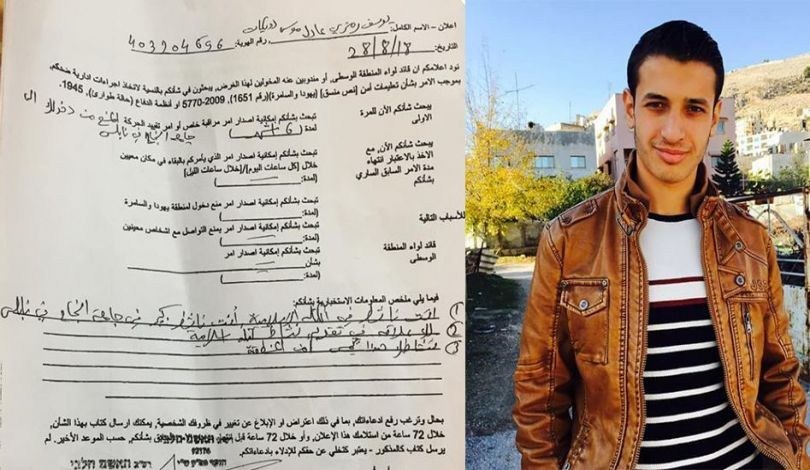
Photo: Yousef Dweikat and the order barring him from his university. Via Hadf News.
Samidoun Palestinian Prisoner Solidarity Network – August 29, 2018
Palestinian student Yousef Dweikat was banned from entering the campus of his university, An-Najah National University in occupied Nablus, on Tuesday, 28 August 2018. Dweikat, 20, a student at the Faculty of Engineering at the university and an activist with the Islamic Bloc student organization, was summoned to meet with Israeli occupation intelligence in the Salem military base.
When he presented himself, he was presented with an order barring him from his own university campus for the next six months. A Palestinian refugee who lives in Balata refugee camp, Dweikat, an electrical engineering student, is a former prisoner; he was arrested by Israeli occupation forces in March 2017 and jailed for six months for his involvement in student activities.
In an interview with Quds News, Dweikat called upon the university “to create solutions and alternatives so that this type of decision does not affect a larger number of university students.” He noted that the Israeli occupation had used a similar policy against university students in the 1980s and is now returning to those practices. Dweikat also said that his education was already delayed because of his previous detention and that he had already registered for the new year, paid his university fees and prepared to start the new semester. “My family and I are tense and frustrated. We do not know what we can do next to confront this unjust decision,” he said.
This is only the latest violation of the Palestinian right to education by the Israeli occupation. According to the Palestinian Ministry of Education, there are over 300 Palestinian university students imprisoned in Israeli jails. Each year, especially around the time of student council elections, universities face invasions and attacks on active students. Student leaders like Omar Kiswani, president of the Bir Zeit University student council, have been seized from campus in violent raids.
In addition, as the Palestinian Right to Enter campaign notes, international academics – including Palestinians born in exile with foreign passports – are routinely denied entry to Palestine by Israeli occupation forces at colonially controlled borders. By denying entry to scholars invited to teach, lecture or study at Palestinian universities, the Israeli occupation seeks to isolate Palestinian educators, scholars and students from their international peers.
These routine violations of Palestinian academic freedom – along with the racial exclusion of international students, particularly those identified as Arabs, Muslims or Palestinians – have added impetus to the ongoing call for academic boycott of Israeli institutions. The US Campaign for the Academic and Cultural Boycott of Israel is urging universities, students and faculty to take a pledge to boycott “study abroad” programs run by Israeli institutions, “We Will not Study in Israel Until Palestinians Can Return: Boycott Study Abroad in Israel!” Samidoun Palestinian Prisoner Solidarity Network is one of the endorsers of this call.
As many students head back to university around the world, solidarity with Palestinian students and scholars is particularly critical. These arrests and bans are an attempt to dismantle Palestinian students’ ability to learn, organize and uphold their identity, existence and struggle on campus. Samidoun Palestinian Prisoner Solidarity Network urges supporters of Palestine on campuses around the world to join the campaign to boycott Study Abroad, support the academic boycott of Israel and hold events and activities to highlight the violation of Palestinian rights to education, particularly the imprisonment of Palestinian students.
Social Media Giants Enter NATO Service
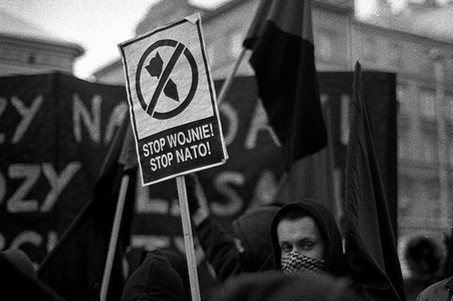
By Rick Rozoff | Ron Paul Institute | August 28, 2018
On August 22 Facebook and its CEO Mark Zuckerberg announced that they had arbitrarily removed 652 accounts, groups and pages allegedly linked to Russia and Iran for “coordinated inauthentic behavior,” by which we’re safe in assuming is meant political information inconvenient for the US power structure and its “Euro-Atlantic” elite allies in Europe and elsewhere.
The purpose pursued and the criteria employed are both explicitly political, focusing especially on federal elections. Facebook boasted of recent successes in this regard in France and Mexico.
There are historically-decisive Senate and Congressional elections this November 6th in the US.
At the beginning of this month several major conservative and libertarian Facebook, YouTube and other social media accounts were closed by the above and other parties in a heavy-handed, coordinated manner. The sites and individuals banned are ones that have urged cooperation between the US and Russia and warned against worsening political and potential military conflict between the world’s two major nuclear powers.
What connects the two unprecedented social media purges is an agreement reached in May of this year between Facebook and the Atlantic Council.
The Atlantic Council of the United States was established in 1961 by former Secretaries of State Dean Acheson and Christian Herter to bolster support for NATO. Atlantic Councils were set up in other member states for the same purpose, and at the present time they now number more than 40 in NATO and Partnership for Peace countries. The name is derivative of North Atlantic Council, the highest governing body of NATO.
Due to its efforts, NATO has grown from 16 to 29 members since the end of the Cold War and in addition has recruited at least forty military partners throughout the world. With Colombia joining its Partners Across the Globe program earlier this year, NATO now has members and partners on all inhabited continents.
The partnership between Facebook and the Atlantic Council was described by the Atlantic Council’s president and CEO Fred Kempe as follows:
This partnership will help our security, policy and product teams get real-time insights and updates on emerging threats and disinformation campaigns from around the world. It will also increase the number of ‘eyes and ears’ we have working to spot potential abuse on our service – enabling us to more effectively identify gaps in our systems, preempt obstacles, and ensure that Facebook plays a positive role during elections all around the world.
The collaboration, like NATO and Facebook themselves, are not only avowedly political but unabashedly global in scale.
In the interim Facebook has announced it’s hired “additional third-party reviewers” for the purpose advancing the aforesaid political censorship and furtherance of NATO’s international agenda.
Failing such methods, there are also those proposed by then-president presumptive Hillary Clinton two years ago: “As president, I will make it clear that the United States will treat cyberattacks just like any other attack. We will be ready with serious political, economic and military responses.”
Guns and Butter Banned and Removed from KPFA Radio
Guns and Butter | August 16, 2018
Dear Guns and Butter Supporters and Listeners,
Guns and Butter has been taken off the KPFA airwaves by the General Manager of the station.
I received on Wednesday, August 8th, before Guns and Butter would have aired on KPFA, the following email from the General Manager:
Bonnie,
KPFA will cease broadcasting “Guns and Butter” effective immediately.
We’ve received an avalanche of negative calls and emails from listeners about your uncritically airing of views by a holocaust denier, climate denial and casting the Parkland mass shooting survivors as crisis actors. As steward of our airways, we can’t defend this content to our listeners.
Sincerely,
Quincy McCoy Kevin Cartwright
General Manager Program Director
This was followed by removal of the entire KPFA broadcast archives of Guns and Butter, down the memory hole.
KPFA defines itself as “Free Speech Radio” and this reaction is a form of censorship. There was no discussion of these claims, nor any provision for due process or community involvement before these actions were taken.
Background
On July 24th, after registering unique premiums I had developed for the two-week KPFA Summer Fund Drive, I received an email from the pledge room informing me that Guns and Butter was pre-empted for the two-week fund drive. The show had never been pre-empted during fund drives, no reason was given, nor any prior notice.
On July 18th I received one other message from the station – the General Manager forwarded to me two email complaints from listeners, the day Guns and Butter aired The Impact of Zionist Influence in the U.S., a presentation by Alan Sabrosky as part of a panel, Zionism – Deconstructing the Power Paradigm, from an online conference. The GM wrote that he agreed with the criticism, that there was “nothing in the mission that agrees or allows unbalanced issue shows like this especially about a topic as sensitive as this.”
Response to Claims
“Holocaust Denial” Alan Sabrosky is a Jewish American war veteran and former Army War College Director at the Strategic Studies Institute. He did not claim that there was no persecution of Jewish people in fascist Germany. The focus of his talk was on present and future perils, specifically war with Iran. Airing his brief comments on WWII is apparently what has angered some people. There could be an equivalent number of people who appreciated those comments but did not choose to send an email about them.
“Climate Denial” (Whatever that means) Programming on Guns and Butter has covered climate disruption, climate extremes, etc. It has not flat out supported the theory that global warming is the future trend because there are other scientific phenomenon and influences on the climate that are being studied such as sun cycles, space weather and the weakening of the earth’s magnetosphere, among other factors, that should be considered.
“Crisis Actors” No one on the show claimed that Parkland student shooting survivors were crisis actors. What was pointed out was that it was suspicious that the student activist whose political narrative was picked up by the media was not even at the school during the shooting, but showed up right afterward.
About Guns and Butter
Guns and Butter is an educational program that provides a platform for opinions and analyses not heard in the mainstream media. The program is not necessarily about what I think or believe, nor does it constitute an endorsement of every thing said by a guest, but an opportunity for thought and discussion by listeners interested in differing points of view. In a time of extreme polarity in our country, open sharing of ideas is where we need to be.
Guns and Butter spearheaded deep analysis of the seminal event of the 21st Century – the crimes of September 11th that no other program on KPFA would deal with. I also produced many hours of original economic and financial programming with Dr. Michael Hudson, Dr. Michel Chossudovsky, Dr. Webster Tarpley, to name a few. You wouldn’t realize it now, but there wasn’t any other financial/economic programming on the station at the time. The geopolitical coverage on Guns and Butter has also been superb. The show has produced outstanding programming on a wide variety of complex and difficult subjects.
Guns and Butter was created by me and a fellow volunteer reporter in the KPFA Newsroom in 2001. It was approved for broadcast by a democratic vote of the KPFA Program Council that included community members. The program is fully edited and mixed for broadcast, and is a more than full-time stressful job to produce. It has aired for 17 years and has raised multiple hundreds of thousands of dollars for the station, which reflects very strong listener support. I have never received any support from the station.
An unprecedented attack on the 1st Amendment right of free speech is taking place generally. Alternative media on the Internet is being removed, not just from social media platforms, but websites themselves have come under denial of service attack. Youtube has for some time been eliminating channels. I have just learned that Word Press is taking down websites. Computer algorithms are clamping down on search engines for alternative news and has adversely affected many popular sites, including Global Research.
It seems that differing viewpoints are no longer allowed on KPFA’s airwaves and that listeners’ feelings are purportedly being protected by station management when it is information, facts and data that should be given the highest precedence by management, not opinions. It is always uncomfortable hearing something that one finds offensive or that threatens to break one out of one’s bubble, but it is an individual’s responsibility not the station’s to take care of one’s own feelings. And rather than management deciding what listeners should or should not hear because of managements’ own personal biases or pressure from special interest groups, listeners’ ability to think for themselves and make up their own minds should be respected and not be subject to censorship of ideas and unknown research from either the Right or the Left, especially when it comes to KPFA which should be guided by the Pacifica mission that includes the following:
To establish a Foundation organized and operated exclusively for educational purposes. ……… In radio broadcasting operations to engage in any activity that shall contribute to a lasting understanding between nations and between the individuals of all nations, races, creeds and colors; to gather and disseminate information on the causes of conflict between any and all of such groups; and through any and all means compatible with the purposes of this corporation to promote the study of political and economic problems and of the causes of religious, philosophical and racial antagonisms.
Guns and Butter is broadcast on WBAI in New York City every Wednesday at 9AM and is carried on many Pacifica Affiliates and will continue to be archived here on the Guns and Butter website.
We need your financial help to sustain our programming, most especially during this extremely difficult time of alternative media censorship, and we thank you for your support. Thank you to everyone who has signed up for monthly sustainable contributions, and to those of you who have made one-time donations. We cannot express enough our gratitude. As always, your donations are tax-deductible to the full extent of the law. Guns and Butter is a project of Inquiring Systems, a registered 501(c)(3) that has been providing non-profit status to socially responsible organizations since 1978.
American Pravda: Holocaust Denial
By Ron Unz • Unz Review • August 27, 2018
Reason Magazine and Holocaust Denial
A few years ago I somehow heard about a ferocious online dispute involving a left-leaning journalist named Mark Ames and the editors of Reason magazine, the glossy flagship publication of America’s burgeoning libertarian movement. Although I was deep in my difficult programming work, curiosity got the better of me, so I decided to take a look.
During the Immigration Wars of the 1990s, I’d become quite friendly with the Reason people, frequently visiting their offices, especially during my “English” campaign of 1998, when I’d located my own political headquarters in the same small Westside LA office building they used. As my content-archiving software project began absorbing more and more of my time during the early 2000s, I’d gradually lost touch with them, but even so, the 40-odd years of their magazine archives had become the first publication I’d incorporated into my system, and I was now pleased to discover that both sides in the ongoing feud had put my system to good use in exploring those old Reason issues.
Apparently, the libertarians grouped around Reason had successfully been making political inroads into Silicon Valley’s enormously wealthy technology industry, and had now organized a major conference in San Francisco to gather together their supporters. Their left-leaning rivals decided to nip that project in the bud by highlighting some of the more unsavory ideological positions that mainstream libertarian leaders had once regularly espoused. Perhaps Ron Paul and other libertarians might oppose overseas wars and drug laws, and support cutting taxes and regulations, but they and their Republican Party allies were unspeakably vile on all sorts of other issues, and all “good thinkers” should therefore stay very far away.
The debate began in rather mundane fashion with an article by Ames entitled “Homophobia, Racism, and the Kochs” denouncing Reason for sharing a platform with a high-ranking Republican Congresswoman of Christian conservative views, as well as the magazine’s reliance upon Koch funding and its alleged support for Apartheid South Africa during the 1970s and 1980s. The response by the Reason editor seemed quite persuasive, and he rightfully dismissed the guilt-by-association attacks. He also outlined the gross errors and omissions in the charges regarding South Africa, and ridiculed Ames as a notoriously error-prone “conspiracy theorist.” Surely few outsiders would have paid any attention to such a typical exchange of mudslinging between rival ideological camps.
But then things took a very different turn, and a week later Ames returned with a 5,000 word article bearing a title sure to grab attention: “Holocaust Denial.” He claimed that in 1976 Reason had published an entire special issue devoted to that explosive topic.
Surely everyone on the Internet has encountered numerous instances of Holocaust Denial over the years, but for a respectable magazine to have allotted a full issue to promoting that doctrine was something else entirely. For decades, Hollywood has sanctified the Holocaust, and in our deeply secular society accusations of Holocaust Denial are a bit like shouting “Witch!” in Old Salem or leveling accusations of Trotskyism in the Court of the Red Czar. Progressive Sam Seder’s Majority Report radio show devoted a full half-hour segment to the charges against Reason, and Googling “Reason Magazine”+”Holocaust Denial” today yields thousands of hits. This substantial explosion of Internet controversy was what caught my own attention at the time.
My initial reaction was one of puzzlement. Reason had been the first periodical I had digitized in my system a dozen years earlier, and surely I would have noticed an entire issue promoting Holocaust Denial. However, I soon discovered that February 1976 had been excluded from the supposedly complete set the magazine had shipped me for processing, an omission that itself raises serious suspicions. But Ames had somehow located a copy in a research library and produced a full PDF, which he conveniently placed on the Internet to support his accusations.

Carefully reading his article and then glancing through the contents, I decided that his accusation was technically false but substantially true. Apparently the actual theme of the issue was “Historical Revisionism” and except for a couple of paragraphs buried here and there among the 76 pages, Holocaust Denial never came up, so characterizing it as a Holocaust Denial issue was obviously a grotesque exaggeration. But on the other hand, although few of the authors were familiar to me, it seemed undeniably true that they were numbered among America’s more prominent Holocaust Deniers, and most of them were deeply associated with organizations situated in that same camp. Furthermore, there were strong indications that their positions on that topic must certainly have been known to the Reason editors who commissioned their pieces.
The clearest case comes when Ames quoted the explicit statements of Dr. Gary North, a prominent libertarian thinker who had served as one of Ron Paul’s earliest Congressional aides and later became his longtime partner in politics and business:
Probably the most far-out materials on World War II revisionism have been the seemingly endless scholarly studies of the supposed execution of 6 million Jews by Hitler. The anonymous author [Hoggan] of ‘The Myth of the Six Million’ has presented a solid case against the Establishment’s favorite horror story—the supposed moral justification for our entry into the war…The untranslated books by the former Buchenwald inmate Prof. Paul Rassinier, have seriously challenged the story…A recent and very inexpensive book in magazine form, Did Six Million Really Die?, appeared in 1973, written by Richard Harwood.
A later issue carried a thousand word letter by Prof. Adam Reed of Rockefeller University, a past Reason contributor, strongly affirming the mainstream Holocaust narrative by quoting from standard works, and taking Dr. North to task for his citation of Holocaust Denial works of doubtful quality. But North firmly stood his ground:
“The second point, that about 6 million Jews really did die in the concentration camps, is one that will be open until the records of the period become fully available. I am not convinced yet, one way or the other. I am happy to have Dr. Reed’s interpretation of the data, but until the publishing companies and academic guild encourage the re-examination of the data, I shall continue to recommend that those interested in revisionist questions read The Myth of the Six Million and Did Six Million Really Die? as reasonable (though not necessarily irrefutable) pieces of historical revisionism. If a person can’t make up his mind, he should do more reading.”
Dr. James J. Martin was the lead contributor to the February Revisionism issue, and the preceding January issue had featured an extended Q&A by the editors, with one of the queries directly addressing the controversial topic:
REASON: Dr. Martin, do you believe (1) that the specific charge against the Nazis of having a mass extermination program of several million Jews is true, and (2) that the Allied atrocities were as great or greater than those of the Germans, from your study of the question?
MARTIN: Well, I never made a head count of all who lost their lives in the War-we’ve seen a wide variety of statistical materials, some of which have been pulled out of thin air. As a consequence, it’s hard to make any kind of estimate of this sort, whether ten more were killed on the one side or the other is not a particularly entrancing subject as far as I’m concerned. Whether allegations can be proven it remains to be seen. I don’t believe that the evidence of a planned extermination of the entire Jewish population of Europe is holding up. I have been influenced over the years by the works of Paul Rassinier, and he still has to be reckoned with. His works have been ignored for a long time, and sooner or later somebody’s going to have to do a decent job of coping with what he has presented. I think Rassinier’s general case is sound at the moment and I haven’t seen any strong evidence to upset his allegations or his assertions that there was no planned program for the extermination of European Jews. His other main case is that there were no gas chamber extermination programs. The fact that a great many people lost their lives is incontrovertible—that the German concentration camps weren’t health centers is well known-but they appear to have been far smaller and much less lethal than the Russian ones.
Another major contributor to the issue was Dr. Austin J. App, and just three years earlier he had published a short book bearing the lurid title The Six Million Swindle: Blackmailing the German People for Hard Marks with Fabricated Corpses.
In a follow-up column by Ames’ own editor, the stunned reactions of various journalists are listed, with one of them Tweeting out “I had no idea that Reason Magazine was once a haven for Holocaust Revisionism. Holy Moly.” Despite the angry obfuscations of present-day Reason staffers, this description seems quite correct.
Indeed, there seems considerable circumstantial evidence that around that time “Holocaust Skepticism” extended rather broadly within the entire nascent libertarian movement. Aside from the sharp critique of the aforementioned Prof. Reed, the overwhelming majority of the reader responses seemed totally favorable, with Samuel Konkin III, editor of New Libertarian Weekly and various similar publications, suggesting that the February issue was one of the best they had ever published. David Nolan, founder of America’s Libertarian Party, also praised the issue as “outstanding.”
The two editors of the issue in question even today remain quite prominent figures at Reason and within American libertarianism, while the masthead then carried names such as David Brudnoy and Alan Reynolds, who both later became influential figures in conservative and libertarian politics. There seems no evidence of any resignations or angry recriminations following the issue’s publication, which seems to have been digested with total equanimity, apparently arousing less rancor than might have been generated by a dispute over monetary policy.
I’d never paid much attention to Holocaust discussions over the years, but the name of Murray Rothbard on the 1976 Reason masthead prompted a memory. Rothbard is widely regarded as the founder of modern libertarianism, and I recalled in the 1990s reading somewhere that he had often ridiculed the Holocaust as being total nonsense, which had stuck in my mind as a typical example of libertarian eccentricity. A quick Google search seemed to confirm my recollection that Rothbard was an avowed Holocaust Denier.
Although the whole controversy regarding Reason’s editorial line of the mid-1970s soon died down, it remained a nagging puzzle in the back of my mind. I’d always been quite skeptical of libertarian ideology, but my Reason friends from the 1990s had certainly seemed like smart and rational people to me, hardly raving lunatics of any sort, and two of the ones I’d known best had been the co-editors of the controversial issue in question.
I could easily understand how zealous libertarian ideologues might be swept past the point of rationality on certain matters—perhaps arguing that the police and the army should be abolished as statist institutions—but the factual question of what had or had not happened to the Jews of Europe during World War II hardly fell into that sort of category. Furthermore, libertarianism had always attracted a very large Jewish contingent, especially in its upper ranks, and one of the issue editors came from that background, as did Rothbard and numerous others featured on the masthead. While deranged anti-Semitism is not impossible among Jews, I would think that it is somewhat less likely. Clearly something very odd must have been going on.
I was then too busy with my work to focus on the matter, but some months later I had more time, and began a detailed investigation. My first step was to carefully read the Reason articles produced by those controversial writers previously unknown to me. Although those pieces were not Holocaust-related, I thought they might give me a sense of their thinking.
To my surprise, the historiography seemed outstandingly good, and almost certainly accurate based on what I had picked up over the years from perfectly mainstream sources. Dr. Martin’s long article on the notorious framing of “Tokyo Rose” was probably the best and most comprehensive treatment I had ever encountered on that topic, and Dr. App’s analysis of the tragedy of the Sudeten-Germans was equally strong, raising several points I had previously not known. Percy Greaves effectively summarized many of the very suspicious aspects of the Pearl Harbor attack, and although his case for the prosecution against FDR was certainly not airtight, it accorded with the views presented by numerous scholars in other books on the subject. Moreover, his position was seconded by a young Bruce Bartlett, later a prominent Reagan and Bush official, and still later a strong Republican opponent of George W. Bush, routinely feted by the New York Times. Most of the other writings also seemed of very high quality, including Dr. North’s summary of World War II Revisionism. In general, the academic scholarship of those articles greatly surpassed anything found in opinion magazines of more recent decades, Reason itself included. Those so interested can click on the above links, read the articles in question, and decide for themselves.
Back then, Reason was a young and struggling magazine, with a shoestring staff and budget. Publishing articles of such obvious quality was surely a remarkable achievement for which the editors could feel justifiably proud, and the overwhelmingly positive letters they received seemed absolutely warranted. Meanwhile, the nasty attacks by Ames appeared to be those of a mere political hack who may not have even bothered actually reading the articles whose authors he vilified.
As a further sign of Ames’ dishonesty, he flung the epithet “Nazi” some two dozen times in his hack-job, along with numerous uses of “anti-Semitic” as well, and Greaves was certainly the subject of many of those slurs. But although Greaves and Bartlett wrote back-to-back articles on exactly the same Pearl Harbor topic, and according to Wikipedia, the former was the academic advisor to the latter on that subject, Bartlett’s name appears nowhere in Ames’s hit-piece, presumably because denouncing a prominent policy expert much beloved by the New York Times as an “anti-Semitic Neo-Nazi” might prove self-defeating. Even leaving that aside, accusing the Jewish libertarians running Reason of being Nazi propagandists must surely be the sort of charge that would strain the credulity of even the most gullible.
Debra Lipstadt and Holocaust Denial
With Ames’ credibility totally shredded, I decided to carefully reread his article again, looking for what clues I could find to the whole bizarre situation. Academic scholars who publish very good history on certain subjects might still have totally irrational views on others, but normally one would assume otherwise.
It appeared that much of Ames’ understanding of the issue had come from a certain Debra Lipstadt, whom he characterized as a great Holocaust expert. Her name was very vaguely familiar to me as some sort of academic activist, who years before had won a major legal victory over a rightwing British historian named David Irving, and Irving himself received further denunciations in the Ames article.
However, one name did stick out. Apparently based on Lipstadt’s information, Ames described Harry Elmer Barnes as “the godfather of American Holocaust denial literature” and Martin’s “Holocaust denial guru.”
A dozen years earlier, the name “Barnes” would have meant almost nothing to me. But as I produced my content-archiving system and digitized so many of America’s most influential publications of the last 150 years, I had soon discovered that many of our most illustrious public intellectuals—Left, Right, and Center—had been suddenly purged and “disappeared” around 1940 because of their stalwart opposition to FDR’s extremely aggressive foreign policy, and Barnes, an eminent historian and sociologist, had been among the most prominent of those. He had been one of the earliest editors at Foreign Affairs and for many years afterward his important articles had graced the pages of The New Republic and The Nation, while even after his fall, he had edited Perpetual War for Perpetual Peace, an important 1953 collection of essays by himself and other once-prominent figures. But to have a figure of such intellectual stature accused of being a Holocaust Denier, let alone the “godfather” of the entire movement, seemed rather bizarre to me.
Since Ames was merely an ignorant political hack transmitting the opinions of others, I moved on Lipstadt, his key source. Anyone who has spent much time on the comment-threads of relatively unfiltered websites has certainly encountered the controversial topic of Holocaust Denial, but I now decided to try to investigate the issue in much more serious fashion. A few clicks on the Amazon.com website, and her 1993 book Denying the Holocaust arrived in my mailbox a couple of days later, providing me an entrance into the mysterious world.
Reading the book was certainly a tremendous revelation to me. Lipstadt is a professor of Holocaust Studies with an appointment in Emory University’s Department of Theology, and once I read the opening paragraph of her first chapter, I decided that her academic specialty might certainly be described as “Holocaust Theology.”
The producer was incredulous. She found it hard to believe that I was turning down an opportunity to appear on her nationally televised show. “But you are writing a book on this topic. It will be great publicity.” I explained repeatedly that I would not participate in a debate with a Holocaust denier. The existence of the Holocaust was not a matter of debate. I would analyze and illustrate who they were and what they tried to do, but I would not appear with them…Unwilling to accept my no as final, she vigorously condemned Holocaust denial and all it represented. Then, in one last attempt to get me to change my mind, she asked me a question: “I certainly don’t agree with them, but don’t you think our viewers should hear the other side?”
Lipstadt’s absolute horror at having someone actually dispute the tenets of her academic doctrine could not have been more blatant. Surely no zealous theologian of the European Dark Ages would have reacted any differently.
The second chapter of her book supported that impression. Since many of the individuals she castigates as Holocaust Deniers also supported the Revisionist perspective of the underlying causes of the First and Second World Wars, she harshly attacked those schools, but in rather strange fashion. In recent years, blogger Steve Sailer and others have ridiculed what they describe as the “point-and-sputter” style of debate, in which a “politically-incorrect” narrative is merely described and then automatically treated as self-evidently false without any accompanying need for actual refutation. This seemed to be the approach that Lipstadt took throughout her rather short book.
For example, she provided a very long list of leading academic scholars, prominent political figures, and influential journalists who had championed Revisionist history, noted that their views disagree with the more mainstream perspective she had presumably imbibed from her History 101 textbooks, and thereby regarded them as fully debunked. Certainly a Christian preacher attempting to refute the evolutionary theories of Harvard’s E.O. Wilson by quoting a passage of Bible verse might take much the approach. But few evangelical activists would be so foolish as to provide a very long list of eminent scientists who all took the same Darwinist position and then attempt to sweep them aside by citing a single verse from Genesis. Lipstadt seems to approach history much like a Bible-thumper, but a particularly dim-witted one. Moreover, many of the authors she attacked had already become familiar to me after a decade of my content-archiving work, and I had found their numerous books quite scholarly and persuasive.
Barnes, in particular, figured quite prominently in Lipstadt’s chapter and throughout her book. The index listed his name on more than two dozen pages, and he is repeatedly described as the “godfather” of Holocaust Denial, and its seminal figure. Given such heavy coverage, I eagerly examined all those references and the accompanying footnotes to uncover the shocking statements he must have made during his very long scholarly career.
I was quite disappointed. There is not a single reference I could find to his supposed Holocaust Denial views until just the year before his death at age 79, and even that item is hardly what I had been led to believe. In a 9,300 word article on Revisionism for a libertarian publication, he ridicules a leading Holocaust source for claiming that Hitler had killed 25 million Jews, noting that total was nearly twice their entire worldwide population at the time. In addition, Barnes several times applied the word “allegedly” to the stories of the Nazi extermination scheme, an sacrilegious attitude that appears to have horrified a theologian such as Lipstadt. Finally, in a short, posthumously published review of a book by French scholar Paul Rassiner, Barnes found his estimate of just 1 million to 1.5 million Jewish deaths quite convincing, but his tone suggested that he had never previously investigated the matter himself.
So although that last item technically validated Lipstadt’s accusation that Barnes was a Holocaust Denier, her evidence-free claims that he was the founder and leader of the field hardly enhances her scholarly credibility. Meanwhile, all the many tens of thousands of words I have read by Barnes has suggested that he was a careful and dispassionate historian.
A notorious incident that occurred soon after the Bolshevik Revolution came to my mind. Eminent philologist Timfei Florinsky, one of Russia’s most internationally renowned academic scholars, was hauled before a revolutionary tribunal for a public interrogation about his ideas, and one of the judges, a drunken Jewish former prostitute, found his answers so irritating that she drew her revolver and shot him dead right there and then. Given Lipstadt’s obvious emotional state, I have a strong suspicion that she might have wished she could deal in a similar fashion with Barnes and the numerous other scholars she denounced. Among other things, she noted with horror that more than two decades after his 1940 purge from public life, Barnes’ books were still required reading at both Harvard and Columbia.
All of us reasonably extrapolate what we already know or can easily check against what is more difficult to verify, and the remaining chapters of Lipstadt’s book left me very doubtful about the reliability of her work, all of which was written in a similar near-hysterical style. Since she had already been vaguely known to me from her well-publicized legal battle against historian David Irving more than a dozen years earlier, I was hardly surprised to discover that many pages were devoted to vilifying and insulting him in much the same manner as Barnes, so I decided to investigate that case.
I was only slightly surprised to discover that Irving had been one of the world’s most successful World War II historians, whose remarkable documentary findings had completely upended our knowledge of that conflict and its origins, with his books selling in the many millions. His entire approach to controversial historical issues was to rely as much as possible upon hard documentary evidence, and his total inability to locate any such documents relating to the Holocaust drove Lipstadt and her fellow ethnic-activists into a frenzy of outrage, so after many years of effort they finally managed to wreck his career. Out of curiosity, I read a couple of his shorter books, which seemed absolutely outstanding historiography, written in a very measured tone, quite different from that of Lipstadt, whose own 2005 account of her legal triumph over Irving, History on Trial, merely confirmed my opinion of her incompetence.
Lipstadt’s first book Beyond Belief, published in 1986, tells an interesting story as well, with her descriptive subtitle being “The American Press and the Coming of the Holocaust, 1933-1945.” Much of the volume consists of press clippings from the American print media of that era interspersed with her running rather hysterical commentary, but providing little analysis or judgment. Some of the journalists reported horrifying conditions for Jews in pre-war Germany while others claim that such stories were wildly exaggerated, and Lipstadt automatically praised the former and denounced the latter without providing any serious explanation.
Lenni Brenner’s remarkable book Zionism in the Age of the Dictators had been published three years earlier. Although I only discovered it very recently, surely any half-competent specialist in her own topic would have noticed it, yet Lipstadt provided no hint of its existence. Perhaps the reality of the important Nazi-Zionist economic partnership of the 1930s, with Nazi officials traveling to Palestine as honored Zionist guests and leading Nazi newspapers praising the Zionist enterprise might have complicated her simple story of fanatic German Jew-hatred under Hitler steadily rising towards an exterminationist pitch. Her faculty appointment in a Department of Theology seems very apt.
Lipstadt’s wartime coverage is just as bad, perhaps worse. She catalogs perhaps a couple of hundred print news reports, each describing the massacre of hundreds of thousands or even millions of Jews by the Nazis. But she expresses her outrage that so many of these reports were buried deep within the inside pages of newspapers, a placement suggesting that they were regarded as hysterical wartime atrocity propaganda and probably fictional, with the editors sometimes explicitly stating that opinion. Indeed, among these under-emphasized stories was the claim that the Germans had recently killed 1.5 million Jews by individually injecting each one of them in the heart with a lethal drug. And although I don’t see any mention of it, around that same time America’s top Jewish leader Rabbi Stephen Wise was peddling the absurd report that the Nazis had slaughtered millions of Jews, turning their skins into lampshades and rendering their bodies into soap. Obviously, separating truth from falsehood during a blizzard of wartime propaganda is not nearly as easy as Lipstadt seems to assume.
Ordinary Americans were apparently even more skeptical than newspaper editors. According to Lipstadt:
Writing in the Sunday New York Times Magazine, [Arthur] Koestler cited public opinion polls in the United States in which nine of ten average Americans dismissed the accusations against the Nazis as propaganda lies and flatly stated that they did not believe a word of them.
Lipstadt convincingly demonstrates that very few Americans seem to have believed in the reality of the Holocaust during the Second World War itself, despite considerable efforts by agitated Jewish activists to persuade them. Over the years, I have seen mention of numerous other books making this same basic point, and therefore harshly condemning the American political leaders of the time for having failed “to save the Jews.”
Explicit and Implicit Holocaust Denial After World War II
Yet as I began further investigating the history of Holocaust Denial in the wake of the Reason contretemps, I was very surprised to discover that this same pattern of widespread disbelief in the Holocaust seems to have continued unabated after the end of the war and throughout the 1950s, being especially strong among high-ranking American military figures, especially top generals and individuals with an Intelligence background, who seemingly would have had the best knowledge of the true events.
Some years ago, I came across a totally obscure 1951 book entitled Iron Curtain Over America by John Beaty, a well-regarded university professor. Beaty had spent his wartime years in Military Intelligence, being tasked with preparing the daily briefing reports distributed to all top American officials summarizing available intelligence information acquired during the previous 24 hours, which was obviously a position of considerable responsibility.
As a zealous anti-Communist, he regarded much of America’s Jewish population as deeply implicated in subversive activity, therefore constituting a serious threat to traditional American freedoms. In particular, the growing Jewish stranglehold over publishing and the media was making it increasingly difficult for discordant views to reach the American people, with this regime of censorship constituting the “Iron Curtain” described in his title. He blamed Jewish interests for the totally unnecessary war with Hitler’s Germany, which had long sought good relations with America, but instead had suffered total destruction for its strong opposition to Europe’s Jewish-backed Communist menace.
Beaty also sharply denounced American support for the new state of Israel, which was potentially costing us the goodwill of so many millions of Muslims and Arabs. And as a very minor aside, he also criticized the Israelis for continuing to claim that Hitler had killed six million Jews, a highly implausible accusation that had no apparent basis in reality and seemed to be just a fraud concocted by Jews and Communists, aimed at poisoning our relations with postwar Germany and extracting money for the Jewish State from the long-suffering German people.
He was scathing toward the Nuremberg Trials, which he described as a “major indelible blot” upon America and “a travesty of justice.” According to him, the proceedings were dominated by vengeful German Jews, many of whom engaged in falsification of testimony or even had criminal backgrounds. As a result, this “foul fiasco” merely taught Germans that “our government had no sense of justice.” Sen. Robert Taft, the Republican leader of the immediate postwar era took a very similar position, which later won him the praise of John F. Kennedy in Profiles in Courage. The fact that the chief Soviet prosecutor at Nuremberg had played the same role during the notorious Stalinist show trials of the late 1930s, during which numerous Old Bolsheviks confessed to all sorts of absurd and ridiculous things, hardly enhanced the credibility of the proceedings to many outside observers.
Then as now, a book taking such controversial positions stood little chance of finding a mainstream New York publisher, but it was soon released by a small Dallas firm, and then became enormously successful, going through some seventeen printings over the next few years. According to Scott McConnell, founding editor of The American Conservative, Beaty’s book became the second most popular conservative text of the 1950s, ranking only behind Russell Kirk’s iconic classic, The Conservative Mind.
Moreover, although Jewish groups including the ADL harshly condemned the book, especially in their private lobbying, those efforts provoked a backlash, and numerous top American generals, both serving and retired, wholeheartedly endorsed Beaty’s work, denouncing the ADL efforts at censorship and urging all Americans to read the volume. Although Beaty’s quite explicit Holocaust Denial might shock tender modern sensibilities, at the time it seems to have caused barely a ripple of concern and was almost totally ignored even by the vocal Jewish critics of the work.
Much of this very interesting story is told by Joseph Bendersky, an expert in Holocaust Studies, who devoted ten years of archival research to his 2000 book The “Jewish Threat.” His work chronicles the extremely widespread anti-Semitism found within the U.S. Army and Military Intelligence throughout the first half of the twentieth century, with Jews being widely regarded as posing a serious security risk. The book runs well over 500 pages, but when I consulted the index I found no mention of the Rosenbergs nor Harry Dexter White nor any of the other very numerous Jewish spies revealed by the Venona Decrypts, and the term “Venona” itself is also missing from the index. Reports of the overwhelmingly Jewish leadership of the Russian Bolsheviks are mostly treated as bigotry and paranoia, as are descriptions of the similar ethnic skew of America’s own Communist Party, let alone the heavy financial support of the Bolsheviks by Jewish international bankers. At one point, he dismisses the link between Jews and Communism in Germany by noting that “less than half” of the Communist Party leadership was Jewish; but since fewer than one in a hundred Germans came from that ethnic background, Jews were obviously over-represented among Communist leaders by as much as 5,000%. This seems to typify the sort of dishonesty and innumeracy I have regularly encountered among Jewish Holocaust experts.
Meanwhile, with the copyright having long lapsed, I’m pleased to add Beaty’s work to my Controversial HTML Books selection, so individuals interested can read it and decide for themselves:
John Beaty • 1951 • 82,000 Words
Beaty’s very brief 1951 discussion has been the earliest instance of explicit Holocaust Denial I have managed to locate, but the immediate postwar years seem absolutely rife with what might be described as “implicit Holocaust Denial,” especially within the highest political circles.
Over the years, Holocaust scholars and activists have very rightfully emphasized the absolutely unprecedented nature of the historical events they have studied. They describe how some six million innocent Jewish civilians were deliberately exterminated, mostly in gas chambers, by one of Europe’s most highly cultured nations, and emphasize that monstrous project was often accorded greater priority than Germany’s own wartime military needs during the country’s desperate struggle for survival. Furthermore, the Germans also undertook enormous efforts to totally eliminate all possible traces of their horrifying deed, with huge resources expended to cremate all those millions of bodies and scatter the ashes. This same disappearance technique was even sometimes applied to the contents of their mass graves, which were dug up long after initial burial, so that the rotting corpses could then be totally incinerated and all evidence eliminated. And although Germans are notorious for their extreme bureaucratic precision, this immense wartime project was apparently implemented without benefit of a single written document, or at least no such document has ever been located.
Lipstadt entitled her first book “Beyond Belief,” and I think that all of us can agree that the historical event she and so many others in academia and Hollywood have made the centerpiece of their lives and careers is certainly one of the most very remarkable occurrences in all of human history. Indeed, perhaps only a Martian Invasion would have been more worthy of historical study, but Orson Welles’s famous War of the Worlds radio-play which terrified so many millions of Americans in 1938 turned out to be a hoax rather than real.
The six million Jews who died in the Holocaust certainly constituted a very substantial fraction of all the wartime casualties in the European Theater, outnumbering by a factor of 100 all the British who died during the Blitz, and being dozens of times more numerous than all the Americans who fell there in battle. Furthermore, the sheer monstrosity of the crime against innocent civilians would surely have provided the best possible justification for the Allied war effort. Yet for many, many years after the war, a very strange sort of amnesia seems to have gripped most of the leading political protagonists in that regard.
Robert Faurission, a French academic who became a prominent Holocaust Denier in the 1970s, once made an extremely interesting observation regarding the memoirs of Eisenhower, Churchill, and De Gaulle:
Three of the best known works on the Second World War are General Eisenhower’s Crusade in Europe (New York: Doubleday [Country Life Press], 1948), Winston Churchill’s The Second World War (London: Cassell, 6 vols., 1948-1954), and the Mémoires de guerre of General de Gaulle (Paris: Plon, 3 vols., 1954-1959). In these three works not the least mention of Nazi gas chambers is to be found.
Eisenhower’s Crusade in Europe is a book of 559 pages; the six volumes of Churchill’s Second World War total 4,448 pages; and de Gaulle’s three-volume Mémoires de guerre is 2,054 pages. In this mass of writing, which altogether totals 7,061 pages (not including the introductory parts), published from 1948 to 1959, one will find no mention either of Nazi “gas chambers,” a “genocide” of the Jews, or of “six million” Jewish victims of the war.
Given that the Holocaust would reasonably rank as the single most remarkable episode of the Second World War, such striking omissions must almost force us to place Eisenhower, Churchill, and De Gaulle among the ranks of “implicit Holocaust Deniers.”
Many others seem to fall into that same category. In 1981, Lucy S. Dawidowicz, a leading Holocaust scholar, published a short book entitled The Holocaust and the Historians, in which she denounced so many prominent historians for having so totally ignored the reality of the Holocaust for many years following World War II. Indeed, discussion of that topic was almost entirely confined to the Jewish Studies programs which Jewish ethnic activists had newly established at numerous universities throughout the country. Although Lipstadt’s poor scholarly habits and hysterical style hardly impressed me, she appears to have been among the most successful academics who began a career in those ethnic studies departments, which suggests that their average quality was far below her own.
Meanwhile, Dawidowicz emphasizes that mainstream histories often entirely omitted the Holocaust from their presentations:
But it is plain from the most cursory review of textbooks and scholarly works by English and American historians that the awesome events of the Holocaust have not been given their historic due. For over two decades some secondary school and college texts never mentioned the subject at all, while others treated it so summarily or vaguely as to fail to convey sufficient information about the events themselves or their historical significance.
With regard to serious scholarship, she notes that when Friedrich Meinecke, universally acknowledged as Germany’s most eminent historian, published The German Catastrophe in 1946, he harshly denounced Hitler as the leader of “a band of criminals” but made absolutely no mention of the Holocaust, which surely would have represented the height of such criminality. Major British accounts of Hitler and World War II by leading historians such as A.J.P. Taylor, H.R. Trevor-Roper, and Alan Bullock were almost as silent. A similar situation occurred in America as late as 1972 when the massive 1,237 page Columbia History of the World, having a Jewish co-editor, devoted a full chapter to World War II but confined its discussion of the Holocaust to just two short and somewhat ambiguous sentences. One almost gets a sense that many of these experienced professional historians treated discussion of the Holocaust as a considerable embarrassment, a subject that they sought to avoid or at least completely minimize.
Dawidowicz even castigates Slaughterhouse-Five, the 1969 fictional masterpiece by Kurt Vonnegut, for its bald assertion that the firebombing of Dresden was “the greatest massacre in European history,” a claim that seems to reduce the Holocaust to non-existence.
I myself had noticed something similar just a couple of years before Dawidowicz’s book appeared. The English translation of German journalist Joachim Fest’s widely praised Hitler had been published in 1974 and I had read it a few years later, finding it just as excellent as the critics had indicated. But I remember being a little puzzled that the 800 page book contained no more than a couple of pages discussing the Nazi death camps and the word “Jews” never even appeared in the index.
The vast majority of Hitler’s Jewish victims came from Russia and the Eastern European nations included in the Soviet Bloc. That was also the location of all the extermination camps that are the central focus of Holocaust scholars, and therefore the Soviets were the source of most of the key evidence used at the Nuremberg Trials. Yet Dawidowicz notes that after Stalin grew increasingly suspicious of Jews and Israel a few years after the end of the war, virtually all mention of the Holocaust and German wartime atrocities against Jews vanished from the Soviet media and history books. A similar process occurred in the Warsaw Pact satellites, even while the top Communist Party leadership of many of those countries often remained very heavily Jewish for some years. Indeed, I recall reading quite a number of newspaper articles mentioning that after the Berlin Wall fell and the sundered halves of Europe were finally reunited, most Eastern Europeans had never even heard of the Holocaust.
These days, my morning newspapers seem to carry Holocaust-related stories with astonishing frequency, and probably no event of the twentieth century looms so large in our public consciousness. According to public survey data, even as far back as 1995, some 97% of Americans knew of the Holocaust, far more than were aware of the Pearl Harbor attack or America’s use of the atomic bombs against Japan, while less than half our citizenry were aware that the Soviet Union had been our wartime ally. But I’d suspect that anyone who drew his knowledge from the mainstream newspapers and history books during the first couple of decades after the end of the Second World War might never have even been aware that any Holocaust had actually occurred.
In 1999 Philip Novick published a book on this general theme entitled The Holocaust in American Life, citing that survey, and his introduction began by noting the very strange pattern the Holocaust exhibited in its cultural influence, which seems quite unique among all major historical events. In the case of almost all other searing historical occurrences such as the massive bloodshed of the Somme or the bitter Vietnam War, their greatest impact upon popular consciousness and media came soon afterward, with the major books and films often appearing within the first five or ten years when memories were fresh, and the influence peaking within a couple of decades, after which they were gradually forgotten.
Yet in the case of the Holocaust, this pattern was completely reversed. Hardly anyone discussed it for the first twenty years after the end of the World War II, while it gradually moved to the center of American life in the 1970s, just as wartime memories were fading and many of the most prominent and knowledgeable figures from that era had departed the scene. Novick cites numerous studies and surveys demonstrating that this lack of interest and visibility certainly included the Jewish community itself, which had seemingly suffered so greatly under those events, yet apparently had almost completely forgotten about them during the 1950s and much of the 1960s.
I can certainly confirm that impression from my personal experience. Prior to the mid- or late-1970s, I had had only the vaguest impression that virtually all the Jews and Gypsies of Europe had been exterminated during the Second World War, and although the term “Holocaust” was in widespread use, it invariably referred to a “Nuclear Holocaust,” a term long-since supplanted and scarcely used today. Then, after the Berlin Wall fell, I was quite surprised to discover that Eastern Europe was still filled with vast numbers of unexterminated Gypsies, who quickly flooded into the West and provoked all sorts of political controversies.
The Rediscovery of the Holocaust
The late scholar Raul Hilberg is universally acknowledged as the founder of modern Holocaust studies, which began with the 1961 publication of his massive volume The Destruction of the European Jews. In his very interesting 2007 Hilberg obituary, historian Norman Finkelstein emphasizes that prior to Hilberg’s work, there had been virtually no writing on the Holocaust, and discussion of the topic was considered almost “taboo.” For a recent event of such apparent enormity to have been so completely wiped away from public discussion and the consciousness of historians and political scientists can be explained in several different ways. But once I began to investigate the circumstances behind Hilberg’s ground-breaking work, I encountered all sorts of strange ironies.
According to Wikipedia, Hilberg’s family of Austrian Jews coincidentally arrived in the United States on the exact day in 1939 that war broke out, and in his early teens he was soon horrified to read all the news reports of the ongoing extermination of his fellow Jews in the continent his family had left behind, even telephoning Jewish leaders asking why they were doing so little to save their kinsmen from annihilation. He subsequently served in the U.S. military in Europe, then majored in Political Science at Brooklyn College after the end of the conflict. The inspiration for his future scholarly focus seems to have come when he was shocked by a remark made by one of his lecturers, Hans Rosenberg:
The most wicked atrocities perpetrated on a civilian population in modern times occurred during the Napoleonic occupation of Spain.
When Hilberg asked how Rosenberg, himself a German-Jewish refugee, could have so totally ignored the murder of 6 million Jews, a monstrous crime committed just a couple of years earlier, Rosenberg sought to deflect the question, saying that “it was a complicated matter” and “history doesn’t teach down into the present age.” Since Rosenberg was a student of Meinecke, whom Lipstadt has bitterly denounced as an implicit Holocaust Denier, one wonders whether Rosenberg may have shared the beliefs of his mentor but was reluctant to admit that fact to his overwhelmingly Jewish students in emotionally-charged postwar Brooklyn.
Later, Hilberg conducted his doctoral research at Columbia under Franz Neumann, another German-Jewish refugee scholar. But when Hilberg indicated he wanted his research to focus on the extermination of Europe’s Jews, Neumann strongly discouraged that topic, warning Hilberg that doing so would be professionally imprudent and might become “his academic funeral.” When he attempted to publish his research in book form, it received numerous negative reviews, with Israel’s Yad Vashem fearing it would encounter “hostile criticism,” and over a six year period, it was rejected by several major publishing houses along with Princeton University, based on the advice of the influential Jewish intellectual Hannah Arendt. One naturally wonders whether all these established scholars may have quietly known something that a naive young doctoral candidate such as Hilberg did not. His book only appeared in print because a Jewish immigrant whose business had suffered under the Nazis funded the entire publication.
I’d never paid much attention to Holocaust issues, but the supporters of my local Palo Alto Library operate a monthly book sale, and with serious nonfiction hardcovers often priced at just a quarter each, my personal library has grown by hundreds of volumes over the years, now including several of the thickest and most influential Holocaust texts. Aside from Hilberg’s classic volume, these include Nora Levin’s The Holocaust (1968), Lucy Dawidowicz’s The War Against the Jews, 1933-1945 (1975), Martin Gilbert’s The Holocaust (1985), and Daniel Goldhagen’s Hitler’s Willing Executioners (1996).
I claim absolutely no expertise in Holocaust issues, and analyzing the evidence and argumentation these voluminous works offer is entirely beyond my ability. But I decided to attempt to assess their overall credibility by exploring a few particular items, without actually bothering to read the thousands of pages of text they provided.
Consider the interesting case of Field Marshal Erhard Milch, Hermann Goering’s very powerful number-two in the German Luftwaffe. His father was certainly a Jew, and according to researchers Robert Wistrich and Louis Snyder, there is archival evidence that his mother was Jewish as well. Now is it certainly not impossible that a Third Reich supposedly dedicated with grim fanaticism to the extermination of each and every Jew might have spent the entire war with a full- or half-Jew near the absolute top of its military hierarchy, but surely that puzzling anomaly would warrant careful explanation, and Milch’s apparent Jewish background was certainly known during the Nuremberg Trials.
Yet when I carefully consulted the very comprehensive indexes of those five books, totaling over 3,500 pages, there is virtually no discussion of Milch, except a few very brief mentions of his name in connection with various military operations. Either the authors were unaware of Milch’s Jewish background, or perhaps they hoped to keep that fact away from their readers lest it cause “confusion.” Neither of these possibilities enhances the trust we should place in their research skills or their scholarly objectivity.
Indeed, the fascinating and widely-praised 2002 book Hitler’s Jewish Soldiers by Bryan Mark Rigg notes that aside from Milch, Hitler’s military contained over a dozen half-Jewish generals and admirals and another dozen quarter-Jews of that same high rank, plus a total of roughly 150,000 additional half- or quarter-Jewish soldiers, with a large fraction of these being officers. All of these individuals would have had some fully-Jewish parents or grand-parents, which seems decidedly odd behavior for a regime supposedly so focused on the total eradication of the Jewish race.
Another obvious matter casts further doubt upon the historical quality of those five immensely thick volumes of standard Holocaust narrative, which together occupy nearly a linear foot on my bookshelves. For prosecutors of any crime, establishing a plausible motive is certainly an important goal, and in the case of the Jewish Holocaust, these authors would seem to have an easy task at hand. Hitler and his German colleagues had always claimed that the Jews overwhelmingly dominated Bolshevik Communism, and much of their struggle against the former was in order to prevent further bloody deeds of the latter. So surely devoting an early chapter or so to describing this central Nazi doctrine would provide an airtight explanation of what drove the Nazis to their fiendish slaughters, rendering fully explicable the horrifying events that would occupy the remainder of their text.
Yet oddly enough, an examination of their indexes for “Bolsheviks,” “Communism,” and all variants reveals almost no discussion of this important issue. Goldhagen’s 1996 book provides just a couple of short sentences spread across his 600 pages, and the other works seem to contain virtually nothing at all. Since all of these Holocaust books almost totally avoid Hitler’s self-declared motive for his anti-Jewish actions, they are forced to desperately search for alternative explanations, seeking clues buried deep within the German past or turning to psychanalytical speculations or perhaps deciding that what they describe as the greatest massacre in all human history was undertaken out of sheer Nazi wickedness.
The obvious reason for this glaring omission is that the authors are constructing a morality-play in which the Jews must be portrayed as absolutely blameless victims, and even hinting at their role in the numerous Communist atrocities that long preceded the rise of the Third Reich might cause readers to consider both sides of the issue. When purported historians go to absurd lengths to hide such glaring facts, they unmask themselves as propagandists, and we must be very cautious about trusting their reliability and candor in all other matters, whether great or small.
Indeed, the issue of Communism raises a far larger matter, one having rather touchy implications. Sometimes two simple compounds are separately inert, but when combined together may possess tremendous explosive force. From my introductory history classes and readings in high school, certain things had always seemed glaringly obvious to me even if the conclusions remained unmentionable, and I once assumed they were just as apparent to most others as well. But over the years I have begun to wonder whether perhaps this might not be correct.
Back in those late Cold War days, the death toll of innocent civilians from the Bolshevik Revolution and the first two decades of the Soviet Regime was generally reckoned at running well into the tens of millions when we include the casualties of the Russian Civil War, the government-induced famines, the Gulag, and the executions. I’ve heard that these numbers have been substantially revised downwards to perhaps as little as twenty million or so, but no matter. Although determined Soviet apologists may dispute such very large figures, they have always been part of the standard narrative history taught within the West.
Meanwhile, all historians know perfectly well that the Bolshevik leaders were overwhelmingly Jewish, with three of the five revolutionaries Lenin named as his plausible successors coming from that background. Although only around 4% of Russia’s population was Jewish, a few years ago Vladimir Putin stated that Jews constituted perhaps 80-85% of the early Soviet government, an estimate fully consistent with the contemporaneous claims of Winston Churchill, Times of London correspondent Robert Wilton, and the officers of American Military Intelligence. Recent books by Alexander Solzhenitsyn, Yuri Slezkine, and others have all painted a very similar picture. And prior to World War II, Jews remained enormously over-represented in the Communist leadership, especially dominating the Gulag administration and the top ranks of the dreaded NKVD.
Both of these simple facts have been widely accepted in America throughout my entire lifetime. But combine them together with the relatively tiny size of worldwide Jewry, around 16 million prior to World War II, and the inescapable conclusion is that in per capita terms Jews were the greatest mass-murderers of the twentieth century, holding that unfortunate distinction by an enormous margin and with no other nationality coming even remotely close. And yet, by the astonishing alchemy of Hollywood, the greatest killers of the last one hundred years have somehow been transmuted into being seen as the greatest victims, a transformation so seemingly implausible that future generations will surely be left gasping in awe.
Today’s American Neocons are just as heavily Jewish as were the Bolsheviks of a hundred years ago, and they have greatly benefited from the political immunity provided by this totally bizarre inversion of historical reality. Partly as a consequence of their media-fabricated victimhood status, they have managed to seize control over much of our political system, especially our foreign policy, and have spent the last few years doing their utmost to foment an absolutely insane war with nuclear-armed Russia. If they do manage to achieve that unfortunate goal, they will surely outdo the very impressive human body-count racked up by their ethnic ancestors, perhaps even by an order-of-magnitude or more.
Holocaust Frauds and Confusions
Since the Holocaust only became a major public topic after wartime memories had grown dim, the story has always seemed to suffer from the problems traditionally associated with “recovered memory syndrome.” Truths and falsehoods were often mixed together in strange ways, and the door was opened wide to an astonishing number of outright frauds and liars.
For example, in the late 1970s I remember many of my high school classmates devouring The Painted Bird by Jerzy Kosinski, perhaps the first widely popular Holocaust memoir. But then a few years later, the media revealed that Kosinski’s national best-seller was simply fraudulent, and the plagiarizing author eventually committed suicide. Indeed, there have been so many fake Holocaust memoirs over the years that they nearly constitute a literary genre of their own.
Probably the most world’s most famous Holocaust survivor was Elie Wiesel, who parlayed the stories of his wartime suffering into becoming an enormous political celebrity. His career was capped with a Nobel Peace Prize in 1986, and the announcement declared him “a messenger to mankind.” Yet journalist Alexander Cockburn has persuasively argued that Wiesel was simply a fraud, and his famous autobiographical work Night just another literary hoax.
Although the iconic figure of “the Six Million” has been endlessly repeated by our media, the estimated numbers of the dead have actually been shockingly variable over the years. Although I never paid much attention to Holocaust issues, I have closely read my major newspapers and magazines for decades, and had regularly seen the statement that the Nazi death machine had brutally exterminated five million Gentiles along with the six million Jews. But just last year, I was stunned to discover that former total was simply a whole-cloth invention by prominent Holocaust-activist Simon Wiesenthal, who simply made the figure up one day with the intent of giving non-Jews more of a stake in the Holocaust story. And despite being based on absolutely no evidence or research, his casual claim was never effectively refuted by actual Holocaust scholars, who knew it to be total nonsense, and therefore it was so regularly repeated in the media that I probably read it hundreds of times over the years, always assuming it had some firm grounding in proven reality.
Similarly, for decades I had always read the undeniable fact that the Nazis had exterminated 4 million inmates at Auschwitz, with most of the victims being Jews, and Lipstadt certainly treated that number as absolutely rock-solid historical reality. But in the early 1990s after the fall of Communism, the official total was quietly revised downwards to as little as 1.1 million. The fact that a sudden reduction in the official Holocaust body-count by 3 million has had so little impact upon our public Holocaust media narrative hardly seems to inspire great confidence in either the total figures or the media reporting of them.

Over the last couple of generations, our media has engraved that figure of Six Million so deeply onto the minds of every Western citizen that the meaning of the iconic number is universally understood, and those who question it risk a prison sentence in many European countries. Yet its actual origin is somewhat obscure. According to some accounts, Jewish groups lobbied President Truman into casually inserting it into one of his speeches, and thereafter it has endlessly echoed in the media down to the present day. Some angry Internet activist has put together a graphic displaying extracts from dozens of New York Times stories between 1869 and 1941 all citing the figure of 6 million Eastern European Jews as being threatened with death, suggesting that our official Holocaust body-count actually predated World War II by as much as three generations. I really wouldn’t be surprised if that might be the original source of the number.
Sometimes the creation of a new Holocaust hoax was only narrowly averted. Throughout most of the twentieth century, Jews and blacks had been close political allies in America, with the top leadership of the NAACP almost invariably being Jewish, as were nearly all of Martin Luther King, Jr.’s top white advisors and a very large fraction of the key white activists involved in the black Civil Rights movement of the 1950s and 1960s. But by the late 1960s, a schism had erupted, with many younger black activists becoming deeply hostile to what they perceived as overwhelming Jewish influence, while more militant blacks, whether Muslim or otherwise, began siding with the Palestinians against Zionist Israel. This growing conflict became especially bitter during Jesse Jackson’s presidential campaign of 1988 and reached a flash-point in the New York City of the early 1990s.
A couple of film-makers sought to help heal this rift by producing a major 1992 PBS documentary entitled The Liberators, recounting how black American troops had been among the first units that captured the Buchenwald and Dachau concentration camps, thereby freeing the tens of thousands of Jewish inmates from Nazi captivity. A historical narrative of such deep symbolic resonance quickly attracted overwhelming support from both black leaders and Jewish ones, with Jesse Jackson sharing the stage with Holocaust survivors and numerous Jewish luminaries at the Harlem premiere, and the film received an Oscar nomination. However, in early Febuary 1993 Jeffrey Goldberg took to the pages of The New Republic to reveal that the story was merely a hoax, based on falsified history. Although the film’s Jewish co-producer angrily denounced her critics as racists and Holocaust Deniers, those charges stuck, and were eventually reported in the New York Times and other major media outlets. The leading Jewish organizations and Holocaust centers that had been heavily promoting the film soon distanced themselves, and in 2013 The Times of Israel even marked the twenty-year anniversary of what it described as a notorious hoax. But I suspect that if matters had gone a little differently, the story might soon have become so deeply embedded in the canonical Holocaust narrative that anyone questioning the facts would have been vilified as a racist.
A few years earlier, The New Republic had actually been in the forefront of promoting a different hoax also relating to Jewish issues, one which might have had far greater international political significance when Joan Peters, an obscure Jewish writer, published a major historical work in 1984. She claimed that her extensive archival research had revealed that the bulk of the present-day Palestinians were actually not native to Palestine, but instead were recently-arrived immigrants, drawn there by the heavy economic development produced by the Zionist settlers who had actually preceded them.
Her shocking findings received hundreds of glowing reviews and academic endorsements across the entire spectrum of the mainstream and elite American media, and her book quickly became a huge bestseller. Leading Jewish Holocaust luminaries such as Dawidowicz and Wiesel took center stage in praising her remarkable scholarship, which seemed likely to completely demolish the claims of the expelled Palestinians, thereby reshaping the nature of the Middle East conflict to Israel’s great advantage.
However, a young graduate student in History at Princeton named Norman Finkelstein had considerable interest in the history of Zionism, and being very much surprised by her findings, decided to investigate those claims. Once he began carefully checking her footnotes and her alleged sources, he discovered they were entirely fraudulent, and her groundbreaking research merely amounted to a hoax, which some later suggested had been concocted by an intelligence organization and merely published under her name.
Although Finkelstein widely distributed his important findings, they were totally ignored by all the American journalists, scholars, and media organizations he contacted, with the sole exception of Noam Chomsky, and the growing Joan Peters Hoax might have destroyed the legal basis of the international Palestinian claims to their own Palestine homeland. But some independent-minded British publications eventually picked up his information, and the resulting wave of media embarrassment caused the Peters claims to fade into oblivion. Meanwhile, Finkelstein himself suffered severe retaliation as a consequence, and according to Chomsky was completely blacklisted by his Princeton department and the wider academic community.
More than a dozen years later, Finkelstein’s work became the focus of a second major controversy. In the late 1990s, international Jewish organizations launched a major effort to extract many billions of dollars from the largest Swiss banks, arguing that such funds were the rightful property of European Jews who had died in the Holocaust. When the banks initially resisted, arguing that no solid evidence was being presented for such enormous claims, they were harshly denounced by America’s Jewish-dominated media, and Jewish lobbying led the American government to threaten them with severe financial sanctions that could have destroyed their businesses. Faced with such serious extortionate pressure, the banks finally gave way and paid out the bulk of the funds being demanded, with those billions mostly retained by the Jewish organizations leading the campaign and spent on their own projects since the purported Jewish heirs were impossible to locate.
This situation led historian Finkelstein to publish a short book in 2000 entitled The Holocaust Industry, in which he harshly critiqued what he characterized as a global Jewish money-making enterprise aimed at unfairly extracting wealth on behalf of the supposed Holocaust victims, often with little regard for truth or fairness. Although almost entirely ignored by the American media, it became a major bestseller in Europe, which eventually forced American publications to give it some attention. Among other things, Finkelstein noted that more than a half-century after the end of the Holocaust, the number of officially designated Holocaust survivors had grown so large that simple mortality considerations seemed to imply that huge numbers of European Jews must have survived the war. This obviously raised serious questions about how many might have actually died during that conflict and its accompanying Holocaust.
Over the years, I had noticed the same sorts of media reports claiming enormous totals of Holocaust survivors still alive now six or seven decades after the event. For example, even as late as 2009 an official at Israel’s Jewish Agency justified laws criminalizing Holocaust Denial by explaining that almost 65 years after the end of the war “there are still hundreds of thousands of living Holocaust survivors,” a statement which itself seems to constitute rather explicit Holocaust Denial. Indeed, a very noticeable number of all the New York Times obituaries I read these days in my morning newspapers seem to include Holocaust survivors still expiring in their eighties and nineties.
Anyone who reads serious history books knows that Jews have generally enjoyed a reputation for producing many of the world’s greatest swindlers and frauds, hardly surprising given their notorious tendency to lie and dissemble.
Meanwhile, the Jewish community also seems to contain far more than its fair share of the emotionally disturbed and the mentally ill, and perhaps as a consequence has served as a launching-pad for many of the world’s religious cults and fanatic ideological movements. Any exploration of the Holocaust certainly tends to support this rather negative appraisal.
The Holocaust and Hollywood
Although the Holocaust began to enter American consciousness during the 1960s and 1970s with the publication of major books by Hilberg, Levin, Dawidowicz, and others, together with the resulting articles and reviews that these generated, the initial social impact was probably not substantial, at least outside the Jewish community. Even highly successful books selling in the many tens of thousands of copies would have little impact in a population of more than 200 million.
Our media completely shapes our perceived reality of the world, and although intellectuals and many of the highly educated are greatly influenced by books and other forms of printed content, the vast majority of the population understands the world through electronic media, especially that of popular entertainment.
Consider, for example, the 1974 publication of Time on the Cross: The Economics of American Negro Slavery, a magisterial two volume analysis by economists Robert William Fogel and Stanley L. Engerman. By applying quantitative methods, the study overturned generations of assumptions about the American social institution, demonstrating that black slaves in the South were encouraged to marry and maintain their households, while having diets and medical care comparable to that of the free white population and often superior to that of Northern industrial wage-earners. Moreover, following emancipation the life expectancy of freedmen declined by ten percent and their illnesses increased by twenty per cent. All of this is summarized in the extensive Wikipedia entry.
Although their results were controversial, the authors had the strongest possible academic credentials, with Fogel, an eminent scholar, being a leading figure in a school of economics who went on to win a Nobel Prize. And Fogel’s ideological credentials were even more robust, given that he had had a lifelong commitment to black Civil Rights starting with the eight years he had spent as a young Communist Party organizer, while his 1949 marriage to a black woman had often subjected the couple to the indignities of the anti-miscegenation laws of that era. Consequently, their findings received unprecedented coverage in the mainstream media for an academic study and surely influenced numerous historians and journalists. Yet I think the long-term impact upon popular perceptions about slavery has been almost nil.
By contrast, in 1976 the ABC television network ran the prime-time miniseries Roots, a multi-generational account of a slave family. The story closely adhered to the traditionally harsh slavery narrative, while supposedly being based upon the recorded family history of Alex Hailey, the author of the best-selling book of that same title. But although his work was later found to be fraudulent and apparently plagiarized, the ratings were stellar and the social impact enormous due to the audience of 100 million Americans who watched those episodes. Thus, even the most impressive written scholarship had absolutely no chance of competing with fictionalized television drama.
All three of America’s television networks were under Jewish ownership or control, so it was hardly surprising that two years later ABC decided to repeat this process with the 1978 television miniseries Holocaust, which also achieved an audience of 100 million and generated enormous profits. It seems quite possible this may have been the first time many American families discovered that colossal but almost entirely invisible event of World War II.
The following year, William Styron published Sophie’s Choice, a heart-rending tale involving deeply buried memories of the extermination of Christian Polish children in the Auschwitz gas chambers. Although such an occurrence was absolutely contrary to the doctrines of all Jewish Holocaust scholars, the novel became a huge national best-seller anyway, and a 1982 film of the same name soon followed, with Meryl Streep winning an Oscar for Best Actress. A decade later, Steven Spielberg’s 1993 Schindler’s List won a remarkable seven Oscars, while grossing nearly $100 million.
With Hollywood so overwhelmingly Jewish, the consequences were hardly surprising, and a huge cinematic genre soon developed. According to Finkelstein, Hollywood produced some 180 Holocaust films just during the years 1989-2004. Even the very partial subset of Holocaust films listed on Wikipedia has grown enormously long, but fortunately the Movie Database has winnowed down the catalog by providing a list of the 50 Most Moving Holocaust Films.
Many billions of dollars have surely been invested over the years on the total production costs of this ongoing business enterprise. For most ordinary people, “seeing is believing,” and how could anyone seriously doubt the reality of the Holocaust after having seen all the gas chambers and mounds of murdered Jewish corpses constructed by highly-paid Hollywood set designers? Doubting the existence of Spiderman and the Incredible Hulk would be almost as absurd.
Some 2% of Americans have a Jewish background, while perhaps 95% possess Christian roots, but the Wikipedia list of Christian films seems rather scanty and rudimentary by comparison. Very few of those films were ever widely released, and the selection is stretched to even include The Chronicles of Narnia, which contains no mention of Christianity whatsoever. One of the very few prominent exceptions on the list is Mel Gibson’s 2004 The Passion of the Christ, which he was forced to personally self-fund. And despite the enormous financial success of that movie, one of the most highly profitable domestic releases of all time, the project rendered Gibson a hugely vilified pariah in the industry over which he had once reigned as its biggest star, especially after word got around that his own father was a Holocaust Denier.
In many respects, Hollywood and the broader entertainment media today provide the unifying spiritual basis of our deeply secular society, and the overwhelming predominance of Holocaust-themed films over Christian ones has obvious implications. Meanwhile, in our globalized world, the American entertainment-media complex totally dominates Europe and the rest of the West, so that the ideas generated here effectively shape the minds of many hundreds of millions of people living elsewhere, whether or not they fully recognize that fact.
In 2009, Pope Benedict XVI sought to heal the long-standing Vatican II rift within the Catholic Church and reconcile with the breakaway Society of St. Pius X faction. But this became a major media controversy when it was discovered that Bishop Richard Williamson, one of the leading members of that latter organization, had long been a Holocaust Denier and also believed that Jews should convert to Christianity. Although the many other differences in Catholic doctrinal faith were fully negotiable, apparently refusing to accept the reality of the Holocaust was not, and Williamson remained estranged from the Catholic Church. Soon afterward he was even prosecuted for heresy by the German government.
Internet critics have suggested that over the last couple of generations, energetic Jewish activists have successfully lobbied Western nations into replacing their traditional religion of Christianity with the new religion of Holocaustianity, and the Williamson Affair certainly seems to support that conclusion.

Consider the French satirical magazine Charlie Hebdo. Funded by Jewish interests, it spent years launching vicious attacks against Christianity, sometimes in crudely pornographic fashion, and also periodically vilified Islam. Such activities were hailed by French politicians as proof of the total freedom of thought allowed in the land of Voltaire. But the moment that one of its leading cartoonists made a very mild joke related to Jews, he was immediately fired, and if the publication had ever ridiculed the Holocaust, it surely would have been immediately shut down, and its entire staff possibly thrown into prison.
Western journalists and human rights advocates have often expressed support for the boldly transgressive activities of the Jewish-funded Femen activists when they desecrate Christian churches all around the world. But such pundits would certainly be in an uproar if anyone were to act in similar fashion toward the growing international network of Holocaust Museums, most of them built at public expense.
Indeed, one of the underlying sources of bitter Western conflict with Vladimir Putin’s Russia seems to be that he has restored Christianity to a favored place in a society where the early Bolsheviks had once dynamited churches and massacred many thousands of priests. Western intellectual elites held far more positive feelings toward the USSR while its leaders retained a stridently anti-Christian attitude.
The Rise and Suppression of Holocaust Denial
Since the Holocaust had been almost unknown in America until the mid-1960s, explicit Holocaust Denial was equally non-existent, but as the former grew in visibility following the publication of Hilberg’s 1961 book, the latter soon began to awaken as well.
Lipstadt’s vilification of Barnes as the “godfather” of Holocaust Denial does contain a nugget of truth. His posthumously-published 1968 review endorsing Rassinier’s denialist analysis seems to be the first such substantial statement published anywhere in America, at least if we exclude Beaty’s very casual 1951 dismissal of the Jewish claims, which seem to have attracted negligible public attention.
Near the end of the 1960s, a right-wing publisher named Willis Carto came across a short and unpolished Holocaust Denial manuscript, apparently produced some years earlier, and he ignored legal niceties by simply putting it into print. The purported author then sued for plagiarism, and although the case was eventually settled, his identity eventually leaked out as being that of David L. Hoggan, a Barnes protege with a Harvard Ph.D. in history serving as a junior faculty member at Stanford. His desire for anonymity was aimed at preventing the destruction of his career, but he failed in that effort, and further academic appointments quickly dried up.
Meanwhile, Murray Rothbard, the founding father of modern libertarianism, had always been a strong supporter of historical Revisionism, and greatly admired Barnes, who for decades had been the leading figure in that field. Barnes had also briefly hinted at his general skepticism about the Holocaust in a lengthy 1967 article appearing in the Rampart Journal, a short-lived libertarian publication, and this may have been noticed within those ideological circles. It appears that by the early 1970s, Holocaust Denial had become a topic of some discussion within America’s heavily Jewish but fiercely free-thinking libertarian community, and this was to have an important consequence.
A professor of Electrical Engineering at Northwestern named Arthur R. Butz was casually visiting some libertarian gathering during this period when he happened to notice a pamphlet denouncing the Holocaust as a fraud. He had never previously given any thought to the issue, but such a shocking claim captured his attention, and he began looking into the matter early in 1972. He soon decided that the accusation was probably correct, but found the supporting evidence, including that presented in the unfinished and anonymous Hoggan book, far too sketchy, and decided it needed to be fleshed out in much more detailed and comprehensive fashion. He proceeded to undertake this project over the next few years, working with the methodical diligence of a trained academic engineer.
His major work, The Hoax of the Twentieth Century, first appeared in print late in 1976, and immediately became the central text of the Holocaust Denial community, a position it still seems to retain down to this present day, while with all the updates and appendices, the length has grown to well over 200,000 words. Although no mention of this forthcoming book appeared in the February 1976 issue of Reason, it is possible that word of the pending publication had gotten around within libertarian circles, prompting the sudden new focus upon historical Revisionism.
Butz was a respectable tenured professor at Northwestern, and the release of his book laying out the Holocaust Denial case soon became a minor sensation, covered by the New York Times and other media outlets in January 1977. In one of her books, Lipstadt devotes a full chapter entitled “Entering the Mainstream” to Butz’s work. According to a December 1980 Commentary article by Dawidowicz, Jewish donors and Jewish activists quickly mobilized, attempting to have Butz fired for his heretical views, but back then academic tenure still held firm and Butz survived, an outcome that seems to have greatly irritated Dawidowicz.
Such a detailed and comprehensive book laying out the Holocaust Denial case naturally had a considerable impact on the national debate, especially since the author was a mainstream and apparently apolitical academic, and an American edition of Butz’s book soon appeared in 1977. I’m very pleased to have made arrangements to include the volume in my collection of Controversial HTML Books, so those interested can easily read it and decide for themselves.
The Hoax of the Twentieth Century
The Case Against the Presumed Extermination of European Jewry
Arthur R. Butz • 1976/2015 • 225,000 Words
The following year, these Holocaust Denial trends seemed to gain further momentum as Carto opened a small new publishing enterprise in California called the Institute for Historical Review (IHR), which launched a quarterly periodical entitled The Journal of Historical Review in 1980. Both the IHR and its JHR publication centered their efforts around Revisionism in general, but with Holocaust Denial being their major focus. Lipstadt devotes an entire chapter to the IHR, later noting that most of the main authors of the February 1976 Reason issue soon became affiliated with that project or with other Carto enterprises, as did Butz, while the editorial board of the JHR was soon well-stocked with numerous Ph.D.’s, often earned at highly-reputable universities. For the next quarter century or so, the IHR would hold small conferences every year or two, with David Irving eventually becoming a regular presenter, and even fully mainstream figures such as Pulitzer Prize-winning historian John Toland occasionally appearing as speakers.

As an important example of IHR efforts, in 1983 the organization published The Dissolution of Eastern Europe Jewry, a very detailed quantitative analysis of the underlying demographics and population movements around the period encompassed by World War II, apparently the first such study undertaken. The author, writing under the pen-name Walter N. Sanning, sought to revise the extremely simplistic population analysis casually assumed by Holocaust historians.
Before the war, millions of Jews had lived in Eastern Europe, and after the war, those communities had mostly vanished. This undeniable fact has long stood as an implicit central pillar of the traditional Holocaust narrative. But drawing upon entirely mainstream sources, Sanning persuasively demonstrates that the situation was actually far more complicated than it might seem. For example, it was widely reported at the time that vast numbers of Polish Jews had been transported by the Soviets to locations deep within their territory, on both voluntary and involuntary terms, with future Israeli Prime Minister Menachem Begin being including in those transfers. In addition, huge numbers of heavily urbanized Soviet Jews were similarly evacuated ahead of the advancing German forces in 1941. The exact size of these population movements has long been uncertain and disputed, but Sanning’s careful analysis of postwar Soviet census data and other sources suggests that the totals were likely towards the upper end of most estimates. Sanning makes no claim that his findings are definitive, but even if they are only partially correct, such results would certainly preclude the reality of traditional Holocaust numbers.
Another regular IHR participant was Robert Faurisson. As a professor of literature at the University of Lyons-2, he began expressing his public skepticism about the Holocaust during the 1970s, and the resulting media uproar led to efforts to remove him from his position, while a petition was signed on his behalf by 200 international scholars, including famed MIT professor Noam Chomsky. Faurisson stuck to his opinions, but attacks persisted, including a brutal beating by Jewish militants that hospitalized him, while a French political candidate espousing similar views was assassinated. Jewish activist organizations began lobbying for laws to broadly outlaw the activities of Faurisson and others, and in 1990, soon after the Berlin Wall fell and research at Auschwitz and other Holocaust sites suddenly became far easier, France passed a statute criminalizing Holocaust Denial, apparently the first nation after defeated Germany to do so. During the years that followed, large numbers of other Western countries did the same, setting the disturbing precedent of resolving scholarly disputes via prison sentences, a softer form of the same policy followed in Stalinist Russia.
Since Faurisson was a literary scholar, it is not entirely surprising that one of his major interests was The Diary of Anne Frank, generally regarded as the Holocaust’s iconic literary classic, telling the story of a young Jewish girl who died after being deported from Holland to Auschwitz. He argued that the text was substantially fraudulent, written by someone else after the end of the war, and for decades various determined individuals have argued the case back and forth. I cannot properly evaluate any of their complex arguments, which apparently involve questions of ballpoint pen technology and textual emendations, nor have I ever read the book itself.
But for me, the most striking aspect of the story is the girl’s actual fate under the official narrative, as recounted in the thoroughly establishmentarian Wikipedia entry. Apparently disease was raging in her camp despite the best efforts of the Germans to control it, and she soon became quite ill, mostly remaining bedridden in the infirmary, before eventually dying from typhus in Spring 1945 at a different camp about six months after her initial arrival. It seems rather odd to me that a young Jewish girl who fell severely ill at Auschwitz would have spent so much time in camp hospitals and eventually die there, given that we are told the primary purpose of Auschwitz and other such camps was the efficient extermination of its Jewish inmates.
By the mid-1990s the Holocaust Denial movement seemed to be gaining in public visibility, presumably aided by the doubts raised after the official 1992 announcement that the estimated deaths at Auschwitz had been reduced by around 3 million.
For example, the February 1995 issue of Marco Polo, a glossy Japanese magazine with a circulation of 250,000, carried a long article declaring that the gas chambers of the Holocaust were a propaganda hoax. Israel and Jewish-activist groups quickly responded, organizing a widespread advertising boycott of all the publications of the parent company, one of Japan’s most respected publishers, which quickly folded in the face of that serious threat. All copies of the issue were recalled from the newspapers, the staffers were dismissed, and the entire magazine was soon shut down, while the president of the parent company was forced to resign.
In exploring the history of Holocaust Denial, I have noticed this same sort of recurrent pattern, most typically involving individuals rather than institutions. Someone highly-regarded and fully mainstream decides to investigate the controversial topic, and soon comes to conclusions that sharply deviate from the official truth of the last two generations. For various reasons, those views become public, and he is immediately demonized by the Jewish-dominated media as a horrible extremist, perhaps mentally-deranged, while being relentlessly hounded by a ravenous pack of fanatic Jewish-activists. This usually brings about the destruction of his career.
In the early 1960s Stanford historian David Hoggan produced his anonymous manuscript The Myth of the Six Million, but once it got into circulation and his identity became known, his academic career was destroyed. A dozen years later, something along the same lines happened with Northwestern Electrical Engineering professor Arthur Butz, and only his academic tenure saved him from a similar fate.
Fred Leuchter was widely regarded as one of America’s leading expert specialists on the technology of executions, and a long article in The Atlantic treated him as such. During the 1980s, Ernst Zundel, a prominent Canadian Holocaust Denier, was facing trial for his disbelief in the Auschwitz gas chambers, and one of his expert witnesses was an American prison warden with some experience in such systems, who recommended involving Leuchter, one of the foremost figures in the field. Leuchter soon took a trip to Poland and closely inspected the purported Auschwitz gas chambers, then published the Leuchter Report, concluding that they were obviously a fraud and could not possibly have worked in the manner Holocaust scholars had always claimed. The ferocious attacks which followed soon cost him his entire business career and destroyed his marriage.
David Irving had ranked as the world’s most successful World War II historian, with his books selling in the millions amid glowing coverage in the top British newspapers when he agreed to appear as an expert witness at the Zundel trial. He had always previously accepted the conventional Holocaust narrative, but reading the Leuchter Report changed his mind, and he concluded that the Auschwitz gas chambers were just a myth. He was quickly subjected to unrelenting media attacks, which first severely damaged and then ultimately destroyed his very illustrious publishing career, and he later even served time in an Austrian prison for his unacceptable views.
Dr. Germar Rudolf was a successful young German chemist working at the prestigious Max Planck Institute when he heard of the controversy regarding the Leuchter Report, which he found reasonably persuasive but containing some weaknesses. Therefore, he repeated the analysis on a more thorough basis, and published the results as the Chemistry of Auschwitz, which came to the same conclusions as Leuchter. And just like Leuchter before him, Rudolf suffered the destruction of his career and his marriage, and since Germany treats these matters in harsher fashion, he eventually served five years in prison for his scientific impudence.
Most recently, Dr. Nicholas Kollerstrom, who had spent eleven years as a historian of science on the staff of University College, London, suffered this same fate in 2008. His scientific interests in the Holocaust provoked a media firestorm of vilification, and he was fired with a single day’s notice, becoming the first member of his research institution ever expelled for ideological reasons. He had previously provided the Isaac Newton entry for a massive biographical encyclopedia of astronomers, and America’s most prestigious science journal demanded that the entire work be pulped, destroying the work of over 100 writers, because it had been fatally tainted by having such a villainous contributor. He recounted this unfortunate personal history as an introduction to his 2014 book Breaking the Spell, which I highly recommend.
Kollerstrom’s text effectively summarizes much of the more recent Holocaust Denial evidence, including the official Auschwitz death books returned by Gorbachev after the end of the Cold War, which indicate that Jewish fatalities were some 99% lower than the widely-believed total. Furthermore, Jewish deaths actually showed a sharp decline once plentiful supplies of Zyklon B arrived, exactly contrary to what might have been expected under the conventional account. He also discusses the interesting new evidence contained in the British wartime decrypts of all German communications between the various concentration camps and the Berlin headquarters. Much of this material is presented in an interesting two hour interview on Red Ice Radio, conveniently available on YouTube:
The lives and careers of a very sizable number of other individuals have followed this same unfortunate sequence, which in much of Europe often ends in criminal prosecution and imprisonment. Most notably, a German lawyer who became a bit too bold in her legal arguments soon joined her client behind bars, and as a consequence, it has become increasingly difficult for accused Holocaust Deniers to secure effective legal representation. By Kollerstrom’s estimates, many thousands of individuals are currently serving time across Europe for Holocaust Denial.

My impression is that by the late 1960s, the old Soviet Bloc countries had mostly stopped imprisoning people merely for questioning Marxist-Leninist dogma, and reserved their political prisons only for those actively organizing against the regime, while Holocaust Denial is treated today in far harsher fashion. One clear difference is that actual belief in Communist doctrine had entirely faded away to almost nothing even among the Communist leadership itself, while these days Holocaustianity is still a young and deeply held faith, at least within a small slice of the population that exerts enormously disproportionate leverage over our public institutions.
Another obvious factor is the many billions of dollars currently at stake in what Finkelstein has aptly characterized as “the Holocaust Industry.” For example, potentially enormous new claims are now being reopened against Poland for Jewish property that was lost or confiscated during the World War II era.
In America, the situation is somewhat different, and our First Amendment still protects Holocaust Deniers against imprisonment, though the efforts of the ADL and various other groups to criminalize “hate speech” are clearly aimed at eventually removing that obstacle. But in the meantime, crippling social and economic sanctions are often used to pursue the same objectives.
Furthermore, various Internet monopolies have been gradually persuaded or co-opted into preventing the easy distribution of dissenting information. There have been stories in the media over the last few years that Google has been censoring or redirecting its Holocaust search results away from those disputing the official narrative. Even more ominously, Amazon, our current near-monopolistic retailer of books, last year took the unprecedented step of banning thousands of Holocaust Denial works, presumably lest they “confuse” curious readers, so it is fortunate that I had purchased mine a couple of years earlier. These parallels with George Orwell’s 1984 are really quite striking, and the “Iron Curtain Over America” that Beaty had warned about in his 1951 book of that title seems much closer to becoming a full reality.
Various figures in the Holocaust Denial community have attempted to mitigate this informational blacklist, and Dr. Rudolf some time ago established a website HolocaustHandbooks.com, which allows a large number of the key volumes to be purchased or easily read on-line in a variety of different formats. But the growing censorship by Amazon, Google, and other Internet monopolies greatly reduces the likelihood that anyone will readily encounter the information.
Obviously, most supporters of the conventional Holocaust narrative would prefer to win their battles on the level playing fields of analysis rather than by utilizing economic or administrative means to incapacitate their opponents. But I have seen little evidence that they have enjoyed any serious success in this regard.
Aside from the various books by Lipstadt, which I found to be of poor quality and quite unpersuasive, one of the most energetic Holocaust supporters of the last couple of decades seems to have been Michael Shermer, the editor of Skeptic magazine, who had earned his degrees in psychology and the history of science.
In 1997, he published Why People Believe in Strange Things, seeking to debunk all sorts of irrational beliefs popular in certain circles, with the book’s subtitle describing these as “pseudo-science” and “superstition.” His cover text focused on ESP, alien abductions, and witchcraft, but rebutting Holocaust Denial was the single largest portion of that book, encompassing three full chapters. His discussion of this latter subject was rather superficial, and he probably undercut his credibility by grouping it together with his debunking of the scientific reality of “race” as a similar right-wing fallacy, one also long since disproved by mainstream scientists. Regarding the latter issue, he went on to argue that the alleged black-white differences claimed in works such as The Bell Curve by Richard Herrnstein and Charles Murray was entirely pseudo-scientific nonsense, and he emphasized that book and similar ones had been promoted by the same pro-Nazi groups who advocated Holocaust Denial, with those two pernicious doctrines being closely linked together. Shermer had recruited Harvard professor Stephen Jay Gould to write the Foreword for his book and that raises serious questions about his knowledge or his judgment since Gould is widely regarded as one of the most notorious scientific frauds of the late twentieth century.
In 2000, Shermer returned to the battle, publishing Denying History, entirely focused on refuting Holocaust Denial. This time he recruited Holocaust scholar Alex Grobman as his co-author and acknowledged the generous financial support he had received from various Jewish organizations. A large portion of the text seemed to focus on the psychology and sociology of Holocaust Deniers, trying to explain why people could believe in such patently absurd nonsense. Indeed, so much space was devoted to those issues that he was forced to entirely skip over the official reduction of the Auschwitz body-count by 3 million just a few years earlier, thus avoiding any need to explain why this large shift had had no impact on the canonical Holocaust figure of Six Million.
Although various writers such as Shermer may have been encouraged by generous financial subsidies to make fools of themselves, their more violent allies on the extreme fringe have probably had a greater impact on the Holocaust debate. Although judicial and economic sanctions may deter the vast majority of Holocaust Deniers from showing their face, extra-legal violence has also often been deployed against those hardy souls who remain undeterred.
For example, during the 1980s the offices and warehouse storage facilities of the IHR in Southern California were fire-bombed and totally destroyed by Jewish militants. And although Canada has traditionally had little political violence, in 1995 the large, ramshackle house that served as the residence and business office of Canada’s Ernst Zundel, one of the world’s leading publishers and distributers of Holocaust Denial literature, was similarly fire-bombed and burned to the ground. Zundel had already faced several criminal prosecutions on charges of spreading “false news,” and eventually served years in prison, before being deported back to his native Germany, where he served additional imprisonment. Various other prominent Holocaust Deniers have even faced threats of assassination.
Most historians and other academic scholars are quiet souls, and surely the looming threat of such serious terroristic violence must have dissuaded many of them from involving themselves in such obviously controversial issues. Meanwhile, relentless financial and social pressure may gradually wear down both individuals and organizations, causing them to eventually either abandon the field or become far less active, with their places sometimes taken by newcomers.
The year after the 9/11 attacks, the JHR ceased print publication. The growth of the Internet was probably an important contributing factor, and with the national focus shifting so sharply toward foreign policy and the Middle East, its IHR parent organization became much less active, while much of the ongoing debate in Revisionism and Holocaust Denial shifted to various other online venues. But at some point over the years, the JHR digitized many hundreds of its articles and posted them on its website, providing over three million words of generally very high-quality historical content.
Over the last couple of months, I have been repeatedly surprised to discover that the historians associated with the IHR had long ago published articles on topics quite parallel to some of my own. For example, after I published an article on the Suvorov Hypothesis that Germany’s Barbarossa attack had preempted Stalin’s planned attack and conquest of Europe, someone informed me that a reviewer had extensively discussed the same Suvorov book twenty years earlier in an issue of JHR. I also discovered several pieces by CIA defector Victor Marchetti, a important figure for JFK assassination researchers, who had received little attention in the mainstream media. There were also articles on the fate of the Israeli attack on the USS Liberty, a topic almost entirely excluded from the mainstream media.
Casually browsing some of the archives, I was quite impressed with their quality, and since the archives were freely available for anyone to republish, I went ahead and incorporated them, making the millions of words of their Revisionist and Holocaust Denial content much more conveniently available to interested readers. The material is fully searchable, and also organized by Author, Topic, and Time Period, with a few sample links included below:
The Journal of Historical Review, 1980-2002 Issues
Author Archives:
- David Irving – 11 Articles
- Arthur R. Butz – 15 Articles
- Robert Faurisson – 47 Articles
- James J. Martin – 13 Articles
- Percy L. Greaves, Jr. – 8 Articles
Topic Archives:
- Holocaust – 306 Articles
- World War II – 201 Articles
- Pearl Harbor – 15 Articles
- USS Liberty – 3 Articles
So for those particularly interested in Holocaust Denial, well over a million words of such discussion may now be conveniently available, including works by many of the authors once so highly regarded by the early editors of Reason magazine.
Secretive Holocaust Denial
The steadily growing economic and political power of organized Jewish groups, backed by Hollywood image-making, eventually won the visible war and crushed the Holocaust Denial movement in the public arena, enforcing a particular historical narrative by criminal prosecutions across most of Europe and severe social and economic sanctions in America. But a stubborn underground resistance still exists, with its size being difficult to estimate.
Although my interest in the Holocaust had always been rather minimal, once the Internet came into being and my circle of friends and acquaintances greatly expanded, the topic would very occasionally come up. Over the years, a considerable number of seemingly rational people at one time or another privately let slip their extreme skepticism about various elements of the canonical Holocaust narrative, and such doubts seemed to represent merely the tip of the iceberg.
Every now and then someone in that category spoke a little too freely or became a target for retaliation on a different matter, and our media went into a feeding frenzy of Holocaust Denial accusations and counter-accusations.
For example, during the impeachment battles of the late 1990s, Clinton partisans believed that prominent liberal pundit Christopher Hitchens had betrayed the personal confidences of presidential aide Sidney Blumenthal, and journalist Edward Jay Epstein decided to retaliate in kind, widely circulating a memo to the media accusing Hitchens of secretly being a Holocaust Denier. He alleged that at a 1995 dinner gathering following a New Yorker anniversary celebration, Hitchens had drunk a little too much wine and began expounding to his table-mates that the Holocaust was simply a hoax. Epstein backed his claim by saying he had been so shocked at such statements that he had entered them into his personal diary. That telling detail and the fact that most of the other witnesses seemed suspiciously vague in their recollections persuaded me that Epstein was probably being truthful. A bitter feud between Hitchens and Epstein soon erupted.
In 2005 Hitchens denounced various opponents of Bush’s Iraq War as anti-Semites, and in retaliation Alexander Cockburn published a couple of Counterpunch columns resurrecting that 1999 controversy, which is when I first discovered it. As a regular reader of Counterpunch, I was intrigued and Googling around a bit, quickly located media accounts of Epstein’s explicit accusations. Numerous reports of the the incident still survive on the web, including one from the NY Daily News as well as a portion of an MSNBC piece, and although some of the more extensive ones have disappeared over the last dozen years, the media text I remember reading in 2005 has been preserved on the static HTML pages of several websites:
Epstein told MSNBC that Hitchens had misspoken himself on the Holocaust on Feb. 12, 1995 – in fact, practically four years ago – as the two of them, along with some other friends, were dining in New York.
Epstein was so shocked, he says, and considered Hitchens doubts so grave, that he went home and noted them in his diary!
According to the Epstein diary: “Once seated in a booth, and freely sipping his free red wine, Hitchens advanced a theory more revealing than anything going on at the Hudson theater. His thesis, to the shock of everyone at the table, was that the Holocaust was a fiction developed by a conspiracy of interests bent on ‘criminalizing the German Nation’”
“He explained that no evidence of German mass murder had ever been found – and what gruesome artifacts had been found had been fabricated after the event,” Epstein confided to his diary.
“What of the testimony of Nazi generals at Nuremberg about the death camps,” he asked.
Hitchens, according to the Epstein diary notation, explained “. . . without missing a beat, that such admissions were obtained under Anglo-American torture.” Epstein then asked, as noted in his diary: “‘But what happened to the Jews in Europe?’ Hitch shrugged and said, ‘Many were killed by local villagers when they ran away, others died natural deaths, and the remainder made it to Israel.”
After reading these interesting columns, I began noticing that Cockburn himself sometimes provided hints suggesting that his own personal opinion on the Holocaust might be somewhat heretical, including his cryptical remarks that huge hoaxes were actually much easier to create and maintain than most people realized.
Just a few months after his attack on Hitchens, Cockburn published a two-part article strongly arguing that Nobel Peace Prize Winner Elie Wiesel, the most famous of all Holocaust survivors, was simply a fraud. I had always been taught that Zyklon B was the deadly agent used by the Nazis to exterminate the Jews of Auschwitz and I had vaguely become aware that Holocaust Deniers absurdly claimed the compound had instead been employed as a delousing agent in the camps, aimed at preventing the spread of Typhus; but then the following year, I was shocked to discover in one of Cockburn’s columns that for decades the U.S. government had itself used Zyklon B as the primary delousing agent for immigrants entering at its Mexican border. I recall several other columns from the mid-2000s dancing around Holocaust issues, but I now seem unable to locate them within the Counterpunch archives.
My growing realization 15-odd years ago that substantial numbers of knowledgeable people appeared to be secret adherents of Holocaust Denial certainly reshaped my own unquestioning assumptions on that subject. The occasional newspaper account of a Holocaust Denier being discovered and then flayed and destroyed by the media easily explained why the public positions on that subject remained so unanimous. Being busy with other things, I don’t think I ever had a conversation with anyone on that controversial subject or even so much as an email exchange, but I did keep my eyes and ears open, and huge doubts had certainly entered my mind many years before I ever bothered reading my first book on the subject.
Meanwhile, the concurrent collapse of my belief in our official American Pravda narrative on so many other controversial topics played a major role as well. Once I realized to my dismay that I couldn’t believe a word of what our media and political leaders said about major events in the here and now, their credibility on controversial happenings so long ago and far away entirely disappeared. For these reasons, I had grown quite suspicious and held a very open mind on Holocaust matters as I eventually began reading books on both sides of the issue in the wake of the Reason controversy.
The Future of Holocaust Denial
For many years following the end of World War II very little seems to have been written about the momentous topic now known as the Holocaust. But from the 1960s onward, interest surged so enormously that many thousands or even tens of thousands of volumes on that once-ignored event have been produced. Therefore, the fifteen or twenty books that I have personally read is merely a sliver of that total.
I have invested only a few weeks of reading and research in studying this large and complex subject, and my knowledge is obviously dwarfed by that of the considerable number of individuals who have devoted many years or decades of their lives to such activity. For these reasons, the analysis I have presented above must surely contain numerous gaping errors that others could easily correct. But sometimes a newcomer may notice things that deeply-involved professionals might normally miss, and may also better understand the perspectives of those who have likewise never paid much attention to the subject.
Any conclusions I have drawn are obviously preliminary ones, and the weight others should attach to these must absolutely reflect my strictly amateur status. However, as an outsider exploring this contentious topic I think it far more likely than not that the standard Holocaust narrative is at least substantially false, and quite possibly, almost entirely so.
Despite this situation, the powerful media focus in support of the Holocaust over the last few decades has elevated it to a central position in Western culture. I wouldn’t be surprised if it currently occupies a larger place in the minds of most ordinary folk than does the Second World War that encompassed it, and therefore possesses greater apparent reality.
However, some forms of shared beliefs may be a mile wide but an inch deep, and the casual assumptions of individuals who have never actually investigated a given subject may rapidly change. Also, the popular strength of doctrines that have long been maintained in place by severe social and economic sanctions, often coupled by criminal ones, may possibly be much weaker than anyone realizes.
Until thirty years ago, Communist rule over the USSR and its Warsaw Pact allies seemed absolutely permanent and unshakeable, but the roots of that belief had totally rotted away, leaving behind nothing more than a hollow facade. Then one day, a gust of wind came along, and the entire gigantic structure collapsed. I wouldn’t be surprised if our current Holocaust narrative eventually suffers that same fate, perhaps with unfortunate consequences for those too closely associated with having maintained it.
Related Readings:
- The Hoax of the Twentieth Century by Arthur R. Butz
- The Dissolution of Eastern European Jewry by Walter N. Sanning
- The Remarkable Historiography of David Irving
- American Pravda: Jews and Nazis
- American Pravda: Post-War France and Post-War Germany
- American Pravda: Our Great Purge of the 1940s
- Our American Pravda
Israeli forces ransack Nablus print shop, confiscate equipment
Ma’an – August 27, 2018
NABLUS – Dozens of Israeli forces raided and ransacked a Palestinian print shop on predawn Monday near the Balata refugee camp in the northern occupied West Bank district of Nablus.
Locals said that Israeli forces raided the al-Manahil print shop and confiscated print equipment before closing down the shop on Monday.
Sources added that some 18 Israeli military vehicles entered the refugee camp and demolished the gates of and the interior content of the print shop.
The shop belonged to Palestinian resident, Ghassan Thuqan, who was previously detained by Israeli forces last year, along with his two sons.
Sources mentioned that Israeli forces closed down the shop under the pretext that the structure was allegedly being used for “terrorist operations.”
It is noteworthy that the print shop was fully licensed and legal; the owner had not received a prior notice that his business was suspected of wrongdoing by Israeli forces.
No detentions nor injuries were reported from the raid.
The video below shows Israeli forces raiding the area and confiscating print equipment:
Featured Video

New positive ivermectin evidence
or go to
Aletho News Archives – Video-Images
From the Archives
Fanatical Followers of the Covid Regime: A Jim Jones-Style Cult?
By Professor Roger Watson and Dr. Niall McCrae | The Daily Sceptic | November 15, 2021
As scholars at leading British universities over recent decades, we witnessed the replacement of critical thinking and debate by narrative: facts are discrimination and scientific method is imperialism; truth, instead, is derived from ‘progressive’ values. This educational trend may be a major contributory factor to the ease in which society has been inculcated to the Covid ‘new normal’ of masking, testing, and repeated doses of vaccines for a disease of similar risk to severe influenza.
One doesn’t need much critical reasoning to observe the flawed logic of some vaccination enthusiasts, such as people who respond to experiencing any side effects, however debilitating, by saying “at least I know it’s working”, or, after contracting the disease despite their promised inoculation (over 90% effective, according to initial drug company claims), “I’d have been worse off without the jab.” … continue
Blog Roll
 Aletho News
- ‘Grave, alarming’: Iran mission on Trump’s UNGA ‘annihilation’ threats
- Najaf airport to reopen to Iranian flights within 24 hours: Ambassador
- From ‘How Will This End For Iran’ to ‘When America Walks Away’: A tale of two Economist covers
- Tehran blasts ‘baseless’ speculation linking Iran to alleged bomb plot at UK air base
- The Rise And… Rise Of ‘Color Revolutions’
- The Coming GOP Bloodbath?
- Arctic Scare Stories Melt Away
- Wrong, Euronews: Climate Change Has Not Created a Food, Energy, and Economic “Meta-Crisis”
- New positive ivermectin evidence
- Met Office Caught Fabricating Daily Temperature Record Claims
- If Americans Knew
- Netanyahu Asked UAE Leader to Deny Report on Oct. 7 Warning in Secret Visit, Sources Say
- CNN Chief Int’l Correspondent Clarissa Ward on Journalists in Gaza
- Democratic Party Consultants Surround Troy Jackson with Pro-Israel Donors
- Christian Leader Responds To Netanyahu’s Claims Regarding Palestinian Christians
- In Gaza, ‘Whoever Survives the Bombing Won’t Survive the Rubble’
- Israel kills more Palestinians, amid push to resettle Gaza – Daily Update
- Israel forces Gazans to live in constant peril – Daily Update
- Deconstructing Netanyahu’s pants-on-fire UN rant – Daily Update
- Trump betrayed voters with his campaign lies and prioritized a foreign country once he took office
- Netanyahu calls Israel’s war in Gaza ‘opposite of genocide’ in UN speech to near-empty hall
- No Tricks Zone
- New Study: Earth And Venus Surface Warmth Largely Explained By Convection And Lapse Rate, Not CO2 Or Radiation
- 2025 Nature Paper Claiming Worsening Global Drought Gets RETRACTED …Heavily Flawed
- New Study: ‘Global Drought Shows No Detectable Recent Acceleration Under Climate Warming’
- Economic Masterminds: German Socialists Suggest Taxing Productivity Gains Stemming From Using AI
- The South China Sea Has Not Been Cooperating With The Climate Change Narrative
- Energy Crisis: Germany Enters Heating Season With Historically Low Gas Reserve Fill Levels
- New Study: The Antarctic Ice Sheet Gained Mass From 2020-2024 Due To Staggering Snow And Ice Accumulation
- Study: Ocean Heating Rates From Thousands Of Years Ago ‘Dwarf’ Modern Ocean Heating Rates
- Climate Extremists Target, Attack Large-Scale Power Grid Infrastructure In Germany!
- New Study: Antarctic Ice Melt Has Contributed Less Than 1 Centimeter To Sea Level Rise In The Last 30 Years

