Two British universities halt pro-Palestinian events
Press TV – February 28, 2017
Two British universities have been accused of undermining freedom of speech after cancelling an annual pro-Palestinian event aimed at raising awareness about human rights violations in the occupied territories.
The accusation was leveled on Monday after the University of Exeter and the University of Central Lancashire (UCLan) announced the cancellation of a pro-Palestinian student-run event called Israel Apartheid Week.
Students at Exeter were barred from giving a street theater performance called Mock Checkpoint, in which some participants were to dress up as Israeli soldiers while others performed the roles of Palestinian victims.
The event had been approved by the student union at the university but was banned for “safety and security reasons” less than 48 hours before commencement. An appeal against the decision was also refused.
Members of Friends of Palestine Society at Exeter accused the university of censoring students, saying, “They are not allowing freedom of speech – by cancelling an event that was in support of Palestinian activism and for Palestinian rights; they are directly censoring us.”
Professors react
The move prompted almost 250 academics, including 100 professors, to sign a letter denouncing attempts by university officials to silence campus discussion about Israel and its treatment of Palestinians.
“These are outrageous interferences with free expression, and are direct attacks on academic freedom,” the letter noted. “As academics with positions at UK universities, we wish to express our dismay at this attempt to silence campus discussion about Israel, including its violation of the rights of Palestinians for over 50 years.
“It is with disbelief that we witness explicit political interference in university affairs in the interests of Israel under the thin disguise of concern about anti-semitism,” it added.
More than half a million Israelis live in over 230 illegal settlements built since the 1967 Israeli occupation of the Palestinian territories of the West Bank and East Jerusalem al-Quds.
Much of the international community regards the Israeli settlements as illegal because the territories they are built on were captured by Israel in a war and are hence subject to the Geneva Conventions, which forbid construction on occupied lands.
Nevertheless, the Israeli regime continues to build more settlements and expand the existing ones.
Mainstream Media’s ‘Victimhood’
By Robert Parry | Consortium News | February 28, 2017
It’s heartwarming that The New York Times and The Washington Post are troubled that President Trump is loosely throwing around accusations of “fake news.” It’s nice that they now realize that truth does not reliably come from the mouth of every senior government official or from every official report.
The Times is even taking out full-page ads in its own pages to offer truisms about truth: “The truth is hard. The truth is hidden. The truth must be pursued. The truth is hard to hear. The truth is rarely simple. The truth isn’t so obvious. …” On Sunday, those truth truisms ran opposite an alarmist column by Jim Rutenberg entitled, “Will the Real Democracy Lovers Please Stand Up?” Meanwhile, The Washington Post launched its own melodramatic slogan, “Dies in Darkness.”
Yet, it was only weeks ago when the Post and Times were eagerly promoting plans for silencing or blacklisting independent news sites that didn’t toe the line on what the U.S. government and its allies were claiming was true.
On Nov. 20, the Times published a lead editorial calling on Facebook and other technology giants to devise algorithms that could eliminate stories that the Times deemed to be “fake.” The Times and other mainstream news outlets – along with a few favored Internet sites – joined a special Google-sponsored task force, called the First Draft Coalition, to decide what is true and what is not. If the Times’ editorial recommendations were followed, the disfavored stories and the sites publishing them would no longer be accessible through popular search engines and platforms, essentially blocking the public’s access to them. [See Consortiumnews.com’s “What to Do About ‘Fake News.’”]
On Thanksgiving Day, the Post ran a front-page story citing an anonymous group, called PropOrNot, blacklisting 200 Web sites, including Consortiumnews.com and other important sources of independent journalism, because we supposedly promoted “Russian propaganda.”
Although PropOrNot and the Post didn’t bother to cite any actual examples or to ask the accused for comment, the point was clear: If you didn’t march in lockstep behind the Official Narrative on, say, the Ukraine crisis or the war in Syria, you were to be isolated, demonized and effectively silenced. In the article, the Post blurred the lines between “fake news” – stories that are simply made up – and what was deemed “propaganda,” in effect, information that didn’t jibe with what the U.S. State Department was saying.
Back then, in November, the big newspapers believed that the truth was easy, simple, obvious, requiring only access to some well-placed government official or a quick reading of the executive summary from some official report. Over the last quarter century or so, the Times, in particular, has made a fetish out of embracing pretty much whatever Officialdom declared to be true. After all, such well-dressed folks with those important-sounding titles couldn’t possibly be lying.
That gullibility went from the serious, such as rejecting overwhelming evidence that Ronald Reagan’s Nicaraguan Contra rebels were deeply involved in drug trafficking, to the silly, trusting the NFL’s absurd Deflategate allegations against Tom Brady. In those “old” days, which apparently ended a few weeks ago, the Times could have run full-page ads, saying “Truth is whatever those in authority say it is.”
In 2002, when the George W. Bush administration was vouching for a motley crew of Iraqi “defectors” describing Saddam Hussein’s hidden WMDs, Iraq’s purchase of some “aluminum tubes” must have been for building nuclear bombs. In 2003, when Secretary of State Colin Powell showed some artist drawings of “mobile chemical weapons labs,” they must really exist – and anyone who doubted Powell’s “slam-dunk” testimony deserved only contempt and ridicule.
When the Obama administration issued a “government assessment” blaming the Syrian military for the sarin gas attack outside Damascus on Aug. 21, 2013, there was no need to scrutinize its dubious assertions or ask for actual proof. To do so made you an “Assad apologist.”
When a bunch of U.S. allies under the effective control of Ukraine’s unsavory SBU intelligence service presented some videos with computer-generated graphics showing Russians supplying the Buk missile that shot down Malaysia Airlines Flight 17 over eastern Ukraine on July 17, 2014, there was no need to examine the holes in the evidence or note that the realistic-looking graphics were fictional and based on dubious assumptions. To do so made you a “Moscow stooge.”
In other words, when the U.S. government was gluing black hats on an “enemy” and white hats on a U.S. “ally,” the Times never seemed to object. Nor did pretty much anyone else in the mainstream media. No one seemed to note that both sides usually deserved gray hats. With very few exceptions – when the State Department or other U.S. agencies were making the charges – the Times and its cohorts simply stopped applying responsible journalistic skepticism.
Of course, there is a problem with “fake news,” i.e., stories that are consciously made up for the purpose of making money from lots of clicks. There are also fact-free conspiracy theories that operate without evidence or in defiance of it. No one hates such bogus stories more than I do — and they have long been a bane of serious journalism, dating back centuries, not just to the last election.
But what the Times, the Post and the rest of the mainstream media have typically ignored is that there are many situations in which the facts are not clear or when there are alternative explanations that could reasonably explain a set of facts. There are even times when the evidence goes firmly against what the U.S. government is claiming. At those moments, skepticism and courage are necessary to challenge false or dubious Official Narratives. You might even say, “The truth is rarely simple. The truth isn’t so obvious…”
A Tough Transition
During the transition from the Obama administration to the Trump team, the Times, the Post and other mainstream media outlets got caught in their own transition from trusting whatever the outgoing officials said to distrusting whatever the incoming officials said. In those final days, big media accepted what President Obama’s intelligence agencies asserted about Russia supposedly interfering in the U.S. election despite the lack of publicly available evidence that could be scrutinized and tested.
Even something as squirrelly as the attack on Trump’s National Security Adviser Michael Flynn – with Obama holdovers citing the never-prosecuted Logan Act from 1799 as the pretext for ginning up some kind of criminal-sounding case that scared Trump into firing Flynn – was treated as legitimate, without serious questions asked. Since Obama officials were doing the feeding, the no-skepticism rule applied to the eating. But whatever statements came from Trump, even his few lucid moments explaining why war with nuclear-armed Russia wasn’t such a great idea, were treated as dangerous nonsense.
When Trump scolded the mainstream press for engaging in “fake news” and then applied the phrase “enemy of the people,” the Times, the Post and the rest went into full victimization-mode. When a few news companies were excluded from a White House news briefing, they all rushed to the barricades to defend freedom of the press. Then, Trump went even further – he rejected his invitation to the White House Correspondents Dinner, the black-tie/evening-gown event where mainstream media stars compete to attract the hottest celebrity guests and hobnob with important government officials, a walking-talking conflict-of-interest-filled evening, an orgy of self-importance.
So, the Times, the Post and their mainstream-media friends now feel under attack. Whereas just weeks ago they were demanding that Google, Facebook and other powerful information platforms throttle those of us who showed professional skepticism toward dubious claims from the U.S. government, now the Times, the Post and the others are insisting that we all rally around them, to defend their journalistic freedom. In another full-page ad on Sunday, the Times wrote: “Truth. It’s more important now than ever.”
I would argue that truth is always important, but especially so when government officials are leading countries toward war, when lives are at stake, whether in Iraq or Syria or Ukraine or the many other global hotspots. At those moments in the recent past, the Times did not treat truth – in all its subtlety and nuance – as important at all.
I would argue, too, that the stakes are raised even higher when propagandists and ideologues are risking the prospect of nuclear war that could kill billions and effectively end human civilization. However, in that case, the American people have seen little truly professional journalism nor a real commitment to the truth. Instead, it’s been much more fun to demonize Russian President Vladimir Putin and paint black-and-white pictures of the evil Russians.
At such moments, those New York Times’ truisms about truth are forgotten: “The truth is rarely simple. The truth isn’t so obvious. …”
Investigative reporter Robert Parry broke many of the Iran-Contra stories for The Associated Press and Newsweek in the 1980s.
Fatah movement says Facebook shut down the movement’s official page
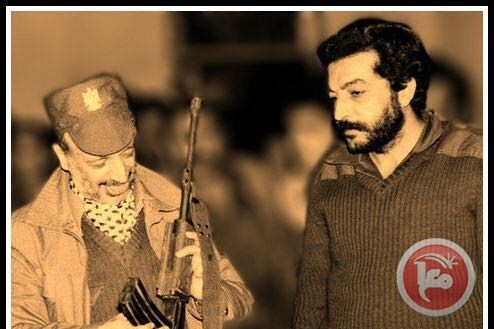
The photo which reportedly led Facebook to close Fatah’s official page
Ma’an – February 27, 2017
RAMALLAH – The official Facebook page of the Palestinian Authority’s (PA) ruling party Fatah was shut down by Facebook Inc. on Monday, according to an official statement from the Fatah movement.
Munir al-Jaghoub, a Fatah official and the “administrator” of the page said in the statement that Facebook closed the Fatah’s official page after the group posted a photo of the late Palestinian President and Fatah leader Yasser Arafat alongside the current deputy chairman of the movement Mahmoud al-Aloul.
Arafat appears in the photo handing a rifle to al-Aloul. According to the statement, the rifle belonged to Israeli soldiers and was captured by Fatah militants in southern Lebanon during the 1982 Lebanon war.
The statement added that Monday’s incident was the second time Facebook has closed the Fatah movement’s official Facebook page.
In recent months, Israel has detained scores of Palestinians for social media activity, alleging that a wave of unrest that swept the occupied Palestinian territory in October 2015 was encouraged largely by online “incitement.”
In September, Facebook agreed to work with the Israeli government to “minimize online anti-Semitic incitement” — in an effort to pressure the social media site to coordinate to remove content considered to promote “terrorism.”
Israel had previously blamed Facebook outright for the perceived proliferation of incitement, with Public Security Minister Gilad Erdan reportedly saying that Facebook chairman and cofounder Mark Zuckerberg had “blood on his hands” for not adequately cooperating with Israel to remove content.
Earlier this year, the controversial “Facebook bill” passed the first reading in the Knesset, which would allow Israeli officials to force the social media giant to remove certain content through a court order if there are suspicions of “incitement.”
Despite Facebook complying with 95 percent of the Israeli government’s removal requests in recent months, some members of the Knesset have expressed indignation that Facebook has not taken enough action to remove content inciting “acts of terror against Jews.”
Meanwhile, Palestinians have instead pointed chiefly to the frustration and despair brought on by Israel’s nearly 50-year military occupation of the Palestinian territory and the absence of a political horizon as reasons for the outbreak of violence. Many Palestinians have also pointed out that Israeli violence has continued to shape everyday life in the occupied territory, regardless of any recent “upticks” in clashes or attacks.
Palestinian children attend class in the street after Israel shuts down school
Ma’an – February 26, 2017
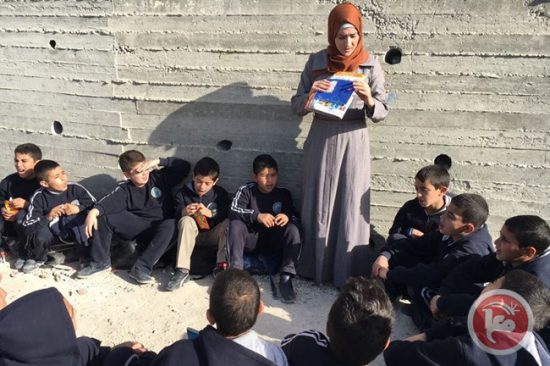
JERUSALEM – After Israeli authorities shut down a Palestinian elementary school in the occupied East Jerusalem town of Sur Bahir last Thursday over alleged “incitement” in its study materials, students attended class in the street on Sunday and protested against Israel’s decision to close the school.
Children who were enrolled at al-Nukhba (“the elite” in Arabic) arrived to the campus with their parents in an action organized by the parent committees of Sur Bahir’s schools, holding posters expressing support for al-Nukhba and denouncing Israel’s closure of educational institutions as “tyrannical.”
Last Thursday, head of the school Luay Jamal Bkirat and the school’s financial manager Nasser Hamed were summoned to an Israeli police station for interrogation, when Israeli intelligence officials informed them that the school was being shut down for carrying inciting content in the teaching materials used at the school.
Bkirat denied the claims, saying that al-Nukhba school was “teaching the Palestinian curriculum used in all schools in Jerusalem and that no one of the faculty had ever been summoned for interrogation before over incitement.”
He added that the school — which serves 250 boys from kindergarten to grade six — was opened last year and gained a temporary operating license from the Jerusalem municipality, and that the license was revoked in November for unknown reasons.
Bkirat condemned the decision and said that he would “conduct procedures to stop this decision which aims to destroy education.”
The Times of Israel reported that the school was shut down for being a “Hamas front,” after a months-long joint probe by Israel’s Education Ministry, Jerusalem police, and Israeli intelligence, the Shin Bet.
Israeli authorities from the education ministry claimed the school was established by Hamas with the aim of teaching “content that undermines the sovereignty of Israel,” and that the school’s aims were “consistent with the ideology of the terror organization, which calls for the destruction of Israel,” the Times of Israel said.
According to the Israeli news outlet, the ministry ordered the school not to open in September “and when it continued to operate, issued the closure order.”
Israeli Jews and Palestinians study in separate school systems in occupied East Jerusalem, with the Palestinian schools run by either Israel’s Jerusalem municipality, the Islamic Waqf and administered by the Palestinian Ministry of Education, private institutions, or UNRWA, the UN agency responsible for Palestinian refugees.
According to the Palestinian Ministry of Education, Palestinian children suffer from routine Israeli interference and political pressure to replace Palestinian curricula with an Israeli one in occupied East Jerusalem, where full Israeli military and civil control deprives students from proper and secure educational services.
A 2016 report by Israeli daily Haaretz also said that Palestinian schools in occupied East Jerusalem received less than half the funds that the Jerusalem municipality transferred to Jewish schools in West Jerusalem.
Though Sur Bahir lies beyond the periphery of occupied East Jerusalem, the town remained under full Israeli security and civil control within Israel’s Jerusalem municipality after the territory was illegally annexed in 1967.
A 2011 report by the Applied Research Institute – Jerusalem (ARIJ) said that due to a lack of some levels of education in Sur Bahir, many students were forced to attend schools in neighboring villages.
Castigated by the Southern Poverty Law Center

By Deir Yassin Remembered | Dissident Voice | February 24, 2017
The “public” that allegedly “protested” against this billboard in Ann Arbor, as reported by the Rochester Democrat and Chronicle, were not the only folks watching DYR.
The SPLC has now included DYR on its Hate Map.
Dan McGowan responds:
The Southern Poverty Law Center (SPLC) recently criticized Deir Yassin Remembered (DYR) by including it on the so-called Hate Map, purportedly for the high crime of Holocaust denial.
Apparently if the SPLC disagrees with you, it will label you as a racist or a hatemonger. There is no discussion, no defense, and no chance of winning a defamation suit against it.
The SPLC is the cash cow of the civil rights movement. Last year it took in over $58 million, some of which was added to its bloated endowment of over $328 million held in questionable investments, some in off shore accounts.
Its two chief executives together received over $800,000. Of its nine top executives, none come from minorities.
The SPLC claims to reject hate, embrace diversity, and respect differences. But often the SPLC and the people who believe their fear mongering behave exactly the opposite. The SPLC campaigns to deny free speech and freedom of association to groups of Americans with whom they disagree, often doing so to pander to other groups for more contributions all in the name of promoting “tolerance.” For example, if the British historian David Irving plans a lecture in Syracuse, the SPLC will protest any venue he might select, leaflet cars at his hotel saying, “There is a Nazi staying here,” and photograph and shout at anyone who might try to attend.
SPLC slime is not reserved solely for skinheads and members of the KKK. Dr. Ben Carson got a dose for opposing same sex marriage. SPLC later apologized but the charge never completely goes away, leading Carson to say that fear of being on the SPLC’s list serves to shut people up.
The SPLC makes money out of fear mongering and promoting the idea that Americans are inundated with hateful people, particularly on the radical right. The favorite target is the KKK and white supremacists.
The Baltimore Sun characterizes SPLC operations this way: “Its business is fundraising, and its success at raking in the cash is based on its ability to sell gullible people on the idea that present-day America is awash in white racism and anti-Semitism, which it will fight tooth-and-nail as the public interest law firm it purports to be.”1
It is understandable that the SPLC will run out of rocks under which to look for old KKK members and skinheads, but why criticize Deir Yassin Remembered, a small not-for-profit organization of Jews and non-Jews working to build a memorial for Palestinians murdered in 1948 on the west side of Jerusalem? DYR is certainly not the radical right. DYR practices and preaches tolerance; it has agreed to the advice of none other than the Latin Patriarch of Jerusalem that its memorial show the Christian tenet of forgiveness. Its advisory board boasts diversity; it is composed of half men, half women, half Jews, half non-Jews. It has worked continuously since 1994 for Palestinian human rights, including equal rights of citizenship, with no compensation for any executive and with less than $5,000 of reserves.
The answer lies in the writings of some of the DYR members who have questioned the use of the Holocaust as both the sword and shield of Israel. The Holocaust has been used to justify the need for a Jewish state and its expropriation of Palestinian land; the Holocaust is used to monopolize victimhood and defend Israel from criticism of its brutal and unending occupation.
But it is more than that. The Holocaust has morphed from a historical event to a religion, which must not be contradicted for fear of being branded an apostate or a hater or a denier or an anti-Semite. Religious faith is self-validating, impervious to reason, and regards proposals to scientifically validate its claims as profane in all senses of the word.
So, anyone who is skeptical about the number “six million,” about mass extermination in gas chambers, or about Nazi orders for extermination is to be named and shamed and hated. For this topic, there can be no diversity of opinion and no respect for inquiry or debate.
Don’t tell us that the United States government claimed Hitler murdered over 20 million people until the late 1970s when that number was officially revised downwards and carved in stone at 11 million. Don’t tell us that Jewish historians today claim the 5 million number of non-Jewish victims is overstated. Don’t remind us that the lampshade and the soap-from-human-fat stories were simple gruel propaganda and have no historical significance. Don’t remind us that Elie Wiesel took his violin to Auschwitz and that none of his family was gassed. Don’t remind us that Elie chose to retreat with the Nazis rather than be liberated from Auschwitz as was the father of Anne Frank.
Fear mongering and sliming little organizations like DYR is fake news. It is ridiculous disinformation to keep SPLC campaign money coming in. It foments hate and bigotry and intolerance by the very hypocrites who claim the opposite.
- “The truth about ʻhate crimesʼ and the racial justice racket” by Ron Smith, Baltimore Sun, December 3, 2008.
Deir Yassin Remembered seeks progress on behalf of the over 100 Palestinian men, women, and children who were victims of the Deir Yassin Massacre. Read other articles by Deir Yassin Remembered, or visit Deir Yassin Remembered’s website.
America First

By Paul Larudee | Dissident Voice | February 20, 2017
Nothing in Trump’s campaign resonated with the American heartland quite like “America First”. But Trump wasn’t the first. Remember Charles Lindbergh? He put “America First” and paid the price.
Deir Yassin Remembered (DYR) also wasn’t first but neither were we last. The first DYR “America First” billboard went up in Detroit in November 2015. It didn’t last long but such is Jewish power.
It re-appeared on February 6 this year near Ann Arbor, Michigan but, just one week later, DYR received a call from Adams Outdoor Advertising General Manager Mike Cannon saying that the board had to come down. Such is Jewish power.
These tactics, known as ‘Dynamic Silencing”, are well-worn and well-described by Benjamin Ginsberg in his book The Fatal Embrace: Jews and the State, p. 124:
Working together, officials of the American Jewish Committee, the American Jewish Congress, and the ADL would approach the publishers of major newspapers and owners of radio stations in cities where Smith [substitute any “anti-Semite”] had scheduled appearances to ask that Smith be given no coverage whosoever. If newspapers and radio stations failed to cooperate on a voluntary basis, Jewish organizations were usually able to secure their compliance by threatening boycotts by Jewish advertisers.
So where now? Try another site? Turn it into a lapel pin? Put it on a truck and drive it cross-country?
Please send any ideas to us here.
Paul Larudee is one of the founders of the Free Gaza and Free Palestine Movements and an organizer in the International Solidarity Movement.
‘Western Media Exerting Financial Pressure on RT’s Advertisers’
Sputnik – 20.02.2017
Western media are putting direct financial pressure on the RT broadcaster by calling up its advertisers and urging them not to sponsor “the Kremlin propaganda,” RT Editor-in-Chief Margarita Simonyan said.
“There is a wonderful UK outlet that has called up all our advertisers in the United Kingdom and simply put them to shame, rebuked them, saying shame on you, you are sponsoring the Kremlin propaganda by advertising through a such-and-such broadcaster. Some of the advertisers left, naturally, having been scared away, because nobody wants bad publicity… This is direct financial pressure,” Simonyan said in an interview that will be aired on Russian NTV channel on Monday night, without specifying which UK media she was referring to.
She added that the The Wall Street Journal newspaper contacted US cable operators providing access to RT “trying to convey the same message: shame on you, you are spreading the Kremlin propaganda, you should immediately terminate the contacts.”
“Understandably, someone will get scared and will not renew a contract with us as soon as it becomes possible, because they are in it for business. They do not want to be enmeshed in a scandal, to be written about, in general, and to get bad press, in particular,” Simonyan said.
The RT editor-in-chief added that these tactics had not crippled RT’s revenue and had instead exposed new viewers to the broadcaster, people who “would not have come [to RT] otherwise, not its target audience.”
“[The media] do not understand that the more they try to undermine us, the more they advertise us, the more people who see that think, hey, why is everyone piling up on [RT], let’s see what is really going on,” Simonyan said.
She stressed that new viewers came as the result of Western media’s “primitive” and “undemocratic” fight against the RT.
Russian media have often been taken to task lately. In November, the European Parliament passed a resolution where it described the RT as a threat to Europe’s unity and drew a parallel between the broadcaster and propaganda disseminated by Daesh, a terrorist group outlawed in many countries, including Russia.
In a comment on the EP motion, Russian President Vladimir Putin praised the channel for doing a good job and said the resolution showed that the Western concept of democracy was apparently degrading.
Berkeley event was successful despite efforts against it
If Americans Knew | February 17, 2017
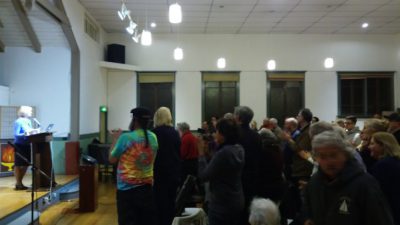
Alison Weir provides the following report back on an event that almost didn’t happen:
After I was invited by the Social Justice Committee of the Berkeley Fellowship of Unitarian Universalists (BFUU) to give a public presentation, extremist pro-Israel activists went to work to get the event canceled. They put up blog posts and even a Craigslist advertisement attacking me, exaggerating inaccurate claims about me by the ADL and, especially, the widely refuted JVP-US Campaign dossier on me.
This has become standard practice for Israel partisans who wish to prevent audiences from hearing my presentation.
A few individuals within the BFUU then took up the JVP-USC false claims, trying to get the event shut down before anyone had the chance to hear me directly. This effort threatened to succeed, but ultimately failed when members committed to social justice and free speech refused to cave in.
Activist songwriter-musician Vic Sadot, former Social Justice Committee Chair Cynthia Johnson, human rights worker Tom Luce, and current Social Justice Committee Chair Gene Herman – all longtime, respected Berkeley human rights activists – didn’t give in to the significant pressure, took a great deal of heat for this, and the event went on.
Nevertheless, they were nervous, particularly after seeing the Craigslist ad that seemed designed to foment hate against me and possibly provoke violence. At a recent event elsewhere in the area, a similar smear campaign had been undertaken against me (including another Craigslist ad), and a few Israel partisans showed up to disrupt the event — to the degree that the police had to be called. One Israel partisan then hit a woman videotaping the incident.
Fortunately, no protesters showed up this time, and I again spoke to a full house. The audience included many members of BFUU – which has a long tradition of peace and human rights activism – who came to hear me for themselves.
At the end of the talk, I was honored and extremely grateful to receive a standing ovation. Numerous audience members said they appreciated the talk, had learned new information, and bought my book. One person told me she hadn’t known any of the information before.
This success only happened because Vic, Cynthia, Tom, Gene and others were willing to stick their necks out, and because the BFUU congregation came down on the side of free speech and against censorship.
It would have been much easier for them to cancel the event entirely, or to bring a less “controversial” speaker. But they didn’t.
This is an example of what a few brave souls can do. Thank you.
UPDATE: I’ve just learned that the event was co-sponsored by Norcal Sabeel, another committed and courageous group.
Sheikh Raed Salah banned from travel abroad or entering Jerusalem for five more months
Samidoun Palestinian Prisoner Solidarity Network – February 15, 2017
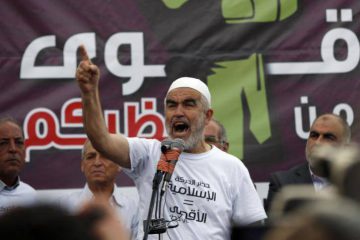 Sheikh Raed Salah was banned from leaving Palestine and barred from entering al-Aqsa Mosque and the city of Jerusalem for five more months on Tuesday, 14 February, reported Quds News.
Israeli police delivered an order from Aryeh Deri, the far-right Israeli Interior Minister, to Salah’s home in Umm al-Fahm, on Tuesday night, banning him from travel or visiting Jerusalem, until 15 July 2017. The order comes as a renewal of the one-month travel ban slapped on Salah on 17 January 2017, immediately upon his release from Israeli prison from a nine-month sentence for “incitement,” for a sermon he delivered in 2007.
The order declares that Salah’s travel abroad poses a “real danger… to state security.” Salah is the leader of the Islamic Movement in Palestine ’48; in 2015, the Israeli state banned the Islamic Movement in an action condemned by Palestinian organizations across the political spectrum as an attack on all Palestinians in ’48 Palestine, who hold Israeli citizenship.
Throughout his imprisonment, Salah was held in solitary confinement and repeatedly interrogated; appeals to end his isolation were denied throughout that time. He was even denied access to magazines, books and other materials brought for him.
Canada’s largest PR machine troubled by a few ‘toxic’ stories
By Yves Engler · February 8, 2017
The media is unfair to the military, according to the Chief of Defence Staff. During a speech to the Greater Vancouver Board of Trade last week General Jonathan Vance slammed “very toxic narratives” in reporting on the Canadian Forces.
“If you’re paying attention to the news today, there are some very toxic narratives about the armed forces,” Vance said. “The narrative that seems to prevail right now is if you join the armed forces, you are going to be sexually assaulted, raped or you’re going to suffer from PTSD at some point and may commit suicide.”
Reporting the truth is toxic?
With the largest PR machine in the country, the CF aggressively always protects its image and promotes its worldview. As I detail in my latest book A Propaganda System: How Canada’s Government, Corporations, Media and Academia Sell War and Exploitation, the military runs a slew of journalistic, academic and cultural initiatives. The military produces dozens of publications and its numerous websites make articles, speeches, reports and other types of information easily accessible to the public. The Canadian Forces also employs YouTube, Facebook, Twitter and other social media platforms to promote its positions and recruit new members.
In 2010-11 the Canadian Forces admitted to spending $354 million on public relations and related military commemorations. Six hundred and sixty-one staff members worked on this effort. According to another 2011 report, the Department of National Defence’s Public Affairs department had 286 staff. Public Affairs Officers’ write press releases, organize press conferences, monitor the news, brief journalists, befriend reporters and editors, or perform various other media-related activities. A large proportion of the news stories about the military are based on CF statements and events.
But that clearly isn’t good enough for the Chief of Defence Staff. After taking charge of the CF, Vance immediately sought to reinforce their influence over news coverage of military affairs. In fall 2015, Ottawa Citizen military reporter David Pugliese revealed Canada’s top soldier’’ call for the “weaponization of public affairs.” Vance proposed a plan to induce positive coverage and deter critical reporting. Journalists producing unflattering stories about the military were to be the target of phone calls to their boss, letters to the editor and other “flack” designed to undercut their credibility in the eyes of readers and their employers.
While the “weaponization of public affairs” slogan was novel, Pugliese pointed out in a blog that “Vance isn’t the first to attempt to bring pesky journalists to heel. It was quite common for officials working for then Defence Minister Peter MacKay to phone editors of various publications to complain about reporters.”
The CF didn’t stop at complaining to journalists’ bosses. The top brass repeatedly asked the military’s National Investigative Service (NIS) to investigate reporters’ sources. In 2011 NIS investigated prominent CTV journalist Robert Fife after he uncovered documents about Chief of Defence Staff Walt Natynczyk spending over $1 million in public funds flying to hockey games and a Caribbean vacation. Pugliese described this as a blatant “intimidation tactic by the NIS against a journalist who was clearly not playing military cheerleader.”
In a similar incident, NIS spent more than a month investigating how Pugliese obtained information about a major Pacific Ocean military exercise in spring 2012. While the Ottawa Citizen defence reporter said the information came from a U.S. Navy release, which the NSI investigation ultimately supported, DND officials believed Pugliese was tipped off by a friendly Public Affairs Officer. Esprit du Corp editor Scott Taylor pointed out that the investigation had nothing to do with operational security. “No classified information was divulged. No operational security jeopardized. No Canadian sailors’ lives were put in peril as a result of Pugliese’s rather innocuous story, but [defence minister Peter] MacKay’s timetable for release [of the information] had not been strictly adhered to.”
According to Taylor, NIS was employed on at least four occasions to investigate the source of information for stories. Yet in none of these instances was classified material reported.
The military is sensitive about embarrassing leaks. A July 2014 Embassy story titled “DND points to ‘challenges’ with former soldiers talking to media” reported on ministerial briefing notes concerning the problem of “leaks.” A year earlier the CF required soldiers wounded in Afghanistan to sign a form saying they wouldn’t criticize senior officers on Facebook or other social media. Former soldiers are a concern since active CF members are restricted in what they can say publicly or post online.
An extremely centralized organization, the people at the top of Canadian Forces want to control everyone and everything.
To paraphrase a widely circulated quote: when you’re accustomed to shaping coverage, a bit of criticism can feel like a “toxic” media environment.
Featured Video

The American Retreat from Vietnam
or go to
Aletho News Archives – Video-Images
From the Archives
Secret document reveals plans for civil war in Lebanon, Israeli false flags, and invasion
By Randi Nord | Geopolitics Alert | April 5, 2019
Beirut – During his visit with US Secretary of State, Mike Pompeo, Lebanese President Michael Aoun reportedly received a US-Israeli document detailing plans for creating a civil war in Lebanon with covert false flag operations and possible Israeli invasion.
Although the source of the document is Israeli and created in partnership with Washington, no one knows who presented it to Aoun. The Lebanese TV station, Al-Jadeed, initially reported the document on Lebanese TV and a video on its website. Geopolitics Alert translated the report for this article. … continue
Blog Roll
 Aletho News
- There’s a drought in academia: A drought in honest research on the subject of drought and other weather extremes
- Department of War Awards $20.7 Billion Contract to Raytheon for Air-to-Air Missiles
- ‘Distance yourselves from Israel’: IRGC urges US population to question govt policies
- America’s Greenland deal has a radioactive backstory
- The RAF Fairford ‘terror plot’: Unpacking escalation in the UK echo-chamber
- EU Council Advances Chat Control 2.0 Scanning Proposal
- Ex-Greek MEP files complaint against Israeli spyware firm over alleged Pegasus surveillance
- Troubling ideas throughout the Torah, Talmud, Mishneh Torah and Tanya
- ‘Grave, alarming’: Iran mission on Trump’s UNGA ‘annihilation’ threats
- Najaf airport to reopen to Iranian flights within 24 hours: Ambassador
- If Americans Knew
- New Report: “Scholasticide and Genocide in Gaza: Assessment, Testimonies and Legal Analysis”
- Ex-Biden officials are desperate for a Gaza scapegoat
- Israeli “settlers” Invade Al-Aqsa; Pour Boiling Water on 75-Year-Old
- Israel Has Kidnapped Another American Teenager
- US arms sales to Israel worth $21.6 billion in 20 months
- Three Palestinians Killed in Israeli Attacks on Gaza
- Revealed: German “Anti-Semitism Expert” Driving Crackdown on Palestine Solidarity is Former Israeli Spy
- Egypt’s Warning to Israel Before Oct 7
- Israel’s siege signals another cruel winter for 1.8 million Gazans – Daily Update
- Netanyahu Asked UAE Leader to Deny Report on Oct. 7 Warning in Secret Visit, Sources Say
- No Tricks Zone
- New Study: Earth And Venus Surface Warmth Largely Explained By Convection And Lapse Rate, Not CO2 Or Radiation
- 2025 Nature Paper Claiming Worsening Global Drought Gets RETRACTED …Heavily Flawed
- New Study: ‘Global Drought Shows No Detectable Recent Acceleration Under Climate Warming’
- Economic Masterminds: German Socialists Suggest Taxing Productivity Gains Stemming From Using AI
- The South China Sea Has Not Been Cooperating With The Climate Change Narrative
- Energy Crisis: Germany Enters Heating Season With Historically Low Gas Reserve Fill Levels
- New Study: The Antarctic Ice Sheet Gained Mass From 2020-2024 Due To Staggering Snow And Ice Accumulation
- Study: Ocean Heating Rates From Thousands Of Years Ago ‘Dwarf’ Modern Ocean Heating Rates
- Climate Extremists Target, Attack Large-Scale Power Grid Infrastructure In Germany!
- New Study: Antarctic Ice Melt Has Contributed Less Than 1 Centimeter To Sea Level Rise In The Last 30 Years

