Police search house, prepare charges against German Holocaust skeptic

By Brandon Martinez | Non-Aligned Media | June 4, 2015
German media have reported that police have raided the house of 86-year-old Ursula Haverbeck, a German lady who has publicly doubted the Holocaust story.
A report in Mindener Tageblatt says:
“The public prosecution department of the city of Bielefeld has been investigating a case of “incitement to hatred“ (Volksverhetzung) against … Ursula Haverbeck. Now, a new lawsuit was added: prosecutors of Niedersachsen’s State Office of Criminal Investigations have searched the houses of Vlotho resident Haverbeck with the support of authorities of the city of Herford. The houses of three further accused were also searched on that day.”
Haverbeck has been constantly pursued by German authorities for her nonconformist opinions about the Holocaust. In Germany, a self-professed ‘democracy,’ individuals do not have the right to question establishment myths about the Second World War. The public is forced to accept the self-serving interpretations of the winners of World War II under penalty of fines and imprisonment.
The government of Germany should be boycotted and condemned until the present Stasi-like police state is disbanded.
FBI operating surveillance aircraft over US, planes traced to fake companies – report
RT | June 2, 2015
The FBI is operating its own air force, sending low-flying planes across the US. The aircraft carry video and cellphone surveillance technology, and are hidden behind bogus companies that are actually fronts for the government, AP has revealed.
According to the news agency, the surveillance tools on board are typically used without a judge’s approval. The flights are widespread, spanning across the United States.
In a recent 30-day period, the agency flew more than 100 flights above more than 30 cities in 11 states, plus the District of Columbia. Those cities included Houston, Phoenix, Seattle, Chicago, Boston, and Minneapolis. Aircraft also flew over southern California.
The FBI says the planes are used for specific, ongoing investigations.
The findings come after years of reports since 2003 that a government surveillance program might be behind suspicious-looking planes slowly circling US neighborhoods.
Flight tracking
The news agency began analyzing flight data following a Washington Post article in early May, which revealed flights by two planes circling over Baltimore.
As part of its investigation, AP examined aircraft ownership registrations that shared similar addresses and flight patterns. Using data from FlightRadar24.com, the agency found that some FBI missions circled above at least 40,000 residents during a flight over Anaheim, California, in late May.
Most of the flight patterns occurred in counter-clockwise orbits up to several miles wide, and roughly one mile above the ground at slow speeds.
One of the planes photographed in flight last week in northern Virginia had unusual antennas under its fuselage and a camera attached to its left side.
In total, AP has tracked 50 aircraft back to the FBI.
Fears of spying
While Washington maintains that aerial surveillance is important for certain investigations, the use of such aircraft has sparked concerns over whether there should be updated regulations protecting the civil liberties of Americans, as such technology could potentially facilitate government spying.
It could also have other wide-ranging implications, according to the report. For instance, the planes could capture video of unrelated criminal activity on the ground, which could be handed over for prosecutions.
Some of the aircraft can be equipped with technology that can identify thousands of people below through the cellphones they carry – even if they’re not making a call, or they’re tucked away in their own homes.
Officials told AP that the practice – which mimics cell phone towers and gets phones to reveal subscriber information – is rare, but it does indeed exist.
However, AP found FBI flights orbiting over large, enclosed buildings in recent weeks, for extended periods of time. These flights took place in areas where aerial photography would be less effective than electronic signals collection – including Ronald Reagan Washington National Airport and the Mall of America in Bloomington, Minnesota.
But FBI spokesman Christopher Allen said the planes “are not equipped, designed or used for bulk collection activities or mass surveillance.”
An unnamed FBI spokesman also said the surveillance flights comply with agency rules. Those rules, which are heavily redacted in publicly available documents, limit the types of equipment the agency can use, as well as the justifications and duration of surveillance.
‘Not a secret’
Allen also said the FBI’s aviation program “is not secret,” but that “specific aircraft and their capabilities are protected for operational security purposes.”
However, AP managed to trace the aircraft to at least 13 fake companies – including FVX Research, KQM Aviation, NBR Aviation, and PXW Services.
According to law enforcement officials, Justice Department lawyers approved the decision to create fake companies to protect the flights’ security. They added that the Federal Aviation Administration is aware of the practice.
The FBI asked AP not to disclose the names of the bogus companies, claiming it would burden taxpayers with the expense of creating new cover companies, and could endanger the planes and the integrity of the surveillance missions. The agency’s request was denied.
Meanwhile, basic aspects of the aviation program are withheld from the public in censored versions of official Justice Department reports.
The findings come just one month after a Justice Department memo barred law enforcement agencies from using unmanned drones “solely for the purpose of monitoring activities protected by the First Amendment,” saying they are to be used only in connection with authorized investigations and activities.
‘He will pay a heavy price’: Erdogan threatens Turkish editor-in-chief for scandalous report
RT | June 1, 2015
Turkish President Tayyip Erdogan has publicly threatened the editor-in-chief of a Cumhuriyet daily for publishing a report, which showed police discovering weapons ready to be sent to Syrian rebels in trucks belonging to Turkish intelligence.
“This slander and this illegitimate operation against the National Intelligence Organization (MIT) are, in a way, an act of espionage. This newspaper got involved in this espionage activity, too,” Erdogan told the TRT public broadcaster.
The video published on the Cumhuriyet news website on Friday showed Turkish gendarmerie and police officers finding weapons due for dispatch to Syria on trucks belonging to the National Intelligence Organization (MIT).
The Cumhuriyet report said the footage was dated January 19, 2014, and described the arms in the trucks as weapons and ammunition.
The Turkish president said the arms shown in the footage were transported to Turkmens in Syria. He added the numbers of weapons were provided to Cumhuriyet by a “parallel state” – political enemies determined to discredit his government.
“What only matters to them is casting a shadow on Turkey’s image.”
Erdogan promised sanctions against Cumhuriyet’s editor-in-chief, Can Dundar.
“I suppose the person who wrote this as an exclusive report will pay a heavy price for this… I will not let him off lightly,” Erdogan said, apparently referring to Dundar.
Dundar responded to the Turkish president’s lambast on Twitter: “The person who committed this crime will pay a heavy price,” he wrote, adding a link to the Cumhuriyet’s story about Erdogan threatening him.
Reuters also investigated the incident and showed testimony from the gendarmerie and officers. The latter claimed they discovered rocket parts, ammunition, and semi-finished mortar shells that were being transported in trucks accompanied by the country’s state intelligence agency (MIT) to parts of Syria under Islamist control.
At the time of the incident, the Syrian side of the border in Hatay province, neighboring Adana province, was controlled by Ahrar al-Sham, an Islamist group.
The prosecutors said the trucks were searched in several raids by police and the gendarmerie – one in November 2013 and three others in January 2014 – on the orders of prosecutors acting on tip-offs that they were carrying weapons.
“Our investigation has shown that some state officials have helped these people deliver the shipments,” prosecutor Ozcan Sisman, who ordered the search of the first truck on November 7, 2013 told Reuters in May.
Sisman and Takci, another prosecutor, have been arrested and now face charges of carrying out an illegal search. They both deny the charges.
About 30 officers involved in the search on January 1 and the incident on January 19 also face charges, including military espionage and attempts to overthrow the government, according to an April 2015 Istanbul court paper.
Prisoner Abdullah Barghouthi in solitary confinement after radio interview
Ma’an – May 31, 2015
GAZA CITY – Israeli prison services on Sunday stormed the cell of Hamas leader Abdullah al-Barghouthi in Rimon prison after it was revealed that he had given a telephone interview to a Gaza-based radio station from inside the prison.
An Israeli prison spokeswoman told Ma’an that the former al-Qassam Brigades commander had been sent into solitary confinement and would face trial for his actions.
Israeli media reported that prison officers searched the prison cell for the phone. Hebrew-language news sites questioned how a Palestinian prisoner had been able to access a mobile phone and give a radio interview.
During the interview with the Hamas-affiliated al-Rai radio station, Barghouthi called on Hamas and its military wing al-Qassam Brigades to take their time as they negotiate a prisoner swap deal with Israel.
“Don’t hasten, because we are firm and perseverant,” he said.
He added, “We won’t change and we shall remain firm regardless of whether we are released today or after a thousand years.”
In response, a spokesman for al-Qassam Brigades Abu Ubayda tweeted: “Freeing you (all prisoners) is a duty we are committed to, and your jailers will eventually vanish.”
Barghouthi is serving 67 life terms, the highest sentence ever handed down by an Israeli military court, after he was convicted of multiple attacks in Israel.
He has been detained since March 2003.
US government ordered to prepare Guantánamo force-feeding videos for release
Reprieve | May 29, 2015
An appeal court has today ordered the Obama Administration to redact 12 hours of secret Guantánamo force-feeding footage in preparation for its public release, rejecting the Administration’s argument that not one single frame should be seen by the public.
The classified videos, which show Guantánamo prisoner Abu Wa-‘el Dhiab being forcibly removed from his cell and force-fed by the US military, were ordered to be released to the public by federal Judge Gladys Kessler in October 2014, following a First Amendment intervention from 16 US press organizations in the abuse case Dhiab v Obama.
The Obama Administration defied Judge Kessler’s order to prepare the videos for release, complaining that the process was too much work and insisting that revealing even one frame from the videos posed a national security risk. Leaving the videos unredacted, the Administration took the case straight to D.C.’s federal Court of Appeals in an attempt to get the order overturned.
In a judgment handed down today, the Court of Appeals ruled that the Administration’s refusal to comply with the lower court’s order was wrong, and rejected its attempt to use the ‘burdensome’ task of redacting videos as a reason to circumvent the First Amendment.
The Obama Administration must now comply with Judge Kessler’s original order to redact the videotapes to address national security concerns, and submit the redacted tapes to her court for reconsideration ahead of their release.
Alka Pradhan, Reprieve US attorney for Mr Dhiab, said: “The Obama Administration’s defiance of Judge Kessler’s order suggests a basic contempt for both the court’s authority and our First Amendment rights, which the Circuit judges recognized.
“The Administration is fighting hard because once those videotapes are redacted, they are one step closer to public release – and the government is one step closer to being held accountable for their treatment of Guantanamo detainees. Yet the harder the Administration resists, the more they confirm that they have much wrongdoing to hide.
“It is time to stop running absurd arguments, and simply to do the right thing: expose and end the ongoing abuse of hunger-strikers at Guantanamo Bay.”
Struggling against the Surveillance State
By John V. Walsh | Dissident Voice | May 27, 2015
A struggle of some consequence is now being waged in Congress to keep on life support the NSA’s massive spying on the American people. And in this struggle the so-called progressives (more accurately referred to as liberals) are engaged in a massive betrayal of all they profess to believe in. Instead too many of them are scurrying about attacking Rand Paul, the libertarian, anti-interventionist, Republican Senator who is leading the charge against the Bush/Obama spying program. Among other things Senator Paul has engaged in a filibuster to stop this nefarious program. So far he has been successful.
Let us try to make the crucial events in Congress as simple and crystal clear as possible. There are two pieces of legislation that were before the Senate last week.
The first is the Patriot Act itself, Section 215 of which, in the government’s secret interpretation, allowed the NSA to vacuum up data on virtually every piece of electronic communication by every American and indeed everyone on the planet. This secret interpretation and use of 215 came to light only when the heroic Edward Snowden blew his whistle. Such massive spying has already been declared illegal by a recent opinion of the Second Circuit Court, although the NSA ignores this ruling. The Patriot Act is due to expire on June 1, and Obama is desperate to keep its essentials alive. Since the government has not been able to produce any convincing data that such surveillance has protected the U.S., one might well ask why Obama is so frantic, almost hysterical, to keep it alive. Why indeed.
The second is a “reform” of the Patriot Act, called the “USA Freedom Act,” proposed by Obama and company. However, the USA Freedom Act is not different in its essentials from the original Patriot Act. One “difference” is that the telephone and internet companies will hold the data rather than the government itself, and then the government will vacuum it up from those companies. A distinction without a difference, to be sure. Here is what the ACLU has to say about the “USA Freedom Act”:
“This bill would make only incremental improvements, and at least one provision—the material-support provision—would represent a significant step backwards,” ACLU deputy legal director Jameel Jaffer said in a statement. “The disclosures of the last two years make clear that we need wholesale reform.”
Jaffer wants Congress to let Section 215 sunset completely, a common sentiment among privacy activists who are USA Freedom Act skeptics—they’d rather let it expire and wait for a better reform package than endorse something half-baked.
Now we get to the meat of the politics and the possible victory over the Stasi State that we have within reach. Last week both these bills came up for a vote in the Senate. Rand Paul filibustered, a filibuster denigrated by many “progressives” as just a “long speech.” Nevertheless, it was enough that cloture had to be invoked to get a vote on the bills. That means 60 votes were needed to keep the legislation alive. First came the vote for the USA Freedom Act. There were less than 60 votes to keep it alive. Down it went. Then came the vote to continue the good ol’ Patriot Act and its atrocious Section 215. Again there were less than the 60 votes needed to keep it alive. Down it went. So as things stand now, Section 215 will be history as of June 1!
That in itself is an enormous victory and should be widely heralded. But here is the interesting thing. All the Democrats voted in favor of Obama’s phony reform, the USA Freedom Act. (As noted above, they could not, however, muster the 60 votes needed to bring it forward and get it passed.) They included the favorites of the faux progressives, Ron Wyden, Patrick Leahey, Elizabeth Warren and of course that notorious advocate of butchery in Gaza, Bernie Sanders. What motivated these Dems to take such a stand? First, it was Obama’s bill, and more importantly it gave some cover to these Dems since most of their constituents are horrified by the Spy State. Next, when it came time to vote for the original Bush/Obama Patriot Act, the sides switched and the Republicans voted in favor of that measure. But they also failed to muster the 60 votes needed to go forward and so that version of mass surveillance failed. Only Rand Paul and a few other Republicans stood firm on the issue of no mass surveillance and confronted the Republican majority, a clear proclamation of principle over Party. For progressives this is (yet another) massive failure of those Dems whom they labored to install in the Senate.
Now this week the bullies that “lead” Congress are conferring frantically to find a way to keep alive the government spying on us. Every sort of blackmail, payoff, bribe and other inducement is certainly on the table to bring the necessary number of Senators along. It is not beyond imagination that the NSA is providing some embarrassing confidential information on recalcitrant Senators, which has been hoovered up in the last decade. These Congressional leaders have until the weekend to muster the 60 Senate votes needed for this ugly task, and they are within 3 votes of getting their way right now. Today Obama himself urged Congress to do whatever it takes to continue the bulk spying law.
Clearly this is a time when progressive organizations, who are forever urging us to write and contact our Congresspeople, should be rolling into action. And here is the biggest problem. I have long been on many of the progressive mailing lists. On this issue I have received nothing from them – nada, zilch. So I checked to see what they had on their web sites. Would there be at least a mention of this issue, a plea to contact one’s Senator? I checked Progressive Democrats of America (PDA), Green Party, Code Pink and Peace Action. None of them had a call to action on this issue as far as I could see as of May 26, which is very late in the game . To be fair, UNAC (United National Antiwar Coalition) did have a statement on this as an issue, dating from a while back and including condemnation of Obama for his actions. But even here there was no call to action – no call for phone or letters to Congress and certainly no calls for a street demonstration, which is almost an autonomic reflex with UNAC.
In short the pwogs have shown an abysmal failure to take action in halting the Spy State. And there is not much time to act. If you, dear reader, contribute to one of these organizations, stay your check writing hand until they do something. Dollars they understand – if not principles.
Moreover, what I have received recently in personal emails from progressive contacts is yet more excoriations of Rand Paul. Here the progressives have an ally in what should be an all important fight and they turn on him! In fact the pwogs are among the targets of this surveillance. Why then make an enemy of a potential ally in the fight against the police state? That is indeed worth thinking about.
One final point, Rand Paul in the Senate, and fellow libertarians in the House like Thomas Massie and Justin Amash (the only Palestinian American in Congress) and a few others (including a few Democrats like Mark Pocan and Zoe Lofgren) stand almost alone now in serious opposition to the entire imperial elite establishment, Republican and Democrat both, in this fight. And Rand Paul is taking the greatest hits – even from that corpulent bag of corruption and mendacity, Chris Christie.
A victory on this issue is possible now. It happened before when Obama halted a plan to bomb Syria because of opposition in Congress, an opposition fueled by letters to Congress, resulting in a bipartisan opposition to an attack on Syria.
A victory here would arouse more interest in the kind of Right/Left alliances on concrete issues that this writer, Ralph Nader and others have been advocating for some years.
So progressives should abandon their theological or religious approach to politics, an infantile disorder that produces little because it does not allow issues to be attacked one at a time. If one conducts one’s politics like a Church, then one’s influence will never extend far beyond the tiny groups huddled in Church basements.
John V. Walsh can be reached at john.endwar@gmail.com
Kiev’s Repression of Anti-Fascism in Odessa
By ERIC DRAITSER | CounterPunch | May 27, 2015
There is a common misconception in the West that there is only one war in Ukraine: a war between the anti-Kiev rebels of the East, and the US-backed government in Kiev. While this conflict, with all its attendant geopolitical and strategic implications has stolen the majority of the headlines, there is another war raging in the country – a war to crush all dissent and opposition to the fascist-oligarch consensus. For while in the West many so called analysts and leftists debate whether there is really fascism in Ukraine or whether it’s all just “Russian propaganda,” a brutal war of political repression is taking place.
The authorities and their fascist thug auxiliaries have carried out everything from physical intimidation, to politically motivated arrests, kidnappings, torture, and targeted assassinations. All of this has been done under the auspices of “national unity,” the convenient pretext that every oppressive regime from time immemorial has used to justify its actions. Were one to read the Western narrative on Ukraine, one could be forgiven for believing that the country’s discontent and outrage is restricted solely to the area collectively known as Donbass – the Donetsk and Lugansk People’s Republics as they have declared themselves. Indeed, there is good reason for the media to portray such a distorted picture; it legitimizes the false claim that all Ukraine’s problems are due to Russian meddling and covert militarization.
Instead, the reality is that anger and opposition to the US-backed oligarch-fascist coalition government in Kiev is deeply rooted and permeates much of Ukraine. In politically, economically, and culturally important cities such as Kharkov, Dnepropetrovsk, and Kherson, ghastly forms of political persecution are ongoing. However, nowhere is this repression more apparent than in the Black Sea port city of Odessa. And this is no accident.
Odessa: Center of Culture, Center of Resistance
For more than two centuries, Odessa has been the epicenter of multiculturalism in what is today called Ukraine, but what alternately was the Soviet Union and the Russian Empire. With its vibrant history of immigration and trade, Odessa has been the heart of internationalism and cultural, religious, and ethnic coexistence in the Russian-speaking world. Its significant populations of Russians, Jews, Ukrainians, Poles, Germans, Greeks, Tatars, Moldovans, Bulgarians and other ethnic and national identities made Odessa a truly international city, a cosmopolitan Black Sea port with French architecture, Ottoman influence, and rich Jewish and Russian/Soviet cultural history.
In many ways, Odessa was the quintessential Soviet city, one which, to a large extent, actually embodied the Soviet ideal enumerated in the state anthem – a city “united forever in friendship and labor.” And it is this spirit of multiculturalism and shared history which rejects the racist, chauvinist, fascist politics which now passes for standard political currency in “Democratic Ukraine.”
When in February 2014, the corrupt, though democratically elected, government of former President Viktor Yanukovich was ousted in a US-backed coup, the people of Odessa, just as in many other cities, began to organize counter-demonstrations against what they perceived to be a Western-sponsored oligarch-fascist alliance seizing power over their country. In the ensuing weeks and months, tens of thousands turned out into the streets to air their discontent, including massive rallies held in February, March, and April.
This inchoate movement against the new dispensation in Kiev, handpicked by the US and its European allies, culminated in two critical events: the establishment of an anti-Maidan movement calling for federalization and greater autonomy for the Odessa region, and the massacre at the Trade Unions House carried out by fascist thugs which resulted in the deaths of more than fifty anti-fascist activists and demonstrators. As a protest organizer and eyewitness recounted to this author, “That was the moment when everything changed, when we knew what Ukraine had really become.”
The brutality of the pogrom – an appropriate word considering the long and violent history of this region – could hardly be believed even by hardened anti-fascist activists. Bodies with bullet wounds found inside the burned out building, survivors beaten on the streets after their desperate escape from the flames, and myriad other horrific accounts demonstrate unequivocally that what the Western media dishonestly and disgracefully referred to as “clashes with pro-Russian demonstrators,” was in fact a massacre; one that forever changed the nature of resistance in Odessa, and throughout much of Ukraine.
No longer were protesters simply airing their grievances against an illegitimate government sponsored by foreigners. No longer were there demonstrations simply in favor of federalization and greater autonomy. Instead, the nature of the resistance shifted to one of truly anti-fascist character seeking to get the truth about Ukraine out to the world at large. Where once Odessa had been the site of peaceful demands for fairness, instead it became the site of a brutal government crackdown aimed at destroying any semblance of political protest or resistance. Indeed, May 2, 2014 was a watershed. That was the day that politics became resistance.
The Reality of the Repression
The May 2, 2014 massacre in Odessa is one of the few examples of political repression that actually garnered some attention internationally. However, there have been numerous other examples of Kiev’s brutal and illegal crackdown on dissent in the critical coastal city and throughout the country, most of which remain almost entirely unreported.
In recent weeks and months, the local authorities have engaged in politically motivated arrests of key journalists and bloggers who have presented a critical perspective on the developments in Odessa. Most prominent among them are the editors of the website infocenter-odessa.com, a locally oriented news site that has been fiercely critical of the Kiev regime and its local authorities.
In late 2014, the editor of the site, Yevgeny Anukhin, was arrested without any warrant while he was attempting to register his human rights organization with the authorities. According to various sources, the primary reasons for his arrest were his possession of video evidence of illegal shelling by Ukrainian military of a checkpoint in Kotovka, and data on his computer which included a compilation of names of political prisoners held without trial in Odessa. With no evidence or warrant, and in breach of standard legal procedures, he was arrested and charged with recruitment of insurgents against the Ukrainian state.
In May 2015, the new editor of infocenter-odessa.com Vitaly Didenko, a leftist, anti-fascist activist and journalist was also arrested on trumped up charges of drug possession which, according to multiple sources in Odessa, are entirely fabricated by the SBU (Security Service of Ukraine) secret police in order to create a pretext upon which to detain him. In the course of his arrest, Didenko was seriously injured, incurring several broken ribs and a broken arm. He is currently sitting in an Odessa jail, his case entirely ignored by Western media, including those organizations ostensibly committed to the protection of journalists.
Additionally, just this past weekend (May 24, 2015) there was yet another sickening display of political repression on the very spot of the May 2, 2014 massacre. Activists and ordinary Odessa citizens had been taking part in a memorial service for the victims of the tragedy when the demonstration was violently dispersed by armed men in either military or national guard uniforms (see here for photos). According to eyewitnesses, the military men instigated violence at the gathering and broke it up, all while both local police and OSCE monitors stood aside and watched. Naturally, this is par for the course in “Democratic Ukraine.”
Aside from journalists, a large number of activists have been detained, kidnapped, and/or tortured by Ukrainian authorities and their fascist goons. Key members of the Borotba (Struggle) leftist organization have been repeatedly harassed, arrested, and beaten by the police. One particularly infamous example was the detainment of Vladislav Wojciechowski, a member of Borotba and survivor of the May 2nd massacre. According to Borotba’s website, “During the search of the apartment where he lived, explosives were planted. Nazi “self-defense” paramilitaries participated in his arrest. Vladislav was beaten, and it is possible that a confession was beaten out of him under torture. Currently, he is in SBU custody.” He was ultimately charged with “terrorism” by the authorities after having been beaten and tortured by both Nazi goons and SBU agents.
Upon his release more than three months later in December 2014 in a “prisoner exchange” between Kiev and the eastern rebels, Wojciechowski defiantly stated, “I am very angry with the fascist government of Ukraine, which proved once again with its barbaric acts that it is willing to wade through corpses to defend its interests and those of the West. They failed to break me! And my will has become tempered steel. Now I’m even more convinced that it is impossible to save Ukraine without defeating fascism on its territory.” Wojciechowski was also the editor of the website 2May.org, a site dedicated to disseminating the truth about the Odessa massacre.
It should be noted though that Wojciechowski was arrested along with his comrades Pavel Shishman of the now outlawed Communist Party of Ukraine, and Nikolai Popov of the Communist Youth. These arrests should come as no surprise to observers of the political situation in Ukraine where all forms of leftist politics – the Communist party, Soviet symbols and names, etc. – have been outlawed and brutally repressed.
Kiev is not only engaged in an assault on political freedoms, but also a class war against the working class of Odessa and Ukraine generally. That the events leading up to the massacre took place at Kulikovo Field – a famous staging area for Soviet era demonstrations of working class politics – and the massacre itself took place in the adjacent Trade Unions House, there’s a symbolic resonance, the significance of which is not lost on the people of Odessa. It is the attempt to both erase the legacy of working class struggle and leftist politics, as well as the sacrifices of previous generations in a place where historical memory runs deep, and the scars of the past have yet to heel.
Aside from these shameful attacks on leftist formations, multicultural institutions too have been repressed under the pretext of “Russian separatism.” A multiethnic, multi-nationality organization known as the Popular Rada of Bessarabia (PRB) was founded in early April 2015 in order to push for regional autonomy and/or ethnic autonomy in response to the legal and extralegal attacks on minorities by the Kiev authorities. It was reported that within 24 hours of the founding congress, Ukraine’s SBU had detained the core leaders of the organization, including the Chair of the organization’s presidium Dmitry Zatuliveter whose whereabouts, according to this author’s latest information, remain unknown. Within two weeks 30 more PRB activists were arrested, including founding member Vera Shevchenko.
While the Western media and its armies of think tanks and propaganda mouthpieces steadfastly deny that an organization such as PRB can be anything other than “a project of Russian political consultants,” the reality is that such moves have been a reaction to repressive legislation and intimidation by the US-backed regime in Kiev which has done everything from outlawing the two most popular political parties of the Russian-speaking South and East (The Party of Regions and the Communist Party), to attempting to strip the Russian language of official status within Ukraine, a move interpreted by these groups as a direct threat against them and their regions where Russian, not Ukrainian, is the lingua franca.
As Senior Fellow at the Jamestown Foundation and former Radio Free Europe/Radio Liberty (read CIA front) contributor Vladimir Socor wrote last month in an article entitled Ukraine Defuses Pro-Russia Instigations in Odesa Province, “In the spirit of preventive action, Ukrainian law enforcement agencies have arrested some 20 members of a centrifugal organization in Odesa [sic] province.. The timely intervention also stopped the publicity bandwagon that had just started rolling from Moscow in support of the Odesa [sic] group.” Interestingly, the author deceptively frames his apologia for so called “preventive detention” as merely a “timely intervention,” conveniently glossing over the blatant illegality of the action by Kiev, which has eschewed the rule of law in favor of brute force and repression.
And what is the PRB’s great crime in the eyes of Mr. Socor and the US interests for which he speaks? As he directly states in the article with typical condescension:
[BPR’s program and manifesto] include demands for: greater representation of ethnic groups in the administration of Ukraine’s Odesa [sic] province; promotion of the ethnic groups’ cultural identities and schools; conferral of a “national-cultural special status” to Bessarabia; a free economic zone, with specific reference to local control over Ukraine’s Black Sea and Danube ports; no integration of Ukraine with the European Union, the “enslavement practices of which would ruin the region and its agriculture”; and reinstatement of Ukraine’s [recently abandoned] international status of nonalignment, or else: “In the event of Ukraine moving close to NATO [the North Atlantic Treaty Organization], we reserve the right to implement the self-determination of Bessarabia.”
A careful reading of these demands reveals that these are precisely the demands that any right-minded anti-imperialist position should espouse, including rejection of NATO integration, rejection of EU integration, rejection of opening up Ukraine’s agricultural sector to the likes of Monsanto and other Western corporations, and protection of ethnic, religious, and cultural minorities, among other things. While Socor writes of these demands derisively, the reality is that they constitute precisely the sort of program that is essential for defending both Ukraine’s sovereignty, and the rights of the people of Odessa and the region. But of course, for Socor, this is all just a Russian plot. Instead, he kneels to kiss the chocolate ring of Poroshenko… and perhaps other parts of Victoria Nuland and John Kerry, while vigorously cheer-leading further political repression.
A Message for the Left
The question facing leftists internationally is no longer whether they believe there are fascists in Ukraine, or whether they are an important part of the political establishment in the country; this is now impossible to refute. Rather, the challenge before the international left is whether it can overcome its deep-seated mistrust of Russia, and consequent inability to separate fact from fiction, and unwaveringly defend its comrades in Ukraine with the conviction and aplomb of its historical antecedents.
There is a whole history that is under assault, a whole people being oppressed, a leftist tradition being ground to dust under the heel of an imperialist agenda and comprador oligarch bourgeoisie. Some on the left choose to snicker derisively at this struggle, aligning themselves once again with the Empire just as they so often have in Libya, Syria, and elsewhere. And then there are those who, like this author, refuse to be cowed by the baseless slur of “Russian apologist” and “Putin puppet”; those of us who choose not to look away while our comrades in Ukraine are beaten, kidnapped, tortured, imprisoned, and disappeared.
For while they speak out in the face of reprisals, in the midst of brutal repression, under threat of prison and death, the least we can do is speak out from our comfortable chairs. Anything less is moral cowardice and utter betrayal.
Second senior Brotherhood official dies in prison
MEMO | May 26, 2015
Senior Muslim Brotherhood official and former parliamentarian Mohamed Falahji, 58, died in an Egyptian prison on Monday morning, Quds Press has reported.
Falahji is the second top leader of the movement to have died in prison as a result of maltreatment or lack of proper medical attention. His death brings the number of prisoners who have died in Egyptian prisons since the ouster of the freely-elected President Mohamed Morsi in August 2013 to 265.
The parliamentarian was arrested on 26 August, 2013 on charges of affiliation with a “terrorist” organisation, taking part in demonstrations and inciting violence. He was sent to Jamasah Prison, northern Egypt just over a month later. It was there that he started to experience a lot of pain.
After several calls by his family and appeals by his lawyer, he was transferred to the public hospital in Damietta last month. After examination, he was found to be suffering from kidney stones and inflammation of the gall bladder. He was sent back to prison without receiving any proper treatment.
Falahji’s death comes just a few days after former lawmaker and official in the Freedom and Justice Party Farid Ismail died of liver failure in a Cairo hospital. He was also 58 years old.
Isamil, who was sentenced to seven years in prison last year, was moved from jail in Al-Zagazig to Al-Aqrab Prison Hospital in Tora, south of Cairo, a few days before his death. He was in a coma for several days before he was pronounced dead by the authorities.
On 27 September, 2013, a Brotherhood official in Daqhaliyya, Safwat Khalil, 57, died of cancer in Al-Mansoura Prison. Several others at different leadership levels and members of the Islamic movement have also died in custody due to different diseases or in mysterious circumstances.
The Egyptian authorities insist that all prison inmates have access to proper medical treatment. They stress that they are following international standards and conventions in this regard.
According to Ahmed Mufreh, the director of the Egypt portfolio with NGO Al-Karama for Human Rights, 135 prisoners have died in Egyptian custody since Abdel Fattah Al-Sisi led the coup against Morsi in 2013.
Israeli court sentences Palestinian speaker to prison

Speaker of the Palestinian Legislative Council (PLC) Abdul Aziz Duwaik
Press TV – May 25, 2015
An Israeli military court has handed down a months-long prison term to the speaker of the Palestinian Legislative Council (PLC) and ordered him to pay more than a thousand dollars on charges on of delivering a speech at a pro-resistance celebration three years ago.
On Monday, the Ofer Court in northern Israel sentenced Abdul Aziz Duwaik to 12 months in jail and a fine of six thousand Israeli shekels (USD 1,550), Arabic-language Palestinian news agency Safa reported.
The Ahrar Center for Prisoner Studies and Human Rights condemned the verdict, demanding the immediate release of all Palestinian prisoners currently being held at Israeli detention facilities, the 67-year-old PLC speaker in particular.
Fuad al-Khafash, director of the Palestinian non-governmental organization (NGO), said the Tel Aviv regime has targeted the Palestinian parliament ever since the Palestinian resistance movement Hamas scored a landslide victory in Palestinian elections in 2006, preventing Palestinian lawmakers from serving their respective nation.
Khafash named Hassan Yousef, Mohammad al-Natsheh, Hassan al-Bourini, Mohammad Maher, Yousef Bader and Ezam Salhab as some of the Palestinian legislators that Israel holds captive in its jails.
Israeli soldiers abducted Duwaik in the occupied West Bank city of al-Khalil (Hebron) early on June 16, 2014. Palestinian sources said the senior Hamas official was taken away after his house in al-Khalil was stormed.
Meanwhile, Israeli forces have also arrested at least sixteen Palestinians, including a number of teenagers, during separate raids on a number of houses across the occupied West Bank.
Palestinian security sources, speaking on condition of anonymity, said Israeli military soldiers raided the town of Silwan, which lies on the edge of East al-Quds (Jerusalem) and al-Quds on Monday, and detained eleven Palestinians.
Israeli forces took away five other Palestinians from the entrance gate of the al-Aqsa Mosque compound in the occupied West Bank.
In recent months, Israeli forces have frequently raided the houses of Palestinians in the West Bank, arresting dozens of people, who are then transferred to Israeli prisons, where they are kept without any charges.
There have been many reports about the deteriorating health of Palestinian prisoners held inside Israeli jails.
More than 7,000 Palestinians are reportedly held in 17 Israeli prisons and detention camps. Moreover, 540 Palestinians are held without any trial under the so-called administrative detention, which is a sort of imprisonment without trial or charge that allows Israel to incarcerate Palestinians for up to six months. The detention order can be renewed for indefinite periods of time.
The Right to Record Police
By REBECCA K. SMITH | CounterPunch | May 22, 2015
Last week, federal courts issued two decisions affirming the right of citizens to record police under the First Amendment. In Atlanta, a court held the police department in contempt of court for violating a prior court order to allow citizens to record police. In New York, a court held that recording police is a “clearly established right” under the U.S. Constitution, and that if a police officer violates that right, he or she can be sued in federal court.
First, in Anderson v. Atlanta, the court addressed a prior court order that had ordered the Atlanta police to implement reforms to their training policies and conduct mandatory in-person training for all officers regarding those reforms. In part, the new required policy states: “All employees shall be prohibited from interfering with a citizen’s right to record police activity by photographic, video, or audio means. This prohibition is in effect only as long as the recording by the citizen does not physically interfere with the performance of an officer’s duties.” An officer’s violation of this policy would result in dismissal.
In the court’s contempt order, it found that the Atlanta police had not made the required changes to its policy, and therefore had also failed to implement and enforce the required changes. The court held the Atlanta police in contempt of court, imposed sanctions, and awarded the plaintiff $30,000 in attorney fees for litigating the contempt motion. The court gave the police 45 days to comply with its order. The court stated that after the 45 days expired the court would impose a fine of $10,000 per day.
Second, in Higginbotham v. New York, the court addressed a lawsuit alleging that a journalist covering the Occupy Wall Street protests was falsely arrested and preventing from exercising his First Amendment rights. In 2011, the plaintiff had been working as a freelance video-journalist covering an Occupy Wall Street protest. The plaintiff had climbed on top of a phone booth to record a nearby arrest. A police officer ordered him to climb down but he did not immediately comply because there were too many people surrounding him. When he did begin to climb down, officers grabbed his legs, he dropped his camera, and he fell to the ground. The officers placed him in handcuffs and held him in custody for four hours before releasing him. He was charged with disorderly conduct, but the charge was later dismissed.
In the case, the court rejected the officers’ motion to dismiss the complaint. The court held that the complaint raised a plausible claim of false arrest. The court further held that the complaint raised a plausible claim that the plaintiff was arrested in retaliation for attempting to exercise First Amendment rights. The court noted that “[a]ll of the circuit courts that have [addressed the issue] have concluded that the First Amendment protects the right to record police officers performing their duties in a public space, subject to reasonable time, place and manner restrictions.” After discussing the important goals of prohibiting government censorship and promoting free discussion of government affairs, the court held that “[t]he videotaping of police officers in the performance of their duties in public plainly furthers these First Amendment goals.” The court further held that “[v]ideotaping from a reasonable distance is arguably less of a hindrance to legitimate police activity than the verbal challenges [to police officers] that the First Amendment unquestionably protects.”
Rebecca K. Smith is Board Secretary and Cooperating Attorney at the Civil Liberties Defense Center.
Featured Video
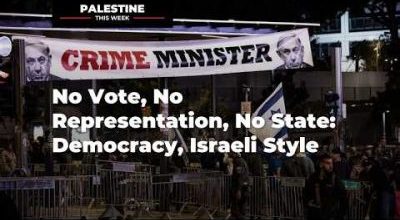
No Vote, No Representation, No State: Democracy, Israeli Style
or go to
Aletho News Archives – Video-Images
From the Archives
Sanctions, War and the Policy of Dual Containment
By SASAN FAYAZMANESH | March 17, 2008
It is now nearly three decades since the Unites States adopted the policy of dual containment of Iran and Iraq. While much has been written about the containment of Iraq, there has been very little in-depth analysis of this policy when it comes to Iran. In a book that is going to be released on March 31, 2008, entitled The United States and Iran: Sanctions, Wars and the Policy of Dual Containment (Routledge), I attempt to address this shortcoming by investigating when and why the US policy of containment of Iran came about, how it evolved, and where it stands today.[1] To the extent that Israel has been involved in US policy making, the study will also include the role that Israel has played in the containment of Iran. Also, since the fate of Iran has been inextricably linked to that of Iraq, occasionally the investigation will overlap with the containment of Iraq.
The policy of dual containment of Iran and Iraq originated during the Carter Administration, but it was not until the Clinton Administration that the expression “dual containment” became popular. … continue
Blog Roll
 Aletho News
- No Vote, No Representation, No State: Democracy, Israeli Style
- Zionist Bought Senate Blocks Information About American Citizens Killed By Israel
- While Gaza dominates the UN, these are the people keeping it alive
- New Report: “Scholasticide and Genocide in Gaza: Assessment, Testimonies and Legal Analysis”
- ‘THAAD Delusion’: Iran war exposes US missile shield limits – The Atlantic
- Moscow issues warning to NATO over Russian exclave
- Yes, the Iran war has destroyed Trump’s presidency
- The fallacy of US delusions about Iran’s economic collapse
- Hezbollah denies Syria cell link, warns of Israeli plan to sow discord
- The legacy of US sanctions, war, and occupation in Iraq
- If Americans Knew
- Mamdani releases plan to combat antisemitism and hate crimes in New York City
- Iran’s Revolutionary Guards Publish Letter to the American People
- DMFI launches $1 million ad campaign supporting Virginia’s Elaine Luria
- US Senate blocks resolution seeking report on Americans killed by Israel
- Israeli Attacks Kill Ten Palestinians in Gaza
- Massacre at Minab: The School That Became a Grave
- Israeli media: The IDF Shows It Doesn’t Turn a Blind Eye; It Actively Emboldens Settler Havoc
- As settlers ravage West Bank, Israeli forces kill 10 in Gaza – Daily Update
- New Report: “Scholasticide and Genocide in Gaza: Assessment, Testimonies and Legal Analysis”
- Ex-Biden officials are desperate for a Gaza scapegoat
- No Tricks Zone
- Green Energy Debacle: German Expert Professor Fritz Vahrenholt Warns Of Severe Economic And Social Consequences
- Two More Paleo Reconstructions Affirm Meters-Higher Sea Levels Across Ireland, Brazil 7000-6000 Years Ago
- New Study: Earth And Venus Surface Warmth Largely Explained By Convection And Lapse Rate, Not CO2 Or Radiation
- 2025 Nature Paper Claiming Worsening Global Drought Gets RETRACTED …Heavily Flawed
- New Study: ‘Global Drought Shows No Detectable Recent Acceleration Under Climate Warming’
- Economic Masterminds: German Socialists Suggest Taxing Productivity Gains Stemming From Using AI
- The South China Sea Has Not Been Cooperating With The Climate Change Narrative
- Energy Crisis: Germany Enters Heating Season With Historically Low Gas Reserve Fill Levels
- New Study: The Antarctic Ice Sheet Gained Mass From 2020-2024 Due To Staggering Snow And Ice Accumulation
- Study: Ocean Heating Rates From Thousands Of Years Ago ‘Dwarf’ Modern Ocean Heating Rates

