Iran no threat to any country, says President Rouhani
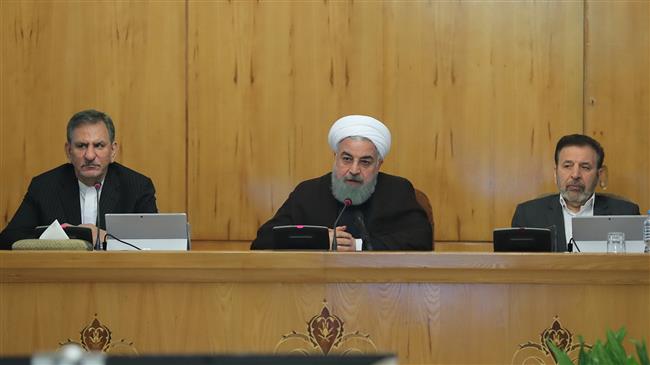
Iranian President Hassan Rouhani (C) talks during a cabinet session in Tehran on March 7, 2017. (Photo by president.ir)
Press TV – March 7, 2018
Iranian President Hassan Rouhani says the Israeli regime is in no position to call Iran a threat to the Middle East, stressing the development of the country’s missile program is aimed at safeguarding peace and security.
“Those who have over the past 70 years created tension, launched wars and caused destruction in the region and have committed genocide and caused [the] Sabra and Shatila [massacre] are in no position to portray Iran as a threat,” Rouhani said during a cabinet session on Wednesday.
“Iran is no threat to anyone. Iran is [the pillar] of stability and security for the entire region. But of course it will strongly defend its rights,” he added.
The Iranian president made the remarks a day after Israeli Prime Minister Benjamin Netanyahu claimed that Iran was responsible for “darkness descending” on the Middle East and said Israel faced threats from the Islamic Republic.
In a hawkish address to the American Israel Public Affairs Committee (AIPAC) in Washington on Tuesday, Netanyahu also alleged that Iran was increasing its influence in the Middle East and sought to dominate regional countries.
Rouhani criticized attempts by certain nations of the region to promote Iranophobia, saying Iran had never invaded and would not invade any country.
“History shows that the Iranian nation has never… occupied any country. We have never bombarded our neighbors or piled up pressure on regional nations. Not only haven’t we driven people out of their countries, but we have welcomed refugees,” he noted.
Iran seeks the progress and prosperity of all regional countries, Rouhani said, stressing Iran’s economic, political and military power was for deterrence not attacking other countries.
“Our weapons are meant to promote peace, strengthen stability and security, and to prevent others from thinking about invading our country. Therefore, no one should be concerned about Iran’s weapons, missiles or strengthening of its defense might,” Rouhani stressed.
Analysts alarmed over Pentagon’s 60,000-strong Syrian rebel force
‘US aid ends up with extremists’
RT | March 7, 2018
Analysts have warned that US-supported groups in Syria often defect to extremists with their weapons. That’s after it was revealed the Pentagon plans to spend around $300 million to train and equip a 60,000-strong army in Syria.
Commenting on the Pentagon’s plans to build, train and equip a massive ‘Vetted Syrian Opposition’ to fight Islamic State (IS, formerly ISIS) in Syria, a number of US-based experts told RT the move has nothing to do with combatting terrorism. Instead, US weapons and aid could easily land in the hands of Islamist extremists, as has often been seen in the past.
“In the past, some of the groups who were the recipient of US aid ended up either taking over or [being] defeated by some of the radical forces on the ground in Syria. Or some of them ended up joining the extremists and taking some of the weapons with them,” Edmund Ghareeb, a scholar at the American University in Washington, DC, told RT.
Another expert said an armed formation will help Washington tighten its grip over rebel-controlled parts of Syria, while stressing that the US’ “hostile military presence in Syria” has no legal basis. “They want to create… conditions in Syria where the country is still divided. The record of the US and the CIA’s operations in Syria is that the people they have supported all along have been extremists,” said Nicolas J.S. Davies, the author of ‘Blood On Our Hands: the American Invasion and Destruction of Iraq.’
He argued that the State Department and Pentagon “clearly want to push ahead with a plan to basically keep forces under their control in command of all Syrian territory east of the Euphrates river.”
While the US justifies its presence in Syria with claims it is fighting terrorists, the only area IS “has survived is the area that is under American and its allies’ control,” Daoud Khairallah, a professor of international law at Georgetown University, believes.“One would wonder whether they are getting assistance from Americans for their survivability, ” Khairallah told RT.
Pentagon pays monthly allowance to rebels, seeks to establish large force in Syria
Following the virtual defeat of IS terrorists in Syria, the US appears to be trying to restructure its military presence in the war-torn country. In February, a fiscal year 2019 budget document mulled creating a new army out of elements of the so-called Vetted Syrian Opposition (VSO). The forces are “projected to total approximately 60,000 to 65,000” by October 2018, according to a report titled ‘Justification for FY 2019 Overseas Contingency Operations (OCO)’.
The document explains that some 30,000 fighters will conduct “ongoing combat missions” against remaining pockets of IS in the Middle Euphrates River Valley (MERV), while another 35,000-strong contingent will form Internal Security Forces in liberated areas.
Creating the massive new military structure of rather questionable legality, roughly equivalent to the size of the Canadian armed forces, is an expensive endeavor. Besides seeking $250 million for border security requirements for areas outside of Iraq and Syria, the Pentagon is seeking some $300 million from US lawmakers to implement the creation of the new opposition bulwark machine that will be funded through the Syrian Train and Equip Program. Launched under the Obama administration in 2014, the program identified and trained selected Syrian opposition forces to fight IS.
The Pentagon plans to spend the bulk of the new funds on arming the forces. Nearly $50 million is allocated for buying AK-47s, PKM machine guns, as well as RPG-7 anti-tank rocket-propelled grenade launchers. Mortar launchers and sniper rifles are also on the menu next to hand grenades, different types of vehicles and tons of ammunition.
Washington plans to pay a monthly allowance to its force, in addition to providing the new force with uniforms, hygiene kits and medical equipment. “[The Department of Defense] will transition to a stabilization effort that will focus on support to local Internal Security Forces, who will receive stipends for their efforts to secure liberated territory and prevent the re-emergence of ISIS or its affiliates,” the document reads. “Currently, 10,000 established partner force personnel are being paid stipends. The individual stipend payments range from $200 to $400 per month.”
While Washington maintains that its goal is to defeat IS, Moscow has repeatedly questioned US intentions, especially as the American presence in Syria is viewed as a violation of sovereignty.
The Russian military last month asserted that the true US goal is to capture “economic assets” in Syria, warning that America’s presence constitutes a dangerous threat to the political process and territorial integrity of the country.
Russian MoD Urges US Not to Hinder UN Access to Syria’s Raqqa
Sputnik – March 6, 2108
According to the Russian Defense Ministry, the only areas in Syria where the requirements of UN Security Council Resolution 2401 are completely ignored and there is no help for the population remains the destroyed city of Raqqa, as well as the Al-Rukban refugee camp in the US-controlled area of At-Tanf.
Since the entry into force of the resolution, no humanitarian convoy has been delivered there. The residents’ situation is estimated to be a humanitarian disaster.
“We urge the United States to fulfill its obligations under UNSC 2401, not to impede access to controlled areas for representatives of international humanitarian organizations and the UN to assess the severity of the humanitarian situation and take urgent measures to provide the necessary assistance to the civilian population,” the statement said.
The Defense Ministry recalled that in the Eastern Ghouta de-escalation zone, despite the daily imposed humanitarian pauses, militants are preventing people from leaving the areas of combat operations and are firing at the humanitarian convoys.
The ministry stressed that the reconciliation center earlier organized an entry for the UN convoy to Eastern Ghouta loaded with 247 tons of food and basic necessities. Furthermore, it is noted that the convoy was ready to evacuate up to one thousand civilians, but only 13 people, including five children, were able to leave late during the night.The UN Security Council unanimously adopted resolution 2401 which urges all parties to the conflict to immediately halt all clashes and adhere to a long-term humanitarian pause on the entire territory of Syria in order to ensure safe and unhindered humanitarian aid deliveries, as well as medical evacuations for those injured.
Terrorist organizations regularly violate the humanitarian pause. Earlier, Jabhat al-Nusra terrorists fired mortar shells at the humanitarian convoy that was on its way to the Syrian town of Douma in Eastern Ghouta.
Who Loves Ya, Saudi?
Just the UK’s Theresa May and her deluded Foreign Office, and the callous death merchants of Washington and Tel Aviv
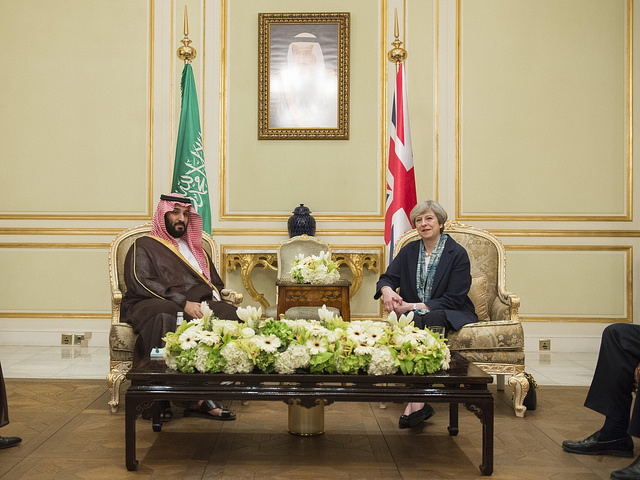
Prime Minister Theresa May met with Deputy Crown Prince Mohammad bin Salman Al Saud on her visit to Saudi Arabia. Image credit: Number 10/ flickr
By Stuart Littlewood | American Herald Tribune | March 3, 2018
It’s amazing what unprincipled people will admit to when goaded. A petition has been posted on the parliamentary website calling on prime minister Theresa May to withdraw her invitation to the Crown Prince of Saudi Arabia, Mohammad bin Salman, to visit the UK. It reads:
“The Saudi Arabian regime has one of the worst human rights records in the world. Torture and arbitrary detention are widely documented. In 2017 alone, over 100 people were executed.
“The Crown Prince has directed the bombardment of Yemen. Tens of thousands have been killed or injured. There is widespread famine and cholera, creating the worst humanitarian crisis in the world. Yet, the UK still sells arms to Saudi Arabia.
“The Saudi regime has supported repression in Bahrain, where its military intervened to end peaceful protests in 2011.”
An Early Day Motion (EDM865) has been tabled in Parliament also asking for the visit to be cancelled. It notes that the Saudi regime actually executed 142 people last year.
Bin Salman arrives in London on 7 March. He’ll be met by angry protesters.
The petition has well over 11,000 signatures so far. Of course, their request will be ignored. The UK Government is a great admirer of terror regimes such as Saudi Arabia and Israel, which are now bosom-pals. They share many ambitions, such as the de-stabilising and overthrow of countries they don’t happen to like with the help of their useful idiots in Washington and Westminster. Prime targets are Iran and Syria. And they are itching to annihilate resistance groups like Hezbollah and Hamas, and any others that get in their way.
They also share utter contempt for human rights and international norms of behaviour.
Successive British governments have gone to extreme lengths to invent preposterous reasons why they adore and support the criminals who run Israel, slaughter the Palestinians and menace the region (and indeed the rest of the world) with their undeclared and unsafeguarded nuclear arsenal. Now Westminster ties itself in knots trying to explain why we continue to snuggle up to the Saudis who are eager to join the US-UK-Israeli axis.
Wouldn’t it be nice if our mainstream media, instead of wringing their hands and broadcasting disinformation about the Middle East, investigated and named the evil warmongers who recruit, bankroll and arm the corrupt regimes, rebel militia, mercenaries and assorted hoodlums who started and now perpetuate the horror and devastation in Syria and Yemen?
Saudi Arabia a partner for “tackling international terror and extremism”? Seriously?
Responding to the petition, the ever-inventive Foreign Office says our strong relationship with Saudi Arabia “is important for mutual security and prosperity” and includes meaningful discussion on reform and human rights. The statement says it has helped make both of our countries safer and more prosperous. “We have vital national security and economic interests in maintaining and developing our strong relationship, including how we can work together to tackle international challenges such as terrorism and extremism.”
And Saudi intelligence “has saved potentially hundreds of lives in the UK”, according to Mrs May.
What’s more, the Crown Prince has embarked on a series of reforms to modernise society and the economy such as allowing women to drive and attend football matches, reopening cinemas and a commitment that women will make up one third of the Saudi workforce by 2030. “The visit will usher in a new era in bilateral relations focused on a partnership that delivers wide-ranging benefits for both the United Kingdom and the Kingdom of Saudi Arabia.”
As for the apalling state of affairs in Yemen, the Government says the UK “is committed to securing a political solution that ends the humanitarian disaster” and will continue to play a leading role in “supporting the UN to find a peaceful solution through close engagement with our regional and international partners”.
We’ve heard this claptrap many times before, especially in relation to never-ending crimes against the Palestinians.
What else does our upstanding Government say? “The UK supports the Saudi-led Coalition military intervention [in Yemen]…. We regularly raise the importance of compliance with International Humanitarian Law with the Saudi Arabian Government and other members of the military Coalition. Saudi Arabia has publicly stated that it is investigating reports of alleged violations of IHL, and that lessons will be acted upon.”
So why not wait for real evidence of that before rolling out the red carpet and infuriating decent people by allowing the Crown Prince of this obnoxious regime to pose on the steps of Downing Street for the world’s media and be filmed poncing around with our Royal Family? From his track record Bin Salman understands only too well the value of PR, which he exploits for all its worth, while precious little changes beneath the elaborate ‘modernising’ veneer.
Guilty as hell of complicity
Since Bin Salman’s bombing campaign in Yemen started three years ago the UK, instead of condemning such murderous aggression, has showered Saudi Arabia with £billions worth of aircraft and other weaponry to help deliver death and destruction. All principles are jettisoned, it seems, and all concerns for human suffering forgotten so that greedy business can milk the obscene wealth of that part of the world.
Last summer the Campaign Against Arms Trade (CAAT) brought a legal action against the Secretary of State for International Trade for continuing to grant export licences for arms to Saudi Arabia, arguing that this was a breach of UK policy which states that the Government must refuse such licences if there’s a clear risk that the arms might be used to commit serious violations of International Humanitarian Law.
It was, by then, undeniable that Saudi forces had used UK-supplied weaponry to violate International Humanitarian Law in their war on Yemen. According to the United Nations, well over 10,000 people had been killed up to that point, the majority by the Saudi-led bombing raids that had also destroyed vital infrastructure such as schools and hospitals and contributed to the cholera crisis. 3 million Yemenis had been displaced from their homes and 7 million were on the brink of dying from famine. UNICEF were reporting that a child died in Yemen every ten minutes from preventable causes including starvation and malnourishment.
A crippling naval blockade aided and supported by the US had been a key cause of the humanitarian crisis. The European Parliament and numerous humanitarian NGOs had condemned the Saudi air strikes as unlawful. And 18 months earlier a UN Panel of Experts had accused Saudi forces of widespread and systematic targeting of civilians.
The UK Government at that time had licensed £3.3 billion worth of arms such as aircraft, helicopters, drones, missiles, grenades, bombs and armoured vehicles to the Saudi regime and refused to suspend this lucrative trade even when the horrors stared them in the face. It was claimed that the Government ignored warnings by senior civil servants and its own arms control experts, and that some records of expressed concern had gone missing.
Despite the glaring facts, the High Court decided to allow the UK Government to carry on exporting arms to Saudi Arabia for use against Yemenis.
The CAAT website today reports that the UK has licensed over £4.6 billion worth of arms to Saudi Arabia since the bombing began in March 2015:
£2.7 billion worth of ML10 licences (Aircraft, helicopters, drones)
£1.9 billion worth of ML4 licences (Grenades, bombs, missiles, countermeasures)
£572,000 worth of ML6 licences (Armoured vehicles, tanks)
And the UK government admits that Saudi Arabia has used UK weapons in its attacks on Yemen. Typhoon and Tornado aircraft, manufactured by BAE Systems, have been central to the attacks. The Government confirms that they have been deployed on combat missions in Yemen and further Typhoons have been delivered. Meanwhile, BAE and the UK government are pushing for a new contract, so who knows what triumphant announcement compounding these crimes against humanity will be made during the Crown Prince’s visit?
The Government has also admitted that UK-supplied precision-guided weapons have been used in Yemen and that it “accelerated delivery of Paveway precision-guided bombs” in response to Saudi requests.
At the start of the conflict in March 2015 former Foreign Secretary Philip Hammond said:
“If we are requested to provide them with enhanced support – spare parts, maintenance, technical advice, and resupply – we will seek to do so. We’ll support the Saudis in every practical way short of engaging in combat.” [emphasis added]
In September 2016 the House of Commons Business, Innovation & Skills and International Development Committees commented:
“Given that the UK has a long history of defence exports to Saudi Arabia and its coalition partners, and considering the evidence we have heard, it seems inevitable that any violations of international humanitarian and human rights law by the coalition have involved arms supplied from the UK.” [emphasis added]
And in December 2016, the UK government finally admitted that UK-made cluster bombs had also been deployed in the conflict.
How sick is that?
Convention provokes rage against NDP machine
By Yves Engler · March 1, 2018
They came, mostly young people, to fight for justice. They came to support the rule of international law, to help solve a longstanding injustice through non-violent means; they came to tell an oppressed people you have not been forgotten; they came to do what is right for a left wing political party; they came to speak truth to power.
And how did the left wing party respond? By using the “machine” — orders from on high, backroom arm-twisting, opaque block voting and procedural manoeuvring — to prevent debate. Silence in class!
While NDP insiders probably feel they dodged the “Palestine Resolution” bullet at their recent convention, many party apparatchiks may come to regret their undemocratic moves. Their naked suppression of debate might stir rage against the machine they’ve proved to be. At a minimum it has provoked many to ask why.
Why, when the Palestine Resolution was endorsed unanimously by the NDP youth convention and by over 25 riding associations, did the powers that be not want it even discussed?
Given the resolution mostly restated official Canadian policy, except that it called for “banning settlement products from Canadian markets, and using other forms of diplomatic and economic pressure to end the occupation” one can only assume that the party machine either supports the indefinite Israeli occupation of Palestinian land or has some sort of problem with boycotts and economic sanctions. Clearly the NDP is not against boycotts and economic sanctions in principle since they’ve recently supported these measures against Russia, Venezuela and elsewhere.
If, after a half-century of illegal occupation, one can’t call for boycotting Israeli settlement goods, then when? After a century? Two?
Or is the problem the particular country to be boycotted? Does the NDP hierarchy believe that anti-Semitism can be the only possible motivation for putting economic pressure on Israel to accept a Palestinian state? Or perhaps it is simply a worry that the dominant media would attack the party?
Whatever the ideological reason the bottom line is the Palestine Resolution was buried to ensure it wouldn’t be discussed. When its proponents sought to push it up the priority list at an early morning session before the main plenary, the party hierarchy blocked it. In a poorly publicized side room meeting they succeeded 200 to 189. NDP House Leader Guy Caron mobilized an unprecedented number of current and former MPs, including Murray Rankin, Randall Garrison, Craig Scott, Tracey Ramsey, Alexandre Boulerice, Hélène Laverdière, Nathan Cullen and others, to vote against debating the most widely endorsed foreign policy resolution at the convention (Niki Ashton was the only MP to support re-prioritizing the Palestine Resolution.)
Apparently, the party leadership discussed how to counter the resolution at two meetings before the convention. In a comment on a Guardian story about the need for the NDP to move left, Tom Allen, a staffer for Windsor Tecumseth NDP MP Cheryl Hardcastle, describes “panicked” planning to defeat the resolution. “As for the part about the ‘party establishment (being) easily able to deflect challenges from the left.’ I would respectfully submit that this is wrong. As an NDP staffer I can tell you that it wasn’t easy at all this time and, especially with regards to the ‘Palestinian Resolution,’ which required a great deal of panicked last minute organizing to defeat (and only then by a close margin).”
Why would the party establishment risk turning off so many young activists, exactly the sort of member new leader Jagmeet Singh claims he wants to attract?
A quick look at some of the more prominent supporters of shutting down debate suggests an answer.
Victoria area MPs (defence critic) Randall Garrison and (justice critic) Murray Rankin who voted against debating the Palestine Resolution are members of the Canada Israel Inter-Parliamentary Group and took a Centre for Israel and Jewish Affairs paid trip to Israel in 2016. After the IDF slaughtered 2,200 Palestinians in Gaza in the summer of 2014, Rankin offered words of encouragement to an emergency fundraiser for Israel.
Party foreign critic Hélène Laverdière, who voted to suppress the Palestine Resolution, took a paid trip to the American Israel Public Affairs Committee’s conference in Washington in 2016 and participated in a Jewish National Fund event in Israel.
British Columbia liaison and critic for democratic institutions, Nathan Cullen also voted against debating the Palestine Resolution. “I am strongly in support of Israel”, Cullen bellowed in a 2016 statement about how people should be allowed to criticize that country. In 2014-15 Cullen’s office took in Daniel Gans through CIJA’s Parliamentary Internship Program, which pays pro-Israel university students $10,000 to work for parliamentarians (Gans then worked as parliamentary assistant to NDP MP Finn Donnelly). In 2014 Cullen met representatives of CIJA Pacific Region to talk about Israel, Iran and other subjects. According to CIJA’s summary of the meeting, “Mr. Cullen understood the importance of a close Canada-Israel relationship.”
Maybe the loudest anti-Palestinian at the convention was former president of the Ontario NDP and federal council member Janet Solberg. Unsatisfied as a settler in Toronto, Solberg pursued a more aggressive colonial experience when she moved to historic Palestine as a young adult.
Just before the convention the President of the Windsor-Tecumseh Federal NDP, Noah Tepperman, sent out an email to all riding associations calling on them to oppose Palestine resolutions. In it he claimed, “boycotts based on religion, nationality or place of origin directly contravene the spirit of inclusiveness to which we in the NDP are committed.” He further alluded to an anti-Jewish agenda by connecting the different solidarity resolutions to “a backdrop of already-high-and-rising antisemitism here in Canada as well as abroad.” But, Tepperman sits on the board of the Windsor Jewish National Fund, which is an openly racist organization.
The truth is pro-Israel-no-matter-what-it-does NDP members in positions of power within the party won a narrow battle. How the war goes will depend on the lessons learned by those seeking a party that’s an instrument of real change, that fights against all forms of racism and oppression.
America’s Illegal Sojourn in Syria
By Philip M. GIRALDI | Strategic Culture Foundation | 01.03.2018
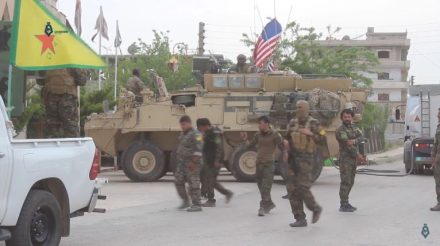
It should come as no surprise to anyone that the Donald Trump administration has recently affirmed that it has a perfect legal right to remain in Syria as long as it wishes because it is fighting terrorism. The argument goes something like this: Congress has approved a bill that permits the US military to seek out and destroy al-Qaeda and associated groups wherever they may be. It is part of what is referred to as the Authorization to Use Military Force or AUMF. According to the White House, an associated group, the Islamic State in Syria (ISIS), remains currently active in Syria and the United States military presence is therefore legal until the group is completely eliminated, requiring no additional legislation or authority to remain in the country.
The Trump legal finding was spelled out in two letters released by the undersecretaries for policy at the State and Defense departments. They were in response to requests made by Senator Time Kaine of Virginia who has for several years been asking the White House under both Barack Obama and Donald Trump to clarify what legal authority has permitted it to base 2,000 American soldiers in Syria without any declaration of war, any United Nations authorization or any invitation by the legitimate government of Bashar al-Assad in Damascus. Kaine has cited the restrictions imposed by the War Powers Act of 1973, which permits a president to use military force in an emergency situation but after 60 days it is necessary to go to Congress for approval.
The State Department letter heightened the ambiguity of the US position with its explanation that “The United States does not seek to fight the government of Syria or Iran or Iranian-supported groups in Iraq or Syria. However, the United States will not hesitate to use necessary and proportionate force to defend US, coalition, or partner forces…”
There are a number of problems with the White House justification to stay in Syria, starting with the fact that al-Qaeda and ISIS are not in any way associated and might best be described as rivals or even enemies, rendering the whole AUMF argument irrelevant. In addition, the reason for American forces being in Syria at all has been variously described by senior administration officials. Secretary of State Rex Tillerson has been busy emphasizing that a prolonged stay is needed to block the resurgence of ISIS and also to prevent the Syrian government from retaking areas currently occupied by American-supported rebel groups. He curiously describes such areas freed from government control as “liberated.” He has also stated that the US will stay in place to put pressure on Bashar al-Assad to step down, i.e. regime change.
Tillerson uses the example of Libya to support his argument, observing that Libya was not occupied and “stabilized” by the nations that combined to overthrow the government of Muammar Ghaddafi. He has also cited President Barack Obama’s decision to withdraw US forces from Iraq as a contributing factor in the rise of ISIS, apparently unaware that American military was forced to leave by the Iraqi government.
But last Friday President Trump sent a different signal, stating during the press conference with the Australian Prime Minister that “We’re there for one reason: to get ISIS and get rid of ISIS, and to go home. We’re not there for any other reason and we’ve largely accomplished our goal.”
There is considerable spin being generated by the Administration to support its claims. Nevertheless, it should be accepted that the Syrian regime of al-Assad is nearly universally recognized to be legitimate and sovereign in its own territory, a fact that is even acknowledged by the United States, which is, at the same time, supporting rebels seeking to overthrow that government. And the US intention to maintain a continued presence minus any viable al-Qaeda threat in the country is completely illegal under both domestic and international law.
In short, the continued United States presence in Syria bears all the hallmarks of yet another US policy wrapped in top level ambiguity that is a failure even before it starts. Not only illegal, it is impractical, with 2,000 US advisers spread thin supporting Kurdish proxies who are already heavily engaged fighting the Turks. Eventually Washington will become weary of the effort and leave. May that day come soon.
US Deploys 600 Additional Troops in Syria’s At-Tanf – Reports
Sputnik – 01.03.2018
Aссording to the Turkish newspaper Yeni Akit, the United States has deployed 600 troops in the international coalition’s base in At-Tanf in Syria, adjacent to the Iraqi border.
The military contingent, comprised of special forces soldiers, has arrived at the base in At-Tanf, which was established by the US two years ago, in early 2016. A report from another Turkish media outlet Milliyet, citing the website Palmyra Monitor in Arabic, suggests that the units reached the base with armored vehicles.
Earlier in the day the assistant to the secretary of the Russian Security Council, told Sputnik that it was astonishing that the United States had “occupied” such a large territory without the Syrian Government’s consent.
“The situation when the United States is virtually occupying a 55-kilometer [34-mile] zone around At-Tanf on the Syrian-Jordanian border without the consent of the Syrian Government, is bewildering. This zone includes the infamous Rukban refugee camp, where militants from illegal armed groups are freely moving near the US Armed Forces,” he said.
In addition, the United States has established as many as 20 military bases in Syrian Kurdistan, which according to the official, hampers restoring peace and stability in the country.
Separately, Russia’s Ambassador to Jordan Boris Bolotin told Sputnik he has information that militants of the armed opposition are being trained in the At Tanf region on the Syrian-Jordanian border: “I do not rule out that they could be jihadists who fled Raqqa.”
Since 2014, the US-led coalition has been conducting airstrikes against Daesh targets in Syria without any authorization from the Damascus government or a UN mandate. Syria, for its part, considers their presence a violation of the country’s national sovereignty.
Israel approves bill paving way for annexation of West Bank

Israeli hydraulic shovels demolishing a Palestinian building in the occupied West Bank
Press TV – February 26, 2018
Israel has approved a bill to expand the jurisdiction of Israeli courts over Area C of the West Bank, paving the way for the annexation of the region.
The area is currently ruled by the military but an annexation would require Israeli law to be imposed and Palestinians living in the area to identify as Arab Israelis.
The ministerial committee for legislation on Sunday approved the measure introduced by justice minister Ayelet Shaked who is known for her extremist views regarding Palestinians.
Her office claimed in a statement that the bill aimed to minimize the caseload of the high court of justice which rules on property rights, building and construction, and restraining orders.
Under the new provision, such cases will be adjudicated by the district courts.
The legislation is also designed to treat Israeli settlers living in the West Bank like those living within the pre-1967 borders, or the so-called Green Line.
The bill must be rubber-stamped by the Israeli parliament or the Knesset but it has already drawn condemnation for being part of a drive to annex Area C and deprive Palestinians living there of their rights.
Yousef Jabarin, a member of the Joint List which represents Palestinian citizens of Israel at the Knesset, slammed the measure as another initiative by Israel to normalize the occupation and to advance “creeping annexation” over the West Bank.
“The High Court of Justice has never treated the Palestinians in the territories justly,” Jabarin said, noting that the legislation will complicate and prolong legal proceedings, leaving Palestinians with little legal recourse.
Under interim agreements signed in the 1990s with Israel, the West Bank is divided into three zones.
The Area C of the West Bank is the largest division in the occupied territory as it comprises 60 percent of the land, and is under full Israeli military control.
The Israeli military almost never grants Palestinians living in Area C building permits.
Palestinians want the West Bank as part of their future independent state, with East Jerusalem al-Quds as its capital.
The presence and continued expansion of illegal Israeli settlements in occupied Palestine, however, has created a major obstacle to the establishment of such a state.
More than half a million Israelis live in over 230 settlements built since the 1967 Israeli occupation of the Palestinian territories of the West Bank and East Jerusalem al-Quds.
The UN and most countries regard the Israeli settlements as illegal because they are built on territories captured by Israel in a war in 1967 and are hence subject to the Geneva Conventions, which forbid construction on occupied lands.
Nevertheless, the Israeli regime continues to build new settlements and expand existing ones.
US President Donald Trump on December 6 formally recognized Jerusalem al-Quds as the so-called capital of Israel and announced plans to move the American embassy to the occupied city.
Jaafari: Ending Civilians’ Suffering Requires Implementing UN Resolutions
Al-Manar | February 25, 2018
Syria’s Permanent Representative at the UN Bashar al-Jaafari said that ending the suffering of Syrians doesn’t require showboating sessions or forming UN committees; it only requires applying the 30 resolutions issued by the UN.
In a speech after the Security Council voted on a resolution calling for the cessation of combat activities in Syria for at least 30 days, Jaafari said that the people in Damascus are truly suffering due to the acts of the terrorists positioned in the Eastern Ghouta, adding “the appeals of 8 million Syrians do not reach the General Secretariat or the mailboxes of Britain and France’s representatives, but the appeals of terrorists do reach them.”
He noted that the Syrian Arab Red Crescent HQ in Damascus was targeted by 10 shells fired by the so-called “moderate” terrorists located in Ghouta, killing and injuring people including a doctor.
Jaafari stressed meanwhile, that the Syrian government has dealt in a serious manner with all initiatives and was committed to them due to its care for the lives of Syrian citizens, and that the government has called on armed groups in the Eastern Ghouta to lay down their weapons and provided safe corridors for civilians to exit it.
Syria’s Representative said that the Astana agreement had stipulated for committing the armed groups to break any ties to ISIL and Nusra Front terrorist groups, and gave the Syrian government the right to retaliate to any attack.
“We practice a sovereign right of self-defense and we will continue to fight terrorism wherever it is found on Syrian soil,” Jaafari affirmed, adding that the Syrian government reserves the full right to retaliate against armed terrorist groups if they target civilians with even a single shell.
The Syrian diplomat asserted that the new resolution should be applied to the entirety of Syrian territory, including Afrin, and areas occupied by US forces, and the occupied Syrian Golan.
He also said that what is required is for the governments of the United States, Britain, and France to stop holding meetings and making strategic plans that bring to mind the age of colonialism and that seek to divide Syria and change the governing system in it by force.
Montreal Gazette’s anti-Palestinian bias
By Yves Engler · February 24, 2018
Shame on the Montréal Gazette. Shame on Dan Delmar. Even when McGill’s uber-Israeli nationalist administration dismisses allegations of “anti-Semitism” the paper and its writer uses them to smear freedom promoting students.
In October Canadian Jewish Political Affairs Committee activist Noah Lew cried “anti-Semitism” after he wasn’t voted on to the Board of Directors of the Students’ Society of McGill University (SSMU). At a General Assembly Democratize SSMU sought to impeach the student union’s president Muna Tojiboeva. The ad-hoc student group was angry over her role in suspending an SSMU vice president and adopting a Judicial Board decision that declared a Boycott, Divestment and Sanctions resolution unconstitutional. While they couldn’t muster the two thirds of votes required to oust the non-Jewish president of the student union, Democratize SSMU succeeded in blocking the re-election of two Board of Directors candidates who supported the effort to outlaw BDS resolutions.
After failing to be re-elected to the Board of Directors at the same meeting Noah Lew claimed he was “blocked from participating in student government because of my Jewish identity and my affiliations with Jewish organizations.” Lew’s claim received international coverage, including coverage in the Gazette.
As she’s done on previous occasions, McGill Principal Suzanne Fortier echoed the Israel activists’ claims. Fortier sent out two emails to all students and faculty about the incident with one of them noting, “allegations have arisen suggesting that the votes against one or more of those directors were motivated by anti-Semitism.” At the time she announced an investigation into the incident.
Released two weeks ago, the investigation dismissed Lew’s claim of anti-Semitism. After interviewing 38 students over three-and-a-half weeks, former Student Ombudsman Dr. Spencer Boudreau concluded that he could “not substantiate the notion that the vote was motivated by anti-Semitism” and couldn’t find “evidence that would equate students’ protests about Israel’s policies with anti-Semitism.” Rather, Boudreau found that the vote was “motivated by politics, that is, based on his [Lew] support for Israel and Zionism and/or for his view of the BDS movement.”
Instead of covering the investigation, the Gazette repeated the Israel nationalist’s baseless smear. A story headlined “Student says anti-Semitism still an issue in McGill student government” quoted Lew and Israel lobby organizations objecting to the report’s findings. The article barely acknowledged the central conclusion of the investigation and failed to quote from it.
Four days after the news story Gazette columnist Dan Delmar criticized the report in a story titled “If anti-Semitism isn’t the problem on campus, what is?” The long-time anti-Palestinian commentator wrote, “for many if not most Canadian Jews, this writer included, the phenomenon of campus anti-Semitism in Canada is a reality and has been particularly problematic for nearly two decades.”
While the Gazette’s attacks are shameful, they are not surprising. The paper has engaged in a multi-year smear campaign against Palestine solidarity activists at McGill. According to a search of the Gazette’s database, the paper has published 12 stories referring to anti-Semitism at McGill since 2014 (I couldn’t find a single Gazette story detailing anti-Black, Asian or indigenous discrimination at the elite university). Rather than a sudden growth of anti-Jewishness, the spate of anti-Semitism stories are a response to students campaigning to divest from corporations complicit in Israel’s occupation. Between 2014 and 2016 there were three votes inspired by the Boycott Divestment and Sanctions movement at biannual SSMU General Assemblies. After two close votes, in February 2016 a motion mandating the student union to support some BDS demands passed the union’s largest ever General Assembly, but failed an online confirmation vote after the McGill administration, Montreal’s English media and pro-Israel Jewish groups blitzed students.
Since that vote Lew and other anti-Palestinian activists have sought to have SSMU define BDS resolutions as unconstitutional. Concurrently, the university’s board of governors is seeking changes to its endowment’s social responsibility criteria, which would effectively block the possibility of divesting from companies violating Palestinian rights or causing climate disturbances.
The Gazette has ignored the Israel activists and administration’s extreme anti-Palestinian measures. The paper has also ignored the administration’s pro-Israel orientation. In May Principal Fortier traveled to that country and in November McGill Vice-Principal Innovation Angelique Mannella participated in an event put on by the explicitly racist Jewish National Fund.
In his column Delmar asks, “If anti-Semitism isn’t the problem on campus, what is?” The answer is obvious: Many students feel embarrassed and angry about their university — and other Canadian institutions’ — complicity in Palestinian dispossession. When they try to channel their emotions into non-violent action to help liberate a long-oppressed people they are blocked by powerful institutions and called names. The problem is the anti-Palestinian bias of those institutions, including the Gazette.
Featured Video
BRITAIN’S WARNING: PREPARE FOR WAR
or go to
Aletho News Archives – Video-Images
From the Archive
How Ukraine Tortured and Slaughtered Donbass
By Kit Klarenberg | Al Mayadeen | July 11, 2024
Almost immediately after the proxy war erupted, ISIS-tier footage of the torture and murder of Russians in Ukrainian custody emerged.
On July 6th, the New York Times published an astonishing investigation: In Ukraine, Killings of Surrendering Russians Divide an American-Led Unit. The article documents in grim detail how Chosen Company, an international volunteer battalion for Kiev, routinely executes Russian prisoners of war. It is the very first mainstream admission that this practice – a brazen breach of the Geneva Conventions, and a grave war crime – is widespread among Ukraine’s fighters, both foreign and homegrown. … continue
Blog Roll
 Aletho News
- Israel Demolishes Home Of Lebanese Journalist Whose Viral Film Exposed Pager Attack
- Record Oil, Empty Tanks: The UAE’s Miracle Recovery
- Burnham tackles Britain’s poverty with aggression in Yemen
- Peace in Ukraine: the easy way – or the hard way
- Trump & the Rrrrussians
- US taxpayer money laundered back through Ukraine – Musk
- Before COVID, an NIH lab chief proposed making a SARS-like bat virus more infectious
- Gates, Bourla on Trial in Netherlands Accused of ‘Great Reset’ Scheme at Vaccine Injury Hearing
- BRITAIN’S WARNING: PREPARE FOR WAR
- “Historic Russia”: The Land Putin Will Not Give Back
- If Americans Knew
- An error has occurred; the feed is probably down. Try again later.
- No Tricks Zone
- Two New Studies Find Thwaites Glacier Melt Cannot Be Driven By Human Activity Or A Warming Ocean
- E-Cars Reduce CO2 Emissions By Only 41% Compared To Internal Combustion Engine Vehicles
- Predictions Made By Renowned Climate Professor Over Past Decades Have Been Proven To Be Poor
- New Study Suggests Large Regions Of The Pacific Ocean Have Been Cooling For The Last 80 Years
- Germany’s Green Energy Debacle: High Energy Costs Force Kahla Porzellan to Close After 182 Years!
- New Study: 50 Years Of The Most Aggressive ‘Net Zero’ Policies Can Only Affect The Global Climate By 0.03°C
- US September “Heat” Was No Record…Many Records Set Decades Ago
- Latest European Green Energy Debacle; Portugal’s Largest Flagship Solar Park Insolvent!
- Green Energy Debacle: German Expert Professor Fritz Vahrenholt Warns Of Severe Economic And Social Consequences
- Two More Paleo Reconstructions Affirm Meters-Higher Sea Levels Across Ireland, Brazil 7000-6000 Years Ago

