150 French Jews move to Israel

MEMO | July 20, 2017
Some 150 French Jews have moved into an illegal settlement in the occupied West Bank, according to Arutz Sheva.
The settlers landed on Tuesday night as part of a programme by the International Fellowship of Christians and Jews (IFCJ), the second such arrival this month. Last week, 200 settlers arrived at Ben Gurion Airport; the largest group scheduled to arrive this summer.
Samaria Regional Council Head Yossi Dagan congratulated Tuesday’s arrivals.
“You have done the most Zionist thing. You left your families, homes, and language to move to Israel,” he said.
Israeli Immigration Minister Sofa Landver has also hailed the continued arrival of French Jews as “a Zionist and principled Aliya [Jewish immigration] that has contributed and will continue to contribute greatly to the State of Israel.”
French Jewish immigration has surged since 2012 with a record of 7,800 people settling in Israel in 2015 alone. Over ten per cent of the Jewish community in France have moved to Israel since 2000, half in the past five years, according to the Jewish Agency.
Earlier this month, the grand rabbi of the orthodox Satmar Hassidic group in New York called for Jews not to settle in Israel because the state was secularising Jewish immigrants. The Satmar group has been fiercely anti-Zionist since its inception, and is raising money to fund Jewish community projects in France to dissuade them from moving to Israel.
Read Also:
Expel 100,000 Palestinians and annex settlement says Israeli Minister
Trump ends CIA arms to Salafists in Syria
By Adam Garrie | The Duran | July 19, 2017
Today, two reports emerged within minutes of each other which indicate that under Donald Trump, the United States has fully shifted its policies in Syria away from arming and aiding Salafist/jihadist terrorist fighters and is now allying exclusively with Kurdish.
To a less extent, America is also politically allied with Russia in a limited capacity in south western Syria, something which is more significant due to the shift it represents rather than in terms of size or scope.
Here are the key events:
1. US media reports that Trump ends CIA arming of terrorists
The deeply anti-Trump Washington Post has reported the following,
“President Trump has decided to end the CIA’s covert program to arm and train moderate Syrian rebels battling the government of Bashar al-Assad, a move long sought by Russia, according to U.S. officials.
The program was a central plank of a policy begun by the Obama administration in 2013 to put pressure on Assad to step aside, but even its backers have questioned its efficacy since Russia deployed forces in Syria two years later.
Officials said the phasing out of the secret program reflects Trump’s interest in finding ways to work with Russia, which saw the anti-Assad program as an assault on its interests. The shuttering of the program is also an acknowledgement of Washington’s limited leverage and desire to remove Assad from power”.
The report adds,
“Officials said Trump made the decision to scrap the CIA program nearly a month ago, after an Oval Office meeting with CIA Director Mike Pompeo and national security adviser H.R. McMaster ahead of a July 7 meeting in Germany with Russian President Vladimir Putin”.
While the Washington Post calls this a win for Russia, in reality this will not directly effect Russia one way or another. It is however, a win for Syria.
By most reasonable accounts, the conflict in Syria could have ended far earlier if not for the CIA and other US actors arming, funding and training Salafist jihadist fighters in Syria (often referred to as moderate rebels by the western mainstream media).
As even the Washington Post admits, almost in a gloating fashion, arming such jihadists was a flagship policy of the United States under Barack Obama.
This will take a substantial deal of pressure off the Syrian Arab Army and their fight against remaining terrorists in Syria.
Ever since Trump took office, the general trajectory of US meddling in Syria shifted from arming jihadists to arming, funding and working in close military coordination with Kurdish forces.
Today’s revelation simply affirms what was long the apparent on the ground policy of the United States since February of 2017.
It is key to remember that even after this announcement, the US presence in Syria is still illegal according to international law.
2. FSA jihadists withdraw from front-line in Raqqa
Almost simultaneous to the Washington Post report, Al-Masdar which is generally the most reliable source of on the ground information in Syria, reported the following,
“The Quwwat al-Nukhba sub-group of the Free Syrian Army (FSA), which fights within the US-backed Syrian Democratic Forces (SDF), has been dismissed from any and all front-line duties in the ongoing Raqqa operation.
About one week ago, word came out that the FSA-linked group was to give up its positions within Raqqa city and retreat to the SDF’s rear areas outside the urban center. However, contradictory reports then came in suggesting that a compromise was reached whereby the Arab faction could retain its positions within the city – this was supported by some photo evidence.
However, according to the latest reports, Quwwat al-Nukhba has officially withdrawn from all of its front-line positions within Raqqa city and handed them over to the Kurdish People’s Protection Units (YPG).
Information on why the Arab militia has been booted out of the operation remains officially unclear. Nonetheless, some sources suggest that the group showed repeated incompetence during Raqqa battle, advancing quickly within the city but then withdrawing from all gains, abandoning them to ISIS, almost as soon as they were taken.In any case, the United States – who has overall command of the SDF – represents the party that gave the order for the Arab FSA-linked faction to withdraw (perhaps at the behest of Kurdish recommendations).
This now means that the battle to capture Raqqa from ISIS has become an almost exclusively Kurdish operation”.
Raqqa is now officially a two-horse race between US backed Kurdish forces from the north and the Syrian Arab Army approaching from the west and from the south via Dier Ez-Zor, which is fast becoming a bigger hotspot of remaining ISIS fighters in Syria vis-a-vis Raqqa.
The upside of this for Syria is that the danger of a kind of semi-permanent style US funded Salafist insurgency is reduced to almost nil. This is especially true due to Syria’s strong central government vis-a-vis that of Iraq in the mid-2000s and into recent years.
With the US garrison in southern Syria located in At-Tanf now effectively cut off from the rest of the country via strong lines of control by the Syrian Arab Army and its allies, the US would have hit a logistical brick wall if it expended its resources continuing to arm increasingly encircled and materially ineffective jihadist groups like the FSA and its splinter groups and off-shoots.
This move also removes any scant Turkish influence from the race to Raqqa as the few FSA fighters participating in the surge represented the only people who are loyal to a group that is in great part, a Turkish proxy.
Thus, the American decision to force the withdrawal of the minor contingent of the FSA from front-line fighting in Raqqa is close to a de-facto admission that incorporating such jihadists into the final battle with the jihadists of ISIS would be an exercise in futility, one that Kurds themselves also likely oppose.
3. The Russia connection
At present, there is no overt linkage to these events and Donald Trump’s meeting at the G20 summit with Vladimir Putin. One can however, infer a conclusion that in order to work more effectively with Russia, the United States has dropped the last vestiges of support for jihadists such as the FSA, knowing that it would have reached a similar conclusion based on sheer logistics, even if Russia and the US did not strike a deal to mutually enforce the current ceasefire in south-western Syria along with Jordan.
In this sense, it is wise to remember that hyperbolic linkages of items 1 and 2 with the Trump-Putin meeting are at best circumstantial rather than causal–pragmatic rather than overtly strategic.
This still does not solve the crisis of what Kurdish forces might want as a result of their participation in the race for Raqqa, assuming they partly or wholly win the race.
Furthermore, if Kurds demand further concessions from Damascus including increased autonomy or even independence, many suspect that the United States will strongly back Kurdish demands rather than play the part of a neutral party. This would of course be opposed not only by Syria, Iraq and Iran but most strongly by Turkey which is a traditional US ally, although one which hardly sees eye-to-eye with the US on major Middle Eastern issues ranging from Qatar to Syria.
In this sense, the United States has chosen to infuriate Turkey further, make life slightly less difficult for Syria in terms of battle-field logistics, vaguely placate Russia and most importantly, declare an increased measure of loyalty to Kurds at the expense of the many anti-Kurdish actors in the region, including several technical US allies, namely both Turkey and Iraq.
Israel to build new field hospital in Syria to treat militants
Press TV – July 19, 2017
Israel’s military says the Tel Aviv regime plans to build a new field hospital in Syria to treat what it generally named patients amid international concerns over the regime’s support for the Takfiri militants fighting in the Arab country.
Lieutenant Colonel Tomer Koler told reporters in a phone conference on Wednesday that the hospital would be located on the Syrian side of the fence but on the Israeli side of the demarcation line in the Golan Heights, which is Syrian territory occupied by Israel. The fence built by Israel does not always comply with the line precisely.
Koler expressed hope that the hospital would be operational in the next month.
He noted that Israel had delivered what he called “humanitarian aid” into Syria, including hundreds of tons of food and clothing, as well as fuel and equipment such as generators.
Israel reportedly had a field hospital in the area but shut it last year.
Syria has been gripped by foreign-backed militancy since March 2011. The Syrian government says Tel Aviv and its Western and regional allies are aiding Takfiri militant groups, wreaking havoc in the country.
There have been reports that Israel offers medical treatment to terrorists, wounded while operating in Syria, in hospitals set up on the Golan Heights. Back on April 9, Israeli Prime Minister Benjamin Netanyahu said Tel Aviv would continue treating wounded militants from Syria as part of what he claimed to be a “humanitarian effort.”
Israel regularly hits positions held by the Syrian army in the Golan Heights, describing the attacks as retaliatory. Damascus says the raids aim to help Takfiri militants fighting against government forces. On several occasions, the Syrian army has confiscated Israeli-made arms and military equipment from terrorists fighting government forces.
Last month, United Nations Secretary General Antonio Guterres expressed concerns about a spike in contacts between Israeli armed forces and Syria militants in recent months, saying it could lead to escalation and cause harm to UN observers deployed to the Golan Heights.
Moreover, the Wall Street Journal recently reported that Israel has been providing Takfiri terrorists in Syria’s Golan Heights with a steady flow of funds and medical supplies.
In September last year, the Israeli daily Ha’aretz quoted Israeli parliament member Akram Hasoon as saying that Israel was directly aiding the Takfiri terrorist group Jabhat Fateh al-Sham, formerly known as al-Nusra Front, another terrorist group operating in Syria. He revealed that an earlier attack by the Nusra group on the Druze Village of Khadr had the support of the Israeli minister for military affairs, Avigdor Lieberman.
Afghanistan civilian deaths hit record highs as US-led airstrikes reach 2012 levels
RT | July 18, 2017
The US Air Force and its allies have dropped more munitions on Afghanistan in the first half of 2017 than in all of the previous year. This is level with the previous high in the first half of 2012 and coincides with a spike in civilian casualties, according to the UN.
So far this year, 232 civilians were killed in the airstrikes, compared to 162 the first six months of 2016. Around half of those died in operations carried out by the Afghan Air Force.
The American and coalition forces have dropped 1,634 munitions in Afghanistan during the first half of 2017, according to figures released by the US Air Force. The US and allied jets have flown over 2,000 combat sorties, and more than 500 of them ended up releasing at least one munition.
By comparison, there were 28,760 sorties recorded in all of 2012, with 1,975 of them reported to have released at least one weapon.
A drastic increase in aerial missions predictably caused more fatalities among Afghan civilians. A Monday report released by the UN’s mission to Afghanistan said the death toll began to climb due to the coalition bombings during the first half of 2017.
The last time the US Air Force expended munitions at this level was in 2012. At the time, there were nearly 50,000 US soldiers in the country, compared to the 9,800 US troops estimated to be stationed there now.
In June, President Donald Trump authorized the Pentagon, headed by Secretary of Defense Jim Mattis, to set the number of US forces in Afghanistan. Mattis reportedly plans to deploy an additional 4,000 troops to the war-torn country, signaling the largest troop increase since Trump took office.
“Each one of these casualty figures reflects a broken family, unimaginable trauma and suffering, and the brutal violation of people’s human rights,” Zeid Ra’ad Al Hussein, UN High Commissioner for Human Rights, said in a statement.
“Many Afghan civilians are suffering psychological trauma, having lost family and friends, and are living in fear knowing the risks they face as they go about their daily lives. Many more have been forced from their homes and suffered lasting damage to their health, education and livelihoods. The continuing national tragedy of Afghanistan must not be overlooked,” Al Hussein said.
UN panel blasts Israel over abuses and settlement expansion in Occupied Palestinian Territories
RT | July 18, 2017
Israel continues the illegal practice of settlement expansion in the Occupied Palestinian Territories, a United Nations expert panel has said in its annual evaluation. It further accuses Tel Aviv of excessive use of force and collective punishment against Palestinians.
After gathering testimonies from civil society organizations, UN representatives and Palestinian officials, the UN Special Committee to Investigate Israeli Practices Affecting the Human Rights of the Palestinian People and Other Arabs of the Occupied Territories noted a number of violations against the Palestinians over the last year, including the detention of minors by the Israel Defense Force (IDF).
“The Committee heard troubling testimony regarding the arrest and detention of children, including cases of reported ill-treatment and lack of adequate protection,” the Committee said after its fact-finding visit to Amman, Jordan.
The Committee also heard testimonies of “excessive use of force” by Israeli forces and the “lack of accountability” by Tel Aviv which “further exacerbated the cycle of violence.”
The UN experts recorded testimonies of continued administrative detention and “difficult conditions” of Palestinians in Israeli prisons.
While the full report of Israel’s treatment of Palestinians will only be published in November, the experts highlighted the continued expansion of Israeli settlements in the occupied territories which are illegal under international law.
“Organizations told the Committee that Israeli settlement expansion had continued in the West Bank, including East Jerusalem, as well as the Syrian Golan, with a notably high level of new construction announced this year, in violation of international humanitarian law,” the fact finding team said.
The UN group said that settlements, as well as the separation wall, dubbed “the apartheid wall” by critics, are having a “negative impact” on the human rights of Palestinians by restricting their freedom of movement.
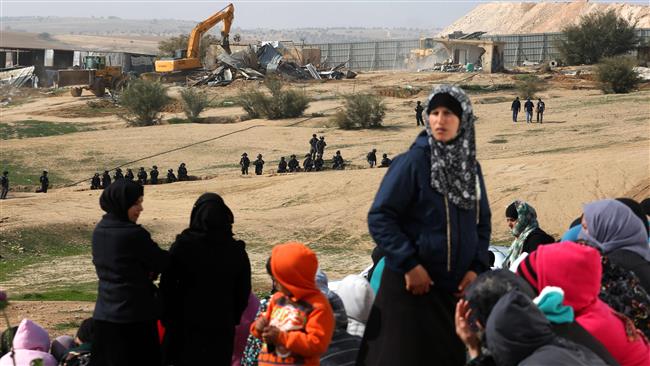
The experts also voiced concern over the demolition of homes in the occupied territories, especially Bedouin communities in so-called Area C.
“The use of punitive demolitions in the West Bank including East Jerusalem was described as a form of collective punishment,” by the organizations interviewed, the Committee said.
“The Committee clearly observed that the Israeli authorities continue with policies and practices that negatively impact the human rights situation in the Occupied Palestinian Territory.”
Pointedly, Tel Aviv does not recognize the authority of the UN Committee, which has been releasing annual reports into Israeli practices since 1968. Relations between Tel Aviv and the world body have drastically deteriorated recently.
Following the passage of the UN Security Council anti-settlement resolution in December last year, Israel cut funding to various UN agencies. Roughly $10 million has been withheld since then as the UN continues to pass resolutions which are perceived as anti-Israeli by Tel Aviv.
Israel accuses various bodies working under the auspices of the UN of having an anti-Israeli bias and failing to acknowledge the Jewish state’s security concerns.
The Myth of the Kurdish YPG’s Moral Excellence
By Stephen Gowans | what’s left | July 11, 2017
A barbed criticism aimed at the International Socialist Organization, shown nearby, under the heading “If the ISO Existed in 1865” encompasses a truth about the orientation of large parts of the Western Left to the Arab nationalist government in Damascus. The truth revealed in the graphic is that the ISO and its cognates will leave no stone unturned in their search for an indigenous Syrian force to support that has taken up arms against Damascus, even to the point of insisting that a group worthy of support must surely exist, even if it can’t be identified.
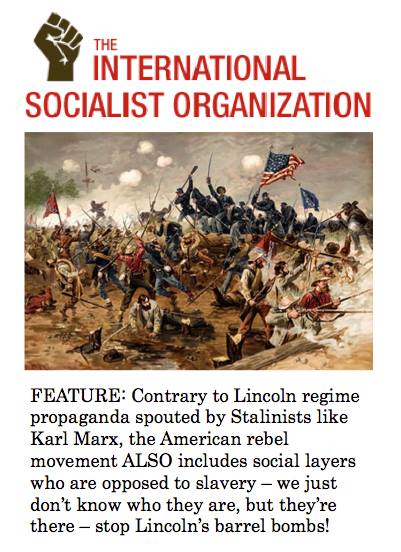
If the ISO existed in 1865.
Of course, Washington lends a hand, helpfully denominating its proxies in the most laudatory terms. Islamist insurgents in Syria, mainly Al Qaeda, were not too many years ago celebrated as a pro-democracy movement, and when that deception proved no longer tenable, as moderates.
Now that the so-called moderates have been exposed as the very opposite, many Leftists cling to the hope that amid the Islamist opponents of Syria’s secular, Arab socialist, government, can be found votaries of the enlightenment values Damascus already embraces. Surely somewhere there exist armed anti-government secular Leftists to rally behind; for it appears that the goal is to find a reason, any reason, no matter how tenuous, to create a nimbus of moral excellence around some group that opposes with arms the government in Damascus; some group that can be made to appear to be non-sectarian, anti-imperialist, socialist, committed to the rights of women and minorities, and pro-Palestinian; in other words, a group just like Syria’s Ba’ath Arab Socialists, except not them.
Stepping forward to fulfill that hope is the PKK, an anarchist guerrilla group demonized as a terrorist organization when operating in Turkey against a US ally, but which goes by the name of the YPG in Syria, where it is the principal component of the lionized “Syrian Democratic Force.” So appealing is the YPG to many Western Leftists that some have gone so far as to volunteer to fight in its units. But is the YPG the great hope it’s believed it to be?
Kurds in Syria
It’s difficult to determine with precision how many Kurds are in Syria, but it’s clear that the ethnic group comprises only a small percentage of the Syrian population (less than 10 percent according to the CIA, and 8.5 percent according to an estimate cited by Nikolaos Van Dam in his book The Struggle for Power in Syria. [1]
Estimates of the proportion of the total Kurd population living in Syria vary from two to seven percent based on population figures presented in the CIA World Factbook. Half of the Kurd community lives in Turkey, 28 percent in Iran and 20 percent in Iraq. A declassified 1972 US State Department report estimated that only between four and five percent of the world’s Kurds lived in Syria [2].
While the estimates are rough, it’s clear that Kurds make up a fairly small proportion of the Syrian population and that the number of the group’s members living in Syria as a proportion of the Kurd community as a whole is very small.

The PKK
Kurdish fighters in Syria operate under the name of the YPG, which is “tied to the Kurdistan Workers’ Party, or PKK, a radical guerrilla movement combining [anarchist ideas] with Kurdish nationalism. PKK guerrillas [have] fought the Turkish state from 1978” and the PKK is “classified as a terrorist organization by the European Union, Turkey and the U.S.” [3]
Cemil Bayik is the top field commander of both the PKK in Turkey and of its Syrian incarnation, the YPG. Bayik “heads the PKK umbrella organization, the KCK, which unites PKK affiliates in different countries. All follow the same leader, Abdullah Ocalan, who has been in prison in Turkey” [4] since 1999, when he was apprehended by Turkish authorities with CIA assistance.
Ocalan “was once a devotee of Marxism-Leninism,” according to Carne Ross, who wrote a profile of the Kurdish nationalist leader in The Financial Times in 2015. But Ocalan “came to believe that, like capitalism, communism perforce relied upon coercion.” Imprisoned on an island in the Sea of Marmara, Ocalan discovered “the masterwork of a New York political thinker named Murray Bookchin.” Bookchin “believed that true democracy could only prosper when decision-making belonged to the local community and was not monopolized by distant and unaccountable elites.” Government was desirable, reasoned Bookchin, but decision-making needed to be decentralized and inclusive. While anarchist, Bookchin preferred to call his approach “communalism”. Ocalan adapted Bookchin’s ideas to Kurd nationalism, branding the new philosophy “democratic confederalism.” [5]
Labor Zionism has similar ideas about a political system based on decentralized communes, but is, at its core, a nationalist movement. Similarly, Ocalan’s views cannot be understood outside the framework of Kurdish nationalism. The PKK may embrace beautiful utopian goals of democratic confederalism but it is, at its heart, an organization dedicated to establishing Kurdish self-rule—and, as it turns out, not only on traditionally Kurdish territory, but on Arab territory, as well, making the parallel with Labour Zionism all the stronger. In both Syria and Iraq, Kurdish fighters have used the campaign against ISIS as an opportunity to extend Kurdistan into traditionally Arab territories in which Kurds have never been in the majority.
The PKK’s goal, writes The Wall Street Journal’s Sam Dagher, “is a confederation of self-rule Kurdish-led enclaves in Iran, Iraq, Syria and Turkey” [6] countries in which Kurdish populations have a presence, though, as we’ve seen, an insignificant one in Syria. In pursuit of this goal “as many as 5,000 Syrian Kurds have died fighting alongside the PKK since the mid-1980s, and nearly all of YPG’s top leaders and battle-hardened fighters are veterans of the decades-long struggle against Turkey.” [7]
In Syria, the PKK’s goal “is to establish a self-ruled region in northern Syria,” [8] an area with a significant Arab population.
When PKK fighters cross the border into Turkey, they become ‘terrorists’, according to the United States and European Union, but when they cross back into Syria they are miraculously transformed into ‘guerrilla” fighters waging a war for democracy as the principal component of the Syrian Democratic Force. The reality is, however, that whether on the Turkish or Syrian side of the border, the PKK uses the same methods, pursues the same goals, and relies largely on the same personnel. The YPG is the PKK.
An Opportunity
Washington has long wanted to oust the Arab nationalists in Syria, regarding them as “a focus of Arab nationalist struggle against an American regional presence and interests,” as Amos Ma’oz once put it. The Arab nationalists, particularly the Ba’ath Arab Socialist party, in power since 1963, represent too many things Washington deplores: socialism, Arab nationalism, anti-imperialism, and anti-Zionism. Washington denounced Hafez al-Assad, president of Syria from 1970 to 2000, as an Arab communist, and regards his son, Bashar, who succeeded him as president, as little different. Bashar, the State Department complains, hasn’t allowed the Syrian economy—based on Soviet models, its researchers say—to be integrated into the US-superintended global economy. Plus, Washington harbors grievances about Damascus’s support for Hezbollah and the Palestinian national liberation movement.
US planners decided to eliminate Asia’s Arab nationalists by invading their countries, first Iraq, in 2003, which, like Syria, was led by the Ba’ath Arab Socialists, and then Syria. However, the Pentagon soon discovered that its resources were strained by resistance to its occupations of Afghanistan and Iraq, and that an invasion of Syria was out of the question. As an alternative, Washington immediately initiated a campaign of economic warfare against Syria. That campaign, still in effect 14 years later, would eventually buckle the economy and prevent Damascus from providing education, health care and other essential services in some parts of the country. At the same time, Washington took steps to reignite the long-running holy war that Syria’s Islamists had waged on the secular state, dating to the 1960s and culminating in the bloody takeover of Hama, Syria’s fourth largest city, in 1982. Beginning in 2006, Washington worked with Syria’s Muslim Brotherhood to rekindle the Brother’s jihad against Assad’s secular government. The Brothers had two meetings at the White House, and met frequently with the State Department and National Security Council.
The outbreak of Islamist violence in March of 2011 was greeted by the PKK as an opportunity. As The Wall Street Journal’s Yaroslav Trofimov recounts, “The PKK, once an ally of… Damascus… had long been present among Kurdish communities in northern Syria. When the revolutionary tide reached Syria, the group’s Syrian affiliate quickly seized control of three Kurdish-majority regions along the Turkish frontier. PKK fighters and weapons streamed there from other parts of Kurdistan.”[9] The “Syrian Kurds,” wrote Trofimov’s colleagues, Joe Parkinson and Ayla Albayrak, viewed “the civil war as an opportunity to carve out a self-governing enclave—similar to the one established by their ethnic kin in neighboring Iraq.” [10] That enclave, long backed by the United States and Israel, was seen as a means of weakening the Iraqi state.
Damascus facilitated the PKK take-over by withdrawing its troops from Kurdish-dominated areas. The Middle East specialist Patrick Seale, who wrote that the Kurds had “seized the opportunity” of the chaos engendered by the Islamist uprising “to boost their own political agenda” [11] speculated that the Syrian government’s aims in pulling back from Kurd-majority areas was to redirect “troops for the defence of Damascus and Aleppo;” punish Turkey for its support of Islamist insurgents; and “to conciliate the Kurds, so as to dissuade them from joining the rebels.” [12] The PKK, as it turns out, didn’t join the Islamist insurgents, as Damascus hoped. But they did join a more significant part of the opposition to Arab nationalist Syria: the puppet master itself, the United States.
By 2014, the PKK had “declared three self-rule administrations, or cantons as they call them, in northern Syria: Afreen, in the northwest, near the city of Aleppo; Kobani; and Jazeera in the northeast, which encompasses Ras al-Ain and the city of Qamishli. Their goal [was] to connect all three.” [13] This would mean controlling the intervening spaces occupied by Arabs.
A Deal with Washington
At this point, the PKK decided that its political goals might best be served by striking a deal with Washington.
The State Department had “allowed for the possibility of a form of decentralization in which different groups” — the Kurds, the secular government, and the Islamist insurgents — each received some autonomy within Syria. [14] Notice the implicit assumption in this view that it is within Washington’s purview to grant autonomy within Syria, while the question of whether the country ought to decentralize, properly within the democratic ambit of Syrians themselves, is denied to the people who live and work in Syria. If we are to take seriously Ocalan’s Bookchin-inspired ideas about investing decision-making authority in the people, this anti-democratic abomination can hardly be tolerated.
All the same, the PKK was excited by the US idea of dividing “Syria into zones roughly corresponding to areas now held by the government, the Islamic State, Kurdish militias and other insurgents.” A “federal system” would be established, “not only for Kurdish-majority areas but for all of Syria.” A Kurd federal region would be created “on all the territory now held by the” PKK. The zone would expand to include territory the Kurds hoped “to capture in battle, not only from ISIS but also from other Arab insurgent groups.” [15]
The PKK “pressed U.S. officials” to act on the scheme, pledging to act as a ground force against ISIS in return. [16] The group said it was “eager to join the U.S.-led coalition against Islamic State in return for recognition and support from Washington and its allies for the Kurdish-dominated self-rule administrations they [had] established in northern Syria.” [17]
The only people pleased with this plan were the PKK, the Israelis and the Americans.
“US support for these Kurdish groups” not only in Syria, but in Iraq, where the Kurds were also exploiting the battle with ISIS to expand their rule into traditionally Arab areas, helped “to both divide Syria and divide Iraq,” wrote The Independent’s veteran Middle East correspondent Robert Fisk. [18] Division redounded to the benefit of the United States and Israel, both of which have an interest in pursuing a divide and rule policy to exercise a joint hegemony over the Arab world. Patrick Seale remarked that the US-Kurd plan for Kurdish rule in northern Syria had been met by “quiet jubilation in Israel, which has long had a semi-clandestine relationship with the Kurds, and welcomes any development which might weaken or dismember Syria.” [19]
For their part, the Turks objected, perceiving that Washington had agreed to give the PKK a state in all of northern Syria. [20] Meanwhile, Damascus opposed the plan, “seeing it as a step toward a permanent division of the nation.” [21]
Modern-day Syria, it should be recalled, is already the product of a division of Greater Syria at the hands of the British and French, who partitioned the country into Lebanon, Palestine, Transjordan, and what is now Syria. In March, 1920, the second Syrian General Congress proclaimed “Syria to be completely independent within her ‘natural’ boundaries, including Lebanon and Palestine.” Concurrently “an Arab delegation in Palestine confronted the British military governor with a resolution opposing Zionism and petitioning to become part of an independent Syria.” [22] France sent its Army of the Levant, mainly troops recruited from its Senegalese colony, to quash by force the Levantine Arabs’ efforts to establish self-rule.
Syria, already truncated by British and French imperial machinations after WWI “is too small for a federal state,” opines Syria’s president Bashar al-Assad. But Assad quickly adds that his personal view is irrelevant; a question as weighty as whether Syria ought to become a federal or confederal or unitary state, he says, is a matter for Syrians to decide in a constitutional referendum, [23] a refreshingly democratic view in contrast to the Western position that Washington should dictate how Syrians arrange their political (and economic) affairs.
Tip of the US Spear
For Washington, the PKK offers a benefit additional to the Kurdish guerrilla group’s utility in advancing the US goal of weakening Syria by fracturing it, namely, the PKK can be pressed into service as a surrogate for the US Army, obviating the necessity of deploying tens of thousands of US troops to Syria, and thereby allowing the White House and Pentagon to side-step a number of legal, budgetary and public relations quandaries. “The situation underscores a critical challenge the Pentagon faces,” wrote The Wall Street Journal’s Paul Sonne; namely, “backing local forces… instead of putting American troops at the tip of the spear.” [24]
Having pledged support for Kurdish rule of northern Syria in return for the PKK becoming the tip of the US spear, the United States is “providing “small arms, ammunition and machine guns, and possibly some nonlethal assistance, such as light trucks, to the Kurdish forces.” [25]
The arms are “parceled out” in a so called “drop, op, and assess” approach. The shipments are “dropped, an operation [is] performed, and the U.S. [assesses] the success of that mission before providing more arms.” Said a US official, “We will be supplying them only with enough arms and ammo to accomplish each interim objective.” [26]
PKK foot soldiers are backed by “more than 750 U.S. Marines,” Army Rangers, and US, French and German Special Forces, “using helicopters, artillery and airstrikes,” the Western marionette-masters in Syria illegally, in contravention of international law. [27]
Ethnic Cleansing
“Large numbers of Arab residents populate the regions Kurds designate as their own.” [28] The PKK has taken “over a large swath of territory across northern Syria—including predominantly Arab cities and towns.” [29] Raqqa, and surrounding parts of the Euphrates Valley on which the PKK has set its sights, are mainly populated by Arabs, observes The Independent’s veteran foreign correspondent Patrick Cockburn—and the Arabs are opposed to Kurdish occupation. [30]
Kurdish forces are not only “retaking” Christian and Muslim Arab towns in Syria, but are doing the same in the Nineveh province of Iraq—areas “which were never Kurdish in the first place. Kurds now regard Qamishleh, and Hassakeh province in Syria as part of ‘Kurdistan’, although they represent a minority in many of these areas.” [31]
The PKK now controls 20,000 square miles of Syrian territory [32], or roughly 17 percent of the country, while Kurds represent less than eight percent of the population.
In their efforts to create a Kurdish region inside Syria, the PKK “has been accused of abuses by Arab civilians across northern Syria, including arbitrary arrests and displacing Arab populations in the name of rolling back Islamic State.” [33] The PKK “has expelled Arabs and ethnic Turkmen from large parts of northern Syria,” reports The Wall Street Journal. [34] The Journal additionally notes that human rights “groups have accused [Syrian and Iraqi Kurdish fighters] of preventing Arabs from returning to liberated areas.” [35]
Neither Syrian nor Democratic
The PKK dominates the Syrian Democratic Forces, a misnomer conferred upon a group of mainly Kurdish fighters by its US patron. The group is not Syrian, since many of its members are non-Syrians who identify as Kurds and who flooded over the border from Turkey to take advantage of the chaos produced by the Islamist insurgency in Syria to carve out an area of Kurdish control. Nor is the group particularly democratic, since it seeks to impose Kurdish rule on Arab populations. Robert Fisk dismisses the “Syrian Democratic Forces” as a “facade-name for large numbers of Kurds and a few Arab fighters.” [36]
The PKK poses as a Syrian Democratic Force, and works with a token force of Syrian Arab fighters, to disguise the reality that the Arab populated areas it controls, and those it has yet to capture, fall under Kurd occupation.
A De Facto (and Illegal) No Fly Zone
In August, 2016, after “Syrian government bombers had been striking Kurdish positions near the city of Hasakah, where the U.S. [had] been backing Kurdish forces” the Pentagon scrambled “jets to protect them. The U.S. jets arrived just as the two Syrian government Su-24 bombers were departing.” This “prompted the U.S.-led coalition to begin patrolling the airspace over Hasakah, and led to another incident… in which two Syrian Su-24 bombers attempted to fly through the area but were met by coalition fighter jets.” [37]
The Pentagon “warned the Syrians to stay away. American F-22 fighter jets drove home the message by patrolling the area.” [38]
The New York Times observed that in using “airpower to safeguard areas of northern Syria where American advisers” direct PKK fighters that the United States had effectively established a no-fly zone over the area, but noted that “the Pentagon has steadfastly refused to” use the term. [39] Still, the reality is that the Pentagon has illegally established a de facto no-fly zone over northern Syria to protect PKK guerillas, the tip of the US spear, who are engaged in a campaign of creating a partition of Syria, including through ethnic cleansing of the Arab population, to the delight of Israel and in accordance with US designs to weaken Arab nationalism in Damascus.
An Astigmatic Analogy
Some find a parallel in the YPG’s alliance with the United States with Lenin accepting German aid to return from exile in Switzerland to Russia following the 1917 March Revolution. The analogy is inapt. Lenin was playing one imperialist power off against another. Syria is hardly an analogue of Imperial Russia, which, one hundred years ago, was locked in a struggle for markets, resources, and spheres of influence with contending empires. In contrast, Syria is and has always been a country partitioned, dominated, exploited and threatened by empires. It has been emancipated from colonialism, and is carrying on a struggle—now against the contrary efforts of the PKK—to resist its recolonization.
The PKK has struck a bargain with the United States to achieve its goal of establishing a Kurdish national state, but at the expense of Syria’s efforts to safeguard its independence from a decades-long US effort to deny it. The partition of Syria along ethno-sectarian lines, desired by the PKK, Washington and Tel Aviv alike, serves both US and Israeli goals of weakening a focus of opposition to the Zionist project and US domination of West Asia.
A more fitting analogy, equates the PKK in Syria to Labor Zionism, the dominant Zionist force in occupied Palestine until the late 1970s. Like Ocalan, early Zionism emphasized decentralized communes. The kibbutzim were utopian communities, whose roots lay in socialism. Like the PKK’s Syrian incarnation, Labor Zionism relied on sponsorship by imperialist powers, securing their patronage by offering to act as the tips of the imperialists’ spears in the Arab world. Zionists employed armed conquest of Arab territory, along with ethnic cleansing and denial of repatriation, to establish an ethnic state, anticipating the PKK’s extension by armed force of the domain of a Kurdish state into Arab majority territory in Syria, as well as Kurd fighters doing the same in Iraq. Anarchists and other leftists may have been inspired by Jewish collective agricultural communities in Palestine, but that hardly made the Zionist project progressive or emancipatory, since its progressive and emancipatory elements were negated by its regressive oppression and dispossession of the indigenous Arab population, and its collusion with Western imperialism against the Arab world.
Conclusion
Representing an ethnic community that comprises less than 10 percent of the Syrian population, the PKK, a Kurdish anarchist guerrilla group which operates in both Turkey and Syria, is using the United States, its Air Force, Marine Corps, Army Rangers and Special Forces troops, as a force multiplier in an effort to impose a partition of Syria in which the numerically insignificant Kurd population controls a significant part of Syria’s territory, including areas inhabited by Arabs in the majority and in which Kurds have never been in the majority. To accomplish its aims, the PKK has not only struck a deal with a despotic regime in Washington which seeks to recolonize the Arab world, but is relying on ethnic cleansing and denial of repatriation of Arabs from regions from which they’ve fled or have been driven to establish Kurdish control of northern Syria, tactics which parallel those used by Zionist forces in 1948 to create a Jewish state in Arab-majority Palestine. Washington and Israel (the latter having long maintained a semi-clandestine relationship with the Kurds) value a confederal system for Syria as a means of weakening Arab nationalist influence in Arab Asia, undermining a pole of opposition to Zionism, colonialism, and the international dictatorship of the United States. Forces which resist dictatorship, including the most odious one of all, that of the United States over much of the world, are the real champions of democracy, a category to which the PKK, as evidenced by its actions in Syria, does not belong.
1. Nikolaos Van Dam, The Struggle for Power in Syria: Politics and Society under Assad and the Ba’ath Party, IB Taurus, 2011, p.1.
2. “The Kurds of Iraq: Renewed Insurgency?”, US Department of State, May 31, 1972, https://2001-2009.state.gove/documents/organization/70896.pdf
3. Sam Dagher, “Kurds fight Islamic State to claim a piece of Syria,” The Wall Street Journal, November 12, 2014.
4. Patrick Cockburn, “War against ISIS: PKK commander tasked with the defence of Syrian Kurds claims ‘we will save Kobani’”, The Independent, November 11, 2014.
5. Carne Ross, “Power to the people: A Syrian experiment in democracy,” Financial Times, October 23, 2015.
6. Dagher, November 12, 2014.
7. Dagher, November 12, 2014.
8. Dagher, November 12, 2014.
9. Yaroslav Trofimov, “The State of the Kurds,” The Wall Street Journal, June 19, 2015.
10. Joe Parkinson and Ayla Albayrak, “Syrian Kurds grow more assertive”, The Wall Street Journal, November 15, 2013.
11. Patrick Seale, “Al Assad uses Kurds to fan regional tensions”, Gulf News, August 2, 2012.
12. Seale, August 2, 2012.
13. Dagher, November 12, 2014.
14. David E. Sanger, “Legacy of a secret pact haunts efforts to end war in Syria,” the New York Times, May 16, 2016.
15. Anne Barnard, “Syrian Kurds hope to establish a federal region in country’s north,” The New York Times, March 16, 2016.
16. Dagher, November 12, 2014.
17. Dagher, November 12, 2014.
18. Robert Fisk, “This is the aim of Donald Trump’s visit to Saudi Arabia – and it isn’t good for Shia communities,” The Independent, May 18, 2017.
19. Seale, August 2, 2012.
20. Yaroslav Trofimov, “U.S. is caught between ally Turkey and Kurdish partner in Syria,” The Wall Street Journal, May 4, 2017.
21. Anne Barnard, “Syrian Kurds hope to establish a federal region in country’s north,” The New York Times, March 16, 2016.
22. David Fromkin, A Peace to End All Peace: The Fall of the Ottoman Empire and the Creation of the Modern Middle East, Henry Holt & Company, 2009, p. 437.
23. “President al-Assad to RIA Novosti and Sputnik: Syria is not prepared for federalism,” SANA, March 30, 2016.
24. Paul Sonne, “U.S. seeks Sunni forces to take militant hub,” The Wall Street Journal, April 29, 2016.
25. Dion Nissenbaum, Gordon Lubold and Julian E. Barnes, “Trump set to arm Kurds in ISIS fight, angering Turkey,” The Wall Street Journal, May 9, 2017.
26. Nissenbaum et al, May 9, 2017.
27. Dion Nissenbaum and Maria Abi-Habib, “Syria’s newest flashpoint is bringing US and Iran face to face,” The Wall Street Journal, June 15, 2017; “Syria condemns presence of French and German special forces in Ain al-Arab and Manbij as overt unjustified aggression on Syria’s sovereignty and independence,” SANA, June 15, 2016; Michael R. Gordon. “U.S. is sending 400 more troops to Syria.” The New York Times. March 9, 2017.
28. Matt Bradley, Ayla Albayrak, and Dana Ballout, “Kurds declare ‘federal region’ in Syria, says official,” The Wall Street Journal, March 17, 2016.
29. Maria Abi-Habib and Raja Abdulrahim, “Kurd-led force homes in on ISIS bastion with assent of U.S. and Syria alike,” The Wall Street Journal, May 11, 2017.
30. Patrick Cockburn, “Battle for Raqqa: Fighters begin offensive to push Isis out of Old City,” The Independent, July 7, 2017.
31. Robert Fisk, “This is the aim of Donald Trump’s visit to Saudi Arabia – and it isn’t good for Shia communities,” The Independent, May 18, 2017.
32. Dion Nissenbaum and Maria Abi-Habib, “U.S. split over plan to take Raqqa from Islamic state,” The Wall Street Journal. March 9, 2017.
33. Raja Abdulrahim, Maria Abi_Habin and Dion J. Nissenbaum, “U.S.-backed forces in Syria launch offensive to seize ISIS stronghold Raqqa,” The Wall Street Journal, November 6, 2016.
34. Margherita Stancati and Alia A. Nabhan, “During Mosul offensive, Kurdish fighters clear Arab village, demolish homes,” The Wall Street Journal, November 14, 2016.
35. Matt Bradley, Ayla Albayrak, and Dana Ballout, “Kurds declare ‘federal region’ in Syria, says official,” The Wall Street Journal, March 17, 2016.
36. Robert Fisk, “The US seems keener to strike at Syria’s Assad than it does to destroy ISIS,” The Independent, June 20, 2017.
37. Paul Sonne and Raja Abdulrahim, “Pentagon warns Assad regime to avoid action near U.S. and allied forces,” The Wall Street Journal, August 19, 2016.
38. Michael R. Gordon and Neil MacFarquhar, “U.S. election cycle offers Kremlin a window of opportunity in Syria,” The New York Times, October 4, 2016.
39. Michael R. Gordon and Neil MacFarquhar, “U.S. election cycle offers Kremlin a window of opportunity in Syria,” The New York Times, October 4, 2016.
By Opposing Syrian Ceasefire, Israel ‘Shows Direct Support for Terrorists’
Sputnik – 17.07.2017
Tel Aviv has come out in opposition to the Russian-US ceasefire deal in southern Syria. Speaking to Radio Sputnik, Russian Middle East expert Boris Dolgov said it was noteworthy that Israel is now supporting those militant groups which both Moscow and Washington classify as terrorists.
Israel has voiced its opposition to the Russian-US ceasefire agreement reached by Presidents Putin and Trump at the G20 summit in Hamburg earlier this month.
Speaking to reporters following a meeting in Paris with French President Emmanuel Macron on Sunday, Prime Minister Benjamin Netanyahu said that Israel opposed the ceasefire plan.
According to the prime minister, the ceasefire would create the conditions for an Iranian presence in the Syria. Israeli officials have also marked their concern with the fact that the ceasefire agreement closes only a 20 km strip of territory along the Israeli-Syrian border to Iranian forces.
Netanyahu’s remarks Sunday were a reiteration of comments he made July 9, when he requested that Russia and the US take account of Israel’s interests in Syria. “Israel will welcome the real cessation of hostilities in Syria, but it must not result in the consolidation of the Iranian and its satellites’ forces in Syria in general and particularly in Syria’s south,” he said.
Kremlin spokesman Dmitry Peskov refrained from commenting on Israel’s opposition to the ceasefire deal. “I will leave this without comments. The position voiced by President [Vladimir] Putin is in this regard consistent and well known. In terms of establishing areas of de-escalation, sufficient interaction is taking place among all parties concerned,” Peskov said.
Speaking to Radio Sputnik, Boris Dolgov, a senior fellow at the Middle East Studies’ Center for Arab and Islamic Studies, expressed the view that Israel’s reaction to the Russian-US deal was not surprising, and could be explained by the fact that Tel Aviv supports militant groups that both Russia and the US consider to be terrorists.
“Israel is more and more ‘engaged’ in the Syrian conflict,” Dolgov said.
“This engagement consists of Israeli support for armed groups fighting against the Assad government in the Golan Heights. Israel officially admits that the militants from these groups receive medical treatment in Israeli hospitals. They explain this via the fact that these militants are fighting against the Hezbollah movement, which Israel considers to be a terrorist group,” the analyst added.
Hezbollah, Dolgov said, has been active in southern Syria against Islamist groups, including al-Nusra. “Israel, apparently, disagrees with the fact that as a result of the [ceasefire] agreement, the Islamist militants’ actions against Hezbollah will be terminated. This suggests that Israel, alas, has sided with these groups.”
That, according to Dolgov, means that Israel, having actively intervened in the Syrian conflict, “has taken the side of those groups that the US and Russia consider to be terrorist organizations.”
Netanyahu slams Ireland’s pro-Palestine stance
Press TV – July 12, 2017
Enraged by Dublin’s financial aid to anti-Israel Palestinian rights groups, Prime Minister Benjamin Netanyahu has lashed out at visiting Irish Foreign Minister Simon Coveney over his country’s pro-Palestine policy.
Netanyahu’s office made the criticism in a statement issued on Tuesday after the premier’s meeting with Coveney in Jerusalem al-Quds.
The premier “expressed his dissatisfaction over Ireland’s traditional stance” on Palestine and urged Coveney to condemn what he called Palestinian “incitement,” the statement read.
He also challenged the top Irish diplomat over Dublin’s assistance to the “NGOs that call for the destruction of Israel,” it added.
Coveney, for his part, said in a news briefing that his discussions with Netanyahu touched on a range of issues, including Israeli settlements, the humanitarian and political situation in the blockaded Gaza Strip and the so-called peace process.
“Of course, we have clear differences on some issues, but these differences are honestly held and openly expressed,” he noted.
Ireland runs Irish Aid, an official overseas development program for overseas development.
A number of Palestinian rights groups, such as Al-Haq, Addameer and the Palestinian Center for Human Rights, are funded by the program.
During his three-day trip, which began on Monday, Coveney is scheduled to meet with Palestinian President Mahmoud Abbas, United Nations officials and representatives from the NGOs funded by Irish Aid.
Speaking prior to his departure for the occupied territories, Coveney said he was “looking forward to hearing a diverse range of views from” the Palestinians, Israelis and NGOs.
“Of course, I will also use the opportunity to make clear Ireland’s concerns about the impact of the continuing occupation and the fact that, as things stand, the prospects of a comprehensive peace agreement remain dim,” he pointed out.
The meeting took place on the same day that Ireland’s South Dublin County Council voted unanimously to fly the Palestinian flag over the County Hall in Tallaght for a month in solidarity with the “oppressed people of Palestine.”
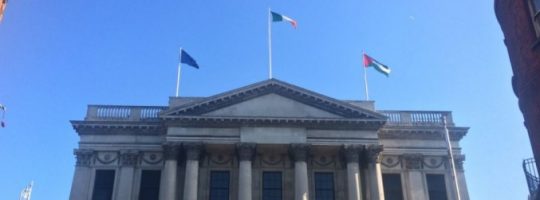
It has become the fourth Irish local authority to make such a move in recent months.
“I am delighted with [the] vote in solidarity with the people of Palestine. It might seem like a very small gesture but I know from the reaction to similar decisions made by other councils that today’s vote will be applauded across Palestine and elsewhere,” said Councilor Enda Fanning.
About 600,000 Israelis live in over 230 settlements built illegally since the 1967 occupation of the Palestinian territories.
Palestinian officials say they want the resolution of the conflict with Tel Aviv based on the so-called two-state solution along pre-1967 boundaries.
However, Netanyahu has on several occasions said Israel should maintain its military occupation of the West Bank under any agreement with the Palestinians.
In recent months, the Tel Aviv regime has stepped up its illegal settlement construction activities in the occupied lands and oppressive measures against the Palestinians, leading to an increase in global anti-Israel sentiment.
BDS gains support from US Mennonite churches
MEMO | July 12, 2017
The Mennonite Church of America has voted to sell its holdings in companies that profit from the Israeli occupation, according to the Washington Post.
The church, which has over 75,000 members voted by a majority of 98 per cent to support the Boycott Divestment Sanctions (BDS) campaign last week in Orlando.
The resolution voted upon, called on “individuals and congregations to avoid the purchase of products associated with acts of violence or policies of military occupation, including items produced in [Israeli] settlements.”
In a statement, the Mennonite Church explained its decision: “The Palestinian people have suffered injustices, violence, and humiliation, including … life under Israeli military occupation and in refugee camps throughout the Middle East.”
The church has also turned to their own $3 billion fund and asked investment managers to review all investment practices that may benefit the ongoing Israeli occupation.
Numerous churches in the US have also committed to a divestment campaign of Israeli goods, including the Presbyterian Church, the United Church of Christ, the Quakers, the Unitarian Universalists and the Evangelical Lutheran Church. Whilst the 12.8 million-member United Methodist church did not move to support BDS outright, they have barred investment in five Israeli banks citing human rights concerns.
Read also: BDS campaign supported by African churches
Israel Wants US, Not Russia, to Control Deescalation Zones in Syria – Haaretz Report
Sputnik – 07.07.2017
TEL-AVIV – Senior Israeli politicians held talks on safe zone issues with US special envoy for the global coalition to counter Islamic State (terrorist group outlawed in Russia) Brett McGurk, telling him Israel would prefer to have US troops rather than Russian troops controlling Syrian deescalation zones, and US President Donald Trump’s administration is already considering this idea, but has not made any decision yet, Haaretz newspaper reported, citing three sources involved in the talks.
Israel voiced three main demands upon the US envoy: the separation of safe zone talks from the Astana talks; keeping Iran, Hezbollah and other Shiite militias away from the Israeli and Jordanian borders; and not playing any active role in controlling safe zones near its border.
“We’re in close contact with the Americans and they understand our positions and our concerns very well. We made it clear to the Americans and other parties that we want to see the entire package relating to the deescalation zones, not just a few details, and then we can decide what our position is,” one of the officials said, as quoted by the newspaper.
Russian President Vladimir Putin and Trump are expected to meet for the first time later Friday on the sidelines of the G20 summit to discuss key issues of the international agenda, including cooperation in the settlement of the Syrian crisis. On Thursday, Putin discussed the fight against terrorism and the situation in Syria with Israeli Prime Minister Benjamin Netanyahu in a telephone conversation.
US Senators Warn Trump Against Returning Seized Russian Diplomatic Compounds
Sputnik – 07.07.2017
WASHINGTON — Three US senators warned President Donald Trump against making any deal with his counterpart Russian President Vladimir Putin to return two seized Russian diplomatic compounds, a letter from the lawmakers showed.
“The return of these two facilities to Russia while the Kremlin refuses to address its influence campaign against the United States would embolden President Vladimir Putin and invite a dangerous escalation in the Kremlin’s destabilizing actions against democracies worldwide,” Senators Jeanne Shaheen, Marco Rubio and Johnny Iakson warned in their letter to Trump on Thursday.
The senators wrote their letter ahead of a scheduled face-to-face meeting between Putin and Trump on Friday on the sidelines of the G20 Summit in Hamburg.
Senior Trump administration officials have said that the two leaders could discuss the return of the two diplomatic compounds in the US states of New York and Maryland.
But the three senators urged Trump to “remove the return of these facilities from any negotiation or consideration in your discussions with President Putin during your upcoming trip.”
Former President Barack Obama shut down the two compounds in December last year, amid allegations that Russia interfered in the 2016 US presidential election.
Russia denies meddling in the vote, insisting that it does not interfere in the internal affairs of other countries.
US ‘Can’t Get Facts Straight’ in Threats to Sanction China, Russia Over N. Korea
Sputnik – 06.07.2017
US officials say China has betrayed Washington in efforts to contain North Korea, citing a nearly 40% growth in trade between the two Asian countries. Chinese and Russian observers say the US doesn’t have its facts straight, and that Washington must work with, rather than ignore, Russian and Chinese initiatives on ensuring peace in the peninsula.
US UN Ambassador Nikki Haley has warned that Washington might use its “considerable military forces” against North Korea if necessary, and called on Russia and China to cut trade ties with the Asian country.
Speaking at an emergency meeting of the UN Security Council on Wednesday, a day after North Korea carried out its first test of its new intercontinental ballistic missile, the US ambassador accused Russia and China of failing to fully implement UN-mandated sanctions, and warned that the countries wouldn’t be able to maintain their trade arrangements with the US if the trade with Pyongyang didn’t stop.
Russia and China used the emergency meeting to present their own joint initiative aimed at reducing tensions on the Korean Peninsula, and urged Washington and Seoul to immediately suspend and abolish the deployment of THAAD missile defense on South Korean soil. The two countries also stressed that the US’s apparent willingness to consider the use of military force to stop North Korea’s nuclear and missile programs was “unacceptable.”
At the meeting, Haley proposed tightening the sanctions regime against Pyongyang, adding that the US would “go our own path” if the Security Council didn’t approve the proposal. Russian officials responded by saying that a tightening of sanctions would only “lead to a dead end” in attempts to arrange a diplomatic and political settlement to the crisis. Chinese UN Ambassador Liu Jieyi called on all parties to “exercise restraint, avoid provocative actions and belligerent rhetoric, demonstrate the will for unconditional dialogue and work actively together to defuse the tension.
In addition to threats of unilateral action, including more sanctions, US officials have also warned that Washington might sanction Chinese companies, including banks, which continue to do business with North Korea.
At Wednesday’s Security Council meeting, Haley accused China of failing to enforce sanctions, noting that the country accounted for 90% of North Korea’s total trade volume, and that trade has gone up. The ambassador stressed that the Trump administration would continue to work with China and other countries on the North Korean problem but would not repeat the “inadequate approaches of the past.”
Also Wednesday, President Donald Trump tweeted that trade between China and North Korea had grown “by almost 40%” in the first quarter of 2017. “So much for China working with us – but we had to give it a try!” he wrote.
Guo Yanjun, deputy director of Center for Asian Studies at the Chinese Diplomatic Academy, said that the US was deliberately distorting the facts on Chinese-North Korean trade statistics, and their relation to UN sanctions resolutions.
“Such so-called warnings are not based on objective data,” the expert told Sputnik.
“It is common knowledge that for the sake of implementing UN Security Council Resolution 2321 on sanctions against North Korea, China approved and strictly enforces the list of items prohibited under the resolution from start to finish,” Guo added.
“I suppose that such warnings against Beijing could be based on the fact that Washington has paid attention only to the 37.4 overall increase in trade between China and the DPRK in the first quarter of this year. At the same time, Washington should have seen that during this same period, China’s imports of coal amounted to 267.8 million tons, a drop of 51.6% compare to the same period last year,” the expert noted.
China, Guo stressed, “strictly and unfailingly implements the trade embargo against Pyongyang, but it is necessary to take into account the economic situation in the country and the living conditions of North Korea’s population. China’s trade embargo does not affect bilateral trade which serves the spheres of vital activity of the population. Doing otherwise would lead North Korea to face a humanitarian crisis. This is a threat to China as well, and one that would be difficult to avoid.”
Accordingly, the analyst noted, “on the one hand, we strictly implement the resolutions of the UN Security Council; on the other, we see the warnings and accusations from the US to be unreasonable. In this regard, I would like to stress once again that we should not confuse facts with speculation.”
Commenting on the fact that the US and its allies have ignored the Chinese and Russian proposals – including regarding North Korea’s economic strangulation and the THAAD deployment, Russian military observer Vladimir Evseev told Sputnik that Washington was doing so because these ideas do not fit its own scenario on how to respond to the North Korean nuclear and missile threat.
It’s “perfectly clear,” the expert noted, that what the US was doing now was “only an imitation” of defense against North Korean missiles via the THAAD missile defense system. THAAD, he stressed, is ineffective, and cannot realistically defend against the group launch of North Korean missiles. Furthermore, he noted, Tuesday’s test brings Pyongyang closer to being able to strike Hawaii.
“In these conditions, the US might decide on carrying out a strike to disarm North Korea. Pyongyang’s response to such a decision would not be a nuclear strike against South Korea, but the deployment of special forces troops on South Korean territory. The strength of this well-trained force is at least 50,000 troops, and according to some sources 80,000. They will pass through the demilitarized zone; special tunnels have already been created for this purpose. Passing through the DMZ will not present a serious problem for them. After that, they will carry out sabotage activities in South Korean territory, destroying chemical and nuclear industries, as a result of which the possibility of life on the Korean peninsula will be put under question.”
This, Evseev warned, would also “create serious environmental consequences for Russia, Japan and all other nearby states, including China. Such a scenario, unfortunately, is becoming more and more possible. It is absolutely clear that the policy of the Trump administration is not only completely hopeless, but also reckless, because it is factually leading to a war being unleashed on the Korean peninsula.”
“And the fact that the US does not notice the efforts by Russia and China to deescalate the situation in the region factually pushes Moscow and Beijing to joint efforts to prevent the implementation of the US military scenario,” the analyst added.
Following this week’s events, Russia and China have called for an end to the belligerent rhetoric, and for practical steps to implement the join Russian-Chinese plan to address the North Korean missile and nuclear programs. At the same time, both countries have urged Pyongyang to strictly comply with the demands of UN Security Council resolutions.
Featured Video

The Truth About the Trump Shootings with Ken Silva
or go to
Aletho News Archives – Video-Images
From the Archives
Trans ‘milk’ as good as the real thing – NHS
RT | February 18, 2024
The drug-induced nipple secretions of trans women are as good as mothers’ breast milk for babies, the University of Sussex Hospitals NHS Trust claimed in a letter to campaigners made public in a report by British think tank the Policy Exchange on Sunday.
The healthcare trust’s medical director, Rachel James, argued that the off-label prescription drug cocktail men transitioning to female take in order to produce milk was “similar to the natural hormones which encourage lactation to develop when the baby is newly born.”
“The evidence which is available demonstrates that the milk is comparable to that produced following the birth of a baby,” James wrote in the letter, sent to Children of Transitioners last August.
Biological men who wish to lactate must first take hormones to grow milk glands and then take high doses of either domperidone or metoclopramide to stimulate milk production. Neither drug is approved for this use, though they are occasionally prescribed off-label to biological women who have trouble lactating.
However, domperidone’s own manufacturer, Janssen, warns patients the drug “may cause unwanted side effects affecting the heart in a breastfed baby” and “should be used during breastfeeding only if your physician considers this clearly necessary.” … continue
Blog Roll
 Aletho News
- Seyed M. Marandi: U.S. Strike Imminent – Toward Total War in the Middle East
- Russia Voted Under Fire. Washington Is Loading the Tankers.
- 12 Things Your Oncologist Was Trained Not to Tell You
- Anthrax Attacks Paved Way for COVID-Era ‘Junk Drugs and Vaccines’
- How Real Is the Impact of Western Sanctions on Israel?
- France, You Are Guilty: How Paris Turned Western Sahara into the Maghreb’s Powder Keg
- 2025 Nature Paper Claiming Worsening Global Drought Gets RETRACTED …Heavily Flawed
- Your Milk Is Not the Problem
- The Truth About the Trump Shootings with Ken Silva
- ARE PATIENTS BEING PROPERLY INFORMED ABOUT OZEMPIC?
- If Americans Knew
- Salah Sarsour’s Legal Team Says DHS Has Not Met Its Burden to Prove He Is Deportable
- An analysis of tax forms by The Intercept show Kraft’s charity and LLC have donated to Friends of the IDF and AIPAC’s super PAC.
- Israeli attacks kill four Palestinians in Gaza – Daily Update
- Inside Gaza’s death trap of collapsing, bombed-out buildings
- The everyday items Israel bans from Gaza every day
- Inside the siege, the ruined buildings of Gaza – Daily Update
- Debunking The Claim That Macklemore Has A “History Of Antisemitism”
- CPJ demands release of arrested Palestinian-US journalist near Bethlehem
- Robert Kraft: The Billionaire Friend of Netanyahu Pulling The Strings Behind the Macklemore/Ed Sheeran Blow Up
- Columbia Administered Fund Gives Big Money to Pro-Israel Groups
- No Tricks Zone
- 2025 Nature Paper Claiming Worsening Global Drought Gets RETRACTED …Heavily Flawed
- New Study: ‘Global Drought Shows No Detectable Recent Acceleration Under Climate Warming’
- Economic Masterminds: German Socialists Suggest Taxing Productivity Gains Stemming From Using AI
- The South China Sea Has Not Been Cooperating With The Climate Change Narrative
- Energy Crisis: Germany Enters Heating Season With Historically Low Gas Reserve Fill Levels
- New Study: The Antarctic Ice Sheet Gained Mass From 2020-2024 Due To Staggering Snow And Ice Accumulation
- Study: Ocean Heating Rates From Thousands Of Years Ago ‘Dwarf’ Modern Ocean Heating Rates
- Climate Extremists Target, Attack Large-Scale Power Grid Infrastructure In Germany!
- New Study: Antarctic Ice Melt Has Contributed Less Than 1 Centimeter To Sea Level Rise In The Last 30 Years
- Fear Of Debate: Alarmist German Climate Scientist Calls On Mainstream Media To Discredit Skeptic Voices
 Aletho News