Israel’s Mockery of Security: 101 Actions Israel Could Take
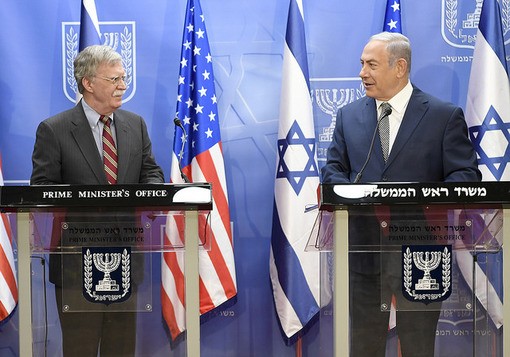
Photo Source U.S. Embassy Jerusalem | CC BY 2.0
By Sam Bahour | CounterPunch | November 14, 2018
Israel has made a colossal mockery of the concept of security.
In debating an Israeli friend from Jerusalem, I challenged him that Israel consciously plans and uses its military might to damage the Palestinian’s national project to build a state and free itself from Israeli control. Avner, my Israeli friend, argued otherwise, buying into the Israeli state narrative that Israel is “forced” to take measures which negatively affect Palestinians because Israeli security requires it. My knee-jerk reaction as someone living and working under Israeli military occupation for over two decades, was that this was hogwash and, short of ending its illegal (note: legal occupations are temporary by definition) occupation of Palestinians, I claimed that Israel—the occupying power—could immediately take 101 measures to reduce tensions on the ground, without jeopardizing any true and rational security needs. He shrugged and said, “tell me”?
In the years to follow, I have given numerous talks on the state of affairs under Israeli occupation to groups visiting Palestine from all corners of the world. A large number of those talks were to Jewish-American groups—many participants being rabbinical students and mainstream Jewish influencers hosted by the U.S. not-for-profit Encounter—who traveled to Palestine for an Encounter Program. In a recent Encounter talk, one rabbi attentively listened as I made the same claim, Israel can take 101 actions tomorrow morning without jeopardizing security. He raised his hand and asked, where can we get that list?
So, here it is. A quick compilation, with the generous assistance of several friends here in Palestine, and with a few items selected from the umpteen reports being published about the rapidly deteriorating state of affairs. This list is not intended to be comprehensive by any means, but rather a look beyond the daily headlines to give readers, especially those who have bought into the Israeli propaganda—hook, line and sinker—that this military occupation is all about “security”.
I attempted to place a few subtitles to categorize the list, although many items are multifaceted. Space does not allow for a full explanation of each proposed action, so if anyone wants to be directed to a more in-depth explanation of any listed action, or otherwise, please feel free to reach out at the email listed below.
Before offering the list, I must state upfront and clearly, my goal in presenting these ideas is not to assist the powers-that-be to design an embellished military occupation intended as permanent. Rather, my purpose is to reveal Israel’s underlying intentions, its indefinite time frame for continued domination, and the cornucopia of diverse types of actions carefully calculated to humiliate each and every Palestinian, while structurally blocking a path to Palestinian statehood, otherwise known as the two-state solution. That noted, for those who simply cannot fathom the notion of a Palestinian state free from Israeli occupation, I welcome all efforts to get my list addressed while the occupation continues, which would align Israel’s actions somewhat better with the law of occupation, the Geneva Convention Relative to the Protection of Civilian Persons in Time of War (Fourth Geneva Convention, 12 August 1949).
101 actions Israel could take
Gaza
1) Allow for free movement of goods to/from Gaza
2) Open the Erez [Passenger] Crossing to the West Bank 365 days a year, 24 hours a day, 7 days a week for the nearly 2 million Palestinian residents of Gaza
3) Permit Palestinians to tap their natural gas wells discovered in the sea of Gaza in 2000
4) Allow access to the Gaza Strip’s land
5) Allow access to the Gaza Strip’s territorial waters, expanding Gaza’s fishing zone: The Government of Israel halved Gaza’s fishing zone from 6 nautical miles to 3 nautical miles; compare that to the twenty-nautical mile limit set by the Oslo Accords. (World Bank)
6) Allow access to the Gaza Strip’s air space, releasing 3G frequencies for wireless internet access for Gaza
7) Keep the Karm Abu Salem cargo crossing open (World Bank)
8) Allow solar panels into Gaza (World Bank)
Jerusalem
9) Stop stripping Jerusalemites of their Jerusalem residency status
10) Eliminate arbitrary taxation regime being applied to Palestinians in East Jerusalem, especially those in the Old City
11) Increase public services to East Jerusalem to align with the level of taxation paid by East Jerusalem residents and with their proportion of the entire city’s population
12) Allow daily mechanism for Palestinians’ freedom of religion, not only on the occasional holidays (entry to Jerusalem to pray at Al-Aqsa, Church of the Holy Sepulchre, e.g.)
Education
13) Remove barriers inside the West Bank between children and their schools
14) Stop soldiers at checkpoints from harassing school age students, stop the delaying and excessive searching of students (and teachers) coming to/from Jerusalem through the Qalandia checkpoint, especially of those who are unaccompanied by parents
15) Provide teachers open access to their workplaces, i.e. crossing checkpoints, etc.
16) Eliminate routine Israeli military forces incursions into schools
17) Allow academic/educational institutions to operate comfortably and freely within Palestinian communities in the occupied Palestinian territory (oPt), including East Jerusalem
18) Recognize/accredit the degrees granted by all Palestinian higher educational institution as legitimate credentials for continuing education in Israel or for professional work permits
19) Stop delaying release of textbook shipments
20) Stop delaying release of, and desist from tampering with, examination papers and answer sheets coming from the International Baccalaureate Organization (IBO)
21) Stop banning basic laboratory supplies for students’ laboratory experiments
22) Grant permits for school education/recreational trips: an entire generation has never seen the sea
23) Stop systematically targeting schools in marginalized areas like Khan al-Ahmar in the Jordan Valley
24) Allow importing of educational accessories and tools: During the Microsoft International Student Competition, smart pens, circuits, and other similar materials required by participants were discarded at the Israeli border on the pretext that these educational materials were a threat to Israel’s security
25) Allow student travel. During the Microsoft International Student Competition, the Palestinian team won first place over 23 Arab countries in the innovation category and were qualified to compete in the US. One of the students, despite the student having no security issues, and with an official invitation from Microsoft and the US consulate in hand, was unable to get Israeli permission to enter Jerusalem to process his US visa.
Humanitarian
26) Stop the arrests, especially of children: Number of Palestinians who have been held in Israeli jails for periods ranging from 1 week to life, 1967-1988: 600,000; number of Palestinians arrested during the first intifada (1987-94): 175,000
27) Stop the torture: Documented percentage of Palestinian detainees who have been tortured during interrogation: 85%
28) Stop the deportations: Documented number of Palestinians deported between 1967 and 1992: 1,522; between 1970 and 1973: 785; in 1992: 415; number deported from the West Bank to the Gaza Strip, 2002-2004: 32
29) Stop the house demolitions: Documented number of Palestinian homes in the oPt demolished by Israeli authorities, June 1967-March 2009: 24,145
30) Stop the killings: Killings during the two Intifadas: Number of Palestinians killed by Israeli security forces and civilians, December 9, 1987 to September 28, 2000: in the oPt: 1,489; within the Green Line: 60. Number killed, September 28, 2000 – September 28, 2004: 3,234
31) Release the bodies of killed Palestinians to their families
32) Stop ripping apart bicultural families: Provide clear and easy access via family re-unification for foreign nationals married to Palestinians
33) Stop arbitrary denial of entries and restrictions on visiting foreign nationals, allowing Palestinian firms to recruit Palestinian and international talent abroad by issuance of work visas/permits for any such person who does not have a Palestinian identity card.
34) Respect Palestinian water rights as defined under international law and honor applicable, signed bilateral water-related agreements
35) Stop spraying of herbicides intended to destroy crops, especially on outskirts of the Gaza Strip
36) Respect the Bedouin community’s way of life, stop the displacement of Bedouin communities
Municipalities
37) Reclassify areas currently classified as Area C if they are within defined city boundaries
38) Expedite landfill approvals: The regional landfill in Rammun (center of West Bank) took about 15 years for the Israeli side to approve
39) Expedite cemetery approvals: The new Ramallah cemetery project took about 12 years for the Israeli side to approve
40) Expedite water/sanitation approvals: The project for a central purification plant in Ein Griot has been waiting for Israeli approval for years now
41) Expedite approvals for new or improved transportation routes: The desperately needed Ramallah ring road project, a case in point, has submitted all required details and continues to await Israeli approval
Economic
42) Stop the illegal dumping of Israeli goods and services into the Palestinian markets, Stop unlicensed Israeli firms, such as Israeli telecommunications firms, from illegally selling their services to the Palestinian Authority (PA) areas
43) Stop the arbitrary delays in importation of technology products
44) Release 4G frequencies for West Bank and Gaza
45) Allow for free movement of goods within the oPt
46) Allow for unfettered imports
47) Allow for unfettered exports
48) Allow the entry of Palestinian goods into the Israeli market, as the Paris Protocol (4/94) provided for in a unique economic and trade regime named the Customs Envelope
49) Stop using an Israeli-specific “Dual Use List” for Palestinians, causing unjustified additional restrictions to importation of goods into Gaza and considerable delays and difficulties for West Bank economic projects, such as the Bethlehem Industrial Estate (BMIP)
50) Stop the extensive security checks within the West Bank which pose an economic obstacle to trade
51) Allow for delivery of large machinery/equipment/vehicles related to PA and international projects, especially for agriculture and construction
52) Eliminate all military checkpoints between Palestinian cities/villages inside the oPt
53) Provide humane/non-segregated access to Palestinians via air, sea and land ports
54) Provide PA security forces full access to all oPt areas
55) Provide PA police full control of all oPt roads
56) Stop issuing licenses to Israeli firms quarrying of Palestinian lands in the oPt
57) Remove closures to all entrances to villages and cities in the oPt, as some residents travel 90-120 additional minutes to reach destinations literally minutes away
58) Allow Palestinians full privileges on “Israeli-only” roads
59) Allow 24/7 access on Israeli-issued travel permits
60) Allow Palestinians with multi-day Israeli travel permits to lawfully stay overnight in Jerusalem and Israel
61) Eliminate the recent requirement of a so called “Magnetic Card” required to apply for an Israeli travel permit to Jerusalem or Israel
62) Eliminate the so called “BMC – Businessman’s Card” required to apply for a multi month Israeli travel permit to Jerusalem or Israel, which artificially segments Palestinian society
63) Allow ease of rehabilitation of deteriorating old cities, especially in Hebron and Jerusalem
64) De-monopolize the Israeli/Jerusalem tourism sector (tourism operators, guides, licenses, etc.), ending the demand to adhere to the “Israeli narrative”
65) Apply and enforce the laws and adjudicate violations equally with respect to all residents/citizens under Israeli jurisdiction as an occupying power
66) De-legitimize “open carry” of weapons for Israeli settlers or accord Palestinian farmers the same privileges
67) Secure Palestinian farmers yearlong access to their farm land, not only partial harvesting seasons
68) Maximize allowed farming area, especially near settlements
69) Expedite issuance of land deeds (Tabu), especially in Area C
70) Allow legal building in Areas B and C
71) Allow access to natural water sources in Area C
72) Allow postal mail and packages to reach the Palestinian Post in a timely manner: In August 2018 Israel dumped 10 tons of mail they held up from 2010
Israeli Crossings and Ports
Border Crossings with Jordan / Allenby/King Hussein Bridge (KHB)
73) Open this sole passenger crossing to Jordan 365 days a year, 24 hours a day, 7 days a week for the nearly 3 million Palestinian residents of West Bank
74) Increase the number of vehicles, load capacity of cargo loading and unloading, and operating hours at the KHB
75) Streamline the logistics for imports entering the oPt: For example, cement silos could be constructed to store bulk cement until transferred by Palestinian trucks into the Palestinian territory.
Border Crossings with Israel
76) Stop restrictions on shipments through cargo crossings from the oPt into Israel, such as limited number and capacity of cargo crossings, limited working hours, and strict security restrictions: This encourages tax evasion and unfair competition in the form of goods smuggled into the oPt by Israeli trucks that freely enter the Palestinian areas via the crossings and need not unload their cargos, unlike the Palestinian trucks. Moreover, Israeli cargo trucks are not subject to inspection by the Palestinian Authorities.
77) Stop random sampling security checks of cargo which cause cargo damage, as well as, long security checks of perishable cargo which is damaged when delayed for a long period for security inspection purposes.
78) Logistical arrangements for the entrance of goods into the Gaza Strip is an ultra-complicated and troublesome task. In addition to the very long waiting hours at Erez Crossing, the facility has unsystematic working hours with the constant possibility of sudden closure for “security” reasons.
Container Ports
79) Allow direct imports to the oPt via a Palestinian clearing agent. Currently, all kinds of raw materials and goods need to be imported through an Israeli agent. Such a procedural requirement incurs high costs for the Palestinian importer for security and customs inspection. Additionally, the Palestinian importer incurs fees of relevant bonded Israeli warehouses and storage facilities as long as the cargo is withheld in the Israeli ports for inspection purposes, sometimes weeks, months or years on end.
80) Allow Palestinians to define their own import needs. Currently the quantity, quality, destination of imported goods and materials are determined according to the outdated Paris Protocol, which provides the annual ceiling of imports per country of origin.
Area C
81) Stop the prohibition of construction in Area C: Obtaining a permit to construct any factory or plant in Area C is made unbearably difficult and the process should be streamlined, simplified, and not subject to arbitrary regulations and delays.
82) As things stand, permits issued for Area C are time-bound and must be renewed on an annual basis, causing significant delays and a barrier to investment; revise these regulations to streamline the process.
83) Streamline the exhausting “security”-driven bureaucratic procedures to establish land titles, especially in Area
84) Expand spatial plans for Palestinian villages in Area C (World Bank)
85) Grant approval to Palestinian business projects in Area C (World Bank)
Constraints on Movement and Permits
86) Issue and abide by clear and lawful policies and procedures for obtaining all types of visas for foreign visitors, including granting visas to international faculty as they return for a new academic year and eliminating denial of long-term visas to international and regional experts working in the oPt
87) Lift the military ban on Palestinian commercial drivers’ entering Israel with a Palestinian-registered vehicle: This ban is enormously expensive for Palestinian employers, who bear the added logistical costs to rent an Israeli truck for the Israeli side of the route travelled, incurring more than double the rental cost of the Palestinian truck alone.
88) Allow for permits to manage commercial operations within Israeli areas, such as the management of warehouses in these areas. Currently, the limitations on permits issued shackle Palestinian firms’ ability to manage their internal affairs.
89) Allow Palestinian clearing agents access to Israeli ports at Ashdod, Haifa or Eilat. Currently, an Israeli agent needs to be hired as a go-between with the Palestinian importer.
90) Many Palestinian companies are active in both the West Bank and Gaza. Allow permits for West Bank company staff to enter the Gaza Strip and vice versa. At present, absent such permits, staff is unable to follow up on work in progress, attend meetings, or participate in training courses.
91) Permit Palestinian firms’ shareholders to travel to/from the West Bank/Gaza Strip to attend the annual general meetings of firms they are invested in. At present, to work around this, firms incur the extra expense of arranging two venues for a meeting; one in the West Bank and the other in the Gaza Strip, to ensure an equal opportunity for all the shareholders in Palestine to attend the meetings, which are connected by video conferencing.
Legal Issues
92) Streamline legal actions for Palestinian firms having issues with Israeli citizens/cheques; currently, the problem of the Israeli citizen/firm’s being subject to another jurisdiction creates manifold obstacles to prompt resolution.
93) Recognize a third country arbitration between Israeli and Palestinian businesses. If a commercial dispute arises between Palestinian and Israeli parties, Israeli laws requires that arbitration be made in Israeli areas for security purposes and for the safety of the Israeli party. This practice is a clear violation of customary international practices and norms that the seat of arbitration should be in a third and neutral country.
94) Stop the military ban on a large number of Gazan traders who have been commercially banned by Israel without due process, rendering them unable to sell or purchase goods and materials.
Quality inspection
95) Stop the discrimination in dealing with standards certificates. The required Israeli quality inspection of imports transshipped through Israel and acquiring of the Israeli Standards Certificate require a lot of time that might extend up to six months with high costs. Currently, Israeli shipments require one certificate for every product being imported, despite the number of times imported, whereas the Palestinian importer must get a new certificate for every shipment of the same product, adding time and cost to every importation of goods.
96) Allow Israeli products entering the Palestinian market to get a Palestinian Standards Certificate. Currently, the Palestinian market is flooded with Israeli products that bypass Palestinian standards certification.
Financial
97) Stop withholding/delaying the various monetary transfers to the Gaza Strip, imposing extra costs to cover transfers
98) Pay the Palestinian Authority seigniorage for their use of Israeli currency
99) Stop delays in transferring payments to Palestinian government, further indebting the PA: VAT and Import duties collected by the Government of Israel (GoI) on behalf of the PA and should be transferred monthly based on an arrangement instituted by the Paris protocol. (World Bank)
100) Stop unilateral deductions from Palestinian funds, further indebting the PA: These are deductions made by the GoI from clearance revenues to settle utility bills owed by Palestinian Local Government Units (LGUs), utilities and distribution companies to Israeli suppliers. (World Bank)
101) Transfer to the Palestinian Authority fiscal losses accumulated over the years. The signed agreements defined specific arrangements through which the GoI collects VAT, import duties and other income, or the so-called clearance revenues, on behalf of the PA and shares it with the latter on a monthly basis. Some of these arrangements have become outdated and others have not been implemented as envisaged by the agreements, resulting in fiscal losses for the PA. The quantified annual loss (excluding revenues collected by the GoI in Area C that could not be quantified due to data constraints) amounts to USD 285 million, or 2.2 percent of Palestinian GDP. (World Bank)
So, here you have it, a detailed sampling of what the Israeli military occupation means from ground zero. These and dozens of other Israeli restrictions are what mainly underlie the inability of Palestinians, individually and collectively, to create a different reality on the ground, let alone properly prepare for a free and independent state.
A longtime Jewish-American attorney friend with whom I shared this list as a draft in process responded unequivocally: These issues, he said, are not Israeli security threats; on the contrary. If they were rationally addressed, the results would serve Israeli security needs. With that, one must step back a bit and reflect on what Israel’s real intentions might be in sustaining its 50-year military occupation through the use of this vast web of “security” regulations.
Sam Bahour is managing partner of Applied Information Management (AIM), a policy analyst with Al-Shabaka: The Palestinian Policy Network, a secretariat member of the Palestine Strategy Group, and chairman of Americans for a Vibrant Palestinian Economy. He blogs at http://www.epalestine.com. Twitter: @SamBahour
Russia keeps Israel’s Netanyahu in anteroom
By M. K. BHADRAKUMAR | Indian Punchline | November 11, 2018
It is over a month since Israeli Prime Minister Benjamin Netanyahu had announced that he was going to Moscow to meet Russian President Vladimir Putin with a view to open a new page in the relations between the two countries following the incident over Syrian skies on September 17 when a Russian reconnaissance plane was shot down killing 15 personnel.
However, Moscow has not scheduled Netanyahu’s visit so far. Netanyahu hoped that on the sidelines of the ceremony marking the centenary of the World War 1 armistice in Paris tomorrow there might be an opportunity for a meeting with Putin. The Israelis sought a meeting. But Moscow apparently hasn’t confirmed Putin’s convenience.
Clearly, Moscow is keeping Netanyahu in the anteroom to cool his heels, signaling that it cannot be ‘business as usual’. In a hard-hitting interview with Times of Israel, the Russian ambassador to Israel Anatoly Viktorov made it clear in the weekend that the September 17 incident rankled. He said the Russian defence establishment is “extremely disappointed” with the Israeli military’s response to the incident.
Ambassador Viktorov also rubbed it in that the Israeli demand for the removal of all Iranian troops on Syrian soil is both “unrealistic” and unnecessary since Iran has no plans to attack Israel and it is Israelis, after all, who are killing Iranians and not vice versa!
Quite obviously, Russia has hardened its stance vis-à-vis Israel. Conceivably, Moscow must be pleased with the ‘new normal’. According to Russian reports, since the deployment of the awesome S-300 missile system in Syria, the Israeli Air Force “hasn’t conducted a single air mission in Syria.” That is to say, the Israeli stance that the S-300 deployment notwithstanding, Israeli jets reserve the right to attack Syria, etc. is just bravado.
Tel Aviv is not taking chances, given the scale of deployment of the S-300 and the probability that Russia has also imposed electronic countermeasures over Syria’s coastline to suppress satellite navigation, onboard radar systems and communications of warplanes attacking targets on Syrian territory.
In political terms, the longer this impasse continues, the weaker the Israeli claim that the Iranian presence in Syria threatens its security becomes. In reality, though, Israel has all along been using the ‘Iranian threat’ as a pretext to attack Syria, thereby staking claim to have a voice in any peace settlement. Israel’s agenda is to get some sort of international legitimacy for its illegal annexation of the Golan Heights.
The Russians are apparently taunting the Israelis by admitting that S-300 may not be hundred percent fool proof. In another report, a senior Syrian military official has been quoted by Russian media as saying, “There is no concept of zero probability in military strategy. We cannot say that this probability has been reduced to zero, because we are talking about open skies, extended borders, various technologies… Therefore, I cannot say that in the end there will not be such a probability, however, the probability of this aggression achieving its goals has been minimized.”
Nonetheless, for the Israelis this is a piquant situation of the “unknown unknown”. Russia is keeping Israel guessing how dangerously risky it could be for its pilots to undertake strikes under these obscure circumstances. Russia may be planning to seek an overhaul of the entire mechanism regarding Israel notifying in advance its air strikes on Syria. Israel was giving Russians only short notice before undertaking missions and had been getting away with it, but the September 17 incident has changed the calculus.
Certainly, for the overall stabilization of the Syrian situation, it is helpful that Israel is prevented from inserting itself into the security situation. Interestingly, Tehran and Damascus have left it entirely to Moscow to needle the Israelis, but it stands to reason that the three allies are also in consultation as regards any new ground rules for the Israelis in the Syrian conflict.
The bottom line is that the Israeli swagger that Netanyahu and Putin have had a special thing going between them at the personal level stands exposed.
Apparently, that is not the case. It seems Moscow deals with Israel strictly on the basis of its willingness to behave responsibly.
Given the state of play currently in the US-Russian relations, Israel is unable to leverage the Trump administration to intervene on its behalf with Moscow. At the Helsinki summit in July between Putin and President Trump, the latter had underscored Israeli security concerns as an agenda item.
Washington Post Publishes Article of Yemen’s Houthi Leader

Head of Yemen’s Revolutionary Committee, Mohammad Ali Al-Houthi
Al-Manar | November 10, 2018
The Washington Post has published on Friday the first article of the head of the Supreme Revolutionary Committee, Mohammad Ali Al-Houthi.
Houthi leader: We Want Peace for Yemen, But Saudi Airstrikes Must Stop
The continued escalation of attacks against the port city of Hodeida in Yemen by the U.S.-Saudi-Emirati coalition confirms that the American calls for a cease-fire are nothing but empty talk. The recent statements are trying to mislead the world. Saudi leaders are reckless and have no interest in diplomacy. The United States has the clout to bring an end to the conflict — but it has decided to protect a corrupt ally.
Any observer of the crimes committed in Yemen by Saudi Arabia — a campaign that has been accompanied by disinformation and a blockade of journalists trying to cover the war — can offer an account of the indiscriminate killing thousands of civilians, mostly through airstrikes. Their attacks have led to the greatest humanitarian crisis on earth.
The brutality of the Saudi regime was reflected in the murder of the journalist Jamal Khashoggi. And it can be seen in the military escalation and airstrikes in Hodeida and other cities, in defiance of all international warnings.
The blockade of the port city is meant to bring the Yemeni people to their knees. The coalition is using famine and cholera as weapons of war. It is also extorting the United Nations by threatening to cut their funds, as if it were a charity and not a responsibility required under international law and Security Council resolutions.
The United States wants to be viewed as an honest mediator — but it is in fact participating and sometimes leading the aggression on Yemen.
We are defending ourselves — but we don’t have warplanes like the ones that bomb Yemenis with banned ammunition. We can’t lift the blockade imposed on Yemeni imports and exports. We cannot cancel the air embargo and allow daily flights, or end the ban of importing basic commodities, medicines and medical equipment from any place other than the United Arab Emirates, as it is imposing on Yemeni business executives.
And the list goes on. These repressive practices are killing and destroying Yemen.
Yemen was not the one who declared the war in the first place. Even Jamal Benomar, the former United Nations envoy to Yemen, said we were close to a power-sharing deal in 2015 that was disrupted by the coalition airstrikes. We are ready to stop the missiles if the Saudi-led coalition stops its airstrikes.
But the United States’ calling to stop the war on Yemen is nothing but a way to save face after the humiliation caused by Saudi Arabia and its spoiled leader, Crown Prince Mohammed bin Salman, who has ignored Washington’s pleas to clarify Khashoggi’s murder.
Moreover, Trump and his administration clearly prefer to continue this devastating war because of the economic returns it produces — they drool over those arms sales profits.
We love peace — the kind of honorable peace defended by our revolution’s leader, Abdulmalik al-Houthi. We are ready for peace, the peace of the brave. God willing, Yemenis will remain the callers of peace and lovers of peace.
Pentagon Report Questions US’ Own Legal Justification for Staying in Syria
Sputnik – November 7, 2018
The latest quarterly report by the Lead Inspector General on the status of Operation Inherent Resolve, the codename for the US military’s intervention against Daesh in Syria and Iraq, has paid extensive focus to Iran, mentioning it 105 times in 130 pages. However, while accusing Tehran of posing a growing threat to US forces, the report admits that the Department of Defense has “no evidence” that Iranian troops or Iranian-allied militia have actually attacked the US in Syria.
The report also hints at a confused US policy in Syria, pointing to Trump National Security Adviser John Bolton’s recent statement about keeping US troops in Syria so long as “Iranian troops” and “Iranian proxy militias” remain outside of Iran.
This sentiment, the report admits, has led to “questions about the legal justification of maintaining US troops in Syria, which currently relies on the 2001 Authorization for the Use of Military Force against those who ‘planned, authorized, committed, or aided the terrorist attacks that occurred on September 11, 2001,’ which has been interpreted as including [Daesh].”
Unlike the presence of the Russian military and Iranian military advisors, the US has no internationally recognized legal justification for its presence in Syria, with Damascus repeatedly condemning US operations in the Arab Republic and demanding a US exit from the country.
The DoD points out that in the wake of Bolton’s remarks, military officials have changed tack, paying lip service to the “enduring defeat” of Daesh while telling congressional committees about the “ancillary benefits” and “leverage” provided by the continued presence of US forces in Syria.
Pointing to shifting political goals, which now seem to include “removing Iran and Iranian proxies from the country, influencing the outcome of the Syrian civil war… and stabilizing areas of northeast Syria liberated from [Daesh],” the report warns that “these non-military goals could keep the US military involved in Syria after the defeat of [Daesh]” over an unspecified period.
Iranian ‘Security Threats’ to US in Syria
Mentioning the intensive US drilling at the Al-Tanf Garrison in southern Syria following calls by Iran to end the illegal US presence in the area, the report warns of “several Iranian-backed militias” operating in the same area, with “their presence creat[ing] the potential for violence with US troops and US-backed forces.”
At the same time, the DoD report admits that “neither Iran nor Iranian-backed militias had hindered counter-[Daesh] operations,” and says that the Pentagon has “no evidence” that ‘Iranian troops’ or Iranian-allied militia have actually attacked the US in Syria.
‘Iran-Backed Militias’ in Iraq
In neighboring Iraq, the report mentions elements of the Popular Mobilization Forces, Shiite militia groups which played a crucial role in defeating Daesh in Iraq, saying that they pose a similar threat to US interests, given what are said to be their “close ties to Iran.”
“The influence of these Shia militias in both the security sector and the political process –and their continued willingness to act independently of the [Iraqi Security Forces] – increases Iran’s influence in Iraq,” the report states.
Alleging that Iran has deployed some 100-150 Islamic Revolutionary Guards Corps personnel among the militia, the report accuses these “Iranian proxies” of being “likely responsible for two attacks targeting US facilities in Iraq,” including a mortar attack in the Baghdad Green Zone in early September and rocket attacks in Basra near the US consulate, which led to the diplomatic mission’s temporary evacuation later that month.
The DoD report makes no mention of the fact that Iran firmly condemned the September attacks on US diplomatic areas out of principle. In a statement, the Iranian foreign ministry accused the US of “propaganda and false allegations against Iran and the Iraqi forces,” and called the consulate closure a “suspicious move aimed at evading responsibility and pinning the blame on others.”
Ultimately, the report warns that so far as Iraq is concerned, “if left unchecked, Iranian-sponsored harassment of US forces could increase, and Iranian influence operations could increase as they vie for influence in the new government.”
The Trump administration has shifted its position on Syria several times, with the president saying the US would “be coming out of Syria like very soon” in March before launching airstrikes against Damascus two weeks later. In September, National Security Adviser John Bolton linked the withdrawal of US troops from Syria to the alleged Iranian presence in the country, prompting the Pentagon to change its tone on the purpose of the Syria mission being the defeat of Daesh.
See also:
Israeli Defense Chief: US Sanctions Deal a ‘Critical Blow’ to Iran in Syria
Afghan delegation to attend multilateral peace talks in Russia
Press TV – November 5, 2018
An Afghan delegation will attend international talks on the war-torn country, which are scheduled to be held in the Russia capital Moscow this month.
The spokesman for the High Peace Council, Sayed Ihsan Taheri, said on Monday that the council would send four representatives to the meeting, which will focus on kick-starting peace talks between Kabul and the Taliban.
The HPC is a government body responsible for reconciliation efforts with militants.
The Afghan Foreign Ministry, however, did not say whether it would dispatch a delegation to the conference or not.
“We are still negotiating with the Russian officials,” spokesman Sebaghtullah Ahmadi said, adding, “We welcome any peace effort that is Afghan-led.”
Moscow has also invited representatives from the United States as well as Iran, India, China, Pakistan and five former Soviet republics in Central Asia to take part.
Russia said Saturday it would host the event on November 9 in the Russian capital. The meeting was initially scheduled to take place in September.
Taliban pledge to attend Moscow talks
Senior Taliban officials confirmed on Monday that the Afghan Taliban will join multilateral peace talks hosted by Russia on Friday.
A five-member Taliban delegation led by Sher Mohammad Abbas Stanakzai, head of the Taliban’s political council in Qatar, will attend.
“The majority of our top leaders showed the willingness to participate in the Moscow peace talks though some of them also expressed their reservations and said it would not give them any benefit on the ground in Afghanistan,” said a Taliban member.
Some Taliban members said the delegation would raise their demands for a withdrawal of all foreign forces, the release of all prisoners and the lifting of a ban on travel.
“This is a very good opportunity and we would like to participate and raise our genuine issues,” said another Taliban official. “We would urge these world powers to help resolve the Afghan issue as per international laws and principles.”
The Moscow talks will be held as newly-appointed US adviser to Afghanistan Zalmay Khalilzad reportedly met with the Taliban representatives in Qatar in October with the declared aim of bringing the militant group to the negotiating table.
Zahid Hussain, a Pakistani defense analyst and author of two books on militancy in the region, earlier said the appointment of Khalilzad as a special adviser in Afghanistan could complicate his job. “He has been very critical of Pakistan in the past and his appointment will not help move things forward.”
Afghan people still face insecurity 17 years after the United States and its allies invaded the country as part of Washington’s so-called war on terror.
Although the Taliban militant group was removed from power as a result of the invasion, the country remains occupied and many areas are still threatened by insecurity.
Ansarullah rejects US mediation in efforts to resolve Yemen conflict
Press TV – October 31, 2018
The Houthi Ansarullah movement has opposed a US proposal for mediation in efforts to resolve the conflict in Yemen, holding Washington responsible for the Saudi-led aggression against Yemen.
Mohammed al-Bakhiiti, a member of Ansarullah’s Political Council, told Iran’s Arabic-language Al-Alam news network on Wednesday that peace would be restored to Yemen if the US ended its war on the impoverished country.
He also expressed his objection to any solution to the Yemen crisis that ignores the country’s independence and sovereignty.
On Tuesday, American officials called for a ceasefire in Yemen and demanded that the sides to the conflict come to the negotiating table within a month.
US Defense Secretary Jim Mattis said the US had been watching the conflict “for long enough,” and that he believed Saudi Arabia and the UAE were ready for talks.
“We have got to move toward a peace effort here, and we can’t say we are going to do it sometime in the future,” he said. “We need to be doing this in the next 30 days.”
Mattis’ call was later echoed by US Secretary of State Mike Pompeo, who urged the coalition to stop airstrikes in Yemen’s populated areas, saying the “time is now for the cessation of hostilities.”
Bakhiti further stressed that Washington’s proposed solution for the Yemen conflict included dividing the country.
Mattis’ plan, supported by Saudi Arabia and the UAE, is meant to achieve goals that have not been attained during the war on Yemen, he added.
The only solution to the crisis is intra-Yemeni talks and non-interference by foreign parties, the Houthi official said.
In March 2015, Saudi Arabia and its allies launched a brutal war against Yemen in an attempt to reinstall the country’s former Riyadh-allied regime and crush the Houthis.
The Western-backed war, however, has so far failed to achieve its stated goals, thanks to stiff resistance from Yemeni troops and allied Houthi fighters.
The offensive, coupled with a naval blockade, has destroyed Yemen’s infrastructure and led to famine as well as a cholera outbreak in the import-dependent state. Tens of thousands of people have also lost their lives in the conflict.
Syrian FM: US Seeks to Prolong Conflict in Syria
Al-Manar | October 30, 2018
Under the pretext of protecting Kurds, the US is setting up military bases and aerodromes in Syria’s east, which signals their intention to prolong the armed conflict, Syrian Foreign Minister Walid Muallem told a press conference on Monday.
SANA news agency quoted Muallem as saying that the US is using its base in Al-Tanf on the Syrian-Iraqi border to train former members of the ISIL terrorist organization in order to include them later into units fighting against the Syrian army.
The foreign minister noted that the government forces and their allies are “the only real force fighting against ISIL groups and al-Nusra front extremist group on the Syrian territory.”
Muallem also said that terrorists from the al-Nusra group still remain in the area where the Idlib demilitarized zone should have been established.
“This is a signal that Ankara does not want to fulfill its obligations in the framework of Russian-Turkish agreements on Idlib,” he said.
The foreign minister noted that Idlib, located 320 kilometers from Damascus, remains under the control of terrorists who are supported by Turkey and the West, Tass news agency reported.
“We remain in close coordination with Russian friends regarding the situation in Syria’s north-west,” he added. Muallem also reminded that the agreement on Idlib is temporary, and the Syrian government has a legal right to return the province under its sovereignty.
According to the Russian-Turkish memorandum signed in Sochi on September 17 after talks between the presidents of Russia and Turkey, the demilitarized zone 15-20 kilometers deep in Idlib should have been established by October 15. However, Turkey asked to postpone joint patrolling in Idlib due to its inability to guarantee security from its side.
Istanbul Summit on Syria Was a Success but Caveats Remain
By Melkulangara BHADRAKUMAR | Strategic Culture Foundation | 29.10.2018
The four-nation Turkey-Russia-Germany-France summit on Syria on October 27 in Istanbul had an impressive outcome. All participants – each with own interests – has some ‘takeaway’ from the summit, which itself is a measure of the success of the event. This is also important because the participants now have a reason to work together.
Such an outcome can be interpreted in the following ways. First and foremost, a major regional conflict impacting international security was addressed without US participation. A sign of our times?
Second, participants didn’t quarrel over President Bashar Al-Assad’s “fate”. The debate becomes pedantic today in terms of ground realities. The Syrian nation should decide on its future. That’s also been Assad’s demand.
Third, some serious thought has been given to the journey towards a Syrian settlement – ceasefire, drafting of new constitution followed by elections under UN supervision.
Four, the participants snubbed the US-Israeli plan to balkanize Syria into “spheres of influence” and have also squashed the Israeli dreams of getting international legitimacy for its illegal occupation of Golan Heights as part of any settlement.
Five, Germany and France have become amenable to the Russian demand pressing the urgency for rendering humanitarian aid to Syria and help in reconstruction. (The US made this conditional on Assad’s removal.) We’ll have to see how it pans out, but the summit also stressed the importance of the return of Syrian refugees (which is a key issue for European countries.)
Six, the participants recognized that the remaining terrorists in Syria must be destroyed – although, significantly, they also supported the Idlib ceasefire deal brokered by Turkey and Russia.
The bottom line is that it is the post-war Syrian order that is under discussion now. However, it must be understood as well that the proxy war is not ending but is rather morphing into the diplomatic war that lies ahead, which of course will be keenly fought, given the divergent interests of the foreign protagonists.
Generally speaking, Russia and Turkey are in command as of now. Their own equations are good but there are grey areas, too. The importance of close coordination between Russia and Turkey cannot but be stressed.
Iran cannot be happy that it has been excluded from the Istanbul summit. But it may prove an underestimation that Iran is in no position to assert its legitimate interests. The close consultations between Russia and Iran – not only regarding Syria – are of course the mitigating factor here.
Similarly, a “post-Khashoggi” Saudi attitude to Syria remains the “known unknown”. The US is in a position to blackmail Saudi Arabia to continue to bankroll its military presence in Syria, but the Saudis cannot have their heart in the overreach to project power abroad. Something has fundamentally changed – Saudis are not used to their prestige being dragged in the mud as in this past month and the traumatic experience cannot but have a sobering effect.
Besides, Saudis dare not cross swords with Turkey on the latter’s Syrian playpen. Above all, Saudis would not want to undermine Russian efforts to stabilize Syria, since Moscow’s goodwill and cooperation is extremely vital for Riyadh in the coming period, now that the raison d’etre of Riyadh’s “Look East” is beyond doubt.
Basically, France and Germany are lightweights in Syria. They had a limited agenda at the Istanbul summit. Russia must know fully well that in the final analysis, US involvement is crucial. It is entirely conceivable that at the forthcoming Russian-American summit in Paris on November 11, Syria will be a major topic of discussion.
The US policy in Syria is at a crossroad and will hinge greatly on the standing of President Trump in the aftermath of the November 6 mid-term elections in the US.
Clearly, this was far from a situation of three major allies of the US staging a mutiny on the NATO ship. Germany and France would have consulted Washington most certainly ahead of the Istanbul summit (which has been in the making for months.)
The big question is how the Turkish-American relations evolve. The Khashoggi affair has brought about certain US-Turkey “proximity”. Ironically, the Deep State in America and Trump are on the same page here – rediscovering the vital importance of Turkey for US regional strategies.
The spokesmen of the Deep State used to defame Turkish President Recep Erdogan for being “Islamist” and “authoritarian” and so on and probably even tried to overthrow him in the failed coup of 2016, but today, they laud him for espousing Islamic democracy as the panacea for the region.
Erdogan, in turn – or at least a part of him – had always hankered for recognition by the West when he sought Turkey’s historic leadership role in the Middle East and uniqueness to act as a bridge between the West and the region. Equally, Trump is eternally grateful to Erdogan to refrain from spilling the beans on the Khashoggi affair and for helping him finesse a major crisis for his presidency on the foreign-policy front.
Suffice to say, this “transition” in the US-Turkey tough love can profoundly affect the geopolitics of the Middle East – provided of course Washington plays its cards carefully in regard of Erdogan’s wish list on a host of pending issues, including some of great sensitivity.
Syria is somewhere at the top of Erdogan’s priorities. Howsoever unpalatable it may appear, Erdogan will expect the Americans to throw their Syrian Kurdish allies under the bus. Yesterday, the Turkish army bombarded Kurdish positions east of Euphrates.
Now, how Turkish policies play out in Syria is difficult to predict, since the variables are too many. A US-Turkey rapprochement is hard to reach. But then, Turks and Americans are also old allies and they have a way of knocking their heads together and start working together again.
Moscow Considers US Actions in S Syria ‘Occupation’ – Russian Foreign Ministry
Sputnik – 25.10.2018
Moscow has repeatedly criticized the US military campaign in Syria, which has not been authorized by either the UN or Damascus.
Speaking at a regular briefing on Thursday, Russian Foreign Ministry spokeswoman Maria Zakharova said that the United States has occupied the southern part of Syria.
“The situation in the northeast of Syria, where the US side is still trying to flirt with separatist-minded Kurdish groups, is concerning, as well as in the south of the country near At Tanf, where there is a de facto undisguised occupation by US forces of the territory of the sovereign Syrian state,” she said.
The Russian diplomat further stated that the militants who had found such a “safe haven, a shelter in the 55-kilometer exclusive zone,” established by the US, were extorting $2,000 dollars per person from civilians who wanted to leave the area.
Zakharova also stressed that Moscow was ready for a constructive dialogue with UN Special Envoy for Syria Staffan de Mistura’s successor.
“We reaffirm the focus on constructive cooperation with Staffan de Mistura’s successor. Let me remind you that he should be appointed by the UN secretary general… The candidacy of the new special envoy should be acceptable to the authorities of the Syrian Arab Republic.”
INF Treaty
Addressing Washington’s potential withdrawal from the 1987 Intermediate-Range Nuclear Forces Treaty (INF), Zakharova said that Russia was calling on all nations to signal the US to preserve the agreement.
“We urge all those who feel their own responsibility for the destinies of the world to send an unambiguous signal to Washington about the danger of the plans announced by them,” she said.
The diplomat stressed that Russia’s missile programs, including development of cruise missiles, were carried out in full compliance with the treaty, and while Moscow intends to continue work with the agreement, Washington is unwilling to act on equal basis.
“For several years, the American side has refused to provide any objective data supporting Washington’s conclusions that the Russian 9M729 ground-based cruise missile that passed flight tests has the operating range banned by the treaty. We have repeatedly confirmed that the missile programs implemented by Russia fully meet our obligations under the INF Treaty,” she underscored, adding that the development of the 9M729 cruise missile was “transparent to the maximum affordable degree.
“The American side was never able to present any evidence to either Russia or the international community to substantiate its claims. They remain unfounded and are provocative. And we reiterate that Russia strictly abides by the provisions of the treaty,” she added.
Russia will be forced to react if the US undermines the INF treaty, Zakharova said.
“Now we are forced to seriously warn Washington. If the American side undermines the treaty, Russia will have to react. We are ready to work on maintaining its [the INF] viability, but for this we need a partner who is responsible and interested in continuing the dialogue for the sake of world stability. A solution to the problem can only be found through a frank, equitable and, of course, constructive dialogue,” she said.
The spokeswoman also added that the appeal of US President Donald Trump about China’s participation in the new INF agreements should not be addressed to Russia.
“The question about the possibility of China’s participation in certain new, modified agreements in the field of intermediate- and shorter-range missiles, which the US President publicly argued in a hypothetical manner, should not be addressed to us.”
Her remarks came just days after Donald Trump told reporters he would scrap the 1987 INF treaty, citing Russia’s alleged violations of the agreement on the development of ground-based intermediate-range missiles. Moscow has repeatedly rejected the claims, and pointed to possible US violations of the treaty with its missile defense installations in Eastern Europe.
Kremlin alarmed by MoD report that US spy plane coordinated drone attack on Russia’s Syria base
RT | October 25, 2018
The Kremlin has said it is concerned about a report by Russia’s Defense Ministry that a US spy plane was in control of a drone attack on Russia’s Khmeimim Airbase in Syria in January.
Kremlin spokesman Dmitry Peskov made clear that the military has analyzed all available data and has drawn the necessary conclusions before saying that the drone attack on the Russian airbase was directed from a US P-8 Poseidon surveillance plane.
“This is undoubtedly a very alarming report,” he noted.
All further details will be provided by the Defense Ministry. But President Vladimir Putin may raise the issue with his US counterpart Donald Trump when the opportunity arises.
The Kremlin’s response comes after Colonel General Alexander Fomin, the deputy defense minister, had reportedly addressed the January drone attack during the Beijing Xiangshan Forum, a high-profile conference on defense and security.
According to the top defense military official, 13 unmanned aerial vehicles (UAVs) had approached Russia’s Khmeimim base at the time when the Poseidon plane was traversing skies over the Mediterranean. When Russian electronic countermeasures were turned on at Khmeimim, the drones continued their flying mission in manual mode.
He said the drones were not manned “by some peasant,” they were flown from “a standard, well-equipped P-8 Poseidon,” which had manual control over the UAVs in question.
When these drones came across Russia’s electronic warfare measures, they pulled back from the kill zone and began receiving some commands via satellite communications, General Fomin explained. Someone, he said, “guided the UAVs to the so-called holes [in Russian defenses],” which they utilized before being downed by Khmeimim’s surface-to-air missiles.
The incident occurred overnight on January 8, involving 10 UAVs targeting Khmeimim itself. Three more drones attempted a strike on the Russian naval facility at the Syrian port city of Tartus. All 13 craft were then engaged by the Pantsir-S1 air-defense system.
Three enemy drones, overridden by the Russian electronic warfare team, landed intact outside Khmeimim and were later inspected by the military. It was the first time that Syrian militants had used remote-controlled top-notch weaponry in the war. The Defense Ministry said the drones had been acquired “only from a country possessing state-of-the-art technologies.”
The Pentagon tried to rebut the Russian allegations at the time, with spokesman Adrian Rankin-Galloway claiming “those devices and technologies can easily be obtained in the open market.”
The January attack was not the only one of its kind. Russian air defenses at Khmeimim have dealt with intruder UAVs on numerous occasions throughout this summer. No drone managed to get close to the facility.
Israeli forces assault priests, detain one in Jerusalem
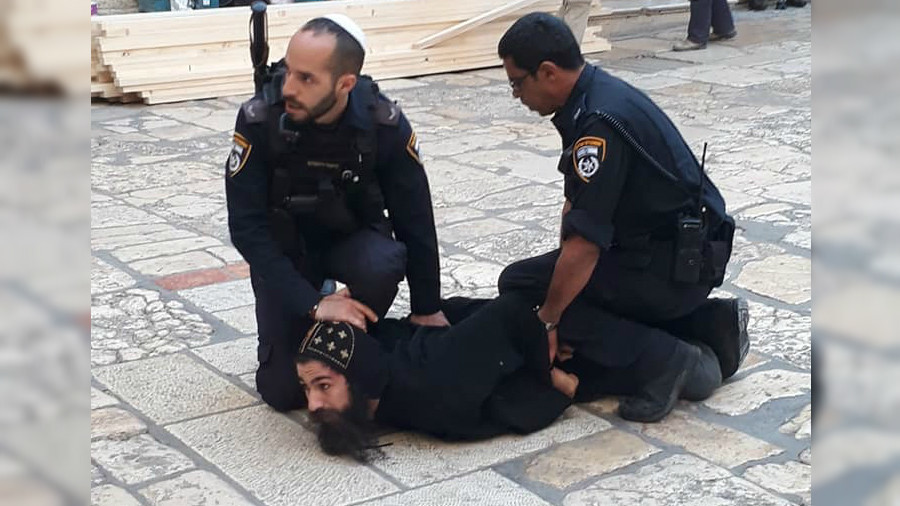
The arrest of Monk Macarius Orshalemy. © Coptic Orthodox Patriarchate Jerusalem
Ma’an – October 24, 2018
JERUSALEM – Israeli forces and police assaulted several Coptic Orthodox priests in front of the Church of the Holy Sepulchre, in the Old City of occupied East Jerusalem, and forcefully detained one of them on Wednesday morning.
Prior to the assault, the Coptic Orthodox Church organized a peaceful protest near Deir al-Sultan Monastery, located on the roof of the Church of the Holy Sepulchre, against an Israeli decision denying the church the right to conduct the needed renovation work inside the holy site.
It is noteworthy that the Israeli municipality of Jerusalem continues to conduct unauthorized renovation work for the Ethiopian Coptic Church section without the approval of the Coptic Orthodox Church.
Eyewitnesses said that Israeli soldiers and police officers surrounded the priests who were protesting, before assaulting and pushing them with excessive use of force, causing them several injuries.
Witnesses added that the Israeli police forcibly removed the priests and detained one of them, before allowing the Israeli municipality workers into the holy site.
The Islamic Christian Committee to Defend Jerusalem and Holy Sites condemned the assault on the Coptic Orthodox priests and denounced the intervention of Israeli authorities in the renovation works of the holy site.
The committee pointed out that it is not within its jurisdiction to intervene in issues of occupied East Jerusalem, considering the area is subjected to the rules of international humanitarian law (IHL).
The committee called upon the Egyptian government and the Christian world to immediately intervene to stop Israeli authorities from these attacks and not to enter the holy site under the pretext of restoration, since the Coptic Orthodox Church is the only authorized body to do so.
The committee also called on the world to stand by the Palestinian right to sovereignty over its land in the holy city and the rest of its other occupied territories, and to stop the measures carried out by the Israeli occupation in violation of the resolutions of international law and international humanitarian law.
Syria Update: Creeping Partition
By Peter Ford | October 23, 2018
The September crisis over Idlib was brought to a conclusion by the Russian Turkish agreement to create a partially demilitarised border strip. This should have been implemented by 16 October but hasn’t.
Idlib
Some armed groups have pulled back their heavy weapons from the 15-20 km wide 250 km long strip but others haven’t, while the groups internationally categorised as terrorist, including Hayat Tahrir Ash Sham (HTS), Hurras Ad Deen, and the Turkmenistan militia, have not vacated the area as the Turks promised. Russia was supposed to be allowed into the area to monitor but isn’t. In blatant violation of the ceasefire some of the groups are shelling neighbouring government-controlled areas including the outskirts of Aleppo and northern Lattakia.
The Turks claim all is well. The Russians, putting a brave face on a very unsatisfactory situation, call for patience. The reality appears to be that the Russians don’t think the Syrian government forces are strong enough to overcome the approximately 90,000 jihadi fighters in Idlib, many dug in in areas of difficult terrain, and all promised air cover by the US if Asad advances.
It has barely been noticed that the US has moved the goalposts on what it gives itself permission to do in Syria. The new US envoy for Syria, James Jeffrey, a former diplomat emerging from that neocon haven, the Washington Institute for the Near East Policy, stated explicitly recently that the US no longer felt itself bound to bomb Syria only if Asad used chemical weapons: henceforth the US would bomb ‘if Asad advances. Period’. (In such an eventuality it would be interesting to see how the British government went about following suit, although it is worth noting that its much contested legal opinion which was offered in April (attached) would startlingly licence the government to bomb under any circumstances whatever as long as it claimed to be acting for humanitarian reasons.)
Some claim that the standoff and emergence of an effectively separate entity in the North could force the Syrian government to make concessions at the negotiating table. This is wishful thinking. The Syrian government would never regard recovery of a lost province as a fair price for surrendering power. That being the case what we are witnessing appears to be the beginning of the emergence of a safe haven for terrorists under the guardianship of the Turks and the air umbrella of the Western powers: a replay of US/Saudi support for the Taliban in the days when removing the Russians from Afghanistan seemed like a good idea.
The North East
The dismemberment of Syria continues also in the North East (Al Hasakeh province and part of Deir Ez Zor province) which is under the joint control of the Kurdish-dominated SDF (Syrian Democratic Forces) and the US. Here too the US recently moved the goalposts virtually unnoticed, Secretary of Defence Mattis declaring that the purpose of the US forces’ presence was to combat Iran, which has no presence whatever in the North East. The US barely even pretends now that the purpose is to defeat the lingering remnants of ISIS, a task which the Syrian forces could handle easily if they were allowed to enter the parts of Deir Ez Zor and Hasakeh provinces where ISIS lurks effectively under US protection. The US plan appears to be to condition the withdrawal of the US presence on the withdrawal of that of the limited number of Iranian military advisers in Syria and of the rather larger number of Iranian–funded militia forces, considered essential to its security by the Syrian government. As many have pointed out this is a recipe for another open-ended US commitment to a military presence in the Middle East.
When the US-led coalition does move against ISIS remnants it is careless of civilian casualties: 62 civilians were killed this week in an air strike on two villages in Deir Ez Zor. This being the conveniently anonymous ‘coalition’ we have no way of knowing if the RAF was involved.
Hopes had been aroused that the US might pull out because of the costliness of propping up local civilian services, which for Trump is anathema. The arrival of 100 million dollars from Saudi Arabia in the Pentagon’s bank account last week (totally unconnected of course with the current predicament of Crown Prince Mohamed Bin Salman) may have upset the Turks, unhappy to see another Kurdish statelet emerging, but it has eased the financial burden of de facto US occupation.
Al Tanf
The US had given some hints that it might be willing to draw back from the Al Tanf enclave it controls with UK military support near the apex of the Syrian, Jordanian and Iraqi borders. Displaced persons started to go home from the jihadi-infested Rukban camp which lies within the Al Tanf perimeter. The Syrian government is offering to facilitate more returns but will not acquiesce in US control over sovereign Syrian territory. Hopes of US departure appear to have been dashed, however, as it becomes clearer that the new US strategy for Syria requires the US to keep all its assets in Syria, however vulnerable they would be in the event of major conflict, and however much they complicate the humanitarian situation, as potential bargaining chips to force the Syrian government to make concessions in terms of relinquishing Iranian military protection, preparatory to a reinvigorated Geneva negotiating process with a weakened Asad which would deliver the yearned for ‘transition’ away from him.
Return of refugees and reconstruction
With most territory clawed back and fighting now virtually on pause, the Syrian government is working hard to resettle the internally displaced and encourage the return of refugees. Syria’s enemies have discouraged return but many Syrians have voted with their feet: 50,000 have already returned from Lebanon in 2018. Much has been made by those enemies of Law 10 which required property owners to register their claims, an essential step before large scale reconstruction of heavily damaged districts could proceed and new housing be allocated. This was disingenuously portrayed as a land grab by the government. Reports suggest that registration has been put on hold.
Funds for reconstruction remain elusive. The Western powers continue to block any international development assistance as long as the holy grail of ‘transition’ has not been attained.
Meanwhile ordinary Syrians continue to groan under the handicaps of sanctions and government red tape.
Israel
Israel’s mis-step in causing the shooting down of a Russian plane has been heavily punished. Syria has now taken delivery of several Russian S-300 anti-aircraft systems, as well as aircraft communication jamming equipment. As a result Israel, which carried out over 200 air raids on Syria before the incident, has not carried out a single one since, possibly pending delivery by the US of more stealth fighter bombers. The US has categorised Russia’s delivery of the new (defensive) systems as ‘destabilising’ ….
Farewell Staffan de Mistura
The UN envoy for Syria, Staffan de Mistura, has announced his intention to step down in November, citing ‘personal reasons’. His great achievement in the eyes of Western powers was to keep the Geneva process alive when it was clearly moribund. Without Geneva they would lose the commitment to ‘transition’ which Russia conceded in a moment of great weakness in 2014. The Geneva process has been void of significance, however, for years. The besuited opposition representatives who attend the Geneva discussions are transparently stooges of the Western and Gulf powers and have absolutely no influence over the Islamist battalions, who have not the slightest interest in the refining of the constitution or sharing power and who listen only to Turkey, which controls their logistics. The only meaningful negotiation takes place between Turkey and Russia.
White Helmets
The government declined to answer Baroness Cox’s parliamentary question as to their plans for receiving White Helmets who fled Syria via Israel in July, citing the protection needs of this particularly ‘vulnerable’ category of refugee, only to leak details via the Daily Telegraph a few days later. It transpires that the country can look forward to receiving 28 of these ‘heroes’ with their families. Meanwhile a White Helmets local leader who remained behind, giving the lie to those who claimed they would all be rounded up, told a Western journalist that half of the evacuees were not White Helmets at all but jihadis masquerading as such.
Peter Ford was a British Ambassador to Syria; he is now an important, independent commentator on the dirty war.
Featured Video
Trita Parsi: Israel Set a Trap for Total War in the Region
or go to
Aletho News Archives – Video-Images
Book Review
Why the War on Conspiracy Theories Is Bad Public Policy
By Kevin Barrett • Unz Review • February 1, 2019
 A Review of Conspiracy Theories and Other Dangerous Ideas by Cass Sunstein (based on an earlier paper co-authored with Adrian Vermeule); In Defense of Troublemakers: The Power of Dissent in Life and Business by Charlan Nemeth; and Conspiracy Theories and the People Who Believe Them, edited by Joseph E. Uscinski
On January 25 2018 YouTube unleashed the latest salvo in the war on conspiracy theories, saying “we’ll begin reducing recommendations of borderline content and content that could misinform users in harmful ways—such as videos promoting a phony miracle cure for a serious illness, claiming the earth is flat, or making blatantly false claims about historic events like 9/11.”
At first glance that sounds reasonable. Nobody wants YouTube or anyone else to recommend bad information. And almost everyone agrees that phony miracle cures, flat earthism, and blatantly false claims about 9/11 and other historical events are undesirable.
But if we stop and seriously consider those words, we notice a couple of problems. First, the word “recommend” is not just misleading but mendacious. YouTube obviously doesn’t really recommend anything. When it says it does, it is lying. … continue
Blog Roll
 Aletho News
- Putin’s key remarks on peace talks and Europe’s ‘schizophrenia’
- Trita Parsi: Israel Set a Trap for Total War in the Region
- Trump’s Iran war is on an Israeli leash
- Saudi oil boss issues global supply warning
- Riyadh Says Its Oil System Is Intact. The Numbers Say Otherwise.
- Trump and Netanyahu Want to “Finish the Job” on Iran
- US ‘one-sided dictation’ not Iran’s beliefs makes rational talks impossible: Baghaei
- Iran’s Next Strike May Not Explode. It Could Shut You Down /Col Doug Macgregor
- Iran: US political targets legitimate if assassinations return
- Iraq shuts key border crossing with Iran under US pressure: Report
- If Americans Knew
- DAILY UPDATE: Latest essential news on Palestine, Israel, & region
- The Israel Lobby’s Changing Fortunes
- AIPAC has become such a political liability that it’s shifting to a more “nimble” approach to buying politicians
- At least 160 Israeli settler attacks in 2 weeks
- Will Gaza’s Ancient Christian Community Disappear Forever?
- Israel’s vision of regional security rests on keeping Arab states weak
- Heidi Levine recounts how Palestinian youths helped save her in settler attack
- DAILY UPDATE: Latest essential news on Palestine, Israel, & region
- Trump’s Intensifying Sabotage of the ICC, for Israel’s Sake
- Israeli military detain US and UK volunteers in West Bank including Democratic NY politician Brad Lander
- No Tricks Zone
- E-Cars Reduce CO2 Emissions By Only 41% Compared To Internal Combustion Engine Vehicles
- Predictions Made By Renowned Climate Professor Over Past Decades Have Been Proven To Be Poor
- New Study Suggests Large Regions Of The Pacific Ocean Have Been Cooling For The Last 80 Years
- Germany’s Green Energy Debacle: High Energy Costs Force Kahla Porzellan to Close After 182 Years!
- New Study: 50 Years Of The Most Aggressive ‘Net Zero’ Policies Can Only Affect The Global Climate By 0.03°C
- US September “Heat” Was No Record…Many Records Set Decades Ago
- Latest European Green Energy Debacle; Portugal’s Largest Flagship Solar Park Insolvent!
- Green Energy Debacle: German Expert Professor Fritz Vahrenholt Warns Of Severe Economic And Social Consequences
- Two More Paleo Reconstructions Affirm Meters-Higher Sea Levels Across Ireland, Brazil 7000-6000 Years Ago
- New Study: Earth And Venus Surface Warmth Largely Explained By Convection And Lapse Rate, Not CO2 Or Radiation

