No connection between Judaism and Al-Aqsa, suggests UN resolution

Muslims arrive at Al-Aqsa Mosque Compound to perform the Friday prayer in Jerusalem on 26 October 2018 [Mostafa Alkharouf/Anadolu Agency]
MEMO | December 3, 2018
The UN General Assembly has apparently rejected any connection between Judaism and the Noble Sanctuary of Al-Aqsa. In a vote held on Friday, the General Assembly passed six resolutions condemning Israeli violations against Palestinians. Among them was Resolution A/73/L.29 entitled “Jerusalem” which called for “respect for the historic status quo at the holy places of Jerusalem, including the Haram Al-Sharif.”
The use of the Arabic name for the sanctuary has been interpreted as a not-so-subtle rejection of the site’s alleged connection with Judaism. The Jewish name for the Noble Sanctuary, the Temple Mount, is not mentioned anywhere in the UN document.
The resolution received 148 votes in favour and just 11 against. It also stressed that the UN General Assembly,
“Reiterates its determination that any actions taken by Israel, the occupying Power, to impose its laws, jurisdiction and administration on the Holy City of Jerusalem are illegal and therefore null and void and have no validity whatsoever, and calls upon Israel to immediately cease all such illegal and unilateral measures.”
The Assembly passed several other resolutions on the question of Israel-Palestine this weekend. One — A/73/L.29 The Syrian Golan — rejected Israel’s occupation of the Golan Heights, “demand[ing] once more that Israel withdraw from all the occupied Syrian Golan to the line of 4 June 1967 in implementation of the relevant Security Council resolutions.”
The resolution also declared that “the Israeli decision of 14 December 1981 to impose its laws, jurisdiction and administration on the occupied Syrian Golan is null and void,” adding: “The continued [Israeli] occupation of the Syrian Golan and its de facto annexation constitute a stumbling block in the way of achieving a just, comprehensive and lasting peace in the region.”
The General Assembly resolutions were condemned vehemently in the Israeli media, with Breaking Israel News slamming them as evidence of the UN “[continuing] its streak of frequently condemning the Jewish state”. Other media cited NGO UN Watch — which is known for calling the UN anti-Israel or anti-Semitic – as saying that the “Jerusalem” resolution “implies that Israeli administration of Jerusalem hinders freedom of religion when in fact the opposite is true.” UN Watch also labelled the “Syrian Golan” resolution as being “oblivious to [the] genocidal massacres taking place now in Syria, and its security implications for Israel and the civilians of the Golan Heights.”
The resolutions, however, were hailed as a success by the Palestinian Authority, Wafa reported. “By voting in favour of the five resolutions,” said Palestine’s Permanent Observer to the UN, Riyad Mansour, “the international community affirms its support of our national cause, despite the efforts made by the US administration in international forums to resist this.”
In a rare move, following the General Assembly vote, the European Union publicly warned the Palestinians that they must drop their UN bid to use only Al-Haram Al-Sharif to refer to Jerusalem’s holiest site. In a statement, the EU “[stressed] the need for language on the holy sites of Jerusalem to reflect the importance and historical significance of the holy sites for the three monotheistic religions, and to respect religious and cultural sensitivities.” It added that the future choice of language “may affect the EU’s collective support for the resolutions.”
Commenting on the EU statement, the Jerusalem Post observed, “Until now, the EU has not taken a united stand on a drive by both the Arab states and the Palestinians to subtly change UN language with regard to the Temple Mount [Al-Haram Al-Sharif].” Its opposition or decision to abstain on any future resolutions of this nature “would mark a dramatic shift in its policy.”
READ ALSO:
Hamas hails Fatah’s criticism to US’ draft resolution condemning resistance at UN
Let’s talk about the lawsuit against Airbnb
By Kathryn Shihadah | Palestine Home | December 2, 2018
The global tourism company Airbnb decided this week to de-list properties it has offered for rent in Israeli settlements. Amnesty International has been pushing for Airbnb to make this move and praised it as “a stand against discrimination, displacement, and land theft.”
Ha’aretz reports that a group of American Jews now plan to sue Airbnb for religious discrimination.
Since the plaintiffs are Jewish, the lawsuit implies a charge of anti-Semitism – an accusation that has become more and more common lately.
A great deal of controversy has sprung up around the “Israel-centric” definition of anti-Semitism that essentially forbids even legitimate criticism of Israel.
This restrictive definition has even found its way into Congress as the (widely criticized) “Anti-Semitism Awareness Act” and similar bills in a number of states and even countries.
While America awaits Airbnb’s court date in Delaware, the court of public opinion is already in session. If we are going to judge this case, we’d better get familiar with the details. Drawing conclusions without understanding context would be irresponsible.
The charges
According to the lawsuit, Airbnb is in violation of the U.S. Fair Housing Act by discriminating on religious grounds.
Robert Tolchin, a lawyer for the plaintiffs, explained: “Airbnb has made a religion- and nationality-based decision…’We will not list for Jews in the West Bank.’” He elaborated, “It should be equal access for all.”
Some of the plaintiffs, among them Israeli-Americans, claim to own homes in West Bank settlements, and want to rent them out; others say they want to be future clients. All view Airbnb’s policy as “redlining” – targeting only Jewish-owned properties to be de-listed, while allowing Muslims and Christians in the West Bank to continue renting their homes.
They insist that this amounts to Airbnb taking sides in the dispute over the West Bank, where Palestinians hope to establish a state and which Israel captured in 1967, along with East Jerusalem and the Gaza Strip.
The plaintiffs are seeking an injunction against Airbnb to “block future discrimination against Jews and Israelis,” plus damages to cover lost rental income and legal fees.
Let’s talk about the charges.
Discrimination?
Tolchin claims that Airbnb’s decision to de-list settlement rental properties was “religion- and nationality-based,” and that Muslims’ and Christians’ homes are not subject to the policy. Among the West Bank population, only Jews are subject to the policy.
Airbnb insists that those specific properties – Jewish-owned homes in the West Bank – “contribute to human suffering.” Tolchin does not address this point in his statement, but it is an important part of the context.
The West Bank is part of occupied Palestinian Territory, not Israel. The land under question was confiscated from Palestinians and appropriated by Israelis. In violation of international law, Israel transferred some of its citizens into occupied territory to live on Jewish-only settlements.
To be clear, only Israeli Jews – not Israeli Christians or Israeli Muslims – live on these settlements. Airbnb’s “redlining” targeted not a religious group, but a body of people who live illegally on someone else’s land.
All Israeli Jews living on West Bank settlements – not just Airbnb hosts, but all 600,000 – live illegally on someone else’s land.
Hundreds of thousands of Palestinians have lost their homes, businesses, farms, and orchards due to settlements; settlers do indeed “contribute to human suffering.”
Christians and Muslims in the West Bank are not subject to the de-listing policy – not because Airbnb is showing religious preference, but because these groups are casualties of injustice, not perpetrators.
Equal opportunity?
The plaintiffs are either rental home hosts in settlements, or potential customers. Thanks to Airbnb’s new policy, it will not be possible to arrange rentals on their website.
Conversely, thanks to Israel’s policy, Palestinians have not been allowed to live in their homes or farm in their fields for over 50 years. Instead, they live as refugees.
Attorney Tolchin’s plea for “equal access for all” drips with irony, as the whole point of settlements is that they are Palestinian-free zones on Palestinian land. “Equal access” in this context means “all Jews are equally welcome, and non-Jews are equally unwelcome.”
Likewise the “damages” the plaintiffs seek – lost rental income – pale in comparison to the damages Palestinians experienced in the loss of their homes, the decades of lost income, and the casualties of justice, innocence, and hope.
Taking sides?
The other accusation Tolchin mentions is Airbnb’s sin of taking sides.
Airbnb had a moral obligation to take sides when it learned the facts. Airbnb did not choose to pick on Jews, but took action against oppression, knowing that to stay neutral would be to side with the oppressive regime.
The summation
The plaintiffs in the lawsuit against Airbnb are not able to substantiate the accusation of religious discrimination, since Airbnb’s policy is in reality based not on religion, but on international law and human suffering.
The allegation of unequal access is likewise feeble: no one has less access to the properties in question than the Palestinians who actually own the land.
As for the accusation that Airbnb has taken sides, that one is true – it is just not illegal or punishable. In fact, it is a moral imperative.
The verdict
The court of public opinion, having explored context, is now free to deliberate.
How do you find the defendant?
RELATED READING:
Action Alert: tell Booking.com to follow Airbnb in de-listing Israeli settlement properties
The humanitarian impact of Israeli settlements in Hebron city
Israeli settlers, with IDF complicity, have destroyed 800,000 olive trees since 1967
UN once again urges Israel to withdraw from entirety of Syria’s Golan Heights
Press TV – December 1, 2018
The majority of the United Nations General Assembly has adopted a resolution urging the Israeli regime to withdraw from the entirety of the Syrian Golan Heights it occupied some half a century ago.
The resolution, titled The Syrian Golan, was adopted by a record vote of 99 in favor, 10 against and 66 abstentions on a Friday session, declaring that the Israeli controversial move to extend its laws, jurisdiction and administration on the occupied mountainous plateau is null and void and calling on the Tel Aviv regime to pull out from the strategically-important territory.
In 1967, the Israeli regime waged a full-scale war against Arab territories, including those of Syria, and occupied a large swathe of Syria’s Golan Heights.
In 1973, another war, known as the Arab-Israeli War or the Yom Kippur War, broke out between the Israeli regime and a coalition of Arab states led by Egypt and Syria. A year later, a UN-brokered ceasefire came into force, according to which the Israeli regime and the Syrian government agreed to separate their troops, and create a buffer zone patrolled by the UN Disengagement and Observer Force (UNDOF).
In late 1981, Israel passed the Golan Heights Law that extended the regime’s “laws, jurisdiction and administration” to the Golan Heights, effectively annexing the territory to Israel.
A few days after the law’s passage in Israel’s Knesset, UN Security Council Resolution 497 determined the law as “null and void and without international legal effect.”
The assembly on Friday also denounced Israel’s non-compliance with the UNSC 1981 resolution.
The so-called Israeli law is not recognized by the international community.
“Israel continues to occupy a precious part of our land, and our people there continue to suffer because of this occupation,” said Syria’s permanent delegation at the world body, Munzer Munzer, adding, “We are the legitimate owners.”
He also stressed that Syria would not forfeit its right to its land and that its share of Golan Heights are non-negotiable.
The fact that most UN member states continue to support these resolutions shows that they are committed to the goals and purposes of the UN Charter, and that they reject foreign occupation and support Syria’s right to reclaim the entirety of its Israeli-occupied lands, Munzer added.
Back in July, the Israeli military said that it had deployed artillery and armored reinforcements to the occupied mountainous plateau, claiming that the move was the result of a situation assessment “in light of developments on the Syrian Golan Heights.”
Jewish Americans sue Airbnb over West Bank listing ban
MEMO | November 29, 2018
A group of Jewish Americans sued Airbnb Inc on Wednesday in US federal court, accusing the home rental company of religious discrimination over its decision last week to remove listings for about 200 homes in the Israeli-occupied West Bank, Reuters reports.
The 18 plaintiffs, including Israeli-American families and individuals who said they own or wish to rent affected homes, accused Airbnb of “redlining” Jewish-owned properties while letting Muslims and Christians rent their homes.
They said this effectively left Airbnb taking sides in the dispute over the West Bank, where Palestinians hope to establish an independent state and which Israel captured in 1967, along with East Jerusalem.
“We don’t believe this lawsuit will succeed in court, but we know that people will disagree with our decision and appreciate their perspective,” Airbnb said in a statement.
The complaint was filed in federal court in Delaware, where Airbnb is incorporated, and which the plaintiffs said has jurisdiction over the San Francisco-based company’s alleged violation of US laws against housing discrimination.
“Airbnb has made a religion- and nationality-based decision about who can list,” Robert Tolchin, a lawyer for the plaintiffs, said in an interview. “It decided in the United States, ‘We will not list for Jews in the West Bank.’ It should be equal access for all.”
The plaintiffs are seeking injunctive relief and unspecified damages, including for lost rental income.
A separate lawsuit challenging Airbnb’s policy was filed in a Jerusalem court on Nov. 22.
The Delaware case differed by claiming that “Airbnb is violating Americans’ rights, and this can’t be argued in an Israeli court under Israeli law,” Nitsana Darshan-Leitner, another lawyer for the plaintiffs, said in an interview.
Most world powers believe Israel’s settlements on occupied Palestinian land violate international law.
Roughly 500,000 Israelis live in settlements in the West Bank and East Jerusalem.
Airbnb’s delisting was announced on Nov. 19 and applies only in the West Bank, where Palestinians have limited self-rule under Israeli military occupation.
While concluding that “companies should not profit on lands where people have been displaced,” Airbnb said it had “deep respect” for the “many strong views” about what to do with disputed lands.
Palestinians in the West Bank have welcomed Airbnb’s decision.
The case is Silber et al v Airbnb Inc, US District Court, District of Delaware, No. 18-01884.
Hamas calls on UN to support Palestinians’ right to bear arms against Israel
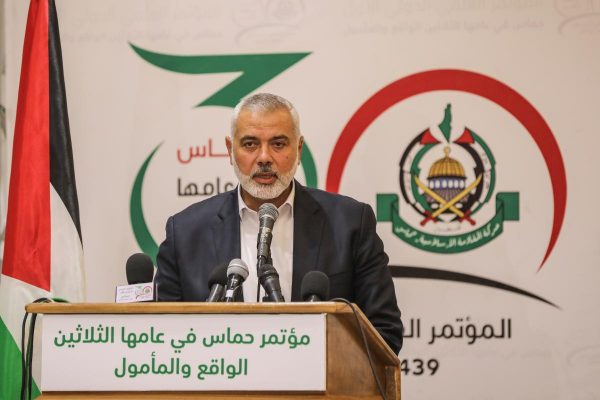
Head of the Political Bureau of Hamas Ismail Haniyeh makes a speech during a conference on 18 September, 2018 in Gaza City, Gaza [Ali Jadallah/Anadolu Agency]
MEMO | November 29, 2018
Hamas chief Ismail Haniyeh has called on the United Nations to recognise and support the Palestinian people’s right to bear arms against Israel in self-defence.
Haniyeh wrote to UN General Assembly (UNGA) President Maria Fernada Spinosa in advance of the organisation’s debate regarding Hamas rocket fire into Israel.
“We reiterate the right of our people to defend themselves and to resist the occupation, by all available means,” wrote Haniyeh, “including armed resistance, guaranteed by the international law.” He based the demand on international law drawn up and implemented by the UN, which gives states and peoples the right to defend themselves with arms if necessary, in the case of an external attack. “The General Assembly of the United Nations adopted dozens of resolutions that affirm the right of peoples to independence, self-determination and struggle by all available means, peaceful and non-peaceful, for that right. The UN singled out the Palestinian people for dozens of relevant resolutions, including 2621, 2649, 2787 and 3236,” he said.
After condemning the US for adopting Israel’s narrative of the conflict and justifying Israel’s aggression towards the Palestinians, Haniyeh insisted that “the last of these efforts is the attempt by the United States Ambassador to the United Nations… to submit a draft resolution condemning the Palestinian resistance and the right of our people to defend themselves against this racist and continuous occupation for more than seven decades.”
Israel’s Ambassador to the UN, Danny Danon, commented on Haniyeh’s letter, saying that Hamas “going to the UN for assistance is like a serial killer asking the police for assistance. Israel and the United States will continue to mobilize the countries of the world into a united front against the terrorism that Hamas engages in.”
The debate held in the UN today coincides with the International Day of Solidarity with the Palestinian People, which is held every year on 29 November. It comes two weeks after the latest Israeli assault on Gaza, which broke out after an undercover Israeli special forces operation in the strip was botched and compromised by Hamas. Days later, a ceasefire was declared, which was again broken by Israel the following morning when Israeli soldiers killed a Palestinian fisherman off the coast of Gaza.
READ: US lobbies for vote against Hamas at UN General Assembly
With Azov Sea Events Stealing Spotlight, US Gathers Huge Military Force in and Around Syria
By Arkady SAVITSKY | Strategic Culture Foundation | 29.11.2018
While the world attention is riveted to the situation in the Azov Sea and the relationship between Russia and Ukraine, US forces are getting prepared for a large-scale military operation in Syria.
US President Donald Trump announced this past March that the military personnel would be leaving Syria “very soon.” Looks like he has changed his mind since then. The five-ship strong Harry S. Truman Carrier Strike Group has recently entered the Mediterranean Sea. American, British, French and Israeli aircraft are conducting round the clock flights across Syria’s airspace under the pretext of holding an exercise. The US-led anti-ISIS coalition aircraft are constantly on patrol. French Dupuy de Lome intelligence gathering vessel is also there, coordinating its activities with the American ships.
The US Army has rushed another 500 Marines to the Al Tanf base straddling the borders of Syria, Jordan and Iraq. 1,700 members of the Syrian Democratic Forces (SDF), which operates under US command, have also moved to reinforce the garrison. There are over a dozen US military locations in northeastern Syria, including at least four air strips stretched from Manbij in the vicinity of the Turkish border to Al-Hasakeh, the hub of the pro-American Kurds-dominated SDF forces located in northern Syria.
US soldiers started to patrol the Syrian-Turkish border earlier this month. The move is seen as offering a kind of protection to Kurdish forces from Turkey, probably because their support would be crucial if shooting starts. Russia warned the US twice in September about possible consequences in case Syria starts an operation to free its territory from foreign troops but the warning fell on deaf ears.
According to the Washington Post, the US is preparing to strike Iran in Syria under the pretext of being a target of unprovoked attack.
There are other signs an operation is a possibility. “Russia has been permissive, in consultation with the Israelis, about Israeli strikes against Iranian targets inside Syria. We certainly hope that that permissive approach will continue,” James Jeffrey, Washington’s special representative to Syria said in early November. Back then, the ambassador noted that forcing Iran to leave Syria was an objective of Trump’s economic pressure campaign against the Islamic Republic. With the Islamic State reduced to insignificance and holding no territory to control, it would be a large order to find a legal pretext for a military action but the administration appears to be unfazed. With no threat to national security or strategic interests to justify getting embroiled in a conflict, it is adamant to stay.
The Arab nations, which are candidates for the “Arab NATO” membership, held a joint large-scale military exercise dubbed Arab Shield 1. It ended on Nov.16. The training event was seen as a preparation for a joint military operation. Tamer al-Shahawi, a member of the parliamentary National Defense and Security Committee and a former Egyptian military intelligence officer, said “There is close cooperation between the Gulf states, Egypt and Israel against Tehran. Arab countries are trying to benefit from any possible support against the Iranian influence.”
To increase the effect of sanctions, Iran should be separated from the Mediterranean Sea. The route across Iraq, Syria and Iran-friendly Lebanon should be made inaccessible. If Israel decides to strike what it calls Iranian targets, it would badly need US backing. Another reason to stay in Syria is making sure the nation would be divided in case the reconciliation and restoration process starts to gain momentum. Separating the SDF-controlled areas from the rest of the country is the only way to achieve it. Rebuilding rebel forces and controlling a vast chunk of land is the way to deny Syrian President Assad the international legitimacy he so desperately strives for. The ongoing American presence at Tanf and elsewhere demonstrates Washington has no intention to leave the Middle East as President Trump promised it would do. Neither would it pull out from Syria until a security situation in the region meets its goals.
The concentration of US military in the region is a worrisome sign. This huge force has gathered for something much more serious than just training. With the events in Europe grabbing public attention, the situation creep in Syria is staying under the radar. It shouldn’t be. Something is definitely being cooked up.
Turkey’s Hour of Reckoning in Syria
By Melkulangara BHADRAKUMAR | Strategic Culture Foundation | 29.11.2018
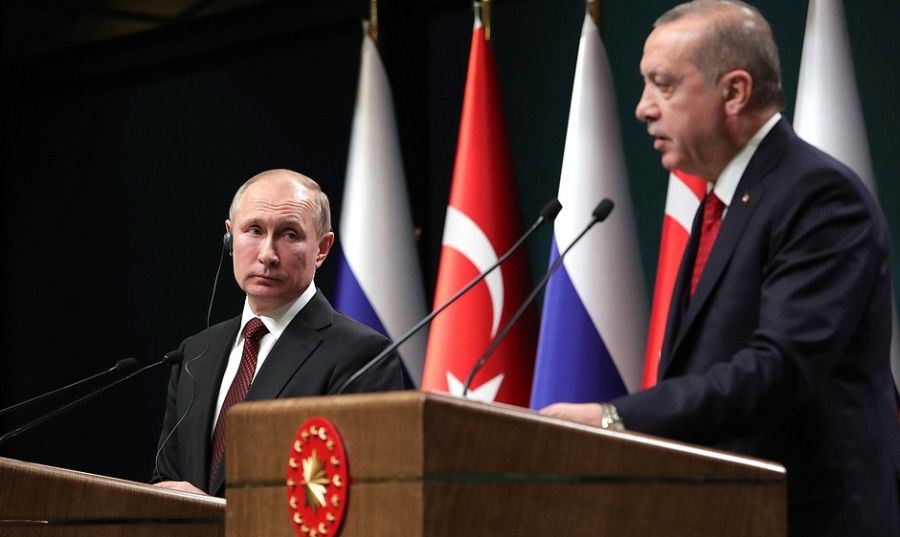
During a Pentagon briefing last weekend, Secretary of Defence James Mattis dropped a bombshell by innocuously slipping in that the US military intends to set up a string of observation posts on the Syrian-Turkish border. Mattis implied that Turkey was on board and that the idea was for the two militaries to jointly prevent any terrorist threats to the US’ NATO ally emanating out of Syrian territories.
Turkish officials immediately tore into Mattis’ project. Defence Minister Hulusi Akar disclosed that he had warned US Chairman of the Joint Chiefs of Staff Gen. Joseph Dunford only a week ago that the observation posts would have a “negative impact” and create the impression that “US soldiers are somehow protecting terrorist YPG (Syrian Kurdish) members and shielding them.”
The move would make an already complex situation “much more complex,” Akar added. He said, “Nobody should doubt that the Turkish armed forces and the Republic of Turkey will take the necessary steps against all kinds of risks and threats from across its borders.”
On Tuesday, President Recep Erdogan lashed out against the US troop presence in eastern Syria, charging that plans to establish observation posts along the Turkish border are meant to aid terrorist elements. “Those who say they are countering (ISIS) in Syria are in fact allowing a small group of terrorists to exist in the country to justify their presence in the war-torn country,” he said.
Erdogan alleged that the US is actually showing a preference to “live and breathe with the terrorists.” “The only target of this terror organization (YPG)… is our country,” he said. “It’s not possible for us to remain idle against this threat.”
Clearly, what is unfolding is a US game plan to block the Turkish military’s future operations in northern Syria against the Kurdish militia. Pentagon regards the YPG to be its most effective Syrian partner. Simply put, what we see here is the Syrian equivalent of what Washington did in 1991 in Iraq by imposing a “no-fly zone” over the Kurdistan region in the north.
The US is playing the long game. It is exactly three years since President Obama deployed 50 commandos to advise the Syrian Kurdish militia in their fight against the ISIS. Obama insisted it was “just an extension” of “special ops” that the US was running already. But the the numbers steadily kept increasing – from 50 to 250, from 250 to 500, and from 500 to 2000. The true figure today is around 5000 – and growing.
Seth Harp at the New Yorker magazine noted after a recent visit to the US bases in Syria, “the mission has morphed into something more like a conventional ground war. The United States has built a dozen or more bases from Manbij to Al-Hasakah, including four airfields, and American-backed forces now control all of Syria east of the Euphrates, an area about the size of Croatia.”
According to reports, there are presently 17 military bases in northeastern Syria. Yet, the US Congress has not authorized military action in Syria, nor has UN mandated the use of force. The Pentagon’s so-called Operation Inherent Resolve comes under the authority of the secretive Joint Special Operations Command, which means that “basic facts are kept classified, including the cost of the mission, the units involved, where they are located, and the number of wounded, which is believed to be substantial,” as Harp pointed out.
The intriguing part is about the US intentions. The stated purpose of the Operation Inherent Resolve is to defeat the ISIS, but lately it has shifted to countering Iranian presence in Syria. According to the US special representative for Syria engagement James F. Jeffrey, Trump has agreed to keep U.S. troops in Syria indefinitely. “We are not in a hurry,” he said.
Turkey’s worst fear may be coming true – a Syrian Kurdistan taking shape right along its border. Indeed, this becomes a template of the overall US strategy to encircle Turkey and Iran and to control Baghdad and Damascus – and eventually to make Russian presence in Syria untenable.
The US aims to put a knife into the heart of the Turkey-Russia-Iran axis in Syria by accentuating the contradictions in the region. The gloves have come off vis-à-vis Iran, Pentagon is now “defanging” Turkey and it remains to be seen how long the gloves will remain in place in the dealings with Russia.
In a candid interview with the Russia media on November 21, Special Representative for Syria Engagement Jeffrey sounded testy. He repeated that the deployment of S-300 missiles to Syria is a “dangerous escalation” – “we would urge the Russians to be very careful with this” – and assertively spoke of the new sanctions against Iran and Russia for oil shipments to Syria, while also rejecting offhand any talk of trade-offs with Russia over Iranian presence in Syria and debunking the Astana process. Jeffrey even reserved the US military’s right “to exercise our right of self-defense” if Russian forces on the ground came in the way. (Jeffrey disclosed that there have been military engagements with the Russians so far in “about a dozen times in one or another place in Syria.”)
Pentagon will press ahead with the establishment of observation posts on the Syrian-Turkish border despite Ankara’s objections. Turkey’s hour of reckoning is approaching. A few days ago, Turkish media reported that Saudi and UAE troops had deployed to northern Syria. In early November, the UAE reopened its embassy in Damascus.
The US and Israel are pressing Saudi Arabia and the UAE to fund the Syrian Kurdish militia and help create proximity between the Kurdish and Arab tribes inhabiting northeastern Syria with a view to create a unified Kurdish-Arab militia that becomes a Syrian bulwark against the two non-Arab regional powers Turkey and Iran.
To quote from a prominent Saudi commentator in the establishment daily Asharq Al-Awsat, “The Americans are now establishing Syrian Kurdish militias as a striking force against several parties and this revives the hopes of the Syrian opposition that it has an opportunity to resume its fighting activities after it has lost most of what it gained of villages and territories during the civil war.”
Both Saudis and Emiratis are once again at the US’s bidding in Syria. These Gulf States no longer hide their association with Israel. They are reciprocating the US-Israeli help to shove the Khashoggi affair under the rug.
Israeli Minister Urges US Governors to Punish Airbnb for Settlement Delistings
Sputnik – November 28, 2018
Israel’s Public Security Minister Gilad Erdan, who heads the government’s response to the Boycott, Divestment and Sanctions (BDS) movement, wrote a letter to five US governors asking them to take action against the home-renting service Airbnb after the company removed listings on its platform for properties in the illegally occupied West Bank.
Israeli listings in East Jerusalem and the Golan Heights, which are also illegally occupied, were left in place.
Erdan responded almost immediately to Airbnb’s decision by condemning it as “racist.”
“US law permits companies like Airbnb to engage in business in these territories,” the company said in a statement at the time. “At the same time, many in the global community have stated that companies should not do business here because they believe companies should not profit on lands where people have been displaced.”
“It is thanks to the hard work of activists in this coalition and around the world that Airbnb will no longer be profiting from Israeli apartheid in the West Bank,” Ariel Gold, national co-director of the anti-war group Codepink and pro-BDS activist, told Sputnik News following Airbnb’s announcement. “Israeli settlements are not only illegal under international law, but they contribute directly to the daily human rights abuses Palestinians face.”
Airbnb’s move came just one day before Human Rights Watch was scheduled to release a report on home rentals facilitated by Airbnb and Booking.com in the West Bank, which the UN considers to be illegally occupied by Israel.
Erdan called on former hosts on the platform to band together and sue Airbnb following the announcement of the company’s decision. He also promised to complain to senior officials in the US and ask them to check whether Airbnb’s move violates laws against boycotting Israel that “exist in over 25 states,” Sputnik News reported.
In Erdan’s letter to the governors of Illinois, New York, Florida, Missouri and California, he said Airbnb had adopted “the anti-Semitic practices and narrative of the boycott movement.” Of the five states the governors represent, four have laws against the BDS movement, the exception being Missouri. Airbnb is headquartered in California.
According to the Israeli TV news outlet Kan, Illinois Governor Bruce Rauner requested the state’s investment board to consider divesting from Airbnb, while Florida’s incoming Governor Ron DeSantis vowed to take similar action.
Erdan’s letter forebears a government-wide Israeli response to the de-listings from an inter-ministerial committee comprising officials from Erdan’s Strategic Affairs Ministry as well as the ministries for foreign affairs, tourism, justice, finance and economy.
While Israeli Tourism Minister Yariv Levin called last week for a “special and high tax” on Airbnb, such an action could wind up hurting the owners of the 22,000 Israeli homes that are allowed to continue renting on the platform, something officials would prefer to avoid.
Meanwhile, lawyers in Israel have already heeded Erdan’s call, filing a class action lawsuit against the company last Thursday on behalf of illegal West Bank settlers.
The Final Push for Idlib Will Come Soon
By Federico PIERACCINI | Strategic Culture Foundation | 23.11.2018
The situation in Syria is that of a frozen conflict, following the agreements made between Russia, Turkey and Syria on the demilitarized zone created around Idlib. Except for some sporadic terrorist attacks, the truce seems to be holding up over the last few weeks, even though it has become clear to everyone what the next step is for the province.
The Syrian Arab Army (SAA) has been busy eradicating Daesh in the southern part of Syria in recent weeks, concentrating its efforts on securing all areas that have been liberated from terrorist control but which still remain vulnerable to sporadic attacks, as occurred in Sweida at the end of July 2018. In that incident, there were dozens of victims and numerous abductees who remained in the hands of Daesh for months. This caused the Syrian population in neighbouring areas to clamor for protection, forcing the SAA to undertake an anti-terrorist campaign that has been ongoing since August.
This effort by the SAA has slowed down in part due to subsequent events, with an agreement reached between Erdogan and Putin to create a demilitarized zone in the province of Idlib. From October 15, an area spanning 20 kilometres and guarded by Turkish and Russian troops guarantees a separation between the SAA and terrorist groups in the province.
Russian and Syrian efforts have been moving in two very specific directions over the last few weeks. While Moscow supplies Damascus with new equipment in preparation for the future advance on Idlib, Putin and his entourage continue diplomatic efforts to draw more of Syria’s enemies closer to the Russia-Iran-Syria axis. The meeting that brought about the demilitarized zone included Macron and Merkel, the Europeans having evidently come to terms with the impossibility of overthrowing the legitimate government of Syria. Macron and Merkel were offered a way out of the Syrian conflict, decoupling themselves from the belligerent stance of the United States, Israel and Saudi Arabia. The intention is to usher Paris and Berlin towards the same direction Qatar, Turkey and Jordan have been progressively gravitating. Certainly, these are not countries to be considered friends of Damascus. Rather, they are parties with whom a constructive dialogue needs to be entered into in order to advance common diplomatic interests.
Moscow has often found it possible to reach an agreement or start unpublicized negotiations with each of these parties. Erdogan seems to have preferred an agreement with Putin rather than waiting for the liberation of Idlib by the SAA, thus being able to postpone the natural conclusion of the war that will find him sitting at the table defeated. At the same time, Erdogan wants to concentrate on the Kurds in order to secure the border between Syria and Turkey controlled by the Syrian Democratic Forces (SDF), and to prevent any partition of Syrian territory that would favor other parties. Jordan has even reopened the border crossings with Syria, appearing to be the first country in opposition to Damascus that is now taking practical steps to mend fences.
The case of the participation of the two European countries at the summit with Erdogan and Putin is more complex. The rift between Washington and the other European capitals is wide and well documented, even more so after the events in Paris commemorating the end of the First World War. Macron and Trump seem to be diverging further in terms of policy and ideology, while Trump and Merkel have always had their differences. Trump’s choices in the Middle East, in the wake of the destructive actions of Israel and Saudi Arabia, marked a profound point of difference and mistrust with the European allies. Macron and Merkel have a huge problem dealing with refugees flowing from areas in North Africa and the Middle East destroyed by US-led wars. The prospect of working with Erdogan, and indirectly with Damascus, to bring back hundreds of thousands of refugees currently in France and especially Germany, seems to have been Putin’s winning argument during the talks in Istanbul.
This slow diplomatic approach has been accelerated as a result of Israel’s downing of a Russian electronic-surveillance aircraft. The need to avoid a direct conflict between Moscow and Tel Aviv allowed the Russian missile forces to deploy to Syria an advanced model of the S-300 in addition to the existing S-300/400 systems on the ground. The presence of these advanced systems, and Moscow’s threats to use them, together with American concerns over the possibility of an F-35 being shot down by Soviet systems dating from the 1970s, forced the Zionist entity to halt its attacks on Syria.
This situation has helped to create a frozen conflict in the country. Together with the agreement of Idlib, this gives the SAA plenty of time to rest, regroup, and receive supplies needed for future campaigns.
The current truce is a strategic pause that has all the appearance of what has happened in the past in the provinces of Homs and Aleppo. The need to free Idlib from terrorists goes hand in hand with the promise of Assad and the government of Damascus to liberate every inch of Syria from terrorists. The diplomatic efforts of Moscow serve to prepare the ground for what will happen in the coming months, with the SAA set to advance on Idlib. In this sense, the deployment of advanced systems in Syria serves as a deterrent against possible responses from countries like Israel and the United States, anxious to defend their jihadists, but continuing to have minimal influence on the ground.
Russia and Syria’s moves therefore seem to be in preparation for the battle for Idlib, to be the longest and most difficult yet. The liberation of the province is inevitable but requires all the necessary political, diplomatic and military preparation in order to ensure success and limit potential escalation. As is often the case, Moscow and her allies approach complex issues with simple and pragmatic solutions, even offering exit strategies to their (geo)political opponents, which contrasts with their demonstrated tendency to rush heedlessly towards war.
Airbnb pledges to remove occupied West Bank settlement listings, Israel hits back
RT | November 20, 2018
Global home-rental company Airbnb says it will remove listings of homes located in Israeli settlements in the occupied West Bank. Israeli officials have predictably called the move anti-Semitic and a surrender to terrorism.
Human Rights Watch applauded Airbnb’s move, which came a day before the group’s publication of a (presumably damning) report on the human rights impact of tourist rental listings in settlements. Waleed Assraf, who runs an anti-settlement group for the Palestinian Liberation Organization, was hopeful other companies would follow Airbnb’s example, noting “this will contribute to achieving peace.”
Israeli Tourism Minister Yariv Levin called Airbnb’s move “discriminatory” and ordered his ministry to formulate a retaliatory plan to “limit the company’s activities” in Israel, adding that the country would back settlement listers’ lawsuits in both Israeli and US courts.
Michael Oren, former Israeli ambassador to the US and current deputy minister in PM Netanyahu’s office, called for a revenge boycott, deeming AirBnB’s policy “the very definition of anti-Semitism.” Settler council Yesha agreed that the company’s actions “can only be a result of anti-Semitism or surrendering to terrorism – or both.”
A statement on Airbnb’s website read “We concluded that we should remove listings in Israeli settlements in the occupied West Bank that are at the core of the dispute between Israelis and Palestinians,” explaining that their policy for contested territories like the West Bank, Tibet, and Western Sahara involves “evaluat[ing] whether the existence of listings is contributing to existing human suffering” and “determin[ing] whether the existence of listings in the occupied territory has a direct connection to the larger dispute in the region.” About 200 listings are affected, though they have not yet been taken down.
Palestinian official Saab Erekat wrote to Airbnb’s CEO in January 2016 asking the company to end its relationship with Israeli settlements, and Human Rights Watch called on all businesses to cut ties with companies operating in West Bank settlements in its “Occupation, Inc.,” report shortly thereafter, explaining that the income from such companies relieves the Israeli government of the economic burden of sustaining the illegal settlements. The international Boycott, Divestment and Sanctions movement has also called for travelers to avoid the home-rental service.
The Israeli settlements, constructed on land captured during the 1967 war, are illegal under international law, but Israel has long disputed this. Settlements have been gradually encroaching on Palestinian land ever since the end of the conflict, accompanied by a heavy military presence and the violence that accompanies it.
In first, US endorses Israeli occupation of Golan, votes against 9 anti-Israel resolutions

Press TV – November 16, 2018
The US has, for the first time, endorsed the Israeli occupation of the Golan Heights by voting against an annual UN resolution that condemned the occupation and was unanimously approved along with several other resolutions against Tel Aviv.
The resolution titled “The occupied Syrian Golan,” adopted on Friday with 151 votes in favor, two against (Israel and the US), and 14 abstentions, condemns Israel for “repressive measures” against Syrian citizens in the Golan Heights.
The resolution, which was adopted during the 73rd session of the UN General Assembly’s Special Political and Decolonization Committee (Fourth Committee), expresses deep concern that the Syrian Golan, occupied since 1967, has been under continued Israeli military occupation.
The non-binding annual resolution takes issue with the “illegality of the decision” taken by Israel “to impose its laws, jurisdiction and administration on the occupied Syrian Golan,” which is illegal under international law.
The US’ vote against the annual resolution signaled a dramatic shift in Washington’s policy toward the territory, as it used to abstain in previous cases. The administration of Donald Trump had announced its changed policy ahead of the vote.
“If this resolution ever made sense, it surely does not today. The resolution is plainly biased against Israel,” outgoing US Ambassador to the UN Nikki Haley said in a statement.
During the debate, Syrian envoy Bashar al-Jafari vowed that Damascus would recapture the heights by peace or by war.
Israel seized the Golan Heights from Syria during the 1967 Six-Day War and has continued to occupy two-thirds of the strategically-important territory ever since, in a move that has never been recognized by the international community.
The Tel Aviv regime has built dozens of illegal settlements in the area since its occupation and has used the region to carry out a number of military operations against the Syrian government
Tel Aviv has also been pressing the US administration under Israel-friendly President Trump to recognize its claim to sovereignty over the occupied territory in defiance of international law.
Syria has repeatedly reaffirmed its sovereignty over the Golan Heights, saying the territory must be completely restored to its control.
Eight other resolutions against Israel
The resolution on the occupied Syrian Golan was one of the nine separate resolutions which condemned the Israeli regime.
Through these resolutions, the UN reinforced the mandate of its Relief and Works Agency (UNRWA), and renewed the mandate of its “special committee to investigate Israeli practices affecting the human rights of the Palestinian people and other Arabs of the Occupied Territories.”
Other resolutions included “Palestine refugees’ properties and their revenues”, “Persons displaced as a result of the June 1967 and subsequent hostilities”, “Applicability of the Geneva Convention… to the Occupied Palestinian Territory…”, and “Operations of the United Nations Relief and Works Agency for Palestine Refugees in the Near East”.
The member states also unanimously voted for a resolution titled “Assistance to Palestine refugees”.
Apart from the US, which voted against all the nine resolutions, only a few member states – including Canada and Australia – cast nay votes. The majority of member states voted for the resolutions.
View the resolutions and voting results here: https://t.co/WlLL5EBZ4q
— UN Watch (@UNWatch) November 16, 2018
Featured Video

Trita Parsi: Israel Set a Trap for Total War in the Region
or go to
Aletho News Archives – Video-Images
Book Review
Why the War on Conspiracy Theories Is Bad Public Policy
By Kevin Barrett • Unz Review • February 1, 2019
 A Review of Conspiracy Theories and Other Dangerous Ideas by Cass Sunstein (based on an earlier paper co-authored with Adrian Vermeule); In Defense of Troublemakers: The Power of Dissent in Life and Business by Charlan Nemeth; and Conspiracy Theories and the People Who Believe Them, edited by Joseph E. Uscinski
On January 25 2018 YouTube unleashed the latest salvo in the war on conspiracy theories, saying “we’ll begin reducing recommendations of borderline content and content that could misinform users in harmful ways—such as videos promoting a phony miracle cure for a serious illness, claiming the earth is flat, or making blatantly false claims about historic events like 9/11.”
At first glance that sounds reasonable. Nobody wants YouTube or anyone else to recommend bad information. And almost everyone agrees that phony miracle cures, flat earthism, and blatantly false claims about 9/11 and other historical events are undesirable.
But if we stop and seriously consider those words, we notice a couple of problems. First, the word “recommend” is not just misleading but mendacious. YouTube obviously doesn’t really recommend anything. When it says it does, it is lying. … continue
Blog Roll
 Aletho News
- Putin’s key remarks on peace talks and Europe’s ‘schizophrenia’
- Trita Parsi: Israel Set a Trap for Total War in the Region
- Trump’s Iran war is on an Israeli leash
- Saudi oil boss issues global supply warning
- Riyadh Says Its Oil System Is Intact. The Numbers Say Otherwise.
- Trump and Netanyahu Want to “Finish the Job” on Iran
- US ‘one-sided dictation’ not Iran’s beliefs makes rational talks impossible: Baghaei
- Iran’s Next Strike May Not Explode. It Could Shut You Down /Col Doug Macgregor
- Iran: US political targets legitimate if assassinations return
- Iraq shuts key border crossing with Iran under US pressure: Report
- If Americans Knew
- DAILY UPDATE: Latest essential news on Palestine, Israel, & region
- The Israel Lobby’s Changing Fortunes
- AIPAC has become such a political liability that it’s shifting to a more “nimble” approach to buying politicians
- At least 160 Israeli settler attacks in 2 weeks
- Will Gaza’s Ancient Christian Community Disappear Forever?
- Israel’s vision of regional security rests on keeping Arab states weak
- Heidi Levine recounts how Palestinian youths helped save her in settler attack
- DAILY UPDATE: Latest essential news on Palestine, Israel, & region
- Trump’s Intensifying Sabotage of the ICC, for Israel’s Sake
- Israeli military detain US and UK volunteers in West Bank including Democratic NY politician Brad Lander
- No Tricks Zone
- E-Cars Reduce CO2 Emissions By Only 41% Compared To Internal Combustion Engine Vehicles
- Predictions Made By Renowned Climate Professor Over Past Decades Have Been Proven To Be Poor
- New Study Suggests Large Regions Of The Pacific Ocean Have Been Cooling For The Last 80 Years
- Germany’s Green Energy Debacle: High Energy Costs Force Kahla Porzellan to Close After 182 Years!
- New Study: 50 Years Of The Most Aggressive ‘Net Zero’ Policies Can Only Affect The Global Climate By 0.03°C
- US September “Heat” Was No Record…Many Records Set Decades Ago
- Latest European Green Energy Debacle; Portugal’s Largest Flagship Solar Park Insolvent!
- Green Energy Debacle: German Expert Professor Fritz Vahrenholt Warns Of Severe Economic And Social Consequences
- Two More Paleo Reconstructions Affirm Meters-Higher Sea Levels Across Ireland, Brazil 7000-6000 Years Ago
- New Study: Earth And Venus Surface Warmth Largely Explained By Convection And Lapse Rate, Not CO2 Or Radiation

